Stem-Changing –AR Verbs


   Let’s give them the boot!
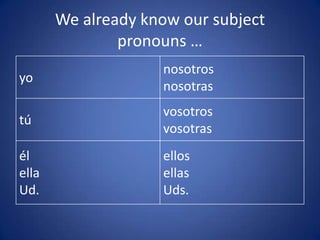
We already know our subject
               pronouns …
                    nosotros
yo
                    nosotras
                    vosotros
tú
                    vosotras
él                  ellos
ella                ellas
Ud.                 Uds.
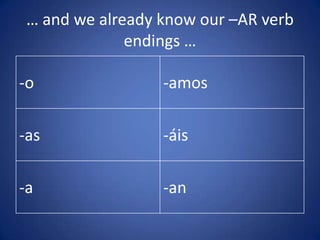
… and we already know our –AR verb
              endings …

-o                -amos

-as               -áis

-a                -an
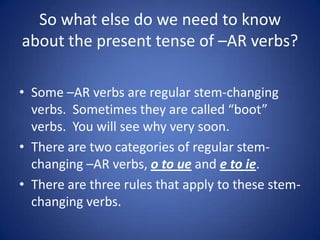
So what else do we need to know
about the present tense of –AR verbs?

• Some –AR verbs are regular stem-changing
  verbs. Sometimes they are called “boot”
  verbs. You will see why very soon.
• There are two categories of regular stem-
  changing –AR verbs, o to ue and e to ie.
• There are three rules that apply to these stem-
  changing verbs.
The Three Rules

1. The stem change occurs in all forms except
   nosotros and vosotros.
2. The stem change occurs in the syllable
   directly before the verb ending.
3. The verbs have regular endings in the present
   tense.
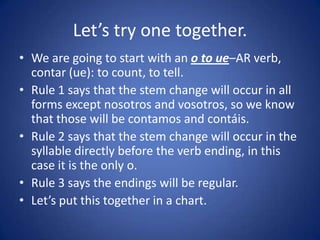
Let’s try one together.
• We are going to start with an o to ue–AR verb,
  contar (ue): to count, to tell.
• Rule 1 says that the stem change will occur in all
  forms except nosotros and vosotros, so we know
  that those will be contamos and contáis.
• Rule 2 says that the stem change will occur in the
  syllable directly before the verb ending, in this
  case it is the only o.
• Rule 3 says the endings will be regular.
• Let’s put this together in a chart.
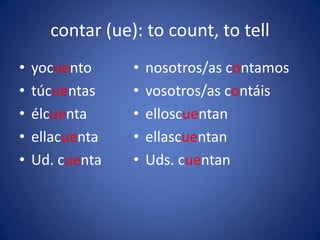
contar (ue): to count, to tell
•   yocuento     •   nosotros/as contamos
•   túcuentas    •   vosotros/as contáis
•   élcuenta     •   elloscuentan
•   ellacuenta   •   ellascuentan
•   Ud. cuenta   •   Uds. cuentan
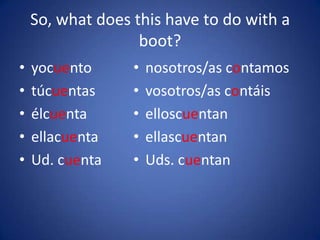
So, what does this have to do with a
                   boot?
•   yocuento      •   nosotros/as contamos
•   túcuentas     •   vosotros/as contáis
•   élcuenta      •   elloscuentan
•   ellacuenta    •   ellascuentan
•   Ud. cuenta    •   Uds. cuentan
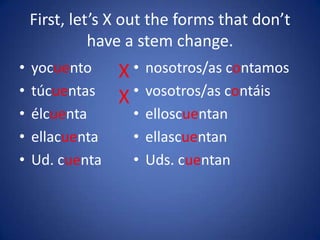
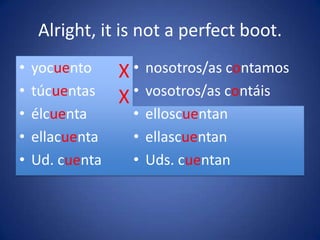
First, let’s X out the forms that don’t
              have a stem change.
•   yocuento     X • nosotros/as contamos
•   túcuentas    X • vosotros/as contáis
•   élcuenta       • elloscuentan
•   ellacuenta     • ellascuentan
•   Ud. cuenta     • Uds. cuentan
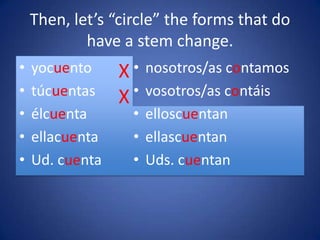
Then, let’s “circle” the forms that do
            have a stem change.
•   yocuento     X • nosotros/as contamos
•   túcuentas    X • vosotros/as contáis
•   élcuenta       • elloscuentan
•   ellacuenta     • ellascuentan
•   Ud. cuenta     • Uds. cuentan
Alright, it is not a perfect boot.
•   yocuento     X • nosotros/as contamos
•   túcuentas    X • vosotros/as contáis
•   élcuenta       • elloscuentan
•   ellacuenta     • ellascuentan
•   Ud. cuenta     • Uds. cuentan
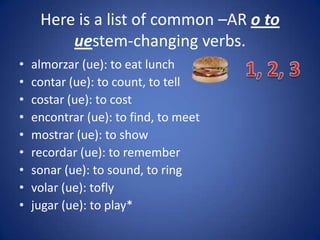
Here is a list of common –AR o to
         uestem-changing verbs.
•   almorzar (ue): to eat lunch
•   contar (ue): to count, to tell
•   costar (ue): to cost
•   encontrar (ue): to find, to meet
•   mostrar (ue): to show
•   recordar (ue): to remember
•   sonar (ue): to sound, to ring
•   volar (ue): tofly
•   jugar (ue): to play*
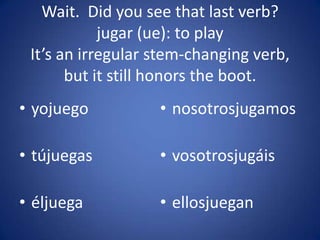
Wait. Did you see that last verb?
            jugar (ue): to play
 It’s an irregular stem-changing verb,
       but it still honors the boot.
• yojuego          • nosotrosjugamos

• tújuegas         • vosotrosjugáis

• éljuega          • ellosjuegan
Take note!!!
• If it’s in the boot, change the root!
• When stem-changing verbs are listed in a
  glossary, they will indicate the change. (ue)
  indicates the stem change of o to ue.
Let’s try another one together.
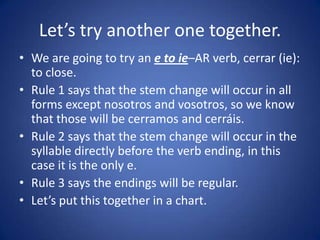
• We are going to try an e to ie–AR verb, cerrar (ie):
  to close.
• Rule 1 says that the stem change will occur in all
  forms except nosotros and vosotros, so we know
  that those will be cerramos and cerráis.
• Rule 2 says that the stem change will occur in the
  syllable directly before the verb ending, in this
  case it is the only e.
• Rule 3 says the endings will be regular.
• Let’s put this together in a chart.
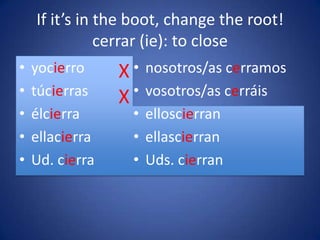
If it’s in the boot, change the root!
               cerrar (ie): to close
•   yocierro     X • nosotros/as cerramos
•   túcierras    X • vosotros/as cerráis
•   élcierra       • elloscierran
•   ellacierra     • ellascierran
•   Ud. cierra     • Uds. cierran
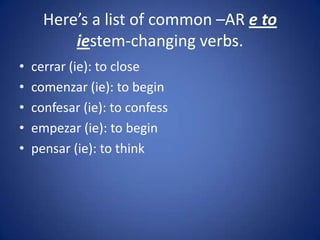
Here’s a list of common –AR e to
          iestem-changing verbs.
•   cerrar (ie): to close
•   comenzar (ie): to begin
•   confesar (ie): to confess
•   empezar (ie): to begin
•   pensar (ie): to think
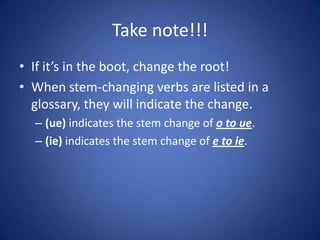
Take note!!!
• If it’s in the boot, change the root!
• When stem-changing verbs are listed in a
  glossary, they will indicate the change.
  – (ue) indicates the stem change of o to ue.
  – (ie) indicates the stem change of e to ie.
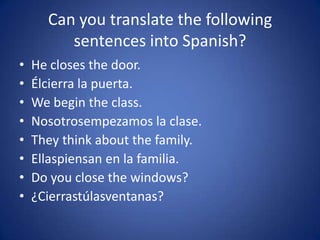
Can you translate the following
         sentences into Spanish?
•   He closes the door.
•   Élcierra la puerta.
•   We begin the class.
•   Nosotrosempezamos la clase.
•   They think about the family.
•   Ellaspiensan en la familia.
•   Do you close the windows?
•   ¿Cierrastúlasventanas?
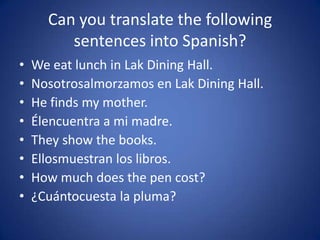
Can you translate the following
         sentences into Spanish?
•   We eat lunch in Lak Dining Hall.
•   Nosotrosalmorzamos en Lak Dining Hall.
•   He finds my mother.
•   Élencuentra a mi madre.
•   They show the books.
•   Ellosmuestran los libros.
•   How much does the pen cost?
•   ¿Cuántocuesta la pluma?
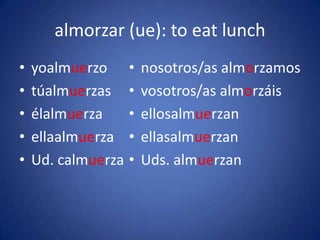
almorzar (ue): to eat lunch
•   yoalmuerzo •      nosotros/as almorzamos
•   túalmuerzas •     vosotros/as almorzáis
•   élalmuerza    •   ellosalmuerzan
•   ellaalmuerza •    ellasalmuerzan
•   Ud. calmuerza •   Uds. almuerzan

Intro to ar stem change verbs

  • 1.
    Stem-Changing –AR Verbs Let’s give them the boot!
  • 2.
    We already knowour subject pronouns … nosotros yo nosotras vosotros tú vosotras él ellos ella ellas Ud. Uds.
  • 3.
    … and wealready know our –AR verb endings … -o -amos -as -áis -a -an
  • 4.
    So what elsedo we need to know about the present tense of –AR verbs? • Some –AR verbs are regular stem-changing verbs. Sometimes they are called “boot” verbs. You will see why very soon. • There are two categories of regular stem- changing –AR verbs, o to ue and e to ie. • There are three rules that apply to these stem- changing verbs.
  • 5.
    The Three Rules 1.The stem change occurs in all forms except nosotros and vosotros. 2. The stem change occurs in the syllable directly before the verb ending. 3. The verbs have regular endings in the present tense.
  • 6.
    Let’s try onetogether. • We are going to start with an o to ue–AR verb, contar (ue): to count, to tell. • Rule 1 says that the stem change will occur in all forms except nosotros and vosotros, so we know that those will be contamos and contáis. • Rule 2 says that the stem change will occur in the syllable directly before the verb ending, in this case it is the only o. • Rule 3 says the endings will be regular. • Let’s put this together in a chart.
  • 7.
    contar (ue): tocount, to tell • yocuento • nosotros/as contamos • túcuentas • vosotros/as contáis • élcuenta • elloscuentan • ellacuenta • ellascuentan • Ud. cuenta • Uds. cuentan
  • 8.
    So, what doesthis have to do with a boot? • yocuento • nosotros/as contamos • túcuentas • vosotros/as contáis • élcuenta • elloscuentan • ellacuenta • ellascuentan • Ud. cuenta • Uds. cuentan
  • 9.
    First, let’s Xout the forms that don’t have a stem change. • yocuento X • nosotros/as contamos • túcuentas X • vosotros/as contáis • élcuenta • elloscuentan • ellacuenta • ellascuentan • Ud. cuenta • Uds. cuentan
  • 10.
    Then, let’s “circle”the forms that do have a stem change. • yocuento X • nosotros/as contamos • túcuentas X • vosotros/as contáis • élcuenta • elloscuentan • ellacuenta • ellascuentan • Ud. cuenta • Uds. cuentan
  • 11.
    Alright, it isnot a perfect boot. • yocuento X • nosotros/as contamos • túcuentas X • vosotros/as contáis • élcuenta • elloscuentan • ellacuenta • ellascuentan • Ud. cuenta • Uds. cuentan
  • 12.
    Here is alist of common –AR o to uestem-changing verbs. • almorzar (ue): to eat lunch • contar (ue): to count, to tell • costar (ue): to cost • encontrar (ue): to find, to meet • mostrar (ue): to show • recordar (ue): to remember • sonar (ue): to sound, to ring • volar (ue): tofly • jugar (ue): to play*
  • 13.
    Wait. Did yousee that last verb? jugar (ue): to play It’s an irregular stem-changing verb, but it still honors the boot. • yojuego • nosotrosjugamos • tújuegas • vosotrosjugáis • éljuega • ellosjuegan
  • 14.
    Take note!!! • Ifit’s in the boot, change the root! • When stem-changing verbs are listed in a glossary, they will indicate the change. (ue) indicates the stem change of o to ue.
  • 15.
    Let’s try anotherone together. • We are going to try an e to ie–AR verb, cerrar (ie): to close. • Rule 1 says that the stem change will occur in all forms except nosotros and vosotros, so we know that those will be cerramos and cerráis. • Rule 2 says that the stem change will occur in the syllable directly before the verb ending, in this case it is the only e. • Rule 3 says the endings will be regular. • Let’s put this together in a chart.
  • 16.
    If it’s inthe boot, change the root! cerrar (ie): to close • yocierro X • nosotros/as cerramos • túcierras X • vosotros/as cerráis • élcierra • elloscierran • ellacierra • ellascierran • Ud. cierra • Uds. cierran
  • 17.
    Here’s a listof common –AR e to iestem-changing verbs. • cerrar (ie): to close • comenzar (ie): to begin • confesar (ie): to confess • empezar (ie): to begin • pensar (ie): to think
  • 18.
    Take note!!! • Ifit’s in the boot, change the root! • When stem-changing verbs are listed in a glossary, they will indicate the change. – (ue) indicates the stem change of o to ue. – (ie) indicates the stem change of e to ie.
  • 19.
    Can you translatethe following sentences into Spanish? • He closes the door. • Élcierra la puerta. • We begin the class. • Nosotrosempezamos la clase. • They think about the family. • Ellaspiensan en la familia. • Do you close the windows? • ¿Cierrastúlasventanas?
  • 20.
    Can you translatethe following sentences into Spanish? • We eat lunch in Lak Dining Hall. • Nosotrosalmorzamos en Lak Dining Hall. • He finds my mother. • Élencuentra a mi madre. • They show the books. • Ellosmuestran los libros. • How much does the pen cost? • ¿Cuántocuesta la pluma?
  • 22.
    almorzar (ue): toeat lunch • yoalmuerzo • nosotros/as almorzamos • túalmuerzas • vosotros/as almorzáis • élalmuerza • ellosalmuerzan • ellaalmuerza • ellasalmuerzan • Ud. calmuerza • Uds. almuerzan