Intro to 8th grade
square dancing
MS. RIOS' PE CLASS
Dance focus: Rolling in My
Sweet Baby's Arms
Unit Content Standards
1.1 Identify and demonstrate square dance
steps, positions, and patterns set to music.
1.2 Create and perform a square dance.
3.4 Participate in moderate to vigorous
physical activity a minimum of four days each
week.
5.2 Organize and work cooperatively with a
group to achieve the goals of the group.
5.6 Describe leadership roles and
responsibilities in the context of team games
and activities.
5.7 Model support toward individuals of all
ability levels and encourage others to be
supportive and inclusive of all individuals.
Lecture Objectives
Learn background information about
square dancing.
Discuss the history and types of
square dancing.
Do-sa-do
Allemande Left
Grand Right and Left
Promenade Home
Analyze and learn basic square dancing
steps.
Educational Hook
In the next minute, write down
anything you know about square
dancing. If you cannot think of
anything, write down any questions
you may have about square dancing.
Add a little bit of body text
Square dance originated from England and France
Regarded as a social dance
Traditional Square Dance: Also commonly known as “Old time
square dance". Originated from New England and Appalachian
regions
Modern Western Dance: Derived from traditional square
dance, but grew more popular between the 1950s and 1980s.
The main difference between the two is that M.W.D.
allows the caller to randomize the calls, meaning they do
not have to follow predetermined calls.
We will be following traditional Square Dance format in our
class
Two Main Types of Square dancing in America:
About Square
Dancing
PARTICIPANTS
In square dancing, there
are 4 couples in a
group, or 8 people total.
MUSIC!
Common instruments in
square dancing music are
banjos, guitars, and the
fiddler. Songs can be
purely instrumental or
include singing. Banjo Guitar Fiddler
Characteristics of Square Dancing cont.
Characteristics of Square Dancing
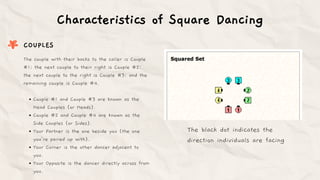
COUPLES
Couple #1 and Couple #3 are known as the
Head Couples (or Heads).
Couple #2 and Couple #4 are known as the
Side Couples (or Sides).
Your Partner is the one beside you (the one
you're paired up with).
Your Corner is the other dancer adjacent to
you.
Your Opposite is the dancer directly across from
you.
The couple with their backs to the caller is Couple
#1; the next couple to their right is Couple #2;
the next couple to the right is Couple #3; and the
remaining couple is Couple #4.
The black dot indicates the
direction individuals are facing
Dance Break!
Which couples are considered the "heads"
Which couples are considered the "sides"
What is the difference between your partner and your corner
Who is considered your opposite?
With the person next to you, identify the following:
Characteristics of Square Dancing cont.
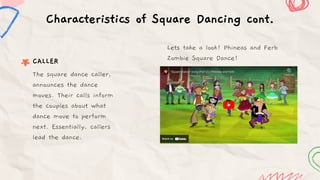
CALLER
The square dance caller,
announces the dance
moves. Their calls inform
the couples about what
dance move to perform
next. Essentially, callers
lead the dance.
Lets take a look! Phineas and Ferb
Zombie Square Dance!
Dance Break!
Differentiate between the role of the caller and
the role of the dancers. Explain the importance
of having a caller.
Call: Do-sa-do
Partners face one another and pass R shoulders, back to back and
L shoulders returning to their original positions.
Call: Allemande Left
Corners use a forearm grasp and walk in a
complete circle till they get back home. At
completion of an Allemande Left you are facing
your Partner, and somewhat back-to-back with
your Corner.
Call: Grand Right and Left
Right And Left Grand is like climbing a ladder. Give a right
pull by with your Partner, then a left pull by with the next,
then a right pull by with the next (your Opposite), then a
left pull by with the next (your Corner). Continue this until
each dancer is back with their original partner. It should be
a total of 4 hands (right, left, right, left).
Call: Promenade Home
In promenade position (partners stand side by side, joining R
hand to R hand and L hand to L hand with the R hand on
top). Walk counterclockwise, the lead will have his/her left
shoulder toward the center of the square, until the couples
are back in their starting or home spots.
Rolling in My Sweet Baby's Arms
Now let's see it in action!
Square Dancing
Putting it
all together Social dance
involving 8 people
String instruments
Caller that leads
the dance
2 main versions
of S.D.
Originated in
Europe
Music can have
singing
10 Minute Partner Activity
Do-sa-do
Allemande Left
Grand Right and Left
Promenade Home
Take out a piece of paper and describe the calls
we discussed today:
Sources:
https://www.ceder.net/def/class_notes.php
https://www.squareupfashions.com/blogs/news/history-of-square-dance-
what-is-square-dancing-and-how-did-it-start
https://www.masterclass.com/articles/square-dance-explained
https://www.pecentral.org/lessonideas/ViewLesson.asp?
ID=12201#.Y2hSOOzMJp-
http://www.dancefacts.net/dance-list/square-dance/

Intro to 8th Grade Square Dancing

  • 1.
    Intro to 8thgrade square dancing MS. RIOS' PE CLASS Dance focus: Rolling in My Sweet Baby's Arms
  • 2.
    Unit Content Standards 1.1Identify and demonstrate square dance steps, positions, and patterns set to music. 1.2 Create and perform a square dance. 3.4 Participate in moderate to vigorous physical activity a minimum of four days each week. 5.2 Organize and work cooperatively with a group to achieve the goals of the group. 5.6 Describe leadership roles and responsibilities in the context of team games and activities. 5.7 Model support toward individuals of all ability levels and encourage others to be supportive and inclusive of all individuals. Lecture Objectives Learn background information about square dancing. Discuss the history and types of square dancing. Do-sa-do Allemande Left Grand Right and Left Promenade Home Analyze and learn basic square dancing steps.
  • 3.
    Educational Hook In thenext minute, write down anything you know about square dancing. If you cannot think of anything, write down any questions you may have about square dancing.
  • 4.
    Add a littlebit of body text Square dance originated from England and France Regarded as a social dance Traditional Square Dance: Also commonly known as “Old time square dance". Originated from New England and Appalachian regions Modern Western Dance: Derived from traditional square dance, but grew more popular between the 1950s and 1980s. The main difference between the two is that M.W.D. allows the caller to randomize the calls, meaning they do not have to follow predetermined calls. We will be following traditional Square Dance format in our class Two Main Types of Square dancing in America: About Square Dancing
  • 5.
    PARTICIPANTS In square dancing,there are 4 couples in a group, or 8 people total. MUSIC! Common instruments in square dancing music are banjos, guitars, and the fiddler. Songs can be purely instrumental or include singing. Banjo Guitar Fiddler Characteristics of Square Dancing cont.
  • 6.
    Characteristics of SquareDancing COUPLES Couple #1 and Couple #3 are known as the Head Couples (or Heads). Couple #2 and Couple #4 are known as the Side Couples (or Sides). Your Partner is the one beside you (the one you're paired up with). Your Corner is the other dancer adjacent to you. Your Opposite is the dancer directly across from you. The couple with their backs to the caller is Couple #1; the next couple to their right is Couple #2; the next couple to the right is Couple #3; and the remaining couple is Couple #4. The black dot indicates the direction individuals are facing
  • 7.
    Dance Break! Which couplesare considered the "heads" Which couples are considered the "sides" What is the difference between your partner and your corner Who is considered your opposite? With the person next to you, identify the following:
  • 8.
    Characteristics of SquareDancing cont. CALLER The square dance caller, announces the dance moves. Their calls inform the couples about what dance move to perform next. Essentially, callers lead the dance. Lets take a look! Phineas and Ferb Zombie Square Dance!
  • 9.
    Dance Break! Differentiate betweenthe role of the caller and the role of the dancers. Explain the importance of having a caller.
  • 10.
    Call: Do-sa-do Partners faceone another and pass R shoulders, back to back and L shoulders returning to their original positions.
  • 11.
    Call: Allemande Left Cornersuse a forearm grasp and walk in a complete circle till they get back home. At completion of an Allemande Left you are facing your Partner, and somewhat back-to-back with your Corner.
  • 12.
    Call: Grand Rightand Left Right And Left Grand is like climbing a ladder. Give a right pull by with your Partner, then a left pull by with the next, then a right pull by with the next (your Opposite), then a left pull by with the next (your Corner). Continue this until each dancer is back with their original partner. It should be a total of 4 hands (right, left, right, left).
  • 13.
    Call: Promenade Home Inpromenade position (partners stand side by side, joining R hand to R hand and L hand to L hand with the R hand on top). Walk counterclockwise, the lead will have his/her left shoulder toward the center of the square, until the couples are back in their starting or home spots.
  • 14.
    Rolling in MySweet Baby's Arms Now let's see it in action!
  • 15.
    Square Dancing Putting it alltogether Social dance involving 8 people String instruments Caller that leads the dance 2 main versions of S.D. Originated in Europe Music can have singing
  • 16.
    10 Minute PartnerActivity Do-sa-do Allemande Left Grand Right and Left Promenade Home Take out a piece of paper and describe the calls we discussed today:
  • 17.