EBI is an Outstation of the European Molecular Biology Laboratory.
New InterPro website
Antony Quinn
A new website?
• Not quite!
• Re-design of well-used and established website =
CHALLENGING!
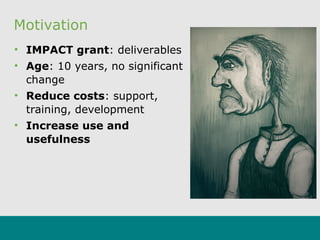
Motivation
• IMPACT grant: deliverables
• Age: 10 years, no significant
change
• Reduce costs: support,
training, development
• Increase use and
usefulness
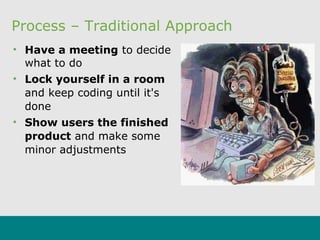
Process – Traditional Approach
• Have a meeting to decide
what to do
• Lock yourself in a room
and keep coding until it's
done
• Show users the finished
product and make some
minor adjustments
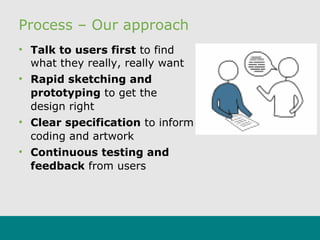
Process – Our approach
• Talk to users first to find
what they really, really want
• Rapid sketching and
prototyping to get the
design right
• Clear specification to inform
coding and artwork
• Continuous testing and
feedback from users
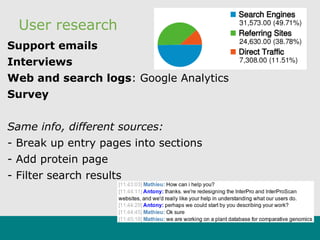
User research
Support emails
Interviews
Web and search logs: Google Analytics
Survey
Same info, different sources:
- Break up entry pages into sections
- Add protein page
- Filter search results
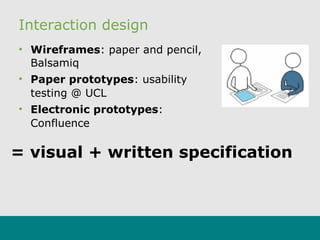
Interaction design
• Wireframes: paper and pencil,
Balsamiq
• Paper prototypes: usability
testing @ UCL
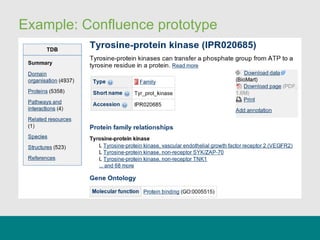
• Electronic prototypes:
Confluence
= visual + written specification
Example: Confluence prototype
Graphic and web design
• Visual identity: logo, colour palette
• Typography: Verdana
• Code: HTML, CSS, JavaScript
Development
• Need:
• Speed
• Reliability
• Scalability
• Technology:
• Java
• Oracle
Demo: Typical workflow
I want to get all the human sequences that
are members of the same protein
family as the protein I'm researching...
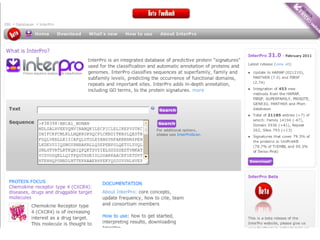
Demo: Sequence search
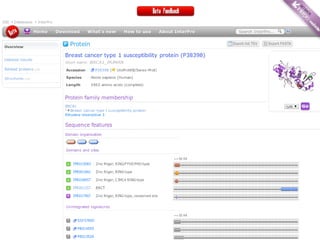
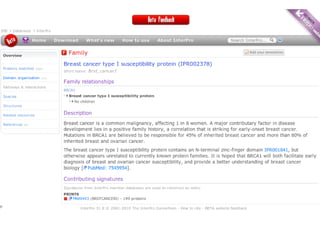
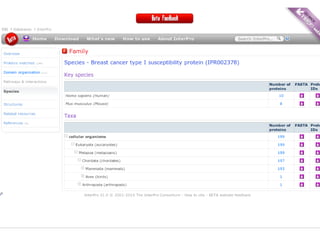
Demo: Protein page
The present
Beta website:
wwwdev.ebi.ac.uk/interpro
Send us your feedback:
The future
Release 13 April 2011
Search: bigger, better, faster, more
i5: new technology, same interface
On-going iterative process
What we learned along the way
• User research and usability testing help
resolve disagreements
• Rapid, iterative designs and prototypes help
reduce the costs and frustrations of
(re-)development
• Clear visual and written specifications reduce
ambiguity and uncertainty: “we know when we're
finished”
• We need to think about how this fits with
agile (scrum)
By the way...
Our approach is called:
User-Centred Design
Find out more from Jenny Cham, Francis
Rowland, Paula de Matos or me, and at:
http://ebiinterfaces.wordpress.com
Credits
InterPro team:
• Sebastien Pesseat: web design
• Matthew Fraser & David Binns:
web development
• Everyone else: input & advice
Images:
• 3. Flickr/Codger/Nathan Marciniak
• 5 & 7. UX Stencil © Todd Zazelenchuk &
Elizabeth Boling. Available from
http://www.userfocus.co.uk/uxstencil
• 10. Flickr/Speed skate/Flame Proof Productions
Thank you for listening

Bioinformatics UX Design: InterPro

  • 1.
    EBI is anOutstation of the European Molecular Biology Laboratory. New InterPro website Antony Quinn
  • 2.
    A new website? •Not quite! • Re-design of well-used and established website = CHALLENGING!
  • 3.
    Motivation • IMPACT grant:deliverables • Age: 10 years, no significant change • Reduce costs: support, training, development • Increase use and usefulness
  • 4.
    Process – TraditionalApproach • Have a meeting to decide what to do • Lock yourself in a room and keep coding until it's done • Show users the finished product and make some minor adjustments
  • 5.
    Process – Ourapproach • Talk to users first to find what they really, really want • Rapid sketching and prototyping to get the design right • Clear specification to inform coding and artwork • Continuous testing and feedback from users
  • 6.
    User research Support emails Interviews Weband search logs: Google Analytics Survey Same info, different sources: - Break up entry pages into sections - Add protein page - Filter search results
  • 7.
    Interaction design • Wireframes:paper and pencil, Balsamiq • Paper prototypes: usability testing @ UCL • Electronic prototypes: Confluence = visual + written specification
  • 8.
  • 9.
    Graphic and webdesign • Visual identity: logo, colour palette • Typography: Verdana • Code: HTML, CSS, JavaScript
  • 10.
    Development • Need: • Speed •Reliability • Scalability • Technology: • Java • Oracle
  • 11.
    Demo: Typical workflow Iwant to get all the human sequences that are members of the same protein family as the protein I'm researching...
  • 12.
  • 13.
  • 17.
  • 18.
    The future Release 13April 2011 Search: bigger, better, faster, more i5: new technology, same interface On-going iterative process
  • 19.
    What we learnedalong the way • User research and usability testing help resolve disagreements • Rapid, iterative designs and prototypes help reduce the costs and frustrations of (re-)development • Clear visual and written specifications reduce ambiguity and uncertainty: “we know when we're finished” • We need to think about how this fits with agile (scrum)
  • 20.
    By the way... Ourapproach is called: User-Centred Design Find out more from Jenny Cham, Francis Rowland, Paula de Matos or me, and at: http://ebiinterfaces.wordpress.com
  • 21.
    Credits InterPro team: • SebastienPesseat: web design • Matthew Fraser & David Binns: web development • Everyone else: input & advice Images: • 3. Flickr/Codger/Nathan Marciniak • 5 & 7. UX Stencil © Todd Zazelenchuk & Elizabeth Boling. Available from http://www.userfocus.co.uk/uxstencil • 10. Flickr/Speed skate/Flame Proof Productions Thank you for listening