1
A REPORT ON THE INTERNSHIP PROGRAMME
AT
123CAPITALS (SHARE BROKING)
Submitted to Loyola College (Autonomous), Chennai
In the partial Fulfilment of the requirement of the skill based course of the
Award of the Degree of
BACHELOR OF COMMERCE IN CORPORATE SECRETARYSHIP
BY
SHANMUGAPRIYAN.M
14-BC-018
Under the guidance of
PROF. Dr. I. EUCHARISTA FATIMA MARY, MBA., Ph.D.
Assistant Professor, Department of BBA & B.COM Corporate Secretaryship
SHIFT-II
MARCH– 2017
Department of BBA & B.COM Corporate Secretaryship
Loyola College, Chennai – 600 034
2
ACKNOWLEDGEMENT
It is my profound privilege to thank our Principal Rev. Dr. M.
Arockiyasamy Xavier, S.J and Deputy Principal Dr. Fatima Vasanth for
giving me an opportunity to undergo internship training, which helped me to
acquire practical knowledge.
I express my sincere thanks to the Co-Ordinator of the Department of
BBA and Corporate Secretaryship Ms. P. Sushama Rajan for allowing me to
undertake institutional training at 123CAPITALS and for their valuable support
in completion of this project.
I would like to thank my project mentor and guide Prof. Dr. I.
Eucharista Fatima Mary for encouraging and guiding me throughout my
program. Her experience and expertise has been a source of inspiration and
comfort as I have set out to begin my career.
SHANMUGAPRIYAN.M
14-BC-018
3
DECLARATION
I SHANMUGAPRIYAN.M, Dept. No: 14-BC-018,hereby declare that this
report of internship work done at 123CAPITALS is the Original work done by
me and submitted to the department of BBA & BCOM Corporate
Secretaryship, Loyola College, Chennai, in the partial fulfilment for the
award of B.Com (CorporateSecretaryship) degree under the guidance of Prof.
I. Eucharista Fatima Mary
INTERNAL GUIDE SHANMUGAPRIYAN.M
Prof. I. Eucharista Fatima Mary 14-BC-018
Date:06/03/2017
Place:Chennai
4
CONTENTS
Chapters Titles Page No.
I
II
III
INTRODUCTION
1.1 Overview of industry as a whole
1.2 Profile of the organisation
CONCEPTUALFRAMEWORK
2.0 List Of Concepts Learnt
2.1 Types of StockBrokers
2.2 Types of Transactions
2.3 Understanding the Four Measures of Volatility
2.4 Technical Analysis
2.5 Fundamental Analysis
2.6 Golden Rules for Trading in Stock Market
2.7 Settlement Cycle
2.8 StockExchange Charges
2.9 Demat A/C
2.10 Trading Account
WORK EXPERIENCE
3.1 Student’s Work Profile
3.2 Generation Of Leads
3.3 Analysis Of Calling
6
7
10
15
16
17
19
20
23
31
37
39
44
51
51
59
60
60
61
5
IV
V
3.4 Interpretation Of Data
3.5 Self Trading Account
3.6 My Portfolio
3.7 Work At 123CAPITALS
SKILLS ACQUIRED
4.1 Interpersonal Skills
4.2 Technical Skills
SUGGESTIONS& CONCLUSION
5.1 Positive Things About Internship Programme
5.2 Limitations And Suggestions
5.3 Conclusion
BIBLIOGRAPHY
62
63
68
68
71
72
77
75
76
76
78
79
6
CHAPTER -I
7
1.1 Overview of Industry as a Whole
1.1.1 STOCKEXCHANGE
A stock exchange, share market or bourse is a corporation or mutual organization which
provides facilities for stock brokers and traders, to trade company stocks and other securities.
Stock exchanges also provide facilities for the issue and redemption of securities, as well as,
other financial instruments and capital events including the payment of income and
dividends. The securities traded on a stock exchange include: shares issued by companies,
unit trusts and other pooled investment products and bonds. To be able to trade a security
on a certain stock exchange, it has to be listed there.
NSE
The National Stock Exchange of India Limited (NSE) is a Mumbai-based stock exchange.
It is the largest stock exchange in India and the third largest in the world in terms of volume
of transactions. NSE is mutually-owned by a set of leading financial institutions, banks,
insurance companies and other financial intermediaries in India but its ownership and
management operate as separate entities. NSE has a market capitalization of around US$1
trillion and over 1,652 listings as of July 2015.
NSE Mission
NSE’s mission is setting the agenda for change in the securities markets in India. The NSE
was set-up with the main objectives of:
Establishing a nation-wide trading facility for equities, debt instruments and hybrids,
8
Providing a fair, efficient and transparent securities market to investors using
electronic trading systems,
The standards set by NSE in terms of market practices and technology have become industry
benchmarks and are being emulated by other market participants. NSE is more than a mere
market facilitator. It's that force which is guiding the industry towards new horizons and
greater opportunities.
BSE
The Bombay Stock Exchange (or BSE) is the oldest stock exchange in Asia. It is located at
Dalal Street, Mumbai, India.
The Bombay Stock Exchange was established in 1875. There are around 5000+ Indian
companies listed with the stock exchange, and have a significant trading volume. The
companies listed on BSE Ltd command a total market capitalization of US$ 1.43 trillion (Mar.
2016). The BSE SENSEX (Sensitive index), also called the "BSE 30", is a widely used
market index in India and Asia. It is also one of the world’s leading exchanges (3rd largest
in December 2015) for Index options trading.
1.1.2 PRIMARYMARKET
The primary is that part of the capital markets that deals with the issuance of new securities.
Companies, governments or public sector institutions can obtain funding through the sale of
a new stock or bond issue. This is typically done through a syndicate of securities dealers.
The process of selling new issues to investors is called underwriting. In the case of a new
9
stock issue, this sale is an initial public offering (IPO). Dealers earn a commission that is
built into the price of the security offering, though it can be found in the prospectus.
This is the market for new long term capital. The primary market is the market where the
securities are sold for the first time. Therefore it is also called New Issue Market (NIM).
Primary issues are used by companies for the purpose of setting up new business or for
expanding or modernizing the existing business.
1.1.3 SECONDARYMARKET
The secondary market is the financial market for trading of securities that have already been
issued in an initial private or public offering. Alternatively, secondary market can refer to
the market for any kind of used goods. The market that exists in a new security just after the
new issue is often referred to as the aftermarket. Once a newly issued stock is listed on a
stock exchange, investors and speculators can easily trade on the exchange, as market
makers provide bids and offers in the new stock.
DEMAT A/C
Demat a/c is just like a saving a/c. In saving a/c we save our money and in demat we deal in
share market. Demat is dematerialization and trading in the demat mode. It is safer and faster
alternative to the physical existence of securities. Demat as a parallel solution offers from
delays, thefts, forgeries, settlement risk and paper work. This system works through
depository participants (DP) who offer demat services and the securities are held in the
electronic form for the investor directly by the depository.
TRADING A/C
A trading account is an account used to place buy or sell orders in the stock market.
10
1.2 PROFILE OF THE ORGANISATION
1.2.1 ABOUT COMPANY
123 CAPITALS is one of India’s emerging diversified financial services groups. 123
offers an integrated suite of financial services initially with Broking. 123 CAPITALS is
headquartered in Coimbatore providing Equity, Derivative and Currency derivative trading
through NSE ,BSE and registered its DP services with IL&FS in NSDL and also gives
commodity trading on MCX through its subsidiary group 123 COMMODITIES. It is
headed by Mr.Chakkaravarty who has a vast knowledge about stock and securities market.
He began to trade at the age of 16 and he continues to do so till date successfully.
1.2.2 LOGO
1.2.3 VISION
“To be commercially competitive, future oriented, Unique, creative & socially
responsible.”
1.2.4 MISSION
11
“Bringing simplicity in financial transactions with our unique strategies with consistently
enhancing technology in financial products and services.”
1.2.5 BRANDING
123 is their pricing strategy which is a surprised brokerage in the industry which plays a vital
role in the growth and wealth of a portfolio. Our brand and logo also represents the same in a
pictorial way.
The numerical value number 1 represent surprised with! (Apostrophe),
The numerical value number 2 represents growth with upward arrow from numeric 2,
The numerical value number 3 represents wealth with the similarity of numeric 3 and
alphabet W.
Capitals means wealth in the form of money or other assets owned by a person or
organization or available for a purpose such as starting a company or investing.
1.2.6 SERVICESOFFERED
123capitals offers its customers a wide range of equity related services including trade
execution on BSE, NSE, Derivatives, depository services, online trading, investment advice
etc.’
1.2.7 PRICING
123 CAPITALS pricing is very innovative and unique and the 1st group in India to come
with such a pricing strategy, with richest quality which benefits the ultimate customer’s
and its partner’s.
We are committed to the service of our customers and the need to continually improve the
quality and reliability of all products and services which we provide.
12
1.2.8 ADVANTAGES
Breaking % (percentage) and order wise brokerage models.
• No upfront fee or turnover commitment
• No special penny stock brokerage or minimum contract charges
• Brokerage calculator to help you calculate all costs upfront
Desktop, web, and mobile trading platforms.
Get integrated trading platform for Equities, Commodities, Derivatives and Currencies.
Delivery trades can be done in unlimited volumes.
1.2.9 SEBIREGISTRATION
SEBI REGNO: 123 CAPITALS: NSE CM/F&O/CDS – INZ230001026, BSE
CM/F&O/CDS – INZ010000826. NSE MEMBER CODE- 90001, BSE MEMBER CODE
– 6545
SEBI REGNO: 123 COMMODITIES: MCX- INZ000077021 FMC CODE -
MCX/TM/PART/2049, MCX MEMBER -ID: 46585, COMMODITIES IS OFFERED
THROUGH 123 COMMODITIES WHICH IS A GROUP FIRM OF 123 CAPITALS
1.2.10 CORPORATE OFFICE ADDRESS
No.112, E4, ELDORADA Building
Nungambakkam High Road,
Chennai-600034.
13
Tamil Nadu.
INDIA.
044-450041230
1.2.11 PROFILE OF WORK GUIDE
Name: Mr.Chakkaravarthy
Email: chakkaravarthy@123capitals.in
Career Profile
-Enthusiastic professional with more than twelve years of experience in matters related to
finance.
-Experience of working in online brokerage industry.
-Expertise in financial and stock market trading business.
-Knowledge of International stock purchase and equity plan design.
-Well verse with securities processing and financial markets.
-Experience of using Equity Edge, FAS123R and stock administration software’s.
Key Skills
-Excellent in Market Research.
-Excellent understanding of the organizational structure and its development needs.
-Excellent ability of understanding and analysing complex information.
-Strong knowledge stock market and excellent predicting skills.
Personality Traits
-Excellent verbal and writing skills.
-Excellent problem solving skills.
14
-Strong analytical and interpersonal skills.
-Ability to handle pressurized situations.
Achievements
-Recognized for Best Analytical Thought in BSE 20**.
-Participated in inter College Chess Championship.
Academic Qualifications
M.Com from PSG arts with First Class
B.Com (Accounts) from PSG arts with First Class
15
16
2.0 LIST OF CONCEPTS LEARNT
1. NSE
2. BSE
3. IPO
4. DIVIDEND
5. MARKET CAPITALISATION
6. INSIDER TRADING
7. SHORT SELLING
8. INTRADAY TRADING
9. BULL AND BEAR MARKRT
10. MARKET VOLATALITY
11. MARKETING
12. MARGIN TRADING
13. MAHURAT TRADING
14. PRIMARY MARKET
15. SECONDARY MARKET
16. BROKERAGE
17. SECURITIES SERVICE TAX
18. PORTFOLIO
19. TARGET
20. STOP LOSS
21. DERIVATIVES
22. COMMODITY MARKET
23. STOCK EXCHANGES
24. BROKERS AND SUB-BROKERS
25. SEBI
26. TRADING ACCOUNT
27. DEMAT ACCOUNT
28. DEPOSITARY PARTICIPANT
29. MOBILE TRADING
30. DISCOUNT BROKERS
31. SENSEX
17
32. NIFTY
33. EPS
34. FACE VALUE
35. L/U PRICE BAND
36. CESS
37. PE RATIO
38. VOLUME
39. TRADING HOURS
40. HISTORICAL STOCK PRICES
41. NDSL
42. CDSL
2.1 TYPES OF STOCK BROKERS
Full-Service Brokers
These firms charge higher commissions or a percentage of assets. They offer the largest
assortment of diversified financial services and usually assign a licensed individual broker to
each client. These firms tend to have their own investment banking and research departments
that provide their own analyst recommendations, products and access to initial public
offerings (IPOs). Clients have the option of calling their personal broker directly to place
trades or use various other platforms including online and mobile. Full-service brokers have
physical offices and locations. They also offer financial planning, asset management and
banking services. In addition to savings and checking accounts many full service brokers
provide personal, business and home loans services. While most full-service brokers provide
online access and trading functions, they tend to charge higher commissions and route orders
directly to their own market makers or through order-fill agreements with other firms. Full-
service broker online platforms tend to have less day trading tools and indicators as they cater
more towards long-term investors.
18
DiscountBrokers
Discount brokers have narrowed the gap with full-service brokers in terms of financial
products and services providing independent research, mutual fund access and basic banking
products. As the name says, discount brokers have smaller commissions for trades. Usually
the commissions will range for Rs 1 to Rs 20 per trade ticket, which may appeal to swing
traders and less active day traders. The platforms tend to have more trading and research tools
than the full-service brokers since they cater to active investors and day traders. Many of the
larger discount brokers provide their own direct-access trading platforms and physical office
locations throughout the country.
Online Brokers
Online brokers also known as direct-access brokers cater to active day trading clients with the
smallest commissions often priced on a per-share basis, which is needed when scaling in and
out of positions. These firms provide direct-access platforms with charting and routing
capabilities with access to electronic communication networks (ECN), market makers,
specialists, dark pools and multiple exchanges. Speed and access are the top benefits of
direct-access brokers, often allowing for point-and-click executions and programmable hot-
keys. Complex stock and options orders can be placed on these platforms. The heavy-duty
platforms often carry a monthly fee composed of software fees and exchange fees. The
software fees can usually be waived or discounted based on the client’s monthly
trading volume. Active day traders are best advised to use reputable online/direct-access
brokers to ensure maximum control and flexibility as well as speedy order fills. To keep
overhead low and pass on the cheaper rates, online brokers usually don’t provide physical
office locations for customers.
19
2.2 TYPES OF TRANSACTIONS
DELIVERY TRADING
A Delivery trade happens when a trader buys or sell shares & does not square off the position
on the same day. These transactions are settled as per the T+2 settlement cycles of the
exchanges i.e. Shares bought/sold on Monday are sold on Wednesday and so on and so forth.
Note: In India, positional short selling is not allowed in the Cash Market. Hence in order to
sell shares, a trader/investor has to own them first.
Traditional brokers charge a higher Brokerage when Investors transact in the delivery trades
with brokerage running as high as 0.6% or Rs.600 per Lakh.
INTRADAY TRADING
Taking entry & exits of any financial instrument such as equities, futures, options on same
day is intraday trading. Day traders close all their positions before the close of the market.
One advantage of trading over investing is, traders can be active both sides of the market,
meaning they short first and can buy back later to close the potion.
Most brokers provide a lot of leverage or margin for intraday trading, meaning brokers lets
you take
10 to 20 times position than actual amount you have in your account. If you have about Rs.
50000 in your account, your broker lets you take Rs. 500000 to Rs. 1000000 position. Due to
the large margin funding many traders take far bigger positions than they should be & most
novice traders end up blowing up their account within few months.
20
Fundamentals of a company do not change on a daily basis, so most day traders take their
entries based on Technical Analysis. Some do take trades based on news & rumours
2.3 UNDERSTANDING THE FOUR MEASURES OF VOLATILITY
"Volatility" is a term that is increasingly interjected into financial market commentary by the
press and professionals. In fact, Bloomberg Radio has a daily "Volatility Report." While the
term is being thrown around with a seemingly high degree of expertise, I find that the concept
is not well understood by most commentators and the average investor.
Historical volatility;
Implied volatility;
The volatility index; and
Intraday volatility.
Type 1: Historical Volatility
Volatility in its most basic form represents daily changes in stock prices. We call this
historical volatility (or historic volatility) and it is the starting point for understanding
volatility in the greater sense. Historic volatility is the standard deviation of the change in
price of a stock or other financial instrument relative to its historic price over a period of
time. That sounds quite eloquent but for the average investor who does not command an
intimate knowledge of statistics, the definition is most overwhelming.
Think of a Pendulum
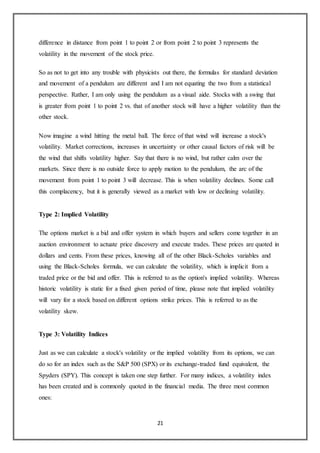
To help you visualize the concept of volatility, think of a pendulum like in the picture below.
The pendulum is constructed from a steel ball, attached to a rope and then suspended from a
ceiling.
The pendulum starts at the resting state when our ball is at point 2 (the mean). If you raise the
ball to point 1 and let it go, the ball would then swing from point 1 to point 3. Over time that
ball will swing back and forth always passing though point 2. If this were a stock, the
21
difference in distance from point 1 to point 2 or from point 2 to point 3 represents the
volatility in the movement of the stock price.
So as not to get into any trouble with physicists out there, the formulas for standard deviation
and movement of a pendulum are different and I am not equating the two from a statistical
perspective. Rather, I am only using the pendulum as a visual aide. Stocks with a swing that
is greater from point 1 to point 2 vs. that of another stock will have a higher volatility than the
other stock.
Now imagine a wind hitting the metal ball. The force of that wind will increase a stock's
volatility. Market corrections, increases in uncertainty or other causal factors of risk will be
the wind that shifts volatility higher. Say that there is no wind, but rather calm over the
markets. Since there is no outside force to apply motion to the pendulum, the arc of the
movement from point 1 to point 3 will decrease. This is when volatility declines. Some call
this complacency, but it is generally viewed as a market with low or declining volatility.
Type 2: Implied Volatility
The options market is a bid and offer system in which buyers and sellers come together in an
auction environment to actuate price discovery and execute trades. These prices are quoted in
dollars and cents. From these prices, knowing all of the other Black-Scholes variables and
using the Black-Scholes formula, we can calculate the volatility, which is implicit from a
traded price or the bid and offer. This is referred to as the option's implied volatility. Whereas
historic volatility is static for a fixed given period of time, please note that implied volatility
will vary for a stock based on different options strike prices. This is referred to as the
volatility skew.
Type 3: Volatility Indices
Just as we can calculate a stock's volatility or the implied volatility from its options, we can
do so for an index such as the S&P 500 (SPX) or its exchange-traded fund equivalent, the
Spyders (SPY). This concept is taken one step further. For many indices, a volatility index
has been created and is commonly quoted in the financial media. The three most common
ones:
22
S&P 500 Volatility Index (VIX)
S&P 100 Volatility Index (VXO)
NASDAQ 100 Volatility Index (VXN)
These volatility indices are a weighted average of the implied volatilities for several series of
options (puts and calls). Many market participants and observers will use these indices as a
gauge of market sentiment. The CBOE Web site has some interesting information on the
VIX, other volatility indices and related products.
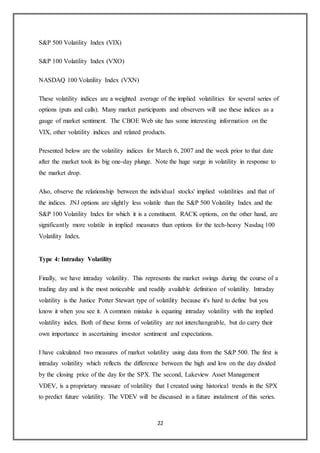
Presented below are the volatility indices for March 6, 2007 and the week prior to that date
after the market took its big one-day plunge. Note the huge surge in volatility in response to
the market drop.
Also, observe the relationship between the individual stocks' implied volatilities and that of
the indices. JNJ options are slightly less volatile than the S&P 500 Volatility Index and the
S&P 100 Volatility Index for which it is a constituent. RACK options, on the other hand, are
significantly more volatile in implied measures than options for the tech-heavy Nasdaq 100
Volatility Index.
Type 4: Intraday Volatility
Finally, we have intraday volatility. This represents the market swings during the course of a
trading day and is the most noticeable and readily available definition of volatility. Intraday
volatility is the Justice Potter Stewart type of volatility because it's hard to define but you
know it when you see it. A common mistake is equating intraday volatility with the implied
volatility index. Both of these forms of volatility are not interchangeable, but do carry their
own importance in ascertaining investor sentiment and expectations.
I have calculated two measures of market volatility using data from the S&P 500. The first is
intraday volatility which reflects the difference between the high and low on the day divided
by the closing price of the day for the SPX. The second, Lakeview Asset Management
VDEV, is a proprietary measure of volatility that I created using historical trends in the SPX
to predict future volatility. The VDEV will be discussed in a future instalment of this series.
23
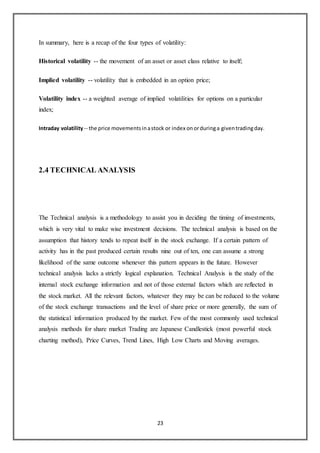
In summary, here is a recap of the four types of volatility:
Historical volatility -- the movement of an asset or asset class relative to itself;
Implied volatility -- volatility that is embedded in an option price;
Volatility index -- a weighted average of implied volatilities for options on a particular
index;
Intraday volatility-- the price movementsinastock or index onorduringa giventradingday.
2.4 TECHNICAL ANALYSIS
The Technical analysis is a methodology to assist you in deciding the timing of investments,
which is very vital to make wise investment decisions. The technical analysis is based on the
assumption that history tends to repeat itself in the stock exchange. If a certain pattern of
activity has in the past produced certain results nine out of ten, one can assume a strong
likelihood of the same outcome whenever this pattern appears in the future. However
technical analysis lacks a strictly logical explanation. Technical Analysis is the study of the
internal stock exchange information and not of those external factors which are reflected in
the stock market. All the relevant factors, whatever they may be can be reduced to the volume
of the stock exchange transactions and the level of share price or more generally, the sum of
the statistical information produced by the market. Few of the most commonly used technical
analysis methods for share market Trading are Japanese Candlestick (most powerful stock
charting method), Price Curves, Trend Lines, High Low Charts and Moving averages.
24
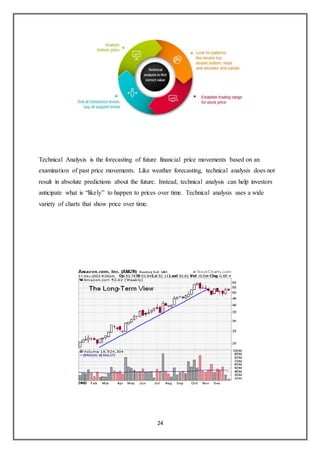
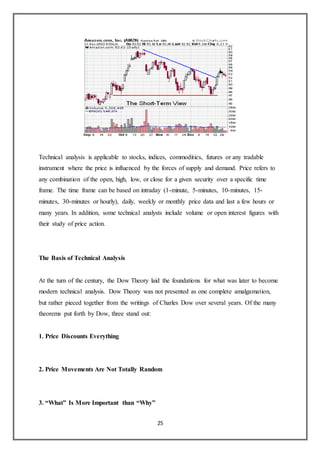
Technical Analysis is the forecasting of future financial price movements based on an
examination of past price movements. Like weather forecasting, technical analysis does not
result in absolute predictions about the future. Instead, technical analysis can help investors
anticipate what is “likely” to happen to prices over time. Technical analysis uses a wide
variety of charts that show price over time.
25
Technical analysis is applicable to stocks, indices, commodities, futures or any tradable
instrument where the price is influenced by the forces of supply and demand. Price refers to
any combination of the open, high, low, or close for a given security over a specific time
frame. The time frame can be based on intraday (1-minute, 5-minutes, 10-minutes, 15-
minutes, 30-minutes or hourly), daily, weekly or monthly price data and last a few hours or
many years. In addition, some technical analysts include volume or open interest figures with
their study of price action.
The Basis of Technical Analysis
At the turn of the century, the Dow Theory laid the foundations for what was later to become
modern technical analysis. Dow Theory was not presented as one complete amalgamation,
but rather pieced together from the writings of Charles Dow over several years. Of the many
theorems put forth by Dow, three stand out:
1. Price Discounts Everything
2. Price Movements Are Not Totally Random
3. “What” Is More Important than “Why”
26
Price Discounts Everything
This theorem is similar to the strong and semi-strong forms of market efficiency. Technical
analysts believe that the current price fully reflects all information. Because all information is
already reflected in the price, it represents the fair value, and should form the basis for
analysis. After all, the market price reflects the sum knowledge of all participants, including
traders, investors, portfolio managers, buy-side analysts, sell-side analysts, market strategist,
technical analysts, fundamental analysts and many others. It would be folly to disagree with
the price set by such an impressive array of people with impeccable credentials. Technical
analysis utilizes the information captured by the price to interpret what the market is saying
with the purpose of forming a view on the future.
Prices Movements are not Totally Random
Most technicians agree that prices trend. However, most technicians also acknowledge that
there are periods when prices do not trend. If prices were always random, it would be
extremely difficult to make money using technical analysis. In his book, Schwager on
Futures: Technical Analysis, Jack Schwager states:
“One way of viewing it is that markets may witness extended periods of random fluctuation,
interspersed with shorter periods of non-random behaviour. The goal of the chartist is to
identify those periods (i.e. major trends).”
27
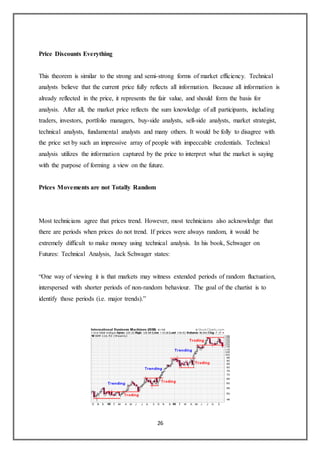
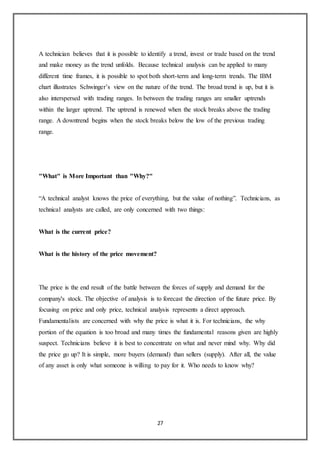
A technician believes that it is possible to identify a trend, invest or trade based on the trend
and make money as the trend unfolds. Because technical analysis can be applied to many
different time frames, it is possible to spot both short-term and long-term trends. The IBM
chart illustrates Schwinger’s view on the nature of the trend. The broad trend is up, but it is
also interspersed with trading ranges. In between the trading ranges are smaller uptrends
within the larger uptrend. The uptrend is renewed when the stock breaks above the trading
range. A downtrend begins when the stock breaks below the low of the previous trading
range.
"What" is More Important than "Why?"
“A technical analyst knows the price of everything, but the value of nothing”. Technicians, as
technical analysts are called, are only concerned with two things:
What is the current price?
What is the history of the price movement?
The price is the end result of the battle between the forces of supply and demand for the
company's stock. The objective of analysis is to forecast the direction of the future price. By
focusing on price and only price, technical analysis represents a direct approach.
Fundamentalists are concerned with why the price is what it is. For technicians, the why
portion of the equation is too broad and many times the fundamental reasons given are highly
suspect. Technicians believe it is best to concentrate on what and never mind why. Why did
the price go up? It is simple, more buyers (demand) than sellers (supply). After all, the value
of any asset is only what someone is willing to pay for it. Who needs to know why?
28
2.4.1 GENERALSTEPS TO TECHNICALEVALUATION
Many technicians employ a top-down approach that begins with broad-based macro analysis.
The larger parts are then broken down to base the final step on a more focused/micro
perspective. Such an analysis might involve three steps:
Broad market analysis through the major indices such as the S&P 500, Dow Industrials,
NASDAQ and NYSE Composite.
Sector analysis to identify the strongest and weakest groups within the broader market.
Individual stock analysis to identify the strongest and weakest stocks within select groups.
The beauty of technical analysis lies in its versatility. Because the principles of technical
analysis are universally applicable, each of the analysis steps above can be performed using
the same theoretical background. You don't need an economics degree to analyse a market
index chart. You don't need to be a CPA to analyse a stock chart. Charts are charts. It does
not matter if the time frame is 2 days or 2 years. It does not matter if it is a stock, market
index or commodity. The technical principles of support, resistance, trend, trading range and
other aspects can be applied to any chart. While this may sound easy, technical analysis is by
no means easy. Success requires serious study, dedication and an open mind.
2.4.2 CHART ANALYSIS
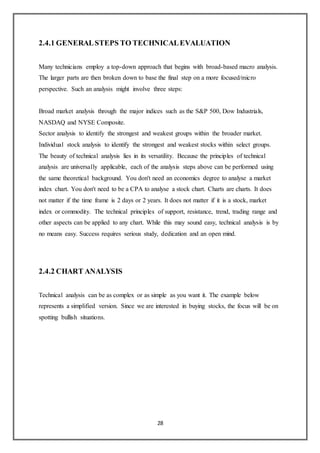
Technical analysis can be as complex or as simple as you want it. The example below
represents a simplified version. Since we are interested in buying stocks, the focus will be on
spotting bullish situations.
29
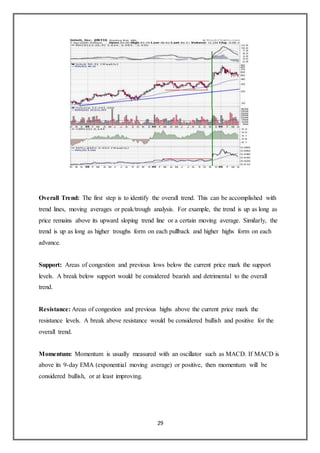
Overall Trend: The first step is to identify the overall trend. This can be accomplished with
trend lines, moving averages or peak/trough analysis. For example, the trend is up as long as
price remains above its upward sloping trend line or a certain moving average. Similarly, the
trend is up as long as higher troughs form on each pullback and higher highs form on each
advance.
Support: Areas of congestion and previous lows below the current price mark the support
levels. A break below support would be considered bearish and detrimental to the overall
trend.
Resistance: Areas of congestion and previous highs above the current price mark the
resistance levels. A break above resistance would be considered bullish and positive for the
overall trend.
Momentum: Momentum is usually measured with an oscillator such as MACD. If MACD is
above its 9-day EMA (exponential moving average) or positive, then momentum will be
considered bullish, or at least improving.
30
Buying/Selling Pressure: For stocks and indices with volume figures available, an indicator
that uses volume is used to measure buying or selling pressure. When Chaikin Money Flow is
above zero, buying pressure is dominant. Selling pressure is dominant when it is below zero.
Relative Strength: The price relative is a line formed by dividing the security by a
benchmark. For stocks it is usually the price of the stock divided by the S&P 500. The plot of
this line over a period of time will tell us if the stock is outperforming (rising) or
underperforming (falling) the major index.
The final step is to synthesize the above analysis to ascertain the following:
Strength of the current trend.
Maturity or stage of current trend.
Reward to risk ratio of a new position.
Potential entry levels for new long position.
2.4.3 TOP-DOWN TECHNICALANALYSIS
For each segment (market, sector and stock), an investor would analyse long-term and
short-term charts to find those that meet specific criteria. Analysis will first consider the
market in general, perhaps the S&P 500. If the broader market were considered to be in
bullish mode, analysis would proceed to a selection of sector charts. Those sectors that
show the most promise would be singled out for individual stock analysis. Once the
sector list is narrowed to 3-4 industry groups, individual stock selection can begin. With
a selection of 10-20 stock charts from each industry, a selection of 3-4 of the most
promising stocks in each group can be made. How many stocks or industry groups make
the final cut will depend on the strictness of the criteria set forth. Under this scenario, we
would be left with 9-12 stocks from which to choose. These stocks could even be broken
down further to find the 3-4 of the strongest of the strong.
31
2.5 FUNDAMENTALANALYSIS
If you are a fundamental analyst, you will first conduct a qualitative analysis, wherein, you
will look at things like the company’s quality of management, corporate governance
standards, quality of earnings, competitive position etc. Then, based on these, you will project
its future earnings. Intrinsic value can also be defined as the value of these future earnings in
terms of today’s money. The present value approach/model is used for this calculation. We
will discuss it in detail in subsequent sections.
You may also use an approach called the relative value approach for ascertaining the stock’s
real value. Herein, you will calculate the inherent value of a company’s shares based on the
fundamentals of its competitors. You may first calculate the ratio of the market price of the
competitors with a fundamental such as sales, book value or net income.
Then, you may apply this ratio to the fundamental of the concerned company and comment
on its value. Like the present value approach, here too you may begin your analysis with an
assessment of qualitative factors. This approach too will be discussed in detail in subsequent
sections.
This value calculated using one of these methods is then compared to the current price of the
company’s stock. It helps ascertain if the shares are undervalued or overvalued. It is bought if
it is overvalued and left alone otherwise. An illustration of this value calculation process is
given below.
32
2.5.1 FUNDAMENTALV/S TECHNICAL ANALYSIS
Equity investors, like you, like to invest in companies that they believe will achieve high
earnings growth in the future. This is because high growth companies come with a higher
future dividend paying potential. This, in turn, invites more investors to buy them. It
ultimately leads to an appreciation of the stock price.
2.5.2 ASSUMPTIONSOF EFFICIENT MARKET FUNDAMENTAL
ANALYSIS
33
This philosophy is based on three assumptions: other investors in the market have all the
relevant information to form an opinion about the future prospects of the company; they act
upon this information, and this information gets reflected in market prices.
A market that displays these characteristics is called an efficient market. In such markets, all
investors are privy to all the information pertaining to a company. They all use the same set
of information to make their investment decisions. As a result, nobody can make more profit
than the other and all the relevant information is reflects in market prices. This was the
central idea of Eugene Fama’s efficient market hypothesis of the 1960s.
2.5.3 INTRODUCTIONTO STOCKVALUATION
Now that we have established that the market conditions we operate under are not perfect, it
is clear that equity analysis can generate superior returns for you compared to the market.
Let’s then proceed towards the process of analysing companies. This portion deals with the
approaches to calculating the fair or intrinsic value of a stock.
Fair or intrinsic value of a stock is the price the stock should actually be trading at according
to your analysis. You can compare it with its current market price to ascertain whether it is
overvalued, undervalued or fairly valued. You would like to buy a stock that is undervalued,
because its price should appreciate to your estimate of fair value, earning you a profit in the
process. If you own a stock that you think is overvalued, you sell it. As for fairly valued
stocks, you’d best leave them alone.
34
There are three techniques used for the valuation of equity shares:
PRESENT VALUE MODELS:
Present value models are based on the principal that since shareholders are joint-owners of
the company, its future earnings belong to them. The combined value of these earnings, in
terms of today’s money, should therefore be the value of these equity shares.
The value of money changes with time. Rs 100 will not be worth the same in ten years’ time
as it is today. Similarly, the value of future income projected for a future period will be
different today.
To account for this, future incomes are divided by a specific discount rate to calculate their
value as of today. This is known as time value of money. The present value model has
different variants. Each of them uses a different concept of future income for discounting.
These include dividend, residual income and free cash flows. The model that uses dividends
is the most straight forward and commonly used. We will explain this in a later section.
35
RELATIVE VALUE (MULTIPLIER) MODELS:
A company can also be valued relative to the value of other, similar companies. In this case,
the market price of its rivals is compared with one of their fundamentals, such as sales, book
value of equity and net income. The ratio is then applied to the concerned company to
estimate its value. The ratios used for this purpose are called price multiples.
ASSET-BASED VALUATION:
In this model, the value of a company is based on the market value of its assets and liabilities.
The market value of liabilities (not including equity) is subtracted from the market value of
assets to arrive at the value of equity. For the model to work, most of the assets of the
company should be tangible long-term assets. This model is rarely used.
2.5.4 INTRODUCTIONTO FINANCIAL STATEMENT ANALYSIS
The financial performance of a company is organized and reported in the form of financial
statements. There are three important statements presented in the annual and quarterly reports
of a company: the income statement, the balance sheet and the cash flow statement. A brief
description of each of these is present below.
36
THE INCOME STATEMENT:
The income statement deals with the incomes and expenses of a company during a given
financial year. It classifies them into various parts based on their nature. Expenses are
subtracted from incomes to arrive at the profit for the year.
When analysing the income statement, you should be concerned about the stability and future
growth potential of incomes and expenses. Companies are evaluated on the basis of income
from their ‘core businesses’. Although companies also earn revenue from other sources from
time to time, these sources are not considered stable and truly representative of the efficiency
of the company’s operations.
Expenses-wise, you are again interested in looking at the categories of expenses, their
criticality to the business, prospects of their recurrence and their role in increasing future
earnings.
THE CASH FLOW STATEMENT:
This statement specifically talks about the cash position of a company. It divides the
company’ activities into three categories—operating, investing and financing, and gives an
account of the cash flowing in and out of the business on account of these.
The importance of the cash flow statement dwells on the fact that while a company earns and
spends a lot of funds, as accounted for in the income statement, a lot of these flow are non-
cash. A lot of these flows inspire the hope of receiving or paying cash in future, whereas
others don’t entail a flow at all. The statement removes this confusion by specifically stating
the sources and uses of cash in the current period. Ideally, companies would be best placed if
they generate enough cash from operations to finance their investing activities. Bringing in
cash from financing activities to fund the other two implies an increase in the level of
liabilities.
37
THE BALANCE SHEET:
This is the other most critical financial statement. It talks about the assets and liabilities of the
business. Unlike the income statement, the balance sheet reflects the state of the assets and
liabilities of a business at a particular point in time and not over a period of time.
A company needs certain assets to run its business smoothly. These are financed by certain
liabilities—debt and equity. For a company to be profitable, the revenue generated from these
assets should be greater than the amount required to repay the liabilities incurred to acquire
them.
This is what you should try and ascertain from the balance sheet. You are concerned about
the nature of the assets and their future revenue generation potential. At the same time, you
are also concerned about the sustainability of debt. Too much debt will pressurize the
company to earn beyond its potential to repay this debt. This is a dangerous and unsustainable
proposition.
2.6 GOLDEN RULES FOR TRADING IN STOCKMARKET
Neverover trade and do not make hurry to book profit
If want to invest Rs.1, 00,000 for trading in Share Market then trade only Rs. 50,000. Don’t
over trade Rs. 2, 00,000. Don’t be hurry for booking profit when market is in positive, wait
and watch for right time and then book profit.
Choose multiple sectors for trading
Invest your fund in multiple sectors rather than investing all in a single fund. Trade in 3 or 4
Sectors Stock at a time with strict stop loss.
38
Follow the trend
Do not be afraid to buy at high prices and sell at low prices. Do not buy just because it is a
low price & do not sell because it is high. Buy when there is bad news and Sell when there is
good news.
Don’t; expect to make profit everyday
If you consider you are a smart trader who can make profit on every trade, you are 100%
wrong. Always be flexible and accept the fact as soon as you realize that you are on wrong
side of the trade. Simply get out of the trade without changing your strategy during the
market; it may because you double losses.
Withdraw some portion of your profit periodically
It is must that trader must take a portion of the profit and put it in separate account. This is
absolutely must for long term stability in the market.
Do not trade with unclear mind
NSE & BSE will never close, every morning at 9.00 a.m. (5 days in a week) it will open. So
do not try to be a millionaire in a day. It is next to impossible to earn money every day in
stock market.
If you will avoid stop loss, next day market will avoid you
Do not average out in our share tips when market is not in favour. Limit your losses by
keeping a stop loss order - Never cancel a stop loss order after you have placed it, otherwise
you may lose more.
Trade only in stocks having high volume
39
In low volume stocks the volatility is too high and chance of Stop Loss limit getting failed is
too high as there would be no Buyer or seller at your Stop Loss Level.
Sell short as often as you long
Remember that if you are caught in a SHORT SELL POSITION, high chances are that it will
give back in less than a month. But if you are caught in a LONG POSITION it takes much
more time to build (Sometimes we have to wait for 2- 3 years for our buying prices.) If you
consider 10 different reasons affecting the market (NSE & BSE) - on an average, 7 reasons
are for bearish trend & only 3 reasons for bullish trend. Hence be cautious in taking a long
position.
Do not everfollow rumours
Do not follow rumours. Only follow the trend created by genuine news.
Adjust your daily expenses in a profit
Do not forget expenses like Brokerage, telephone & Mobile bills, Internet charges, computer
maintenance, etc. in the profits.
2.7 SETTLEMENT CYCLE
The important settlement types are as follows:
Normal segment (N)
Trade for trade Surveillance (W)
Retail Debt Market (D)
Limited Physical market (O)
40
Non cleared TT deals (Z)
Auction normal (A)
Trades in the settlement type N, W, D and A are settled in dematerialized mode. Trades under
settlement type O are settled in physical form. Trades under settlement type Z are settled
directly between the members and may be settled either in physical or dematerialized mode
.
Details of the two modes of settlement are as under:
Dematerialised settlement
NSCCL follows a T+2 rolling settlement cycle. For all trades executed on the T day, NSCCL
determines the cumulative obligations of each member on the T+1 day and electronically
transfers the data to Clearing Members (CMs). All trades concluded during a particular
trading date are settled on a designated settlement day i.e. T+2 day. In case of short deliveries
on the T+2 day in the normal segment, NSCCL conducts a buy –in auction on the T+2 day
itself and the settlement for the same is completed on the T+3 day, whereas in case of W
segment there is a direct close out. For arriving at the settlement day all intervening holidays,
which include bank holidays, NSE holidays, Saturdays and Sundays are excluded. The
settlement schedule for all the settlement types in the manner explained above is
communicated to the market participants vide circular issued during the previous month.
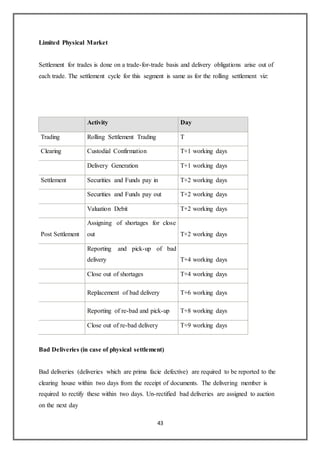
Rolling Settlement
In a rolling settlement, for all trades executed on trading day .i.e.T day the obligations are
determined on the T+1 day and settlement on T+2 basis i.e. on the 2nd working day. For
arriving at the settlement day all intervening holidays, which include bank holidays, NSE
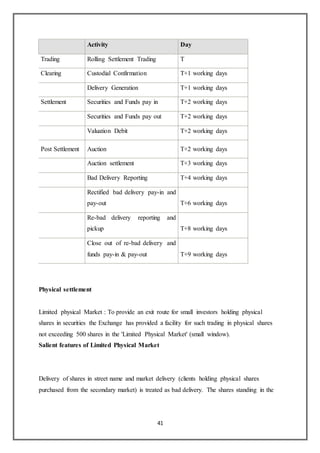
holidays, Saturdays and Sundays are excluded. A tabular representation of the settlement
cycle for rolling settlement is given below:
41
Activity Day
Trading Rolling Settlement Trading T
Clearing Custodial Confirmation T+1 working days
Delivery Generation T+1 working days
Settlement Securities and Funds pay in T+2 working days
Securities and Funds pay out T+2 working days
Valuation Debit T+2 working days
Post Settlement Auction T+2 working days
Auction settlement T+3 working days
Bad Delivery Reporting T+4 working days
Rectified bad delivery pay-in and
pay-out T+6 working days
Re-bad delivery reporting and
pickup T+8 working days
Close out of re-bad delivery and
funds pay-in & pay-out T+9 working days
Physical settlement
Limited physical Market : To provide an exit route for small investors holding physical
shares in securities the Exchange has provided a facility for such trading in physical shares
not exceeding 500 shares in the 'Limited Physical Market' (small window).
Salient features of Limited Physical Market
Delivery of shares in street name and market delivery (clients holding physical shares
purchased from the secondary market) is treated as bad delivery. The shares standing in the
42
name of individuals/HUF only would constitute good delivery. The selling/delivering
member must necessarily be the introducing member.
Any delivery of shares which bears the last transfer date on or after the introduction of the
security for trading in the LP market is construed as bad delivery.
Any delivery in excess of 500 shares is marked as short and such deliveries are compulsorily
closed-out.
Shortages, if any, are compulsorily closed-out at 20% over the actual traded price. Non
rectification/replacement for bad delivery are closed out at 10% over the actual trade price.
Non rectification/replacement for objection cases are closed out at 20% above the official
closing price in regular Market on the auction day.
The buyer must compulsorily send the securities for transfer and dematerialisation, latest
within 3 months from the date of pay-out.
Company objections arising out of such trading and settlement in this market are reported in
the same manner as is currently being done for normal market segment. However securities
would be accepted as valid company objection, only if the securities are lodged for transfer
within 3 months from the date of pay-out.
43
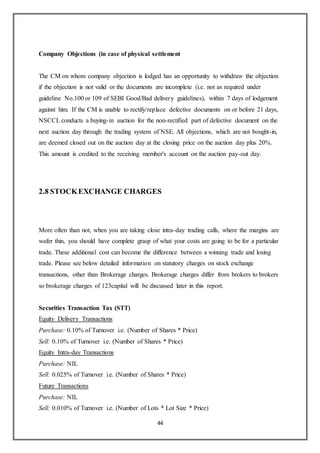
Limited Physical Market
Settlement for trades is done on a trade-for-trade basis and delivery obligations arise out of
each trade. The settlement cycle for this segment is same as for the rolling settlement viz:
Activity Day
Trading Rolling Settlement Trading T
Clearing Custodial Confirmation T+1 working days
Delivery Generation T+1 working days
Settlement Securities and Funds pay in T+2 working days
Securities and Funds pay out T+2 working days
Valuation Debit T+2 working days
Post Settlement
Assigning of shortages for close
out T+2 working days
Reporting and pick-up of bad
delivery T+4 working days
Close out of shortages T+4 working days
Replacement of bad delivery T+6 working days
Reporting of re-bad and pick-up T+8 working days
Close out of re-bad delivery T+9 working days
Bad Deliveries (in case of physical settlement)
Bad deliveries (deliveries which are prima facie defective) are required to be reported to the
clearing house within two days from the receipt of documents. The delivering member is
required to rectify these within two days. Un-rectified bad deliveries are assigned to auction
on the next day
44
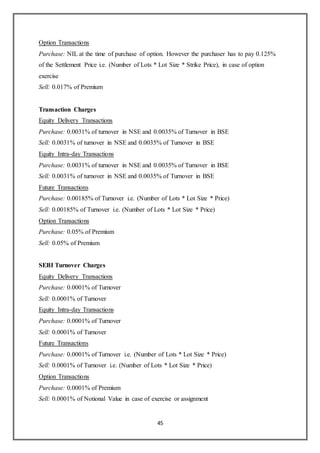
Company Objections (in case of physical settlement
The CM on whom company objection is lodged has an opportunity to withdraw the objection
if the objection is not valid or the documents are incomplete (i.e. not as required under
guideline No.100 or 109 of SEBI Good/Bad delivery guidelines), within 7 days of lodgement
against him. If the CM is unable to rectify/replace defective documents on or before 21 days,
NSCCL conducts a buying-in auction for the non-rectified part of defective document on the
next auction day through the trading system of NSE. All objections, which are not bought-in,
are deemed closed out on the auction day at the closing price on the auction day plus 20%.
This amount is credited to the receiving member's account on the auction pay-out day.
2.8 STOCKEXCHANGE CHARGES
More often than not, when you are taking close intra-day trading calls, where the margins are
wafer thin, you should have complete grasp of what your costs are going to be for a particular
trade. These additional cost can become the difference between a winning trade and losing
trade. Please see below detailed information on statutory charges on stock exchange
transactions, other than Brokerage charges. Brokerage charges differ from brokers to brokers
so brokerage charges of 123capital will be discussed later in this report.
Securities Transaction Tax (STT)
Equity Delivery Transactions
Purchase: 0.10% of Turnover i.e. (Number of Shares * Price)
Sell: 0.10% of Turnover i.e. (Number of Shares * Price)
Equity Intra-day Transactions
Purchase: NIL
Sell: 0.025% of Turnover i.e. (Number of Shares * Price)
Future Transactions
Purchase: NIL
Sell: 0.010% of Turnover i.e. (Number of Lots * Lot Size * Price)
45
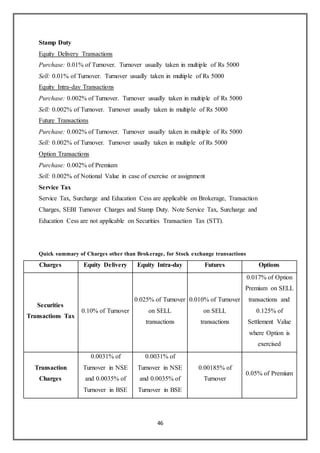
Option Transactions
Purchase: NIL at the time of purchase of option. However the purchaser has to pay 0.125%
of the Settlement Price i.e. (Number of Lots * Lot Size * Strike Price), in case of option
exercise
Sell: 0.017% of Premium
Transaction Charges
Equity Delivery Transactions
Purchase: 0.0031% of turnover in NSE and 0.0035% of Turnover in BSE
Sell: 0.0031% of turnover in NSE and 0.0035% of Turnover in BSE
Equity Intra-day Transactions
Purchase: 0.0031% of turnover in NSE and 0.0035% of Turnover in BSE
Sell: 0.0031% of turnover in NSE and 0.0035% of Turnover in BSE
Future Transactions
Purchase: 0.00185% of Turnover i.e. (Number of Lots * Lot Size * Price)
Sell: 0.00185% of Turnover i.e. (Number of Lots * Lot Size * Price)
Option Transactions
Purchase: 0.05% of Premium
Sell: 0.05% of Premium
SEBI Turnover Charges
Equity Delivery Transactions
Purchase: 0.0001% of Turnover
Sell: 0.0001% of Turnover
Equity Intra-day Transactions
Purchase: 0.0001% of Turnover
Sell: 0.0001% of Turnover
Future Transactions
Purchase: 0.0001% of Turnover i.e. (Number of Lots * Lot Size * Price)
Sell: 0.0001% of Turnover i.e. (Number of Lots * Lot Size * Price)
Option Transactions
Purchase: 0.0001% of Premium
Sell: 0.0001% of Notional Value in case of exercise or assignment
46
Stamp Duty
Equity Delivery Transactions
Purchase: 0.01% of Turnover. Turnover usually taken in multiple of Rs 5000
Sell: 0.01% of Turnover. Turnover usually taken in multiple of Rs 5000
Equity Intra-day Transactions
Purchase: 0.002% of Turnover. Turnover usually taken in multiple of Rs 5000
Sell: 0.002% of Turnover. Turnover usually taken in multiple of Rs 5000
Future Transactions
Purchase: 0.002% of Turnover. Turnover usually taken in multiple of Rs 5000
Sell: 0.002% of Turnover. Turnover usually taken in multiple of Rs 5000
Option Transactions
Purchase: 0.002% of Premium
Sell: 0.002% of Notional Value in case of exercise or assignment
Service Tax
Service Tax, Surcharge and Education Cess are applicable on Brokerage, Transaction
Charges, SEBI Turnover Charges and Stamp Duty. Note Service Tax, Surcharge and
Education Cess are not applicable on Securities Transaction Tax (STT).
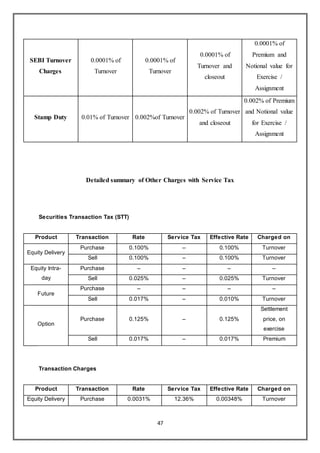
Quick summary of Charges other than Brokerage, for Stock exchange transactions
Charges Equity Delivery Equity Intra-day Futures Options
Securities
Transactions Tax
0.10% of Turnover
0.025% of Turnover
on SELL
transactions
0.010% of Turnover
on SELL
transactions
0.017% of Option
Premium on SELL
transactions and
0.125% of
Settlement Value
where Option is
exercised
Transaction
Charges
0.0031% of
Turnover in NSE
and 0.0035% of
Turnover in BSE
0.0031% of
Turnover in NSE
and 0.0035% of
Turnover in BSE
0.00185% of
Turnover
0.05% of Premium
47
SEBI Turnover
Charges
0.0001% of
Turnover
0.0001% of
Turnover
0.0001% of
Turnover and
closeout
0.0001% of
Premium and
Notional value for
Exercise /
Assignment
Stamp Duty 0.01% of Turnover 0.002%of Turnover
0.002% of Turnover
and closeout
0.002% of Premium
and Notional value
for Exercise /
Assignment
Detailed summary of Other Charges with Service Tax
Securities Transaction Tax (STT)
Product Transaction Rate Service Tax Effective Rate Charged on
Equity Delivery
Purchase 0.100% – 0.100% Turnover
Sell 0.100% – 0.100% Turnover
Equity Intra-
day
Purchase – – – –
Sell 0.025% – 0.025% Turnover
Future
Purchase – – – –
Sell 0.017% – 0.010% Turnover
Option
Purchase 0.125% – 0.125%
Settlement
price, on
exercise
Sell 0.017% – 0.017% Premium
Transaction Charges
Product Transaction Rate Service Tax Effective Rate Charged on
Equity Delivery Purchase 0.0031% 12.36% 0.00348% Turnover
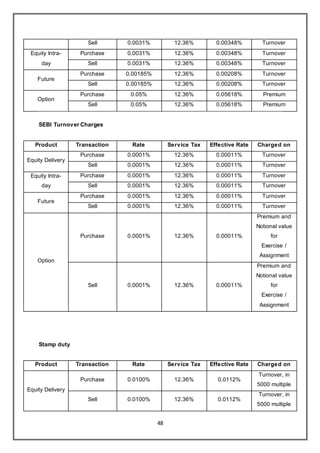
48
Sell 0.0031% 12.36% 0.00348% Turnover
Equity Intra-
day
Purchase 0.0031% 12.36% 0.00348% Turnover
Sell 0.0031% 12.36% 0.00348% Turnover
Future
Purchase 0.00185% 12.36% 0.00208% Turnover
Sell 0.00185% 12.36% 0.00208% Turnover
Option
Purchase 0.05% 12.36% 0.05618% Premium
Sell 0.05% 12.36% 0.05618% Premium
SEBI Turnover Charges
Product Transaction Rate Service Tax Effective Rate Charged on
Equity Delivery
Purchase 0.0001% 12.36% 0.00011% Turnover
Sell 0.0001% 12.36% 0.00011% Turnover
Equity Intra-
day
Purchase 0.0001% 12.36% 0.00011% Turnover
Sell 0.0001% 12.36% 0.00011% Turnover
Future
Purchase 0.0001% 12.36% 0.00011% Turnover
Sell 0.0001% 12.36% 0.00011% Turnover
Option
Purchase 0.0001% 12.36% 0.00011%
Premium and
Notional value
for
Exercise /
Assignment
Sell 0.0001% 12.36% 0.00011%
Premium and
Notional value
for
Exercise /
Assignment
Stamp duty
Product Transaction Rate Service Tax Effective Rate Charged on
Equity Delivery
Purchase 0.0100% 12.36% 0.0112%
Turnover, in
5000 multiple
Sell 0.0100% 12.36% 0.0112%
Turnover, in
5000 multiple
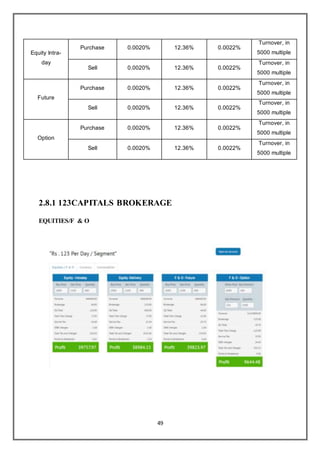
49
Equity Intra-
day
Purchase 0.0020% 12.36% 0.0022%
Turnover, in
5000 multiple
Sell 0.0020% 12.36% 0.0022%
Turnover, in
5000 multiple
Future
Purchase 0.0020% 12.36% 0.0022%
Turnover, in
5000 multiple
Sell 0.0020% 12.36% 0.0022%
Turnover, in
5000 multiple
Option
Purchase 0.0020% 12.36% 0.0022%
Turnover, in
5000 multiple
Sell 0.0020% 12.36% 0.0022%
Turnover, in
5000 multiple
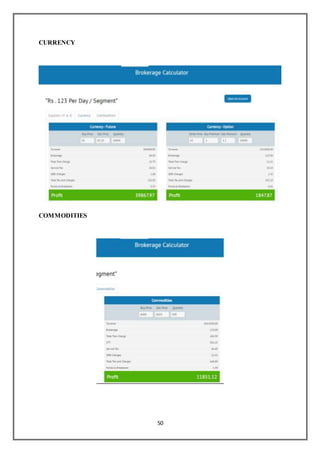
2.8.1 123CAPITALS BROKERAGE
EQUITIES/F & O
50
CURRENCY
COMMODITIES
51
2.9 DEMAT A/C
WHAT IS DEMATERIALIZATION?
Technology has brought about a drastic change in our everyday lives. The stock markets too
have not been left untouched by the change. In 1875, the Bombay Stock Exchange was
founded with an open outcry floor trading exchange. Traders would stand on the floor and
shout prices of stocks for buying or selling. Then, money would be exchanged for physical
receipts of the shares called the certificate. This led to a great amount of paperwork. Even the
settlements of trade agreements took time because of the need to deliver the share certificates.
Much has changed since.
In 1996, dematerialization was embraced. Dematerialization is the process by which physical
share certificates held by an investor are converted into an equivalent number of securities in
electronic form and credited into the investor’s demat account.
CENTRAL DEPOSITORY:
There are two depositories in India – the CDSL and NSDL. They hold all the demat accounts.
The central depository holds details of your shareholding on your behalf like banks.
UNIQUE ID:
Each demat account has a unique number for identification purposes. This is the number you
need to provide for transactions. The number will help the exchange and companies identify
you and credit the shares in your account.
DEPOSITORY PARTICIPANTS:
Access to the central depository is provided by the Depository Participants or DPs. They act
as the intermediary between the central depository and the investor. DPs could be banks,
brokers or financial institutions that are empowered to offer demat services. You open a
52
demat account or a Beneficial Owner (BO) accounts with a DP, who will provide you a
unique access to the central depository.
PORTFOLIO HOLDING:
The demat account holds all your securities. So, whenever you check your account, you can
see your portfolio holding and its details. These are updated automatically every time you
conduct a transaction – be is buying or selling a security.
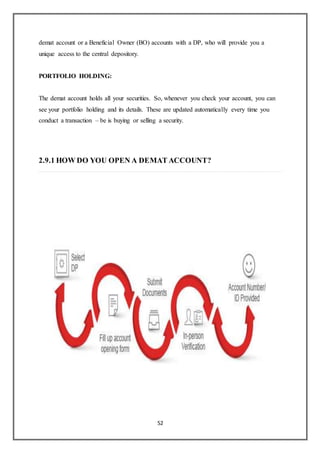
2.9.1 HOW DO YOU OPEN A DEMAT ACCOUNT?
53
 Then fill up an account opening form and submit along with copies of the required
documents and a passport-sized photograph. You also need to have a PAN card. Also
carry the original documents for verification.
 You will be provided with a copy of the rules and regulations, the terms of the
agreement and the charges that you will incur.
 During the process, an In-Person Verification would be carried out. A member of the
DP’s staff would contact you to check the details provided in the account opening
form.
 Once the application is processed, the DP will provide you with an account number or
client ID. You can use the details to access your demat account online.
 As a demat account holder, you would need to pay some fees like the annual
maintenance fee levied for maintenance of account and the transaction fee -- levied
for debiting securities to and from the account on a monthly basis. These fees differ
from every service provider (called a Depository Participant or DP). While some DPs
charge a flat fee per transaction, others peg the fee to the transaction value, and are
subject to a minimum amount. The fee also differs based on the kind of transaction
(buying or selling). In addition to the other fees, the DP also charges a fee for
converting the shares from the physical to the electronic form or vice-versa.
Minimum shares: A demat account can be opened with no balance of shares. It also does not
require that a minimum balance be maintained.
2.9.2 DOCUMENTS REQUIRED FOR A DEMAT & TRADING ACCOUNT
You need to submit proof of identity and address along with a passport size photograph and
the account opening form. Only photocopies of the documents are required for submission,
but originals are also required for verification.
Here is a broad list of documents that can be used as proofs:
54
You need to submit proof of identity and address along with a passport size photograph and
the account opening form. Only photocopies of the documents are required for submission,
but originals are also required for verification.
Proof of identity: PAN card, voter's ID, passport, driver's license, bank attestation, IT returns,
electricity bill, telephone bill, ID cards with applicant's photo issued by the central or state
government and its departments, statutory or regulatory authorities, public sector
undertakings (PSUs), scheduled commercial banks, public financial institutions, colleges
affiliated to universities, or professional bodies such as ICAI, ICWAI, ICSI, bar council etc.
Proof of address: Ration card, passport, voter ID card, driving license, bank passbook or bank
statement, verified copies of electricity bills, residence telephone bills, leave and license
agreement or agreement for sale, self-declaration by High Court or Supreme Court judges,
identity card or a document with address issued by the central or state government and its
departments, statutory or regulatory authorities, public sector undertakings (PSUs), scheduled
commercial banks, public financial institutions, colleges affiliated to universities and
professional bodies such as ICAI, ICWAI, Bar Council etc.
This is easy. All you need to do is fill in the Demat Request Form (DRM), fill in the
appropriate details of the share certificates you hold, and submit it with the physical share
receipt. Every share certificate needs a separate DRM form. Once the form is approved, your
demat account will automatically be updated to reflect your newly dematerialized shares.
2.10 TRADING ACCOUNT
2.10.1 WHAT IS A TRADING ACCOUNT?
When a company lists on the stock market, its shares become available for trading on the
stock exchange. Earlier, the exchange had an open-outcry system. In the mid-90s, the stock
exchanges adopted the electronic system. This means, all trades were conducted
55
electronically. Simply put, you didn’t have to go to the counter and place an order physically.
You could do it through a computer, which would verify the details, the market price, and
process the trade.
For this reason, you need a special account through which you can conduct transactions. This
is called the trading account. Without one, you cannot trade in the stock markets. You register
for an online trading account with a stock broker or a firm. Each account comes with a unique
trading ID, which is used for conducting transactions.
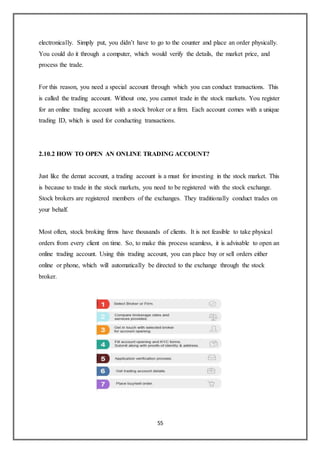
2.10.2 HOW TO OPEN AN ONLINE TRADING ACCOUNT?
Just like the demat account, a trading account is a must for investing in the stock market. This
is because to trade in the stock markets, you need to be registered with the stock exchange.
Stock brokers are registered members of the exchanges. They traditionally conduct trades on
your behalf.
Most often, stock broking firms have thousands of clients. It is not feasible to take physical
orders from every client on time. So, to make this process seamless, it is advisable to open an
online trading account. Using this trading account, you can place buy or sell orders either
online or phone, which will automatically be directed to the exchange through the stock
broker.
56
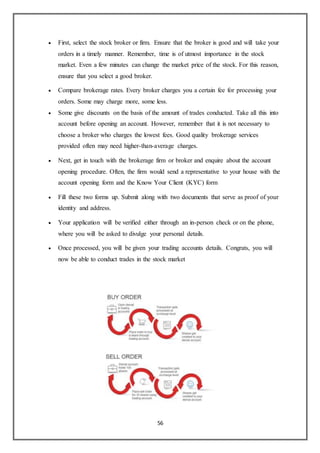
 First, select the stock broker or firm. Ensure that the broker is good and will take your
orders in a timely manner. Remember, time is of utmost importance in the stock
market. Even a few minutes can change the market price of the stock. For this reason,
ensure that you select a good broker.
 Compare brokerage rates. Every broker charges you a certain fee for processing your
orders. Some may charge more, some less.
 Some give discounts on the basis of the amount of trades conducted. Take all this into
account before opening an account. However, remember that it is not necessary to
choose a broker who charges the lowest fees. Good quality brokerage services
provided often may need higher-than-average charges.
 Next, get in touch with the brokerage firm or broker and enquire about the account
opening procedure. Often, the firm would send a representative to your house with the
account opening form and the Know Your Client (KYC) form
 Fill these two forms up. Submit along with two documents that serve as proof of your
identity and address.
 Your application will be verified either through an in-person check or on the phone,
where you will be asked to divulge your personal details.
 Once processed, you will be given your trading accounts details. Congrats, you will
now be able to conduct trades in the stock market
57
2.10.3 TYPES OF ORDERS
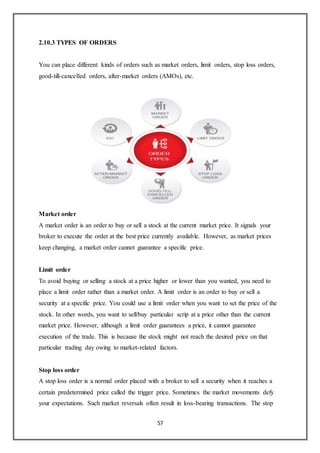
You can place different kinds of orders such as market orders, limit orders, stop loss orders,
good-till-cancelled orders, after-market orders (AMOs), etc.
Market order
A market order is an order to buy or sell a stock at the current market price. It signals your
broker to execute the order at the best price currently available. However, as market prices
keep changing, a market order cannot guarantee a specific price.
Limit order
To avoid buying or selling a stock at a price higher or lower than you wanted, you need to
place a limit order rather than a market order. A limit order is an order to buy or sell a
security at a specific price. You could use a limit order when you want to set the price of the
stock. In other words, you want to sell/buy particular scrip at a price other than the current
market price. However, although a limit order guarantees a price, it cannot guarantee
execution of the trade. This is because the stock might not reach the desired price on that
particular trading day owing to market-related factors.
Stop loss order
A stop loss order is a normal order placed with a broker to sell a security when it reaches a
certain predetermined price called the trigger price. Sometimes the market movements defy
your expectations. Such market reversals often result in loss-bearing transactions. The stop
58
loss trigger price is your defence mechanism – an amount at which you will be able to sustain
yourself against such unanticipated market movements. For example, if you bought a stock at
Rs. 10, you place a stop loss order with your broker to sell it, if it reaches Rs. 8. This helps
you prevent further loss, in the eventuality that the price of the stock might dip even further.
Thus, it helps limit your loss or protect unrealized profits, whichever the case.
Good-till-cancelled
GTC or Day Orders are orders given to your broker that hold true only during the trading day
when the order was placed. If the order has not been executed on that day, it will not be
passed on to the next trading day. Thus, they are orders that are only 'good until it is
cancelled' or 'good for the day'. For example, suppose that you have placed a stop loss order
with your broker to sell a stock once the price reaches level X. If it does not reach limit X,
your broker will not sell the stock. However, the stop loss order given to your broker will not
hold true for the next day. So, even if the stock reaches level X on Day 2, he will not execute
the trade till you instruct him to do so again.
IOC
An Immediate or Cancel (IOC) order allows a Trading Member to buy or sell a security as
soon as the order is released into the market, in case order failed to full fill the total quantity it
will be removed from the market. Partial match is possible for the order, and the unmatched
portion of the order is cancelled immediately.
59
60
3.1 STUDENT’S WORKPROFILE (ROLE AND RESPONSIBILITIES):
This work was at 123CAPITALS LTD. with a profile of sales trainee. This profile offers us
to understand the need of customer and provide them the best deal possible with
maximization of the profit, both for the company as well as for the customer.
The most important aspect for the role of trainee is trust. So far fulfilment of the targets one
needs to:
• Capitalize on the old and loyal client age which can be building slowly by advising people
in the best possible way.
• Generating new leads through various activities.
3.2 GENERATION OF LEADS:
Since this work was new in the field so this work had to start from scratch and generate new
leads to sustain in the market.
Cold calling is one of the trusted ways of getting to the customers without meeting them.
Although the rate of conversion remained very less, for cold calling the quality and accent
remains a very important criterion. This activity gives us mixed result. This activity often got
success and generated many leads through it but it also landed me in awkward position where
the customer were in different mood and made us hear words for which a marketer should be
always prepared to hear. Corporate calls always remained more difficult to crack with respect
to retail sector.
The corporate were the most difficult and most temping to get the business from. It took me
one day to crack Hi-tech Gears At 123CAPITALS LTD. after getting the product knowledge
in the first week at the branch I was also allotted distributor to work with. In the initial phase
61
I was accompanied by more experienced staff. After I became known to the market and
procedure I started attending calls alone only.
After the third week my performance also improved and I was able to get close to the targets,
though it looked difficult to achieve in the beginning. To get awareness of the every product I
attended diversified calls. This helped me to implement cross selling to get better results.
3.3 ANALYSIS OF CALLING
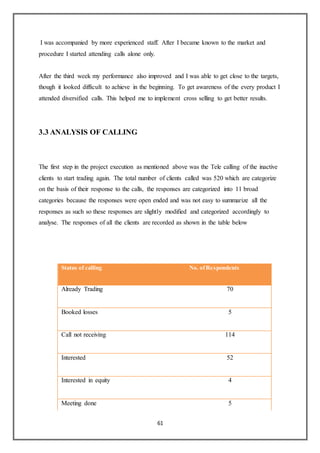
The first step in the project execution as mentioned above was the Tele calling of the inactive
clients to start trading again. The total number of clients called was 520 which are categorize
on the basis of their response to the calls, the responses are categorized into 11 broad
categories because the responses were open ended and was not easy to summarize all the
responses as such so these responses are slightly modified and categorized accordingly to
analyse. The responses of all the clients are recorded as shown in the table below
Status of calling No. ofRespondents
Already Trading 70
Booked losses 5
Call not receiving 114
Interested 52
Interested in equity 4
Meeting done 5
62
Not interested 151
Out of range/switched off 96
Want to close a/c 6
Will call himself when
interested 10
Will give fund in February 7
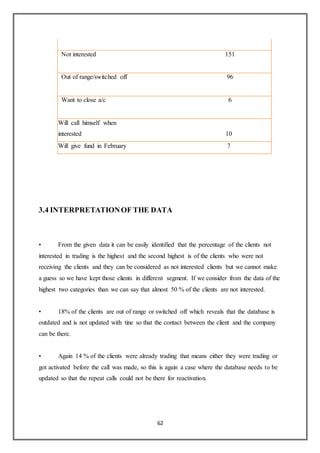
3.4 INTERPRETATIONOF THE DATA
• From the given data it can be easily identified that the percentage of the clients not
interested in trading is the highest and the second highest is of the clients who were not
receiving the clients and they can be considered as not interested clients but we cannot make
a guess so we have kept those clients in different segment. If we consider from the data of the
highest two categories than we can say that almost 50 % of the clients are not interested.
• 18% of the clients are out of range or switched off which reveals that the database is
outdated and is not updated with tine so that the contact between the client and the company
can be there.
• Again 14 % of the clients were already trading that means either they were trading or
got activated before the call was made, so this is again a case where the database needs to be
updated so that the repeat calls could not be there for reactivation.
63
• Only 10% of the clients found to be interested in further working with the company
and want to activate their accounts out of which some wants relaxation in the brokerage and
need a RM so that they might stay updated.
• Rest 2% were seemed to be interested and will call themselves, 1 % were ready to
give funds in July and start trading then only, and the remaining 2 % booked losses and want
to close the account.
• 1% of the clients was done with the meetings with RMs and was ready to invest
again.
3.5 SELF TRADING ACCOUNT
After getting sufficient knowledge about share trading from experienced employees at
123CAPITALS I decided to open a share trading account in my own name and I decided not
to open the account in 123CAPITALS because I did not find the brokerage of 123CAPITALS
suitable to my needs. So I decided to open my trading account at ZERODHA. The brokerage
details of Zerodha are as follows:
Free equity delivery
All your equity delivery investments (NSE, BSE), absolutely free — ₹0 brokerage.
Intraday equity and F&O trades
₹20 or 0.01% (whichever is lower) per executed order on intraday trades across equity,
currency, and commodity trades across NSE, BSE, and MCX.
I usually do not do Intraday trading and try my level best to stick to delivery trading as it
involves lesser risk and avoid speculation trading and Zerodha providing zero brokerage for
delivery based trading is a great feature which attracts many traders. 123CAPITALS is a
64
suitable broker for traders who make a lot of intraday trades as the cap for brokerage per day
is only Rs 123/Segment.
Zerodha also provides quality back office and trading tools which provides various tools for
analysis and maintaining proper statement. The tools provided by Zerodha are as follows:
Kite web
Kite is a minimalistic, intuitive, responsive, light, yet powerful web and mobile trading
application offered by Zerodha. Bandwidth consumption of less than 0.5 Kbps for a full
market watch, extensive charting with over 100 indicators and 6 chart types, advanced order
types like Brackets and cover, millisecond order placements, and more. Used by over 70,000
clients and serving over 5 million requests a day with no hiccups.
Kite mobile
Enjoy the Kite experience seamlessly on your Android and iOS devices.
65
Kite Connect API
Kite Connect is a set of simple HTTP APIs built on top of Zerodha’s exchange-approved web
based trading platform, Kite. It enables users—clients of Zerodha—to gain programmatic
access to data such as profile and funds information, order history, positions, live quotes etc.
In addition, it enables users to place orders and manage portfolio at their convenience from an
interface of their choice.
Q
Complete trade and reporting console and dashboard.
66
Quant
A personal trading journal with insights on your best trading periods, most profitable streaks,
optimal position sizes, contracts, and more, all intelligently compiled from your past trading
behaviour.
67
Pi
Pi is the desktop trading application built by Trade lab. Trading, charting, scripting, and
analysis, all rolled into a Windows desktop trading platform.
With all the above tools trading and analysis becomes very easy. Although I am a beginner in
trading the tools provided by Zerodha made trading look very easy. As 123CAPITALS is a
new brokerage firm it requires a lot of marketing activities to increase the goodwill of the
company and instil trust among the traders
68
3.6 MY PORTFOLIO
Symbol
Buy
qty
Buy
avg
Buy value
Sell
qty
Sell
avg
Sell
value
Net
Qty
Previous Closing
Price
Realized
profit
Unrealized
Profit
1 HCC 600 ₹40.09 ₹24,056.50 0 0 0 600 ₹43.25 ₹1893.50
2 EDL 120 ₹70.75 ₹8,490.00 0 0 0 120 ₹56.15 ₹-1,752.00
Total realized profit 0 ₹141.5
Reason
I have purchased both Hindustan Construction Company Ltd and Empee Distilleries Ltd with
a long term prospective.
3.7 WORK AT 123CAPITALS
My work started on the 19th of DECEMBER, 2016 at 9.00 am sharp. As it was
Monday morning, the fresh day for the trading week everyone in the office was quite busy
with their work and no one bothered to assign any work to me nor were interested in teaching
me anything. Nearly after 2 hours things started to settle down in the office and I was called
by Mr.Chakkaravarthy the managing director of the broking firm. He assigned me with a
person named Revathi to guide me during the internship period. Mr.Chakkaravarthy said that
69
my main focus would be based on marketing for the company because the company itself
was mainly focused in the expansion of the company and company name. I too believed that
the company required a lot of work in the marketing department as the company was lacking
in active clients compared to other competitive companies such as Karvy, Zerodha, RSK
Securities, LKP securities, Sharekhan.
Mrs. A. Revathi was very helpful to me during my entire internship course. I could not
have completed this course without the help of Mr. Revathi. He was the one who thought me
the entire basics regarding share market. It took me nearly a week to learn about the basics
about share market. On the second day Mrs. A. Revathi insisted me to open a trading account
in order to improve my involvement and interest in share market. As I had a Pan Card and
bank account I right away decided to open the trading account at Zerodha with the permission
of my father with a capital of Rs32500.The account opening process took about 4 days and
my trading account was opened on the 23rd of December, 2016.As soon as my account was
opened I was ready with my portfolio and accordingly I bought 600 shares of HCC ltd and
120 shares of Empee Distilleries with long term prospective as Mrs. A. Revathi advised me
never to do intraday trading and said that long term trading is most beneficial and risk free.
From 26th onwards I was given a job in the marketing department. My work was to make
calls to selected number of inactive clients to find out the reason as to why they weren’t
trading presently and I received mixed results and the report regarding the tele calling
analysis can be found on Page no.56 of this report. I had to submit the report to the Managing
Director Mr.Chakkaravarthy before the 6th of January, 2017 and I did successfully submit the
required report on the 5th of January and Mr.Chakkaravarthy congratulated me for the work I
had done and for early submission.
On the 6th January I was not assigned any job so I was just going through the different
departments of the firm. From the 9th onwards I was given a sheet everyday with different
mobile numbers along with their names and I had call everyone and persuade them to
practice trading and choose 123CAPITALS for it by explaining all the advantages of trading
with 123CAPITALS.I received mixed results during the tele calling sessions and most of
them would just end the call abruptly without even listening to what I had to say, some of
them were really interested and asked various questions about trading and about
123CAPITALS.It was a very difficult task as I had to explain in detail all the information
70
related to trading over the phone and also I had to answer their queries. I felt it was very
monotonous and boring job as I had to repeat the same information over and over again.
Many of them did seem interested in trading after explaining in detail about trading but they
hesitated and backed out to trade with 123CAPITALS as they said that they did not hear
about the company anywhere and felt that the company lacked goodwill. But with great
efforts I did manage to find 5 new clients for the company namely:
1. G.Krishnamurthy (44)
2. S.Sumathi (32)
3. R.Ram Kumar (32)
4. Alphonse (52)
5. S.Shekar Reddy (45)
I had to personally meet all the above persons in their respective houses and offices to
guide them and complete the account opening process. It was very difficult and time
consuming job as most of them were filled with questions as they were very scared to risk
their money as they believed that share trading only leads to losses. All of them said that they
heard this statement from people who had done share trading in the past and I felt this is the
main reason for slow growth of financial sector in India. Most of them believe that share
trading is similar to gambling and hesitate to invest their money in the share market which
provides a huge opportunity for wealth growth. I continued with the same task till the 13th of
January and after that I started to collect materials and information with the help of Mrs. A.
Revathi for preparation of my internship report. On the 17th I summarised my daily report,
wished everyone goodbye and I successfully completed my 26 days of internship. It was a
great experience and I learnt a lot from this internship and it also helped me to explore a new
Phase of the financial market with expert guidance.
71
72
4.1 INTERPERSONALSKILLS
 SELF CONFIDENCE
 POSITIVE ATTITUDE
 COMMUNICATION
 CRITICAL THINKING AND PROBLEM SOLVING
 TIME MANAGEMENT AND PUNCTUALITY
 TEAM WORK
 HANDLING PRESSURE
 FLEXIBILITY
 ABILITY TO ACCEPT CONSTRUCTIVE FEEDBACK
 STRONG WORK ETHIC
73
4.2 TECHNICAL SKILLS
Analytical Skill
One skill every trader needs is the ability to analyse data quickly. There is a lot of math
involved in trading, but it is represented through charts with indicators and patterns
from technical analysis. Consequently traders need to develop their analytical skills so they
can recognize trends and trends in the charts.
Research
Traders need to have a healthy thirst for information and a desire to find all the relevant data
that impacts the securities they trade. Many traders create calendars of economic releases and
set announcements that have measurable effects on the financial markets. By being on top of
these information sources, traders are able to react to new information as the market is still
digesting it.
Focus
Focus is a skill and it increases the more traders exercise it. Because there is so much
financial information out there, traders need to be able to hone in on the important, actionable
data that will affect their trades. Some traders also focus in on the types of securities they
trade so they can deepen their understanding of a specific sector, industry or currency to the
point where it becomes a competitive advantage against less specialized traders.
Control
Hand in hand with focus is control. A trader needs to control his or her emotions and stick to
a trading plan and strategy. This is especially important in managing risk by using stop losses
or taking profits at set points. Many strategies are designed so the trader loses a little in bad
trades and systematically gains more on good trades. When traders start to get emotional
about their trades - good or bad - strategy goes out the window.
Record Keeping
One of the most important keys to trading is record keeping. If a trader records the results of
his or her trades diligently, then improving is simply a matter of testing and tweaking
74
strategies to find a successful one. It is hard to show real progress if you are keeping accurate
records.
Marketing
Marketing is important in every organisation as it helps in increasing the goodwill and
attracting more potential clients who help in the growth of the business.
75
CHAPTER - V
76
5.1 POSITIVE THINGS ABOUT INTERNSHIP PROGRAMME
The following areas were the positive things about the internship:
• Good Communication Skills (Voice quality is clear and articulate)
• Persistent and able to bounce back from rejection
• Good organizational skills.
• Ability to project a telephone personality (Enthusiasm, friendliness)
• Flexibility: can adapt to different types of clients and new situations
• Punctuality – Punctual to the workplace
5.2 LIMITATIONS AND SUGGESTIONS
The limitations of the internship are as follows:
• Insufficient Time Period – Unable to understand the concepts completely
• Limited Scope – The options available to the students is quite limited
• Excess Holidays – The internship period had a lot of public holidays namely Christmas,
New Year and Pongal
•Insufficient Job Search Period – The time period provided for submission of acceptance
letter was very less which is just 7 working days.
77
The Suggestions for improving the internship are as follows:
• Provide sufficient internship period
• Provide more options to choose from
• Conduct the internship during summer to reduce occurrence of public holidays
• Provide adequate time for job searching
78
CONCLUSION
I have done my internship in 123CAPITALS and I have learned and
acquired many skills which I did not possess beforemy internship, also I have
successfully completed my internship with the help of my professors and intern
guide, they were friendly and kind to me which enabled me to perform better.
Overall this has been a great journey for me and this internship has
certainly helped me gain more practical understanding about the work and I
have learned and improved within myself.
I thank the college for giving this great opportunity and my guide
Prof. I. Eucharista Fatima Mary for her guidance throughout the internship.
79
BIBLIOGRAPHY
https://123capitals.com/
https://zerodha.com/products
https://www.kotaksecurities.com/ksweb/Research/Investment-Knowledge-Bank/stock-
market-faqs
http://en.wikipedia.org/wiki/Bombay_Stock_Exchange
https://en.wikipedia.org/wiki/National_Securities_Depository_Limited
http://www.sebi.gov.in/faq/faqdemat.html
http://en.wikipedia.org/wiki/National_Stock_Exchange_of_India
123capitals – Insider Information

Internship report at Share Broking (123CAPITALS)

  • 1.
    1 A REPORT ONTHE INTERNSHIP PROGRAMME AT 123CAPITALS (SHARE BROKING) Submitted to Loyola College (Autonomous), Chennai In the partial Fulfilment of the requirement of the skill based course of the Award of the Degree of BACHELOR OF COMMERCE IN CORPORATE SECRETARYSHIP BY SHANMUGAPRIYAN.M 14-BC-018 Under the guidance of PROF. Dr. I. EUCHARISTA FATIMA MARY, MBA., Ph.D. Assistant Professor, Department of BBA & B.COM Corporate Secretaryship SHIFT-II MARCH– 2017 Department of BBA & B.COM Corporate Secretaryship Loyola College, Chennai – 600 034
  • 2.
    2 ACKNOWLEDGEMENT It is myprofound privilege to thank our Principal Rev. Dr. M. Arockiyasamy Xavier, S.J and Deputy Principal Dr. Fatima Vasanth for giving me an opportunity to undergo internship training, which helped me to acquire practical knowledge. I express my sincere thanks to the Co-Ordinator of the Department of BBA and Corporate Secretaryship Ms. P. Sushama Rajan for allowing me to undertake institutional training at 123CAPITALS and for their valuable support in completion of this project. I would like to thank my project mentor and guide Prof. Dr. I. Eucharista Fatima Mary for encouraging and guiding me throughout my program. Her experience and expertise has been a source of inspiration and comfort as I have set out to begin my career. SHANMUGAPRIYAN.M 14-BC-018
  • 3.
    3 DECLARATION I SHANMUGAPRIYAN.M, Dept.No: 14-BC-018,hereby declare that this report of internship work done at 123CAPITALS is the Original work done by me and submitted to the department of BBA & BCOM Corporate Secretaryship, Loyola College, Chennai, in the partial fulfilment for the award of B.Com (CorporateSecretaryship) degree under the guidance of Prof. I. Eucharista Fatima Mary INTERNAL GUIDE SHANMUGAPRIYAN.M Prof. I. Eucharista Fatima Mary 14-BC-018 Date:06/03/2017 Place:Chennai
  • 4.
    4 CONTENTS Chapters Titles PageNo. I II III INTRODUCTION 1.1 Overview of industry as a whole 1.2 Profile of the organisation CONCEPTUALFRAMEWORK 2.0 List Of Concepts Learnt 2.1 Types of StockBrokers 2.2 Types of Transactions 2.3 Understanding the Four Measures of Volatility 2.4 Technical Analysis 2.5 Fundamental Analysis 2.6 Golden Rules for Trading in Stock Market 2.7 Settlement Cycle 2.8 StockExchange Charges 2.9 Demat A/C 2.10 Trading Account WORK EXPERIENCE 3.1 Student’s Work Profile 3.2 Generation Of Leads 3.3 Analysis Of Calling 6 7 10 15 16 17 19 20 23 31 37 39 44 51 51 59 60 60 61
  • 5.
    5 IV V 3.4 Interpretation OfData 3.5 Self Trading Account 3.6 My Portfolio 3.7 Work At 123CAPITALS SKILLS ACQUIRED 4.1 Interpersonal Skills 4.2 Technical Skills SUGGESTIONS& CONCLUSION 5.1 Positive Things About Internship Programme 5.2 Limitations And Suggestions 5.3 Conclusion BIBLIOGRAPHY 62 63 68 68 71 72 77 75 76 76 78 79
  • 6.
  • 7.
    7 1.1 Overview ofIndustry as a Whole 1.1.1 STOCKEXCHANGE A stock exchange, share market or bourse is a corporation or mutual organization which provides facilities for stock brokers and traders, to trade company stocks and other securities. Stock exchanges also provide facilities for the issue and redemption of securities, as well as, other financial instruments and capital events including the payment of income and dividends. The securities traded on a stock exchange include: shares issued by companies, unit trusts and other pooled investment products and bonds. To be able to trade a security on a certain stock exchange, it has to be listed there. NSE The National Stock Exchange of India Limited (NSE) is a Mumbai-based stock exchange. It is the largest stock exchange in India and the third largest in the world in terms of volume of transactions. NSE is mutually-owned by a set of leading financial institutions, banks, insurance companies and other financial intermediaries in India but its ownership and management operate as separate entities. NSE has a market capitalization of around US$1 trillion and over 1,652 listings as of July 2015. NSE Mission NSE’s mission is setting the agenda for change in the securities markets in India. The NSE was set-up with the main objectives of: Establishing a nation-wide trading facility for equities, debt instruments and hybrids,
  • 8.
    8 Providing a fair,efficient and transparent securities market to investors using electronic trading systems, The standards set by NSE in terms of market practices and technology have become industry benchmarks and are being emulated by other market participants. NSE is more than a mere market facilitator. It's that force which is guiding the industry towards new horizons and greater opportunities. BSE The Bombay Stock Exchange (or BSE) is the oldest stock exchange in Asia. It is located at Dalal Street, Mumbai, India. The Bombay Stock Exchange was established in 1875. There are around 5000+ Indian companies listed with the stock exchange, and have a significant trading volume. The companies listed on BSE Ltd command a total market capitalization of US$ 1.43 trillion (Mar. 2016). The BSE SENSEX (Sensitive index), also called the "BSE 30", is a widely used market index in India and Asia. It is also one of the world’s leading exchanges (3rd largest in December 2015) for Index options trading. 1.1.2 PRIMARYMARKET The primary is that part of the capital markets that deals with the issuance of new securities. Companies, governments or public sector institutions can obtain funding through the sale of a new stock or bond issue. This is typically done through a syndicate of securities dealers. The process of selling new issues to investors is called underwriting. In the case of a new
  • 9.
    9 stock issue, thissale is an initial public offering (IPO). Dealers earn a commission that is built into the price of the security offering, though it can be found in the prospectus. This is the market for new long term capital. The primary market is the market where the securities are sold for the first time. Therefore it is also called New Issue Market (NIM). Primary issues are used by companies for the purpose of setting up new business or for expanding or modernizing the existing business. 1.1.3 SECONDARYMARKET The secondary market is the financial market for trading of securities that have already been issued in an initial private or public offering. Alternatively, secondary market can refer to the market for any kind of used goods. The market that exists in a new security just after the new issue is often referred to as the aftermarket. Once a newly issued stock is listed on a stock exchange, investors and speculators can easily trade on the exchange, as market makers provide bids and offers in the new stock. DEMAT A/C Demat a/c is just like a saving a/c. In saving a/c we save our money and in demat we deal in share market. Demat is dematerialization and trading in the demat mode. It is safer and faster alternative to the physical existence of securities. Demat as a parallel solution offers from delays, thefts, forgeries, settlement risk and paper work. This system works through depository participants (DP) who offer demat services and the securities are held in the electronic form for the investor directly by the depository. TRADING A/C A trading account is an account used to place buy or sell orders in the stock market.
  • 10.
    10 1.2 PROFILE OFTHE ORGANISATION 1.2.1 ABOUT COMPANY 123 CAPITALS is one of India’s emerging diversified financial services groups. 123 offers an integrated suite of financial services initially with Broking. 123 CAPITALS is headquartered in Coimbatore providing Equity, Derivative and Currency derivative trading through NSE ,BSE and registered its DP services with IL&FS in NSDL and also gives commodity trading on MCX through its subsidiary group 123 COMMODITIES. It is headed by Mr.Chakkaravarty who has a vast knowledge about stock and securities market. He began to trade at the age of 16 and he continues to do so till date successfully. 1.2.2 LOGO 1.2.3 VISION “To be commercially competitive, future oriented, Unique, creative & socially responsible.” 1.2.4 MISSION
  • 11.
    11 “Bringing simplicity infinancial transactions with our unique strategies with consistently enhancing technology in financial products and services.” 1.2.5 BRANDING 123 is their pricing strategy which is a surprised brokerage in the industry which plays a vital role in the growth and wealth of a portfolio. Our brand and logo also represents the same in a pictorial way. The numerical value number 1 represent surprised with! (Apostrophe), The numerical value number 2 represents growth with upward arrow from numeric 2, The numerical value number 3 represents wealth with the similarity of numeric 3 and alphabet W. Capitals means wealth in the form of money or other assets owned by a person or organization or available for a purpose such as starting a company or investing. 1.2.6 SERVICESOFFERED 123capitals offers its customers a wide range of equity related services including trade execution on BSE, NSE, Derivatives, depository services, online trading, investment advice etc.’ 1.2.7 PRICING 123 CAPITALS pricing is very innovative and unique and the 1st group in India to come with such a pricing strategy, with richest quality which benefits the ultimate customer’s and its partner’s. We are committed to the service of our customers and the need to continually improve the quality and reliability of all products and services which we provide.
  • 12.
    12 1.2.8 ADVANTAGES Breaking %(percentage) and order wise brokerage models. • No upfront fee or turnover commitment • No special penny stock brokerage or minimum contract charges • Brokerage calculator to help you calculate all costs upfront Desktop, web, and mobile trading platforms. Get integrated trading platform for Equities, Commodities, Derivatives and Currencies. Delivery trades can be done in unlimited volumes. 1.2.9 SEBIREGISTRATION SEBI REGNO: 123 CAPITALS: NSE CM/F&O/CDS – INZ230001026, BSE CM/F&O/CDS – INZ010000826. NSE MEMBER CODE- 90001, BSE MEMBER CODE – 6545 SEBI REGNO: 123 COMMODITIES: MCX- INZ000077021 FMC CODE - MCX/TM/PART/2049, MCX MEMBER -ID: 46585, COMMODITIES IS OFFERED THROUGH 123 COMMODITIES WHICH IS A GROUP FIRM OF 123 CAPITALS 1.2.10 CORPORATE OFFICE ADDRESS No.112, E4, ELDORADA Building Nungambakkam High Road, Chennai-600034.
  • 13.
    13 Tamil Nadu. INDIA. 044-450041230 1.2.11 PROFILEOF WORK GUIDE Name: Mr.Chakkaravarthy Email: chakkaravarthy@123capitals.in Career Profile -Enthusiastic professional with more than twelve years of experience in matters related to finance. -Experience of working in online brokerage industry. -Expertise in financial and stock market trading business. -Knowledge of International stock purchase and equity plan design. -Well verse with securities processing and financial markets. -Experience of using Equity Edge, FAS123R and stock administration software’s. Key Skills -Excellent in Market Research. -Excellent understanding of the organizational structure and its development needs. -Excellent ability of understanding and analysing complex information. -Strong knowledge stock market and excellent predicting skills. Personality Traits -Excellent verbal and writing skills. -Excellent problem solving skills.
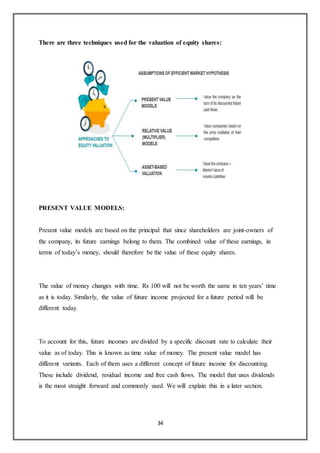
  • 14.
    14 -Strong analytical andinterpersonal skills. -Ability to handle pressurized situations. Achievements -Recognized for Best Analytical Thought in BSE 20**. -Participated in inter College Chess Championship. Academic Qualifications M.Com from PSG arts with First Class B.Com (Accounts) from PSG arts with First Class
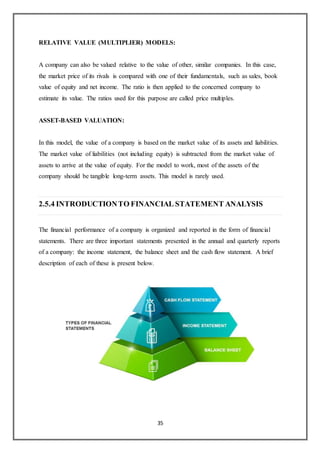
  • 15.
  • 16.
    16 2.0 LIST OFCONCEPTS LEARNT 1. NSE 2. BSE 3. IPO 4. DIVIDEND 5. MARKET CAPITALISATION 6. INSIDER TRADING 7. SHORT SELLING 8. INTRADAY TRADING 9. BULL AND BEAR MARKRT 10. MARKET VOLATALITY 11. MARKETING 12. MARGIN TRADING 13. MAHURAT TRADING 14. PRIMARY MARKET 15. SECONDARY MARKET 16. BROKERAGE 17. SECURITIES SERVICE TAX 18. PORTFOLIO 19. TARGET 20. STOP LOSS 21. DERIVATIVES 22. COMMODITY MARKET 23. STOCK EXCHANGES 24. BROKERS AND SUB-BROKERS 25. SEBI 26. TRADING ACCOUNT 27. DEMAT ACCOUNT 28. DEPOSITARY PARTICIPANT 29. MOBILE TRADING 30. DISCOUNT BROKERS 31. SENSEX
  • 17.
    17 32. NIFTY 33. EPS 34.FACE VALUE 35. L/U PRICE BAND 36. CESS 37. PE RATIO 38. VOLUME 39. TRADING HOURS 40. HISTORICAL STOCK PRICES 41. NDSL 42. CDSL 2.1 TYPES OF STOCK BROKERS Full-Service Brokers These firms charge higher commissions or a percentage of assets. They offer the largest assortment of diversified financial services and usually assign a licensed individual broker to each client. These firms tend to have their own investment banking and research departments that provide their own analyst recommendations, products and access to initial public offerings (IPOs). Clients have the option of calling their personal broker directly to place trades or use various other platforms including online and mobile. Full-service brokers have physical offices and locations. They also offer financial planning, asset management and banking services. In addition to savings and checking accounts many full service brokers provide personal, business and home loans services. While most full-service brokers provide online access and trading functions, they tend to charge higher commissions and route orders directly to their own market makers or through order-fill agreements with other firms. Full- service broker online platforms tend to have less day trading tools and indicators as they cater more towards long-term investors.
  • 18.
    18 DiscountBrokers Discount brokers havenarrowed the gap with full-service brokers in terms of financial products and services providing independent research, mutual fund access and basic banking products. As the name says, discount brokers have smaller commissions for trades. Usually the commissions will range for Rs 1 to Rs 20 per trade ticket, which may appeal to swing traders and less active day traders. The platforms tend to have more trading and research tools than the full-service brokers since they cater to active investors and day traders. Many of the larger discount brokers provide their own direct-access trading platforms and physical office locations throughout the country. Online Brokers Online brokers also known as direct-access brokers cater to active day trading clients with the smallest commissions often priced on a per-share basis, which is needed when scaling in and out of positions. These firms provide direct-access platforms with charting and routing capabilities with access to electronic communication networks (ECN), market makers, specialists, dark pools and multiple exchanges. Speed and access are the top benefits of direct-access brokers, often allowing for point-and-click executions and programmable hot- keys. Complex stock and options orders can be placed on these platforms. The heavy-duty platforms often carry a monthly fee composed of software fees and exchange fees. The software fees can usually be waived or discounted based on the client’s monthly trading volume. Active day traders are best advised to use reputable online/direct-access brokers to ensure maximum control and flexibility as well as speedy order fills. To keep overhead low and pass on the cheaper rates, online brokers usually don’t provide physical office locations for customers.
  • 19.
    19 2.2 TYPES OFTRANSACTIONS DELIVERY TRADING A Delivery trade happens when a trader buys or sell shares & does not square off the position on the same day. These transactions are settled as per the T+2 settlement cycles of the exchanges i.e. Shares bought/sold on Monday are sold on Wednesday and so on and so forth. Note: In India, positional short selling is not allowed in the Cash Market. Hence in order to sell shares, a trader/investor has to own them first. Traditional brokers charge a higher Brokerage when Investors transact in the delivery trades with brokerage running as high as 0.6% or Rs.600 per Lakh. INTRADAY TRADING Taking entry & exits of any financial instrument such as equities, futures, options on same day is intraday trading. Day traders close all their positions before the close of the market. One advantage of trading over investing is, traders can be active both sides of the market, meaning they short first and can buy back later to close the potion. Most brokers provide a lot of leverage or margin for intraday trading, meaning brokers lets you take 10 to 20 times position than actual amount you have in your account. If you have about Rs. 50000 in your account, your broker lets you take Rs. 500000 to Rs. 1000000 position. Due to the large margin funding many traders take far bigger positions than they should be & most novice traders end up blowing up their account within few months.
  • 20.
    20 Fundamentals of acompany do not change on a daily basis, so most day traders take their entries based on Technical Analysis. Some do take trades based on news & rumours 2.3 UNDERSTANDING THE FOUR MEASURES OF VOLATILITY "Volatility" is a term that is increasingly interjected into financial market commentary by the press and professionals. In fact, Bloomberg Radio has a daily "Volatility Report." While the term is being thrown around with a seemingly high degree of expertise, I find that the concept is not well understood by most commentators and the average investor. Historical volatility; Implied volatility; The volatility index; and Intraday volatility. Type 1: Historical Volatility Volatility in its most basic form represents daily changes in stock prices. We call this historical volatility (or historic volatility) and it is the starting point for understanding volatility in the greater sense. Historic volatility is the standard deviation of the change in price of a stock or other financial instrument relative to its historic price over a period of time. That sounds quite eloquent but for the average investor who does not command an intimate knowledge of statistics, the definition is most overwhelming. Think of a Pendulum To help you visualize the concept of volatility, think of a pendulum like in the picture below. The pendulum is constructed from a steel ball, attached to a rope and then suspended from a ceiling. The pendulum starts at the resting state when our ball is at point 2 (the mean). If you raise the ball to point 1 and let it go, the ball would then swing from point 1 to point 3. Over time that ball will swing back and forth always passing though point 2. If this were a stock, the
  • 21.
    21 difference in distancefrom point 1 to point 2 or from point 2 to point 3 represents the volatility in the movement of the stock price. So as not to get into any trouble with physicists out there, the formulas for standard deviation and movement of a pendulum are different and I am not equating the two from a statistical perspective. Rather, I am only using the pendulum as a visual aide. Stocks with a swing that is greater from point 1 to point 2 vs. that of another stock will have a higher volatility than the other stock. Now imagine a wind hitting the metal ball. The force of that wind will increase a stock's volatility. Market corrections, increases in uncertainty or other causal factors of risk will be the wind that shifts volatility higher. Say that there is no wind, but rather calm over the markets. Since there is no outside force to apply motion to the pendulum, the arc of the movement from point 1 to point 3 will decrease. This is when volatility declines. Some call this complacency, but it is generally viewed as a market with low or declining volatility. Type 2: Implied Volatility The options market is a bid and offer system in which buyers and sellers come together in an auction environment to actuate price discovery and execute trades. These prices are quoted in dollars and cents. From these prices, knowing all of the other Black-Scholes variables and using the Black-Scholes formula, we can calculate the volatility, which is implicit from a traded price or the bid and offer. This is referred to as the option's implied volatility. Whereas historic volatility is static for a fixed given period of time, please note that implied volatility will vary for a stock based on different options strike prices. This is referred to as the volatility skew. Type 3: Volatility Indices Just as we can calculate a stock's volatility or the implied volatility from its options, we can do so for an index such as the S&P 500 (SPX) or its exchange-traded fund equivalent, the Spyders (SPY). This concept is taken one step further. For many indices, a volatility index has been created and is commonly quoted in the financial media. The three most common ones:
  • 22.
    22 S&P 500 VolatilityIndex (VIX) S&P 100 Volatility Index (VXO) NASDAQ 100 Volatility Index (VXN) These volatility indices are a weighted average of the implied volatilities for several series of options (puts and calls). Many market participants and observers will use these indices as a gauge of market sentiment. The CBOE Web site has some interesting information on the VIX, other volatility indices and related products. Presented below are the volatility indices for March 6, 2007 and the week prior to that date after the market took its big one-day plunge. Note the huge surge in volatility in response to the market drop. Also, observe the relationship between the individual stocks' implied volatilities and that of the indices. JNJ options are slightly less volatile than the S&P 500 Volatility Index and the S&P 100 Volatility Index for which it is a constituent. RACK options, on the other hand, are significantly more volatile in implied measures than options for the tech-heavy Nasdaq 100 Volatility Index. Type 4: Intraday Volatility Finally, we have intraday volatility. This represents the market swings during the course of a trading day and is the most noticeable and readily available definition of volatility. Intraday volatility is the Justice Potter Stewart type of volatility because it's hard to define but you know it when you see it. A common mistake is equating intraday volatility with the implied volatility index. Both of these forms of volatility are not interchangeable, but do carry their own importance in ascertaining investor sentiment and expectations. I have calculated two measures of market volatility using data from the S&P 500. The first is intraday volatility which reflects the difference between the high and low on the day divided by the closing price of the day for the SPX. The second, Lakeview Asset Management VDEV, is a proprietary measure of volatility that I created using historical trends in the SPX to predict future volatility. The VDEV will be discussed in a future instalment of this series.
  • 23.
    23 In summary, hereis a recap of the four types of volatility: Historical volatility -- the movement of an asset or asset class relative to itself; Implied volatility -- volatility that is embedded in an option price; Volatility index -- a weighted average of implied volatilities for options on a particular index; Intraday volatility-- the price movementsinastock or index onorduringa giventradingday. 2.4 TECHNICAL ANALYSIS The Technical analysis is a methodology to assist you in deciding the timing of investments, which is very vital to make wise investment decisions. The technical analysis is based on the assumption that history tends to repeat itself in the stock exchange. If a certain pattern of activity has in the past produced certain results nine out of ten, one can assume a strong likelihood of the same outcome whenever this pattern appears in the future. However technical analysis lacks a strictly logical explanation. Technical Analysis is the study of the internal stock exchange information and not of those external factors which are reflected in the stock market. All the relevant factors, whatever they may be can be reduced to the volume of the stock exchange transactions and the level of share price or more generally, the sum of the statistical information produced by the market. Few of the most commonly used technical analysis methods for share market Trading are Japanese Candlestick (most powerful stock charting method), Price Curves, Trend Lines, High Low Charts and Moving averages.
  • 24.
    24 Technical Analysis isthe forecasting of future financial price movements based on an examination of past price movements. Like weather forecasting, technical analysis does not result in absolute predictions about the future. Instead, technical analysis can help investors anticipate what is “likely” to happen to prices over time. Technical analysis uses a wide variety of charts that show price over time.
  • 25.
    25 Technical analysis isapplicable to stocks, indices, commodities, futures or any tradable instrument where the price is influenced by the forces of supply and demand. Price refers to any combination of the open, high, low, or close for a given security over a specific time frame. The time frame can be based on intraday (1-minute, 5-minutes, 10-minutes, 15- minutes, 30-minutes or hourly), daily, weekly or monthly price data and last a few hours or many years. In addition, some technical analysts include volume or open interest figures with their study of price action. The Basis of Technical Analysis At the turn of the century, the Dow Theory laid the foundations for what was later to become modern technical analysis. Dow Theory was not presented as one complete amalgamation, but rather pieced together from the writings of Charles Dow over several years. Of the many theorems put forth by Dow, three stand out: 1. Price Discounts Everything 2. Price Movements Are Not Totally Random 3. “What” Is More Important than “Why”
  • 26.
    26 Price Discounts Everything Thistheorem is similar to the strong and semi-strong forms of market efficiency. Technical analysts believe that the current price fully reflects all information. Because all information is already reflected in the price, it represents the fair value, and should form the basis for analysis. After all, the market price reflects the sum knowledge of all participants, including traders, investors, portfolio managers, buy-side analysts, sell-side analysts, market strategist, technical analysts, fundamental analysts and many others. It would be folly to disagree with the price set by such an impressive array of people with impeccable credentials. Technical analysis utilizes the information captured by the price to interpret what the market is saying with the purpose of forming a view on the future. Prices Movements are not Totally Random Most technicians agree that prices trend. However, most technicians also acknowledge that there are periods when prices do not trend. If prices were always random, it would be extremely difficult to make money using technical analysis. In his book, Schwager on Futures: Technical Analysis, Jack Schwager states: “One way of viewing it is that markets may witness extended periods of random fluctuation, interspersed with shorter periods of non-random behaviour. The goal of the chartist is to identify those periods (i.e. major trends).”
  • 27.
    27 A technician believesthat it is possible to identify a trend, invest or trade based on the trend and make money as the trend unfolds. Because technical analysis can be applied to many different time frames, it is possible to spot both short-term and long-term trends. The IBM chart illustrates Schwinger’s view on the nature of the trend. The broad trend is up, but it is also interspersed with trading ranges. In between the trading ranges are smaller uptrends within the larger uptrend. The uptrend is renewed when the stock breaks above the trading range. A downtrend begins when the stock breaks below the low of the previous trading range. "What" is More Important than "Why?" “A technical analyst knows the price of everything, but the value of nothing”. Technicians, as technical analysts are called, are only concerned with two things: What is the current price? What is the history of the price movement? The price is the end result of the battle between the forces of supply and demand for the company's stock. The objective of analysis is to forecast the direction of the future price. By focusing on price and only price, technical analysis represents a direct approach. Fundamentalists are concerned with why the price is what it is. For technicians, the why portion of the equation is too broad and many times the fundamental reasons given are highly suspect. Technicians believe it is best to concentrate on what and never mind why. Why did the price go up? It is simple, more buyers (demand) than sellers (supply). After all, the value of any asset is only what someone is willing to pay for it. Who needs to know why?
  • 28.
    28 2.4.1 GENERALSTEPS TOTECHNICALEVALUATION Many technicians employ a top-down approach that begins with broad-based macro analysis. The larger parts are then broken down to base the final step on a more focused/micro perspective. Such an analysis might involve three steps: Broad market analysis through the major indices such as the S&P 500, Dow Industrials, NASDAQ and NYSE Composite. Sector analysis to identify the strongest and weakest groups within the broader market. Individual stock analysis to identify the strongest and weakest stocks within select groups. The beauty of technical analysis lies in its versatility. Because the principles of technical analysis are universally applicable, each of the analysis steps above can be performed using the same theoretical background. You don't need an economics degree to analyse a market index chart. You don't need to be a CPA to analyse a stock chart. Charts are charts. It does not matter if the time frame is 2 days or 2 years. It does not matter if it is a stock, market index or commodity. The technical principles of support, resistance, trend, trading range and other aspects can be applied to any chart. While this may sound easy, technical analysis is by no means easy. Success requires serious study, dedication and an open mind. 2.4.2 CHART ANALYSIS Technical analysis can be as complex or as simple as you want it. The example below represents a simplified version. Since we are interested in buying stocks, the focus will be on spotting bullish situations.
  • 29.
    29 Overall Trend: Thefirst step is to identify the overall trend. This can be accomplished with trend lines, moving averages or peak/trough analysis. For example, the trend is up as long as price remains above its upward sloping trend line or a certain moving average. Similarly, the trend is up as long as higher troughs form on each pullback and higher highs form on each advance. Support: Areas of congestion and previous lows below the current price mark the support levels. A break below support would be considered bearish and detrimental to the overall trend. Resistance: Areas of congestion and previous highs above the current price mark the resistance levels. A break above resistance would be considered bullish and positive for the overall trend. Momentum: Momentum is usually measured with an oscillator such as MACD. If MACD is above its 9-day EMA (exponential moving average) or positive, then momentum will be considered bullish, or at least improving.
  • 30.
    30 Buying/Selling Pressure: Forstocks and indices with volume figures available, an indicator that uses volume is used to measure buying or selling pressure. When Chaikin Money Flow is above zero, buying pressure is dominant. Selling pressure is dominant when it is below zero. Relative Strength: The price relative is a line formed by dividing the security by a benchmark. For stocks it is usually the price of the stock divided by the S&P 500. The plot of this line over a period of time will tell us if the stock is outperforming (rising) or underperforming (falling) the major index. The final step is to synthesize the above analysis to ascertain the following: Strength of the current trend. Maturity or stage of current trend. Reward to risk ratio of a new position. Potential entry levels for new long position. 2.4.3 TOP-DOWN TECHNICALANALYSIS For each segment (market, sector and stock), an investor would analyse long-term and short-term charts to find those that meet specific criteria. Analysis will first consider the market in general, perhaps the S&P 500. If the broader market were considered to be in bullish mode, analysis would proceed to a selection of sector charts. Those sectors that show the most promise would be singled out for individual stock analysis. Once the sector list is narrowed to 3-4 industry groups, individual stock selection can begin. With a selection of 10-20 stock charts from each industry, a selection of 3-4 of the most promising stocks in each group can be made. How many stocks or industry groups make the final cut will depend on the strictness of the criteria set forth. Under this scenario, we would be left with 9-12 stocks from which to choose. These stocks could even be broken down further to find the 3-4 of the strongest of the strong.
  • 31.
    31 2.5 FUNDAMENTALANALYSIS If youare a fundamental analyst, you will first conduct a qualitative analysis, wherein, you will look at things like the company’s quality of management, corporate governance standards, quality of earnings, competitive position etc. Then, based on these, you will project its future earnings. Intrinsic value can also be defined as the value of these future earnings in terms of today’s money. The present value approach/model is used for this calculation. We will discuss it in detail in subsequent sections. You may also use an approach called the relative value approach for ascertaining the stock’s real value. Herein, you will calculate the inherent value of a company’s shares based on the fundamentals of its competitors. You may first calculate the ratio of the market price of the competitors with a fundamental such as sales, book value or net income. Then, you may apply this ratio to the fundamental of the concerned company and comment on its value. Like the present value approach, here too you may begin your analysis with an assessment of qualitative factors. This approach too will be discussed in detail in subsequent sections. This value calculated using one of these methods is then compared to the current price of the company’s stock. It helps ascertain if the shares are undervalued or overvalued. It is bought if it is overvalued and left alone otherwise. An illustration of this value calculation process is given below.
  • 32.
    32 2.5.1 FUNDAMENTALV/S TECHNICALANALYSIS Equity investors, like you, like to invest in companies that they believe will achieve high earnings growth in the future. This is because high growth companies come with a higher future dividend paying potential. This, in turn, invites more investors to buy them. It ultimately leads to an appreciation of the stock price. 2.5.2 ASSUMPTIONSOF EFFICIENT MARKET FUNDAMENTAL ANALYSIS
  • 33.
    33 This philosophy isbased on three assumptions: other investors in the market have all the relevant information to form an opinion about the future prospects of the company; they act upon this information, and this information gets reflected in market prices. A market that displays these characteristics is called an efficient market. In such markets, all investors are privy to all the information pertaining to a company. They all use the same set of information to make their investment decisions. As a result, nobody can make more profit than the other and all the relevant information is reflects in market prices. This was the central idea of Eugene Fama’s efficient market hypothesis of the 1960s. 2.5.3 INTRODUCTIONTO STOCKVALUATION Now that we have established that the market conditions we operate under are not perfect, it is clear that equity analysis can generate superior returns for you compared to the market. Let’s then proceed towards the process of analysing companies. This portion deals with the approaches to calculating the fair or intrinsic value of a stock. Fair or intrinsic value of a stock is the price the stock should actually be trading at according to your analysis. You can compare it with its current market price to ascertain whether it is overvalued, undervalued or fairly valued. You would like to buy a stock that is undervalued, because its price should appreciate to your estimate of fair value, earning you a profit in the process. If you own a stock that you think is overvalued, you sell it. As for fairly valued stocks, you’d best leave them alone.
  • 34.
    34 There are threetechniques used for the valuation of equity shares: PRESENT VALUE MODELS: Present value models are based on the principal that since shareholders are joint-owners of the company, its future earnings belong to them. The combined value of these earnings, in terms of today’s money, should therefore be the value of these equity shares. The value of money changes with time. Rs 100 will not be worth the same in ten years’ time as it is today. Similarly, the value of future income projected for a future period will be different today. To account for this, future incomes are divided by a specific discount rate to calculate their value as of today. This is known as time value of money. The present value model has different variants. Each of them uses a different concept of future income for discounting. These include dividend, residual income and free cash flows. The model that uses dividends is the most straight forward and commonly used. We will explain this in a later section.
  • 35.
    35 RELATIVE VALUE (MULTIPLIER)MODELS: A company can also be valued relative to the value of other, similar companies. In this case, the market price of its rivals is compared with one of their fundamentals, such as sales, book value of equity and net income. The ratio is then applied to the concerned company to estimate its value. The ratios used for this purpose are called price multiples. ASSET-BASED VALUATION: In this model, the value of a company is based on the market value of its assets and liabilities. The market value of liabilities (not including equity) is subtracted from the market value of assets to arrive at the value of equity. For the model to work, most of the assets of the company should be tangible long-term assets. This model is rarely used. 2.5.4 INTRODUCTIONTO FINANCIAL STATEMENT ANALYSIS The financial performance of a company is organized and reported in the form of financial statements. There are three important statements presented in the annual and quarterly reports of a company: the income statement, the balance sheet and the cash flow statement. A brief description of each of these is present below.
  • 36.
    36 THE INCOME STATEMENT: Theincome statement deals with the incomes and expenses of a company during a given financial year. It classifies them into various parts based on their nature. Expenses are subtracted from incomes to arrive at the profit for the year. When analysing the income statement, you should be concerned about the stability and future growth potential of incomes and expenses. Companies are evaluated on the basis of income from their ‘core businesses’. Although companies also earn revenue from other sources from time to time, these sources are not considered stable and truly representative of the efficiency of the company’s operations. Expenses-wise, you are again interested in looking at the categories of expenses, their criticality to the business, prospects of their recurrence and their role in increasing future earnings. THE CASH FLOW STATEMENT: This statement specifically talks about the cash position of a company. It divides the company’ activities into three categories—operating, investing and financing, and gives an account of the cash flowing in and out of the business on account of these. The importance of the cash flow statement dwells on the fact that while a company earns and spends a lot of funds, as accounted for in the income statement, a lot of these flow are non- cash. A lot of these flows inspire the hope of receiving or paying cash in future, whereas others don’t entail a flow at all. The statement removes this confusion by specifically stating the sources and uses of cash in the current period. Ideally, companies would be best placed if they generate enough cash from operations to finance their investing activities. Bringing in cash from financing activities to fund the other two implies an increase in the level of liabilities.
  • 37.
    37 THE BALANCE SHEET: Thisis the other most critical financial statement. It talks about the assets and liabilities of the business. Unlike the income statement, the balance sheet reflects the state of the assets and liabilities of a business at a particular point in time and not over a period of time. A company needs certain assets to run its business smoothly. These are financed by certain liabilities—debt and equity. For a company to be profitable, the revenue generated from these assets should be greater than the amount required to repay the liabilities incurred to acquire them. This is what you should try and ascertain from the balance sheet. You are concerned about the nature of the assets and their future revenue generation potential. At the same time, you are also concerned about the sustainability of debt. Too much debt will pressurize the company to earn beyond its potential to repay this debt. This is a dangerous and unsustainable proposition. 2.6 GOLDEN RULES FOR TRADING IN STOCKMARKET Neverover trade and do not make hurry to book profit If want to invest Rs.1, 00,000 for trading in Share Market then trade only Rs. 50,000. Don’t over trade Rs. 2, 00,000. Don’t be hurry for booking profit when market is in positive, wait and watch for right time and then book profit. Choose multiple sectors for trading Invest your fund in multiple sectors rather than investing all in a single fund. Trade in 3 or 4 Sectors Stock at a time with strict stop loss.
  • 38.
    38 Follow the trend Donot be afraid to buy at high prices and sell at low prices. Do not buy just because it is a low price & do not sell because it is high. Buy when there is bad news and Sell when there is good news. Don’t; expect to make profit everyday If you consider you are a smart trader who can make profit on every trade, you are 100% wrong. Always be flexible and accept the fact as soon as you realize that you are on wrong side of the trade. Simply get out of the trade without changing your strategy during the market; it may because you double losses. Withdraw some portion of your profit periodically It is must that trader must take a portion of the profit and put it in separate account. This is absolutely must for long term stability in the market. Do not trade with unclear mind NSE & BSE will never close, every morning at 9.00 a.m. (5 days in a week) it will open. So do not try to be a millionaire in a day. It is next to impossible to earn money every day in stock market. If you will avoid stop loss, next day market will avoid you Do not average out in our share tips when market is not in favour. Limit your losses by keeping a stop loss order - Never cancel a stop loss order after you have placed it, otherwise you may lose more. Trade only in stocks having high volume
  • 39.
    39 In low volumestocks the volatility is too high and chance of Stop Loss limit getting failed is too high as there would be no Buyer or seller at your Stop Loss Level. Sell short as often as you long Remember that if you are caught in a SHORT SELL POSITION, high chances are that it will give back in less than a month. But if you are caught in a LONG POSITION it takes much more time to build (Sometimes we have to wait for 2- 3 years for our buying prices.) If you consider 10 different reasons affecting the market (NSE & BSE) - on an average, 7 reasons are for bearish trend & only 3 reasons for bullish trend. Hence be cautious in taking a long position. Do not everfollow rumours Do not follow rumours. Only follow the trend created by genuine news. Adjust your daily expenses in a profit Do not forget expenses like Brokerage, telephone & Mobile bills, Internet charges, computer maintenance, etc. in the profits. 2.7 SETTLEMENT CYCLE The important settlement types are as follows: Normal segment (N) Trade for trade Surveillance (W) Retail Debt Market (D) Limited Physical market (O)
  • 40.
    40 Non cleared TTdeals (Z) Auction normal (A) Trades in the settlement type N, W, D and A are settled in dematerialized mode. Trades under settlement type O are settled in physical form. Trades under settlement type Z are settled directly between the members and may be settled either in physical or dematerialized mode . Details of the two modes of settlement are as under: Dematerialised settlement NSCCL follows a T+2 rolling settlement cycle. For all trades executed on the T day, NSCCL determines the cumulative obligations of each member on the T+1 day and electronically transfers the data to Clearing Members (CMs). All trades concluded during a particular trading date are settled on a designated settlement day i.e. T+2 day. In case of short deliveries on the T+2 day in the normal segment, NSCCL conducts a buy –in auction on the T+2 day itself and the settlement for the same is completed on the T+3 day, whereas in case of W segment there is a direct close out. For arriving at the settlement day all intervening holidays, which include bank holidays, NSE holidays, Saturdays and Sundays are excluded. The settlement schedule for all the settlement types in the manner explained above is communicated to the market participants vide circular issued during the previous month. Rolling Settlement In a rolling settlement, for all trades executed on trading day .i.e.T day the obligations are determined on the T+1 day and settlement on T+2 basis i.e. on the 2nd working day. For arriving at the settlement day all intervening holidays, which include bank holidays, NSE holidays, Saturdays and Sundays are excluded. A tabular representation of the settlement cycle for rolling settlement is given below:
  • 41.
    41 Activity Day Trading RollingSettlement Trading T Clearing Custodial Confirmation T+1 working days Delivery Generation T+1 working days Settlement Securities and Funds pay in T+2 working days Securities and Funds pay out T+2 working days Valuation Debit T+2 working days Post Settlement Auction T+2 working days Auction settlement T+3 working days Bad Delivery Reporting T+4 working days Rectified bad delivery pay-in and pay-out T+6 working days Re-bad delivery reporting and pickup T+8 working days Close out of re-bad delivery and funds pay-in & pay-out T+9 working days Physical settlement Limited physical Market : To provide an exit route for small investors holding physical shares in securities the Exchange has provided a facility for such trading in physical shares not exceeding 500 shares in the 'Limited Physical Market' (small window). Salient features of Limited Physical Market Delivery of shares in street name and market delivery (clients holding physical shares purchased from the secondary market) is treated as bad delivery. The shares standing in the
  • 42.
    42 name of individuals/HUFonly would constitute good delivery. The selling/delivering member must necessarily be the introducing member. Any delivery of shares which bears the last transfer date on or after the introduction of the security for trading in the LP market is construed as bad delivery. Any delivery in excess of 500 shares is marked as short and such deliveries are compulsorily closed-out. Shortages, if any, are compulsorily closed-out at 20% over the actual traded price. Non rectification/replacement for bad delivery are closed out at 10% over the actual trade price. Non rectification/replacement for objection cases are closed out at 20% above the official closing price in regular Market on the auction day. The buyer must compulsorily send the securities for transfer and dematerialisation, latest within 3 months from the date of pay-out. Company objections arising out of such trading and settlement in this market are reported in the same manner as is currently being done for normal market segment. However securities would be accepted as valid company objection, only if the securities are lodged for transfer within 3 months from the date of pay-out.
  • 43.
    43 Limited Physical Market Settlementfor trades is done on a trade-for-trade basis and delivery obligations arise out of each trade. The settlement cycle for this segment is same as for the rolling settlement viz: Activity Day Trading Rolling Settlement Trading T Clearing Custodial Confirmation T+1 working days Delivery Generation T+1 working days Settlement Securities and Funds pay in T+2 working days Securities and Funds pay out T+2 working days Valuation Debit T+2 working days Post Settlement Assigning of shortages for close out T+2 working days Reporting and pick-up of bad delivery T+4 working days Close out of shortages T+4 working days Replacement of bad delivery T+6 working days Reporting of re-bad and pick-up T+8 working days Close out of re-bad delivery T+9 working days Bad Deliveries (in case of physical settlement) Bad deliveries (deliveries which are prima facie defective) are required to be reported to the clearing house within two days from the receipt of documents. The delivering member is required to rectify these within two days. Un-rectified bad deliveries are assigned to auction on the next day
  • 44.
    44 Company Objections (incase of physical settlement The CM on whom company objection is lodged has an opportunity to withdraw the objection if the objection is not valid or the documents are incomplete (i.e. not as required under guideline No.100 or 109 of SEBI Good/Bad delivery guidelines), within 7 days of lodgement against him. If the CM is unable to rectify/replace defective documents on or before 21 days, NSCCL conducts a buying-in auction for the non-rectified part of defective document on the next auction day through the trading system of NSE. All objections, which are not bought-in, are deemed closed out on the auction day at the closing price on the auction day plus 20%. This amount is credited to the receiving member's account on the auction pay-out day. 2.8 STOCKEXCHANGE CHARGES More often than not, when you are taking close intra-day trading calls, where the margins are wafer thin, you should have complete grasp of what your costs are going to be for a particular trade. These additional cost can become the difference between a winning trade and losing trade. Please see below detailed information on statutory charges on stock exchange transactions, other than Brokerage charges. Brokerage charges differ from brokers to brokers so brokerage charges of 123capital will be discussed later in this report. Securities Transaction Tax (STT) Equity Delivery Transactions Purchase: 0.10% of Turnover i.e. (Number of Shares * Price) Sell: 0.10% of Turnover i.e. (Number of Shares * Price) Equity Intra-day Transactions Purchase: NIL Sell: 0.025% of Turnover i.e. (Number of Shares * Price) Future Transactions Purchase: NIL Sell: 0.010% of Turnover i.e. (Number of Lots * Lot Size * Price)
  • 45.
    45 Option Transactions Purchase: NILat the time of purchase of option. However the purchaser has to pay 0.125% of the Settlement Price i.e. (Number of Lots * Lot Size * Strike Price), in case of option exercise Sell: 0.017% of Premium Transaction Charges Equity Delivery Transactions Purchase: 0.0031% of turnover in NSE and 0.0035% of Turnover in BSE Sell: 0.0031% of turnover in NSE and 0.0035% of Turnover in BSE Equity Intra-day Transactions Purchase: 0.0031% of turnover in NSE and 0.0035% of Turnover in BSE Sell: 0.0031% of turnover in NSE and 0.0035% of Turnover in BSE Future Transactions Purchase: 0.00185% of Turnover i.e. (Number of Lots * Lot Size * Price) Sell: 0.00185% of Turnover i.e. (Number of Lots * Lot Size * Price) Option Transactions Purchase: 0.05% of Premium Sell: 0.05% of Premium SEBI Turnover Charges Equity Delivery Transactions Purchase: 0.0001% of Turnover Sell: 0.0001% of Turnover Equity Intra-day Transactions Purchase: 0.0001% of Turnover Sell: 0.0001% of Turnover Future Transactions Purchase: 0.0001% of Turnover i.e. (Number of Lots * Lot Size * Price) Sell: 0.0001% of Turnover i.e. (Number of Lots * Lot Size * Price) Option Transactions Purchase: 0.0001% of Premium Sell: 0.0001% of Notional Value in case of exercise or assignment
  • 46.
    46 Stamp Duty Equity DeliveryTransactions Purchase: 0.01% of Turnover. Turnover usually taken in multiple of Rs 5000 Sell: 0.01% of Turnover. Turnover usually taken in multiple of Rs 5000 Equity Intra-day Transactions Purchase: 0.002% of Turnover. Turnover usually taken in multiple of Rs 5000 Sell: 0.002% of Turnover. Turnover usually taken in multiple of Rs 5000 Future Transactions Purchase: 0.002% of Turnover. Turnover usually taken in multiple of Rs 5000 Sell: 0.002% of Turnover. Turnover usually taken in multiple of Rs 5000 Option Transactions Purchase: 0.002% of Premium Sell: 0.002% of Notional Value in case of exercise or assignment Service Tax Service Tax, Surcharge and Education Cess are applicable on Brokerage, Transaction Charges, SEBI Turnover Charges and Stamp Duty. Note Service Tax, Surcharge and Education Cess are not applicable on Securities Transaction Tax (STT). Quick summary of Charges other than Brokerage, for Stock exchange transactions Charges Equity Delivery Equity Intra-day Futures Options Securities Transactions Tax 0.10% of Turnover 0.025% of Turnover on SELL transactions 0.010% of Turnover on SELL transactions 0.017% of Option Premium on SELL transactions and 0.125% of Settlement Value where Option is exercised Transaction Charges 0.0031% of Turnover in NSE and 0.0035% of Turnover in BSE 0.0031% of Turnover in NSE and 0.0035% of Turnover in BSE 0.00185% of Turnover 0.05% of Premium
  • 47.
    47 SEBI Turnover Charges 0.0001% of Turnover 0.0001%of Turnover 0.0001% of Turnover and closeout 0.0001% of Premium and Notional value for Exercise / Assignment Stamp Duty 0.01% of Turnover 0.002%of Turnover 0.002% of Turnover and closeout 0.002% of Premium and Notional value for Exercise / Assignment Detailed summary of Other Charges with Service Tax Securities Transaction Tax (STT) Product Transaction Rate Service Tax Effective Rate Charged on Equity Delivery Purchase 0.100% – 0.100% Turnover Sell 0.100% – 0.100% Turnover Equity Intra- day Purchase – – – – Sell 0.025% – 0.025% Turnover Future Purchase – – – – Sell 0.017% – 0.010% Turnover Option Purchase 0.125% – 0.125% Settlement price, on exercise Sell 0.017% – 0.017% Premium Transaction Charges Product Transaction Rate Service Tax Effective Rate Charged on Equity Delivery Purchase 0.0031% 12.36% 0.00348% Turnover
  • 48.
    48 Sell 0.0031% 12.36%0.00348% Turnover Equity Intra- day Purchase 0.0031% 12.36% 0.00348% Turnover Sell 0.0031% 12.36% 0.00348% Turnover Future Purchase 0.00185% 12.36% 0.00208% Turnover Sell 0.00185% 12.36% 0.00208% Turnover Option Purchase 0.05% 12.36% 0.05618% Premium Sell 0.05% 12.36% 0.05618% Premium SEBI Turnover Charges Product Transaction Rate Service Tax Effective Rate Charged on Equity Delivery Purchase 0.0001% 12.36% 0.00011% Turnover Sell 0.0001% 12.36% 0.00011% Turnover Equity Intra- day Purchase 0.0001% 12.36% 0.00011% Turnover Sell 0.0001% 12.36% 0.00011% Turnover Future Purchase 0.0001% 12.36% 0.00011% Turnover Sell 0.0001% 12.36% 0.00011% Turnover Option Purchase 0.0001% 12.36% 0.00011% Premium and Notional value for Exercise / Assignment Sell 0.0001% 12.36% 0.00011% Premium and Notional value for Exercise / Assignment Stamp duty Product Transaction Rate Service Tax Effective Rate Charged on Equity Delivery Purchase 0.0100% 12.36% 0.0112% Turnover, in 5000 multiple Sell 0.0100% 12.36% 0.0112% Turnover, in 5000 multiple
  • 49.
    49 Equity Intra- day Purchase 0.0020%12.36% 0.0022% Turnover, in 5000 multiple Sell 0.0020% 12.36% 0.0022% Turnover, in 5000 multiple Future Purchase 0.0020% 12.36% 0.0022% Turnover, in 5000 multiple Sell 0.0020% 12.36% 0.0022% Turnover, in 5000 multiple Option Purchase 0.0020% 12.36% 0.0022% Turnover, in 5000 multiple Sell 0.0020% 12.36% 0.0022% Turnover, in 5000 multiple 2.8.1 123CAPITALS BROKERAGE EQUITIES/F & O
  • 50.
  • 51.
    51 2.9 DEMAT A/C WHATIS DEMATERIALIZATION? Technology has brought about a drastic change in our everyday lives. The stock markets too have not been left untouched by the change. In 1875, the Bombay Stock Exchange was founded with an open outcry floor trading exchange. Traders would stand on the floor and shout prices of stocks for buying or selling. Then, money would be exchanged for physical receipts of the shares called the certificate. This led to a great amount of paperwork. Even the settlements of trade agreements took time because of the need to deliver the share certificates. Much has changed since. In 1996, dematerialization was embraced. Dematerialization is the process by which physical share certificates held by an investor are converted into an equivalent number of securities in electronic form and credited into the investor’s demat account. CENTRAL DEPOSITORY: There are two depositories in India – the CDSL and NSDL. They hold all the demat accounts. The central depository holds details of your shareholding on your behalf like banks. UNIQUE ID: Each demat account has a unique number for identification purposes. This is the number you need to provide for transactions. The number will help the exchange and companies identify you and credit the shares in your account. DEPOSITORY PARTICIPANTS: Access to the central depository is provided by the Depository Participants or DPs. They act as the intermediary between the central depository and the investor. DPs could be banks, brokers or financial institutions that are empowered to offer demat services. You open a
  • 52.
    52 demat account ora Beneficial Owner (BO) accounts with a DP, who will provide you a unique access to the central depository. PORTFOLIO HOLDING: The demat account holds all your securities. So, whenever you check your account, you can see your portfolio holding and its details. These are updated automatically every time you conduct a transaction – be is buying or selling a security. 2.9.1 HOW DO YOU OPEN A DEMAT ACCOUNT?
  • 53.
    53  Then fillup an account opening form and submit along with copies of the required documents and a passport-sized photograph. You also need to have a PAN card. Also carry the original documents for verification.  You will be provided with a copy of the rules and regulations, the terms of the agreement and the charges that you will incur.  During the process, an In-Person Verification would be carried out. A member of the DP’s staff would contact you to check the details provided in the account opening form.  Once the application is processed, the DP will provide you with an account number or client ID. You can use the details to access your demat account online.  As a demat account holder, you would need to pay some fees like the annual maintenance fee levied for maintenance of account and the transaction fee -- levied for debiting securities to and from the account on a monthly basis. These fees differ from every service provider (called a Depository Participant or DP). While some DPs charge a flat fee per transaction, others peg the fee to the transaction value, and are subject to a minimum amount. The fee also differs based on the kind of transaction (buying or selling). In addition to the other fees, the DP also charges a fee for converting the shares from the physical to the electronic form or vice-versa. Minimum shares: A demat account can be opened with no balance of shares. It also does not require that a minimum balance be maintained. 2.9.2 DOCUMENTS REQUIRED FOR A DEMAT & TRADING ACCOUNT You need to submit proof of identity and address along with a passport size photograph and the account opening form. Only photocopies of the documents are required for submission, but originals are also required for verification. Here is a broad list of documents that can be used as proofs:
  • 54.
    54 You need tosubmit proof of identity and address along with a passport size photograph and the account opening form. Only photocopies of the documents are required for submission, but originals are also required for verification. Proof of identity: PAN card, voter's ID, passport, driver's license, bank attestation, IT returns, electricity bill, telephone bill, ID cards with applicant's photo issued by the central or state government and its departments, statutory or regulatory authorities, public sector undertakings (PSUs), scheduled commercial banks, public financial institutions, colleges affiliated to universities, or professional bodies such as ICAI, ICWAI, ICSI, bar council etc. Proof of address: Ration card, passport, voter ID card, driving license, bank passbook or bank statement, verified copies of electricity bills, residence telephone bills, leave and license agreement or agreement for sale, self-declaration by High Court or Supreme Court judges, identity card or a document with address issued by the central or state government and its departments, statutory or regulatory authorities, public sector undertakings (PSUs), scheduled commercial banks, public financial institutions, colleges affiliated to universities and professional bodies such as ICAI, ICWAI, Bar Council etc. This is easy. All you need to do is fill in the Demat Request Form (DRM), fill in the appropriate details of the share certificates you hold, and submit it with the physical share receipt. Every share certificate needs a separate DRM form. Once the form is approved, your demat account will automatically be updated to reflect your newly dematerialized shares. 2.10 TRADING ACCOUNT 2.10.1 WHAT IS A TRADING ACCOUNT? When a company lists on the stock market, its shares become available for trading on the stock exchange. Earlier, the exchange had an open-outcry system. In the mid-90s, the stock exchanges adopted the electronic system. This means, all trades were conducted
  • 55.
    55 electronically. Simply put,you didn’t have to go to the counter and place an order physically. You could do it through a computer, which would verify the details, the market price, and process the trade. For this reason, you need a special account through which you can conduct transactions. This is called the trading account. Without one, you cannot trade in the stock markets. You register for an online trading account with a stock broker or a firm. Each account comes with a unique trading ID, which is used for conducting transactions. 2.10.2 HOW TO OPEN AN ONLINE TRADING ACCOUNT? Just like the demat account, a trading account is a must for investing in the stock market. This is because to trade in the stock markets, you need to be registered with the stock exchange. Stock brokers are registered members of the exchanges. They traditionally conduct trades on your behalf. Most often, stock broking firms have thousands of clients. It is not feasible to take physical orders from every client on time. So, to make this process seamless, it is advisable to open an online trading account. Using this trading account, you can place buy or sell orders either online or phone, which will automatically be directed to the exchange through the stock broker.
  • 56.
    56  First, selectthe stock broker or firm. Ensure that the broker is good and will take your orders in a timely manner. Remember, time is of utmost importance in the stock market. Even a few minutes can change the market price of the stock. For this reason, ensure that you select a good broker.  Compare brokerage rates. Every broker charges you a certain fee for processing your orders. Some may charge more, some less.  Some give discounts on the basis of the amount of trades conducted. Take all this into account before opening an account. However, remember that it is not necessary to choose a broker who charges the lowest fees. Good quality brokerage services provided often may need higher-than-average charges.  Next, get in touch with the brokerage firm or broker and enquire about the account opening procedure. Often, the firm would send a representative to your house with the account opening form and the Know Your Client (KYC) form  Fill these two forms up. Submit along with two documents that serve as proof of your identity and address.  Your application will be verified either through an in-person check or on the phone, where you will be asked to divulge your personal details.  Once processed, you will be given your trading accounts details. Congrats, you will now be able to conduct trades in the stock market
  • 57.
    57 2.10.3 TYPES OFORDERS You can place different kinds of orders such as market orders, limit orders, stop loss orders, good-till-cancelled orders, after-market orders (AMOs), etc. Market order A market order is an order to buy or sell a stock at the current market price. It signals your broker to execute the order at the best price currently available. However, as market prices keep changing, a market order cannot guarantee a specific price. Limit order To avoid buying or selling a stock at a price higher or lower than you wanted, you need to place a limit order rather than a market order. A limit order is an order to buy or sell a security at a specific price. You could use a limit order when you want to set the price of the stock. In other words, you want to sell/buy particular scrip at a price other than the current market price. However, although a limit order guarantees a price, it cannot guarantee execution of the trade. This is because the stock might not reach the desired price on that particular trading day owing to market-related factors. Stop loss order A stop loss order is a normal order placed with a broker to sell a security when it reaches a certain predetermined price called the trigger price. Sometimes the market movements defy your expectations. Such market reversals often result in loss-bearing transactions. The stop
  • 58.
    58 loss trigger priceis your defence mechanism – an amount at which you will be able to sustain yourself against such unanticipated market movements. For example, if you bought a stock at Rs. 10, you place a stop loss order with your broker to sell it, if it reaches Rs. 8. This helps you prevent further loss, in the eventuality that the price of the stock might dip even further. Thus, it helps limit your loss or protect unrealized profits, whichever the case. Good-till-cancelled GTC or Day Orders are orders given to your broker that hold true only during the trading day when the order was placed. If the order has not been executed on that day, it will not be passed on to the next trading day. Thus, they are orders that are only 'good until it is cancelled' or 'good for the day'. For example, suppose that you have placed a stop loss order with your broker to sell a stock once the price reaches level X. If it does not reach limit X, your broker will not sell the stock. However, the stop loss order given to your broker will not hold true for the next day. So, even if the stock reaches level X on Day 2, he will not execute the trade till you instruct him to do so again. IOC An Immediate or Cancel (IOC) order allows a Trading Member to buy or sell a security as soon as the order is released into the market, in case order failed to full fill the total quantity it will be removed from the market. Partial match is possible for the order, and the unmatched portion of the order is cancelled immediately.
  • 59.
  • 60.
    60 3.1 STUDENT’S WORKPROFILE(ROLE AND RESPONSIBILITIES): This work was at 123CAPITALS LTD. with a profile of sales trainee. This profile offers us to understand the need of customer and provide them the best deal possible with maximization of the profit, both for the company as well as for the customer. The most important aspect for the role of trainee is trust. So far fulfilment of the targets one needs to: • Capitalize on the old and loyal client age which can be building slowly by advising people in the best possible way. • Generating new leads through various activities. 3.2 GENERATION OF LEADS: Since this work was new in the field so this work had to start from scratch and generate new leads to sustain in the market. Cold calling is one of the trusted ways of getting to the customers without meeting them. Although the rate of conversion remained very less, for cold calling the quality and accent remains a very important criterion. This activity gives us mixed result. This activity often got success and generated many leads through it but it also landed me in awkward position where the customer were in different mood and made us hear words for which a marketer should be always prepared to hear. Corporate calls always remained more difficult to crack with respect to retail sector. The corporate were the most difficult and most temping to get the business from. It took me one day to crack Hi-tech Gears At 123CAPITALS LTD. after getting the product knowledge in the first week at the branch I was also allotted distributor to work with. In the initial phase
  • 61.
    61 I was accompaniedby more experienced staff. After I became known to the market and procedure I started attending calls alone only. After the third week my performance also improved and I was able to get close to the targets, though it looked difficult to achieve in the beginning. To get awareness of the every product I attended diversified calls. This helped me to implement cross selling to get better results. 3.3 ANALYSIS OF CALLING The first step in the project execution as mentioned above was the Tele calling of the inactive clients to start trading again. The total number of clients called was 520 which are categorize on the basis of their response to the calls, the responses are categorized into 11 broad categories because the responses were open ended and was not easy to summarize all the responses as such so these responses are slightly modified and categorized accordingly to analyse. The responses of all the clients are recorded as shown in the table below Status of calling No. ofRespondents Already Trading 70 Booked losses 5 Call not receiving 114 Interested 52 Interested in equity 4 Meeting done 5
  • 62.
    62 Not interested 151 Outof range/switched off 96 Want to close a/c 6 Will call himself when interested 10 Will give fund in February 7 3.4 INTERPRETATIONOF THE DATA • From the given data it can be easily identified that the percentage of the clients not interested in trading is the highest and the second highest is of the clients who were not receiving the clients and they can be considered as not interested clients but we cannot make a guess so we have kept those clients in different segment. If we consider from the data of the highest two categories than we can say that almost 50 % of the clients are not interested. • 18% of the clients are out of range or switched off which reveals that the database is outdated and is not updated with tine so that the contact between the client and the company can be there. • Again 14 % of the clients were already trading that means either they were trading or got activated before the call was made, so this is again a case where the database needs to be updated so that the repeat calls could not be there for reactivation.
  • 63.
    63 • Only 10%of the clients found to be interested in further working with the company and want to activate their accounts out of which some wants relaxation in the brokerage and need a RM so that they might stay updated. • Rest 2% were seemed to be interested and will call themselves, 1 % were ready to give funds in July and start trading then only, and the remaining 2 % booked losses and want to close the account. • 1% of the clients was done with the meetings with RMs and was ready to invest again. 3.5 SELF TRADING ACCOUNT After getting sufficient knowledge about share trading from experienced employees at 123CAPITALS I decided to open a share trading account in my own name and I decided not to open the account in 123CAPITALS because I did not find the brokerage of 123CAPITALS suitable to my needs. So I decided to open my trading account at ZERODHA. The brokerage details of Zerodha are as follows: Free equity delivery All your equity delivery investments (NSE, BSE), absolutely free — ₹0 brokerage. Intraday equity and F&O trades ₹20 or 0.01% (whichever is lower) per executed order on intraday trades across equity, currency, and commodity trades across NSE, BSE, and MCX. I usually do not do Intraday trading and try my level best to stick to delivery trading as it involves lesser risk and avoid speculation trading and Zerodha providing zero brokerage for delivery based trading is a great feature which attracts many traders. 123CAPITALS is a
  • 64.
    64 suitable broker fortraders who make a lot of intraday trades as the cap for brokerage per day is only Rs 123/Segment. Zerodha also provides quality back office and trading tools which provides various tools for analysis and maintaining proper statement. The tools provided by Zerodha are as follows: Kite web Kite is a minimalistic, intuitive, responsive, light, yet powerful web and mobile trading application offered by Zerodha. Bandwidth consumption of less than 0.5 Kbps for a full market watch, extensive charting with over 100 indicators and 6 chart types, advanced order types like Brackets and cover, millisecond order placements, and more. Used by over 70,000 clients and serving over 5 million requests a day with no hiccups. Kite mobile Enjoy the Kite experience seamlessly on your Android and iOS devices.
  • 65.
    65 Kite Connect API KiteConnect is a set of simple HTTP APIs built on top of Zerodha’s exchange-approved web based trading platform, Kite. It enables users—clients of Zerodha—to gain programmatic access to data such as profile and funds information, order history, positions, live quotes etc. In addition, it enables users to place orders and manage portfolio at their convenience from an interface of their choice. Q Complete trade and reporting console and dashboard.
  • 66.
    66 Quant A personal tradingjournal with insights on your best trading periods, most profitable streaks, optimal position sizes, contracts, and more, all intelligently compiled from your past trading behaviour.
  • 67.
    67 Pi Pi is thedesktop trading application built by Trade lab. Trading, charting, scripting, and analysis, all rolled into a Windows desktop trading platform. With all the above tools trading and analysis becomes very easy. Although I am a beginner in trading the tools provided by Zerodha made trading look very easy. As 123CAPITALS is a new brokerage firm it requires a lot of marketing activities to increase the goodwill of the company and instil trust among the traders
  • 68.
    68 3.6 MY PORTFOLIO Symbol Buy qty Buy avg Buyvalue Sell qty Sell avg Sell value Net Qty Previous Closing Price Realized profit Unrealized Profit 1 HCC 600 ₹40.09 ₹24,056.50 0 0 0 600 ₹43.25 ₹1893.50 2 EDL 120 ₹70.75 ₹8,490.00 0 0 0 120 ₹56.15 ₹-1,752.00 Total realized profit 0 ₹141.5 Reason I have purchased both Hindustan Construction Company Ltd and Empee Distilleries Ltd with a long term prospective. 3.7 WORK AT 123CAPITALS My work started on the 19th of DECEMBER, 2016 at 9.00 am sharp. As it was Monday morning, the fresh day for the trading week everyone in the office was quite busy with their work and no one bothered to assign any work to me nor were interested in teaching me anything. Nearly after 2 hours things started to settle down in the office and I was called by Mr.Chakkaravarthy the managing director of the broking firm. He assigned me with a person named Revathi to guide me during the internship period. Mr.Chakkaravarthy said that
  • 69.
    69 my main focuswould be based on marketing for the company because the company itself was mainly focused in the expansion of the company and company name. I too believed that the company required a lot of work in the marketing department as the company was lacking in active clients compared to other competitive companies such as Karvy, Zerodha, RSK Securities, LKP securities, Sharekhan. Mrs. A. Revathi was very helpful to me during my entire internship course. I could not have completed this course without the help of Mr. Revathi. He was the one who thought me the entire basics regarding share market. It took me nearly a week to learn about the basics about share market. On the second day Mrs. A. Revathi insisted me to open a trading account in order to improve my involvement and interest in share market. As I had a Pan Card and bank account I right away decided to open the trading account at Zerodha with the permission of my father with a capital of Rs32500.The account opening process took about 4 days and my trading account was opened on the 23rd of December, 2016.As soon as my account was opened I was ready with my portfolio and accordingly I bought 600 shares of HCC ltd and 120 shares of Empee Distilleries with long term prospective as Mrs. A. Revathi advised me never to do intraday trading and said that long term trading is most beneficial and risk free. From 26th onwards I was given a job in the marketing department. My work was to make calls to selected number of inactive clients to find out the reason as to why they weren’t trading presently and I received mixed results and the report regarding the tele calling analysis can be found on Page no.56 of this report. I had to submit the report to the Managing Director Mr.Chakkaravarthy before the 6th of January, 2017 and I did successfully submit the required report on the 5th of January and Mr.Chakkaravarthy congratulated me for the work I had done and for early submission. On the 6th January I was not assigned any job so I was just going through the different departments of the firm. From the 9th onwards I was given a sheet everyday with different mobile numbers along with their names and I had call everyone and persuade them to practice trading and choose 123CAPITALS for it by explaining all the advantages of trading with 123CAPITALS.I received mixed results during the tele calling sessions and most of them would just end the call abruptly without even listening to what I had to say, some of them were really interested and asked various questions about trading and about 123CAPITALS.It was a very difficult task as I had to explain in detail all the information
  • 70.
    70 related to tradingover the phone and also I had to answer their queries. I felt it was very monotonous and boring job as I had to repeat the same information over and over again. Many of them did seem interested in trading after explaining in detail about trading but they hesitated and backed out to trade with 123CAPITALS as they said that they did not hear about the company anywhere and felt that the company lacked goodwill. But with great efforts I did manage to find 5 new clients for the company namely: 1. G.Krishnamurthy (44) 2. S.Sumathi (32) 3. R.Ram Kumar (32) 4. Alphonse (52) 5. S.Shekar Reddy (45) I had to personally meet all the above persons in their respective houses and offices to guide them and complete the account opening process. It was very difficult and time consuming job as most of them were filled with questions as they were very scared to risk their money as they believed that share trading only leads to losses. All of them said that they heard this statement from people who had done share trading in the past and I felt this is the main reason for slow growth of financial sector in India. Most of them believe that share trading is similar to gambling and hesitate to invest their money in the share market which provides a huge opportunity for wealth growth. I continued with the same task till the 13th of January and after that I started to collect materials and information with the help of Mrs. A. Revathi for preparation of my internship report. On the 17th I summarised my daily report, wished everyone goodbye and I successfully completed my 26 days of internship. It was a great experience and I learnt a lot from this internship and it also helped me to explore a new Phase of the financial market with expert guidance.
  • 71.
  • 72.
    72 4.1 INTERPERSONALSKILLS  SELFCONFIDENCE  POSITIVE ATTITUDE  COMMUNICATION  CRITICAL THINKING AND PROBLEM SOLVING  TIME MANAGEMENT AND PUNCTUALITY  TEAM WORK  HANDLING PRESSURE  FLEXIBILITY  ABILITY TO ACCEPT CONSTRUCTIVE FEEDBACK  STRONG WORK ETHIC
  • 73.
    73 4.2 TECHNICAL SKILLS AnalyticalSkill One skill every trader needs is the ability to analyse data quickly. There is a lot of math involved in trading, but it is represented through charts with indicators and patterns from technical analysis. Consequently traders need to develop their analytical skills so they can recognize trends and trends in the charts. Research Traders need to have a healthy thirst for information and a desire to find all the relevant data that impacts the securities they trade. Many traders create calendars of economic releases and set announcements that have measurable effects on the financial markets. By being on top of these information sources, traders are able to react to new information as the market is still digesting it. Focus Focus is a skill and it increases the more traders exercise it. Because there is so much financial information out there, traders need to be able to hone in on the important, actionable data that will affect their trades. Some traders also focus in on the types of securities they trade so they can deepen their understanding of a specific sector, industry or currency to the point where it becomes a competitive advantage against less specialized traders. Control Hand in hand with focus is control. A trader needs to control his or her emotions and stick to a trading plan and strategy. This is especially important in managing risk by using stop losses or taking profits at set points. Many strategies are designed so the trader loses a little in bad trades and systematically gains more on good trades. When traders start to get emotional about their trades - good or bad - strategy goes out the window. Record Keeping One of the most important keys to trading is record keeping. If a trader records the results of his or her trades diligently, then improving is simply a matter of testing and tweaking
  • 74.
    74 strategies to finda successful one. It is hard to show real progress if you are keeping accurate records. Marketing Marketing is important in every organisation as it helps in increasing the goodwill and attracting more potential clients who help in the growth of the business.
  • 75.
  • 76.
    76 5.1 POSITIVE THINGSABOUT INTERNSHIP PROGRAMME The following areas were the positive things about the internship: • Good Communication Skills (Voice quality is clear and articulate) • Persistent and able to bounce back from rejection • Good organizational skills. • Ability to project a telephone personality (Enthusiasm, friendliness) • Flexibility: can adapt to different types of clients and new situations • Punctuality – Punctual to the workplace 5.2 LIMITATIONS AND SUGGESTIONS The limitations of the internship are as follows: • Insufficient Time Period – Unable to understand the concepts completely • Limited Scope – The options available to the students is quite limited • Excess Holidays – The internship period had a lot of public holidays namely Christmas, New Year and Pongal •Insufficient Job Search Period – The time period provided for submission of acceptance letter was very less which is just 7 working days.
  • 77.
    77 The Suggestions forimproving the internship are as follows: • Provide sufficient internship period • Provide more options to choose from • Conduct the internship during summer to reduce occurrence of public holidays • Provide adequate time for job searching
  • 78.
    78 CONCLUSION I have donemy internship in 123CAPITALS and I have learned and acquired many skills which I did not possess beforemy internship, also I have successfully completed my internship with the help of my professors and intern guide, they were friendly and kind to me which enabled me to perform better. Overall this has been a great journey for me and this internship has certainly helped me gain more practical understanding about the work and I have learned and improved within myself. I thank the college for giving this great opportunity and my guide Prof. I. Eucharista Fatima Mary for her guidance throughout the internship.
  • 79.