Richard.Kang@hv.io ©
2021
Internet Of Things
Case Studies of Edge Computing
presented by
Richard Kang
Richard.Kang@hv.io
https://www.linkedin.com/in/kangks/
prepared by
08 April 2021
Richard.Kang@hv.io ©
2021
My professional experience
- Principal Cloud Engineer with Versent Singapore, an AWS
Premier Partner
- Senior IoT Specialist Solution Architect with Amazon
Web Services (AWS)
Richard.Kang@hv.io ©
2021
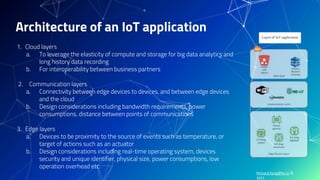
Architecture of an IoT application
1. Cloud layers
a. To leverage the elasticity of compute and storage for big data analytics and
long history data recording
b. For interoperability between business partners
2. Communication layers
a. Connectivity between edge devices to devices, and between edge devices
and the cloud
b. Design considerations including bandwidth requirements, power
consumptions, distance between points of communications
3. Edge layers
a. Devices to be proximity to the source of events such as temperature, or
target of actions such as an actuator
b. Design considerations including real-time operating system, devices
security and unique identifier, physical size, power consumptions, low
operation overhead etc.
Richard.Kang@hv.io ©
2021
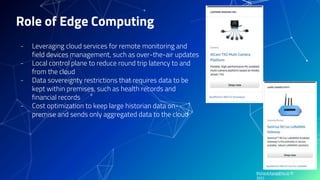
Role of Edge Computing
- Leveraging cloud services for remote monitoring and
field devices management, such as over-the-air updates
- Local control plane to reduce round trip latency to and
from the cloud
- Data sovereignty restrictions that requires data to be
kept within premises, such as health records and
financial records
- Cost optimization to keep large historian data on-
premise and sends only aggregated data to the cloud
Richard.Kang@hv.io ©
2021
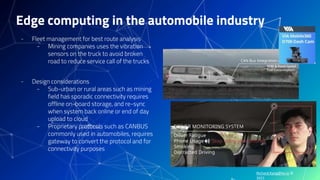
Edge computing in the automobile industry
- Fleet management for best route analysis
- Mining companies uses the vibration
sensors on the truck to avoid broken
road to reduce service call of the trucks
- Design considerations
- Sub-urban or rural areas such as mining
field has sporadic connectivity requires
offline on-board storage, and re-sync
when system back online or end of day
upload to cloud
- Proprietary protocols such as CANBUS
commonly used in automobiles, requires
gateway to convert the protocol and for
connectivity purposes
Richard.Kang@hv.io ©
2021
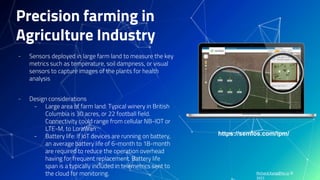
Precision farming in
Agriculture Industry
- Sensors deployed in large farm land to measure the key
metrics such as temperature, soil dampness, or visual
sensors to capture images of the plants for health
analysis
- Design considerations
- Large area of farm land: Typical winery in British
Columbia is 30 acres, or 22 football field.
Connectivity could range from cellular NB-IOT or
LTE-M, to LoraWan
- Battery life: If IoT devices are running on battery,
an average battery life of 6-month to 18-month
are required to reduce the operation overhead
having for frequent replacement. Battery life
span is a typically included in telemetrics sent to
the cloud for monitoring.
https://semios.com/ipm/
Richard.Kang@hv.io ©
2021
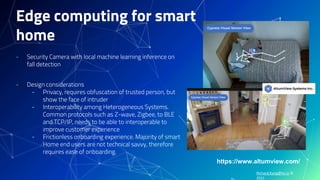
Edge computing for smart
home
- Security Camera with local machine learning inference on
fall detection
- Design considerations
- Privacy, requires obfuscation of trusted person, but
show the face of intruder
- Interoperability among Heterogeneous Systems.
Common protocols such as Z-wave, Zigbee, to BLE
and TCP/IP, needs to be able to interoperable to
improve customer experience
- Frictionless onboarding experience. Majority of smart
Home end users are not technical savvy, therefore
requires ease of onboarding.
https://www.altumview.com/
Richard.Kang@hv.io ©
2021
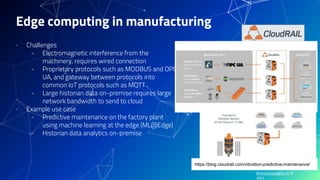
Edge computing in manufacturing
- Challenges
- Electromagnetic interference from the
machinery, requires wired connection
- Proprietary protocols such as MODBUS and OPC-
UA, and gateway between protocols into
common IoT protocols such as MQTT
- Large historian data on-premise requires large
network bandwidth to send to cloud
- Example use case
- Predictive maintenance on the factory plant
using machine learning at the edge (ML@Edge)
- Historian data analytics on-premise
https://blog.cloudrail.com/vibration-predictive-maintenance/
Richard.Kang@hv.io ©
2021
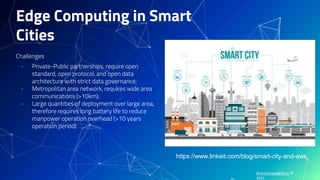
Edge Computing in Smart
Cities
Challenges
- Private-Public partnerships, require open
standard, open protocol, and open data
architecture with strict data governance;
- Metropolitan area network, requires wide area
communications (>10km);
- Large quantities of deployment over large area,
therefore requires long battery life to reduce
manpower operation overhead (>10 years
operation period)
https://www.linkeit.com/blog/smart-city-and-aws
Richard.Kang@hv.io ©
2021
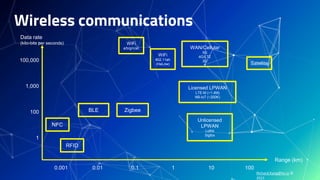
Wireless communications
Data rate
(kilo-bits per seconds)
Range (km)
1
100
1,000
100,000
0.001 0.01 0.1 1 10
RFID
BLE
WiFi
a/b/g/n/ac WAN/Cellular
5G
4G/LTE
3G
Licensed LPWAN
LTE-M (~1.4M)
NB-IoT (~200K)
Unlicensed
LPWAN
LoRA
Sigfox
Zigbee
Satellite
100
NFC
WiFi
802.11ah
(HaLow)
Richard.Kang@hv.io ©
2021
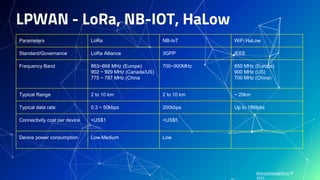
LPWAN - LoRa, NB-IOT, HaLow
Parameters LoRa NB-IoT WiFi HaLow
Standard/Governance LoRa Alliance 3GPP IEEE
Frequency Band 863~868 MHz (Europe)
902 ~ 929 MHz (Canada/US)
775 ~ 787 MHz (China
700~900MHz 850 MHz (Europe)
900 MHz (US)
700 MHz (China)
Typical Range 2 to 10 km 2 to 10 km ~ 20km
Typical data rate 0.3 ~ 50kbps 200kbps Up to 18Mpbs
Connectivity cost per device <US$1 >US$5
Device power consumption Low-Medium Low
Richard.Kang@hv.io ©
2021
Richard.Kang@hv.io
https://www.linkedin.com/in/kangks/
Thank you!
Richard.Kang@hv.io ©
2021
Useful links
- ASEAN Smart Cities https://pages.awscloud.com/intc-
city_innovationforlife_ASEAN.html

Internet of things case studies of edge computing

  • 1.
    Richard.Kang@hv.io © 2021 Internet OfThings Case Studies of Edge Computing presented by Richard Kang Richard.Kang@hv.io https://www.linkedin.com/in/kangks/ prepared by 08 April 2021
  • 2.
    Richard.Kang@hv.io © 2021 My professionalexperience - Principal Cloud Engineer with Versent Singapore, an AWS Premier Partner - Senior IoT Specialist Solution Architect with Amazon Web Services (AWS)
  • 3.
    Richard.Kang@hv.io © 2021 Architecture ofan IoT application 1. Cloud layers a. To leverage the elasticity of compute and storage for big data analytics and long history data recording b. For interoperability between business partners 2. Communication layers a. Connectivity between edge devices to devices, and between edge devices and the cloud b. Design considerations including bandwidth requirements, power consumptions, distance between points of communications 3. Edge layers a. Devices to be proximity to the source of events such as temperature, or target of actions such as an actuator b. Design considerations including real-time operating system, devices security and unique identifier, physical size, power consumptions, low operation overhead etc.
  • 4.
    Richard.Kang@hv.io © 2021 Role ofEdge Computing - Leveraging cloud services for remote monitoring and field devices management, such as over-the-air updates - Local control plane to reduce round trip latency to and from the cloud - Data sovereignty restrictions that requires data to be kept within premises, such as health records and financial records - Cost optimization to keep large historian data on- premise and sends only aggregated data to the cloud
  • 5.
    Richard.Kang@hv.io © 2021 Edge computingin the automobile industry - Fleet management for best route analysis - Mining companies uses the vibration sensors on the truck to avoid broken road to reduce service call of the trucks - Design considerations - Sub-urban or rural areas such as mining field has sporadic connectivity requires offline on-board storage, and re-sync when system back online or end of day upload to cloud - Proprietary protocols such as CANBUS commonly used in automobiles, requires gateway to convert the protocol and for connectivity purposes
  • 6.
    Richard.Kang@hv.io © 2021 Precision farmingin Agriculture Industry - Sensors deployed in large farm land to measure the key metrics such as temperature, soil dampness, or visual sensors to capture images of the plants for health analysis - Design considerations - Large area of farm land: Typical winery in British Columbia is 30 acres, or 22 football field. Connectivity could range from cellular NB-IOT or LTE-M, to LoraWan - Battery life: If IoT devices are running on battery, an average battery life of 6-month to 18-month are required to reduce the operation overhead having for frequent replacement. Battery life span is a typically included in telemetrics sent to the cloud for monitoring. https://semios.com/ipm/
  • 7.
    Richard.Kang@hv.io © 2021 Edge computingfor smart home - Security Camera with local machine learning inference on fall detection - Design considerations - Privacy, requires obfuscation of trusted person, but show the face of intruder - Interoperability among Heterogeneous Systems. Common protocols such as Z-wave, Zigbee, to BLE and TCP/IP, needs to be able to interoperable to improve customer experience - Frictionless onboarding experience. Majority of smart Home end users are not technical savvy, therefore requires ease of onboarding. https://www.altumview.com/
  • 8.
    Richard.Kang@hv.io © 2021 Edge computingin manufacturing - Challenges - Electromagnetic interference from the machinery, requires wired connection - Proprietary protocols such as MODBUS and OPC- UA, and gateway between protocols into common IoT protocols such as MQTT - Large historian data on-premise requires large network bandwidth to send to cloud - Example use case - Predictive maintenance on the factory plant using machine learning at the edge (ML@Edge) - Historian data analytics on-premise https://blog.cloudrail.com/vibration-predictive-maintenance/
  • 9.
    Richard.Kang@hv.io © 2021 Edge Computingin Smart Cities Challenges - Private-Public partnerships, require open standard, open protocol, and open data architecture with strict data governance; - Metropolitan area network, requires wide area communications (>10km); - Large quantities of deployment over large area, therefore requires long battery life to reduce manpower operation overhead (>10 years operation period) https://www.linkeit.com/blog/smart-city-and-aws
  • 10.
    Richard.Kang@hv.io © 2021 Wireless communications Datarate (kilo-bits per seconds) Range (km) 1 100 1,000 100,000 0.001 0.01 0.1 1 10 RFID BLE WiFi a/b/g/n/ac WAN/Cellular 5G 4G/LTE 3G Licensed LPWAN LTE-M (~1.4M) NB-IoT (~200K) Unlicensed LPWAN LoRA Sigfox Zigbee Satellite 100 NFC WiFi 802.11ah (HaLow)
  • 11.
    Richard.Kang@hv.io © 2021 LPWAN -LoRa, NB-IOT, HaLow Parameters LoRa NB-IoT WiFi HaLow Standard/Governance LoRa Alliance 3GPP IEEE Frequency Band 863~868 MHz (Europe) 902 ~ 929 MHz (Canada/US) 775 ~ 787 MHz (China 700~900MHz 850 MHz (Europe) 900 MHz (US) 700 MHz (China) Typical Range 2 to 10 km 2 to 10 km ~ 20km Typical data rate 0.3 ~ 50kbps 200kbps Up to 18Mpbs Connectivity cost per device <US$1 >US$5 Device power consumption Low-Medium Low
  • 12.
  • 13.
    Richard.Kang@hv.io © 2021 Useful links -ASEAN Smart Cities https://pages.awscloud.com/intc- city_innovationforlife_ASEAN.html

Editor's Notes

  • #11 References: https://iot-analytics.com/our-coverage/iot-connectivity-hardware/