Chapter 4
IoT System Management with
NETCONF-YANG
Bahga & Madisetti, © 2015
Book website: http://www.internet-of-things-book.com
Outline
• Need for IoT systems management
• SNMP
• Network operator requirements
• NETCONF
• YANG
• IoT systems management with NETCONF-YANG
Bahga & Madisetti, © 2015
Book website: http://www.internet-of-things-book.com
Need for IoT Systems Management
• Automating configuration
• Monitoring operational and statistical data
• Improved reliability
• System-wide configuration
• Multiple system configuration
• Retrieving and reusing configurations
Bahga & Madisetti, © 2015
Book website: http://www.internet-of-things-book.com
Simple Network Management Protocol (SNMP)
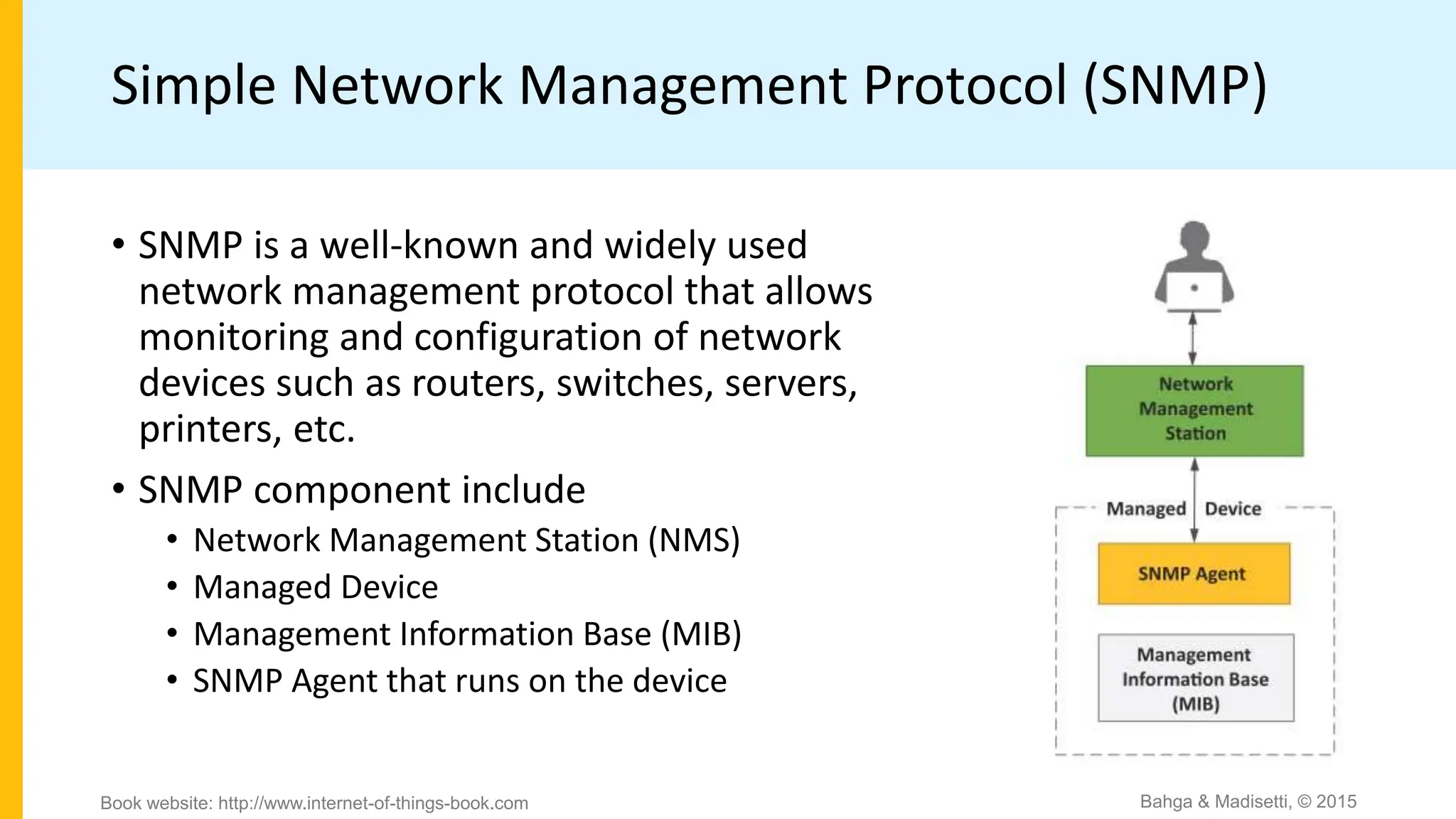
• SNMP is a well-known and widely used
network management protocol that allows
monitoring and configuration of network
devices such as routers, switches, servers,
printers, etc.
• SNMP component include
• Network Management Station (NMS)
• Managed Device
• Management Information Base (MIB)
• SNMP Agent that runs on the device
Bahga & Madisetti, © 2015
Book website: http://www.internet-of-things-book.com
Limitations of SNMP
• SNMP is stateless in nature and each SNMP request contains all the
information required to process the request. The application needs to be
intelligent to manage the device.
• SNMP is a connectionless protocol which uses UDP as the transport
protocol, making it unreliable as there is no support for acknowledgement of
requests.
• MIBs often lack writable objects without which device configuration is not
possible using SNMP.
• It is difficult to differentiate between configuration and state data in MIBs.
• Retrieving the current configuration from a device can be difficult with
SNMP.
• Earlier versions of SNMP did not have strong security features.
Bahga & Madisetti, © 2015
Book website: http://www.internet-of-things-book.com
Network Operator Requirements
• Ease of use
• Distinction between configuration and state data
• Fetch configuration and state data separately
• Configuration of the network as a whole
• Configuration transactions across devices
• Configuration deltas
• Dump and restore configurations
Bahga & Madisetti, © 2015
Book website: http://www.internet-of-things-book.com
• Configuration validation
• Configuration database schemas
• Comparing configurations
• Role-based access control
• Consistency of access control lists
• Multiple configuration sets
• Support for both data-oriented and task-
oriented access control
NETCONF
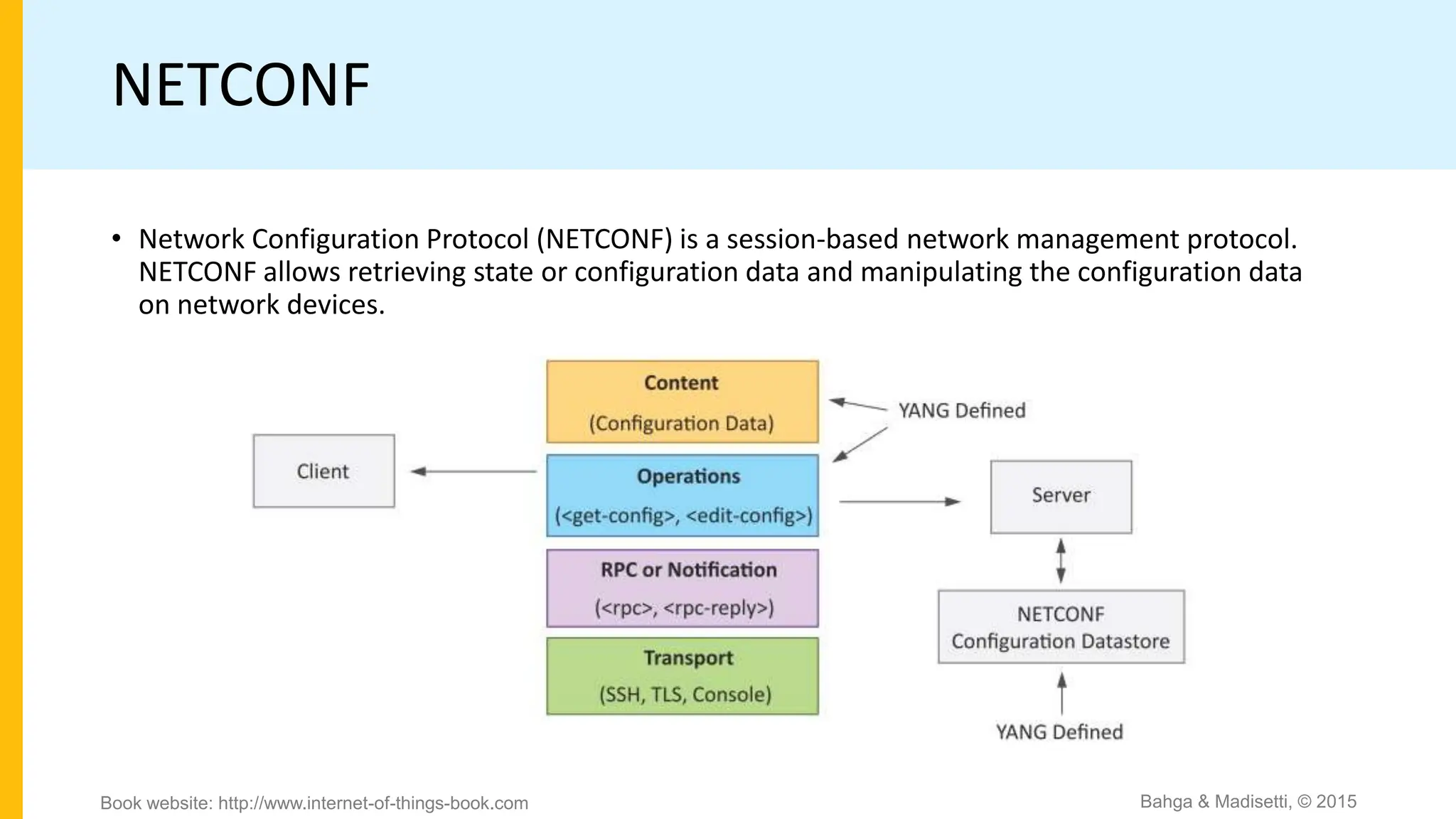
• Network Configuration Protocol (NETCONF) is a session-based network management protocol.
NETCONF allows retrieving state or configuration data and manipulating the configuration data
on network devices.
Bahga & Madisetti, © 2015
Book website: http://www.internet-of-things-book.com
NETCONF
• NETCONF works on SSH transport protocol.
• Transport layer provides end-to-end connectivity and ensures reliable delivery of
messages.
• NETCONF uses XML-encoded Remote Procedure Calls (RPCs) for framing request and
response messages.
• The RPC layer provides a mechanism for encoding of RPC calls and notifications.
• NETCONF provides various operations to retrieve and edit configuration data from network
devices.
• The Content Layer consists of configuration and state data which is XML-encoded.
• The schema of the configuration and state data is defined in a data modelling language
called YANG.
• NETCONF provides a clear separation of the configuration and state data.
• The configuration data resides within a NETCONF configuration data store on the server.
Bahga & Madisetti, © 2015
Book website: http://www.internet-of-things-book.com
YANG
• YANG is a data modelling language used to model configuration and state data
manipulated by the NETCONF protocol
• YANG modules contain the definitions of the configuration data, state data, RPC calls that
can be issued and the format of the notifications.
• YANG modules define the data exchanged between the NETCONF client and server.
• A module comprises a number of 'leaf' nodes which are organized into a hierarchical tree
structure.
• The 'leaf' nodes are specified using the 'leaf' or 'leaf-list' constructs.
• Leaf nodes are organized using 'container' or 'list' constructs.
• A YANG module can import definitions from other modules.
• Constraints can be defined on the data nodes, e.g. allowed values.
• YANG can model both configuration data and state data using the 'config' statement.
Bahga & Madisetti, © 2015
Book website: http://www.internet-of-things-book.com
YANG Module – Example
Bahga & Madisetti, © 2015
Book website: http://www.internet-of-things-book.com
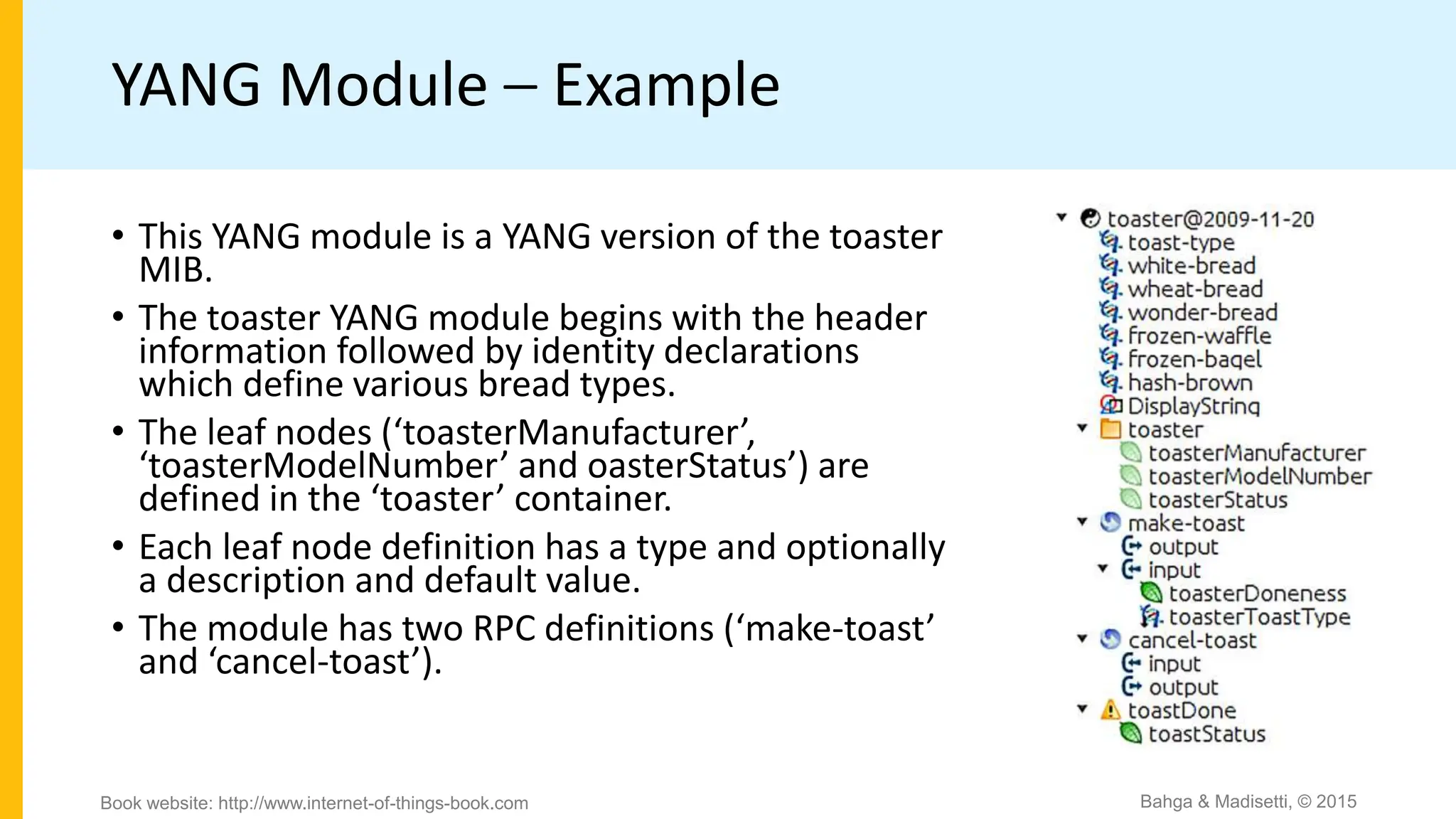
• This YANG module is a YANG version of the toaster
MIB.
• The toaster YANG module begins with the header
information followed by identity declarations
which define various bread types.
• The leaf nodes (‘toasterManufacturer’,
‘toasterModelNumber’ and oasterStatus’) are
defined in the ‘toaster’ container.
• Each leaf node definition has a type and optionally
a description and default value.
• The module has two RPC definitions (‘make-toast’
and ‘cancel-toast’).
IoT Systems Management with NETCONF-YANG
Bahga & Madisetti, © 2015
Book website: http://www.internet-of-things-book.com
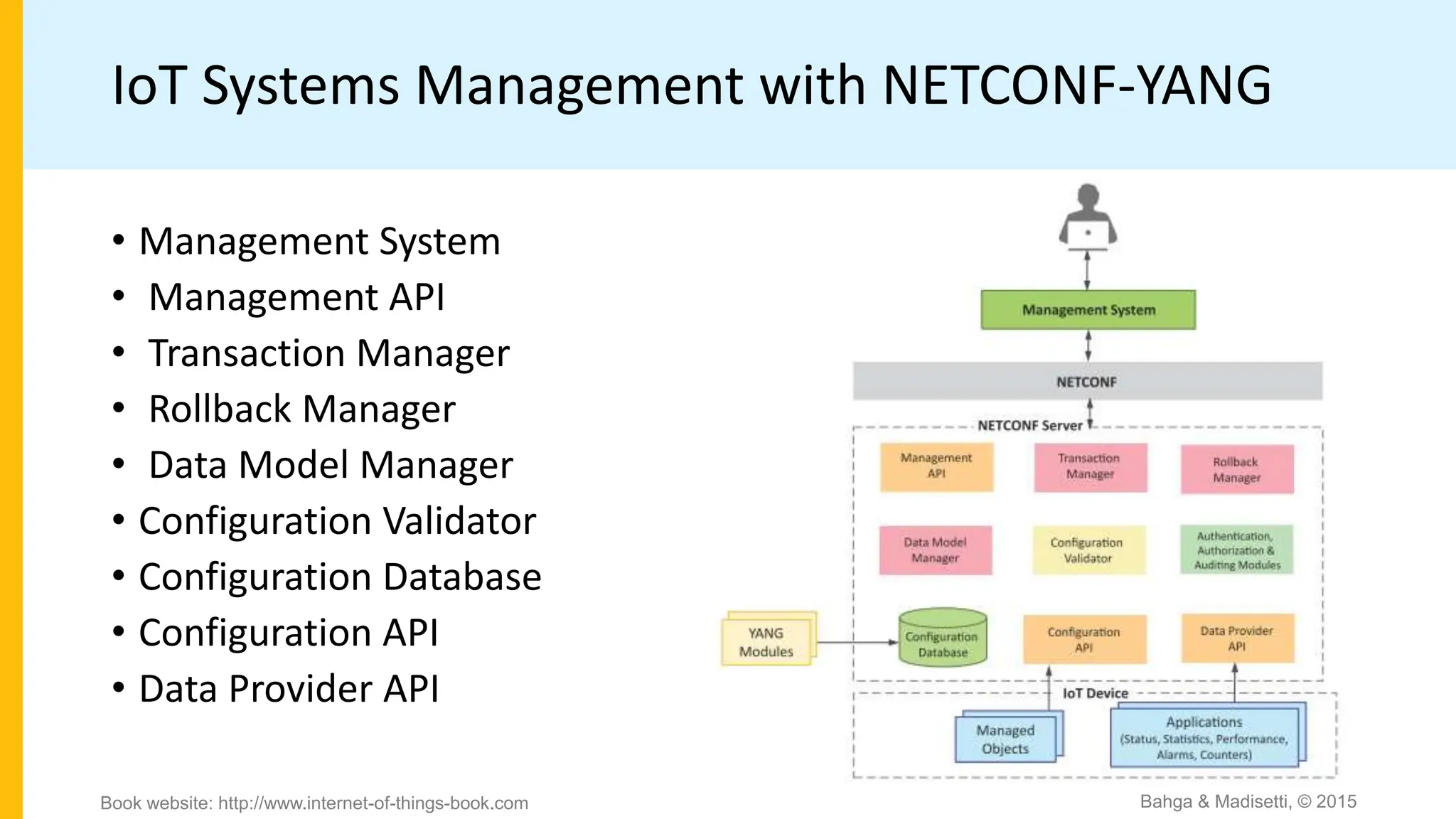
• Management System
• Management API
• Transaction Manager
• Rollback Manager
• Data Model Manager
• Configuration Validator
• Configuration Database
• Configuration API
• Data Provider API

Internet of things -Arshdeep Bahga .pptx

  • 1.
    Chapter 4 IoT SystemManagement with NETCONF-YANG Bahga & Madisetti, © 2015 Book website: http://www.internet-of-things-book.com
  • 2.
    Outline • Need forIoT systems management • SNMP • Network operator requirements • NETCONF • YANG • IoT systems management with NETCONF-YANG Bahga & Madisetti, © 2015 Book website: http://www.internet-of-things-book.com
  • 3.
    Need for IoTSystems Management • Automating configuration • Monitoring operational and statistical data • Improved reliability • System-wide configuration • Multiple system configuration • Retrieving and reusing configurations Bahga & Madisetti, © 2015 Book website: http://www.internet-of-things-book.com
  • 4.
    Simple Network ManagementProtocol (SNMP) • SNMP is a well-known and widely used network management protocol that allows monitoring and configuration of network devices such as routers, switches, servers, printers, etc. • SNMP component include • Network Management Station (NMS) • Managed Device • Management Information Base (MIB) • SNMP Agent that runs on the device Bahga & Madisetti, © 2015 Book website: http://www.internet-of-things-book.com
  • 5.
    Limitations of SNMP •SNMP is stateless in nature and each SNMP request contains all the information required to process the request. The application needs to be intelligent to manage the device. • SNMP is a connectionless protocol which uses UDP as the transport protocol, making it unreliable as there is no support for acknowledgement of requests. • MIBs often lack writable objects without which device configuration is not possible using SNMP. • It is difficult to differentiate between configuration and state data in MIBs. • Retrieving the current configuration from a device can be difficult with SNMP. • Earlier versions of SNMP did not have strong security features. Bahga & Madisetti, © 2015 Book website: http://www.internet-of-things-book.com
  • 6.
    Network Operator Requirements •Ease of use • Distinction between configuration and state data • Fetch configuration and state data separately • Configuration of the network as a whole • Configuration transactions across devices • Configuration deltas • Dump and restore configurations Bahga & Madisetti, © 2015 Book website: http://www.internet-of-things-book.com • Configuration validation • Configuration database schemas • Comparing configurations • Role-based access control • Consistency of access control lists • Multiple configuration sets • Support for both data-oriented and task- oriented access control
  • 7.
    NETCONF • Network ConfigurationProtocol (NETCONF) is a session-based network management protocol. NETCONF allows retrieving state or configuration data and manipulating the configuration data on network devices. Bahga & Madisetti, © 2015 Book website: http://www.internet-of-things-book.com
  • 8.
    NETCONF • NETCONF workson SSH transport protocol. • Transport layer provides end-to-end connectivity and ensures reliable delivery of messages. • NETCONF uses XML-encoded Remote Procedure Calls (RPCs) for framing request and response messages. • The RPC layer provides a mechanism for encoding of RPC calls and notifications. • NETCONF provides various operations to retrieve and edit configuration data from network devices. • The Content Layer consists of configuration and state data which is XML-encoded. • The schema of the configuration and state data is defined in a data modelling language called YANG. • NETCONF provides a clear separation of the configuration and state data. • The configuration data resides within a NETCONF configuration data store on the server. Bahga & Madisetti, © 2015 Book website: http://www.internet-of-things-book.com
  • 9.
    YANG • YANG isa data modelling language used to model configuration and state data manipulated by the NETCONF protocol • YANG modules contain the definitions of the configuration data, state data, RPC calls that can be issued and the format of the notifications. • YANG modules define the data exchanged between the NETCONF client and server. • A module comprises a number of 'leaf' nodes which are organized into a hierarchical tree structure. • The 'leaf' nodes are specified using the 'leaf' or 'leaf-list' constructs. • Leaf nodes are organized using 'container' or 'list' constructs. • A YANG module can import definitions from other modules. • Constraints can be defined on the data nodes, e.g. allowed values. • YANG can model both configuration data and state data using the 'config' statement. Bahga & Madisetti, © 2015 Book website: http://www.internet-of-things-book.com
  • 10.
    YANG Module –Example Bahga & Madisetti, © 2015 Book website: http://www.internet-of-things-book.com • This YANG module is a YANG version of the toaster MIB. • The toaster YANG module begins with the header information followed by identity declarations which define various bread types. • The leaf nodes (‘toasterManufacturer’, ‘toasterModelNumber’ and oasterStatus’) are defined in the ‘toaster’ container. • Each leaf node definition has a type and optionally a description and default value. • The module has two RPC definitions (‘make-toast’ and ‘cancel-toast’).
  • 11.
    IoT Systems Managementwith NETCONF-YANG Bahga & Madisetti, © 2015 Book website: http://www.internet-of-things-book.com • Management System • Management API • Transaction Manager • Rollback Manager • Data Model Manager • Configuration Validator • Configuration Database • Configuration API • Data Provider API