DPI-665
Politics of the Internet
    April 11, 2012

    Internet Freedom
   And Its Discontents
       Micah L. Sifry
Audio: http://bit.ly/HXBsgW
      CC-BY-NC-SA
Topics for discussion
• What is “Internet Freedom”?
• Why is this being talked about now?
• Are we naïve about the role of the
  Internet in closed societies?
• Should the U.S. Govt align itself with
  U.S. tech companies? (and vice versa?)
• Who does the net empower more?
  Governments or activists? Why?
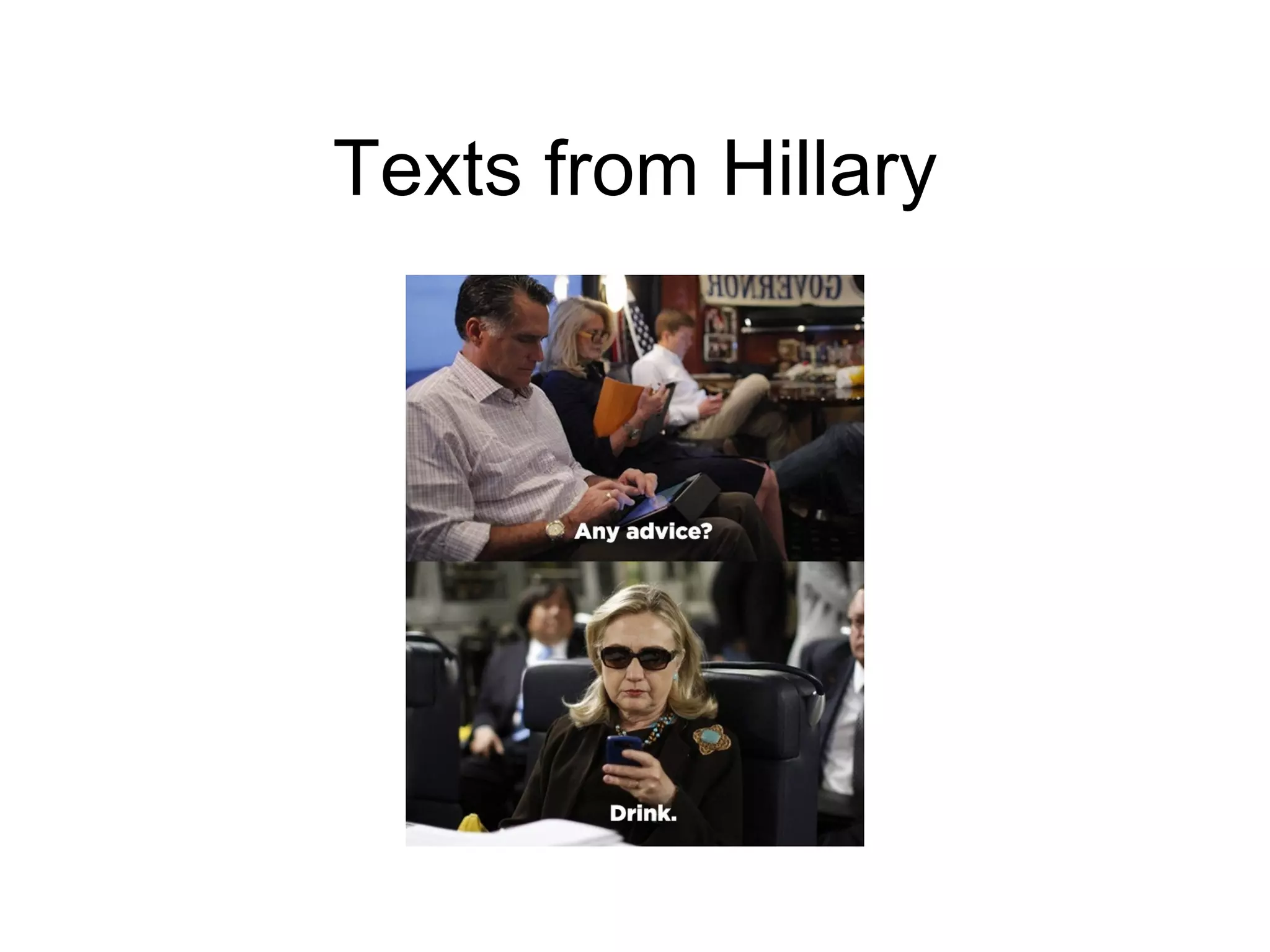
Texts from Hillary
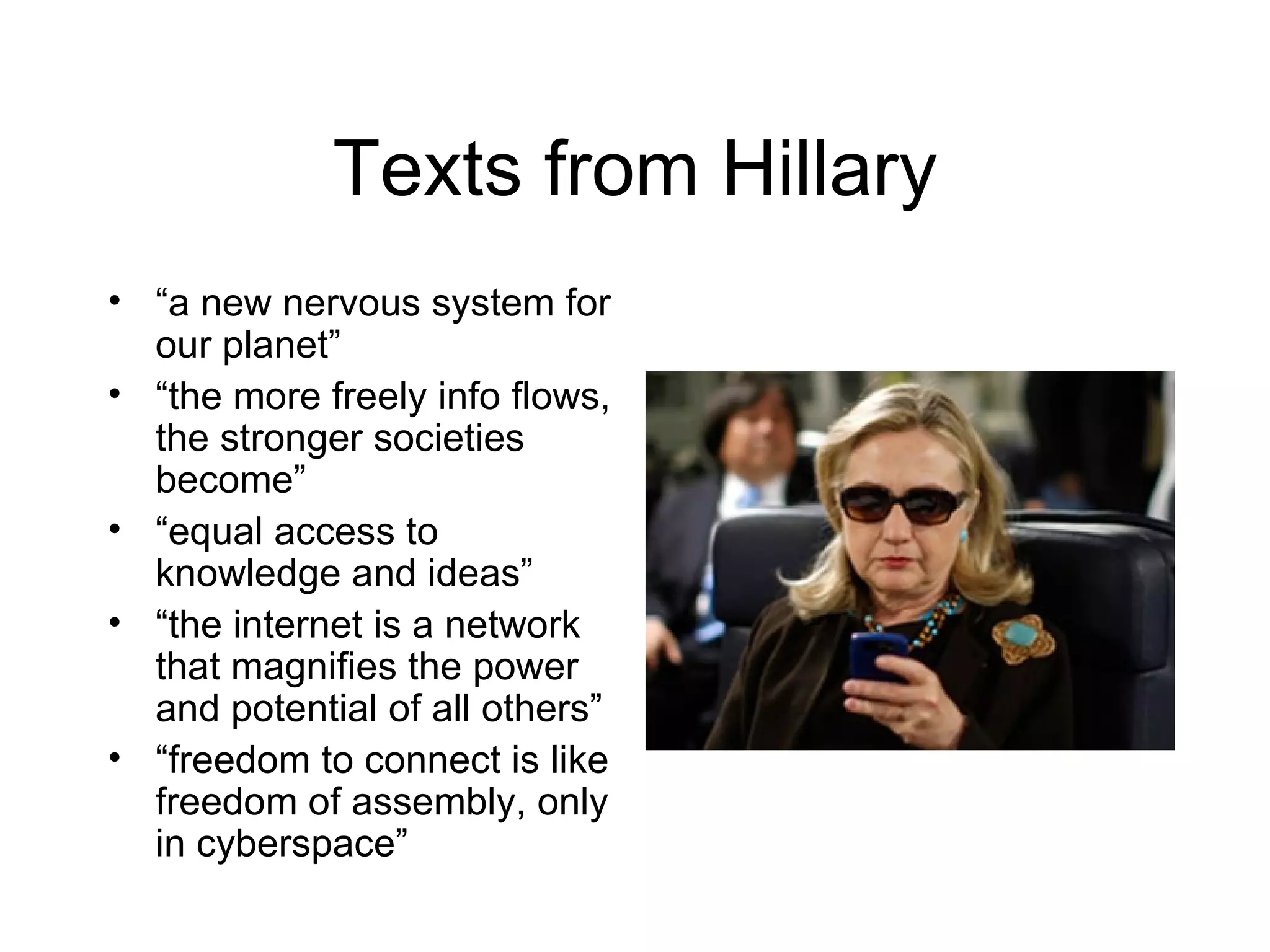
Texts from Hillary
• “a new nervous system for
  our planet”
• “the more freely info flows,
  the stronger societies
  become”
• “equal access to
  knowledge and ideas”
• “the internet is a network
  that magnifies the power
  and potential of all others”
• “freedom to connect is like
  freedom of assembly, only
  in cyberspace”
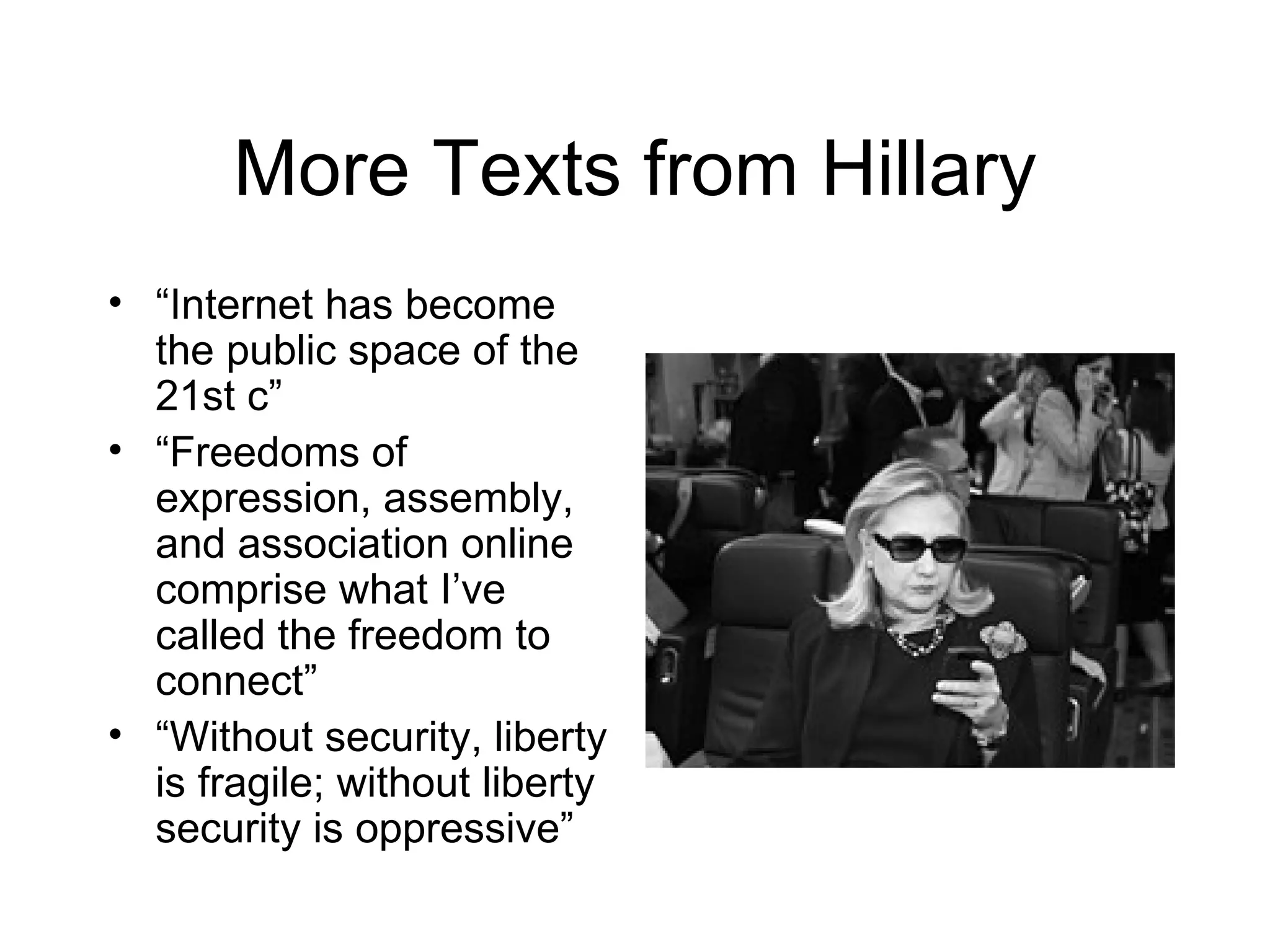
More Texts from Hillary
• “Internet has become
  the public space of the
  21st c”
• “Freedoms of
  expression, assembly,
  and association online
  comprise what I’ve
  called the freedom to
  connect”
• “Without security, liberty
  is fragile; without liberty
  security is oppressive”
Hold this thought…
“The WikiLeaks incident      “And one final word on this matter:
                                There were reports in the days
  began with a theft, just      following these leaks that the United
  as if it had been             States Government intervened to
                                coerce private companies to deny
  executed by smuggling         service to WikiLeaks. That is not the
  papers in a briefcase.        case. Now, some politicians and
                                pundits publicly called for
  The fact that WikiLeaks       companies to disassociate from
  used the internet is not      WikiLeaks, while others criticized
                                them for doing so. Public officials
  the reason we criticized      are part of our country’s public
  its actions. WikiLeaks        debates, but there is a line between
                                expressing views and coercing
  does not challenge our        conduct. Business decisions that
  commitment to internet        private companies may have taken
                                to enforce their own values or
  freedom.”                     policies regarding WikiLeaks were
                                not at the direction of the Obama
                                Administration.”
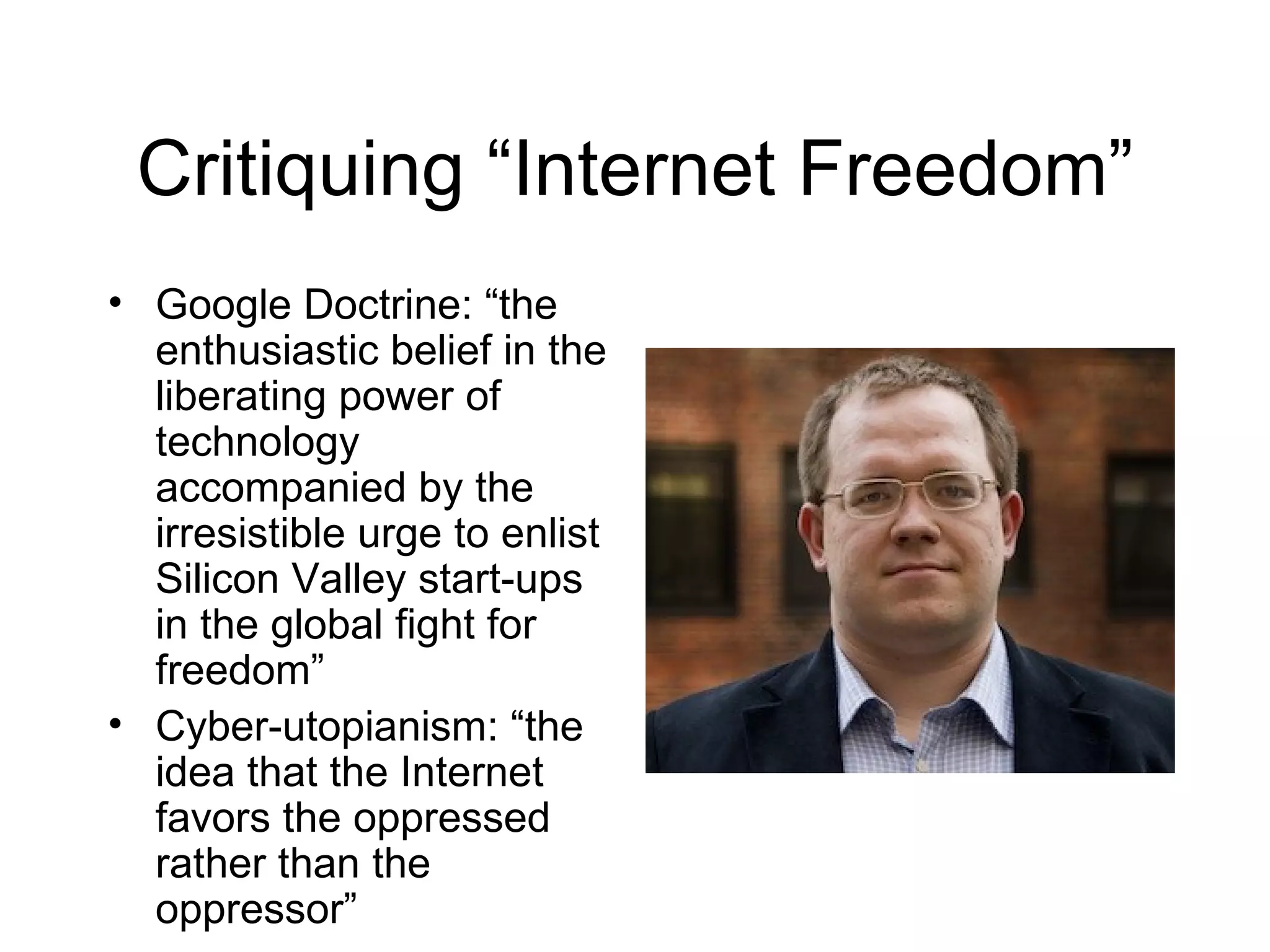
Critiquing “Internet Freedom”
• Google Doctrine: “the
  enthusiastic belief in the
  liberating power of
  technology
  accompanied by the
  irresistible urge to enlist
  Silicon Valley start-ups
  in the global fight for
  freedom”
• Cyber-utopianism: “the
  idea that the Internet
  favors the oppressed
  rather than the
  oppressor”
Morozov’s Good Questions
• Iran: What “Twitter revolution”?
• Did State Dept endanger dissidents by
  embracing US tech (like Twitter?)
• Does increasing access to Western info
  sources lead to democratization? Or to
  depoliticization? (as in, David vs David
  Letterman, and Big Brother vs Big Brother
• Is the “dictator’s dilemma” truly that bad--or
  does greater internet access allow for better
  surveillance and control?
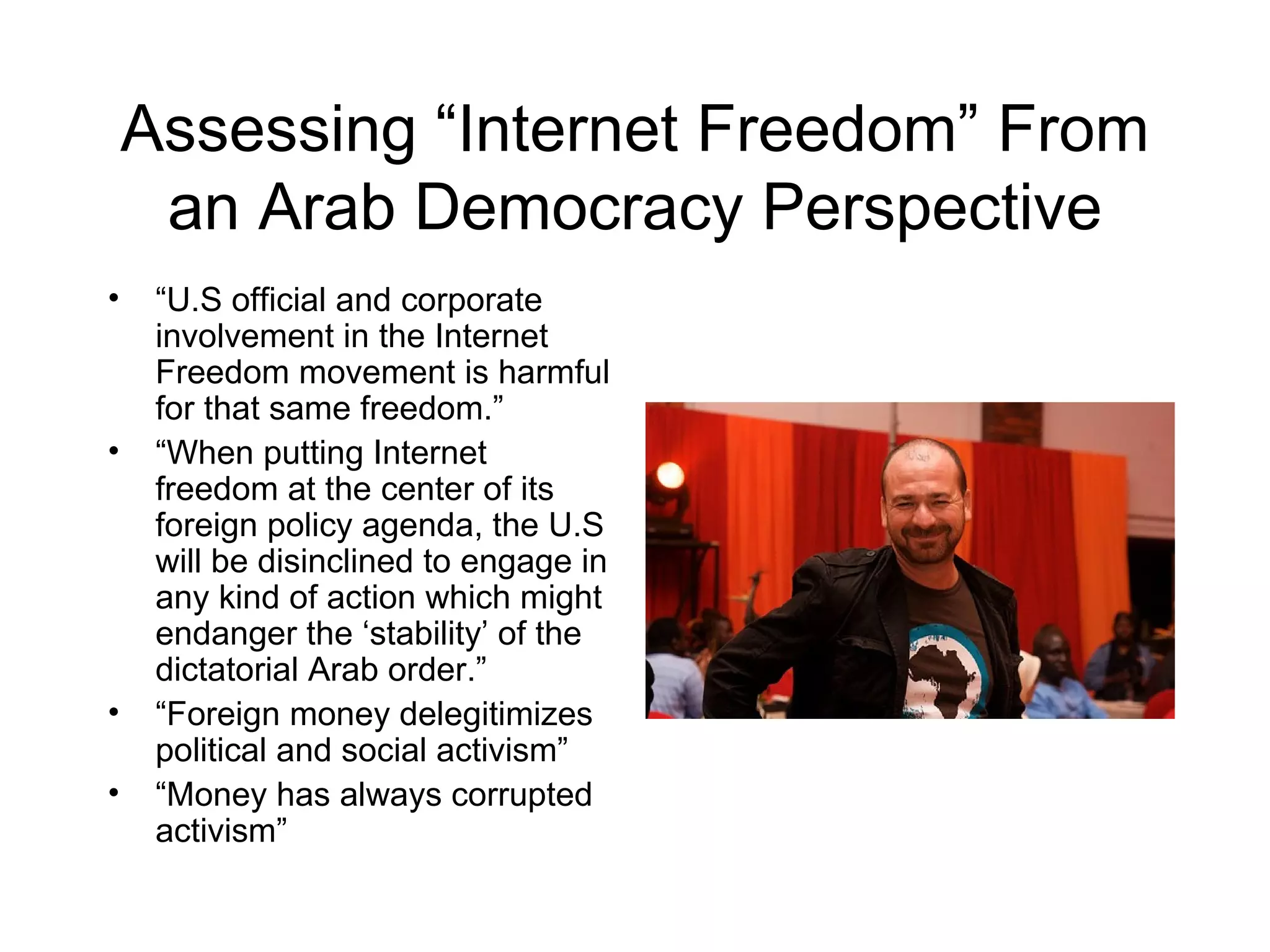
Assessing “Internet Freedom” From
     an Arab Democracy Perspective
•    “U.S official and corporate
     involvement in the Internet
     Freedom movement is harmful
     for that same freedom.”
•    “When putting Internet
     freedom at the center of its
     foreign policy agenda, the U.S
     will be disinclined to engage in
     any kind of action which might
     endanger the ‘stability’ of the
     dictatorial Arab order.”
•    “Foreign money delegitimizes
     political and social activism”
•    “Money has always corrupted
     activism”
Abu Gharbia’s Advice
“For digital activism in the Arab world to achieve its
    noble aspirations, it must remain independent and
    homegrown, tapping its financial, logistic and moral
    support into the grassroots level or try to seek a
    support from neutral parties that do not push for any
    kind of political or ideological agenda.”
“If the U.S. and other Western governments want to
    support Internet Freedom they should start by
    prohibiting the export of censor wares and other
    filtering software to our countries. After all, most of
    the tools used to muzzle our online free expression
    and monitor our activities on the Internet are being
    engineered and sold by American and Western
    corporations.”
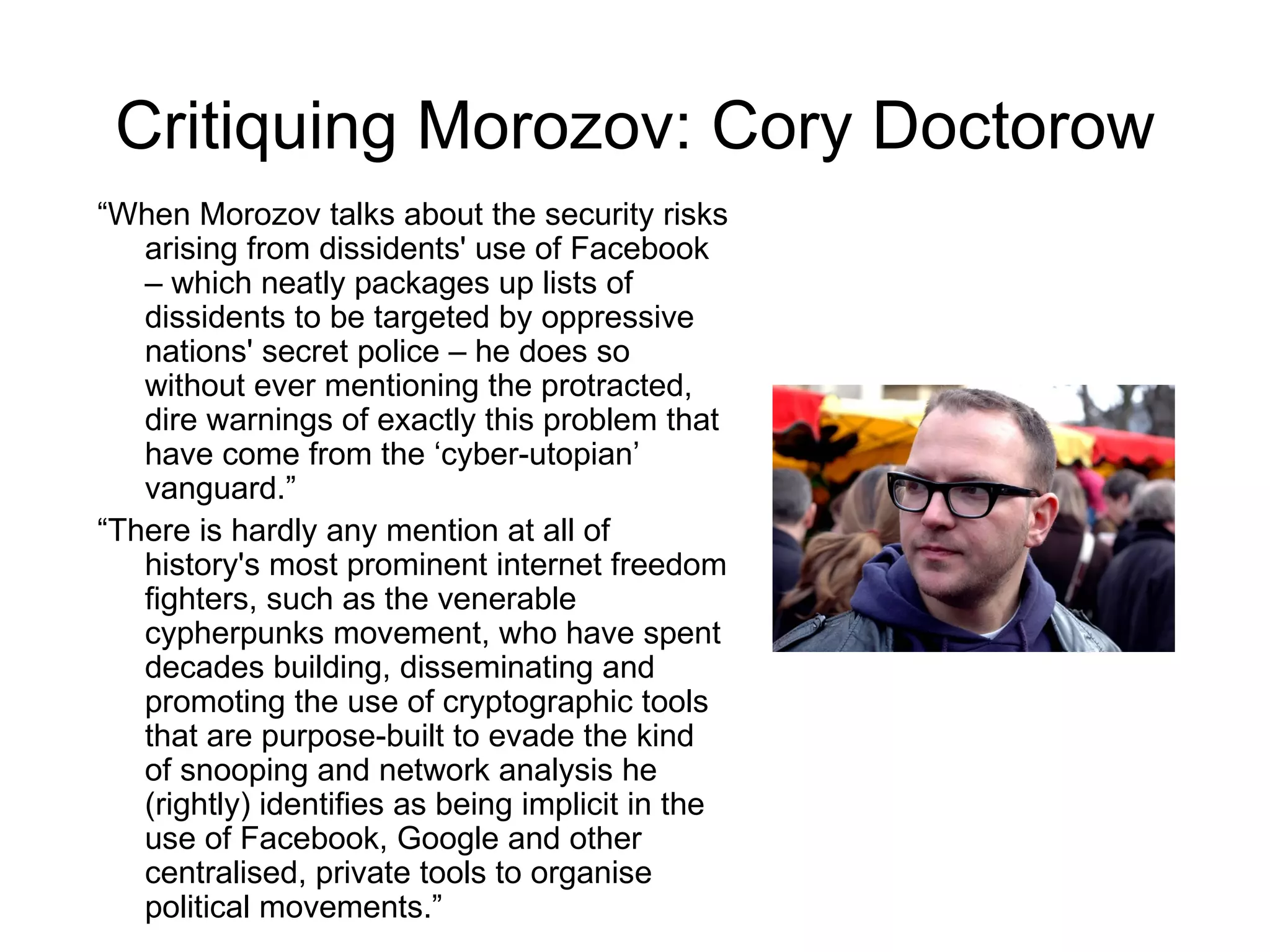
Critiquing Morozov: Cory Doctorow
“When Morozov talks about the security risks
   arising from dissidents' use of Facebook
   – which neatly packages up lists of
   dissidents to be targeted by oppressive
   nations' secret police – he does so
   without ever mentioning the protracted,
   dire warnings of exactly this problem that
   have come from the ‘cyber-utopian’
   vanguard.”
“There is hardly any mention at all of
   history's most prominent internet freedom
   fighters, such as the venerable
   cypherpunks movement, who have spent
   decades building, disseminating and
   promoting the use of cryptographic tools
   that are purpose-built to evade the kind
   of snooping and network analysis he
   (rightly) identifies as being implicit in the
   use of Facebook, Google and other
   centralised, private tools to organise
   political movements.”
Strong Crypto for Dissidents
“It is vastly easier to scramble a message than it is to
    break the scrambling system and gain access to the
    message without the key.
“Poorly resourced individuals and groups with cheap,
    old computers are able to encipher their messages to
    an extent that they cannot be deciphered by all the
    secret police in the world… In this sense, at least, the
    technological deck is stacked in favour of dissidents –
    who have never before enjoyed the power to hide
    their communiques beyond the reach of secret police
    – over the state, who have always enjoyed the power
    to keep secrets from the people.”

Internet Freedom and its Discontents

  • 1.
    DPI-665 Politics of theInternet April 11, 2012 Internet Freedom And Its Discontents Micah L. Sifry Audio: http://bit.ly/HXBsgW CC-BY-NC-SA
  • 2.
    Topics for discussion •What is “Internet Freedom”? • Why is this being talked about now? • Are we naïve about the role of the Internet in closed societies? • Should the U.S. Govt align itself with U.S. tech companies? (and vice versa?) • Who does the net empower more? Governments or activists? Why?
  • 3.
  • 4.
    Texts from Hillary •“a new nervous system for our planet” • “the more freely info flows, the stronger societies become” • “equal access to knowledge and ideas” • “the internet is a network that magnifies the power and potential of all others” • “freedom to connect is like freedom of assembly, only in cyberspace”
  • 5.
    More Texts fromHillary • “Internet has become the public space of the 21st c” • “Freedoms of expression, assembly, and association online comprise what I’ve called the freedom to connect” • “Without security, liberty is fragile; without liberty security is oppressive”
  • 6.
    Hold this thought… “TheWikiLeaks incident “And one final word on this matter: There were reports in the days began with a theft, just following these leaks that the United as if it had been States Government intervened to coerce private companies to deny executed by smuggling service to WikiLeaks. That is not the papers in a briefcase. case. Now, some politicians and pundits publicly called for The fact that WikiLeaks companies to disassociate from used the internet is not WikiLeaks, while others criticized them for doing so. Public officials the reason we criticized are part of our country’s public its actions. WikiLeaks debates, but there is a line between expressing views and coercing does not challenge our conduct. Business decisions that commitment to internet private companies may have taken to enforce their own values or freedom.” policies regarding WikiLeaks were not at the direction of the Obama Administration.”
  • 7.
    Critiquing “Internet Freedom” •Google Doctrine: “the enthusiastic belief in the liberating power of technology accompanied by the irresistible urge to enlist Silicon Valley start-ups in the global fight for freedom” • Cyber-utopianism: “the idea that the Internet favors the oppressed rather than the oppressor”
  • 8.
    Morozov’s Good Questions •Iran: What “Twitter revolution”? • Did State Dept endanger dissidents by embracing US tech (like Twitter?) • Does increasing access to Western info sources lead to democratization? Or to depoliticization? (as in, David vs David Letterman, and Big Brother vs Big Brother • Is the “dictator’s dilemma” truly that bad--or does greater internet access allow for better surveillance and control?
  • 9.
    Assessing “Internet Freedom”From an Arab Democracy Perspective • “U.S official and corporate involvement in the Internet Freedom movement is harmful for that same freedom.” • “When putting Internet freedom at the center of its foreign policy agenda, the U.S will be disinclined to engage in any kind of action which might endanger the ‘stability’ of the dictatorial Arab order.” • “Foreign money delegitimizes political and social activism” • “Money has always corrupted activism”
  • 11.
    Abu Gharbia’s Advice “Fordigital activism in the Arab world to achieve its noble aspirations, it must remain independent and homegrown, tapping its financial, logistic and moral support into the grassroots level or try to seek a support from neutral parties that do not push for any kind of political or ideological agenda.” “If the U.S. and other Western governments want to support Internet Freedom they should start by prohibiting the export of censor wares and other filtering software to our countries. After all, most of the tools used to muzzle our online free expression and monitor our activities on the Internet are being engineered and sold by American and Western corporations.”
  • 12.
    Critiquing Morozov: CoryDoctorow “When Morozov talks about the security risks arising from dissidents' use of Facebook – which neatly packages up lists of dissidents to be targeted by oppressive nations' secret police – he does so without ever mentioning the protracted, dire warnings of exactly this problem that have come from the ‘cyber-utopian’ vanguard.” “There is hardly any mention at all of history's most prominent internet freedom fighters, such as the venerable cypherpunks movement, who have spent decades building, disseminating and promoting the use of cryptographic tools that are purpose-built to evade the kind of snooping and network analysis he (rightly) identifies as being implicit in the use of Facebook, Google and other centralised, private tools to organise political movements.”
  • 13.
    Strong Crypto forDissidents “It is vastly easier to scramble a message than it is to break the scrambling system and gain access to the message without the key. “Poorly resourced individuals and groups with cheap, old computers are able to encipher their messages to an extent that they cannot be deciphered by all the secret police in the world… In this sense, at least, the technological deck is stacked in favour of dissidents – who have never before enjoyed the power to hide their communiques beyond the reach of secret police – over the state, who have always enjoyed the power to keep secrets from the people.”

Editor's Notes

  • #5 Hillary Clinton’s first speech on Internet Freedom, Jan 2010
  • #6 Internet freedom speech 2011
  • #8 Evgeny Morozov, author of the Net Delusion
  • #10 Sami Abu Gharbia, Nawaat.org