Poject On I N T E R N E TPoject On I N T E R N E T
Session ObjectiveSession Objective
What is INTERNET ?
Brief History of Internet.
Services provided by Internet.
Impact of Internet.
◦ Education.
◦ Health Care.
◦ Business.
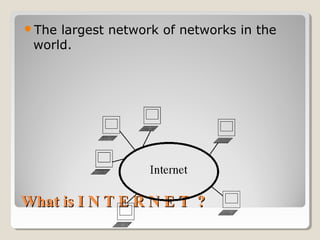
The largest network of networks in the
world.
What is I N T E R N E T ?What is I N T E R N E T ?
A network of networks, joining many
government, university and private
computers together and providing an
infrastructure for the use of E-mail,
bulletin boards, file archives, hypertext
documents, databases and other
computational resources.
Continue……
What is I N T E R N E T ?What is I N T E R N E T ?
The vast collection of computer networks
which form and act as a single huge
network for transport of data and
messages across distances which can be
anywhere from the same office to
anywhere in the world.
Continue……
Brief History of InternetBrief History of Internet
ARPA – Advanced Research Project
Agency.
1969 January 2 – started an experimental
Computer Network.
Concept – No Server, but equal
importance/participation to every
computer in the Network.
Even if, one or two node destroyed that
will not affect the Network.
Brief History of InternetBrief History of Internet
First named as ARPANET
This is renamed as INTERNET
◦ TCP/IP (Transmission Control Protocol/Internet
Protocol)
Continue……
Internet Growth TrendsInternet Growth Trends
1977: 111 hosts on Internet
1981: 213 hosts
1983: 562 hosts
1984: 1,000 hosts
1986: 5,000 hosts
1987: 10,000 hosts
1989: 100,000 hosts
1992: 1,000,000 hosts
2001: 150 – 175 million hosts
2002: over 200 million hosts
By 2010, about 80% of the planet will be on the
Internet
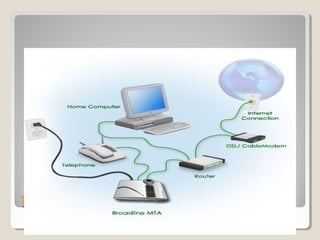
How to Connect to InternetHow to Connect to Internet
Internet ServicesInternet Services
Electronic Mail (e-mail)
World Wide Web
Telnet
File Transfer Protocol (FTP)
Internet Telephone
Web TV/Radio
Internet Relay Chat
News Groups
Electronic Mail (e-Mail)Electronic Mail (e-Mail)
Distributes e-mail messages and attached
files to one or more electronic mailboxes.
Eg:- e-mail addresses
◦ thomas@mes.edu.in
◦ murugan@mesmarampally.org
Electronic Mail (e-Mail)Electronic Mail (e-Mail)
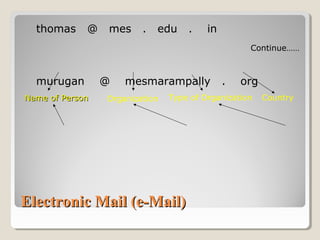
thomas @ mes . edu . in
murugan @ mesmarampally . org
Continue……
Organization Type of OrganizationName of PersonName of Person Country
Electronic Mail (e-Mail)Electronic Mail (e-Mail)
Different e-mail service providers
◦ G-Mail
◦ Yahoo Mail
◦ Hot Mail
Continue……
World Wide Web (W W W)World Wide Web (W W W)
Most important service provided by
Internet.
An internet-based hypermedia initiative
for global information sharing.
Developed in 1989 by Tim Berners-Lee of
the European Particle Physics Lab (CERN)
in Switzerland.
Search EnginesSearch Engines
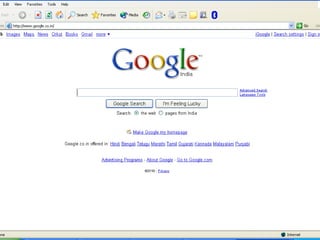
For searching information on the Internet.
◦ Google
◦ Yahoo
◦ Altavista
WWIKIPEDIIKIPEDIAA
A wiki is a publishing platform on which
many people can contribute new content
and revise existing content.
The content benefits from the collective
knowledge of the contributors, so wikis
can be very beneficial for group projects.
Some businesses and organizations use
wikis to maintain documents.

Internet

  • 1.
    Poject On IN T E R N E TPoject On I N T E R N E T
  • 2.
    Session ObjectiveSession Objective Whatis INTERNET ? Brief History of Internet. Services provided by Internet. Impact of Internet. ◦ Education. ◦ Health Care. ◦ Business.
  • 3.
    The largest networkof networks in the world.
  • 4.
    What is IN T E R N E T ?What is I N T E R N E T ? A network of networks, joining many government, university and private computers together and providing an infrastructure for the use of E-mail, bulletin boards, file archives, hypertext documents, databases and other computational resources. Continue……
  • 5.
    What is IN T E R N E T ?What is I N T E R N E T ? The vast collection of computer networks which form and act as a single huge network for transport of data and messages across distances which can be anywhere from the same office to anywhere in the world. Continue……
  • 6.
    Brief History ofInternetBrief History of Internet ARPA – Advanced Research Project Agency. 1969 January 2 – started an experimental Computer Network. Concept – No Server, but equal importance/participation to every computer in the Network. Even if, one or two node destroyed that will not affect the Network.
  • 7.
    Brief History ofInternetBrief History of Internet First named as ARPANET This is renamed as INTERNET ◦ TCP/IP (Transmission Control Protocol/Internet Protocol) Continue……
  • 8.
    Internet Growth TrendsInternetGrowth Trends 1977: 111 hosts on Internet 1981: 213 hosts 1983: 562 hosts 1984: 1,000 hosts 1986: 5,000 hosts 1987: 10,000 hosts 1989: 100,000 hosts 1992: 1,000,000 hosts 2001: 150 – 175 million hosts 2002: over 200 million hosts By 2010, about 80% of the planet will be on the Internet
  • 9.
    How to Connectto InternetHow to Connect to Internet
  • 10.
    Internet ServicesInternet Services ElectronicMail (e-mail) World Wide Web Telnet File Transfer Protocol (FTP) Internet Telephone Web TV/Radio Internet Relay Chat News Groups
  • 11.
    Electronic Mail (e-Mail)ElectronicMail (e-Mail) Distributes e-mail messages and attached files to one or more electronic mailboxes. Eg:- e-mail addresses ◦ thomas@mes.edu.in ◦ murugan@mesmarampally.org
  • 12.
    Electronic Mail (e-Mail)ElectronicMail (e-Mail) thomas @ mes . edu . in murugan @ mesmarampally . org Continue…… Organization Type of OrganizationName of PersonName of Person Country
  • 13.
    Electronic Mail (e-Mail)ElectronicMail (e-Mail) Different e-mail service providers ◦ G-Mail ◦ Yahoo Mail ◦ Hot Mail Continue……
  • 14.
    World Wide Web(W W W)World Wide Web (W W W) Most important service provided by Internet. An internet-based hypermedia initiative for global information sharing. Developed in 1989 by Tim Berners-Lee of the European Particle Physics Lab (CERN) in Switzerland.
  • 15.
    Search EnginesSearch Engines Forsearching information on the Internet. ◦ Google ◦ Yahoo ◦ Altavista
  • 17.
    WWIKIPEDIIKIPEDIAA A wiki isa publishing platform on which many people can contribute new content and revise existing content. The content benefits from the collective knowledge of the contributors, so wikis can be very beneficial for group projects. Some businesses and organizations use wikis to maintain documents.