El Camino College Business Training Center  INTERNATIONAL TRADE ORIENTATION OVERVIEW OF EXPORTING AND IMPORTING Bronwen Madden, Deputy Director Center for International Trade Development El Camino College Business Training Center
NEW GRANT FUNDED CITD INITIATIVES  International Trade Compliance Institute (ITCI) Information and Training on all Aspects of International Trade Regulations  Seminars/workshops on EAR, ITAR, AES, ACE & more ITCI Website  www.tradecomplianceinstitute.org “ Green” Export Enabler Program (GEEP) Increase Calif. Green Technologies Exports to China Free competitiveness and export readiness assessments Export training and market research/planning for China market entry Subsidized trade event and matchmaking assistance GEEP Website  www.greenexport.org
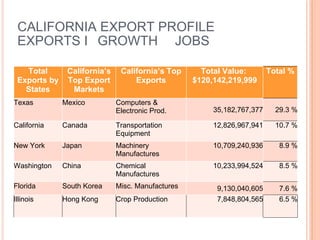
CALIFORNIA EXPORT PROFILE EXPORTS  GROWTH  JOBS Total Exports by States California’s Top Export Markets California’s Top Exports Total Value:  $120,142,219,999 Total % Texas Mexico Computers & Electronic Prod. 35,182,767,377 29.3 % California  Canada Transportation Equipment 12,826,967,941 10.7 % New York  Japan Machinery Manufactures 10,709,240,936 8.9 % Washington China Chemical Manufactures 10,233,994,524 8.5 % Florida South Korea Misc. Manufactures 9,130,040,605 7.6 % Illinois Hong Kong Crop Production 7,848,804,565 6.5 %
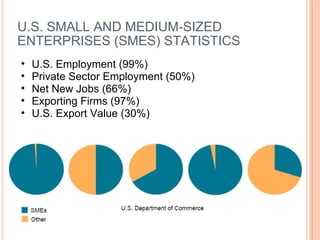
U.S. SMALL AND MEDIUM-SIZED ENTERPRISES (SMES) STATISTICS U.S. Employment (99%) Private Sector Employment (50%) Net New Jobs (66%) Exporting Firms (97%) U.S. Export Value (30%)
CALIFORNIA [UNREALIZED] EXPORT GROWTH POTENTIAL 96% of the World’s Consumers Live Outside the U.S. 66% of the World’s Purchasing Power is Outside the U.S.  85% of California’s Manufactures do  Not  Export Many Make Exportable Products 60% Sell Only to Canada and Mexico (w/in NAFTA) Many have New-to-Market Export Potential
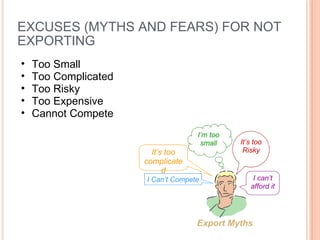
EXCUSES (MYTHS AND FEARS) FOR NOT EXPORTING Too Small Too Complicated Too Risky Too Expensive Cannot Compete It’s too Risky I’m too small I can’t afford it Export Myths It’s too complicated I Can’t Compete
WHY TRADE? 1 in 5 U.S. Manufacturing Jobs (20%) Depend on Exports Export Jobs Receive Higher Wages Each Additional $1B in Exports Creates 15,000 New Jobs Exporting Increases your Sales to More Markets Exporting Reduces Dependence on the U.S. Market Source Products Unavailable Domestically Increase Sales Volume / Profits Adjust for Seasonal Availability Source at Lower Cost; More Price Competitive
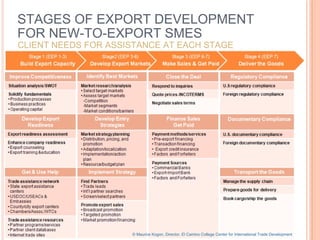
STAGES OF EXPORT DEVELOPMENT FOR NEW-TO-EXPORT SMES CLIENT NEEDS FOR ASSISTANCE AT EACH STAGE © Maurice Kogon, Director, El Camino College Center for International Trade Development
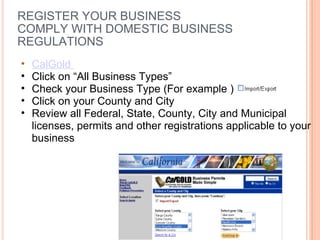
REGISTER YOUR BUSINESS COMPLY WITH DOMESTIC BUSINESS REGULATIONS CalGold  Click on “All Business Types”  Check your Business Type (For example ) Click on your County and City Review all Federal, State, County, City and Municipal licenses, permits and other registrations applicable to your business
INTERNATIONAL EXPORT (IMPORT) PLAN NEED TO ADDRESS THE FOLLOWING TOPICS Company Goals , Financial Resources , Non-financial Resources , Current Trends and Practices, Production Capacity, and SWOTT Analysis Target Market Product Characteristics , Product Packaging, and Product Handling Product Potential Markets, Market Assessments, Your Target Market, and Industry Analysis Pricing Market Price , Pricing Strategy, Unit Price, and Profit Market Entry General Strategies and Promotional Strategies Action Plan Objectives, Tasks, Priorities, Resources , Schedule, and Evaluation
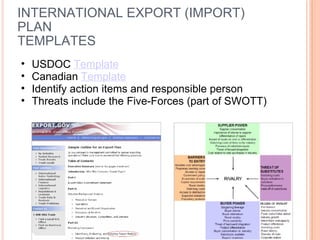
INTERNATIONAL EXPORT (IMPORT) PLAN TEMPLATES USDOC  Template Canadian  Template Identify action items and responsible person Threats include the Five-Forces (part of SWOTT)
EXPORT READINESS (STEPS TO TAKE) Increase Efficiency & Competitiveness  Product Readiness Company Readiness Identify  Resources*  Available to Help You Export On-line Export Readiness Assessment (ERA) California Centers for International Trade Development Identify Few Markets with Highest Export Potential Identify Entry Strategy for Each Market (Desired Partnership Arrangement) Export Promotion & Prompt Follow-up  *Resources on federal and state level, public and private. See the WTW info guide.
EXPORT READINESS INDICATORS Has your company received any unsolicited inquiries from foreign firms?  Are domestic sales of your product doing reasonably well?  Do you have a relatively strong share of the domestic market?  Is your product price-competitive in the domestic market?  Does your product compare favorably with domestic competitors in features and benefits?
TRADE INTERMEDIARIES MANAGEMENT COMPANIES & TRADING COMPANIES Export Management Company (EMC) An independent firm which acts as the exclusive export sales department for manufacturers. Income is usually made on commission or retainer basis, however, title of the goods may also be taken whereas a price mark-up is made. Export Trading Company (ETC) An independent agent that takes title of the goods for export and pays the manufacturer directly. Payment is made on a price mark-up, usually 10-15%. This is attractive for the manufacturer as they avoid risks associated with exporting. Job Function (see handout) Market research/planning/promotion Find customers abroad Respond to inquires/Issue quotes Main Issues (sample agreement in  Exporting Basics ) Exclusive/Non-exclusive  Territory Duration Non-Circumvention Present purchase orders Handle export paperwork Arrange shipping and financing
IDENTIFYING BEST MARKETS Product / Service Demand (Significant Market Segment) Highest Import Volume over past 5 years Highest Import Growth over past 5 years No Significant Barriers to Entry No or Little Domestic Competition Strong U.S. Market Share High Receptivity Comfort Market Infrastructure Available to Finance and Deliver Goods Market Research Best Market Reports Country Commercial Guides  (Chapter Four)
MARKET CONSIDERATIONS Differences That Make A Difference  Language Religion  Tastes  Business Practices Income Levels  Product Standards Physical Environments  Legal Requirements Adaptations Worth Considering  To The Product  To The Promotional Materials To The Packaging
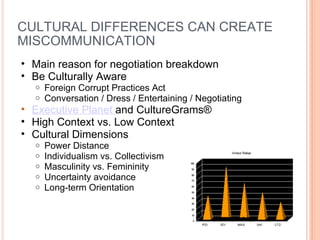
CULTURAL DIFFERENCES CAN CREATE MISCOMMUNICATION Main reason for negotiation breakdown Be Culturally Aware Foreign Corrupt Practices Act  Conversation / Dress / Entertaining / Negotiating  Executive Planet  and CultureGrams® High Context vs. Low Context Cultural Dimensions Power Distance Individualism vs. Collectivism Masculinity vs. Femininity  Uncertainty avoidance Long-term Orientation
ENTRY STRATEGY / CHANNELS OF DISTRIBUTION Acquisition  Sell Through an Intermediary (an Agent or Distributor); Contractual Technology Exchange  License Agreement Establish Joint Venture (JV) / Strategic Alliance Hire Staff Overseas (Manufacture Representative) Establish a Branch / Subsidiary Office Overseas (Foreign Direct Investment) Sell Directly to End-Users
INTERNATIONAL BUSINESS MARKETING, PROMOTION, AND MATCHMAKING On-line: Website, Featured U.S. Exporter (FUSE),  CITD Trade Directory, Exporters Yellow-Pages Direct Mail: Buy industry lists from respective industry chamber or industry magazines Media Advertisements:  Commercial News USA , Industry Magazines, Local TV, Newspapers, Yellow-pages Events: Catalog Show / Trade Show / Trade Mission  USDOC Trade Promotion Services Gold Key Service International Partner Search
AGENT / DISTRIBUTOR QUALIFICATION CHECKLIST  Sales Force Sales Performance  Territorial Coverage  Companies/Products Represented  Customer Profile  Facilities and Equipment  Localization Capabilities  Market Development Capabilities Industry Knowledge – Supply Chains, Distrib. Channels And ALWAYS do your due diligence and get a background check (credit report) on serious partners Example:   Tire repair  company best served by  distributor already representing and  distributing tires / complementary  automotive parts.
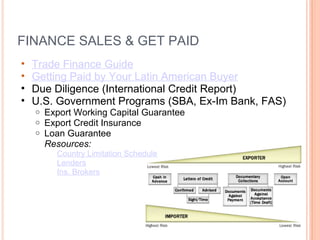
FINANCE SALES & GET PAID Trade Finance Guide Getting Paid by Your Latin American Buyer Due Diligence (International Credit Report) U.S. Government Programs (SBA, Ex-Im Bank, FAS) Export Working Capital Guarantee Export Credit Insurance Loan Guarantee Resources:   Country Limitation Schedule   Lenders Ins. Brokers
METHODS OF PAYMENT IN INTERNATIONAL TRADE Cash-in-Advance Letters of Credit Documentary Collections Open Account Export Working Capital Financing Government-Guaranteed Export Working Capital Loan Programs Export Credit Insurance Export Factoring Forfaiting Government Assisted Foreign Buyer Financing Foreign Exchange Risk Management
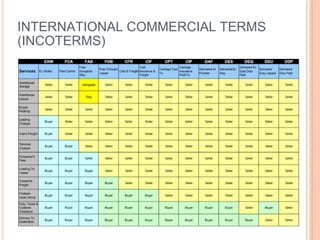
INTERNATIONAL COMMERCIAL TERMS (INCOTERMS)
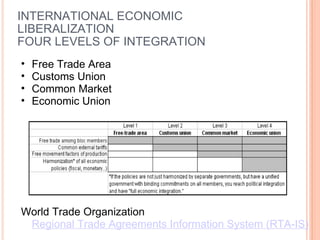
INTERNATIONAL ECONOMIC LIBERALIZATION FOUR LEVELS OF INTEGRATION Free Trade Area  Customs Union Common Market Economic Union World Trade Organization  Regional Trade Agreements Information System (RTA-IS)
OFFICE OF THE U.S. TRADE REPRESENTATIVE Increased levels of trade and investment = more jobs  The U.S. has FTAs in force with 17 countries.  Australia Bahrain Canada Chile Costa Rica Dominican Republic El Salvador Guatemala Honduras Congress must enact legislation to approve and implement each individual agreement (Colombia, Korea, and Panama) in order for them to go into effect. Israel Jordan Mexico Morocco Nicaragua Oman Peru  Singapore
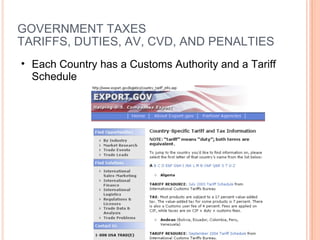
GOVERNMENT TAXES  TARIFFS, DUTIES, AV, CVD, AND PENALTIES Each Country has a Customs Authority and a Tariff Schedule
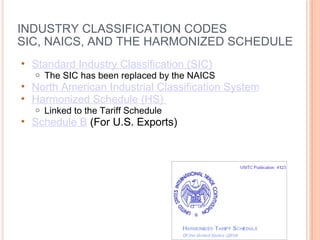
INDUSTRY CLASSIFICATION CODES SIC, NAICS, AND THE HARMONIZED SCHEDULE Standard Industry Classification (SIC) The SIC has been replaced by the NAICS North American Industrial Classification System (NAICS)  Harmonized Schedule (HS)  Linked to the Tariff Schedule Schedule B  (For U.S. Exports)
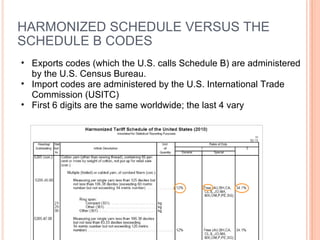
HARMONIZED SCHEDULE VERSUS THE SCHEDULE B CODES Exports codes (which the U.S. calls Schedule B) are administered by the U.S. Census Bureau.  Import codes are administered by the U.S. International Trade Commission (USITC) First 6 digits are the same worldwide; the last 4 vary
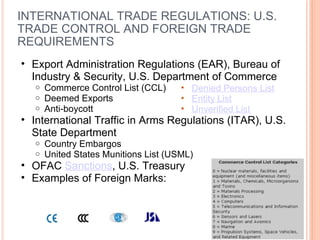
INTERNATIONAL TRADE REGULATIONS: U.S. TRADE CONTROL AND FOREIGN TRADE REQUIREMENTS Export Administration Regulations (EAR), Bureau of Industry & Security, U.S. Department of Commerce Commerce Control List (CCL) Deemed Exports Anti-boycott International Traffic in Arms Regulations (ITAR), U.S. State Department Country Embargos United States Munitions List (USML) OFAC  Sanctions , U.S. Treasury Examples of Foreign Marks: Denied Persons List Entity List Unverified List
RESTRICTIVE MERCHANDISE TO THE U.S. (IMPORTING);  RESTRICTIVE IS A RED FLAG FOR POSSIBLE LICENSE Alcoholic beverages Animal and animal products Certain drugs Firearms and ammunition Fruit, nuts Meat and meat products Milk, dairy, and cheese products Plants and plant products Poultry and poultry products Petroleum and petroleum products Vegetables Certain trademarked and copyrighted articles Not Always, But Usually: art material cultural property hazardous/toxic/flammable materials household appliances some electronics products toys and children’s articles
 
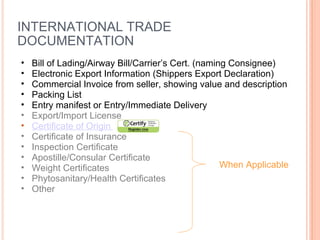
INTERNATIONAL TRADE DOCUMENTATION Bill of Lading/Airway Bill/Carrier’s Cert. (naming Consignee) Electronic Export Information (Shippers Export Declaration) Commercial Invoice from seller, showing value and description Packing List Entry manifest or Entry/Immediate Delivery  Export/Import License Certificate of Origin  Certificate of Insurance Inspection Certificate  Apostille/Consular Certificate Weight Certificates Phytosanitary/Health Certificates Other When Applicable
EX: AUTOMATED EXPORT SYSTEM (AES) IM:  AUTOMATED COMMERCIAL ENVIRONMENT (ACE) Ensure Export Compliance Correct Errors & Decrease Costs  Eliminate Paper Review of Licenses Provides Accurate Trade Data Shippers Export Declaration (SED) changed to Electronic Export Information (EEI) Importer of Record is the person who benefits (exporter)
FREIGHT FORWARDERS AND CUSTOMS BROKERS Freight Forwarders (Transport Architect)   Freight forwarders act on behalf of exporters in arranging transportation services. Most freight forwarders handle both ocean and air transportation, but usually in separate departments. They are familiar with the import rules and regulations of foreign countries, methods of shipping, U.S. Government export regulations, and documents connected with foreign trade. Services include providing quotations on freight costs, port charges, consular fees, cost of special documentation, insurance costs and freight forwarder's fees.  Customs Brokers (Import Specialist) Licensed by the U.S. Department of the Treasury, the customs broker must possess thorough knowledge of tariff schedules and Customs regulations and keep abreast of the amendments made through constant changes in the law and administrative regulations. The broker must be well-versed in determining proper classifications and dutiable value, and be fully aware of the vast number of commodities subject to quotas. Many brokers help clients choose modes of transportation and appropriate carriers, which require analyses of a vast body of data. They also provide assistance to importers in assigning shipments the best routes. There are estimates for landed costs, payments of goods through draft, letters of credit insurance, and re-delivery of cargo if there is more than one port of destination.
DELIVER THE GOODS Electronic Land (Truck or Train) Water (lower cost, slow movement, majority of trade) Air (higher cost, fast movement, higher value goods) Insure Cargo  Book, Track, & Trace Cargo Customs Clearance  Importing to the U.S. (informal = less that $2,000 excluding textiles and footwear) Exporting from the U.S. (informal = less that $2,500)
FOREIGN TRADE ZONES Cost savings (tax relief, lower wage costs) Tariff shifts can reduce customs duties Add value to reach 51% domestic content  Defer customs fees  Five  Foreign Trade Zones  in Los Angeles Area Foreign Trade Zone No. 50 Foreign Trade Zone No. 50-1 Foreign Trade Zone No. 202 Foreign Trade Zone No. 205 Foreign Trade Zone No. 205A
DUTY DRAWBACK Drawback is a refund of duty paid on imported merchandise that is linked to an exportation (or destruction) of an article.  Permitted on the exportation of imported merchandise (and the exchange, or tradeoff, of domestic merchandise) with unchanged condition (substitution) and not used in the U.S. Categories of drawback Manufacturing drawback Unused merchandise drawback  Rejected merchandise drawback
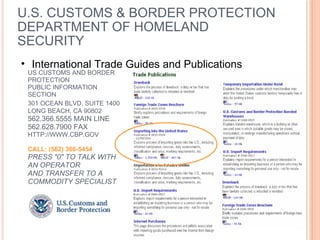
U.S. CUSTOMS & BORDER PROTECTION DEPARTMENT OF HOMELAND SECURITY US CUSTOMS AND BORDER PROTECTION PUBLIC INFORMATION SECTION 301 OCEAN BLVD, SUITE 1400   LONG BEACH, CA 90802 562.366.5555 MAIN LINE 562.628.7900 FAX HTTP://WWW.CBP.GOV CALL: (562) 366-5454 PRESS "0" TO TALK WITH AN OPERATOR AND TRANSFER TO A COMMODITY SPECIALIST International Trade Guides and Publications
EL CAMINO COLLEGE CENTER FOR INTERNATIONAL TRADE DEVELOPMENT Maurice Kogon, Director Bronwen Madden, Deputy Director Kerry Bonner, GEEP Project Manager Darling Garcia, Administrative Assistant  13430 Hawthorne Blvd., Hawthorne, CA 90250 USA Phone: (310) 973-3173 Fax: (310) 973-3132 http://ElCamino.CITD.org http://TradeComplianceInstitute.org http://GreenExport.org

International Trade Orientation Short Version

  • 1.
    El Camino CollegeBusiness Training Center INTERNATIONAL TRADE ORIENTATION OVERVIEW OF EXPORTING AND IMPORTING Bronwen Madden, Deputy Director Center for International Trade Development El Camino College Business Training Center
  • 2.
    NEW GRANT FUNDEDCITD INITIATIVES International Trade Compliance Institute (ITCI) Information and Training on all Aspects of International Trade Regulations Seminars/workshops on EAR, ITAR, AES, ACE & more ITCI Website www.tradecomplianceinstitute.org “ Green” Export Enabler Program (GEEP) Increase Calif. Green Technologies Exports to China Free competitiveness and export readiness assessments Export training and market research/planning for China market entry Subsidized trade event and matchmaking assistance GEEP Website www.greenexport.org
  • 3.
    CALIFORNIA EXPORT PROFILEEXPORTS  GROWTH  JOBS Total Exports by States California’s Top Export Markets California’s Top Exports Total Value: $120,142,219,999 Total % Texas Mexico Computers & Electronic Prod. 35,182,767,377 29.3 % California Canada Transportation Equipment 12,826,967,941 10.7 % New York Japan Machinery Manufactures 10,709,240,936 8.9 % Washington China Chemical Manufactures 10,233,994,524 8.5 % Florida South Korea Misc. Manufactures 9,130,040,605 7.6 % Illinois Hong Kong Crop Production 7,848,804,565 6.5 %
  • 4.
    U.S. SMALL ANDMEDIUM-SIZED ENTERPRISES (SMES) STATISTICS U.S. Employment (99%) Private Sector Employment (50%) Net New Jobs (66%) Exporting Firms (97%) U.S. Export Value (30%)
  • 5.
    CALIFORNIA [UNREALIZED] EXPORTGROWTH POTENTIAL 96% of the World’s Consumers Live Outside the U.S. 66% of the World’s Purchasing Power is Outside the U.S. 85% of California’s Manufactures do Not Export Many Make Exportable Products 60% Sell Only to Canada and Mexico (w/in NAFTA) Many have New-to-Market Export Potential
  • 6.
    EXCUSES (MYTHS ANDFEARS) FOR NOT EXPORTING Too Small Too Complicated Too Risky Too Expensive Cannot Compete It’s too Risky I’m too small I can’t afford it Export Myths It’s too complicated I Can’t Compete
  • 7.
    WHY TRADE? 1in 5 U.S. Manufacturing Jobs (20%) Depend on Exports Export Jobs Receive Higher Wages Each Additional $1B in Exports Creates 15,000 New Jobs Exporting Increases your Sales to More Markets Exporting Reduces Dependence on the U.S. Market Source Products Unavailable Domestically Increase Sales Volume / Profits Adjust for Seasonal Availability Source at Lower Cost; More Price Competitive
  • 8.
    STAGES OF EXPORTDEVELOPMENT FOR NEW-TO-EXPORT SMES CLIENT NEEDS FOR ASSISTANCE AT EACH STAGE © Maurice Kogon, Director, El Camino College Center for International Trade Development
  • 9.
    REGISTER YOUR BUSINESSCOMPLY WITH DOMESTIC BUSINESS REGULATIONS CalGold Click on “All Business Types” Check your Business Type (For example ) Click on your County and City Review all Federal, State, County, City and Municipal licenses, permits and other registrations applicable to your business
  • 10.
    INTERNATIONAL EXPORT (IMPORT)PLAN NEED TO ADDRESS THE FOLLOWING TOPICS Company Goals , Financial Resources , Non-financial Resources , Current Trends and Practices, Production Capacity, and SWOTT Analysis Target Market Product Characteristics , Product Packaging, and Product Handling Product Potential Markets, Market Assessments, Your Target Market, and Industry Analysis Pricing Market Price , Pricing Strategy, Unit Price, and Profit Market Entry General Strategies and Promotional Strategies Action Plan Objectives, Tasks, Priorities, Resources , Schedule, and Evaluation
  • 11.
    INTERNATIONAL EXPORT (IMPORT)PLAN TEMPLATES USDOC Template Canadian Template Identify action items and responsible person Threats include the Five-Forces (part of SWOTT)
  • 12.
    EXPORT READINESS (STEPSTO TAKE) Increase Efficiency & Competitiveness Product Readiness Company Readiness Identify Resources* Available to Help You Export On-line Export Readiness Assessment (ERA) California Centers for International Trade Development Identify Few Markets with Highest Export Potential Identify Entry Strategy for Each Market (Desired Partnership Arrangement) Export Promotion & Prompt Follow-up *Resources on federal and state level, public and private. See the WTW info guide.
  • 13.
    EXPORT READINESS INDICATORSHas your company received any unsolicited inquiries from foreign firms? Are domestic sales of your product doing reasonably well? Do you have a relatively strong share of the domestic market? Is your product price-competitive in the domestic market? Does your product compare favorably with domestic competitors in features and benefits?
  • 14.
    TRADE INTERMEDIARIES MANAGEMENTCOMPANIES & TRADING COMPANIES Export Management Company (EMC) An independent firm which acts as the exclusive export sales department for manufacturers. Income is usually made on commission or retainer basis, however, title of the goods may also be taken whereas a price mark-up is made. Export Trading Company (ETC) An independent agent that takes title of the goods for export and pays the manufacturer directly. Payment is made on a price mark-up, usually 10-15%. This is attractive for the manufacturer as they avoid risks associated with exporting. Job Function (see handout) Market research/planning/promotion Find customers abroad Respond to inquires/Issue quotes Main Issues (sample agreement in Exporting Basics ) Exclusive/Non-exclusive Territory Duration Non-Circumvention Present purchase orders Handle export paperwork Arrange shipping and financing
  • 15.
    IDENTIFYING BEST MARKETSProduct / Service Demand (Significant Market Segment) Highest Import Volume over past 5 years Highest Import Growth over past 5 years No Significant Barriers to Entry No or Little Domestic Competition Strong U.S. Market Share High Receptivity Comfort Market Infrastructure Available to Finance and Deliver Goods Market Research Best Market Reports Country Commercial Guides (Chapter Four)
  • 16.
    MARKET CONSIDERATIONS DifferencesThat Make A Difference Language Religion Tastes Business Practices Income Levels Product Standards Physical Environments Legal Requirements Adaptations Worth Considering To The Product To The Promotional Materials To The Packaging
  • 17.
    CULTURAL DIFFERENCES CANCREATE MISCOMMUNICATION Main reason for negotiation breakdown Be Culturally Aware Foreign Corrupt Practices Act Conversation / Dress / Entertaining / Negotiating Executive Planet and CultureGrams® High Context vs. Low Context Cultural Dimensions Power Distance Individualism vs. Collectivism Masculinity vs. Femininity Uncertainty avoidance Long-term Orientation
  • 18.
    ENTRY STRATEGY /CHANNELS OF DISTRIBUTION Acquisition Sell Through an Intermediary (an Agent or Distributor); Contractual Technology Exchange License Agreement Establish Joint Venture (JV) / Strategic Alliance Hire Staff Overseas (Manufacture Representative) Establish a Branch / Subsidiary Office Overseas (Foreign Direct Investment) Sell Directly to End-Users
  • 19.
    INTERNATIONAL BUSINESS MARKETING,PROMOTION, AND MATCHMAKING On-line: Website, Featured U.S. Exporter (FUSE), CITD Trade Directory, Exporters Yellow-Pages Direct Mail: Buy industry lists from respective industry chamber or industry magazines Media Advertisements: Commercial News USA , Industry Magazines, Local TV, Newspapers, Yellow-pages Events: Catalog Show / Trade Show / Trade Mission USDOC Trade Promotion Services Gold Key Service International Partner Search
  • 20.
    AGENT / DISTRIBUTORQUALIFICATION CHECKLIST Sales Force Sales Performance Territorial Coverage Companies/Products Represented Customer Profile Facilities and Equipment Localization Capabilities Market Development Capabilities Industry Knowledge – Supply Chains, Distrib. Channels And ALWAYS do your due diligence and get a background check (credit report) on serious partners Example: Tire repair company best served by distributor already representing and distributing tires / complementary automotive parts.
  • 21.
    FINANCE SALES &GET PAID Trade Finance Guide Getting Paid by Your Latin American Buyer Due Diligence (International Credit Report) U.S. Government Programs (SBA, Ex-Im Bank, FAS) Export Working Capital Guarantee Export Credit Insurance Loan Guarantee Resources: Country Limitation Schedule Lenders Ins. Brokers
  • 22.
    METHODS OF PAYMENTIN INTERNATIONAL TRADE Cash-in-Advance Letters of Credit Documentary Collections Open Account Export Working Capital Financing Government-Guaranteed Export Working Capital Loan Programs Export Credit Insurance Export Factoring Forfaiting Government Assisted Foreign Buyer Financing Foreign Exchange Risk Management
  • 23.
  • 24.
    INTERNATIONAL ECONOMIC LIBERALIZATIONFOUR LEVELS OF INTEGRATION Free Trade Area Customs Union Common Market Economic Union World Trade Organization Regional Trade Agreements Information System (RTA-IS)
  • 25.
    OFFICE OF THEU.S. TRADE REPRESENTATIVE Increased levels of trade and investment = more jobs The U.S. has FTAs in force with 17 countries. Australia Bahrain Canada Chile Costa Rica Dominican Republic El Salvador Guatemala Honduras Congress must enact legislation to approve and implement each individual agreement (Colombia, Korea, and Panama) in order for them to go into effect. Israel Jordan Mexico Morocco Nicaragua Oman Peru Singapore
  • 26.
    GOVERNMENT TAXES TARIFFS, DUTIES, AV, CVD, AND PENALTIES Each Country has a Customs Authority and a Tariff Schedule
  • 27.
    INDUSTRY CLASSIFICATION CODESSIC, NAICS, AND THE HARMONIZED SCHEDULE Standard Industry Classification (SIC) The SIC has been replaced by the NAICS North American Industrial Classification System (NAICS) Harmonized Schedule (HS) Linked to the Tariff Schedule Schedule B (For U.S. Exports)
  • 28.
    HARMONIZED SCHEDULE VERSUSTHE SCHEDULE B CODES Exports codes (which the U.S. calls Schedule B) are administered by the U.S. Census Bureau. Import codes are administered by the U.S. International Trade Commission (USITC) First 6 digits are the same worldwide; the last 4 vary
  • 29.
    INTERNATIONAL TRADE REGULATIONS:U.S. TRADE CONTROL AND FOREIGN TRADE REQUIREMENTS Export Administration Regulations (EAR), Bureau of Industry & Security, U.S. Department of Commerce Commerce Control List (CCL) Deemed Exports Anti-boycott International Traffic in Arms Regulations (ITAR), U.S. State Department Country Embargos United States Munitions List (USML) OFAC Sanctions , U.S. Treasury Examples of Foreign Marks: Denied Persons List Entity List Unverified List
  • 30.
    RESTRICTIVE MERCHANDISE TOTHE U.S. (IMPORTING); RESTRICTIVE IS A RED FLAG FOR POSSIBLE LICENSE Alcoholic beverages Animal and animal products Certain drugs Firearms and ammunition Fruit, nuts Meat and meat products Milk, dairy, and cheese products Plants and plant products Poultry and poultry products Petroleum and petroleum products Vegetables Certain trademarked and copyrighted articles Not Always, But Usually: art material cultural property hazardous/toxic/flammable materials household appliances some electronics products toys and children’s articles
  • 31.
  • 32.
    INTERNATIONAL TRADE DOCUMENTATIONBill of Lading/Airway Bill/Carrier’s Cert. (naming Consignee) Electronic Export Information (Shippers Export Declaration) Commercial Invoice from seller, showing value and description Packing List Entry manifest or Entry/Immediate Delivery Export/Import License Certificate of Origin Certificate of Insurance Inspection Certificate Apostille/Consular Certificate Weight Certificates Phytosanitary/Health Certificates Other When Applicable
  • 33.
    EX: AUTOMATED EXPORTSYSTEM (AES) IM: AUTOMATED COMMERCIAL ENVIRONMENT (ACE) Ensure Export Compliance Correct Errors & Decrease Costs Eliminate Paper Review of Licenses Provides Accurate Trade Data Shippers Export Declaration (SED) changed to Electronic Export Information (EEI) Importer of Record is the person who benefits (exporter)
  • 34.
    FREIGHT FORWARDERS ANDCUSTOMS BROKERS Freight Forwarders (Transport Architect) Freight forwarders act on behalf of exporters in arranging transportation services. Most freight forwarders handle both ocean and air transportation, but usually in separate departments. They are familiar with the import rules and regulations of foreign countries, methods of shipping, U.S. Government export regulations, and documents connected with foreign trade. Services include providing quotations on freight costs, port charges, consular fees, cost of special documentation, insurance costs and freight forwarder's fees. Customs Brokers (Import Specialist) Licensed by the U.S. Department of the Treasury, the customs broker must possess thorough knowledge of tariff schedules and Customs regulations and keep abreast of the amendments made through constant changes in the law and administrative regulations. The broker must be well-versed in determining proper classifications and dutiable value, and be fully aware of the vast number of commodities subject to quotas. Many brokers help clients choose modes of transportation and appropriate carriers, which require analyses of a vast body of data. They also provide assistance to importers in assigning shipments the best routes. There are estimates for landed costs, payments of goods through draft, letters of credit insurance, and re-delivery of cargo if there is more than one port of destination.
  • 35.
    DELIVER THE GOODSElectronic Land (Truck or Train) Water (lower cost, slow movement, majority of trade) Air (higher cost, fast movement, higher value goods) Insure Cargo Book, Track, & Trace Cargo Customs Clearance Importing to the U.S. (informal = less that $2,000 excluding textiles and footwear) Exporting from the U.S. (informal = less that $2,500)
  • 36.
    FOREIGN TRADE ZONESCost savings (tax relief, lower wage costs) Tariff shifts can reduce customs duties Add value to reach 51% domestic content Defer customs fees Five Foreign Trade Zones in Los Angeles Area Foreign Trade Zone No. 50 Foreign Trade Zone No. 50-1 Foreign Trade Zone No. 202 Foreign Trade Zone No. 205 Foreign Trade Zone No. 205A
  • 37.
    DUTY DRAWBACK Drawbackis a refund of duty paid on imported merchandise that is linked to an exportation (or destruction) of an article. Permitted on the exportation of imported merchandise (and the exchange, or tradeoff, of domestic merchandise) with unchanged condition (substitution) and not used in the U.S. Categories of drawback Manufacturing drawback Unused merchandise drawback Rejected merchandise drawback
  • 38.
    U.S. CUSTOMS &BORDER PROTECTION DEPARTMENT OF HOMELAND SECURITY US CUSTOMS AND BORDER PROTECTION PUBLIC INFORMATION SECTION 301 OCEAN BLVD, SUITE 1400 LONG BEACH, CA 90802 562.366.5555 MAIN LINE 562.628.7900 FAX HTTP://WWW.CBP.GOV CALL: (562) 366-5454 PRESS "0" TO TALK WITH AN OPERATOR AND TRANSFER TO A COMMODITY SPECIALIST International Trade Guides and Publications
  • 39.
    EL CAMINO COLLEGECENTER FOR INTERNATIONAL TRADE DEVELOPMENT Maurice Kogon, Director Bronwen Madden, Deputy Director Kerry Bonner, GEEP Project Manager Darling Garcia, Administrative Assistant 13430 Hawthorne Blvd., Hawthorne, CA 90250 USA Phone: (310) 973-3173 Fax: (310) 973-3132 http://ElCamino.CITD.org http://TradeComplianceInstitute.org http://GreenExport.org

Editor's Notes

  • #6 Myths about Exporting I'm too small to export ; only large firms with name recognition, ample resources, and export departments can export successfully. False! Most of the world’s exporters are SMEs. I can't afford to export; I don't have the money to hire people, market abroad, or expand production if I get new export business. Not true! There are low-cost ways to market and promote abroad, handle new export orders, and finance receivables. These don't require hiring new staff or setting up an export department. I can' t compete overseas; my products are unknown and my prices too high for foreign markets. Not necessarily. The world is large, with varied needs and interests. If your product is selling well in the domestic market, it might well be wanted somewhere else in the world. What makes your product sell in the home market can help it sell abroad. Exporting is too risky; I might not get paid. I might get cheated. I might break a law I didn't know about. Not likely! Selling anywhere has risks, but they can be reduced with reasonable precautions. Exporting is too complicated; I don't know how. Wrong! You don't need to be an expert to export. You can use outside experts to deal with the complications, hire your own expert, Or, become more knowledgeable yourself with training like ours.
  • #22 EXPORT WORKING CAPITAL The Small Business Administration (SBA) Export Working Capital Program (EWCP) and the Working Capital Guarantee (WCG) of the Export-Import Bank of the United States (Ex-Im Bank) assist U.S. Exporters to obtain loans to produce goods or services for export by guaranteeing repayment to the lending institution. The loans can be either transaction specific or revolving and there is no minimum or maximum transaction amount. The U.S exporting company should normally have one-year operating history and the current financials of the company should reflect a positive net worth. EXPORT CREDIT INSURANCE Ex-Im Bank’s Export Credit Insurance enables U.S. exporters to confidently extend credit terms to their international buyers. Export Credit Insurance covers export receivables against commercial risk, if the foreign buyer should default, and political risk coverage, in the case of war, inconvertibility of currency etc. The policy can be a single-buyer policy or it can be a multi-buyer policy. The Ex-Im Bank offers both short and medium-term insurance policies. With short-term policies, the typical terms are 180 days or less, exceptionally 360 days. Medium term insurance covers capital equipment, projects and related services with repayment terms up to 5 years (exceptionally 7 years) with financing up to $10 million. The importer would make cash payment of at least 15 percent. LOAN GUARANTEE The Ex-Im Bank's Loan Guarantee is a very useful program for exporters. Under this program, the Ex-Im Bank provides loan guarantees that allow lenders to offer financing to exporters' foreign customers with fixed or floating competitive rates. This program reduces payment risks to exporters as they are paid upfront for their exports. Foreign buyers are enabled to overcome financing problems and can buy US. goods and services. Banks with delegated authority from the Ex-Im Bank participate in the loan guarantee program and would do due diligence on foreign buyers to ensure that there is reasonable assurance for repayment before granting the loan. UNITED STATES DEPARTMENT OF AGRICULTURE (USDA) FOREIGN AGRICULTUREAL SERVICES (FAS) PROGRAMS United States Department of Agriculture (USDA) – Foreign Agricultural Services (FAS) export finance programs. If the product of the U.S. exporter is agricultural, i.e. the “3Fs” food, feed and fiber, programs offered by the FAS of the USDA could assist exporters to expand their international trade. There are basically three programs: the Supplier Credit Guarantee Program (SCGP), the GSM-102 and GSM-103 programs. The SCGP provides 65 percent guarantee on the principal receivable for credit terms of up to 180 days. Importers must issue Promissory Notes to cover payment. The GSM-102 and GSM-103 are bank driven programs where Dollar denominated Letters of Credit must be issued by the importer from USDA approved foreign banks. GSM-102 program covers credit terms up to three years and GSM-103 programs covers credit term up from 3 to 10 years.