Weapons of
Mass
Destruction
Volume I:
Chemical and
Biological Weapons
Weapons of
Mass Destruction
An Encyclopedia of Worldwide Policy,
Technology, and History

          Eric A. Croddy and James J. Wirtz, Editors
              Jeffrey A. Larsen, Managing Editor
                              Foreword by David Kay


          Volume I: Chemical and Biological Weapons
                        Eric A. Croddy, Editor


            Santa Barbara, California   Denver, Colorado   Oxford, England
Copyright 2005 by Eric A. Croddy, James J. Wirtz, and Jeffrey A. Larsen
All rights reserved. No part of this publication may be reproduced, stored in a retrieval system, or transmitted, in any
form or by any means, electronic, mechanical, photocopying, recording, or otherwise, except for the inclusion of brief
quotations in a review, without prior permission in writing from the publishers.

Library of Congress Cataloging-in-Publication Data
Weapons of mass destruction : an encyclopedia of worldwide policy, technology, and history / Eric A. Croddy and
James J. Wirtz, editors.
     p. cm.
  Includes bibliographical references and index.
  ISBN 1-85109-490-3 (hardback : alk. paper)—ISBN 1-85109-495-4 (e-book)
  1. Weapons of mass destruction—Encyclopedias. I. Croddy, Eric, 1966– II. Wirtz, James J., 1958–
U793.W427 2005
358'.3'03—dc22 2004024651
                                                                                              0807060510987654321

This book is also available on the World Wide Web as an eBook. Visit abc-clio.com for details.

ABC-CLIO, Inc.
130 Cremona Drive, P.O. Box 1911
Santa Barbara, California 93116–1911

This book is printed on acid-free paper.

Manufactured in the United States of America
Contents


           Weapons of Mass Destruction
An Encyclopedia of Worldwide Policy, Technology, and History
         Volume I: Chemical and Biological Weapons

                          Foreword, vii
            Preface: Weapons of Mass Destruction, ix
                  Editors and Contributors, xiii
          A-to-Z List of Entries, Volumes I and II, xvii
      Introduction: Chemical and Biological Weapons, xxv
      Chronology: Chemical and Biological Weapons, xxxi

     Chemical and Biological Weapons, Entries A to Y, 1

    Key Documents: Chemical and Biological Weapons, 341
                    Bibliography, 395
                       Index, 413


                                                               v
Foreword
                                                           David Kay
                                                           Senior Research Analyst, Potomac Institute,
The importance of this encyclopedia was under-             Washington, D.C., and former Director,
scored by the fact that virtually the only area of         Iraq Survey Group (2003–2004)
agreement in the 2004 U.S. presidential campaign
between the two major candidates, President
George W. Bush and Senator John F. Kerry, was that
the proliferation of weapons of mass destruction
poses the most serious national security threat with       made new classes of weapons possible. But scientific
which the next president would have to deal.               progress marches at a very fast rate, leaving behind
    While the prospect of chemical, biological, radi-      old, but still dangerous, knowledge. For example,
ological, or nuclear weapons falling into the hands        the secrets regarding methods for enriching ura-
of terrorists or regimes hostile to the United States      nium were simply bought by the Iraqis from the
and its friends is indeed a frightening prospect, how      U.S. Government Printing Office. That office could
many of us understand exactly what this means?             not imagine that there was anything important in a
When were such weapons first developed? Which              40-year-old project from the dawn of the U.S. nu-
states and scientists are leading these developments?      clear program.
Have these weapons actually been used in the past?             In another remarkable case, uranium enrichment
How often and with what consequence—not only               technology was stolen from a commercial company
for the populations they were used against, but for        in Holland by A. Q. Khan—a rather ordinary Pak-
those that used them, as well? Do these weapons re-        istani who went to Germany to earn an engineering
ally give states a decisive edge over their adversaries?   degree. Khan subsequently used this technology to
How easy are they to develop and use? Does the ease        develop Pakistan’s nuclear weapons and then sold the
of development or use of such weapons by states,           same technology to North Korea, Iran, and Libya.
like North Korea, differ from the obstacles faced by       The techniques of gene modification, which less than
terrorist groups, like al-Qaeda? What are the tools        20 years ago were the stuff of Nobel prizes, are now
available to the United States to halt the spread of       routinely taught in American high schools and com-
such weapons? Have we had any success in limiting          munity colleges and have opened up whole new
the spread of these weapons? Are there any protec-         classes of biological weapons. As this study also
tive measures that individuals can take to lessen          makes clear, even the safe disposal of weapons of
their vulnerability if such weapons are used?              mass destruction following a state’s decision to aban-
    These are but a few of the questions that the au-      don or limit their programs presents serious chal-
thors of this authoritative two-volume study at-           lenges of preventing the weapons and associated
tempt to answer. This encyclopedia will have endur-        technology from falling into the hands of terrorists.
ing importance as states and societies attempt to          The thousands of Soviet-era nuclear weapons and
come to terms with the consequence of the collision        the engineering talent that created them represent a
of scientific progress with the failure to develop a re-   clear and present danger with which the world has
liable global security structure. The initial develop-     not yet completely dealt. The readers of this work will
ment of chemical, biological, and nuclear weapons,         find numerous examples of the lowering of the bar-
as this study makes clear, often involved scientific       riers to the acquisition by states and terrorists of these
and engineering breakthroughs of the highest               most terrible of weapons.
order. The paths to enriching uranium and geneti-              But this study does not simply present the horrors
cally modifying pathogens are but two examples of          of a world filled with weapons of mass destruction. It
such successes, scientific breakthroughs that have         also catalogs and illuminates the various methods of

                                                                                                                 vii
viii FOREWORD

attempting to control and constrain these weapons—        the few efforts made in this regard, it is hard not to
including treaties and agreements such as the Nuclear     come away with a sense of dread for the future. Most
Non-Proliferation Treaty and the Chemical Weapons         control efforts have been aimed at states, not at ter-
Convention, as well as intrusive inspections, such as     rorists operating outside of the control of states.
the efforts of the United Nations to hunt such            Hopefully students and policy makers using this
weapons in Iraq after the first Gulf War. As will be      book a few years hence will be able to record more
clear to the reader, such endeavors have had both suc-    progress toward meeting this new challenge.
cesses and failures. Much remains to be done to en-           The authors and editors have done an important
sure that their effectiveness matches the problems        service by pulling together such an illuminating
posed by the proliferation of such weapons. The           study at exactly the point when there is a broad po-
largest gap in effective mechanisms of control and re-    litical consensus of the importance of the problem.
sponse to the acquisition of such weapons is with re-     One can only hope that our citizens and our politi-
gard to the efforts of terrorists groups to acquire the   cal leaders take the time to explore the depth of in-
means of mass murder. While these volumes identify        formation presented here.
Preface: Weapons
The term “weapon of mass destruction” (WMD) is
                                                       of Mass Destruction
a relatively modern expression. It was probably
first used in print media following the interna-
                                                       Eric A. Croddy and James J. Wirtz
tional uproar over Germany’s aerial bombardment
of the Basque city of Guernica in April 1937. (The
latter event was famously depicted in Picasso’s
painting Guernica y Luno.) Only a year before, an-     never particularly enamored by chemical or biolog-
other Axis power, Italy, had begun using mustard       ical weapons and treated them as a deterrent to be
and other chemical warfare (CW) agents in              used in retaliation for the use of chemical or bio-
Abyssinia (modern-day Ethiopia).1 During the           logical weapons used by the opponent. By the early
anxious years leading up World War II, WMD re-         1990s, the U.S. military had abandoned offensive
ferred to the indiscriminate killing of civilians by   use of these weapons, although it maintained a re-
modern weaponry, especially aircraft. It also          search and development program designed to pro-
echoed the fear of chemical weapons that was un-       duce effective equipment, procedures, medications,
leashed by World War I, which had come to a con-       and inoculations to defend against chemical and bi-
clusion just a few years earlier.                      ological attack.
    Following the development of the atomic bomb           Over the last decade, much has been written
in 1945, the term “WMD” came to include nuclear        about WMD. The meaning of the term itself is
and eventually biological weapons. WMD was ap-         somewhat controversial, although there is a formal,
parently first used to describe nuclear warfare by     legalistic definition. According to U.S. Code Title
Soviet strategists. In 1956, during the 20th Commu-    50, “War and National Defense,” per the U.S. Con-
nist Party Congress in Moscow, the Soviet Minister     gress, the term “weapon of mass destruction”means
of Defense—and “Hero of Stalingrad”—Marshal            “any weapon or device that is intended, or has the
Georgy Konstantinovich Zhukov prophesied that          capability, to cause death or serious bodily injury to
modern warfare “will be characterized by the mas-      a significant number of people through the release,
sive use of air forces, various rocket weapons and     dissemination, or impact of toxic or poisonous
various means of mass destruction such as atomic,      chemicals or their precursors; a disease organism;
thermonuclear, chemical and bacteriological            radiation or radioactivity.”4 For its part, the U.S. De-
weapons.”2 In that same year, the Hungarian Minis-     partment of Defense has a similar characterization
ter of Defense echoed Marshal Zhukov, stating that     of WMD, although in addition it includes “...the
“Under modern conditions, the decisive aspect of       means to deliver [WMD].”5 So, what makes a
operational planning is the use of nuclear and other   weapon massively destructive? Is it the type of inju-
weapons of mass destruction.”3                         rious agents involved, namely radioactive, chemical,
    When the West learned of Zhukov’s speech, na-      or biological, or is it that the attack itself produces
tional security strategists in the United States and   significant casualties or destruction? Also what
elsewhere became quite concerned. By inference,        would “significant” mean in this context: ten, a hun-
they concluded that WMD—nuclear, biological,           dred, or a thousand casualties? What if very few
and chemical weapons—were an integral part of          people are actually killed or hurt by at attack? In the
Soviet military doctrine. Partly in response to        latter respect, the U.S. Federal Bureau of Investiga-
Zhukov’s ministrations on WMD, the United States       tion has a rather unique and somewhat satisfying
reviewed its offensive chemical and biological         interpretation of the term “WMD,” invoked when
weapons program in 1958. The U.S. military was         the U.S. government indicted Timothy McVeigh

                                                                                                            ix
x PREFACE

with using a WMD in his 1995 terrorist attack in          ture and that civilized people everywhere reject the
Oklahoma City. In this case, although the device          use of chemical and biological weapons. Interna-
used was a conventional bomb (employing ammo-             tional law is replete with treaties, agreements, and
nium nitrate-fuel oil explosive), “A weapon crosses       regimes whose purpose is to proscribe the use of
the WMD threshold when the consequences of its            these weapons, or mitigate the consequences of any
release overwhelm local responders.”6                     such use. In particular, the world has successfully
    Some analysts, however, have suggested that           kept nuclear weapons in reserve for almost sixty
various technical hurdles prevent chemical and            years as truly deterrent weapons of last resort.
even biological weapons from causing casualties              Our encyclopedia covers a wide range of topics,
on a truly massive scale. Some point to the Aum           some historical, some drawn from today’s headlines.
Shinrikyo sarin attack on the Tokyo subway system         We describe many of the pathogens, diseases, sub-
on March 20, 1995, which resulted in eleven               stances, and machines that can serve as weapons of
deaths, as an example of the limits of WMD. They          mass destruction, as well as their associated delivery
note that high-explosives have been used with far         systems. We also describe important events and in-
greater lethal effects than sarin in the annals of        dividuals that have been influential in the develop-
modern terrorism. Others are increasingly con-            ment of weapons of mass destruction and doctrines
cerned about the destructive potential of even            for their use (or control). We have encouraged our
rudimentary weapons. Analysts today are worried,          contributors to highlight ongoing controversies and
for instance, that terrorists might try to employ ra-     contemporary concerns about WMD and current
diological dispersal devices or “dirty bombs.”            international arms control and nonproliferation ef-
These weapons do not detonate with a fission re-          forts intended to reduce the threat they pose to
action, but rather utilize conventional explosives to     world peace and security. Even a work of this length,
distribute radiological materials and contaminate         however, cannot completely cover the history, sci-
a given area. Few deaths are likely to result from the    ence, and personal stories associated with a topic of
effects of a dirty bomb, but the consequences—in          this magnitude, so we have included abundant ref-
terms of anxiety, clean-up, and the recognized abil-      erences to help readers take those initial steps for
ity of a terrorist to conduct the very act itself—        further study of the topics we survey.
would likely be far reaching.
                                                          Acknowledgments
About the Encyclopedia                                    Our deepest debt is to the contributors who made
The very presence of chemical, biological and nu-         this volume a reality. Many of them joined the proj-
clear weapons in international arsenals and the po-       ect at its inauguration several years ago and have
tential that they might fall into the hands of terror-    waited a long time to see their work in print. It is im-
ist organizations guarantees that weapons of mass         possible for just three people to be experts on all of
destruction will be of great policy, public, and schol-   the subjects covered in this volume, and without the
arly interest for years to come. We cannot resolve the    hard work of our contributors, this encyclopedia
debates prompted by WMD, but we hope that we              would never have been completed. Thanks to our
and our contributors can provide facts to help the        research assistants, Abraham Denmark and Laura
reader sort through the controversies that are likely     Fontaine, who uncovered most of the key docu-
to emerge in the years ahead. Much that is contained      ments in both volumes and wrote a few entries for
in these volumes is disturbing and even frightening;      us, as well. We also want to express our appreciation
it is impossible to write a cheery encyclopedia about     to a senior government official who reviewed Vol-
weapons whose primary purpose is to conduct               ume II for accuracy and sensitive material. We owe
postindustrial-scale mass murder. The sad truth of        a special debt to Jeff Larsen, our managing editor,
the matter is that chemical, biological, radiological,    whose help was instrumental in the success of this
and nuclear weapons reflect the willingness of hu-        project. Not only did he provide editorial support to
mans to go to great lengths to find increasingly          both volumes, but he displayed a keen ability to deal
lethal and destructive instruments of war and vio-        with the publisher and our 95 contributors, keep
lence. We are pleased to note, however, that much of      track of timelines, requirements, and progress, and
what is reported in these volumes is historical in na-    gently push the two of us when we needed encour-
PREFACE xi

agement during this multiyear project that involved           Frederick R. Sidell, Ernest T. Takafuji, and David
over 500 separate parts. Finally, we also want to ex-         R. Franz, eds., Textbook of Military Medicine,
press our appreciation to Alicia Merritt, Martha              Part I: Warfare, Weaponry, and the Casualty:
Whitt, Giulia Rossi, and the behind-the-scenes                Medical Aspects of Chemical and Biological
copyeditors at ABC-CLIO who worked tirelessly to              Warfare (Washington, DC: Borden Institute,
help get this manuscript into print. We discovered            Walter Reed Army Medical Center, 1997), p. 54.
                                                         3.   Quoted in the archives, “Report of Colonel-
that nothing is a trivial matter when it comes to a
                                                              General István Bata, Hungarian Minister of
manuscript of this size. The commitment of our                Defense, to Members of the HWP Central
publisher to this topic, and the dedication of the            Committee on the Conduct of the Staff-
production staff at ABC-CLIO, greatly facilitated             Command Exercise Held, 17 July 1956,” found at
the completion of these volumes.                              the International Relations and Security
   We hope that this encyclopedia will help inform            Network (Switzerland), documents collection,
the public debate about weapons of mass destruc-              http://www.isn.ethz.ch/
tion and international security policy, with the goal    4.   Title 50, Chapter 40, Sec. 2302.
of never again seeing such weapons used in anger.        5.   Office of the Secretary of Defense, Proliferation:
                                                              Threat and Response (Washington, DC: U.S.
Notes                                                         Government Printing Office, 2001), p. 4.
  1. Stanley D. Fair, “Mussolini’s Chemical War,”        6.   U.S. Federal Bureau of Investigation (FBI), “The
      Army, January 1985, p. 52.                              FBI and Weapons of Mass Destruction,” 4
  2. Jeffery K. Smart, “History of Chemical and               August 1999, http://norfolk.fbi.gov.wmd.htm
      Biological Warfare: An American Perspective,” in
Editors                                               Editors and
ERIC A. CRODDY (EDITOR, VOLUME I,
CHEMICAL AND BIOLOGICAL WEAPONS)
                                                      Contributors
  Analyst with U.S. Pacific Command, Pearl
  Harbor, HI

JAMES J. WIRTZ (EDITOR, VOLUME II,                    JEFFREY M. BALE
NUCLEAR WEAPONS)                                         Senior Research Associate, Monterey Institute
  Professor and Chair, Department of National            of International Studies, Monterey, CA
  Security Affairs, U.S. Naval Postgraduate
  School, Monterey, CA, and Senior Fellow,            ZACH BECKER
  Center for International Security and                 Science Applications International Corporation,
  Cooperation, Stanford University, Palo Alto, CA       Arlington, VA

JEFFREY A. LARSEN (MANAGING EDITOR,                   ANJALI BHATTACHARJEE
VOLUMES I AND II)                                       Research Associate, WMD Terrorism Project,
   Senior Policy Analyst, Science Applications          Center for Nonproliferation Studies, Monterey
   International Corporation and President,             Institute of International Studies, Monterey, CA
   Larsen Consulting Group, Colorado Springs,
   CO                                                 JENNIFER BROWER
                                                        Science and Technology Policy Analyst, The
Contributors                                            RAND Corporation, Arlington, VA
GARY ACKERMAN
  Deputy Director, Chemical and Biological            WILLIAM D. CASEBEER
  Weapons Nonproliferation Program,                     Associate Professor, Department of Philosophy,
  Monterey Institute of International Studies,          U.S. Air Force Academy, CO
  Monterey, CA
                                                      KALPANA CHITTARANJAN
JEFFREY A. ADAMS                                        Research Fellow, Observer Research
   Senior Analyst, Analytic Services, Inc. (ANSER),     Foundation, Chennai Chapter, Chennai, India
   Arlington, VA
                                                      CLAY CHUN
PETER ALMQUIST                                          Chairman, Department of Distance Education,
  Bureau of Arms Control, U.S. Department of            U.S. Army War College, Carlisle Barracks, PA
  State, Washington, DC
                                                      WILLIAM S. CLARK
ELIZABETH AYLOTT                                        Defense Policy Analyst, Science Applications
  Plans and Policy Analyst, Science Applications        International Corporation, Arlington, VA
  International Corporation, Ramstein Air Base,
  Germany                                             CHRIS CRAIGE
                                                        Graduate Student, U.S. Naval Postgraduate
                                                        School, Monterey, CA

                                                                                                     xiii
xiv EDITORS AND CONTRIBUTORS

MALCOLM DAVIS                                       ANDREA GABBITAS
  Lecturer, Defence Studies Department, King’s        Graduate Student, Department of Political
  College London, London, UK                          Science, Massachusetts Institute of Technology,
                                                      Cambridge, MA
ABE DENMARK
  Graduate Student, Graduate School of              SCOTT SIGMUND GARTNER
  International Studies, University of Denver,        Associate Professor, Department of Political
  Denver, CO                                          Science, University of California–Davis, Davis, CA

JOHN W. DIETRICH                                    MICHAEL GEORGE
  Assistant Professor, Bryant University,             Policy Analyst, Science Applications
  Smithfield, RI                                      International Corporation, Arlington, VA

ANDREW M. DORMAN                                    DON GILLICH
  Lecturer in Defence Studies, King’s College         Nuclear Research and Operations Officer, U.S.
  London, London, UK                                  Army, Colorado Springs, CO

FRANNIE EDWARDS                                     DAN GOODRICH
  Office of Emergency Services, San Jose, CA          Public Health Department, Santa Clara, CA

LAWRENCE R. FINK                                    PHIL GRIMLEY
  Corporate Export Administration, International      Professor of Pathology and Molecular Cell
  Legal Department, Science Applications              Biology, F. Edward Herbert Medical School,
  International Corporation, Arlington, VA            Uniformed Services University of Health
                                                      Sciences, Bethesda, MD
STEPHANIE FITZPATRICK
  Arms Control/Policy Analyst, Independent          EUGENIA K. GUILMARTIN
  Consultant, Arlington, VA                           Assistant Professor, Department of Social
                                                      Sciences, U.S. Military Academy, West Point, NY
SCHUYLER FOERSTER
  President, World Affairs Council of Pittsburgh,   JOHN HART
  Pittsburgh, PA                                      Researcher, Stockholm International Peace
                                                      Research Institute, Solna, Sweden
LAURA FONTAINE
  Graduate Student, Graduate School of              PETER HAYS
  International Studies, University of Denver,        Executive Editor, Joint Force Quarterly, National
  Denver, CO                                          Defense University, Washington, DC

J. RUSS FORNEY                                      JAMES JOYNER
    Associate Professor, Department of Chemistry      Managing Editor, Strategic Insights,
    and Life Science, U.S. Military Academy, West     Washington, DC
    Point, NY
                                                    AARON KARP
MARTIN FURMANSKI                                      Professor, Old Dominion University, and
  Scientists Working Group on Biological and          Assistant Professor, U.S. Joint Forces Staff
  Chemical Weapons, Center for Arms Control           College, Norfolk, VA
  and Nonproliferation, Ventura, CA
                                                    KERRY KARTCHNER
                                                      Senior Advisor for Missile Defense Policy, U.S.
                                                      State Department, Washington, DC
EDITORS AND CONTRIBUTORS xv

MIKE KAUFHOLD                                         CLAUDINE MCCARTHY
  Senior National Security Policy Analyst, Science      National Association of County and City Health
  Applications International Corporation, San           Officials, Washington, DC
  Antonio, TX
                                                      JEFFREY D. MCCAUSLAND
BRET KINMAN                                              Director, Leadership in Conflict Initiative,
  Graduate Student, Department of National               Dickinson College, Carlisle, PA
  Security Affairs, U.S. Naval Postgraduate School,
  Monterey, CA                                        PATRICIA MCFATE
                                                        Science Applications International Corporation,
KIMBERLY L. KOSTEFF                                     Santa Fe, NM
  Policy Analyst, Science Applications
  International Corporation, Arlington, VA            ROB MELTON
                                                        Assistant Professor of Military Strategic Studies,
AMY E. KRAFFT                                           34th Education Group, U.S. Air Force Academy,
  Research Biologist, Department of Molecular           CO
  Genetic Pathology, Armed Forces Institute of
  Pathology, Rockville, MD                            BRIAN MORETTI
                                                        Assistant Professor, Department of Physics, U.S.
JENNIFER LASECKI                                        Military Academy, West Point, NY
  Computer Sciences Corporation, Alexandria, VA
                                                      JENNIFER HUNT MORSTEIN
PETER LAVOY                                             Senior Analyst, Science Applications
  Director, Center for Contemporary Conflict,           International Corporation, McLean, VA
  U.S. Naval Postgraduate School, Monterey, CA
                                                      EDWARD P. NAESSENS, JR.
SEAN LAWSON                                             Associate Professor, Nuclear Engineering
  Graduate Student, Department of Science and           Program Director, Department of Physics, U.S.
  Technology Studies, Rensselaer Polytechnic            Military Academy, West Point, NY
  Institute, Troy, NY
                                                      T. V. PAUL
MICHAEL LIPSON                                            James McGill Professor of International
  Assistant Professor, Department of Political            Relations, McGill University, Montreal, Canada
  Science, Concordia University, Montreal,
  Canada                                              ROY PETTIS
                                                        Science Advisor to the Office of Strategic and
BRIAN L’ITALIEN                                         Theater Defenses, Bureau of Arms Control, U.S.
  Defense Intelligence Agency, Washington, DC           State Department, Washington, DC

MORTEN BREMER MAERLI                                  RICH PILCH
 Researcher, Norwegian Institute of International       Scientist in Residence, Chemical and Biological
 Affairs, Oslo, Norway                                  Nonproliferation Program, Center for
                                                        Nonproliferation Studies, Monterey Institute of
TOM MAHNKEN                                             International Studies, Monterey, CA
  Professor of Strategy, Naval War College,
  Newport, RI                                         ELIZABETH PRESCOTT
                                                        International Institute for Strategic Studies,
ROBERT MATHEWS                                          Washington, DC
  Asia-Pacific Centre for Military Law, University
  of Melbourne, Victoria, Australia
xvi EDITORS AND CONTRIBUTORS

BEVERLEY RIDER                                         ROBERT SOBESKI
  Senior Scientist, Genencor International, Inc.,        Assistant Professor, Department of Physics, U.S.
  Palo Alto, CA                                          Military Academy, West Point, NY

GUY ROBERTS                                            JOHN SPYKERMAN
  Principal Director, Negotiations Policy, Office of     Foreign Affairs Officer, U.S. State Department,
  the Secretary of Defense, Washington DC                Washington, DC

J. SIMON ROFE                                          TROY S. THOMAS
    Lecturer, Defence Studies Department, King’s         Fellow, Center for Strategic Intelligence
    College London, London, UK                           Research, Defense Intelligence Agency,
                                                         Washington, DC
KEN ROGERS
  Professor of Political Science, Department of        CHARLES L. THORNTON
  Social Sciences and Philosophy, Arkansas Tech          Research Fellow, Center for International and
  University, Russellville, AR                           Security Studies, School of Public Policy,
                                                         University of Maryland, College Park, MD
STEVEN ROSENKRANTZ
  Foreign Affairs Officer, Office of Strategic and     ROD THORNTON
  Theater Defenses, Bureau of Arms Control, U.S.         Lecturer, Defence Studies Department, King’s
  State Department, Washington, DC                       College London, London, UK

C. ROSS SCHMIDTLEIN                                    ANTHONY TU
   Research Fellow, Department of Medical                Department of Biochemistry and Molecular
   Physics, Memorial Sloan-Kettering Cancer              Biology, Colorado State University, Ft Collins, CO
   Center, New York, NY
                                                       PETER VALE
GLEN M. SEGELL                                           Nelson Mandela Professor of Politics, Rhodes
  Director, Institute of Security Policy, London,        University, Grahamstown, South Africa
  UK
                                                       GILLES VAN NEDERVEEN
D. SHANNON SENTELL, JR.                                  Independent Consultant, Fairfax, VA
   Assistant Professor, Department of Physics, U.S.
   Military Academy, West Point, NY                    MICHAEL WHEELER
                                                         Senior Defense Analyst, Science Applications
JACQUELINE SIMON                                         International Corporation, McLean, VA
   Independent Consultant, Ottawa, Canada
                                                       JOLIE WOOD
JOSHUA SINAI                                             Graduate Student, Department of Government,
  Analytic Services, Inc. (ANSER), Alexandria, VA        University of Texas, Austin, TX

STANLEY R. SLOAN                                       JACK WOODALL
  Visiting Scholar, Middlebury College, and               Visiting Professor, Department of Medical
  Director, Atlantic Community Initiative,                Biochemistry, Federal University of Rio de
  Richmond, VT                                            Janeiro, Brazil

JAMES M. SMITH                                         ROBERT WYMAN
  Director, USAF Institute for National Security         Arms Control Operations Specialist, Science
  Studies, U.S. Air Force Academy, Colorado              Applications International Corporation,
  Springs, CO                                            Arlington, VA
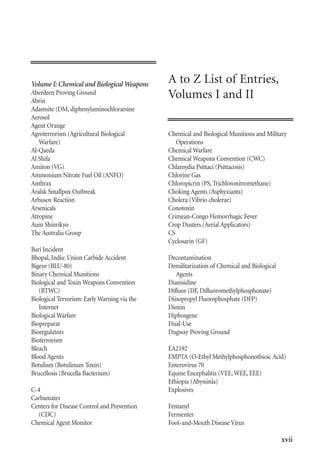
Volume I: Chemical and Biological Weapons     A to Z List of Entries,
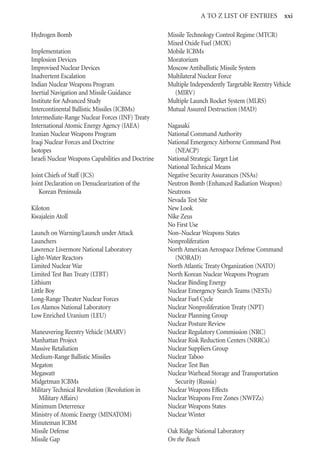
Aberdeen Proving Ground
Abrin
                                              Volumes I and II
Adamsite (DM, diphenylaminochlorarsine
Aerosol
Agent Orange
Agroterrorism (Agricultural Biological        Chemical and Biological Munitions and Military
   Warfare)                                      Operations
Al-Qaeda                                      Chemical Warfare
Al Shifa                                      Chemical Weapons Convention (CWC)
Amiton (VG)                                   Chlamydia Psittaci (Psittacosis)
Ammonium Nitrate Fuel Oil (ANFO)              Chlorine Gas
Anthrax                                       Chloropicrin (PS, Trichloronitromethane)
Aralsk Smallpox Outbreak                      Choking Agents (Asphyxiants)
Arbusov Reaction                              Cholera (Vibrio cholerae)
Arsenicals                                    Conotoxin
Atropine                                      Crimean-Congo Hemorrhagic Fever
Aum Shinrikyo                                 Crop Dusters (Aerial Applicators)
The Australia Group                           CS
                                              Cyclosarin (GF)
Bari Incident
Bhopal, India: Union Carbide Accident         Decontamination
Bigeye (BLU-80)                               Demilitarization of Chemical and Biological
Binary Chemical Munitions                        Agents
Biological and Toxin Weapons Convention       Dianisidine
   (BTWC)                                     Difluor (DF, Difluoromethylphosphonate)
Biological Terrorism: Early Warning via the   Diisopropyl Fluorophosphate (DFP)
   Internet                                   Dioxin
Biological Warfare                            Diphosgene
Biopreparat                                   Dual-Use
Bioregulators                                 Dugway Proving Ground
Bioterrorism
Bleach                                        EA2192
Blood Agents                                  EMPTA (O-Ethyl Methylphosphonothioic Acid)
Botulism (Botulinum Toxin)                    Enterovirus 70
Brucellosis (Brucella Bacterium)              Equine Encephalitis (VEE, WEE, EEE)
                                              Ethiopia (Abyssinia)
C-4                                           Explosives
Carbamates
Centers for Disease Control and Prevention    Fentanyl
  (CDC)                                       Fermenter
Chemical Agent Monitor                        Foot-and-Mouth Disease Virus

                                                                                            xvii
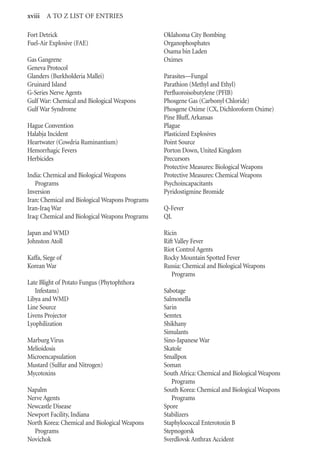
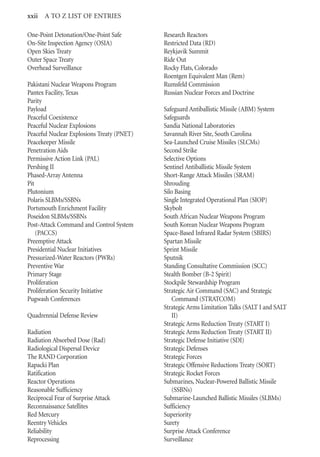
xviii A TO Z LIST OF ENTRIES

Fort Detrick                                     Oklahoma City Bombing
Fuel-Air Explosive (FAE)                         Organophosphates
                                                 Osama bin Laden
Gas Gangrene                                     Oximes
Geneva Protocol
Glanders (Burkholderia Mallei)                   Parasites—Fungal
Gruinard Island                                  Parathion (Methyl and Ethyl)
G-Series Nerve Agents                            Perfluoroisobutylene (PFIB)
Gulf War: Chemical and Biological Weapons        Phosgene Gas (Carbonyl Chloride)
Gulf War Syndrome                                Phosgene Oxime (CX, Dichloroform Oxime)
                                                 Pine Bluff, Arkansas
Hague Convention                                 Plague
Halabja Incident                                 Plasticized Explosives
Heartwater (Cowdria Ruminantium)                 Point Source
Hemorrhagic Fevers                               Porton Down, United Kingdom
Herbicides                                       Precursors
                                                 Protective Measures: Biological Weapons
India: Chemical and Biological Weapons           Protective Measures: Chemical Weapons
   Programs                                      Psychoincapacitants
Inversion                                        Pyridostigmine Bromide
Iran: Chemical and Biological Weapons Programs
Iran-Iraq War                                    Q-Fever
Iraq: Chemical and Biological Weapons Programs   QL

Japan and WMD                                    Ricin
Johnston Atoll                                   Rift Valley Fever
                                                 Riot Control Agents
Kaffa, Siege of                                  Rocky Mountain Spotted Fever
Korean War                                       Russia: Chemical and Biological Weapons
                                                    Programs
Late Blight of Potato Fungus (Phytophthora
   Infestans)                                    Sabotage
Libya and WMD                                    Salmonella
Line Source                                      Sarin
Livens Projector                                 Semtex
Lyophilization                                   Shikhany
                                                 Simulants
Marburg Virus                                    Sino-Japanese War
Melioidosis                                      Skatole
Microencapsulation                               Smallpox
Mustard (Sulfur and Nitrogen)                    Soman
Mycotoxins                                       South Africa: Chemical and Biological Weapons
                                                    Programs
Napalm                                           South Korea: Chemical and Biological Weapons
Nerve Agents                                        Programs
Newcastle Disease                                Spore
Newport Facility, Indiana                        Stabilizers
North Korea: Chemical and Biological Weapons     Staphylococcal Enterotoxin B
  Programs                                       Stepnogorsk
Novichok                                         Sverdlovsk Anthrax Accident
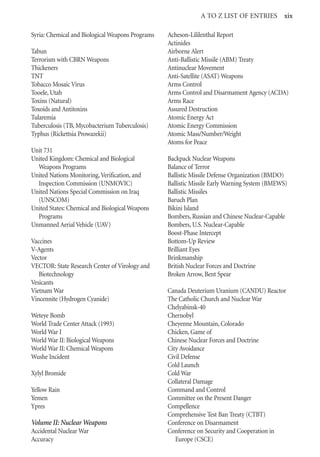
A TO Z LIST OF ENTRIES xix

Syria: Chemical and Biological Weapons Programs   Acheson-Lililenthal Report
                                                  Actinides
Tabun                                             Airborne Alert
Terrorism with CBRN Weapons                       Anti-Ballistic Missile (ABM) Treaty
Thickeners                                        Antinuclear Movement
TNT                                               Anti-Satellite (ASAT) Weapons
Tobacco Mosaic Virus                              Arms Control
Tooele, Utah                                      Arms Control and Disarmament Agency (ACDA)
Toxins (Natural)                                  Arms Race
Toxoids and Antitoxins                            Assured Destruction
Tularemia                                         Atomic Energy Act
Tuberculosis (TB, Mycobacterium Tuberculosis)     Atomic Energy Commission
Typhus (Rickettsia Prowazekii)                    Atomic Mass/Number/Weight
                                                  Atoms for Peace
Unit 731
United Kingdom: Chemical and Biological           Backpack Nuclear Weapons
  Weapons Programs                                Balance of Terror
United Nations Monitoring, Verification, and      Ballistic Missile Defense Organization (BMDO)
  Inspection Commission (UNMOVIC)                 Ballistic Missile Early Warning System (BMEWS)
United Nations Special Commission on Iraq         Ballistic Missiles
  (UNSCOM)                                        Baruch Plan
United States: Chemical and Biological Weapons    Bikini Island
  Programs                                        Bombers, Russian and Chinese Nuclear-Capable
Unmanned Aerial Vehicle (UAV)                     Bombers, U.S. Nuclear-Capable
                                                  Boost-Phase Intercept
Vaccines                                          Bottom-Up Review
V-Agents                                          Brilliant Eyes
Vector                                            Brinkmanship
VECTOR: State Research Center of Virology and     British Nuclear Forces and Doctrine
   Biotechnology                                  Broken Arrow, Bent Spear
Vesicants
Vietnam War                                       Canada Deuterium Uranium (CANDU) Reactor
Vincennite (Hydrogen Cyanide)                     The Catholic Church and Nuclear War
                                                  Chelyabinsk-40
Weteye Bomb                                       Chernobyl
World Trade Center Attack (1993)                  Cheyenne Mountain, Colorado
World War I                                       Chicken, Game of
World War II: Biological Weapons                  Chinese Nuclear Forces and Doctrine
World War II: Chemical Weapons                    City Avoidance
Wushe Incident                                    Civil Defense
                                                  Cold Launch
Xylyl Bromide                                     Cold War
                                                  Collateral Damage
Yellow Rain                                       Command and Control
Yemen                                             Committee on the Present Danger
Ypres                                             Compellence
                                                  Comprehensive Test Ban Treaty (CTBT)
Volume II: Nuclear Weapons                        Conference on Disarmament
Accidental Nuclear War                            Conference on Security and Cooperation in
Accuracy                                             Europe (CSCE)
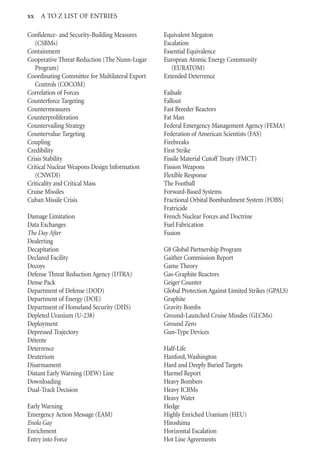
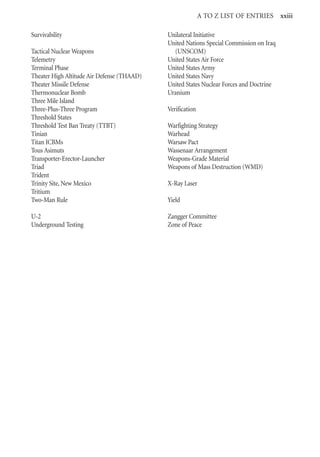
xx A TO Z LIST OF ENTRIES

Confidence- and Security-Building Measures       Equivalent Megaton
   (CSBMs)                                       Escalation
Containment                                      Essential Equivalence
Cooperative Threat Reduction (The Nunn-Lugar     European Atomic Energy Community
   Program)                                         (EURATOM)
Coordinating Committee for Multilateral Export   Extended Deterrence
   Controls (COCOM)
Correlation of Forces                            Failsafe
Counterforce Targeting                           Fallout
Countermeasures                                  Fast Breeder Reactors
Counterproliferation                             Fat Man
Countervailing Strategy                          Federal Emergency Management Agency (FEMA)
Countervalue Targeting                           Federation of American Scientists (FAS)
Coupling                                         Firebreaks
Credibility                                      First Strike
Crisis Stability                                 Fissile Material Cutoff Treaty (FMCT)
Critical Nuclear Weapons Design Information      Fission Weapons
   (CNWDI)                                       Flexible Response
Criticality and Critical Mass                    The Football
Cruise Missiles                                  Forward-Based Systems
Cuban Missile Crisis                             Fractional Orbital Bombardment System (FOBS)
                                                 Fratricide
Damage Limitation                                French Nuclear Forces and Doctrine
Data Exchanges                                   Fuel Fabrication
The Day After                                    Fusion
Dealerting
Decapitation                                     G8 Global Partnership Program
Declared Facility                                Gaither Commission Report
Decoys                                           Game Theory
Defense Threat Reduction Agency (DTRA)           Gas-Graphite Reactors
Dense Pack                                       Geiger Counter
Department of Defense (DOD)                      Global Protection Against Limited Strikes (GPALS)
Department of Energy (DOE)                       Graphite
Department of Homeland Security (DHS)            Gravity Bombs
Depleted Uranium (U-238)                         Ground-Launched Cruise Missiles (GLCMs)
Deployment                                       Ground Zero
Depressed Trajectory                             Gun-Type Devices
Détente
Deterrence                                       Half-Life
Deuterium                                        Hanford, Washington
Disarmament                                      Hard and Deeply Buried Targets
Distant Early Warning (DEW) Line                 Harmel Report
Downloading                                      Heavy Bombers
Dual-Track Decision                              Heavy ICBMs
                                                 Heavy Water
Early Warning                                    Hedge
Emergency Action Message (EAM)                   Highly Enriched Uranium (HEU)
Enola Gay                                        Hiroshima
Enrichment                                       Horizontal Escalation
Entry into Force                                 Hot Line Agreements
A TO Z LIST OF ENTRIES xxi

Hydrogen Bomb                                       Missile Technology Control Regime (MTCR)
                                                    Mixed Oxide Fuel (MOX)
Implementation                                      Mobile ICBMs
Implosion Devices                                   Moratorium
Improvised Nuclear Devices                          Moscow Antiballistic Missile System
Inadvertent Escalation                              Multilateral Nuclear Force
Indian Nuclear Weapons Program                      Multiple Independently Targetable Reentry Vehicle
Inertial Navigation and Missile Guidance              (MIRV)
Institute for Advanced Study                        Multiple Launch Rocket System (MLRS)
Intercontinental Ballistic Missiles (ICBMs)         Mutual Assured Destruction (MAD)
Intermediate-Range Nuclear Forces (INF) Treaty
International Atomic Energy Agency (IAEA)           Nagasaki
Iranian Nuclear Weapons Program                     National Command Authority
Iraqi Nuclear Forces and Doctrine                   National Emergency Airborne Command Post
Isotopes                                               (NEACP)
Israeli Nuclear Weapons Capabilities and Doctrine   National Strategic Target List
                                                    National Technical Means
Joint Chiefs of Staff (JCS)                         Negative Security Assurances (NSAs)
Joint Declaration on Denuclearization of the        Neutron Bomb (Enhanced Radiation Weapon)
   Korean Peninsula                                 Neutrons
                                                    Nevada Test Site
Kiloton                                             New Look
Kwajalein Atoll                                     Nike Zeus
                                                    No First Use
Launch on Warning/Launch under Attack               Non–Nuclear Weapons States
Launchers                                           Nonproliferation
Lawrence Livermore National Laboratory              North American Aerospace Defense Command
Light-Water Reactors                                   (NORAD)
Limited Nuclear War                                 North Atlantic Treaty Organization (NATO)
Limited Test Ban Treaty (LTBT)                      North Korean Nuclear Weapons Program
Lithium                                             Nuclear Binding Energy
Little Boy                                          Nuclear Emergency Search Teams (NESTs)
Long-Range Theater Nuclear Forces                   Nuclear Fuel Cycle
Los Alamos National Laboratory                      Nuclear Nonproliferation Treaty (NPT)
Low Enriched Uranium (LEU)                          Nuclear Planning Group
                                                    Nuclear Posture Review
Maneuvering Reentry Vehicle (MARV)                  Nuclear Regulatory Commission (NRC)
Manhattan Project                                   Nuclear Risk Reduction Centers (NRRCs)
Massive Retaliation                                 Nuclear Suppliers Group
Medium-Range Ballistic Missiles                     Nuclear Taboo
Megaton                                             Nuclear Test Ban
Megawatt                                            Nuclear Warhead Storage and Transportation
Midgetman ICBMs                                        Security (Russia)
Military Technical Revolution (Revolution in        Nuclear Weapons Effects
  Military Affairs)                                 Nuclear Weapons Free Zones (NWFZs)
Minimum Deterrence                                  Nuclear Weapons States
Ministry of Atomic Energy (MINATOM)                 Nuclear Winter
Minuteman ICBM
Missile Defense                                     Oak Ridge National Laboratory
Missile Gap                                         On the Beach
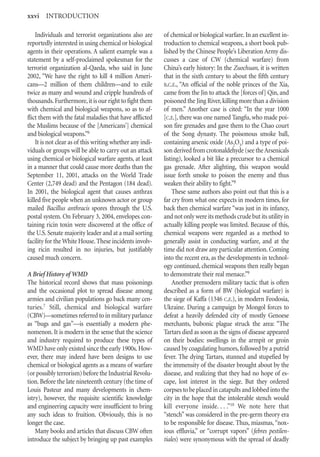
xxii A TO Z LIST OF ENTRIES

One-Point Detonation/One-Point Safe         Research Reactors
On-Site Inspection Agency (OSIA)            Restricted Data (RD)
Open Skies Treaty                           Reykjavik Summit
Outer Space Treaty                          Ride Out
Overhead Surveillance                       Rocky Flats, Colorado
                                            Roentgen Equivalent Man (Rem)
Pakistani Nuclear Weapons Program           Rumsfeld Commission
Pantex Facility, Texas                      Russian Nuclear Forces and Doctrine
Parity
Payload                                     Safeguard Antiballistic Missile (ABM) System
Peaceful Coexistence                        Safeguards
Peaceful Nuclear Explosions                 Sandia National Laboratories
Peaceful Nuclear Explosions Treaty (PNET)   Savannah River Site, South Carolina
Peacekeeper Missile                         Sea-Launched Cruise Missiles (SLCMs)
Penetration Aids                            Second Strike
Permissive Action Link (PAL)                Selective Options
Pershing II                                 Sentinel Antiballistic Missile System
Phased-Array Antenna                        Short-Range Attack Missiles (SRAM)
Pit                                         Shrouding
Plutonium                                   Silo Basing
Polaris SLBMs/SSBNs                         Single Integrated Operational Plan (SIOP)
Portsmouth Enrichment Facility              Skybolt
Poseidon SLBMs/SSBNs                        South African Nuclear Weapons Program
Post-Attack Command and Control System      South Korean Nuclear Weapons Program
    (PACCS)                                 Space-Based Infrared Radar System (SBIRS)
Preemptive Attack                           Spartan Missile
Presidential Nuclear Initiatives            Sprint Missile
Pressurized-Water Reactors (PWRs)           Sputnik
Preventive War                              Standing Consultative Commission (SCC)
Primary Stage                               Stealth Bomber (B-2 Spirit)
Proliferation                               Stockpile Stewardship Program
Proliferation Security Initiative           Strategic Air Command (SAC) and Strategic
Pugwash Conferences                             Command (STRATCOM)
                                            Strategic Arms Limitation Talks (SALT I and SALT
Quadrennial Defense Review                      II)
                                            Strategic Arms Reduction Treaty (START I)
Radiation                                   Strategic Arms Reduction Treaty (START II)
Radiation Absorbed Dose (Rad)               Strategic Defense Initiative (SDI)
Radiological Dispersal Device               Strategic Defenses
The RAND Corporation                        Strategic Forces
Rapacki Plan                                Strategic Offensive Reductions Treaty (SORT)
Ratification                                Strategic Rocket Forces
Reactor Operations                          Submarines, Nuclear-Powered Ballistic Missile
Reasonable Sufficiency                          (SSBNs)
Reciprocal Fear of Surprise Attack          Submarine-Launched Ballistic Missiles (SLBMs)
Reconnaissance Satellites                   Sufficiency
Red Mercury                                 Superiority
Reentry Vehicles                            Surety
Reliability                                 Surprise Attack Conference
Reprocessing                                Surveillance
A TO Z LIST OF ENTRIES xxiii

Survivability                               Unilateral Initiative
                                            United Nations Special Commission on Iraq
Tactical Nuclear Weapons                      (UNSCOM)
Telemetry                                   United States Air Force
Terminal Phase                              United States Army
Theater High Altitude Air Defense (THAAD)   United States Navy
Theater Missile Defense                     United States Nuclear Forces and Doctrine
Thermonuclear Bomb                          Uranium
Three Mile Island
Three-Plus-Three Program                    Verification
Threshold States
Threshold Test Ban Treaty (TTBT)            Warfighting Strategy
Tinian                                      Warhead
Titan ICBMs                                 Warsaw Pact
Tous Asimuts                                Wassenaar Arrangement
Transporter-Erector-Launcher                Weapons-Grade Material
Triad                                       Weapons of Mass Destruction (WMD)
Trident
Trinity Site, New Mexico                    X-Ray Laser
Tritium
Two-Man Rule                                Yield

U-2                                         Zangger Committee
Underground Testing                         Zone of Peace
Introduction:
                                                          Chemical and
In the United States, there are various legal and         Biological Weapons
academic definitions of weapons of mass destruc-
                                                          Eric A. Croddy
tion (WMD), although not everyone may agree on
any of them. The U.S. Department of Defense
(DOD) defines WMD as, “Weapons that are capa-
ble of a high order of destruction and/or of being
used in such a manner as to destroy large numbers         Army Marshal Georgi Konstantinovich Zhukov. In
of people. Weapons of mass destruction can be             fact, it was this speech that highlighted for U.S. pol-
high explosives or nuclear, biological, chemical,         icy makers the real or perceived threat from the So-
and radiological weapons, but exclude the means           viet Union, particularly in terms of the latter’s pre-
of transporting or propelling the weapon where            sumed arsenal of chemical and biological
such means is a separable and divisible part of the       weaponry. As such, Zhukov’s speech invigorated
weapon.”1                                                 United States Cold War research into WMD, in-
    According to the DOD, conventional explosives         cluding biological weaponry.4 During the Cold War,
also can be considered WMD. And this is reason-           the United States—and, to a much greater extent,
able, especially when one considers the cumulative        the Soviet Union—amassed large chemical and bi-
number of deaths caused by gunpowder since its in-        ological weapons stockpiles. The threat posed by
vention in the tenth century and by nitroglycerine        these stockpiles has diminished greatly since the
since its invention in the nineteenth century.2 But       crumbling of the Berlin wall.
the underlying assumption of what makes a                     Regional threats posed by state-funded mili-
weapon massively destructive is the idea that these       taries from chemical and biological weapons also
weapons can cause simultaneous mass casualties.           have declined. By the end of 2003, the U.S. govern-
Nuclear weapons (dealt with separately in Volume          ment had admitted that there was little evidence
II) are an obvious category of WMD, but radiolog-         that Iraq had possessed large chemical or biological
ical weapons (such as so-called dirty bombs are less      weapon stockpiles after the mid-1990s. This has
likely to cause mass injury or death (see Radiologi-      since led both the United States and British govern-
cal Dispersal Device in volume II).3                      ments to begin inquiries into the faulty prewar in-
    Highly toxic chemical compounds—the nerve             telligence on Iraq that was in large part the basis for
agents being prime candidates—could comprise              justifying Operation Iraqi Freedom in March 2003.5
WMD, for example, if delivered effectively against            Other regional threats, however, still remain.
an urban target. Biological agents—that is,               Among these, states such as Syria and North Korea
pathogens and toxins derived from plants or ani-          are suspected of possessing chemical and biological
mals—might also constitute WMD if delivered effi-         weapons. Their bellicose posture regarding their
ciently. When compared to conventional and chem-          immediate neighbors and regional rivals, as well as
ical weapons, biological agents have the greatest         their possession of long-range delivery systems
potential to cause mass casualties, and, theoretically,   (such as Scud missiles), make these threats impossi-
theirs could easily exceed the casualties caused by       ble to ignore. By contrast, Libyan leader Mohamar
the largest nuclear weapon.                               Qaddafi stated in early 2004 that he would re-
    In terms of referring to nuclear, chemical—and        nounce the possession of WMD, which demon-
by inference, biological—weapons, the term                strates how quickly the threat of weapons of mass
“weapons of mass destruction” first came into use         destruction seems to rise and fall on the global
in 1956 when it was used in a speech by Soviet Red        agenda.

                                                                                                            xxv
xxvi INTRODUCTION

    Individuals and terrorist organizations also are       of chemical or biological warfare. In an excellent in-
reportedly interested in using chemical or biological      troduction to chemical weapons, a short book pub-
agents in their operations. A salient example was a        lished by the Chinese People’s Liberation Army dis-
statement by a self-proclaimed spokesman for the           cusses a case of CW (chemical warfare) from
terrorist organization al-Qaeda, who said in June          China’s early history: In the Zuochuan, it is written
2002, “We have the right to kill 4 million Ameri-          that in the sixth century to about the fifth century
cans—2 million of them children—and to exile               B.C.E., “An official of the noble princes of the Xia,
twice as many and wound and cripple hundreds of            came from the Jin to attack the [forces of] Qin, and
thousands. Furthermore, it is our right to fight them      poisoned the Jing River, killing more than a division
with chemical and biological weapons, so as to af-         of men.” Another case is cited: “In the year 1000
flict them with the fatal maladies that have afflicted     [C.E.], there was one named Tangfu, who made poi-
the Muslims because of the [Americans’] chemical           son fire grenades and gave them to the Chao court
and biological weapons.”6                                  of the Song dynasty. The poisonous smoke ball,
    It is not clear as of this writing whether any indi-   containing arsenic oxide (As2O3) and a type of poi-
viduals or groups will be able to carry out an attack      son derived from crotonaldehyde (see the Arsenicals
using chemical or biological warfare agents, at least      listing), looked a bit like a precursor to a chemical
in a manner that could cause more deaths than the          gas grenade. After alighting, this weapon would
September 11, 2001, attacks on the World Trade             issue forth smoke to poison the enemy and thus
Center (2,749 dead) and the Pentagon (184 dead).           weaken their ability to fight.”8
In 2001, the biological agent that causes anthrax              These same authors also point out that this is a
killed five people when an unknown actor or group          far cry from what one expects in modern times, for
mailed Bacillus anthracis spores through the U.S.          back then chemical warfare “was just in its infancy,
postal system. On February 3, 2004, envelopes con-         and not only were its methods crude but its utility in
taining ricin toxin were discovered at the office of       actually killing people was limited. Because of this,
the U.S. Senate majority leader and at a mail sorting      chemical weapons were regarded as a method to
facility for the White House. These incidents involv-      generally assist in conducting warfare, and at the
ing ricin resulted in no injuries, but justifiably         time did not draw any particular attention. Coming
caused much concern.                                       into the recent era, as the developments in technol-
                                                           ogy continued, chemical weapons then really began
A Brief History of WMD                                     to demonstrate their real menace.”9
The historical record shows that mass poisonings               Another premodern military tactic that is often
and the occasional plot to spread disease among            described as a form of BW (biological warfare) is
armies and civilian populations go back many cen-          the siege of Kaffa (1346 C.E.), in modern Feodosia,
turies.7 Still, chemical and biological warfare            Ukraine. During a campaign by Mongol forces to
(CBW)—sometimes referred to in military parlance           defeat a heavily defended city of mostly Genoese
as “bugs and gas”—is essentially a modern phe-             merchants, bubonic plague struck the area: “The
nomenon. It is modern in the sense that the science        Tartars died as soon as the signs of disease appeared
and industry required to produce these types of            on their bodies: swellings in the armpit or groin
WMD have only existed since the early 1900s. How-          caused by coagulating humors, followed by a putrid
ever, there may indeed have been designs to use            fever. The dying Tartars, stunned and stupefied by
chemical or biological agents as a means of warfare        the immensity of the disaster brought about by the
(or possibly terrorism) before the Industrial Revolu-      disease, and realizing that they had no hope of es-
tion. Before the late nineteenth century (the time of      cape, lost interest in the siege. But they ordered
Louis Pasteur and many developments in chem-               corpses to be placed in catapults and lobbed into the
istry), however, the requisite scientific knowledge        city in the hope that the intolerable stench would
and engineering capacity were insufficient to bring        kill everyone inside. . . .”10 We note here that
any such ideas to fruition. Obviously, this is no          “stench” was considered in the pre-germ theory era
longer the case.                                           to be responsible for disease. Thus, miasmas, “nox-
    Many books and articles that discuss CBW often         ious effluvia,” or “corrupt vapors” (febres pestilen-
introduce the subject by bringing up past examples         tiales) were synonymous with the spread of deadly
INTRODUCTION xxvii

epidemics—plague (causative organism: Yersinia             however, that horrific BW experiments were con-
pestis) being among the most notorious.11                  ducted upon Chinese civilians and prisoners of
   The suggestion later made by historians that the        war.12 It is possible that some Allied soldiers, includ-
Mongols were in fact able to spread bubonic                ing American and British personnel, were experi-
plague by hurling disease-ridden corpses over the          mented upon by Ishii Shiro (see the Sino-Japanese
fortress walls is an intriguing one. During the four-      War listing) and his scientists, but this has not been
teenth century, however, a germ theory of disease          confirmed. Apart from the East Asian theater of op-
did not exist. How would the people of that era            erations, however, no offensive use of CBW was
have known exactly how the disease could spread?           conducted in World War II. Suggestions that the So-
What they could not have known is that bubonic             viet Red Army used tularemia (caused by the bac-
plague is spread by fleas, which collect the bacteria      terium Francisella tularensis) against invading Nazi
Yersinia pestis (the causative organism of plague)         forces at the Stalingrad front are not supported by
through feeding upon infected rats. Fleas do not           the available evidence.13 German and Allied military
linger near the body once the temperature of the           scientists did pursue the manufacture of CW agents
host (be it rodent or human) cools following               in very large quantities, but these never were used in
death, making it rather unlikely that the cadavers         conflict.
would have done much to spread the plague. In the              In the Korean War (1950–1953), Chinese offi-
end, it was not the use of projectile cadavers, but        cials, during armistice negotiations, accused the
more likely the exceptionally large rat population         United States of using biological weapons. Although
around the Black Sea that led to a pandemic                there is evidence that at least some of the commu-
throughout the region (and indeed much of Eu-              nist Chinese leaders truly believed the allegations
rope). One could probably conclude, however, that          concerning BW in Korea14, there is no evidence that
the Mongols did have the intent to spread disease          the U.S. military used chemical or biological
among their enemy, and at least in this respect they       weapons during the conflict.15
conducted an early form of BW.                                 During the Cold War, chemical agents became
                                                           even deadlier. The United States and the Soviet
CBW in the Modern Era                                      Union stockpiled the German G-series nerve agents
The stunningly high rate of casualties that occurred       (sarin and soman), as well as the newer V-agents.
in World War I had much do with the machine gun            Perhaps more dangerous was the development of
and rapid-fire artillery, but it also was caused in        weaponized biological agents. The United States
large part by the great number of men that were            and its allies during World War II had pursued a
brought to the battlefields. World War I marks the         rudimentary offensive and defensive BW program.
emergence of “gas warfare:” the use of chlorine,           Later, work continued using a variety of infectious
phosgene, and other toxic chemicals. For the most          agents, including the causative organisms of an-
part, these were used in vain attempts to achieve a        thrax, tularemia, and less deadly—but highly effi-
breakthrough against well-defended armies in               cient—microbes such as Venezuelan equine en-
trenches. Later, chemical warfare agents such as sul-      cephalitis.
fur mustard entered the scene when previous com-               The controversy over the potential use of CBW
pounds were found to be less effective on the battle-      grew increasingly protracted during the Vietnam
field. Unlike chemicals used during the early stages       War, particularly when the U.S. military used herbi-
of the conflict, mustard is not gaseous, but an oily       cides (such as Agent Orange) against Viet Cong-
liquid. It did not kill large numbers of troops, but it    controlled areas. In a variety of instances, riot con-
caused debilitating injury by irritating the skin, eyes,   trol agents (RCAs or tear gas) were used against the
and upper airways. First used in 1917, it was re-          Viet Cong and Viet Minh regular army. Although
sponsible for the most injuries caused by chemical         such forms of weaponry were not intended to cause
weapons during World War I.                                death, their use in an unpopular war heightened the
    Japan conducted CBW against China from 1937            sensitivity of the U.S. government to public percep-
to 1945. It is unknown whether the use of chemicals        tions of its CBW policies. As a consequence of Viet-
against Chinese soldiers gave the Japanese army a          nam and high-profile incidents involving nerve
significant advantage on the battlefield. It is certain,   agents at storage facilities in Utah and Okinawa,
xxviii INTRODUCTION

President Richard Nixon ended most U.S. chemical         tended level of death and destruction, but it caused
and biological programs in 1969.                         significant structural damage. Yousef reportedly
    When President Nixon renounced offensive BW          considered the use of cyanide—a toxic “blood
and the United States stopped the production of bi-      agent”—during the 1993 bombing. However, tech-
ological weapons, the Soviet Union was only getting      nical difficulties and other unknown factors pre-
started. In 1979, a mysterious outbreak of anthrax in    vented Yousef from designing such a device.18
Sverdlovsk, Siberia (now Yekaterinberg) was sus-             There was another “wake-up call” to the threat of
pected by Western intelligence to have been caused       WMD, this time in Tokyo, Japan, when a guru
by a BW-related accident. (After many years of de-       named Shoko Asahara instructed followers to use
nials, Russia admitted in the 1990s that the             nerve agents (sarin) against his real or perceived en-
Sverdlovsk outbreak was caused by Soviet military        emies. In 1995, Shoko Asahara’s cult (Aum Shin-
work with BW agents.) By the late 1980s, the Soviet      rikyo) struck at the Tokyo authorities by releasing a
BW apparatus (Biopreparat) had assembled the             nerve agent on the subway system. The death toll
world’s largest infrastructure devoted to the devel-     was 12, with thousands injured. The end result of
opment of biological weapons. The Soviet arsenal         the Tokyo subway attack was less than many experts
included the standard agents, anthrax, tularemia,        expected from a WMD attack. Still, it made a
and a particularly virulent form of plague. But it       tremendous impact, not only on Japanese society
had also weaponized smallpox, placing it in a liquid     but also on how governments around the world
form to be delivered by intercontinental ballistic       reevaluated the CBW terrorist threat.
missiles.16 Boris Yeltsin formally ended the program         Improvised devices made by Palestinian terror-
in 1992.17                                               ists using toxic chemicals have been a particular
    Iraq had already used large amounts of chemical      concern to Israel. But death and injury caused by
(but not biological) weapons against Iranian troops      shrapnel (ball bearings, nails, bolts, etc. made into
and Kurdish populations during its 1980–1988 con-        projectiles by an exploding device) comprise the
flict with Iran. After the first Gulf War (1990–1991),   largest portion of the casualties inflicted by Palestin-
subsequent inspections conducted by United Na-           ian suicide bombers. In 2002, however, it was re-
tions personnel revealed that Iraq had undertaken a      ported that Israeli intelligence believed Palestinian
serious effort to develop chemical, biological, nu-      homicide bombers to have put rat poison in their
clear, and possibly radiological weapons. In 1995,       explosive devices. According to this assessment, ter-
the western world was particularly alarmed by the        rorists put an anticoagulant type of rodenticide on
scope of the Iraqi BW program. Suspecting that Iraq      shrapnel. Following bombings that occurred in
had maintained at least a remnant of its WMD pro-        2002, Israeli doctors made note of excessive bleeding
grams, including CBW agents and missile delivery         in certain bombing victims. This type of poison
systems, the United States led a war against Iraq be-    (warfarin) acts very slowly in mammals, making its
ginning in 2003 that toppled the Iraqi regime. No        utility and effect somewhat doubtful.19 There is
caches of CBW agents have yet been found in Iraq         other evidence that Palestinian terrorists have been
by coalition forces since their occupation of Iraq.      attempting to use other types of toxic chemicals in
                                                         improvised explosive devices.20
The Chemical and Biological Threat Today                     Now that Saddam Hussein’s Baath Party has lost
The world after September 11, 2001 has certainly         control of Iraq and Libya has offered to abandon its
changed, but even before then experts such as            WMD programs, there is a lower risk of seeing
Michael Osterholm, Jessica Stern, and Jonathan           CBW on the battlefield among national armies.
Tucker had worried about the prospect that terror-       Syria and North Korea still retain a significant
ists might obtain and use WMD. In 1993, Ramzi            chemical weapons capability. But even skeptics of
Yousef made the first attempt to destroy the World       arms control treaties such as the 1993 Chemical
Trade Center. Yousef and his cohorts might have          Weapons Convention (CWC), the 1972 Biological
hoped that the towers would fall over in domino          and Toxin Weapons Convention (BTWC), and in-
fashion, killing upwards of 250,000 people. Instead,     formal arrangements such as the Australia Group
the bomb they planted killed six people and injured      must concede that some progress has recently been
more than 1,000. The attack failed to achieve the in-    made on the nonproliferation front. It is increas-
INTRODUCTION xxix

ingly apparent that the world community has sus-                  somewhat justified) fear of “radiation” by the
tained the recent momentum toward the elimina-                    general public would no doubt cause great
tion of chemical and biological weapons, despite                  anxiety at the very least, perhaps even panic.
some notable setbacks.                                            Thus, RDDs are sometimes referred to as
    Although the United States and other developed                “weapons of mass disruption,” as opposed to
countries seem to be headed toward complete (if                   WMD.
                                                             4.   William Patrick, “Biological Weapons Historical
slow) chemical and biological disarmament, they
                                                                  Overview,” Chemical & Biological Warfare
continue to prepare their militaries for CBW de-                  Proliferation Course (Washington, DC: Central
fense in terms of materials and training. This is pru-            Intelligence Agency, Biological Warfare Branch,
dent, but one could make the argument that mod-                   December 1995).
ern militaries are not likely to encounter chemical or       5.   Global Security Newswire, “Powell Says Knowing
biological weapons in organized combat. The more                  True Iraqi WMD Capability Might Have
likely threat is from terrorists using toxic chemicals            Affected War Decision,” 3 February 2004,
or infectious agents. This is unnerving, but terrorists           http://www.nti.org.
have thus far made little effective use of these types       6.   S. Abu Gheith, In the Shadow of the Lances,
of unconventional weapons. And yet, despite recent                Middle East Research Institute, Special Dispatch
gains in the war against international terrorism,                 Series no. 388, 12 June 2002, http://memri.org/.
WMD will continue to pose a threat to society. It is         7.   Erhard Geissler and John Ellis van Courtland
                                                                  Moon, eds., Biological and Toxin Weapons:
difficult to conceive of a worse scenario than the ef-
                                                                  Research, Development and Use from the Middle
fective use of chemical or biological weapons by ter-             Ages to 1945, SIPRI Chemical & Biological
rorists who act with little or no restraint. By foster-           Warfare Studies, No. 18 (Oxford, UK: Oxford
ing an understanding of CBW agents, weapons, and                  University Press, 1999); James S. Ketchum and
their potential role in conflict, it is hoped that this           Frederick R. Sidell, “Incapacitating Agents,” in
volume will increase awareness—and vigilance—to                   Frederick R. Sidell, Ernest T. Takafuji, and
defeat these threats.                                             David R. Franz, Textbook of Military Medicine,
                                                                  Part I: Warfare, Weaponry, and the Casualty:
Notes:                                                            Medical Aspects of Chemical and Biological
  1. U.S. Department of Defense, Defense Technical                Warfare (Borden Institute, Walter Reed Army
       Information Center (DTIC), December 2003,                  Medical Center: Washington, D.C.: 1997) pp.
       http://www.dtic.mil/.                                      289–290.
  2. Joseph Needham, Science and Civilisation in             8.   Cheng Shuiting and Shi Zhiyuan, Military
       China, vol. 5, pt. 7: Military Technology: The             Technology Information Handbook: Chemical
       Gunpowder Epic (New York: Cambridge                        Weapons, second edition (Beijing: People’s
       University Press, 1986), p. 9. As a British                Liberation Army Press, 1999; second printing
       diplomat (and to his death a committed                     January 2000), p. 7.
       Marxist), Needham was among the first to alert        9.   Ibid.
       the world to Japan’s use of chemical weapons         10.   Quoted in Mark Wheelis, “Biological Warfare
       against China during World War II.                         before 1914,” in Erhard Geissler and John Ellis
  3. A radiological dispersal device (RDD) or “dirty              van Courtland Moon, eds., Biological and Toxin
       bomb” employs a high explosive (such as                    Weapons: Research, Development, and Use from
       dynamite) to disperse radiological materials               the Middle Ages to 1945, SIPRI Chemical &
       (such as cobalt–60, cesium–137, or                         Biological Warfare Studies no. 18 (Oxford:
       strontium–90) across a large area. This would              Oxford University Press, 1999), p. 14.
       not result in a massive radiological hazard as no    11.   Michael R. Gilchrist, “Disease & Infection in the
       fission takes place. Rather, the contaminated area         American Civil War,” The American Biology
       would likely remain off limits to people until it          Teacher, vol. 60, no. 4, April 1998, p. 258.
       was fully cleared of radiating materials—a time-     12.   Hal Gold, Unit 731 Testimony. Tokyo: Yen Books,
       consuming and expensive process. The                       1996.
       immediate effects of the explosion itself might of   13.   Eric Croddy and Sarka Krcalova, “Tularemia,
       course cause death and injury, but few casualties          Biological Warfare (BW), and the Battle for
       would be expected from the radiological sources            Stalingrad (1942–1943),” Military Medicine, vol.
       themselves. Nonetheless, the disproportionate (if          166, no. 10, October 2001, pp. 837–838.
xxx   INTRODUCTION

 14. Chen Jian, Mao’s China and the Cold War             18. John J. Parachini, “The World Trade Center
     (Chapel Hill: University of North Carolina Press,       Bombers (1993),” in John B. Tucker, ed., Toxic
     2001), p. 110.                                          Terror: Assessing Terrorist Use of Chemical and
 15. “China’s Role in the Chemical and Biological            Biological Weapons (Cambridge, MA: MIT Press,
     Disarmament Regimes,” The Nonproliferation              2000), p. 201.
     Review, vol. 9, no. 1, spring 2002, pp. 16–47.      19. Sue Shaw and Jeremy Anderson, “Warfarin
 16. Richard Preston, “The Bioweaponeers,” The New           Ingestion,” Evidence Centre Report, Monash
     Yorker, 9 March 1998, p. 63.                            Medical Center, Australia, 18 March 1999.
 17. Ken Alibek, Biohazard (New York: Random             20. Andrew Chang, “Bombs and Bioterror,” 6 August
     House, 1998), p. 133.                                   2002, http://www.ABCnews.com.
Incidents of chemical or biological warfare (CBW)
                                                           Chronology: Chemical
in history are of great interest, but they are also
quite problematic—at least until we arrive at mod-
                                                           and Biological Weapons
ern times (the post–World War I era). We say prob-
lematic because until the twentieth century, science
had not sufficiently explained the roles of toxic
chemicals or infectious disease in order to effec-         vice causing mass casualties, certainly not all events
tively utilize them in warfare. Nor had industry           would necessarily qualify.
been developed in like fashion to exploit chemistry            This will not stop us from trying to delineate a
or biology for the purpose of waging battle. When it       chronology of examples that are relevant to CBW.
comes to chemical weaponry in particular, Augustin         Here are listed a selection of historical events, with
Prentiss put it quite well:                                an effort to describe them by category: either chem-
                                                           ical or biological weaponry.
   History records numerous earlier but abortive at-
   tempts to utilize the powers of chemistry for mili-     Sixth Century B.C.      Assyrians reportedly used
   tary ends . . ..With the exception of Greek fire [use                           ergot fungus (Claviceps
   of petroleum-based incendiaries, ca. 7th century                                purpurea) to poison their
   C.E.], none of them produced important results
                                                                                   enemy’s water wells
   and none permanently challenged the supremacy
   of existing weapons. They are of interest to us only
   as indicating man’s eagerness to experiment with        431–404 B.C.            Spartan armies use sulfur
   any means that promise to promote his fortunes                                  and toxic arsenic smoke
   in battle and his final dependence upon technical                               during Peloponnesian War
   knowledge to produce such means. (Prentiss, p.
   xvi)                                                    Fourth Century B.C.     Chinese engineers use
                                                                                   arsenic against
    Quite the same can be said of biological                                       underground sappers.
weaponry. In either case of chemical or biological
weapons, the basic knowledge to understand the             Circa 200 B.C.          Officers in Hannibal’s army
scientific disciplines behind them was inadequate                                  adulterate the wine of
until the nineteenth century, when significant ad-                                 African rebels with
vances were made in fields such as organic chem-                                   mandrake, which contains
istry and microbiology. Still, it then took the latter                             belladonna alkaloids
stages of the Industrial Revolution for nations to                                 causing hallucinations.
develop the capacity for mass production of
chemicals that would play a noteworthy—albeit              187 B.C.                Ambraciots (Greece)
overall insignificant—role in World War I                                          employ irritating smoke
(1914–1918).                                                                       against Roman soldiers
    Another criterion to consider is the scope of the
purported attack. Was this a poisoning of a few in-        7th Century C.E.        The Byzantine architect,
dividuals, or a whole army? Keeping in context with                                Callinicus (“Kallinikos”),
a weapon of mass destruction (WMD), that is, a de-                                 reportedly invents the first


                                                                                                           xxxi
xxxii CHRONOLOGY

               liquid incendiary—“Greek                         asphyxiating or deleterious
               Fire.”                                           gases.” (Mauroni, p. 81)

Circa 1040     Scottish king poisons wine       1914            French troops use tear gas
               using a belladonna-like                          grenades against German
               (“sleepy nightshade”) herb                       positions in World War I
               and gives to Norwegian
               enemies as “provisions”          22 April 1915   German military uses
               under pretense of                                barrage of chlorine gas
               surrender. Scots then                            against Allied trenches in
               slaughter the incapacitated                      Ypres, Belgium.
               Norwegians.
                                                12 July 1917    Germany uses mustard
1347           Mongolians lay siege to                          agent against Allied troops
               Kaffa (in modern Ukraine)                        at Ypres, Belgium.
               and throw corpses over city
               walls to spread bubonic          1916–1918       German agents infect beasts
               plague. May have                                 of burden—including
               contributed to Black Death,                      horses bound for use by
               which killed approximately                       Allies in Europe—using
               50 million people through                        glanders and anthrax.
               the fourteenth century.
                                                1919            In midst of the Russian civil
1672           Bishop of Münster                                war, British troops use
               attempted the use of                             adamsite
               atropine-like drug in                            (diphenylaminearsine, DM)
               grenades in siege against                        against Bolsheviks.
               city of Groningen. Attack
               backfires.                       1922            The U.S. delegates at the
                                                                Washington Arms
1767           British plot to supply cloths                    Conference table a proposal
               from a smallpox hospital                         to abolish chemical warfare,
               ward to American Indian                          but France ultimately rejects
               tribes in hopes of spreading                     the treaty because of
               disease. Unknown if this                         stipulations regarding
               strategy was ultimately                          submarines.
               successful.
                                                17 June 1925    Geneva Protocol for the
1855           Sir Lyon Playfair suggests                       Prohibition of the Use in
               using cyanide-containing                         War of Asphyxiating,
               chemicals against Russian                        Poisonous or other gases,
               troops during Crimean                            and of Bacteriological
               War, but this tactic never                       Methods of Warfare is
               found approval by the                            signed by nearly thirty
               British High Command.                            countries.

29 July 1899   First Hague Convention           1936            German chemists synthesize
               signed, prohibiting “the use                     first nerve agents to be
               of projectiles the sole object                   weaponized, including
               of which is the diffusion of                     tabun (GA).
CHRONOLOGY xxxiii

1937–1942       During Sino-Japanese War,                         employs riot control
                Japan employs chemical                            agents—chiefly CS—in
                and biological weapons                            certain military operations,
                against Chinese troops and                        creating controversy,
                civilians.                                        especially for war critics at
                                                                  home and abroad.
1939            Japanese attempt to poison
                water with Salmonella          1967               With possible support from
                enterica Typhi (causative                         the Soviet Union, Egyptian
                agent in typhoid) in the so-                      forces use chemical
                called Nomonhon Incident                          weapons, including mustard
                in a biological attack on                         agent and some kind of
                Soviet troops, but                                organophosphate (nerve
                apparently is unsuccessful.                       agent) against Yemeni
                                                                  royalists.
1935            Italian troops under Benito
                Mussolini begin using          25 November 1969   U.S. president Richard M.
                chemical weapons (mustard                         Nixon renounces the
                agent) against Ethiopians.                        offensive use of biological
                                                                  weapons, ordering that the
1942            United States undertakes                          U.S. program be
                study of biological warfare                       dismantled.
                (BW) agents, including
                defensive and offensive        10 April 1972      Great Britain, the Soviet
                preparations.                                     Union, and the United
                                                                  States sign the Biological
December 1943   German Luftwaffe attacks                          and Toxin Weapons
                Allied ships carrying sulfur                      Convention.
                mustard in Bari, Italy,
                leading to more than 600       1973               Following the Yom Kippur
                casualties.                                       War (fought between
                                                                  Israel and Arab countries),
1956            Soviet Marshal and Defense                        U.S. military analysts
                Minister Georgy Zhukov                            discover that Egypt
                mentions the use of                               possessed armored
                “various means of mass                            vehicles equipped with
                destruction, such as atomic,                      protection against nuclear,
                thermonuclear, chemical                           chemical, and biological
                and bacteriological                               (NBC) warfare. This leads
                weapons,” stirring great                          to concern that Warsaw
                interest and anxiety in the                       Pact forces, supported by
                West. (Mauroni, p. 85)                            the Soviet Union, were
                                                                  prepared to use NBC
1962            The U.S. military begins                          weapons.
                herbicide operations in
                Vietnam War, including the     1973–1974          The Soviet Union initiates
                use of Agent Orange.                              and establishes Biopreparat,
                                                                  a civilian organization
1965            As the war in Vietnam                             devoted to producing
                escalates, the United States                      biological warfare agents.
xxxiv CHRONOLOGY

26 March 1975       The Biological and Toxin                       suspected links to the
                    Weapons Convention enters                      terrorist organization al-
                    into force.                                    Qaeda detonate 1,500
                                                                   pounds of explosive in the
1979                Anthrax (Bacillus anthracis)                   basement of the World
                    spores are accidentally                        Trade Center in New York.
                    released from a biological                     The attack does not destroy
                    weapons facility in                            the buildings, but kills six
                    Sverdlovsk, Russia; at least                   people and injures more
                    64 people died from                            than one thousand.
                    inhalation anthrax.                            Concerns arise over the
                                                                   possibility that the
1983                Iraq begins using chemical                     terrorists laced the high
                    warfare agents, including                      explosives with chemical
                    mustard, in the Iran-Iraq                      weapons in order to
                    War (1980–1988).                               increase the number of
                                                                   casualties.
January–March 1991 A United States–led
                   coalition invades Iraq in       27 June 1994    Aum Shinrikyo, a new
                   Operation Desert Storm.                         religious cult in Japan, uses
                   The goal is to force Iraqi                      sarin nerve agent in an
                   compliance with United                          assassination attempt on
                   Nations resolutions calling                     three judges in Matsumoto,
                   for its withdrawal from                         killing seven people and
                   Kuwait and elimination of                       injuring over 200.
                   its weapons of mass
                   destruction (WMD)               20 March 1995   Aum Shinrikyo releases
                   programs. A newly formed                        sarin nerve agent on the
                   United Nations Special                          Tokyo subway, killing 12
                   Commission on Iraq                              people and injuring about
                   (UNSCOM) searches for                           1,000. Japanese police
                   WMD and oversees the                            discover nerve agent
                   destruction of known                            precursors at the cult’s
                   chemical and biological                         home base near Mt. Fuji
                   weapons arsenals and                            and also learn that Aum
                   production facilities until                     attempted to produce
                   1998, when Iraq defies                          biological weapons.
                   international mandates and
                   forces UNSCOM                   19 April 1995   Timothy McVeigh detonates
                   inspectors to leave the                         a 4,000-pound ammonium
                   country.                                        nitrate fuel oil (ANFO)
                                                                   explosive device in a rented
13 January 1993     The Chemical Weapons                           truck, destroying the Alfred
                    Convention (CWC) is open                       P. Murrah Federal Building
                    for signature.                                 in Oklahoma City,
                                                                   Oklahoma and killing 168
26 February 1993    On 26 February 1993, a                         people.
                    small group of men from
                    the Middle East with           29 April 1997   The CWC enters into force.
CHRONOLOGY xxxv

October 2001       A still unknown perpetrator     References:
                   mails four letters containing   Geissler, Erhard, and John Ellis van Courtland Moon,
                   anthrax spores to                  eds., Biological and Toxin Weapons: Research,
                   unsuspecting victims in            Development and Use from the Middle Ages to 1945,
                   Florida, New York, and two         SIPRI Chemical & Biological Warfare Studies, No. 18
                   U.S. senators in Washington,       (Oxford, UK: Oxford University Press, 1999).
                                                   Kern, Paul Bentley, Ancient Siege Warfare (Bloomington,
                   D.C. Five people eventually
                                                      IN: Indiana University Press, 1999).
                   die of inhalation anthrax,      Ketchum, James S., and Frederick R. Sidell,
                   while seventeen others—            “Incapacitating Agents,” Frederick R. Sidell, Ernest T.
                   having contracted either           Takafuji, and David R. Franz, eds., Textbook of
                   inhalation or cutaneous            Military Medicine, Part I: Warfare, Weaponry, and the
                   forms of the disease—are           Casualty: Medical Aspects of Chemical and Biological
                   treated successfully.              Warfare (Washington, DC: Borden Institute, Walter
                                                      Reed Army Medical Center, 1997), pp. 287–305.
                                                   Mauroni, Al, Chemical and Biological Warfare: A
March–April 2003   Led by the United States,
                                                      Reference Handbook (Santa Barbara, CA: ABC-CLIO,
                   coalition forces undertake         2003).
                   Operation Iraqi Freedom,        Needham, Joseph, Science and Civilisation in China, Vol.
                   with the stated goal of            5, Pt. 7 (New York: Cambridge University Press,
                   ridding Iraq of its weapons        1986).
                   of mass destruction             Prentiss, Augustin M., Chemicals in War—A Treatise on
                   (WMD) programs.                    Chemical Warfare (New York: McGraw Hill, 1937).
ABERDEEN PROVING GROUND
Established in October 1917, Aberdeen Proving
Ground in Maryland is the oldest active location in
the United States for the design and testing of mu-
nitions and protective military equipment. During
                                                          A
World War I, Edgewood Arsenal, the northern area
of the proving ground, was the primary location in        troops. During World War II, President Franklin
the United States for chemical weapons research,          Roosevelt condemned Japan’s use of chemical
development, production, and testing. Aberdeen            weapons in China, but he reserved the right to re-
Proving Ground was also the center of United States       spond in kind if such an attack were launched on
offensive chemical weapons operations until pro-          the Allies. This resulted in a military requirement
duction of chemical warfare (CW) agents in the            spurring more chemical weapons activity at Edge-
United States ended in 1968.                              wood. But with the exception of Japanese chemical
     Among the chemical agents the Edgewood facility      weapons used in China (1937–1943), and possible
produced (in ton quantities) were the choking agents      use of cyanide grenades against Allied soldiers in the
phosgene and chloropicrin, the blister agent mus-         Pacific, no other actor in World War II utilized
tard, and the nerve agent sarin (see Choking Agents,      chemical weapons on the battlefield. The only U.S.
Mustard [military code: HD, for mustard, “H,” dis-        chemical casualties suffered during World War II
tilled, “D”], Sarin [GB, for “German” nerve agent         were accidental (see Bari Incident).
type,“B,” second in series]). Throughout the decades          Following World War II, Edgewood continued to
of the U.S. chemical weapons program, Aberdeen            be the center for U.S. chemical weapons research,
Proving Ground also has been central to defensive         serving as the site for pilot production of the nerve
chemical activities. Aberdeen is home to the U.S.         agent sarin. In 1969, however, President Richard
Army Soldier and Biological Chemical Command              Nixon stopped U.S. chemical weapons production,
(SBCCOM), the Program Manager for Chemical                and on November 25 he announced that he would
Demilitarization, and the U.S. Army Medical Re-           resubmit the 1925 Geneva Protocol for the Prohibi-
search Institute of Chemical Defense (USAMRICD).          tion of the Use in War of Asphyxiating, Poisonous,
Finally, the Aberdeen Chemical Agent Disposal Facil-      or Other Gases, and of Bacteriological Methods of
ity will dispose of 5 percent of the original stockpile   Warfare to the Senate for ratification (it had been
of United States chemical weapons, which is cur-          rejected in 1926). The U.S. Senate, however, did not
rently being stored at Edgewood, by 2006–2007 (see        ratify the Geneva Protocol until the subsequent
Demilitarization of Chemical and Biological Agents).      Ford administration (1975).
     The Chemical Warfare Service (CWS) was cre-              Throughout its history, Edgewood has played a
ated in 1918 to oversee all United States chemical        key role in defensive chemical weapons efforts,
weapons activities; during World War I, Edgewood          from development and testing of gas masks and
Arsenal was the home of offensive weapons pro-            other protective equipment, to researching and de-
duction by CWS that comprised four production             veloping medical treatments for chemical
plants and four munitions-filling plants. In the in-      weapons casualties. When destruction of the U.S.
terwar years, almost all CWS activities were trans-       chemical weapons stockpile began in earnest by
ferred to Edgewood, where the emphasis shifted            the 1990s, Edgewood became home to both the
from agent production to defensive research and           Program Manager for Chemical Demilitarization
development and chemical defense training for             (the office overseeing U.S. destruction efforts), and

                                                                                                              1
2 ABRIN

the Chemical Demilitarization Training Facility,             The abrin toxin itself consists of a large protein
where personnel responsible for operating de-            chain. Like ricin toxin, the abrin protein attaches it-
struction facilities are trained. Destruction of         self to a cell with its B portion, and the A segment
1,818 one-ton containers of mustard will take            inserts itself into the ribosome, stopping protein
place at the Aberdeen Chemical Agent Disposal Fa-        synthesis. This leads to cell death and causes nausea,
cility beginning in 2004. This disposal will be con-     vomiting, and shock. If abrin particles are inhaled,
ducted by first using chemicals to neutralize the        abrin can cause the death of tissue in the lungs and
agent. Afterward, the hazardous waste products           airways, leading to severe inflammation and edema.
generated will be detoxified by sewage treatment         Death from abrin poisoning would likely occur
bacteria at an off-site commercial facility.             many hours after exposure.
                              —Claudine McCarthy             In a military manual published by members of
See also: Demilitarization of Chemical and Biological    the al-Qaeda terrorist organization (circa 2000), the
   Agents; United States Chemical and Biological         reader is instructed that precatory beans (“red or
   Weapons Programs; World War I; World War II:          black and used in prayer beads”) could be used to
   Chemical Weapons                                      extract abrin for assassination purposes. The recipe
References                                               described in the manual was probably derived from
Department of Defense, 21st Century Complete Guide to    The Poisoner’s Handbook, an underground pam-
   the U.S. Army Aberdeen Proving Ground and             phlet published in the 1980s.
   Aberdeen Test Center in Maryland (CD-ROM)                                                  —Eric A. Croddy
   (Progressive Management, 12 September 2003).
U.S. Army Aberdeen Proving Ground website, http://       See also: Al-Qaeda; Bioterrorism; Ricin
   www.apg.army.mil/aberdeen_proving_ground.htm.         References
U.S. Army Program Manager for the Elimination of         Al-Qaeda, ‘I’alan al-Jihad ‘ala al-Tawaghit al-Bilad (no
   Chemical Weapons, available at http://www.pmcd.          date; seized by British police in 2000, published in
   army.mil/default.asp.                                    the United Kingdom).
                                                         Olsnes, Sjur, and Alexander Pihl, “Isolation and
                                                            Properties of Abrin: A Toxic Protein Inhibiting
ABRIN                                                       Protein Synthesis,” European Journal of Biochemistry,
                                                            vol. 35, no. 1, 1973, pp. 179–185.
Abrin is a highly toxic protein that can be used as a
                                                         Olsnes, Sjur, Karin Refsnes, and Alexander Pihl,
poison. But like ricin (a toxin found in the castor         “Mechanism of Action of the Toxic Lectins Abrin and
bean plant, Ricinus communis), abrin is more likely to      Ricin,” Nature, vol. 249, 14 June 1974, pp. 627–631.
be used as a poison for murder or for assassinating
certain targets than as a component in a weapon of
mass destruction (WMD).                                  ADAMSITE (DM, DIPHENYLAMINO-
    Abrin can be extracted from the seeds of the         CHLORARSINE)
Abrus precatorius plant, the beans of which are          The chemical agent adamsite falls between the cate-
known as Rosary peas, precatory beans, crab’s eye,       gories of moderately toxic chemical warfare (CW)
or the jequirity bean. Provided the bean is well mas-    agent and riot control agent (RCA). For adamsite to
ticated, one such seed from this plant can be enough     be used as a WMD,large quantities would be required,
to kill a human adult. Both abrin and ricin (another     and such a scenario seems implausible. In enclosed
plant lectin) share similar structures, toxicological    spaces, however, many people could be affected by a
properties, and approximately the same molecular         release of adamsite. According to a Chinese military
weight (60,000 and 65,000, respectively). Research       book on chemical weaponry, the United States used
conducted in the 1970s demonstrated that abrin           adamsite in the Korean War (1950–1953), probably a
was approximately 2.5 times more toxic than ricin        reference to the use of tear gas—which included
when administered to mice. Due to the much larger        adamsite at the time—used to control rioting Chinese
market for castor beans (as a source for vegetable oil   and North Korean POWs. Today, no known modern
and for use in lubricants), the worldwide availability   military stocks significant amounts of this chemical.
of jequirity seeds is relatively small. As a conse-      Still, large quantities may remain (most likely in Rus-
quence, and despite the disparity in their toxicities,   sia) in existence, awaiting destruction as an old chem-
ricin probably remains a greater overall threat.         ical weapon (produced prior to 1946).
AEROSOL 3

                  Figure A-1: Adamsite                    sualty-causing effects of its shrapnel and explosive
                                                          force are about the same as conventional munitions.
                                                          This type of CW ordnance is often used intermixed
                                                          with conventional munitions to produce disorder
                                                          and exhaustion on the battlefield” (p. 26).
                                                              There are numerous toxicological studies, but
                                                          most are based on animal experimentation, and
                                                          therefore it is difficult to arrive at a precise lethal
                                                          dose for adamsite in humans. An accidental death
                                                          was reported in one individual who was exposed to
    The German chemist Heinrich Wieland is cred-          an estimated 1,000–2,000 milligrams per cubic
ited with having synthesized diphenylaminochlor-          meter of air (mg/m3) concentration of adamsite for
arsine in 1915. Three years later in the United States,   5–30 minutes. The estimated median lethal concen-
Major Roger Adams also synthesized this com-              tration of adamsite is 11 gramsmin/m3, a toxicity
pound while conducting his own independent re-            which pales in comparison to that of most other
search. Thereafter, the U.S. military referred to this    CW agents. But adamsite is far more toxic than
chemical as adamsite. During the early twentieth          other RCAs such as CS tear gas (see Riot Control
century, rapid advances in organic chemistry—in-          Agents). CS is designator for the tear gas after its in-
cluding the mass production of dye-base precursors        ventors and chloroacetophenon (CN), both used by
such as diphenylamine—made adamsite relatively            civilian and military detachments for quelling pub-
easy to manufacture in large quantities. Reportedly,      lic disturbances.
in 1919, the British employed adamsite against Bol-                                            —Eric A. Croddy
shevik forces during the Russian Civil War. During        See also: Arsenicals; Riot Control Agents
its war against China in World War II, Japan used         References
large quantities of related compounds such as             Cheng Shuiting and Shi Zhiyuan, Military Technology
diphenylcyanoarsine, and Japan may also have used            Information Handbook: Chemical Weapons, second
adamsite.                                                    edition (Beijing: People’s Liberation Army Press,
    Adamsite is a yellowish, crystalline solid that can      1999; second printing January 2000).
be delivered by means of generating smoke with            Sidell, Frederick R., “Riot Control Agents,” in Frederick
high heat. Adamsite can also be delivered in the             R. Sidell, Ernest T. Takafuji, and David R. Franz, eds.,
                                                             Textbook of Military Medicine, Part I: Warfare,
form of a liquid (dissolved in solvent) or fine pow-
                                                             Weaponry, and the Casualty: Medical Aspects of
der. As the term vomiting agent suggests, adamsite           Chemical and Biological Warfare (Washington, DC:
has been known to cause severe nausea, although it           Borden Institute, Walter Reed Army Medical Center,
is not entirely clear why it has this effect in humans.      1997), pp. 307–324.
Adamsite also has been referred to as a sneeze gas        U.S. National Research Council, Possible Long-Term
(sternutator) and an irritant smoke. Unlike other            Health Effects of Short-Term Exposure to Chemical
types of RCAs, the effects of adamsite—which in-             Agents, Volume 2: Cholinesterase Reactivators,
clude severe irritation of the upper respiratory             Psychochemicals, and Irritants and Vesicants
tract—are delayed by at least several minutes.               (Washington, DC: National Research Council, 1984),
Adamsite is practically odorless, and this, coupled          pp. 203–211.
with its ability to break through the protective
masks of the era, was another feature that has made       AEROSOL
adamsite a potentially insidious and effective CW         When it comes to the delivery of chemical or bio-
agent. In the United States military, adamsite was        logical warfare (CBW) agents, understanding the
originally designed to be delivered in the M6A1           physical and chemical qualities of toxic or infectious
grenade. The same Chinese military text referred to       substances is crucial. One of the most important
above describes a former Soviet munition that em-         factors in delivering CBW agents is the formation of
ployed adamsite: “The former Soviet [KRAV-25]             aerosols. In nuclear warfare, aerosols represent a
chemical munition is filled with 2.7 kg of adamsite,      threat in the form of radioactive fallout. In conven-
producing a vapor for about 9–10 minutes. The ca-         tional weaponry, fuel-air munitions (thermobaric
4 AEROSOL

weapons) can employ liquid fuel in the form of an           (such as fungi) and how these affect human health.
aerosol that, upon ignition, causes great destruction       Chemical-based aerosols are, of course, very rele-
over a wide area.                                           vant when assessing risks from industrial and
    Although their behavior in the atmosphere may           household pollutants.
share similarities, aerosols are to be distinguished            Aerosols consist of particles that fall out of the
from gases and vapors. A gas is an amorphous, mol-          atmosphere, but at a low rate of speed. Although
ecular form of matter. Vapors are those gases that          gravity dictates that all particles must drop to the
evolve from liquids, especially those that are in liq-      ground, their fall is influenced by the atmospheric
uid form at room temperature. Water vapor, for ex-          interferences and aerodynamic fluctuations of vari-
ample, evaporates from water and can condense               ously sized particles. The chart below shows the rel-
back into liquid. An aerosol can be briefly described       ative rates of fall among particles ranging from 0.2
as a suspension of tiny particles in air, these particles   microns to 1 millimeter in diameter.
being either liquids or solids. Although some scien-
tific disciplines have set strict guidelines on what
makes a true aerosol, aerosols generally are airborne       Table A-2: Particle Fall Rate at 20 Degrees Celsius
particles that stay aloft in the atmosphere for a cer-                                 Weight            Terminal velocity
tain period of time.                                        Diameter (microns)       (microgram)            (cm/min)
    Smoke, mist, and fogs are examples of aerosols
                                                            0.2                     4.2 x 10⁻⁹                   0.014
consisting of very small (0.25 microns) to relatively       0.5                     6.5 x 10⁻⁸                    .06
large (40 microns) particles. (A fog is essentially a       1                       5.2 x 10⁻⁷                    .21
cloud formed by particles with water droplets ad-           2                       4.2 x 10⁻⁶                    .77
hering to them.) With strong light and a dark back-         3                       1.4 x 10⁻⁵                   1.6
ground, the human eye can see floating particles in         5                       6.5 x 10⁻⁵                   4.7
                                                            10                      5.2 x 10⁻⁴                  18
the air of about 30 microns in size. (For compari-
                                                            20                      4.2 x 10⁻³                  72
son, human hairs have an average diameter of 75             30                      1.4 x 10⁻²                 162
microns.) Atmospheric haze is thought to be largely         51                      6.5 x 10⁻²                 432
caused by particles of approximately 0.1 microns or         100                     5.2 x 10⁻¹               1,500
even smaller. Objects that are less than 0.2 microns        200                     4.2                      4,200
cannot be seen even with light microscopy. Com-             300                     14                       6,900
                                                            500                     65                      12,000
mon substances that can form aerosols are listed in         1,000 [1mm]             525 [.525 mg]           23,100
the table below.


Table A-1: Representative Particle Sizes
                                                                Brownian movement—motion of tiny particles
                                                            caused by the ongoing dynamics at the molecular
Some example particle sizes           Diameter, microns     level—thermal forces, electrostatic charges, and
Tobacco smoke                              0.25
                                                            other factors affect aerosol stability. However, when
Flour dust                                 15–20            looking at the larger picture, wind and atmospheric
Pollens                                    15–70            changes as well as precipitation dramatically influ-
Talc powder                                10               ence the nature of aerosols in a variety of contexts.
                                                                The utilization of aerosols is important for max-
                                                            imizing concentrations of chemical and biological
    The word aerosol itself is a throwback to World         warfare (CBW) agents. Whether chemical or biolog-
War I, when Professor F. G. Donnan first coined the         ical, aerosols can be delivered in two basic forms:
word. An aerosol in the older context referred to the       line source and point source. A line source can be vi-
behavior of irritating arsenical smokes. Today, the         sualized by using the crop duster model: Aerosols
science of aerosols has involved many disciplines,          are released from a moving platform, an object that
not the least of which concerns biological materials        draws a line of cloud in its wake. Wind moving per-
that exist in the air. Bioaerosol research involves,        pendicular to this line source can then spread the
among many other things, the characterization of            aerosol over a large swath of territory. Point sources
allergens (such as pollen) and infectious organisms         rely on single bursts or from releases from a static
AEROSOL 5

position. After point release via spray or detonation              volatile liquids present significant challenges to ef-
with an explosive, air currents can carry these agents             fective delivery. They do not form vapors quickly
to saturate nearby targets. Point sources usually re-              enough or in dense enough format to be effective.
quire redundant applications to achieve wider area                 Therefore, modern CW has included the use of
coverage.                                                          aerosols to maximize the effectiveness of delivery of
    Because their behavior is similar to that of                   toxic agents on the battlefield. By means of toxic
gases, aerosols are greatly influenced by wind ve-                 aerosols, CW agents are more widely dispersed, and
locity and thermal convection currents. CBW                        under favorable meteorological conditions, they re-
agents generally increase their effectiveness as a                 main in high concentration over time.
function of concentration (particles or milligrams                     Chemical aerosols can be produced by means of
of liquid per cubic meter of air, etc.) and time. The              explosive munitions, such as artillery shells or aerial
longer an aerosolized agent remains on target,                     bombs, or through the use of spray tanks with spe-
while maintaining a high enough concentration to                   cially fitted nozzles. When aerosols are produced by
cause infection (if a biological weapon) or injury                 explosion, a certain amount of agent will be de-
(if a chemical weapon), the more casualties will re-               stroyed in the detonation energy and possible con-
sult. Therefore, conditions of stable air with little              flagration. Loss of CW agent is not expected to be
mixing of different temperature layers are ideal for               much more than 25 percent, however. A Chinese
disseminating aerosolized agents. Such a state is re-              People’s Liberation Army book on chemical
ferred to as an inversion. An inversion is character-              weaponry describes the percentages of droplets,
ized by little vertical movement of air, and it usu-               aerosol, and destroyed agent in a U.S. chemical mu-
ally occurs near dusk or dawn. Aided by low wind                   nition in the following way: “In the case of the U.S.
velocity, CBW agent aerosols released under these                  155 mm VX explosive [howitzer] shell, about 60
conditions will linger over the ground and stay rel-               percent of the agent is scattered within a 20 meter
atively concentrated over time. Less ideal are con-                area, 15 percent being disseminated in an aerosol
ditions described as neutral, with little change in                that floats downwind from the point of detonation
air temperature as one reaches higher altitudes.                   in the air. The remaining CW agent is destroyed due
Here, winds are often stronger, with minor convec-                 to the blast.”
tion currents. Finally, air instability in the lapse                   Especially in the case of biological warfare (BW),
phase is least ideal for aerosol delivery. Not only are            aerosols are most effective when their average parti-
the horizontal winds in this situation unfavorable,                cle sizes fall between about 1 and 10 microns. Using
but strong vertical gusts of air break up and dissi-               experimental animals and corn oil droplets, early re-
pate aerosols.                                                     search conducted by the United States BW program
    In chemical warfare (CW), the primary chal-                    in the 1950s showed the relationship of particle di-
lenge in delivering toxic substances on the battle-                ameter to particles’ ultimate fate in a model respira-
field is to create concentrations high enough to                   tory system (see table below).
cause a large number of casualties. Gases such as                      Particles that can effectively reach down into the
chlorine and phosgene can expand quickly over an                   lungs and deposit in the alveoli—tiny air sacs where
area, but they also disperse just as rapidly, reducing             gas exchange takes place between the lung and the
their toxic effects. Even those CW agents that are                 bloodstream—are absorbed more quickly. The


Table A-3: Experimental Distribution of Corn Oil Particles in Mice Lungs

                                                                          % Terminal Bronchi and
Size microns (Particle      % Lung (Number of       % Bronchi (Number of       alveoli ducts         % Alveoli (Number of
diameter)                    particles found)          particles found)  (Number of particles found)   particles found)

0.8–2.5                              80                       24                       26                     30
3.3–10                               19                       10                        7                      2
12–17                                 1                        0                        0                      0
Total                               100                       34                       33                     32
6 AEROSOL

highest alveolar deposition is for particles from 1 to             tion—the essence of BW—is best achieved by alve-
5 microns in diameter. Much smaller particles (such                olar deposition of infectious particles. Experiments
as the main constituent of tobacco smoke) can be so                with animals and with human volunteers have
small that they are inhaled and exhaled without                    shown the direct relationship between optimal par-
landing upon inner surfaces of the bronchi or lungs.               ticle size and the chances for infection to start via
Those particles 10 microns or larger become more                   the lungs.
prone to barriers in the respiratory system, deposit-                  Even more so than chemical weapons, biological
ing on hairs in the upper airways or bronchial tree.               agents are difficult to disseminate efficiently in
For some agents, such as mustard, however, large                   aerosols for creating large casualties. First, BW
particles will cause severe tissue damage in the                   agents are sensitive to heat and violent shock. Pro-
higher regions of the throat, causing death from res-              duction of aerosols by means of explosive devices is
piratory blockage due to subsequent formation of                   likely to kill 99 percent or more of the BW agent.
dead tissue. With its predilection for membrane sol-               Therefore, to expect battlefield success, bacteria,
ubility, VX nerve agent will absorb into skin and                  viruses, or toxins must be prepared in such a way
upper tissues in the respiratory tract. Thus, even if              that enough infectious or toxic doses remain effec-
the particles are not dispersed in the size of 1–5 mi-             tive following detonation. Second, the formulation
crons, chemical casualties will still likely occur for             of BW agents to retain shelf life and virulence—as
unprotected individuals. The only difference may be                well as having the right physical properties to create
the time before onset and the degree of severity.                  effective aerosols—takes considerable expertise and
                                                                   development. Finally, the controlled release of
                                                                   aerosolized particles that fit the “sweet spot,” that is,
Table A-4: Particle Size and Deposition in the Human               in the 1–5 micron average diameter range, has been
           Respiratory System
                                                                   a difficult hurdle even for advanced BW programs.
                                Areas where deposition is most         In more conventional types of weaponry,
Particle diameter                      likely to occur             aerosolized explosives can be used to create devasta-
                                                                   tion. In the case of fuel-air munitions (or fuel-air
Larger than 10 microns          Throat and nasal passages
5 to 10 microns                 Upper to lower respiratory tract   explosives, FAE), combustible fuels can be
2 to 5 microns                  Lung and bronchioles               aerosolized over a target and detonated, causing a
Less than 2 microns             Alveoli                            massive detonation with significant overpressures.
                                                                   So-called thermobaric munitions can employ a
                                                                   highly flammable liquid/vapor such as ethylene
    For biological weapons, average particle sizes are             oxide or propylene oxide. These large munitions are
even more important, as most, if not all, modern                   normally dropped from aircraft, their rate of fall
applications of BW agents—save the dermally active                 slowed by parachute, and their contents released
trichothecene mycotoxins—utilize inhalation to                     over a large area. After a delay, this aerosol is deto-
cause injury or death. With some notable excep-                    nated with another charge that, after the cloud has
tions, the deliberate cause of disease through inhala-             formed something of a pancake shape, ignites the


Table A-5: Bacteria Required to Create Medical Conditions

                                                                                                      Number of bacteria required
                                  Number of bacteria required to    Number of bacteria required      to cause infection/Respiratory
                                   cause infection/Respiratory     to cause infection/Respiratory    virulence (RLD50) Francisella
                                  virulence (RLD50) Guinea pig       virulence (RLD50) Rhesus        tularensis Human volunteers,
Particles, diameter (microns)         Francisella tularensis       monkey Francisella tularensis    infectious dose (ID50, nonfatal)

1                                                 2.5                                 14                         10–52
6.5                                            4,700                                 178                        14–162
11.5                                          23,000                                 672                         NA
18                                           125,000                               3447                          NA
22                                           230,000                     More than 8,500                         NA
AGENT ORANGE 7

cloud in a very large blast. One can compare the            are included in this discussion on WMD not only
large force involved in grain elevator explosions, in       because of the controversy surrounding their use,
which small quantities of grain dust are ignited by a       but also because of their capacity to cause extensive
spark, which leads to a massive blast. In a thermo-         destruction to forests and jungle. Although the
baric device using aerosols, the resultant explosion        short-term environmental effects can be devastat-
creates very large overpressures capable of flattening      ing, most herbicides (when used correctly) have lit-
structures in the immediate blast zone and causing          tle or no deleterious effect on human health. The
considerable damage on the periphery. In addition           same also can be said of Agent Orange.
to targeting troop concentrations, this type of                 Spraying liquid herbicides in large quantities
aerosolized fuel-air munition has found a role in           from aerial applicators (such as crop dusters) was a
clearing land mines. Both the United States and             pre-World War II idea. In the 1930s, the U.S. Army
Chinese militaries, for example, have fielded such          Air Corps refined techniques that would prove use-
systems for land mine removal.                              ful for the application of DDT, one of the most suc-
                                    —Eric A. Croddy         cessful insecticides ever developed. During World
See also: Biological Warfare; Chemical Warfare; Fuel-Air    War II, the U.S. Army aggressively pursued research
    Explosive; Line Source; Point Source                    into producing compounds that could destroy
References                                                  plants. More than 1,000 different compounds were
Alt, Leonard A., C. Douglas Forcino, and Richard I.         investigated at Camp Detrick, Maryland. One
    Walker, “Nuclear Events and Their Consequences,” in     chemical code-named LN-8 stood out from the rest.
    Richard I. Walker and T. Jan Cerveny, eds., Medical     This formulation, 2,4-dichlorophenoxyacetic acid,
    Consequences of Nuclear Warfare (Falls Church, VA:      or 2,4-D, proved to be one of the most effective her-
    TMM Publications, Office of the Surgeon General,        bicides ever synthesized. It is still a widely used her-
    1989), pp. 1–14.
                                                            bicide for weed control and other agrochemical ap-
Cheng Shuiting and Shi Zhiyuan, Military Technology
    Information Handbook: Chemical Weapons, second
                                                            plications.
    edition (Beijing: People’s Liberation Army Press,           Highly effective herbicides based on the phen-
    1999; second printing January 2000).                    oxyacetic acids (chiefly 2,4-D) were tested at bomb-
Fothergill, Leroy D., “Biological Warfare and Its           ing ranges in Texas and Indiana during World War
    Defense,” Armed Forces Chemical Journal, vol. 12, no.   II. These trials were so successful that U.S. military
    5, September-October 1958, pp. 4–28.                    planners considered the use of herbicides against
Punte, Charles L., “Some Aspects of Particle Size in        the Japanese during the war in the Pacific. The strat-
    Aerosol Studies,” Armed Forces Chemical Journal, vol.   egy would involve using herbicides to mark the jun-
    12, no. 2, March-April 1958, pp. 28–32.                 gle, leaving lines of dead foliage to guide bombers to
Reist, Parker C., Aerosol Science and Technology, second    Japanese troop concentrations. This stratagem and
    edition (San Francisco: McGraw-Hill, 1993).             other plans that included attacking Japanese rice
Urbanetti, John S., “Toxic Inhalational Injury,” in
                                                            crops in preparation of a final invasion, however,
    Frederick R. Sidell, Ernest T. Takafuji, and David R.
    Franz, eds., Textbook of Military Medicine, Part I:
                                                            were eventually tabled.
    Warfare, Weaponry, and the Casualty: Medical Aspects        During the Korean War (1950–1953), the U.S.
    of Chemical and Biological Warfare (Washington,         Air Force made operational plans to use 2,4-D her-
    DC: Borden Institute, Walter Reed Army Medical          bicide with 2,4,5-T (which would eventually be
    Center, 1997), pp. 247–270.                             called Agent Orange during the Vietnam War) to
                                                            destroy vegetation that could be of use to the enemy.
AGENT ORANGE                                                The plan was never implemented because the ecol-
Agent Orange was the name given to one type of              ogy of the Korean peninsula was entirely different
chemical herbicide used by the U.S. military during         from that of tropical zones, and there was no per-
the Vietnam War. The 1993 Chemical Weapons                  ceived benefit in the use of herbicides in that con-
Convention prohibits the use of herbicides as a             flict. Spraying equipment that was initially shipped
means of warfare. The United States, however, has           to Korea was put in storage, and the chemical agents
reserved the right to use these chemicals for weed          were destroyed in 1955.
control at airfields, for example, and in limited               While fighting against Malaysian communist in-
amounts for security of its armed forces. Herbicides        surgents at about the same time, the British military
8 AGROTERRORISM

used trioxene and diesolene herbicides against                the enemy protective cover, especially along the bor-
enemy crops. Some operational lessons from this               ders with North Vietnam, and to eliminate manioc
conflict were useful for future U.S. military engage-         (tapioca) groves that were being used by the Viet
ments. In the late 1950s, artillery range exercises in        Cong guerillas for both cover and as a food source.
the United States were hampered with overgrowth,              Less than 10 percent of the herbicides used in Viet-
and Dr. James W. Brown was brought in from the                nam and Laos were directed against enemy crops,
U.S. Army Biological Warfare Laboratories to devise           the remainder being used to clear fields of fire for
a solution to the problem. He supervised the aerial           finding and fixing the enemy, and to maintain secu-
spraying of sugar maples using a combination of               rity around military facilities by removing vegeta-
2,4-D and 2,4,5-T. These practical experiences led to         tion that obscured sightlines. Results of the herbi-
the use of this mixture in the Vietnam War, espe-             cide campaign were mixed. Some studies showed
cially during the years 1961–1971.                            that the Viet Cong were hard pressed to make up for
    As the United States became more actively in-             the food shortages caused by the operation, but oth-
volved in the South Vietnamese struggle against               ers found Operation Ranch Hand to be politically
communist forces, herbicides were considered for              and militarily counterproductive.
use against enemy cover and food. South Viet-                     The United States eventually abandoned the
namese President Ngo Dinh Diem and his brother                South Vietnamese, and it may be impossible to assess
Ngo Dinh Nhu were enthusiastic supporters of de-              fully the merits or demerits of Operation Ranch
foliation operations. President John F. Kennedy and           Hand. The ecological aftermath of Operation Ranch
the U.S. Joint Chiefs of Staffs, however, recalled how        Hand also offers a mixed picture. Most of the devas-
Chinese communist propaganda had (falsely) ac-                tation occurred primarily in the mangrove forests;
cused the use by the United States of chemical and            some estimates claim that it will require 100 years for
biological warfare against North Korea a decade ear-          the forests to grow back. But most other areas recov-
lier. Before authorizing the use of herbicides in Viet-       ered within about a year after the last spraying sorties.
nam, then, the Kennedy administration first looked                Following the Vietnam War, many U.S. veterans
into the legality of such a venture. In 1961, Secretary       claimed that they suffered illness due to exposure to
of State Dean Rusk assured President Kennedy that             Agent Orange. Studies subsequently found that
the use of defoliant did not violate international law        dioxin, a highly toxic and carcinogenic substance,
concerning CW and was an accepted tactic of war.              was present in small concentrations within Agent
Still, the use of herbicides in warfare, along with the       Orange. No scientific evidence, however, has thus far
use of tear gas (CS) and napalm, drew criticism               been able to link Agent Orange and very small con-
from both international and domestic circles.                 centrations of dioxin to significant human disease.
    Although the U.S. Air Force employed a number                                                   —Eric A. Croddy
of herbicide formulations during the Vietnam War,             See also: Dioxin; Herbicides; Vietnam War
Agent Orange was used in the greatest quantity and            References
was arguably the most effective.                              Bovey, Rodney W., and Alvin L. Young, The Science of
                                                                 2,4,5-T and Associated Phenoxy Herbicides (New
                                                                 York: John Wiley & Sons, 1980), p. 372.
Table A-6: Representative Herbicides Used in South Vietnam,   Buckingham, William A., Jr., Operation Ranch Hand:
           1965–1971                                             The Air Force and Herbicides in Southeast Asia,
                                                                 1961–1971 (Washington, DC: Office of Air Force
Herbicide                                          Gallons
                                                                 History, United States Air Force, 1982).
Orange (2,4-D and 2,4,5-T phenoxyacetic acids)   10,645,904   Gough, Michael, Dioxin, Agent Orange: The Facts (New
White (80% 2,4-D and 20% picloram)                5,632,904      York: Plenum, 1986).
Blue (cacodylic acid)                             1,144,746   Matolcsy, György, Miklós Nádasy, and Viktor Andriska,
                                                                 Pesticide Chemistry (New York: Elsevier, 1988).

   The U.S. Air Force conducted a massive defoliant           AGROTERRORISM (AGRICULTURAL
campaign in Vietnam called Operation Ranch                    BIOLOGICAL WARFARE)
Hand. The initial goal of the herbicide program in            Agroterrorism, or agricultural BW, is also referred to
Vietnam (and also in neighboring Laos) was to deny            as agricultural bioterrorism. None of these terms,
AGROTERRORISM 9

however, seem to discriminate between military              teats, as well as ulcerating patches on the hooves
programs and smaller, less sophisticated attacks on         (thus the name foot-and-mouth). The 1997 out-
a food supply (e.g., bioterrorism or sabotage). Still,      break probably began with the smuggling of an in-
they are interchangeably understood to mean the             fected animal across the Taiwan Straits from main-
deliberate use of pathogens against crops or live-          land China. Although some have suggested this was
stock. The social and economic consequences of a            a deliberate attack perpetrated by the Chinese, most
concerted agroterrorist attack could be quite exten-        Taiwanese veterinarians believe it was uninten-
sive. Because industrialized countries are increas-         tional. Another outbreak of FMD a few years later,
ingly dependent upon large-scale, dense, and effi-          this time in the United Kingdom, also led to billions
cient mechanized farms, there is an acute                   of dollars in economic losses, primarily in the sheep
vulnerability to deliberate attack using plant or ani-      rearing industry. These examples of natural out-
mal pathogens. Such attacks could cause huge eco-           breaks of animal disease demonstrate the potential
nomic losses.                                               threat from agroterrorism.

Vulnerability of Livestock                                  Food Security: “Farm to Fork”
For example, Newcastle disease (caused by a virus)          There is another dimension to the threat from
primarily affects birds, resulting in severe illness        agroterrorism, namely that of food safety. In both
with a high mortality rate (between 95 and 100 per-         developed and developing economies, there has re-
cent). Humans can also be infected with the New-            cently been an increased focus on security sur-
castle disease virus (though the disease is relatively      rounding the “farm to fork” cycle of the food indus-
benign in humans, unlike in birds), and it is possi-        try—that is, the vulnerability of the food supply to
ble for people to spread the virus to animals. In           deliberate contamination with toxins or pathogens.
1971, southern California experienced a Newcastle           Such an attack could occur at the locations where
disease outbreak that led to the slaughter of 12 mil-       crops or animals are first raised, at the midpoint
lion chickens in an effort to control its spread. An-       processing facility, or even on the grocery shelves
other serious epizootic, avian influenza virus (fowl        and at other points of sale. So far, the deliberate poi-
plague), has been known to jump from one species,           soning of food or beverages in modern societies has
such as fowl or pig, to humans (and vice versa). In         largely been a phenomenon reserved for criminal or
1983–1984, an outbreak of avian influenza (H5N5             malicious activity, and not organized warfare or ter-
strain) in Pennsylvania led to a campaign to destroy        rorism. During the late 1990s, in China, a substan-
all infected birds in the vicinity. As a result, prices     tial number of cases occurred in which jealousy or
for poultry rose some $350 million that year. An-           hatred led individuals to contaminate food or bev-
other strain of avian influenza, H5N1, killed six           erages with rat poison, including the acutely toxic
people in Hong Kong in 1997, also demonstrating             rodenticide tetramine (tetramethylene disulfote-
the virus’s ability (albeit rare) to jump from one          tramine). Mass poisonings have sometimes resulted,
species to another.                                         including a 2002 incident in which 40 people died
    In one of the most serious animal disease out-          and 300 others were seriously poisoned with
breaks to occur in the previous century, foot-and-          tetramine.
mouth disease (FMD) in 1997 devastated Taiwan’s                 Attacks on agriculture, however, could stem
swine industry, leading to some $25 billion in direct       from purely financial motives. For example, after
and indirect losses to the country’s economy. Al-           deliberately spreading a disease among cattle or
though FMD is not nearly as deadly to animals as            corn, and thus causing a dramatic rise or fall in
other diseases such as rinderpest, a deadly viral dis-      their prices on the world market, a malevolent actor
ease that can wipe out whole herds of cattle, it is still   might be able to take advantage by speculating on
among the most feared disease in agriculture, espe-         commodity futures.
cially in the cattle and swine industries. The disease          Like the categories of pathogenic organisms that
generally results in many sick and, therefore unpro-        affect human beings, BW agents that could be used
ductive, animals. In addition to fever, anorexia, and       against agriculture include bacteria, viruses, fungi,
general malaise, infected animals manifest blister-         and insects. Today, a number of possible BW agents
like sores on and inside the oral cavity and on the         have been recognized that could be used against crops
10 AGROTERRORISM

or livestock animals (see tables A-7 and A-8 below).            I, Germany was probably the first to employ infec-
These lists, however, are by no means exhaustive.               tious agents (such as glanders, or Burkholderia
                                                                mallei) against the Allies’ horses and mules. These
                                                                were small-scale sabotage operations, and it is un-
Table A-7: Potential Anti-Crop BW agents                        clear what the ultimate result was of these efforts.
Bacterial diseases                      Bacterial agents            Research programs among the Allies to defend
                                                                against—as well as to offensively employ—crop and
Rice blight                       Xanthomonas oryzae            animal diseases began in earnest during World War
Corn blight                       Pseudomonas alboprecipitans
                                                                II. In 1938, the British scientist J. B. S. Haldane pro-
Viral diseases                            Viral agents          posed the notion that both Germany and England
                                                                could be vulnerable to an attack on their respective
Tobacco mosaic                    Tobacco mosaic virus          agricultural industries by the highly destructive Col-
Sugar-beet curly top              Curly top virus               orado potato beetle. In 1939, French veterinary and
                                                                BW experts even proposed dropping potato beetles
Fungal diseases                          Fungal agents
                                                                on Germany’s crops. None of these plans, as far as it
Late blight of potato             Phytophthora infestans        is known, were ever carried out. In the early 1940s,
Rice blast                        Pyricularia oryzae            the potential BW threat to Allied agricultural tar-
Black stem rust of cereals        Puccina graminis tritici
                                                                gets, as well as possible weaknesses in Axis food sup-
Brown spot of rice                Cochliobolus miyabeanus
                                                                plies, led to further research into a number of
                                                                pathogens that could cause disease in crops and do-
                                                                mesticated animals. Beginning with a recommenda-
                                                                tion by U.S. governmental experts in March 1942, a
Table A-8: Potential Anti-Animal BW Agents
                                                                number of plant and animal pathogens were con-
Rickettsial diseases (Bacteria)        Rickettsial agents       sidered as possible biological weapons for use by the
                                                                United States (see table A-9).
Heartwater of sheep and goats     Cowdria ruminantium

Viral diseases                            Viral agents          Anti-Livestock Agents (World War II)
                                                                Throughout the war years, animal diseases were
Foot-and-mouth disease            Foot-and-mouth disease        very much a security concern for the Allies, as well
  (FMD)                             (FMD) virus                 as being potential weapons to be used against the
Rinderpest (cattle plague)        Rinderpest virus
African swine fever               African swine fever virus
                                                                Axis powers. During World War II, as far as U.S. in-
Aujeszky’s disease                Herpes virus                  telligence was concerned, rinderpest (cattle plague)
Newcastle disease (poultry)       Newcastle virus               was one of the most threatening of the animal
Avian influenza                   Avian influenza virus         pathogens, because it was largely unknown in the
                                                                Western Hemisphere at the time. Falling into the
Fungal diseases                          Fungal agents
                                                                same group of viruses (morbillivirus) as human
Aspergillosis (poultry)           Aspergillus fumigatus         measles and distemper virus in dogs, rinderpest
                                                                only infects animals (primarily cattle). The virus
                                                                can be transmitted via contact with infected mate-
                                                                rial, especially animal urine, as well as by airborne
Targeting Crops and Animals: World War I and                    droplets. Rinderpest is so deadly and spreads so fast
World War II                                                    that—as in the case of FMD—the usual method of
The devastating consequences of crop diseases were              control is simply to destroy infected animals. In a
keenly felt by Germany during World War I, when                 joint American and Canadian project conducted at
large stores of potatoes were destroyed by potato               Grosse Ile on the St. Lawrence River, studies were
blight (Phytophthora infestans), the same disease               led into developing large amounts of rinderpest
that accelerated the famines in Ireland during the              vaccine against a possible BW attack by Germany
mid-1800s. Some have even suggested that this                   against Allied agriculture. Allied military scientists
potato famine contributed to Germany’s capitula-                also studied the foot-and-mouth virus during
tion and the end of the war. Also during World War              World War II.
AGROTERRORISM 11

Table A-9: World War II BW Research in Anti-Crop and Anti-Animal Pathogens (United States and Canada)

Project                                  Code                                          Location

Anti-crop agent
Blight of potatoes                       LO                        Main Agricultural Experiment Station, Orono, Maine
Rice diseases                            IR, E                     Texas Sub-Station No. 4, Beaumont, Texas
Southern blight                          C                         Bureau of Plant Industry, Beltsville, Maryland
Anti-animal agents
Fowl plague                              OE                        Harvard University
Foot-and-mouth disease                   OO                        Joint War Research Service–USDA Committee
Rinderpest                               GIR-1                     War Disease Control Station, Quebec, Canada


    The most concerted Allied military program to              this disease as a potential weapon (code IR), but
attack Germany’s agriculture, however, was dubbed              found that the conidia spores—the means by which
Operation Vegetarian, in which Great Britain un-               the fungal agent reproduces and spreads from plant
dertook to kill Germany’s supply of domestic live-             to plant—did not survive well in warm weather
stock. In 1943, an English soap factory molded some            conditions. It was therefore not viewed as having
5 million cakes impregnated with a slurry of an-               much potential. By end of World War II, such re-
thrax (Bacillus anthracis) spores, which were de-              search with fungal agents was largely inconclusive.
signed to attract grazing cattle, horses, and sheep.           The development of effective growth regulators for
Upon consumption, the anthrax bacteria would                   herbicidal applications—primarily the chemical
then cause a gastrointestinal form of the disease.             herbicide 2,4-D—replaced schemes that would have
(Although the primary goal was to destroy an im-               used biological agents to destroy crops during the
portant food source, this project also had the poten-          war. (Another mitigating factor against targeting
tial to cause human anthrax cases as well, via sec-            rice crops was concern about the imminent military
ondary infection.) The original plans required at              occupation of Japan and about the future source of
least 1,250 planes to fly across Germany, each air-            food for the Japanese population.)
craft dropping about 10 boxes of the anthrax cakes                 The Allies also observed at this time that Ger-
per sortie. Ultimately, however, the plan to attack            many was economically dependent on potatoes.
Germany’s livestock with anthrax-laden cakes never             The United States conducted research into Southern
materialized, and 30 years later, the last of the re-          blight (Sclerotium rolfsii, code C), a fungus that ap-
maining cakes were destroyed.                                  peared to have potential as a BW weapon. By war’s
                                                               end, however, it was found to have little efficacy
Anti-Crop Agents                                               against resistant Japanese crops and was not pur-
In 1943, Dr. E. C. Tullis at the Beaumont, Texas, fa-          sued any further. Another fungus (Phytophthora in-
cility noted that Japanese rice varieties grown in             festans), the cause of potato blight that had de-
Arkansas were often subject to a fungal disease                stroyed Irish and German potato crops throughout
called rice blast (also known as rotten neck or Pyric-         the prior century, was known to be a potentially
ularia blight), caused by Pyricularia oryzae. This             powerful BW agent. But this fungus was difficult to
fungal organism—along with another, brown spot                 store, and a method of devising its large-scale pro-
of rice caused by Helminthosporium oryzae                      duction remained elusive. One method of delivery
(Cochliobolus miyabeanus, code letter E), was re-              devised for potato blight involved the use of navy
searched for its possible use on Japanese rice fields.         beans and specially made pellets. Again, these means
Rice blast is a severe threat to rice crops, and an out-       of warfare were never used.
break of it was partly responsible for the 1942–1943
Bengal famine that led to the deaths of more than 2            Cold War Activity
million people. Its fungal spores are now found in             During the first half of the Cold War (1950–1969),
the Western Hemisphere as well as Africa and Asia.             work continued with anticrop agents in the U.S. of-
During World War II, the United States investigated            fensive biological weapons program. Having revived
12 AGROTERRORISM

earlier work with agents such as Sclerotium rolfsii        used fine-powdered silica as a carrier for dry dis-
(the cause of Southern blight or Sclerotium rot), the      semination of a mixture of aflatoxin and wheat
U.S. military later stockpiled some 30 tons of Puc-        smut fungi. This could have served as a means to at-
cina graminis tritici fungal spores (black stem rust).     tack the food supply of Iraq’s neighbor Iran, or per-
At that time, the United States considered the Chi-        haps Iraq’s Kurdish populations to the north. It is
nese rice plantations and the extensive wheat fields       noteworthy that Iraqi scientists used silica to dis-
in the Soviet Union (Ukraine) as potential targets.        tribute the agent in fine particulates, an indicator of
Early prototypes of delivery systems used feathers         a rather sophisticated BW program. In other areas,
that were to be dropped in 500-pound propaganda            Iraq apparently worked with camel pox, a close rel-
leaflet bombs. These were judged by American               ative to human smallpox (Variola major). The ulti-
bioweaponeers to “carry a sufficient number of             mate goals of this research are unclear. It is possible
spores to initiate a cereal rust epidemic” (Rogers,        that Iraqi BW scientists were looking to employ an-
Whitby, and Dando, pp. 73–74). The former Soviet           tianimal attacks against an erstwhile enemy (e.g.,
Union also led a significant research and develop-         Iran), or perhaps were looking for a surrogate for
ment program into agricultural BW agents, many of          smallpox to use against human targets.
these being similar to those studied in the West. The          Although vaccines are available for a number of
full extent, however, of Soviet and Russian work in        animal diseases, such as FMD, rinderpest, and peste
offensive agricultural BW is still unknown. All U.S.       des petits ruminants (e.g., “goat plague”), for various
work regarding the use of BW agents against crops          reasons these are not normally used in the devel-
and animals was halted in 1969 with President              oped world for prophylactic purposes, due to unit
Richard Nixon’s announcement forbidding further            costs of the vaccine and the demands of regulated
offensive biological weapons research.                     livestock markets. Furthermore, as with human
    Charges against the United States of using agri-       viral diseases, effective chemotherapeutic treat-
cultural warfare continued throughout the Cold             ments are lacking. Viruses also happen to be the
War, however. These included allegations by Fidel          cause of the most worrying of animal diseases—
Castro’s government in Cuba that the United States         FMD, Newcastle, highly pathogenic avian influenza,
was deliberately disseminating an aggressive, fruit-       etc. As a consequence, the primary defenses against
burrowing insect (Thrips palmi) against Cuba’s cit-        agroterrorism are early detection of disease out-
rus crops. East Germany often accused the West of          breaks, the separation of diseased animals (usually
using Colorado potato beetles (the so-called Ami-          by culling) from healthy ones, and vaccinating a
Kafer) against Soviet bloc countries. Even in the late     ring around the affected populations to stop the
1990s, the Russian BW expert General Valentin              outbreak. In the United States, the primary defense
Yevstigneyev suggested that the United States was          against exotic and otherwise devastating diseases in
responsible for past beetle infestations in the former     plants and animals is the U.S. Department of Agri-
Soviet Union. These and similar charges were never         culture’s (USDA) Animal and Plant Health Inspec-
substantiated.                                             tion Service (APHIS). The research and develop-
    During the 1980s, the Iraqi bioweapons program         ment of diagnostic, surveillance, and detection
also conducted investigations into the use of anti-        techniques are conducted at the Foreign Animal
crop agents, including Tilletia fungus. Recognized as      Disease Diagnostic Laboratory at Plum Island Ani-
a serious disease in wheat since the 1700s (then de-       mal Disease Center in New York. To develop an ad-
scribed by the English agronomist Jethro Tull),            vanced warning capability, the USDA also has estab-
Tilletia grows in the kernel of grains and develops        lished its own intelligence units to analyze and
into a “dirty” black center that completely devours        predict future animal disease outbreaks.
the food portion of the plant. This wheat cover                                                  —Eric A. Croddy
smut, or bunt of wheat, continues to devastate field       See also: Anthrax; Foot-and-Mouth Disease Virus;
grains throughout the world. In their work with               Glanders; Iran-Iraq War; Newcastle Disease; World
fungi, Iraqi BW scientists tested wheat cover smut            War I; World War II: Biological Weapons
(Tilletia spp.) fungal spores in field trials, in combi-   References
nation with aflatoxin derived from Aspergillus             Cochrane, Rexmond C., History of the Chemical Warfare
flavus. During their experiments, Iraqi BW scientists         Service in World War II, vol. 2: Biological Warfare
AL-QAEDA 13

   Research in the United States (Fort Detrick, MD:        Arab mujahideen that remained in the vicinity. After
   Historical Section, Plans, Training, and Intelligence   Azam’s assassination in 1989, bin Laden took over
   Division, Office of Chief, Chemical Corps,              these organizations, forming them into al-Qaeda
   November 1947).                                         with the goal of developing a broad-based alliance
Croddy, Eric, “Rat Poison and Food Security in the         among former Arab mujahideen.
   People’s Republic of China: Focus on                        Al-Qaeda’s ideology is based on the Wahhabi
   Tetramethylene Disulfotetramine (Tetramine),”
                                                           branch of Sunni Islam, which demands the strict
   Archives of Toxicology, vol. 78, no. 1, January 2004,
   pp. 1-6.                                                application of Islam to every aspect of political and
Frazier, Thomas W., and Drew C. Richardson, eds., Food     social life. Additionally, al-Qaeda has elevated the
   and Agricultural Security (Annals of the New York       concept of jihad (holy war) to a position of central
   Academy of Sciences), vol. 894 (New York: New York      importance in its interpretation of Islam. Al-Qaeda
   Academy of Sciences, 1999).                             defines jihad as a duty for all Muslims to fight
Parker, Henry S., Agricultural Bioterrorism: A Federal     against kafir (infidels or unbelievers). For al-Qaeda,
   Strategy to Meet the Threat, McNair Paper no. 65        unbelievers include all non-Muslims, as well as
   (Washington, DC: Institute for National Strategic       those Muslims it believes do not adequately uphold
   Studies, National Defense University, 2002).            the teachings of Islam. The Saudi royal family is
Rogers, Paul, Simon Whitby, and Malcolm Dando,             among the Muslims targeted for destruction.
   “Biological Warfare against Crops,” Scientific              Al-Qaeda has four main grievances. First, it
   American, vol. 280, no. 6, June 1999, pp. 70–75.
                                                           claims that the Saudi royal family is corrupt and
                                                           does not uphold its professed Wahhabi beliefs. Sec-
AL-QAEDA                                                   ond, it opposes Saudi cooperation with and reliance
Al-Qaeda (Arabic for base or foundation) is the Is-        on the United States. Third, it sees the U.S. military
lamic terrorist organization responsible for the Sep-      presence in Saudi Arabia since the end of the first
tember 11, 2001, attacks on the United States. The         Gulf War as an “occupation” of Islamic holy sites.
history of al-Qaeda is closely tied to the life of its     Fourth, it opposes U.S. support for Israel. Not only
leader, Osama bin Laden, and is mostly shaped by           is al-Qaeda geographically disparate; it is also ideo-
his experiences as part of the Arab mujahideen (holy       logically diffuse. In different geographical locations,
warriors) in Afghanistan in the 1980s and his role as      certain issues are given emphasis by local cells. In all
a Saudi political dissident.                               cases, however, local conflicts between cells are seen
    In the early 1980s, the Saudi government sup-          in the broader context of jihad against unbelievers.
ported the mujahideen resistance against the Soviet            This ideology of jihad, combined with al-Qaeda’s
Union’s invasion of Afghanistan, recruiting and            grievances against what it saw as insufferable Amer-
sending Arab men from Saudi Arabia and other               ican cultural influences, led bin Laden to declare
countries to fight in the name of Islam. At that time,     jihad against the United States in 1998, even though,
bin Laden, with the help of the Saudi government,          as a secular leader, bin Laden lacked the religious au-
established the Islamic Salvation Foundation with          thority to issue this type of edict. The original fatwa
the same purpose. After the withdrawal of the Soviet       specifically mentions the United States, but also in-
Union from Afghanistan—which was seen by the               cludes its allies: “The ruling to kill the Americans
mujahideen as a victory for Islam produced by their        and their allies—civilians and military—is an indi-
efforts—many of these volunteer soldiers returned          vidual duty for every Muslim who can do it in any
to their native Saudi Arabia, only to be disaffected       country in which it is possible to do it, in order to
and alienated from a government that they felt no          liberate the al-Aqsa Mosque and the holy mosque
longer appreciated them or upheld the values of            from their grip, and in order for their armies to
Islam. Sharing this sentiment, bin Laden became a          move out of all the lands of Islam, defeated and un-
key player in the founding of a dissident organiza-        able to threaten any Muslim. This is in accordance
tion known as the Advice and Reform Council.               with the words of Almighty God, ‘and fight the pa-
    Meanwhile, bin Laden was also active in south          gans all together as they fight you all together,’ and
Asia. The World Muslim League and the Muslim               ‘fight them until there is no more tumult or oppres-
Brotherhood organizations in Peshawar, Pakistan,           sion, and there prevail justice and faith in God’”
led by Abdullah Azam, served as the center for the         (quoted in Poonawalla, 2003, online). Even before
14 AL-QAEDA


Seventeen sailors on the U.S.S. Cole died in an al-Qaeda–sponsored suicide attack on October 12, 2000. (Reuters/Corbis)


declaring jihad against the West, however, al-Qaeda                   logical weapons. In November 2001, U.S. forces in
was on the path to war. Al-Qaeda is believed to have                  Afghanistan discovered the blueprints for a crude
been responsible for attacks against Americans                        nuclear bomb in a house in Kabul. It has been re-
worldwide: eighteen U.S. soldiers killed in Mo-                       ported that al-Qaeda has tried on numerous occa-
gadishu, Somalia, in 1993; five U.S. soldiers killed in               sions to obtain uranium or other radioactive mate-
a Riyadh, Saudi Arabia, bomb attack in 1995; and                      rials. Reports by both U.S. and British intelligence
nineteen U.S. military personnel killed in Dhahran,                   sources indicate that al-Qaeda was successful on at
Saudi Arabia (Khobar Towers), in 1996. Among the                      least one occasion. Under interrogation, a senior al-
perpetrators of the Khobar Towers bombing was                         Qaeda official, Abu Zubayda, indicated that al-
Ibrahim Salih Mohammed Al-Yacoub, who was in-                         Qaeda had in fact constructed a radiological “dirty”
dicted in Virginia. (Suggestions made in 2003 im-                     bomb. British intelligence sources have confirmed
plied that Iran also may have played a role in the                    this information, adding that the crude device was
Khobar Towers bombing.) Al-Qaeda is also sus-                         constructed in an al-Qaeda laboratory in the town
pected of being involved in the 1992 bombings in                      of Herat, Afghanistan.
Aden, Yemen; the 1993 World Trade Center bomb-                            Al-Qaeda has also made attempts to develop
ing; a 1994 plot to assassinate President Bill Clinton;               chemical and biological weapons. Bin Laden has ex-
and a 1995 plan to blow up a dozen U.S. jetliners                     pressed his desire for the group to develop a CBW
over the Atlantic Ocean. More recently, al-Qaeda has                  capability. Files recovered from al-Qaeda computers
been charged with perpetrating the U.S. embassy                       and equipment found in al-Qaeda laboratories in
bombings in Kenya and Tanzania in 1998, as well as                    Afghanistan support bin Laden’s statements and in-
the attack on the U.S.S. Cole in 2001.                                dicate that the group at one time had the capability
    Since its formation, al-Qaeda has attempted to                    to produce limited quantities of some CBW agents.
acquire or develop weapons of mass destruction,                       For example, one lab near Kandahar was equipped
including nuclear, chemical, biological, and radio-                   to produce anthrax. Finally, in August 2002, the
AL SHIFA 15

Cable News Network (CNN) broadcast al-Qaeda–              ning in 1997, Human Rights Watch and various Su-
produced videotapes that it had obtained in Af-           danese opposition groups began to claim that three
ghanistan that showed dogs being killed by clouds         facilities within Sudan were involved in CW activi-
of unknown toxic chemicals. These were probably           ties: Kubar, Kafuri, and Shegarra. All three were lo-
trials or demonstrations of hydrogen cyanide gas.         cated near Khartoum. Neither Human Rights
                                    —Sean Lawson          Watch nor the Sudanese opposition groups men-
See also: Al Shifa; Osama bin Laden; Terrorism with       tioned Al Shifa.
   CBRN Weapons; World Trade Center Attack (1993)             After the 1998 bombings of U.S. embassies in
References                                                Africa, U.S. intelligence linked Al Shifa to Osama bin
Ackerman, Gary, and Jeffrey M. Bale, Al-Qa’ida and        Laden, his global terrorist network, and his attempts
   Weapons of Mass Destruction (Monterey, CA: Center      to acquire WMD (see Osama bin Laden and Al-
   for Nonproliferation Studies, 2002), available at      Qaeda). The United States alleged that the factory
   http://cns.miis.edu/pubs/other/alqaidawmd.htm.         was a closed facility, guarded by elements of the Su-
Fandy, Mamoun, Saudi Arabia and the Politics of Dissent   danese military, and that it did not produce any
   (New York: St. Martin’s, 1999).
                                                          commercial pharmaceutical products. The United
Gunaratna, Rohan, Inside Al Qaida: Global Network of
   Terror (New York: Columbia University Press, 2002).
                                                          States claimed to have evidence indicating that Iraq
Poonawalla, Aziz H., “Bin Laden’s Fatwa: A Call to        was involved in CW activities at Al Shifa and that its
   Harabah,” The American Muslim, March-April 2003,       new owner, Salaheldin Idris, was connected through
   online, http://www.theamericanmuslim.org.              the Egyptian Islamic Jihad organization to bin
   Originally published in Al-Quds al-’Arabi on           Laden. Finally, the cornerstone of U.S. allegations of
   Febuary 23, 1998.                                      CW activities at Al Shifa was a soil sample pur-
                                                          ported to show high levels of a VX nerve agent pre-
AL SHIFA                                                  cursor chemical (O-ethyl methylphosphonothioic
On August 20, 1998, in response to the U.S. embassy       acid, also known as EMPTA). U.S. officials claimed
bombings in Kenya and Tanzania two weeks prior,           that EMPTA had no legitimate commercial use and
the United States struck the Al Shifa Pharmaceutical      was therefore an indicator of illicit CW activities at
Factory in Khartoum, Sudan, with twelve cruise            the Al Shifa facility (see EMPTA).
missiles, destroying the factory, killing one person,         Within days following the U.S. strike on Al
and injuring ten. Al Shifa was located in an indus-       Shifa, U.S. allegations regarding the plant came
trial area northeast of Khartoum. It consisted of         under serious scrutiny. Since the incident, the
four buildings, one for administration and three          United States has been accused of acting hastily
production buildings. Construction of the factory,        based on limited intelligence and without the par-
funded by Bashir Hassan Bashir and Salem Baboud,          ticipation of the full U.S. intelligence community.
began in 1992 and was completed in 1996. In March         After the incident, U.S. documents apparently un-
1998, Bashir and Baboud sold the plant to Sala-           known to those who decided to strike Al Shifa, as
heldin Idris, a Sudanese-born Saudi businessman.          well as eyewitness accounts from the factory, indi-
    Al Shifa was the largest of six pharmaceutical fac-   cated that the factory did indeed produce com-
tories in Sudan, employing approximately 300 peo-         mercial pharmaceutical products. Eyewitness re-
ple and providing 50 to 60 percent of the country’s       ports from the factory before the strike also
pharmaceutical needs. The factory produced veteri-        indicated that it was not closed, nor was it guarded
nary medicines, as well as medicines for the treat-       by the Sudanese military. Furthermore, indepen-
ment of malaria, diabetes, hypertension, ulcers,          dent, unclassified reports were inconclusive as to
rheumatism, gonorrhea, and tuberculosis.                  the relationship between the factory’s owner, Sala-
    Prior to 1998, the United States had neither offi-    heldin Idris, and either Osama bin Laden or the
cially nor publicly identified the Sudan as a chemi-      Sudanese government. Finally, after the strike,
cal weapons proliferation state of concern. There         spokespersons for the Organization for the Prohi-
had been previous accusations leveled by the West,        bition of Chemical Weapons (OPCW) announced
including the U.S. government, of CW activity in          that EMPTA is considered a dual-use chemical,
Sudan dating as far back as 1989, however, although       with applications in the production of fungicide,
few of these charges had appeared credible. Begin-        pesticide, and antimicrobial agents.
16 AMITON

   Although the presence of EMPTA in the afore-                             Figure A-2: Amiton (VG)
mentioned soil sample is persuasive, it is still unclear
whether Al Shifa had been involved with the manu-
facture of VX agent, whether at the time of the strike
or perhaps several months earlier (see V-Agents).
                                      —Sean Lawson
References
Barletta, Michael, “Chemical Weapons in the Sudan:
   Allegations and Evidence,” The Nonproliferation         etrating the skin. Therefore, considering its potency
   Review, vol. 6, Fall 1998, pp. 115–136.                 as a nerve poison, VG could be manufactured by
Croddy, Eric, “Dealing with Al Shifa: Intelligence and     state military programs trying to achieve a chemical
   Counterproliferation,” International Journal of         weapons capability inexpensively, or perhaps by ter-
   Intelligence and CounterIntelligence, vol. 15, Spring   rorist organizations looking for a simple method for
   2002, pp. 52–60.                                        producing a highly toxic OP compound.
Rashid, Ahmed, Taliban: Militant Islam, Oil, and                                                —Eric A. Croddy
   Fundamentalism in Central Asia (New Haven, CT:
                                                           See also: Parathion (Methyl and Ethyl); V-Agents
   Yale University Press, 2001).
                                                           Reference
                                                           Marrs, Timothy C., Robert L. Maynard, and Frederick R.
AMITON (VG)                                                   Sidell, Chemical Warfare Agents: Toxicology and
                                                              Treatment (New York: John Wiley & Sons, 1996).
Originally developed as a pesticide, amiton was
among the first series of phosphonothiolate esters
synthesized by Ranajit Ghosh, a chemist at British         AMMONIUM NITRATE FUEL OIL (ANFO)
Imperial Chemical Industries, in the 1950s. Later, a       Ammonium nitrate fuel oil (ANFO) is a low-veloc-
commercial insecticide included amiton in an ox-           ity (meaning the speed of expansion following a
alate salt for civilian uses. Although not as toxic as     blast is less than higher-yield explosives such as
other V-agent analogues, amiton (also known as             TNT), pushing-type secondary explosive (see defin-
Tetram; U.S. military code VG) had potential for use       ition below) used primarily to move earth and rock.
by the military as a nerve agent. A highly toxic           Because the materials involved in its production are
organophosphate (OP), amiton has since been                readily available, it is easy for individuals in the agri-
made obsolete due to safety concerns. Because of its       cultural industry to produce large volumes of
highly toxic nature and its potential for use as a         ANFO without attracting attention.
chemical warfare (CW) agent, it is listed as a Sched-          In the 1650s a chemist by the name of J. R.
ule 2 toxic compound in the Chemical Weapons               Glauber prepared what he called “Nitrum Flam-
Convention (CWC). The chemical structure of ami-           mans,” now known as ammonium nitrate. He did
ton is quite similar to that of VX nerve agent, the di-    not recognize its utility as a component in explo-
rect carbon-phosphorus bond being the significant          sives. In the early nineteenth century, researchers
chemical group separating VG from VX.                      Grindel and Robin looked to develop black pow-
    In mammals, the toxicity of amiton is signifi-         der—the classic explosive of the time until smoke-
cantly lower than that of VX. For example, tests on        less powder was introduced—using ammonium ni-
laboratory rats show the average lethal dose for oral      trate instead of potassium nitrate. The results of this
administration of amiton to be 5 milligrams per            excursion are unclear. In the early years of mass pro-
kilogram of body weight. The lethal dose for VX, by        duction and use of ammonium nitrate, numerous
comparison, is estimated at 12 micrograms for the          and sometimes disastrous incidents including ex-
same animal and route of exposure, or about 400            plosions occurred. Still, its utility as an explosive
times more toxic than amiton. Still, amiton is rela-       went largely unnoticed until the twentieth century.
tively easy to manufacture, especially when com-
pared to other nerve agents such as VX. Its chemical       Texas City Disaster: 1947
structure is also likely to provide a relative degree of   A French cargo vessel, the S.S. Grandcamp, docked at
persistency in terms of physical characteristics, and      Texas City on 16 April 1947, was carrying a supply of
its moderate oil solubility makes VG capable of pen-       ammonium nitrate fertilizer. (The shipment was des-
AMMONIUM NITRATE FUEL OIL 17

tined for use as fertilizer as part of the Marshall Plan   selected ANFO for several reasons. The primary
for the reconstruction of war-ravaged Europe).When         components were easily acquired in bulk in the agri-
a fire accidentally broke out on the ship, subsequent      cultural communities of the American Midwest
attempts to douse the flames resulted in pressurized       without drawing any attention from law enforce-
steam, and put the ammonium nitrate cargo under            ment, and the materials for bomb construction were
pressure. Meanwhile, black smoke issued from a             inexpensive. McVeigh created a very large device be-
bright orange flame, and local inhabitants decided to      cause he believed that, due to the lower yield of
go outside to witness the spectacle. Despite the fact      ANFO in relation to other high explosives, a large
that ammonium nitrate was known to be a poten-             container would be needed to construct a very pow-
tially hazardous oxidizer—known to react explosively       erful weapon. McVeigh probably did not realize that
with a variety of fuels such as oil and kerosene—none      the compressed air shock wave produced by slower-
seemed to be aware of the danger.                          detonating materials (e.g., ANFO) is highly effective
    At 9:12 A.M., the ammonium nitrate on the boat         against rigid building components.
detonated. Someone immediately speculated that                 McVeigh rented a delivery truck, filled it with
“the Russians” had dropped an atomic bomb on the           ANFO in 55-gallon drums, added booster charges,
city of 18,000 people. The event registered as far         and parked it at the curb next to the Murrah Build-
away as Oklahoma City (480 miles) on a seismo-             ing. The tricky part of the operation involved set-
graph. Creating a two-thousand-foot mushroom               ting all the detonators to go off simultaneously.
cloud—and an explosion that could be heard for             Due to the comparatively low sensitivity of ANFO,
150 miles—it probably could have been mistaken             a single detonation might have pushed most of the
for a nuclear device. Secondary fires erupted at the       AFNO harmlessly away from the primary blast. Ul-
Monsanto Chemical Plant, while additional confla-          timately, McVeigh succeeded in creating a simulta-
grations spread to nearby petroleum refineries. An-        neous detonation of the AFNO, which produced
other blast occurred early the next morning at about       extensive damage to the Federal Building and hun-
1 A.M., when another vessel carrying ammonium ni-          dreds of casualties. The federal courthouse across
trate, the High Flyer, erupted in even more spectac-       the street was severely damaged, and glass was bro-
ular fashion. This time nearby oil depots were set         ken in the windows of many downtown buildings.
ablaze, along with warehouses and a grain elevator.        Injuries in other buildings from the shock wave and
In all, at least 581 people died, and over 3,500 were      flying glass added to the numbers of victims.
injured. Over 30 percent of the residential homes in           The Murrah Building tragedy, coming just weeks
Texas City, or about 500, were seriously damaged,          after the Aum Shinrikyo attack on the Tokyo subway
and two thousand people were subsequently made             system, led the U.S. Congress to take action to help
homeless. This horrific incident showed the obvious        the nation’s largest cities to prepare to respond to ter-
dangers of handling ammonium nitrate, while also           rorist attacks. The Nunn-Lugar-Domenici amend-
highlighting its potential utility as an explosive.        ment to the 1997 Department of Defense Appropria-
    Ammonium nitrate fuel oil was developed in the         tion Bill provided funding for the Department of
1950s as a low-cost earth-moving charge to replace         Defense, Department of Health and Human Services,
dynamite. The primary problem encountered in               Department of Justice, Federal Emergency Manage-
using this explosive is water ingress: ammonium ni-        ment Agency, Environmental Protection Agency, and
trate readily absorbs water, which decreases its sen-      Department of Energy to join the nation’s 122 largest
sitivity and slows its detonation. The introduction        cities in the Domestic Preparedness Program.
of fuel oil helps to dissipate this effect, and it pro-
motes uniform caking of the material, leading to           Technical Aspects
more efficient combustion.                                 Ammonium nitrate fuel oil is a secondary explosive
                                                           (the more powerful of the two types; see Explosives)
Oklahoma City Bombing, 1995                                and may require a booster to detonate it, depending
The most horrific domestic use of ANFO as a                on its water content. ANFO produces shock waves
weapon has been the bombing of the Murrah Fed-             that cause indirect shattering or compression of its
eral Building in Oklahoma City in 1995. In seeking         target (as compared to some other explosives, which
out an explosive for his purposes, Timothy McVeigh         work by direct shattering or “cutting” through the
18 ANTHRAX

target material). Ammonium nitrate has 42 percent             References
of the efficiency of TNT. Thus, it detonates at a veloc-      Akhavan, Jaqueline, The Chemistry of Explosives, second
ity of only 8,900 feet per second as compared to TNT,            edition (Cambridge, UK: Royal Society of
which detonates at 22,600 feet per second. Given that            Chemistry, 2001).
the prime ingredient of ANFO is ammonium nitrate,             Blaster’s Handbook (Wilmington, DE: DuPont de
most high-grade fertilizer is acceptable as a compo-             Nemours, 1977).
                                                              Ledgard, Jared B., The Preparatory Manual of Explosives
nent. A minimum of 32 percent of the fertilizer, by
                                                                 (Columbus, OH: Paranoid Publications Group,
weight, must be ammonium nitrate, and the material               2002).
must be as dry as possible. The secondary ingredient,         Military Explosives, Technical Manual No. 9-1910
fuel oil, can be either diesel fuel oil or a 1 to 1 mixture      (Washington, DC: Departments of the Army and the
of motor oil and gasoline. The less ammonium ni-                 Air Force, 14 April 1955).
trate that is present in the fertilizer, the more fuel oil    U.S. Army Field Manual 5-250, Explosives and
is needed to offset the moisture.                                Demolitions (Washington, DC: Department of the
    As mentioned previously, ANFO is used in in-                 Army, 1992).
dustry as an earth- and rock-moving charge for
mining and earthworks. In commercial use, ANFO                ANTHRAX
is mixed at the site, and only as needed. The Ameri-          Anthrax is an acute infectious disease and one of the
can military also uses ammonium nitrate for earth-            most feared BW agents, due, in part, to its high fa-
moving and as a cratering charge to destroy build-            tality rate. Anthrax is classified by the Centers for
ings, fortifications, and bridge abutments. The               Disease Control (CDC) as a category A bioterror
military munition is a 40-pound device containing             threat because it can be easily disseminated, it can
30 pounds of ammonium nitrate and 10 pounds of                result in high mortality rates, it has the potential for
TNT-based explosive as the booster.                           a major public health impact, it can cause public
    The simplicity of ANFO and availability of mate-          panic and social disruption, and it requires special
rials have made it popular among various terrorist            action for public health preparedness. Although nu-
groups for decades. In Europe, ANFO explosives have           merous other category A threats are deadly, anthrax
been used so widely that government regulations re-           in particular elicits a sense of fear since September
quire AN to be produced in prills too large to be able        2001, when it was deliberately spread through the
to be used in explosives. Vehicle-borne ANFO bombs            U.S. postal system. This attack caused twenty-two
became a standard item, particularly with the Provi-          cases of infection and five deaths. This act of bioter-
sional Irish Republican Army. Over time, these vehi-          rorism caused the first death from inhalatory an-
cle bombs grew in size to include trucks.                     thrax since 1976.
    Ammonium nitrate is used every day by law-
abiding individuals in their legal pursuits. Follow-          Background
ing the Oklahoma City bombing, increased law en-              Anthrax was the first disease for which a microbial
forcement awareness and legislation has been                  origin was definitively established (by Robert Koch
pursued surrounding fertilizers with heavy ammo-              in 1876). Bacillus anthracis, the causative agent of an-
nium nitrate concentrations. Due to the huge vol-             thrax, is a disease of grazing mammals (sheep, cattle,
ume of this material used in agricultural and com-            etc.) that can be transmitted to humans (zoonose),
mercial operations, it is highly unlikely that                although this is uncommon nowadays. This large,
complete control over its sale and movement will              gram-positive (absorbs the color stain), nonmotile
ever be established. Policing is left largely to the re-      bacterium occurs in two distinct forms: the vegeta-
tail fertilizer industry, and that policing relies on         tive, rod-shaped form, which is the actively growing
making note of individuals seeking this material              and replicating phase, and the spore form, which is
based on its composition and dryness, as well as              the dormant, resistant phase. When conditions be-
keeping track of the location, volume, and method             come unfavorable for this microbe’s survival (e.g.,
of payment for each purchase.                                 lack of nutrients), it forms a rigid outer shell through
                   —Dan Goodrich and Eric A. Croddy           a process called sporulation. These spores are oval,
                                                              colorless, odorless, tasteless, microscopic, and hardy,
See also: High Explosives; Oklahoma City Bombing              capable of surviving in the soil for years.
ANTHRAX 19


An envelope tested positive for anthrax spores at the Daily Jang newspaper offices in Pakistan (November 2, 2001). (Reuters/Corbis)


    Although humans are more resistant to anthrax                      sulted in a fatality rate lower than previously esti-
than grazing mammals (such as sheep), B. anthracis                     mated, however.
can cause three distinct diseases in humans de-                            The second and most common form of anthrax,
pending on the route of exposure. The first and                        making up some 95 percent of all cases, is cutaneous
deadliest form, inhalation anthrax, is contracted by                   anthrax. This type usually occurs after contact with
inhaling the spores and is the only form that poses                    infected animals or animal products and is usually
a serious BW threat. Inhalation anthrax is charac-                     related to occupational exposure (anthrax was once
terized by flulike symptoms including a sore throat,                   called wool sorter’s disease). The bacterium gains
fever, muscle aches, and malaise. After this acute                     entry through a break in the skin, and infection be-
phase, there is sometimes a brief improvement, fol-                    gins as a papule, progressing into an ulcer with a
lowed by respiratory failure and shock, with                           central black necrotic area. Other symptoms include
meningitis also frequently developing. Chest X-rays                    fever, malaise, headache, and regional lymph node
usually show a characteristic widening of the medi-                    swelling. The term anthrax is derived from the
astinum—tissues surrounding the lymph in the                           Greek word for coal, anthrakis, because of the char-
chest—due to hemorrhaging of local lymph nodes.                        acteristic black skin lesions. Fatality of this type is
(For more information on how anthrax spores                            less than 1 percent with treatment and between 5
cause disease in the body, see Biological Warfare.)                    and 20 percent without.
Case-fatality estimates are extremely high even with                       The third form, gastrointestinal anthrax, is rare
treatment, and close to 100 percent of those in-                       (no confirmed cases in the United States), usually fol-
fected with inhalation anthrax will die without                        lows consumption of contaminated meat, and is
treatment. In 2001, five of eleven inhalatory an-                      characterized by severe gastrointestinal symptoms.
thrax cases ended in death. Improved treatment re-                     The fatality rate is 25–60 percent even with treatment.
20 ANTHRAX

Symptoms can appear within 7 days of contact for all      risk. The government intends to make AVA more
three disease types but can take up to 60 days to ap-     widely available once further requirements are met.
pear for inhalatory anthrax.                              The immunization involves six shots over a period
                                                          of 18 months, with annual boosters.
Diagnosis and Treatment                                       During a quest for improved vaccines, the U.S.
There is no rapid screening test for early inhalatory     military researchers at Fort Detrick, Maryland, re-
anthrax diagnosis, and because many illnesses begin       quested a strain of anthrax from the Department of
with flulike symptoms, the disease is difficult to        Agriculture. They received a particularly virulent
spot. Diagnosis is made by isolating and culturing B.     strain from Texas A&M University in 1981 (but mis-
anthracis from the blood, skin lesions, or respiratory    takenly attributed it to the USDA laboratory in
secretions, measuring serum antianthrax antibod-          Ames, Iowa) and have since referred to that strain as
ies, or DNA testing. Results are usually obtained         the Ames strain. During the bioterrorist incidents in
within 24 hours.                                          2001, this strain was the same used in the anthrax
    Upon infection, B. anthracis multiply fast,           letters mailed in the United States.
rapidly producing toxins and spreading from the               Anthrax has played a long and devastating role in
lungs into the bloodstream, resulting in death            human history. An epidemic in seventeenth-century
within days. Once flulike symptoms appear, the bac-       Europe caused 60,000 deaths. Today, only approxi-
teria have already produced copious amounts of            mately 2,000 human cases are reported worldwide
toxins, against which antibiotics are useless. There-     annually; these are mostly the cutaneous type and
fore, once a victim is symptomatic, anthrax has           occur mostly in developing countries (rarely do any
nearly always progressed too far for treatment. An-       cases occur in the United States). The largest inter-
thrax is usually susceptible to the antibiotics amox-     national outbreak in modern times has been in
icillin or doxycycline, but in a BW attack, antibiotic    Zimbabwe (1979–1980), with more than 10,000
resistance is possible due to the potential of genetic    people infected and over 180 deaths. Nearly all of
manipulation by the weapon designer; therefore, al-       these were of the cutaneous form of anthrax, al-
ternate antibiotics such as ciprofloxacin (“Cipro”)       though some cases of inhalational and gastrointesti-
may need to be used. Before the 2001 attacks,             nal anthrax cannot be ruled out.
ciprofloxacin was considered the first line of defense        Before the advent of safer handling processes,
for anthrax. To avoid individuals’ developing resis-      vaccines, and improved veterinary management of
tance to ciprofloxacin, however, the CDC now rec-         domesticated animals, “wool sorter’s disease” was a
ommends initially considering other antibiotics that      relatively common occupational hazard in wool-re-
are equally effective (in the absence of resistance),     lated textile mills, especially during the eighteenth-
are less expensive, and have fewer side effects. Treat-   century Industrial Revolution. This deadly job-re-
ment is continued for 60 days due to the possibility      lated illness was caused by inhaled anthrax spores
of delayed spore germination.                             liberated from newly spun wool, causing not only
                                                          cutaneous but also the more deadly inhalational an-
History                                                   thrax. This hazard became much less common in
In 1876, Robert Koch first described B. anthracis as      the twentieth century, however, and is nearly un-
the cause of anthrax, which helped lead to the first      heard of today. According to the Center for Non-
animal anthrax vaccine, developed by Louis Pasteur        proliferation Studies, between 1900 and 1978 only
in 1881. Max Sterne developed an improved attenu-         eighteen cases of inhalatory anthrax were reported
ated (mutated) live animal vaccine in the 1930s,          in the United States. Two of those occurred among
which is still used today.                                researchers working in a medical laboratory.
    Human vaccines (live attenuated) were devel-              One landmark case occurred in 1957 in Man-
oped in the Soviet Union in 1940 and in the United        chester, New Hampshire, when nine workers at a
States and Great Britain (bacteria-free filtrates from    goat hair processing plant became infected after
attenuated strains) in the 1950s. An improved ver-        handling a contaminated shipment of skins from
sion called Anthrax Vaccine Adsorbed (AVA) is pro-        Pakistan. Four of the five workers who contracted
duced by BioPort and was approved in 1970 by the          inhalation anthrax died. Interestingly, the individu-
U.S. Food and Drug Administration for those at            als who died were not vaccinated against anthrax.
ANTHRAX 21

Although the numbers of actual cases were too            anthrax epidemic in this century. The official Soviet
small for a proper scientific conclusion, one of the     statistics reported years later that 96 people were in-
lessons learned from this incident is that inoculating   fected, resulting in 64 deaths. Others have estimated
workers with anthrax vaccine probably protected          that between 68 and 600 deaths were caused by this
them from the inhalational form of the disease.          accidental release of anthrax. Soviet officials attrib-
                                                         uted the outbreak to contaminated meat, but in
Bioterrorism                                             1992, Russian President Boris Yeltsin acknowledged
Evidence suggests that during World War I, Ger-          that military-related anthrax study was conducted
many used covert operations with anthrax-infected        at the research institute. In addition, Soviet BW test-
animal feed and livestock against the Allied forces      ing was conducted on Vozrozhdeniye Island in the
and injected anthrax into American livestock. Japan      Aral Sea in the 1970s and 1980s.
also conducted BW research in occupied                       In 1997, Russian scientists reported that they had
Manchuria, China from 1932 to 1945. Approxi-             created a genetically engineered vaccine-resistant
mately 3,000 scientists worked to weaponize an-          strain that caused anthrax in laboratory animals,
thrax and other disease agents. The Japanese re-         but have denied other researchers access to their dis-
search program, designated Unit 731, tested anthrax      covery. The Pentagon announced plans to copy the
bombs on humans. Anthrax-contaminated food               Russian experiment to test the efficacy of the cur-
was dropped on Chinese cities, and anthrax-filled        rent U.S. vaccine. Currently, the United States and
chocolates were given to children in Nanking,            Russia are in discussions over how to obtain this
China. By the end of World War II, the Japanese BW       strain for additional testing.
program had stockpiled nearly 900 pounds of an-              In 1985, Iraq began an offensive BW program
thrax, to be used in specially designed fragmenta-       and, after the Persian Gulf War, Iraq admitted to the
tion bombs. After the war, Unit 731 leaders were         UN Special Commission (UNSCOM) that it had
granted immunity from war crimes prosecution in          amassed 6,000 liters of anthrax, deployed 5 Scud
return for the disclosure of their research.             missiles and several 122-mm rockets filled with an-
    The United States and Great Britain                  thrax, and produced 50 bombs filled with anthrax
weaponized anthrax during World War II as a po-          spores. They also had spray tanks fitted to aircraft
tential retaliatory weapon against a German BW           that could distribute biological agents over a specific
attack. In 1942, the United States formed the War        target. These “death-drones” were targeted during
Research Service. About 5,000 anthrax-filled             Desert Fox, the joint U.S./U.K. air attack on Iraqi
bombs were produced at Camp Detrick, Maryland            BW installations in December 1998.
(now Fort Detrick). The British tested anthrax               Aum Shinrikyo, the doomsday cult behind the
bombs on Gruinard Island off the northwest coast         deadly sarin gas attack in Tokyo’s subway in 1995,
of Scotland (1942–1943). They also stockpiled an-        tried twice to disperse aerosol anthrax from the roof
thrax-laced cattle cakes.                                of Aum Shinrikyo’s office building in Tokyo in 1993.
    President Richard Nixon terminated the U.S. of-      The attacks failed, partly because they used the non-
fensive BW program in 1969, and the U.S. Army            toxic vaccine strain (Sterne).
Medical Research Institute of Infectious Diseases            The threat from state-sponsored programs using
(USAMRIID) was established to develop BW de-             anthrax as a biological weapon is difficult to assess,
fenses. The United States, Soviet Union, Iraq, and       as many countries are capable of producing and de-
many other countries later signed the 1972 Biologi-      livering this weapon. But, as the case below demon-
cal Weapons Convention (BWC).                            strates, even smaller groups or individuals are capa-
    Despite their treaty obligations, however, the So-   ble of causing great harm and anxiety using anthrax
viets maintained a huge BW program until at least        as a weapon of terror.
1992. They built a production facility for anthrax
bombs at Stepnogorsk (located in Kazakhstan). On         The 2001 U.S. Anthrax Attack
April 2, 1979, Military Compound 19 (the Microbi-        Shortly after the terrorist attacks on the World Trade
ology and Virology Institute) in Sverdlovsk (now         Center and Pentagon on September 11, 2001, four
Yekaterinburg) accidentally released anthrax spores      anthrax-laced letters were mailed from Trenton,
into the atmosphere, causing the largest inhalatory      New Jersey, to the New York Post, the NBC Television
22 ANTHRAX

studios in New York, and Senators Tom Daschle and         Table A-10: Chronology of Events in 2001 U.S. Anthrax
Patrick Leahy. A fifth letter (sent to American                       Attacks
Media, Inc.) was apparently discarded after being         9/18, Trenton, NJ     Anthrax letters mailed to NBC, NY
opened. An estimated total of 10 grams of spores                                    Post, and probably to the
were contained in the letters, leading to 22 anthrax                                National Enquirer (AMI).
cases in 4 states (New York, New Jersey, Florida, and     9/19–25, NYC          NBC received and opened anthrax
Connecticut) and the District of Columbia. The                                      letter; not recognized as
                                                                                    dangerous and not reported by
CDC confirmed that eleven victims were infected                                     media.
from inhalatory anthrax (five of these victims died),     9/22, NYC             First suspected case of cutaneous
and eleven others suffered from cutaneous anthrax.                                  anthrax, 30-year-old woman, NY
    Genetic analyses of the anthrax in the letters                                  Post employee.
matched perfectly with Fort Detrick’s 1980 Ames           10/5, Boca Raton, FL  First death from inhalatory anthrax
                                                                                    (Stevens, 63, photo editor,
strain. Therefore, the source of anthrax was proba-
                                                                                    American Media, Inc. [AMI]).
bly the U.S. biological warfare program, which had        10/8, Boca Raton, FL  Second AMI person sick (Blanco, 73,
officially destroyed its stores of weaponized anthrax                               mailroom worker); inhalatory
in 1969. Given the origin of the anthrax and the                                    anthrax later confirmed; FBI
warnings contained in the letters (“We have this an-                                takes over investigation.
thrax. You die now. Are you afraid?”), the perpetra-      10/9, Trenton, NJ     Anthrax letters mailed to Daschle
                                                                                    and Leahy.
tor’s motive was probably not to kill large numbers
                                                          10/10, Boca Raton, FL Third AMI worker (mailroom
of people but to raise public fear. Although the                                    worker) tests positive for
death toll was relatively low, the strikes crippled                                 anthrax. Anthrax strain appears
business, government, and postal services and                                       to be Ames.
strained the public health system.                        10/12, NYC            Cutaneous anthrax case reported at
                                                                                    NBC (Tom Brokaw’s assistant).
                                                          10/13, NYC            NBC anthrax letter first reported.
Technical Aspects                                         10/13, Boca Raton, FL At least 6 workers at AMI have tested
To reach the lower lung and be most effective, an-                                  positive for anthrax.
thrax spores need to be delivered in particles 1–10       10/5, Washington, DC Daschle's office opens anthrax letter.
microns (µm). Particles of much larger size are           10/16, Trenton, NJ    Two postal workers report
more apt to stick in upper airways and the throat,                                  symptoms; by 10/20 are
                                                                                    diagnosed with inhalatory
where a higher dose is required to cause infection.                                 anthrax.
As the spores measure approximately 1 um, a pow-          10/19, NYC            Anthrax letter found unopened in
der of individual spores is best, but natural surface                               mailroom.
charges cause spores to clump and to stick to sur-        10/20                 First mention that source is probably
faces, making aerosolization difficult.                                             domestic.
                                                          10/21, Washington, DC Several DC postal workers may have
    Anthrax “weaponization” is the purification, sep-
                                                                                    anthrax. Second anthrax death
aration, and concentration of spores into fine parti-                               (Morris, 55, postal worker).
cles capable of aerosolization (i.e., having a neutral-   10/22, Washington, DC Third anthrax death (Curseen, 47,
ized surface charge), with a very narrow size range                                 postal worker).
(1.5–3 microns in diameter) and an extraordinary          10/31, NYC            Fourth death (Nguyen, 61, hospital
concentration (one trillion spores per gram) and                                    worker). Presumed cross-
                                                                                    contamination of mail.
purity. The anthrax spores contained in the 2001          11/6, CT              Fifth anthrax death (Lundgren, 94).
senators’ letters were uniformly tiny and had no sur-                               Presumed cross-contamination
face charge, and were therefore weaponized.                                         of mail.
    Inhalatory anthrax is the most likely form of dis-
ease to follow a BW attack and will likely involve the
aerosolized delivery of spores. An aerosol spray of
spores would leave little to no indication of disper-     ington, D.C., would result in up to 3 million deaths
sal until a resulting, sudden outbreak of inhalatory      (WHO Expert Committee, 1970).
anthrax occurred. It has been estimated that a re-           Current anthrax defensive research involves im-
lease of 100 kilograms of spores upwind of Wash-          proving rapid diagnostic methods and prophylactic
ARALSK SMALLPOX OUTBREAK 23

and advanced therapeutic regimens. Some new                  was a smallpox outbreak at Aralsk or that the Soviet
treatment methods might include specially pre-               Union had weaponized the smallpox virus was un-
pared antibodies, and substances designed to block           known until the 1990s.
the anthrax toxin at the cellular level.                         From about 1936 to 1992, Vozrozhdeniye (Re-
                                      —Beverly Rider         naissance) Island, located between Kazakhstan and
See also: Aerosol; Bioterrorism; Sverdlovsk Anthrax          Uzbekistan, was the site of open-air field testing of
    Accident                                                 BW agents developed by the Soviet military. At
References                                                   various times, Soviet military scientists tested the
Alibek, K., and S. Handelman, Biohazard: The Chilling        BW agents Francisella tularensis (tularemia),
    True Story of the Largest Covert Biological Weapons      Yersinia pestis (bubonic plague), Bacillus anthracis,
    Program in the World (New York: Random House,            and smallpox virus (Variola major) at the Vozrozh-
    1999).                                                   deniye Island facility. Vozrozhdeniye Island lies on
Centers for Disease Control and Prevention (CDC)             the Aral Sea, as does the city of Aralsk, then a city
    anthrax website, http://www.cdc.gov/ncidod/dbmd/
                                                             with a population of about 50,000. In fall 1971, an
    diseaseinfo/anthrax_g.htm.
Department of Defense Anthrax Vaccine Immunization
                                                             outbreak of smallpox infected ten people, three of
    Program (AVIP) website, http://www.anthrax.osd.mil.      whom died. Officially, the Soviet Union had eradi-
Friedlander, Arthur M., “Anthrax,” in Frederick R. Sidell,   cated smallpox as a disease on its extended terri-
    Ernest T. Takafuji, and David R. Franz, eds., Textbook   tory by 1940. (Cases of smallpox had been re-
    of Military Medicine, Part I: Warfare, Weaponry, and     ported by the Soviet Union in 1961, but apparently
    the Casualty: Medical Aspects of Chemical and            these infections were brought into the country by
    Biological Warfare (Washington, DC: Borden               travelers.)
    Institute, Walter Reed Army Medical Center, 1997),           In 1952, concerned that the United States could
    pp. 467–478.                                             use offensive BW against the Soviet Union, the So-
Inglesby, Thomas V., et al. “Anthrax as a Biological         viet military restarted a field testing program for bi-
    Weapon, 2002: Updated Recommendations for                ological weapons at Vozrozhdeniye Island. Two
    Management,” Journal of the American Medical
                                                             years later, the Soviet military established a center
    Association, vol. 287, no. 17, May 2002, pp.
    2236–2252.
                                                             for smallpox research at Zagorsk (now Sergiyev
Meselson, Matthew Jeanne Guillemin, Martin Hugh-             Posad). At first, the mission of the Scientific Re-
    Jones, Alexander Langmuir, Ilona Popova, Alexis          search Institute of Medicine (now called the Virol-
    Shelokov, and Olga Yamplskaya, “The Sverdlovsk           ogy Center of the Scientific Research Institute of
    Anthrax Outbreak of 1979,” Science, vol. 266, Nov.       Microbiology) at Zagorsk was to develop smallpox
    18, 1994, pp. 1202–1208.                                 vaccine, but by the 1960s, intense efforts to
World Health Organization, Expert Committee, Health          weaponize BW agents, including Variola virus, were
    Aspects of Chemical & Biological Weapons, first          underway.
    edition (Geneva: United Nations, 1970).                      On about July 15, 1971, a Soviet research boat
                                                             began an extended voyage in and around the Aral
ARALSK SMALLPOX OUTBREAK                                     Sea, starting from Aralsk. It made about twenty-
Although smallpox has been eradicated for more               five stops at various research stations before re-
than 25 years and was nearing extinction as a disease        turning home. On board were a number of scien-
in many parts of the world, an outbreak of smallpox          tific researchers and staff, including an expert on
occurred in 1971 in Aralsk, Kazahkstan (at the time          fisheries (ichthyologist). The job of this individual,
still part of the Soviet Union). Alan P. Zelicoff, M.D.,     who would turn out to be smallpox patient num-
a researcher at the U.S. Department of Energy’s San-         ber 1, was to cast nets and collect fish and plant
dia National Laboratories, has reported (2002,               specimens. Because her duties required her to be
Tucker and Zilinskas) that the origin of the small-          outside on the boat, it is possible that she was more
pox outbreak in Aralsk was most likely the result of         vulnerable to exposure to smallpox from Soviet
Soviet biological weapons testing of Variola major           open-air testing. On August 6, the researcher de-
virus, the causative agent of smallpox. Other experts        veloped symptoms that would later be diagnosed
are more reserved, and some wholeheartedly dis-              as smallpox, but only after she had infected nine
agree with Zelicoff. In the event the fact that there        more people.
24 ARBUSOV REACTION

    If indeed the researcher had acquired her infec-      ARBUSOV REACTION
tion as a result of open-air testing of Variola major     Two giants in the development of organophospho-
virus, it was mostly a function of Soviet military se-    rus chemistry—Carl Arnold August Michaelis (d.
crecy that prevented early diagnosis of smallpox          1916) and Aleksandr Erminingeldovich Arbuzov (d.
among the victims of Aralsk. Because the Soviet           1968)—are often cited in the scientific literature as
Union had officially eradicated smallpox 30 years         having described a chemical reaction that is typical
prior to the incident, attending physicians first as-     in nerve agent synthesis. Both Michaelis and Arbu-
cribed the illness to various causes and did not ini-     zov conducted groundbreaking research in the syn-
tially consider smallpox as the source. Eventually,       thesis and description of countless phosphorus-
three of the ten people who became ill with small-        containing substances. The German chemist
pox died. The three who died had not been vacci-          Michaelis was in many ways the founder of this par-
nated against the disease and developed the most se-      ticular subset of chemistry, and Arbuzov (as well as
rious form of hemorrhagic smallpox. Thirty years          his son and daughter) continued this work. Today,
later, during an interview with the Russian press in      there still stands the A. E. Arbuzov Institute of Or-
November 2001, Dr. Pyotr Burgasov, former chief           ganic and Physical Chemistry of the Kazan Scien-
hygiene medical officer for the Soviet Union, said        tific Centre of the Russian Academy of Sciences
that a female researcher on a research boat that had      (Volga region).
neared Vozrozhdeniye Island had been infected with            The Arbuzov (or Michaelis-Arbuzov) reaction
smallpox and had subsequently spread the disease          occurs when a carbon atom or chain (alkylation) is
to others in Aralsk. Dr. Burgasov claimed that the        combined to a trivalent phosphoric ester, that is, an
outbreak was caused by the open-air test release of       acidic phosphate surrounded by three alcohol
about 400 grams of smallpox virus. Because Dr.            groups. The carbon-phosphorus bond—a key fea-
Burgasov had previously been known to deny the            ture of the more toxic nerve agents (e.g., Sarin, VX,
existence of a Soviet BW program (particularly con-       etc.)—can then be produced by an alkyl halide (a
cerning the Sverdlovsk anthrax outbreak in 1979),         carbon group with a halogen), such as methyl io-
his anecdote is especially important to support the       dide. According to Japanese sources, the terrorist
theory that the smallpox outbreak in 1971 indeed          cult Aum Shinrikyo used an analogous route of syn-
was caused by Soviet BW testing at Vozrozhdeniye          thesis when producing sarin nerve agent. Aum op-
Island.                                                   eratives disseminated sarin on at least three occa-
    Although the exact cause of the Aralsk small-         sions, resulting in the deaths of seven people in 1994
pox outbreak has not been officially determined           (Matsumoto City), and in twelve deaths and more
by any government—including that of Russia—               than 1,000 people being injured during an attack on
the preponderance of evidence leads to the con-           the Tokyo subway in 1995.
clusion that an accidental exposure from open air             Curiously, neither Michaelis nor Arbuzov them-
testing on Vozrozhdeniye Island was the source of         selves produced organophosphate esters that were
the infection.                                            exceptionally toxic to mammals—or if they did so,
                                    —Eric A. Croddy       these went unreported. This would have to wait for
See also: Biopreparat; Russia: Chemical and Biological    German chemists who synthesized tabun (quite by
   Weapons Programs; Smallpox                             accident) and other nerve agents in the late 1930s.
References                                                                                      —Eric A. Croddy
Elkin, I. M., “Military-Epidemiological Doctrine (Based   See also: Aum Shinrikyo; Nerve Agents
   on the Lessons from Anti-Epidemic Protection of        References
   the Troops in the Great Patriotic War in               Engel, Robert, Synthesis of Carbon-Phosphorus Bonds
   1941–1945),” Zhurnal Mikrobiologii, Epidemiologii y       (Boca Raton, FL: CRC Press, 1988).
   Immunobiologii, no. 5, May 1980, pp. 11–13.            Kosolapoff, Gennady M., Organophosphorus Compounds
Tucker, Jonathon B., and Raymond Zilinskas, eds., The        (New York: John Wiley & Sons, 1950).
   1971 Smallpox Epidemic in Aralksk, Kazakhstan, and
   the Soviet Biological Warfare Program, Occasional
   Paper #9 (Monterey, CA: Center for                     ARSENICALS
   Nonproliferation Studies, Monterey Institute of        Arsenic (As) has long been recognized for its highly
   International Studies, July 2002).                     toxic properties, as a pure metal or, more often, in its
ARSENICALS          25

oxide form. Chemical experts in the Chinese Peo-          the American chemist Major Roger Adams in
ple’s Liberation Army (PLA) have written: “In the         1918. This RCA is often referred to as adamsite. It
year 1000 (A.D.), there was one named Tangfu, who         is not likely to be considered a CW agent with
made poison fire grenades and gave them to the            enough toxicity to warrant being used as a WMD.
Chao court of the Song dynasty. The poisonous             Even so, this and other arsenicals are extremely
smoke ball, containing arsenic oxide (As2O3) and a        toxic, much more so than compounds such as CS
type of poison derived from crotonaldehyde, looked        tear gas (see adamsite).
a bit like a precursor to a chemical gas grenade. After       One of the first arsenic-based chemicals used as
lighting its fuse, this weapon would belch out smoke      a means of warfare was arsine gas (AsH3). Despite
poisoning the enemy, and thus weakening their abil-       its high toxicity, early efforts in weaponizing arsine
ity to fight” (Cheng and Shi, p. 7).                      were frustrated by its flammability. (Attempts dur-
    Metallic arsenic (and its use as a poison) has        ing World War I to use hydrogen cyanide [HCN]
been responsible not only for countless murders,          failed for the same reason.) Chemical weapons de-
but it was also responsible for a horrific environ-       signers in World War I then looked to organic com-
mental catastrophe in Bangladesh. By the late twen-       pounds containing arsenic, such as ethyldichlorar-
tieth century, some 70 million people in Bangladesh       sine, the effects of which had been well described as
were at risk from arsenic poisoning from contami-         early as 1880. As LaCoste wrote, “[Ethyl dichlorar-
nated groundwater.                                        sine] has a very powerful irritant action on the mu-
    In CW, numerous toxic compounds containing            cous membranes of the eyes and nose, causes
arsenic, roughly categorized as arsenicals, were de-      painful blistering of the skin, and is very dangerous
veloped during World War I. Arsenicals first ap-          for those working with it, since its vapor causes res-
peared in the form of substances that are immedi-         piratory [distress], faintness, and long lasting paral-
ately irritating to the eyes, nose and throat—such as     ysis and [numbness] of the extremities” (Vedder,
diphenylcyanoarsine—but blister-causing types of          1925, p. 173). Drawing upon this knowledge, Ger-
agent (vesicant) also formed a significant part of the    man chemical weapons scientists first used an ar-
chemical weapons used during the war. (Lewisite,          senical in an artillery munition called Blue Cross,
arguably the most important arsenical agent, was          which contained mostly diphenylchlorarsine and
not used in World War I because it was invented too       diphenylcyanoarsine.
late for use on the battlefield.) The Japanese military       There were specific, tactical reasons for choosing
made use of arsenicals, especially diphenylcyanoar-       arsenical compounds for battlefield use. By 1917,
sine, against Chinese troops on the mainland and          most belligerents were well prepared against inhala-
Taiwan in the 1930s. Japanese forces also may have        tion threats on the battlefield. Since the introduc-
used lewisite (or a close analogue) during World          tion of gas warfare in 1915, the use of improved pro-
War II, but only against Chinese forces. Other refer-     tective masks had reduced casualties produced by
ences have suggested that lewisite has never been         chlorine, phosgene, and other agents. Military
used in appreciable amounts in warfare. By the end        chemists had not been able to devise substances that
of World War II, both the United States and Ger-          could break through gas masks, directly attack the
many had stockpiled large quantities of lewisite for      skin, or both. The use of arsenicals such as
chemical munitions, but those were later sup-             diphenylchlorarsine (“Clark I”) and diphenyl-
planted by more effective CW agents such as the           cyanoarsine (“Clark II”) was intended to render gas
highly toxic organophosphates (i.e., nerve agents).       masks ineffective by delivering these agents in a fine
    It is difficult to conceive of most arsenicals in     aerosol, producing very small particles that would
the same vein as weapons of mass destruction              penetrate the filters used in protective masks at the
(WMD). Highly toxic lewisite is certainly a well-         time. (In fact, the term aerosol has its origins in re-
known CW agent, but other arsenic-based organic           search in the early twentieth century regarding the
compounds are better described as irritating or           behavior of irritating arsenical smokes. See also
riot control agents (RCAs, or tear gas). Also re-         Aerosol.) Because of their extreme irritation of the
ferred to as a vomiting agent, diphenylaminochlor-        nose and throat, these CW agents earned the appel-
arsine (DM) was independently invented by the             lation of sternutators or sneeze producers. Their use
German chemist Heinrich Wieland in 1915 and               was intended to force removal of the mask, making
26 ARSENICALS

the enemy vulnerable to further assault with other         some degree in World War I. By 1918, however, sul-
toxic agents.                                              fur mustard became the dominant blister agent on
    In September 1917, Germany launched the first          the battlefield and the cause of most chemical casu-
significant barrage against Russian troops using           alties in the entire war. German military comman-
diphenylchlorarsine at Uexhuell near the Dvina             ders saw a potential role for a CW agent that was
River. In July 1918, German military headquarters          fast-acting, more volatile, and would clear an area
reported the following about Blue Cross shells: “In        more quickly than mustard. Ethyldichlorarsine had
sufficient concentrations it penetrates the French         such properties. In contrast, sulfur mustard caused
mask effectively and the English mask to a lesser de-      injury only after considerable delay but was much
gree, in which case it forces the enemy to tear off        more persistent, making it more suitable for defen-
their masks. For this reason a mixture of blue and         sive operations. Because Germany was planning a
green cross [that is, pulmonary irritants such as          major offensive by spring 1918, ethyldichlorarsine
phosgene] is recommended” (Vedder, p. 174).                was produced for the western front by March of that
    The German development of diphenylcyanoar-             year. Referred to by the Germans as Dick and coded
sine was even more effective than its predecessor,         Yellow Cross I (differentiating it from Yellow Cross,
diphenylchlorarsine. Augustin Prentiss, a World War        which was sulfur mustard), its overall impact as a
I contemporary and expert on chemical weapons,             vesicant was largely overshadowed by its lung-irri-
commented on this CW agent:“In diphenylcyanoar-            tating properties. It is not clear how many casualties
sine, we have the extreme limit of effectiveness in low    were caused due to Yellow Cross I, including its less
concentrations of all chemical agents used in the war.     toxic relative, ethyldibromarsine.
Thus, a concentration of 0.00025 mg. per liter is in-          Dr. W. Lee Lewis, an American chemist, invented
tolerable if inhaled for 1 minute. As a man at rest        chlorovinyldichloroarsine, which was subsequently
normally inhales 8 liters of air per minute, he would      named lewisite in his honor in 1917. It also was
absorb only 0.0002 mg of the substance in that time.       called the dew of death, given its possible use by dis-
This is, however, sufficient to incapacitate him for an    semination from aircraft. Lewisite is a true vesicant
hour. For an average man, weighing 154 lbs                 as well as a highly irritating CW agent, and it may
(70,000,000 mg), this means that diphenylcyanoar-          have been manufactured by Germany at the same
sine is effective in the ration of 1:35,000,000 of body    time of Lewis’s discovery. If Germany did manufac-
weight, which makes it the strongest of all the known      ture lewisite in quantity, it is unknown why they did
irritants” (Prentiss, p. 211).                             not use it. Full-scale manufacture of lewisite by the
    It proved difficult, however, to deliver these Blue    United States began at a facility in a Cleveland,
Cross agents in particles small enough to achieve the      Ohio, suburb in 1918. Before the Allies could em-
desired effect of being a reliable mask breaker.           ploy lewisite in World War I, however, the armistice
Among the American Expeditionary Forces that               had brought an end to the conflict. Lewisite had al-
had by this time entered the fray, statistics compiled     ready been shipped across the Atlantic, and due to
found that only 577 casualties and 3 deaths were           its instability, it was dumped into the ocean for
caused by these respiratory-irritant chemicals.            quick disposal.
Other statistics from casualty reports of the war              Lewisite is absorbed through membranes of the
support the conclusion that Blue Cross agents were         skin, causing extreme irritation and blistering, as
not very successful.                                       well as destruction of tissue in the upper respiratory
    By September 1918, Germany also had intro-             tract. Lewisite has potent damaging effects on the
duced phenyldichlorarsine, ethyldichlorarsine, and         eyes, and exposure without adequate decontamina-
ethydibromarsine as toxic lung agents. In addition         tion may cause blindness. It is believed that the tox-
to its highly irritating effects, ethyldichlorarsine was   icological action of lewisite focuses upon inhibition
recognized for its toxicological properties as a vesi-     of enzymes in the body.
cant or blister agent.                                         Following World War I, military chemists com-
                                                           pared the inhalation exposure toxicities of various
The Arsenical Vesicants                                    arsenicals and blister agents (e.g., mustard), ranking
The blistering effects of some compounds, includ-          them in order of most toxic to least toxic (figures are
ing the arsenical ethyldichlorarsine, were utilized to     from Prentiss, 1937):
ARSENICALS             27

Table A-11: Toxicity of Arsenical Vesicants                  treating victims of lewisite exposure is thorough de-
                                                             contamination. But there is also a chemical antidote
Agent
                                                             using chelation therapy, that is, the use of chemicals
Lewisite                                      Most Toxic     to “grab” arsenic from solution. Because arsenic has
Mustard                                                      affinity for certain chemical groups, especially sul-
Phenyldibromarsine                                           fur, compounds such as dimercaprol, traditionally
Phenyldichlorarsine
Ethyldichlorarsine
                                                             called British Anti-Lewisite (BAL), have been found
Methyldichlorarsine                                          effective in treating lewisite poisoning. Not enough
Dibromethyl sulfide                           Least Toxic    data exist on human cases, however, to determine
                                                             the extent of its efficacy. More recent improvements
                                                             upon BAL include therapeutics that can be admin-
   According to a Chinese text on chemical                   istered orally, namely the water-soluble dimercapto-
weaponry, which draws upon a reference by Franke             succinic acid (DMSA) and dimercapto–1-propane-
(1967):                                                      sulfonic acid (DMPS).
                                                                 Although arsenic is poisonous, it has multiple
   Lewisite is a colorless, oily liquid that in its actual   uses in civilian applications. Due to its ubiquity,
   production takes on a brown color. Very low con-          some arsenic compounds are controlled out of con-
   centrations of Lewisite vapor produce an odor             cern that they could be used to produce chemical
   similar to geraniums. The volatility of lewisite is       weapons. For example, a common method of man-
   greater than that of mustard, easily forms high           ufacturing lewisite is to start with arsenic trichloride
   densities on the battlefield, and one does not need
                                                             (AsCl3), a precursor that is restricted by the Chemi-
   to add anti-freezing solvents to use lewisite during
   winter. Because of these properties, and the very
                                                             cal Weapons Convention (CWC). By the same
   close relationship between lewisite and mustard,          token, existing stocks of lewisite that are slated for
   they are often used in tandem. Lewisite hydrolyzes        destruction may be recycled for peaceful uses. Be-
   in water faster than mustard, but in this instance        cause the former Soviet Union had a considerably
   the degradation products are toxic. Additionally,         large stockpile of lewisite-filled munitions (often
   lewisite in its liquid form penetrates the skin at a      mixed with sulfur mustard), chemical demilitariza-
   rate 3–4 times faster than mustard (Cheng and             tion efforts have focused upon extracting arsenic
   Shi, p. 17).                                              from lewisite stocks for recycling. Arsenic is used in
                                                             a variety of industrial process, including gallium-ar-
    The mixing of lewisite with mustard was, in fact,        senide semiconductor chips, although it is unclear
a common practice in the Japanese military’s use of          whether such a venture is economically viable. Ar-
vesicants, as well as in Soviet doctrine for chemical        senic is still utilized in formulations for insecticides
munitions. The need for this chemical cocktail was           and in fungicidal treatments for lumber.
caused by the fact that sulfur mustard congeals at a                                               —Eric A. Croddy
relatively high temperature. Mixing mustard with             See also: Vesicants; World War I
solvents, including not only lewisite and other chlo-        References
rinated hydrocarbons but also the nerve agent diiso-         Cheng Shuiting and Shi Zhiyuan, Military Technology
propyl fluorophosphate (DFP), has been done to                  Information Handbook: Chemical Weapons, second
bring down the freezing point of mustard for use in             edition (Beijing: People’s Liberation Army Press,
winter.                                                         1999; second printing, January 2000).
    In addition to the blistering and the irritant ef-       Franke, Siegfried, Manual of Military Chemistry, vol. 1,
fect on skin, eyes, and the respiratory system,                 Chemistry of Chemical Warfare [Lehrbuch der
                                                                Militärchemie der Kampfstoffe], (East Berlin:
lewisite also serves as a systemic poison. Skin dam-
                                                                Deutscher Militärverlag, 1967).
age as a result of lewisite exposure, however, is ex-        Prentiss, Augustin M., Chemicals in War: A Treatise on
pected to heal faster than that caused by mustard.              Chemical Warfare (New York: McGraw-Hill, 1937).
Effects of lewisite on skin, including extreme pain          Sidell, Frederick R., “Riot Control Agents,” in Frederick
and redness, occur within minutes of exposure, with             R. Sidell, Ernest T. Takafuji, and David R. Franz, eds.,
blisters forming about 10–15 hours later. As in the             Textbook of Military Medicine, Part I: Warfare,
case of mustard exposure, the first approach to                 Weaponry, and the Casualty: Medical Aspects of
28 ATROPINE

   Chemical and Biological Warfare (Washington, DC:                   effects include scopalomine. The latter drug has sig-
   Borden Institute, Walter Reed Army Medical Center,                 nificant hallucinogenic properties and is the toxic
   1997), pp. 307–324.                                                principle in Jimson’s weed (Datura). This family of
Vedder, Edward B., The Medical Aspects of Chemical                    compounds has been thoroughly investigated by
   Warfare (Baltimore: Williams & Wilkins, 1925).                     chemical warfare programs in the United States,
                                                                      former Soviet Union, and Warsaw Pact nations (in-
ATROPINE                                                              cluding East Germany). Some analogues were
The first line of defense against nerve agent poison-                 found to have potential value as incapacitating
ing is a drug called atropine. This compound has                      agents, such as BZ, the code name of one of these
been used for centuries in various ways, one of                       agents (3-quinuclindinyl benzilate).
these being to cause the dilation of the pupils in the                    The effects of the belladonna and Datura alka-
eyes. At one time, it was very fashionable in Europe                  loids on the human body have been known for cen-
for women to have dilated pupils, and extracts from                   turies. Symptoms of atropine intoxication can be
the belladonna plant were used for this purpose.                      described in well-known similes: Blind as a bat
(The same is done today for eye examinations; at-                     (pupils become excessively dilated, blurring the vi-
ropine is used to widen pupils to allow the practi-                   sion); dry as a bone (atropine shuts down the sweat
tioner to see better into the patient’s retinal space.)               glands); red as a beet (atropine causes the skin to
This drug and others like it are still referred to as                 flush through dilation of the blood vessels); mad as
the belladonna group of compounds, from the Ital-                     a hatter (for its hallucinogenic and behavioral mod-
ian for beautiful lady. Atropine, a so-called alkaloid                ification); and hot as a hare (lack of perspiration
(nitrogen-carbon compounds that are noted for                         causes body temperature to rise). Although very
their pharmacological effects), is found in the                       small amounts of these drugs can cause physiologi-
deadly nightshade plant (Atropa belladonna) and in                    cal symptoms, humans can tolerate significant doses
other related species of the genus Solanaceae, such                   of atropine. One immediate danger from atropine
as henbane. Related compounds that have similar                       intoxication is the propensity for hyperthermia.


Militaries and emergency responders can treat nerve agent casualties with atropine and oxime. (Reuters/Corbis)
AUM SHINRIKYO 29

    Atropine is primarily known for its life-saving,     tion of 2 milligrams of atropine. A Chinese military
diagnostic, and therapeutic uses in health care set-     textbook recommends the following doses for nerve
tings. There have, however, been instances when at-      agent exposure, which are typical of those found
ropine has been utilized as a potential mass casualty    prescribed by various armed forces: “1–2 mg for
weapon, including a plot to cause mass poisoning.        light injuries, 3–5 mg for moderate, and 5–10 mg for
In the late 1950s, a large number of saltshakers in a    serious exposures. If symptoms have not lessened in
cafeteria that served employees of Radio Free Eu-        their severity after 10–30 minutes, one should con-
rope were adulterated with atropine, enough to have      sider increasing the above dosage. Datura and other
caused serious poisoning at least (although proba-       Chinese medicinal herbs can also provide therapeu-
bly not death). The plot was foiled when a spy           tic benefit.” (Cheng and Shi, p. 82).
alerted the authorities about the poisoned salt, later       The effects of atropine injected in humans at
assayed to find about 25 milligrams of atropine per      varying doses have been described in the existing lit-
shaker.                                                  erature. At 0.5 milligrams, there is dryness of the
    Relatively large doses (up to 1 gram) of atropine    skin with a slowed heart rate. Between 1 and 2 mil-
may be called for to treat cases of exposure to          ligrams, one sees dilation of pupils (madriasis) and
organophosphate insecticides, and there is a very        faster heartbeats. Above 10 milligrams, there is delir-
different set of treatment protocols and treatment       ium, apathy, and hallucinations, followed by uncon-
duration for these than for military nerve agents.       sciousness. In the absence of nerve agent poisoning,
Following exposure to a toxic organophosphate, ad-       the doses delivered in autoinjectors (2 milligrams)
ministration of atropine counterbalances danger-         are tolerated quite well. In the false belief of a nerve
ously high levels of the neurotransmitter acetyl-        agent attack during the Gulf War (1991), many Is-
choline, a condition brought on by the effects of        raeli citizens self-administered atropine in the midst
nerve agents (e.g., sarin). Nerve agents, having         of Iraqi Scud missile raids. No untoward effects were
blocked or inhibited the function of acetyl-             reported.
cholinesterase (AChE) enzyme that keeps the acetyl-                                            —Eric A. Croddy
choline levels in balance, results in an increase in     See also: Nerve Agents; Psychoincapacitants
acetylcholine molecules. This chemical stimulates        References
receptors in the nervous system, causing exhaustion      Cheng Shuiting and Shi Zhiyuan, Military Technology
in the breathing muscles, changes in heart rhythm,          Information Handbook: Chemical Weapons, second
and secretions in the throat that can asphyxiate the        edition (Beijing: People’s Liberation Army Press,
victim. Atropine, on the other hand, is a so-called         1999; second printing, January 2000).
anticholinergic compound: it partially blocks recep-     Franke, Siegfried, Manual of Military Chemistry, vol. 1,
tors in the nervous system, protecting them from            Chemistry of Chemical Warfare [Lehrbuch der
                                                            Militärchemie der Kampfstoffe] (East Berlin:
excessive levels of acetylcholine stimulation. Al-
                                                            Deutscher Militärverlag, 1967).
though atropine does little for involuntary twitch-      Sidell, Frederick R., “Nerve Agents,” in Frederick R.
ing in skeletal muscles, it does help to dry up secre-      Sidell, Ernest T. Takafuji, and David R. Franz, eds.,
tions and restore some normalcy to the rest of the          Textbook of Military Medicine, Part I: Warfare,
nervous system.                                             Weaponry, and the Casualty: Medical Aspects of
    Longer-term treatment of nerve agent poisoning          Chemical and Biological Warfare (Washington, DC:
may include administering chemical compounds                Borden Institute, Walter Reed Army Medical Center,
called oximes. These help restore the normal activ-         1997), pp. 129–196.
ity of AChE by releasing the enzyme (via dephos-
phorylation, the breaking of the phosphate-enzyme        AUM SHINRIKYO
bond) from the nerve agent’s blockage. Oxime treat-      The Japanese apocalyptic group Aum Shinrikyo
ment in conjunction with atropine increases the          (“Supreme Truth”) is generally credited with
chances of survival for victims exposed to nerve         opening the Pandora’s box of WMD terrorism
agents.                                                  with its sarin attack on the Tokyo subway system
    Atropine for treatment of nerve agents is fielded    on March 20, 1995. Although this was not the first
in the form of autoinjectors. These are spring-          ever chemical or biological terrorism attack, it was
loaded syringes that deliver an intramuscular injec-     of such a scale (5 trains on 3 separate lines attacked
30 AUM SHINRIKYO

nearly simultaneously, resulting in 12 deaths and        Their preparedness to assume governmental func-
more than 1,000 people seriously injured) that it is     tions complemented their absolute opposition to
generally regarded as the benchmark for the begin-       the existing government, inspiring preparation for
ning of modern WMD terrorism. The subway at-             violent action to accelerate or augment the coming
tack was not the first Aum Shinrikyo chemical ter-       apocalypse and to protect the group until that day
ror attack. It was preceded by attempts to develop       arrived. Aum Shinrikyo developed hierarchical op-
and employ biological weapons. Thus, Aum Shin-           erational organs, a highly sophisticated infrastruc-
rikyo stands as a valuable case study regarding both     ture, and extensive support mechanisms. Using the
the dangers of WMD terrorism and of the signifi-         broader religious periphery for first-level recruit-
cant difficulties that even a well-financed group        ment and basic funding, Aum Shinrikyo developed
with internal technical expertise might encounter        business enterprises and internally selected techni-
in employing WMD for mass casualty effects.              cal experts to support its action program. These in-
    Aum Shinrikyo represented, at once, a “new reli-     cluded both conventional, chemical, and biological
gion,” a political movement, and a fanatical apoca-      weapons labs derived from legitimate cover enter-
lyptic cult willing to use mass casualty terrorism to    prises. The Aum Shinrikyo weapons program was
accelerate and achieve what it saw as its preordained    ultimately as well financed and technically sup-
destiny. Aum Shinrikyo was founded by Shoko Asa-         ported as many smaller programs of Japan’s actual
hara, based on the belief that Armageddon was in-        government. So, although Aum Shinrikyo was a
evitable and that only the devout believers in Aum       broad-based and large, horizontal religious move-
Shinrikyo would survive the end of the world. As a       ment, it contained a vertically stratified and tightly
religion, Aum Shinrikyo was successful in drawing        disciplined action cadre at its political center.
recruits and donations. The group specifically tar-          The several violent actions carried out by the
geted its recruitment at technical universities, and     Aum Shinrikyo cadre looked much like traditional
the group enjoyed a relatively well-educated and         terrorism—the same individuals were involved in
wealthy membership. At the same time that it was         planning and executing the organization’s terrorist
experiencing growth in membership and wealth,            acts, this group acted in close concert with an
Aum Shinrikyo was singularly unsuccessful as a le-       equally small and disciplined direct support cadre,
gitimate political movement, losing all of the Japan-    and all were under the direct control of the central
ese elections in which it fielded candidates. The        leadership of the group. The major difference be-
group was able to employ its wealth and some of its      tween Aum Shinrikyo and traditional terrorists was
technically expert members, however, to support its      that Aum Shinrikyo only used WMD in its attacks.
WMD terrorism program. Even though Japanese                  Aum Shinrikyo tried to develop and employ bio-
authorities compiled a growing body of evidence on       logical and chemical weapons as early as 1990. Tes-
Aum Shinrikyo’s terrorist objectives and chemical        timony during the legal proceedings following the
and biological programs preceding the Tokyo sub-         1995 Tokyo subway attacks indicated that the targets
way attacks, they hesitated to take action against the   of the mostly unsuccessful attempts included the
group because of provisions in Japanese law pro-         general Japanese public, specific group rivals, disaf-
tecting religious freedom and practice. Aum Shin-        fected cult members, investigative journalists, the
rikyo enjoyed the benefits as a self-described reli-     Japanese legal system and government, members of
gious organization in furthering its political agenda    the Japanese royal family, and United States military
through terrorism.                                       installations in Japan.
    The inner cadre of Aum Shinrikyo’s leadership            Aum Shinrikyo had extensive biological and
was organized into a “shadow government,” with a         chemical agent development programs, but their ac-
structure directly mirroring Japan’s executive de-       tual employment of WMD presents a very mixed
partment and functions. Individual Aum Shinrikyo         story. As early as April 1990, the group attempted to
leaders were assigned positions in the shadow gov-       employ botulinum toxin for mass casualty effects in
ernment to prepare them to assume the corre-             Tokyo. The attack coincided with an island retreat
sponding duties in the new order. Aum Shinrikyo          by the Aum Shinrikyo leadership and membership,
blended a “new religion” veneer with a political core    so that the group itself would not fall victim to the
that was characteristic of traditional terrorism.        attack. The group attempted to disperse the toxin
AUM SHINRIKYO 31

from truck-mounted dispensers: one outside the               The group’s second sarin attack, in June of 1994,
Diet (national parliament) building downtown, one        also was not fully successful. It was intended to kill
outside the U.S. naval facilities in the southern port   three judges who were presiding at a trial involving
suburbs, and one at Narita International Airport.        Aum Shinrikyo. The plan to gas the judges, their
The attack failed when the dispenser sprayers may        courthouse, and an adjacent police station was
have killed the toxin in the dispersal process, or       meant to be an attack on the justice system that was
more probably the toxin was ineffective from the         posing a threat to Aum Shinrikyo. Poor planning
beginning. Aum Shinrikyo was forced to return to         caused the attack team to arrive after the judges had
the drawing board.                                       left the courthouse, and the subsequent plan to at-
    The group again attempted to disperse botu-          tack their apartment complex failed when the gas
linum toxin in June 1993, again from a truck-            dispersed too widely and the wind shifted, leading
mounted spray dispenser. The target in this attack       to only limited effects on the specific apartments of
was the gathering of world dignitaries in conjunc-       interest. The target judges fell ill, but they were not
tion with the wedding of Crown Prince Naruhito.          among the seven who were killed in the attack.
This attack suffered the same fate as the 1990 botu-         The March 1995 Tokyo subway attacks repre-
linum attack: The dispersal system exceeded the en-      sented a direct application of terrorism for the
vironmental parameters and would likely have ren-        dual purposes of producing mass casualties and
dered the toxin ineffective.                             intimidating the authorities for self-preservation.
    Aum Shinrikyo then turned to anthrax as its          Japanese national police under the Ministry of Jus-
agent of choice. Just weeks after the 1993 royal wed-    tice had finally amassed sufficient evidence to
ding attempt, the group dispensed anthrax from the       mount a raid on the Aum Shinrikyo compound
roof of a cult-owned building in downtown Tokyo.         and chemical weapons laboratory. The raid was set
Although a few people reported being affected by         for March 22. Aum Shinrikyo first attempted to
noxious fumes, this attack also failed to cause casu-    cause mass casualties at the Kasumigaseki subway
alties. The anthrax strain Aum Shinrikyo used was        station using botulinum toxin on March 15. Be-
an American animal vaccine strain, not a toxic           sides the disruptive effects of a mass casualty at-
strain.                                                  tack, Kasumigaseki station served as the Ministry
    Aum Shinrikyo’s initial unsuccessful experiences     of Justice headquarters, and the timing would have
with biological weapons caused the group to switch       meant that many of the passengers on those trains
to chemical weapons. Beginning in 1993, reports          should be Ministry of Justice employees. Aum
suggested they had successfully experimented with        Shinrikyo hoped to delay or divert the Justice raid
sarin employed against sheep on a cult-owned             on their own headquarters, which they had been
ranch in Australia. (Later investigations, however,      tipped off was imminent. In this case, the group
showed that tests on the sheep carcasses may have        used dispensers hidden in briefcases, but the dis-
confused sarin with commercial pesticides used in        persal again failed.
“sheep dip.”) Early in 1994, they chose the leader of        Aum Shinrikyo then reverted to sarin, and they
a rival “new religion” and its associated political      again attacked the subway system on March 20. This
party as their victims, but the field application of     subway attack employed an unsophisticated disper-
their chemical weapon was unsuccessful when their        sal method—plastic bags of liquid sarin punctured
effort to create a gaseous form of sarin resulted in     by the pointed ends of umbrellas. The operation in-
the dispersal van catching fire. Aum Shinrikyo con-      volved rush-hour attacks on five separate subway
tinued to rely on chemical attacks as their primary      trains in the Tokyo system, trains that were all due to
form of action, both to exploit their economic and       arrive at Kasumigaseki station shortly before eight
technical capabilities in this arena and to further      o’clock on a weekday morning. The earlier purpose
their end goal of creating broader effects to hasten     and plan still applied: targeting Ministry of Justice
the ultimate global conflict that would usher in their   employees, many of whom would be on those trains.
rise to power. Toward this end, Aum Shinrikyo was        Because of the primitive dispersal method, the five
certainly willing to accept mass casualties; however,    attacks resulted in many fewer casualties (12 killed,
they continued to encounter problems with disper-        1,000 injured) than might have been anticipated
sal and application of WMD.                              given the quantity of sarin involved, and the attack
32 AUM SHINRIKYO

ultimately precipitated a much more complete inves-            Although the Aum Shinrikyo leadership, terror-
tigation and prosecution of Aum Shinrikyo.                 ist planning and operational cadre, and WMD tech-
    Finally, as the investigations and arrests follow-     nical development personnel were arrested, tried,
ing the March 1995 subway attacks began, Aum               and imprisoned after the Tokyo subway attacks, the
Shinrikyo returned to the Tokyo subway system one          group as a religious movement still exists in signifi-
more time. On May 5, 1995, the group attempted to          cant numbers, primarily in Japan and in Russia. Es-
employ cyanide in Shinjuku station. In this case, the      timates from 1995 were that Aum Shinrikyo had
dispersal system involved sequential use of acid,          more than 40,000 followers, with almost 30,000 of
then cyanide, but the device was discovered before it      those in Russia, approximately 10,000 in Japan, and
could do any harm.                                         smaller numbers in other countries, primarily the
    Aum Shinrikyo had only limited success in four-        United States and Germany. That same year, Aum
teen separate biological and chemical attacks. The         Shinrikyo’s financial assets were estimated at 1 bil-
group employed or attempted to employ sarin and            lion dollars.
cyanide, as well as VX and phosgene gas. In terms of           Aum Shinrikyo stands as the “poster child” for
biological weapons, Aum Shinrikyo at various times         both the extreme threat of WMD terror and the dif-
was developing or seeking to develop anthrax, bot-         ficulties faced by a nonstate actor in delivering on
ulinum, Q-fever, and even Ebola for use as weapons.        that threat. Aum Shinrikyo had several unique ad-
Aum Shinrikyo had up to twenty people dedicated            vantages that allowed it to advance its WMD terror-
to biological weapon production and testing. After         ism program. It had a multilayered organization
the Tokyo subway attack, Japanese police found             that allowed its religious component to serve as
enough sarin precursors in the group’s possession to       both cover and sponsor for its terrorism element. It
produce tons of sarin nerve agent. At that time,           had access to an array of resources—from millions
work at Aum Shinrikyo labs also suggested that the         of dollars in funding to member scientists to group-
group was continuing to develop or experiment              owned chemical companies for facilities and cover.
with a variety of nerve agents—including VX,               And, significantly, the nature of its religious founda-
soman, and tabun—and other chemical weapons                tion—particularly as interpreted after the breakup
such as mustard and sodium cyanide. As many as             of the Soviet Union and the concurrent display of
eighty Aum Shinrikyo members worked on chemi-              United States conventional military power in the
cal weapons development.                                   1991 Gulf War led Aum Shinrikyo’s leaders to con-
    Aum Shinrikyo also was involved with, and had          clude that a global apocalypse was not as imminent
specific interest in, both nuclear and conventional        as they once thought—allowed the group to turn
weapons. Nuclear weapons represented the ultimate          conventional wisdom that terrorists want many ob-
apocalyptic tool to Aum Shinrikyo’s leadership. The        servers and few casualties on its head.
group widely sought nuclear weapons materials and              Even with all these advantages, however, Aum
expertise—from Australian uranium to Russian               Shinrikyo’s experience highlights several of the
lasers (an experimental technology for producing           daunting obstacles that stand in the way of any
fissile materials). They also showed interest in other     group seeking to develop and employ WMD for the
“exotic” weapons that had relevance to Japan, in-          purposes of terrorism. First, although Aum Shin-
cluding seismological weapons. They also procured          rikyo was able to procure dangerous chemical and
and produced conventional weapons, notably the             biological agents, it was not able to gain access to
AK-74 rifle. The group’s AK-74s were used for train-       some of the highly lethal biological strains that it
ing and arming a small paramilitary cadre, and they        sought. Safeguards on these strains do provide some
served as a source of some revenue to Aum Shin-            significant protection against groups without state
rikyo. The variety of weapons and systems that Aum         sponsorship attaining specific materials. Second, the
Shinrikyo procured, as well as insight into their fu-      dispersal problem for chemical and biological
ture plans, was demonstrated by their efforts late in      agents is very real, and even a well funded and tech-
the group’s action phase to employ a Russian mili-         nically gifted cadre within a terrorist group will face
tary helicopter as well as some unmanned drone air-        significant challenges in agent dissemination and
craft, all outfitted with aerial spray dispersal systems   utilization in the field. Third, the cold scientific ra-
for chemical weapons.                                      tionality required to overcome these technical hur-
THE AUSTRALIA GROUP 33

dles can be overshadowed by the emotional and ide-         attempts were being made to use this lack of uni-
ological imperatives of terrorist leaders—the “ac-         formity to circumvent these initial controls. This
tion program” may not have the patience needed to          led Australia to propose, in April 1985, that repre-
allow the agent development side to complete its           sentatives from the fifteen countries that had in-
work. In the end, WMD terrorism remains a very             troduced licensing for exports should meet to ex-
real but difficult-to-deliver-on threat.                   amine ways to standardize the measures taken at
                                    —James M. Smith        the national level to prevent illicit trafficking in
See also: Bioterrorism; Nerve Agents; Sarin                chemical weapons precursors.
References                                                    The first meeting of what came to be known as
Brackett, D.W., Holy Terror: Armageddon in Tokyo (New      the Australia Group (AG) took place in Brussels,
    York: Weatherhill, 1996).                              Belgium, in June 1985. Participating countries
Kaplan, David E., and Andrew Marshall, The Cult at the     agreed that there was benefit in continuing the
    End of the World: The Incredible Story of Aum          process, and meetings of the group are now held in
    Shinrikyo (London: Hutchison, 1996).                   Paris on an annual basis. The emergence of increas-
Lifton, Robert Jay, Destroying the World to Save It: Aum   ing evidence of diversion of dual-use materials to
    Shinrikyo, Apocalyptic Violence, and the New Global
                                                           biological weapons programs in the late 1980s led
    Terrorism (New York: Metropolitan, 1999).
                                                           participants to take steps to address the increasing
                                                           problem of the spread of BW.
THE AUSTRALIA GROUP
The Australia Group is an informal network of              Technical Details
thirty-three countries and the European Commis-            AG participants have developed, through a consen-
sion that aim to ensure that their exports do not          sus approach, common export control lists, which
contribute to the development of chemical or bio-          specify items that each AG participant undertakes to
logical weapons. The Australia Group does this by          control through its respective national export li-
licensing the export of certain chemicals, biological      censing procedures.
agents, and dual-use chemical and biological manu-             Licensing procedures allow each participating
facturing equipment that can be used in CBW pro-           country to consider whether a particular export
grams, based on common control lists.                      could contribute to CBW and therefore breach the
                                                           country’s obligations under the Biological and
History                                                    Toxin Weapons Convention (BTWC) or the Chem-
In April 1984, a special investigation mission sent by     ical Weapons Convention (CWC). Every export li-
the UN Secretary General to Iran found that chem-          cense application is examined by the national au-
ical weapons (CW) had been used against Iran in            thority on a case-by-case basis, with the decision
the Iran-Iraq war, which was a clear and unequivo-         about whether to supply the requested items resting
cal violation of the 1925 Geneva Protocol. There           solely with the country approached. An export re-
was also evidence that Iraq had obtained materials         quest is denied only if there is particular concern
for its CW program from the international chemical         about potential diversion for CBW purposes.
industry. In response to these findings, a number of           Australia Group participants have committed to
countries placed licensing measures on the export of       consult each other before exporting items that an-
certain chemicals used in the manufacture of chem-         other participant has previously denied because of
ical weapons.                                              proliferation concerns. This commitment to con-
    The countries concerned saw an urgent need to          sult is referred to as a no-undercut policy, but it
address the problem posed by the spread of CW and          does not constitute a binding ban. Group partici-
ensure that their industries were not, either deliber-     pants also have implemented a catch-all provision,
ately or inadvertently, helping other countries to ac-     whereby a participant will not supply an item that
quire and use such weapons in violation of interna-        is not on export control list when there is particu-
tional law and norms.                                      lar concern about potential diversion of the item
    The measures originally imposed by these               for CBW purposes.
countries, however, were not uniform either in                 Group participants ensure that their countries’
scope or application. It also became apparent that         private sectors are informed of the dangers inherent
34 THE AUSTRALIA GROUP

in the uncontrolled export of dual-use chemicals       and biological products for peaceful purposes is not
and biological materials and equipment. Chemical       hindered, in accordance with Article XI of the CWC
and biotechnology companies, and traders con-          and Article X of the BTWC.
scious of their public image and corporate respon-
sibilities, have welcomed the assurances provided      Future Developments
by the controls implemented by Australia Group         Since its inception, the Australia Group has proven
participants. The transparency generated by the        to be an important element in ongoing interna-
Australia Group’s activities increases confidence,     tional efforts to impede the proliferation of chem-
creating an environment more conducive to the          ical and biological weapons. Recent developments,
normal flow of commercial goods, equipment, and        however, have challenged the effectiveness of na-
technology.                                            tional export licensing measures. Economic glob-
                                                       alization has seen the number of potential chemi-
Current Status                                         cal supplier countries grow considerably. The
Participating countries in the Australia Group are     rapid pace of technological change, particularly in
Argentina, Australia, Austria, Belgium, Bulgaria,      the biotechnology sector, also poses new challenges
Canada, Cyprus, Czech Republic, Denmark, Fin-          for keeping common control lists up to date. Mon-
land, France, Germany, Greece, Hungary, Iceland,       itoring intangible technology transfer (know-how)
Ireland, Japan, Republic of Korea, Luxembourg,         is being increasingly complicated by rapid ad-
Netherlands, New Zealand, Norway, Poland, Portu-       vances in communications and information trans-
gal, Romania, Slovakia, Spain, Sweden, Switzerland,    fer. Terrorists, not state actors, are now seen as
Turkey, United Kingdom, and United States. The         being a potential CBW threat, but the Australia
European Commission is also a participant. Aus-        Group has not developed controls that are opti-
tralia chairs the group and provides a secretariat     mized to prevent terrorists from acquiring chemi-
within its Department of Foreign Affairs and Trade.    cal precursors.
    There are presently five common control lists          In response, recent technical reviews of the Aus-
covering fifty-four CW precursors: dual-use chemi-     tralia Group’s common control lists have taken into
cal manufacturing facilities and equipment and re-     account changing technologies and chemical and
lated technology; dual-use biological equipment;       biological terrorism issues. In addition, group par-
and biological agents, including plant pathogens,      ticipants are encouraging all exporting and trans-
animal pathogens, and toxins.                          shipping (that is, goods being shipped across na-
    The common control lists are reviewed and          tional borders) countries to implement similar
adjusted periodically to ensure their continued        measures. In recent years, the group has maintained
effectiveness. Australia Group members believe         a practice of briefing a large number of nonpartici-
that export control measures should be effective       pating countries on the outcomes of its meetings.
in impeding the production of chemical and bio-        These briefings make available lists of chemical and
logical weapons, be practical and reasonably easy      biological agents and related equipment and tech-
to implement, and not impede the normal trade          nologies that are of proliferation concern, and they
of materials and equipment used for legitimate         have helped other countries to adopt export control
purposes.                                              measures.
    All countries participating in the Australia           Although a small number of countries criticize
Group are State Parties in good standing to both the   the Australia Group for what they claim are restric-
CWC and BTWC. These countries consider the im-         tions on legitimate trade and technology transfers,
plementation of national licensing procedures          there appears to be an increasing acceptance by
based on the various AG lists as an essential means    most countries of the idea that adopting national
to ensure that they are fully implementing their       export licensing measures based on the Australia
nonproliferation obligations under Article I of the    Group’s common control lists raises the barriers to
CWC and Article III of the BTWC. In applying ex-       both chemical and biological weapons proliferation
port licensing procedures, group participants also     and chemical or biological terrorism. Many coun-
seek to ensure that international trade in chemical    tries also believe that the group provides a tool for
THE AUSTRALIA GROUP 35

implementing nonproliferation obligations under           cal materials of concern are likely to increase in the
the CWC and BWC. A number of group partici-               years ahead.
pants and other countries have also used the various                                         —Robert Mathews
common control lists as a basis for domestic moni-        See also: Biological and Toxin Weapons Convention;
toring of listed items, as a means to increase the bar-      Chemical Weapons Convention; Dual-Use
riers to terrorism. The importance of the Australia       Reference
Group and the use of lists of chemical and biologi-       Australia Group website, http://www.australiagroup.net.
BARI INCIDENT
On December 2, 1943, in what came to be referred
to by some as a second Pearl Harbor, German JU-
88 bombers attacked the port city of Bari, Italy,
sinking seventeen Allied ships and damaging sev-
                                                       B
eral others. Among the American vessels fatally
struck that night was the Liberty class cargo ship         Being oil miscible, liquid mustard released into the
SS John Harvey, which, in addition to its typical      harbor waters mixed with oil from stricken vessels.
load of conventional arms, food, and other sup-        This mustard agent came into contact with sailors
plies, carried 2,000 one-hundred pound M47A1           who had dived into the water to escape their sinking
bombs filled with the blister agent sulfur mustard     ships. Sulfur mustard vapors were also released into
(see Mustard [Sulfur and Nitrogen]). Due to the        the air. Because medical personnel were unaware of
sensitive nature of, and thus the compartmental-       the mustard’s presence, rescued seamen were allowed
ized information regarding this cargo, only a se-      to remain in their oil-soaked clothing while those in-
lect few crew members were aware of this danger-       jured in the blasts were treated, prolonging contact
ous freight. Unfortunately, all of these crew          with the agent. Victims began to exhibit the delayed
members were killed in the attack, leaving med-        effects of mustard exposure within hours, with burns
ical personnel ashore unaware of the need to treat     on their skin, swollen eyes and genitals, and tempo-
casualties for blister agent exposure. Of approxi-     rary blindness. More serious casualties were those in-
mately 800 American military casualties hospital-      volving respiratory exposures of mustard agent.
ized following the raid, more than 600 were even-          After the bombing, medical personnel at Bari,
tually diagnosed with gas exposure, and 83 of          finding the symptoms exhibited by their patients to be
those died. Numbers of civilian casualties are less    consistent with blister agent use, called for an investi-
well documented, but estimates run as high as          gation. U.S. Army Medical Corps Lieutenant Colonel
1,000.                                                 Stewart Alexander, a chemical warfare expert, trav-
    Although he had issued a statement denounc-        elled to Bari, where he determined mustard to be the
ing the use of chemical weapons by any actor in        source of the nonblast casualties. In February 1944,
World War II, President Franklin Delano Roo-           the U.S. government issued a statement acknowleging
sevelt had also reserved the right to retaliate in     the presence of mustard in the John Harvey’s cargo.
kind if chemical weapons were used by the Axis.            After the war, the United States disposed of un-
He therefore ordered mustard-filled munitions to       specified amounts of phosgene, hydrogen cyanide,
be forward deployed in Europe to provide the ca-       cyanogen chloride, and additional quantities of
pability to launch a retaliatory strike in the event   mustard off the coast near Bari. Studies performed
that the Germans initiated gas warfare. In 1943,       by the University of Bari as recently as 1997 have
the Germans were on the defensive. As a conse-         discovered cases of mustard exposure among fisher-
quence, or so the Allies believed, Germany could       man trawling these waters.
have been desperate enough to use poison gas on                                        —Claudine McCarthy
the battlefield. To avoid triggering a preemptive      See also: Mustard (Sulfur and Nitrogen); Vesicants;
strike by Germany with chemicals, however, the             World War II: Chemical Weapons
presence of the Allies’ chemical munitions was         References
kept secret. This was to play a tragic role in what    Infield, Glenn B., Disaster at Bari (New York:
transpired off the Italian coast.                          Macmillan, 1971).

                                                                                                             37
38 BHOPAL, INDIA: UNION CARBIDE ACCIDENT

Reminick, Gerald, Nightmare in Bari: The World War II    chemical that has specific groupings of carbon, ni-
  Liberty Ship Poison Gas Disaster and Coverup (Palo     trogen, and oxygen) pesticide carbaryl (marketed
  Alto, CA: Glencannon, 2001).                           under the trade name Sevin[r]).
                                                             The Bhopal plant had experienced a number of
BHOPAL, INDIA: UNION CARBIDE ACCIDENT                    incidents prior to December 1984. Between 1981
The Bhopal, India, Union Carbide accident is an ex-      and 1982, two separate phosgene gas (a chemical
ample of how industrial chemicals—whether in             precursor of MIC) accidents claimed the life of one
precursor, intermediate, or finished form—have the       worker and injured twenty-four others. The plant
potential to create massive casualties. The accident     suffered its first MIC leak in 1982. That incident in-
also provides a window into the possible outcomes        jured four workers. Between 1980 and 1984, the
of an intentional release of CW agents.                  number of UCIL operators assigned to the MIC
    On the night of December 3, 1984, Bhopal and         unit was downsized to half its original strength. In
its environs fell victim to the worst industrial acci-   May 1982, a confidential safety audit was conducted
dent in human history. As the city slept, approxi-       by a United States-based team. The team identified
mately 40 tons of the highly toxic industrial chemi-     “61 hazards, 30 of them major and 11 in the dan-
cal methyl isocyanate (MIC) escaped from two             gerous phosgene/MIC units.” Corrective measures
underground storage tanks, blanketing the highly         were subsequently taken (Kalelkar, 1988).
concentrated population in an invisible, choking             The details of exactly how the lethal MIC was able
cloud. The gas cloud, trapped under a nocturnal          to escape into the atmosphere on December 3, 1984,
temperature inversion, engulfed a 5-mile-wide            are still contested today. Much of the attention has
perimeter, claiming the lives of thousands of men,       focused on activity in the plant involving the use of
women, children, and animals in its wake. The dis-       water to flush the lines in the MIC manufacturing
aster is explained by the high toxicity of MIC, a        unit. This water, according to the Indian govern-
more potent choking gas than phosgene. To com-           ment’s explanation, seeped inside the MIC storage
pare, the safety limit for MIC exposure in humans        tanks due to leaking valves. However, post-event in-
over an 8-hour period is 0.02 parts per million          vestigations conducted by Union Carbide, the parent
(ppm), but phosgene is rated at 0.1 ppm.                 company, and by Arthur D. Little, an independent
    Union Carbide India Ltd. (UCIL), a subsidiary of     chemical industry consulting firm, found evidence
Union Carbide Corporation, first set up shop in          of sabotage. In this scenario, a disgruntled worker
1934. Constructed in 1969, the company’s Bhopal          may have deliberately introduced water into the
facility was originally designed for pesticide produc-   tanks containing MIC, knowing that this would ruin
tion, which required the mixing of stable chemicals.     the chemical used in the preparation of the final
Finished pesticide would then be sold directly to the    product. The individual probably had no inkling as
Indian government. The factory was located in close      to the ultimate consequences of his action.
proximity to established working-class settlements           Adding to the conditions that would portend
in order to take advantage of the Bhopal-Ujain rail      disaster, three essential safety measures had been
line.                                                    offline at the time of the incident. The refrigera-
    In 1974, UCIL was licensed by the Madhya             tion unit, which would have kept the tank temper-
Pradesh (MP) government to manufacture 50,000            ature close to 0° centigrade, had been shut down in
tons of pesticides per year. Soon, however, the mar-     June 1984. Cooling the MIC to low temperatures
ket for finished pesticides began to wane, due in part   might have reduced the ultimate reaction rate and
to a decrease in cases of malaria and therefore in the   volatility, but this is only speculation. Also, months
need for mosquito abatement measures, but also be-       before the incident, process vents—exhaust units
cause of aggressive competition from more than 300       for excess gases—were taken out for maintenance.
smaller manufacturing firms. To cut production           Thus, the flare tower used to incinerate chemical
costs, UCIL began to manufacture key chemical in-        exhaust that could have treated unwanted emis-
termediates instead of purchasing them from a sep-       sions was not available. Finally, the safety scrub-
arate supplier. In 1978, the plant was reconfigured to   ber—another means of treating toxic effluents—
produce MIC, a volatile intermediate chemical used       had been turned off, although it was usable at the
in the production of the carbamate (a category of        time of the incident.
BHOPAL, INDIA: UNION CARBIDE ACCIDENT 39


In December 1984, up to 3,000 people died in the Bhopal, India, methyl isocyanate gas release. (Alain Nogues/Corbis Sygma)


    The introduction of water into the tank with a                   duction facility was closed at the cost of 650 perma-
volatile chemical at ambient temperature triggered a                 nent jobs. Months later, the neighboring research fa-
runaway, exothermic reaction. Although desperate                     cility was cut to a skeleton staff. Two massive 3-week
efforts were taken by workers to control the gas re-                 evacuations of the area led to business losses rang-
lease, these were futile and may have even added to                  ing from $8–$65 million. Although the government
the problem. Making the hazard worse still, numer-                   took steps to compensate the survivors, including
ous shantytowns had been built up around the                         monetary reparations and the construction of area
plant, mostly because the land was government-                       hospitals, these efforts paled in comparison to the
owned and therefore rent-free. As a result, thou-                    traumatic effects brought on by the accident.
sands of people were located close to the site of the                    At the same time, a number of lawsuits were filed
MIC release.                                                         against the Union Carbide Corporation in both the
    Though the government reported that 3,800                        United States and India. After a long legal battle be-
people perished, other casualty estimates have                       tween the Indian government and the Union Car-
ranged from 2,000 to 8,000 dead immediately fol-                     bide Corporation, which included a number of
lowing the accident. The government also reported                    Congressional hearings and a battle over legal juris-
that 40 people were left with permanent total dis-                   diction, an agreement was reached that ordered
abilities and 2,680 people were left with permanent                  Union Carbide to pay $470 million to the Indian
partial disabilities. Damage to renal, respiratory, re-              government in compensation. By 1993, after a num-
productive, and sensory systems compounded most                      ber of bureaucratic procedural hurdles, distribution
of the immediate injuries.                                           of the compensation finally began. As part of the
    The years following the Union Carbide accident                   dispersal plan, the Indian government intended to
have seen a number of actions, each with varying re-                 use the award for general community rehabilitation.
sults. In addition to medical recovery, the people of                Because this was not the original intent of the set-
Bhopal now faced economic disaster. Immediately                      tlement, a public uproar ensued over the govern-
following the accident, the $25 million Bhopal pro-                  ment’s plan. As recently as 2002, the government
40 BIGEYE

backed down from this posture, stating that the              flight (the bomb was to be delivered by plane). This
money would be used for compensation to the vic-             separation would have extended the storage shelf
tims. Relatives of the dead, and survivors suffering         life of the bomb and eased munitions maintenance
serious injuries, received an average of $3,000              requirements. Bigeyes were to be carried by tactical
apiece.                                                      fighters, such as the A-6 and F-111, and they were to
   UCIL maintained a low profile in the post-                be used to attack second-echelon forces such as air-
Bhopal period. The aftermath of the accident                 fields and ammunition dumps to disrupt enemy op-
sapped the economic strength of the corporation,             erations behind the front lines.
leading to a buyout by its major competitor, Dow                 General Accounting Office investigations uncov-
Chemical. Further lawsuits aimed at garnering addi-          ered fusing, mixing, and detonation problems with
tional compensation for the accident from Dow                Bigeye, which led the U.S. Senate, especially Senator
Chemical are currently pending.                              Richard Pryor (D-Ark.), to withhold funding and
                                   —Brian L’Italien          production go-ahead for the Bigeye bomb. There
See also: Carbamates; Choking Agents; Phosgene Gas           were two other binary chemical weapons in the U.S.
References                                                   arsenal: a multiple-launch rocket system submuni-
Bhopal Medical Appeal website, http://www.bhopal.org.        tion that never reached the prototype stage, and the
Dow Chemical website, http://www.bhopal.com.                 155-millimeter artillery projectiles called M-687,
Kalelkar, Ashok S., and Arthur D. Little, Inc.,              which did reach full-scale production.
   “Investigation of Large-Magnitude Incidents: Bhopal           The originally proposed deployment of the Big-
   as a Case Study,” paper presented at the Institution of
                                                             eye bombs to Europe led to further controversy. The
   Chemical Engineers Conference on Preventing
                                                             Belgian government nearly fell over the question,
   Major Chemical Accidents, London, May 1988.
Mehta, Pushpa S., Anant S. Mehta, Sunder J. Mehta, and       and the West German government only approved
   Arjun B. Makhijani, “Bhopal Tragedy’s Health              the deployment in a subministerial forum. A full
   Effects,” Journal of the American Medical Association,    ministerial approval would have led to a parliamen-
   vol. 264, no. 21, 5 December 1990, pp. 2782–2783.         tary debate that the government in Bonn did not
                                                             want on the heels of the bruising Intermediate Nu-
                                                             clear Force deployment debate over deployment of
BIGEYE (BLU-80)                                              American nuclear weapons on European soil. The
Bigeye was the code name for a 500-pound binary              European NATO allies were also disturbed by the
chemical bomb designed by the U.S. navy for the de-          adoption of the AirLand battle doctrine, which
livery of VX nerve gas. Binary refers to the concept         called for the use of chemical and nuclear weapons
of using two nontoxic but poisonous substances               to achieve victory over Warsaw Pact forces in the
that are mixed in flight to produce a lethal nerve           event of war on the inter-German border.
agent. (See Binary Chemical Munitions.) This was                 With the signing of the Chemical Weapons Con-
done to ensure safer storage and handling of chem-           vention, the Pine Buff facility (where Bigeyes were
ical munitions. Munitions already filled with chem-          produced) was inspected and then sealed in 1997 by
ical agents—so-called unitary weapons—had                    the Organization for the Prohibition of Chemical
started to leak in the 1970s, and the Department of          Weapons, the implementing body established by the
Defense was well aware of the negative public re-            convention.
sponse to the dangers of these unitary chemical                                            —Gilles Van Nederveen
weapons. The Department of Defense needed a
weapon that citizens would accept.                           See also: Binary Chemical Munitions; QL; V-Agent
                                                             References
    The Bigeye concept was conceived in 1959. Test-
                                                             98th Congress, 1st Session, 13 July 1983; page S-9804,
ing on Bigeye started in 1972, and about 200 test ar-
                                                                vote no 184, Omnibus Defense Authorization/Binary
ticles were produced at Pine Buff Arsenal, Arkansas.            Chemical Weapons.
(Production never commenced, however, because                100th Congress, 1st Session, 24 September 1987; page S-
the United States and the Soviet Union agreed to a              12704, vote no. 269, Defense Authorization
chemical weapons destruction plan in 1990.) One                 Bill/Bigeye Binary Chemical Bomb.
canister of this binary weapon would be stored sep-          Badelt, J., Chemische Kriegsfuehrung—Chemische
arately from the bomb itself and added just prior to            Abruestung: Die Bundesrepublik Deutschland und das
BINARY CHEMICAL MUNITIONS 41

   Pariser Chemiewaffen-Uebereinkommen (Berlin:          in any conflict. Another idea considered during the
   Berliner Verlag, 1994).                               1940s included the formation of a vesicant (blister
Hernahan, John F., “The Nerve Gas Controversy,” The      agent). For this CW agent, a nontoxic molecule
   Atlantic Monthly, September 1974, pp. 52–56.          would react with another to form the toxic chemical
Zanders, J. P., “The Debate on Binary Chemical           product, the nitrogen-based blister agent methyl N-
   Weapons in Belgium: The Act of 11 April 1962          (2-chloroethyl)-N-nitrosocarbamate (code named
   Revisited,” Vredeonderzoek 7 (Brussels: Vrije
                                                         KB-16). As far as it is known, this design was never
   Universiteit Brussel, December 1992).
                                                         fully developed into a chemical weapon.
                                                             Since the advent of modern chemical warfare,
BINARY CHEMICAL MUNITIONS                                chemical weapons scientists traditionally have con-
Binary chemical munitions consist of two separate        sidered binary forms of weaponry in order satisfy
components that by themselves are relatively non-        three basic requirements. The first was to build a
toxic, but when mixed together produce a toxic           chemical weapon that could combine components
chemical warfare (CW) agent. Offering advantages         to produce a constant and prolonged release of toxic
particularly in their safer production and handling,     chemicals. Another reason for binary designs was to
binary chemical weapons are more advanced (if not        add stability to the chemical components, avoiding
generally superior) to unitary chemical munitions,       the constant problem of shelf life found in unitary
which simply contain the CW agent (the final toxic       chemical munitions. The blister agent mustard and
chemical product) in the warhead fill. Some binary-      the blood agent hydrocyanic acid (HCN), for exam-
type designs may be used in terrorist attacks, with      ple, were notorious during World War I (and dan-
simple designs most likely using more common             gerous, in the case of HCN) for being unstable dur-
chemical ingredients (e.g., cyanide).                    ing storage. Finally, from the production base to
    During the late 1980s, the United States pro-        logistics on the field, binary chemical munitions
duced a number of binary weapons, including ar-          were designed to produce a weapon that was safer
tillery projectiles (containing the nerve agent sarin)   and easier to handle than highly toxic unitary
and the Bigeye VX nerve agent glide bomb—a               weapons. This has become especially important
ground attack weapon that sprayed agent as it flew       since the discovery and development of modern
over a defined area. Since the signing of the 1993       nerve agents. One of the most important benefits of
Chemical Weapons Convention (CWC), all compo-            producing nontoxic binary components is that
nents of binary chemical weapons are undergoing          these can be manufactured at chemical production
destruction in the United States. It is possible, even   plants without a special safety process and control
likely, that the former Soviet Union also produced       system. Furthermore, when the two parts are stored
binary chemical weapons, including one that pro-         in different locations (as is done in the United States
duced a novel CW agent called novichok. As of this       with its binary artillery shells), the chance of cata-
writing, no details on Russian-held binary chemical      strophic accidents during handling is less likely with
weapons are found in the open literature. Russia,        binary weapons than with unitary ones.
like other CWC signatories, is enjoined to destroy all       Maritime traditions are replete with exacting
of its chemical weapons stockpiles.                      standards of safety. It should not be surprising that
    The idea of binary chemical munitions is not         the hazards involved in transport and handling of
new. Some concepts for binary chemical weapons           chemical weapons were of special concern to the
were devised during World War II. In one design of       U.S. Navy. During the mid-1960s, the U.S. Navy had
an aerial bomb, for example, military chemists sep-      patented a design for a binary chemical weapon uti-
arated two components, magnesium arsenide and            lizing two chemicals—one liquid and one solid—
sulfuric acid, into chambers divided by a partition.     that would react to form a toxic CW agent. This was
When the bomb struck the ground, the partition           probably the prototype for the VX Bigeye bomb that
would be shattered and the chemical components           was developed two decades later. In 1969, the U.S.
mixed to produce arsine (AsH3) gas, considered to        Navy submitted requests for proposals to defense
be a blood agent, that is, it attacks the blood-respi-   firms that included research and development of “a
ratory system in the body. It does not appear, how-      chemical cluster weapon capable of mixing and re-
ever, that this chemical ordnance ever found service     acting two non-toxic chemicals to generate toxic
42 BINARY CHEMICAL MUNITIONS

agent within the cluster payloads” (SIPRI, p. 307).       can afford the cost of producing large numbers of
This was a requirement for a binary chemical muni-        this type of ordnance. Also, as one would expect in
tion, probably involving the production of nerve          any synthesis, the chemical reaction in a binary sys-
agents such as sarin (GB) or soman (GD). By 1972,         tem is not instantaneous. Furthermore, portions of
the U.S. military had been able to build a prototype      the round consist of various non-CW chemicals, in-
of a binary chemical weapon for use in land-based         cluding some containing fluorine, which generate
artillery. This would later become M-687, the 155-        distinctive odors that could be quickly detected by
millimeter howitzer projectile.                           an enemy.
    During the Cold War, the U.S. approach to bi-
nary chemical ordnance focused on two types: bi-          Other Designs
nary sarin (for an artillery projectile) and VX (Big-     Because of its ability to fire a large and redundant
eye) agents. The M-687 projectile produced sarin by       number of volleys, the multiple-launch rocket sys-
mixing difluoromethylphosphonate (or difluor)             tem (MLRS) has long been considered one of the
and isopropyl alcohol. After the weapon was fired,        more effective delivery platforms to increase the
the membrane separating the component chemicals           concentration of chemical warfare agent on a given
would be shattered by the force of gravity. Now           target. The U.S. Army had produced both sarin and
spinning at thousands of revolutions per minute,          VX unitary warheads for the M55 rocket used by the
the weapon’s rotation in flight facilitated the mixing    MLRS.
of the binary components to form sarin. When the             A binary design that only made it to the proto-
projectile neared its target, a special fuse mechanism    type stage was for a so-called intermediate-volatile
ensured efficient dissemination of the agent              nerve agent munition for the MLRS. Although exact
through the back of the projectile. One component         details are not available, it is possible that the binary
of the M-687 projectiles was stored in Umatilla,          components would have produced a nerve agent
Oregon, and the other was held in storage at Pine         that had moderate persistence, perhaps soman
Bluff, Arkansas. All are soon to be destroyed pur-        (GD) or cyclosarin (GF). When using rockets in a
suant to the CWC.                                         direct-fire weapon like the MLRS—as opposed to a
    During the 1980s, the Ronald Reagan administra-       shell with a ballistic trajectory—one would have to
tion revamped the U.S. military’s offensive chemical      consider the target and trajectory, allowing for
weapons arsenal as a means to better counter War-         enough time for components to fully react.
saw Pact forces. In part because of its relatively sim-      Because of the ongoing interest by the United
ple design, significant numbers of the M-687 how-         States in refurbishing its chemical arsenal, com-
itzer binary chemical round were produced until           bined with the massive Soviet military threat in
1991, when offensive chemical weapons were re-            the 1980s—or perhaps a combination of the
nounced by the George H.W. Bush administration.           two—China began to study the production of bi-
    The VX Bigeye glide bomb, developed under the         nary chemical munitions for its People’s Libera-
auspices of the U.S. Navy, was intended to spray VX       tion Army. Whether or not these munitions went
from an aerial munition that would glide over the         beyond the blueprint stage is unknown. One dia-
target. Two relatively nontoxic compounds, sulfur         gram found in Chinese military writings on
and a chemical code-named QL , would combine to           chemical warfare depicts what appears to be a
form VX within the bomb itself. Although a work-          rough design for a binary warhead, perhaps a
ing prototype was built, the project was plagued          sketch of the HY-1 (Hai-Ying) cruise missile
with technical problems, not the least of which was       (based on the original Soviet Styx). It is not cer-
a tendency for the munition to burst prematurely          tain if such a design would be effective, or if its
because of expanding internal gases. The BLU-             aerodynamics would affect its trajectory. Chinese
80/Bigeye was designed to deliver some 180 pounds         publications also have shown a design for a puta-
of VX nerve agent.                                        tive binary rocket for their MLRS that could be
    Although binary chemical weapons clearly offer        based on a real prototype. It features the binary
many advantages, they also have their drawbacks.          components being mixed inside the rocket war-
The design used in the Bigeye VX bomb was clearly         head, and explosive charges along the center being
difficult and complex to engineer, and few countries      used to disperse the nerve agent.
BIOLOGICAL AND TOXIN WEAPONS CONVENTION 43

    Having signed and ratified the 1993 Chemical              printing (Beijing: People’s Liberation Army Press,
Weapons Convention (CWC), China has vowed to                  1999).
declare and destroy any past or remaining chemical         Stockholm International Peace Research Institute
weapons in their inventories. Little is known about           (SIPRI). The Problem of Chemical and Biological
past or present Chinese production or deployment              Warfare, vol. 2: CB Weapons Today (Stockholm:
of binary chemical weapons. Anecdotal evidence                Almqvist & Wiksell, 1973).
suggests that China considered producing binary
chemical weapons, including those for artillery            BIOLOGICAL AND TOXIN WEAPONS
rockets, but considered the associated per unit costs      CONVENTION (BTWC)
to be exorbitantly high.                                   The 1972 Biological and Toxin Weapons Conven-
    Western intelligence has long suspected that the       tion (BTWC—often referred to as the Biological
former Soviet Union developed binary chemical              Weapons Convention, or BWC) prohibits the devel-
weapons. It is likely that Soviet chemical weapons         opment, production, and stockpiling of biological
designers developed designs for sarin binary and           weapons. There are currently 147 countries that are
perhaps VX nerve agent munitions. Following the            party to the BTWC. Although not explicitly stated in
breakup of the Soviet Union in the early 1990s, an         its preamble, by inference the BTWC prohibits the
intriguing story that came to light was the research       use of microbial or other biological agents, or tox-
into novel CW agents conducted by Soviet chemical          ins, whatever their origin or method of production.
weapons scientists. These included novichok (Rus-          Unlike the Chemical Weapons Convention (signed
sian for newcomer) chemical compounds, some                in 1993), however, as of 2004, the BTWC has no ver-
being up to ten times more toxic than VX nerve             ification protocol—that is, the BTWC has no set
agent. According to Russian dissident scientists,          rules or guidelines to verify compliance by its mem-
novichok agents were to be used in binary weapons.         bers. Although its current status as a “toothless” dis-
The usual means of treating nerve agent casualties         armament treaty does not make its obligations any
would not be effective against this highly toxic           less binding upon its parties, the BTWC is little
chemical. Details on this and other novel CW agents        more than a gentleman’s agreement. A verification
reportedly developed in the former Soviet Union            protocol for the BTWC is not likely to be concluded
are still classified.                                      by the end of the first decade of the twenty-first cen-
    Terrorists may also utilize the basic concept of bi-   tury. Because it has thus far lacked verification pro-
nary chemical systems for sabotage or even large-          visions, confidence-building measures (CBMs)
scale attacks. In 1995, immediately following the          were adopted during the second BTWC Review
sarin nerve agent attack on the Tokyo subway by the        Conference in 1986, and parties to the Convention
Japanese cult Aum Shinrikyo, cyanide binary de-            are now submitting BW-related reports on an an-
vices were discovered in subway restrooms. Consist-        nual basis to the United Nations. After failed at-
ing of two containers, one holding solid cyanide salt      tempts to arrive at an acceptable protocol, the
and the other a dilute acid solution, a crude timer        United States and other treaty members are engag-
was to have combined the components to form hy-            ing in efforts to enhance the effectiveness of the
drocyanic acid (HCN) gas. Fortunately, these chem-         BTWC with biosecurity initiatives.
ical devices were deactivated before they could do
any harm. Another design found in the open litera-         Background: CBW History
ture proposes to mix two relatively nontoxic com-          The first effort to prohibit the use of biological
pounds that would form phosgene gas, a toxic lung          weapons—albeit with important loopholes and ex-
irritant. It is uncertain if such a system could create    ceptions—can be found in the 1925 Geneva Proto-
sufficient concentrations of phosgene gas to cause         col, sometimes called the Gas Protocol. Its full title
death or injury.                                           was Geneva Protocol for the Prohibition of the Use
                                       —Eric A. Croddy     in War of Asphyxiating, Poisonous, or Other Gases,
See also: Bigeye; Difluor; QL; V-Agents                    and of Bacteriological Methods of Warfare. The in-
References                                                 clusion of the term bacteriological methods of war-
Cheng Shuiting and Shi Zhiyuan, Military Technology        fare was made nearly at the last minute by the sug-
   Information Handbook: Chemical Weapons, second          gestion of the Polish delegate. (Viruses were poorly
44 BIOLOGICAL AND TOXIN WEAPONS CONVENTION

understood in 1925, but they certainly would have          concern about the threat posed by incendiary
been included in the title, had they been better un-       bombs or toxic biological and chemical mists in-
derstood at the time.) As in the case of chemical          creased. Elvira K. Fradkin, in a 1934 treatise called
weapons, the Geneva Protocol of 1925 only prohib-          The Air Menace and the Answer, described how bi-
ited the first use of such weapons against other par-      ological agents could rain death from the skies: “An
ties to the treaty, and not the development, produc-       airplane could carry enough of the botulinus toxin
tion and stockpiling of such weapons.                      to destroy every living thing in the world if admin-
    Prior to the 1925 Protocol, there had been acts of     istration of the toxin were as simple a process as
sabotage in World War I that used bacteria. The            production and transportation” (Fradkin, p. 57).
German-American agent Anton Dilger conducted a             And although never quite certain of what threat ex-
number of attacks on Allied horses and pack mules          isted from germ warfare, in 1938, the British scien-
from 1915–1916, using the causative agents of glan-        tist John Burdon Sanderson Haldane warned that
ders (Burkholderia mallei) and anthrax (Bacillus an-       yellow fever could be utilized as a biological
thracis). Working from a makeshift laboratory in           weapon. A year later, Imperial Japanese agents vis-
Washington, D.C., Dilger hired other agents—in-            ited the Rockefeller Institute in the United States in
cluding longshoremen—to infect animals in their            an attempt to acquire cultures of yellow fever virus.
stockades along ports in the eastern United States.        As yellow fever was not a disease endemic to the Far
These acts of biological warfare (BW), however,            East, these surreptitious inquiries aroused suspi-
were barely noticed by Allied authorities.                 cions by Western intelligence. These reports of
    During the 1930s, biological weapons were still        Japanese efforts to obtain and develop potential
very much an unknown quantity. In December                 BW agents—as well as (often spurious) intelligence
1932, a report from the Special Committee on               indicating that Nazi Germany had an interest in bi-
Chemical, Incendiary, and Bacterial Weapons—for            ological weapons—encouraged the Allies to initiate
the Conference for the Limitation and Reduction of         their own BW programs.
Armaments—stated: “Chemical warfare is known                   During World War II, the United States, Canada,
from actual experience; bacteriological warfare, on        and the United Kingdom initiated substantial pro-
the other hand, is a hypothesis. Nor are there any re-     grams for BW defense and offense, including the
sults of laboratory experiments on which knowledge         production of virulent organisms such as anthrax
can be based. The behavior of pathogenic microbes          spores. Although committed not to use such
intentionally transported from the laboratory to nat-      weapons unless for retaliation in kind, Presidents
ural media is practically unknown to us. It must nev-      Roosevelt and Truman continued offensive research
ertheless be admitted that such warfare is possible”       and development of biological weapons. North
(Fradkin, pp. 58–59). The Conference also predicted        Korea and the People’s Republic of China alleged
the future conundrum faced by arms control and             that the United States used biological weapons dur-
disarmament in the realm of biological weaponry:           ing the Korean War (1951–1953). These allegations
                                                           are not supported by any credible evidence.
   We are not at present in a position to subject bac-         Throughout the Cold War and until renouncing
   teriological research to effective supervision. Viru-   biological weapons in 1969, the United States tested
   lent bacteria, such as might cause epidemics, are to    and weaponized several offensive BW agents, in-
   be found in all bacteriological laboratories (both      cluding Brucella, anthrax, tularemia, staphylococcal
   public and private), and also in hospitals treating
                                                           enterotoxin B, and anticrop agents. Although U.S.
   contagious diseases. There can be no question of
                                                           military commanders were usually somewhat skep-
   hindering the progress of medical bacteriology, the
   objects of which are humanitarian (the prepara-         tical of their utility, American BW scientists were
   tion of sera, vaccines, etc.), by supervising and re-   confident by the 1960s that their validated biologi-
   stricting experiments with virulent cultures. Such      cal delivery systems could be effective in shutting
   supervision, moreover, would never be complete          down enemy ports, or indeed in bringing a whole
   and therefore always ineffective. (Fradkin, p. 59)      country to its knees by the use of debilitating
                                                           viruses, bacteria, or toxins.
   As military aviation made rapid advances dur-               Until the late 1960s, for much of the U.S. public,
ing the early twentieth century, public and official       the idea of using chemical and biological agents was
BIOLOGICAL AND TOXIN WEAPONS CONVENTION 45

not particularly controversial, or at least it appeared   1970, biological toxins (not just disease-causing
that way. The use of chemical herbicides (including       pathogens) were included in the unilateral renunci-
Agent Orange) and CS tear gas during the Vietnam          ation of BW by the United States.
War, however, led to protests against the perception         In the years 1970 and 1971, negotiations in
that chemical warfare (CW) agents were being em-          Geneva over a biological and toxin weapons treaty
ployed by the United States in that conflict. In          had been making little progress for a number of rea-
March 1968, some 6,000 sheep were killed near             sons, mostly having to do with an insistence by the
Dugway Proving Ground, Utah. Their owner                  Soviet Union that chemical weapons also be in-
claimed that the U.S. Army was responsible when           cluded in the treaty. The Soviets finally relented on
aircraft dropped VX nerve agent during training           this point, however, and the final version of the
runs near Skull Valley, Utah. Although the U.S.           BTWC was approved on September 28, 1971,
Army paid the farmer $1 million in restitution, it        opened for signature in April 1972, and put into
did not admit to being culpable. Still, the impact of     force in March 1975.
this incident—and ongoing operations by the                  Five years following the treaty’s entry into force,
United States in destroying obsolete chemical             the first Review Conference of the BTWC was held
weapons by dumping them into the ocean—led to             in March 1980. Intense discussions at this confer-
public questions concerning U.S. offensive CBW            ence were spurred in part by the advances already
policies. In response, the Nixon administration re-       made in genetic engineering, as well as by the in-
viewed the U.S. position with regard to both CW           creased military interest around the world in the bi-
and BW in May 1969. Two months later, a chemical          ological sciences. Two controversies were brought
spill on a U.S. military base in Okinawa, Japan, ex-      forward during this time: the Sverdlovsk anthrax
posed twenty-four people (including one civilian)         outbreak in 1979 and U.S. allegations of yellow rain
to sarin nerve agent. Protests erupted in Japan as a      (T-2 mycotoxin) being used by Soviet client states in
result, and further revelations that U.S. chemical        the Middle East and southeast Asia. Reports con-
weapons were stored in West Germany added more            cerning the Sverdlovsk outbreak appeared at the
fuel to the controversy.                                  same time as the first Review Conference took place.
                                                          Not surprisingly, the then-suspected (now con-
Makings of a Convention                                   firmed) release of a biological warfare agent (an-
As the public outcry in the United States against         thrax spores) raised great concerns, not only about
chemical and biological weapons grew, the United          Soviet BW programs but also about the implica-
Kingdom brought forth a proposal on July 10, 1969,        tions of future verification, inspections, and BTWC
to the UN’s Eighteen-Nation Disarmament Com-              compliance.
mittee that would ban production, development,               During the second Review Conference in 1986,
and stockpiling of biological weapons. In 1968, this      four important confidence-building measures
committee had considered a comprehensive ban on           (CBMs) were established in order to increase the

all forms of chemical and biological of warfare. At       level of trust among signatories and improve trans-
that time, however, Western countries such as the         parency: (1) Annual provision by signatories of data
United Kingdom did not believe that BW would be           on high-containment facilities designed for work on
as important as the immediate threat posed by             dangerous biological materials; (2) Annual notifica-
chemical weapons, and they preferred that CW and          tion to signatories of outbreaks of unusual diseases;
BW be treated separately. In 1969, President Nixon        (3) Encouragement of publication of results of bio-
made the decision to renounce biological warfare—         logical research related to the BW convention; and
specifically the use of disease-causing organisms—        (4) Promotion of contact between scientists en-
mostly because of their perceived technical prob-         gaged in research, including exchanges of staff for
lems, but also because enemies could plausibly            joint research.
threaten large populated cities in the United States.        The overall response to the CBMs was tepid,
By supporting biological weapons disarmament,             with fewer than forty countries reporting regularly
Nixon also hoped that this decision would improve         on an annual basis since the 1986 review. Most de-
the public image of his administration and the            veloping nations either did not send declarations, or
United States. After some further internal debate by      their declarations were incomplete. Although China
46 BIOLOGICAL AND TOXIN WEAPONS CONVENTION

and the Soviet Union did supply information detail-      biotechnology should also be included. Later, the Ad
ing their BW-related programs, by 1991 only 40 sig-      Hoc Group held three meetings in 1995, two sub-
natories out of 117 had established their own do-        stantive meetings in 1996, and other meetings dur-
mestic legislation for implementing proper               ing 1997–1998. The eleventh session (June 22 to July
declarations, and only 70 (out of 135) had done so       10, 1998) involving the fifty-two-nation Ad Hoc
by 1996.                                                 Group concluded with a 250-page “rolling text,”
   At the 1991 review, considerations for strength-      which contained about 3,000 reservations from in-
ening the BTWC were inspired by the recent Gulf          dividual parties.
War. Several proposals were made, including a mea-
sure to extend Article 1 to cover BW agents against      Current Status
plants and animals. CBMs added to the convention         In late 2001, BTWC protocol negotiations came to
included:                                                an impasse. In rejecting the last iteration of the draft
                                                         protocol text, U.S. Undersecretary of State John
   •    Declaration of data on national biological       Bolton said on November 19, 2001: “The draft pro-
        defense programs and facilities, as well as      tocol that was under negotiation for the past seven
        high-containment facilities                      years is dead in our view. Dead, and is not going to
   •    Better definition of an unusual outbreak of      be resurrected. It has proven to be a blind alley”
        disease                                          (U.S. Department of State, 2001). This pronounce-
   •    Emphasis on publication of results               ment not only crystallized U.S. officials’ opposition
   •    Promotion and publicizing of contacts            to what they saw as a seriously deficient protocol; it
        between staff involved in BW defense             also led to widespread doubt that little, if anything,
   •    Declaration of legislation and other             would be accomplished at the fifth Review Confer-
        regulations to implement the provisions of       ence. Upon concluding the November 2002 review,
        the Convention and to control the export         however, the parties were able to agree on some sub-
        of BW agents                                     stantive issues and to plot a course for annual meet-
   •    Declaration of past activities in offensive or   ings before the next conference in 2006. In sum-
        defensive biological programs since              mary, the parties agreed to the following scheduled
        January 1, 1946                                  agenda: in 2003, domestic legislative initiatives and
   •    Declaration of production facilities for         rules to govern the safe use and transfer of danger-
        vaccines against human diseases                  ous pathogens would be considered; in 2004, in-
                                                         creased efforts for global disease surveillance and
    To develop the technical means to verify compli-     better mechanisms to evaluate the cause of disease
ance with the BTWC, the Ad Hoc Group of Gov-             outbreaks would be discussed; and in 2005, an
ernment Experts (Verification Experts or VEREX)          agreed protocol for scientists and researchers con-
was established at the 1991 review. Within the two       ducting research relevant to the BTWC would be
categories of on-site and off-site inspection mea-       negotiated.
sures,VEREX determined twenty-one means of ver-              Although it seems naïve to suggest that criminal-
ifying BTWC compliance.                                  izing biological weapons will dissuade individuals
    Additional meetings of the VEREX group were          or governments determined to acquire them, many
held in Geneva between March 1992 and September          believe that making the possession or use of biolog-
1993, resulting in a final report to the BTWC parties.   ical weapons a universal crime could further biolog-
Though VEREX was able to conclude that at least          ical weapons disarmament.
some combination of the measures listed above was                                              —Eric A. Croddy
promising, it did recognize that the dual-use nature
                                                         See also: Australia Group; Chemical Weapons
of BW-related technology, basic equipment, and              Convention; Geneva Protocol
starting materials made verification of the conven-      References
tion problematic. During the Ad Hoc Group meet-          Fradkin, Elvira K., The Air Menace and the Answer (New
ings in 1994, additional discussions called for mea-        York: Macmillan, 1934).
sures to strengthen the BTWC, suggesting that            Sims, Nicholas A., The Evolution of Biological Disarmament
challenge inspections and peaceful transfer of              (New York: Oxford University Press, 2001).
BIOLOGICAL TERRORISM: EARLY WARNING VIA THE INTERNET 47

Tucker, Jonathan B., “A Farewell to Germs: The U.S.       48 hours’ advance warning could have made a
   Renunciation of Biological and Toxin Warfare,          vital difference in terms of alerting physicians to
   1969–1970,” International Security, vol. 27, no. 1,    look for suspicious symptoms in persons from the
   summer 2002, pp. 107–148.                              area, perhaps as they carried the disease to other
U.S. Department of State, “Bolton Says BWC Draft          countries.
   Protocol Is Dead and Won’t Be Resurrected,” 19             Smallpox virus is another agent that has been
   November 2001, http://usinfo.state.gov/topical/
                                                          listed as a potential bioweapon. All cases of suspi-
   pol/arms/stories/01112001.htm.
                                                          cious smallpox-like rashes must be investigated and
                                                          immediately reported to local health authorities and
BIOLOGICAL TERRORISM: EARLY WARNING                       WHO. On June 7, 2003, the U.S. Centers for Disease
VIA THE INTERNET                                          Control and Prevention (CDC) issued a press re-
The use of a biological weapon can be recognized by       lease on its website: About seventeen cases of pox-
the appearance of a deadly pathogen or toxin in an        like rash had occurred in people living in the west-
unexpected place or an unexpected season, or by the       ern United States who had come into contact with
appearance of a previously unknown agent. The key         sick pet prairie dogs. Onset of the first cases had
to containing the resulting outbreak of disease is        been in early May 2003. The diagnosis was monkey
rapid detection and reporting. In recent years, out-      pox, a disease never before seen in the Americas, and
breaks of the previously unknown viruses Hendra,          the source was eventually traced not to bioterror-
Nipah, and SARS (severe acute respiratory syn-            ism, but to infected Gambian giant rats from Africa.
drome) in Asia and of anthrax, West Nile, and mon-        The rats, sold as pets, had been in contact with the
key pox viruses in the United States have met the         prairie dogs in pet stores and at pet sales. As a result
above criteria. Although only the anthrax that ap-        of this public announcement, fifty-four more cases
peared in the U.S. postal system turned out to be a       were identified and 3 more states were found to be
terrorist attack, the Internet played a crucial role in   involved in the outbreak of monkey pox.
providing early warning of many of these disease              On June 23, 2003, a report appeared on the In-
outbreaks.                                                ternet of an outbreak of a pox-like disease in a re-
   The free, independent, public Internet network         mote area of the Republic of the Congo (Brazza-
ProMED (Program for Monitoring Emerging Dis-              ville). The report was sent in by a missionary doctor
eases) was launched by the Federation of American         working in the region. Patient specimens were sent
Scientists in 1994 to give early warning of bioterror     to the CDC, which diagnosed them to be cases of
attacks. It is now operated by ISID (the Interna-         monkey pox, not smallpox. That was the first public
tional Society for Infectious Diseases). On Novem-        notice of these cases, which had reportedly been oc-
ber 18, 2001, Dr. D. A. Henderson, director of the        curring since mid-April 2003. Public health officials
Office of Public Health Preparedness of the U.S. De-      across the globe need to be informed rapidly of all
partment of Health and Human Services, wrote,             such cases so that smallpox can be ruled out, or so
“ProMED-mail with CNN was our main source of              that vaccination can be provided if smallpox does
information through most of the recent anthrax            reemerge anywhere in the world.
outbreak!” (Henderson, 2001).                                 On February 10, 2003, both WHO and ProMED
   Plague is considered to be a potential biological      received e-mail queries about an outbreak of a viru-
weapon. On June 22, 2003, ProMED sent a                   lent form of pneumonia in Guangdong, China, sub-
newswire report of an outbreak of bubonic plague          sequently named SARS (severe acute respiratory
in Algeria by e-mail to its 30,000 subscribers in         syndrome). WHO immediately asked for official
150 countries, a report that was also seen by thou-       confirmation, forcing the Chinese government to
sands more who accessed ProMED’s website. Two             admit to the outbreak, but clearance for WHO to
days later, the World Health Organization (WHO)           issue a public warning took 48 hours to obtain.
in Geneva posted an alert on its website after it         ProMED is an independent network, so it was able
obtained clearance from the country concerned to          to post the news by e-mail and on its website imme-
publish the report. If this had been a terrorist at-      diately. Once again, if this had been a terrorist at-
tack—Algeria has suffered from a number of non-           tack, advance warning could have made a crucial
biological terrorist attacks in the past—the extra        difference in terms of response and containment.
48 BIOLOGICAL TERRORISM: EARLY WARNING VIA THE INTERNET

The real importance of this episode was that indi-       Health Organization (OIE is its French acronym)
viduals, not governments or public health officials,     posted news of the initial outbreak on its website,
informed the world health authority and a public         ProMED copied it by e-mail to its 20,000 U.S. sub-
Internet list directly about a deadly outbreak.          scribers, reaching a much broader audience. This in-
    It was later discovered that cases of SARS had       cident suggests that a comprehensive early warning
been noted at least as far back as November 2002,        system for bioterrorism events must also cover ani-
and news about them had been circulating on the          mal and plant diseases. Early warning is important
Chinese internet, so the early warning had been out      because it enables owners to look for symptoms in
there for anyone who knew where to look and could        their animals and to take precautions. A warning
read Chinese. Health Canada’s GPHIN (Global              network can also raise suspicion in the minds of vet-
Public Health Intelligence Network) had distributed      erinarians treating sick livestock.
reports of outbreaks in the original Chinese with           Brazil is the world’s largest orange producer and
English headlines to a closed subscriber list.           exporter of frozen concentrated orange juice, gener-
ProMED is developing a Chinese language website          ating annual revenues of about $5 billion. The Brazil
and e-mail list, and translations will feed into the     orange crop is being progressively infected by citrus
open English language list.                              sudden death (CSD) disease, which had by 2003
    Internet reporting had earlier helped to uncover     spread into the state of Sao Paulo, an area that ac-
another new virus in Asia. In October 1998, fatal        counts for 85 percent of Brazil’s 280 million trees.
cases of encephalitis began to be seen in parts of       There is no cure for CSD; trees simply have to be re-
peninsular Malaysia where pig farming was prac-          placed by planting resistant varieties, which take
ticed. The outbreak was initially attributed to Japan-   years to come into production. An attack on an im-
ese encephalitis virus (JEV), but on January 17,         portant food or export crop such as oranges would
1999, a virologist posted a message on the Internet      therefore cause economic havoc and damage na-
pointing out that the profile of the cases did not fit   tional food supplies; hence, important outbreaks of
that of JEV infection. List moderators continued to      plant pathogens need to be reported widely in a
query the official diagnosis thereafter, and two         timely manner. Here, there is room for improve-
months later, the Malaysian government officially        ment. The European and Mediterranean Plant Pro-
declared that a new virus was involved, which was        tection Organization (EPPO) sends out a monthly
named Nipah virus.                                       report by e-mail, but other regional plant protection
    By contrast, the arrival of West Nile virus in the   organizations have yet to connect their members
United States was not uncovered on the Internet.         through the Internet. ProMED picks up food crop
When crows were found dead in the Bronx Zoo in           reports from the newswires and its own subscribers,
New York City in 1999, nobody thought to send a          but it does not cover economically important non-
report on them to an Internet list with a wide, inter-   food crops.
disciplinary readership such as ProMED. Such an
alert might have alerted investigators to a possible     Technical Aspects
connection between the avian deaths and the con-         Web spiders and bots have been created by a num-
current epidemic of human encephalitis in New            ber of organizations to comb the Internet for re-
York City.                                               ports of outbreaks, using keywords. One of them is
                                                         GPHIN, operated by Health Canada, whose output
Agroterrorism Warnings                                   is made available to WHO but is otherwise closed to
Agroterrorism, or terrorism involving attacks on         the public. There also are a number of similarly con-
livestock or crops of major food or economic value,      structed military networks. The University of
is now recognized as a potential threat. The huge        Guelph, Canada, operates networks on food safety
and costly outbreak of Newcastle disease in poultry      and agriculture topics, FSNet and AgNet, which are
in four western and southern U.S. states, which was      open for paid subscription. San Diego State Univer-
recognized in late 2002, probably did not enter the      sity hosts MiTAP (MITRE Text and Audio Process-
country through the commercial poultry trade, but        ing), developed by defense contractors but open to
via imported fighting cocks kept in private back         the public. MiTAP monitors infectious disease out-
yards. On the same day that the World Animal             breaks and other global threats. Hundreds of infor-
BIOLOGICAL TERRORISM: EARLY WARNING VIA THE INTERNET 49

mation sources are automatically captured, filtered,         also evident that even a global network cannot catch
summarized, and categorized into searchable news-            every outbreak of potential importance. It needs to
groups based on disease, region, information                 be supplemented by national networks, preferably
sources, person, and organization. Critical informa-         with the same independence of operation.
tion is automatically extracted and tagged to facili-        ProMED-style networks have already been set up in
tate browsing and sorting, and an information re-            Brazil and the Netherlands, and one will soon be set
trieval engine supports source-specific, full-text           up in South Korea. Using subscribers’ own comput-
keyword searches. The system processes thousands             ers, university servers, and part-time staff, these na-
of articles daily, delivering up-to-date information         tional networks are highly cost-effective.
to more than 600 users. The capability to handle                 The examples given here show that the Internet
foreign languages is being developed. MiTAP com-             has repeatedly proved its worth as a medium for
plements GPHIN and ProMED in the outbreak                    early warning about outbreaks of disease that could
early warning field, but both MiTAP and ProMED               have been caused deliberately.
face serious funding problems.                                                                     —Jack Woodall
    MiTAP requires the user to visit its site and            See also: Agroterrorism (Agricultural Biological
browse, whereas ProMED, in addition to posting out-             Warfare); Bioterrorism
break reports on its site, sends reports by e-mail so        References
that subscribers get them as soon as they check their        Damianos, L., J. Ponte, S. Wohlever, F. Reeder, D. Day, G.
e-mail. ProMED is presently the only independent,               Wilson, and L. Hirschman, “MiTAP, Text and Audio
free to the user, publicly accessible, global network           Processing for Bio-Security: A Case Study,” in
that gives early warning of outbreaks of human, ani-            Proceedings of IAAI-2002: The Fourteenth Innovative
mal, and plant diseases that have the potential to im-          Applications of Artificial Intelligence Conference,
pact international trade and travel. It is unique in that       Edmonton, Alberta, Canada, July 28–August 1, 2002,
it receives reports not only from the major newswires,          http://mitap.sdsu.edu/publications/MiTAP_IAAI02.
but also from local media; from its subscribers                 pdf.
                                                             Henderson, D.A., from November 2001 correspondence,
(through forwarding of new items); and from physi-
                                                                quoted in editorial, September 2003, http://www.
cians, veterinarians, researchers, hospitals, and labo-
                                                                infectiousdiseasenews.com.
ratories working with actual disease outbreaks. For
                                                             ProMED, “JE—Australia (First Record),” ProMED-Mail,
instance, ProMED had contact with a physician in                27 April 1995, 19950427.0229, http://www.
mainland China during the SARS epidemic, who was                promedmail.org.
able to put the official reports about SARS in context.      ProMED, “Japanese Encephalitis—Malaysia (05),”
It received clinical details of the smallpox-like cases in      ProMED-Mail, 17 January 1999, 19990117.0074,
the Republic of the Congo from the doctor who ex-               http://www.promedmail.org.
amined cases there. It received news directly from a         ProMED, “Lassa Fever—Germany ex Nigeria (02),”
hospital in Germany concerning a case of Lassa fever,           ProMED-Mail, 5 April 2000, 20000405.0497, http://
a hemorrhagic disease that usually occurs in Nigeria.           www.promedmail.org.
It has also received reports on outbreaks in Australia       ProMED, “Newcastle Disease, Game Birds—USA (CA):
from chief veterinary officers there, including the first       OIE,” ProMED-Mail, 4 October 2002, 20021004.
report of Japanese encephalitis virus from that coun-           5468, http://www.promedmail.org.
try.All reports posted on ProMED are prescreened by          ProMED, “Newcastle Disease—Australia (Victoria)
a panel of moderators who are experts in their par-             (04),” ProMED-Mail, 29 May 2002, 20020529.4353,
                                                                http://www.promedmail.org.
ticular specialties, so that hoaxes and questionable re-
                                                             ProMED, “Plague, Bubonic—Algeria (Oran),” ProMED-
ports are not posted to the list.
                                                                Mail, 22 June 2003, 20030622.1537, http://www.
    Thus, ProMED provides an important comple-                  promedmail.org.
ment to official outbreak reporting networks such            ProMED, “Monkeypox, Human—Congo Rep:
as those of the WHO and CDC, with the advantage                 Suspected,” ProMED-Mail, 23 June 2000, 20030623.
that ProMED is unconstrained by the need to re-                 1545, http://www.promedmail.org.
ceive official clearance from the countries involved.        ProMED, “Pneumonia—China (Guangdong): RFI,”
In addition, ProMED covers animal and crop plant                ProMED-Mail, 10 February 2003, 20030210.0357,
outbreaks, which WHO and CDC do not. But it is                  http://www.promedmail.org.
50 BIOLOGICAL WARFARE

ProMED, “Citrus Sudden Death, Oranges—Brazil,”            loading onto warheads that could hit U.S.-based
   ProMED-Mail, 20 March 2003, 20030320.0696,             targets (using intercontinental ballistic missiles).
   http://www.promedmail.org.                             During the Cold War, the two superpowers had the
World Health Organization, “Plague in Algeria,” 24 June   capability of inflicting hundreds of thousands of bi-
   2003, http://www.who.int/csr/don/2003_06_24a/en/.      ological casualties with the use of such weapons.
                                                          Both countries, as well as many others who are party
BIOLOGICAL WARFARE                                        to the 1972 Biological and Toxin Weapons Conven-
Biological warfare (BW) refers to the use of living       tion (BTWC), have since agreed to ban the posses-
organisms, or of toxins produced by living organ-         sion, research, and development of offensive biolog-
isms, as weapons against humans, animals, or              ical weapons. But there exists today the possibility
plants. In the modern parlance, there is usually a        that other states could develop BW programs that
distinction made between BW and bioterrorism, the         could attain or even exceed the level of devastating
latter referring to the terrorist use of BW agents and    potential once held solely by the United States and
weapons. Although the effects of a bioterrorist inci-     the Soviet Union.
dent could have far-reaching ramifications, gener-
ally speaking these would be smaller in scale and         Biological Warfare in History
would probably employ less sophisticated technol-         There are historical cases of armies using infectious
ogy than in state-level BW programs. BW agents            disease as a weapon going back at least 600 years.
have already been utilized in modern-day acts of          One incident was the siege of the city of Kaffa by
terrorism, albeit with a relatively small impact in       Mongol forces in 1346 C.E. During this campaign,
terms of total casualties (including both injuries and    bubonic plague had already infected and killed
deaths). For example, five people died and twelve         many of the Mongol (Tartar) troops, and it was
others were infected in 2001 by anthrax spores            rapidly being spread by the ubiquitous presence of
(Bacillus anthracis) that were mailed through the         rats and their associated fleas. In a clever if some-
U.S. postal system by an unknown perpetrator.             what desperate move, the leader of the Mongols de-
    In the military sense of BW, however, one would       cided to hurl his own dead soldiers over the walls
expect to have large numbers of casualties (in the        into Kaffa (presumably using siege engines). The
thousands and even millions) caused by the large-         intent was apparently to spread disease among the
scale delivery of BW agents suited for military           European traders who had made Kaffa their refuge
(counterforce) or civilian (countervalue) targets. In     (Karlen, p. 87). It is unclear, however, if this tech-
fact, next to nuclear weaponry, biological weapons        nique really worked (Wheelis, p. 13). Although the
pose the greatest threat in terms of causing mass ca-     tactic seemed to show the deliberate use of a BW
sualties. The major differences between nuclear war-      agent, one should note that this would not have
fare and BW include the lack of persistent con-           been an effective means to transmit plague. In the
tamination following the use of biological weaponry       case of bubonic plague, the causative bacteria
(with some important exceptions) and the fact that        (Yersinia pestis) are spread by fleas that will only
biological munitions do not damage physical struc-        feed upon live hosts, and so it not likely that plague
tures (such as buildings or other infrastructure). Bi-    could have been disseminated by using corpses as a
ological weapons might therefore be more accurately       delivery system. The presence of rats, and the fleas
referred to as mass casualty weapons instead of           that spread the disease, however, ensured that a
weapons of mass destruction (WMD).                        pool of host animals brought plague throughout
    Before renouncing the use of BW in 1969, the          Europe. As a classic text on disease vectors noted,
United States possessed a significant stockpile of bi-    “The rat, as transported in commerce, constitutes
ological weapons systems. The Soviet Union had at         the chief means of spreading the diseases [i.e.,
least a rudimentary program since the 1920s, and it       plague], the infection being carried from rat to rat
continued to develop BW agents and delivery de-           by means of rat fleas. For this reason plague may
vices long after pledging not to do so (from about        appear in a city far removed from the original focus
1975 to 1990). The Soviet Union researched, devel-        of infection” (Herms, p. 424). This was the likely
oped, and produced large quantities of potent BW          and ultimate source of disease transmission, not
agents including anthrax, smallpox, and plague for        human cadavers.
BIOLOGICAL WARFARE 51

    Similarly, there was clear intent to spread disease   means of conducting offensive BW depends pri-
as a means of warfare during the French and Indian        marily upon the use of aerosols, which are infec-
War (1754–1767) (Fenn, p. A11). During the wars           tious particles that can be spread through the air
against Native Americans, British military advisors       and inhaled into the lungs to cause disease (see
in the New World plotted to use smallpox in order         Aerosol). In the 1930s, however, the idea that disease
to “Bring about the Total Extirpation of those In-        could be spread through the air still had its critics in
dian Nations” (d’Errico). The colonial armies ap-         the scientific community. At Geneva, Switzerland,
parently proceeded to obtain blankets from small-         during negotiations on limiting armaments, a Spe-
pox hospitals and to give these to the native tribes.     cial Committee on Chemical, Incendiary, and Bac-
However, as in the case of plague during the siege of     terial Weapons wrote the following in December
Kaffa (see above), it is not clear if the methods used    1932:
here resulted in significantly higher rates of infec-
tion among the native tribes in the Americas than by         The problem of bacteriological warfare is entirely
the natural spread of smallpox. After all, millions of       different from that of chemical warfare. Chemical
indigenous peoples had already died from the nat-            warfare is known from actual experience [e.g.,
ural spread of smallpox following the arrival of the         World War I]; bacteriological warfare, on the
first Europeans to the New World. Also, the virus            other hand, is a hypothesis. Nor are there any re-
                                                             sults of laboratory experiments on which knowl-
(Variola major) is not known to be transmitted by
                                                             edge can be based. The behavior of pathogenic
using bedding or linens that had contact with previ-         microbes intentionally transported from the labo-
ous smallpox victims, but it is highly transmissible         ratory to natural media is practically unknown to
from aerosols and infectious droplets from active            us. It must nevertheless be admitted that such
infections.                                                  warfare is possible. Furthermore, we can only
    These premodern examples of BW occurred in               imagine what it would represent and how it could
an era when infectious disease was not well under-           be prepared, and deduce from such suppositions
stood. Until the advent of modern microbiology,              possible methods of defense. (Fradkin, pp. 58–59)
particularly the groundbreaking work of Louis Pas-
teur and others in the late nineteenth century, the           During the 1920s and 1930s, other voices such as
conception of disease was usually linked to “foul va-     that of the British scientist J. B. S. Haldane warned
pors” or miasmas that mysteriously caused epi-            against the potential of biological weapons. Haldane
demics. (The name malaria, for example, comes             suggested that yellow fever could be utilized as such
from the Italian meaning bad air.) The idea that a        a weapon. Indeed, in 1939, Japanese agents at-
germ could be the source of deadly disease took           tempted to acquire yellow fever virus from the
considerable time to find widespread acceptance.          Rockefeller Institute in New York, but they failed in
Only in the nineteenth and twentieth centuries were       their somewhat awkward attempts to purchase the
scientists able to isolate the disease-causing mi-        virus. (Yellow fever is not endemic to Asia, and thus
croorganisms and to confirm the identity of a             Japan’s interest in the disease appeared quite suspi-
pathogen. Thus, the historical references to BW are       cious to U.S. intelligence agencies.) This incident set
of relevance only in that there was the deliberate use    off a warning for the United States security appara-
of disease as a weapon.                                   tus, particularly as American involvement in war
    By the 1930s, however, a number of scientists         was looming on both the European and Pacific
and military thinkers had begun to seriously con-         fronts. As a consequence, the Allies began to collab-
sider the potential threat from biological weapons.       orate on developing, and defending against, offen-
For example, in 1925, a Polish military officer per-      sive BW capabilities.
suaded the conference for the Geneva Protocol (or             Although Germany had little in the way of an
Gas Protocol) of that year to include a ban on “bac-      ongoing BW program, the Allies could not be cer-
teriological” weapons in addition to the prohibition      tain of that at the time, and they therefore planned
of chemical weaponry. And although the threat of          for the worst. As for Japan, it had already begun an
BW seemed real, the science and application of bio-       active program in China, from about 1938 until the
logical weapons still was very much terra incognita.      end of World War II. In gruesome experiments that
We know now that the only practical and effective         sometimes included live vivisection of humans, the
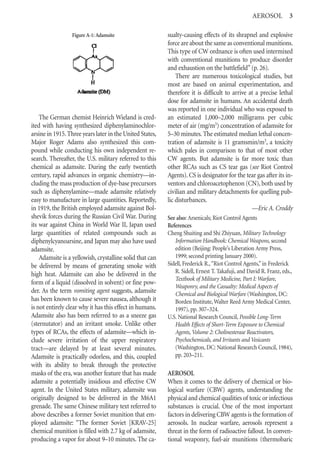
52 BIOLOGICAL WARFARE

Japanese scientists in Unit 731 and related detach-      States and its allies. Most Russian research in offen-
ments of its hygiene and veterinary services re-         sive BW essentially ended under the Boris Yeltsin
searched plague, anthrax, gas gangrene, and other        administration, although some Western security an-
diseases. The Japanese military scientists also devel-   alysts believe that such work continues even today,
oped weapons, including bombs that delivered             albeit on a much more limited scale.
plague bacteria using the flea as a vector (transmit-
ting organism).                                          Delivery of BW Agents: Basic Principles of
    During World War II, the United States, Britain,     Biological Weapons and Aerosols
and Canada jointly researched antihuman, as well as      The main operating principle of biological
antiagricultural, BW agents. Although much of the        weaponry is the use of infectious aerosols. This is
research began as a means to defend against possible     considered the most efficient method of delivering
attack, bombs filled with anthrax spores were pro-       BW agents to infect large numbers of people. In a
duced and tested on Gruinard Island (off the coast       less likely scenario, however, insects could be bred
of Scotland). But in the European theater, no bio-       near a living host (say, a rat) infected with disease-
logical (or chemical) weapons were used. On D-Day        causing organisms, such as plague bacteria (Yersinia
in June 1944, the Allies had prepared enough botu-       pestis). During World War II, for example, Japanese
linum vaccine (toxoid) to administer to all of the       BW scientists used fleas that were raised alongside
troops getting ready to land in Normandy. This           plague-infested rats. As fleas collect plague bacteria
massive toxoid program was begun based on faulty         in their foregut (proventriculus), under certain con-
intelligence that the German military planned to use     ditions these organisms form a blockage of their di-
botulinum toxin against an Allied invasion.              gestive tract. Desperate for nutrition, when these
    During the Cold War (1947–1991), the United          hungry fleas find another host (such as a human), a
States developed a number of offensive biological        flea discharges the mass of bacteria into the opening
weapons, the first being a bacterial munition loaded     of its bite, causing an infection. In nature, animal
with Brucella suis in the early 1950s. Anthrax, tu-      and human diseases caused by bacteria are often
laremia, Q-fever, and Venezuelan equine encephali-       due to the contamination of food and water, as well
tis (VEE) were also researched and produced for de-      as transmission by arthropods (vectors). The bac-
livery against Soviet or Cuban targets, and anticrop     terium that causes tularemia or rabbit fever (Fran-
agents were stockpiled for use on the grain fields in    cisella tularensis), for example, can sometimes infect
Ukraine and China.                                       humans through ticks carrying the pathogen; the
    During this period, the Soviet Union also pur-       organism is transmitted through the tick’s bite. But
sued biological weapons development, but their bi-       the use of vectors (or of contamination of food and
ological sciences were held back by poor technology      water) to spread disease on a large scale is not con-
and a political climate that wreaked havoc on their      sidered a significant BW threat. It is not an efficient
scientific community. When President Richard M.          mode of delivery to cover large targeted areas, and
Nixon decided that the United States would unilat-       on the defensive side of the ledger, there are now a
erally disavow offensive biological warfare in 1969,     number of insecticides available to combat mosqui-
the Soviet Union had just started to come out of its     toes and other disease-carrying insects.
relative dark ages in terms of modern genetics as            Biological weapons must therefore rely on
well as other biological disciplines. To help catch up   aerosols for effective dissemination. Nearly all
to the West, the U.S.S.R. embarked on a massive          known BW agents must be produced and delivered
biotechnological initiative that was primarily touted    in very small particles, ranging from about 1–10 mi-
for being the foundation for developing strategic bi-    crons in average diameter. (The one exception is the
ological weapons. The Soviet Union developed             dermally active toxin T-2 and related trichothecene
many of the same BW agents as the United States,         mycotoxins, although these toxins would also be ef-
including anthrax, tularemia, and antiagricultural       fective when delivered as aerosols.) Particles ranging
biological weapons. The Soviet Biopreparat com-          between 1–10 microns are more likely to lodge
plex also researched and developed a plague              themselves into the very small alveoli, the tiny air
weapon, as well as producing tons of smallpox virus      sacs in the lung where oxygen and carbon dioxide
for use in the event of an all-out war with the United   are exchanged during respiration. Here, the alveolar
BIOLOGICAL WARFARE 53

wall is only about 2 microns thick, and pathogens           that exist normally in the human gut (such as Es-
can pass into the bloodstream. Particles larger than        cherichia coli), and anthrax bacteria (Bacillus an-
10 microns (0.010 millimeters) are more apt to be           thracis) are all examples of bacterial organisms.
caught in the upper respiratory tree and in the nasal       Within the classification of bacteria is a family of
passages. Many of these larger particles, instead of        rickettsial organisms. These are bacteria that can
starting an infection, are instead brought back up          only survive in host organisms (i.e., living tissue);
and out by cilia, the tiny hairs that line the inner sur-   some rickettsia can cause serious disease in animals
faces of the respiratory system. These particles are        and humans, including typhus (Rickettsia
then gradually taken away by the body’s own mech-           prowazekii), Q-fever (Coxiella burnetii) and Rocky
anisms for removing foreign matter, and they are            Mountain spotted fever (Rickettsia rickettsii). All
thereby rendered harmless.                                  three of these organisms have the potential to be
    One should note in this discussion of particle          used in biological weapons. The United States, for
sizes that the bioweaponeer must work under cer-            example, produced Q-fever as a weapon during the
tain physical limits. Individual bacteria, such as          Cold War and researched Rocky Mountain spotted
Bacillus anthracis, for example, range in size from         fever in a number of biological tests for weaponiza-
roughly one-half micron to 2–3 microns or more in           tion. Typhus bacteria also may have been a part of
diameter. To fashion bacteria into some sort of             the early Soviet BW program.
weapon, therefore, requires that the pathogens be
separated into small enough particles, averaging less       Viruses
than 10 microns in diameter. Processing the biolog-         Viruses are usually much smaller than bacteria. One
ical material to such a fineness while maintaining its      of the largest viruses that cause disease in humans,
viability is technically demanding. Although find-          smallpox (Variola major) virus, measures about
ing, growing, and preparing bacteria is not techni-         0.3–0.4 microns in diameter, or roughly one-tenth
cally difficult, producing a complete weapon system         the size of anthrax bacteria spores. Viruses also dif-
to deliver these agents in the desired aerosol para-        fer from bacteria in their structure, and they are de-
meters is no easy task.                                     pendent upon living cells (prokaryotic, e.g., bacteria
    Because BW agents almost exclusively require            and eukaryotic, e.g., animal cells) for replication. In
the utilization of aerosols to cause infection, one         nature, viruses can be spread in ways similar to
form of ready defense is simply filtering the air with      those of bacterial infections, such as vectors (e.g.,
a mask or with the filters found in collective shelters.    mosquitoes) and contact with infectious hosts. But
One U.S. Army study showed that doubling over a             also like some bacterial diseases, many viruses are
towel once or twice and holding this over the nose          spread by aerosols and large infectious droplets, par-
and mouth was sufficient to filter out most particles       ticularly through formation of infectious particles
in the sizes necessary for causing infection through        generated by coughing or sneezing.
the inhaled route. But though such protective mea-              Viruses can be harmless or can cause diseases,
sures are effective in theory, in practice one needs to     some more serious than others. Some viruses can
first know that a biological attack is taking place.        grow quickly and create symptoms of disease within
Aerosols are silent, invisible, and at present can only     days or weeks, but others may take a much longer
be detected in real time with special light-scattering      time to cause illness. The Human Immunodefi-
techniques. Thus, it is unlikely that most people           ciency Virus (HIV), which causes Acquired Immun-
under a biological attack would be able to don pro-         odeficiency Syndrome (AIDS), and the rabies virus
tective masks in time to be of any use.                     are examples of infections that are fatal but that take
                                                            considerable time before infected individuals may
BW Agent Types                                              become deathly ill. For use as a biological weapon,
Bacteria                                                    the pathogen would need to be one that can cause
There are three main categories of BW agents: bac-          disease quickly and that is likely to infect most hu-
teria, viruses, and toxins. Bacteria are organisms that     mans following exposure. A viral BW agent would
are more primitive than the cells making up animal          also require a formulation that could be dissemi-
tissue and that, with the right nutrients, can live and     nated in the form of an aerosol to be most effective
replicate by division. Bacteria used in yogurt, those       in a biological weapon.
54 BIOLOGICAL WARFARE

Toxins                                                         Theoretically, any disease or disease-causing
Unlike CW agents that are synthetically manufac-           toxin could be fashioned into some sort of weapon.
tured, BW toxins are molecules produced by living          (See the sidebar for a list of potential BW agents.)
organisms. One toxin, for example, is produced by          However, only a small percentage of disease-causing
the bacteria Clostridium botulinum and is the              agents are practical for large-scale biological attacks
cause of some very serious forms of food poison-           on humans. Bioterrorism could also involve a num-
ing (botulism). (Botulus is the Latin word for             ber of disease-causing microbes (pathogens) or tox-
sausage, as the disease has long been associated           ins, although attacks using these would probably be
with tainted meat products.) The toxicity of botu-         on a smaller scale.
linum toxin is variously estimated to be lethal in             Because BW is essentially warfare by means of
amounts ranging from about 0.1 micrograms (in-             infectious disease—public health in reverse—it is
gested) to 5 micrograms (inhaled), the latter fig-         important in studying BW to understand how mi-
ure being 200 times smaller than the estimated             croorganisms or their toxins cause injury or death.
lethal dose of the most toxic nerve agent, VX.             Anthrax is often cited as a typical BW agent, and it
However, the actual delivery of botulinum would            has been used in acts of terrorism both in Japan and,
present more difficulties than VX. Botulinum               with more success, in the United States. Again, the
toxin is rather fragile, and if its chemical structure     importance of the aerosolized dissemination route
and integrity are damaged (denatured), it will             of exposure cannot be understated. Using Bacillus
cause no harm. Also, whereas VX can act through            anthracis, the bacteria that causes anthrax, involves
the skin, botulinum toxin must be delivered in the         the production of anthrax bacterial spores. As op-
form of an aerosol or introduced into the body             posed to the growing and dividing phase of the bac-
through wounds, injection, or ingestion. One bio-          terial life cycle, spores are very similar in concept to
logical toxin that is unusual in this respect is T-2,      seeds of a plant. Although not part of a reproductive
a compound derived from some species of Fusar-             cycle, the bacterial endospore (or spore) is a means
ium mold. This compound is especially toxic to             by which a bacterium can ensure its own survival.
skin upon contact. It is not clear, however, if T-2        When faced with a lack of food or when under other
was ever produced or used in any form as a means           physical stress, spore-forming bacteria like Bacillus
of warfare, although it and other trichothecene            anthracis and Coxiella burnetii can convert from
mycotoxins are suspected as being the active in-           their growth phase into a smaller, more spherical
gredient in yellow rain.                                   shape that includes a very thick, protective outer
                                                           wall. This spore can remain in a stage of hibernation
Using Biological Weapons                                   until it finds another environment with nutrients,
One major difference between CW and BW is that             water, and more favorable conditions. For use in a
biological weapons, all other things being equal,          weapon, these spores are produced in such a way
have much more delayed effects (measured in days           that they can be easily disseminated in an aerosol.
to weeks), whereas CW agents cause injury and                  When the victim breathes in anthrax spores, tens
death much more quickly (measured in minutes to            to hundreds to thousands of spores (data are in-
hours). One can think of BW as the use of infectious       complete with regard to infectivity in humans) are
disease against an enemy. There is usually a certain       necessary to cause disease, depending upon the in-
latent or incubation period between exposure to            dividual. (In the case of Q-fever, it may require
microbes and the appearance of actual disease              fewer than ten spores in order to cause infection.
symptoms. Like CW agents, some biological toxins           The resulting disease, however, is much less serious
may have faster action than others, perhaps only           than inhalation anthrax.) If they are of the right
hours to a day or so before the effects become             particle size, they can reach the alveoli in the lungs.
known. Staphylococcal enterotoxin B (SEB), for ex-         Here, they may sit for a while and do nothing until
ample, has a relatively short latent period. In cases of   picked up by special cells that pick up foreign mat-
SEB ingestion or inhalation, symptoms may appear           ter. These macrophages will surround the anthrax
in a matter of a few hours (or less). Botulinum            spore and carry it to the nearby lymph. (The lym-
toxin, on the other hand, requires 12 to 24 hours or       phatic system is a special draining system that the
more before it takes effect.                               body uses to rid itself of foreign bodies and
BIOLOGICAL WARFARE 55


SELECTED PATHOGENS                                Murray Valley encephalitis
WITH POTENTIAL FOR USE                            Negishi (tick-borne group)
                                                  Omsk hemorrhagic fever (tick-borne group)
IN BIOLOGICAL WARFARE
                                                  Powassan (tick-borne group)
                                                  Rocio
HUMAN/ZOONOTIC PATHOGENS                          Russian spring-summer encephalitis (tick-borne
Viral Pathogens                                       group)
Arenaviridae (Old World)                          St. Louis encephalitis
Lassa fever                                       Sal Vieja
Mopeia (Mozambique, Zimbabwe)                     San Perlita
                                                  Spondweni
Arenaviridae (New World)                          Tick-borne encephalitis
Flexal hemorrhagic fever (Brazil)                 Wesselsbron
Guanarito hemorrhagic fever (Venezuela)           West Nile fever
Junin hemorrhagic fever (Argentine)               Yellow fever
Lymphocytic choriomeningitis
Machupo hemorrhagic fever (Bolivia)               Hepadnaviridae
Sabia hemorrhagic fever (Brazil)                  Hepatitis B
                                                  Hepatitis D (delta)
Bunyaviridae
Akabane (hantavirus)                              Orthomyxoviridae
Belgrade (Dobrava)                                Influenza (Ad Hoc Group, BWC)
Bhanja (nairovirus)
Crimean-Congo hemorrhagic fever (CCHF)            Paramyxoviridae
    (nairovirus)                                  Hendra Complex viruses (equine morbillivirus)
Germiston                                         Menangle
Hantaan (hemorrhagic fever with renal syndrome)   Nipah
    (hantavirus)
Oropouche                                         Poxviridae
Rift Valley fever                                 Alastrim (Variola minor)
Seoul (hantavirus)                                Monkey pox
Sin Nombre (formerly Muerto Canyon)               Smallpox (Variola major)

Caliciviridae                                     Rhabdoviridae
Hepatitis E                                       Piry
                                                  Rabies
Filoviridae
Ebola                                             Retroviridae
Marburg                                           Human immunodeficiency viruses (HIV)
                                                  Human T-cell lymphotropic viruses (HTLV) types 1
Flaviviridae                                         and 2
Absettarov (tick-borne group)                     Simian immunodeficiency virus
Dengue
Hanzalova (tick-borne group)                      Togaviridae
Hepatitis C                                       Chikungunya
Hepatitis G                                       Eastern equine encephalitis
Hypr (tick-borne group)                           Everglades
Israel turkey meningitis                          Getah
Japanese encephalitis                             Middleburg
Kumlinge (tick-borne group)                       Mucambo
Kyasanur Forest (tick-borne group)                Ndumu
Louping-Ill (tick-borne group)                                                             (continues)
56 BIOLOGICAL WARFARE


 SELECTED PATHOGENS (continued)                         Mycobacterium simae
                                                        Mycobacterium szulgai
 Sagiyama                                               Mycobacterium tuberculosis
 Tonate                                                 Mycobacterium ulcerans
 Venezuelan equine encephalitis (VEE)                   Mycobacterium xenopi
 Western equine encephalitis (WEE)                      Salmonella paratyphi A, B, C (paratyphoid)
                                                        Salmonella typhi (typhoid)
 Unclassified Viruses                                   Shigella dysenteriae (dysentery)
 Borna disease                                          Vibrio cholerae (cholera)
 Hepatitis viruses not yet identified                   Yersinia pestis (plague)
 Transfusion-transmitted viruses                        Yersinia pseudotuberculosis

 Transmissible Spongiform Encephalopathies (TSEs)       Rickettsiae
 Bovine spongiform encephalopathy (BSE, or mad          Coxiella burnetii (Q-fever)
    cow disease) and other related TSEs                 Ehrlichia spp. (e.g., Ehrlichia sennetsu, formerly
 Creutzfeldt-Jakob disease and variants                    known as Rickettsia sennetsu)
 Fatal familial insomnia                                Rickettsia akari
 Gerstmann-Sträussler-Scheinker syndrome                Rickettsia Canada
 Kuru                                                   Rickettsia conorii
                                                        Rickettsia Montana
 Bacteria                                               Rickettsia prowazekii (epidemic typhus)
 Bacillus anthracis (anthrax)                           Rickettsia rickettsii (Rocky Mountain spotted fever)
 Bartonella quintana (formerly Rochalimea quintana),    Rickettsia tsutsugamushi
    trench fever                                        Rickettsia typhi (Rickettsia mooseri)
 Brucella abortus (brucellosis)                         Rochalimaea spp.
 Brucella canis
 Brucella melitensis (brucellosis)                      Fungi
 Brucella ovis (not known to be a human pathogen; Ad    Blastomyces dermitidis (Ajellomyces dermatitidis)
    Hoc Group, BWC)                                        (blastomycosis)
 Brucella suis (brucellosis)                            Cladophialophora bantiana (formerly known as
 Burkholderia mallei (glanders)                            Xylohypha bantiana, Cladosporium bantianum)
 Burkholderia pseudomallei (melioidosis)                Coccidioides immitis
 Chlamydophila psittaci (formerly Chlamydia psittaci)   Coccidioides posadasii
 Closteridium tetani (tetanus)                          Histoplasma capsulatum (incl. var. duboisii)
 Clostridium botulinum ( “Botulinum neurotoxin-         Histoplasma capsulatum var. farcinimosum
    producing strains of Clostridium,” according to     Histoplasma capsulatum var. capsulatum (Ajellomyces
    CDC [Centers for Disease Control])                     capsulatus)
 Clostridium perfringens (gas gangrene)                 Paracoccidioides brasiliensis
 Corynebacterium diphtheriae (diptheria) Ad Hoc         Penicillium marneffei
    Group, BWC
 Escherichia coli (enterohaemorrhagic, e.g., O157H7)    Parasites
 Francisella tularensis (tularemia) (UKNCC list notes   Echinococcus granulosus
    Type A only [class 3 pathogen])                     Echinococcus multilocularis
 Legionella pneumophila (legionnaires' disease)         Echinococcus vogeli
 Mycobacterium africanum                                Leishmania brasiliensis
 Mycobacterium avium/intracullulare                     Leishmania donovani
 Mycobacterium bovis                                    Naegleria fowleri (naegleriasis, amoebic
 Mycobacterium kansasii                                     meningoencephalitis)
 Mycobacterium leprae                                   Plasmodium falciparum (malaria)
 Mycobacterium malmoense                                Taenia solium (pork tapeworm, cysticercosis)
 Mycobacterium microti                                  Trypanosoma brucei rhodesiense
 Mycobacterium scrofulaceum                             Trypanosoma cruzi
BIOLOGICAL WARFARE 57


Toxins                                                 Animal Bacteria
Abrin                                                  Mycoplasma mycoides var. capri (goats, i.e., contagious
Aflatoxins                                                caprine pleuropneumonia)
Botulinum (botulinum neurotoxins, according to         Mycoplasma mycoides var. mycoides (small colony:
   CDC)                                                   contagious bovine pleuropneumonia)
Cholera
Closteridium perfringens (APHIS: epsilon toxin)        Animal Rickettsia
Cobra venom                                            Cowdria ruminantium (heartwater)
Conotoxin
Corynebacterium diphtheriae toxin                      PLANT PATHOGENS
Diacetoxyscirpenol (DAS)                               Plant Viruses
HT-2                                                   Banana bunchy top
Microcystin (cyanginosin)                              Plum pox potyvirus
Modeccin                                               Sugar cane Fiji disease (Ad Hoc Group, BWC)
Ricin
Saxitoxin                                              Plant Bacteria
Shiga (includes shiga-like toxins, according to CDC)   Citrus greening disease (Candidatus)
Staphylococcus aureus toxins (enterotoxins)            Erwinia amylovora, fire blight of apple (Ad Hoc
T-2 (trichothecene mycotoxin)                             Group, BWC)
Tetanus                                                Erwinia carotovora (Ad Hoc Group, BWC)
Tetrodotoxin                                           Liberobacter africanus and Liberobacter asiaticus
Verotoxin                                                 (huanglongbing, yellow dragon disease)
Verrucologen (Myrothecium verrucaria)                  Ralstonia solanacearum (Pseudomonas solanacearum),
Viscum album lectin 1 (viscumin)                          tomatoes (Ad Hoc Group, BWC)
Volkensin                                              Xanthomonas albilineans (leaf scald)
                                                       Xanthomonas campestris pv. Aurantifolia (Ad Hoc
ANIMAL PATHOGENS                                          Group, BWC)
Animal Viruses                                         Xanthomonas campestris pv. Citri
African horse sickness                                 Xanthomonas campestris pv. oryzae (leaf blight,
African swine fever                                       bacterial leaf blight)
Aujeszky's disease (porcine herpes)                    Xanthomonas citri
(Highly pathogenic) avian influenza                    Xanthomonas oryzae pv. oryzae
Bluetongue                                             Xylella fastidiosa
Camel pox
Classical swine fever (hog cholera)                    Plant Fungi
Foot-and-mouth disease                                 Bipolaris oryzae (Helminthosporium oryzae,
Goat pox                                                  Cochliobolus miyaeanus ), brown spot of rice
Horse pox                                              Colletotrichum coffeanum var. virulans (Colletrichum
Lumpy skin disease                                        kahawae)
Lyssa                                                  Deuterophoma tracheiphila (Phoma tracheiphila), mal
Malignant catarrhal fever                                 secco disease
Newcastle disease                                      Dothistroma pini (Scirrhia pini) needle blight on/of
Peste des petits ruminants                                pine (Ad Hoc Group, BWC)
Porcine enterovirus type 9, also known as swine        Microcyclus ulei (Dothidella ulei), South American leaf
   vesicular disease (SVD)                                blight
Rabies                                                 Moniliophthora rorei (Monilia rorei), cocoa moniliasis
Rinderpest                                             Peronosclerospora philippinensis (Philippine downy
Sheep pox                                                 mildew)
Simian herpes B                                        Phakopsora pachyrhizi
Teschen disease                                        Phytophthora infestans, late blight of potato (Ad Hoc
Vesicular stomatitis                                      Group, BWC)
Whitepox (poxviridae; African monkeys and rodents)                                                  (continues)
58 BIOLOGICAL WARFARE


   SELECTED PATHOGENS (continued)                            Soybean rust
                                                             Synchytrium endobioticum (potato wart)
   Puccinia erianthi (also known as Puccinia                 Tilletia spp. (wheat cover smut) (Ad Hoc Group,
       melanocephala), orange rust of sugar cane (Ad             BWC)
       Hoc Group, BWC)                                       Ustilago maydis, corn smut
   Puccinia graminis f. sp. tritici (rust fungus)
   Puccinia striiformis (wheat yellow rust) (Puccinia        Destructive Plant/Fruit Insects
       glumarum)                                             Ceratitis capitata (Wiedemann; Ad Hoc Group, BWC)
   Pyricularia grisea (formerly known as Pyricularia         Mediterranean fruit fly (medfly)
       oryzae, also Magnaporthe grisea), rice blast fungus   Thrips palmi Karny (Ad Hoc Group, BWC)
   Sclerophthora rayssiae var. zeae (brown stripe downy      Western flower thrips Frankliniella occidentalis
       mildew)                                                  (Pergande; Ad Hoc Group, BWC)
   Sclerotinia sclerotiorum, sclerotinia rot (Ad Hoc
       Group, BWC)


pathogens.) In some instances, however, when the             more and more cells, killing them as they go in
Bacillus anthracis spores infiltrate the lung, instead       some cases, causing various disease symptoms
of being dissolved and drained from the body, the            such as headache, fever, chills, and nausea. Viral
pathogenic bacteria begin to grow and multiply.              BW agents include smallpox, viruses that cause se-
These bacteria would ordinarily be captured and              vere bleeding in tissues (hemorrhagic fevers), and
killed by the body’s immune system. Disease-caus-            viruses that cause severe disease in horses (such as
ing forms of anthrax, however, produce a protec-             Venezuelan Equine Encephalitis) but also produce
tive covering (capsule) that prevents the body from          illness in humans. VEE virus, grown in fertilized
effectively finding, fixing, and destroying them.            chicken eggs during the Cold War, was an impor-
Anthrax bacteria then excrete a toxin complex: one           tant BW agent in both the U.S. and Soviet biologi-
component, called protective antigen (PA), is con-           cal weapons arsenals. This virus can also be grown
nected to another part called the lethal factor (LF)         in other types of tissue culture and can be prepared
component. PA binds with cell receptors in the               in dry powder form for wide dissemination as an
body, allowing the LF toxin to gain entry into the           aerosol. Although most individuals exposed to this
host’s cells. Cell damage and death due to the LF            virus will contract the disease, and the symptoms
toxin causes the body to make a frantic effort to            (flulike and worse) are severe, few will die from
fight off the disease, bringing about severe inflam-         VEE infection. For use by militaries against large,
mation and producing fever, nausea, vomiting, and            well-populated targets, VEE virus can cause wide-
swelling of tissues. Unless treated aggressively with        spread incapacitation of the enemy forces and
antibiotics, inhalation anthrax usually causes               their civilian populations.
death in humans if not caught in the early stages of
disease.                                                     BW Defense
    Other bacteria, such as plague and tularemia,            The first line of defense against BW is early detec-
also cause disease by toxic elements built within            tion of the toxin or pathogen. This is most likely to
their cellular structures. Plague, unless treated with       be accomplished by health care professionals and by
antibiotics, is likely to be quite deadly, especially if     laboratories designed to identify microbial diseases
inhaled as an aerosol. Tularemia also can be deadly,         and related toxins. (In 2004, work was underway to
but with treatment most victims will survive this            detect aerosols at a distance and to define those that
disease.                                                     constitute a biological threat; however, these devices
    Also best delivered in aerosol form, viral BW            are still in the early stages of technical reliability.)
agents cause disease as they take over the cellular          Probably, the first sign of a BW attack would be ac-
machinery in the body and use these to replicate             tual cases of disease that are diagnosed by physicians
themselves. The viruses can continue to infect               in a hospital, clinical laboratory, or medical office.
BIOPREPARAT 59

Once the BW agent has been identified, the next            Fenn, Elizabeth A., “Biological Warfare, circa 1750,” The
course of action would include treating the individ-          New York Times, 11 April 1998, p. A11.
ual patient but also starting an aggressive public         Fradkin, Elvira K., The Air Menace and the Answer (New
health action plan to treat other possible exposures.         York: Macmillan, 1934).
    Some BW agents can be treated with vaccines if         Herms, William B., Medical Entomology, (New York:
the exposure to the agent is detected early. Smallpox         MacMillan Company, 1950).
                                                           Karlen, Arno, Man and Microbes (New York: G. P.
is a good example. Being a disease that is easily
                                                              Putnam’s Sons, 1995), p. 87.
transmitted from one person to another, it would be        Murray, Patrick R., George S. Kobayashi, Michael A.
critical to vaccinate anyone near or in contact with          Pfaller, and Ken S. Rosenthal, Medical Microbiology,
the victim. This can both protect those exposed in-           second edition (St. Louis: Mosby, 1994), p. 526.
dividuals from smallpox infection and slow or stop         Patrick, William III, “Analysis of Botulinum Toxin, Type
the spread of smallpox in the community. Without              A, as a Biological Warfare Threat,” unpublished
adequate vaccination, smallpox could spread like              report, 2001.
wildfire and could rage out of control even with           Wheelis, Mark, “Biological Warfare before 1914,” in
strict measures to keep people from traveling or in-          Erhard Geissler and John Ellis van Courtland Moon,
teracting outside their homes and neighborhoods.              eds., Biological and Toxin Weapons: Research,
    Vaccines can be used against anthrax and plague,          Development, and Use from the Middle Ages to 1945,
although at present it is not certain how effective           SIPRI Chemical & Biological Warfare Studies no. 18
                                                              (Oxford: Oxford University Press, 1999), p. 13.
these would be against inhalation forms of either
disease. Vaccinations also would have to be done
well ahead of time, days or preferably weeks before        BIOLOGICAL WARFARE PROTECTIVE
the actual BW attack. Some toxins also have vac-           MEASURES
cines (toxoids) for protection against exposure, such      See Protective Measures: Biological Weapons
as that used for botulinum. Again, communities
need to have an accurate threat picture and ade-           BIOLOGICAL WEAPONS CONVENTION
quate time before the actual attack for these to be        (BWC)
successful.                                                See Biological and Toxin Weapons Convention
    In most cases, vaccines would be most critical
for contagious BW diseases like smallpox, and to a         BIOPREPARAT
certain extent plague (in its pneumonic form).             During the latter half of the twentieth century, the
Other BW agents, however, are not known to be              Soviet Union (and later, to a much more limited de-
contagious. Bacterial and rickettsial diseases are         gree, Russia) possessed the largest and most ad-
treatable with antibiotics. Viral diseases are for the     vanced biological weapons technology and produc-
most part not successfully treatable with                  tion infrastructure ever known. The Soviet
chemotherapy, although some antiviral medica-              organization known as Biopreparat was ostensibly
tions have been shown to be efficacious in some in-        devoted to civilian biotechnology. It was, in fact, the
stances. But for most viral infections, all that can be    research and development arm for the Soviet mili-
done is to provide supportive care to the victim—          tary to produce biological warfare agents and muni-
fluid replacement, breathing assistance, and pain          tions. Some open source documents provide
regulation. These can be quite effective in reducing       glimpses into past Soviet activities in offensive bio-
overall mortality.                                         logical warfare. Much of what is known from the
                                     —Eric A. Croddy       open literature about the former Soviet BW pro-
                                                           gram, however, is based upon the testimony of So-
See also: Chemical and Biological Munitions and
                                                           viet defectors, including Vladimir Pasechnik, Ken
   Military Operations; Kaffa, Siege of; Protective
   Measures: Biological Weapons; Vaccines
                                                           Alibek, and other participants in the Biopreparat
References                                                 program.
d’Errico, Peter, “Jeffrey Amherst and Smallpox Blankets:       Biopreparat—a parallel entity to the Soviet Min-
   Lord Jeffrey Amherst’s letters Discussing Germ          istry of Defense (MOD), from which it obtained fi-
   Warfare against American Indians,” http://www.          nancing—was officially subordinate to the civilian
   nativeweb.org/pages.legal.amherst/lord_jeff.html.       Main Administration of the Microbiological Industry
60 BIOPREPARAT

(Glavmikrobioprom). Referred to as the Concern,           developed by Soviet KGB scientists), little is known
Biopreparat during its 20 years of activity (from 1972    about the role of this toxin and others in the Soviet
until about 1992) served as the main technology and       BW program.
manufacturing base for the antihuman biological
warfare (BW) agents in the former Soviet Union. Al-       Brief History of Soviet Biological Weapons
though its charge was to conduct offensive BW re-         Following the establishment of the Bolshevik
search and development, Biopreparat also produced         regime in 1917, the Soviet biological weapons pro-
civilian pharmaceuticals and was the second largest       gram grew in fits and starts. Begun largely because
manufacturer of antibiotics in the world.                 of the great losses Russia suffered in World War I, es-
    The civilian nature of Biopreparat and its con-       pecially from chemical warfare, it is likely that past
nection with military biology is not surprising. The      experience with diseases (e.g., typhus) were was a
creation of a civilian-styled organization for devel-     deciding factor in the Soviet Union’s starting the
oping biological weapons followed a Soviet pattern        program. The Soviet BW program would be inter-
established decades before Biopreparat was formed.        rupted by Stalin’s purges and by the rise of Lysenko-
For example, because of the endemic nature of             ism (see below), and then it would be reborn with
plague (sometimes called Black Death) throughout          the dawn of new discoveries in genetics.
the Eurasian continent, it was logical that Soviet sci-       The Soviet biological weapons program can be
entists had developed an extensive antiplague sys-        roughly divided into two phases: 1) the initiation of
tem for disease monitoring and surveillance. Such a       a full-fledged biological warfare program in 1928,
civilian-oriented system would actually have dual         and 2) the resurgence in the pursuit of military
roles: public-health-related research into infectious     biotechnology following Lysenkoism in the early
diseases, and militarily useful work in developing bi-    1970s. Serious efforts on the part of the Soviet
ological warfare (BW) agents. By the 1950s, the sem-      Union to develop biological weaponry took place
blance of an infrastructure—again, civilian, at least     just after signing arms control agreements meant to
in outward appearance—for biological weapons de-          stem such activity.
velopment had already been established in the So-             In 1928, Yakob Moiseevich Fishman recom-
viet Union. Referred to in official-speak as Problem      mended to Red Army Commissar Kliment
No. 5, offensive biological weapons research and de-      Voroshilov that the Soviet Union initiate biological
velopment was carried out by these antiplague and         weapons development. That same year, the Soviet
related organizations.                                    Union acceded to the Geneva Protocol of 1925, for-
    By the end of its biological weapons program          bidding the use (albeit with many loopholes and ex-
(1992), the Soviet military had weaponized several        ceptions) of chemical and “bacteriological” warfare.
viruses: smallpox, Venezuelan equine encephalitis         Similarly, in 1975, when the Soviet government offi-
(VEE), and Marburg. In the development stage              cially ratified the 1972 Biological Toxin and
were other hemorrhagic fevers, including Ebola,           Weapons Convention (BTWC), it had already
Lassa, Russian spring-summer encephalitis, Argen-         begun a massive project for military biological re-
tine and Bolivian hemorrhagic fevers, and possibly        search and weapons production. A year after signing
others. Lethal bacteria in the Soviet biological          the BTWC, an organization was formed by the So-
weapons arsenal included an especially potent form        viet government that would be tasked with biologi-
of anthrax (Bacillus anthracis), with less deadly but     cal weapons research, development, and manufac-
still virulent tularemia (Francisella tularensis) and     ture: the All-Union Science-Production Association,
Brucella spp. bacteria. (The latter BW agent was          or Biopreparat (Order No. 131, April 1974).
later replaced by the incapacitating biological agent
glanders, or Burkholderia mallei.) Another incapac-       Prelude to Biopreparat: Lysenko
itating agent, Q-fever (Coxiella burnetti), was also      The Soviet Union’s decision to reinvigorate its offen-
produced in the Soviet Union, but like Brucella, it,      sive BW efforts followed a period termed Lysenko-
too, eventually fell out of favor as a weapon. Ac-        ism—or the Russian pejorative Lysenkovshchina.
cording to Ken Alibek, work with botulinum toxin          Until the 1970s, Soviet scientists had to their credit
was conducted in the mid-1970s. But aside from            many advances in applied and basic research. But in
their roles as assassination weapons (such as those       the field of biology, the Soviet Union had in many
BIOPREPARAT 61

areas fallen far behind the West. This state of affairs   Unlike Lysenko, who derided scientific knowledge
could largely be blamed on one person, the Ukrain-        drawn from other countries, Ovchinnikov read the
ian-born agronomist Trofim D. Lysenko (1898–              foreign scientific journals and knew of the advances
1976). Lysenko relied on extensive self-promotion to      in Western biotechnology. According to Ken Alibek,
make up for a lack of knowledge in the scientific field   who was former deputy director of Biopreparat
in which he eventually chose to work.                     until his defection to the West in 1992, Ovchinnikov
    After receiving a certificate in agronomy in 1925,    “decided to resolve the crisis in Russian biology by
Lysenko started his professional career as an agricul-    appealing to the self-interest of the masters of our
tural technician in Azerbaijan. While Lysenko was         [i.e., Soviet] militarized economy. In 1972, he asked
growing a batch of peas, a Pravda (a Russian news-        the Ministry of Defense to support a genetics pro-
paper) correspondent took special note of the             gram devoted to developing new agents for biologi-
young scientist, impressed most of all by Lysenko’s       cal warfare” (Alibek, p. 41). If many top Soviet lead-
proletarian origins. Through means of journalistic        ers were unimpressed by Ovchinnikov’s proposals,
hyperbole, Lysenko was suddenly credited with             President Leonid Brezhnev was highly receptive.
making a qualitative leap in agricultural technique:      After all, if the Soviet Union were falling behind in
the ability to grow abundant yields of crops in the       scientific technology—no less being surpassed by its
winter soil. Emboldened by this publicity, Lysenko        nemesis the United States and its NATO allies—this
went on to claim that winter wheat could be grown         would require decisive action.
to fantastic yields if the seeds were exposed to cold         That same year (1972), the Soviet Council of
temperatures and were planted in spring instead of        Ministers also convened the Interagency Science
autumn. He was made responsible for directing the         and Technology Council on Molecular Biology and
planting of wheat in the collective farms, and exag-      Genetics (ISTCMBG). This council was comprised
gerated claims of his yields were widely distributed.     of leaders from within the Soviet military, the Acad-
But what would turn out to be disastrous methods          emy of Sciences, and the Ministries of Health and
of Stalinist collectivization would only make Ly-         Agriculture. Chairing this secret body was Vladimir
senko all the more famous.                                Zhdanov, an accomplished microbiologist whose
    Based on his own inchoate understanding of the        specialty was viruses. The post of deputy director
science and without diligent scruples, Lysenko then       was held by Igor Domaradsky. Domaradsky had
turned his sights on genetics. He would later claim       earlier been the director of antiplague systems dur-
that geneticists, and all of those who accepted           ing the 1950s, and having expertise with plague
Mendelian laws, were wreckers, enemies of social-         (Yersinia pestis), he would play a critical role for later
ism and therefore enemies of the state. With the un-      research into weaponizing the bacterium. (This was
failing support of Stalin (who had a talent for ruth-     no mean feat. During the 1950s and 1960s, when the
lessness and who, like Lysenko, came from modest,         United States still possessed an offensive BW pro-
peasant beginnings), thousands of Russian scientists      gram, American scientists tried to devise a plague-
who did not toe the official line—especially the ge-      based weapon but were unsuccessful.) Along with
neticists among them—were subsequently arrested           Biopreparat, these individuals and organizations
and sent to the infamous gulags (labor camps).            would play a crucial role in the research and devel-
Many more were simply ostracized. In 1953, when           opment of biological weapons.
Watson and Crick published their groundbreaking
research on the DNA double helix, some of this            Organizations and Laboratories within
antigenetics campaign was halted. But Lysenko’s           Biopreparat
opinions on biology, particularly his animus against      In 1973, Biopreparat had been formally established
modern genetics, continued to influence the coun-         under the code name Fermenty (Enzymes). Re-
try until at least the mid-1960s, and ultimately, its     quirements for biological weapons research and de-
effects were still felt long after Lysenko’s death.       velopment were set according to the decisions
    In the early 1970s, the forceful personality of a     made by the ISTCMBG. Located in Moscow, Bio-
well-regarded Soviet molecular biologist, academi-        preparat was listed simply as Post Office Box A-
cian Yuri Ovchinnikov, entered the battle over the        1063. The first director, a lieutenant general at the
future of genetic research inside the Soviet Union.       time, was Vsevolod Ivanovich Ogarkov. Thus, the
62 BIOPREPARAT

military biological activities of Biopreparat were in-    the Microbiological Industry (Glavmikrobioprom)
formally known in Russia as “Sistema Ogarkova,” or        established Vector in March 1985. In the early 1990s,
Ogarkov’s System. Despite its civilian trappings,         Vector had a staff of about 3,000. Vector is one of
Biopreparat’s institutes and production facilities        two official repositories of the smallpox virus, the
were actually run by the fifteenth Directorate of the     other being the U.S. Centers for Disease Control and
Soviet Ministry of Defense.                               Prevention (CDC), in Atlanta, Georgia.
    Alibek, who had been the organization’s first             The State Scientific Institute of Ultrapure Bio-
deputy director from 1988 to 1991, reported that          logical Preparations was located in Leningrad (now
Biopreparat was meant to be the primary produc-           St. Petersburg). This facility was a crucial link in de-
tion source of biological warfare agents in the event     veloping a technological basis for weaponizing BW
of a war footing or outright hostilities with the West.   agents, particularly the creation of very fine
Thus, in peacetime, Biopreparat was mostly on a           aerosols. Under the leadership of Vladimir Pasech-
“standby footing.” “Mobilization” facilities included     nik—who in 1989 would defect and reveal to the
the Scientific Design Institute and Factory of Bio-       West many secrets of the Soviet biological weapons
preparations Complex in Berdsk, Novosibirsk,              program—the Institute was involved in the manu-
Siberia; the Scientific Research Institute of Microbi-    facture of cruise missiles capable of delivering infec-
ology in Kirov (now Vyatka), 150 miles southwest of       tious aerosols.
Moscow; and the Center for Military-Technical                 The Scientific Experimental and Production
Problems of Anti-Bacteriological Defense in               Base was located in Stepnogorsk, Kazakhstan.
Sverdlovsk (now Yekaterinberg). There were several        Stepnogorsk is a Stalinesque town built largely for
other important elements of the Biopreparat net-          uranium mining, located in the otherwise desolate
work. The State Scientific Center of Applied Micro-       steppes of northern Kazakhstan. It also held the
biology was located in Obolensk (about 60 miles           largest biological weapons facility in the world. Due
south of Moscow). This facility was involved in bio-      to an accident caused by a release of anthrax spores
logical weapons research, including the genetic ma-       at Sverdlovsk (now Yekaterinberg) in 1979, produc-
nipulation of microbial agents and their testing in       tion of anthrax was moved to Stepnogorsk because
aerosol chambers. Established in 1974 during the          the Scientific Experimental and Production Base
height of the Soviet BW program, the Center had a         possessed superior air handling capabilities and was
staff of about 1,500 people, half of whom were re-        in a remote location. During a time of conflict, tons
search scientists.                                        of anthrax could have been produced there within
    The Center of Virology in Zagorsk (now Sergiyev       two weeks. Built at an estimated cost of 1 billion
Posad), was located 50 miles northeast of Moscow.         rubles (approximately U.S. $1 billion), the massive
According to Alibek, the Center produced smallpox         complex of buildings, tunnels, bunkers, and 20,000-
to meet an annual stockpile quota of 20 tons. Based       liter fermenters at Stepnogorsk has since the end of
on a highly virulent strain obtained from an Indian       the Cold War been gutted and almost completely
smallpox patient in 1967, this weapon had a refrig-       destroyed. What remained of the equipment and
erated shelf life of six months. In the event of a nu-    staffing was converted to a commercial enterprise to
clear exchange with the United States, smallpox           produce commercial products (“joint-stock com-
virus (and other BW agents) was to be loaded in liq-      pany”) in 1993.
uid form in bomblets on the SS-18 intercontinental            In addition to the testing of a variety of other
ballistic missile (ICBM).                                 BW agents, including Marburg virus, the Stepno-
    The Institute of Immunological Design was lo-         gorsk facility was charged with the manufacture of
cated in Lybuchany (outside Moscow) and was               weapons-grade anthrax and plague. With advances
under the direction of Vladimir Petrovich Zav’yalov.      made in the 1980s in producing virulent strains of
In the 1980s, this institute was charged with the de-     bacteria, it was here that Alibek managed the devel-
velopment of tularemia vaccine and diagnostic test-       opment of the 836 strain of weaponized anthrax,
ing kits.                                                 probably the most lethal ever produced.
    The State Scientific Center of Virology and               Also located in Kazakhstan near the Uzbekistan
Biotechnology (Vector) was located in Koltsovo            border was Vozrozhdeniye (Rebirth) Island. After
(Novosibirsk, Siberia). The Main Administration of        1952, this was the Aral test facility, Aralsk-7, a bio-
BIOREGULATORS 63

logical weapons proving ground for the Soviet mili-         propriately elevated levels (e.g., as a result of inten-
tary. Biological weapons testing at this installation       tional introduction into the body), a bioregulator
was likely the cause of a smallpox outbreak in 1971         can overwhelm the body’s compensatory mecha-
near Rebirth Island.                                        nisms, and its actions can go unchecked. Potential
    At its peak, Biopreparat had an estimated               consequences include the sensation of pain, loss of
40,000–60,000 personnel, with about 40 laborato-            consciousness, altered blood pressure, and altered
ries and production facilities spread across much of        psyche. These consequences, although profoundly
the former Soviet territory. Even during the Gor-           incapacitating, are generally not lethal, although
bachev years (1986–1990) of Perestroika, a five-year        death is possible under certain circumstances.
plan continued to weaponize the Ebola, Marburg,                 In theory, a bioregulator can be introduced into
and smallpox viruses. As far as it is known, how-           the body in one of two ways. First, it can be intro-
ever, the biological-weapons-related activity and           duced by using well-established genetic engineering
associated elements of Biopreparat have largely             techniques; the gene that codes for the bioregulator
been disbanded.                                             can be inserted into a microorganism, which is then
                                    —Eric A. Croddy         delivered into the body via injection, ingestion, or
See also: Aralsk Smallpox Outbreak; Russia: Chemical        inhalation. Upon gaining entry into the body, the
   and Biological Weapons Programs; Stepnogorsk;            microorganism produces the bioregulator, and its
   Sverdlovsk Anthrax Accident                              effects are felt. Second, the bioregulator itself can be
References                                                  chemically or enzymatically synthesized in a labora-
Alibek, Ken, Biohazard (New York: Random House,             tory. Once a quantity of the bioregulator has been
   1999).                                                   produced, it can be delivered on its own, again via
Bozheyeva, Gulbarshyn, Yerlan Kunakbayev, and Dastan        injection, ingestion, or inhalation, in the same man-
   Yeleukenov, Former Soviet Biological Weapons             ner that any other biological weapon (or pharma-
   Facilities in Kazakhstan: Past, Present, and Future,
                                                            ceutical agent, for that matter) would be delivered.
   Occasional Paper no. 1, Center for Nonproliferation
   Studies, Monterey, California, June 1999.
                                                                Bioregulators lend themselves to rapid synthesis
Miller, Judith, Stephen Engelberg, and William Broad,       due to the abbreviated nature of their constituent
   Germs (New York: Simon & Schuster, 2001).                amino acid chains, and commercial and scientific
Rimmington, Anthony, “Invisible Weapons of Mass             developments have made the production of various
   Destruction: The Soviet Union’s BW Programme             peptides possible on a large scale. For example, 4
   and Its Implications for Contemporary Arms               million kilograms of NutraSweet—a simple peptide
   Control,” The Journal of Slavic Military Studies, vol.   consisting of two amino acids, aspartic acid and
   13, no. 3, September 2000, pp. 1–46.                     phenylalanine—were manufactured per year in the
Soyfer, Valery N., Lysenko and the Tragedy of Soviet        late 1980s. Such production has become increas-
   Science (New Brunswick, NJ: Rutgers University           ingly affordable, and the synthetic techniques em-
   Press, 1994).                                            ployed further allow for the enhancement not only
                                                            of a bioregulator’s potency, but also of properties
BIOREGULATORS                                               such as its activity and selectivity, all of which helps
Bioregulators, or bioregulatory peptides, are geneti-       to create a powerful, highly specific, and potentially
cally coded chains of amino acids that are produced         very dangerous analogue. Given both the produc-
naturally in the human body and are essential for           tion and manipulation potential of bioregulators,
normal physiological functioning. These substances          the future illicit development—and subsequent
resemble toxins in their nature and action, and in          use—of these substances cannot be ruled out.
technical terms can in fact be defined as toxins, in
that they are “chemicals of biological origin.”             Research in the Soviet Union
Though the role of bioregulators in controlling bio-        Soviet bioweaponeers engaged in extensive research
logical processes has only begun to be understood,          on bioregulators throughout the 1980s under the
their effects are known to range from the mediation         code name Project Bonfire. As reported during a
of sensations such as fear and pain to the regulation       conference of Soviet scientists in 1989, the project
of the body’s vital signs, namely blood pressure,           had been a success: the gene coding for the bioregu-
heart rate, and respiration. When present at inap-          lator myelin toxin, named as such by the Soviets for
64 BIOTERRORISM

its ability to damage the myelin sheaths of neurons       later could not be accounted for, leaving open the
and thus disrupt nerve transmission throughout the        possibility that Basson embezzled the funds and that
body, had been identified and—through the appli-          these peptides were never produced by the scientists
cation of advanced recombinant DNA tech-                  of Project Coast.
niques—inserted into the bacterium Yersinia
pseudotuberculosis. In laboratory tests, this single      Bioregulators of Importance
agent caused both the symptoms of the pathogen            Though in fact comprising a very broad category of
and the paralytic effects of myelin toxin. Notably,       chemicals, for practical purposes bioregulators can
Yersinia pestis, the causative agent of plague, is        be narrowed in spectrum, based largely on their ac-
closely related to Y. pseudotuberculosis, suggesting      tion and amenability to synthesis, to those with bio-
the possibility of transfer of similar genetic material   logical warfare (BW) implications. A selection of
into this potentially contagious, lethal pathogen to      bioregulators often referred to in a BW context is
create an enhanced and truly formidable biological        represented in Table B-1.
weapon. It has been reported that Soviet scientists
did in fact successfully perform such a transfer be-
fore the collapse of the Soviet Union, but that the       Table B-1: Select Bioregulators and Some of Their Effects
agent was not developed any further. It is not known                               Prototype
whether other bioregulators were researched within        Type                   Bioregulator(s)      Primary Effect(s)
the former biological weapons program. It is
                                                          Algogen                 Substance P       Sensory
known, however, that a number of other bioregula-                                                     transmission of
tors were studied, ostensibly for peaceful purposes,                                                  pain
in the Soviet Union throughout the later years of the     Endogenous opioid       Endorphins,       Analgesia similar to
Cold War and in Russia today.                                                       enkephalins       morphine
                                                          Hormone                 Vasopressin       Water retention,
                                                                                                      vasoconstriction
Research in South Africa
                                                          Endothelium-
South Africa’s apartheid-era chemical and biologi-          derived factor        Endothelin        Vasoconstriction
cal weapons program, Project Coast, may have in-
vestigated bioregulators. Although the claims are
largely unverified and may, in fact, have been crim-                                                     —Rich Pilch
inally motivated, it has been suggested by scientists     References
within the program (and in particular by program          Bokan, Slavko, John G. Breen, and Zvonko Orehovec,
leader Wouter Basson himself) that such research              “An Evaluation of Bioregulators as Terrorism and
was performed at two separate locations: the large-           Warfare Agents,” ASA Newsletter, Issue No. 90, June
scale chemical weapons research and development               28, 2002, p. 1.
facility Delta G Scientific, and the clandestine labo-    Leitenberg, Milton, James Leonard, and Richard
ratories of Special Forces headquarters. According            Spertzel, “Biodefense Crossing the Line,” Politics and
to Basson, efforts at the Special Forces laboratory           the Life Sciences, Vol. 22, No. 2, 2004, pp. 1-2.
led to the successful production of a peptide de-
rived from the human thymus gland (different              BIOTERRORISM
thymic peptides exist, each with various actions:         Generally speaking, bioterrorism refers to the use of
alpha-thymosin, for example, is active in the devel-      biological agents—microbial pathogens or toxins
opment of a beneficial immune response, and dif-          derived from living organisms—as a means of per-
ferent types of beta-thymosin have been linked to         petrating some terrorist attack. This seems simple
cancer), as well as growth hormone and other un-          enough, although arriving at a noncontroversial
specified peptides produced by the pituitary gland        meaning of the very word terrorism can be fraught
in the brain.                                             with difficulty. The U.S. Federal Bureau of Investi-
    It is theorized that Basson may have provided         gation (FBI) defines terrorism as “the unlawful use
this information to substantiate his own claim that       of force against persons or property to intimidate or
he had spent a large amount of government money           coerce a government, the civilian population or any
on a peptide synthesizer. This peptide synthesizer        segment thereof, in the furtherance of political or
BIOTERRORISM 65

social objectives” (U.S. Code of Federal Regulations,       concerted efforts made by nonstate actors to use bi-
28 Section 0.85). Forming a textbook definition of          ological agents in the pursuit of some political
bioterrorism is difficult. In discussing bioterrorism,      agenda—that is, bioterrorism. No one died as a di-
though, it may be much less important what one              rect result of these biological attacks, although the
thinks it is and more important to consider the po-         Rajneeshee cult in Oregon was more successful in
litical, psychological, and emotional impact that           terms of actually carrying out a biological attack
might be created by the use of the term to describe         than Aum Shinrikyo.
some disease outbreak.                                          The Rajneeshee, a religious organization that es-
    The concept of bioterrorism might be seen as            tablished itself in Wasco County, Oregon, made ex-
different from simple criminality involving                 traordinary efforts to create its own society. Led by
pathogens or toxins; one might call these types of          an Indian national named the Bhagwan (Hindi for
events biocriminality or malicious mischief. Unless         “God”) Shree Rajneesh, in 1984 the cult sought to
there is some clear motive that speaks to a wider po-       control the Wasco County political establishment by
litical or social statement, the simple act of murder-      swaying upcoming local elections in its favor. The
ing someone by using a biological agent is still tech-      attack that followed in September 1984 was part of
nically a homicide.                                         a plan to make as many as possible of the noncult
    Often mentioned in the context of bioterrorism          population stay away from the polls, chiefly by
is the assassination of the Bulgarian dissident             means of giving them diarrhea. Cult scientists con-
Georgy Markov with ricin toxin. In 1978, the Bul-           sidered a number of different pathogens that cause
garian secret service (with technical assistance from       diarrhea, including Giardia lamblia, a parasite that
the Soviet KGB) assassinated Markov while he was            causes giardiasis, and Shigella dysenteriae (bacteria
working in London. The motive: Markov had criti-            that cause dysentery). Both diseases can be serious,
cized the tyranny of the Bulgarian authorities on           but with modern health care they are usually self-
Western radio. In a more legalistic view, this state-       limiting. In the end, the cult’s technical advisor in
sponsored assassination of a governmental critic            the use of such pathogens, Diane Ivonne Onang (re-
does not fit the typical definition of terrorism. The       named Ma Anand Puja) decided to use Salmonella
salient aspect of this case, however, is the fact that a    typhimurium, a common cause of food poisoning.
biological toxin—ricin—was used as the weapon.              In November 1984, cult operatives took vials of Sal-
Thus, bioterrorism is often ascribed to many delib-         monella bacteria and contaminated food at super-
erate acts using biological agents, even if the actual      markets and restaurants. They especially singled out
purpose does not exactly fit the terrorist model.           salad bars at local restaurants for adulteration. As a
    Since the Markov case, there have been many             result of this attack, 751 people became ill with sal-
other instances of ricin being involved with terrorist      monellosis.
activity. Most notably, the Islamist terrorist organiza-        An especially disturbing aspect of this case was
tion al-Qaeda has instructed its adherents on how to        that this deliberate act of food poisoning was not
produce ricin from the castor bean plant. In 2003,          discovered until at least a year later. Eventually, Ore-
several terrorists linked with al-Qaeda were discov-        gon prosecutors were able to arrest most of the key
ered in Europe with homemade ricin toxin. These in-         operatives involved in the biological attack. But long
dividuals may have been planning attacks on civilians       before the criminal proceedings were to begin, the
or soldiers by poisoning their food. They were prob-        cult’s political aspirations were ultimately defeated
ably interested in ricin because it is relatively easy to   by more prosaic circumstances.
acquire, not because it has a great utility as a weapon         Some commentators in 2001 referred to the Ore-
of mass destruction.Aside from some instances when          gon case as a terrifying incident (Miller, Engleberg
food or beverages could be contaminated and dis-            and Broad, 2001, p. 14). However, although there
tributed to many people, ricin appears to be a weapon       were a large number of casualties, none died as a di-
of choice for assassinating individuals.                    rect result of the attack. Perhaps the important les-
    A 1984 Salmonella bacteria attack in Oregon, and        son from the Rajneeshee case is that, instead of dis-
the attempts by the Japanese cult Aum Shinrikyo to          seminating microbes that cause gastrointestinal
use botulinum toxin and anthrax bacteria in the             upset, even more virulent or lethal toxins could have
early 1990s (see Aum Shinrikyo), have been the most         been used.