INTERMOLECULAR FORCES OF
ATTRACTION
Intermolecular forces
 Intermolecular forces – holds molecules
together which can be attractive or
repulsive
 Inter-ionic forces – forces that holds ions
together.
 Intermolecular forces are accountable
for the properties of substances and
explain why substances exist as solids,
liquids, or gases at room temperature.
Intermolecular forces – the
attractions between molecules
Determine whether a compound is a solid,
liquid or gas at a given temperature
(determine melting and boiling points of
substances)
3 Main Types:
a) Hydrogen bonding
b) Dipole-dipole interactions
c) Dispersion forces
Hydrogen Bonding
 Attraction formed between the hydrogen atom of one molecule and
an electronegative atom of an adjacent molecule (O, N, or F)
 A type of dipole interaction and the strongest intermolecular force
Dipole-dipole interactions
Dipoles interact by the positive end of one
molecule being attracted to the negative
end of another molecule (similar to but
much weaker than ionic bonds)
Dispersion Forces
Caused by electron motion.
Electrons around one
molecule momentarily repel
electrons a nearby molecule
creating a momentary charge
difference
Can exist between nonpolar
molecules as well as polar
Weakest intermolecular force
but increases as the number
of electrons increases
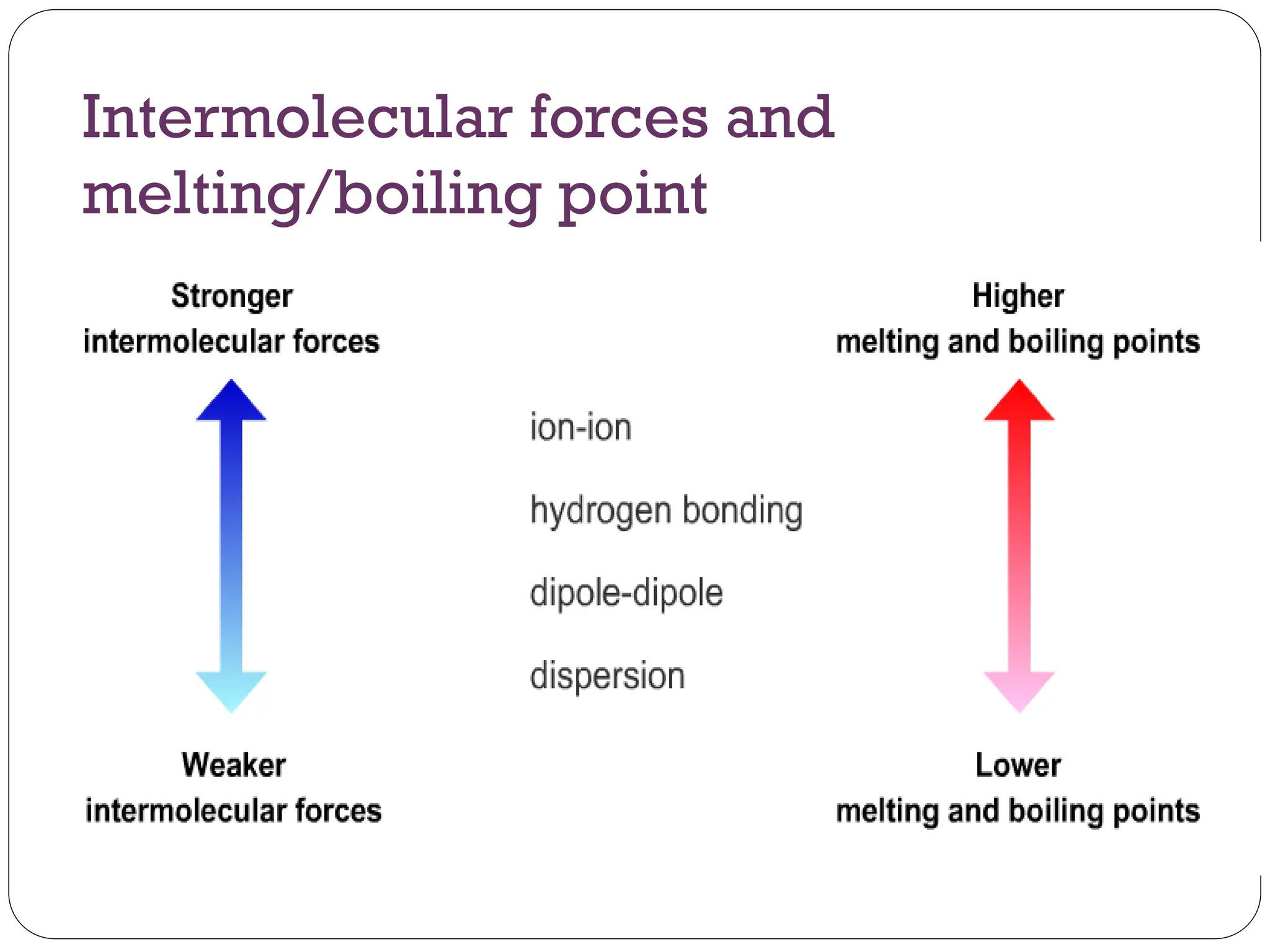
Intermolecular forces and
melting/boiling point

intermolecular forces_physical science_Grade 12

  • 1.
  • 2.
    Intermolecular forces  Intermolecularforces – holds molecules together which can be attractive or repulsive  Inter-ionic forces – forces that holds ions together.  Intermolecular forces are accountable for the properties of substances and explain why substances exist as solids, liquids, or gases at room temperature.
  • 3.
    Intermolecular forces –the attractions between molecules Determine whether a compound is a solid, liquid or gas at a given temperature (determine melting and boiling points of substances) 3 Main Types: a) Hydrogen bonding b) Dipole-dipole interactions c) Dispersion forces
  • 4.
    Hydrogen Bonding  Attractionformed between the hydrogen atom of one molecule and an electronegative atom of an adjacent molecule (O, N, or F)  A type of dipole interaction and the strongest intermolecular force
  • 5.
    Dipole-dipole interactions Dipoles interactby the positive end of one molecule being attracted to the negative end of another molecule (similar to but much weaker than ionic bonds)
  • 6.
    Dispersion Forces Caused byelectron motion. Electrons around one molecule momentarily repel electrons a nearby molecule creating a momentary charge difference Can exist between nonpolar molecules as well as polar Weakest intermolecular force but increases as the number of electrons increases
  • 7.