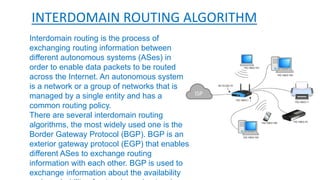
Interdomain routing involves exchanging routing information between autonomous systems (ASes) to facilitate data packet routing across the internet, primarily through the Border Gateway Protocol (BGP), which employs a path-vector algorithm and various attributes for optimizing routes. While BGP offers scalability, flexibility, robustness, security, multihoming support, and interoperability, it also presents challenges such as complexity, security vulnerabilities, slow convergence, and potential scalability issues. Overall, understanding the advantages and disadvantages of interdomain routing algorithms like BGP is essential for effective internet network management.