BGP - BorderGateway Protocol
What is BGP?
Border Gateway Protocol (BGP): The protocol used for routing between different Autonomous
Systems (ASes) on the Internet.
Purpose: Ensures that data packets are delivered efficiently across vast networks.
Key Feature: Allows enforcement of routing policies based on politics, economics, or security.
Visual: A diagram showing multiple ASes (AS1, AS2, etc.) connected via BGP links.
2.
Why Do WeNeed BGP?
Intradomain Protocols: (e.g., OSPF, IS-IS) focus on efficiency within a single AS.
Interdomain Protocols: (e.g., BGP) handle:
• Political considerations
• Economic constraints
• Security policies
Example: "Do not route traffic from the Pentagon through an AS in a rival country."
Visual: Two ASes exchanging data, one with a "restricted" route.
3.
Key Concepts inBGP
1. Autonomous System (AS): Independent networks managed by organizations (e.g., ISPs,
corporations).
2. Transit: AS provides routes for other ASes (paid service).
3. Peering: ASes exchange traffic directly (usually free).
4. Routing Policies: Rules governing how traffic flows.
5. Visual: Simple flow diagram showing Transit and Peering relationships between AS1, AS2, and
AS3.
4.
How BGP Works
•Path Vector Protocol:
Keeps track of the route (AS path) data takes.
• Policies First: Routes are selected based on policies, not just shortest paths.
• TCP-based Communication: Reliable route advertisements between routers.
• Visual: A route advertisement showing AS3 -> AS2 -> AS1.
5.
Example Scenario
Transit: AS1(a provider) advertises routes to AS2, AS3, and AS4. AS2, AS3, and AS4 pay AS1 for
transit services.
Peering: AS2 and AS3 exchange traffic directly to reduce transit costs.
Visual:
A network diagram with AS1 providing transit and AS2-AS3 peering directly.
6.
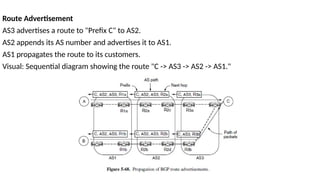
Route Advertisement
AS3 advertisesa route to "Prefix C" to AS2.
AS2 appends its AS number and advertises it to AS1.
AS1 propagates the route to its customers.
Visual: Sequential diagram showing the route "C -> AS3 -> AS2 -> AS1."
7.
BGP Routing Policies
•Political: Avoid routes through certain regions.
• Economic: Prefer cheaper ISPs.
• Security: Route only through trusted ASes.
Example: "Do not use AT&T in Australia due to poor performance."
Visual: Table showing policy examples.
8.
Advantages of BGP
•Scalable for the global Internet.
• Flexible to support various policies.
• Reliable communication via TCP.
Visual: A global map highlighting interconnected networks.
9.
Conclusion
BGP enables inter-ASrouting and supports routing policies.
It balances performance, security, and cost considerations.
BGP ensures the Internet stays connected globally.
Visual: A simple diagram showing data flowing seamlessly across the globe.