Space Law, AI and
Cybersecurity
Presented By Charles Lee Mudd Jr.
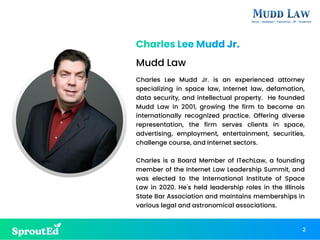
Charles Lee Mudd Jr. is an experienced attorney
specializing in space law, Internet law, defamation,
data security, and intellectual property. He founded
Mudd Law in 2001, growing the firm to become an
internationally recognized practice. Offering diverse
representation, the firm serves clients in space,
advertising, employment, entertainment, securities,
challenge course, and Internet sectors.
Charles is a Board Member of ITechLaw, a founding
member of the Internet Law Leadership Summit, and
was elected to the International Institute of Space
Law in 2020. He's held leadership roles in the Illinois
State Bar Association and maintains memberships in
various legal and astronomical associations.
Charles Lee Mudd Jr.
2
Mudd Law
Protecting the Security and
Sustainability of the Next Frontier
Charles Lee Mudd Jr.
Space Law, AI, and Cybersecurity
3
International Space Regime
(briefly….)
4
The US Space Regulatory Regime
5
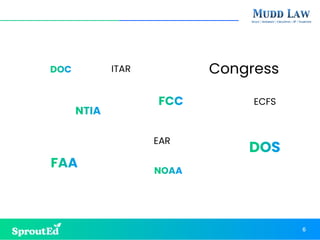
FAA NOAA
DOS
DOC
NTIA
Congress
FCC ECFS
ITAR
EAR
6
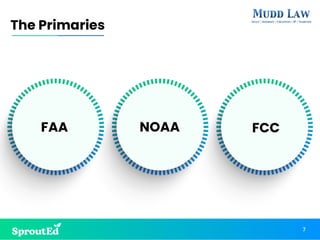
FAA
The Primaries
7
FCC
NOAA
DOT - FAA
Office of Commercial Space Transportation.
Enabling statute Commercial Space Launch Act of 1984
(51 U.S.C. § 50901-50923)
Commercial Space Launch Amendments Act of 2004
8
Launch or Reentry Vehicles
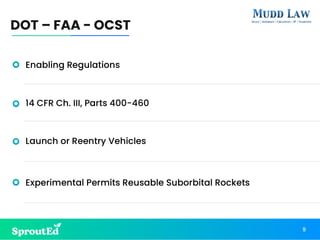
Experimental Permits Reusable Suborbital Rockets
DOT – FAA - OCST
Enabling Regulations
9
14 CFR Ch. III, Parts 400-460
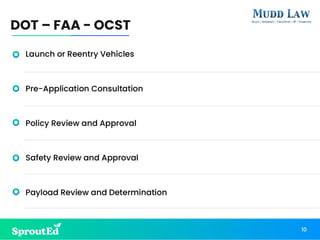
Launch or Reentry Vehicles
Pre-Application Consultation
Policy Review and Approval
Safety Review and Approval
Payload Review and Determination
DOT – FAA - OCST
10
Financial Responsibility
Environmental Review
Compliance Monitoring
DOT – FAA - OCST
11
12
13
Evaluation of Space Transportation Demands/Needs
National Security Space Transportation Demands
“Other important technologies include data management,
cybersecurity, and [SSA].”
DOT – FAA - OCST
14
2020 National Spaceport Network Development Plan
13 Licensed Launches (10 SpaceX)
23 Launch Licenses
2 Human Spaceflight Licensed & Permitted Launches
DOT – FAA - OCST
15
2024 Statistics
New Launch and Reentry Regulations (157 submissions)
August 19, 2019 NPRM closed - published September 30,
2020
Effective March 10, 2021, March 10, 2026*
*Information Collection Requirements delayed pending OMB
DOT – FAA - OCST
16
Streamlined Launch and Reentry License Requirements
(SLR2)
Part 450 (combination of old 415, 417, 431, 435)
Part 450 licenses will be valid for up to 5 years (renewable)
DOT – FAA - OCST
17
Streamlined Launch and Reentry License Requirements
(SLR2)
Workshops held in November 2020
YouTube Videos and PDFs Available
DOT – FAA - OCST
18
In 2020, FAA began issuing circulars to update aspects of
its oversight of commercial space transportation.
Prior to 2020, last circular occurred in 2007.
DOT – FAA - OCST
19
2021 Computing System Safety
“It is intended to provide guidance for an applicant in
developing software and computing system safety
analyses and processes to comply with § 450.141.”
DOT – FAA - OCST
20
Commercial Remote Sensing Regulatory Affairs
(https://www.nesdis.noaa.gov/CRSRA/)
DOC – NOAA - CRSRA
21
DOC – NOAA - CRSRA
22
no person who is subject to the jurisdiction or control of the U.S. may
operate any private remote sensing space system without a license,
and authorized the Secretary of Commerce to license private sector
parties to operate private remote sensing space systems
Based on
National and Commercial Space Programs Act, 51 U.S.C. § 60101, et seq.
Within the CRSRA, there has been
coordination between…
DOS, DOD, DOI, JCS, and
Office Director of National Intelligence
DOC – NOAA - CRSRA
23
Cybersecurity
Data Protection
DOC – NOAA - CRSRA
24
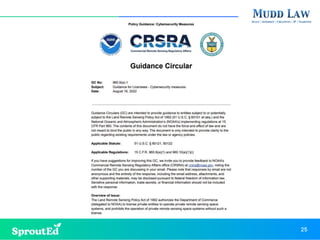
25
May 8, 2002
NOAA Licensee
Data Protection Template
A. End-to-end process (high level)
1. Provide a high level description of the overall data protection strategy.
2. Provide a flow diagram that highlights the entire data protection process, from
satellite tasking orders and decks to delivery of imagery and finished products.
3. Provide a high level description for the end-to-end data protection process. This
description should delineate between protection methods implemented on the
spacecraft (e.g., data encryption) and ground based protection methods (e.g., ground
receiving station physical security). The combination of these protection methods
must clearly implement the license conditions regulating commanding authority,
tasking, imagery resolution and delivery time, country/regional access to imagery,
etc.)
B. Program Space Segment (detailed information)
Provide a brief description of the satellite system to include:
1. Orbital information (altitude, inclination, etc.)
2. Sensor type(s) (panchromatic, multispectral, hyperspectral, radar, etc.), basic design
features [example: for EO systems, resolution (IFOV), imaging modes, spectral range
(VNIR, SWIR, etc.), spectral bands (number of bands, center wavelength,
bandwidth), swath width (FOV)] and scanning mechanism description(s)
(pushbroom, step-stare, etc). Indicate which sensors produce co-registered imagery
(e.g., by common optical systems) and which are independent (e.g., PAN and SAR).
3. Top-level platform properties (e.g., in-track and cross track pointing ability, on-board
storage capacity, etc.)
4. General space/ground architecture (description with diagram).
5. Overview of the end-to-end system communications architecture (description with
diagram)
6. RF data downlinks
a. Link information (top level description of the number of RF channels and the
purpose of each)
b. Physical characterization of each link (frequency, modulation protocol, bit rates, link
margin, beam patterns, data compression protocol, encryption methodology, etc.)
c. Information type(s) carried by each RF channel (e.g., tasking of image collection;
telemetry, tracking, and control (TT&C), satellite health/status, imagery metadata,
raw imagery data, etc.). The encryption level for each general information type must
be specified.
7. Indicate whether the satellite incorporates separate tasking links and/or data protocols
(e.g., encryption standards) for US Government and commercial operations. If
separate processes exist, describe the differences in detail. This would include:
encryption types used on all satellite up- and/or downlinks; key and re-key schemes;
26
Licenses
Annual Audits
DOC – NOAA - CRSRA
27
28
When completed: FOUO/PROPIN/PRIVILEGED DOCUMENT
RELEASE OR DISSEMINATION BEYOND THE INTENDED RECIPIENT IS STRICTLY PROHIBITED
Page 1 of 10
Rev 3/14/2017
NATIONAL OCEANIC AND ATMOSPHERIC ADMINISTRATION (NOAA)
COMMERCIAL REMOTE SENSING REGULATORY AFFAIRS (CRSRA) COMPLIANCE AND
MONITORING
20__ AUDIT
LICENSEE OF RECORD: _
CORPORATE AFFILIATION: _
PROPOSED LICENSED SYSTEM(S) OF RECORD: _
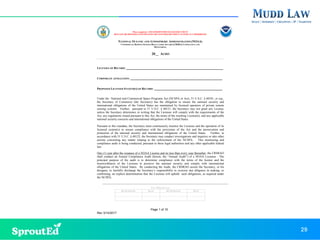
Under the National and Commercial Space Programs Act (NCSPA or Act), 51 U.S.C. § 60101, et seq.,
the Secretary of Commerce (the Secretary) has the obligation to ensure the national security and
international obligations of the United States are maintained by licensed operators of private remote
sensing systems. Further, pursuant to 51 U.S.C. § 60121, the Secretary may not grant any License,
unless the Secretary determines in writing that the Licensee will comply with the requirements of the
Act, any regulations issued pursuant to this Act, the terms of the resulting License(s), and any applicable
national security concerns and international obligations of the United States.
Pursuant to this mandate, the Secretary must continuously monitor the Licensee and the operation of its
licensed system(s) to ensure compliance with the provisions of the Act and the preservation and
protection of the national security and international obligations of the United States. Further, in
accordance with 51 U.S.C. § 60123, the Secretary may conduct investigations and inquiries or take other
actions concerning any matter relating to the enforcement of the NCSPA. This monitoring and
compliance audit is being conducted, pursuant to these legal authorities and any other applicable federal
law.
For Official Use
REVIEWED BY DATE REVIEWED BY DATE
One (1) year after the issuance of a NOAA License and no less than every year thereafter, the CRSRAO
shall conduct an Annual Compliance Audit (herein, the “Annual Audit”) of a NOAA Licensee. The
principal purpose of the audit is to determine compliance with the terms of the license and the
trustworthiness of the Licensee to preserve the national security and comply with international
obligations of the United States. By conducting the Audit, the CRSRAO assists the Secretary, or his
designee, to lawfully discharge the Secretary’s responsibility to exercise due diligence in making, or
confirming, an explicit determination that the Licensee will uphold such obligations, as required under
the NCSPA.
29
Cybersecurity
where propulsion systems, show ensured + control
Tier 2 and Tier 3 – could see specific requirements
(eg tracking, telemetry, and control)
DOC – NOAA - CRSRA
30
Final Rules – May 19, 2020
DOC – NOAA - CRSRA
31
Final Rules – May 19, 2020
Cybersecurity
Encryption
recommend taking higher level, provide for encryption of data
where possible
Cybersecurity
Indeed, they do provide recommendations
(Requirements less stringent that had been proposed)
DOC – NOAA - CRSRA
32
Final Rules – May 19, 2020
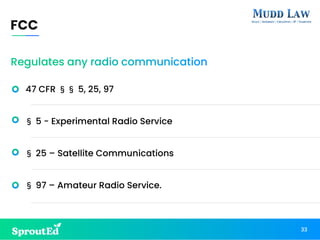
Regulates any radio communication
47 CFR §§ 5, 25, 97
§ 5 - Experimental Radio Service
§ 25 – Satellite Communications
§ 97 – Amateur Radio Service.
FCC
33
Streamlined Small Sat
Regulations
FCC
34
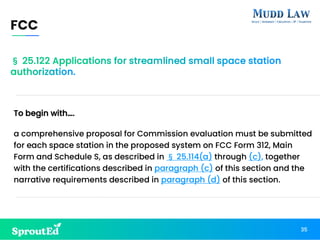
§ 25.122 Applications for streamlined small space station
authorization.
To begin with….
a comprehensive proposal for Commission evaluation must be submitted
for each space station in the proposed system on FCC Form 312, Main
Form and Schedule S, as described in § 25.114(a) through (c), together
with the certifications described in paragraph (c) of this section and the
narrative requirements described in paragraph (d) of this section.
FCC
35
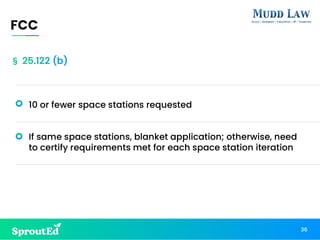
10 or fewer space stations requested
If same space stations, blanket application; otherwise, need
to certify requirements met for each space station iteration
FCC
36
§ 25.122 (b)
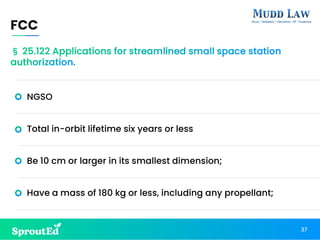
NGSO
Total in-orbit lifetime six years or less
Be 10 cm or larger in its smallest dimension;
Have a mass of 180 kg or less, including any propellant;
FCC
37
§ 25.122 Applications for streamlined small space station
authorization.
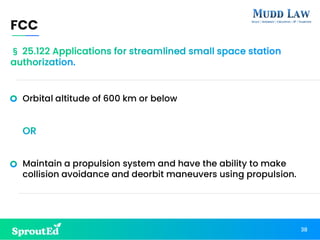
Orbital altitude of 600 km or below
OR
Maintain a propulsion system and have the ability to make
collision avoidance and deorbit maneuvers using propulsion.
FCC
38
§ 25.122 Applications for streamlined small space station
authorization.
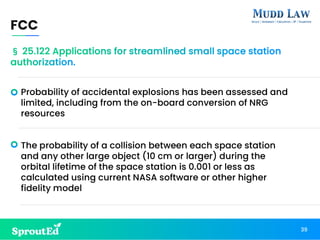
Probability of accidental explosions has been assessed and
limited, including from the on-board conversion of NRG
resources
The probability of a collision between each space station
and any other large object (10 cm or larger) during the
orbital lifetime of the space station is 0.001 or less as
calculated using current NASA software or other higher
fidelity model
FCC
39
§ 25.122 Applications for streamlined small space station
authorization.
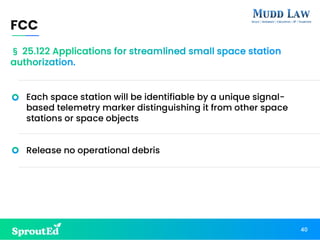
Each space station will be identifiable by a unique signal-
based telemetry marker distinguishing it from other space
stations or space objects
Release no operational debris
FCC
40
§ 25.122 Applications for streamlined small space station
authorization.
The space station(s) will be disposed of post-mission through
atmospheric re-entry. The probability of human casualty from
portions of the spacecraft surviving re-entry and reaching the
surface of the Earth is zero as calculated using current NASA
software or higher fidelity models
FCC
41
§ 25.122 Applications for streamlined small space station
authorization.
Operation of the space station(s) will be compatible with
existing operations in the authorized frequency band(s).
Operations will not materially constrain future space station
entrants from using the authorized frequency band(s)
FCC
42
§ 25.122 Applications for streamlined small space station
authorization.
DOS | ITAR
DOC | EAR
43
NASA
44
Influential and
visionary
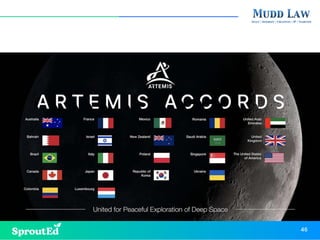
45
46
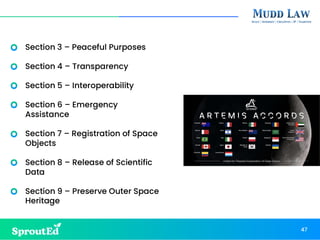
Section 3 – Peaceful Purposes
Section 4 – Transparency
Section 5 – Interoperability
Section 6 – Emergency
Assistance
Section 7 – Registration of Space
Objects
Section 8 – Release of Scientific
Data
Section 9 – Preserve Outer Space
Heritage
47
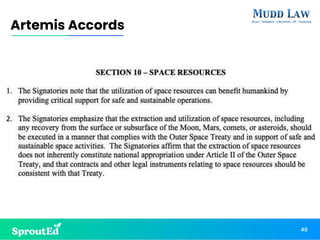
48
Artemis Accords
Section 10 – Space Resources
Section 11 – Deconfliction
• Due Regard and Harmful Interference
• Long-Term Sustainability Guidelines (2019)
• Due Regard (again)
• Harmful Interference (again)
• Communication and Coordination to Avoid HI
• Safety Zones
49
Artemis Accords
Section 11 – Deconfliction
Section 12 – Orbital Debris
• Plan for Mitigation of Orbital Debris
• Limit as possible new, long-lived harmful debris
50
Artemis Accords
1. Space Debris
2. Extraction of Space Debris and Ownership Issues
3. Space Environmentalism - Earth’s Orbital Space
4. Liability Development – On-Orbit Operations
51
Emerging Issues
5. Defining Ownership Rights
6. ITAR and EAR – Space Operations
7. Cybersecurity in Space
8. Dark & Quiet Skies
52
Emerging Issues
What Cannot Work By Itself
Waiting for a Treaty
Reliance on Guidelines, Recommendations, Thoughts
Self-Governance
Antiquated Regulations
53
Multi-Jurisdictional, Multi-Disciplinary, and Obligatory
Continue to Develop Guidelines as Foundation
Push for New Treaty – Encompassing or Limited
International Agreements
Encourage Industry Best Practices
Modernize Regulations
Collaboration
54
United States New Space Regime
Two-Phases
Preparatory
Consolidated
55
56
Space Law
AI
Cybersecurity
AI/ML
Artificial Intelligence
57
58
Artificial Intelligence
AI represents the programmed simulation of
human intelligence in machines.
Natural Language Processing
Interaction Between Computers and Human Languages
To Enable Computers to Understand, Interpret, and Generate
Natural Language
59
Artificial Intelligence
Natural Language Processing
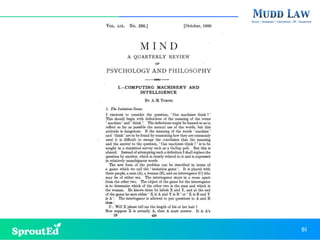
Alan Turing (1950)
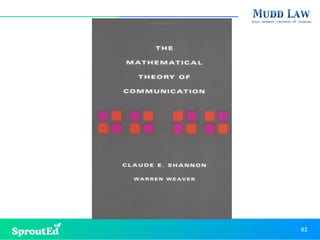
Shannon-Weaver (1949)
60
Artificial Intelligence
61
62
Alan Turing (1950)
Turing proposed that if a machine could carry out a
conversation that was indistinguishable from a human
conversation, it could be said to be intelligent.
63
Artificial Intelligence
Natural Language Processing
64
Artificial Intelligence
1951 Checkers and Chess
65
Ferranti Mark 1
video removed, slide will be
deleted
66
Connection Between Mark 1 and WWW
Conway Berners-Lee and Mary Lee Woods
Tim Berners-Lee
World Wide Web
67
Internet History
68
Artificial Intelligence
“Every aspect of learning or any other feature of intelligence
can in principle be so precisely described that a machine
can be made to simulate it.”
John McCarthy, Marvin Minsky, Nathaniel Rochester, and Claude Shannon, “A
Proposal for the Dartmouth Summer Research Project on Artificial Intelligence,”
1956.
69
Machine Learning
A subfield of AI that uses statistical and algorithmic
techniques to enable computers to learn from data without
being explicitly programmed.
The use of ML seeks to develop algorithms that can improve
their performance on a specific task as the algorithms
become exposed to more data.
70
Machine Learning
Arthur Samuel coined the term “Machine Learning” in
1959.
Returning to Checkers, Samuel developed a version of
the game that could play at an expert level by
“learning” from its mistakes and improving its strategy
over time.
video removed, slide will be
deleted
71
An AI model trained on massive amounts of text
data
Employs deep learning techniques (e.g. neural
networks) to learn statistical patterns in language
Uses these patterns to generate new human-like
language output
72
Large Language Models (LLM)
73
Large Language Models (LLM)
First LLM developed in 2010 at the University of Toronto
Employs deep learning techniques (e.g. neural
networks) to learn statistical patterns in language
Uses these patterns to generate new human-like
language output
74
And from there, let’s travel to
November 30, 2022…
History of ChatGPT
75
Unsupervised Learning
Neural Networks
76
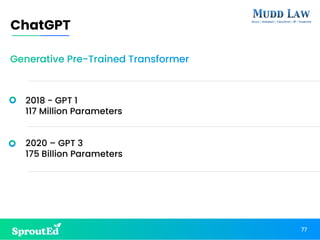
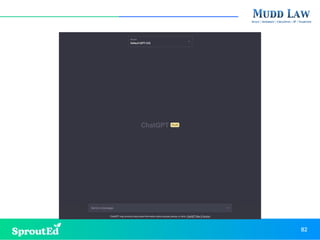
ChatGPT
Generative Pre-Trained Transformer
2018 - GPT 1
117 Million Parameters
2020 – GPT 3
175 Billion Parameters
77
ChatGPT
Generative Pre-Trained Transformer
78
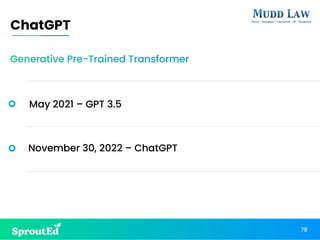
ChatGPT
Generative Pre-Trained Transformer
May 2021 – GPT 3.5
November 30, 2022 – ChatGPT
ChatGPT
79
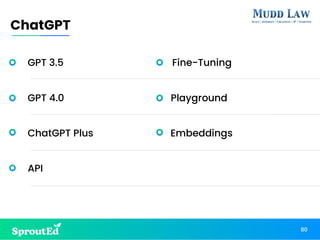
GPT 3.5 Fine-Tuning
GPT 4.0 Playground
ChatGPT Plus Embeddings
API
80
ChatGPT
81
ChatGPT
Applications
82
83
84
85
86
87
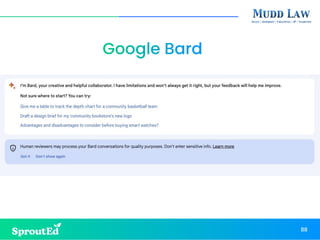
Google Bard
88
Over 40 languages
Numerous countries
Google Lens
Share with Others
Modify Responses
89
Google Bard
Updates
90
91
92
93
94
95
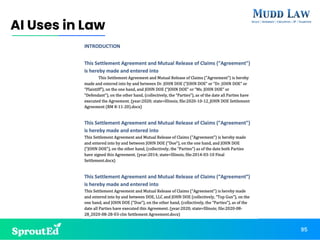
AI Uses in Law
Claralabs
Scheduling Assistant
96
AI Uses in Law
97
AI Uses in Law
98
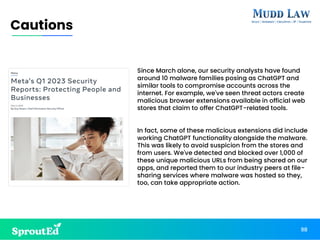
Cautions
Since March alone, our security analysts have found
around 10 malware families posing as ChatGPT and
similar tools to compromise accounts across the
internet. For example, we've seen threat actors create
malicious browser extensions available in official web
stores that claim to offer ChatGPT-related tools.
In fact, some of these malicious extensions did include
working ChatGPT functionality alongside the malware.
This was likely to avoid suspicion from the stores and
from users. We've detected and blocked over 1,000 of
these unique malicious URLs from being shared on our
apps, and reported them to our industry peers at file-
sharing services where malware was hosted so they,
too, can take appropriate action.
video removed, slide will be
deleted
99
100
Cautions
Mata v. Avianca, Inc., No. 22-cv-1461 (PKC), Order to Show Cause
(S.D.N.Y. May 4, 2023) (issuing rule to show cause where “[a]
submission filed by plaintiff’s counsel in opposition to a motion to
dismiss is replete with citations to nonexistent cases.”) (D.E. 31);
Attorney Affidavit (D.E. 32-1) (S.D.N.Y. May 25, 2023) (responding to rule
to show cause order by stating that the case authorities found by the
district court to be nonexistent “were provided by Chat GPT which also
provided its legal source and assured the reliability of its content.”).
Standing Orders
USDC N.D. Texas, Judge Brently Starr
(https://www.txnd.uscourts.gov/judge/judge-brantley-starr)
101
Arising Rules
I further certify that no portion of any filing in this case will be drafted by
generative artificial intelligence or that any language drafted by
generative artificial intelligence—including quotations, citations,
paraphrased assertions, and legal analysis—will be checked for accuracy,
using print reporters or traditional legal databases, by a human being
before it is submitted to the Court. I understand that any attorney who
signs any filing in this case will be held responsible for the contents thereof
according to applicable rules of attorney discipline, regardless of whether
generative artificial intelligence drafted any portion of that filing.
102
Arising Rules
Standing Orders
USDC N.D. Illinois
(https://www.txnd.uscourts.gov/judge/judge-brantley-starr)
103
Arising Rules
Any party using any generative AI tool to conduct legal
research or to draft documents for filing with the Court must
disclose in the filing that AI was used, with the disclosure
including the specific AI tool and the manner in which it was
used.
104
Arising Rules
“Parties should not assume that mere reliance on an AI tool will be
presumed to constitute reasonable inquiry, because, to quote a phrase,
“I’m sorry, Dave, I’m afraid I can’t do that …. This mission is too important for
me to allow you to jeopardize it.” 2001: A SPACE ODYSSEY (MetroGoldwyn-
Mayer 1968).
One way to jeopardize the mission of federal courts is to use an AI tool to
generate legal research that includes “bogus judicial decisions” cited for
substantive propositions of law.”
Arising Rules
105
See Mata v. Avianca, Inc., No. 22-cv-1461 (PKC), Order to Show Cause
(S.D.N.Y. May 4, 2023) (issuing rule to show cause where “[a] submission
filed by plaintiff’s counsel in opposition to a motion to dismiss is replete
with citations to nonexistent cases.”) (D.E. 31);
Id., Attorney Affidavit (D.E. 32-1) (S.D.N.Y. May 25, 2023) (responding to
rule to show cause order by stating that the case authorities found by
the district court to be nonexistent “were provided by Chat GPT which
also provided its legal source and assured the reliability of its content.”).
106
Arising Rules
Just as the Court did before the advent of AI as a tool for legal
research and drafting, the Court will continue to presume that the
Rule 11 certification is a representation by filers, as living, breathing,
thinking human beings, that they themselves have read and
analyzed all cited authorities to ensure that such authorities
actually exist and that the filings comply with Rule 11(b)(2).
Arising Rules
107
Standing Orders
U.S. Court International Trade
http://mlo.bz/intltradeai
USDC E.D. Pa.
https://mlo.bz/jlYOe
108
Arising Rules
109
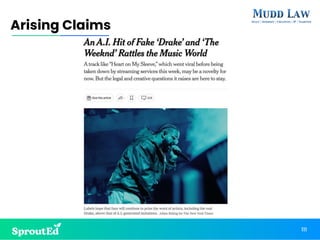
Arising Claims
110
111
Arising Claims
112
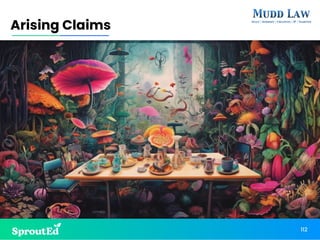
Arising Claims
Illinois
Artificial Intelligence Video Interview Act
820 ILCS 42/5, et seq.
Use, Sharing, Destruction
113
Arising Claims
114
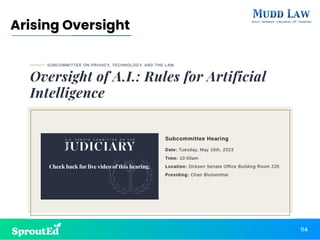
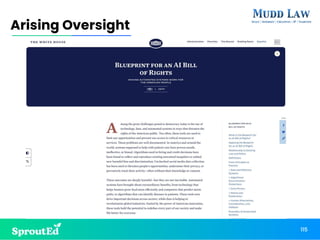
Arising Oversight
115
Arising Oversight
116
Space Law
AI
Cybersecurity
117
Cybersecurity
Space Industry
Hack-a-Sat Events
Hack-a-Sat 4
Winning Teams Accessed U.S. Government Satellite in
Hours
UN Space Treaties – absence of cybersecurity obligation,
but other requirements might imply implementation of
measures (eg debris, non-contamination)
Long-Term Sustainability Guidelines – absence of
cybersecurity provisions
118
Cybersecurity
NIST 1.1 | 2.0
Introduction to Cybersecurity for Commercial Space
Operations (2/22)
Space Cybersecurity Symposium III (6/16/22)
119
Cybersecurity
IEEE
Standard for Space System Cybersecurity
Space System Cybersecurity Working Group
120
Cybersecurity
NASA
19 Jan 2024
Space Security Best Practices Guide
121
Cybersecurity
National Security Agency
Commercial Solutions for Classified (CSfC)
https://www.nsa.gov/Resources/Commercial-Solutions-for-Classified-Program/
122
Cybersecurity
Implementation of AI to Protect Cybersecurity
And Beyond
123
Putting it All Together
Optimize Analysis Time
Accelerate Threat Detection
Expedite Responses
Protect User Identity and Datasets
124
Putting it All Together
AI and Cybersecurity
IBM Reports
93% Executives Considering AI in Cybersecurity
Average Reduction of $3,000,000 million in data breach costs
Reduction in response time (230 days to 99 days, as an
example)
125
Putting it All Together
AI and Cybersecurity
AI and Space
NASA
”Throughout NASA, Artificial Intelligence (AI) is profoundly
disrupting science, its methods, processes, and discoveries.”
126
Putting it All Together
AI and Space
NASA
Artificial Intelligence Group
Putting it All Together
127
AI and Space
NASA
Earth Observing Data
Putting it All Together
128
AI and Space
NASA
Science Mission Directorate AI Initiative
129
Putting it All Together
AI and Space – NASA
2022 Responsible AI Plan
130
Putting it All Together
AI and Space – NASA – 2023 Report
“Important AI projects are underway at each of the seven NASA
Centers represented at the workshop, many as pilot projects
and a few as partnerships across Centers”
Putting it All Together
131
AI and Space – NASA – 2023 Report
“Achieving the full potential for advances in AI demands
greater collaboration between NASA centers, with other
government agencies and with private industry and
academia.”
Putting it All Together
132
AI and Space – NASA – 2023 Report
“Continuing NASA investment in High-End Computing
infrastructure, including on-premises and commercial cloud,
and commitment to Open Science will accelerate current and
future work.”
Putting it All Together
133
AI and Space – NASA – 2023 Report
“An expansion of efforts in ethical, explainable, and trustworthy
AI is needed to overcome the “fear” of AI that is hindering further
uptake of AI in the broader community.”
Putting it All Together
134
AI and Space – NASA – 2023 Report
“AI-supported autonomy is fundamental for current and future
missions to maximize science returns from missions in deep
space and from those generating huge volumes of data.”
Putting it All Together
135
AI and Space – NASA – 2023 Report
“Ongoing support for training and learning in the rapidly
changing ecosystem of AI is essential for our workforce to
continue making advances and to help recruit and retain that
workforce.”
Putting it All Together
136
AI and Space – NASA – 2023 Report
Yet, no mention of cyber or data security.
Putting it All Together
137
Putting it All Together
NASA
AI Use Case Inventory – 2023
No cybersecurity, data security,
only “security” security camera
138
139
slide deleted
www.muddlawoffices.com
Charles Lee Mudd Jr.
Call or email and I'd be happy to speak with you more in-depth or answer any questions.
Contact Information
140
Mudd Law
312-964-5051
charles@muddlaw.com

Space Law, AI, and Cybersecurity | SproutEd

  • 1.
    Space Law, AIand Cybersecurity Presented By Charles Lee Mudd Jr.
  • 2.
    Charles Lee MuddJr. is an experienced attorney specializing in space law, Internet law, defamation, data security, and intellectual property. He founded Mudd Law in 2001, growing the firm to become an internationally recognized practice. Offering diverse representation, the firm serves clients in space, advertising, employment, entertainment, securities, challenge course, and Internet sectors. Charles is a Board Member of ITechLaw, a founding member of the Internet Law Leadership Summit, and was elected to the International Institute of Space Law in 2020. He's held leadership roles in the Illinois State Bar Association and maintains memberships in various legal and astronomical associations. Charles Lee Mudd Jr. 2 Mudd Law
  • 3.
    Protecting the Securityand Sustainability of the Next Frontier Charles Lee Mudd Jr. Space Law, AI, and Cybersecurity 3
  • 4.
  • 5.
    The US SpaceRegulatory Regime 5
  • 6.
  • 7.
  • 8.
    DOT - FAA Officeof Commercial Space Transportation. Enabling statute Commercial Space Launch Act of 1984 (51 U.S.C. § 50901-50923) Commercial Space Launch Amendments Act of 2004 8
  • 9.
    Launch or ReentryVehicles Experimental Permits Reusable Suborbital Rockets DOT – FAA - OCST Enabling Regulations 9 14 CFR Ch. III, Parts 400-460
  • 10.
    Launch or ReentryVehicles Pre-Application Consultation Policy Review and Approval Safety Review and Approval Payload Review and Determination DOT – FAA - OCST 10
  • 11.
  • 12.
  • 13.
  • 14.
    Evaluation of SpaceTransportation Demands/Needs National Security Space Transportation Demands “Other important technologies include data management, cybersecurity, and [SSA].” DOT – FAA - OCST 14 2020 National Spaceport Network Development Plan
  • 15.
    13 Licensed Launches(10 SpaceX) 23 Launch Licenses 2 Human Spaceflight Licensed & Permitted Launches DOT – FAA - OCST 15 2024 Statistics
  • 16.
    New Launch andReentry Regulations (157 submissions) August 19, 2019 NPRM closed - published September 30, 2020 Effective March 10, 2021, March 10, 2026* *Information Collection Requirements delayed pending OMB DOT – FAA - OCST 16
  • 17.
    Streamlined Launch andReentry License Requirements (SLR2) Part 450 (combination of old 415, 417, 431, 435) Part 450 licenses will be valid for up to 5 years (renewable) DOT – FAA - OCST 17
  • 18.
    Streamlined Launch andReentry License Requirements (SLR2) Workshops held in November 2020 YouTube Videos and PDFs Available DOT – FAA - OCST 18
  • 19.
    In 2020, FAAbegan issuing circulars to update aspects of its oversight of commercial space transportation. Prior to 2020, last circular occurred in 2007. DOT – FAA - OCST 19
  • 20.
    2021 Computing SystemSafety “It is intended to provide guidance for an applicant in developing software and computing system safety analyses and processes to comply with § 450.141.” DOT – FAA - OCST 20
  • 21.
    Commercial Remote SensingRegulatory Affairs (https://www.nesdis.noaa.gov/CRSRA/) DOC – NOAA - CRSRA 21
  • 22.
    DOC – NOAA- CRSRA 22 no person who is subject to the jurisdiction or control of the U.S. may operate any private remote sensing space system without a license, and authorized the Secretary of Commerce to license private sector parties to operate private remote sensing space systems Based on National and Commercial Space Programs Act, 51 U.S.C. § 60101, et seq.
  • 23.
    Within the CRSRA,there has been coordination between… DOS, DOD, DOI, JCS, and Office Director of National Intelligence DOC – NOAA - CRSRA 23
  • 24.
  • 25.
  • 26.
    May 8, 2002 NOAALicensee Data Protection Template A. End-to-end process (high level) 1. Provide a high level description of the overall data protection strategy. 2. Provide a flow diagram that highlights the entire data protection process, from satellite tasking orders and decks to delivery of imagery and finished products. 3. Provide a high level description for the end-to-end data protection process. This description should delineate between protection methods implemented on the spacecraft (e.g., data encryption) and ground based protection methods (e.g., ground receiving station physical security). The combination of these protection methods must clearly implement the license conditions regulating commanding authority, tasking, imagery resolution and delivery time, country/regional access to imagery, etc.) B. Program Space Segment (detailed information) Provide a brief description of the satellite system to include: 1. Orbital information (altitude, inclination, etc.) 2. Sensor type(s) (panchromatic, multispectral, hyperspectral, radar, etc.), basic design features [example: for EO systems, resolution (IFOV), imaging modes, spectral range (VNIR, SWIR, etc.), spectral bands (number of bands, center wavelength, bandwidth), swath width (FOV)] and scanning mechanism description(s) (pushbroom, step-stare, etc). Indicate which sensors produce co-registered imagery (e.g., by common optical systems) and which are independent (e.g., PAN and SAR). 3. Top-level platform properties (e.g., in-track and cross track pointing ability, on-board storage capacity, etc.) 4. General space/ground architecture (description with diagram). 5. Overview of the end-to-end system communications architecture (description with diagram) 6. RF data downlinks a. Link information (top level description of the number of RF channels and the purpose of each) b. Physical characterization of each link (frequency, modulation protocol, bit rates, link margin, beam patterns, data compression protocol, encryption methodology, etc.) c. Information type(s) carried by each RF channel (e.g., tasking of image collection; telemetry, tracking, and control (TT&C), satellite health/status, imagery metadata, raw imagery data, etc.). The encryption level for each general information type must be specified. 7. Indicate whether the satellite incorporates separate tasking links and/or data protocols (e.g., encryption standards) for US Government and commercial operations. If separate processes exist, describe the differences in detail. This would include: encryption types used on all satellite up- and/or downlinks; key and re-key schemes; 26
  • 27.
  • 28.
  • 29.
    When completed: FOUO/PROPIN/PRIVILEGEDDOCUMENT RELEASE OR DISSEMINATION BEYOND THE INTENDED RECIPIENT IS STRICTLY PROHIBITED Page 1 of 10 Rev 3/14/2017 NATIONAL OCEANIC AND ATMOSPHERIC ADMINISTRATION (NOAA) COMMERCIAL REMOTE SENSING REGULATORY AFFAIRS (CRSRA) COMPLIANCE AND MONITORING 20__ AUDIT LICENSEE OF RECORD: _ CORPORATE AFFILIATION: _ PROPOSED LICENSED SYSTEM(S) OF RECORD: _ Under the National and Commercial Space Programs Act (NCSPA or Act), 51 U.S.C. § 60101, et seq., the Secretary of Commerce (the Secretary) has the obligation to ensure the national security and international obligations of the United States are maintained by licensed operators of private remote sensing systems. Further, pursuant to 51 U.S.C. § 60121, the Secretary may not grant any License, unless the Secretary determines in writing that the Licensee will comply with the requirements of the Act, any regulations issued pursuant to this Act, the terms of the resulting License(s), and any applicable national security concerns and international obligations of the United States. Pursuant to this mandate, the Secretary must continuously monitor the Licensee and the operation of its licensed system(s) to ensure compliance with the provisions of the Act and the preservation and protection of the national security and international obligations of the United States. Further, in accordance with 51 U.S.C. § 60123, the Secretary may conduct investigations and inquiries or take other actions concerning any matter relating to the enforcement of the NCSPA. This monitoring and compliance audit is being conducted, pursuant to these legal authorities and any other applicable federal law. For Official Use REVIEWED BY DATE REVIEWED BY DATE One (1) year after the issuance of a NOAA License and no less than every year thereafter, the CRSRAO shall conduct an Annual Compliance Audit (herein, the “Annual Audit”) of a NOAA Licensee. The principal purpose of the audit is to determine compliance with the terms of the license and the trustworthiness of the Licensee to preserve the national security and comply with international obligations of the United States. By conducting the Audit, the CRSRAO assists the Secretary, or his designee, to lawfully discharge the Secretary’s responsibility to exercise due diligence in making, or confirming, an explicit determination that the Licensee will uphold such obligations, as required under the NCSPA. 29
  • 30.
    Cybersecurity where propulsion systems,show ensured + control Tier 2 and Tier 3 – could see specific requirements (eg tracking, telemetry, and control) DOC – NOAA - CRSRA 30 Final Rules – May 19, 2020
  • 31.
    DOC – NOAA- CRSRA 31 Final Rules – May 19, 2020 Cybersecurity Encryption recommend taking higher level, provide for encryption of data where possible
  • 32.
    Cybersecurity Indeed, they doprovide recommendations (Requirements less stringent that had been proposed) DOC – NOAA - CRSRA 32 Final Rules – May 19, 2020
  • 33.
    Regulates any radiocommunication 47 CFR §§ 5, 25, 97 § 5 - Experimental Radio Service § 25 – Satellite Communications § 97 – Amateur Radio Service. FCC 33
  • 34.
  • 35.
    § 25.122 Applicationsfor streamlined small space station authorization. To begin with…. a comprehensive proposal for Commission evaluation must be submitted for each space station in the proposed system on FCC Form 312, Main Form and Schedule S, as described in § 25.114(a) through (c), together with the certifications described in paragraph (c) of this section and the narrative requirements described in paragraph (d) of this section. FCC 35
  • 36.
    10 or fewerspace stations requested If same space stations, blanket application; otherwise, need to certify requirements met for each space station iteration FCC 36 § 25.122 (b)
  • 37.
    NGSO Total in-orbit lifetimesix years or less Be 10 cm or larger in its smallest dimension; Have a mass of 180 kg or less, including any propellant; FCC 37 § 25.122 Applications for streamlined small space station authorization.
  • 38.
    Orbital altitude of600 km or below OR Maintain a propulsion system and have the ability to make collision avoidance and deorbit maneuvers using propulsion. FCC 38 § 25.122 Applications for streamlined small space station authorization.
  • 39.
    Probability of accidentalexplosions has been assessed and limited, including from the on-board conversion of NRG resources The probability of a collision between each space station and any other large object (10 cm or larger) during the orbital lifetime of the space station is 0.001 or less as calculated using current NASA software or other higher fidelity model FCC 39 § 25.122 Applications for streamlined small space station authorization.
  • 40.
    Each space stationwill be identifiable by a unique signal- based telemetry marker distinguishing it from other space stations or space objects Release no operational debris FCC 40 § 25.122 Applications for streamlined small space station authorization.
  • 41.
    The space station(s)will be disposed of post-mission through atmospheric re-entry. The probability of human casualty from portions of the spacecraft surviving re-entry and reaching the surface of the Earth is zero as calculated using current NASA software or higher fidelity models FCC 41 § 25.122 Applications for streamlined small space station authorization.
  • 42.
    Operation of thespace station(s) will be compatible with existing operations in the authorized frequency band(s). Operations will not materially constrain future space station entrants from using the authorized frequency band(s) FCC 42 § 25.122 Applications for streamlined small space station authorization.
  • 43.
  • 44.
  • 45.
  • 46.
  • 47.
    Section 3 –Peaceful Purposes Section 4 – Transparency Section 5 – Interoperability Section 6 – Emergency Assistance Section 7 – Registration of Space Objects Section 8 – Release of Scientific Data Section 9 – Preserve Outer Space Heritage 47
  • 48.
  • 49.
    Section 10 –Space Resources Section 11 – Deconfliction • Due Regard and Harmful Interference • Long-Term Sustainability Guidelines (2019) • Due Regard (again) • Harmful Interference (again) • Communication and Coordination to Avoid HI • Safety Zones 49 Artemis Accords
  • 50.
    Section 11 –Deconfliction Section 12 – Orbital Debris • Plan for Mitigation of Orbital Debris • Limit as possible new, long-lived harmful debris 50 Artemis Accords
  • 51.
    1. Space Debris 2.Extraction of Space Debris and Ownership Issues 3. Space Environmentalism - Earth’s Orbital Space 4. Liability Development – On-Orbit Operations 51 Emerging Issues
  • 52.
    5. Defining OwnershipRights 6. ITAR and EAR – Space Operations 7. Cybersecurity in Space 8. Dark & Quiet Skies 52 Emerging Issues
  • 53.
    What Cannot WorkBy Itself Waiting for a Treaty Reliance on Guidelines, Recommendations, Thoughts Self-Governance Antiquated Regulations 53
  • 54.
    Multi-Jurisdictional, Multi-Disciplinary, andObligatory Continue to Develop Guidelines as Foundation Push for New Treaty – Encompassing or Limited International Agreements Encourage Industry Best Practices Modernize Regulations Collaboration 54
  • 55.
    United States NewSpace Regime Two-Phases Preparatory Consolidated 55
  • 56.
  • 57.
  • 58.
    58 Artificial Intelligence AI representsthe programmed simulation of human intelligence in machines. Natural Language Processing
  • 59.
    Natural Language Processing InteractionBetween Computers and Human Languages To Enable Computers to Understand, Interpret, and Generate Natural Language 59 Artificial Intelligence
  • 60.
    Natural Language Processing AlanTuring (1950) Shannon-Weaver (1949) 60 Artificial Intelligence
  • 61.
  • 62.
  • 63.
    Alan Turing (1950) Turingproposed that if a machine could carry out a conversation that was indistinguishable from a human conversation, it could be said to be intelligent. 63 Artificial Intelligence Natural Language Processing
  • 64.
  • 65.
  • 66.
    video removed, slidewill be deleted 66
  • 67.
    Connection Between Mark1 and WWW Conway Berners-Lee and Mary Lee Woods Tim Berners-Lee World Wide Web 67 Internet History
  • 68.
    68 Artificial Intelligence “Every aspectof learning or any other feature of intelligence can in principle be so precisely described that a machine can be made to simulate it.” John McCarthy, Marvin Minsky, Nathaniel Rochester, and Claude Shannon, “A Proposal for the Dartmouth Summer Research Project on Artificial Intelligence,” 1956.
  • 69.
    69 Machine Learning A subfieldof AI that uses statistical and algorithmic techniques to enable computers to learn from data without being explicitly programmed. The use of ML seeks to develop algorithms that can improve their performance on a specific task as the algorithms become exposed to more data.
  • 70.
    70 Machine Learning Arthur Samuelcoined the term “Machine Learning” in 1959. Returning to Checkers, Samuel developed a version of the game that could play at an expert level by “learning” from its mistakes and improving its strategy over time.
  • 71.
    video removed, slidewill be deleted 71
  • 72.
    An AI modeltrained on massive amounts of text data Employs deep learning techniques (e.g. neural networks) to learn statistical patterns in language Uses these patterns to generate new human-like language output 72 Large Language Models (LLM)
  • 73.
    73 Large Language Models(LLM) First LLM developed in 2010 at the University of Toronto Employs deep learning techniques (e.g. neural networks) to learn statistical patterns in language Uses these patterns to generate new human-like language output
  • 74.
    74 And from there,let’s travel to November 30, 2022…
  • 75.
  • 76.
  • 77.
    2018 - GPT1 117 Million Parameters 2020 – GPT 3 175 Billion Parameters 77 ChatGPT Generative Pre-Trained Transformer
  • 78.
    78 ChatGPT Generative Pre-Trained Transformer May2021 – GPT 3.5 November 30, 2022 – ChatGPT
  • 79.
  • 80.
    GPT 3.5 Fine-Tuning GPT4.0 Playground ChatGPT Plus Embeddings API 80 ChatGPT
  • 81.
  • 82.
  • 83.
  • 84.
  • 85.
  • 86.
  • 87.
  • 88.
  • 89.
    Over 40 languages Numerouscountries Google Lens Share with Others Modify Responses 89 Google Bard Updates
  • 90.
  • 91.
  • 92.
  • 93.
  • 94.
  • 95.
  • 96.
  • 97.
  • 98.
    98 Cautions Since March alone,our security analysts have found around 10 malware families posing as ChatGPT and similar tools to compromise accounts across the internet. For example, we've seen threat actors create malicious browser extensions available in official web stores that claim to offer ChatGPT-related tools. In fact, some of these malicious extensions did include working ChatGPT functionality alongside the malware. This was likely to avoid suspicion from the stores and from users. We've detected and blocked over 1,000 of these unique malicious URLs from being shared on our apps, and reported them to our industry peers at file- sharing services where malware was hosted so they, too, can take appropriate action.
  • 99.
    video removed, slidewill be deleted 99
  • 100.
    100 Cautions Mata v. Avianca,Inc., No. 22-cv-1461 (PKC), Order to Show Cause (S.D.N.Y. May 4, 2023) (issuing rule to show cause where “[a] submission filed by plaintiff’s counsel in opposition to a motion to dismiss is replete with citations to nonexistent cases.”) (D.E. 31); Attorney Affidavit (D.E. 32-1) (S.D.N.Y. May 25, 2023) (responding to rule to show cause order by stating that the case authorities found by the district court to be nonexistent “were provided by Chat GPT which also provided its legal source and assured the reliability of its content.”).
  • 101.
    Standing Orders USDC N.D.Texas, Judge Brently Starr (https://www.txnd.uscourts.gov/judge/judge-brantley-starr) 101 Arising Rules
  • 102.
    I further certifythat no portion of any filing in this case will be drafted by generative artificial intelligence or that any language drafted by generative artificial intelligence—including quotations, citations, paraphrased assertions, and legal analysis—will be checked for accuracy, using print reporters or traditional legal databases, by a human being before it is submitted to the Court. I understand that any attorney who signs any filing in this case will be held responsible for the contents thereof according to applicable rules of attorney discipline, regardless of whether generative artificial intelligence drafted any portion of that filing. 102 Arising Rules
  • 103.
    Standing Orders USDC N.D.Illinois (https://www.txnd.uscourts.gov/judge/judge-brantley-starr) 103 Arising Rules
  • 104.
    Any party usingany generative AI tool to conduct legal research or to draft documents for filing with the Court must disclose in the filing that AI was used, with the disclosure including the specific AI tool and the manner in which it was used. 104 Arising Rules
  • 105.
    “Parties should notassume that mere reliance on an AI tool will be presumed to constitute reasonable inquiry, because, to quote a phrase, “I’m sorry, Dave, I’m afraid I can’t do that …. This mission is too important for me to allow you to jeopardize it.” 2001: A SPACE ODYSSEY (MetroGoldwyn- Mayer 1968). One way to jeopardize the mission of federal courts is to use an AI tool to generate legal research that includes “bogus judicial decisions” cited for substantive propositions of law.” Arising Rules 105
  • 106.
    See Mata v.Avianca, Inc., No. 22-cv-1461 (PKC), Order to Show Cause (S.D.N.Y. May 4, 2023) (issuing rule to show cause where “[a] submission filed by plaintiff’s counsel in opposition to a motion to dismiss is replete with citations to nonexistent cases.”) (D.E. 31); Id., Attorney Affidavit (D.E. 32-1) (S.D.N.Y. May 25, 2023) (responding to rule to show cause order by stating that the case authorities found by the district court to be nonexistent “were provided by Chat GPT which also provided its legal source and assured the reliability of its content.”). 106 Arising Rules
  • 107.
    Just as theCourt did before the advent of AI as a tool for legal research and drafting, the Court will continue to presume that the Rule 11 certification is a representation by filers, as living, breathing, thinking human beings, that they themselves have read and analyzed all cited authorities to ensure that such authorities actually exist and that the filings comply with Rule 11(b)(2). Arising Rules 107
  • 108.
    Standing Orders U.S. CourtInternational Trade http://mlo.bz/intltradeai USDC E.D. Pa. https://mlo.bz/jlYOe 108 Arising Rules
  • 109.
  • 110.
  • 111.
  • 112.
  • 113.
    Illinois Artificial Intelligence VideoInterview Act 820 ILCS 42/5, et seq. Use, Sharing, Destruction 113 Arising Claims
  • 114.
  • 115.
  • 116.
  • 117.
    117 Cybersecurity Space Industry Hack-a-Sat Events Hack-a-Sat4 Winning Teams Accessed U.S. Government Satellite in Hours
  • 118.
    UN Space Treaties– absence of cybersecurity obligation, but other requirements might imply implementation of measures (eg debris, non-contamination) Long-Term Sustainability Guidelines – absence of cybersecurity provisions 118 Cybersecurity
  • 119.
    NIST 1.1 |2.0 Introduction to Cybersecurity for Commercial Space Operations (2/22) Space Cybersecurity Symposium III (6/16/22) 119 Cybersecurity
  • 120.
    IEEE Standard for SpaceSystem Cybersecurity Space System Cybersecurity Working Group 120 Cybersecurity
  • 121.
    NASA 19 Jan 2024 SpaceSecurity Best Practices Guide 121 Cybersecurity
  • 122.
    National Security Agency CommercialSolutions for Classified (CSfC) https://www.nsa.gov/Resources/Commercial-Solutions-for-Classified-Program/ 122 Cybersecurity
  • 123.
    Implementation of AIto Protect Cybersecurity And Beyond 123 Putting it All Together
  • 124.
    Optimize Analysis Time AccelerateThreat Detection Expedite Responses Protect User Identity and Datasets 124 Putting it All Together AI and Cybersecurity
  • 125.
    IBM Reports 93% ExecutivesConsidering AI in Cybersecurity Average Reduction of $3,000,000 million in data breach costs Reduction in response time (230 days to 99 days, as an example) 125 Putting it All Together AI and Cybersecurity
  • 126.
    AI and Space NASA ”ThroughoutNASA, Artificial Intelligence (AI) is profoundly disrupting science, its methods, processes, and discoveries.” 126 Putting it All Together
  • 127.
    AI and Space NASA ArtificialIntelligence Group Putting it All Together 127
  • 128.
    AI and Space NASA EarthObserving Data Putting it All Together 128
  • 129.
    AI and Space NASA ScienceMission Directorate AI Initiative 129 Putting it All Together
  • 130.
    AI and Space– NASA 2022 Responsible AI Plan 130 Putting it All Together
  • 131.
    AI and Space– NASA – 2023 Report “Important AI projects are underway at each of the seven NASA Centers represented at the workshop, many as pilot projects and a few as partnerships across Centers” Putting it All Together 131
  • 132.
    AI and Space– NASA – 2023 Report “Achieving the full potential for advances in AI demands greater collaboration between NASA centers, with other government agencies and with private industry and academia.” Putting it All Together 132
  • 133.
    AI and Space– NASA – 2023 Report “Continuing NASA investment in High-End Computing infrastructure, including on-premises and commercial cloud, and commitment to Open Science will accelerate current and future work.” Putting it All Together 133
  • 134.
    AI and Space– NASA – 2023 Report “An expansion of efforts in ethical, explainable, and trustworthy AI is needed to overcome the “fear” of AI that is hindering further uptake of AI in the broader community.” Putting it All Together 134
  • 135.
    AI and Space– NASA – 2023 Report “AI-supported autonomy is fundamental for current and future missions to maximize science returns from missions in deep space and from those generating huge volumes of data.” Putting it All Together 135
  • 136.
    AI and Space– NASA – 2023 Report “Ongoing support for training and learning in the rapidly changing ecosystem of AI is essential for our workforce to continue making advances and to help recruit and retain that workforce.” Putting it All Together 136
  • 137.
    AI and Space– NASA – 2023 Report Yet, no mention of cyber or data security. Putting it All Together 137
  • 138.
    Putting it AllTogether NASA AI Use Case Inventory – 2023 No cybersecurity, data security, only “security” security camera 138
  • 139.
  • 140.
    www.muddlawoffices.com Charles Lee MuddJr. Call or email and I'd be happy to speak with you more in-depth or answer any questions. Contact Information 140 Mudd Law 312-964-5051 charles@muddlaw.com