Veterans Benefits – Boot Camp
Veterans Benefits
– Boot Camp
Presented By
Chris Johnson
Chris Johnson
2
CHRIS JOHNSON
Chris Johnson is an attorney and partner at Johnson
McGinnis Elder Care Law & Estate Planning PLLC in
Hendersonville, Tennessee. With over 20 years of
combined legal and military experience, Chris
specializes in elder law, estate planning, and VA
benefits planning. He is a graduate of the U.S. Naval
Academy and the College of William and Mary School
of Law. Chris has served as an Infantry Officer and
Judge Advocate in the U.S. Marine Corps, retiring as a
Major. Chris is an active community member and a
member of the Tennessee Bar Association and Rotary
International. He is also the co-host of the "Aging
Starts Now" podcast, providing valuable insights on
elder care and legal issues.
Johnson McGinnis Elder Care Law &
Estate Planning PLLC, Partner
3
Why the VA matters
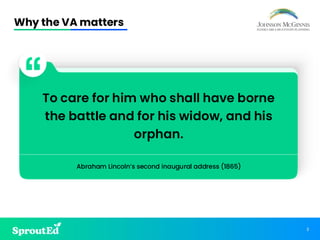
To care for him who shall have borne
the battle and for his widow, and his
orphan.
Abraham Lincoln’s second inaugural address (1865)
4
Department of Veterans Affairs
Veterans Benefits Administration
• All non-medical VA benefits: Compensation, Pension, Education,
Home Loan Guaranty, Vocational Rehabilitation and Employment,
Life Insurance
• Administered by VA Regional Offices
Veterans Health Administration
• All VA health care services
• Administered by VA Medical Centers, Ambulatory Care &
Community Based Outpatient Clinics
National Cemetery Administration
• National Cemeteries
• Support to State Veterans Cemeteries
• Headstones & Markers
• Presidential Memorial Certificates
5
US Department of Veterans Affairs:
Breakdown
(Know the animal you are dealing with)
• Established in 1930; only became a cabinet level position in 1989
• Employs over 400,000 people
• Second Largest Governmental Department after DoD
• Veterans Health Administration
• Largest section of the VA (employs 350,790)
• Largest Health Care Provider in the Country: over 1400 community-
based clinics and 167 medical centers
• $200 Billion annual budget
• Veterans Benefits Administration
• Over $100 Billion for compensation benefits
• Long Term liabilities: estimated $2.5 Trillion for compensation
• $60 Billion for education
• National Cemetery Administration
• $4.6 Billion for burial benefits
• Changing who is eligible for National Cemeteries.
6
Why is understanding the VA important?
• Understanding the bureaucracy you are dealing with will help you be
successful in your interactions with them.
• Understand the only person who truly cares about your situation is you; it
is your responsibility to make them care.
• The VBA and VHA do not communicate well (and that is being very kind);
if you start off in the wrong place, you will be hopelessly lost because the
person you are dealing with likely doesn’t know where to send you either.
• VBA NSC claims have a 75% turnover rate (that have been identified) for
those that continually pursue their claim, so don’t ever give up. The VA
did an audit in 2020 that found a 35% error rate. Neither is good.
7
Pension Management Centers
• The VA has 3 main pension management centers (PMC)
• St. Paul, MN
• Milwaukee, WI
• Philadelphia, PA
• Each VA office has its specialty
• The VA did this to streamline the processing system and
eliminate backlogs
8
Representation before the VA
• Who is a Claimant?
• A person who has filed or has expressed to a
rep/agent/attorney an intention to file
• Who may assist a claimant?
• Accredited Attorneys
• Accredited Agents
• Family members in one-time situations
9
Fees
• Closely regulated by the VA
• Interested parties cannot be charged a fee until an initial
decision has been made
• Interested party means:
• Claimant
• Spouse
• Child
• Parent
• Prefiling consultation fees are allowed
10
Application for Accreditation
• Any person who acts as a representative of a veteran in the
preparation, presentation, or prosecution of a VA claim must
be accredited.
• Must be:
• Good character and reputation
• Qualified to render valuable assistance to claimants
• Otherwise competent to advise and assist claimants in
the preparation, presentation, and prosecution of their
claim
11
Get accredited
• Submit to Office of General Counsel VA Form 21a (download
from https://www.va.gov/ogc/accreditation.asp); and
• Submit self-certification of admission information concerning
practice before any court, bar, or State or Federal agency; and
• Submit documentation of completion of a 3-hour accredited
VA CLE
• 38 C.F.R. § 14.629(b)(1)(iii) and (iv) reference for CLE
requirements
12
Initial CLE & Annual certification
• After initial accreditation, the attorney must obtain and certify in
writing a minimum of 3 hours of qualifying CLE in the next 12 months;
and
• Obtain another 3 hours of CLE not later than 3 years from date of
initial accreditation; and
• Obtain 3 hours of CLE every 2 years thereafter; and
• Certify completion as described in 38 CFR sec. 14.629 (b)(1)(iii)
• https://www.va.gov/OGC/docs/Accred/HowtoApplyforAccreditation.
pdf
13
VA PIV Program
• VA benefit programs are managed through their Veterans Benefits
Management System (VBMS)
• Attorneys can receive direct access to this system by
coordinating with their local VA Regional Office
• Real time access to the processing of the claim
• Greatly reduces processing time of claims
• Receive a “VA.GOV” email address
• Receive a VA PIV card for access via a CITRIX portal
• Allows your firm to avoid the 1-800-827-1000 hotline
14
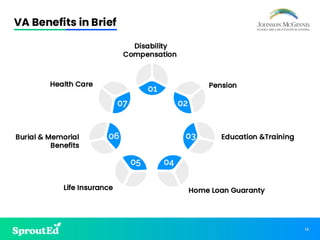
VA Benefits in Brief
01
07 02
03
06
05 04
Disability
Compensation
Pension
Education &Training
Home Loan Guaranty
Health Care
Life Insurance
Burial & Memorial
Benefits
15
Health Care
16
Eligibility
• Veterans who served in the active military, naval or air
service and who were discharged or released under
conditions other than dishonorable
• Former Reservists who served full-time and for
operational or support (excludes training purposes)
• Former National Guard members if mobilized by a
Federal order
17
VHA Services
• Always start with the handbook
• https://www.va.gov/healthbenefits/vhbh/publications/vhbh
_sample_handbook_2014.pdf
• 1-877-222-VETS
• All benefits flow through VA Form 10-10EZ
• At-home services are always routed through social worker
assigned to primary care provider
• Always start with PCP; directly request services
• Ask to talk to the social worker
• If no luck, move on to the patient advocates office
18
VHA Priority Groups
• Priority group 1: We may assign you to priority group 1 if any of the
below descriptions are true. You:
• Have a service-connected disability that we've rated as 50% or
more disabling, or
• Have a service-connected disability that we've concluded
makes you unable to work (also called unemployable), or
• Received the Medal of Honor (MOH)
• Priority group 2
• We may assign you to priority group 2 if you have a service-
connected disability that we've rated as 30% or 40% disabling.
19
VHA Priority Groups (cont’d)
• Priority group 3: We may assign you to priority group 3 if any of the below
descriptions are true. You:
• Are a former prisoner of war (POW), or
• Received the Purple Heart medal, or
• Were discharged for a disability that was caused by—or got worse because of—your
active-duty service, or
• Have a service-connected disability that we've rated as 10% or 20% disabling, or
• Were awarded special eligibility classification under Title 38, U.S.C § 1151, "benefits for
individuals disabled by treatment or vocational rehabilitation“
• Priority group 4: We may assign you to priority group 4 if either of the below
descriptions is true. You:
• Are receiving VA aid and attendance or housebound benefits, or
• Have received a VA determination of being catastrophically disabled
20
VHA Priority Groups (cont’d)
• Priority group 5: We may assign you to priority group 5 if any
of the below descriptions are true. You:
• Don't have a service-connected disability, or you have a
non-compensable service-connected disability that
we've rated as 0% disabling, and you have an annual
income level that's below our adjusted income limits
(based on your resident zip code), or
• Are receiving VA pension benefits, or
• Are eligible for Medicaid programs
21
VHA Priority Groups (cont’d)
• Priority group 6: We may assign you to priority group 6 if any of the below descriptions
are true. You:
• Have a compensable service-connected disability that we've rated as 0%
disabling, or
• Were exposed to ionizing radiation during atmospheric testing or during the
occupation of Hiroshima and Nagasaki, or
• Participated in Project 112/SHAD, or
• Served in the Republic of Vietnam between January 9, 1962, and May 7, 1975, or
• Served in the Persian Gulf War between August 2, 1990, and November 11, 1998, or
• Served on active duty at Camp Lejeune for at least 30 days between August 1,
1953, and December 31, 1987
• We may also assign you to priority group 6 if you meet all of the requirements listed
below. You:
• Are currently or newly enrolled in VA health care, and
• Served in a theater of combat operations after November 11, 1998, and
• Were discharged less than 5 years ago
• Note: As a returning combat Veteran, you're eligible for these enhanced benefits for 5
years after discharge. At the end of this enhanced enrollment period, we'll assign you
to the highest priority group you qualify for at that time.
22
• Priority group 7: We may assign you to priority group 7 if both of the
below descriptions are true for you:
• Your gross household income is below the geographically
adjusted income limits (GMT) for where you live, and
• You agree to pay copays
• View current copay rates
• Priority group 8: We may assign you to priority group 8 if both of the
below descriptions are true for you:
• Your gross household income is above VA income limits and
geographically adjusted income limits for where you live, and
• You agree to pay copays
• If you're assigned to priority group 8, your eligibility for VA health
care benefits will depend on which sub-priority group we place you
in.
VHA Priority Groups (cont’d)
23
VHA Priority Groups (cont’d)
• Once I’m enrolled in VA health care, will my priority group ever
change?
• Your priority group may change in some cases, such as if:
• Your income changes, or
• Your service-connected disability worsens and we
give you a higher disability rating
• ALWAYS NOTIFY THE VA IF YOUR PERSONAL CIRCUMSTANCES
CHANGE TO PREVENT FUTURE PROBLEMS
24
Enrollment
• To receive VA health care, a veteran must enroll in the
VA health care system unless:
• veteran has a 50% or more service-connected VA
disability rating
• less than one year has passed since veteran was
discharged from the military for a disability that
was incurred or aggravated in the line of duty but
VA has not yet rated
25
Time Limits: You have five years from date of discharge from
active duty, if you were discharged from active duty on or
after January 28, 2003. You have until January 27, 2011, if you
were discharged from active duty before January 28, 2003,
and were not enrolled as of January 28, 2008.
Veterans of Operations Enduring
& Iraqi Freedom
26
VA provides free health care for: veterans who served on
active duty in a theater of combat operations after
November 11, 1998, for any illness possibly related to their
service in that theater
Veterans of Operations Enduring
& Iraqi Freedom
27
VA Service-Connected Compensation
• Disability Compensation is a tax-free monetary benefit paid to
Veterans with disabilities that are the result of a disease or
injury incurred or aggravated during active military service.
Compensation may also be paid for post-service disabilities
that are considered related or secondary to disabilities
occurring in service and for disabilities presumed to be related
to circumstances of military service, even though they may
arise after service. Generally, the degrees of disability
specified are also designed to compensate for considerable
loss of working time from exacerbations or illnesses.
28
Compensation
• A service-connected disability is a disease or injury incurred or
aggravated while on active duty. The disability does not have to
be combat or wartime related.
• The disability MUST have a nexus to the claimant’s military service.
29
Compensation Rating
• Disabilities are rated from 0% to 100%
• VA rating is independent of any military rating
• Payments begin with 10% ratings
• Additional allowance for dependents with 30% or higher rating
• 50% Service-Connected rating provides no cost health care and
prescription medication
• 70% Service-Connected rating obligates the VA to pay the full cost of
nursing home care (This is a big benchmark for veterans)
• 100% Service-Connected rating provides dental treatment from VA,
Veteran employment preference for a spouse
30
Compensation Rating cont’d
• 0% rating is STILL a rating
• Can provide eligibility for certain priority categories
• 30% means VA will now compensate for dependents as well
• 60% VA will bump veteran to 100% if Veteran has a single condition
rated 60% or higher and is unemployable due to that condition
• 100% claimant can request permanent and total (P&T)
• Special Monthly Compensation
• Paid for unique conditions and serious injuries
• TBI, loss of use of limbs, sensory or creative organs
31
VA Math—even worse than common core!
• Ratings don’t add cumulatively
• One rating “reduces” the healthy veteran, then the next
rating is only applied to the remaining healthy veteran
• Example
• 50% rating + 30% rating
• 100-50 = 50
• .30 x 50 = 15
• 50 + 15 = 65
• 65 is rounded up to 70%
32
Compensation
• Compensation is tax-free monetary benefit
• Additional Special Monthly Compensation added for loss of limb,
organ, etc.
• Concurrent Retirement and Disability Pay (CRDP) Prohibited prior
to 2004, phased in complete in 2014
• If you have SC rating of 50% or more, you can draw both
• Concurrent VSI(Voluntary Separation Incentive), SSB(Special
Separation Bonus), and Separation pay still prohibited
33
Disability can be established…
• Directly
• Due to aggravation of a pre-service disability
• Presumptively
• Secondary to a service-connected condition
34
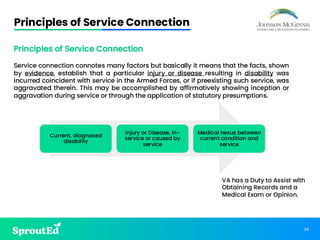
Principles of Service Connection
Service connection connotes many factors but basically it means that the facts, shown
by evidence, establish that a particular injury or disease resulting in disability was
incurred coincident with service in the Armed Forces, or if preexisting such service, was
aggravated therein. This may be accomplished by affirmatively showing inception or
aggravation during service or through the application of statutory presumptions.
Current, diagnosed
disability
Injury or Disease, in-
service or caused by
service
Medical nexus between
current condition and
service
VA has a Duty to Assist with
Obtaining Records and a
Medical Exam or Opinion.
Principles of Service Connection
35
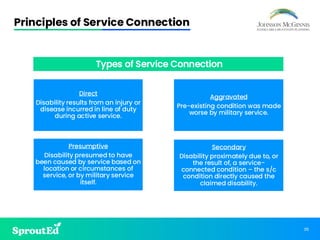
Principles of Service Connection
Types of Service Connection
Direct
Disability results from an injury or
disease incurred in line of duty
during active service.
Aggravated
Pre-existing condition was made
worse by military service.
Presumptive
Disability presumed to have
been caused by service based on
location or circumstances of
service, or by military service
itself.
Secondary
Disability proximately due to, or
the result of, a service-
connected condition – the s/c
condition directly caused the
claimed disability.
36
3
6
Principles of Service Connection
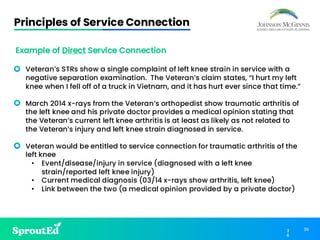
Example of Direct Service Connection
• Veteran’s STRs show a single complaint of left knee strain in service with a
negative separation examination. The Veteran’s claim states, “I hurt my left
knee when I fell off of a truck in Vietnam, and it has hurt ever since that time.”
• March 2014 x-rays from the Veteran’s orthopedist show traumatic arthritis of
the left knee and his private doctor provides a medical opinion stating that
the Veteran’s current left knee arthritis is at least as likely as not related to
the Veteran’s injury and left knee strain diagnosed in service.
• Veteran would be entitled to service connection for traumatic arthritis of the
left knee
• Event/disease/injury in service (diagnosed with a left knee
strain/reported left knee injury)
• Current medical diagnosis (03/14 x-rays show arthritis, left knee)
• Link between the two (a medical opinion provided by a private doctor)
37
Principles of Service Connection
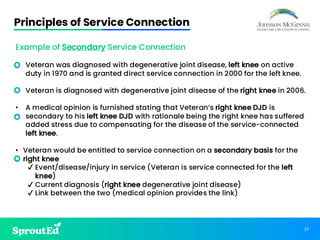
Example of Secondary Service Connection
• Veteran was diagnosed with degenerative joint disease, left knee on active
duty in 1970 and is granted direct service connection in 2000 for the left knee.
• Veteran is diagnosed with degenerative joint disease of the right knee in 2006.
• A medical opinion is furnished stating that Veteran’s right knee DJD is
secondary to his left knee DJD with rationale being the right knee has suffered
added stress due to compensating for the disease of the service-connected
left knee.
• Veteran would be entitled to service connection on a secondary basis for the
right knee
✔ Event/disease/injury in service (Veteran is service connected for the left
knee)
✔ Current diagnosis (right knee degenerative joint disease)
✔ Link between the two (medical opinion provides the link)
38
Principles of Service Connection
Example of Aggravation of Pre-Existing Disability to establish Service Connection
• Prior to active-duty service, Veteran is diagnosed with hypertension. Physician
prescribes diet and exercise to improve blood pressure readings.
• While on active duty, Veteran’s blood pressure readings increase, and he is
prescribed medication for control of Veteran’s hypertension.
• A VA examiner provides a medical opinion indicating that the Veteran’s
hypertension was aggravated beyond its natural progression during active-duty
service (a rating specialist cannot make this medical determination alone).
• The Veteran would be entitled to service connection on an aggravated basis as
control of Veteran’s hypertension required only diet and exercise prior to active
duty, and while on active duty, medication was added for control.
• Event/disease/injury in service (placed on medication for pre-existing
hypertension)
• Current diagnosis (hypertension, with medication for control)
• Link between the two (aggravation of the pre-existing condition during
active service)
39
Principles of Service Connection
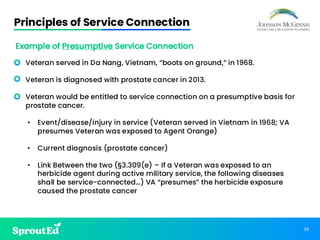
• Veteran served in Da Nang, Vietnam, “boots on ground,” in 1968.
• Veteran is diagnosed with prostate cancer in 2013.
• Veteran would be entitled to service connection on a presumptive basis for
prostate cancer.
• Event/disease/injury in service (Veteran served in Vietnam in 1968; VA
presumes Veteran was exposed to Agent Orange)
• Current diagnosis (prostate cancer)
• Link Between the two (§3.309(e) – If a Veteran was exposed to an
herbicide agent during active military service, the following diseases
shall be service-connected…) VA “presumes” the herbicide exposure
caused the prostate cancer
Example of Presumptive Service Connection
40
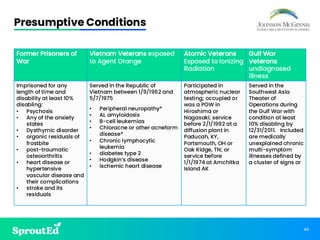
Presumptive Conditions
Former Prisoners of
War
Vietnam Veterans exposed
to Agent Orange
Atomic Veterans
Exposed to Ionizing
Radiation
Gulf War
Veterans
undiagnosed
illness
Imprisoned for any
length of time and
disability at least 10%
disabling:
• Psychosis
• Any of the anxiety
states
• Dysthymic disorder
• organic residuals of
frostbite
• post-traumatic
osteoarthritis
• heart disease or
hypertensive
vascular disease and
their complications
• stroke and its
residuals
Served in the Republic of
Vietnam between 1/9/1962 and
5/7/1975
• Peripheral neuropathy*
• AL amyloidosis
• B-cell leukemias
• Chloracne or other acneform
disease*
• Chronic lymphocytic
leukemia
• diabetes type 2
• Hodgkin’s disease
• ischemic heart disease
Participated in
atmospheric nuclear
testing; occupied or
was a POW in
Hiroshima or
Nagasaki; service
before 2/1/1992 at a
diffusion plant in
Paducah, KY,
Portsmouth, OH or
Oak Ridge, TN; or
service before
1/1/1974 at Amchitka
Island AK
Served in the
Southwest Asia
Theater of
Operations during
the Gulf War with
condition at least
10% disabling by
12/31/2011. Included
are medically
unexplained chronic
multi-symptom
illnesses defined by
a cluster of signs or
41
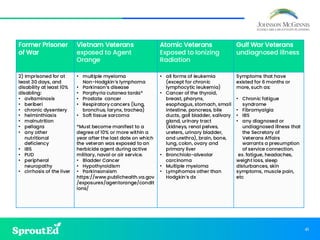
Former Prisoner
of War
Vietnam Veterans
exposed to Agent
Orange
Atomic Veterans
Exposed to Ionizing
Radiation
Gulf War Veterans
undiagnosed illness
2) Imprisoned for at
least 30 days, and
disability at least 10%
disabling:
• avitaminosis
• beriberi
• chronic dysentery
• helminthiasis
• malnutrition
• pellagra
• any other
nutritional
deficiency
• IBS
• PUD
• peripheral
neuropathy
• cirrhosis of the liver
• multiple myeloma
Non-Hodgkin’s lymphoma
• Parkinson’s disease
• Porphyria cutanea tarda*
• Prostate cancer
• Respiratory cancers (lung,
bronchus, larynx, trachea)
• Soft tissue sarcoma
*Must become manifest to a
degree of 10% or more within a
year after the last date on which
the veteran was exposed to an
herbicide agent during active
military, naval or air service.
• Bladder Cancer
• Hypothyroidism
• Parkinsonsism
https://www.publichealth.va.gov
/exposures/agentorange/condit
ions/
• all forms of leukemia
(except for chronic
lymphocytic leukemia)
• Cancer of the thyroid,
breast, pharynx,
esophagus, stomach, small
intestine, pancreas, bile
ducts, gall bladder, salivary
gland, urinary tract
(kidneys, renal pelves,
ureters, urinary bladder,
and urethra), brain, bone,
lung, colon, ovary and
primary liver
• Bronchiolo-alveolar
carcinoma
• Multiple myeloma
• Lymphomas other than
Hodgkin’s dx
Symptoms that have
existed for 6 months or
more, such as:
• Chronic fatigue
syndrome
• Fibromyalgia
• IBS
• any diagnosed or
undiagnosed illness that
the Secretary of
Veterans Affairs
warrants a presumption
of service connection.
ex. fatigue, headaches,
weight loss, sleep
disturbances, skin
symptoms, muscle pain,
etc
42
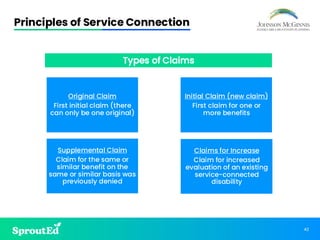
Principles of Service Connection
Original Claim
First initial claim (there
can only be one original)
Initial Claim (new claim)
First claim for one or
more benefits
Supplemental Claim
Claim for the same or
similar benefit on the
same or similar basis was
previously denied
Claims for Increase
Claim for increased
evaluation of an existing
service-connected
disability
Types of Claims
43
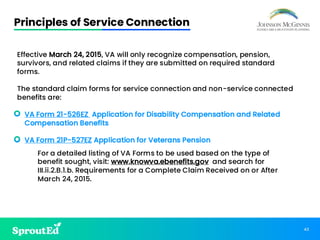
Principles of Service Connection
Effective March 24, 2015, VA will only recognize compensation, pension,
survivors, and related claims if they are submitted on required standard
forms.
The standard claim forms for service connection and non-service connected
benefits are:
• VA Form 21-526EZ Application for Disability Compensation and Related
Compensation Benefits
• VA Form 21P-527EZ Application for Veterans Pension
For a detailed listing of VA Forms to be used based on the type of
benefit sought, visit: www.knowva.ebenefits.gov and search for
III.ii.2.B.1.b. Requirements for a Complete Claim Received on or After
March 24, 2015.
44
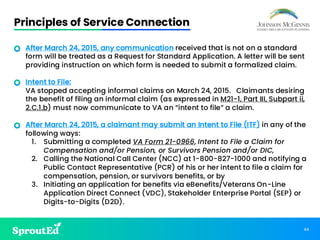
Principles of Service Connection
• After March 24, 2015, any communication received that is not on a standard
form will be treated as a Request for Standard Application. A letter will be sent
providing instruction on which form is needed to submit a formalized claim.
• Intent to File:
• VA stopped accepting informal claims on March 24, 2015. Claimants desiring
the benefit of filing an informal claim (as expressed in M21-1, Part III, Subpart ii,
2.C.1.b) must now communicate to VA an “intent to file” a claim.
• After March 24, 2015, a claimant may submit an Intent to File (ITF) in any of the
following ways:
1. Submitting a completed VA Form 21-0966, Intent to File a Claim for
Compensation and/or Pension, or Survivors Pension and/or DIC,
2. Calling the National Call Center (NCC) at 1-800-827-1000 and notifying a
Public Contact Representative (PCR) of his or her intent to file a claim for
compensation, pension, or survivors benefits, or by
3. Initiating an application for benefits via eBenefits/Veterans On-Line
Application Direct Connect (VDC), Stakeholder Enterprise Portal (SEP) or
Digits-to-Digits (D2D).
45
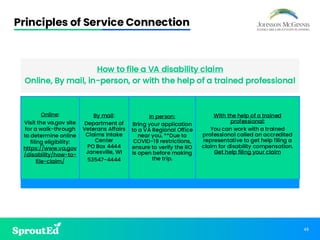
Principles of Service Connection
How to file a VA disability claim
Online, By mail, in-person, or with the help of a trained professional
Online:
Visit the va.gov site
for a walk-through
to determine online
filing eligibility:
https://www.va.gov
/disability/how-to-
file-claim/
By mail:
Department of
Veterans Affairs
Claims Intake
Center
PO Box 4444
Janesville, WI
53547-4444
In person:
Bring your application
to a VA Regional Office
near you. **Due to
COVID-19 restrictions,
ensure to verify the RO
is open before making
the trip.
With the help of a trained
professional:
You can work with a trained
professional called an accredited
representative to get help filing a
claim for disability compensation.
Get help filing your claim
46
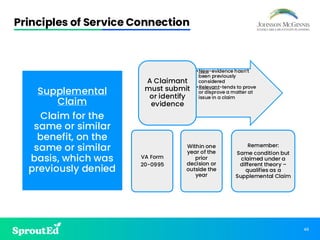
Principles of Service Connection
Supplemental
Claim
Claim for the
same or similar
benefit, on the
same or similar
basis, which was
previously denied
•New-evidence hasn’t
been previously
considered
•Relevant-tends to prove
or disprove a matter at
issue in a claim
A Claimant
must submit
or identify
evidence
VA Form
20-0995
Within one
year of the
prior
decision or
outside the
year
Remember:
Same condition but
claimed under a
different theory –
qualifies as a
Supplemental Claim
47
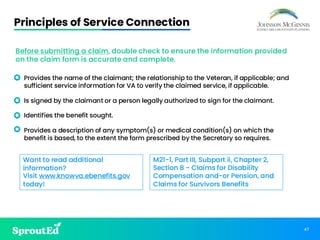
Principles of Service Connection
• Provides the name of the claimant; the relationship to the Veteran, if applicable; and
sufficient service information for VA to verify the claimed service, if applicable.
• Is signed by the claimant or a person legally authorized to sign for the claimant.
• Identifies the benefit sought.
• Provides a description of any symptom(s) or medical condition(s) on which the
benefit is based, to the extent the form prescribed by the Secretary so requires.
M21-1, Part III, Subpart ii, Chapter 2,
Section B - Claims for Disability
Compensation and-or Pension, and
Claims for Survivors Benefits
Before submitting a claim, double check to ensure the information provided
on the claim form is accurate and complete.
Want to read additional
information?
Visit www.knowva.ebenefits.gov
today!
48
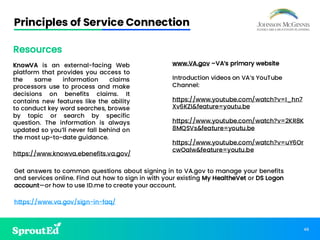
Principles of Service Connection
KnowVA is an external-facing Web
platform that provides you access to
the same information claims
processors use to process and make
decisions on benefits claims. It
contains new features like the ability
to conduct key word searches, browse
by topic or search by specific
question. The information is always
updated so you’ll never fall behind on
the most up-to-date guidance.
https://www.knowva.ebenefits.va.gov/
https://www.va.gov/sign-in-faq/
www.VA.gov –VA’s primary website
Introduction videos on VA’s YouTube
Channel:
https://www.youtube.com/watch?v=I_hn7
Xv6KZI&feature=youtu.be
https://www.youtube.com/watch?v=2KR8K
8MQSVs&feature=youtu.be
https://www.youtube.com/watch?v=uY6Or
cwOalw&feature=youtu.be
Get answers to common questions about signing in to VA.gov to manage your benefits
and services online. Find out how to sign in with your existing My HealtheVet or DS Logon
account—or how to use ID.me to create your account.
Resources
49
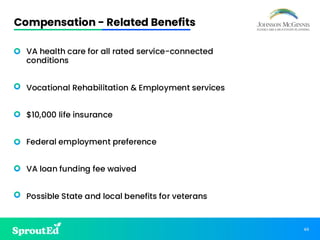
Compensation - Related Benefits
• VA health care for all rated service-connected
conditions
• Vocational Rehabilitation & Employment services
• $10,000 life insurance
• Federal employment preference
• VA loan funding fee waived
• Possible State and local benefits for veterans
50
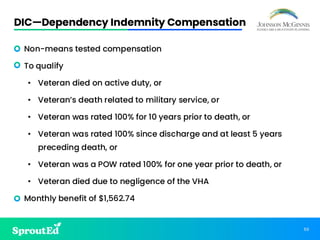
DIC—Dependency Indemnity Compensation
• Non-means tested compensation
• To qualify
• Veteran died on active duty, or
• Veteran’s death related to military service, or
• Veteran was rated 100% for 10 years prior to death, or
• Veteran was rated 100% since discharge and at least 5 years
preceding death, or
• Veteran was a POW rated 100% for one year prior to death, or
• Veteran died due to negligence of the VHA
• Monthly benefit of $1,562.74
51
BREAK
52
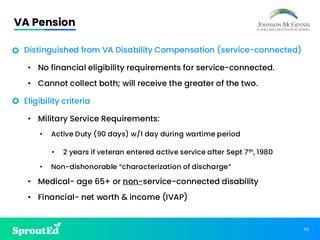
VA Pension
• Distinguished from VA Disability Compensation (service-connected)
• No financial eligibility requirements for service-connected.
• Cannot collect both; will receive the greater of the two.
• Eligibility criteria
• Military Service Requirements:
• Active Duty (90 days) w/1 day during wartime period
• 2 years if veteran entered active service after Sept 7th, 1980
• Non-dishonorable “characterization of discharge“
• Medical- age 65+ or non-service-connected disability
• Financial- net worth & income (IVAP)
53
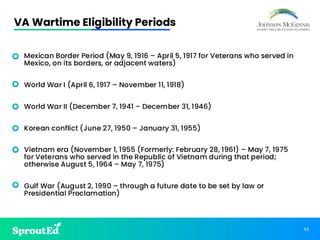
VA Wartime Eligibility Periods
• Mexican Border Period (May 9, 1916 – April 5, 1917 for Veterans who served in
Mexico, on its borders, or adjacent waters)
• World War I (April 6, 1917 – November 11, 1918)
• World War II (December 7, 1941 – December 31, 1946)
• Korean conflict (June 27, 1950 – January 31, 1955)
• Vietnam era (November 1, 1955 (Formerly: February 28, 1961) – May 7, 1975
for Veterans who served in the Republic of Vietnam during that period;
otherwise August 5, 1964 – May 7, 1975)
• Gulf War (August 2, 1990 – through a future date to be set by law or
Presidential Proclamation)
54
5
4
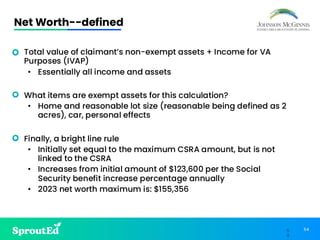
Net Worth--defined
• Total value of claimant’s non-exempt assets + Income for VA
Purposes (IVAP)
• Essentially all income and assets
• What items are exempt assets for this calculation?
• Home and reasonable lot size (reasonable being defined as 2
acres), car, personal effects
• Finally, a bright line rule
• Initially set equal to the maximum CSRA amount, but is not
linked to the CSRA
• Increases from initial amount of $123,600 per the Social
Security benefit increase percentage annually
• 2023 net worth maximum is: $155,356
55
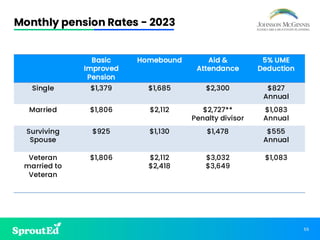
Monthly pension Rates - 2023
Basic
Improved
Pension
Homebound Aid &
Attendance
5% UME
Deduction
Single $1,379 $1,685 $2,300 $827
Annual
Married $1,806 $2,112 $2,727**
Penalty divisor
$1,083
Annual
Surviving
Spouse
$925 $1,130 $1,478 $555
Annual
Veteran
married to
Veteran
$1,806 $2,112
$2,418
$3,032
$3,649
$1,083
56
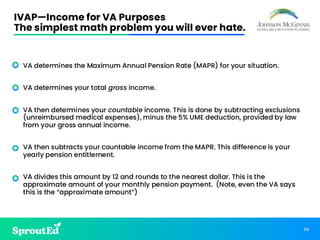
IVAP—Income for VA Purposes
The simplest math problem you will ever hate.
• VA determines the Maximum Annual Pension Rate (MAPR) for your situation.
• VA determines your total gross income.
• VA then determines your countable income. This is done by subtracting exclusions
(unreimbursed medical expenses), minus the 5% UME deduction, provided by law
from your gross annual income.
• VA then subtracts your countable income from the MAPR. This difference is your
yearly pension entitlement.
• VA divides this amount by 12 and rounds to the nearest dollar. This is the
approximate amount of your monthly pension payment. (Note, even the VA says
this is the “approximate amount”)
57
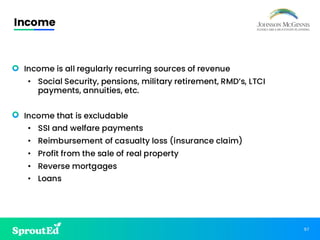
Income
• Income is all regularly recurring sources of revenue
• Social Security, pensions, military retirement, RMD’s, LTCI
payments, annuities, etc.
• Income that is excludable
• SSI and welfare payments
• Reimbursement of casualty loss (insurance claim)
• Profit from the sale of real property
• Reverse mortgages
• Loans
58
Unreimbursed Medical Expenses
• Best way to lower income
• Goal is to reduce IVAP to zero or a negative number to maximize the
pension benefit
• Negative IVAP will not reduce net worth
• Regularly recurring unreimbursed medical expenses is what the VA is
looking for
• Exception to caregiver licensing requirement:
• Either assistance with two or more ADLs (like before)
• Certification by health professional that due to a physical, mental, or cognitive
disorder the individual requires [the custodial care]- §3.278(d)(2) and (3)(iv)
59
Common Concerns & Questions
• What if the Veteran’s spouse has the unreimbursed medical
expenses?
• Married couple treated as a single unit
• Claimant has a joint account with child?
• If it has been in existence for some time, count half towards net
worth of claimant
• If claimant’s child’s name added after 18 October 2018, likely
count the whole amount
• What if there was a divorce?
• Does not affect the Veteran
• Rule of thumb is that divorce severs the benefits
• Exceptions: Divorce was not valid; separation caused by
physical or mental abuse by the Veteran towards the
surviving spouse (need strong evidence); Veteran
abandoned the spouse
60
Marriage
• Surviving spouse is defined as the spouse married to the Veteran
at the time of death
• An exception for abuse/abandonment…very rare
• Need to be married for at least one year
• Many people cannot find their marriage paperwork
• Simply as the VA to “deem” the marriage valid
61
Divorce and Remarriage
• Surviving Spouse gets remarried, it is not a bar to benefits if:
• Remarriage was void
• Remarriage was annulled by a court having basic authority to render
annulment decrees, unless obtained through fraud or collusion
• On or after January 1, 1971, remarriage of a surviving spouse terminated
prior to November 1, 1990, or terminated by legal proceedings
commenced prior to November 1, 1990, by an individual who, but for the
remarriage, would be considered the surviving spouse, shall not bar the
furnishing of benefits to such surviving spouse provided that the
marriage:
• Has been terminated by death, or
• Has been dissolved by a court with basic authority to render divorce
decrees unless the VA determines that the divorce was secured
through fraud by the surviving souse or by collusion
• (see 38 CFR §3.55)
62
Dependent Children
• Definition of a child
• Must be unmarried and:
• Under the age of 18, or
• Between 18-23 and a full-time student, or
• Any age, if child was under 18 when veteran was rated
permanently and totally disabled
• Child must be biological, adopted, or step-child and acquired that
status prior to age 18
• Children do not have to be legitimate
63
3 Year Look-Back & Penalty Period
• Look-Back period: 36 months
• Does not apply to transfers made prior to 18 October 2018
• Only penalizes transfers of “covered assets”
• Home on less than 2 acres is not a “covered asset”
• Only penalizes transfers of assets that exceed the net worth limit.
• No penalty for transfers that would not have affected eligibility
• Penalty calculation: Asset transferred/MAPR for aid and attendance for a married
Veteran (currently $2,431) = Penalty in months
• Penalty period commences from 1st of the month, following the date of last transfer
38 CFR §3.276
• 5 year cap on the penalty period (Maximum penalizable transfer: $158,520)
• If you trigger a penalty of greater than 3 years, you have erred
64
Exceptions to the Transfer Penalty &
Curing a Gift
• Fraud or Unfair Business Practice
• Transfer to a trust established for a child incapable of self-support
prior to age 18
• Money can never revert to Veteran or Veteran’s Spouse
• Transfers that had no effect on the Net Worth determination
• Curing Gifts
• Can be partial or total cure
• Must be made before claim was filed or within 60 days of the
notice of the penalty
• Evidence of cure must be received by VA not later than 90 days
after the notice of the decision
65
Pension
• Aid and Attendance section
• An additional layer, NOT a stand alone benefit!
• At least one of these must be true:
• You need another person to help you perform daily
activities, like bathing, feeding, and dressing, or
• You have to stay in bed—or spend a large portion of the
day in bed—because of illness, or
• You are a patient in a nursing home due to the loss of
mental or physical abilities related to a disability, or
• Your eyesight is limited (even with glasses or contact
lenses you have only 5/200 or less in both eyes; or
concentric contraction of the visual field to 5 degrees or
less)
66
Pension
• Homestead exclusion
• Market value less mortgages or other encumbrances, of all
real and personal property owned by the claimant, except
the claimant’s dwelling, including a reasonable lot area, and
personal effects consistent with claimants reasonable
mode of life
• Reasonable lot area is now defined as 2 acres
67
Traps for the Uninformed
• Multiple transfers within the 36-month look-back will be
tolled to the last transfer date. See § 3.276(e)(2)
• Homes on lots greater than 2 acres
• Annuity based planning
• Poorly drafted trusts that allow the Grantor or Grantor’s
spouse to benefit directly from the trust assets
68
Aid and Attendance & Housebound
Tips for filling out the application
• Accurate and comprehensive. If there is white space, have the doctor fill it in. VA
can't read between the lines if there are not lines to read between.
• Pass/fail. Remember the examples on the yes/no questions.
• Ensure the writing is legible. All of the info in the world does no good if it is in
hieroglyphics.
• Ensure limitations are put front and center, not buried in the middle of a paragraph.
• If incontinence is an issue, be sure it is addressed.
• Be present for the visit with the medical provider.
• 2 ADL’s or a protective environment is the key.
• Have a conversation re: appropriateness of a Fiduciary.
69
Filing claims
• Resources available to help
• VA accreditation—don’t apply without one!
• Be relentless
• Get it right the first time
• Bring in a Professional
• Plan early
• Ensure your plan is comprehensive
70
Overpayments
• Handled by the Debt Management Center (DMC)
• Respond immediately
• Initial letter will come from the PMC
• You have 30 days to contest
• After 30 days, transferred to DMC
• Always request a waiver (VA Form 5655)
• Winning arguments
• No unjust enrichment
• Payback will cause substantial financial harm to the claimant
• Through no fault of own/was through VA error
71
Medicaid and VA
• Single Veteran receiving pension
• Once approved for Medicaid, VA pension reduced to $90
• Called the personal needs allowance
• Note: There is no reduction if the veteran is married and the
family unit still has UME’s and is otherwise eligible for
pension…many miss this
72
VA Appeals
• Right to appeal
• Claimant can always appeal any VA decision
• Decisions include:
• Eligibility Date
• Debt Notices
• Necessity of Fiduciary
• Rating Decisions
• Eligibility for benefits
73
VA Appeals Cont’d
• Appeal process was updated under the Appeals Modernization Act
• Options:
• Higher Level Review Lane
• You think they got it wrong and have all the evidence they need
• Supplemental Claim
• You think they got it wrong, but need to show them with
additional evidence
• Formal Appeal:
• File a notice of disagreement to the Board of Veterans Appeals
74
Higher Level Review
• Claim is reviewed de novo
• The review is done by a more experienced reviewer/adjudicator
• No new evidence allowed
75
Supplemental Claim
• New Evidence is submitted
• Not necessarily reviewed by a more senior/experienced
adjudicator
76
Board of Veterans Appeals
• Three main elections:
1. Direct Review: no new evidence, and no hearing
1. Evidence submission: New evidence is submitted and
no hearing
1. Hearing: New evidence and the claimant/appellant
can testify before an administrative law judge
77
Post BVA
• Three more options:
1. Motion for reconsideration
1. Motion to vacate the decision
1. Motion for revision based upon Clear and Unmistakable Error
(CUE)
• Note: CUE has no time limit
78
After the BVA
• Once you have exhausted all administrative appeals
• Can appeal to the Court of Appeals for Veterans Claims
• Must be made within 120 days of the BVA decision
• Then Can appeal to the US Court of Appeals for the Federal Circuit
• Must be made within 60 days of the CAVC decision
• Then the US Supreme Court
• Must be made within 90 days of the Federal Circuit’s decision
79
VA Other Benefit Programs
• Long Term Care
• Nehmer Claims
• Survivor Benefit Program (DoD)
• Disability Grants
• Free Tax Preparation
• Home Loan
• Student Loan
• Burial/Funeral
80
Veterans and Long-Term Care
• VA has a network of long-term care facilities
• Tennessee has four:
• Clarksville, Murfreesboro, Knoxville and Humboldt
• Coming soon: Cleveland & Arlington
• 153 State Veterans homes in total
81
Nehmer Claims
• Reopens a claim and survives the death of the claimant
• For Vietnam veterans who served in country, or in the blue water zone
from January 9, 1962 to May 7, 1975
• For claims that are pending or were denied from September 25, 1985
until the present
• Allows for wrongly denied claim to be corrected
82
Survivor Benefit Plan (SBP)
• Taxable annuity paid via the DoD to surviving spouses,
children, or former spouses
• Veteran had to pay into the program while alive
• Always good to inquire following the death of a military
retiree
83
Disability Grants for Veterans
• Specially Adapted Housing Grant (SAH)
• Money must be used to buy, build, or change your permanent
home and you meet both of the following requirements:
• You own or will own the home, AND
• You have a qualifying service-connected disability, such as:
• Loss or loss of use of more than one limb
• Loss or loss of use of a lower leg
• Blindness in both eyes
• Certain severe burns
• SAH Handbook Link:
https://www.benefits.va.gov/HOMELOANS/documents/docs/sah
_handbook_for_design.pdf
84
Disability Grants for Veterans (cont’d)
• Special Home Adaptation Grant (SHA)
• Veteran must use the grant money to buy, build, or change your
permanent home, along with the following:
• You or a family member own or will own the home, AND
• You have a qualifying service-connected disability, such as:
• Loss or loss of use of both hands
• Certain severe burns
• Certain respiratory or breathing injuries
• Can get up to $20,387 for FY2022
• If you are living temporarily in a family member’s home, you can
request a Temporary Residence Adaptation grant (TRA)
• Must meet the SHA or SAH criteria
85
Disability Grants for Veterans (cont’d)
• VA Automobile Allowance and Adaptive Equipment
• You may be eligible for disability benefits if you have a disability
that’s related to your service (called a service-connected disability)
and that includes at least one of the conditions listed below:
• Loss, or permanent loss of use, of 1 or both feet, or
• Loss, or permanent loss of use, of 1 or both hands, or
• Permanent decreased vision in both eyes: 20/200 vision or less in
your better eye with glasses, or greater than 20/200 vision but
with a visual field defect that has reduced your peripheral vision
to 20 degrees or less in your better eye, or
• A severe burn injury, or
• Amyotrophic lateral sclerosis (ALS), or
• Ankylosis in 1 or both knees or hips (Note: This qualifies you for an
adaptive-equipment grant only)
• Eligible for a one-time payment of $21,488
86
Other Benefits:
• Free Tax preparation and filing services aboard military installations.
• VA Home Loan
• VA Student Loans (known as the Post-9/11 GI Bill)
• Burial Benefits
• Flag, burial allowance, headstones, markers, and medallions
87
Burial Benefits
88
Burial Benefits
120+ Cemeteries Nationwide
• Gravesite
• Opening and Closing
• Headstone/Marker
• Burial Flag
• Funeral Honors
• Presidential Memorial Certificates
• Burial Cost Reimbursement
• Perpetual Care
• All at No Cost to the Family
89
• Burial Flag: to drape coffin or urn, and given to next of kin
• Funeral Honors: Flag folding and playing of Taps
• Presidential Memorial Certificates: available to family and other
loved ones
Burial Benefits: Other
90
DOJ Radiation Exposure
Compensation Act (RECA)
• Non-VA program to compensate servicemembers and select civilians who
were affected by exposure to radiation from 1945 - 1962
• On site test exposure
• Uranium Miners, Millers and Ore Transporters
• Downwinders
• Compensable Diseases:
• Leukemia, multiple myeloma, lymphomas (other than Hodgkin’s
disease), thyroid, pharynx, gall bladder, colon, breast, small intestine,
salivary gland, ovary, esophagus, pancreas, urinary bladder, liver,
stomach, bile ducts, brain, lung
• For Veterans, there is an offset with any VA pension program
• $75,000 compensation for servicemember, widow, or children
• Eligible for the Atomic Veteran’s Service Certificate (this is often very
meaningful to family members)
• RECA Trust Fund terminates after July 9, 2022 (THE WINDOW IS CLOSING)
• Claims not filed by this date will be barred
91
The best time to plan
92
QUESTIONS?
93
Contact Information
Call or email and I'd be happy to speak with you more in-depth or answer any questions.
Chris Johnson
https://www.tn-elderlaw.com/media-kit-
chris-johnson
615.824.2571
dhentschel@tn-elderlaw.com
Chris Johnson

Veterans Benefits Boot Camp | SproutEd CLE

  • 1.
    Veterans Benefits –Boot Camp Veterans Benefits – Boot Camp Presented By Chris Johnson Chris Johnson
  • 2.
    2 CHRIS JOHNSON Chris Johnsonis an attorney and partner at Johnson McGinnis Elder Care Law & Estate Planning PLLC in Hendersonville, Tennessee. With over 20 years of combined legal and military experience, Chris specializes in elder law, estate planning, and VA benefits planning. He is a graduate of the U.S. Naval Academy and the College of William and Mary School of Law. Chris has served as an Infantry Officer and Judge Advocate in the U.S. Marine Corps, retiring as a Major. Chris is an active community member and a member of the Tennessee Bar Association and Rotary International. He is also the co-host of the "Aging Starts Now" podcast, providing valuable insights on elder care and legal issues. Johnson McGinnis Elder Care Law & Estate Planning PLLC, Partner
  • 3.
    3 Why the VAmatters To care for him who shall have borne the battle and for his widow, and his orphan. Abraham Lincoln’s second inaugural address (1865)
  • 4.
    4 Department of VeteransAffairs Veterans Benefits Administration • All non-medical VA benefits: Compensation, Pension, Education, Home Loan Guaranty, Vocational Rehabilitation and Employment, Life Insurance • Administered by VA Regional Offices Veterans Health Administration • All VA health care services • Administered by VA Medical Centers, Ambulatory Care & Community Based Outpatient Clinics National Cemetery Administration • National Cemeteries • Support to State Veterans Cemeteries • Headstones & Markers • Presidential Memorial Certificates
  • 5.
    5 US Department ofVeterans Affairs: Breakdown (Know the animal you are dealing with) • Established in 1930; only became a cabinet level position in 1989 • Employs over 400,000 people • Second Largest Governmental Department after DoD • Veterans Health Administration • Largest section of the VA (employs 350,790) • Largest Health Care Provider in the Country: over 1400 community- based clinics and 167 medical centers • $200 Billion annual budget • Veterans Benefits Administration • Over $100 Billion for compensation benefits • Long Term liabilities: estimated $2.5 Trillion for compensation • $60 Billion for education • National Cemetery Administration • $4.6 Billion for burial benefits • Changing who is eligible for National Cemeteries.
  • 6.
    6 Why is understandingthe VA important? • Understanding the bureaucracy you are dealing with will help you be successful in your interactions with them. • Understand the only person who truly cares about your situation is you; it is your responsibility to make them care. • The VBA and VHA do not communicate well (and that is being very kind); if you start off in the wrong place, you will be hopelessly lost because the person you are dealing with likely doesn’t know where to send you either. • VBA NSC claims have a 75% turnover rate (that have been identified) for those that continually pursue their claim, so don’t ever give up. The VA did an audit in 2020 that found a 35% error rate. Neither is good.
  • 7.
    7 Pension Management Centers •The VA has 3 main pension management centers (PMC) • St. Paul, MN • Milwaukee, WI • Philadelphia, PA • Each VA office has its specialty • The VA did this to streamline the processing system and eliminate backlogs
  • 8.
    8 Representation before theVA • Who is a Claimant? • A person who has filed or has expressed to a rep/agent/attorney an intention to file • Who may assist a claimant? • Accredited Attorneys • Accredited Agents • Family members in one-time situations
  • 9.
    9 Fees • Closely regulatedby the VA • Interested parties cannot be charged a fee until an initial decision has been made • Interested party means: • Claimant • Spouse • Child • Parent • Prefiling consultation fees are allowed
  • 10.
    10 Application for Accreditation •Any person who acts as a representative of a veteran in the preparation, presentation, or prosecution of a VA claim must be accredited. • Must be: • Good character and reputation • Qualified to render valuable assistance to claimants • Otherwise competent to advise and assist claimants in the preparation, presentation, and prosecution of their claim
  • 11.
    11 Get accredited • Submitto Office of General Counsel VA Form 21a (download from https://www.va.gov/ogc/accreditation.asp); and • Submit self-certification of admission information concerning practice before any court, bar, or State or Federal agency; and • Submit documentation of completion of a 3-hour accredited VA CLE • 38 C.F.R. § 14.629(b)(1)(iii) and (iv) reference for CLE requirements
  • 12.
    12 Initial CLE &Annual certification • After initial accreditation, the attorney must obtain and certify in writing a minimum of 3 hours of qualifying CLE in the next 12 months; and • Obtain another 3 hours of CLE not later than 3 years from date of initial accreditation; and • Obtain 3 hours of CLE every 2 years thereafter; and • Certify completion as described in 38 CFR sec. 14.629 (b)(1)(iii) • https://www.va.gov/OGC/docs/Accred/HowtoApplyforAccreditation. pdf
  • 13.
    13 VA PIV Program •VA benefit programs are managed through their Veterans Benefits Management System (VBMS) • Attorneys can receive direct access to this system by coordinating with their local VA Regional Office • Real time access to the processing of the claim • Greatly reduces processing time of claims • Receive a “VA.GOV” email address • Receive a VA PIV card for access via a CITRIX portal • Allows your firm to avoid the 1-800-827-1000 hotline
  • 14.
    14 VA Benefits inBrief 01 07 02 03 06 05 04 Disability Compensation Pension Education &Training Home Loan Guaranty Health Care Life Insurance Burial & Memorial Benefits
  • 15.
  • 16.
    16 Eligibility • Veterans whoserved in the active military, naval or air service and who were discharged or released under conditions other than dishonorable • Former Reservists who served full-time and for operational or support (excludes training purposes) • Former National Guard members if mobilized by a Federal order
  • 17.
    17 VHA Services • Alwaysstart with the handbook • https://www.va.gov/healthbenefits/vhbh/publications/vhbh _sample_handbook_2014.pdf • 1-877-222-VETS • All benefits flow through VA Form 10-10EZ • At-home services are always routed through social worker assigned to primary care provider • Always start with PCP; directly request services • Ask to talk to the social worker • If no luck, move on to the patient advocates office
  • 18.
    18 VHA Priority Groups •Priority group 1: We may assign you to priority group 1 if any of the below descriptions are true. You: • Have a service-connected disability that we've rated as 50% or more disabling, or • Have a service-connected disability that we've concluded makes you unable to work (also called unemployable), or • Received the Medal of Honor (MOH) • Priority group 2 • We may assign you to priority group 2 if you have a service- connected disability that we've rated as 30% or 40% disabling.
  • 19.
    19 VHA Priority Groups(cont’d) • Priority group 3: We may assign you to priority group 3 if any of the below descriptions are true. You: • Are a former prisoner of war (POW), or • Received the Purple Heart medal, or • Were discharged for a disability that was caused by—or got worse because of—your active-duty service, or • Have a service-connected disability that we've rated as 10% or 20% disabling, or • Were awarded special eligibility classification under Title 38, U.S.C § 1151, "benefits for individuals disabled by treatment or vocational rehabilitation“ • Priority group 4: We may assign you to priority group 4 if either of the below descriptions is true. You: • Are receiving VA aid and attendance or housebound benefits, or • Have received a VA determination of being catastrophically disabled
  • 20.
    20 VHA Priority Groups(cont’d) • Priority group 5: We may assign you to priority group 5 if any of the below descriptions are true. You: • Don't have a service-connected disability, or you have a non-compensable service-connected disability that we've rated as 0% disabling, and you have an annual income level that's below our adjusted income limits (based on your resident zip code), or • Are receiving VA pension benefits, or • Are eligible for Medicaid programs
  • 21.
    21 VHA Priority Groups(cont’d) • Priority group 6: We may assign you to priority group 6 if any of the below descriptions are true. You: • Have a compensable service-connected disability that we've rated as 0% disabling, or • Were exposed to ionizing radiation during atmospheric testing or during the occupation of Hiroshima and Nagasaki, or • Participated in Project 112/SHAD, or • Served in the Republic of Vietnam between January 9, 1962, and May 7, 1975, or • Served in the Persian Gulf War between August 2, 1990, and November 11, 1998, or • Served on active duty at Camp Lejeune for at least 30 days between August 1, 1953, and December 31, 1987 • We may also assign you to priority group 6 if you meet all of the requirements listed below. You: • Are currently or newly enrolled in VA health care, and • Served in a theater of combat operations after November 11, 1998, and • Were discharged less than 5 years ago • Note: As a returning combat Veteran, you're eligible for these enhanced benefits for 5 years after discharge. At the end of this enhanced enrollment period, we'll assign you to the highest priority group you qualify for at that time.
  • 22.
    22 • Priority group7: We may assign you to priority group 7 if both of the below descriptions are true for you: • Your gross household income is below the geographically adjusted income limits (GMT) for where you live, and • You agree to pay copays • View current copay rates • Priority group 8: We may assign you to priority group 8 if both of the below descriptions are true for you: • Your gross household income is above VA income limits and geographically adjusted income limits for where you live, and • You agree to pay copays • If you're assigned to priority group 8, your eligibility for VA health care benefits will depend on which sub-priority group we place you in. VHA Priority Groups (cont’d)
  • 23.
    23 VHA Priority Groups(cont’d) • Once I’m enrolled in VA health care, will my priority group ever change? • Your priority group may change in some cases, such as if: • Your income changes, or • Your service-connected disability worsens and we give you a higher disability rating • ALWAYS NOTIFY THE VA IF YOUR PERSONAL CIRCUMSTANCES CHANGE TO PREVENT FUTURE PROBLEMS
  • 24.
    24 Enrollment • To receiveVA health care, a veteran must enroll in the VA health care system unless: • veteran has a 50% or more service-connected VA disability rating • less than one year has passed since veteran was discharged from the military for a disability that was incurred or aggravated in the line of duty but VA has not yet rated
  • 25.
    25 Time Limits: Youhave five years from date of discharge from active duty, if you were discharged from active duty on or after January 28, 2003. You have until January 27, 2011, if you were discharged from active duty before January 28, 2003, and were not enrolled as of January 28, 2008. Veterans of Operations Enduring & Iraqi Freedom
  • 26.
    26 VA provides freehealth care for: veterans who served on active duty in a theater of combat operations after November 11, 1998, for any illness possibly related to their service in that theater Veterans of Operations Enduring & Iraqi Freedom
  • 27.
    27 VA Service-Connected Compensation •Disability Compensation is a tax-free monetary benefit paid to Veterans with disabilities that are the result of a disease or injury incurred or aggravated during active military service. Compensation may also be paid for post-service disabilities that are considered related or secondary to disabilities occurring in service and for disabilities presumed to be related to circumstances of military service, even though they may arise after service. Generally, the degrees of disability specified are also designed to compensate for considerable loss of working time from exacerbations or illnesses.
  • 28.
    28 Compensation • A service-connecteddisability is a disease or injury incurred or aggravated while on active duty. The disability does not have to be combat or wartime related. • The disability MUST have a nexus to the claimant’s military service.
  • 29.
    29 Compensation Rating • Disabilitiesare rated from 0% to 100% • VA rating is independent of any military rating • Payments begin with 10% ratings • Additional allowance for dependents with 30% or higher rating • 50% Service-Connected rating provides no cost health care and prescription medication • 70% Service-Connected rating obligates the VA to pay the full cost of nursing home care (This is a big benchmark for veterans) • 100% Service-Connected rating provides dental treatment from VA, Veteran employment preference for a spouse
  • 30.
    30 Compensation Rating cont’d •0% rating is STILL a rating • Can provide eligibility for certain priority categories • 30% means VA will now compensate for dependents as well • 60% VA will bump veteran to 100% if Veteran has a single condition rated 60% or higher and is unemployable due to that condition • 100% claimant can request permanent and total (P&T) • Special Monthly Compensation • Paid for unique conditions and serious injuries • TBI, loss of use of limbs, sensory or creative organs
  • 31.
    31 VA Math—even worsethan common core! • Ratings don’t add cumulatively • One rating “reduces” the healthy veteran, then the next rating is only applied to the remaining healthy veteran • Example • 50% rating + 30% rating • 100-50 = 50 • .30 x 50 = 15 • 50 + 15 = 65 • 65 is rounded up to 70%
  • 32.
    32 Compensation • Compensation istax-free monetary benefit • Additional Special Monthly Compensation added for loss of limb, organ, etc. • Concurrent Retirement and Disability Pay (CRDP) Prohibited prior to 2004, phased in complete in 2014 • If you have SC rating of 50% or more, you can draw both • Concurrent VSI(Voluntary Separation Incentive), SSB(Special Separation Bonus), and Separation pay still prohibited
  • 33.
    33 Disability can beestablished… • Directly • Due to aggravation of a pre-service disability • Presumptively • Secondary to a service-connected condition
  • 34.
    34 Principles of ServiceConnection Service connection connotes many factors but basically it means that the facts, shown by evidence, establish that a particular injury or disease resulting in disability was incurred coincident with service in the Armed Forces, or if preexisting such service, was aggravated therein. This may be accomplished by affirmatively showing inception or aggravation during service or through the application of statutory presumptions. Current, diagnosed disability Injury or Disease, in- service or caused by service Medical nexus between current condition and service VA has a Duty to Assist with Obtaining Records and a Medical Exam or Opinion. Principles of Service Connection
  • 35.
    35 Principles of ServiceConnection Types of Service Connection Direct Disability results from an injury or disease incurred in line of duty during active service. Aggravated Pre-existing condition was made worse by military service. Presumptive Disability presumed to have been caused by service based on location or circumstances of service, or by military service itself. Secondary Disability proximately due to, or the result of, a service- connected condition – the s/c condition directly caused the claimed disability.
  • 36.
    36 3 6 Principles of ServiceConnection Example of Direct Service Connection • Veteran’s STRs show a single complaint of left knee strain in service with a negative separation examination. The Veteran’s claim states, “I hurt my left knee when I fell off of a truck in Vietnam, and it has hurt ever since that time.” • March 2014 x-rays from the Veteran’s orthopedist show traumatic arthritis of the left knee and his private doctor provides a medical opinion stating that the Veteran’s current left knee arthritis is at least as likely as not related to the Veteran’s injury and left knee strain diagnosed in service. • Veteran would be entitled to service connection for traumatic arthritis of the left knee • Event/disease/injury in service (diagnosed with a left knee strain/reported left knee injury) • Current medical diagnosis (03/14 x-rays show arthritis, left knee) • Link between the two (a medical opinion provided by a private doctor)
  • 37.
    37 Principles of ServiceConnection Example of Secondary Service Connection • Veteran was diagnosed with degenerative joint disease, left knee on active duty in 1970 and is granted direct service connection in 2000 for the left knee. • Veteran is diagnosed with degenerative joint disease of the right knee in 2006. • A medical opinion is furnished stating that Veteran’s right knee DJD is secondary to his left knee DJD with rationale being the right knee has suffered added stress due to compensating for the disease of the service-connected left knee. • Veteran would be entitled to service connection on a secondary basis for the right knee ✔ Event/disease/injury in service (Veteran is service connected for the left knee) ✔ Current diagnosis (right knee degenerative joint disease) ✔ Link between the two (medical opinion provides the link)
  • 38.
    38 Principles of ServiceConnection Example of Aggravation of Pre-Existing Disability to establish Service Connection • Prior to active-duty service, Veteran is diagnosed with hypertension. Physician prescribes diet and exercise to improve blood pressure readings. • While on active duty, Veteran’s blood pressure readings increase, and he is prescribed medication for control of Veteran’s hypertension. • A VA examiner provides a medical opinion indicating that the Veteran’s hypertension was aggravated beyond its natural progression during active-duty service (a rating specialist cannot make this medical determination alone). • The Veteran would be entitled to service connection on an aggravated basis as control of Veteran’s hypertension required only diet and exercise prior to active duty, and while on active duty, medication was added for control. • Event/disease/injury in service (placed on medication for pre-existing hypertension) • Current diagnosis (hypertension, with medication for control) • Link between the two (aggravation of the pre-existing condition during active service)
  • 39.
    39 Principles of ServiceConnection • Veteran served in Da Nang, Vietnam, “boots on ground,” in 1968. • Veteran is diagnosed with prostate cancer in 2013. • Veteran would be entitled to service connection on a presumptive basis for prostate cancer. • Event/disease/injury in service (Veteran served in Vietnam in 1968; VA presumes Veteran was exposed to Agent Orange) • Current diagnosis (prostate cancer) • Link Between the two (§3.309(e) – If a Veteran was exposed to an herbicide agent during active military service, the following diseases shall be service-connected…) VA “presumes” the herbicide exposure caused the prostate cancer Example of Presumptive Service Connection
  • 40.
    40 Presumptive Conditions Former Prisonersof War Vietnam Veterans exposed to Agent Orange Atomic Veterans Exposed to Ionizing Radiation Gulf War Veterans undiagnosed illness Imprisoned for any length of time and disability at least 10% disabling: • Psychosis • Any of the anxiety states • Dysthymic disorder • organic residuals of frostbite • post-traumatic osteoarthritis • heart disease or hypertensive vascular disease and their complications • stroke and its residuals Served in the Republic of Vietnam between 1/9/1962 and 5/7/1975 • Peripheral neuropathy* • AL amyloidosis • B-cell leukemias • Chloracne or other acneform disease* • Chronic lymphocytic leukemia • diabetes type 2 • Hodgkin’s disease • ischemic heart disease Participated in atmospheric nuclear testing; occupied or was a POW in Hiroshima or Nagasaki; service before 2/1/1992 at a diffusion plant in Paducah, KY, Portsmouth, OH or Oak Ridge, TN; or service before 1/1/1974 at Amchitka Island AK Served in the Southwest Asia Theater of Operations during the Gulf War with condition at least 10% disabling by 12/31/2011. Included are medically unexplained chronic multi-symptom illnesses defined by a cluster of signs or
  • 41.
    41 Former Prisoner of War VietnamVeterans exposed to Agent Orange Atomic Veterans Exposed to Ionizing Radiation Gulf War Veterans undiagnosed illness 2) Imprisoned for at least 30 days, and disability at least 10% disabling: • avitaminosis • beriberi • chronic dysentery • helminthiasis • malnutrition • pellagra • any other nutritional deficiency • IBS • PUD • peripheral neuropathy • cirrhosis of the liver • multiple myeloma Non-Hodgkin’s lymphoma • Parkinson’s disease • Porphyria cutanea tarda* • Prostate cancer • Respiratory cancers (lung, bronchus, larynx, trachea) • Soft tissue sarcoma *Must become manifest to a degree of 10% or more within a year after the last date on which the veteran was exposed to an herbicide agent during active military, naval or air service. • Bladder Cancer • Hypothyroidism • Parkinsonsism https://www.publichealth.va.gov /exposures/agentorange/condit ions/ • all forms of leukemia (except for chronic lymphocytic leukemia) • Cancer of the thyroid, breast, pharynx, esophagus, stomach, small intestine, pancreas, bile ducts, gall bladder, salivary gland, urinary tract (kidneys, renal pelves, ureters, urinary bladder, and urethra), brain, bone, lung, colon, ovary and primary liver • Bronchiolo-alveolar carcinoma • Multiple myeloma • Lymphomas other than Hodgkin’s dx Symptoms that have existed for 6 months or more, such as: • Chronic fatigue syndrome • Fibromyalgia • IBS • any diagnosed or undiagnosed illness that the Secretary of Veterans Affairs warrants a presumption of service connection. ex. fatigue, headaches, weight loss, sleep disturbances, skin symptoms, muscle pain, etc
  • 42.
    42 Principles of ServiceConnection Original Claim First initial claim (there can only be one original) Initial Claim (new claim) First claim for one or more benefits Supplemental Claim Claim for the same or similar benefit on the same or similar basis was previously denied Claims for Increase Claim for increased evaluation of an existing service-connected disability Types of Claims
  • 43.
    43 Principles of ServiceConnection Effective March 24, 2015, VA will only recognize compensation, pension, survivors, and related claims if they are submitted on required standard forms. The standard claim forms for service connection and non-service connected benefits are: • VA Form 21-526EZ Application for Disability Compensation and Related Compensation Benefits • VA Form 21P-527EZ Application for Veterans Pension For a detailed listing of VA Forms to be used based on the type of benefit sought, visit: www.knowva.ebenefits.gov and search for III.ii.2.B.1.b. Requirements for a Complete Claim Received on or After March 24, 2015.
  • 44.
    44 Principles of ServiceConnection • After March 24, 2015, any communication received that is not on a standard form will be treated as a Request for Standard Application. A letter will be sent providing instruction on which form is needed to submit a formalized claim. • Intent to File: • VA stopped accepting informal claims on March 24, 2015. Claimants desiring the benefit of filing an informal claim (as expressed in M21-1, Part III, Subpart ii, 2.C.1.b) must now communicate to VA an “intent to file” a claim. • After March 24, 2015, a claimant may submit an Intent to File (ITF) in any of the following ways: 1. Submitting a completed VA Form 21-0966, Intent to File a Claim for Compensation and/or Pension, or Survivors Pension and/or DIC, 2. Calling the National Call Center (NCC) at 1-800-827-1000 and notifying a Public Contact Representative (PCR) of his or her intent to file a claim for compensation, pension, or survivors benefits, or by 3. Initiating an application for benefits via eBenefits/Veterans On-Line Application Direct Connect (VDC), Stakeholder Enterprise Portal (SEP) or Digits-to-Digits (D2D).
  • 45.
    45 Principles of ServiceConnection How to file a VA disability claim Online, By mail, in-person, or with the help of a trained professional Online: Visit the va.gov site for a walk-through to determine online filing eligibility: https://www.va.gov /disability/how-to- file-claim/ By mail: Department of Veterans Affairs Claims Intake Center PO Box 4444 Janesville, WI 53547-4444 In person: Bring your application to a VA Regional Office near you. **Due to COVID-19 restrictions, ensure to verify the RO is open before making the trip. With the help of a trained professional: You can work with a trained professional called an accredited representative to get help filing a claim for disability compensation. Get help filing your claim
  • 46.
    46 Principles of ServiceConnection Supplemental Claim Claim for the same or similar benefit, on the same or similar basis, which was previously denied •New-evidence hasn’t been previously considered •Relevant-tends to prove or disprove a matter at issue in a claim A Claimant must submit or identify evidence VA Form 20-0995 Within one year of the prior decision or outside the year Remember: Same condition but claimed under a different theory – qualifies as a Supplemental Claim
  • 47.
    47 Principles of ServiceConnection • Provides the name of the claimant; the relationship to the Veteran, if applicable; and sufficient service information for VA to verify the claimed service, if applicable. • Is signed by the claimant or a person legally authorized to sign for the claimant. • Identifies the benefit sought. • Provides a description of any symptom(s) or medical condition(s) on which the benefit is based, to the extent the form prescribed by the Secretary so requires. M21-1, Part III, Subpart ii, Chapter 2, Section B - Claims for Disability Compensation and-or Pension, and Claims for Survivors Benefits Before submitting a claim, double check to ensure the information provided on the claim form is accurate and complete. Want to read additional information? Visit www.knowva.ebenefits.gov today!
  • 48.
    48 Principles of ServiceConnection KnowVA is an external-facing Web platform that provides you access to the same information claims processors use to process and make decisions on benefits claims. It contains new features like the ability to conduct key word searches, browse by topic or search by specific question. The information is always updated so you’ll never fall behind on the most up-to-date guidance. https://www.knowva.ebenefits.va.gov/ https://www.va.gov/sign-in-faq/ www.VA.gov –VA’s primary website Introduction videos on VA’s YouTube Channel: https://www.youtube.com/watch?v=I_hn7 Xv6KZI&feature=youtu.be https://www.youtube.com/watch?v=2KR8K 8MQSVs&feature=youtu.be https://www.youtube.com/watch?v=uY6Or cwOalw&feature=youtu.be Get answers to common questions about signing in to VA.gov to manage your benefits and services online. Find out how to sign in with your existing My HealtheVet or DS Logon account—or how to use ID.me to create your account. Resources
  • 49.
    49 Compensation - RelatedBenefits • VA health care for all rated service-connected conditions • Vocational Rehabilitation & Employment services • $10,000 life insurance • Federal employment preference • VA loan funding fee waived • Possible State and local benefits for veterans
  • 50.
    50 DIC—Dependency Indemnity Compensation •Non-means tested compensation • To qualify • Veteran died on active duty, or • Veteran’s death related to military service, or • Veteran was rated 100% for 10 years prior to death, or • Veteran was rated 100% since discharge and at least 5 years preceding death, or • Veteran was a POW rated 100% for one year prior to death, or • Veteran died due to negligence of the VHA • Monthly benefit of $1,562.74
  • 51.
  • 52.
    52 VA Pension • Distinguishedfrom VA Disability Compensation (service-connected) • No financial eligibility requirements for service-connected. • Cannot collect both; will receive the greater of the two. • Eligibility criteria • Military Service Requirements: • Active Duty (90 days) w/1 day during wartime period • 2 years if veteran entered active service after Sept 7th, 1980 • Non-dishonorable “characterization of discharge“ • Medical- age 65+ or non-service-connected disability • Financial- net worth & income (IVAP)
  • 53.
    53 VA Wartime EligibilityPeriods • Mexican Border Period (May 9, 1916 – April 5, 1917 for Veterans who served in Mexico, on its borders, or adjacent waters) • World War I (April 6, 1917 – November 11, 1918) • World War II (December 7, 1941 – December 31, 1946) • Korean conflict (June 27, 1950 – January 31, 1955) • Vietnam era (November 1, 1955 (Formerly: February 28, 1961) – May 7, 1975 for Veterans who served in the Republic of Vietnam during that period; otherwise August 5, 1964 – May 7, 1975) • Gulf War (August 2, 1990 – through a future date to be set by law or Presidential Proclamation)
  • 54.
    54 5 4 Net Worth--defined • Totalvalue of claimant’s non-exempt assets + Income for VA Purposes (IVAP) • Essentially all income and assets • What items are exempt assets for this calculation? • Home and reasonable lot size (reasonable being defined as 2 acres), car, personal effects • Finally, a bright line rule • Initially set equal to the maximum CSRA amount, but is not linked to the CSRA • Increases from initial amount of $123,600 per the Social Security benefit increase percentage annually • 2023 net worth maximum is: $155,356
  • 55.
    55 Monthly pension Rates- 2023 Basic Improved Pension Homebound Aid & Attendance 5% UME Deduction Single $1,379 $1,685 $2,300 $827 Annual Married $1,806 $2,112 $2,727** Penalty divisor $1,083 Annual Surviving Spouse $925 $1,130 $1,478 $555 Annual Veteran married to Veteran $1,806 $2,112 $2,418 $3,032 $3,649 $1,083
  • 56.
    56 IVAP—Income for VAPurposes The simplest math problem you will ever hate. • VA determines the Maximum Annual Pension Rate (MAPR) for your situation. • VA determines your total gross income. • VA then determines your countable income. This is done by subtracting exclusions (unreimbursed medical expenses), minus the 5% UME deduction, provided by law from your gross annual income. • VA then subtracts your countable income from the MAPR. This difference is your yearly pension entitlement. • VA divides this amount by 12 and rounds to the nearest dollar. This is the approximate amount of your monthly pension payment. (Note, even the VA says this is the “approximate amount”)
  • 57.
    57 Income • Income isall regularly recurring sources of revenue • Social Security, pensions, military retirement, RMD’s, LTCI payments, annuities, etc. • Income that is excludable • SSI and welfare payments • Reimbursement of casualty loss (insurance claim) • Profit from the sale of real property • Reverse mortgages • Loans
  • 58.
    58 Unreimbursed Medical Expenses •Best way to lower income • Goal is to reduce IVAP to zero or a negative number to maximize the pension benefit • Negative IVAP will not reduce net worth • Regularly recurring unreimbursed medical expenses is what the VA is looking for • Exception to caregiver licensing requirement: • Either assistance with two or more ADLs (like before) • Certification by health professional that due to a physical, mental, or cognitive disorder the individual requires [the custodial care]- §3.278(d)(2) and (3)(iv)
  • 59.
    59 Common Concerns &Questions • What if the Veteran’s spouse has the unreimbursed medical expenses? • Married couple treated as a single unit • Claimant has a joint account with child? • If it has been in existence for some time, count half towards net worth of claimant • If claimant’s child’s name added after 18 October 2018, likely count the whole amount • What if there was a divorce? • Does not affect the Veteran • Rule of thumb is that divorce severs the benefits • Exceptions: Divorce was not valid; separation caused by physical or mental abuse by the Veteran towards the surviving spouse (need strong evidence); Veteran abandoned the spouse
  • 60.
    60 Marriage • Surviving spouseis defined as the spouse married to the Veteran at the time of death • An exception for abuse/abandonment…very rare • Need to be married for at least one year • Many people cannot find their marriage paperwork • Simply as the VA to “deem” the marriage valid
  • 61.
    61 Divorce and Remarriage •Surviving Spouse gets remarried, it is not a bar to benefits if: • Remarriage was void • Remarriage was annulled by a court having basic authority to render annulment decrees, unless obtained through fraud or collusion • On or after January 1, 1971, remarriage of a surviving spouse terminated prior to November 1, 1990, or terminated by legal proceedings commenced prior to November 1, 1990, by an individual who, but for the remarriage, would be considered the surviving spouse, shall not bar the furnishing of benefits to such surviving spouse provided that the marriage: • Has been terminated by death, or • Has been dissolved by a court with basic authority to render divorce decrees unless the VA determines that the divorce was secured through fraud by the surviving souse or by collusion • (see 38 CFR §3.55)
  • 62.
    62 Dependent Children • Definitionof a child • Must be unmarried and: • Under the age of 18, or • Between 18-23 and a full-time student, or • Any age, if child was under 18 when veteran was rated permanently and totally disabled • Child must be biological, adopted, or step-child and acquired that status prior to age 18 • Children do not have to be legitimate
  • 63.
    63 3 Year Look-Back& Penalty Period • Look-Back period: 36 months • Does not apply to transfers made prior to 18 October 2018 • Only penalizes transfers of “covered assets” • Home on less than 2 acres is not a “covered asset” • Only penalizes transfers of assets that exceed the net worth limit. • No penalty for transfers that would not have affected eligibility • Penalty calculation: Asset transferred/MAPR for aid and attendance for a married Veteran (currently $2,431) = Penalty in months • Penalty period commences from 1st of the month, following the date of last transfer 38 CFR §3.276 • 5 year cap on the penalty period (Maximum penalizable transfer: $158,520) • If you trigger a penalty of greater than 3 years, you have erred
  • 64.
    64 Exceptions to theTransfer Penalty & Curing a Gift • Fraud or Unfair Business Practice • Transfer to a trust established for a child incapable of self-support prior to age 18 • Money can never revert to Veteran or Veteran’s Spouse • Transfers that had no effect on the Net Worth determination • Curing Gifts • Can be partial or total cure • Must be made before claim was filed or within 60 days of the notice of the penalty • Evidence of cure must be received by VA not later than 90 days after the notice of the decision
  • 65.
    65 Pension • Aid andAttendance section • An additional layer, NOT a stand alone benefit! • At least one of these must be true: • You need another person to help you perform daily activities, like bathing, feeding, and dressing, or • You have to stay in bed—or spend a large portion of the day in bed—because of illness, or • You are a patient in a nursing home due to the loss of mental or physical abilities related to a disability, or • Your eyesight is limited (even with glasses or contact lenses you have only 5/200 or less in both eyes; or concentric contraction of the visual field to 5 degrees or less)
  • 66.
    66 Pension • Homestead exclusion •Market value less mortgages or other encumbrances, of all real and personal property owned by the claimant, except the claimant’s dwelling, including a reasonable lot area, and personal effects consistent with claimants reasonable mode of life • Reasonable lot area is now defined as 2 acres
  • 67.
    67 Traps for theUninformed • Multiple transfers within the 36-month look-back will be tolled to the last transfer date. See § 3.276(e)(2) • Homes on lots greater than 2 acres • Annuity based planning • Poorly drafted trusts that allow the Grantor or Grantor’s spouse to benefit directly from the trust assets
  • 68.
    68 Aid and Attendance& Housebound Tips for filling out the application • Accurate and comprehensive. If there is white space, have the doctor fill it in. VA can't read between the lines if there are not lines to read between. • Pass/fail. Remember the examples on the yes/no questions. • Ensure the writing is legible. All of the info in the world does no good if it is in hieroglyphics. • Ensure limitations are put front and center, not buried in the middle of a paragraph. • If incontinence is an issue, be sure it is addressed. • Be present for the visit with the medical provider. • 2 ADL’s or a protective environment is the key. • Have a conversation re: appropriateness of a Fiduciary.
  • 69.
    69 Filing claims • Resourcesavailable to help • VA accreditation—don’t apply without one! • Be relentless • Get it right the first time • Bring in a Professional • Plan early • Ensure your plan is comprehensive
  • 70.
    70 Overpayments • Handled bythe Debt Management Center (DMC) • Respond immediately • Initial letter will come from the PMC • You have 30 days to contest • After 30 days, transferred to DMC • Always request a waiver (VA Form 5655) • Winning arguments • No unjust enrichment • Payback will cause substantial financial harm to the claimant • Through no fault of own/was through VA error
  • 71.
    71 Medicaid and VA •Single Veteran receiving pension • Once approved for Medicaid, VA pension reduced to $90 • Called the personal needs allowance • Note: There is no reduction if the veteran is married and the family unit still has UME’s and is otherwise eligible for pension…many miss this
  • 72.
    72 VA Appeals • Rightto appeal • Claimant can always appeal any VA decision • Decisions include: • Eligibility Date • Debt Notices • Necessity of Fiduciary • Rating Decisions • Eligibility for benefits
  • 73.
    73 VA Appeals Cont’d •Appeal process was updated under the Appeals Modernization Act • Options: • Higher Level Review Lane • You think they got it wrong and have all the evidence they need • Supplemental Claim • You think they got it wrong, but need to show them with additional evidence • Formal Appeal: • File a notice of disagreement to the Board of Veterans Appeals
  • 74.
    74 Higher Level Review •Claim is reviewed de novo • The review is done by a more experienced reviewer/adjudicator • No new evidence allowed
  • 75.
    75 Supplemental Claim • NewEvidence is submitted • Not necessarily reviewed by a more senior/experienced adjudicator
  • 76.
    76 Board of VeteransAppeals • Three main elections: 1. Direct Review: no new evidence, and no hearing 1. Evidence submission: New evidence is submitted and no hearing 1. Hearing: New evidence and the claimant/appellant can testify before an administrative law judge
  • 77.
    77 Post BVA • Threemore options: 1. Motion for reconsideration 1. Motion to vacate the decision 1. Motion for revision based upon Clear and Unmistakable Error (CUE) • Note: CUE has no time limit
  • 78.
    78 After the BVA •Once you have exhausted all administrative appeals • Can appeal to the Court of Appeals for Veterans Claims • Must be made within 120 days of the BVA decision • Then Can appeal to the US Court of Appeals for the Federal Circuit • Must be made within 60 days of the CAVC decision • Then the US Supreme Court • Must be made within 90 days of the Federal Circuit’s decision
  • 79.
    79 VA Other BenefitPrograms • Long Term Care • Nehmer Claims • Survivor Benefit Program (DoD) • Disability Grants • Free Tax Preparation • Home Loan • Student Loan • Burial/Funeral
  • 80.
    80 Veterans and Long-TermCare • VA has a network of long-term care facilities • Tennessee has four: • Clarksville, Murfreesboro, Knoxville and Humboldt • Coming soon: Cleveland & Arlington • 153 State Veterans homes in total
  • 81.
    81 Nehmer Claims • Reopensa claim and survives the death of the claimant • For Vietnam veterans who served in country, or in the blue water zone from January 9, 1962 to May 7, 1975 • For claims that are pending or were denied from September 25, 1985 until the present • Allows for wrongly denied claim to be corrected
  • 82.
    82 Survivor Benefit Plan(SBP) • Taxable annuity paid via the DoD to surviving spouses, children, or former spouses • Veteran had to pay into the program while alive • Always good to inquire following the death of a military retiree
  • 83.
    83 Disability Grants forVeterans • Specially Adapted Housing Grant (SAH) • Money must be used to buy, build, or change your permanent home and you meet both of the following requirements: • You own or will own the home, AND • You have a qualifying service-connected disability, such as: • Loss or loss of use of more than one limb • Loss or loss of use of a lower leg • Blindness in both eyes • Certain severe burns • SAH Handbook Link: https://www.benefits.va.gov/HOMELOANS/documents/docs/sah _handbook_for_design.pdf
  • 84.
    84 Disability Grants forVeterans (cont’d) • Special Home Adaptation Grant (SHA) • Veteran must use the grant money to buy, build, or change your permanent home, along with the following: • You or a family member own or will own the home, AND • You have a qualifying service-connected disability, such as: • Loss or loss of use of both hands • Certain severe burns • Certain respiratory or breathing injuries • Can get up to $20,387 for FY2022 • If you are living temporarily in a family member’s home, you can request a Temporary Residence Adaptation grant (TRA) • Must meet the SHA or SAH criteria
  • 85.
    85 Disability Grants forVeterans (cont’d) • VA Automobile Allowance and Adaptive Equipment • You may be eligible for disability benefits if you have a disability that’s related to your service (called a service-connected disability) and that includes at least one of the conditions listed below: • Loss, or permanent loss of use, of 1 or both feet, or • Loss, or permanent loss of use, of 1 or both hands, or • Permanent decreased vision in both eyes: 20/200 vision or less in your better eye with glasses, or greater than 20/200 vision but with a visual field defect that has reduced your peripheral vision to 20 degrees or less in your better eye, or • A severe burn injury, or • Amyotrophic lateral sclerosis (ALS), or • Ankylosis in 1 or both knees or hips (Note: This qualifies you for an adaptive-equipment grant only) • Eligible for a one-time payment of $21,488
  • 86.
    86 Other Benefits: • FreeTax preparation and filing services aboard military installations. • VA Home Loan • VA Student Loans (known as the Post-9/11 GI Bill) • Burial Benefits • Flag, burial allowance, headstones, markers, and medallions
  • 87.
  • 88.
    88 Burial Benefits 120+ CemeteriesNationwide • Gravesite • Opening and Closing • Headstone/Marker • Burial Flag • Funeral Honors • Presidential Memorial Certificates • Burial Cost Reimbursement • Perpetual Care • All at No Cost to the Family
  • 89.
    89 • Burial Flag:to drape coffin or urn, and given to next of kin • Funeral Honors: Flag folding and playing of Taps • Presidential Memorial Certificates: available to family and other loved ones Burial Benefits: Other
  • 90.
    90 DOJ Radiation Exposure CompensationAct (RECA) • Non-VA program to compensate servicemembers and select civilians who were affected by exposure to radiation from 1945 - 1962 • On site test exposure • Uranium Miners, Millers and Ore Transporters • Downwinders • Compensable Diseases: • Leukemia, multiple myeloma, lymphomas (other than Hodgkin’s disease), thyroid, pharynx, gall bladder, colon, breast, small intestine, salivary gland, ovary, esophagus, pancreas, urinary bladder, liver, stomach, bile ducts, brain, lung • For Veterans, there is an offset with any VA pension program • $75,000 compensation for servicemember, widow, or children • Eligible for the Atomic Veteran’s Service Certificate (this is often very meaningful to family members) • RECA Trust Fund terminates after July 9, 2022 (THE WINDOW IS CLOSING) • Claims not filed by this date will be barred
  • 91.
  • 92.
  • 93.
    93 Contact Information Call oremail and I'd be happy to speak with you more in-depth or answer any questions. Chris Johnson https://www.tn-elderlaw.com/media-kit- chris-johnson 615.824.2571 dhentschel@tn-elderlaw.com Chris Johnson