ALMASOR and TRIPLE C
Integrated Area for Tourism Development
Integrated Area
Development (IAD)
(Local Development Practices)
TOPICS
◦IAD Defined
◦The Importance of IAD
◦The Purpose of IAD Planning
◦Evolution of IAD: Philippine Setting
Before 1970s, 1970 to 1986, After EDSA Revolution
◦Major IADs in Bicol Region
BRBDP
ALMASOR
TRIPLE C
What is IAD?
◦ Developing a region, city, village or group of local
governments to their full potential through a
clear course and policy that looks insights into
the problems, strengths, challenges and solutions
in all aspects of society.
◦ Requiring proper spatial planning policies,
infrastructure support and social policies in order
to accommodate the rapid regional growth and
urbanisation in a balanced and sustainable
manner.
What is IAD?
◦ Revitalizing socio-economically depressed
provinces and areas through an integrated
approach in the provision of infra support facilities
and services such as roads, irrigation, domestic
water supply, health and nutrition facilities
◦ Major component of a regional development plan
- an offshoot of the Integrated Reorganization
Plan (PD No. 1, 1972) or the Regionalization in the
country
The Importance of IAD
◦IAD addresses the problems on rural
poverty, growth disparity within and
between regions, lack of inter-sectoral and
spatial integration, environmental integrity
and many others.
◦Economically depressed areas are given
focus on socio-economic development
coupled with the necessary infrastructure
(FMRs, access roads, bridges, irrigations).
The Importance of IAD
◦Resources are equitably shared and
efforts are complemented.
◦The concept of “big brother helping
small brothers” among local
government units (LGUs) is espoused
and patronized.
Purposes of IAD Planning
◦Preparation or execution of a program
for developing a river basin or an island
ecological unit
◦Management of social, economic and
physical affairs of an entire administrative
region or an entire metropolitan area
◦Employed in order to qualify for some
form of funding assistance
IAD in Other Countries
◦ In Britain, IAD initiatives are seen as a way of
responding to poverty and generating local
economic development to address
unemployment, poverty and social exclusion.
◦ In the United States, empowerment zones are
seen as a way of developing parts of cities that
are characterised by high levels of poverty
putting emphasis on broadly based
development strategies with considerable local
community and stakeholder involvement, often
on a partnership basis.
Evolution of IAD (Philippine
Setting) Before 1970s
◦ Although concept of “region” has not been clearly
defined nor delineated but regional planning has been
going on as evidenced in the creation of the National
Planning Commission in 1950 as the only physical
planning agency of the government that took charge
of the preparation of the “general” plans for regional
areas for the purpose of coordinating the various plans
of urban areas within the region.
◦ Proliferation of Multi-Purpose Regional Development
Authorities (MPRDAs)
Major IADs/MPRDAs (Before
1970s)
1. Mindanao Development Authority
(MDA) – most prominent among the authorities but
accomplishments were limited and failed to produce a
comprehensive plan for the region
2. Central Luzon-Cagayan Valley
Authority (CLCVA) - electric power, irrigation,
navigation and flood control
3. Laguna Lake Development Authority
(LLDA)
MDA, CLCVA & LLDA failed because they did not receive
sufficient financial and political support and their
accomplishments fell way short of their mandates.
Evolution of IAD (Philippine
Setting) 1970s until 1986
◦ Cabinet Coordinating Council on Integrated Rural
Development Projects (CCC-IRDP) was created for
the purpose and later replaced by National Council
on Integrated Area Development (NACIAD) by
virtue of PD No. 1378 under the Office of PM Cesar
Virata
◦ Projects (foreign-assisted) were to be the major
instruments to trigger the growth especially of
lagging regions in the country.
◦ Boundaries were drawn to effectively link rural
production areas with market towns and urban
centers thereby enhancing access to products and
factor markets.
Major IADs (1970s until 1986)
◦Bicol River Basin Development
Program in 1975 – first IRD/IAD project
funded by USAID
◦Mindanao Integrated Rural
Development Project in 1975
◦Cagayan IAD Project in 1977
◦Samar IRDP in 1979
◦Palawan IAD Project in 1982
◦Bohol IAD Project in 1983
Evolution of IAD (Philippine
Setting) After EDSA Revolution
◦ NACIAD was abolished and the overall direction,
coordination and supervision of IAD and similar projects
were assumed by NEDA and the RDCs where projects
were located (EO 230).
◦ The reorganization led to the loss of some momentum in
the gains already had in the IAD approach.
◦ The IAD seemed to have lost a lot of its appeal to the
donor or external assisting agencies on which its initial
successes mostly depended.
◦ Most provinces lack the complement of technical
expertise or experience in undertaking an integrated
socio-economic development.
How is IAD Today?
(after the approval of the LGC of 1991)
◦IADs are mostly realized through the
bilateral projects of the GOP and other
countries.
E.g. LGSP-LED (tourism), Debt for Development Swap
Program (coastal resource, ecosystem, livelihood)
◦NGOs initiated convenio projects for a
group of LGUs in a number of regions
◦Alliances among LGUs backed by NEDA
and the RDC
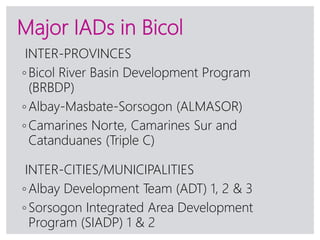
Major IADs in Bicol
INTER-PROVINCES
◦ Bicol River Basin Development Program
(BRBDP)
◦ Albay-Masbate-Sorsogon (ALMASOR)
◦ Camarines Norte, Camarines Sur and
Catanduanes (Triple C)
INTER-CITIES/MUNICIPALITIES
◦ Albay Development Team (ADT) 1, 2 & 3
◦ Sorsogon Integrated Area Development
Program (SIADP) 1 & 2
Bicol River Basin Development Program
◦ BRBDP is the Philippines' first experience implementing an integrated area
development program implemented in 1975.
◦ Organized and created by virtue of Presidential Decree No. 926, dated
April 28, 1976, modified from PD No. 805
◦ Goal: Reduce poverty in local communities such that those within the BRB
are able to sustain their livelihoods without resorting to environmentally
destructive practices and empower them to become co-custodians of the
river basin
◦ Objective: To increase rice production, improve rural income, create
employment opportunities, and upgrade the living standards of the rural
population through the provision of infrastructure facilities (irrigation, flood
control, water management demonstration and training farms, erosion
control and soil conservation, levees/sea walls, FMRs and rural water
supply)
◦ Actual project cost: $ 72.675 million
◦ Timeline (per approved work plan): 5 ½ years (early 1980 to mid 1985)
◦ Executing agencies: NIA, DPWH, DENR
Bicol Rivers
Covering 23 LGUs in Albay
and Camarines provinces
(Per PD 926, the areas
covered are 33 LGUs in Cam
Sur and 12 in Albay.)
The Results and Gains of BRBDP
◦ Significant increase in paddy production -- 6,588 hectares or 58% of the
total “firmed up” area was irrigated in the dry season and 8,722 hectares
or 77% was irrigated during the wet season. This is expected to yield a
total incremental paddy production of 62,000 metric ton in 1990.
◦ Infrastructure facilities had been substantially completed except for one
flood control.
◦ HOWEVER, integrated development did not fully materialize due to the
characteristics of the program and in part due to broader development
trends affecting the Bicol area. Two major issues raised by the program's
experience are examined: integration as a continuing and evolving
challenge for development management, and sustaining the positive
benefits of a program's investments as a challenge for institutional
development.
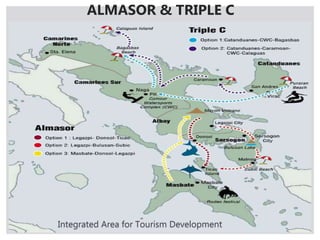
ALMASOR & TRIPLE C
Integrated Area for Tourism Development
ALMASOR & TRIPLE C
◦ The ALMASOR and TRIPLE C are aimed to address the primary concerns of
connectivity and access, tourism product development, and governance that
are crucial to sustainable tourism growth and development.
◦ ALMASOR is the 1st of the 77 tourism development areas that has an Area
Development Plan (2015-2020) which aims to: (a) set the vision and future
direction of tourism development in Albay, Masbate and Sorsogon; (b) guide
the various stakeholders on the key areas for tourism development, related
tourism facilities and services, and support infrastructure; and (c) specify the
roles and responsibilities of key players, institutional arrangements, and
resource requirements.
◦ TRIPLE C covers the provinces of Camarines Norte & Sur and Catanduanes
focused on developing eco-tourism and infrastructure (access roads and
bridges).
The Gains of ALMASOR
◦ Before the creation of ALMASOR, the combined tourist arrivals for the three
provinces in 2011 was at 655,771 or a growth rate of 16.7% from its previous
year.” After the alliance was formed in 2012, tourism in ALMASOR reflected a
dramatic increase of 33.4% in 2012 and 51.8% in 2013.
◦ Albay and Sorsogon achieved significant growths in tourist arrivals of % and
46 %, respectively, in 2012. Albay accounted for 523,832 tourist arrivals and
Sorsogon, 173,700.
◦ Masbate reported a 12.6% growth rate in tourism in 2013.
References
◦ Ricardo M. Sandalo, EnP
. Integrated Area Development and Other Strategies
for Environmental Planning. Retrieved at:
https://www.slideshare.net/jrmadriaga/integrated-area-development
◦ Jenny Cameron, Nancy Odendaal and Alison Todes. Integrated Area
Development Projects: Working Towards Innovation and Sustainability.
Retrieved at: https://core.ac.uk/download/pdf/39670475.pdf
◦ Formulation of an Integrated Bicol River Basin Management and Development
Master Plan. Retrieved at: http://rbco.denr.gov.ph/wp-
content/uploads/2017/10/bicolexecutivesummary.pdf
◦ Project Completion Report of the Bicol River Basin Irrigation Project.
https://www.adb.org/sites/default/files/project-document/72921/38441-phi-
pcr.pdf
◦ http://newsinfo.inquirer.net/596896/bicol-tour-offer-almasor-or-triple-c
◦ https://www.philstar.com/other-sections/starweek-
magazine/2014/07/06/1342852/bicols-almasor-tourism-triumvirate

Integrated-Area-Development-IAD.pptx

  • 1.
    ALMASOR and TRIPLEC Integrated Area for Tourism Development
  • 2.
  • 3.
    TOPICS ◦IAD Defined ◦The Importanceof IAD ◦The Purpose of IAD Planning ◦Evolution of IAD: Philippine Setting Before 1970s, 1970 to 1986, After EDSA Revolution ◦Major IADs in Bicol Region BRBDP ALMASOR TRIPLE C
  • 4.
    What is IAD? ◦Developing a region, city, village or group of local governments to their full potential through a clear course and policy that looks insights into the problems, strengths, challenges and solutions in all aspects of society. ◦ Requiring proper spatial planning policies, infrastructure support and social policies in order to accommodate the rapid regional growth and urbanisation in a balanced and sustainable manner.
  • 5.
    What is IAD? ◦Revitalizing socio-economically depressed provinces and areas through an integrated approach in the provision of infra support facilities and services such as roads, irrigation, domestic water supply, health and nutrition facilities ◦ Major component of a regional development plan - an offshoot of the Integrated Reorganization Plan (PD No. 1, 1972) or the Regionalization in the country
  • 6.
    The Importance ofIAD ◦IAD addresses the problems on rural poverty, growth disparity within and between regions, lack of inter-sectoral and spatial integration, environmental integrity and many others. ◦Economically depressed areas are given focus on socio-economic development coupled with the necessary infrastructure (FMRs, access roads, bridges, irrigations).
  • 7.
    The Importance ofIAD ◦Resources are equitably shared and efforts are complemented. ◦The concept of “big brother helping small brothers” among local government units (LGUs) is espoused and patronized.
  • 8.
    Purposes of IADPlanning ◦Preparation or execution of a program for developing a river basin or an island ecological unit ◦Management of social, economic and physical affairs of an entire administrative region or an entire metropolitan area ◦Employed in order to qualify for some form of funding assistance
  • 9.
    IAD in OtherCountries ◦ In Britain, IAD initiatives are seen as a way of responding to poverty and generating local economic development to address unemployment, poverty and social exclusion. ◦ In the United States, empowerment zones are seen as a way of developing parts of cities that are characterised by high levels of poverty putting emphasis on broadly based development strategies with considerable local community and stakeholder involvement, often on a partnership basis.
  • 10.
    Evolution of IAD(Philippine Setting) Before 1970s ◦ Although concept of “region” has not been clearly defined nor delineated but regional planning has been going on as evidenced in the creation of the National Planning Commission in 1950 as the only physical planning agency of the government that took charge of the preparation of the “general” plans for regional areas for the purpose of coordinating the various plans of urban areas within the region. ◦ Proliferation of Multi-Purpose Regional Development Authorities (MPRDAs)
  • 11.
    Major IADs/MPRDAs (Before 1970s) 1.Mindanao Development Authority (MDA) – most prominent among the authorities but accomplishments were limited and failed to produce a comprehensive plan for the region 2. Central Luzon-Cagayan Valley Authority (CLCVA) - electric power, irrigation, navigation and flood control 3. Laguna Lake Development Authority (LLDA) MDA, CLCVA & LLDA failed because they did not receive sufficient financial and political support and their accomplishments fell way short of their mandates.
  • 12.
    Evolution of IAD(Philippine Setting) 1970s until 1986 ◦ Cabinet Coordinating Council on Integrated Rural Development Projects (CCC-IRDP) was created for the purpose and later replaced by National Council on Integrated Area Development (NACIAD) by virtue of PD No. 1378 under the Office of PM Cesar Virata ◦ Projects (foreign-assisted) were to be the major instruments to trigger the growth especially of lagging regions in the country. ◦ Boundaries were drawn to effectively link rural production areas with market towns and urban centers thereby enhancing access to products and factor markets.
  • 13.
    Major IADs (1970suntil 1986) ◦Bicol River Basin Development Program in 1975 – first IRD/IAD project funded by USAID ◦Mindanao Integrated Rural Development Project in 1975 ◦Cagayan IAD Project in 1977 ◦Samar IRDP in 1979 ◦Palawan IAD Project in 1982 ◦Bohol IAD Project in 1983
  • 14.
    Evolution of IAD(Philippine Setting) After EDSA Revolution ◦ NACIAD was abolished and the overall direction, coordination and supervision of IAD and similar projects were assumed by NEDA and the RDCs where projects were located (EO 230). ◦ The reorganization led to the loss of some momentum in the gains already had in the IAD approach. ◦ The IAD seemed to have lost a lot of its appeal to the donor or external assisting agencies on which its initial successes mostly depended. ◦ Most provinces lack the complement of technical expertise or experience in undertaking an integrated socio-economic development.
  • 15.
    How is IADToday? (after the approval of the LGC of 1991) ◦IADs are mostly realized through the bilateral projects of the GOP and other countries. E.g. LGSP-LED (tourism), Debt for Development Swap Program (coastal resource, ecosystem, livelihood) ◦NGOs initiated convenio projects for a group of LGUs in a number of regions ◦Alliances among LGUs backed by NEDA and the RDC
  • 16.
    Major IADs inBicol INTER-PROVINCES ◦ Bicol River Basin Development Program (BRBDP) ◦ Albay-Masbate-Sorsogon (ALMASOR) ◦ Camarines Norte, Camarines Sur and Catanduanes (Triple C) INTER-CITIES/MUNICIPALITIES ◦ Albay Development Team (ADT) 1, 2 & 3 ◦ Sorsogon Integrated Area Development Program (SIADP) 1 & 2
  • 17.
    Bicol River BasinDevelopment Program ◦ BRBDP is the Philippines' first experience implementing an integrated area development program implemented in 1975. ◦ Organized and created by virtue of Presidential Decree No. 926, dated April 28, 1976, modified from PD No. 805 ◦ Goal: Reduce poverty in local communities such that those within the BRB are able to sustain their livelihoods without resorting to environmentally destructive practices and empower them to become co-custodians of the river basin ◦ Objective: To increase rice production, improve rural income, create employment opportunities, and upgrade the living standards of the rural population through the provision of infrastructure facilities (irrigation, flood control, water management demonstration and training farms, erosion control and soil conservation, levees/sea walls, FMRs and rural water supply) ◦ Actual project cost: $ 72.675 million ◦ Timeline (per approved work plan): 5 ½ years (early 1980 to mid 1985) ◦ Executing agencies: NIA, DPWH, DENR
  • 18.
    Bicol Rivers Covering 23LGUs in Albay and Camarines provinces (Per PD 926, the areas covered are 33 LGUs in Cam Sur and 12 in Albay.)
  • 19.
    The Results andGains of BRBDP ◦ Significant increase in paddy production -- 6,588 hectares or 58% of the total “firmed up” area was irrigated in the dry season and 8,722 hectares or 77% was irrigated during the wet season. This is expected to yield a total incremental paddy production of 62,000 metric ton in 1990. ◦ Infrastructure facilities had been substantially completed except for one flood control. ◦ HOWEVER, integrated development did not fully materialize due to the characteristics of the program and in part due to broader development trends affecting the Bicol area. Two major issues raised by the program's experience are examined: integration as a continuing and evolving challenge for development management, and sustaining the positive benefits of a program's investments as a challenge for institutional development.
  • 20.
    ALMASOR & TRIPLEC Integrated Area for Tourism Development
  • 21.
    ALMASOR & TRIPLEC ◦ The ALMASOR and TRIPLE C are aimed to address the primary concerns of connectivity and access, tourism product development, and governance that are crucial to sustainable tourism growth and development. ◦ ALMASOR is the 1st of the 77 tourism development areas that has an Area Development Plan (2015-2020) which aims to: (a) set the vision and future direction of tourism development in Albay, Masbate and Sorsogon; (b) guide the various stakeholders on the key areas for tourism development, related tourism facilities and services, and support infrastructure; and (c) specify the roles and responsibilities of key players, institutional arrangements, and resource requirements. ◦ TRIPLE C covers the provinces of Camarines Norte & Sur and Catanduanes focused on developing eco-tourism and infrastructure (access roads and bridges).
  • 22.
    The Gains ofALMASOR ◦ Before the creation of ALMASOR, the combined tourist arrivals for the three provinces in 2011 was at 655,771 or a growth rate of 16.7% from its previous year.” After the alliance was formed in 2012, tourism in ALMASOR reflected a dramatic increase of 33.4% in 2012 and 51.8% in 2013. ◦ Albay and Sorsogon achieved significant growths in tourist arrivals of % and 46 %, respectively, in 2012. Albay accounted for 523,832 tourist arrivals and Sorsogon, 173,700. ◦ Masbate reported a 12.6% growth rate in tourism in 2013.
  • 23.
    References ◦ Ricardo M.Sandalo, EnP . Integrated Area Development and Other Strategies for Environmental Planning. Retrieved at: https://www.slideshare.net/jrmadriaga/integrated-area-development ◦ Jenny Cameron, Nancy Odendaal and Alison Todes. Integrated Area Development Projects: Working Towards Innovation and Sustainability. Retrieved at: https://core.ac.uk/download/pdf/39670475.pdf ◦ Formulation of an Integrated Bicol River Basin Management and Development Master Plan. Retrieved at: http://rbco.denr.gov.ph/wp- content/uploads/2017/10/bicolexecutivesummary.pdf ◦ Project Completion Report of the Bicol River Basin Irrigation Project. https://www.adb.org/sites/default/files/project-document/72921/38441-phi- pcr.pdf ◦ http://newsinfo.inquirer.net/596896/bicol-tour-offer-almasor-or-triple-c ◦ https://www.philstar.com/other-sections/starweek- magazine/2014/07/06/1342852/bicols-almasor-tourism-triumvirate

Editor's Notes

  • #2 The ALMASOR and TRIPLE C are aimed to address the primary concerns of connectivity and access, tourism product development, and governance that are crucial to sustainable tourism growth and development. ALMASOR is the 1st of the 77 tourism development areas that has an Area Development Plan (2015-2020) which aims to: (a) set the vision and future direction of tourism development in Albay, Masbate and Sorsogon; (b) guide the various stakeholders on the key areas for tourism development, related tourism facilities and services, and support infrastructure; and (c) specify the roles and responsibilities of key players, institutional arrangements, and resource requirements. TRIPLE C covers the provinces of Camarines Norte & Sur and Catanduanes focused on developing eco-tourism and infrastructure (access roads and bridges).
  • #5 The promise of integrated area development projects is that they offer the space to initiate innovative approaches that promote integration and sustainability, and link planning closely to implementation. The local scale of projects allows for a development process based on an understanding of local needs, conditions, dynamics and potentials, and that includes local residents and stakeholders in a collaborative planning process. There is the potential to formulate projects based on an understanding of the way economic, social, bio-physical and spatial aspects of development problems are inter-related, and thus to formulate projects that move beyond a sectoral approach. Even where single issues such as housing are considered, cross-cutting concerns such as poverty, gender, sustainability and economic development can be incorporated. While special agencies are frequently involved in integrated area development projects, a variety of institutional forms have been adopted, and several agencies and departments may be involved. In these cases, it involves co-ordinated and mutually reinforcing actions, a common definition and understanding of the development problem, and an agreed overarching development strategy. – Jenny Cameron, et. al.
  • #6 Regionalization in the country has moved in two directions: Regionalization of the administration of national sectoral services to bring the government closer to the people through the establishment of regional offices of the national agencies Regionalization of the planning process by RDCs to provide a more rational framework for regional planning complemented by the IAD/RD projects.
  • #12 1) MDA is the most prominent among the authorities. Its accomplishments were limited and failed to produce a comprehensive plan for the region. 2) CLCVA provided electric power and irrigation, promoting navigation and engaging in flood control. 3) LLDA managed and planned for the most strategic natural resource of the country, the Laguna de Bay. MDA, CLCVA and LLDA failed because they did not receive sufficient financial and political support and their accomplishments fall way short of their mandates.
  • #14 Funding agencies for IADs from 1970s until 1986 are: 1) WB– IBRD, 2) JICA, IFAD, USAID, EEC/EU and ADB. For Palawan IAD – 47 million dollar loan from ADB, 7 ECU grant from EEC and 7 million dollar counterpart from GOP implemented from 1981 to 1987.
  • #19 The Bicol River Basin (BRB) is drained by two major rivers.  These are the Bicol River and the  Libmanan River, which meet near Aslong, Libmanan before they finally empty into the San  Miguel Bay.  Based on the topographically delineated watershed divide, 43 local government  units (LGUs) are situated wholly or partially within the Bicol River Basin. 
  • #23 Increase in tourist arrival means an increase in income. This further calls for opportunities for investment. Investment means new local employment.