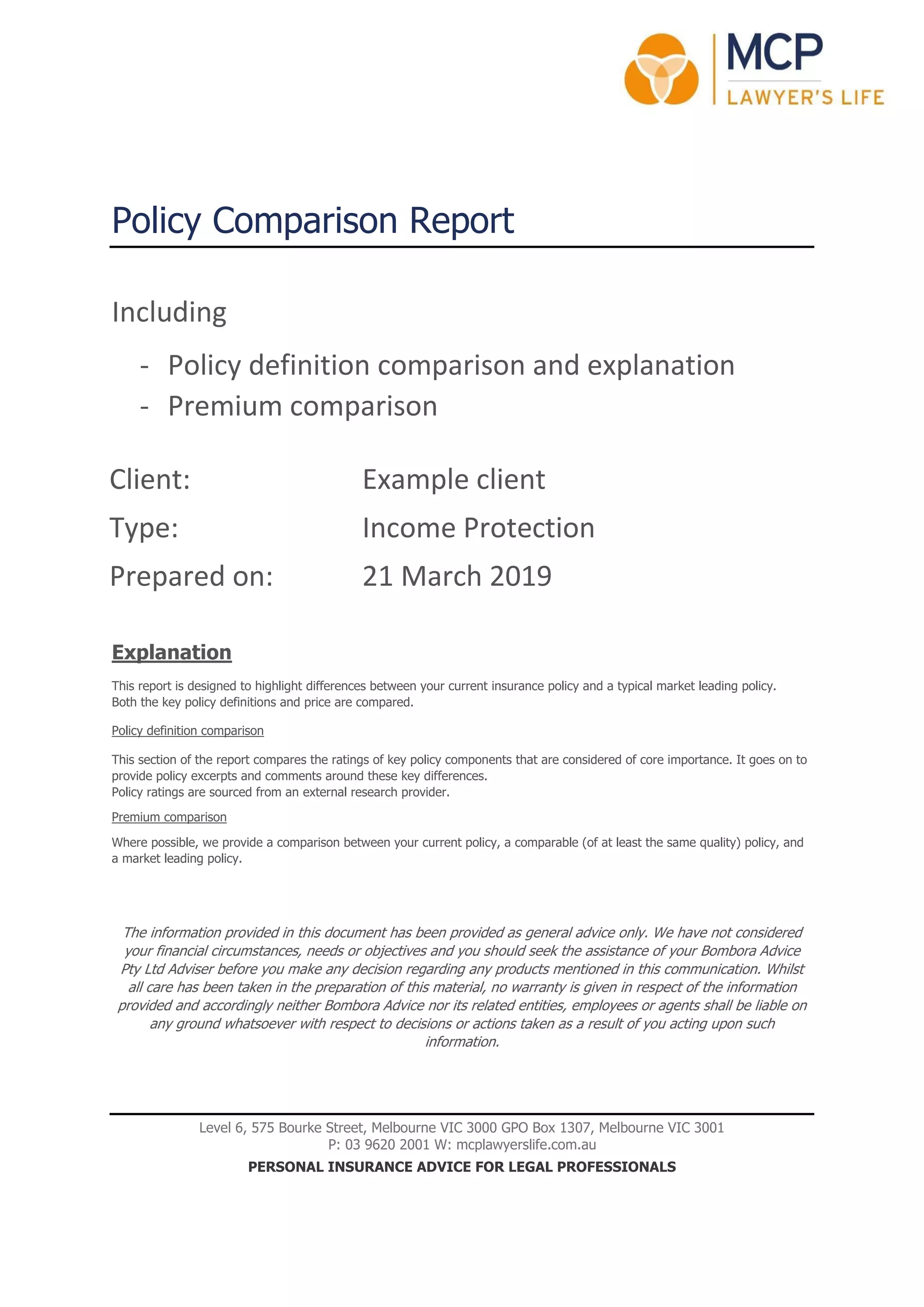
Policy Comparison Report
Including
- Policy definition comparison and explanation
- Premium comparison
Client: Example client
Type: Income Protection
Prepared on: 21 March 2019
Explanation
This report is designed to highlight differences between your current insurance policy and a typical market leading policy.
Both the key policy definitions and price are compared.
Policy definition comparison
This section of the report compares the ratings of key policy components that are considered of core importance. It goes on to
provide policy excerpts and comments around these key differences.
Policy ratings are sourced from an external research provider.
Premium comparison
Where possible, we provide a comparison between your current policy, a comparable (of at least the same quality) policy, and
a market leading policy.
The information provided in this document has been provided as general advice only. We have not considered
your financial circumstances, needs or objectives and you should seek the assistance of your Bombora Advice
Pty Ltd Adviser before you make any decision regarding any products mentioned in this communication. Whilst
all care has been taken in the preparation of this material, no warranty is given in respect of the information
provided and accordingly neither Bombora Advice nor its related entities, employees or agents shall be liable on
any ground whatsoever with respect to decisions or actions taken as a result of you acting upon such
information.
Level 6, 575 Bourke Street, Melbourne VIC 3000 GPO Box 1307, Melbourne VIC 3001
P: 03 9620 2001 W: mcplawyerslife.com.au
PERSONAL INSURANCE ADVICE FOR LEGAL PROFESSIONALS
Part 1:
Policy definition comparison
Prepared by:
Insurance
Income Protection
Other
Market Leading
Income Protection
Core Score 53/100 98/100
Supplementary Score 16/100 56/100
Core Provision Scores
Ability to Work During the Waiting Period B B
Capability Clauses B A
Definition of Pre-Disability Earnings C A
Definition of Total Disability B A
Exclusions A A
Guarantee of Renewability No Yes
Inactive Employment C A
Indemnity Benefit A A
Indexation Benefit No A
Indexation on Claim C A
Injury & Sickness A A
Offsets C A
Partial Disability Benefits B A
Recurrent Disablement C B
Waiting Period Requirements B A
Supplementary Provision Scores
Accident Benefit No a *
Bed Confinement Benefit No No
Best Doctors No No
Critical Conditions Benefit No No
Death Benefit (Built In) c a
Future Insurability Benefit No b
Geographical Limitations b b
Home Care Benefit No No
Other Supplementary Benefits No Yes *
Profit Share No Yes
Rehabilitation Benefit c a
Rewards Program No No
Specified Injury Benefit No No
Superannuation Contributions Yes Yes *
Waiver of Premium - Disability No a
Explanatory Note:
· Upper case letters refer to core provision ratings, which are considered to be those areas of a policy that are critical to the client’s
primary need for a particular policy type.
· Lower case letters refer to supplementary provision ratings, which are considered to be ‘value adding’ features of apolicy.
· Ratings accompanied with an * indicate that the listed rating is based on the assumption that an optional benefit applies. Refer to
research notes for further information.
Explanations
- some further information on the differences in policy definitions highlighted above
Other Policy UniSuper Comments
1
If you choose an Agreed Value policy, you will
be paid based on your insured amount,
regardless of what you are earning at the time.
If you choose an Indemnity policy, you will be
paid the lessor of your insured amount and the
highest average monthly earnings for any 12
month period within the 36 months prior to
disability
You will be paid the lessor of your insured
amount and income at the time of claim
Under the UniSuper policy, if for whatever
reason your income at the time of claim has
reduced (i.e. you’ve temporarily reduced your
working hours), the monthly benefit you’d be
entitled to would be adversely affected
2
Total Disability or Unable to work is defined as:
- is not working in their regular occupation or
any gainful occupation and is unable to
perform one or more duties necessary to
produce income from their regular occupation;
or
- is working in their regular occupation or any
gainful occupation and is not working more
than 10 hours per week and is unable to
perform the duties necessary to produce
income from their regular occupation for more
than 10 hours* per week; or
- is working in their regular occupation or any
gainful occupation and soley due to the illness
or injury is unable to produce monthly earnings
greater than 20% of their pre-claim earnings
Total Disability or Unable to work is defined as:
as a direct result of injury or sickness, you are:
(a) unable to perform at least one income
producing duty of his or her occupation, and
(b) not working in any occupation whether for
reward or not.
‘Other’ definition is a lot more flexible. You
can choose from three different definitions. If
choosing 10hr definition (most flexible) it
allows you to work for up to 10 hours and still
be on a full claim. Allows you to still earn
effectively 100% of your income (75% + 10hrs
(25%)).
UniSuper does not allow you to be working at
all if on a full claim. If working part time,
you’re forced to move to a partial claim and
paid based on reduction in earnings. Partial
disability claim = painful.
3
As long as you pay your premiums we will
continue to insure you with the same or
enhanced terms and conditions until expiry.
This applies even if you suffer changes to your
health, you change occupations (including to
non-professional occupations) or you take up
different pastimes.
Insurance cover will cease on any of these
events:
- you cease to be a UniSuper member,
- you cease to satisfy the eligibility conditions,
- you attain the cover cessation age
- your account has insufficient funds to pay the
insurance premiums,
- you join the armed forces of any country (the
Australian Defence Force Reserve is excluded
for this purpose),
- you cease to satisfy the relevant conditions
for continuation of cover whilst on employer
approved leave,
- the balance of your UniSuper accumulation
account is less than $2,000 and we haven't
received any contributions or transfer of funds
to your account for 12 consecutive months
- we terminate the policy with our Insurer, or
- you die.
UniSuper effectively has the ability to
terminate the policy at any time, potentially
leaving you exposed if you’re unable to obtain
new cover.
4 Will pay a claim even if you’re not working at
the time of injury/illness
- To be compliant with the SIS Act, an income
protection benefit cannot be paid out under a
superannuation structure where the insured in
not gainfully employed when a disability arises.
This is a big one. If for whatever reason you
are not gainfully employed at the time of claim,
under UniSuper, it will not pay out. For
example – in between jobs / contracts.
Extended leave etc.
5 We will increase your sum insured each year
on the Plan anniversary by the greater of:
- The increase in the Professionals Earnings
Index (PEI);
- The increase in CPI; or
- 0%
Your monthly benefit will not increase every
year
Having a policy that increases in coverage
every year allows your policy to keep pace with
your income increases
8 Can increase cover by up to 15% without
underwriting
Can only increase your monthly benefit without
underwriting by $433 once per year
‘Other’ option allows you to easily increase
your cover when your income increases
significantly (i.e. promotion, new job).
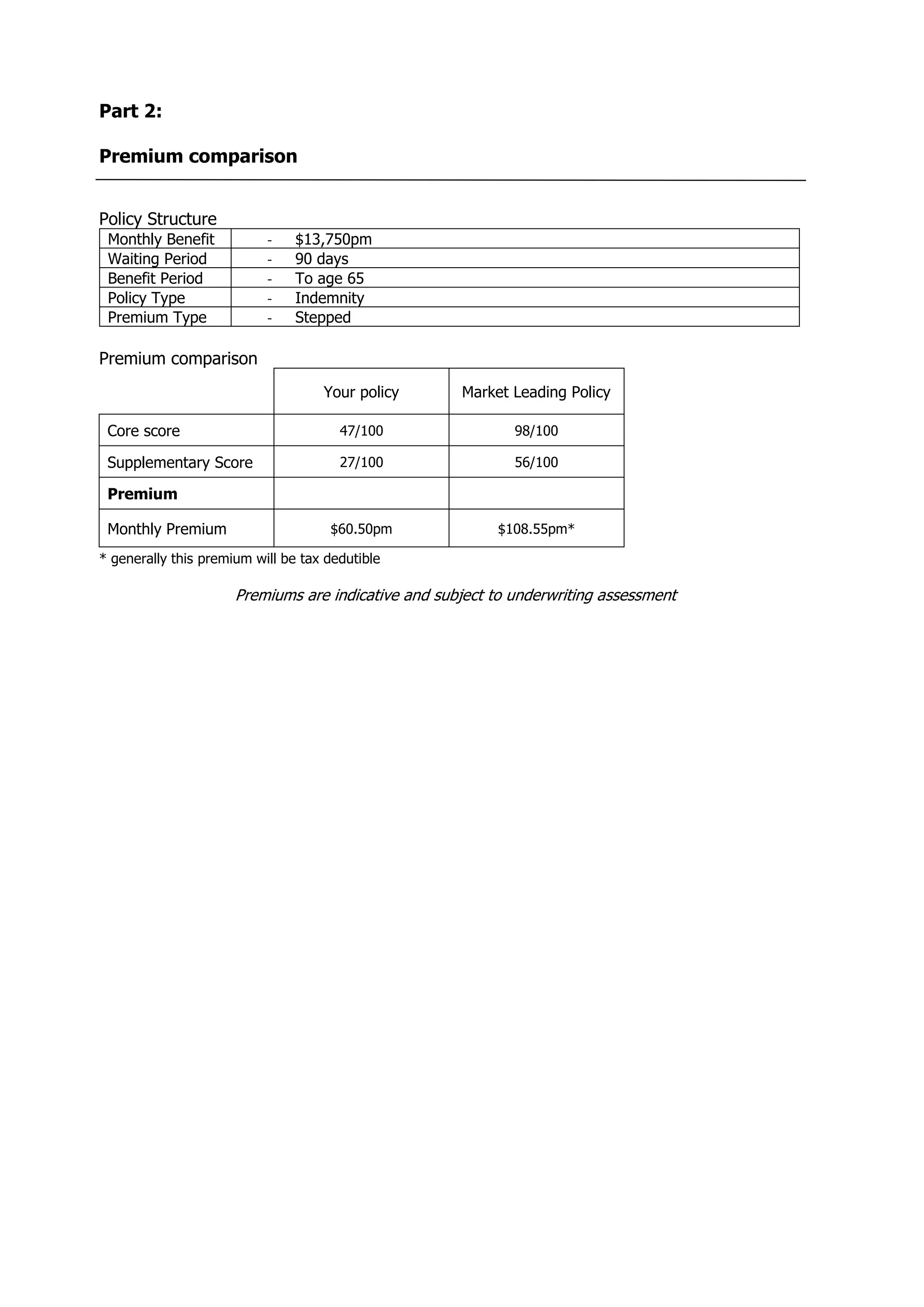
Part 2:
Premium comparison
Policy Structure
Monthly Benefit - $13,750pm
Waiting Period - 90 days
Benefit Period - To age 65
Policy Type - Indemnity
Premium Type - Stepped
Premium comparison
Your policy Market Leading Policy
Core score 47/100 98/100
Supplementary Score 27/100 56/100
Premium
Monthly Premium $60.50pm $108.55pm*
* generally this premium will be tax dedutible
Premiums are indicative and subject to underwriting assessment

Insurance policy comparison report

  • 1.
    Policy Comparison Report Including -Policy definition comparison and explanation - Premium comparison Client: Example client Type: Income Protection Prepared on: 21 March 2019 Explanation This report is designed to highlight differences between your current insurance policy and a typical market leading policy. Both the key policy definitions and price are compared. Policy definition comparison This section of the report compares the ratings of key policy components that are considered of core importance. It goes on to provide policy excerpts and comments around these key differences. Policy ratings are sourced from an external research provider. Premium comparison Where possible, we provide a comparison between your current policy, a comparable (of at least the same quality) policy, and a market leading policy. The information provided in this document has been provided as general advice only. We have not considered your financial circumstances, needs or objectives and you should seek the assistance of your Bombora Advice Pty Ltd Adviser before you make any decision regarding any products mentioned in this communication. Whilst all care has been taken in the preparation of this material, no warranty is given in respect of the information provided and accordingly neither Bombora Advice nor its related entities, employees or agents shall be liable on any ground whatsoever with respect to decisions or actions taken as a result of you acting upon such information. Level 6, 575 Bourke Street, Melbourne VIC 3000 GPO Box 1307, Melbourne VIC 3001 P: 03 9620 2001 W: mcplawyerslife.com.au PERSONAL INSURANCE ADVICE FOR LEGAL PROFESSIONALS
  • 2.
    Part 1: Policy definitioncomparison Prepared by: Insurance Income Protection Other Market Leading Income Protection Core Score 53/100 98/100 Supplementary Score 16/100 56/100 Core Provision Scores Ability to Work During the Waiting Period B B Capability Clauses B A Definition of Pre-Disability Earnings C A Definition of Total Disability B A Exclusions A A Guarantee of Renewability No Yes Inactive Employment C A Indemnity Benefit A A Indexation Benefit No A Indexation on Claim C A Injury & Sickness A A Offsets C A Partial Disability Benefits B A Recurrent Disablement C B Waiting Period Requirements B A Supplementary Provision Scores Accident Benefit No a * Bed Confinement Benefit No No Best Doctors No No Critical Conditions Benefit No No Death Benefit (Built In) c a Future Insurability Benefit No b Geographical Limitations b b Home Care Benefit No No Other Supplementary Benefits No Yes * Profit Share No Yes Rehabilitation Benefit c a Rewards Program No No Specified Injury Benefit No No Superannuation Contributions Yes Yes * Waiver of Premium - Disability No a Explanatory Note: · Upper case letters refer to core provision ratings, which are considered to be those areas of a policy that are critical to the client’s primary need for a particular policy type. · Lower case letters refer to supplementary provision ratings, which are considered to be ‘value adding’ features of apolicy. · Ratings accompanied with an * indicate that the listed rating is based on the assumption that an optional benefit applies. Refer to research notes for further information.
  • 3.
    Explanations - some furtherinformation on the differences in policy definitions highlighted above Other Policy UniSuper Comments 1 If you choose an Agreed Value policy, you will be paid based on your insured amount, regardless of what you are earning at the time. If you choose an Indemnity policy, you will be paid the lessor of your insured amount and the highest average monthly earnings for any 12 month period within the 36 months prior to disability You will be paid the lessor of your insured amount and income at the time of claim Under the UniSuper policy, if for whatever reason your income at the time of claim has reduced (i.e. you’ve temporarily reduced your working hours), the monthly benefit you’d be entitled to would be adversely affected 2 Total Disability or Unable to work is defined as: - is not working in their regular occupation or any gainful occupation and is unable to perform one or more duties necessary to produce income from their regular occupation; or - is working in their regular occupation or any gainful occupation and is not working more than 10 hours per week and is unable to perform the duties necessary to produce income from their regular occupation for more than 10 hours* per week; or - is working in their regular occupation or any gainful occupation and soley due to the illness or injury is unable to produce monthly earnings greater than 20% of their pre-claim earnings Total Disability or Unable to work is defined as: as a direct result of injury or sickness, you are: (a) unable to perform at least one income producing duty of his or her occupation, and (b) not working in any occupation whether for reward or not. ‘Other’ definition is a lot more flexible. You can choose from three different definitions. If choosing 10hr definition (most flexible) it allows you to work for up to 10 hours and still be on a full claim. Allows you to still earn effectively 100% of your income (75% + 10hrs (25%)). UniSuper does not allow you to be working at all if on a full claim. If working part time, you’re forced to move to a partial claim and paid based on reduction in earnings. Partial disability claim = painful. 3 As long as you pay your premiums we will continue to insure you with the same or enhanced terms and conditions until expiry. This applies even if you suffer changes to your health, you change occupations (including to non-professional occupations) or you take up different pastimes. Insurance cover will cease on any of these events: - you cease to be a UniSuper member, - you cease to satisfy the eligibility conditions, - you attain the cover cessation age - your account has insufficient funds to pay the insurance premiums, - you join the armed forces of any country (the Australian Defence Force Reserve is excluded for this purpose), - you cease to satisfy the relevant conditions for continuation of cover whilst on employer approved leave, - the balance of your UniSuper accumulation account is less than $2,000 and we haven't received any contributions or transfer of funds to your account for 12 consecutive months - we terminate the policy with our Insurer, or - you die. UniSuper effectively has the ability to terminate the policy at any time, potentially leaving you exposed if you’re unable to obtain new cover. 4 Will pay a claim even if you’re not working at the time of injury/illness - To be compliant with the SIS Act, an income protection benefit cannot be paid out under a superannuation structure where the insured in not gainfully employed when a disability arises. This is a big one. If for whatever reason you are not gainfully employed at the time of claim, under UniSuper, it will not pay out. For example – in between jobs / contracts. Extended leave etc. 5 We will increase your sum insured each year on the Plan anniversary by the greater of: - The increase in the Professionals Earnings Index (PEI); - The increase in CPI; or - 0% Your monthly benefit will not increase every year Having a policy that increases in coverage every year allows your policy to keep pace with your income increases 8 Can increase cover by up to 15% without underwriting Can only increase your monthly benefit without underwriting by $433 once per year ‘Other’ option allows you to easily increase your cover when your income increases significantly (i.e. promotion, new job).
  • 4.
    Part 2: Premium comparison PolicyStructure Monthly Benefit - $13,750pm Waiting Period - 90 days Benefit Period - To age 65 Policy Type - Indemnity Premium Type - Stepped Premium comparison Your policy Market Leading Policy Core score 47/100 98/100 Supplementary Score 27/100 56/100 Premium Monthly Premium $60.50pm $108.55pm* * generally this premium will be tax dedutible Premiums are indicative and subject to underwriting assessment