Structure of
insulin
 protein hormone with 2 polypeptide chains.
 The A chain has 21 amino acids and B chain
has 30 amino acids.
 These two chains are joined together by two
interchain disulphide bonds, between A7 to
B7 and A20 to B19
 . There is also an intrachain disulphide link in
A chain between 6th and11th amino acids
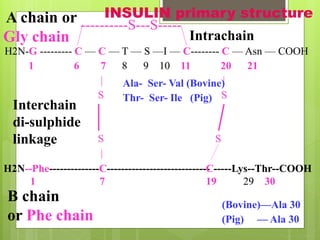
H2N-G --------- C — C — T — S —I — C-------- C — Asn — COOH
1 6 7 8 9 10 11 20 21
| |
S S
S S
|
A chain or
Gly chain
H2N--Phe--------------C-----------------------------
1 7
C-----Lys--Thr--COOH
19 29 30
B chain
or Phe chain
Ala- Ser- Val (Bovine)
Thr- Ser- Ile (Pig)
(Bovine)—Ala 30
(Pig) — Ala 30
----------S---S-----
INSULIN primary structure
Interchain
di-sulphide
linkage
Intrachain
Biosynthesis of insulin
 i. Insulin is a protein synthesized and
secreted by the betacells of the islets of
Langerhans of the pancreas.
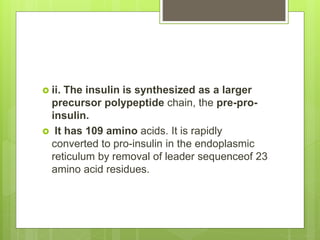
 ii. The insulin is synthesized as a larger
precursor polypeptide chain, the pre-pro-
insulin.
 It has 109 amino acids. It is rapidly
converted to pro-insulin in the endoplasmic
reticulum by removal of leader sequenceof 23
amino acid residues.
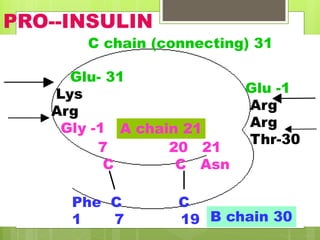
Glu- 31
Lys
Arg
Gly -1
Glu -1
Arg
Arg
Thr-30
7 20 21
C C Asn
Phe C C
1 7 19
A chain 21
B chain 30
C chain (connecting) 31
PRO--INSULIN
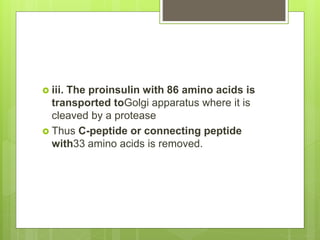
 iii. The proinsulin with 86 amino acids is
transported toGolgi apparatus where it is
cleaved by a protease
 Thus C-peptide or connecting peptide
with33 amino acids is removed.
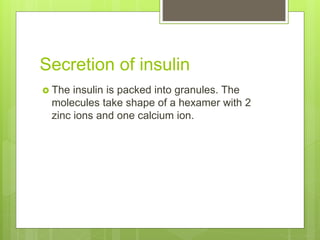
Secretion of insulin
 The insulin is packed into granules. The
molecules take shape of a hexamer with 2
zinc ions and one calcium ion.
 Approximately 50 units of insulin is secreted
per day.
 Normal insulin level in blood is 5-15
microunits/ml.
 Proinsulin contributes 5 to 10% of the total
insulin measured in plasma.
 Proinsulin has about one-third biological
activity as that of insulin
 Insulin and C-peptide are synthesized and
secreted in equimolar quantities. Therefore,
measurement of C-peptide is an index of rate
of secretion of insulin.
 Mutations causing changes in amino acid
sequence at the cleavage points can
lead to familial pro-insulinemia.
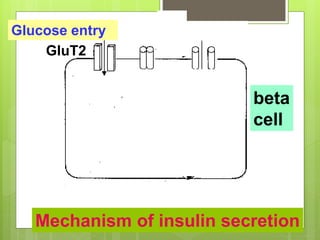
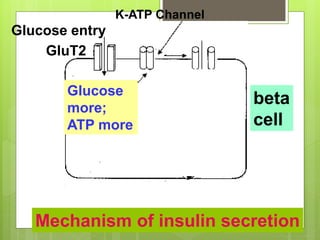
Mechanism of insulin secretion
Glucose entry
GluT2
beta
cell
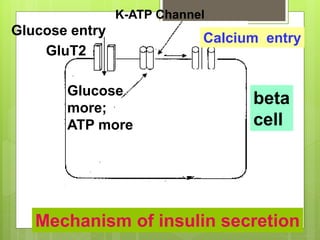
Mechanism of insulin secretion
Glucose entry
GluT2
beta
cell
Mechanism of insulin secretion
Glucose
more;
ATP more
K-ATP Channel
Glucose entry
GluT2
K-ATP Channel
Calcium entry
beta
cell
Mechanism of insulin secretion
Glucose
more;
ATP more
Glucose entry
GluT2
K-ATP Channel
Calcium entry
beta
cell
Mechanism of insulin secretion
Glucose
more;
ATP more
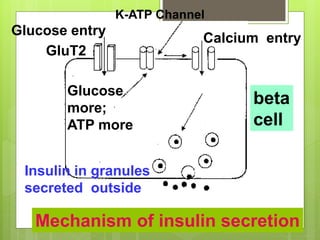
Insulin in granules
secreted outside
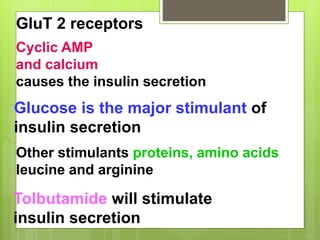
Glucose is the major stimulant of
insulin secretion
GluT 2 receptors
Cyclic AMP
and calcium
causes the insulin secretion
Other stimulants proteins, amino acids
leucine and arginine
Tolbutamide will stimulate
insulin secretion
Insulin half life is only 5 minutes
About 40 – 50 units of insulin
secreted per day
Measurement of Insulin
and C – peptide
by RIA or ELISA methods
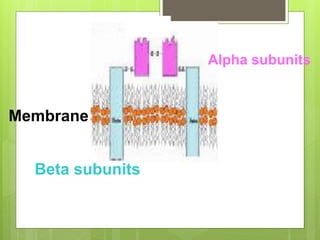
Membrane
Beta subunits
Alpha subunits
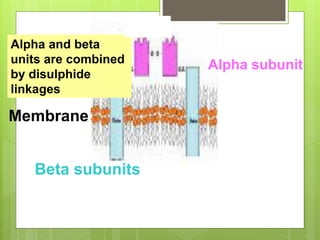
Alpha and beta
units are combined
by disulphide
linkages
Membrane
Beta subunits
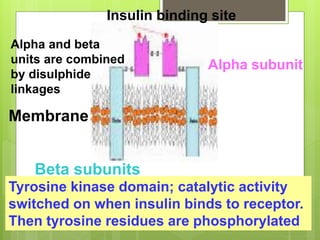
Alpha subunit
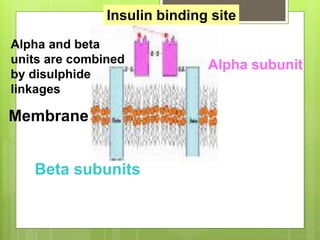
Insulin binding site
Alpha and beta
units are combined
by disulphide
linkages
Membrane
Beta subunits
Alpha subunit
Insulin binding site
Alpha and beta
units are combined
by disulphide
linkages
Membrane
Beta subunits
Tyrosine kinase domain; catalytic activity
switched on when insulin binds to receptor.
Then tyrosine residues are phosphorylated
Alpha subunit
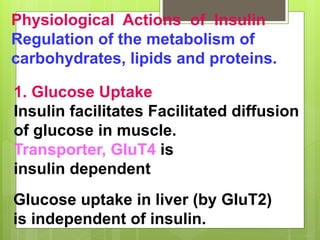
Physiological Actions of Insulin
Regulation of the metabolism of
carbohydrates, lipids and proteins.
1. Glucose Uptake
Insulin facilitates Facilitated diffusion
of glucose in muscle.
Transporter, GIuT4 is
insulin dependent
Glucose uptake in liver (by GluT2)
is independent of insulin.
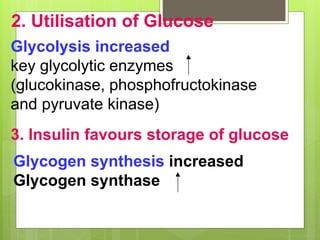
2. Utilisation of Glucose
3. Insulin favours storage of glucose
Glycolysis increased
key glycolytic enzymes
(glucokinase, phosphofructokinase
and pyruvate kinase)
Glycogen synthesis increased
Glycogen synthase
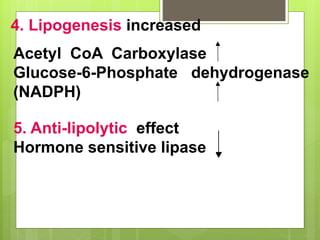
4. Lipogenesis increased
Acetyl CoA Carboxylase
Glucose-6-Phosphate dehydrogenase
(NADPH)
5. Anti-lipolytic effect
Hormone sensitive lipase
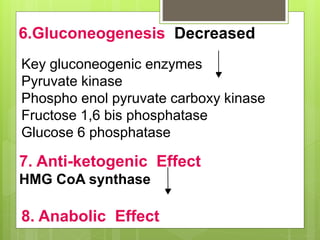
6.Gluconeogenesis Decreased
Key gluconeogenic enzymes
Pyruvate kinase
Phospho enol pyruvate carboxy kinase
Fructose 1,6 bis phosphatase
Glucose 6 phosphatase
8. Anabolic Effect
7. Anti-ketogenic Effect
HMG CoA synthase
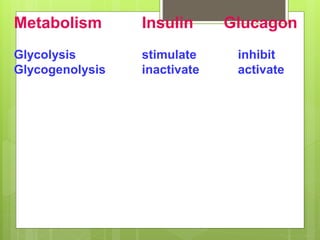
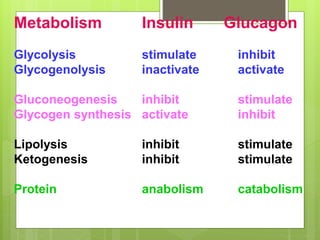
Metabolism Insulin Glucagon
Glycolysis stimulate inhibit
Glycogenolysis inactivate activate
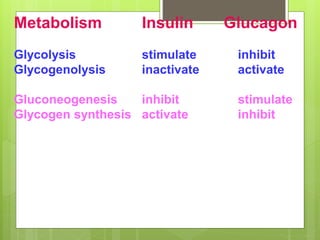
Metabolism Insulin Glucagon
Glycolysis stimulate inhibit
Glycogenolysis inactivate activate
Gluconeogenesis inhibit stimulate
Glycogen synthesis activate inhibit
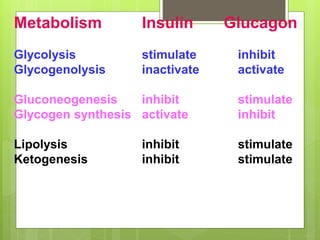
Metabolism Insulin Glucagon
Glycolysis stimulate inhibit
Glycogenolysis inactivate activate
Gluconeogenesis inhibit stimulate
Glycogen synthesis activate inhibit
Lipolysis inhibit stimulate
Ketogenesis inhibit stimulate
Metabolism Insulin Glucagon
Glycolysis stimulate inhibit
Glycogenolysis inactivate activate
Gluconeogenesis inhibit stimulate
Glycogen synthesis activate inhibit
Lipolysis inhibit stimulate
Ketogenesis inhibit stimulate
Protein anabolism catabolism
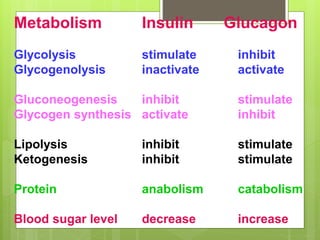
Metabolism Insulin Glucagon
Glycolysis stimulate inhibit
Glycogenolysis inactivate activate
Gluconeogenesis inhibit stimulate
Glycogen synthesis activate inhibit
Lipolysis inhibit stimulate
Ketogenesis inhibit stimulate
Protein anabolism catabolism
Blood sugar level decrease increase
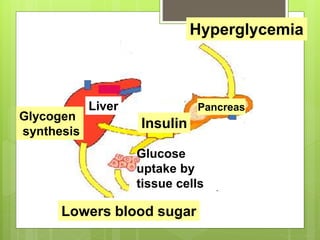
Hyperglycemia
Insulin
Lowers blood sugar
Glucose
uptake by
tissue cells
Glycogen
synthesis
Liver Pancreas
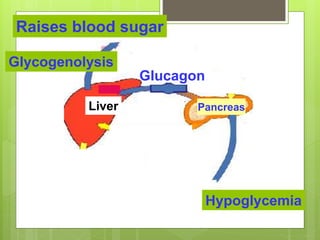
Raises blood sugar
Glucagon
Hypoglycemia
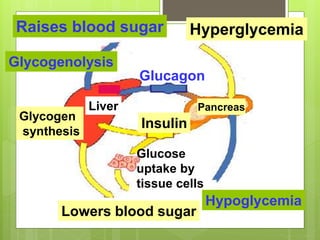
Liver
Glycogenolysis
Pancreas
Raises blood sugar Hyperglycemia
Glucagon
Insulin
Hypoglycemia
Lowers blood sugar
Glucose
uptake by
tissue cells
Glycogen
synthesis
Liver
Glycogenolysis
Pancreas

Insulin metabolism structure synthesis metabolic error

  • 1.
    Structure of insulin  proteinhormone with 2 polypeptide chains.  The A chain has 21 amino acids and B chain has 30 amino acids.  These two chains are joined together by two interchain disulphide bonds, between A7 to B7 and A20 to B19
  • 2.
     . Thereis also an intrachain disulphide link in A chain between 6th and11th amino acids
  • 3.
    H2N-G --------- C— C — T — S —I — C-------- C — Asn — COOH 1 6 7 8 9 10 11 20 21 | | S S S S | A chain or Gly chain H2N--Phe--------------C----------------------------- 1 7 C-----Lys--Thr--COOH 19 29 30 B chain or Phe chain Ala- Ser- Val (Bovine) Thr- Ser- Ile (Pig) (Bovine)—Ala 30 (Pig) — Ala 30 ----------S---S----- INSULIN primary structure Interchain di-sulphide linkage Intrachain
  • 4.
    Biosynthesis of insulin i. Insulin is a protein synthesized and secreted by the betacells of the islets of Langerhans of the pancreas.
  • 5.
     ii. Theinsulin is synthesized as a larger precursor polypeptide chain, the pre-pro- insulin.  It has 109 amino acids. It is rapidly converted to pro-insulin in the endoplasmic reticulum by removal of leader sequenceof 23 amino acid residues.
  • 6.
    Glu- 31 Lys Arg Gly -1 Glu-1 Arg Arg Thr-30 7 20 21 C C Asn Phe C C 1 7 19 A chain 21 B chain 30 C chain (connecting) 31 PRO--INSULIN
  • 7.
     iii. Theproinsulin with 86 amino acids is transported toGolgi apparatus where it is cleaved by a protease  Thus C-peptide or connecting peptide with33 amino acids is removed.
  • 8.
    Secretion of insulin The insulin is packed into granules. The molecules take shape of a hexamer with 2 zinc ions and one calcium ion.
  • 9.
     Approximately 50units of insulin is secreted per day.  Normal insulin level in blood is 5-15 microunits/ml.  Proinsulin contributes 5 to 10% of the total insulin measured in plasma.  Proinsulin has about one-third biological activity as that of insulin
  • 10.
     Insulin andC-peptide are synthesized and secreted in equimolar quantities. Therefore, measurement of C-peptide is an index of rate of secretion of insulin.  Mutations causing changes in amino acid sequence at the cleavage points can lead to familial pro-insulinemia.
  • 11.
  • 12.
  • 13.
    Glucose entry GluT2 beta cell Mechanism ofinsulin secretion Glucose more; ATP more K-ATP Channel
  • 14.
    Glucose entry GluT2 K-ATP Channel Calciumentry beta cell Mechanism of insulin secretion Glucose more; ATP more
  • 15.
    Glucose entry GluT2 K-ATP Channel Calciumentry beta cell Mechanism of insulin secretion Glucose more; ATP more Insulin in granules secreted outside
  • 16.
    Glucose is themajor stimulant of insulin secretion GluT 2 receptors Cyclic AMP and calcium causes the insulin secretion Other stimulants proteins, amino acids leucine and arginine Tolbutamide will stimulate insulin secretion
  • 17.
    Insulin half lifeis only 5 minutes About 40 – 50 units of insulin secreted per day Measurement of Insulin and C – peptide by RIA or ELISA methods
  • 18.
  • 19.
    Alpha and beta unitsare combined by disulphide linkages Membrane Beta subunits Alpha subunit
  • 20.
    Insulin binding site Alphaand beta units are combined by disulphide linkages Membrane Beta subunits Alpha subunit
  • 21.
    Insulin binding site Alphaand beta units are combined by disulphide linkages Membrane Beta subunits Tyrosine kinase domain; catalytic activity switched on when insulin binds to receptor. Then tyrosine residues are phosphorylated Alpha subunit
  • 22.
    Physiological Actions ofInsulin Regulation of the metabolism of carbohydrates, lipids and proteins. 1. Glucose Uptake Insulin facilitates Facilitated diffusion of glucose in muscle. Transporter, GIuT4 is insulin dependent Glucose uptake in liver (by GluT2) is independent of insulin.
  • 23.
    2. Utilisation ofGlucose 3. Insulin favours storage of glucose Glycolysis increased key glycolytic enzymes (glucokinase, phosphofructokinase and pyruvate kinase) Glycogen synthesis increased Glycogen synthase
  • 24.
    4. Lipogenesis increased AcetylCoA Carboxylase Glucose-6-Phosphate dehydrogenase (NADPH) 5. Anti-lipolytic effect Hormone sensitive lipase
  • 25.
    6.Gluconeogenesis Decreased Key gluconeogenicenzymes Pyruvate kinase Phospho enol pyruvate carboxy kinase Fructose 1,6 bis phosphatase Glucose 6 phosphatase 8. Anabolic Effect 7. Anti-ketogenic Effect HMG CoA synthase
  • 26.
    Metabolism Insulin Glucagon Glycolysisstimulate inhibit Glycogenolysis inactivate activate
  • 27.
    Metabolism Insulin Glucagon Glycolysisstimulate inhibit Glycogenolysis inactivate activate Gluconeogenesis inhibit stimulate Glycogen synthesis activate inhibit
  • 28.
    Metabolism Insulin Glucagon Glycolysisstimulate inhibit Glycogenolysis inactivate activate Gluconeogenesis inhibit stimulate Glycogen synthesis activate inhibit Lipolysis inhibit stimulate Ketogenesis inhibit stimulate
  • 29.
    Metabolism Insulin Glucagon Glycolysisstimulate inhibit Glycogenolysis inactivate activate Gluconeogenesis inhibit stimulate Glycogen synthesis activate inhibit Lipolysis inhibit stimulate Ketogenesis inhibit stimulate Protein anabolism catabolism
  • 30.
    Metabolism Insulin Glucagon Glycolysisstimulate inhibit Glycogenolysis inactivate activate Gluconeogenesis inhibit stimulate Glycogen synthesis activate inhibit Lipolysis inhibit stimulate Ketogenesis inhibit stimulate Protein anabolism catabolism Blood sugar level decrease increase
  • 31.
    Hyperglycemia Insulin Lowers blood sugar Glucose uptakeby tissue cells Glycogen synthesis Liver Pancreas
  • 32.
  • 33.
    Raises blood sugarHyperglycemia Glucagon Insulin Hypoglycemia Lowers blood sugar Glucose uptake by tissue cells Glycogen synthesis Liver Glycogenolysis Pancreas