Instrumentation and Control Technician
(447A) Apprenticeship
2014-2015 Program Handbook
School of Trades and Apprenticeship
Conestoga College Institute of Technology and
Advanced Learning
This handbook has been assembled specifically for Instrumentation and Control Technician apprentices
at Conestoga College. This handbook is intended to supplement the Conestoga College Student Guide.
All rules, guidelines and procedures in this handbook are in addition to those specified in the College’s
Student Guide and reflect the School of Trades and Apprenticeship policies and procedures.
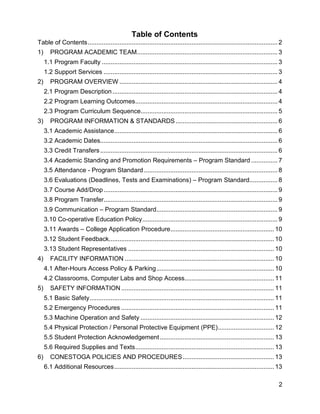
Table of Contents
Table of Contents............................................................................................................ 2
1) PROGRAM ACADEMIC TEAM................................................................................ 3
1.1 Program Faculty .................................................................................................... 3
1.2 Support Services ................................................................................................... 3
2) PROGRAM OVERVIEW .......................................................................................... 4
2.1 Program Description.............................................................................................. 4
2.2 Program Learning Outcomes................................................................................. 4
2.3 Program Curriculum Sequence.............................................................................. 5
3) PROGRAM INFORMATION & STANDARDS .......................................................... 6
3.1 Academic Assistance............................................................................................. 6
3.2 Academic Dates..................................................................................................... 6
3.3 Credit Transfers..................................................................................................... 6
3.4 Academic Standing and Promotion Requirements – Program Standard ............... 7
3.5 Attendance - Program Standard ............................................................................ 8
3.6 Evaluations (Deadlines, Tests and Examinations) – Program Standard................ 8
3.7 Course Add/Drop................................................................................................... 9
3.8 Program Transfer................................................................................................... 9
3.9 Communication – Program Standard..................................................................... 9
3.10 Co-operative Education Policy............................................................................. 9
3.11 Awards – College Application Procedure........................................................... 10
3.12 Student Feedback.............................................................................................. 10
3.13 Student Representatives ................................................................................... 10
4) FACILITY INFORMATION ..................................................................................... 10
4.1 After-Hours Access Policy & Parking................................................................... 10
4.2 Classrooms, Computer Labs and Shop Access................................................... 11
5) SAFETY INFORMATION....................................................................................... 11
5.1 Basic Safety......................................................................................................... 11
5.2 Emergency Procedures ....................................................................................... 11
5.3 Machine Operation and Safety ............................................................................ 12
5.4 Physical Protection / Personal Protective Equipment (PPE)................................ 12
5.5 Student Protection Acknowledgement................................................................. 13
5.6 Required Supplies and Texts............................................................................... 13
6) CONESTOGA POLICIES AND PROCEDURES.................................................... 13
6.1 Additional Resources........................................................................................... 13
2
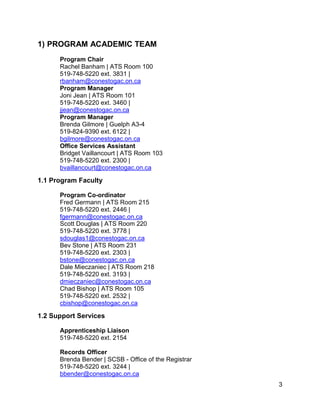
1) PROGRAM ACADEMIC TEAM
Program Chair
Rachel Banham | ATS Room 100
519-748-5220 ext. 3831 |
rbanham@conestogac.on.ca
Program Manager
Joni Jean | ATS Room 101
519-748-5220 ext. 3460 |
jjean@conestogac.on.ca
Program Manager
Brenda Gilmore | Guelph A3-4
519-824-9390 ext. 6122 |
bgilmore@conestogac.on.ca
Office Services Assistant
Bridget Vaillancourt | ATS Room 103
519-748-5220 ext. 2300 |
bvaillancourt@conestogac.on.ca
1.1 Program Faculty
Program Co-ordinator
Fred Germann | ATS Room 215
519-748-5220 ext. 2446 |
fgermann@conestogac.on.ca
Scott Douglas | ATS Room 220
519-748-5220 ext. 3778 |
sdouglas1@conestogac.on.ca
Bev Stone | ATS Room 231
519-748-5220 ext. 2303 |
bstone@conestogac.on.ca
Dale Mieczaniec | ATS Room 218
519-748-5220 ext. 3193 |
dmieczaniec@conestogac.on.ca
Chad Bishop | ATS Room 105
519-748-5220 ext. 2532 |
cbishop@conestogac.on.ca
1.2 Support Services
Apprenticeship Liaison
519-748-5220 ext. 2154
Records Officer
Brenda Bender | SCSB - Office of the Registrar
519-748-5220 ext. 3244 |
bbender@conestogac.on.ca
3
Admissions Officer
Darlene Lavigne | SCSB – Office of the Registrar
519-748-5220 ext. 2331 |
dlavigne@conestogac.on.ca
Technical Support
IT Service Desk | Doon – 1E12
519-748-5220 ext. 3444 |
itsdesk@conestogac.on.ca
Ministry of Training, Colleges and Universities (MTCU)
Apprenticeship | 4275 King St E, Suite 200, Kitchener ON N2P 2E9
800-387-5656 | kitchener.apprenticeship@ontario.ca
Service Canada
Employment Insurance
800-206-7218 | www.servicecanada.gc.ca
Ontario College of Trades (OCOT)
Member Services | 655 Bay St, Suite 600, Toronto ON M5G 2K4
855-299-0028 | info@collegeoftrades.ca
For additional financial and other supports for apprentices and employers, students
should visit Conestoga College’s website at: www.conestogac.on.ca/trades/apprentices.
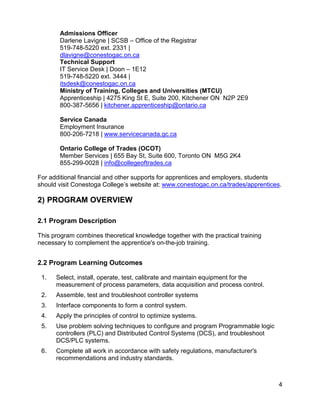
2) PROGRAM OVERVIEW
2.1 Program Description
This program combines theoretical knowledge together with the practical training
necessary to complement the apprentice's on-the-job training.
2.2 Program Learning Outcomes
1. Select, install, operate, test, calibrate and maintain equipment for the
measurement of process parameters, data acquisition and process control.
2. Assemble, test and troubleshoot controller systems
3. Interface components to form a control system.
4. Apply the principles of control to optimize systems.
5. Use problem solving techniques to configure and program Programmable logic
controllers (PLC) and Distributed Control Systems (DCS), and troubleshoot
DCS/PLC systems.
6. Complete all work in accordance with safety regulations, manufacturer's
recommendations and industry standards.
4
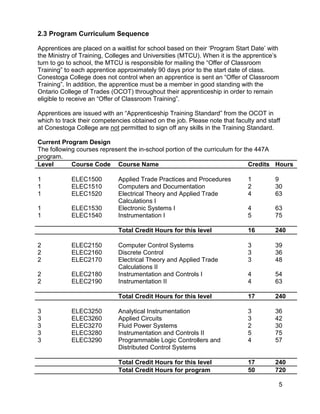
2.3 Program Curriculum Sequence
Apprentices are placed on a waitlist for school based on their ‘Program Start Date’ with
the Ministry of Training, Colleges and Universities (MTCU). When it is the apprentice’s
turn to go to school, the MTCU is responsible for mailing the “Offer of Classroom
Training” to each apprentice approximately 90 days prior to the start date of class.
Conestoga College does not control when an apprentice is sent an “Offer of Classroom
Training”. In addition, the apprentice must be a member in good standing with the
Ontario College of Trades (OCOT) throughout their apprenticeship in order to remain
eligible to receive an “Offer of Classroom Training”.
Apprentices are issued with an “Apprenticeship Training Standard” from the OCOT in
which to track their competencies obtained on the job. Please note that faculty and staff
at Conestoga College are not permitted to sign off any skills in the Training Standard.
Current Program Design
The following courses represent the in-school portion of the curriculum for the 447A
program.
Level Course Code Course Name Credits Hours
1 ELEC1500 Applied Trade Practices and Procedures 1 9
1 ELEC1510 Computers and Documentation 2 30
1 ELEC1520 Electrical Theory and Applied Trade
Calculations I
4 63
1 ELEC1530 Electronic Systems I 4 63
1 ELEC1540 Instrumentation I 5 75
Total Credit Hours for this level 16 240
2 ELEC2150 Computer Control Systems 3 39
2 ELEC2160 Discrete Control 3 36
2 ELEC2170 Electrical Theory and Applied Trade
Calculations II
3 48
2 ELEC2180 Instrumentation and Controls I 4 54
2 ELEC2190 Instrumentation II 4 63
Total Credit Hours for this level 17 240
3 ELEC3250 Analytical Instrumentation 3 36
3 ELEC3260 Applied Circuits 3 42
3 ELEC3270 Fluid Power Systems 2 30
3 ELEC3280 Instrumentation and Controls II 5 75
3 ELEC3290 Programmable Logic Controllers and
Distributed Control Systems
4 57
Total Credit Hours for this level 17 240
Total Credit Hours for program 50 720
5
3) PROGRAM INFORMATION & STANDARDS
3.1 Academic Assistance
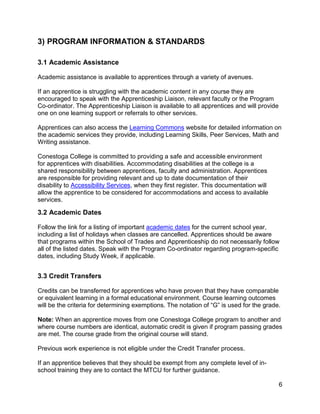
Academic assistance is available to apprentices through a variety of avenues.
If an apprentice is struggling with the academic content in any course they are
encouraged to speak with the Apprenticeship Liaison, relevant faculty or the Program
Co-ordinator. The Apprenticeship Liaison is available to all apprentices and will provide
one on one learning support or referrals to other services.
Apprentices can also access the Learning Commons website for detailed information on
the academic services they provide, including Learning Skills, Peer Services, Math and
Writing assistance.
Conestoga College is committed to providing a safe and accessible environment
for apprentices with disabilities. Accommodating disabilities at the college is a
shared responsibility between apprentices, faculty and administration. Apprentices
are responsible for providing relevant and up to date documentation of their
disability to Accessibility Services, when they first register. This documentation will
allow the apprentice to be considered for accommodations and access to available
services.
3.2 Academic Dates
Follow the link for a listing of important academic dates for the current school year,
including a list of holidays when classes are cancelled. Apprentices should be aware
that programs within the School of Trades and Apprenticeship do not necessarily follow
all of the listed dates. Speak with the Program Co-ordinator regarding program-specific
dates, including Study Week, if applicable.
3.3 Credit Transfers
Credits can be transferred for apprentices who have proven that they have comparable
or equivalent learning in a formal educational environment. Course learning outcomes
will be the criteria for determining exemptions. The notation of “G” is used for the grade.
Note: When an apprentice moves from one Conestoga College program to another and
where course numbers are identical, automatic credit is given if program passing grades
are met. The course grade from the original course will stand.
Previous work experience is not eligible under the Credit Transfer process.
If an apprentice believes that they should be exempt from any complete level of in-
school training they are to contact the MTCU for further guidance.
6
3.4 Academic Standing and Promotion Requirements – Program Standard
If for any reason an apprentice is concerned about their academic progress, they should
arrange to meet with a full-time faculty member or the Program Co-ordinator.
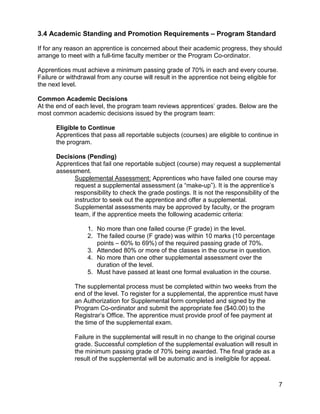
Apprentices must achieve a minimum passing grade of 70% in each and every course.
Failure or withdrawal from any course will result in the apprentice not being eligible for
the next level.
Common Academic Decisions
At the end of each level, the program team reviews apprentices’ grades. Below are the
most common academic decisions issued by the program team:
Eligible to Continue
Apprentices that pass all reportable subjects (courses) are eligible to continue in
the program.
Decisions (Pending)
Apprentices that fail one reportable subject (course) may request a supplemental
assessment.
Supplemental Assessment: Apprentices who have failed one course may
request a supplemental assessment (a “make-up”). It is the apprentice’s
responsibility to check the grade postings. It is not the responsibility of the
instructor to seek out the apprentice and offer a supplemental.
Supplemental assessments may be approved by faculty, or the program
team, if the apprentice meets the following academic criteria:
1. No more than one failed course (F grade) in the level.
2. The failed course (F grade) was within 10 marks (10 percentage
points – 60% to 69%) of the required passing grade of 70%.
3. Attended 80% or more of the classes in the course in question.
4. No more than one other supplemental assessment over the
duration of the level.
5. Must have passed at least one formal evaluation in the course.
The supplemental process must be completed within two weeks from the
end of the level. To register for a supplemental, the apprentice must have
an Authorization for Supplemental form completed and signed by the
Program Co-ordinator and submit the appropriate fee ($40.00) to the
Registrar’s Office. The apprentice must provide proof of fee payment at
the time of the supplemental exam.
Failure in the supplemental will result in no change to the original course
grade. Successful completion of the supplemental evaluation will result in
the minimum passing grade of 70% being awarded. The final grade as a
result of the supplemental will be automatic and is ineligible for appeal.
7
Discontinuance, Withdrawals and Probation
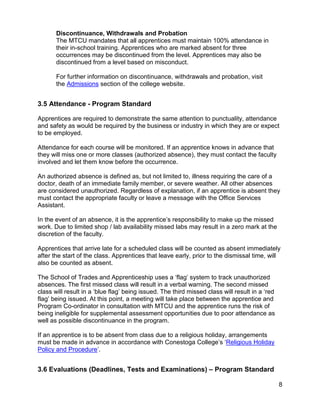
The MTCU mandates that all apprentices must maintain 100% attendance in
their in-school training. Apprentices who are marked absent for three
occurrences may be discontinued from the level. Apprentices may also be
discontinued from a level based on misconduct.
For further information on discontinuance, withdrawals and probation, visit
the Admissions section of the college website.
3.5 Attendance - Program Standard
Apprentices are required to demonstrate the same attention to punctuality, attendance
and safety as would be required by the business or industry in which they are or expect
to be employed.
Attendance for each course will be monitored. If an apprentice knows in advance that
they will miss one or more classes (authorized absence), they must contact the faculty
involved and let them know before the occurrence.
An authorized absence is defined as, but not limited to, illness requiring the care of a
doctor, death of an immediate family member, or severe weather. All other absences
are considered unauthorized. Regardless of explanation, if an apprentice is absent they
must contact the appropriate faculty or leave a message with the Office Services
Assistant.
In the event of an absence, it is the apprentice’s responsibility to make up the missed
work. Due to limited shop / lab availability missed labs may result in a zero mark at the
discretion of the faculty.
Apprentices that arrive late for a scheduled class will be counted as absent immediately
after the start of the class. Apprentices that leave early, prior to the dismissal time, will
also be counted as absent.
The School of Trades and Apprenticeship uses a ‘flag’ system to track unauthorized
absences. The first missed class will result in a verbal warning. The second missed
class will result in a ‘blue flag’ being issued. The third missed class will result in a ‘red
flag’ being issued. At this point, a meeting will take place between the apprentice and
Program Co-ordinator in consultation with MTCU and the apprentice runs the risk of
being ineligible for supplemental assessment opportunities due to poor attendance as
well as possible discontinuance in the program.
If an apprentice is to be absent from class due to a religious holiday, arrangements
must be made in advance in accordance with Conestoga College’s ‘Religious Holiday
Policy and Procedure’.
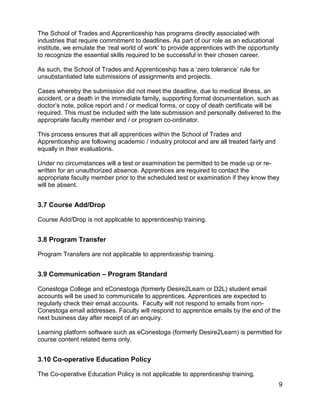
3.6 Evaluations (Deadlines, Tests and Examinations) – Program Standard
8
The School of Trades and Apprenticeship has programs directly associated with
industries that require commitment to deadlines. As part of our role as an educational
institute, we emulate the ‘real world of work’ to provide apprentices with the opportunity
to recognize the essential skills required to be successful in their chosen career.
As such, the School of Trades and Apprenticeship has a ‘zero tolerance’ rule for
unsubstantiated late submissions of assignments and projects.
Cases whereby the submission did not meet the deadline, due to medical illness, an
accident, or a death in the immediate family, supporting formal documentation, such as
doctor’s note, police report and / or medical forms, or copy of death certificate will be
required. This must be included with the late submission and personally delivered to the
appropriate faculty member and / or program co-ordinator.
This process ensures that all apprentices within the School of Trades and
Apprenticeship are following academic / industry protocol and are all treated fairly and
equally in their evaluations.
Under no circumstances will a test or examination be permitted to be made up or re-
written for an unauthorized absence. Apprentices are required to contact the
appropriate faculty member prior to the scheduled test or examination if they know they
will be absent.
3.7 Course Add/Drop
Course Add/Drop is not applicable to apprenticeship training.
3.8 Program Transfer
Program Transfers are not applicable to apprenticeship training.
3.9 Communication – Program Standard
Conestoga College and eConestoga (formerly Desire2Learn or D2L) student email
accounts will be used to communicate to apprentices. Apprentices are expected to
regularly check their email accounts. Faculty will not respond to emails from non-
Conestoga email addresses. Faculty will respond to apprentice emails by the end of the
next business day after receipt of an enquiry.
Learning platform software such as eConestoga (formerly Desire2Learn) is permitted for
course content related items only.
3.10 Co-operative Education Policy
The Co-operative Education Policy is not applicable to apprenticeship training.
9
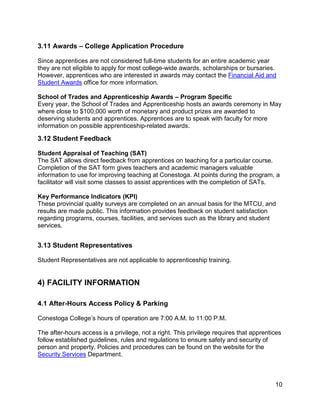
3.11 Awards – College Application Procedure
Since apprentices are not considered full-time students for an entire academic year
they are not eligible to apply for most college-wide awards, scholarships or bursaries.
However, apprentices who are interested in awards may contact the Financial Aid and
Student Awards office for more information.
School of Trades and Apprenticeship Awards – Program Specific
Every year, the School of Trades and Apprenticeship hosts an awards ceremony in May
where close to $100,000 worth of monetary and product prizes are awarded to
deserving students and apprentices. Apprentices are to speak with faculty for more
information on possible apprenticeship-related awards.
3.12 Student Feedback
Student Appraisal of Teaching (SAT)
The SAT allows direct feedback from apprentices on teaching for a particular course.
Completion of the SAT form gives teachers and academic managers valuable
information to use for improving teaching at Conestoga. At points during the program, a
facilitator will visit some classes to assist apprentices with the completion of SATs.
Key Performance Indicators (KPI)
These provincial quality surveys are completed on an annual basis for the MTCU, and
results are made public. This information provides feedback on student satisfaction
regarding programs, courses, facilities, and services such as the library and student
services.
3.13 Student Representatives
Student Representatives are not applicable to apprenticeship training.
4) FACILITY INFORMATION
4.1 After-Hours Access Policy & Parking
Conestoga College’s hours of operation are 7:00 A.M. to 11:00 P.M.
The after-hours access is a privilege, not a right. This privilege requires that apprentices
follow established guidelines, rules and regulations to ensure safety and security of
person and property. Policies and procedures can be found on the website for the
Security Services Department.
10
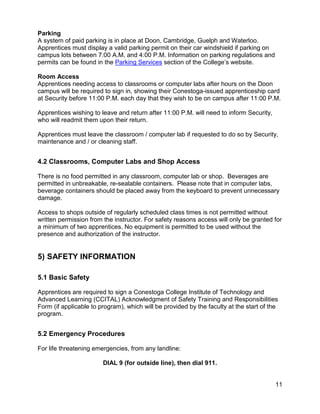
Parking
A system of paid parking is in place at Doon, Cambridge, Guelph and Waterloo.
Apprentices must display a valid parking permit on their car windshield if parking on
campus lots between 7:00 A.M. and 4:00 P.M. Information on parking regulations and
permits can be found in the Parking Services section of the College’s website.
Room Access
Apprentices needing access to classrooms or computer labs after hours on the Doon
campus will be required to sign in, showing their Conestoga-issued apprenticeship card
at Security before 11:00 P.M. each day that they wish to be on campus after 11:00 P.M.
Apprentices wishing to leave and return after 11:00 P.M. will need to inform Security,
who will readmit them upon their return.
Apprentices must leave the classroom / computer lab if requested to do so by Security,
maintenance and / or cleaning staff.
4.2 Classrooms, Computer Labs and Shop Access
There is no food permitted in any classroom, computer lab or shop. Beverages are
permitted in unbreakable, re-sealable containers. Please note that in computer labs,
beverage containers should be placed away from the keyboard to prevent unnecessary
damage.
Access to shops outside of regularly scheduled class times is not permitted without
written permission from the instructor. For safety reasons access will only be granted for
a minimum of two apprentices. No equipment is permitted to be used without the
presence and authorization of the instructor.
5) SAFETY INFORMATION
5.1 Basic Safety
Apprentices are required to sign a Conestoga College Institute of Technology and
Advanced Learning (CCITAL) Acknowledgment of Safety Training and Responsibilities
Form (if applicable to program), which will be provided by the faculty at the start of the
program.
5.2 Emergency Procedures
For life threatening emergencies, from any landline:
DIAL 9 (for outside line), then dial 911.
11
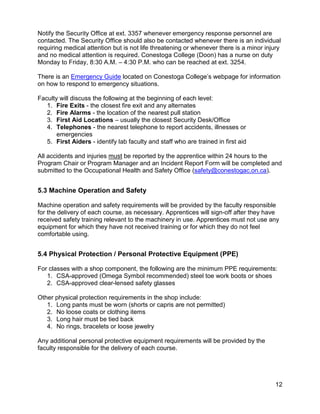
Notify the Security Office at ext. 3357 whenever emergency response personnel are
contacted. The Security Office should also be contacted whenever there is an individual
requiring medical attention but is not life threatening or whenever there is a minor injury
and no medical attention is required. Conestoga College (Doon) has a nurse on duty
Monday to Friday, 8:30 A.M. – 4:30 P.M. who can be reached at ext. 3254.
There is an Emergency Guide located on Conestoga College’s webpage for information
on how to respond to emergency situations.
Faculty will discuss the following at the beginning of each level:
1. Fire Exits - the closest fire exit and any alternates
2. Fire Alarms - the location of the nearest pull station
3. First Aid Locations – usually the closest Security Desk/Office
4. Telephones - the nearest telephone to report accidents, illnesses or
emergencies
5. First Aiders - identify lab faculty and staff who are trained in first aid
All accidents and injuries must be reported by the apprentice within 24 hours to the
Program Chair or Program Manager and an Incident Report Form will be completed and
submitted to the Occupational Health and Safety Office (safety@conestogac.on.ca).
5.3 Machine Operation and Safety
Machine operation and safety requirements will be provided by the faculty responsible
for the delivery of each course, as necessary. Apprentices will sign-off after they have
received safety training relevant to the machinery in use. Apprentices must not use any
equipment for which they have not received training or for which they do not feel
comfortable using.
5.4 Physical Protection / Personal Protective Equipment (PPE)
For classes with a shop component, the following are the minimum PPE requirements:
1. CSA-approved (Omega Symbol recommended) steel toe work boots or shoes
2. CSA-approved clear-lensed safety glasses
Other physical protection requirements in the shop include:
1. Long pants must be worn (shorts or capris are not permitted)
2. No loose coats or clothing items
3. Long hair must be tied back
4. No rings, bracelets or loose jewelry
Any additional personal protective equipment requirements will be provided by the
faculty responsible for the delivery of each course.
12
5.5 Student Protection Acknowledgement
A Student Protection Acknowledgement confirmation pop-up will appear after the
apprentice logs in to the Student Portal. A PDF will direct apprentices to the location of
related policies, procedures and program information. Apprentices will confirm that they
have been duly informed by Conestoga and attest to that fact by clicking the
acknowledgement box provided in the pop-up.
Once the acknowledgement box has been clicked, the apprentice may proceed to enter
the Student Portal. An email will be automatically generated and sent to the apprentice
recognizing their acknowledgement.
The Student Protection Acknowledgement confirmation pop-up will appear to all
apprentices and students once per academic year.
5.6 Required Supplies and Texts
Faculty members are responsible for distributing a suggested minimum tool list, where
applicable. Texts required for each course are included on the pertinent course outline.
6) CONESTOGA POLICIES AND PROCEDURES
6.1 Additional Resources
For additional information on campus and classroom policies, procedures and
guidelines, including the Academic Integrity and Copyright policies, please refer to the
following links to Conestoga College’s website:
Policies, Procedures and Guidelines
2014-2015 Student Guide
13

Instrumentation and control technician apprenticeship program handbook 2014 2015

  • 1.
    Instrumentation and ControlTechnician (447A) Apprenticeship 2014-2015 Program Handbook School of Trades and Apprenticeship Conestoga College Institute of Technology and Advanced Learning This handbook has been assembled specifically for Instrumentation and Control Technician apprentices at Conestoga College. This handbook is intended to supplement the Conestoga College Student Guide. All rules, guidelines and procedures in this handbook are in addition to those specified in the College’s Student Guide and reflect the School of Trades and Apprenticeship policies and procedures.
  • 2.
    Table of Contents Tableof Contents............................................................................................................ 2 1) PROGRAM ACADEMIC TEAM................................................................................ 3 1.1 Program Faculty .................................................................................................... 3 1.2 Support Services ................................................................................................... 3 2) PROGRAM OVERVIEW .......................................................................................... 4 2.1 Program Description.............................................................................................. 4 2.2 Program Learning Outcomes................................................................................. 4 2.3 Program Curriculum Sequence.............................................................................. 5 3) PROGRAM INFORMATION & STANDARDS .......................................................... 6 3.1 Academic Assistance............................................................................................. 6 3.2 Academic Dates..................................................................................................... 6 3.3 Credit Transfers..................................................................................................... 6 3.4 Academic Standing and Promotion Requirements – Program Standard ............... 7 3.5 Attendance - Program Standard ............................................................................ 8 3.6 Evaluations (Deadlines, Tests and Examinations) – Program Standard................ 8 3.7 Course Add/Drop................................................................................................... 9 3.8 Program Transfer................................................................................................... 9 3.9 Communication – Program Standard..................................................................... 9 3.10 Co-operative Education Policy............................................................................. 9 3.11 Awards – College Application Procedure........................................................... 10 3.12 Student Feedback.............................................................................................. 10 3.13 Student Representatives ................................................................................... 10 4) FACILITY INFORMATION ..................................................................................... 10 4.1 After-Hours Access Policy & Parking................................................................... 10 4.2 Classrooms, Computer Labs and Shop Access................................................... 11 5) SAFETY INFORMATION....................................................................................... 11 5.1 Basic Safety......................................................................................................... 11 5.2 Emergency Procedures ....................................................................................... 11 5.3 Machine Operation and Safety ............................................................................ 12 5.4 Physical Protection / Personal Protective Equipment (PPE)................................ 12 5.5 Student Protection Acknowledgement................................................................. 13 5.6 Required Supplies and Texts............................................................................... 13 6) CONESTOGA POLICIES AND PROCEDURES.................................................... 13 6.1 Additional Resources........................................................................................... 13 2
  • 3.
    1) PROGRAM ACADEMICTEAM Program Chair Rachel Banham | ATS Room 100 519-748-5220 ext. 3831 | rbanham@conestogac.on.ca Program Manager Joni Jean | ATS Room 101 519-748-5220 ext. 3460 | jjean@conestogac.on.ca Program Manager Brenda Gilmore | Guelph A3-4 519-824-9390 ext. 6122 | bgilmore@conestogac.on.ca Office Services Assistant Bridget Vaillancourt | ATS Room 103 519-748-5220 ext. 2300 | bvaillancourt@conestogac.on.ca 1.1 Program Faculty Program Co-ordinator Fred Germann | ATS Room 215 519-748-5220 ext. 2446 | fgermann@conestogac.on.ca Scott Douglas | ATS Room 220 519-748-5220 ext. 3778 | sdouglas1@conestogac.on.ca Bev Stone | ATS Room 231 519-748-5220 ext. 2303 | bstone@conestogac.on.ca Dale Mieczaniec | ATS Room 218 519-748-5220 ext. 3193 | dmieczaniec@conestogac.on.ca Chad Bishop | ATS Room 105 519-748-5220 ext. 2532 | cbishop@conestogac.on.ca 1.2 Support Services Apprenticeship Liaison 519-748-5220 ext. 2154 Records Officer Brenda Bender | SCSB - Office of the Registrar 519-748-5220 ext. 3244 | bbender@conestogac.on.ca 3
  • 4.
    Admissions Officer Darlene Lavigne| SCSB – Office of the Registrar 519-748-5220 ext. 2331 | dlavigne@conestogac.on.ca Technical Support IT Service Desk | Doon – 1E12 519-748-5220 ext. 3444 | itsdesk@conestogac.on.ca Ministry of Training, Colleges and Universities (MTCU) Apprenticeship | 4275 King St E, Suite 200, Kitchener ON N2P 2E9 800-387-5656 | kitchener.apprenticeship@ontario.ca Service Canada Employment Insurance 800-206-7218 | www.servicecanada.gc.ca Ontario College of Trades (OCOT) Member Services | 655 Bay St, Suite 600, Toronto ON M5G 2K4 855-299-0028 | info@collegeoftrades.ca For additional financial and other supports for apprentices and employers, students should visit Conestoga College’s website at: www.conestogac.on.ca/trades/apprentices. 2) PROGRAM OVERVIEW 2.1 Program Description This program combines theoretical knowledge together with the practical training necessary to complement the apprentice's on-the-job training. 2.2 Program Learning Outcomes 1. Select, install, operate, test, calibrate and maintain equipment for the measurement of process parameters, data acquisition and process control. 2. Assemble, test and troubleshoot controller systems 3. Interface components to form a control system. 4. Apply the principles of control to optimize systems. 5. Use problem solving techniques to configure and program Programmable logic controllers (PLC) and Distributed Control Systems (DCS), and troubleshoot DCS/PLC systems. 6. Complete all work in accordance with safety regulations, manufacturer's recommendations and industry standards. 4
  • 5.
    2.3 Program CurriculumSequence Apprentices are placed on a waitlist for school based on their ‘Program Start Date’ with the Ministry of Training, Colleges and Universities (MTCU). When it is the apprentice’s turn to go to school, the MTCU is responsible for mailing the “Offer of Classroom Training” to each apprentice approximately 90 days prior to the start date of class. Conestoga College does not control when an apprentice is sent an “Offer of Classroom Training”. In addition, the apprentice must be a member in good standing with the Ontario College of Trades (OCOT) throughout their apprenticeship in order to remain eligible to receive an “Offer of Classroom Training”. Apprentices are issued with an “Apprenticeship Training Standard” from the OCOT in which to track their competencies obtained on the job. Please note that faculty and staff at Conestoga College are not permitted to sign off any skills in the Training Standard. Current Program Design The following courses represent the in-school portion of the curriculum for the 447A program. Level Course Code Course Name Credits Hours 1 ELEC1500 Applied Trade Practices and Procedures 1 9 1 ELEC1510 Computers and Documentation 2 30 1 ELEC1520 Electrical Theory and Applied Trade Calculations I 4 63 1 ELEC1530 Electronic Systems I 4 63 1 ELEC1540 Instrumentation I 5 75 Total Credit Hours for this level 16 240 2 ELEC2150 Computer Control Systems 3 39 2 ELEC2160 Discrete Control 3 36 2 ELEC2170 Electrical Theory and Applied Trade Calculations II 3 48 2 ELEC2180 Instrumentation and Controls I 4 54 2 ELEC2190 Instrumentation II 4 63 Total Credit Hours for this level 17 240 3 ELEC3250 Analytical Instrumentation 3 36 3 ELEC3260 Applied Circuits 3 42 3 ELEC3270 Fluid Power Systems 2 30 3 ELEC3280 Instrumentation and Controls II 5 75 3 ELEC3290 Programmable Logic Controllers and Distributed Control Systems 4 57 Total Credit Hours for this level 17 240 Total Credit Hours for program 50 720 5
  • 6.
    3) PROGRAM INFORMATION& STANDARDS 3.1 Academic Assistance Academic assistance is available to apprentices through a variety of avenues. If an apprentice is struggling with the academic content in any course they are encouraged to speak with the Apprenticeship Liaison, relevant faculty or the Program Co-ordinator. The Apprenticeship Liaison is available to all apprentices and will provide one on one learning support or referrals to other services. Apprentices can also access the Learning Commons website for detailed information on the academic services they provide, including Learning Skills, Peer Services, Math and Writing assistance. Conestoga College is committed to providing a safe and accessible environment for apprentices with disabilities. Accommodating disabilities at the college is a shared responsibility between apprentices, faculty and administration. Apprentices are responsible for providing relevant and up to date documentation of their disability to Accessibility Services, when they first register. This documentation will allow the apprentice to be considered for accommodations and access to available services. 3.2 Academic Dates Follow the link for a listing of important academic dates for the current school year, including a list of holidays when classes are cancelled. Apprentices should be aware that programs within the School of Trades and Apprenticeship do not necessarily follow all of the listed dates. Speak with the Program Co-ordinator regarding program-specific dates, including Study Week, if applicable. 3.3 Credit Transfers Credits can be transferred for apprentices who have proven that they have comparable or equivalent learning in a formal educational environment. Course learning outcomes will be the criteria for determining exemptions. The notation of “G” is used for the grade. Note: When an apprentice moves from one Conestoga College program to another and where course numbers are identical, automatic credit is given if program passing grades are met. The course grade from the original course will stand. Previous work experience is not eligible under the Credit Transfer process. If an apprentice believes that they should be exempt from any complete level of in- school training they are to contact the MTCU for further guidance. 6
  • 7.
    3.4 Academic Standingand Promotion Requirements – Program Standard If for any reason an apprentice is concerned about their academic progress, they should arrange to meet with a full-time faculty member or the Program Co-ordinator. Apprentices must achieve a minimum passing grade of 70% in each and every course. Failure or withdrawal from any course will result in the apprentice not being eligible for the next level. Common Academic Decisions At the end of each level, the program team reviews apprentices’ grades. Below are the most common academic decisions issued by the program team: Eligible to Continue Apprentices that pass all reportable subjects (courses) are eligible to continue in the program. Decisions (Pending) Apprentices that fail one reportable subject (course) may request a supplemental assessment. Supplemental Assessment: Apprentices who have failed one course may request a supplemental assessment (a “make-up”). It is the apprentice’s responsibility to check the grade postings. It is not the responsibility of the instructor to seek out the apprentice and offer a supplemental. Supplemental assessments may be approved by faculty, or the program team, if the apprentice meets the following academic criteria: 1. No more than one failed course (F grade) in the level. 2. The failed course (F grade) was within 10 marks (10 percentage points – 60% to 69%) of the required passing grade of 70%. 3. Attended 80% or more of the classes in the course in question. 4. No more than one other supplemental assessment over the duration of the level. 5. Must have passed at least one formal evaluation in the course. The supplemental process must be completed within two weeks from the end of the level. To register for a supplemental, the apprentice must have an Authorization for Supplemental form completed and signed by the Program Co-ordinator and submit the appropriate fee ($40.00) to the Registrar’s Office. The apprentice must provide proof of fee payment at the time of the supplemental exam. Failure in the supplemental will result in no change to the original course grade. Successful completion of the supplemental evaluation will result in the minimum passing grade of 70% being awarded. The final grade as a result of the supplemental will be automatic and is ineligible for appeal. 7
  • 8.
    Discontinuance, Withdrawals andProbation The MTCU mandates that all apprentices must maintain 100% attendance in their in-school training. Apprentices who are marked absent for three occurrences may be discontinued from the level. Apprentices may also be discontinued from a level based on misconduct. For further information on discontinuance, withdrawals and probation, visit the Admissions section of the college website. 3.5 Attendance - Program Standard Apprentices are required to demonstrate the same attention to punctuality, attendance and safety as would be required by the business or industry in which they are or expect to be employed. Attendance for each course will be monitored. If an apprentice knows in advance that they will miss one or more classes (authorized absence), they must contact the faculty involved and let them know before the occurrence. An authorized absence is defined as, but not limited to, illness requiring the care of a doctor, death of an immediate family member, or severe weather. All other absences are considered unauthorized. Regardless of explanation, if an apprentice is absent they must contact the appropriate faculty or leave a message with the Office Services Assistant. In the event of an absence, it is the apprentice’s responsibility to make up the missed work. Due to limited shop / lab availability missed labs may result in a zero mark at the discretion of the faculty. Apprentices that arrive late for a scheduled class will be counted as absent immediately after the start of the class. Apprentices that leave early, prior to the dismissal time, will also be counted as absent. The School of Trades and Apprenticeship uses a ‘flag’ system to track unauthorized absences. The first missed class will result in a verbal warning. The second missed class will result in a ‘blue flag’ being issued. The third missed class will result in a ‘red flag’ being issued. At this point, a meeting will take place between the apprentice and Program Co-ordinator in consultation with MTCU and the apprentice runs the risk of being ineligible for supplemental assessment opportunities due to poor attendance as well as possible discontinuance in the program. If an apprentice is to be absent from class due to a religious holiday, arrangements must be made in advance in accordance with Conestoga College’s ‘Religious Holiday Policy and Procedure’. 3.6 Evaluations (Deadlines, Tests and Examinations) – Program Standard 8
  • 9.
    The School ofTrades and Apprenticeship has programs directly associated with industries that require commitment to deadlines. As part of our role as an educational institute, we emulate the ‘real world of work’ to provide apprentices with the opportunity to recognize the essential skills required to be successful in their chosen career. As such, the School of Trades and Apprenticeship has a ‘zero tolerance’ rule for unsubstantiated late submissions of assignments and projects. Cases whereby the submission did not meet the deadline, due to medical illness, an accident, or a death in the immediate family, supporting formal documentation, such as doctor’s note, police report and / or medical forms, or copy of death certificate will be required. This must be included with the late submission and personally delivered to the appropriate faculty member and / or program co-ordinator. This process ensures that all apprentices within the School of Trades and Apprenticeship are following academic / industry protocol and are all treated fairly and equally in their evaluations. Under no circumstances will a test or examination be permitted to be made up or re- written for an unauthorized absence. Apprentices are required to contact the appropriate faculty member prior to the scheduled test or examination if they know they will be absent. 3.7 Course Add/Drop Course Add/Drop is not applicable to apprenticeship training. 3.8 Program Transfer Program Transfers are not applicable to apprenticeship training. 3.9 Communication – Program Standard Conestoga College and eConestoga (formerly Desire2Learn or D2L) student email accounts will be used to communicate to apprentices. Apprentices are expected to regularly check their email accounts. Faculty will not respond to emails from non- Conestoga email addresses. Faculty will respond to apprentice emails by the end of the next business day after receipt of an enquiry. Learning platform software such as eConestoga (formerly Desire2Learn) is permitted for course content related items only. 3.10 Co-operative Education Policy The Co-operative Education Policy is not applicable to apprenticeship training. 9
  • 10.
    3.11 Awards –College Application Procedure Since apprentices are not considered full-time students for an entire academic year they are not eligible to apply for most college-wide awards, scholarships or bursaries. However, apprentices who are interested in awards may contact the Financial Aid and Student Awards office for more information. School of Trades and Apprenticeship Awards – Program Specific Every year, the School of Trades and Apprenticeship hosts an awards ceremony in May where close to $100,000 worth of monetary and product prizes are awarded to deserving students and apprentices. Apprentices are to speak with faculty for more information on possible apprenticeship-related awards. 3.12 Student Feedback Student Appraisal of Teaching (SAT) The SAT allows direct feedback from apprentices on teaching for a particular course. Completion of the SAT form gives teachers and academic managers valuable information to use for improving teaching at Conestoga. At points during the program, a facilitator will visit some classes to assist apprentices with the completion of SATs. Key Performance Indicators (KPI) These provincial quality surveys are completed on an annual basis for the MTCU, and results are made public. This information provides feedback on student satisfaction regarding programs, courses, facilities, and services such as the library and student services. 3.13 Student Representatives Student Representatives are not applicable to apprenticeship training. 4) FACILITY INFORMATION 4.1 After-Hours Access Policy & Parking Conestoga College’s hours of operation are 7:00 A.M. to 11:00 P.M. The after-hours access is a privilege, not a right. This privilege requires that apprentices follow established guidelines, rules and regulations to ensure safety and security of person and property. Policies and procedures can be found on the website for the Security Services Department. 10
  • 11.
    Parking A system ofpaid parking is in place at Doon, Cambridge, Guelph and Waterloo. Apprentices must display a valid parking permit on their car windshield if parking on campus lots between 7:00 A.M. and 4:00 P.M. Information on parking regulations and permits can be found in the Parking Services section of the College’s website. Room Access Apprentices needing access to classrooms or computer labs after hours on the Doon campus will be required to sign in, showing their Conestoga-issued apprenticeship card at Security before 11:00 P.M. each day that they wish to be on campus after 11:00 P.M. Apprentices wishing to leave and return after 11:00 P.M. will need to inform Security, who will readmit them upon their return. Apprentices must leave the classroom / computer lab if requested to do so by Security, maintenance and / or cleaning staff. 4.2 Classrooms, Computer Labs and Shop Access There is no food permitted in any classroom, computer lab or shop. Beverages are permitted in unbreakable, re-sealable containers. Please note that in computer labs, beverage containers should be placed away from the keyboard to prevent unnecessary damage. Access to shops outside of regularly scheduled class times is not permitted without written permission from the instructor. For safety reasons access will only be granted for a minimum of two apprentices. No equipment is permitted to be used without the presence and authorization of the instructor. 5) SAFETY INFORMATION 5.1 Basic Safety Apprentices are required to sign a Conestoga College Institute of Technology and Advanced Learning (CCITAL) Acknowledgment of Safety Training and Responsibilities Form (if applicable to program), which will be provided by the faculty at the start of the program. 5.2 Emergency Procedures For life threatening emergencies, from any landline: DIAL 9 (for outside line), then dial 911. 11
  • 12.
    Notify the SecurityOffice at ext. 3357 whenever emergency response personnel are contacted. The Security Office should also be contacted whenever there is an individual requiring medical attention but is not life threatening or whenever there is a minor injury and no medical attention is required. Conestoga College (Doon) has a nurse on duty Monday to Friday, 8:30 A.M. – 4:30 P.M. who can be reached at ext. 3254. There is an Emergency Guide located on Conestoga College’s webpage for information on how to respond to emergency situations. Faculty will discuss the following at the beginning of each level: 1. Fire Exits - the closest fire exit and any alternates 2. Fire Alarms - the location of the nearest pull station 3. First Aid Locations – usually the closest Security Desk/Office 4. Telephones - the nearest telephone to report accidents, illnesses or emergencies 5. First Aiders - identify lab faculty and staff who are trained in first aid All accidents and injuries must be reported by the apprentice within 24 hours to the Program Chair or Program Manager and an Incident Report Form will be completed and submitted to the Occupational Health and Safety Office (safety@conestogac.on.ca). 5.3 Machine Operation and Safety Machine operation and safety requirements will be provided by the faculty responsible for the delivery of each course, as necessary. Apprentices will sign-off after they have received safety training relevant to the machinery in use. Apprentices must not use any equipment for which they have not received training or for which they do not feel comfortable using. 5.4 Physical Protection / Personal Protective Equipment (PPE) For classes with a shop component, the following are the minimum PPE requirements: 1. CSA-approved (Omega Symbol recommended) steel toe work boots or shoes 2. CSA-approved clear-lensed safety glasses Other physical protection requirements in the shop include: 1. Long pants must be worn (shorts or capris are not permitted) 2. No loose coats or clothing items 3. Long hair must be tied back 4. No rings, bracelets or loose jewelry Any additional personal protective equipment requirements will be provided by the faculty responsible for the delivery of each course. 12
  • 13.
    5.5 Student ProtectionAcknowledgement A Student Protection Acknowledgement confirmation pop-up will appear after the apprentice logs in to the Student Portal. A PDF will direct apprentices to the location of related policies, procedures and program information. Apprentices will confirm that they have been duly informed by Conestoga and attest to that fact by clicking the acknowledgement box provided in the pop-up. Once the acknowledgement box has been clicked, the apprentice may proceed to enter the Student Portal. An email will be automatically generated and sent to the apprentice recognizing their acknowledgement. The Student Protection Acknowledgement confirmation pop-up will appear to all apprentices and students once per academic year. 5.6 Required Supplies and Texts Faculty members are responsible for distributing a suggested minimum tool list, where applicable. Texts required for each course are included on the pertinent course outline. 6) CONESTOGA POLICIES AND PROCEDURES 6.1 Additional Resources For additional information on campus and classroom policies, procedures and guidelines, including the Academic Integrity and Copyright policies, please refer to the following links to Conestoga College’s website: Policies, Procedures and Guidelines 2014-2015 Student Guide 13