Instructions to Authors
Journal of Global Infectious Diseases (JGID) a peer-
reviewed Semiannual international journal is being published under the
auspices of the International Infectiologists Network .
The journal’s full text is online at www.jgid.org With the aim of faster and
better dissemination of knowledge, we will be publishing articles ‘Ahead of
Print’ immediately on acceptance. In addition, the journal would allow free
access (Open Access) to its contents, which is likely to attract more readers
and citations to articles published in JGID.
Manuscripts must be prepared in accordance with "Uniform requirements
for Manuscripts submitted to Biomedical Journals" developed by the
International Committee of Medical Journal Editors (October 2006). The
uniform requirements and specific requirement of JGID are summarized
below. Before sending a manuscript contributors are requested to check for
the latest instructions available. Instructions are also available from the
website of the journal (http://www.jgid.org) and from the manuscript
submission site (http://www.journalonweb.com/JGID).
   Scope of the journal
JGID encourages research, education and dissemination of knowledge in the
field of Infectious Diseases across the world thus promoting translational
research by striking a synergy between basic science, clinical medicine and
public health. The Journal intends to bring together scientists and
academicians in Infectious Diseases to promote translational synergy
between Laboratory Science, Clinical Medicine and Public Health. The
Journal invites Original Articles, Clinical Investigations, Epidemiological
Analysis, Data Protocols, Case Reports, Clinical Photographs, review articles
and special commentaries. Students, Residents, Academicians, Public
Health experts and scientists are all encouraged to be a part of this
initiative by contributing, reviewing and promoting scientific works and
science 
 
   The Editorial Process
The manuscripts will be reviewed for possible publication with the
understanding that they are being submitted to one journal at a time and
have not been published, simultaneously submitted, or already accepted for
publication elsewhere.
The Editors review all submitted manuscripts initially. Manuscripts with
insufficient originality, serious scientific and technical flaws, or lack of a
significant message are rejected. All manuscripts received are duly
acknowledged. Manuscripts are sent to two or more expert reviewers
without revealing the identity of the contributors to the reviewers. Each
manuscript is also assigned to a member of the editorial team, who based
on the comments from the reviewers takes a final decision on the
manuscript. The contributors will be informed about the reviewers'
comments and acceptance/rejection of manuscript.
Articles accepted would be copy edited for grammar, punctuation, print
style, and format. Page proofs will be sent to the corresponding author,
which has to be returned within three days. Correction received after that
period may not be included. 
 
   Authorship Criteria
Authorship credit should be based only on substantial contributions
1. Conception and design or acquisition of data or analysis and
interpretation of data;
2. Drafting the article or revising it critically for important intellectual
content;
3. Final approval of the version to be published.
Conditions 1, 2, and 3 must be met. Participation solely in the acquisition of
funding or the collection of data does not justify authorship. General
supervision of the research group is not sufficient for authorship. Each
contributor should have participated sufficiently in the work to take public
responsibility for appropriate portions of the content. The order of naming
the contributors should be based on the relative contribution of the
contributor towards the study and writing the manuscript. Once submitted
the order cannot be changed without written consent of all the
contributors.
For a study from in a single institute the number of contributors should not
exceed six. For a case-report, images, letter to the editor and review
article the number of contributors should not exceed four. A justification
should be included, if the number of contributors exceeds these limits.
Only those who have done substantial work in a particular field can write a review article. A short summary of the
work done by the contributor(s) in the field of review should accompany the manuscript. The journal expects the
contributors to give post-publication updates on the subject of review. The update should be brief, covering the
advances in the field after the publication of article and should be sent as a letter to editor, as and when major
development occurs in the field.
 
   Contribution Details
Contributors should provide a description of what each of them contributed towards the manuscript. Description should be
divided in following categories, as applicable: concepts, design, definition of intellectual content, literature search, clinical
studies, experimental studies, data acquisition, data analysis, statistical analysis, manuscript preparation, manuscript
editing and manuscript review. Authors' contributions will be printed on the first page of the article. One or more author
should take responsibility of the integrity of the work as a whole from inception to published article and should be
designated as 'guarantor'.
   Conflicts of Interest
All authors of submitting articles to the journal must disclose any conflict of interest they may have with an institution or
product that is mentioned in the manuscript and/or is important to the outcome of the study presented. Authors should
also disclose conflict of interest with products that compete with those mentioned in their manuscript. The Editor will
discuss with the authors on an individual basis the method by which any conflicts of interest will be communicated to the
readers.
   Copies of any permission(s)
To reproduce published material, and to use illustrations or report
information about identifiable people a copy of the permission obtained
must accompany the manuscript. Copies of any and all published articles or
other manuscripts in preparation or submitted elsewhere that are related to
the manuscript must also accompany the manuscript. The manuscript should
be sent to
Journal of Global Infectious Diseases
C/O: Dr Ricardo Izurieta
Department of Global Health
MDC 56 College of Public Health
12901 Bruce B Downs Blvd, Tampa, Florida, 33612, USA
   Types of Manuscripts and Limits
 Original articles: Randomized controlled trials, intervention studied,
studies of screening and diagnostic test, outcome studies, cost
effectiveness analyses, case-control series, and surveys with high
response rate. Up to 3000 words excluding about 30 references and
abstract.
 Review articles (including for Ethics forum, Education forum, E-
Medicine, etc.): Systemic critical assessments of literature and data
sources. Up to 4000 words excluding about 90 references and abstract.
For review articles, include the method (literature search) in abstract
as well as in the introduction section.
 Case reports: new/interesting/very rare cases can be reported. Cases
with clinical significance or implications will be given priority.
However, mere reporting of a rare case may not be considered. Up to
1000 words excluding references and abstract and up to 10 references.
 Images in medicine: a short history, photograph, differential
diagnosis, and short discussion of classic and/or rare case. Should not
be more than 800 words excluding up to six references. .
 Letter to the Editor: Should be short, decisive observation. They
should not be preliminary observations that need a later paper for
validation. Up to 500 words and 5 references.
 Announcements of conferences, meetings, courses, and other items
likely to be of interest to the readers should be submitted with the
name and address of the person from whom additional information can
be obtained.
Editorial, Guest Editorial, Commentary, Expert’s Comments and Symposia articles are solicited by the editorial board.
   Online Submission of the Manuscripts
All manuscripts must be submitted on-line through the
website www.journalonweb.com/jgid . First time users will have to register
at this site. Registered authors can keep track of their articles after logging
into the site using their user name and password. Authors do not have to
pay for submission, processing or publication of articles. If you experience
any problems, please contact our editorial office by e-mail at editor @ jgid .
org .
The contributor may provide names of two or three qualified reviewers who
have had experience in the subject of the submitted manuscript, but who
are not affiliated with the same institutes as the contributor/s. However,
the selection of these reviewers is at the sole discretion of the editor.
When you submit an article, the following items must be included.
Manuscripts that do not adhere to the following instructions will be
returned to the corresponding author for technical revision before
undergoing peer review.
1. Unblinded Title Page/First Page File/covering letter: All information
which can reveal your identity should be here. Use text/rtf/doc files.
Do not zip the files. Provide the highest degree of each author. The
covering letter must include:
a. A full statement to the editor about all submissions and previous
reports that might be regarded as redundant publication of the
same or very similar work. Any such work should be referred to
specifically, and referenced in the new paper. Copies of such
material should be included with the submitted paper, to help the
editor decide how to handle the matter.
b. A statement of financial or other relationships that might lead to
a conflict of interest, if that information is not included in the
manuscript itself or in an authors' form
c. A statement that the manuscript has been read and approved by
all the authors, that the requirements for authorship as stated
earlier in this document have been met, and that each author
believes that the manuscript represents honest work, if that
information is not provided in another form (see below); and
d. The name, address, telephone number and email of the
corresponding author, who is responsible for communicating with
the other authors about revisions and final approval of the proofs,
if that information is not included on the manuscript itself.
2. Blinded Article file: Journal of Global Infectious Diseases has a policy
of blinded peer review. The manuscript must not contain any mention
of the authors' names or initials or the institution at which the study
was done or acknowledgements. Page headers/running title can
include the title but not the authors' names. Manuscripts not in
compliance with The Journal's blinding policy will be returned to the
corresponding author. The main text of the article, beginning from
Abstract till References (including tables) should be in this file. Use
rtf/doc files. Do not zip the files. Limit the file size to 400 kb. Do not
incorporate images in the file. If file size is large, graphs can be
submitted as images separately without incorporating them in the
article file to reduce the size of the file.
3. Images: Submit good quality color images. Each image should be less
than 400 kb in size. Size of the image can be reduced by decreasing
the actual height and width of the images (keep up to 1024 x 760
pixels or 4-5 inches). Image format jpeg is acceptable. Do not zip the
files.
4. Legends: Legends for the figures/images should be included at the end
of the article file.
The contributors' form and copyright transfer form (template provided below) has to be submitted in original with the
signatures of all the contributors within two weeks from submission via courier, fax or email as a scanned image. Hard
copies of the images (one set), for articles submitted online, should be sent to the journal office only if the article is
accepted or if the editor requests for them.
   Preparation of the Manuscript
The text of original articles should be divided into sections with the
headings: Abstract, Key-words, Introduction, Materials and Methods,
Results, Discussion, References, Tables and Figure legends. For a brief
report include Abstract, Key-words Introduction, Case report, Discussion,
Reference, Tables and Legends in that order. Do not use subheadings in
these sections. Use double spacing throughout. Number pages
consecutively, beginning with the title page. The language should be
American English.
Title Page
The title page should carry 
1. Type of manuscript (e.g. Original article, Case Report)
2. The title of the article, which should be concise, but informative;
3. Running title or short title not more than 50 characters;
4. The name by which each contributor is known (Last name, First name
and initials of middle name), with his or her highest academic
degree(s) and institutional affiliation;
5. The name of the department(s) and institution(s) to which the work
should be attributed;
6. The name, address, phone numbers, facsimile numbers and e-mail
address of the contributor responsible for correspondence about the
manuscript;
7. The total number of pages, total number of photographs and word
counts separately for abstract and for the text (excluding the
references and abstract);
8. Source(s) of support in the form of grants, equipment, drugs, or all of
these;
9. Acknowledgement, if any; one or more statements should specify 1)
contributions that need acknowledging but do not justify authorship,
such as general support by a departmental chair; 2) acknowledgments
of technical help; and 3) acknowledgments of financial and material
support, which should specify the nature of the support. This should be
included in the title page of the manuscript and not in the main article
file.
10. If the manuscript was presented as part at a meeting, the
organization, place, and exact date on which it was read.
Abstract Page
The second page should carry the full title of the manuscript and an
abstract (of no more than 150 words for brief reports and 250 words for
original articles and other article types). The abstract should be structured
for original articles. State the context (background), aims, settings and
design, materials and methods, statistical analysis used, results and
conclusions. Below the abstract should provide 3 to 8 keywords. The
abstract should not be structured for a brief report, review article,
symposia and research methodology. Do not include references in abstract.
Introduction
State the purpose and summarize the rationale for the study or observation.
Materials and Methods
The Methods section should only include information that was available
at the time the study was planned or protocol written; all information
obtained during the conduct of the study belongs to the results section. 
Selection and Description of Participants: Describe your selection of the
observational or experimental participants (patients or laboratory
animals, including controls) clearly, including eligibility and exclusion
criteria and a description of the source population. Because the
relevance of such variables as age and sex to the object of research is
not always clear, authors should explain their use when they are
included in a study report; for example, authors should explain why only
subjects of certain ages were included or why women were excluded.
The guiding principle should be clarity about how and why a study was
done in a particular way. When authors use variables such as race or
ethnicity, they should define how they measured the variables and
justify their relevance.
Technical information: Identify the methods, apparatus (give the
manufacturer's name and address in parentheses), and procedures in
sufficient detail to allow other workers to reproduce the results. Give
references to established methods, including statistical methods (see
below); provide references and brief descriptions for methods that have
been published but are not well known; describe new or substantially
modified methods, give reasons for using them, and evaluate their
limitations. Identify precisely all drugs and chemicals used, including
generic name(s), dose(s), and route(s) of administration.
Reports of randomized clinical trials should present information on all
major study elements, including the protocol, assignment of
interventions (methods of randomization, concealment of allocation to
treatment groups), and the method of masking (blinding), based on the
CONSORT Statement ( http://www.consort-statement.org ).
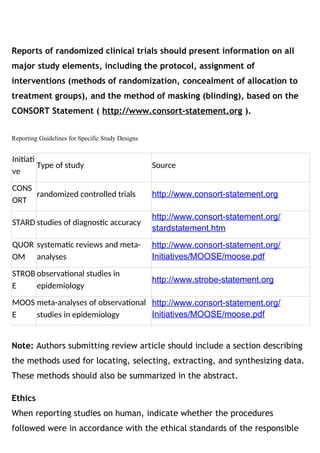
Reporting Guidelines for Specific Study Designs
Initiati
ve
Type of study Source
CONS
ORT
randomized controlled trials http://www.consort-statement.org
STARD studies of diagnostic accuracy 
http://www.consort-statement.org/
stardstatement.htm
QUOR
OM
systematic reviews and meta-
analyses
http://www.consort-statement.org/
Initiatives/MOOSE/moose.pdf
STROB
E
observational studies in
epidemiology
http://www.strobe-statement.org
MOOS
E 
meta-analyses of observational
studies in epidemiology 
http://www.consort-statement.org/
Initiatives/MOOSE/moose.pdf
Note: Authors submitting review article should include a section describing
the methods used for locating, selecting, extracting, and synthesizing data.
These methods should also be summarized in the abstract.
Ethics
When reporting studies on human, indicate whether the procedures
followed were in accordance with the ethical standards of the responsible
committee on human experimentation (institutional or regional) and with
the Helsinki Declaration of 1975, as revised in 2000 (available
at http://www.wma.net/e/policy/17-c_e.html ). Do not use patients’ names,
initials, or hospital numbers, especially in illustrative material. When
reporting experiments on animals, indicate whether the institution’s or a
national research council’s guide for, or any national law on the care and
use of laboratory animals was followed. 
Evidence for approval by a local Ethics Committee (for both human as well
as animal studies) must be supplied by the authors on demand. Animal
experimental procedures should be as humane as possible and the details of
anesthetics and analgesics used should be clearly stated. The ethical
standards of experiments must be in accordance with the guidelines
provided by the CPCSEA (animal) and ICMR (human). The journal will not
consider any paper which is ethically unacceptable. A statement on ethics
committee permission and ethical practices must be included in all research
articles under the ‘Materials and Methods’ section.
Statistics
Whenever possible quantify findings and present them with appropriate
indicators of measurement error or uncertainty (such as confidence
intervals). Report losses to observation (such as dropouts from a clinical
trial). When data are summarized in the Results section, specify the
statistical methods used to analyze them. Avoid non-technical uses of
technical terms in statistics, such as 'random' (which implies a randomizing
device), 'normal', 'significant', 'correlations', and 'sample'. Define statistical
terms, abbreviations, and most symbols. Specify the computer software
used. Use upper italics (P 0.048). For all P values include the exact value
and not less than 0.05 or 0.001.
Results
Present your results in a logical sequence in the text, tables, and
illustrations, giving the main or most important findings first. Do not repeat
in the text all the data in the tables or illustrations; emphasize or
summarize only important observations. Extra or supplementary materials
and technical detail can be placed in an appendix where it will be
accessible but will not interrupt the flow of the text; alternatively, it can
be published only in the electronic version of the journal.
When data are summarized in the Results section, give numeric results not
only as derivatives (for example, percentages) but also as the absolute
numbers from which the derivatives were calculated, and specify the
statistical methods used to analyze them. Restrict tables and figures to
those needed to explain the argument of the paper and to assess its
support. Use graphs as an alternative to tables with many entries; do not
duplicate data in graphs and tables. "Where scientifically appropriate,
analyses of the data by variables such as age and sex should be included.
Discussion
Include summary of key findings (primary outcome measures, secondary
outcome measures, results as they relate to a prior hypothesis); Strengths
and limitations of the study (study question, study design, data collection,
analysis and interpretation); Interpretation and implications in the context
of the totality of evidence (is there a systematic review to refer to, if not,
could one be reasonably done here and now?, what this study adds to the
available evidence, effects on patient care and health policy, possible
mechanisms); Controversies raised by this study; and Future research
directions (for this particular research collaboration, underlying
mechanisms, clinical research). 
Do not repeat in detail data or other material given in the Introduction or
the Results section. In particular, contributors should avoid making
statements on economic benefits and costs unless their manuscript includes
economic data and analyses. Avoid claiming priority and alluding to work
that has not been completed. State new hypotheses when warranted, but
clearly label them as such.
References
References should be numbered consecutively in the order in which they are
first mentioned in the text (not in alphabetic order). Identify references in
text, tables, and legends by Arabic numerals in superscript with square
bracket after the punctuation marks. References cited only in tables or
figure legends should be numbered in accordance with the sequence
established by the first identification in the text of the particular table or
figure. Use the style of the examples below, which are based on the formats
used by the NLM in Index Medicus. The titles of journals should be
abbreviated according to the style used in Index Medicus. Use complete
name of the journal for non-indexed journals. Avoid using abstracts as
references. Information from manuscripts submitted but not accepted
should be cited in the text as "unpublished observations" with written
permission from the source. Avoid citing a "personal communication" unless
it provides essential information not available from a public source, in
which case the name of the person and date of communication should be
cited in parentheses in the text. 
The commonly cited types of references are shown here, for other types of
references such as electronic media; newspaper items, etc. please refer to
ICMJE Guidelines
(http://www.icmje.org orhttp://www.nlm.nih.gov/bsd/uniform_requirements.htm
l). 
Articles in Journals
a. Standard journal article: Bavdekar SB, Gogtay NJ, Muzumdar D,
Vaideeswar P, Salvi V, Sarkar M. The path ahead. J Postgrad Med
2007;53:153-3
List the first six contributors followed by et al.
b. Volume with supplement: Shen HM, Zhang QF. Risk assessment of
nickel carcinogenicity and occupational lung cancer. Environ Health
Perspect 1994; 102 Suppl 1:275-82.
c. Issue with supplement: Payne DK, Sullivan MD, Massie MJ. Women's
psychological reactions to breast cancer. Semin Oncol 1996; 23(1,
Suppl 2):89-97.
Books and Other Monographs
a. Personal author(s): Ringsven MK, Bond D. Gerontology and leadership
skills for nurses. 2nd ed. Albany (NY): Delmar Publishers; 1996.
b. Editor(s), compiler(s) as author: Norman IJ, Redfern SJ, editors. Mental
health care for elderly people. New York: Churchill Livingstone; 1996.
c. Chapter in a book: Phillips SJ, Whisnant JP. Hypertension and stroke.
In: Laragh JH, Brenner BM, editors. Hypertension: pathophysiology,
diagnosis, and management. 2nd ed. New York: Raven Press; 1995. pp.
465-78.
Tables
 Tables should be self-explanatory and should not duplicate textual
material.
 Tables with more than 10 columns and 25 rows are not acceptable.
 Number tables, in Arabic numerals, consecutively in the order of their
first citation in the text and supply a brief title for each.
 Place explanatory matter in footnotes, not in the heading.
 Explain in footnotes all non-standard abbreviations that are used in
each table.
 Obtain permission for all fully borrowed, adapted, and modified tables
and provide a credit line in the footnote.
 For footnotes use the following symbols, in this sequence: *, †, ‡, §,
||,¶ , **, ††, ‡‡
 Tables with their legends should be provided at the end of the text
after the references. The tables along with their number should be
cited at the relevant place in the text
Illustrations (Figures)
 Upload the images in JPEG format. The file size should be within 400
kb in size while uploading. Send sharp, glossy, un-mounted, color
photographic prints, with height of 4 inches and width of 6 inches at
the time of submitting the revised manuscript.
 Figures should be numbered consecutively according to the order in
which they have been first cited in the text.
 Labels, numbers, and symbols should be clear and of uniform size. The
lettering for figures should be large enough to be legible after
reduction to fit the width of a printed column.
 Symbols, arrows, or letters used in photomicrographs should contrast
with the background and should marked neatly with transfer type or by
tissue overlay and not by pen.
 Titles and detailed explanations belong in the legends for illustrations
not on the illustrations themselves.
 When graphs, scatter-grams or histograms are submitted the numerical
data on which they are based should also be supplied.
 The photographs and figures should be trimmed to remove all the
unwanted areas.
 If photographs of people are used, either the subjects must not be
identifiable or their pictures must be accompanied by written
permission to use the photograph.
 If a figure has been published elsewhere, acknowledge the original
source and submit written permission from the copyright holder to
reproduce the material. A credit line should appear in the legend for
such figures.
 Legends for illustrations: Type or print out legends (maximum 40
words, excluding the credit line) for illustrations using double spacing,
with Arabic numerals corresponding to the illustrations. When symbols,
arrows, numbers, or letters are used to identify parts of the
illustrations, identify and explain each one in the legend. Explain the
internal scale (magnification) and identify the method of staining in
photomicrographs.
 Final figures for print production: Print outs of digital photographs are
not acceptable. If digital images are the only source of images, ensure
that the image has minimum resolution of 300 dpi or 1800 x 1600 pixels
in TIFF format. Send the images on a CD. Each figure should have a
label pasted (avoid use of liquid gum for pasting) on its back indicating
the number of the figure, the running title, top of the figure and the
legends of the figure. Do not write the contributor/s' name/s. Do not
write on the back of figures, scratch, or mark them by using paper
clips.
 The Journal reserves the right to crop, rotate, reduce, or enlarge the
photographs to an acceptable size.
Protection of Patients' Rights to Privacy
Identifying information should not be published in written descriptions,
photographs, sonograms, CT scans, etc., and pedigrees unless the
information is essential for scientific purposes and the patient (or parent or
guardian) gives written informed consent for publication. Authors should
mask patients' eyes and remove patients' names from figures unless they
obtain written consent from the patients and submit written consent with
the manuscript. When informed consent has been obtained, it should be
indicated in the article and copy of the consent should be attached with the
covering letter.
Case Reports
Case reports must meet all of the following criteria:
1. the case should be one that is highly unusual, very unique,
underreported in the literature and;
2. the case report must present as a challenging diagnostic and
therapeutic problem and;
3. the case report must have significant educational value including the
ability to perhaps change a clinician's traditional method of handling
such a case and;
4. the case report's interest to the reader should be significant.
Preparation of Case Reports
Follow the standard format for the article (Abstract, Key-words, Introduction, Case History, Discussion and References).
   Sending a revised manuscript
While submitting a revised manuscript, contributors are requested to include, the ‘referees’ remarks along with point to
point clarification at the beginning in the revised file itself. In addition, mark the changes as underlined or colored text in
the article. A photocopy of the first page of all the cited references (articles and books) can be asked by the journal to verify
the references.
   Reprints
Journal provides no free printed reprints. Authors can purchase reprints, payment for which should be done at the time of
submitting the proofs.
   Manuscript submission, processing and publication charges
Journal charges (200 USD/2000 INR) for short articles and (400 USD/4000 INR) for long articles to authors or
authors’ institutions for publications of papers.
   Copyrights
The whole of the literary matter in the JGID is copyright protected.
   Checklist
Covering letter
 Signed by all contributors
 Previous publication / presentations mentioned
 Source of funding mentioned
 Conflicts of interest disclosed
Authors
 Middle name initials provided
 Author for correspondence, with e-mail address provided
 Number of contributors restricted as per the instructions
 Identity not revealed in paper except title page (e.g. name of the
institute in Methods, citing previous study as 'our study', names on
figure labels, name of institute in photographs, etc.)
Presentation and format
 Double spacing
 Margins 2.5 cm from all four sides
 Title page contains all the desired information
 Running title provided (not more than 50 characters)
 Abstract page contains the full title of the manuscript
 Abstract provided (about 150 words for case reports and 250 words for
original articles)
 Structured abstract provided for an original article
 Key words provided (three or more)
 Introduction of 75-100 words
 Headings in title case (not ALL CAPITALS)
 The references cited in the text should be after punctuation marks, in
superscript with square bracket.
 References according to the journal's instructions, punctuation marks
checked
 Send the final article file without ‘Track Changes’
Language and grammar
 Uniformly American English
 Write the full term for each abbreviation at its first use in the title,
abstract, keywords and text separately unless it is a standard unit of
measure. Numerals from 1 to 10 spelt out
 Numerals at the beginning of the sentence spelt out
 Check the manuscript for spelling, grammar and punctuation errors
 If a brand name is cited, supply the manufacturer's name and address
(city and state/country).
 Species names should be in italics
Tables and figures
 No repetition of data in tables and graphs and in text
 Actual numbers from which graphs drawn, provided
 Figures necessary and of good quality (colour)
 Table and figure numbers in Arabic letters (not Roman)
 Labels pasted on back of the photographs (no names written)
 Figure legends provided (not more than 40 words)
 Patients' privacy maintained (if not permission taken)
 Credit note for borrowed figures/tables provided
 Write the full term for each abbreviation used in the table as a footnote
   Contributors' form
(to be modified as applicable and one signed copy attached with the
manuscript)
Manuscript Title: _________________________________________________
I/we certify that I/we have participated sufficiently in the intellectual
content, conception and design of this work or the analysis and
interpretation of the data (when applicable), as well as the writing of the
manuscript, to take public responsibility for it and have agreed to have my/
our name listed as a contributor. 
I/we believe the manuscript represents valid work. Neither this manuscript
nor one with substantially similar content under my/our authorship has
been published or is being considered for publication elsewhere, except as
described in the covering letter. I/we certify that all the data collected
during the study is presented in this manuscript and no data from the study
has been or will be published separately. I/we attest that, if requested by
the editors, I/we will provide the data/information or will cooperate fully
in obtaining and providing the data/information on which the manuscript is
based, for examination by the editors or their assignees. Financial interests,
direct or indirect, that exist or may be perceived to exist for individual
contributors in connection with the content of this paper have been
disclosed in the cover letter. Sources of outside support of the project are
named in the cover letter. 
I/We hereby transfer(s), assign(s), or otherwise convey(s) all copyright
ownership, including any and all rights incidental thereto, exclusively to the
Journal of Global Infectious Diseases, in the event that such work is
published by the Journal of Global Infectious Diseases. The Journal of
Global Infectious Diseases shall own the work, including
1. copyright;
2. the right to grant permission to republish the article in whole or in
part, with or without fee;
3. the right to produce preprints or reprints and translate into languages
other than English for sale or free distribution; and
4. the right to republish the work in a collection of articles in any other
mechanical or electronic format.
We give the rights to the corresponding author to make necessary changes
as per the request of the journal, do the rest of the correspondence on our
behalf and he/she will act as the guarantor for the manuscript on our
behalf.
All persons who have made substantial contributions to the work reported in
the manuscript, but who are not contributors, are named in the
Acknowledgment and have given me/us their written permission to be
named. If I/we do not include an Acknowledgment that means I/we have
not received substantial contributions from non-contributors and no
contributor has been omitted. 
Name Signature Date signed
1 ------------ --------- ---------------
2 ------------ --------- ---------- -----
3 ------------ --------- ---------- -----
4 ------------ --------- ---------- ----- (up to 4 contributors for case
report/images/review)
5 ------------ --------- ---------- -----
6 ------------ --------- ---------- ----- (up to 6 contributors for original studies)
Journal Books
Storyboard
Sketch Book
Acts Of Kindness Tracker
Bill Reminder
Asymmetric Graph Paper
Scuba Diving
Prayer List
School Timetable
Personal Expense Tracker 
Music Sheet
Notes
Outfit Planner
Easy Password Tracker 
Music Album Review
Gratitude Journal
Monthly Planner
Mileage Log 
Lesson Planner
House Sitting Guide Pet Information
Inventory List
Guest List Wedding Planner 
Habit Tracker
Half Graph 4 Half College
Graph Paper 1 cm
Fishing Log
Food Journal
Day Planner
Expenses
Dot Graph
Garden Planting
College Ruled Notebook
blood pressure log
Projects To Complete

Instructions to Authors

  • 1.
    Instructions to Authors Journalof Global Infectious Diseases (JGID) a peer- reviewed Semiannual international journal is being published under the auspices of the International Infectiologists Network . The journal’s full text is online at www.jgid.org With the aim of faster and better dissemination of knowledge, we will be publishing articles ‘Ahead of Print’ immediately on acceptance. In addition, the journal would allow free access (Open Access) to its contents, which is likely to attract more readers and citations to articles published in JGID. Manuscripts must be prepared in accordance with "Uniform requirements for Manuscripts submitted to Biomedical Journals" developed by the International Committee of Medical Journal Editors (October 2006). The uniform requirements and specific requirement of JGID are summarized below. Before sending a manuscript contributors are requested to check for the latest instructions available. Instructions are also available from the website of the journal (http://www.jgid.org) and from the manuscript submission site (http://www.journalonweb.com/JGID).    Scope of the journal JGID encourages research, education and dissemination of knowledge in the field of Infectious Diseases across the world thus promoting translational research by striking a synergy between basic science, clinical medicine and public health. The Journal intends to bring together scientists and academicians in Infectious Diseases to promote translational synergy between Laboratory Science, Clinical Medicine and Public Health. The Journal invites Original Articles, Clinical Investigations, Epidemiological
  • 2.
    Analysis, Data Protocols,Case Reports, Clinical Photographs, review articles and special commentaries. Students, Residents, Academicians, Public Health experts and scientists are all encouraged to be a part of this initiative by contributing, reviewing and promoting scientific works and science       The Editorial Process The manuscripts will be reviewed for possible publication with the understanding that they are being submitted to one journal at a time and have not been published, simultaneously submitted, or already accepted for publication elsewhere. The Editors review all submitted manuscripts initially. Manuscripts with insufficient originality, serious scientific and technical flaws, or lack of a significant message are rejected. All manuscripts received are duly acknowledged. Manuscripts are sent to two or more expert reviewers without revealing the identity of the contributors to the reviewers. Each manuscript is also assigned to a member of the editorial team, who based on the comments from the reviewers takes a final decision on the manuscript. The contributors will be informed about the reviewers' comments and acceptance/rejection of manuscript. Articles accepted would be copy edited for grammar, punctuation, print style, and format. Page proofs will be sent to the corresponding author, which has to be returned within three days. Correction received after that period may not be included.   
  • 3.
       Authorship Criteria Authorship creditshould be based only on substantial contributions 1. Conception and design or acquisition of data or analysis and interpretation of data; 2. Drafting the article or revising it critically for important intellectual content; 3. Final approval of the version to be published. Conditions 1, 2, and 3 must be met. Participation solely in the acquisition of funding or the collection of data does not justify authorship. General supervision of the research group is not sufficient for authorship. Each contributor should have participated sufficiently in the work to take public responsibility for appropriate portions of the content. The order of naming the contributors should be based on the relative contribution of the contributor towards the study and writing the manuscript. Once submitted the order cannot be changed without written consent of all the contributors. For a study from in a single institute the number of contributors should not exceed six. For a case-report, images, letter to the editor and review article the number of contributors should not exceed four. A justification should be included, if the number of contributors exceeds these limits. Only those who have done substantial work in a particular field can write a review article. A short summary of the work done by the contributor(s) in the field of review should accompany the manuscript. The journal expects the contributors to give post-publication updates on the subject of review. The update should be brief, covering the advances in the field after the publication of article and should be sent as a letter to editor, as and when major development occurs in the field.  
  • 4.
       Contribution Details Contributors shouldprovide a description of what each of them contributed towards the manuscript. Description should be divided in following categories, as applicable: concepts, design, definition of intellectual content, literature search, clinical studies, experimental studies, data acquisition, data analysis, statistical analysis, manuscript preparation, manuscript editing and manuscript review. Authors' contributions will be printed on the first page of the article. One or more author should take responsibility of the integrity of the work as a whole from inception to published article and should be designated as 'guarantor'.    Conflicts of Interest All authors of submitting articles to the journal must disclose any conflict of interest they may have with an institution or product that is mentioned in the manuscript and/or is important to the outcome of the study presented. Authors should also disclose conflict of interest with products that compete with those mentioned in their manuscript. The Editor will discuss with the authors on an individual basis the method by which any conflicts of interest will be communicated to the readers.    Copies of any permission(s) To reproduce published material, and to use illustrations or report information about identifiable people a copy of the permission obtained must accompany the manuscript. Copies of any and all published articles or other manuscripts in preparation or submitted elsewhere that are related to the manuscript must also accompany the manuscript. The manuscript should be sent to Journal of Global Infectious Diseases C/O: Dr Ricardo Izurieta Department of Global Health MDC 56 College of Public Health 12901 Bruce B Downs Blvd, Tampa, Florida, 33612, USA    Types of Manuscripts and Limits  Original articles: Randomized controlled trials, intervention studied, studies of screening and diagnostic test, outcome studies, cost effectiveness analyses, case-control series, and surveys with high
  • 5.
    response rate. Upto 3000 words excluding about 30 references and abstract.  Review articles (including for Ethics forum, Education forum, E- Medicine, etc.): Systemic critical assessments of literature and data sources. Up to 4000 words excluding about 90 references and abstract. For review articles, include the method (literature search) in abstract as well as in the introduction section.  Case reports: new/interesting/very rare cases can be reported. Cases with clinical significance or implications will be given priority. However, mere reporting of a rare case may not be considered. Up to 1000 words excluding references and abstract and up to 10 references.  Images in medicine: a short history, photograph, differential diagnosis, and short discussion of classic and/or rare case. Should not be more than 800 words excluding up to six references. .  Letter to the Editor: Should be short, decisive observation. They should not be preliminary observations that need a later paper for validation. Up to 500 words and 5 references.  Announcements of conferences, meetings, courses, and other items likely to be of interest to the readers should be submitted with the name and address of the person from whom additional information can be obtained. Editorial, Guest Editorial, Commentary, Expert’s Comments and Symposia articles are solicited by the editorial board.    Online Submission of the Manuscripts All manuscripts must be submitted on-line through the website www.journalonweb.com/jgid . First time users will have to register at this site. Registered authors can keep track of their articles after logging
  • 6.
    into the siteusing their user name and password. Authors do not have to pay for submission, processing or publication of articles. If you experience any problems, please contact our editorial office by e-mail at editor @ jgid . org . The contributor may provide names of two or three qualified reviewers who have had experience in the subject of the submitted manuscript, but who are not affiliated with the same institutes as the contributor/s. However, the selection of these reviewers is at the sole discretion of the editor. When you submit an article, the following items must be included. Manuscripts that do not adhere to the following instructions will be returned to the corresponding author for technical revision before undergoing peer review. 1. Unblinded Title Page/First Page File/covering letter: All information which can reveal your identity should be here. Use text/rtf/doc files. Do not zip the files. Provide the highest degree of each author. The covering letter must include: a. A full statement to the editor about all submissions and previous reports that might be regarded as redundant publication of the same or very similar work. Any such work should be referred to specifically, and referenced in the new paper. Copies of such material should be included with the submitted paper, to help the editor decide how to handle the matter. b. A statement of financial or other relationships that might lead to a conflict of interest, if that information is not included in the manuscript itself or in an authors' form
  • 7.
    c. A statementthat the manuscript has been read and approved by all the authors, that the requirements for authorship as stated earlier in this document have been met, and that each author believes that the manuscript represents honest work, if that information is not provided in another form (see below); and d. The name, address, telephone number and email of the corresponding author, who is responsible for communicating with the other authors about revisions and final approval of the proofs, if that information is not included on the manuscript itself. 2. Blinded Article file: Journal of Global Infectious Diseases has a policy of blinded peer review. The manuscript must not contain any mention of the authors' names or initials or the institution at which the study was done or acknowledgements. Page headers/running title can include the title but not the authors' names. Manuscripts not in compliance with The Journal's blinding policy will be returned to the corresponding author. The main text of the article, beginning from Abstract till References (including tables) should be in this file. Use rtf/doc files. Do not zip the files. Limit the file size to 400 kb. Do not incorporate images in the file. If file size is large, graphs can be submitted as images separately without incorporating them in the article file to reduce the size of the file. 3. Images: Submit good quality color images. Each image should be less than 400 kb in size. Size of the image can be reduced by decreasing the actual height and width of the images (keep up to 1024 x 760 pixels or 4-5 inches). Image format jpeg is acceptable. Do not zip the files. 4. Legends: Legends for the figures/images should be included at the end
  • 8.
    of the articlefile. The contributors' form and copyright transfer form (template provided below) has to be submitted in original with the signatures of all the contributors within two weeks from submission via courier, fax or email as a scanned image. Hard copies of the images (one set), for articles submitted online, should be sent to the journal office only if the article is accepted or if the editor requests for them.    Preparation of the Manuscript The text of original articles should be divided into sections with the headings: Abstract, Key-words, Introduction, Materials and Methods, Results, Discussion, References, Tables and Figure legends. For a brief report include Abstract, Key-words Introduction, Case report, Discussion, Reference, Tables and Legends in that order. Do not use subheadings in these sections. Use double spacing throughout. Number pages consecutively, beginning with the title page. The language should be American English. Title Page The title page should carry  1. Type of manuscript (e.g. Original article, Case Report) 2. The title of the article, which should be concise, but informative; 3. Running title or short title not more than 50 characters; 4. The name by which each contributor is known (Last name, First name and initials of middle name), with his or her highest academic degree(s) and institutional affiliation; 5. The name of the department(s) and institution(s) to which the work should be attributed; 6. The name, address, phone numbers, facsimile numbers and e-mail address of the contributor responsible for correspondence about the
  • 9.
    manuscript; 7. The totalnumber of pages, total number of photographs and word counts separately for abstract and for the text (excluding the references and abstract); 8. Source(s) of support in the form of grants, equipment, drugs, or all of these; 9. Acknowledgement, if any; one or more statements should specify 1) contributions that need acknowledging but do not justify authorship, such as general support by a departmental chair; 2) acknowledgments of technical help; and 3) acknowledgments of financial and material support, which should specify the nature of the support. This should be included in the title page of the manuscript and not in the main article file. 10. If the manuscript was presented as part at a meeting, the organization, place, and exact date on which it was read. Abstract Page The second page should carry the full title of the manuscript and an abstract (of no more than 150 words for brief reports and 250 words for original articles and other article types). The abstract should be structured for original articles. State the context (background), aims, settings and design, materials and methods, statistical analysis used, results and conclusions. Below the abstract should provide 3 to 8 keywords. The abstract should not be structured for a brief report, review article, symposia and research methodology. Do not include references in abstract. Introduction State the purpose and summarize the rationale for the study or observation.
  • 10.
    Materials and Methods TheMethods section should only include information that was available at the time the study was planned or protocol written; all information obtained during the conduct of the study belongs to the results section.  Selection and Description of Participants: Describe your selection of the observational or experimental participants (patients or laboratory animals, including controls) clearly, including eligibility and exclusion criteria and a description of the source population. Because the relevance of such variables as age and sex to the object of research is not always clear, authors should explain their use when they are included in a study report; for example, authors should explain why only subjects of certain ages were included or why women were excluded. The guiding principle should be clarity about how and why a study was done in a particular way. When authors use variables such as race or ethnicity, they should define how they measured the variables and justify their relevance. Technical information: Identify the methods, apparatus (give the manufacturer's name and address in parentheses), and procedures in sufficient detail to allow other workers to reproduce the results. Give references to established methods, including statistical methods (see below); provide references and brief descriptions for methods that have been published but are not well known; describe new or substantially modified methods, give reasons for using them, and evaluate their limitations. Identify precisely all drugs and chemicals used, including generic name(s), dose(s), and route(s) of administration.
  • 11.
    Reports of randomizedclinical trials should present information on all major study elements, including the protocol, assignment of interventions (methods of randomization, concealment of allocation to treatment groups), and the method of masking (blinding), based on the CONSORT Statement ( http://www.consort-statement.org ). Reporting Guidelines for Specific Study Designs Initiati ve Type of study Source CONS ORT randomized controlled trials http://www.consort-statement.org STARD studies of diagnostic accuracy  http://www.consort-statement.org/ stardstatement.htm QUOR OM systematic reviews and meta- analyses http://www.consort-statement.org/ Initiatives/MOOSE/moose.pdf STROB E observational studies in epidemiology http://www.strobe-statement.org MOOS E  meta-analyses of observational studies in epidemiology  http://www.consort-statement.org/ Initiatives/MOOSE/moose.pdf Note: Authors submitting review article should include a section describing the methods used for locating, selecting, extracting, and synthesizing data. These methods should also be summarized in the abstract. Ethics When reporting studies on human, indicate whether the procedures followed were in accordance with the ethical standards of the responsible
  • 12.
    committee on humanexperimentation (institutional or regional) and with the Helsinki Declaration of 1975, as revised in 2000 (available at http://www.wma.net/e/policy/17-c_e.html ). Do not use patients’ names, initials, or hospital numbers, especially in illustrative material. When reporting experiments on animals, indicate whether the institution’s or a national research council’s guide for, or any national law on the care and use of laboratory animals was followed.  Evidence for approval by a local Ethics Committee (for both human as well as animal studies) must be supplied by the authors on demand. Animal experimental procedures should be as humane as possible and the details of anesthetics and analgesics used should be clearly stated. The ethical standards of experiments must be in accordance with the guidelines provided by the CPCSEA (animal) and ICMR (human). The journal will not consider any paper which is ethically unacceptable. A statement on ethics committee permission and ethical practices must be included in all research articles under the ‘Materials and Methods’ section. Statistics Whenever possible quantify findings and present them with appropriate indicators of measurement error or uncertainty (such as confidence intervals). Report losses to observation (such as dropouts from a clinical trial). When data are summarized in the Results section, specify the statistical methods used to analyze them. Avoid non-technical uses of technical terms in statistics, such as 'random' (which implies a randomizing device), 'normal', 'significant', 'correlations', and 'sample'. Define statistical terms, abbreviations, and most symbols. Specify the computer software
  • 13.
    used. Use upperitalics (P 0.048). For all P values include the exact value and not less than 0.05 or 0.001. Results Present your results in a logical sequence in the text, tables, and illustrations, giving the main or most important findings first. Do not repeat in the text all the data in the tables or illustrations; emphasize or summarize only important observations. Extra or supplementary materials and technical detail can be placed in an appendix where it will be accessible but will not interrupt the flow of the text; alternatively, it can be published only in the electronic version of the journal. When data are summarized in the Results section, give numeric results not only as derivatives (for example, percentages) but also as the absolute numbers from which the derivatives were calculated, and specify the statistical methods used to analyze them. Restrict tables and figures to those needed to explain the argument of the paper and to assess its support. Use graphs as an alternative to tables with many entries; do not duplicate data in graphs and tables. "Where scientifically appropriate, analyses of the data by variables such as age and sex should be included. Discussion Include summary of key findings (primary outcome measures, secondary outcome measures, results as they relate to a prior hypothesis); Strengths and limitations of the study (study question, study design, data collection, analysis and interpretation); Interpretation and implications in the context of the totality of evidence (is there a systematic review to refer to, if not, could one be reasonably done here and now?, what this study adds to the
  • 14.
    available evidence, effectson patient care and health policy, possible mechanisms); Controversies raised by this study; and Future research directions (for this particular research collaboration, underlying mechanisms, clinical research).  Do not repeat in detail data or other material given in the Introduction or the Results section. In particular, contributors should avoid making statements on economic benefits and costs unless their manuscript includes economic data and analyses. Avoid claiming priority and alluding to work that has not been completed. State new hypotheses when warranted, but clearly label them as such. References References should be numbered consecutively in the order in which they are first mentioned in the text (not in alphabetic order). Identify references in text, tables, and legends by Arabic numerals in superscript with square bracket after the punctuation marks. References cited only in tables or figure legends should be numbered in accordance with the sequence established by the first identification in the text of the particular table or figure. Use the style of the examples below, which are based on the formats used by the NLM in Index Medicus. The titles of journals should be abbreviated according to the style used in Index Medicus. Use complete name of the journal for non-indexed journals. Avoid using abstracts as references. Information from manuscripts submitted but not accepted should be cited in the text as "unpublished observations" with written permission from the source. Avoid citing a "personal communication" unless it provides essential information not available from a public source, in
  • 15.
    which case thename of the person and date of communication should be cited in parentheses in the text.  The commonly cited types of references are shown here, for other types of references such as electronic media; newspaper items, etc. please refer to ICMJE Guidelines (http://www.icmje.org orhttp://www.nlm.nih.gov/bsd/uniform_requirements.htm l).  Articles in Journals a. Standard journal article: Bavdekar SB, Gogtay NJ, Muzumdar D, Vaideeswar P, Salvi V, Sarkar M. The path ahead. J Postgrad Med 2007;53:153-3 List the first six contributors followed by et al. b. Volume with supplement: Shen HM, Zhang QF. Risk assessment of nickel carcinogenicity and occupational lung cancer. Environ Health Perspect 1994; 102 Suppl 1:275-82. c. Issue with supplement: Payne DK, Sullivan MD, Massie MJ. Women's psychological reactions to breast cancer. Semin Oncol 1996; 23(1, Suppl 2):89-97. Books and Other Monographs a. Personal author(s): Ringsven MK, Bond D. Gerontology and leadership skills for nurses. 2nd ed. Albany (NY): Delmar Publishers; 1996. b. Editor(s), compiler(s) as author: Norman IJ, Redfern SJ, editors. Mental health care for elderly people. New York: Churchill Livingstone; 1996. c. Chapter in a book: Phillips SJ, Whisnant JP. Hypertension and stroke.
  • 16.
    In: Laragh JH,Brenner BM, editors. Hypertension: pathophysiology, diagnosis, and management. 2nd ed. New York: Raven Press; 1995. pp. 465-78. Tables  Tables should be self-explanatory and should not duplicate textual material.  Tables with more than 10 columns and 25 rows are not acceptable.  Number tables, in Arabic numerals, consecutively in the order of their first citation in the text and supply a brief title for each.  Place explanatory matter in footnotes, not in the heading.  Explain in footnotes all non-standard abbreviations that are used in each table.  Obtain permission for all fully borrowed, adapted, and modified tables and provide a credit line in the footnote.  For footnotes use the following symbols, in this sequence: *, †, ‡, §, ||,¶ , **, ††, ‡‡  Tables with their legends should be provided at the end of the text after the references. The tables along with their number should be cited at the relevant place in the text Illustrations (Figures)  Upload the images in JPEG format. The file size should be within 400 kb in size while uploading. Send sharp, glossy, un-mounted, color photographic prints, with height of 4 inches and width of 6 inches at the time of submitting the revised manuscript.  Figures should be numbered consecutively according to the order in
  • 17.
    which they havebeen first cited in the text.  Labels, numbers, and symbols should be clear and of uniform size. The lettering for figures should be large enough to be legible after reduction to fit the width of a printed column.  Symbols, arrows, or letters used in photomicrographs should contrast with the background and should marked neatly with transfer type or by tissue overlay and not by pen.  Titles and detailed explanations belong in the legends for illustrations not on the illustrations themselves.  When graphs, scatter-grams or histograms are submitted the numerical data on which they are based should also be supplied.  The photographs and figures should be trimmed to remove all the unwanted areas.  If photographs of people are used, either the subjects must not be identifiable or their pictures must be accompanied by written permission to use the photograph.  If a figure has been published elsewhere, acknowledge the original source and submit written permission from the copyright holder to reproduce the material. A credit line should appear in the legend for such figures.  Legends for illustrations: Type or print out legends (maximum 40 words, excluding the credit line) for illustrations using double spacing, with Arabic numerals corresponding to the illustrations. When symbols, arrows, numbers, or letters are used to identify parts of the illustrations, identify and explain each one in the legend. Explain the internal scale (magnification) and identify the method of staining in photomicrographs.
  • 18.
     Final figuresfor print production: Print outs of digital photographs are not acceptable. If digital images are the only source of images, ensure that the image has minimum resolution of 300 dpi or 1800 x 1600 pixels in TIFF format. Send the images on a CD. Each figure should have a label pasted (avoid use of liquid gum for pasting) on its back indicating the number of the figure, the running title, top of the figure and the legends of the figure. Do not write the contributor/s' name/s. Do not write on the back of figures, scratch, or mark them by using paper clips.  The Journal reserves the right to crop, rotate, reduce, or enlarge the photographs to an acceptable size. Protection of Patients' Rights to Privacy Identifying information should not be published in written descriptions, photographs, sonograms, CT scans, etc., and pedigrees unless the information is essential for scientific purposes and the patient (or parent or guardian) gives written informed consent for publication. Authors should mask patients' eyes and remove patients' names from figures unless they obtain written consent from the patients and submit written consent with the manuscript. When informed consent has been obtained, it should be indicated in the article and copy of the consent should be attached with the covering letter. Case Reports Case reports must meet all of the following criteria: 1. the case should be one that is highly unusual, very unique, underreported in the literature and; 2. the case report must present as a challenging diagnostic and
  • 19.
    therapeutic problem and; 3.the case report must have significant educational value including the ability to perhaps change a clinician's traditional method of handling such a case and; 4. the case report's interest to the reader should be significant. Preparation of Case Reports Follow the standard format for the article (Abstract, Key-words, Introduction, Case History, Discussion and References).    Sending a revised manuscript While submitting a revised manuscript, contributors are requested to include, the ‘referees’ remarks along with point to point clarification at the beginning in the revised file itself. In addition, mark the changes as underlined or colored text in the article. A photocopy of the first page of all the cited references (articles and books) can be asked by the journal to verify the references.    Reprints Journal provides no free printed reprints. Authors can purchase reprints, payment for which should be done at the time of submitting the proofs.    Manuscript submission, processing and publication charges Journal charges (200 USD/2000 INR) for short articles and (400 USD/4000 INR) for long articles to authors or authors’ institutions for publications of papers.    Copyrights The whole of the literary matter in the JGID is copyright protected.    Checklist Covering letter  Signed by all contributors  Previous publication / presentations mentioned  Source of funding mentioned  Conflicts of interest disclosed Authors
  • 20.
     Middle nameinitials provided  Author for correspondence, with e-mail address provided  Number of contributors restricted as per the instructions  Identity not revealed in paper except title page (e.g. name of the institute in Methods, citing previous study as 'our study', names on figure labels, name of institute in photographs, etc.) Presentation and format  Double spacing  Margins 2.5 cm from all four sides  Title page contains all the desired information  Running title provided (not more than 50 characters)  Abstract page contains the full title of the manuscript  Abstract provided (about 150 words for case reports and 250 words for original articles)  Structured abstract provided for an original article  Key words provided (three or more)  Introduction of 75-100 words  Headings in title case (not ALL CAPITALS)  The references cited in the text should be after punctuation marks, in superscript with square bracket.  References according to the journal's instructions, punctuation marks checked  Send the final article file without ‘Track Changes’ Language and grammar  Uniformly American English
  • 21.
     Write thefull term for each abbreviation at its first use in the title, abstract, keywords and text separately unless it is a standard unit of measure. Numerals from 1 to 10 spelt out  Numerals at the beginning of the sentence spelt out  Check the manuscript for spelling, grammar and punctuation errors  If a brand name is cited, supply the manufacturer's name and address (city and state/country).  Species names should be in italics Tables and figures  No repetition of data in tables and graphs and in text  Actual numbers from which graphs drawn, provided  Figures necessary and of good quality (colour)  Table and figure numbers in Arabic letters (not Roman)  Labels pasted on back of the photographs (no names written)  Figure legends provided (not more than 40 words)  Patients' privacy maintained (if not permission taken)  Credit note for borrowed figures/tables provided  Write the full term for each abbreviation used in the table as a footnote    Contributors' form (to be modified as applicable and one signed copy attached with the manuscript) Manuscript Title: _________________________________________________ I/we certify that I/we have participated sufficiently in the intellectual content, conception and design of this work or the analysis and
  • 22.
    interpretation of thedata (when applicable), as well as the writing of the manuscript, to take public responsibility for it and have agreed to have my/ our name listed as a contributor.  I/we believe the manuscript represents valid work. Neither this manuscript nor one with substantially similar content under my/our authorship has been published or is being considered for publication elsewhere, except as described in the covering letter. I/we certify that all the data collected during the study is presented in this manuscript and no data from the study has been or will be published separately. I/we attest that, if requested by the editors, I/we will provide the data/information or will cooperate fully in obtaining and providing the data/information on which the manuscript is based, for examination by the editors or their assignees. Financial interests, direct or indirect, that exist or may be perceived to exist for individual contributors in connection with the content of this paper have been disclosed in the cover letter. Sources of outside support of the project are named in the cover letter.  I/We hereby transfer(s), assign(s), or otherwise convey(s) all copyright ownership, including any and all rights incidental thereto, exclusively to the Journal of Global Infectious Diseases, in the event that such work is published by the Journal of Global Infectious Diseases. The Journal of Global Infectious Diseases shall own the work, including 1. copyright; 2. the right to grant permission to republish the article in whole or in part, with or without fee;
  • 23.
    3. the rightto produce preprints or reprints and translate into languages other than English for sale or free distribution; and 4. the right to republish the work in a collection of articles in any other mechanical or electronic format. We give the rights to the corresponding author to make necessary changes as per the request of the journal, do the rest of the correspondence on our behalf and he/she will act as the guarantor for the manuscript on our behalf. All persons who have made substantial contributions to the work reported in the manuscript, but who are not contributors, are named in the Acknowledgment and have given me/us their written permission to be named. If I/we do not include an Acknowledgment that means I/we have not received substantial contributions from non-contributors and no contributor has been omitted.  Name Signature Date signed 1 ------------ --------- --------------- 2 ------------ --------- ---------- ----- 3 ------------ --------- ---------- ----- 4 ------------ --------- ---------- ----- (up to 4 contributors for case report/images/review) 5 ------------ --------- ---------- ----- 6 ------------ --------- ---------- ----- (up to 6 contributors for original studies)
  • 24.
    Journal Books Storyboard Sketch Book ActsOf Kindness Tracker Bill Reminder Asymmetric Graph Paper Scuba Diving Prayer List School Timetable Personal Expense Tracker  Music Sheet Notes Outfit Planner Easy Password Tracker  Music Album Review Gratitude Journal Monthly Planner Mileage Log  Lesson Planner
  • 25.
    House Sitting GuidePet Information Inventory List Guest List Wedding Planner  Habit Tracker Half Graph 4 Half College Graph Paper 1 cm Fishing Log Food Journal Day Planner Expenses Dot Graph Garden Planting College Ruled Notebook blood pressure log Projects To Complete