Instructions: Answer the five (5) questions below. Your answers
should be well thought out and properly structured to represent
systematic thinking. Your answers should integrate as much of
our material from this course as possible to support your
responses. Show me that you “know your stuff” based on the
material covered during our class (no outside material). Each
question is worth 20 points. I wish you well!
1. You have just been hired for a newly created position, the
Director of Organizational and Leadership Development, in a
medium size service organization. During your first day on the
job the CEO sits down with you and shares, “We are growing so
fast coming out of the downturn that we are struggling to create
an effective management development system for our leaders
and they are struggling. I want you to give me a brief report on
the following key issues and try to keep it responsibly concise.”
a. Develop a model for management development that can be
diagramed and described on one page that point out how to best
improve manager/leader performance.
b. What specific things should your organization be doing to
increase the likelihood of developing high performance, results-
oriented managers and conversely, to reduce the likelihood of
managerial failure?
c. What factors do you anticipate might prevent your
organization from being successful at developing the managerial
talent its need to be successful? What are the barriers? What
will you do about it?
[Your response to this question should be presented and
formatted in a fashion that you would want you new boss to
read and absorb].
2. Based on our discussions and readings:
a. Why do managers really fail to get results for their
organizations?
b. Do you think that managerial failure will be more or less
common in the future?
c. Will managers be more or less likely to recover their careers
after managerial failure in the future?
Explain your position in each of these responses (a-c).
d. Explain why getting results is so important to a manager’s
career and what they must do to get better results in 400 words
or less!
3. Several of our reading and discussions have made very strong
cases for the fact that developing effective human resources can
greatly enhance organizational performance and success.
a. Identify and describe ten (10) key organizational practices
that can be used to enhance organizational performance and the
key management actions necessary to support and sustain these
efforts.
b. The performance equation states that “Performance= f
(Ability x Motivation x Support). Explain how the ten (10)
practices you identified fit into this equation.
c. Explain why each of these various groups might fail to
embrace/support these efforts:
· Top management
· Middle management
· First-line supervision
· Members of the work force
4 . Explain how you will use what you learned about groups
or teams to get results in any
organization you work for in the future.
5. a. Explain how and why organizational improvement and
change initiatives should be run to achieve desirable outcomes.
b. According to the “theory of emotional intelligence,” how
does a manager go about acquiring these important and diverse
leadership skills?
c. How does a leader become more results-oriented? (Not what
do they have to do to get better results but how do they become
a person capable of doing those things consistently and doing
them well.)
d. What specific things should a leader do to create a
motivational environment for the people that work for
him/her/they?.
M8-22 ANALYTICS o TEAMS • ORGANIZATIONS •
SKILLS .fÿy' ÿ,oÿ ()V)g
The Strategy That Wouldn't Travel
by Michael C. Beer
It was 6:45 P.M. Karen Jimenez was reviewing the
notes on her team-based productMty project tbr
what seemed like the hundredth time. I31 two days,
she was scheduled to present a report to the senior
management group on the project's progress. She
wasn't at all sure what she was going to say.
The project was designed to improve productiv-
it3, and morale at each plant owned and operated by
Acme Minerals Extraction Company. Phase one--
implemented in early 1995 at the site in Wichita,
I(amsas--looked like a stunning, success by the mid-
dle of 1996. Productivity and mo[ÿale soared, and
operating and maintenance costs decreased signifi-
cantly. But four months ago, Jimenez tried to
duplicate the results at the project's second
target--the plant in Lubbock, Texas--and some-
thing went wrong. The techniques that had worked
so well in Wichita met with only moderate success
in Lubbock. ProductMty improved marginally and
costs went down a bit, but morale actually seemed
to deteriorate slightl): Jimenez was stumped,
approach to teamwork and change. As it turned
out, he had proved a good choice. Daniels was a
hands-on, high-energy, charismatic businessman
who seemed to enjoy media attention. Within his
first year as CEO, he had pretty much righted the
floundering company by selling oft:some unrelated
lines of business. He had also created the share-
services deparnnent--an internal consulting organ-
ization providing change management, reengineer-
ing, total quailB, management, and other
services--and had rapped Jimenez to head the
group. Her first priority Daniels told her, would be
to improve productiviB, and morale at the com-
pany's five extraction sites. None of them were
meeting their projections. And although Wichita
was the only site at which the labor-management
conflict was painfiflly apparent, Daniels and Jimenez
both thought that morale needed an all-around
boost. Hence the team-based productivity project.
She tried to "helicopter up" and think about
the problem in the broad context of the com-
pany's history. A few ),ears ago, Acme had been in
bad financial shape, but what had really brought
things to a head--and had led to her current
dilemma--was a labor relations problem. Acme
had a wide variety of labor requirements For its
operations. The company used highly sophisti-
cated technologB employing geologists, geophysi-
cists, and engineers on what was referred to as the
"brains" side of the business, as well as skilled and
semi-skilled labor on the "brawn" side to run the
extraction operations. And in the summer of
1994, brains and brawn clashed in an embarrass-
ingly public way. A number of engineers at the
Wichita plant locked several union workers out of
the offices in 100-degree heat. Although most
Acme employees now felt that the incident had
been blown out of propo,'tion by the press, the
board of directors had used the bad publicity as an
excuse to push out an aging chief executive and
bring in new blood in the fbrm of'Bill Daniels.
The board had asked Daniels to lead the com-
pany in part because he came fi'om a prominent
management consulting firm that was noted [br its
At the time, Jimenez Felt up tO the task. She had
joined Acme in her late twenties with an MBA and
a few years at a well-known consulting firm under
her belt. She had been at the hehn of more than a
Few successful change efforts. And in the ten years
since she joined Acme, she had gained experience
in a number ofmidlevel positions.
With a hardworking team of her own in toÿq
Jimenez commenced work. First, she decided on a
battle plan. For several reasons, Wichita seemed
ideal as an inaugural site. Under the ÿbrmer CEO,
the site had spent long periods of time on the mar-
ket. The plant consistently tmderpertbrmed, and
the old regime wanted to be rid of it. Periodically,
frustrated by the lack of what he considered seri-
ous of Rrs, the fbrlner CEO ordered improvement
programs, which were ahvays abandoned alter a
short time, Jimenez believed that the failures of
those change programs were predictable: expecta-
tions had been unrealistic,_there had been little
commitment fi'om management, and the improve-
ment-project team members had been given little
authority to implement changi:s. As she consid-
ered her mission at Wichita, Jimenez was certain
that her new political clout combined with her
experience as a consultant would make the project
manageable. Moreover, she reasoned that because
many previous efforts had Failed, her efforts would
look doubly good if the project succeeded. If it
Module 8 . Mana oinÿ CbalLtÿ: in OiLmzuizatiems M8-23
failed, the situation could be positioned with the
proper spin as an intractable set of problems tlÿat
no one could solve.
The biggest problem at Wichita was clearly that
labor and management didn't get along. As a
result, costs to maintain the heavy equipment were
significantly out'of line with those incurred by
other operations. Wichita's high fixed costs and
razor-thin margins meant that every dollar saved in
maintenance was a dollar tbr profit. While operat-
ing costs were high, too, the3: weren't nearly as
high as maintenance costs.
]imenez set about fixing the labor relations
problem. And although things hadn't improved as
smoothly or as quickly as she had hoped, Wichita
was a great success. The problem was, Daniels had
wasted no time in touting the earl), successes to
stakeholders. In fÿct, not long at'ter the Wichita
project had gotten under way, he described it at
great length in a speech to the Financial Analysts'
Society on Wall Street. With characteristic embel-
lishment, he cited the project as a vision tbr the
fiÿttlre of Acme--indeed, he called it tl, Je organiza-
tion for the nventy-first century. He all but told
the analysts that the Wichita model would soon be
rolled out through the entire enterprise.
limenez had been furious--and more than a little
fi'ightened. She didn't want her fi:et held to the fire
like that; she knew that reproducing Wichita's suc-
cess might not be possible and that even if it were, it
might not be accomplished in a cookie-cutter i-:ash-
ion. In fhct, she had tried to let Daniels know of her
fhelings on more than a few occasions, long before
he spouted off'to Wall Street. She had met with him
and sent him reports, e-mail, and memos. The mes-
sage, it seemed, had fhllen on deaf ears.
motion, Wichita had shox,lÿ little coordination or
COnlmunication anlong these groups.
Jimenez knew that she had at least one stroke of
good luck in Wichita in the tbrm of David Keller.
Keller, a 39-year Acme veteran, had been looking
fbr one last job betbre he retired, and he wanted it
to be in Wichita, where his l-'amily had lived for
eight years earlier in his career. He wanted to retire
there. Keller was videly respected in the company
and Jimenez genuinely liked him. So, with the
blessing of Daniels and the other senior managers,
she had appointed him p,'oject leader.
She smiled as she thought about Keller. He was a
Korean War vet who had relocated several times for
Acme, serving in just about every possible line and
staff" position. He joined the company in 1957 and
was immediately baptized in the dust and heat of
North Afi'ica, where the COlnpany had set up opera-
tions soon after World War !I. Keller was a link to
Acme's heady past, when it had thought nothing of
clearing Allied land mines planted in the desert in its
drive to expand. It struck Jimenez tlÿat Keller had
joined the company befbre she was born.
Inside Wichita
Jimenez looked at the clock again: it was now
7:30: The $75 million project that could bl'ing
Aclne into the twenty-first century was listing, she
mused, and so was her career. She looked at her
computer screen for inspiration, but it was blank.
Maybe if" she reviewed the success story once
more. She opened the file marked "Wichita" and
studied the work-process flowchart. The site had
been unexceptional in almost every way. There
were thl'ee fimctional groups: operations, which
consisted of hourly workers who operated and
maintained the extraction equipment; "below
ground," a group composed of engineers, geolo-
gists, and geophysicists who determined where
and how to drill for the desired minerals; and
"above ground," a group of engineers in charge of
cursor), refinement and transportation of the min-
erals. Before the team project ha&been put in
Jimenez thought about the Wichita project's
rough spots. One of them had been the institution
of a monthly "problem chat," an optional meting
open to all staff to discuss unresolved problems. No
one attended the first one. She and Keller sat there
nervously, together eating six doughnuts before
she called a secretary and had them carted away.
But over time, people began to sho' up. After
about fbur months, the meetings were well-
attended, lively problem-solving discussions that
actually produced SOlne improvements. In one case,
a maintenance worker explained to a thcilities engi-
neer that one of the standard equipment configura-.
tions was f:ailing as a result of high levels of heat and
sand contamination, resulting in occasional down-
time. With Keller mediating, the complaint had
been taken well, without the usual fi'iction. The
engineer easily fabricated a new configuration more
suitable to the conditions, and downtime was 'irtu-
all), elilninated. Such insights were common at the
problem chats. Previously no organizational mecha-
nism had existed for capturing solutions or transfer-
ring them to other parts of the operation.
j'imcnez and Keller then introdtlced teams to
"select a problem and implement a tailored solu-
tiou," or SPITS. These were ad-hoc groups made
up of members fi'om each of the functional a,'eas.
The groups were formed to work on a specific
project identified in a problem chat; they were dis-
banded when the problem was solved. It was the
implementation of SPITS teams that led some
eight months later to a wholesale reorganization of
the Wichita work site. ]imenez believed that
SPITS had been a breakthrough that had shown
M8-24 ANALYTICS • TEAMS ÿ ORGANIT_ATIOIÿIS
, SKILLS
her how to boost productivity and morale--the
goal tlÿr Daniels had set lÿ)r her. The program had
given cross-filnctional teams of 12 to 15 people
fi'om operations, above ground, and below
ground the responsibility and authority to address
problems as they occurred without seeking the
approval of management.
Jimencz reminded herself that even after
SPITSÿ there were still some rocky moments in
Wichita. Solne engineers resented having to work
alongside operations personi}el. They told Keller,
"These miners don't understand why we do what
re do." Likewise, some operations staff balked at
having to work with engineers who "knew how to
mine only on a computer screen."
But one },ear into the pilot, things began to
hum. People weren't just working together, they
were socializing together. At one of the problem
chats, an operations worker jokingly suggested that
the brains and the brawn duke it out once a week to
get rid of the tensions. Keller jumped on the joke
and had T-shirts made that said BRAINS AND
BRAWN; he then challenged the groups to square
of'f weekly in a softball game. EaHy into the first
game, a 200-pound miner slammed into a thin,
wiry engineer at home plate, and limenez, watch-
ing fi'om the sidelines, was sure that her corporate
change plan had just been called out. But the engi-
neer simply d usted hilnsclfofl-; laughing and swear-
ing at the same time. At the next game, the
engineer showed tip wearing knee and shoulder
pads, and Jimcnez heard both his colleagues and
the operations guys laughing. She knew something
had changed. Later that night at a bar, the beer
flowed in massive quantities, but she happily picked
up the check. Her BItAINS AND BRAWN shirt
now lntmg on her of'rice all--a symbol of everything
that was wrong and everything was possible.
Cookie-Cutter Conundrum
Jimencz again came back to the present. She
closed the file, got tip ab,'uptly, and grabbed her
cdat., She needed some air and some food and
derided to walk the two blocks to the local sand-
with joint. She felt a little like an inventor who had
just dcvel{Jped a great new invention that is certain
to make the compan.v tons of money. <'That's
great!" an imaginary boss replies. "Now give me
another 50 joist like it!"
As she walked, she tried to think objectively
about the I,ubbock site. Lubbock was in better
shape than Wichita to begin with, but not by
much. Operating costs there were too high, and
the plant rarely met its production goals. Acme
had considered divesting itself" of Lubbock on
more than one occasion. When Jimenez initially
planned the team-based productivity rollout, she
had thought of Lubbock as a beta site; kinks fiom
Wichita would be worked out there, and then the
plan would be rolled out to the rest of the corn-
pan}, over a two-year period. The shared-services
department didn't have the staff" to oversee
Wichita's fine-tuning and concentrate on Lubbock
as well, so Jimenez assigned only one of her top
internal consultimts, Jennifer Peterson, and two of
Peterson's staff to the Lubbock PrOject. She then
engaged Daniels' foriner consulting firm and
assigned Dave Matthews, a vice president of the
firm, on-site responsibility.
Bad news seemed to dog Jimenez at every turn.
For example, Keller declined to be a part of the
team. Mystified and a little hurt, Jimenez turned
up the pressure a bit, hinting that it might look
bad for him not to work on the Lubbock site.
Keller was resolute.
"Look, Karen," he had said. "I'm 63 },ears old.
My kids are all out of the house. I've relocated ten
times for the company, but I plan to retire soon. I
don't want to spend the next three years burning
myself out traveling all over the cotlntry. I'm stay-
ing in Wichita. If I have to, I'll take earl}, retire-
ment and walk." Although Jimenez thought he
might be bluffing, she couldn't afford to call his
hand. Keller had many powerfnl allies in the com-
pany and was viewed as the prototypical Acme
man; his latest success with the Wichita turn-
around was seen as yet another in a series of
impressive achievements. Jimenez knew she
couldn't afford to lose his experience and knoxsd-
edge; if she couldn't get him thll time, she would
do her best to pick his brain and transfer his
knowledge to a project team.
Keller had promised full access to his entire
staff; the consultants could interview and brain-
storm and strategize all they wanted. Jimenez,
Peterson, and Matthews took advantage of that
opportunitB but even extensive interviews with
Keller and his staff hadn't yielded any truly valu-
able insights. No matter how carefully Jimenez
and her group tried to recreate the circumstances
and techniques that had worked so well in Wichita,
they made very little progress. The Lubbock
employees just didn't seem to react with the same
enthusiasm as the Wichita workers had. Because
no one was showing tip for the problem chats--
despite the "selling" of the meetilÿgs' benefits by
Jimenez, Peterson, and Matthews--attendance
was made mandatory. It was true that Jimenez's
team had attempted to reduce 'the cycle time and
"total time to investment recovery" of the project,
but that goal hadn't seemed unreasonable.
Jimenez thought that there would be fiewer mis-
takes in Lubbock and that the project would need
tess time and fewer resources than Wichita had.
Module 8 , MamTgiHg ChaHgc iJl OrqaMzatiolls M8-25
)
f
1
|
If" anything, just the opposite occurred. Prob-
lems never encountered ill the Wichita project cre-
ated havoc at Lubbock. One particularly vexing to
Jimenez was that the Lubbock workers refused to
engage in any of" the team-building exercises and
events developed fbr them by the project team.
The softball games that had been played with
enthusiasnl in Wichita were skipped by the Lub-
bock crowd until the project team finally off'ered
to spring for food and beer. Even then, there was
more eating than playing. I felt like I was bribing
prison inmates, Jimenez remembered.
e
s
l
I
2r
t
expected, the improvements weren't enough--and
Jimenez knew it.
There had been some improvements. The site
had begun to meet its weekly goals more. consis-
tently and had seen some reduction in operations
and maintenance costs. Normally, Jimenez would
have been complimented on a job well done, but in
the context of'what had gone bef;ore and what was
She returned to her office, still without all
answer. Full and generous fimding had been
approved fbr the team-based productivity project by
the steering committee at the personal request of,
Bill Daniels; this level off filnding was not easily
come by at Acme. How could she convince him--
without looldng like a f'ailure--that the project
couldn't be rolled out with the speed and grace he
envisioned? What's more, it was clear' that stalling
the implementation would dull some o}: the pro-
ject's luster and in all likelihood jeopardize fimding.
She did think that the project would work, given
time. But she wasn't exactly sure how. And any waf-
fling might get her crucified by her colleagues.
The meeting with the senio," managers was rap--
idly approaching. What could she say to them?
}.
Graded Case Analysis #2:
Case Study “The Strategy That Wouldn’t Travel”
Be prepared to discuss the following questions:
Where would you place the Wichita change initiative on the
four dimensions of change initiatives?
What were the main problems at the Wichita facility that
Jimenez’s change initiative addressed? Why was the initiative
successful at the Wichita facility?
What are the problems at Lubbock? Why is the change
initiative not as successful at the Lubbock facility?
What actions should Jimenez take immediately? If you were
brought in to advise Jimenez, what actions would you
recommend to her to move the change initiative forward at
Lubbock? Within the company as a whole?
1
Section #5:
CREATING A CLIMATE FOR BETTER PERFORMANCE:
Motivating and Coaching for Better Results
“It is definitely easier to turn an employee off than it is to turn
them on.”
GE’s Former CEO – Jack Welch
Session Learning Objectives
To explore the role of motivation in human performance and
decision-making.
To review key motivational theories and their application to
reality.
To better understand how managers can motivate/de-motivate
their people in their pursuit of results
To better realize the power of being a great coach, cultural
diversity, and workforce management.
To develop a better understanding of your personal strengths
and areas needing improvement in motivating and coaching
people.
Getting Results©
2
Key Quotes on Motivation
“We know nothing about motivation. All we can do is write
books about it.”
Dr. Peter Drucker
“The laziest man I ever met looked back at me when I looked at
him in the mirror.”
W. C. Fields
“I have never met a person who was not motivated. The real
question is motivated by what, and for whom?”
Henry Ford
“If you don’t know how to create a culture that turns people on,
be assured that you are probably turning them off.”
Lee Iacocca
Getting Results©
Have students look at these quotes and pick out one that they
like and again asked to come up with their own quote on
motivation.
REVIEW: LEADERSHIP DEFINED*
Someone who influences others toward the achievement of goals
and desired outcomes;
An individual who causes others to do things they might not
otherwise do;
A person who demonstrates prowess, talent and skill in a given
endeavor; and/or
Someone who makes things happen and get results with and
through people!
* In periods of change, leadership becomes even more important
than in more normal times!
3
Getting Results©
Asked them to review the definition of leadership and asked
them to clarify why it is important for leaders to motivate their
people.
4
THE Results-Based Leadership SCHOOL
Instructions: Use an X to identify any of the key results based
leadership practices listed below that have a direct relationship
with an employee’s level of motivation.
KEY PRACTICES:
1. Practice effective communications to understand others
and to be understood? __________
2. Lead by example and demonstrate competency and
character in the workplace? __________
3. Have a clear vision and mission for where I am leading my
people? __________
4. Hold people accountable and motivate them to increase
their performance? __________
5. Clarify performance expectations with all my employees?
__________
6. Foster cooperation and teamwork with the people who need
each other to get results?__________
7. Use clearly defined and balanced performance metrics to
measure performance? __________
8 Work at continually developing and nurturing key
working relationships? __________
9. Ensure that my people are properly trained and educated to
get results? __________
10. Employ appropriate and systematic planning practices?
__________
11. Work to rapidly remove performance barriers that get in
the way of getting results? __________
12. Keep myself up-to-date with the skills necessary to be
effective in my job? __________
13. Provide ongoing performance feedback and coaching to my
people? __________
14. Take extreme care in staffing the operation?
__________
15. Proactively clarify my value-added organizational role?
__________
16. Regularly monitor and measure the operation’s
performance? __________
17. Work to make sure that people are properly equipped to
perform their jobs? __________
18. Have mechanisms in place to improve processes on an
ongoing basis? __________
19. Constructively appraise my employees’ performance and
establish plans for their
development?
__________
20. Work to maintain balance in all facets of my life?
__________
TOTAL: __________
Getting Results©
This is the same assessment that they did in session 1 in
discussing results-based leadership. Use the instructions and
asked him to identify which of these factors can have a specific
impact on motivation. The answer is going to be a lot and were
going to find out why in this discussion on this very important
topic
5
TURNED ON or TURNED OFF?
Motivation: Most simply defined as an inner drive to satisfy a
need. And the simplest explanation of motivation is one of the
most powerful. People are willing to expend effort when it
satisfies some need that is important to them.
Instructions: Please answer each of the questions below based
on your
experience with people. Please be specific.
Things That Turn Employees On (Motivate):
Things That Turn Employees Off (De-Motivate):
Getting Results©
In this exercise, divide the room into two groups and asked The
room to identify things that motivate employees and the other
half to identify things that D motivate employees you can then
asked them how this ties in with their readings on the subject of
motivation.. This is a good icebreaker on the subject.
6
HUMAN PERFORMANCE AT WORK
The Situation
You have just taken a new position as the Corporate
Director of Administration
Services in your organization. Your promotion came after
serving for six years as a Divisional Manager of Administration
in an operating subsidiary. The Administrative Services
Division is a collection of various support functions including:
Information Processing, Building Maintenance, Human
Resources, Security and Clerical Support Services. Your
current staff includes an administrative assistant and eight
managers all of whom are direct reports. When you took over
the department, predecessor told you, “You’ve got a very
talented staff but a couple people are struggling right now and I
don’t want to prejudice your thinking by telling you who they
are. Just keep your eyes open.”
After three weeks on the job, you’ve identified two
specific managers whose performance is not up to even
minimally acceptable standards. Pat Roberts has been with the
organization for eight years as the Manager of Clerical Support
Services. Pat’s performance has been poor for quite some time
according to workers in the department. John Rand has been the
Manager of Information Processing for less than six months and
his department is not operating effectively at present. Your job
is to take action.
Your Action
Before approaching these individuals to discuss how to get
them on track, you decide to sit down and make a list of
potential/probable causes for their performance failures. Be
very specific in identifying the issues that you believe might be
contributing to their difficulties. You will be asked to share
your findings with the group.
1.
________________________________________________
___________
2.
________________________________________________
___________
3.
________________________________________________
___________
4.
________________________________________________
___________
5.
________________________________________________
___________
6.
________________________________________________
___________
7.
________________________________________________
___________
8.
________________________________________________
___________
Getting Results©
In this scenario you are asking people to analyze the factors that
can influence a person’s performance. You have two people
both of whom are not performing well ask the group to go
through the exercise individually and then open up discussion to
the class about why each of these performers are not doing well.
You will find that motivation is a piece of the puzzle but not a
complete piece as other factors may impact their performance
like being short staffed, or having poor coworkers, or whatever
but this is a good discussion to say that managers need to think
about how to best motivate people and it is different for
everyone
7
WHAT MOTIVATES YOU?: KNOW YOURSELF
Instructions: In the space provided below list the things that
truly motivate YOU to do your very best in a given activity or
role.
_________________________________________________
_________________________________________________
_________________________________________________
_________________________________________________
_________________________________________________
_________________________________________________
_________________________________________________
Now list the three (3) biggest things that demotivate YOU:
_______________________________________________
_______________________________________________
_______________________________________________
TIME TO DRAW: Now draw a picture on the back of the
previous page that depicts how to best motivate YOU!
Getting Results©
Now personalize the discussion and asked people to identify the
things that motivate them and the things that demotivate them
and asked them to draw a picture of how to best motivate them.
Again pictures are a good way to force students to visualize
important concepts
8
Instructions: Design the attributes of an organization that takes
motivating its employees seriously. (5 minutes)
_________________________________________________
_________________________________________________
_________________________________________________
_________________________________________________
_________________________________________________
_________________________________________________
_________________________________________________
Now list the three (3) biggest things that organizations do to
demotivate YOU:
_______________________________________________
_______________________________________________
_______________________________________________
TIME TO DRAW: Now draw a picture on the back of the
previous page that depicts how to best motivate YOU!
Getting Results©
Now personalize the discussion and asked people to identify the
things that motivate them and the things that demotivate them
and asked them to draw a picture of how to best motivate them.
Again pictures are a good way to force students to visualize
important concepts
MORE ON WHAT DEMOTIVATES US?
THE RESIGNATION LETTER OF A BROKEN EMPLOYEE!
Getting Results©
10
The Resignation Letter of a Broken Employee
Below is the actual resignation letter of an employee sent to the
corporate HR Department of a Fortune 1000 enterprise. Read
this letter carefully and see what might be learned about the
issue of motivation.
Dear Personnel,
I want you to know why I am leaving after 11 years
of hard work and dedication. I reached a
point where I hated to come to work. It started to make me
feel sick all the time and I realized life
is too short to make myself sick for nothing. I worked
hard but nobody ever noticed unless there
was a problem and then jumped all over me to protect their
own ass. I worked in three different
departments and it was always the same, we were
disorganized and always fighting to keep on
schedule and that gave me more stress than I needed. It
didn’t have to be that way but management
would not listen to us. I had suggestions but my boss, Mr.
_____ told me to just work or that he’d
look into it and nothing ever came from it. He made me feel
dumb and at first I didn’t like myself,
but then I didn’t like him or his boss either. They both think
their sh_t doesn’t stink. Hey, why am
I being asked to give up pay and benefits when management
makes lots of money. I read in the paper
our president makes over a million bucks. What makes him so
high and mighty? I don’t have another
job yet but I just had to get out of here or else go crazy, my
work caused me big problems at home.
Nobody will probably even read this letter because I am just a
peon, but if anybody does, remember I
never missed work, I did as I was told, and tried to help the
company in my own way and was treated
like a dog. I feel angry and don’t know what else to say.
John
________________
Questions:
1. What is the first question you ask yourself when you
receive this letter?
2. Why did this employee quit his job?
3. What specific issues are potentially important for the
organization if these
employee’s concerns are indeed accurate?
Getting Results©
Use this resignation letter of an employee as a mini case asked
students to individually read the case/letter and answer each of
the questions. Why did this employee quit? Answer-many
factors that will now be explained in exploring the various
motivational theories.
Major Question
What’s the motivation for studying motivation?
Getting Results©
Motivation: What It Is, Why It’s Important
Motivation
the psychological processes that arouse and direct goal-directed
behavior
Getting Results©
Why Is Motivation Important?
You want to motivate people to:
Join your organization
Stay with your organization
Show up for work at your organization
Be engaged while at your organization
Do extra for your organization
Getting Results©
13
Managers are paid to get results!
Where Are Better Results
Going to Come From?
Talent: a person’s level of skill and ability they possess to
effectively perform their job.
Motivation: a person’s level of inner drive and work ethic
applied to performing their job.
Support: providing the information, tools, climate, processes
and resources necessary for a person to effectively perform their
job.
The Performance Equation: Performance =
f (Talent x Motivation x Support)
Getting Results©
14
Content Perspectives
Content perspectives
theories that emphasize the needs that motivate people
Needs
physiological or psychological deficiencies that arouse
behavior
Getting Results©
Major Question
What kinds of needs motivate employees?
Getting Results©
Maslow’s Hierarchy of Needs
Getting Results©
Alderfer’s ERG Theory
ERG theory
assumes that three basic needs influence behavior-existence,
relatedness, and growth
Getting Results©
Multimedia Lecture Support Package to Accompany Basic
Marketing
Lecture Script 6-18
Three Kinds of Needs
Existence needs
desire for physiological and material well-being
Relatedness needs
desire to have meaningful relationships with people who are
significant to us
Growth needs
desire to grow as human beings and to use our abilities to their
fullest potential
Getting Results©
McClelland’s Acquired
Needs Theory
Acquired Needs Theory
states that three needs - achievement, affiliation, and power -
are major motives determining people’s behavior in the
workplace
Getting Results©
The Three Needs
Need for achievement
desire to achieve excellence in challenging tasks
Need for affiliation
desire for friendly and warm relations with other people
Need for power
desire to be responsible for or control other people
Getting Results©
Need for achievement – the desire to excel, to do something
better or more efficiently, to solve problems, to achieve
excellence in challenging tasks.
21
Herzberg’s Two-Factor Theory
Two-Factor Theory
proposed that work satisfaction and dissatisfaction arise from
two different factors - work satisfaction from so-called
motivating factors and work dissatisfaction from so-called
hygiene factors
Getting Results©
Herzberg’s Two-Factor Theory
Hygiene factors
factors associated with job dissatisfaction which affect the job
context in which people work
Motivating factors
factors associated with job satisfaction which affects the job
content or the rewards of work performance
Getting Results©
Using two-factor theory to motivate employees
Managers should first eliminate dissatisfaction making sure that
working conditions, pay levels, and company policies are
reasonable
Multimedia Lecture Support Package to Accompany Basic
Marketing
Lecture Script 6-23
Herzberg’s Two-Factor Theory
Getting Results©
Major Question
Is a good reward good enough? How do other factors affect
motivation?
Getting Results©
Reinforcement Perspectives on Motivation
Reinforcement theory
attempts to explain behavior change by suggesting that
behavior with positive consequences tends to be repeated,
whereas behavior with negative consequences tends not to be
repeated
Getting Results©
Behavior modication is using reinforcement theory to change
human behavior.
26
Reinforcement Theory Discovered
12-27
Getting Results©
Types of Reinforcement
Positive reinforcement
use of positive consequences to encourage desirable behavior
Negative reinforcement
process of strengthening a behavior by withdrawing something
negative
Getting Results©
Types of Reinforcement
Extinction
weakening of behavior by ignoring it or making sure it is not
reinforced.
Punishment
process of weakening behavior by presenting something
negative or withdrawing something positive
Getting Results©
Four Types of Reinforcement
Getting Results©
Using Reinforcement to Motivate Employees
Positive reinforcement
Reward only desirable behavior
Give rewards as soon as possible
Be clear about what behavior is desired
Have different rewards and recognize individual differences
Getting Results©
Popular Incentive
Compensation Plans
Piece rate
Sales commission
Bonuses
Profit-sharing
Gainsharing
Stock options
Pay for knowledge
Getting Results©
Piece rate
employees paid according to how much output they produce
Sales commission
sales reps are paid a percentage of the earnings the company
made from their sales
Bonuses
cash awards given to employees who achieve specific
performance objectives
profit sharing - the distribution to employees of a percentage of
the company’s profits
-gainsharing - the distribution of savings or gains to groups of
employees who reduced costs and increased measurable
productivity
-stock options - certain employees are given the right to buy
stock at a future date for a discounted price
-pay for knowledge - employee pay is tied to the number of job
relevant skills or academic degrees they earn
Multimedia Lecture Support Package to Accompany Basic
Marketing
Lecture Script 6-32
Ways to Use Punishment
Punish only undesirable behavior.
Give reprimands or disciplinary actions as soon as possible.
Be clear about what behavior is undesirable.
Administer punishment in private.
Combine punishment and positive reinforcement.
Getting Results©
Nonmonetary Ways of Motivating Employees
Flexible workplace
Thoughtfulness
Work-life benefits
Surroundings
Skill-building & educational opportunities
Sabbaticals
Getting Results©
The most common non-monetary incentive is the flexible
workplace
Companies need to offer employees a means of balancing their
work and their personal lives
Companies need to create a work environment that is conducive
to productivity
Companies can help employees build their skills by developing
“shadowing” programs and offering tuition reimbursement
Offering sabbaticals to long-term employees gives people a
change to recharge themselves
Multimedia Lecture Support Package to Accompany Basic
Marketing
Lecture Script 6-34
Equity Theory
Equity theory
focuses on employee perceptions as to how fairly they think
they are being treated compared to others
Inputs, outputs, comparison
Getting Results©
Equity Theory
Getting Results©
Using Equity Theory to Motivate Employees
Employees who feel they are under-rewarded will react to the
inequity in negative ways by:
(1) reducing their inputs
(2) trying to change the outputs or rewards they receive
(3) distorting the inequity
(4) changing the object of comparison or
(5) leaving the situation
Getting Results©
Employees who think they are treated fairly are more likely to
support organizational change and more apt to cooperate in
group settings.
Getting Results©
Practical Lessons from Equity Theory
Employee perceptions are what count
Employee participation helps
Having an appeal process helps
Getting Results©
Expectancy Theory
Expectancy Theory
suggests that people are motivated by two things: (1) how much
they want something and (2) how likely they think they are to
get it.
Getting Results©
Expectancy Theory
Expectancy
belief that a particular level of effort will lead to a particular
level of performance
Instrumentality
expectation that successful performance of the task will lead to
the desired outcome
Valence
the value a worker assigns to an outcome
Getting Results©
Expectancy Theory: The Major Elements
Getting Results©
When attempting to motivate employees, managers should ask
the following questions:
(1) What rewards do the employees value?
(2) What are the job objectives and the performance level you
desire?
(3) Are the rewards linked to performance?
(4) Do employees believe you will deliver the right rewards for
the right performance?
Getting Results©
Goal-Setting Theory
Goals should be specific
Goals should be challenging but achievable
Goals should be linked to action plans
Goals need not be jointly set to be effective
Feedback enhances goal attainment
Getting Results©
45
KEY MOTIVATIONAL THEORIES – A PRIMER
A. NEED THEORIES:
1. Maslow’s Hierarchy of Needs – There is a hierarchy of
needs –
physiological, safety, social, esteem, and self-
actualization; as each need is
substantially satisfied, the next need becomes
dominant.
Bottom
Line:________________________________________________
___
2. Two-Factor Theory (a.k.a. Motivation-Hygiene
Theory)
a) Intrinsic/motivation factors are related to job
satisfaction, while
extrinsic factors are associated with dissatisfaction.
Extrinsic/hygiene factors – such as company policy
and administration, supervision,
and salary – that when adequate in a job, placate workers.
When these factors are
adequate, people will not be dissatisfied.
Bottom
Line:________________________________________________
___
3. ERG – There are three groups of core needs:
existence, relatedness, and growth.
a) Existence – providing our basic material existence
requirements.
b) Relatedness – the desire to maintain important
interpersonal
relationships.
c.) Growth – an intrinsic desire for personal
development.
Bottom
Line:________________________________________________
___
4. McClelland's Needs Theory – Achievement, power,
and affiliation are three important needs
that help explain motivation.
a) Need for achievement – the drive to excel, to
achieve in relation to a
set of standards, to strive to succeed.
b) Need for power – the need to make others
behave in a way that they
would not have behaved otherwise.
c) Need for affiliation – the desire for friendly and
close interpersonal
relationships.
Bottom
Line:________________________________________________
___
B. Theory X and Theory Y
1. Theory X – The assumption that employees dislike
work, are lazy, dislike responsibility, and
must be coerced to perform.
a) Employees inherently dislike work and when
possible will attempt to avoid it.
b) Since employees dislike work, they must be
coerced, controlled or threatened with
punishment to achieve goals.
c) Employees will avoid responsibilities and seek
formal direction when possible.
d) Most workers place security above all other factors
associated with work and
will display little ambition.
Bottom Line
:___________________________________________________
Getting Results©
Here is a two-page quick hitting list of the key motivational
theories that they probably read about in their books. This is a
cliff notes version of motivational theories that they can use as
a reference point given what you discussed in class.
46
2. Theory Y – The assumption that employees like work, are
creative, seek responsibility, and
can exercise self-direction.
a) Employees can view work as being as natural as
rest or play.
b) People will exercise self-direction and self-control
if they are committed to the
objectives.
c) The average person can learn to accept, even seek,
responsibility.
d) The ability to make innovative decisions is widely
dispersed throughout the
population and is not necessarily the sole province of
those in management positions.
Bottom
Line:________________________________________________
___
C. Goal Setting – the theory that specific and difficult
goals, with feedback, lead to higher
performance.
a) S__________
b) M_________
c) A__________
d) R__________
e) T__________
Bottom
Line:________________________________________________
___
D. Reinforcement Theory – Behavior is a function of its
consequences – shaping behavior using
appropriate “reinforcers” helps motivate an
individual to behave appropriately.
a) Positive reinforcement
b) Punishment/Negative reinforcement
Bottom Line:
___________________________________________________
E. Equity Theory - Individuals compare their job inputs
and outcomes with those of
others and then respond to eliminate any
inequalities.
a) Distributive justice – Perceived fairness of the
amount and allocation of rewards
among individuals.
b) Procedural justice – Perceived fairness of the
process used to determine the
distribution of rewards.
Bottom Line:
___________________________________________________
F. Expectancy Theory – The strength of a tendency to act
in a certain way depends on the strength of an
expectation that the act will be followed by a given outcome
and on the attractiveness of that outcome to the
individual.
a) Effort-performance relationship – The probability
perceived by the individual
that exerting a given amount of effort will lead to
performance.
b) Performance-reward relationship – The degree to
which the individual believes
that performing at a particular level will lead to the
attainment of a desired outcome.
c) Reward-personal goals relationship – The degree to
which organizational rewards
satisfy an individual’s personal goals or needs and the
attractiveness of those
potential rewards for the individual.
Bottom Line
:___________________________________________________
Getting Results©
Job Characteristics Model
Getting Results©
Applying the Job Characteristics Model
Diagnose the work environment to see whether a problem exist
Determine whether job redesign is appropriate
Consider how to redesign the job
Multimedia Lecture Support Package to Accompany Basic
Marketing
Lecture Script 6-47
Nonmonetary Ways of Motivating Employees
Flexible workplace
Thoughtfulness
Work-life benefits
Surroundings
Skill-building & educational opportunities
Need to matter
Sabbaticals
Getting Results©
Multimedia Lecture Support Package to Accompany Basic
Marketing
Lecture Script 6-48
Group Presentation
Reading #8: The Performance Management and Appraisal of
Middle Managers in Rapidly Changing Organizations
49
Getting Results©
Group Presentation
Reading #9: On the Folly of Reward A, While hoping for B
50
Getting Results©
Group Presentation
Reading #10: Producing Sustainable Competitive Advantage
Through The Effective Management of People
51
Getting Results©
Why do we care about diversity?
Getting Results©
52
Group Presentation
Reading #11: Coaching for Better Results
53
Getting Results©
54
Key Quotes Coaching and Accountability
"It is not only what we do, but also what we do not do,
for which we should be accountable."
Moliere
“Remember that you are unique. If that has not been fulfilled,
then something wonderful has been lost."
Martha Graham
"We are accountable for our decisions in our personal life
so why shouldn't we be just as accountable in our work life."
"We must reject the idea that every time a law's broken, society
is guilty rather than the lawbreaker. It is time to restore the
American precept that each individual is accountable for his
actions."
Catherine Pulsifer
Ronald Reagan
"People will always exceed targets they set themselves."
Gordon Dryden
“The test of a good coach is that when they leave, others will
carry on successfully.”
Unknown
“You get the best effort from others not by lighting a fire
beneath them, but by building a fire within.”
Bob Nelson
“Coaching is the application of ownership and
accountability to people.”
COL
Getting Results©
After the discussion on motivational theories it is a natural shift
to talk about coaching as coaching puts leaders in a position to
have a profound effect on their employees levels of motivation
given all the theoretical discussion around goal setting,
feedback, reinforcement, and the like
THE BEST/WORST COACH
THAT YOU KNOW EXERCISE
Instructions: Think of the business leader that you have worked
with during your career that you would describe as being the
best/worst COACH. Write down at least seven (7) attributes that
describe this individual and why they were the BEST/WORST.
Your answers will be shared with the group.
____________________________________
____________________________________
____________________________________
____________________________________
____________________________________
____________________________________
____________________________________
____________________________________
____________________________________
____________________________________
55
Getting Results©
Divide the room in half and asked The room to talk about the
best coach in the other half to describe the worst coach give
them 2 min. to complete this exercise. Then have people stand
up on each half of the room and go around and share one thing
that made their best coach or worse coach the best coach or the
worst coach. This is a good way to set the stage for the
upcoming discussion.
56
COACH
C_______ for the success of the employee.
O___________ of ongoing employee behavior and performance.
A________ with the employee’s ability and motivation with
performance standards.
C______________ and feedback about performance to help
shape and reinforce desired outcomes.
H_____ to improve employee performance and make employees
feel appreciated.
Getting Results©
C-concern
O-observation
A-alignment
C-communication
H-help
57
1. In your opinion, what is accountability?
_____________________________________________________
_____________________________________________________
_____________________________________________________
_____________________
2. Why is accountability important to an organization’s success?
_____________________________________________________
_____________________________________________________
_____________________________________________________
_____________________
COACHING AND ACCOUNTABILITY
Getting Results©
Coaching is all about creating accountability around
performance. Ask people to describe accountability and why
accountability is so important to an organization’s success. The
answer is fairly obvious in that if people are not held
accountable there left to their own desires which can be all over
the place. When employees are held accountable it lets them
know that what they are doing is important. The key is that
managers need to hold employees accountable and effective
fashion.
58
Key Question: What is it about accountability that, when
properly applied, has a positive effect on each of the following
key indicators?
Employee motivation?
Morale?
Employee expectations?
Engagement?
Teamwork?
Reward systems?
Continuous improvement?
Overall performance?
ACCOUNTABILITY AND PERFORMANCE IMPROVEMENT
KEY: Effective coaching is the application of effective
accountability to the workplace on an employee-by-employee
basis.
Getting Results©
Asked people how accountability influences each of the eight
items identified in the sheet. Then open up the discussion in
class about which of these factors is most important for
organizational success
59
COACHING AND ACCOUNTABILITY
S.W.O.T. ANALYSIS
What are your organization’s STRENGTHS when it comes to
coaching and accountability?
What are your organization’s WEAKNESSES when it comes to
coaching and accountability?
What OPPORTUNITIES exist for your organization to improve
in this area?
What THREATS exist that your organization must address in
this area?
Getting Results©
Now ask students to conduct a personal swot assessment on the
following questions to see if they have the talent for coaching
that they think they do. You can share with them that coaching
is quite different from culture to culture so ask them the role of
coaching in the Indian workplace. See what you can learn.
60
“Lots of businesses and leaders talk about the importance of
coaching and giving their people feedback, but in the end the
real question is; do they do it, do they do it well, do they do it
regularly and do they do it based on the needs of different
employees?...It isn’t just about providing performance
feedback, it is about helping and supporting employees reach
their full potential.”
A Senior Manager’s Observation
SOMETHING TO THINK ABOUT…
Key Question: What message is this well respected senior
manager trying to share?
Getting Results©
Key stuff pretty obvious.
Group Presentation
Reading #11: Coaching for Better Results – Final Review
61
Getting Results©
62
KEY FINDINGS
82% of managers agree that coaching is critically important to a
manager’s success;
68% of managers stated that knowing their people was critically
important to their effectiveness as a coach;
93% of managers agree that employees want and need feedback
and coaching to improve their performance;
74% of managers stated that they believed most employees do
not get enough feedback and coaching on how to improve their
performance;
69% of managers believe that a manager should adjust their
approach to coaching to meet the performance needs of
individual employees;
78% of managers believe an employee’s ability and motivation
should influence a manager’s approach to coaching an
individual employee;
43% of managers believe that other managers are effective in
their role as a coach;
66% of managers stated that they struggled to make time for
coaching on an ongoing basis; and
80% of managers believe that they could improve their coaching
skills.
Source: Longenecker, C.O. Coaching for Better Results.
Industrial and Commercial Training 2010.
A STUDY ON LEADERS AND COACHING
Background: To explore the practice of coaching in today’s
ultra-competitive workplace, a sample of 219 managers were
surveyed and asked to respond to a series of questions on the
subject to help us better understand their experience with the
subject. These managers were part of a large educational
program and represented over fifty (50) different U.S.
manufacturing and service organizations. Participants had an
average age of 43.5 years, were 63% male and 37% female, had
12.8 years of managerial experience and represented over eight
(8) different functional business disciplines.
Getting Results©
These other key findings from the coaching article that students
will be presenting. Have the students present the article first
and then review it in this format.
63
#1: A Coach Must Know Their People
WHY: _______________________________________
#2 A Coach Must Monitor Each Employee’s Performance
WHY: _______________________________________
#3 Effective Coaches Ensure Their People Have the Proper
Support to Perform
WHY: _______________________________________
#4 Effective Coaches Coach Employees Based On Their Ability
and Motivation
WHY: _______________________________________
#5 Effective Coaches Develop a Coaching Strategy for Each
Employee
WHY: _______________________________________
#6 Effective Coaches Take the Time to Coach
WHY: _______________________________________
#7 Effective Coaches Develop Themselves to Meet the
Demands of the Job of Coaching
WHY:______________________________
SEVEN KEY COACHING LESSONS
Getting Results©
Ask people why each of these seven factors are critically
important for coaching to be meaningful to employees. The why
in each factor can be whatever you decide is truly important.
64
THE EMPLOYEE ABILITY AND MOTIVATION COACHING
MATRIX
The Performance Equation:
Performance = f (Ability x Motivation x Support)
Getting Results©
Again, this is the matrix from coaching article with the various
combinations of employee ability and employee motivation. Ask
the students if they agree with these descriptions and use this as
a basis to say our coaching styles have to be tailor-made to the
individuals with whom we are working.
65
COACHING WORKSHEET
KEY: Effective coaching requires leaders to create a tailor-
made approach to working with each employee that meets their
performance needs. It requires executing that approach with
great regularity, consistency and caring on an ongoing basis,
making adjustments as the employee grows and develops. When
a leader does not coach effectively, is to ask for less than
optimal performance.
Grade YourselfEmployee
RatingPerformance Coaching ActionEmployee
Initials A-F
Motivation Rating
1-5Ability Rating
1-5Identify One Behavior for Each Person that Needs To
Corrected or Reinforced
Instructions: Fill in the initials of people that report to you.
Now give yourself a letter grade A-F on how well you have
coached each of your people this year to-date. Now rate each
employee’s motivation and ability using the 1-5 scale below
with 1 being low and 5 being high. Once you have completed
this, review the actions that are important for the four
categories of employees described on the previous pages.
Select one specific behavior for each employee that needs to be
corrected or reinforced and identify the appropriate coaching
actions that will help this employee improve their performance
when you engage in this practice. This is a starting point for
coaching improvemen.t
Getting Results©
This is just a coaching worksheet to identify specific plans of
action in approaching people in the workforce.
66
Category 1: Coach as Nurturer: Leading the “Dream” Employee
KEY COACHING PRACTICES:
Identifying new and challenging job assignments.
Providing regular doses of praise and recognition.
Offering additional training and development opportunities.
Providing additional responsibility, empowerment and
authority.
Letting the employee know, in creative and meaningful ways,
that they are truly respected, needed and appreciated.
Getting Results©
The next four pages focus on the specifics of approaching each
of the various quadrants in the 2 x 2 matrix with specific
prescriptive actions.
67
Category 2: Coach as Trainer: Leading the
“Up-and-Coming” Employee.
KEY COACHING PRACTICES:
Observes and monitors employee performance and identifies
the specific skills that need to be developed for improvement.
Helps the employee develop a training plan to assist the
employee acquire the skills and provides the resources
necessary to do so sooner rather than later.
Supports the employee in their efforts to acquire these skills by
providing additional on-the-job training, formal training, and
cross-training opportunities.
Provides specific instructions to aid skill acquisition and
regularly answers employee questions that emerge in the
development process.
Provides ongoing and specific feedback and reinforcement to
employees as they work in applying newly acquired skills on the
job.
Getting Results©
68
Category 3: Coach as Motivator: Dealing with the
“Underachieving” Employee.
KEY COACHING PRACTICES:
Clearly establish performance goals and standards for these
employees that represents a value-added performance threshold.
Closely track and monitor employee performance to create a
strong sense of accountability for their performance.
Make use of both positive feedback and reinforcement to
recognize effective performance.
Use constructive criticism, reprimands, and negative
consequences in responding to these employees to remove
undesirable behaviors.
Be willing to demote or terminate an employee in this category
who only performs well when they choose to do so or are under
scrutiny.
Getting Results©
69
Category 4: Coach as Miracle Worker: Dealing with the
“Change-or-Go” Employee.
KEY COACHING PRACTICES:
Review the employee’s employment record with the
organization and track and analyze the employee’s actual
performance contribution to-date.
Ensure that the employee has the proper tools and support that
they need to effectively perform their job.
Clearly define the performance changes that must be made for
employment to continue.
Work with the employee to create a serious performance
improvement/turnaround plan.
Monitor the employee’s performance on a daily basis providing
ongoing feedback and documentation of the employee’s
contribution to the organization and fulfillment of their
improvement plan.
Getting Results©
70
The Role of Ownership & Accountability in Motivation:
Practices to Increase Ownership of Performance
Develop a personal connection with each employee so that you
know and understand an employee’s strengths and weaknesses.
Managers can encourage ownership by developing trust and
maintaining a positive attitude with their employees.
Clarify each employee’s responsibility through effective
delegation so that they know what challenges they must meet
and what work they must take ownership of.
Ensure that people are properly trained and equipped to perform
their work so they will feel prepared to succeed. Make it clear
that you want all of your people to be successful.
Make sure that employees are empowered with the authority and
information they need to make decisions that affect their
performance.
Involve employees in key practices that affect them – such as
goal-setting, planning, and implementing change – so that they
take ownership of decisions that affect them.
Getting Results©
In the getting results research findings it was clear that
employees have to take ownership of the results the
organization needs from them and that they must have
accountability in that regard. This is a summary checklist of the
things that leaders can do to create ownership and
accountability and is a good way to tie up the discussion on
coaching and motivation. The most important point is that
leaders must create an environment and climate for high-
performance and coaching sends a message to their employees
that their activity is critical to the success of the organization
and that they must guide and shape behavior if optimal
performances to be had.
71
(continued)
Always listen to employees, and when problems emerge,
encourage participation, new ideas, and ownership of solutions.
Practice “open-book management” with employees in terms of
sharing organizational and work unit goals, plans, and
performance feedback. In this way, your people see the bigger
picture.
Develop linkage between desired performance and rewards and
incentives to demonstrate to people that there are good reasons
to take ownership of their performance.
Allow people an opportunity to grow and develop new skills and
talents. Doing so causes people to be committed to the job and
the organization.
Celebrate success because people want to be part of a winning
enterprise and because feeling successful makes it easier for
people to come to work. Recognition for strong performance
increases the desire for more good performance.
The Role of Ownership & Accountability in Motivation:
Practices to Increase Ownership of Performance
Getting Results©
72
Practices to Create Accountability for Results
When responsibilities and goals have been clarified, always
establish standards of performance that should be challenging
yet realistic to encourage people to “hit the mark.”
Provide balanced, ongoing performance feedback for your
people so that they know and have no doubt about how well
they are performing.
Provide ongoing coaching for your people on how to improve
their performance and be very specific in doing so.
Use the formal appraisal process as a strategic planning activity
to review performance, identify ways to improve, and recognize
and reinforce desired levels of performance.
Effectively deal with non-performers who are damaging work
unit performance and morale by either implementing a
corrective action program or setting the stage for a person’s
departure from the organization. To not do so is to send all the
wrong messages to non-performers and performers alike.
(Source: Longenecker and Simonetti - Getting Results: Five
Absolutes for High Performance)
Getting Results©
73
A Manager’s List of Good Rewards
Encourage employees to master a skill
Additional decision-making control
Raises and bonuses
Social functions and outings as a team
A night on the town
Additional autonomy
A nice meal or lunch courtesy of the leader
Lunch as a group that the manager buys
Dinner
A pizza party
Picnics for teams
Golf or other sporting event in which both parties participate
Direct praise and recognition
Peer recognition
Letters of recognition to file or place where customers can see
them
Passing on customer compliments and commendations in voice
mail or in writing
Written praise
One-on-one verbal praise
Day off or time off
Cash incentives
Tickets to sporting events, concerts, and so on that the
employees can attend by themselves.
Certificates and plaques
Shirts, phones, pins, hats, cups, and so on, all with the name of
the company on them
A special parking space
Additional responsibilities
Opportunities to excel
Additional training and development opportunities
A personal call or visit from the CEO or a senior executive
Improved resources
Allowing people to bid on projects they would most prefer
*All of these efforts are generally meaningless if the leader is
not respected and/or trusted by their people!
Getting Results©
Finally, here’s a checklist of some things that have been found
to be good rewards that managers can use to create positive
reinforcement/feedback for people. This is a list that we’ve
accumulated in the US. Ask them if it works for the Indian
workforce and if so which ones?
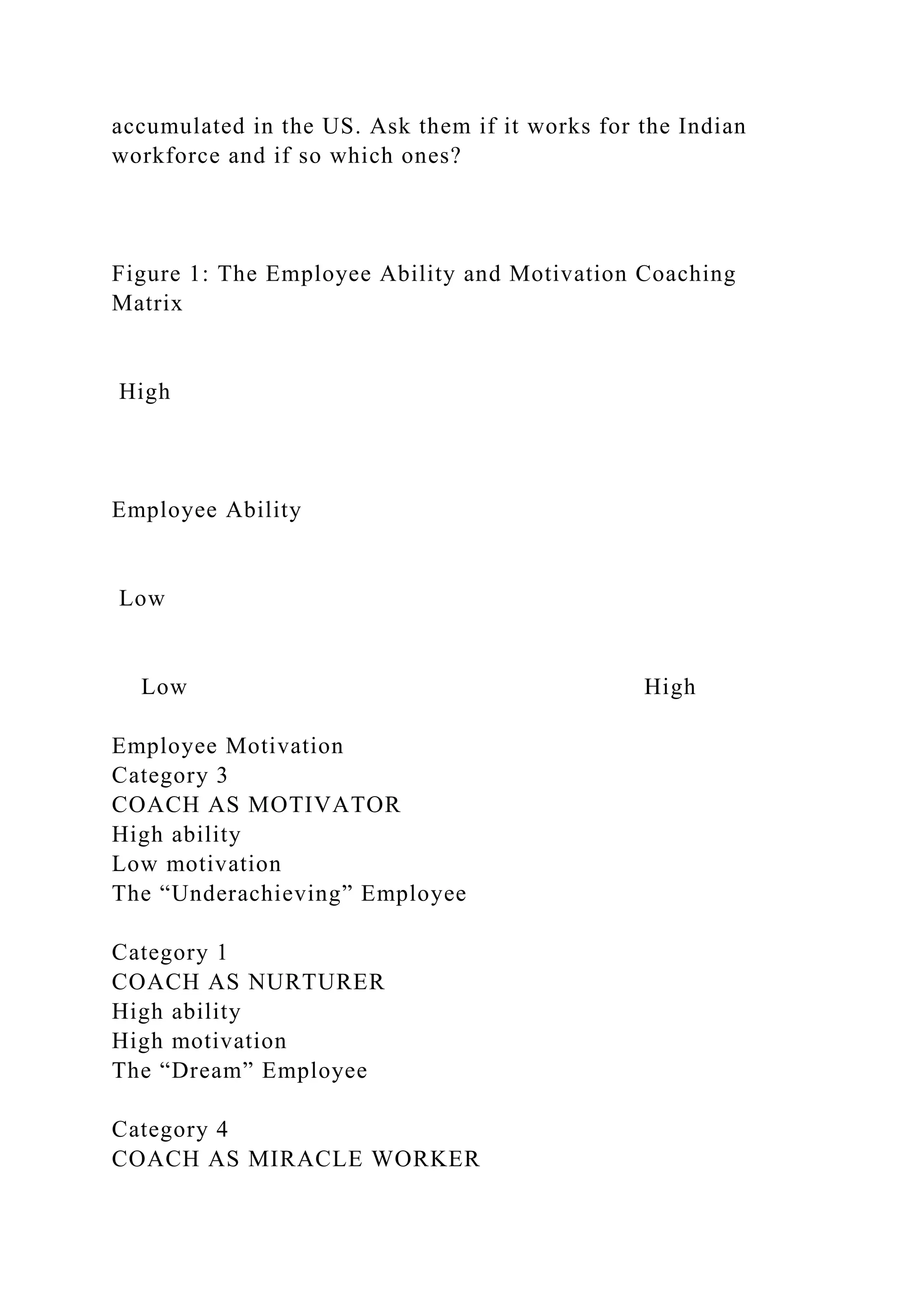
Figure 1: The Employee Ability and Motivation Coaching
Matrix
High
Employee Ability
Low
Low High
Employee Motivation
Category 3
COACH AS MOTIVATOR
High ability
Low motivation
The “Underachieving” Employee
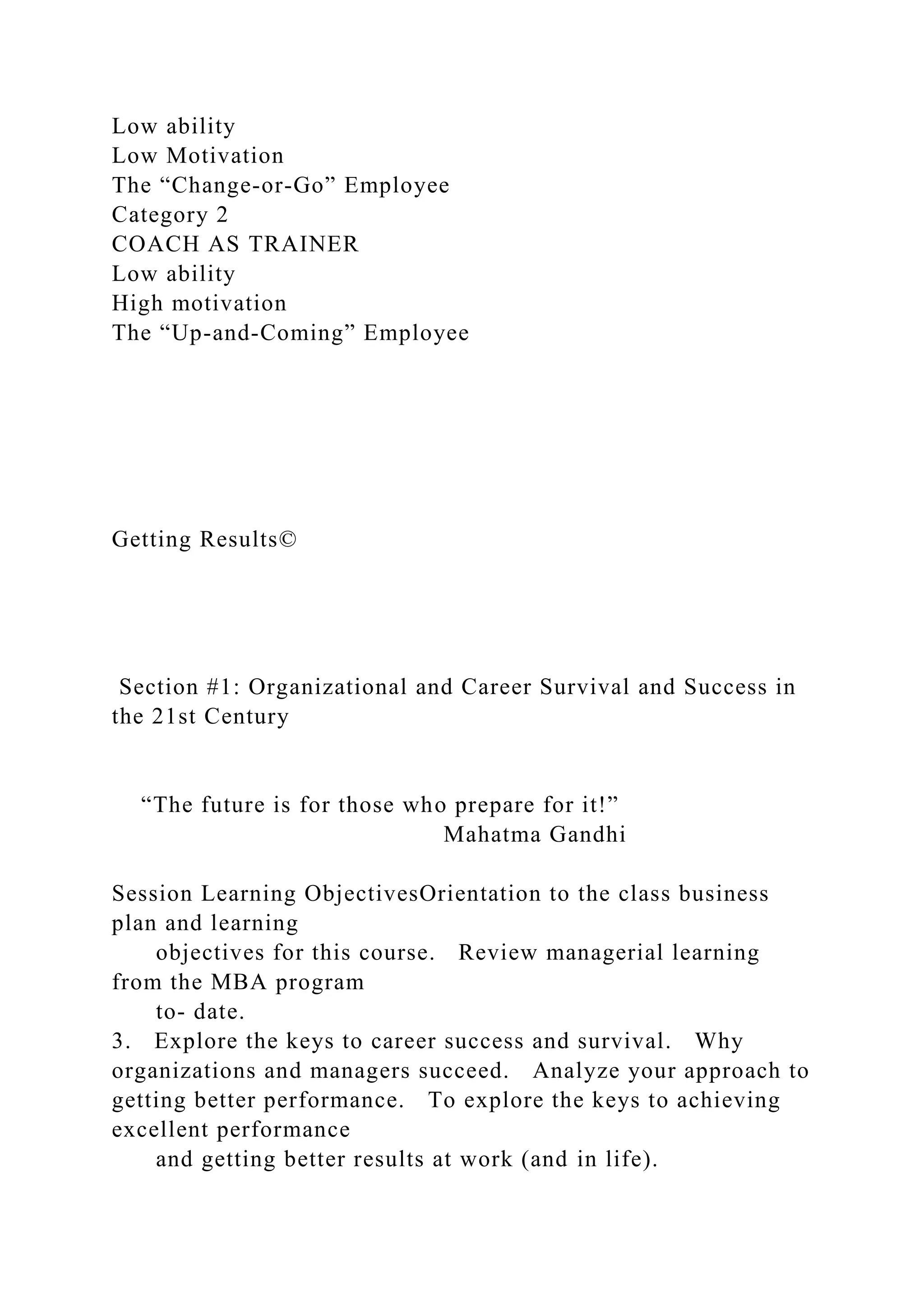
Category 1
COACH AS NURTURER
High ability
High motivation
The “Dream” Employee
Category 4
COACH AS MIRACLE WORKER
Low ability
Low Motivation
The “Change-or-Go” Employee
Category 2
COACH AS TRAINER
Low ability
High motivation
The “Up-and-Coming” Employee
Getting Results©
Section #1: Organizational and Career Survival and Success in
the 21st Century
“The future is for those who prepare for it!”
Mahatma Gandhi
Session Learning ObjectivesOrientation to the class business
plan and learning
objectives for this course. Review managerial learning
from the MBA program
to- date.
3. Explore the keys to career success and survival. Why
organizations and managers succeed. Analyze your approach to
getting better performance. To explore the keys to achieving
excellent performance
and getting better results at work (and in life).
*
Getting Results©
“Managing a business and managing our lives have a lot of
similarities…and these days it isn’t getting any easier to have
great success in both arenas!”
Getting Results©
Introduction: Speed Interviews
During 60 second interviews, please introduce yourself and
answer the following questions:
1. The best things about your
fall.
2. Biggest thing you’ve learned in
the past six (6) months.
3. Name one skill that you
possess that is exceptional.
4. Biggest challenge this
semester.
*
Getting Results©
“I have never met a person who didn’t want to be
successful…The question is, are they willing to be successful?”
Warren Buffet
Getting Results©
THINK!
Our Superordinate Learning Objective
To help you think about how to best improve your workplace
performance and career trajectory!
Getting Results©
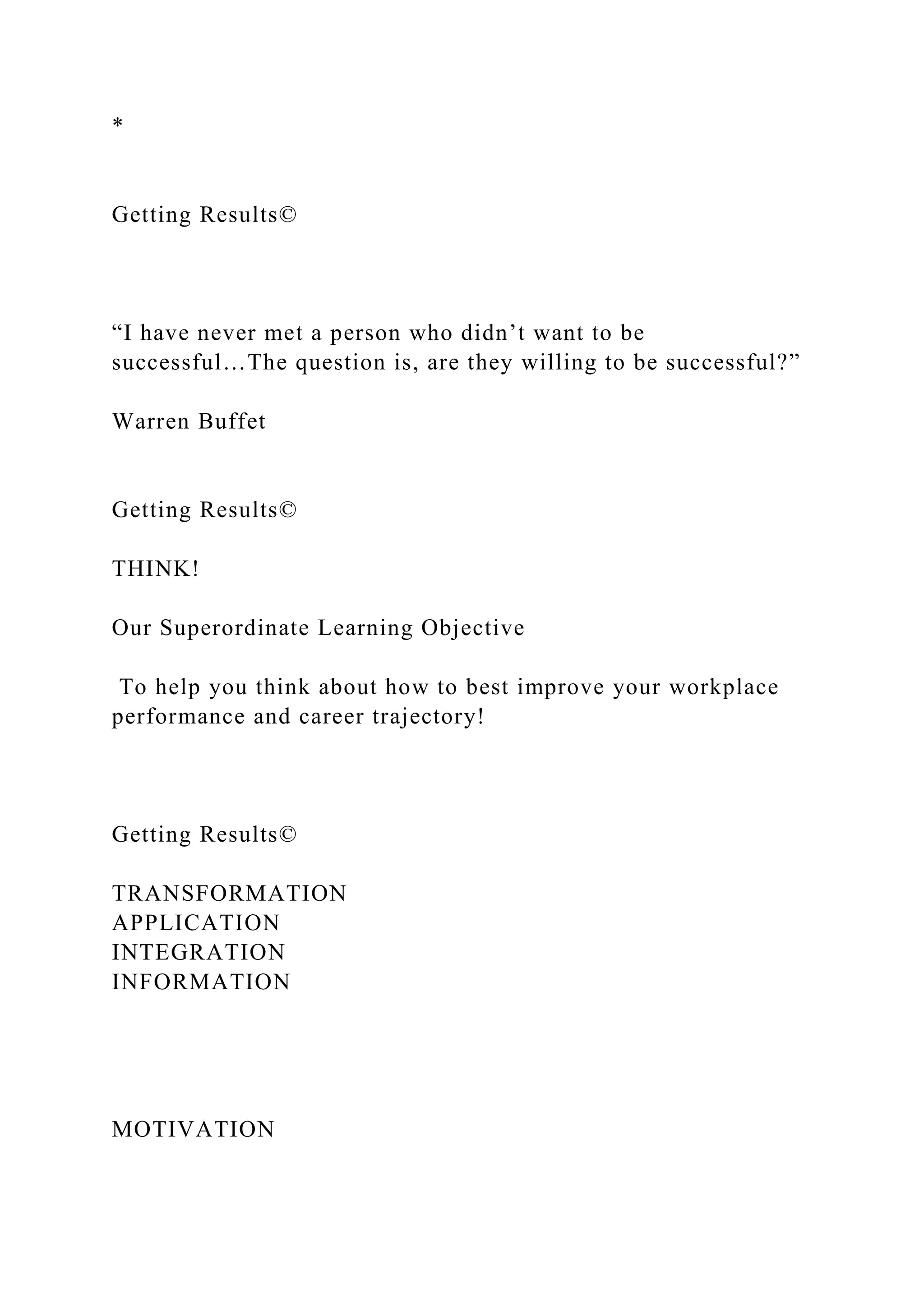
TRANSFORMATION
APPLICATION
INTEGRATION
INFORMATION
MOTIVATION
Getting Results©
“The ongoing challenges of life mandates that we apply all our
wisdom to daily situations lest we fall prey to our own folly.”
Socrates
*
Getting Results©
“LIFE IS TOUGH,
BUT IT’S
TOUGHER
IF YOU’RE
STUPID!”
…..John Wayne
*
Getting Results©
“When a person does not know what to do in a given situation.”
____________:
*
Getting Results©
_____________:
“When a person knows
what to do but for
whatever reason
does not do it!”
*
Getting Results©
“When a person knows what to do in a given situation and does
it!”
______:
*
Getting Results©
Overarching Fact:
Students: Once you graduate, the rules for success will
________ regardless of your discipline or achievements to-date.
So what skills and behaviors are most important to MASTER?
Getting Results©
Overarching Fact:
Working Professionals: As work places change and evolve, we
must all engage in more of the __________________ that allow
us to effectively perform our jobs and create value for our
enterprises.
Getting Results©
“CAREER” DEFINED - (ca-reer: n)“A vocation, calling,
profession, or occupation regarded as a long-term or lifelong
activity;” and “A person's progress and achievement in a chosen
profession during one's working life.”
Getting Results©
Some Quick Facts About Our Working Lives and Careers:The
average American professional spends nearly ________ hours at
work each year or nearly ___ hours each week at work.
Getting Results©
2) That same American worker will have on average ___
different jobs and will work in at least six different
organizations over the course of their career.
Getting Results©
Our careers will last on average ___ years and we will retire at
around ___ years of age (and it is increasing.)
Getting Results©
4) With the average American life expectancy of _____ years,
each of us will walk the earth 28,740 days. ______ of 20,710
days after age 22 will involve us going to work as which will be
over ____ of our adult life.
Getting Results©
Overview of Course
*
Getting Results©
THE CALL FOR REAL LEADERSHIP
“The key to getting better results in a rapidly changing
workplace is to improve your leadership and managerial talents
so as to meet the changing demands and challenges required of
you as a person of influence…These days our leaders must get
better results on an ongoing basis and that requires effective
leadership and process improvement…This is a real test for
most of us but without real leadership, real change and
improvement is going to continue to be a real problem…We
have all the tools but leadership is the real difference!”
CEO Fortune 1000
Service Organization
Write down at least three (3) observations about this quote?
*
Getting Results©
*
To improve my/our performance…
What must I/we keep doing??
What must I/we stop doing??
What must I/we start doing??
*Why are these questions so important to a
leader’s/organization’s success?
THE THREE MOST IMPORTANT QUESTIONS LEADERS
MUST REGULARLY ASK THEMSELVES!
Getting Results©
*
WHERE ARE BETTER RESULTS GOING TO COME FROM?
Talent: a person’s level of skill and ability they possess to
effectively perform their job.
Motivation: a person’s level of inner drive and work ethic
applied to performing their job.
Support: providing the information, tools, climate, processes
and resources necessary for a person to effectively perform their
job.
The Performance Equation: Performance = f (Talent x
Motivation x Support)
A Leader’s Calling:
It is a business leader’s job to manage the Performance
Equation in a fashion that enables them to improve their
personal performance and the performance of each and every
employee that they are responsible for leading!
Getting Results©
Instructions: In the space provided below, write down five
business axioms/lessons, based on what you have learned in the
MBA program to-date. These should be principles that are worth
remembering for a lifetime. These will be shared with the
group.
1.__________________________________________
__________________________________________
2.__________________________________________
__________________________________________
3.__________________________________________
__________________________________________
4.__________________________________________
__________________________________________
5.__________________________________________
__________________________________________
*
KEY MBA BUSINESS AXIOMS/LESSONS!
Getting Results©
What is your definition of leadership?
*
Getting Results©
LEADERSHIP DEFINED*
Someone who influences others toward the achievement of goals
and desired outcomes;
An individual who causes others to do things they might not
otherwise do;
A person who demonstrates prowess, talent and skill in a given
endeavor; and/or
Someone who makes things happen and get results with and
through people!
* In periods of change, leadership becomes even more important
than in more normal times!
*
1896.pdf
Getting Results©
CAREER SURVIVAL AND SUCCESS ESSAY
Instructions: In the space provided below, please write a short
essay on “What I would like to do with my career.” You have
four (4) minutes.
*
Getting Results©
FACTORS THAT SHAPED YOU INTO WHO YOU ARE
TODAY!
Getting Results©
CAREER SURVIVAL AND SUCCESS ESSAY
Instructions: Write a 3 minute essay on “Why some people are
more successful in life than others.”
Getting Results©
CAREER SURVIVAL AND SUCCESS?
Getting Results©
*
CAREER SURVIVAL AND SUCCESS!
Instructions: In the space provided below, write down what you
consider to be the five (5) most important factors for keeping
your career on track. These will be shared with the group.
1.__________________________________________
2.__________________________________________
3.__________________________________________
4.__________________________________________
5.__________________________________________
Getting Results©
*
Background: A large-scale study of over 6,000 professionals
identified the following factors as being key to career success
and survival across industries, functional areas and
organizational levels.
Factor Ranking
1. Performance _______________of
Getting________________
2. Effective ________________Talents and PracticesStrong
____________________and
________________SkillsPossessing/Maintaining a Positive
_________ and _________
5. Ability to _______________________to Meet Job Demands
6. Learning and Leveraging
_____________________________Ability to Handle
__________________and Stay____________________________
and _______________Effectiveness
9. Ability to Use _______________and _________Effectively
10. Possessing a ______________________________________
Key Questions: What are the key lessons embedded in these
findings?
How many of these factors do you have control over?
.
CAREER SURVIVAL AND SUCCESS RESEARCH FINDINGS
Source: Longenecker, C.O. “Career Survival and Success in the
21st Century.” Drake Business Review Fall 2011.
Getting Results©
A CAREER SURVIVAL AND SUCCESS LESSON ON THE
IMPORTANCE OF GETTING RESULTS FOR
PROFESSIONALS WHO ARE PAYING ATTENTION!
Instructions: Please read the following excerpts from an email
that was sent the day after this manager was terminated from a
Fortune 500 enterprise. Look carefully at his words and try to
sense what he was feeling and why he was feeling that way as
you read.
“I simply did not see being let go coming and it was like being
punched in the stomach…I have been extremely busy at work
for the past 18 months since starting this new VP position in
charge of the improvement process in our division. I
mistakenly thought that my boss and I were on the same page in
terms of both what I was doing and how well I was doing it. I
was wrong, dead wrong! As you know, we started a new
performance improvement integration process with high hopes
as a division. It was a major activity aimed at improving
performance across all of our various facilities. It sounded like
a worthwhile initiative and I was very excited to take the lead.
But in retrospect, we never really articulated what we were
trying to accomplish in realistic, measurable terms and we
struggled with buy-in from the start.
We quickly created an improvement process and tools that
everybody should have been able to use in their operations. It
all looked good on paper but when it was time to make real
changes, we had no real power to make things happen…There
was no sense of urgency or commitment and leadership in the
field was nonexistent. My General Manager had made
improvement commitments with our CEO that could not be kept.
He oversold what we were able to actually deliver. People all
had their own ideas about what we were ultimately trying to
accomplish but the leadership above us let us hang out to twist
in the wind. After 18 months the CEO looked at the costs and
the limited return and said enough and that was it.
A couple of people were reassigned but I along with one other
guy was turned out on the street. I was the highest ranked
person to lose his job. I remember us talking about the
importance of never losing sight of what results the
organization needs from you, making sure that you and your
boss are on the same page and doing the things that lead to
results with diligence. Well, I really dropped the ball on this
one and I am very angry at myself, my boss and the CEO as
well.
If I had done a better job of forcing the issue of what we were
trying to accomplish, developing a more realistic game plan for
our field leaders and measuring actual changes more effectively,
things might have turned out differently. My biggest mistake is
that I failed to practice what I knew to be true. I was in charge
of change and the change never happened. I really screwed up
and I know it and I have no one to blame for this mess but
myself. This is the sickest feeling that I have ever had and it
has been both humiliating and humbling. My faith has helped
me greatly and I truly appreciate the love and support of my
wife, but I feel like I have really let her down too… But know
this, I will learn from this defeat and I will be back.”
Key Question: What really happened here?
*
Source: Longenecker, Papp and Stansfield, The Two-Minute
Drill: Lessons on Rapid Organizational Improvement from
America’s Greatest Game, 2007.
Getting Results©
AIMING TO SUCCEED
“Great organizations are always the combination of great
people, systems, and cultures”
Dr. Peter Drucker
Instructions: Based on your experience, what are the
characteristics of a truly successful organization in your
industry. Be very specific! You will share your list with the
group.
____________________________________
____________________________________
____________________________________
____________________________________
____________________________________
____________________________________
____________________________________
____________________________________
____________________________________
____________________________________
*
The purpose of this exercise is to get the students to think about
what makes a successful organization based on their own
experience and readings. Give people 2 min. to fill in the 10
items that they believe are the characteristics of a truly
successful organization. Then you can either have a class
discussion as a whole or break people out in small teams to
discuss but it is useful to have them go through this experience
to think about what greatness looks like and feels like.
*
Getting Results©
*THE CHARACTERISTICS OF HIGHLY SUCCESSFUL
ORGANIZATIONS (n=103)
(Fink and Longenecker , 2012)Your Organizational
Effectiveness RatingLow Average High1.Customer-
Service Oriented123452.Clearly Focused Goals/Aligned
Action123453.Effective Performance Measurement/Feedback
System123454.Practice High Levels of Big-Little Picture
Planning123455.Highly Organized Around Their
Processes123456.Practice Intensive Two-Way
Communication123457.Use Technology
Effectively123458.Employ Effective Leadership at All
Levels123459.Cooperation and Teamwork
Abound1234510.Remove Performance Barriers
Fast1234511.Make it Easier for People to Get their Work
Done1234512.E3 People – Educate, Empower,
Encourage1234513.Effective Selection and Reward
Systems1234514.Very Cost Conscious1234515.Capable of
Rapidly Adapting to Change12345
Getting Results©
*
WHAT ARE THE KEY PRACTICES THAT LEAD TO BETTER
RESULTS?
Getting Results©
*
Result (re’zalt) n.
Defined:
“Something that comes about as a consequence, effect or
conclusion of activity or action.”
“Something obtained, achieved, or brought about by calculation,
investigation or systematic activity.”
Getting Results©
THE ATTRIBUTES OF
RESULTS-ORIENTED MANAGERS
Instructions: Think of the best “high performance” manager
that you have ever worked with during your career. Write down
at least seven (7) attributes that best describe this individual.
Your answers will be shared with the group.
____________________________________
____________________________________
____________________________________
____________________________________
____________________________________
____________________________________
____________________________________
____________________________________
____________________________________
____________________________________
*
Getting Results©
*
STUDY BACKGROUND:To explore how high performance
managers go about “getting results” we conducted a three-phase
research study across nearly every segment of the U.S.
economy:
Phase One: We surveyed a cross section of over 1600 managers,
identified as “high performers,” by their organizations and
asked them to describe “key factors for getting results” based
on their experience as business leaders.
Phase Two: We inteviewed an additional 400 high performers to
further explore the issue of getting results and to provide
specific examples, accounts and practices for achieving superior
performance in rapidly changing enterprises.
Phase Three: A follow-up study with an additional 1,000 “high
performance” business leaders has been completed in the past
three years to further explore the “best practices” of these
leaders to determine the impact that the global economy is
having on key leadership practices.
THE GETTING RESULTS RESEARCH PROJECT: OUR
STUDY
This slide simply contains words of findings that we are about
to discuss come from.
Getting Results©
THE GETTING RESULTS POP QUIZ
Instructions: Please answer each of the following questions
based on your experience. The answers are based on the Getting
Results Research Study on over 3,000 high performance
business leaders. (Yes, there are right and wrong answers!)
What is the most important factor for career success and
survival across all industries?
_________________________________________________
2. What is the first step in becoming a more results-oriented
leader? Establish your metricsSetting goalsClarifying your
missionDefining your roleEffective staffing
3. The majority of managers are effective in their roles as
coaches.
True False
4. What is a result-oriented manager’s most important resource?
_______________________
5. Most results-oriented managers work on average more than
50 hours per week.
True False
6. What is the primary reason most managers cited for not
effectively planning?
_____________________________________________________
__
7. Results-oriented managers make it a top priority to stay
focused on long-term issues at all times. True
False
8. What percentage of managers in the U.S. have a mentor that
they meet with regularly to help provide them with career
development counsel and accountability? ___%
9. What is the most frequently cited reason that managers fail to
get desired results?
_____________________________________________________
______
10. According to results oriented managers the real key to
motivating employees is:Feedback on performanceFinancial
incentivesOwnership of outcomesGoal settingPersonal
development
BONUS: The number one reason employees leave their current
employer is better pay.
True False
*
Here is a quick pop quiz to get students thinking:Answer to
question one: getting desired results for your
organizationClarifying your mission –it has to go first because
your mission must be clear before any of these other activities
can take placeFalse-most managers are not good coaches and
yet coaching is critically important to managerial successTIME-
time is a managers most important resource and it trumps people
and technology as if a manager does not use his or her time
wisely technology in people get ignoredFalse-in this study most
managers worked on average around 46 hours a week. This is a
US population of high performing business leaders:Managers do
not plan because they do not take the time to do soFalse-most
managers do not stay focused on long-term issues at all times.
They stay focused on short term issues and then step out to look
at broader strategic long-term issues from time to time15 to
17% of US managers have a mentor that is real and meaningful.
79% of the leaders in this study had a mentor and accountability
partner.The number one reason why managers fail to get desired
results: poor communication skills and practicesC- getting
employees to take ownership over outcomes is the key to long-
term motivationBonus question-the number one reason why
employees leave their current employer in the US is BAD
BOSS.
Getting Results©
*
Getting Result: Five Absolutes for High Performance
Absolute #1:
Get Everyone on the Same Page: Focus on the Purpose of Your
Organization
Practice 1: Create a Clear Sense of Purpose for Your
Organization
Irrefutable Performance Principle: Work units with a clear
sense of purpose outperform those that do not have a clearly
defined mission.
Practice 2: Clarify Your Role as Leader in the Operation
Irrefutable Performance Principle: Managers improve
their performance and the performance of their people when
they perform value-added practices and minimize non-value-
added activity.
Practice 3: Develop Meaningful Performance Goals and
Measures
Irrefutable Performance Principle: Work units that have
clearly defined performance goals and effective performance
measures will outperform those that do not, all things being
equal.
Practice 4: Frame Each Person’s Role in Your Operation.
Irrefutable Performance Principle: Without effective
leadership employees find it difficult at best to keep their
activity aligned with the current needs of an operation.
Absolute #2:
Prepare for Battle: Equip Your Operation with Tools, Talent,
and Technology
Practice 1: Develop and Use Systematic and Ongoing Planning
Practices
Irrefutable Performance Principle: Effective planning is
not optional for results-oriented leaders because rapidly
changing organizations need systematic future thinking more
than ever.
Practice 2: Employ Progressive Staffing
Irrefutable Performance Principle: You cannot produce
superior results when human resource planning, selection, and
work scheduling do not receive the utmost attention.
Practice 3: Train and Educate Your Staff
Irrefutable Performance Principle: Properly trained and
educated personnel increase the likelihood of achieving desired
levels of performance, while untrained personnel can create
countless problems for an organization.
Practice 4: Equip People with the Tools They Need to Perform
Irrefutable Performance Principle: When people are
properly equipped with the right performance tools, they can
better focus on getting desired results.
Absolute #3:
Stoke the Fire of Performance: Create a Climate for Results
Practice 1: Monitor and Measure Ongoing Performance
Irrefutable Performance Principle: To lead effectively,
you have to know how all facets of your operation are
performing on an ongoing basis. This requires a balanced
approach to monitoring and measuring individuals and work
units in terms of behavior as well as results.
Getting Results©
*
Practice 2: Motivate Employees to Create Ownership and
Accountability
Irrefutable Performance Principle: When a manager
motivates a workforce to create a sense of ownership and
accountability for desired results, the job of getting results gets
easier.
Practice 3: Provide Ongoing Performance Feedback by Being a
Good Coach
Irrefutable Performance Principle: People cannot change
their performance if they don’t know there is a need to do so or
if they don’t know how to change.
Practice 4: Remove Performance Barriers
Irrefutable Performance Principle: When managers
consistently remove barriers to performance they make it easier
for people to get their work done and achieve desired results.
Absolute #4:
Build Bridges on the Road to Results: Nurture Relationships
with People
Practice 1: Forge Effective 360-degree Working Relationships
Irrefutable Performance Principle: Results-oriented
managers foster effective 360-degree working relationships with
all people who are important to getting results, and they
continually work to keep these relationships viable.
Practice 2: Demonstrate Leadership Worthy of Trust
Irrefutable Performance Principle: There is no substitute
for competency and character in developing trustworthy
leadership that fosters long-term success.
Practice 3: Establish Open, Ongoing, and Focused Two-Way
Communication
Irrefutable Performance Principle: A manager’s ability to
meet people’s communication needs is critically important to
success and requires both skill and a systematic process.
Practice 4: Nurture Cooperation and Teamwork
Irrefutable Performance Principle: Effective leadership
creates cooperation and teamwork that accelerates the speed at
which results can be achieved.
Absolute #5:
Keep the Piano in Tune: Practice Continuous Renewal
Practice 1: Develop Improved Processes
Irrefutable Performance Principle: Effective leaders
develop vehicles to proactively improve processes and the
factors that influence performance.
Practice 2: Perfect the Art of Performance Appraisal
Irrefutable Performance Principle: Effective managers
practice constructive employee appraisal and development to
help their people continuously improve their personal
performance.
Practice 3: Develop a Plan to Improve Your Performance
Irrefutable Performance Principle: Effective managers
take responsibility for their own development, determining a
clear plan of action to improve their current performance and
prepare for their future to meet the changing demands of the job
as leader.
Practice 4: Create and Maintain Balance in Your Professional
and Personal Life
Irrefutable Performance Principle: Managers truly
interested in long-term success in every area of their lives,
create and maintain the balance that helps sustain real long-term
success.
Getting Results©
*
Absolute #1
GET EVERYONE ON THE SAME PAGE:
The Power of Creating Focus
Create a clear sense of purpose and direction that is
known and understood by all.
Clarify your value-added role as a leader.
Develop meaningful and balanced performance goals and
measurements that are known and understood by all of your
people.
Flexibly frame each person’s role in the operation so they know
exactly what is expected of them.
Critical Questions to Answer:Why don’t managers practice this
absolute?
What are the CONSEQUENCES of not practicing this absolute?
What are the BENEFITS of practicing this absolute?
Assignment: After answering these questions, draw a picture
that best illustrates this absolute that will be shared with the
group.
Getting Results©
*
Absolute #2
PREPARE FOR BATTLE:
The Power of Preparation
Develop and implement appropriate and systematic planning
activities for your operation.
Practice dynamic and progressive staffing practices.
Ensure ongoing and effective training and education processes
for your people.
Equip your people with the resources they need to perform their
job.
Critical Questions to Answer:Why don’t managers practice this
absolute?
What are the CONSEQUENCES of not practicing this absolute?
What are the BENEFITS of practicing this absolute?
Assignment: After answering these questions, draw a picture
that best illustrates this absolute that will be shared with the
group.
Getting Results©
*
Absolute #3
STOKE THE PERFORMANCE FIRE:
The Power of Creating a Climate for Success
Practice ongoing performance monitoring and measurement at
both the team and individual level.
Motivate your people by creating ownership of outcomes and
accountability for results.
Provide ongoing performance feedback and coaching to your
people based on their talent and motivation levels.
Rapidly removing barriers and solve problems that damage
performance.
Critical Questions to Answer:Why don’t managers practice this
absolute?
What are the CONSEQUENCES of not practicing this absolute?
What are the BENEFITS of practicing this absolute?
Assignment: After answering these questions, draw a picture
that best illustrates this absolute that will be shared with the
group.
Getting Results©
*
Absolute #4
BUILDING BRIDGES ON THE
ROAD TO RESULTS:
The Power of People
Forge effective 360° degree working relationships.
Demonstrate leadership worthy of trust by leading by example
and role modeling desired attitudes and behaviors.
Establish and practice open, ongoing, and focused two-way
communication.
Nurture cooperation and teamwork among the people who need
each other to get desired results.
Critical Questions to Answer:Why don’t managers practice this
absolute?
What are the CONSEQUENCES of not practicing this absolute?
What are the BENEFITS of practicing this absolute?
Assignment: After answering these questions, draw a picture
that best illustrates this absolute that will be shared with the
group.
Getting Results©
*
Develop more effective processes and make it easier for people
to get work done.
Practice constructive employee appraisal and ongoing
development.
Develop yourself to meet the demands of your job.
Create and maintain balance in every area of your life.
Absolute #5
KEEP THE PIANO IN TUNE:
The Power of Renewal
Critical Questions to Answer:Why don’t managers practice this
absolute?
What are the CONSEQUENCES of not practicing this absolute?
What are the BENEFITS of practicing this absolute?
Assignment: After answering these questions, draw a picture
that best illustrates this absolute that will be shared with the
group.
Getting Results©
GETTING RESULTS SELF-ASSESSMENT
*
*
Getting Results©
Instructions: Listed below are the practices that emerged from
the Getting Results Research Project that chronicled the best
practices of over 3,000 high performance business leaders.
Answer each of the following questions in an honest and open
fashion to assess the extent to which you are effectively
engaged in the practices that lead to improving performance and
better results. Please use the following rating scale:
1 = Never 2 = Rarely 3 = Sometimes 4 = Frequently
5 = Always
To What Extent Do I …
FOCUS
Create and maintain a clear vision and mission for where I am
leading my people? __________
Continuously align and clarify my value-added organizational
role? __________
Use clearly defined and balanced performance metrics to
measure performance? __________
Clarify and communicate performance expectations with all my
employees? __________
PREPARE
5. Employ appropriate and systematic planning practices on an
ongoing basis? __________
6. Demonstrate extreme care in properly staffing my
operation? __________
7. Ensure that my people are properly trained and educated to
get results? __________
8. Work to ensure that people are properly equipped to
perform their jobs? __________
CLIMATE Regularly monitor and measure the
individual/operational performance? __________ Create
ownership and accountability around desired performance
outcomes? __________ Provide ongoing performance
feedback and coaching to my people? __________
Work to rapidly remove performance barriers that damage
performance? __________
RELATIONSHIPS
13. Practice effective communications to understand others
and to be understood? __________
14. Lead-by-example and demonstrate competency and
character in the workplace? __________
15. Work at continually developing and nurturing key working
relationships? __________
16. Foster cooperation and teamwork with people who need
each other to get results? __________
RENEWAL
17. Develop myself with the skills and talents necessary to be
a high performer? __________
18. Have mechanisms in place to improve processes on an
ongoing basis? __________
19. Constructively appraise and nurture employee development
my employees’? __________
20. Work to maintain balance and perspective in all facets of
my life? __________
Overall Score: __________
Interpretation: Any practice that receives less than a score of 4
is a potential target behavior for improving your personal
performance and propensity for getting better results. An
overall score of 80 or higher suggests that you
are engaged in most of the critical activities that lead to better
results as a manager.
GETTING RESULTS SELF-ASSESSMENT
*
Now after this discussion and you have clarified what each of
the absolutes means in a deeper way, ask each student to do a
self-assessment on themselves across the 20 factors or practices
that make up the list of absolutes. Have them do some soul-
searching here and asked them to be very candid in their
assessment. This is for their eyes only! And say well if you’re
not good in a particular area that’s why you’re in the EMBA
program to fill in and develop skills in this arena because these
things will translate into better performance
Getting Results©
S.T.O.P.
Lessons on Career Survival and Success
*
BACKGROUND: In the Getting Results Research Project, we
have chronicled the best practices of over 3,000 “high
performance” business leaders and professionals. In this effort,
we came upon a professional who was struggling greatly with
his performance. His struggle was having a profoundly negative
effect on his professional and personal life. When forced to
develop a plan about how to get out of his performance
conundrum, eight questions emerged that all professionals are
well served to STOP and THINK about as a basis for real
performance improvement:
What results are most critical to my/our success?
______________________
(What am I really being paid to accomplish?)
What specific things do I need to be doing to get better results?
__________
(Is there a link between my daily actions and desired
results?)
Do I have a process in place to develop/perfect the skills and
practices I need to get better results?
__________________________________________
(Am I developing my talents to meet the real demands of
my job?)
Do I spend time really doing the things that deliver better
results? ________
(Do I invest my daily work time so as to be successful?)
Are my working relationships really working?
__________________________
(Do I work hard to foster and maintain effective working
relationships?)
Do I monitor my performance on an ongoing basis?
____________________
(Do I track my performance and make adjustments
accordingly?)
Do I have a real plan for improving my part of our operation?
_____________
(Am I removing barriers and making it easier to get work
done?)
Who is holding me accountable for my improvement?
___________________
(Do I have a real mentor, coach or accountability partner
in my life?)
Adapted from Getting Results: Five Absolutes for High
Performance, by Clinton O. Longenecker, Ph.D. and Jack A.
Simonetti, DBA; Jossey – Bass Publishers. Available at better
bookstores nationwide and Amazon.com. The University of
Toledo, College of Business and Innovation.
Sit-Think-Optimize-Perform
The last section is to get them to think now about what they
need to do to get better results by taking the broad list and
breaking it down into eight specific questions that each of them
must answer to improve their personal effectiveness. The
answer to these questions is critically important and we have
found that these questions are cross-cultural. The issues and
questions asked here are appropriate in any organization around
the world regardless of industry, level of leadership, country, or
the like. So you might want to ask students as we wrap up the
workbook for session 1 how they stack up against these
questions.
Getting Results©
*
The 12 Career Success and Survival Imperatives
CHALLENGE #1: ONGOING FOCUS AND ALIGNMENT - In
the modern workplace, being busy does not equal being
effective or successful! It is incumbent that every professional
creates focus around doing the right things, engages in daily
activity that deliver desired outcomes, and makes the best use of
their critical and scarce organizational resources!
Career Success and Survival Imperatives: A person must
identify and deliver the value-added results his or her
organization wants and needs from them and create a track
record of doing so! A person must have the ability to identify,
implement, and master the key value-added practices/behaviors
that lead to achieving these desired results. A person must have
the ability to focus their time, organizational resources, and
power on delivering desired results.
CHALLENGE #2: CREATING REAL PEOPLE POWER - In the
modern workplace it is exceptionally important to effectively
interact with the people around us, whether they are superiors,
peers, subordinates, customers, or organizational stakeholders.
We must have the emotional intelligence and ability to work
with everyone!
Career Success and Survival Imperatives:
4) A person must place a high priority on forging and nurturing
viable, meaningful, and effective working relationships and
networks.
5) A person must have the ability to effectively connect and
communicate with everyone, in every situation.
6) A person must maintain and project a positive personality,
attitude, and outlook about themselves, their work, and life.
Getting Results©
*
The 12 Career Success and Survival Imperatives
( CONTINUED)
CHALLENGE #3: ONGOING LEARNING AND
PERFORMANCE IMPROVEMENT - Successful people must
know how to pay careful attention to the things going on around
them and regularly monitor and track their own performance. In
addition, they must continuously learn and develop their skills,
seek out ongoing feedback and coaching, and improve their
ability to solve problems and serve as change agents, to help
drive improvement in their enterprises.
Career Success and Survival Imperatives:
7) A person must work hard to develop their “situational
awareness” so they always know what is going on around them
(challenges & opportunities) and how well they are performing.
8) People must continuously learn and develop themselves with
the skills/talents necessary to meet the changing demands of
their job.
9) A person must embrace honest feedback and coaching and
seek out real accountability.
10) A person must be a disciplined problem-solver and change
agent who continuously looks for ways to make it easier for
others to get things done!
CHALLENGE #4: TRUE GRIT PROFESSIONALISM AND
CHARACTER -
The last two Career Success and Survival Imperatives just might
be the key to long-term workplace success and life satisfaction.
It is imperative that we all learn how to handle the things that
life throws at us and that we continuously work hard to maintain
our character and integrity.
Career Success and Survival Imperatives:
11) A person must have the ability to handle stress, stay poised,
and maintain balance in every area of their personal and
professional life.
12) A person must demonstrate character and integrity in all
that they do!
Getting Results©
*
Instructions: Carefully read each of the following questions and
rate yourself using the following scale to determine how well
you perform on each of the following Career Success and
Survival Imperatives:
1 = I am clearly failing at this imperative
2 = I am really struggling with this imperative
3 = I am okay with this imperative
4 = I am good with this imperative
5 = I am excellent with this imperative
I consistently identify and deliver the value-added desired
results my organization wants and needs from me on an ongoing
basis._______ I identify, implement, and stay focused on the
key value-added practices/behaviors that lead to desired results
on an ongoing basis. _______ I focus my time, organizational
resources, and power on delivering desired results. _______ I
forge and foster viable, effective working relationships and
business networks with the people I need to get desired results.
_______ I effectively communicate and connect with everyone
in every situation at work. _______ I maintain and project a
positive personality, attitude, and outlook about myself, my
work, and life. _______I maintain my “situational awareness”
so that I always know what is going on around me and how well
I am performing. _______I continually learn and develop the
skills/talents necessary to meet the changing demands of my
job. _______ I embrace feedback and coaching and seek out
accountability for improvement. _______ I work hard to be a
disciplined problem-solver and change agent to make it easier to
get things done. _______I effectively handle stress, stay poised,
and maintain balance in every area of my personal and
professional life. _______ I demonstrate great character and
integrity in all of my personal and professional dealings.
_______
Career Success and Survival Imperatives Assessment
Getting Results©
*
SCORING: In the space provided below, please write down your
score for each of these 12 questions and fill out the subtotal for
each section. When this is completed, add up your four subtotal
scores and determine your GRAND TOTAL.
Ongoing Focus and Alignment
Question #1:
Question #2:
Question #3:
SUBTOTAL: ___________
Creating Real People Power
Question #4:
Question #5:
Question #6:
SUBTOTAL: __________
Ongoing Learning and Performance Improvement
Question #7:
Question #8:
Question #9:
Question #10:
SUBTOTAL: ___________
True Grit Professionalism and Character
Question #11:
Question #12:
SUBTOTAL: ___________
GRAND TOTAL (all four sections): ___________
Interpretation: The purpose of this 12-point questionnaire is to
get you to think candidly about your performance on these
critically important performance-enhancing practices that can
have a powerful effect on your career trajectory. On some of
these imperatives you might score quite high and others you
might need some serious work, but what is important now is that
you are thinking about the impact that each of these imperatives
can have on your ability to be successful and effective in your
chosen profession. If you find yourself having a score of less
than three on any of these 12 imperatives, stop and carefully
think about how you are going to improve this area.
Career Success and Survival Imperatives Assessment
SCORING
Score 12–23: Career Danger Zone
Score 24–35: Career Success Improvement Required
Score 36–47: Career Strengths Emerging
Score 48–60: Career Strengths Are in Place
Getting Results©
THE BUSYNESS CONTINUUMBUSY!NOT
BUSY!REALLY
BUSY!TOO
BUSY!
*
*
Getting Results©
The Busyness Continuum Defined Not Busy: Living a quiet life
with a minimum of activity; time availability is significant
allowing for an abundance of free and idle time with the
absence of pressure.
Busy: Being actively and attentively engaged; living a life full
of activity, responsibilities, and commitments; specific effort
and attention is required to manage priorities, meet deadlines
and accomplish desired outcomes.
Really Busy: To be fully occupied in a particular activity;
committed to something previously planned so unable to
undertake additional activity; or engaged in or characterized by
constant, challenging and ongoing activity.
Too Busy: (Your Definition ?)
THE BUSYNESS CONTINUUM?
*
BUSY!
NOT
BUSY!
REALLY
BUSY!
TOO
BUSY!
Getting Results©
EVERYONE IS BUSY!
THE QUESTION OF THE DAY: BUSY DOING WHAT?
*
*
Getting Results©
WHAT ARE THE CONSEQUENCES OF
BEING TOO BUSY?
*
*
Getting Results©
THE DESTRUCTIVE NATURE OF BEING TOO BUSY:
Loss of the strategic, long-term bigger
picture
Communication breakdowns and
listening skills diminish
Loss of focus, attention to detail, and
more prone to make mistakes
Ineffective and less than optimal
decision-making occurs
Strained working relationships and
increased conflict/tension
Problems are ignored and left
unresolved
Planning, organizing and coordinating
activities break down/disorganization
results
Loss of life balance/health, family time
and personal health
Loss of perspective, negative
attitudes, and tendency to over-react
Become increasingly reactive,
inefficient, and unproductive
*
*
Getting Results©
SO HOW DO WE DEAL WITH THE
SUCCESS
vs.
BUSYNESS
PARADOX?
*
Getting Results©
S.T.O.P.:
Getting Better Results by Slowing Down
SIT
THINK
OPTIMIZE
PERFORM
*
*
Getting Results©
THE POWER OF S.T.O.P.
SIT – The act of regularly slowing down, being still and finding
a quiet place to sit where you will not be disturbed that will
allow you the opportunity to think clearly.
THINK – The critically important process of refocusing your
thoughts from the urgent pressing of issues of the day to devote
real and critical thought to the important and key issues that
drive your cumulative effectiveness.
OPTIMIZE – The act of planning for, prioritizing, and
organizing the specific actions that must be implemented on an
ongoing basis to achieve desired outcomes and higher levels of
performance.
PERFORM – The act of implementing and executing an
operationalized plan of action that addresses key
outcomes/results you desire.
*
*
Getting Results©
*
1915.pdf
.THE POWER OF S.T.0.P .•
Questions for Success-Minded People in Need of Better Results
and a Calmer Life: Everyone is busy, but busy doing what? Are
you
clearly focused? Are you really doing the things that lead to
better
results on a daily basis? Are you doing them well? Are you
using your
time with intent? Are you acting and living with intent?
SIT - The act of regularly slowing down, being still and finding
a quiet, isolated place to sit where
you will not be disturbed that will allow you the opportunity to
think clearly.
KEY QUESTION: What happens to your performance when get
too busy, you do not slow down
to think, and simply find yourself reacting to all of things
confronting you day in and day out?
TH I N K - The critically important process of refocusing your
thoughts from the urgent pressing
issues of the day to devote real and critical thought to the
important results and activities that drive your
cumulative effectiveness.
KEY QUESTION: What happens to your performance when you
do not take time to really think
through and focus on what needs to be actually accomplished in
a given period of time?
0 PTI M 12 E - The act of planning for, prioritizing, and
organizing the specific actions that must
be implemented on an ongoing basis to achieve desired
outcomes and higher levels of performance.
KEY QUESTION: What happens to your performance when you
do not take time to create a
realistic plan for executing the key actions necessary for
success?
PERFORM - The act of implementing and executing a well
thought out plan of action that
addresses the key issues that lead to the outcomes/results you
desire.
KEY QUESTION: What happens to your performance when you
plan for results-oriented action
but do not implement /execute your plan in a disciplined
manner?
KEY S.T.O.P. QUESTIONS:
1.Have you taken the time to conduct a STRATEGIC S.T.O.P.
to clearly identify the results you are
being paid to deliver and to take control of the factors that will
drive your ability to deliver these
outcomes in a given performance period?
2.Do you conduct a DAILY S.T.O.P. to create a specific plan
and performance script that will help
you focus your time, talent, and energy on intentionally
engaging in the activities that will help you
deliver the outcomes that are most important to your success
and the success of your operation?
"EVERYONE IS BUSY, THE QUESTION IS, BUSY DOING
WHAT?"
Getting Results©
*
1916.pdf
.,
�.
••
·.;1L�E$SONS TO UNLEASH
l�E POWER OF S.T.O:P� ._.� • -�
LESSON #1- Assess where you are on the Busyness Continuum
and how your level of busyness impacts
your:
• Workplace effectiveness/performance
• Perspective/Attitude
• Working relationships.
• Family life
.. Health and mental well-being
LESSON #2 - Realistically evaluate where your time goes and
how much of your busyness can be
controlled. You need to apply your time resource with intent! Is
your busyness caused by:
• Pure habit?
• Not controlling your time?
• An overgrown job?
• Lack of resources, tools, and/or support?
• Disorganization or poor planning?
• An inability to say "no" or an over-willingness to say "yes"?
LESSON #3 - Plan a minimum of four STRATEGIC STOP's
each year to conduct a personal alignment
retreat with yourself to determine what you must keep doing,
start doing, and stop doing to create
focus, take control of your activity, and improve your
performance. Key questions issues:
1. What results are most critical for success this performance
period?
2. What activities/work practices will help me get the
outcomes/results we need?
3. How must I invest my time to be successful this performance
period?
4. What working relationships must be further
developed/fostered to improve performance?
5. What problem or process needs to be fixed to improve
performance?
6. What talent/skill to I need to develop this performance period
to get better results?
7. How will I monitor and measure my performance on an
ongoing basis?
8. Who will hold me accountable and coach me to do the things
necessary for success?
LESSON #4- Develop the practice of making your Daily
S.T.O.P. part of your daily work life!
./ 15 Minutes at the start of each day to develop, your
performance script!
./ 5 Minutes mid-shift to make adjustments!
./ 5 Minutes at the end of the day to learn, adjust and plan!
15/5/5 = ___ OF YOUR 9 HOUR WORKDAY!
LESSON #S - Use "performance scripting" to make better use of
your time and keep your resource
deployment tied to your mission and the results you are being
paid to deliver! Operate with INTENT!
•
Getting Results©
*
1917.pdf
8 THE DAILY S.T.O.P. 8
THE RULE OF 15/5/5 = OF YOUR DAY!
---
Keys to Performance Scripting:
1. It is critically important to be still and clear your mind on a
daily basis to develop a daily performance script for the day!
(In
addition, it is important to take time each day to think about the
good things that you are thankful for in your life as well as
what needs to get done!)
2. Start by creating your list of results/key activities you must
realistically accomplish each day! List everything you want to
get
done!
3. Now realistically estimate the amount of time needed for
each
specific activity.
4. Determine who you will need to include in each activity if it
is
to be actually be accomplished.
5. T hen determine what should come off your list until a later
date, be delegated, or dropped all together.
6. Now prioritize your actual, doable list and develop your plan
of attack for the day protecting your productive time and high
priority activities.
7. Take a "half-time timeout" to assess your performance and be
ready to make adjustments and reprioritize!
8. End each day with a final STOP to review progress, and
prepare
what is coming the next day!
( l
�
�
Getting Results©
“Just wanted to send a quick note and let you know how
valuable I have found the STOP technique. I have found over
the past few months the demands of my job have significantly
increased. I like to be very organized and take a methodical
approach to my work. Over the past few months, I often felt
like I was reacting to everything and not taking any time to look
at the bigger picture. As different things were being thrown at
me, I found it difficult to stay productive and without being
overwhelmed with the amount of work that is on my plate single
everyday.
I take 15 minutes first thing in the morning to sit, think, and
organize it allows me to perform at a much higher level
throughout the day. I make real choices about what I am going
to do and not do. I usually take another five minutes around
lunch to check my progress and identify what needs to get done
by the end of the day. This prevents me from losing focus on
what is most important for that particular day. Wrapping up the
day with another five minutes, allows me to see the progress
that was made and prepare for the day ahead. Seeing the
progress at the end of each day allows me to go home with a
feeling of accomplishment and excited to get more done the
next day and I don’t feel like I throw away time!
It is very easy to get caught up in sending emails, attending
meetings and conference calls. By taking just 25 minutes to
STOP it allows me to really understand where my efforts should
be focused. The goal is to get things done and produce results,
not to be busy. Thanks for the technique, it works!”
A Leader’s Observation
THE POWER OF S.T.O.P. - TESTAMONIAL
*
Getting Results©
S.T.O.P.
25 Minutes = 4.62% of your 9 hour work day!
*
*
Getting Results©
Effectiveness ROI
13%-34%
*
*
Getting Results©
“Those who survive are those who take control of the things
they can control, know what they have to work with, make wise
decisions and draw upon the collective wisdom and resources
available to them…It is all about leadership.”
1918.pdf
Getting Results©
“Watch your thoughts for they become words,
Watch your words because they become actions,
Watch your actions for they become habits,
Watch your habits for they become your character,
And watch your character for it
becomes your destiny,
What we think…we become!”
Margaret Thatcher
British PM 1979-1990
Getting Results©
60 Second Speed Interviews
One word to describe yourself.
Share (3) three specific reasons why an organization would
want to hire you.
If you could meet anyone in history for one hour, who would it
be?
*
Getting Results©
Management: What It Is, What Its Benefits AreTo be efficient
means to use resources -people, money, raw materials, and the
like -wisely and cost-effectively
*
Getting Results©
Management: What It Is, What Its Benefits AreTo be effective
means to achieve results, to make the right decisions and to
successfully carry them out so that they achieve organizational
goals
*
Getting Results©
What is Management?A set of activities (planning and decision
making, organizing, leading, and controlling directed at an
organization’s resources (human, financial, physical, and
information) with the aim of achieving organizational goals in
an efficient and effective manner.
*
Getting Results©
Efficiency vs. EffectivenessGive an example of a time when an
organization was effective but not efficient, efficient but not
effective, both efficient and effective, and neither efficient nor
effective.
*
Getting Results©
Effective but not efficientA car company offers a car that has
features that customers want, but it is so expensive to make that
fewer buyers can afford it.
*
Getting Results©
Efficient but not effectiveAtari video game systems costs less
than Nintendo or Sony systems, but are unpopular with
customers.
*
Getting Results©
Efficient and effectiveWal-Mart offers a range of products that
appeal to customers, at the lowest prices.
1-*
Getting Results©
Neither efficient nor effectiveMontgomery Wards, prior to its
bankruptcy, offered unappealing merchandise at relative high
prices.
*
Getting Results©
The Basic Purpose of ManagementEfficiently using resources
wisely and in a cost-effective way and effectively making the
right decisions and successfully implementing them.
*
Getting Results©
You’re the ManagerThe Situation:
The group manager that you are replacing has remained on the
job for a short time to train you, however he did not actively
involve you in daily operations. S/he departs permanently after
today’s meeting.
Morale is low because the group manager has been running a
one-person show with no significant delegation or participation
by other employees.
What are you going to do first? Next?
*
Getting Results©
Why Organizations Value Managers: The Multiplier Effect
*
Getting Results©
Rewards of Studying ManagementUnderstanding how to deal
with organizations from the outsideUnderstanding how to relate
to your supervisorsUnderstanding how to interact with co-
workersUnderstanding how to manage yourself in the workplace
*
Getting Results©
Rewards of Practicing ManagementYou and your employees can
experience a sense of accomplishmentYou can stretch your
abilities and magnify your rangeYou can build a catalog of
successful products or services
*
Getting Results©
Seven Challenges to Being an Exceptional Manager
Managing for competitive advantage – staying ahead of rivals
Managing for diversity – the future won’t resemble the past
Managing for globalization – the expanding management
universe
*
Getting Results©
Seven Challenges to Being an Exceptional Manager (cont.)
Managing for information technology
Managing for ethical standards
Managing for Sustainability— The Business of Green
Managing for your own happiness & life goals
*
Getting Results©
THANKS FOR A GREAT FIRST Section!!!!!!
A+
*
Session #8 & #9
LEADING CHANGE & RAPID PERFORMANCE
IMPROVEMENT
“If a manager cannot create and lead change, they are
going nowhere fast.”
Dr. John
Kotter
Session Learning ObjectivesTo review the various types of
change and improvement initiatives organizations are using to
improve performance.To better understand the fundamentals of
change and improvement.To examine the factors that drive
successful change and improvement as well as failure. To better
understand a leader’s role in the change process.To apply the
lessons of two-minute drill thinking and leadership to accelerate
the improvement process.
*
THE NAME OF THE GAME IS CHANGE
AMSCO Manufacturing
AMSCO Manufacturing has been a leading machine tool
manufacturing company in the U.S. for almost 60 years. The
organization has four manufacturing plants in the U.S. each of
them producing a different mix of the organization’s rather
broad but specialized product line of high-end machine tools.
The company has experienced extreme competitive pressures
from abroad during the past sixteen years. This has caused
AMSCO to take a number of rather large steps in their mind to
meet these challenges. Their heaviest competition is currently
coming from Germany and Japan, but China has become a
bigger player the past four years. And while the world market
for their products has grown, AMSCO’s share has shrunk.
AMSCO has come to the realization that the world is indeed flat
and the current economic downturn has only exacerbated their
problems of flat top-line sales and shrinking margins.
In response, AMSCO has recently spent $47 million in capital
improvements to upgrade their less than cutting edge
manufacturing technologies and processes. At the same time,
the company has implemented a newer MRP system that is
wholly integrated into the organization’s manufacturing and
administrative processes. In addition, the Board of Directors
recently appointed a new, well-traveled and highly paid CEO to
AMSCO to help better control the organization’s slipping profit
margins and reductions in earnings per share. The new CEO is
an accountant by trade (a former CFO from the airline industry)
and is the first “non-engineer” to head up AMSCO. During the
past six years, AMSCO managerial ranks have contracted in a
designed reduction from 376 managers to 248 today. These
reductions also touched off a period of heavy turnover among
managers who were frequently replaced by younger managers
with only limited operational experience but strong technical
and computer-based skills. By in large top management has
been unaffected by these shake-ups and is frequently thought to
be “out of touch” with the current realities of operations.
The company’s manufacturing plants are all unionized being
represented by the AFL-CIO in negotiations for three year
contracts. The 2,450 members of the company’s hourly
workforce at one time had the highest wages in the industry but
after the last two contracts have had to make a variety of
concessions to management including: a reduction in jobs; a
loss of automatic COLA increases; a reduction in health
benefits coverage; a tightening up of work rules concerning pay
for time not worked; mandatory drug testing and expanded job
classifications.
Six years ago the company was rocked by a seven week strike
that created a rift between management and labor that is still
felt today. There has been talk about empowerment and work
teams in the plant operation and some movement in that
direction, but no real change. The average member of the
workforce is 46.4 years old with 11.1 years of formal education.
The company currently is attempting to increase productivity in
all departments and enhance its performance as a total quality
manufacturer and service enterprise using a lean manufacturing
process (but again is seeing limited results at best). AMSCO
recently completed another ISO certification which was viewed
as both a good thing as well as a waste of time, depending on
whom you talked to. At present, there is extreme pressure for
short-term results at AMSCO as it enters the New Year, and
especially after the ongoing uncertainty created by the financial
markets meltdown of 2008.
QUESTIONS:What patterns do you see at AMSCO that are
present in the world as a whole? Be specific.
What do you see as some key organizational issues that will
affect AMSCO’s ability to compete in the future?
What would you do if you were the CEO to lead AMSCO
forward?
This case is a quick overview of the dynamic nature of the
modern workplace. This organization was a leader and they
suddenly find himself wracked with a wide variety of changes
that need to be addressed. Asked the students to read the case
individually or out loud and then have a discussion around the
key issues listed as questions. Increased competition, changes in
technology, aging workforce, labor management tension, are
just a few of the challenges they face. How to these compare
with what’s going on in India? Asked the students
*
Change defined: “Making things different.”
2. What are the forces for change and organizational response
(Chandler Thesis)?
3. Change can be:
a. Proactive:
b. Reactive:
What are most organizational change efforts?
_______________________________
Change can take place at the:
a. Individual level:*
b. Group level:
c. Organizational level:
*All change must at some point become individual
5. Why do people resist change?
a.
_____________________________________________________
_________
b.
_____________________________________________________
_________
c.
_____________________________________________________
_________
d.
_____________________________________________________
_________
e.
_____________________________________________________
_________
The change Learning Cycle:
Problem/Opportunity Tension Plans to Change
Change Develop New Habits
THE ISSUE OF CHANGE: A Primer
ENVIRONMENT
STRATEGY
STRUCTURE
Effectiveness
Efficiency Economic Social Technological Governmental
International
Here is a quick primer that can be used to augment what the
students read in the book. The Chandler Thesis (2.) is one of the
most important models of business leader can understand when
discussing change. When the environment changes
organizations must realign and changed their strategy. One
strategy is realign with the environment which is constantly
changing they must realign their structure. These issues were
most likely discussed in session number two. Leaders must
constantly be concerned with the affected this link between the
environment and strategy-doing the right things and with the
link between strategy and structure which is the efficiency link-
doing things right. Regardless of your position in an
organization or your level in the hierarchy it is imperative to be
both efficient and effective.
3. Most organizational change is reactive. Why? Because
research shows most organizations change only when they have
to change!
4. Change takes place at the individual, group, and
organizational level. In the end group and organizational change
only work if individuals change the us all change is driven by
changing individual behavior. This is why organizations, which
are large collections of individuals, are difficult to change.
5. Why do people resist change ask people to fill the sin
individually and then have a discussion around the issue. This is
obviously going to be discussed in the text so see what they
have learned in this regard. In the end the number one reason
why people resist change is because it is easier not to change.
Change is work and most people resist additional work on top of
their already busy lives.
“Why do people resist change?”
Key Question?
Reasons Employees Resist ChangeIndividual’s predisposition
toward changeSurprise and fear of the unknownClimate of
mistrustFear of failureLoss of status or job security
Reasons Employees Resist ChangePeer pressureDisruption of
cultural traditions or group relationshipsPersonality
conflictsLack of tact or poor timingNon-reinforcing reward
system
Overcoming Resistance To
Changehttps://www.youtube.com/watch?v=RpiDWeRN4UA
A Model of Resistance to Change
THE FAST CHANGE EXERCISE:
_____________________________________________________
_____________________________________________________
__________
Instructions: In the space provided below, briefly describe:
1) The change that you had to make;
2) What forces were driving you to make the change QUICKLY;
and
3) What were the key factors that made the change successful.
You will be asked to share what you have written. On your
mark, get set, GO!
*
STOP RIGHT NOW AND THINK OF ONE OF THE BIGGEST
CHANGES THAT YOU HAVE HAD TO MAKE IN YOUR
LIFE QUICKLY!
This quick writing exercise asked people to identify a
successful change it they had to make in their life quickly. Give
people three or 4 min. to complete the exercise and answer each
of the three questions the key part of the discussion is number
three which says what were the key factors to making this
change successful. Typically it comes down to the simple fact
that people had to make the change. Not changing was not an
option! This is will be a good learning exercise for all parties
concerned.
THINK!
What if you had to make a major change in your life-style or
you would die prematurely?
COULD YOU DO IT?
*
KEY QUESTION:
TO AVOID A SECOND BYPASS SURGERY, WHAT
SPECIFIC LIFE-STYLE CHANGES WERE REQUIRED OF
PATIENTS?
*
Life-Style Changes
Quit Smoking
Diet: Start & Stop
Regular Exercise
Reduce Stress Levels
Take Medications
Get Better Sleep
Alcohol Consumption
*
Patients say, “WELL I AM GOING TO CHANGE!”
THINK!
COULD YOU DO IT?
11.1%
77.8%
*
THINGS THAT DON’T
DRIVE REAL CHANGE :
FACTS
FEAR
FORCE
*
Real Change Drivers:
REFRAME
RADICAL & RAPID
REPEAT
RELATIONSHIPS
*
Collins’s Five Stages of Organizational Decline
Stage 1 Hubris Born of Success (Cocky)
Stage 2 Undisciplined Pursuit of More (Over-reaching)
Stage 3 Denial of Risk and Peril (Unreality)
Stage 4 Grasping for Salvation (Desperation)
Stage 5 Capitulation to Irrelevance or Death (Gone!)
_____________________________________________________
_____________________________________________________
_____________________________________________________
_____________________________________________________
_____________________________________________________
_____________________________________________________
_____________________________________________________
_____________________________________________________
_____________________________________________________
______
_____________________________________________________
_____________________________________________________
_____________________________________________________
_____________________________________________________
_____________________________________________________
_____________________________________________________
_____________________________________________________
_____________________________________________________
_____________________________________________________
______
CHARACTERISTICS OF IMPROVEMENT INITIATIVES
Based on your experience, list at least five (5) characteristics of
an effective or successful organizational improvement
initiative?
Based on your experience, what are the characteristics of an
ineffective or unsuccessful organizational improvement
initiative?
*
Divide the class and half finance half the class to complete the
top half of the exercise which is to identify a successful change
initiative and answer the question what made it successful.
Have the other half of the class identify and unsuccessful
change initiative and what caused it to be a failure. You can ask
the groups to do this in small teams or in the classroom as a
whole but you will see quickly that successful versus
unsuccessful change are polar opposites. Successful changes
have clear focus on successful changes do not. Successful
changes have good leaders unsuccessful change is typically do
not. This discussion will set the stage for the remainder of the
discussion.
A Model for Change
(or is it problem-solving?)
*
THE CHANGE POP QUIZ
Instructions: Please answer each of the questions below based
on your experience.
*
1. All improvement requires change.
True
False
2. Most people resist change at work.
True
False
3. Workforce resistance is usually the primary barrier
to implementing organizational change.
True
False
4. Most front-line managers are generally quick to
embrace organizational change efforts.
True
False5. The most important factor in getting people to
change is presenting them with a clear, rational and well-
thought out plan of action.
6. Most real change and improvement is continuous.
7. Effective leadership is the single most important factor for
successful change.
8. It is generally better for workplace change to take place
slowly rather than faster.
9. In the workplace change represents a hardship for most
leaders.
The majority of workers are not willing to play a key role in
driving organizational change.
Bonus Question: Over 90% of all workplace change/
improvement initiatives are simply problem-solving activities.
Your Score: __________ out of 10
True
True
True
True
True
True
True
False
False
False
False
False
False
False
TrueFalse-most people do not openly resist change at work,
most people are passive about the change until they see that it is
either serious or not serious. Some people confuse this with
resistance but passively has a different solution when compared
to resistance.False- front-line leadership is typically the primary
barrier to implementing organizational change.Falls-front-line
leaders have the most to lose in a leadership change as they are
caught between top management and the front-line workers.
Thus they are not quick to embrace changeFalse –the most
important factor for getting people to change is not a well
thought out plan of action rather leadership.Most real change in
improvement is continuous-False-most change tends to be
discontinuous in that organizations make a change they behave
a certain way until they are forced to change. Thus, changes
made as needed rather than on an ongoing basis.True-leadership
is the single most important factor for successful changeFalse-
research shows that fast change is better than slow changeTrue-
workplace change represents a hardship for most leaders is it
takes place on top of their already busy day jobs.False -the
majority of workers are willing to help drive change but they do
not do so because they have not been asked or empowered to be
engaged.
Bonus-true workplace changes all about problem solving.
BONUS QUESTION:
Over 90%of all workplace change/improvement initiatives are
simply problem solving activities.
TRUE
PROLOGUE: STATE OF THE CHANGE GAME
Most improvement in organizations is not continuous, rather, it
is discontinuous in that changes take place, things settle down,
habits and routines develop and the need for change emerges
again at a later point in time out of necessity or provocation.
Time is the enemy of most change efforts as the longer the
change takes to plan and implement, the more difficult it is to
maintain focus, enthusiasm and momentum.
Frequently, managers and employees are asked to make
changes that have little or nothing to do with their efforts to
improve real performance and/or the desired outcome of the
change is not clearly defined which causes a lack of
commitment, motivation and confidence.
A sense of importance and urgency on the part of those
involved with making the change is a critical ingredient of any
successful change effort.
Change typically represents hardship for those involved in the
process (regardless of how positive the change may be) as the
additional activities associated with making change happen take
place on top of an already busy schedule.
Planning change is frequently a game of extremes in that
leaders/participants tend to either under-plan or over-plan for
the rollout of change initiatives with negative outcomes at
either end of the continuum.
A leader must ultimately be responsible for every change
initiative if it is to be successful and the credibility of the
leader carries great weight in the success or failure of any
change effort.
8. Formal improvement processes can cause a myriad of
dysfunctional problems if they are not properly maintained
including improvement bureaucracies, organizational caste
systems of participants, paperwork jungles and can cause
leaders to abdicate their role and responsibility in the change
process.
9. Many change efforts are frequently too complicated and/or
complex to be properly executed in the reality of the workplace.
10. Communication breakdowns are a primary cause of failure
in change efforts and leaders frequently over-estimate their
effectiveness in sharing critical information with those who
must make the change work.
11. At some point, all change must become personal and
individualized as people must be equipped and motivated to act
differently if things are going to actually change collectively.
12. In many organizations so many change initiatives are in
action at any one time that these efforts are not taken seriously
by those involved.
13. When positive change and improvement does take place,
organizations are frequently prone to backsliding and allowing
old behaviors and practices to reemerge nullifying
improvement.
14. Politics are inevitably something that either accelerates or
decelerates the change process regardless of the size of the
organization and must be taken into consideration in any
attempt at making change.
Review: After reading this, circle the three (3) points that you
can best relate to given your experience.
Introduction: As we begin our seminar on how to successfully
lead real and rapid change, please read the following key
findings which are based on an analysis of over 1,000
organizational change initiatives and circle any points that
resonate with your experience:
*
Asked people to read the 14 Points and Cir. Three that they can
relate to given their experience as the instructions spell out.
Most people will be able to say that organizations approach
change and rather ineffective ways given these key findings.
*
Organizational Attitudes/Approaches
Concerning Change
KEY PRINCIPLES FOR EFFECTIVE CHANGE AND
IMPROVEMENT
Organizational Lethargy
Organizational Urgency
Organizational PanicNothing is ImportantLack of Real
FocusInactionKey Things are ImportantFocus on Desired
OutcomeAppropriate ActionEverything is ImportantLack of
Real FocusChaotic Action
#5: ANY CHANGE WORTH MAKING IS
WORTH MAKING FAST!
#6: FAST AND EFFECTIVE CHANGE = IMPROVEMENT!
#1: CHANGE IS ALL ABOUT EFFECTIVE
PROBLEM-SOLVING!
#2: PEOPLE CHANGE
WHEN THEY ARE FORCED TO CHANGE OR
WHEN THEY WANT TO CHANGE!
#3: CHANGE IS EITHER WORTH DOING RIGHT
OR
POINTLESS!
#4:THE FACTORS THAT DRIVE EFFECTIVE CHANGE
ALSO DRIVE SPEED!
On page 8 there is an important starting point concerning how
organizations approach the change process there are six
important points that students need to be reminded of into
review. Some organizations are most large Ichabod change
others are panicky about change but the key is that
organizations have a sense of urgency surrounding the change
that’s why this slide is important. Changes about problem
solving and it is important remember people change when they
are forced to change, so if we are going to make a change we
either need to do it right or not waste people’s time. Thus, any
change worth making should be done effectively and quickly.
A MODEL FOR CHANGE!
(or is it problem-solving?)
Change Models: While there are literally hundreds of models
that can be used to understand, design, and drive change, the
basic components of these models are illustrated below and are
a variation of the traditional problem-solving process.
Critical questions for any discussion of change and
improvement: What can go wrong using any change model?
What must go right using any model to reap real improvement?
*
Change is really about problem solving. Above is a change
model but at the end of the day it is really all about solving
problems. Ask your students to look at this model and answer
this question. When your organization has to go through a
change are they disciplined in approaching this process?
IMPROVEMENT MODELS
*
Listed below are some of the more popular process
improvement and change models:LeanKaizenSix-SigmaTPS
(Toyota Production System)TQM (Total Quality
Management)Lean/Six-SigmaReengineeringFord QOSQuality
CirclesTraditional Organizational Development
ApproachesLess Formal Models Include: Fist Pounding, Panic,
Threats, Fear Mongering, Mandates, Cutting, Forceful E-mails,
Changing the Format, Burning Platform Pep Talks, “Change or
Die” Meetings…
_____________________________________________________
_______
Questions: What model(s) are you using at your organization?
How proficient are you at improving performance?
What needs to be done to improve and accelerate improvement?
All of these current models for organizational change are really
nothing more than various twists on the problem solving
process. As the students which models they are familiar with
and talk briefly about them. In the and all of these models have
common ground which is illustrated in the next page.
COMMON GROUND ACROSS IMPROVEMENT MODELS
Problem/Opportunity Identification
Mapping, Data Collection, & Detailed Analysis
Gap Analysis/Benchmarking
Idea Generation & Selection
Action & Implementation Planning
Plan Implementation/Execution
Monitor & Measurement
Follow-up & Adjustment
*TMD thinking and practices can be an accelerant at each
step of your improvement effort. Each activity should be viewed
as a “play” that must be properly executed by the right players
to move the improvement drive towards the ultimate goal of
“scoring” (which means real improvement).
*
If you take all of these models and break them down these are
the key steps. When organizations go into change initiatives
they have a tendency to leapfrog over the steps in the process.
Example: an organization has a problem, please give going
through a diagnostic phase, they do not go through a
brainstorming phase to identify various courses of action and
select the best one, they frequently go right to the first solution
or obvious solution that comes to mind and go right to
implementation. In doing so they short-circuit the model and
create additional problems for themselves because they lack the
discipline to work the process. Laying out the steps in the
change process are critical because they increase the likelihood
of success but they also increase the ability of an organization
to accelerate the change process once the key steps have been
identified.
Key Research Findings on Successful and Rapid Organizational
Change (n=1,000 Cases)
_____________________________________________________
_____________________________________________
Winning TMD Research Finding #1: Real and rapid change does
not happen without effective, trustworthy, hands-on leadership
from the person in charge of that unit.
Winning TMD Research Finding #2: Successful change efforts
are triggered by the realization that performance on a specific
performance dimension is not where it needs to be, things must
change and clearly defined goals/outcomes must be established.
Winning TMD Research Finding #3: Leaders of successful
change efforts know what they are up against and who their real
opponents are as well as their team’s strengths and weaknesses
in developing realistic improvement plans.
Winning TMD Research Finding #4: Real and rapid change can
take place when people have clear focus on achieving a specific
desired outcome, they believe the changes are important, they
have a sense of urgency, they know time is critical and that
failing to change has negative consequences.
Winning TMD Research Finding #5: Effective change is based
on action plans that are realistic, understandable, designed to
get a specific result using the talents of the right people and
have a high probability of success when properly executed.
Winning TMD Research Finding #6: Successful change
initiatives have a starting point where individuals and teams
have been prepared to perform, clearly understand that their
performance will determine the success of the effort and that
performance will be measured and critiqued accordingly.
Winning TMD Research Finding #7: Successful change leaders
reinforce effective behavior, let team performers know when
they score, take actions to make the changes stick and learn to
celebrate the victory/success.
Winning TMD Research Finding #8: Organizational change
efforts should be reviewed and analyzed so that lessons can be
documented, shared with others and so that lesson can be drawn
for future improvement.
_____________________________________________________
________
*
Source: The Two-Minute Drill: Lessons on Rapid
Organizational Improvement from America’s Greatest Game
These key findings are from our book the two-minute drill and
represent the key concepts for leading change. Ask the students
to review this list and to draw their own conclusions in this
regard. Leaders have to take these challenges in and do so
effectively when they go to the problem solving process of
leading change
KEY RESEARCH FINDINGS:
Change & improvement efforts will fail when they lack…
Clear focus & desired outcomes Effective leadership & support
Real knowledge of your opponents A sense of urgency &
importance A solid game plan & preparation Talented &
motivated people Proper execution & teamwork Performance
measurement Performance feedback & rapid
adjustment Organizational learning from mistakes &
successesMomentum & energy
Are these things lacking, at times, in your change and
improvement efforts? Leadership is key!
*
Here are key summaries of these key research findings.
WHAT DOES YOUR IMPROVEMENT “PLAY BOOK” LOOK
LIKE?
_____________________________________________________
_____________________________________________________
________
Instructions: Select an improvement opportunity critical to
your success:
_____________________________________________________
___________________
Now, list the specific steps that you would take to make to solve
this problem or make this improvement .
_____________________________________________________
_____________________________________________________
_____________________________________________________
_____________________________________________________
_____________________________________________________
_____________________________________________________
_____________________________________________________
_____________________________________________________
_____________________________________________________
__
*
As students to think of a change that needs to happen at work or
in their personal life. Now ask them to complete a step-by-step
set of activities that would allow them to execute the change
process in their lives, whether personal or professional. These
are the action steps necessary for success.
YOU ARE THE CHANGE LEADER: STRENGTH RATING
LEADER STRENGTH RATING
*
Change Leadership Skill
Ineffective/
Liability
Very
Effective
A Real
Strength
Come energized & ready to execute the game plan
Seize control of the initiative
Communicate above the
roar of the crowd
Create ownership of the
initiaitve
Demonstrate extreme time
sensitivity
Make adjustments quickly
Have the courage to do the right things and avoid doing stupid
stuff
Use creativity & innovation
in finding a way to win
Act as a cheerleader & coach
Demonstrate confidence & poise
Not Very
Effective
1 2 3 4 5
Total Leader Strength Rating (LSR)
Effective/
Competitive
When going into a change/
improvement effort, do you as
the leader effectively…
1 2 3 4 5
1 2 3 4 5
1 2 3 4 5
1 2 3 4 5
1 2 3 4 5
1 2 3 4 5
1 2 3 4 5
1 2 3 4 5
1 2 3 4 5
Page 15 is an assessment of key activities that leaders must
demonstrate when leading the change process. Each of these
activities tell us that leadership is paramount in the change
process because leaders must come energized and excited, take
control of the initiative, use creativity, make adjustments
quickly, use time wisely, and the like. Ask students to assess
their own behavior in approaching the change process
DESIGNING YOUR IMPROVEMENT “PLAY BOOK”-
Worksheet I
_____________________________________________________
_____________________________________________________
________
Instructions: Now select one of the improvement opportunities
you identified:
_____________________________________________________
___________________
Before discussing your improvement opportunity with anyone,
sit down and answer the following key questions about the
specific steps that you would take to make to solve this problem
or make this improvement:Clearly Define the Present
Unacceptable Situation (Opportunity or Problem):
Clarify The Sense of Urgency and Importance Surrounding this
Issue:
What Data and Diagnosis is Needed to Better Understand the
Situation:
Redefine the Situation in Terms of What Desired Improvement
is Needed:
Clearly Determine What You are Up Against in Making This
Change Happen:
Determine Who Will Be Key Players on Your Team and Why:
21
Pages 21 and 22 represent a great checklist for people
approaching the change process personal and/or professional
basis. This is a good way to wrap up the discussion on change
by saying any time you go into a change initiative it is
imperative to take the time to walk through and identify the key
issues identified in these questions. These are the things that
affected change leaders do in mapping out their plan of attack.
DESIGNING YOUR IMPROVEMENT “PLAY BOOK”-
Worksheet II
_____________________________________________________
_____________________________________________________
________
Key Issues Continued…
7. Design What the Change Will Look Like:
8. Select Your Action Plan that Describes What Must Take
Place for Real Change to Take
Place:
9. Develop Your Implementation Plan - Who, What, When,
Where and How?:
10. Implement Your Game Plan with a Timeline, Action and
Accountability:
11. Monitor and Measure Both Behavior and Key Metrics:
12. Determine Impact on Original Situation:
22
Presentation
Reading #13: Characteristics of Successful Improvement Efforts
*
Presentation
Reading #14A: The Tragedy of General Motors
*
Presentation
Reading #14B: $11 Billion Turnaround at GM
*
Presentation
Reading #15: Leadership and Change Management: A Narrative
of an Organizational Turnaround
*
Review QuestionSince change is always with us, what should I
understand about it?
Ways to Deal With
Change and InnovationAllow room for failureGive one
consistent explanation for the changeLook for opportunities in
unconventional waysHave the courage to follow your
ideasAllow grieving, then move on
Comment The Nature of Change in OrganizationsA. People
are generally uncomfortable about change, in both small and
large matters.B. If small changes cause uneasiness, large
changes can cause considerable stress – but they are often
necessary for a company’s survival.
Collins’s Five Stages of Decline
Stage 1 Hubris Born of Success
Stage 2 Undisciplined Pursuit of More
Stage 3 Denial of Risk and Peril
Stage 4 Grasping for Salvation
Stage 5 Capitulation to Irrelevance or Death
Areas in Which Change is Often Needed
Changing people
Perceptions, attitudes, performance, skills
Changing technology
Changing structure
Changing strategy
Changing TechnologyTechnologyany machine or process that
enables an organization to gain a competitive advantage in
changing materials used to produce a finished productnot just
computer technology
Lewin’s Change ModelUnfreezing creating the motivation to
changeChanging learning new ways of doing thingsRefreezing
making the new ways normal
Steps to Leading Organizational Change
Kotter’s Steps to Leading Organizational
Changehttps://www.youtube.com/watch?v=3fOQ_XjCcyA&list=
PLI2exEpn6f_XeofYB9rnlLsSFGGpSA8Ht&index=4
Gain Allies by Communicating
Your VisionShowing how the product or service will be
madeShowing how potential customers will be
reachedDemonstrating how you’ll beat your
competitorsExplaining when the innovation will take place
Pressures for ChangeTechnological advancesGovernment
regulationsSocietal valuesPolitical dynamicsDemographic
changesGlobal interdependenciesCompany life
cycleDiscrepancy in company’s goals & performance
*
Change is difficult due to…Human natureChange is often
imposed upon peopleOrganizational inertiaOrganizations are
patterned structures & behaviorsUnanticipated consequences
Interdependencies of structure & process, power & influence,
values & identity
*
2 Sides of ChangeHard
SideProcessesProceduresToolsDeadlinesStructuresSoft (and
difficult) sideBuy-inCommitmentAttitudeCreativityOvercoming
resistanceBecause:
Set patterns of behavior
Defined relationships with others
Work procedures, and job skills
*
Major Factors Affecting
Success of Change
Advocates of change
Degree of change
Time frame
Impact on culture
Evaluation of change
Driving Forces Toward Acceptance of Change
Driving forces are anything that increases organization to
implement proposed change.
Driving forces include:Dissatisfaction with present
situationExternal pressures toward changeMomentum
(involvement, investment)Managers’ motivation
Restraining Forces Blocking Implementation of Change
Uncertainty regarding change.Fear of unknown.Disruption of
routine.Loss of benefits.Threat to security.Threat to position
power.Redistribution of power.Disturb existing social
networks.Conformity to norms and culture.
*
Strategies to Lessen Resistance
Education and communication.Create a vision.Participation and
involvement of members.Facilitation and support.Negotiation
and agreement.Leadership.Reward systems.Explicit and implicit
coercion.Climate conducive to communications.Power
strategies.
Leading ChangeBegin with a visionIdentify strategic objectives
with a broad appealLink the vision to core
competenciesContinue to assess and refine the vision
*
Implementing ChangeGuidelines for organizational
actionDetermine who can oppose or facilitate changeBuild a
broad coalition of support for the changeIf necessary, build on a
small scaleMake dramatic, symbolic changes that affect the
workMonitor the progress of the change
*
Implementing ChangeGuidelines for people-oriented
actionCreate a sense of urgency about the need to
changePrepare people to adjust to the changeHelp people deal
with the struggles of changeKeep people informed about the
progress of change
*
Implementing ChangeGuidelines for people-oriented
actionDemonstrate continued commitment to the
changeEmpower people to implement the changeRemind people
about the strategic visionEncourage experimentation and
riskReward learning and innovationContinue to question old
beliefs & assumptions
*
4 Dimensions of Change Scope Radical — Incremental Pacing
Punctuated — Continuous Source Top-down — Bottom-up
Process Planned — Emergent
*
Four Steps For Fostering Innovation
Figure 10.4
Effective Issue Selling
Requires Influence
What is influence?the impact of one person upon anotherthe
ability to change another person’s attitudes, beliefs or behavior
*
Primary Influence TacticsRational PersuasionExplain the reason
for a request or proposalExplain how the person would
benefitProvide evidence that the proposal is feasibleExplain
why the proposal is better than competing onesExplain how
likely problems or concerns would be handled
(Yukl, 2006, Leadership in Organizations)
*
Primary Influence TacticsInspirational AppealAppeal to the
person’s ideals or valuesLink the request to the person’s self
imageLink the request to a clear and appealing visionUse a
dramatic, expressive style of speakingUse positive, optimistic
language
*
Primary Influence TacticsConsultationAsk for suggestions on
how to improve a tentative proposalState the objective and ask
what the other person can do to help achieve itInvolve other
people in planning how to attain the outcomeRespond to other’s
concerns and suggestions
*
Secondary Influence TacticsExchangeOffer to share the
benefitsOffer to help the person carry out the requestOffer to do
some of the person’s regular workModify the request to make it
easier to doIndicate that a favor is owed to the other person
*
Secondary Influence TacticsPersonal AppealsAppeal to
friendship for a personal favorExplain why the request is
important to youSay that you are counting on the other person’s
help
*
Secondary Influence TacticsIngratiationCompliment the person
on past achievementsEmphasize the person’s unique
qualificationsBe sympathetic about problems caused by your
requestBe sensitive to the person’s moods
*
Secondary Influence TacticsLegitimating TacticsRefer to
organizational rules and policiesGet someone in authority to
approve your requestInvoke tradition or precedent
*
Secondary Influence TacticsPressure TacticsUse persistent
requestsRemind the other person that he/she agreed to do
something for youAsk for a specific date when it will be done
*
Secondary Influence TacticsCoalition TacticsMention credible
people who support your proposalBring someone along to help
you in your influence attemptGet other people to provide
evidence or an endorsementAsk someone in a higher position to
help you
*
9 Influence TacticsInspirational AppealPower source:
ReferentCommitment: HighConsultationPower source:
AllCommitment: HighRational PersuasionPower source:
ExpertCommitment: Moderate
*
9 Influence TacticsIngratiationPower source:
ReferentCommitment: ModeratePersonal AppealPower source:
ReferentCommitment: Moderate ExchangePower source:
RewardCommitment: Moderate
*
9 Influence TacticsCoalition BuildingPower source:
AllCommitment: LowLegitimate TacticsPower source:
LegitimateCommitment: LowPressurePower source:
CoerciveCommitment: Low
*
Persuading OthersWe tend to use a one-size-fits-all approach
when trying to influence our managers and colleaguesNew
research shows that this approach is a mistake
(Williams & Miller, 2002, Change the Way You Persuade,
HBR)
Common Barriers to InfluenceNot assuming other person is at
least a potential allyNot clarifying your goals and prioritiesNot
assessing your resourcesUnderestimating your resourcesNot
assessing your ally’s social and political capitalLimiting your
range of options
(Cohen & Bradford, 2005, Influence Without Authority)
Factors Blocking
Issue Selling Success Time and skill required to reach
consensusNo room in the organization to “think out
loud”Conflict-avoiding culturePerception or reality that risk-
taking is not rewardedComplex organizational politics
*
Factors Facilitating
Issue Selling Success Do one’s homeworkData about
organizational history on the issueInformation on other staff’s
objectives and agendasInclude others with a stake in the
issueFrame the issue as congruent with organizational
goalsFrame the issue as dealing with external threats“This will
help us avoid…”“This will help us cope with…”
*
Factors Facilitating
Issue Selling SuccessCommunicate flexibly about the issueTalk
numbers with the finance people, long-term benefits with the
strategy staff, etc.Be opportunistic about timingBe a student of
organizational history and contextUnderstand the organization’s
dynamics (political lens and cultural lens)
*
Issue Selling:
Common TacticsGet objective opinions or supportHire a
consultantGather external evidenceArticles from industry
publicationsInformation from competitorsTest the
watersInformal discussions Lobby individuals before a group
presentationEstablish deadlines
*
Strategies to Build InfluenceIdentify your powerIdentify your
skillsStrengthsGapsBuild self confidenceRepeat your personal
PR messageFind high-profile projectsGet a mentor/be a mentor
Coca-Cola Case
*
How Do We Get the Fizz Back in Coke?
Up until 1998 The Coca-Cola Company was considered a crown
jewel of corporate America, the owner of the world’s biggest,
best-known brand. Since then, the company has slipped so
badly that a Fortune writer has called Coca-Cola a case study in
corporate dysfunction. During a six-year period, the board has
installed one CEO, ousted him, and then installed another
inexperienced and abrasive CEO. A third CEO was named soon
after – a retired Coke executive who had been passed over for
the top job earlier.
Despite all the confusion, the company continues to perform
well financially. Coca-Cola has made considerable progress in
strengthening its bottlers, cutting costs, boosting profit margins,
and increasing cash flow. In the first quarter of 2004, the
company earned a record $1.1billion. Despite the rosy
financials, broad market forces were working against Coke and
its management was bouncing from one strategic change to
another. Worldwide volume growth slowed to 4% in 2003,
down from 7% in 1997. Per capita consumption of soft drinks
in the US had been in steady decline because of health concerns
and increased competition from water and other drinks. After a
big global push in the 1990’s, Coke had fewer emerging markets
to tap for market growth.
To add to its troubles, in 2003 Coke faced the revelation that its
middle-level managers had tried to trick Burger King into
promoting a new frozen Coke product in 2000. Coke had
apparently fabricated data about consumer attitudes toward the
new product. As a result it had to apologize to one of its
biggest customers and agreed to pay up to $21million to Burger
King and its franchises.
“The whole Coke model needs to be rethought” says Tom Pirko,
president of a beverage consulting firm. “The carbonated soft
drink model is 30 years old and out of date.” Another concern
is that succession of managers at Coke has focused on trying to
do what Coke has always done, only better. The new CEO, E.
Neville Isdell, says the company’s salvation lies in simply
tuning up the soda operations and capitalizing on existing
brands. He believes that the company needs to execute better
but that its basic strategy is sound. Isdell is adamant that
growth remains in carbonated soft drinks.
To stem the tide of slower growth, Coke management turned to
a couple of modest innovations. Vanilla Coke was introduced
in 2002, as well as a new 12-pack for cans called Fridgepak that
fits conveniently in refrigerators. Coke says it has become the
leading provider of noncarbonated, nonalcoholic beverages
worldwide, with 7% of the market share.
Overall, the company has had trouble finding new brands to
stoke growth. Two small but high-profile acquisitions in 2001,
Planet Java coffees and Mad River juices and teas, flopped and
the company phased out those drinks in 2003. Coke’s iFountain
dispenser, supposed to improve drink quality, was a bust with
restaurants. The key Coke brands remain Coca-Cola, Diet
Coke, Sprite and Fanta. Coke’s plans to make Dasani bottled
water into a global brand were slowed when the launch in
Europe was stopped after
*
elevated levels of bromate, which can cause cancer after long-
term exposure, were detected in bottles in Great Britain.
Coke still lacks a popular entry in the highly profitable energy
drink category to compete with Red Bull. One Coke product in
this market continues to sputter and a planned roll out of a new
energy drink has been postponed. Some frustrated Coke bottlers
have resorted to selling energy drinks made by other companies
to preserve shelf space in their stores.
“I am convinced that a lot of the slowdown in soft drink volume
is because we forgot we had to innovate in soft drinks and keep
consumers interested” says Gary Fayard, Coke’s CFO. “We
want to be the best marketing company in the world. We are
not there yet.”
More than once, Coke has successfully overcome brand fatigue.
Two decades ago, the flagship cola showed signs of running out
of gas and the company came up with the infamous reformulated
New Coke. It flopped, but the nostalgia it triggered among
consumers reinvigorated the original Coke for another decade.
To help boost Coke sales, Coke gave more power to regional
marketers several years ago. Some very un-Coke-like ads
resulted. In a 2000 commercial in the US, a grandmother angry
that Coke is not being served at a family reunion yells at a
relative and knocks down a table with her wheelchair. A
German commercial for Coke showed two adults in an x-rated
intimate embrace. The ads were pulled and the company
reversed the “act local” policy.
After studying company operations, a business reporter
concluded “In the US market, Coke hasn’t created a best-selling
new soda since Diet Coke in 1982. In recent years, Coke has
been outbid by rival PepsiCo Inc. for faster-growing, non-
carbonated beverages like Gatorade.”
QUESTIONS
What internal and external pressures for change are present in
this case? With $5billion in annual profits, why should Coca
Cola worry about managing change?What steps do you
recommend Coca Cola take to become more of a change leader?
*
Effective Issue Selling
Requires InfluenceWhat is influence?the impact of one person
upon anotherthe ability to change another person’s attitudes,
beliefs or behavior
*
Primary Influence TacticsRational PersuasionExplain the reason
for a request or proposalExplain how the person would
benefitProvide evidence that the proposal is feasibleExplain
why the proposal is better than competing onesExplain how
likely problems or concerns would be handled
(Yukl, 2006, Leadership in Organizations)
*
Primary Influence TacticsInspirational AppealAppeal to the
person’s ideals or valuesLink the request to the person’s self
imageLink the request to a clear and appealing visionUse a
dramatic, expressive style of speakingUse positive, optimistic
language
*
Primary Influence TacticsConsultationAsk for suggestions on
how to improve a tentative proposalState the objective and ask
what the other person can do to help achieve itInvolve other
people in planning how to attain the outcomeRespond to other’s
concerns and suggestions
*
Secondary Influence TacticsExchangeOffer to share the
benefitsOffer to help the person carry out the requestOffer to do
some of the person’s regular workModify the request to make it
easier to doIndicate that a favor is owed to the other person
*
Secondary Influence TacticsPersonal AppealsAppeal to
friendship for a personal favorExplain why the request is
important to youSay that you are counting on the other person’s
help
*
Secondary Influence TacticsIngratiationCompliment the person
on past achievementsEmphasize the person’s unique
qualificationsBe sympathetic about problems caused by your
requestBe sensitive to the person’s moods
*
Secondary Influence TacticsLegitimating TacticsRefer to
organizational rules and policiesGet someone in authority to
approve your requestInvoke tradition or precedent
*
Secondary Influence TacticsPressure TacticsUse persistent
requestsRemind the other person that he/she agreed to do
something for youAsk for a specific date when it will be done
*
Secondary Influence TacticsCoalition TacticsMention credible
people who support your proposalBring someone along to help
you in your influence attemptGet other people to provide
evidence or an endorsementAsk someone in a higher position to
help you
*
9 Influence TacticsInspirational AppealPower source:
ReferentCommitment: HighConsultationPower source:
AllCommitment: HighRational PersuasionPower source:
ExpertCommitment: Moderate
*
9 Influence TacticsIngratiationPower source:
ReferentCommitment: ModeratePersonal AppealPower source:
ReferentCommitment: Moderate ExchangePower source:
RewardCommitment: Moderate
*
9 Influence TacticsCoalition BuildingPower source:
AllCommitment: LowLegitimate TacticsPower source:
LegitimateCommitment: LowPressurePower source:
CoerciveCommitment: Low
*
Persuading OthersWe tend to use a one-size-fits-all approach
when trying to influence our managers and colleaguesNew
research shows that this approach is a mistake
(Williams & Miller, 2002, Change the Way You Persuade,
HBR)
Common Barriers to InfluenceNot assuming other person is at
least a potential allyNot clarifying your goals and prioritiesNot
assessing your resourcesUnderestimating your resourcesNot
assessing your ally’s social and political capitalLimiting your
range of options
(Cohen & Bradford, 2005, Influence Without Authority)
Factors Blocking
Issue Selling Success Time and skill required to reach
consensusNo room in the organization to “think out
loud”Conflict-avoiding culturePerception or reality that risk-
taking is not rewardedComplex organizational politics
*
Factors Facilitating
Issue Selling Success Do one’s homeworkData about
organizational history on the issueInformation on other staff’s
objectives and agendasInclude others with a stake in the
issueFrame the issue as congruent with organizational
goalsFrame the issue as dealing with external threats“This will
help us avoid…”“This will help us cope with…”
*
Factors Facilitating
Issue Selling SuccessCommunicate flexibly about the issueTalk
numbers with the finance people, long-term benefits with the
strategy staff, etc.Be opportunistic about timingBe a student of
organizational history and contextUnderstand the organization’s
dynamics (political lens and cultural lens)
*
Issue Selling:
Common TacticsGet objective opinions or supportHire a
consultantGather external evidenceArticles from industry
publicationsInformation from competitorsTest the
watersInformal discussions Lobby individuals before a group
presentationEstablish deadlines
*
Strategies to Build InfluenceIdentify your powerIdentify your
skillsStrengthsGapsBuild self confidenceRepeat your personal
PR messageFind high-profile projectsGet a mentor/be a mentor
M & M Case
*
Team Activity: M&M Color
You work for Mars Candy, and your company has decided to
add a new color to the standard M&M package. There are three
new colors in the running: purple, pink, and white. Your team
has 7 minutes to decide how to persuade your top manager that
your color is the one that should be chosen.
Each team will have 1 minute to persuade your top manager that
your color should be chosen.
M&M Color Activity Discussion
Why do you think that this color was chosen over the other
colors?
More effective or persuasive methods
Personal preference
*
M&M Color Activity Discussion
What methods or techniques did your team use to try to build a
persuasive argument?
M&M Color Activity Discussion
What were some of the challenges you faced in creating a
persuasive argument?
Not a personal idea or goal
Working with new people
Not knowing preferences of the person we are trying to
persuade.
*
M&M Color Activity Discussion
What do you think could have made your argument more
persuasive?
M&M Color Activity Discussion
How does this activity demonstrate the concept of idea selling?
Final Thoughts
Who can benefit from better understanding idea selling?
Final Thoughts
How could you take and apply the concepts of idea selling to
your own job?
Results-Based Management
Session 6 and Session 7 Teams and Groups
1
Why are Work Teams on the Rise?
During the past decade, the use of teams in organizations has
increased dramatically.
In today’s hyper-competitive environment, “old” organizational
structures can be too slow, too unresponsive and too expensive
to be competitive.
Work teams can yield quality, productivity and cost
improvements.
Workers can benefit from increased autonomy and
empowerment.
Prepared by the Society for Industrial and Organizational
Psychology - SIOP
2
What is a “Work Team”?
There are many definitions, however, most have three common
elements (used by academics and practitioners):
1. More than 2 people
2. One or more tasks to perform
The team produces some outcome for which members have
collective responsibility
3. . An interdependent, intact social system
Members are dependent upon one another for some shared
purpose
As stated by SIOP
3
Work Team?
Which of the following are work teams?
Students living on the same dorm floor
Students taking the same management class
Students working on a research paper
Students on a committee charged with making recommendations
to curb binge drinking
4
Team Taxonomies
(Types of Teams)
There are multiple taxonomies of work teams.
These taxonomies attempt to classify different types of teams
based upon their function in the organization.
To some extent all of these team taxonomies are “reinventing
the wheel.”
5
Examples of Work-Related Teams
Functional
Members work together daily on similar tasks and must
coordinate their efforts
Problem Solving
Members focus on a specific issue, develop potential
solution, and often are empowered to take action
Cross-Functional
Members from various work areas who identify and solve
mutual problems
6
Types of Work-Related Teams Cont.
Self-Managed
Highly interdependent and empowered members who must
work together effectively daily to manufacture an entire product
(or major identifiable component) or provide an entire service
to a set of customers.
Virtual
Members who collaborate through various information
technologies on one or more tasks while located at two or more
locations.
Global
Members from a variety of countries who are, therefore,
often separated significantly by time, distance, culture, and
native language.
7
Various Types of Teams
Potential Team Dysfunctions
Groupthink
(illusion of invulnerability, direct pressure to suppress
dissent, self-censorship, shared illusion of unanimity) (Note:
Groupthink is discussed to a much greater degree later in the
lecture!)
Free-riding/Social-loafing/Sucker Effect
Absence of Trust
9
Your Team Experiences
What has been your best team experience?
What contributed to it being the best?
What has been your worst team experience?
What contributed to it being the worst?
Break into Groups
Put together ten ideas for why some groups were great and
others were not.
Design a training program to help a manager acquire the talent
to run the best teams.
What skills do managers need to make their teams work and
what is the best way to acquire these skills.
Characteristics of Effective Groups/Teams
Members know why the group exists and have shared goals.
Members support agreed upon decision-making guidelines or
procedures.
Members communicate freely among themselves.
Members help each other.
Members deal with intra-group conflict.
Members diagnose and improve individual and group processes
and functioning
12
Context
Goals
Team
Effectiveness
Size
Member Roles
and Diversity
Norms
Cohesiveness
Leadership
Influences on Team Effectiveness
13
Context (AKA alignment)
Technology
Values of Members
Working Conditions
Management Practices and Strategies
Formal Organizational Rules
Organizational Rewards (and Punishments)
14
Goals
Team Goalsoals
Outcomes desired by the team as a whole, not just goals of
the individual members
Compatible and conflicting goals often exist within a team
Superordinate goals are likely to have a greater impact if they
are accompanied by superordinate rewards
Superordinate goals are ones that two or more individuals,
teams, or groups might pursue but which can’t be achieved
without their cooperation.
15
How Large Should A Group Be?
Benefits of Small Groups
Regular interaction
Ease of sharing information
Recognition of individual contributions to group
Strong identification with group
Higher group satisfaction
Benefits of Large Groups
More resources
Division of labor
16
Group Composition
Benefits of Homogeneous groups
Collegiality amongst group members
Information sharing
Low levels of conflict
Few coordination problems
Benefits of Heterogeneous groups
Diversity of views represented
High performance
Variety of resources
17
Low cohesiveness: Information flows slowly; group has little
influence; group tends not to achieve its goals
Moderate cohesiveness: Group members work well together;
there is good communication and participation; group is able to
influence its members’ behavior; group tends to achieve its
goals
Very high cohesiveness: Group members socialize excessively;
high level of conformity; group achieves its goals at expense of
other groups
Signs of Cohesiveness
18
Leadership in Teams
Emergent (or informal) leaders are important in determining
whether a team accomplishes its goals. An informal leader is an
individual whose influence in a team grows over time and
usually reflects a unique ability to help the team reach its goals.
Multiple leaders may exist in a team because it has both
relations-oriented and task-oriented goals.
Effective team leaders influence virtually all the other factors
that affect team behaviors (e.g., size, member roles and
diversity, norms, goals, and context).
19
Are Work Teams Always the Answer?
The short answer - no!
Many organizations are jumping on the “teams bandwagon.”
Organizations should ask themselves:
Do people need to work together to get the task done
effectively?
Is expertise limited to a few people?
20
Team Effectiveness
Performance
Quality/Quantity/Timeliness
Membership Satisfaction
The ability to work together…again
Team Learning
Acquire new KSAs; Personal growth and well-being
Outside Satisfaction
Meeting the needs of stockholders
Why Do Work Teams Fail?
Anecdotal evidence indicates that teams “work” only about half
the time. Why?
Inappropriate use of teams.
Lack of support from organizational leaders.
Lack of good information.
Lack of team member skills.
A work team’s success can be impacted as much by what is
happening “outside” the team as it is by what is happening
“inside.”
22
Test Your Styles
Team Cognitive
Style Activity
23
Personality Types Used in the Myers-Briggs Type Indicator
Assessment
Personality Types Used in the Myers-Briggs Type Indicator
Assessment (concluded)
SF
Social
Friendly
Seek to build good relations among members
Concern for people
Focus on facts
Handle problems with warmth/empathy
IMPLEMENTATION focus and practical orientation (“Whatever
works”)
NT
Theoretical (“faculty meeting”)
Complex solutions
Concentrating on DEFINING the problem(s), the goal(s), the
client(s)
Analytic/abstract
Often complicated procedures
Messy process with little consensus
ST
Problem focus
Set up leadership and formal structure
Work fast
DEFINE solutions (not processes)
Concentrate on routines and systems
Procedures important
Task orientation (“Get the job done”)
NF
Emphasis on decentralized, equality-oriented humanistic
organization; moral concerns with a “people orientation”
IDEALISTIC (“senses the existence of [deep] problem”)
Team Processes Questions
Organizational Context:
Have goals and tasks been clearly identified?
Are team members rewarded for individual rather than team
performance?
Has management granted the team enough autonomy to
accomplish the task?
Does the team have access to the information and resources
needed to perform the task?
Team Processes Questions
Task and Maintenance Functions:
Do team members make suggestions as to the best way to
proceed?
Do members give or ask for information, opinions, feelings, and
feedback, or indicate that they are searching for alternatives?
How is the team kept on target?
Team Processes Questions
Task and Maintenance Functions:
Are all ideas presented given adequate discussion before
evaluation begins?
Does the team summarize what has been covered? Does the
team review who is responsible for doing what,
when the team member inputs are dues, or when the team will
meet again?
Are all team members encouraged to enter the discussion?
Team Processes Questions
Task and Maintenance Functions:
Are attempts made by any team members to help others clarify
their ideas?
Are team members careful to reject ideas and not people?
Are conflicts among members ignored or addressed in some
way?
Are team members treated respectfully?
If a team member is insulted or put down, do other members
step in to help?
Team Processes Questions
Decision Making:
Does the team move too quickly toward one solution?
Does the team encourage minority opinion?
Which form of decision making does the team use: consensus,
consultative, or leader decides?
Can the team change its form of decision making if
circumstances warrant a change?
Team Processes Questions
Communication:
Who are the most frequent participators?
Who are the least frequent participators?
Who talks to whom?
How are noisy or silent members handled?
Are team members with the requisite information contributing?
Team Processes Questions
Influence:
Who has the most impact on the team’s actions and decisions?
Whose ideas are ignored?
What tactics to members use to influence one another?
Is there rivalry in the team?
Does a formal/informal leader exist?
Team Processes Questions
Conflict:
How often do members disagree? Is this conflict useful?
To what extent do people take the arguments in the team
personally? How can this conflict be managed?
How often do members get angry with one another while
working?
Do team members feel free to disagree?
Team Processes Questions
Atmosphere:
Are people friendly and open or formal with each other?
Are people involved and interested?
Is there an atmosphere of work? Play? Competition?
Are people in constant conflict or disagreement?
Do people feel safe enough to take interpersonal risks?
The way in which a team handles interactions with those outside
its boundary.
Boundary Management
Model of Team Effectiveness
Context
Team Operations
Effectiveness
Organizational Structure
Team Design
Rewards
Internal Team Processes
Boundary Management
Performance
Member Satisfaction
Team Learning
Outsider Satisfaction
In today’s business structure, in order to be successful, you
need to manage the external environment.
Boundary Management
Stars to the slides
41
Teams need to have deep connections both inside (internally)
and outside (externally) the company.
Function of Teams
Influence
Task Coordination
Information
Various Interfaces Teams Face
Vertical (“manage up”)
Need ambassadorial activities:
Work the power structure
Effective marketing
Building and maintaining a good reputation
Influence
Lateral connections across functions and managing a team’s
work interdependence with other units.
Task Coordination
Liaison works laterally to bring information from marketing,
technologies, and competition together for the team.
Information
Short Term - Isolated and ambassadorial teams fare best.
Pros:
Don’t have to deal with external world.
Teams can come together, set goals, and agree on procedures.
Cons:
The rest of the organization is not involved.
Team Effectiveness
Long Term – Comprehensive strategy works best.
Pros:
Balance internal performance with external demands.
Gather information needed but do not get stuck in research.
Over time teams become stronger.
Team Effectiveness
Managing beyond your borders is an important step. It’s
important that teams are taught to move past perceived notions
that team building is limited to setting goals and priorities and
getting to know each other. It is crucial to work with
management and other parts of the organization.
Moving Outward
Steps:
Educate team members about the importance of boundary
activity.
Teams members need to organize themselves to carry out a
comprehensive strategy.
- must decide how to allocate the work of managing all
liaisons.
- balance is required between too little and too much
interaction with external sources.
Moving Outward
Strategic – team members need to analyze those providing
inputs and accepting outputs from the team in order to improve
efficiency and effectiveness.
Political – need to identify the key “stakeholders” external to
the team.
Cultural – artifacts, norms, values, and assumptions of the
organization in which the team resides, as well as the overall
societal view of teams in general.
Analyzing and Managing the External Environment Using the
Three Lenses
External boundary activity is crucial to achieve positive team
performance. The dimensions of influence, task coordination,
and information improve efficiency of gathering inputs and
exporting outputs and allow for proper implementation of the
three lenses; strategic, political, and cultural.
Wrap-Up
Group Presentation
Reading #12
Barriers and Gateways to Management Cooperation and
Teamwork
Your Team Experiences
What has been your best team experience?
What contributed to it being the best?
What has been your worst team experience?
What contributed to it being the worst?
54
Break into Groups
Put together ten ideas for why some groups were great and
others were not.
Design a training program to help managers acquire the talent to
run the best teams.
What skills do managers need to make their teams work and
what is the best way to acquire these skills.
55
Go to Saving A Key Account Exercise and Debrief
Saving a Key Account
This is an exercise designed to prove the teams outperform
individuals. In this scenario, you have an immediate problem
with the customer that must be fixed.
Read the instructions individually
Take 15 minutes to go through and rank order the steps in the
process that need to be taken to fix this problem and to prevent
it from reoccurring.
Saving a key account (cont.)
Once the task is completed individually, try to find four other
individuals and try to go through the process again coming up
with a team ranking.
When you go the blackboard tab for Section 6 & 7 you will find
the exercise. The instructions are fairly self-explanatory and
there is an explanation at the end of the exercise is to why
things are in the order that they are in.
Saving a key account (cont.)
Do not go past the page to get at the answers until it’s time to
score!
When it is time to score, fill in your individual rankings, then
the group rankings (if you can find a group), before seeing the
expert rankings and then use absolute scoring to determine their
individual and team scores just like they did in the key
leadership exercise that you completed in sections three and
four.
Major Question
How do I work with others to make things happen?
Comment
Research suggests that the best individual, acting alone, can
make a better decision than a group. However, groups make
better decisions than most individuals acting alone.
Advantages of Group
Decision Making
Greater pool of knowledge
Different perspectives
Intellectual stimulation
Better understanding of decision rationale
Deeper commitment to the decision
Disadvantages of Group Decision Making
A few people dominate or intimidate
Groupthink
Satisficing
Goal displacement
Comment
Satisficing—seeking a decision that is “good enough” rather
than “best.”
Goal displacement – when other considerations than the primary
goal rise to the fore, such as rivals trying to win an argument
Groupthink
Groupthink
occurs when group members strive to agree for the sake of
unanimity and thus avoid accurately assessing the decision
situation
What Managers Need to Know About Groups & Decision
Making
They are less efficient.
Their size affects decision quality.
They may be too confident.
Knowledge counts.
Comment: What Managers Need to Know about Groups and
Decision Making
1. They are less efficient. Groups take longer to make
decisions.
2. Group size affects decision quality; the larger the group,
the lower the quality of the decision.
3. Groups may be too confident, and it can lead to
groupthink.
4. Knowledge counts. Decision making accuracy is higher
when group members know a good deal about the relevant
issues, or if the group leader can weight members’ opinions.
When a Group Can Help in Decision Making
Comment: What Managers Need to Know about Groups and
Decision Making
Managers should also consider using certain guidelines in using
groups in decision making:
a. When it can increase quality – If additional information
would increase the quality of the decision, involve those people
who provide the needed information
b. When it can increase acceptance – Involve those
individuals whose acceptance and commitment are important
c. When it can increase development – Involve those
individuals whose development is important
Participative Management
process of involving employees in setting goals, making
decisions, solving problems, and making changes in the
organization
Comment (H) Participative Management: Involving Employees
in Decision Making
Is PM really effective?
It can increase employee job involvement, organizational
commitment, and creativity.
However, the impact on job performance and satisfaction is
small.
Participative management doesn’t work in all situations, but it
can be effective if certain factors are present.
Group Problem-Solving Techniques
Consensus
occurs when members are able to express their opinions and
reach agreement to support the final decision
Brainstorming
technique used to help groups generate multiple ideas and
alternatives for solving problems
Comment (H) Group Problem-Solving Techniques: Reaching for
Consensus
Using groups to make decisions generally requires that they
reach a consensus.
Consensus occurs when members are able to express their
opinions and reach agreement to support the final decision.
It does not mean that all group members agree with the
decision; only that they are willing to work toward its success.
Group Problem-Solving Techniques: Reaching for Consensus
Brainstorming is a technique used to help groups generate
multiple ideas and alternatives for solving problems.
a. The technique consists of having members of a group meet
and review a problem to be solved.
b. Individual members are then asked to silently generate
ideas, which are then collected and written on a board, after
which they are critiqued and evaluated.
c. A variation is electronic brainstorming, or brainwriting, in
which group members come together over a computer network
to generate ideas.
Group Problem-Solving Techniques: Reaching for Consensus
The Delphi Technique is a group process that uses physically
dispersed experts who fill out questionnaires to anonymously
generate ideas.
The judgments are combined and in effect averaged to achieve a
consensus of expert opinion.
Computer-Aided Decision Making
Chauffeur-driven systems
ask participants to answer predetermined questions on
electronic keypads or dials
Group-driven systems
involves a meeting within a room of participants who express
their ideas anonymously on a computer network for anonymous
networking
Managing Group and Team Decision-Making Processes
Managers can promote the effectiveness of group and team
decision making by:
Being aware of the pros and cons of having a group or team
make a decision.
Setting deadlines for when decisions must be made.
Avoiding dominance problems by managing group membership.
Having each group member individually critically evaluate all
alternatives.
Not making your position known too early.
Appointing a group member to be a “devil’s advocate.”
Holding a follow-up meeting to recheck the decision.
77
Managing Group and Team Decision-Making Processes
Managers who are aware of the pros and cons of group decision
making can be more careful about how they manage the group’s
time and resources.
Effective managers can avoid dominance by a single member.
To avoid groupthink, the group should analyze all alternatives
critically and allow divergent viewpoints to be presented. It is
also a good idea to ask one member to play the role of devil’s
advocate.
78
Major Question
How is one collection of workers different from any other?
Comment
Groups versus Teams.
Organizations are not only flatter and information-based but
also organized around teamwork.
Why Teamwork is Important
Table 13.1
Comment
Teamwork is now the cornerstone of progressive management
for a number of reasons.
Groups & Teams
Group
two or more freely acting individuals who share collective
norms, collective goals, and have a common identity
Comment
Groups and Teams: How Do They Differ?
1. A group of people and a team of people are not the same
thing.
a. A group is defined as two or more freely interacting
individuals who share collective norms and goals, and have a
common identity.
(1) It is different from a crowd, which is a transitory collection
of people who don’t interact with one another.
(2) It is also different from an organization (such as a labor
union) which is so large that members also don’t interact.
Groups & Teams
Team
small group of people with complementary skills who are
committed to a common purpose, performance goals, and
approach for which they hold themselves mutually accountable
Formal versus Informal Groups
Formal group
established to do something productive for the organization
headed by a leader
Informal group
formed by people seeking friendship
has no officially appointed leader, although a leader may
emerge
Comment
Groups may be formal or informal.
a. A formal group is a group established to do something
productive for the organization and is headed by a leader.
(1) A formal group may be a division, a department, a work
group, or a committee, and it may be permanent or temporary.
(2) People are usually assigned to teams according to their
skills and the organization’s requirements.
Comment
b. An informal group is a group formed by people seeking
friendship and has no officially appointed leader, although a
leader may emerge from the membership.
(1) An informal group may be simply a collection of friends or
other voluntary organization.
c. Informal groups can advance or undercut the plans of
formal groups.
d. These groups can also be highly productive—even more so
than formal groups.
Various Types of Teams
Table 13.2
Comment
Work Teams for Four Purposes: Advice, Production, Project,
and Action
1. Work teams engage in collective work requiring
coordinated effort. They are of four types, identified according
to their basic purpose: advice, production, project or action.
Work Teams for Four Purposes
Advice teams
created to broaden the information base for managerial
decisions
Committees, review panels
Production teams
responsible for performing day-to-day operations
Assembly teams, maintenance crews
Comment
Advice teams are created to broaden the information base for
managerial decisions. Examples: committees, advisory
councils, and continuous improvement teams.
Production teams are responsible for performing day-to-day
operations. Examples: flight attendant crews, maintenance
crews.
Work Teams for Four Purposes
Project teams
work to do creative problem solving, often by applying the
specialized knowledge of members of a cross-functional team
Task forces, research groups
Work Teams for Four Purposes
Action teams
work to accomplish tasks that require people with specialized
training and a high degree of coordination
Hospital surgery teams, airline cockpit crews, police SWAT
teams
Self-Managed Teams
Self-Managed teams
groups of workers who are given administrative oversight for
their task domains
Comment
Self-Managed Teams: Workers with Own Administrative
Oversight
1. Self-managed teams emerged from what were called quality
circles.
Comment
These are now known as continuous improvement teams, which
consist of small groups of volunteers or workers and supervisors
who meet intermittently to discuss workplace- and quality-
related teams.
Self-managed teams are defined as groups of workers who are
given administrative oversight for their task domains.
Comment: Self-Managed Teams
(1) Administrative oversight involves delegated activities such
as planning, scheduling, monitoring and staffing.
(2) The traditional distinction between manager and managed is
being blurred as non-managerial employees are delegated
greater authority and granted increased authority.
Comment: Self-Management Teams
(3) The most common chores of today’s self-managed teams are
work scheduling and customer interaction. Least common are
hiring and firing.
(4) Self-managed teams have been found to have a positive
effect on productivity and attitudes of self-responsibility and
control, but there is no significant effect on job satisfaction and
organizational commitment.
Ways to Empower
Self-Managed Teams
Table 13.3
Major Question
How does a group evolve into a team?
Five Stages of Group and Team Development
Figure 13.1
Comment
Stages of Group and Team Development
A. Groups and teams go through five stages of development:
forming, storming, norming, performing and adjourning.
Stage I: Forming
Forming
process of getting oriented and getting acquainted
Leaders should allow time for people to become acquainted and
socialize
Comment
The first stage, forming, is the process of getting oriented and
getting acquainted.
1. This stage is characterized by a high degree of uncertainty
as members try to break the ice and figure out who is in charge
and what the group’s goals are.
2. Mutual trust is low, and there is a good deal of holding
back to see who takes charge and how.
3. Leaders should allow time for people to become acquainted
and socialize.
Stage 2: Storming
Storming
characterized by the emergence of individual personalities and
roles and conflicts within the group
Leaders should encourage members to suggest ideas, voice
disagreements, and work through their conflicts about tasks and
goals
106
Comment
Storming
1. The length of this stage depends on the clarity of goals and
the commitment and maturity of the members.
2. Individuals may test the leader’s policies to determine how
they fit into the power structure.
3. In this stage, the leader should encourage members to
suggest ideas, voice disagreements and work through their
conflicts.
Stage 3: Norming
Norming
conflicts are resolved, close relationships develop, and unity
and harmony emerge
Group cohesiveness
Leaders should emphasize unity and help identify team goals
and values
Comment
Norming
1. The group may now evolve into a team.
2. Teams set guidelines for what its members will do together
and how they will do it.
Comment: Norming (cont.)
3. Questions about authority are resolved through
unemotional group discussion.
4. Group cohesiveness, a “we feeling” binding group
members together, is the principal by-product of stage 3.
5. The leader should emphasize unity and help identify the
team’s goals and values.
Stage 4: Performing
Performing
members concentrate on solving problems and completing the
assigned tasks
Leaders should allow members the empowerment they need to
work on tasks
Comment
Performing
1. During this stage, the leader should give members the
empowerment they need to work on tasks.
Stage 5: Adjourning
Adjourning
members prepare for disbandment
Leaders can help ease the transition by rituals celebrating “the
end” and “new beginnings”
Comment
Adjourning
1. The leader can help ease the transition by rituals
celebrating “the end” and “new beginnings.”
2. The team leader can highlight valuable lessons learned to
prepare everyone for future group and team efforts.
Major Question
How can I as a manager build an effective team?
Building Effective Teams
116
Cooperation
Trust
Cohesiveness.
Performance goals and feedback
Motivation through mutual accountability
Size
Roles
Norms
Awareness of groupthink
Building Effective teams
Three most essential considerations in building an effective
team
Cooperating
efforts are systematically integrated to achieve a collective
objective.
Trust
reciprocal faith in others’ intentions and behaviors
Cohesiveness
tendency of a group or team to stick together
Comment
Building Effective Teams
A. The most essential considerations in building an effective
team are: cooperation, trust and cohesiveness.
1. These are followed by performance goals and feedback,
motivation through mutual accountability, size, roles, norms,
and awareness of groupthink.
Comment
Cooperation – Individuals are said to be cooperating when their
efforts are systematically integrated to achieve a collective
objective.
1. A meta-analysis of studies suggests that cooperation is
superior to competition and individualistic efforts in promoting
achievement and productivity.
Comment
Trust – Trust is defined as reciprocal faith in others’ intentions
and behaviors.
1. The word reciprocal emphasizes the give-and-take aspect
of trust; trust begets trust; distrust begets distrust.
2. Trust is based on credibility – how believable you are
based on your past acts of integrity and follow-through on your
promises.
Comment
Cohesiveness – Cohesiveness is the tendency of a group or team
to stick together.
1. Managers can stimulate cohesiveness by encouraging
people to have face-to-face exchanges at work.
2. A recent study found that patterns of communication
among team members were the most important predictor of team
success.
3. Table 13.5 shows other suggestions for enhancing team
cohesiveness.
How to Enhance
Cohesiveness in Teams
Table 13.5
Comment
Performance Goals & Feedback
1. Since teams are individuals organized for a collective
purpose, the purpose needs to be defined in terms of specific,
measurable performance goals with continual feedback to tell
team members how well they are doing.
Comment
Motivation through Mutual Accountability
A culture that supports teamwork exists when:
a. clear performance goals exist,
b. the work is considered meaningful,
c. members believe their efforts matter, and
d. they don’t feel they are being exploited by others.
2. Members feel mutual trust and commitment because they
are mutually accountable.
How to Enhance
Cohesiveness in Teams
GETTING PEOPLE TO WORK TOGETHER ASSESSMENT:
A BAKER’S DOZEN
(Handout)
The Interaction Between Cohesiveness and Performance Norms
126
Comments
Consequences of cohesiveness include more group interaction,
more norm conformity, and increased group performance. In
groups that have high performance norms, cohesiveness can
lead to high performance.
A popular movie from several years ago called Remember the
Titans, starring Denzel Washington, provides a good illustration
of the development and consequences of group cohesiveness.
Japanese work groups have traditionally been characterized by
both high performance norms and high levels of cohesiveness.
This characteristic may help explain why Japanese businesses
are so competitive.
Size: Small Teams or Large Teams?
Small teams: 2-9 members
better interaction
better morale
Disadvantages
Fewer resources
Possibly less innovation
Unfair work distribution
Comment
Size – Small and large teams have different characteristics,
although the number of members is somewhat arbitrary.
Teams with 9 or fewer members have advantages and
disadvantages:
Advantages:
(1) Better interaction—more opportunity for personal discussion
and participation.
(2) Better morale—members are better able to see the worth of
their individual contributions.
Comment
Disadvantages:
(1) Fewer resources—less knowledge, experience, skills, and
abilities to apply to the team’s tasks.
(2) Possibility less innovation—a group that’s too small may be
less creative and bold.
Comment
Unfair work distribution due to less specialization and fewer
resources.
Size: Small Teams or Large Teams?
Large Teams: 10-16 members
More resources
Division of labor
Disadvantages
Less interaction
Lower morale
Social loafing
Multimedia Lecture Support Package to Accompany Basic
Marketing
Lecture Script 6-132
Comment
Large teams of 10-16 members have different advantages and
disadvantages:
Advantages:
(1) More resources—they can access more knowledge,
experience, skills, abilities, and time.
(2) Division of labor—Large teams can take advantage of
division of labor, in which the work is divided into particular
tasks that are assigned to particular workers.
Comment
Disadvantages:
(1) Less interaction—less sharing of information and
coordinating of activities.
(2) Lower morale—people are less able to see the worth of their
individual contributions.
(3) Social loafing, the tendency of people to exert less effort
when working in groups than when working alone.
Roles & Norms
Roles
a socially determined expectation of how an individual should
behave in a specific position
Task roles, maintenance roles
Norms
general guidelines that most group or team members follow
135
Comment
Roles: How Team Members Are Expected to Behave
a. A team member’s role is to help the team reach its goals.
b. Members develop their roles based on the expectations of
the team, the organization, and themselves.
Comment
2. There are two types of team roles: task and maintenance.
A task role, or task-oriented role, consists of behavior that
concentrates on getting the team’s tasks done.
(1) These roles keep the team on track and get the work done.
Comment
A maintenance role, or relationship-oriented role, consists of
behavior that fosters constructive relationships among members.
(1) These roles focus on keeping team members together.
Comment
Norms: Unwritten Rules for Team Members
1. Norms are general guidelines or rules of behavior that
most group or team members follow.
a. Norms define the boundaries between acceptable and
unacceptable behavior.
b. Although unwritten, norms have a powerful influence on
group and organizational behavior.
Why Norms are Enforced
To help the group survive
To clarify role expectations
To help individuals avoid embarrassing situations
To emphasize the group’s important values and identity
Comment
Norms are enforced for four primary reasons:
a. To help the group survive—“Don’t do anything that will
hurt us.”
b. To clarify role expectations—“You have to go along to get
along.”
c. To help individuals avoid embarrassing situations—“Don’t
call attention to yourself.”
d. To emphasize the group’s important values and identity—
“We’re known for being special.”
Cohesiveness & Groupthink
Groupthink
a cohesive group’s blind unwillingness to consider alternatives
Comment
Groupthink: When Peer Pressure Discourages “Thinking
Outside the Box”
a. The group’s striving for unanimity overrides their
motivation to realistically appraise alternative courses of action.
Comment
The Abilene paradox is the tendency of people to go along with
others for the sake of avoiding conflict.
Symptoms of Groupthink
Invulnerability, inherent morality, and stereotyping of
opposition
Rationalization and self-censorship
Illusion of unanimity, peer pressure, and mindguards
Groupthink versus “the wisdom of the crowds”
Comment
Symptoms of groupthink include:
Invulnerability, inherent morality, and stereotyping of
opposition
(1) Group members have the illusion that nothing can go wrong,
breeding excessive optimism and risk taking.
(2) Because they are so assured of the rightness of their actions,
they ignore the ethical implications of their decisions, and these
beliefs are helped along by stereotyped views of the opposition.
Comment
Rationalization and self-censorship
(1) Rationalizing protects the pet assumptions underlying the
group’s decisions from critical questions.
(2) Self-censorship also stifles critical debate.
Comment
Illusion of unanimity, peer pressure, and mindguards
(1) Silence by a member is interpreted to mean consent, but if
people do disagree, peer pressure leads other members to
question the loyalty of the dissenters.
(2) There may also be people known as mindguards – self-
appointed protectors against adverse information.
Results of Groupthink
Reduction in alternative ideas
Limiting of other information
Comment
Groupthink versus “the wisdom of crowds”
(1) Groupthink is characterized by pressure to conform that
often leads to members with different ideas to censor
themselves, the opposite of collective wisdom.
Comment
The results of groupthink: decision-making defects
Groups with a moderate amount of cohesion tend to produce
better decisions than groups with low or high cohesiveness.
Comment
Among decision-making defects that can arise from groupthink
are:
Reduction in alternative ideas
(a) Decisions are made based on few alternatives.
(b) Neither preferred alternatives nor rejected alternatives are
reexamined.
Comment
Limiting of other information
(a) When a groupthink group has made its decision, others
opinions are rejected.
(b) There are no contingency plans in case the decision turns
out to be faulty.
Preventing Groupthink
Allow criticism
Allow other perspectives
Comment
Preventing groupthink: making criticism and other perspectives
Allow criticism.
(1) Each member should be encouraged to be a critical
evaluator.
(2) Once a consensus has been reached, everyone should be
encouraged to rethink their position.
Comment
Allow other perspectives.
(1) Outside experts should be used to introduce fresh
perspectives.
(2) When major alternatives are discussed, someone should be
made devil’s advocate to try to uncover all negative factors.
Major Question
Since conflict is a part of life, what should a manager know
about it in order to deal successfully with it?
The Nature of Conflict
Conflict
process in which one party perceives that its interests are being
opposed or negatively affected by another party
Major Question
Since conflict is a part of life, what should a manager know
about it in order to deal successfully with it?
Comment
Managing Conflict
A. Among the sources of workplace conflict are employee
dismissals, increased workloads, pressure cooker deadlines, and
demands for higher productivity.
B. Conflict is a process in which one party perceives that its
interests are being opposed or negatively affected by another
party.
C. Conflicts may be between individuals, between an
individual and a group, between groups, and between an
organization and its environment.
The Nature of Conflict
Dysfunctional conflict
conflict that hinders the organization’s performance or threatens
its interest
Functional conflict
conflict that benefits the main purposes of the organization and
serves its interests
Comment
There are two types of conflicts: dysfunctional conflict and
functional conflict.
1. Dysfunctional conflict (sometimes called negative conflict)
is conflict that hinders the organization’s performance or
threatens its interests.
a. As a manager, you need to do what you can to remove
dysfunctional conflict, sometimes called negative conflict.
Comment
2. Functional conflict (also called constructive conflict or
cooperative conflict) benefits the main purposes of the
organization and serves its interests.
Relationship Between Level of Conflict and Level of
Performance
Figure 13.2
Comment
Can Too Little or Too Much Conflict Affect Performance?
1. Social scientists now believe that organizations can suffer
from too little conflict.
2. Too little conflict—indolence:
a. Work groups or organizations that experience too little
conflict tend to suffer apathy and lack of creativity.
b. Organizational performance suffers.
Comment
3. Too much conflict—warfare:
a. Excessive conflict can erode organizational performance.
b. Too much conflict can show up as workplace aggression
and violence.
4. A moderate level of conflict can raise performance by
encouraging creativity.
Comment
Three Kinds of Conflict: Personality, Intergroup, & Cross-
Cultural. There are a variety of sources of conflict—so-called
conflict triggers.
Three Kinds of Conflict
Personality conflict
interpersonal opposition based on personal dislike,
disagreement, or differing styles
Personality clashes, competition for scarce resources, time
pressure, communication failures
168
Comment
1. Personality conflict is defined as interpersonal opposition
based on personal dislike, disagreement, or differing styles.
a. Personality clashes – when individual differences can’t be
resolved.
b. Competition for scarce resources – when two parties need
the same things.
c. Time pressure – when people believe there aren’t enough
hours to do the work
d. Communication failures – when people misperceive and
misunderstand.
Three Kinds of Conflict
2. Intergroup conflicts
Inconsistent goals or reward systems, ambiguous jurisdictions,
status differences
3. Multicultural conflicts
Comment
Intergroup conflicts: Clashes Between Work Groups, Teams,
and Departments. Some causes of intergroup conflicts are:
a. Inconsistent goals or reward systems – when people pursue
different objectives.
b. Ambiguous jurisdictions – when job boundaries are
unclear.
c. Status differences – when there are inconsistencies in
power and influence.
Comment
Multicultural Conflicts: Clashes between Cultures
With cross-border mergers, joint ventures, and international
alliances common, there are frequent opportunities for clashes
between cultures.
Devices to Stimulate Constructive Conflict
Spur competition among employees
Change the organization’s culture & procedures
Bring in outsiders for new perspectives
Use programmed conflict
Comment
How to Stimulate Constructive Conflict
1. Constructive conflict can be productive under a number of
circumstances:
a. When your work group seems afflicted with inertia and
apathy.
b. When there is a lack of new ideas and resistance to change.
c. When there seems to be “groupthink” in the work unit.
d. When managers are more concerned with compromise than
in achieving organizational objectives.
Comment
2. Spur competition among employees. Competition can spur
people to produce higher results.
3. Change the organization’s culture and procedures.
a. Competition may be created by making deliberate and
highly publicized moves to change the corporate culture.
b. High-visibility bonuses and promotions will reinforce
results.
Comment
4. Bring in outsiders for new perspectives.
a. Organizations can become inbred and resistant to change
without “new blood.”
b. Outsiders can bring new perspectives and can shake things
up.
Programmed Conflict
Devil’s advocacy
process of assigning someone to play the role of critic to voice
possible objections to a proposal and thereby generate critical
thinking and reality testing
Dialectic method
process of having two people or groups play opposing roles in a
debate in order to better understand a proposal
Comment
Use programmed conflict: devil’s advocacy and the dialectic
method.
a. Programmed conflict is designed to elicit different
opinions without inciting people’s personal feelings.
Comment
(1) Devil’s advocacy is the process of assigning someone to
play the role of critic to voice possible objections to a proposal
and thereby generate critical thinking and reality testing.
(2) The dialectic method is the process of having two people or
groups play opposing roles in a debate in order to better
understand a proposal.
Controlling Conflict Comments
Sometimes managers want to control conflict to keep it from
becoming excessive.
There are several methods that are useful in controlling conflict:
1. Increase the resource base.
2. Enhance coordination.
3. Focus group members on superordinate goals.
4. Match the personalities and work habits of employees.
Can you think of other methods for controlling conflict?
Resolving and Eliminating Conflict
Comments
Managers often need to resolve and eliminate conflict.
Common methods for resolving and eliminating conflict include
the following:
1. Take steps to avoid it to begin with.
2. Convince the conflicting parties to compromise.
3. Bring the conflicting parties together to confront and
negotiate the issues.
Global Connection: Conflict among coworkers is much less
acceptable in Japan than it is in the United States.
Successful Leadership is About
Problem-Solving!
Conflicts come from unresolved problems!
Problem-solving can build and unite a team!
Always get at the root of the problem!
Remember being a successful leader is all about solving
problems!
Additional Information
Work Groups
Informal Work Groups
Formal Work Groups
Command groups
Task Forces
Teams
Self-managed work teams
Friendship Groups
Interest Groups
Additional Information
This is a supplemental to diagram the types of work groups that
fall under formal and informal work groups.
Additional Information
Similarity. Diversity of group members
Group Cohesiveness
Competition with other groups
Group Size
Success
Exclusiveness
Group Cohesiveness
Group cohesiveness is the attractiveness of a group to its
members.
High cohesiveness in groups means the group is appealing to its
members and have a higher satisfaction.
There are several factors that contribute to group cohesiveness.
1) Group Size, 2) Similarity/Diversity of members, 3)
Competition with other groups, 4) Success and 5) exclusiveness.
Comment: Group Cohesiveness
1) Group Size- satisfaction tends to decrease as size increases
and therefore are not as cohesive. In a large group, a few
members are likely to dominate and opportunities for other
members become limited.
2) Similarity/Diversity of Group Members- groups tend to be
more cohesive when members share similar attitudes, values,
experiences, etc. However, if diversity of the group’s members
helps to achieve goals, then diversity, instead of similarity, is
likely to facilitate group cohesiveness.
Comment: Group Cohesiveness
3) Competition with other groups- cohesiveness is increased
when it motivates members to come together to achieve goals.
Ex: groups of salespersons compete to see which can sell the
most each month
4) Success- when groups are successful, they become attractive
to their members and cohesiveness increases.
5) Exclusiveness- this is determined by how difficult it is to
become a member of the group. When members go through a
tough initiation or training process, becoming a member of the
group is prized. (Ex: firefighters go through an intense training
exercises)
4 Types of Work Groups
Top Management Team
Self-Managed Work Teams
Research and Development Team
Virtual Teams
Comment: Top Management Team
Group of managers that report to the CEO.
The best decisions are made by top management teams when
they are diverse or heterogeneous, consisting of managers from
many backgrounds (marketing, finance, production etc.)
Therefore, the diversity of a top management team brings
different viewpoints to the table
Comment: Self-Managed Work Teams
The goal of this group is to enhance job satisfaction and
motivate members to perform at higher levels.
Tasks that are normally performed by individual employees and
managed by a supervisor now fall under the responsibility of a
group ensuring the tasks are done and are done well.
Organizations that have been successful with this are General
Mills, Federal Express, Aetna Life and Casualty, etc.
Comment: Research and Development Teams
Are used to develop new products, particularly in the high tech
industries, such as electronics, pharmaceuticals and computers.
This team may be cross-functional, where there are members
from different departments that (engineering, finance,
marketing, sales, manufacturing, etc.) for developing a new
product
Comment: Virtual Teams
Team interactions and communications occur electronically.
These teams allow for business to be done in different places
and/or time zones.
The types of communication these teams use depends on the
tasks needed to be done.
Synchronous technologies allows for instant and real time
communication, such as videoconferencing, teleconferencing,
instant messaging, and electronic meetings.
Asynchronous technologies results in delayed communication,
such as email, websites, electronic bulletin boards.
Please watch these TED Talks
https://www.ted.com/talks/amy_edmondson_how_to_turn_a_gro
up_of_strangers_into_a_team?language=en
https://www.ted.com/talks/tom_wujec_build_a_tower_build_a_t
eam?language=en
https://www.ted.com/talks/fraser_halliwell_teamwork
Changing Organizational Modules
Objective
Examine old and new organizational structures
1
2
Organizational Theory
An organization is a collection of people working together
under a defined structure for the purpose of achieving
predetermined outcomes through the use of financial, human,
and material resources.
*Organizations are created to fulfill some purpose or objective
2
How We Got to Today’s Management Outlook
Evidence based management
translating principles based on best evidence into
organizational practice, bringing rationality to the decision
making process
Pfeffer and Sutton
Discussion Point
Why do you think managers get “stuck in a rut,” and are
unwilling to try new approaches?
Discussion Point
When do you think organizations are more likely to be creative
and flexible, when organizational performance is high or low?
Discussion Point
Why does low performance so often trigger inflexibility?
Young, innovative, or high-tech firms often adopt the strategy
of ignoring history or attempting to do something radically new.
In what ways will this strategy help them? In what ways will
this strategy hinder them?
Major Question: If the name of the game is to manage work
effectively and efficiently, what can the study of different
viewpoints teach me?
The Importance of
Theory and History
Why Use Theories/Models?
Theory: a conceptual framework for organizing knowledge and
providing a blueprint for action.
Management theories are grounded in reality.
Managers develop their own theories about how they should run
their organizations.
Why History?
Understanding historical developments in management aids
managers in the development of management practices and in
avoiding the mistakes of others.
9
What are the reasons for President Trump’s popularity?
Five Practical Reasons for Studying Past Theories
11
Understanding of the present
Guide to action
Source of new ideas
Clues to meaning of your managers’ decisions
Clues to meaning of outside events
Two Overarching Perspectives about Management
Historical perspective
classical, behavioral, and quantitative
Contemporary perspective
systems, contingency, and quality-management
Classical Viewpoint: Scientific & Administrative Management
Scientific Management: Pioneered by Taylor & the Gilbreths
Scientific management
emphasized the scientific study of work methods to improve the
productivity of individual workers
Frederick W. Taylor, Frank and Lillian Gilbreth
Scientific Management: Pioneered by Taylor & the Gilbreths
4 Principles of Scientific Management
Scientifically study each part of the task
Carefully select workers with the right abilities
Give workers the training and incentives to do the task
Use scientific principles to plan the work methods
15
Administrative Management: Pioneered by Fayol & Weber
Max Weber believed that a bureaucracy was a rational,
efficient, ideal organization based on the principles of logic
Five Positive Bureaucratic Features
A well-defined hierarchy of authority
Formal rules and procedures
A clear division of labor
Impersonality
Careers based on
merit
17
18
Bureaucratic Structures
Positive consequences
Discipline
Efficiency
Quality
Timeliness
Protection
Stability
Negative consequences
Rigidity
Alienation
Restrict change/diversity
Low commitment
18
The Problem with the Classical Viewpoint
Too Mechanistic - Tends to view humans as cogs within a
machine, not taking into account the importance of human needs
INFLEXIBLE!
Slow to change!
Why the Classical Viewpoint is Important?
Work activity is often amenable to a rational approach
Through the application of scientific methods, time and motion
studies, and job specialization, it was possible to boost
productivity
The Classical Management Perspective Today
Limitations
More appropriate approach for use in traditional, stable, simple
organizations.
Prescribed universal procedures that are not appropriate in some
settings.
Employees viewed as interchangeable tools rather than as
resources.
21
18
Behavioral Viewpoint: Behaviorism, Human Relations, &
Behavioral Science
Behavioral viewpoint
Emphasized the importance of understanding human behavior
(attitudes, behaviors, and group processes) and of motivating
employees toward achievement
Behavioral Viewpoint: Behaviorism, Human Relations, &
Behavioral Science
The behavioral viewpoint developed over three phases:
Early behaviorism
The human relations movement
Behavioral science.
Early Behaviorism: Pioneered by Munsterberg, Follett, and
Mayo
Hugo Munsterberg – father of industrial psychology, the study
of human behavior in the work place.
Study jobs and determine which people are best suited to
specific jobs.
Identify the psychological conditions under which employees do
their best work.
Devise management strategies to influence employees to follow
management interests.
Early Behaviorism: Mary Parker Follett
Mary Parker Follett – social worker and social philosopher. She
proposed that managers should allow employees to participate
in a work-development process.
Early Behaviorism: Mary Parker Follett
Mary Parker Follett – social worker and social philosopher –
believed in power sharing among employees and managers
Organizations should be operated as “communities”
Conflicts should be resolved by having managers and workers
talk over differences and find solutions that would satisfy both
parties
The work process should be under control of workers with
relevant knowledge, rather than of managers, who should act as
facilitators.
Early Behaviorism: Pioneered by Munsterberg, Follett, & Mayo
Hawthorne effect
employees worked harder if they received added attention,
thought that managers cared about their welfare and that
supervisors paid special attention to them
Elton Mayo
The Human Relations Movement: Pioneered by Maslow &
McGregor
Human relations movement
proposed that better human relations could increase worker
productivity
Abraham Maslow and Douglas McGregor
Behavioral Management Evolves
The Human Relations Movement
Grew out of the Hawthorne studies.
Proposed that workers respond primarily to the social context of
work, including social conditioning, group norms, and
interpersonal dynamics.
Assumed that the manager’s concern for workers would lead to
increased worker satisfaction and improved worker
performance.
29
23
Maslow’s Hierarchy of Needs
Self-actualization
Esteem
Social
Safety
Physiological
Douglas McGregor –
Theory X versus Theory Y
Theory X
represents a pessimistic, negative view of workers
workers are irresponsible, resistant to change, lack ambition,
hate work, and want to be led
Theory Y
represents an optimistic, positive view of workers
Workers are considered capable of accepting responsibility,
self-direction, self control and being creative
https://www.youtube.com/watch?v=u2LNeWsQOgQ
Theory X
AssumptionsPeople do not like work and try to avoid it.
People do not like work, so managers have to control, direct,
coerce, and threaten employees to get them to work toward
organizational goals.
People prefer to be directed, to avoid responsibility, and to want
security; they have little ambition.Theory Y
AssumptionsPeople do not naturally dislike work; work is a
natural part of their lives.
People are internally motivated to reach objectives to which
they are committed.
People are committed to goals to the degree that they receive
personal rewards when they reach their objectives.
People will both seek and accept responsibility under favorable
conditions.
People have the capacity to be innovative in solving
organizational problems.
People are bright, but under most organizational conditions
their potential is underutilized.
32
Why Theory X/Theory Y Is Important
Helps managers understand how their beliefs affect their
behavior.
Managers can be more effective by considering how their
behavior is shaped by their expectations about human behavior
– the self-fulfilling prophecy
34
Other Founding studies in Human Relations
Lewin, et al. (1930s)
-effect of leadership style
1) Democratic
2) Autocratic
3) Laizee-fair
-highest performance and job satisfaction were in the group
with democratic leader
34
35
Other Founding studies in Human Relations
Coch & French (1940s)
-Change of Production methods
1) Nonparticipation
2) Participation through representation
3) Total participation
-Greatest improvement in production was achieved in total
participation group
35
The Behavioral Science Approach
Behavioral science
relies on scientific research for developing theories about
human behavior that can be used to provide practical tools for
managers
The Emergence of Organizational Behavior
A contemporary field focusing on behavioral perspectives on
management.
Draws on psychology, sociology, anthropology, economics, and
medicine.
Important organizational behavior topics:
Job satisfaction and job stress
Motivation and leadership
Group dynamics and organizational politics
Interpersonal conflict
The design of organizations
37
26
The Behavioral Management Perspective Today
Limitations
Complexity of individuals makes behavior difficult to predict.
Many concepts not put to use because managers are reluctant to
adopt them.
Contemporary research findings are not often communicated to
practicing managers in an understandable form.
38
28
Quantitative Viewpoints: Management Science & Operations
Research
Quantitative management
application to management of quantitative techniques, such as
statistics and computer simulations
Management science,
operations management
Management Science: Using Mathematics to Solve Management
Problems
Management science
stresses the use of rational, science-based techniques and
mathematical models to improve decision making, strategic
planning, and problem solving
believes it can help managers locate the best way to do things
and save money and time
sometimes called operations research
Operations Management: Helping Organizations Deliver
Products or Services More Effectively
Operations management
focuses on managing the production and delivery of an
organization’s products or services more effectively
work scheduling, production planning, facilities location and
design
The Quantitative Management Perspective Today
Contributions
Developed sophisticated quantitative techniques to assist in
decision making.
Application of models has increased our awareness and
understanding of complex processes and situations.
Has been useful in the planning and controlling processes.
Limitations
Quantitative management cannot fully explain or predict the
behavior of people in organizations.
Mathematical sophistication may come at the expense of other
managerial skills.
Quantitative models may require unrealistic or unfounded
assumptions, limiting their general applicability.
42
32
The Contemporary Perspective
Systems Viewpoint
Systems viewpoint
regards the organization as a system of interrelated parts
collection of subsystems
part of the larger environment
The Four Parts of a System
Systems Viewpoint
Open system
continually interacts with its environment
Closed system
has little interaction with its environment
All systems have these basic characteristics:
Internal interdependence
Capacity for feedback
Equilibrium – state of balance
Equifinality
Adaptation
Synergy
Entropy
Systems Perspective
Synergy
Subsystems are more successful working together in a
cooperative and coordinated fashion than working alone.
The whole system (subsystems working together as one system)
is more productive and efficient than the sum of its parts.
Entropy
A normal process in which an organizational system declines
due to failing to adjust to change in its environment
Entropy can be avoided and the organization re-energized
through organizational change and renewal.
48
37
Major Question: In the end, is there one best way to manage in
all situations?
Contingency Viewpoint
Contingency viewpoint
emphasizes that a manager’s approach should vary according to
the individual and the environmental situation
Most practical because it addresses problems on a case-by-case
basis
Contingency Viewpoint: How to Be “Mindful”
Asking the “right” questions:
1. Is this a belief worth challenging? Is it debilitating? Does it
get in the way of an important organizational attribute that we’d
like to strengthen?
2. Is this belief universally valid? Are there counterexamples,
and if so what do we learn from those cases?
Contingency Viewpoint
3. How does this belief serve the interests of its adherents? Are
there people who draw reassurance and comfort from this
belief?
4. Have our choices and assumptions conspired to make this
belief self fulfilling? Is this belief true simply because we have
made it true – and, if so, can we imagine alternatives?
Comments on congruence/contingency approach
Focuses specifically on property of interdependence and hence
fit of different parts.
Focuses on the behavioral system of the organization.
The congruence between two components is defined as “The
degree to which the needs, demands, goals, objectives and/or
structures of one component are consistent with the needs,
demands, goals, objectives, and/or structures of another
component.
Notion of fit provides for problem analysis or diagnosis
identification of problems, and analysis of fits to determine the
causes of problems.
Contingency notion suggests that not all models or behaviors
will work well in all situations
One important implication of the congruence hypothesis is that
organizational problem analysis (or diagnosis) involves
description of the system, identification of problems, and
analysis of fits to determine the causes of problems.
Some examples of fits: individual/organization, individual/task,
individual/informal organization, organization/information in
organization.
Modern Management Today
An Integrative Framework
Is a complementary way of thinking about theories of
management.
Involves recognition of current system and subsystem
interdependencies, environmental influences, and the situational
nature of management.
55
56
Quality Control & Quality Assurance
Quality
total ability of a product or service to meet customer needs
Quality control
the strategy for minimizing errors by managing each stage of
production
Quality assurance
focuses on the performance of workers, urging employees to
strive for “zero defects”
Quality-Management Viewpoint
Total quality management (TQM)
comprehensive approach-led by top management and supported
throughout the organization-dedicated to continuous quality
improvement, training, and customer satisfaction
Deming, Juran
Total Quality Management
Make continuous improvement a priority
Get every employee involved
Listen to and learn from customers and employees
Use accurate standards to identify and eliminate problems
Major Question: Organizations Must Learn or Perish. How do I
build a learning Organization?
The Learning Organization: Handling Knowledge & Modifying
Behavior
Learning organization
organization that actively creates, acquires, and transfers
knowledge within itself and is able to modify its behavior to
reflect new knowledge
How to Build a Learning Organization: Three Roles Managers
Play
Managers Must:
Build a commitment to learning
Work to generate ideas with impact
Work to generalize ideas with impact
Not do STUPID STUFF!
Reading #3
Developing a Learning Organization
Authors Dr. Clinton Longenecker and Dr. Laurence Fink,
Effective Executive, July 2008
Organizational Learning
“Organizational learning can be described as the practice of
continually generating, sharing and leveraging individual and
collective learning experiences to improve organizational
performance.” (1)
Leadership is the Key
Leaders need to:
impact rate of learning
learn and develop or get canned
Make sure their sources of learning must have variety
The Research
Observations based on a decade of research in two areas –
organizational change/ improvement and executive
development.
Observations on The Top Management Leadership Factor
Observation #1
Top managers accelerate or decelerate organizational learning
and performance by their actions.
Observation #2
Top managers must realize that their own long-term survival is
predicated on their ability to learn and develop as leaders.
Observations on The Top Management Leadership Factor
Observation #3
Top managers learn from a wide variety of different
development experiences/practices
Practices
#1: Seeking out honest/accurate performance
feedback from a wide variety of sources
#2: Reading relevant material
#3: Self-reflection/self-appraisal
#4: Recruiting, hiring, and promoting talented
people. “You win with people.”
Practices
#5: Attending formal continuing education
programs, workshops and/or seminars
#6: Membership in professional/trade
organization associations
#7: Mentoring and coaching others
#8: Benchmarking and observing the practices of
other leaders/organizations
#9: Working on knowing the current needs of
your own organization and the demands of
your job
#10: Having a mentor and/or coach
Observations on The Top Management Leadership Factor
Observation #4
The onus for top management learning and development is
placed almost exclusively on their own shoulders
Observation #5
Organizational learning is enhanced when top mangers develop
their management team
“You win with people”
Observation #6
Top management must remove barriers to learning fast and
reward organizational learning
Conclusion
In order to properly utilize the effects of a learning organization
Implement learning activities throughout the organization
Activities and goals must be effectively communicated within
the organization
When your best people leave, their knowledge doesn’t leave
with them
“Those slow to adapt are the quickest to die”
How to Build a Learning Organization: Three Roles Managers
Play
1. Build a commitment to learning—to lead the
way by investing in learning, publicly promoting it,
and creating rewards for it.
2. Work to generate ideas with impact—ideas that
add value for customers, employees, and
shareholders.
3. Work to generalize ideas with impact.
a. The manager can reduce the barriers to learning
among employees and within the organization.
b. This involves creating a psychologically safe and
comforting environment that increases the sharing of
successes, failures, and best
practices.
Other Comments
A learning organization has three parts:
A. Creating and acquiring knowledge
(1) Managers try to actively infuse their organizations with new
ideas and information.
(2) Such knowledge comes from constantly scanning their
external environments and employee training and development.
B. Transferring knowledge - Managers actively work at
transferring knowledge throughout the organization, reducing
barriers to sharing information and ideas.
C. Modifying behavior – Managers encourage employees to use
the new knowledge to change their behavior and help achieve
organizational goals
77
Organizational decline
Three Causes
Organizational Atrophy – org becomes inefficient and overly
bureaucratized (excess staff, lack of communication…)
Vulnerability – inability to prosper in it’s environment (e.g., a
small new company has to deal with a drastic shift in consumer
tastes)
Environmental Decline/Competition – reduced energy and
resources
Some drivers for change in organizations
Flexible manufacturing technology
Increased competition
nationally
internationally
Changing economic structure to service-based, knowledge-
intensive industries
Explosion of new information technologies
Others?
78
Changing Organization of Twenty-First Century
The Only Constant is Change . . .
Modern organizations are becoming more…
Flat
Flexible
Networked
Diverse
Global
80
The Five Dimensions
Flat organizations
Usually connotes few layers of management
ABB, a multinational firm with more than 200,000 employees
worldwide, has only one layer of managers between executive
board and operating managers
Can have additional meanings:
As a design element—in terms of number of layers
As a political element—in terms of power and authority
As a cultural element—in terms of visible status symbols and
perceptions of “power distance”
The Five Dimensions
Flexible organizations are characterized by:
Organizational systems and processes that can respond
differently to different situations
Lower levels of “formalization” with fewer detailed rules and
standard operating procedures
Greater encouragement of initiative on the part of employees
Empowerment
The Five Dimensions
Networked
Indicators of internal networking :
Growing importance of teams and task forces
Direct communications across formal subunit boundaries
without going through the “chain of command”
Dense communications (frequent e-mails, etc.)
Difficulty of acting without involving other people and other
units
Indicators of external networking:
“Strategic alliances” with suppliers, customers, and even
competitors involve close communication and coordination
Links with local stakeholders and community organizations
Extensive outsourcing
The Five Dimensions
Diverse
Indicators of diversity:
Value placed on bringing a variety of perspectives and
viewpoints to a problem
Visible variety in the company, in terms of people and of
presentation (in terms of dress, for example, or the physical
appearance of offices)
The Five Dimensions
Global
Indicators of being global:
Frequent travel outside the home country by key employees
Networks with suppliers and customers in other countries
Communications networks that link employees around the world
in frequent consultation and communications
Training programs that bring together employees from various
countries
Older Organizational Forms
Strengths
Reliability
Replicability
Fairness
Predictability
Clear lines of responsibility
Security
Clear lines of career progression
Weaknesses
Slow to respond to new demands
Lacks flexibility
Tends to focus inward and not outward
Poor at developing new capabilities
Tends to resist taking initiative
Fosters red tape procedures
Newer Organizational Forms
Strengths
Rapidly responds to problems or changes in the environment
Differentiates activities based on differing needs
Accommodates diverse employee needs
Flexible to develop relationships with outside organizations,
clients, suppliers
Good at innovation
Weaknesses
Multiple solutions to problems can lead to lack of coherence
Localized learning may not be shared with the rest of the
organization
Challenges in maintaining horizontal networks
Problems with new silos developing within work units/teams
High demands on individuals to problem-solve and innovate
Small Group Discussion
What KSAs (knowledge, skills, and abilities) are essential for
doing business in a new organization: flat, flexible, networked,
diverse, global?
Think about this from an individual manager perspective – so
what do you need to lead, coordinate, organize, plan, staff,
control, etc. in a new organization?
Schemas
(A little social psychology . . . )
Beliefs that guide our self-perceptions
Notice some things, ignore others
Guide processing of self-relevant information
Tend to seek out information consistent with our schemas
Problems:
Inaccurate! Hard to change! Generalizing! Incomplete!
Often guide our views about organizational issues
3 Perspectives on Organizations
Strategic Design Lens
Sees organizations as social systems designed to achieve
strategic goals
Political Lens
Sees organizations as arenas for competition and conflict
Cultural Lens
Sees organizations as places where there are social and personal
identities carried by people
91
Organization as Strategic Design
Key Concepts: Formal structure, system (information systems,
human resource management systems, etc.)
Key Processes: Grouping (differentiation), linking (integration)
View of Environment: Opportunities and threats, resources
Role of Manager: “Organizational architect,” strategist
Stimuli for Change: Lack of “fit” between environment and
strategy, between organization and strategy, lack of internal
congruence
Barriers to Change: Inadequate analysis
Strategic Design Lens
How the flow of tasks and information is designed
How people are sorted into roles
How these roles are related
How the organization can be rationally optimized to achieve its
goals
Strategic Design Lens
When strategic changes need to be made, managers must also
make design changes.
Oftentimes managers announce a shift in strategy, but the
organization as a whole can’t quickly adjust to carry it out.
Organizational design is a complex system.
Redesigning organizations is much more difficult than changing
the strategy itself.
94
Strategic Design Lens
The strategic design lens sees the organization as a system
designed to carry out a strategy.
When the external environment changes and the strategy
changes to meet the emerging challenges, the organization is
usually faced with the need to make design changes.
Managers who fail to recognize the constraints that organization
put on strategy, at least in the short-term, often suffer
humiliating failures.
As future executives, you need to understand the barriers to
successful strategy execution.
95
Contingencies Affecting Organizational Design
Organizational
Design
Organization’s
Environment
People and HR Functions
Organization’s
Technology
96
Examples of Organizational Designs
(AKA strategic grouping, AKA differentiation)
Expert/Functional
Divisional/Output/Product
Market/Geography/Customer
Hybrid
Matrix
Front/Back
97
Dell’s Functional Structure
98
Advantages
Coordination
Communication
Skill Improvement
Motivation
Controlling
Disadvantages
Limited growth under existing structure
Limits to number of products and services
Coordination difficulties at larger size
CEO
Michael Dell
Manufacturing
Sales
Product
Development
Customer
Service
Product Structure
99
Market Structure
100
Geographic Structure
101
A Matrix Structure
102
Advantages and Disadvantages of the Matrix Structure
Advantages
Coordination
Fast new product development
Communication
Cooperation
Innovation
Creativity
Autonomy
Disadvantages
Role conflict
Role ambiguity
Stress
Unclear individual contributions to team performance
Strategic Linking (AKA integration)
Examples:
Reporting Structures
Liaison Roles
Integrator Roles
Cross Unit Groups
IT
Teams and Task Forces
Alignment (AKA – HR)
MOTIVATION
Performance management
Rewards/incentives
Resource allocation
Training
Mentorship
Human capital investment
Political Lens
How power and influence are distributed and wielded
How multiple stakeholders express their different preferences
and get involved in (or excluded from) decisions
How conflicts can be resolved
Political Lens
The words “political” and “power” often have negative
connotations.
All results-based action in organizations is political.
All effective action requires mobilizing support and getting
people who have the resources you need to provide them.
Mobilizing support requires understanding interests and power.
107
108
Power and Influence
Suggests leadership is an exercise of power
French and Raven (1960)
Reward Power – power through incentives
Coercive Power – power through threat
Legitimate Power – authority
Expert Power – perceived experience, knowledge etc…
Referent Power – admiration, desire to be like the leader
108
Organization as a Political System
Key Concepts: ”Power and influence, interests, dominant
coalition
Key Processes: Conflict, negotiation
View of Environment: Stakeholders
Role of Manager: Forging coalitions, identifying and leveraging
interests, negotiation
Stimuli for Change: Shifts in dominant coalition, in power of
stakeholders
Barriers to Change: “Entrenched Interests”
Cultural Lens
How history has shaped the assumptions and meanings of
different people
How certain practices take on special meaningfulness and even
become rituals
How stories and other artifacts shape the feel of an organization
.
Culture (Definition)
Culture (def.):
Shared assumptions a given group has developed to deal with
the problems of external adaptation and internal integration
Historical (passes across generations)
Moral face (normative not utilitarian)
Associated with stability of group
“The way we do things around here.”
Differentiating/identity device (relative to other groups)
Associated with the intensity of common problems faced by the
group
Changes across time (usually small and slow)
111
Cultural Lens
Culture change is not tinkering with the organizational chart.
Culture change involves replacing old assumptions with new
assumptions.
112
Organization as a Cultural System
Key Concepts: Shared mental maps, cultural artifacts, values,
assumptions
Key Processes: Meaning and interpretation, legitimation,
rhetoric, vision
View of Environment: Social and cultural network, institutional
Role of Manager: Articulating vision, symbol of culture,
managing the culture
Stimuli for Change: Challenges to basic assumptions, contested
interpretations
Barriers to Change: Dominant culture
Real Business Examples
1. What is the political climate in your organization? Give
examples.
How has this climate helped/hurt organizational change?
2. What is the culture in your organization? Give examples.
How had this culture helped/hurt organizational change?
Three Lenses on the “New” Organization
Strategic Design:
New architecture
Political:
Empower the “front line” of organization, recognize multiple
stakeholders
Cultural:
New vision/rhetoric, different framework for identity
115
Reading #1: Why Trafalgar Was Won Before It Was Fought:
Lessons From Resource-Based Theory
The Battle of Trafalgar
Napoleon Bonaparte wants to conquer the world
Needs to Invade England to Complete His Mission
England an Island – Must Get Past Royal Navy
Combined the French and Spanish Naval Fleets
Met for Battle at Cape Trafalgar
Lord Nelson Used Unorthodox Strategies in Leading the English
Royal Navy
English (warships outnumbered 33-27) Destroyed/Captured 18
Enemy Ships While Losing 0
The Battle of Trafalgar
French / Spanish Fleet in Typical Battle Formation
The Battle of Trafalgar
Royal Navy in Surprise Formation
Why Did The British Win?
Resource Based Theory*
The Resource Must Be Valuable
The Resource Must Be Rare
*RBT emphasizes how a firm’s unique resources may
allow the organization to develop a sustained competitive
advantage
Trafalgar Parallel
British seafaring tradition
The British attractiveness of a naval career
Royal Navy’s apprenticeship
Training and Advancement programs
Nation’s stable government
Common culture and goals shared by the sailors
Royal Navy’s past successes and resulting self-confidence
Experience, genius and leadership skills of their Commander
Why Did The British Win?
Resource Based Theory
Imperfectly Imitable Resources
-Acquired through unique historical conditions
Trafalgar Parallel
England had stable government
France did not
England is an Island Nation
Must protect its shores. Had skilled seamen
England emphasized ocean dominance
France emphasized army and land battles
Therefore, France would be unlikely to produce naval
commanders as skilled as Lord Nelson
Each naval victory brought more confidence for the Royal Navy
Would take decades for the French to duplicate this and gain
this competitive advantage
Why Did The British Win?
Lord Nelson
Great Leader willing to depart from the norms of the day
Reading #2
The 10 Greatest CEOs of All Time
Author Jim Collins, Fortune Magazine July 21, 2003
Draw at least one lesson from each case
10) David Packard
Hewlett-Packard Co-Founder
Believe that “A company had greater responsibility than making
money for its stockholders”
“We have the responsibility to our employees to recognize their
dignity as human beings”
In a culture when bosses only dealt with large ideas and
powerful people, he had an open-door policy with his engineers.
He also created the practice of “management by walking
around”
He did not fit into the CEO club because of these ideas.
Because he set himself apart from other CEO’s he was a CEO
that was not set apart from his people.
His culture created 40 consecutive years of positive growth.
9) Katherine Graham
Her father passed away and left the regional newspaper, “The
Washington Post” to her husband.
Her husband took his own life and she was forced to make a
decision; sell the firm or run “The Washington Post.”
Even though she has insecurity issues ,she went to the board
and ran the company.
In 1971 she was confronted with leaked Pentagon papers. Also,
if this information was published she would face risk of
persecution under the Espionage Act.
She published the story and it is well known now as
“Watergate.”
8) William McKnight
Walt Disney was an individual innovator. John Rockefeller was
a systems builder.
William McKnight created a company that turned innovation
into a systematic, repeatable process.
3M is a company that “creates.”
He said “Without creative tension - freedom vs. discipline,
innovation vs. control – all you have is chaos or worse.
7) David Maxwell
He took over a very troubled Fannie Mae in 1981 and retired in
the early 1990’s.
Took over the same time Lee Iacocca took over Chrysler and
David had results in the market 2x the very popular CEO of
Chrysler.
He built Fannie Mae around a mission “strengthening America’s
social fabric by democratizing home ownership. If Fannie Mae
did its job well, people traditionally excluded from
homeownership (minorities, immigrants, single parent families)
could more easily claim their part of the American dream”
This article was written in 2003. Any issues with this thought
process?
6) James Burke
CEO of Johnson and Johnson
He pulled a product off the shelves that may have contained
cyanide poisoning costing the firm $100 million in earnings.
He did this 3 years before the industry knew it was a problem
and made his executives live and breath under the J and J credo.
Did not debate whether customer safety outweighed short term
financial concerns and he led in the absence of a crisis by
preventing one.
5) Darwin Smith
CEO of Kimberly Clark, one of America’s largest paper
manufacturers in the country.
Kleenex was a sideline product to the larger, non profitable
paper manufacturing side of the corporation.
Realize the paper portion was the business and the cancer to the
organization, sold the paper mills and reinvented the company
as a soft tissue manufacturer (Kleenex).
It dominates their rival Scott Paper today in the paper-based
consumer products company.
4) George Merck
CEO of the Merck Co., a Chemical and Drug Company.
He believed the purpose of a corporation is to do something
useful, and do it very well.
His firm was testing a compound to battle parasites in animals,
when he realized the compound might fight against another
parasite that causes blindness and itching in humans so horrific
that some victims commit suicide.
The drug would be needed for tribal people in tropical areas
were they had no money.
Today 30 million people use this drug, largely free of charge!
Also, his profits increased 50x while the CEO.
3) Sam Walton
Started Wal-Mart the current largest US retailer.
He had a large hunger for learning and had a very charismatic
personality.
One of his goals in life was to make “better things more
affordable to people of lesser means.”
Realized that many founders of many organizations die then the
company they started dies shortly after.
Before his death he gave Wal-Mart 2 goals.
Set a goal he could not achieve of annual sales from less than
30 million when he died to 125 billion in 2000.
No personality would become a bigger than the idea, he picked
a predecessor who had seemingly undergone a charisma bypass.
2) Bill Allen
In 1945, after WWII demand for Bomber Aircraft dropped more
than 90%.
He transformed Boeing from a bomber plane corporation to a
commercial airplane corporation.
Invested most of the company’s assets into their 1st commercial
airline plane the 707.
After the 707 success he invested heavily in the 727, 737 and
747, these would be noted by many to be the 4 most successful
bets in industrial history.
He dared to dream BIG, when most people can’t.
1) Charles Coffin
His predecessor held patents on the electric light bulb, the
phonograph, the motion picture, the alkaline battery and the
dissemination of electricity.
Unlike Thomas Edison’s’ inventions that held patents, Charles
Coffin invented a business called General Electric.
It was America’s first research laboratory and the idea of
systematic management development.
Many people credit Jack Welch with creating GE, in reality,
Jack only inherited it decades later.
He made GE into a great company, creating the machine that
created a succession for giants.
Discussion Question
What were the key similarities across these cited CEO’s?
Do not look ahead until you have come up with answers in your
group.
“The 10 Greatest CEO’s of All Time”
Key similarities the 10 CEO’s have in common:
They built great organizations that thrived long after they’re
gone.
These decisions are based on CEO’s after at least 10 years after
they left office.
They presided over innovations either technical or managerial
that changed things outside the company walls.
They all lead their companies through major transformation or
crisis.
Many of them didn’t consider themselves CEO material.
All had over industry average stock returns while in office.
Other Ideas
These CEO’s all have different strengths and in some cases
weaknesses
They share the commonality of being people of vision, the
ability to execute, and the ability to look ahead and find the
best thing in situations that in many cases were troubling.
Additional Information:
Managerial Functions:
Plan
Organize
Control
Lead
Additional Information:
Managerial Skills:
Conceptual- used to analyze the situation
Human- ability to work and communicate managerial functions
with people
Technical- job specific knowledge and techniques
Additional Information:
Organizational Learning: important for rapidly changing
organizations
Five Principles:
Encourage personal mastery or high self-efficacy
Develop complex schemas to understand work activities
Encourage learning in groups or teams
Communicate a shared vision
Encourage systems thinking
Additional Information:
Tall vs. Flat Hierarchy
Tall:
Flat Organizational Structure
Additional Information:
Minimum Chain of Command
An organization should operate within the fewest levels
necessary to organize and control activities
Decentralization:
Giving authority to lower-level managers and non-managerial
employees to make decisions— Flexibility
Can increase motivation
Fewer managers become needed
Key is to create a balance of centralized and decentralized
authority that is best for the organization
Additional Information:
On integration mechanism: Cross-Functional Teams
People from different functions or divisions working together
Team Leader
Manufacture
Personnel
Engineering
Personnel
Product Design Personnel
Materials Personnel
Additional Information:
Employees learn organizational culture:
Employees learn values and norms:
Formal socialization practices
Signs, symbols and stories
Organizational rites and ceremonies
Organization's language
Additional Information:
Summary: organizational culture comes from:
Organizational Culture:
Characteristics of people within organization
Design of Structure
Ethics
Nature of the Employment Relationship
Questions???
1
SECTIONS #3 & 4: THE KEYS TO LEADERSHIP
“The true test of leadership is to keeping people moving in the
right direction when things are going badly all around you.”
President Dwight Eisenhower
Session Learning Objectives
To THINK about leadership!
To identify the things great leaders do!
To discuss the role of leadership and the key leadership schools
of thought and their influence on organizational success.
To understand the barriers to being an effective leader.
Set the table for a discussion and action plan around the
practice of results-based leadership.
Getting Results©
2
Key Quotes on Success and Failure
“Everyone is willing to push a falling fence.”
Chinese Proverb
“Victory has 1,000 fathers, but defeat is always an orphan.”
Count Galeazzo Ciano
“I cannot give you a formula for success, but I can give you a
formula for failure… Try to please everyone.”
“The difference between winning and losing is a player’s
willingness to get up faster than their opponent when they’ve
been knocked down.”
Herbert Swope, Journalist
Coach Bear Bryant
“The greatest lessons I’ve learned have not come from my
success, rather from my bankruptcies, with which I have great
experience.”
Henry Ford
“Success is a moving target that requires the ability to learn,
refocus, and keep a clear mind to hit.”
Dwight D. Eisenhower
“I hate to loss but I know that it is part of life, a part I can hate
but can also learn from if I want to avoid the experience again!”
Jack Welch
“The problem is that many of us are afraid to lose, so we don’t
take the
steps necessary to win!”
Coach Bill Walsh
Getting Results©
Have the students read these quotes and select one that they find
to be particularly interesting. And asked her for people to share
their favorite quote with the class. Then ask if they have a
favorite quote about success and/or failure.
3
THE QUICK INTRAVIEW
“The problem with most of us is that we are so busy running
through life that we fail to stop and take stock of ourselves until
there is a crisis…We all need to examine ourselves regularly to
know our strengths and weakness or we run the risk of being
held captive by both.”
Dr. Billy Graham
1. In the space provided below, identify five (5) qualities you
possess that you consider to be strengths and “career
enhancers.”
a.
________________________________________________
__
b.
________________________________________________
__
c.
________________________________________________
__
d.
________________________________________________
__
e.
________________________________________________
__
2. Now, identify five (5) characteristics/qualities that you feel
prevent you from achieving higher levels of performance.
a.
________________________________________________
__
b.
________________________________________________
__
c.
________________________________________________
__
d.
________________________________________________
__
e.
________________________________________________
__
*This information is important for reflection and improvement!
Getting Results©
A starting point for this session will be to get students to think
about themselves. Research shows that effective leaders know
their own strengths and their weaknesses. In this exercise asked
people to identify their career talents and specific
characteristics or qualities that might hold them back. Then
asked people to form up in small groups of five and while they
stand up to share their lives with each other. If there is
something in their lives that they do not want to share they do
not have to share. Bring the group back together after 5 min. of
discussions they know what we learn here we’ve got people in
the room are very talented but what are some common things
that might hold us back and put those up on the board for
everybody to look at and relate to. Conclusion nobody’s perfect
and we all have room for improvement as leaders
4
A PICTURE OF SUCCESS DEFINED BY YOU
Instructions: In the space provided below, write out your
definition of what the word SUCCESS means to you and draw a
picture to capture this definition. Go!
Success Defined:
______________________________________________
_____________________________________________________
_____________________________________________________
________________
Getting Results©
Now, most leaders want to be successful. Ask people to define
what the word success means to them. And then to take a sheet
of paper and draw what it looks like. Again draw on the fact
that from a research perspective people are more likely to
remember pictures than they are to remember words if you give
everyone a blank sheet of paper you can then collect them and
asked people to hang them on the wall of the classroom for
people to look at. This is just to get people engaged and having
some fun but that have a picture of what success looks like to
them.
5
HOW ARE THESE DEFINITIONS SIMILAR? HOW ARE
THEY DIFFERENT?
MANAGEMENT DEFINED
Instructions: Please define what the word management means
to you.
____________________________________________________
____________________________________________________
____________________________________________________
____________________________________________________
____________________________________________________
____________________________________________________
LEADERSHIP DEFINED
Instructions: Now, please define what the word leadership
means to you.
____________________________________________________
____________________________________________________
____________________________________________________
____________________________________________________
____________________________________________________
____________________________________________________
MANAGEMENT = LEADERSHIP?
Getting Results©
Ask each person to define management and then leadership in
their own words. Then you give them your definition. Most
people will say that management is planning, organizing,
leading, and controlling. Definitions of leadership include
creating vision, communicating, building a team, motivating the
team, and keep people moving forward. Managers are typically
defined as people who plan, provide resources, and control
activity. Asked the class if they can be successful if they are
just managers or just leaders: the answer is no modern managers
have to be both managers and leaders. Modern leaders have to
also manage!
Characteristics of Being a Manager & a Leader
Getting Results©
Being a Leader:
Coping with Change
Determining what needs to be done - setting a direction
Creating arrangements of people to accomplish an agenda -
aligning people
Ensuring people do their jobs - motivating and inspiring
Getting Results©
Tactics for Influencing Others
Getting Results©
Multimedia Lecture Support Package to Accompany Basic
Marketing
Lecture Script 6-8
Rational persuasion
Inspirational appeals
Consultation
Ingratiating tactics
Personal appeals
Exchange tactics
Coalition tactics
Pressure tactics
Legitimating tactics
9
“Success is a very hard thing to define because it means so
many different things to different people and everyone seems to
be an expert on the subject these days…I guess a person is
successful when others ask you to define what success means
and people actually listen and take what you say seriously.”
Warren Buffet
INSTRUCTION: In the space provided below, please list five
(5) ways that you, as a manager/leader, will know that you are
successful in your current role.
_____________________________________________________
___________
_____________________________________________________
___________
_____________________________________________________
___________
_____________________________________________________
___________
_____________________________________________________
___________
MANAGERIAL SUCCESS
Success Defined: The attainment, achievement or
accomplishment of a desired or intended goal, outcome or end
state.
Getting Results©
Now, on this page as people to fill in how they will know if
they are successful in performing their current role. What are
the ways in which people know or feel that they are successful?
This is to foster a discussion around how we define success and
how others measure it. People respond by saying that they know
their successful if they get positive feedback, if they are sitting
their numbers, if they get promoted, and a wide range of things.
It is important to have a metric that they can use to define and
measure success for themselves which most people do not have.
WHY ORGANIZATIONS AND MANAGERS FAIL TO GET
DESIRED RESULTS
Getting Results©
11
AIMING TO FAIL!
“The problem is that doing many of the wrong things comes so
naturally and doing the right things is so very difficult.”
A Manager’s Lament
Instruction: Assume for a moment that you are designing an
organization that is doomed to failure. What would be the
characteristics of your doomed enterprise? You have one minute
to list as many of these factors as possible which will be shared
with the group.
_____________________________________________________
______
_____________________________________________________
______
_____________________________________________________
______
_____________________________________________________
______
_____________________________________________________
______
_____________________________________________________
______
_____________________________________________________
______
_____________________________________________________
______
_____________________________________________________
______
_____________________________________________________
______
Getting Results©
Now, in this exercise asked people to generate what they
consider to be the 10 biggest factors that will drive
organizational failure. Now break the group up in teams of five
and asked him to repeat the process and come up with a
consensual list of top 10 causes for organizational failure. Use
this as a discussion and lead in to the rest of discussion about
management and leadership. Organizations fail when leaders
allow the things that they will describe in this exercise to come
to fruition. Give the groups 7 min. min. to complete this task
collectively
WHY MANAGERS FAIL?
A Three Minute Essay
Instructions: In the next three (3) minutes please describe the
qualities of a manager/leader who is destined to fail. Go!
12
Getting Results©
In this exercise simply asked people to identify what they
consider to be the qualities of a manager who is going to fail.
Ask the question are these things that might cause you to fail?
this exercise this to stimulate them to engage in the nextactivity
on page 10
13
WHY MANAGERS FAIL?
Instructions: In the space provided below, list what you would
consider to be the five (5) primary reasons why managers fail to
get desired results. Please be as specific as possible as your
factors will be shared with the group.
1. _______________________________________
2. _______________________________________
3. _______________________________________
4._______________________________________
5. _______________________________________
13
Getting Results©
Asked them, what are the primary factors that will cause a
manager to fail to get desired results? You can either have them
break out in small groups again or simply go around the room
and have everybody share something. Then you can say what we
have done an extensive research study on the subject and we can
share with you now why managers fail and allow the students to
do the presentation on the article that we wrote in business
horizons.
Presentation
Reading #4: Causes and Consequences of Managerial Failure in
Rapidly Changing Organizations
14
Getting Results©
15
UNDERSTANDING WHY MANAGERS FAIL:
A Four Minute Essay on Failure
Instructions: In the next four (4) minutes, please describe a time
in your life when you experienced a professional failure. What
did you learn from this experience? Please be specific and you
will only have to share what you wish. Go!
Getting Results©
Now, ask students to personalize a time in their life when they
experienced a professional or academic failure. What did they
learn from the experience? Use this as a basis for the fact that
nobody wants to fail but when we do fail there are lessons to be
learned.
Presentation
Reading #5: Why executives derail: Perspectives across time
and cultures
16
Getting Results©
Presentation
Reading #6: Key criteria in twenty-first century management
promotional decisions.
17
Getting Results©
18
1) Practice effective communications?
2) Nurture effective working relationships?
3) Have the requisite skills necessary to perform
their jobs successfully?
4) Provide clear direction/performance
expectations for subordinates?
5) Practice effective delegation and empowerment?
6) Rapidly adapt to change and break outdated
work habits?
7) Foster teamwork and cooperation?
8) Demonstrate personal integrity and foster trust?
9) Effectively lead and motivate my people?
10) Engage in effective planning practices?
11) Monitor performance and provide
ongoing feedback?
12) Remove organizational roadblocks that
stand in the way of improved performance?
13) Demonstrate an appropriate attitude and keep
my ego in check?
14) Select, promote, and develop talented people?
15) Receive and utilize the resources needed
to get results?
16) Take appropriate risks and experiment to
improve performance?
17) Receive the appropriate support I need from
my superior?
18) Hold people accountable for performance and
follow-up on key activities?
19) Use effective operating systems, processes,
And procedures that optimize performance?
20) Organize so as to operate in a most efficient
fashion?
AN ORGANIZATIONAL ASSESSMENT OF THE FACTORS
THAT CAUSE MANAGERIAL FAILURE
INSTRUCTIONS: Answer each of the following questions in an
honest and candid fashion to assess the degree to which you
practice the keys to enhancing organizational results. Any
response in either the Rarely or To a Limited Extent categories
represent opportunities for improvement that should be
addressed.
TO WHAT EXTENT DO I….
Rarely To a Limited To a Great Always
Extent Extent
Getting Results©
This page is a good exercise to ask them and go through and
assess the extent to which they may be caught up in some of the
factors that are potential drivers of failure. You can ask them to
complete this in class or to do it as a take-home.
19
Action: Given our discussion, what specific things do you
believe organizations can and must do to increase the likelihood
of effective/successful managerial performance? Please be
specific.
______________________
______________________
______________________
______________________
______________________
______________________
______________________
The Performance Equation: Performance = f (Ability x
Motivation x Support)
A CALL TO ACTION
Getting Results©
This is a follow-up exercise to the discussion on failure about
what organizations can and should do to prevent failure. It can
be done individually and part of a broader discussion in class or
again in small groups. I think if you get people together in
groups more than twice per class it becomes a pain but mix up
the groups when you do have people getting together to discuss
things. In any case this list is going to be a collection of things
like train your managers, select the best, reward good behavior,
coach and mentor your managers, all of the things that will
tease out of the performance equation at the bottom of the page
20
KEY QUOTES ON LEADERSHIP
“Reason and judgment are the qualities of a leader. Without
them, the leader faces a brutal and short-lived tenure.”
Tacitus, 103 A.D.
“If the blind lead the blind, both shall fall into the ditch.”
Matthew 15:14
“The question, ‘Who ought to be the leader?’ is like asking
‘Who ought to be the tenor in the quartet?’ Obviously, the
person who can sing tenor.”
Henry Ford
“Leadership is always based on the ability to influence others
and using power to change behavior…Without
power…leadership becomes difficult, if not impossible.”
Harry Truman
“If you are the leader, know that people are counting on you to
do the right thing and to ALWAYS guard your most important
leadership resource; your trustworthiness.”
COL
Getting Results©
Ask people to pick out a quote that works for them or maybe
even to make up their own.
Review: LEADERSHIP DEFINED*
Someone who influences others toward the achievement of
goals and desired outcomes;
An individual who causes others to do things they might not
otherwise do;
A person who demonstrates prowess, talent and skill in a given
endeavor; and/or
Someone who makes things happen and get results with and
through people!
Key Point: Achieving performance improvement and
outstanding results requires strong and effective leadership!
21
Getting Results©
This is a review of leadership now as we begin our serious
discussion of the topic
WHY WOULD I WANT TO FOLLOW YOU?
Instructions: In the space provided below, list five (5) reasons
why “I would want to follow you” as a leader in your
workplace. Please be very specific!
1.____________________________________________
2. ____________________________________________
3.____________________________________________
4.____________________________________________
5.____________________________________________
22
Getting Results©
On this page asked people to identify the specific reasons why
other people would want to follow them. Give them 60 seconds
to complete this part of the exercise. When this is complete ask
them towrite out the number one reason why people are willing
to follow themon a blank sheet of paper with the back of the
previous page and right on the page landscape as big as they can
write so that people can read it around the room. Then asked
people to stand up place a sheet of paper in front of them and
walked the room. Tell everyone that they must all read each
other’s sheets before sitting down after 3 min. You directed
discussion was time to rise was time to sit down.
WHY WOULD I WANT TO
FOLLOW YOU DEBRIEF?
Instructions: In the space provided below, write out the themes
that you observe as you walked around the room. So, why do
people want to follow other people during a change or
improvement effort?
23
Getting Results©
Now asked people to make observations about what people
wrote on the sheets of paper. Key findings will be that all saw
people say things like because I have a vision, or I will help you
succeed, or I know where we are going, or I have experience,…
People tend to focus on the human side of leadership rather than
things like because I’m your boss, or you work for me, or
because I said so, because I have an MBA and you don’t,…
There is good learning to be had about why we believe people
will follow each other
A Leader’s
Competency
High
Low
Weak
StrongEmployee Response:
Uncertainty
Fear
Lingering DoubtEmployee Response
Support
Followership
Loyalty
Employee Response:
Frustration
Anger
DisdainEmployee Response:
Patience
Concern
Loss of Confidence
ARE YOU A
TRUSTWORTHY LEADER?
AN EMPLOYEE
RESPONSE TO
A LEADER’S TRUSTWORTHINESS
A Leader’s Moral Character
Key Definitions:
Competency: Possessing the requisite skills and talents
necessary to successfully lead people and get desired results.
Question: What are the problems associated with working
for an incompetent leader?
Character: Possessing the moral and ethic underpinnings
necessary to do the right thing and lead in a principled fashion.
Question: What are the problems associated with working
for a leader with questionable character?
24
Getting Results©
We have found that trustworthiness is a key component of
leadership. Trustworthiness is the interaction of competency
and character. In this matrix we have a combination of high and
low competency and high and low moral character asked the
people to read the definitions of competency and character and
answer each of the questions associated with the problems
attached to working for a leader with questionable character or
who was incompetent. The matrix contains People’s response to
the issues in question. If a person has character and competency
employees will demonstrate support loyalty and followership.
Instructions: In the space provided below, write out your
response to the following question: How does a person become
a better and more effective leader?
25
BECOMING A BETTER AND MORE EFFECTIVE LEADER
ESSAY!
Getting Results©
Now once we’ve talked about this the question becomes what
does a leader have to do to become more effective? In this
exercise we are simply going to ask people to identify what they
consider to be the most important factors for becoming more
effective as a leader. A wide variety of responses will take
place but I would ask people in the class to share one thing may
be with 10 or 12 people engaging. They will share things like
additional training, having a coach, reading books, engaging in
small group discussions, joining trade associations, and the like.
26
SEVERAL SCHOOLS OF
LEADERSHIP THEORY
The Trait School – Early efforts to understand leadership
success focused on the leader’s personal traits. Traits are the
distinguishing personal characteristics of a leader such as
intelligence, honesty, self-confidence, and appearance, among
others. This theory was based on the idea that some people are
born with the traits that make them natural leaders (aka. The
Great Man Theory of Leadership).
2. The Behavioral School – The behavioral approach to
leadership is based on the supposition that individuals who
adopts the appropriate behaviors of a leader can be effective in
such a role. By observing and studying leadership behaviors an
individual can learn to be an effective leader based on this
theory. The research and theories in this school typically focus
on task-oriented and people-oriented behaviors.
3. The Contingency/Situational School – The basic tenet of
this focus is that leader behavior that is effective in some
situations maybe ineffective in other situations. Thus,
contingency or situational leadership takes the position that the
leader’s behavior can and must be driven by the circumstances
of each individual leadership role. Factors that influence each
situation can include the leaders position power, the employees
maturity, leader member relations and task structure, among
others.
4. The Psychological/Emotional Intelligence School –
Researchers have long agreed upon the importance of cognitive
intelligence (IQ) as being critical to a leader’s success.
Increasingly leaders in research have come to the conclusion
that emotional intelligence (EQ) is equally important to a
leader’s success. Emotional intelligence refers to an
individual’s ability to perceive, identify, understand, and
successfully manage emotions in themselves and in their
relationship with others.
The Results-Based School – This school works in reverse
identifying first the desired goals and outcomes that leaders are
seeking, and then identify the specific behaviors and practices
that will enable them to move their groups forward to that end.
It combines the behavior and contingency schools.
THINK: What contributions do each of these school make to
our
understanding of how to best lead others?
Getting Results©
Larry, I’m sure that you have your own material on leadership
but the next section of the handout is a synopsis if you would of
the key points that I cover. Having said that, the book has its
own section on leadership so I would follow the book carefully
in this regard.
27
THE TRAIT LEADERSHIP SCHOOL
Leadership Traits: The qualities and attributes a person
possesses that determine their propensity/ability to effectively
influence the behavior/actions of others.
Think: How do you measure up on each of these key leadership
traits that have been found to be essential to leadership?
1. Ambition and energy
2. The desire to lead others
3. Honesty and integrity
4. Optimism and self-confidence
5. Intelligence
6. Job-relevant knowledge
*Possessing these traits does not make a person a leader but
rather
increases the likelihood of developing critical leader behavior.
KEY LEADERSHIP TRAITS*
Getting Results©
28
THE BEHAVIORAL SCHOOL
Behavioral Leadership Theories: Focus on understanding the
proper blend of task and people oriented behaviors on the part
of the leader that bring out the best in followers.
TASK-ORIENTED BEHAVIORS
1. Plan and define work to be done.
2. Assign task(s) responsibilities.
3. Set clear work standards.
4. Supervise progress on the task(s).
5. Urging completion of task(s).
6. Strong accountability for results.
PEOPLE-ORIENTED BEHAVIORS
1. Warm and social rapport with subordinates.
2. Respect for the feelings of others.
3. Sensitivity to other’s needs.
4. Developing mutual trust.
5. Concern for subordinate beyond their performance.
6. Strong emphasis on involvement/communications.
Getting Results©
29
THE CONTINGENCY/SITUATIONAL SCHOOL
THE PATH-GOAL THEORY OF LEADERSHIP*
The Contingency/Situational School: Focuses on leader
behavior that is determined by the situation and contingency
factors the leader faces including the leader’s power, the
workers’ maturity and the work groups’ history among others!
DIRECTIVE BEHAVIORS
1) Clarifying work expectations/responsibilities
2) Focusing on effective delegation
3) Clarifying the manager’s role to the group.
4) Scheduling work to be done.
5) Maintaining clear standards of performance.
B. SUPPORTIVE BEHAVIORS
1) Demonstrating concern for employee needs.
2) Trying to make work more pleasant.
3) Treating employees as equals/peers.
4) Being friendly and approachable.
5) Listening
C. ACHIEVEMENT–ORIENTED BEHAVIORS
1) Setting challenging goals.
2) Expecting excellence/high performance.
3) Continuously seeking improvement.
4) Showing confidence in employees to excel.
5) Removing performance barriers.
D. PARTICIPATIVE BEHAVIORS
1) Consulting with subordinates
2) Soliciting employee input/suggestions.
3) Taking employee input seriously.
4) Willingness to implement employee recommendations.
5) Sharing critical information.
Key: Before determining an appropriate leadership style as a
leader you must understand:
What power you possess in the situation?
Do your people need you to get their work done?
What is the history of the leader-follower relationship?
Getting Results©
30
THE EMOTIONAL INTELLIGENCE SCHOOL
Question: What is emotional intelligence and why is it
important?
FOUR KEY COMPONENTS
1. Self-Awareness – The ability to recognize and understand
our own emotions and how they affect our lives and our
working relationships.
2. Self-Management – The ability to control unproductive,
uncontrolled, disruptive, or harmful emotions and interactions.
3. Social-Awareness - A person’s ability to put themselves in
another person’s position, sense their emotions, understand their
perspective, sense their concerns and needs, and developing and
practicing empathy for others.
4. Relationship Management - The ability that a person
possesses to connect with others and create positive social
relationships and interactions. Leaders with this talent treat
other people with compassion, sensitivity, courtesy, and
kindness.SELF-AWARENESS
Emotional self-awareness
Accurate self-assessment
Self-confidenceSOCIAL AWARENESS
Empathy
Organizational awareness
Service orientation
SELF-MANAGEMENT
Emotional self-control
Trustworthiness
Conscientiousness
Adaptability
Optimism
Achievement-orientation
InitiativeRELATIONSHIP MANAGEMENT
Development of others
Inspirational leadership
Influence
Communication
Change catalyst
Conflict management
Bond building
Teamwork/collaboration
Question: How does a person become more emotionally
intelligent?
Getting Results©
31
THE Results-Based Leadership SCHOOL
Results Based Theories of Leadership: Suggest that leaders must
start with the desired result or outcome that they are seeking
and apply whatever leadership practices are necessary to
achieve that desired result.
Which of the following practices will help me achieved the
results we need for success …
1. Practice effective communications to understand others
and to be understood? __________
2. Lead by example and demonstrate competency and
character in the workplace? __________
3. Have a clear vision and mission for where I am leading my
people? __________
4. Hold people accountable and motivate them to increase
their performance? __________
5. Clarify performance expectations with all my employees?
__________
6. Foster cooperation and teamwork with the people who need
each other to get results?__________
7. Use clearly defined and balanced performance metrics to
measure performance? __________
8 Work at continually developing and nurturing key
working relationships? __________
9. Ensure that my people are properly trained and educated to
get results? __________
10. Employ appropriate and systematic planning practices?
__________
11. Work to rapidly remove performance barriers that get in
the way of getting results? __________
12. Keep myself up-to-date with the skills necessary to be
effective in my job? __________
13. Provide ongoing performance feedback and coaching to my
people? __________
14. Take extreme care in staffing the operation?
__________
15. Proactively clarify my value-added organizational role?
__________
16. Regularly monitor and measure the operation’s
performance? __________
17. Work to make sure that people are properly equipped to
perform their jobs? __________
18. Have mechanisms in place to improve processes on an
ongoing basis? __________
19. Constructively appraise my employees’ performance and
establish plans for their
development?
__________
20. Work to maintain balance in all facets of my life?
__________
Getting Results©
32
THE LEADERSHIP STYLE CONTINUMUM
Instructions: Write out a definition for each of the following
approaches to leadership in the space provided below.
Directive Leadership Style:
Participative Leadership Style:
Free-Reign Leadership Style:
Getting Results©
Group Presentation
Reading #7: Fixing Management’s Fatal Flaws
33
Getting Results©
Name a leader you admire and indicate why you admire him or
her.
Getting Results©
Answers
35
Getting Results©
For Discussion
Although one can think of a few exceptions, in general people
who achieve preeminence as leaders in business organizations
do not achieve success as political leaders. What are some
characteristics of leaders, followers, or situations that make this
transition difficult?
Getting Results©
Answers
37
Getting Results©
The list of often-cited leaders includes both saints and sinners.
Why is it that the general moral character of the leader
apparently plays no consistent role in a leader’s emergence or
continuation in power?
Getting Results©
Answers
39
Getting Results©
For Discussion
Do you think an organization can function without some form of
political behavior? Do you think that political behavior is more
likely to have positive or negative effects on an organization?
Getting Results©
Comment: Common Political Behaviors
1. Inducement means giving something in return for support.
2. Persuasion relies on manipulation of logic and emotions.
3. When a manager does a favor in hopes of receiving one in
return, that is called creating an obligation.
4. Coercion, or the use of force, may be effective in the
short-term, but it is often ineffective in the long-term.
5. Another common form of political behavior is impression
management, a direct and intentional effort by someone to
enhance his or her image in the eyes of others. Impression
management often centers on superficial traits, such as
appearance.
Getting Results©
Management Challenge
How could managers use impression management to increase
their referent and expert powers?
How could impression management conflict with ethical
leadership?
Getting Results©
42
Answer
43
Getting Results©
What Do Followers Want
in Their Leaders?
Getting Results©
■
44
Significance
Community
Excitement
Notes page
45
Getting Results©
Core Leadership Elements
Vision
Values
Styles
Courage
Getting Results©
46
Vision...
Inspires people
Transforms purpose into action
Generates excitement in the leader
Instills confidence
Forces us to take a stand for a preferred future
Getting Results©
47
How Leaders Employ Vision
Leaders articulate the vision in a compelling way.
They use the vision to communicate direction and priorities.
They keep the vision energized and up to date.
They create the environment that supports achieving the vision.
They are the champions and stewards of the vision.
Getting Results©
48
Vision Helps Leaders To
Make tough decisions about the business portfolio and resource
allocation
Make hard choices around people (retaining, compensating,
promoting)
Recognize opportunities quickly and confront problems
promptly
Have the courage to put self and system on the line when
needed
Stand firm when necessary
Getting Results©
49
Two Components of Vision
Core Purpose
The organization’s fundamental reasons for existence
Envisioned Future
A clear and compelling dream or ideal state
Getting Results©
50
Examples of Core Purpose
Johnson & Johnson
To alleviate pain and disease
Walt Disney
To bring happiness to millions, and to celebrate American
values
Wal-Mart
To provide value to customers and make their lives better via
lower prices and greater selection
Sierra Club
Explore, enjoy and protect earth’s wild places
Getting Results©
51
Examples of Core Purpose
United Way
Mobilize community support to improve people’s lives
WWF
Stop degradation of the natural environment and build a future
where humans live in harmony with nature
NOW
Advocate for the rights of all women
Sierra Club
Explore, enjoy and protect earth’s wild places
Getting Results©
52
Examples of
Compelling Dreams
Ford--Democratize the automobile (1907)
Sony-- Change the worldwide image of Japanese products as
being poor quality (1950s)
GE --Become #1 or #2 in every market served and revolutionize
the company to have the speed and agility of a small enterprise
(1980s)
Wal-Mart --Reach $125 billion in revenues by 2000 (set in
1990; at the time the largest retailer in the
world had just reached $30 billion)
Philip Morris -- Become the General Motors of the tobacco
industry (1960s)
Getting Results©
53
Examples of the Opposite
“The horse is here to stay, the automobile is a novelty”
(Michigan Savings Bank president advising Henry Ford’s
lawyer not to invest in the Ford Motor Co.)
“Who the hell wants to hear actors talk?” (Harry Warner, silent
film producer, in 1927)
“A rocket will never be able to leave the earth’s atmosphere”
(New York Times, 1936)
“The phonograph has no commercial value at all” (Thomas
Edison)
“We don’t like their sound, and guitar music is on the way out
anyway” (Decca Records president in 1962, about the Beatles)
There is no reason for any individual to have a computer in his
home (Digital Equipment Corporation president in 1977)
“The worldwide market for computers is 5” (IBM president).
Getting Results©
54
Three Additional Perspectives
Servant leaders
focus on providing increased service to others - meeting the
goals of both followers and the organization - rather than to
themselves
E-leadership
can involve one-to-one, one-to-many, and within-group and
between-group and collective interaction via information
technology
Getting Results©
Notes
56
Getting Results©
Characteristics of the
Servant Leader
Getting Results©
“5 Reasons Why Servant Leadership Works”
What is a servant leader? If you see people as a means to serve
you, then you are not a servant leader – you are simply a boss.
If you view your role as a leader to empower others to become
better at what they do, to achieve greater levels of skill and
ability, and become better, more productive people in the
process, then you are a servant leader.
Getting Results©
“5 Reasons Why Servant Leadership Works”
Five reasons why servant leadership works:
It fosters an atmosphere of teamwork.
It adds value to the members of your team.
You reap what you sow.
It fosters an atmosphere of trust.
It increases your potential for success.
Getting Results©
Ten Leadership Tips from Steve Jobs
Steve Jobs was an iconic manager with a zest for taking on feats
deemed impossible. The 10 Lessons of Steve Jobs are excerpts
from Walter Isaacson’s “The Real Lessons of Steve Jobs,”
published in the Harvard Business Review in April 2012.
Getting Results©
Ten Leadership Tips from Steve Jobs
Simplify
Control the Experience
Innovate
Ignore the Reality
Have Confidence
Rethink Designs
Team with Winners
Collaborate
Vision + Details
Rebel
Getting Results©
Source: “10 Leadership Tips from Steve Jobs” – Forbes
Magazine, April 2, 2012 -
http://www.forbes.com/sites/susankalla/2012/04/02/10-
leadership-tips-from-steve-jobs/
(Accessed August 7, 2012)
Getting Results©
1
SECTIONS #3 & 4: THE KEYS TO LEADERSHIP – Part 2
“The true test of leadership is to keeping people moving in the
right direction when things are going badly all around you.”
President Dwight Eisenhower
Session Learning Objectives
To THINK about leadership!
To identify the things great leaders do!
To discuss the role of leadership and the key leadership schools
of thought and their influence on organizational success.
To understand the barriers to being an effective leader.
Set the table for a discussion and action plan around the
practice of results-based leadership.
Dr. Laurence Fink
Getting Results©
Deeper Review of Academic Leadership Research
Self-Review from Here
2
Getting Results©
The “Great Man” Theory
“Great Man” theory revolves around great men
Great leaders are great people
Great leaders are born, not made
Their personal attributes make them appealing to followers
Implies leadership is a scarce resource
Getting Results©
Five Approaches to Leadership
Getting Results©
Do Leaders Have Distinctive Personality Characteristics?
Trait approaches to leadership
attempt to identify distinctive characteristics that account for
the effectiveness of leaders
Getting Results©
Trait Approach
Researchers have identified many individual traits that
differentiate, and hopefully predict, leaders from non-leaders.
For example, the following have been reviewed qualitatively
and quantitatively:
Achievement motivation/orientation
Aggressiveness
Cooperativeness
Dependability
Emotional maturity
Internal locus of control
Low need for affiliation
Integrity
Self-confidence
Getting Results©
Judge et al., 2002
Judge et al. (2002) conducted a quantitative review of the
relationship between leadership and the FFM.
Moderate uncorrected effect size magnitudes
Extraversion: r
Small uncorrected effect size magnitudes
Neuroticism : r = - -.24)
In conclusion, Judge et al. summarized decades of trait-based
leadership research, and found consistent and moderate
relationships between multiple personality factors and
leadership.
Getting Results©
Key Positive Leadership Traits
Getting Results©
Comment
Organizations can apply trait theory in two ways:
1. They can incorporate personality and trait assessments into
their selection and promotion processes.
2. They can send targeted employees to management
development programs that include management classes,
coaching sessions, trait assessments, and the like.
Getting Results©
Comment
Based on research by James Kouzes and Barry Posner, credible
leaders should have four traits. The leader should be:
1. Honest
2. Forward looking
3. Inspiring
4. Competent
14-10
Getting Results©
Comment
Project GLOBE (Global Leadership and Organizational
Behavior Effectiveness) surveyed middle managers working for
951 organizations over 62 countries.
1. Researchers determined that certain attributes of leadership
were universally liked or disliked.
2. Visionary and inspirational charismatic leaders generally do
the best.
3. Self-centered leaders seen as loners or face-savers generally
receive a poor reception worldwide.
Getting Results©
Do Women Have Traits that Make Them Better Leaders?
Studies show that women executives score higher than their
male counterparts on a variety of measures - from producing
high quality work to goal-setting to mentoring employees
Getting Results©
Multimedia Lecture Support Package to Accompany Basic
Marketing
Lecture Script 6-12
Comment
Gender Studies – Do Women Have Traits That Make Them
Better Leaders?
Management studies have shown that “women executives, when
rated by their peers, underlings, and bosses, scored higher than
their male counterparts on a wide variety of measures.”
Getting Results©
Comment (H)
Women were found to be better at:
a. Teamwork and partnering
b. Being more collaborative
c. Seeking less personal glory
d. Being motivated less by self-interest than in what they can
do for the company
e. Being more stable
f. Being less turf conscious
Getting Results©
Comment
Women were also found to be better at producing quality work,
recognizing trends, and generating new ideas and acting on
them.
4. Women used a more democratic or participative style than
men, who were apt to use a more autocratic and directive style.
5. Women have been found to display more social leadership,
whereas men have been found to display more task leadership.
Getting Results©
Comment
6. At Fortune 500 companies in 2011, females accounted for
only 16.4% of corporate-officer positions. Possible
explanations for the lack of women in positions of leadership
include:
Getting Results©
Comment
a. Unwillingness to compete as hard as men or make the
required personal sacrifices.
b. Women have a tendency to be overly modest and give
credit to others rather than taking it for themselves.
c. Women are less likely to have access to a supportive
mentor.
d. Early career success is pivotal, and women may start out at
lower levels than men in their first jobs, putting them at a
disadvantage.
Getting Results©
Comment
7. With more than half of college students being women and
women making up half the workforce, it is possible that there
will be more women CEOs within the next 10 years.
Getting Results©
Comment
Women tend to have more leadership traits than men, but hold
fewer leadership positions.
CEOs believe this may be because women lack significant
general management experience, and have not been around long
enough to be selected.
Women believe that male stereotyping and exclusion from
important informal networks contribute to the problem.
Getting Results©
Leadership Lessons from the GLOBE Project
Project GLOBE
ongoing attempt to develop an empirically based theory to
“describe, understand, and predict the impact of specific
cultural variables on leadership and organizational processes
and the effectiveness of these processes
Getting Results©
Major Question
Do effective leaders behave in similar ways?
Getting Results©
Behavioral Approaches
Behavioral leadership
approaches attempt to determine the distinctive styles used by
effective leaders
Getting Results©
Michigan Leadership Model
Job-centered behavior
principal concerns were with achieving production efficiency,
keeping costs down, and meeting schedules
Employee-centered behavior
managers paid more attention to employee satisfaction and
making work groups cohesive
Getting Results©
Comment
Behavioral Approaches: Do Leaders Show Distinctive Patterns
of Behavior?
A. Behavioral leadership approaches attempt to determine the
distinctive styles used by effective leaders.
1. Leadership styles are the combinations of traits, skills and
behaviors that leaders use when interacting with others.
2. Two classic studies came out of the University of
Michigan and The Ohio State University.
Getting Results©
Comment
The University of Michigan Leadership Model
1. A team led by Rensis Likert studied the effects of leader
behavior on job performance.
2. They identified two forms of leadership styles: job-centered
and employee-centered.
a. In job-centered behavior, managers paid more attention to the
job and work procedures.
b. In employee-centered behavior, managers paid more attention
to employee satisfaction and making work groups cohesive.
Getting Results©
Ohio State Leadership Model
Initiating structure
behavior that organizes and defines what group members
should be doing
Consideration
expresses concern for employees by establishing a warm,
friendly, supportive climate
Getting Results©
Comment
The Ohio State Leadership Model
1. A second approach was conducted at Ohio State under
Ralph Stogdill.
2. From surveys of leadership behavior, two major
dimensions of leader behavior were identified, as follows:
a. Initiating structure is leadership behavior that organizes
and defines what group members should be doing.
b. Consideration is leadership behavior that expresses
concern for employees by establishing a warm, friendly,
supportive climate.
Getting Results©
Comment
Research demonstrates that both leadership traits and behaviors
predicted leadership effectiveness criteria, but leader behaviors
were more important.
1. These results suggest that it is important for organizations
to train managers in how to effectively exhibit key leadership
behaviors.
2. Peter Drucker recommended a set of 9 behaviors that
managers can focus on to improve their leadership behaviors.
Getting Results©
Drucker’s Tips for Improving Leadership Effectiveness
Getting Results©
Major Question
How might effective leadership vary according to the situation
at hand?
Getting Results©
Contingency Approaches
Contingency leadership model
determines if a leader’s style is task oriented or relationship-
oriented and if that style is effective for the situation at hand
Getting Results©
Comment
Contingency Approaches: Does Leadership Vary with the
Situation?
A. According to the contingency approach to leadership,
effective leadership behavior depends on the situation at hand.
1. As situations change, different leadership styles become
appropriate.
Getting Results©
Comment
B. The contingency leadership model developed by Fred
Fiedler determines if a leader’s style is task-oriented or
relationship-oriented and if that style is effective for the
situation at hand.
1. The tool used to determine one’s leadership orientation is
a questionnaire known as the least preferred coworker or LPC
scale.
a. The higher the score, the more the relationship-oriented
the respondent; the lower the score, the more task-oriented.
Getting Results©
Dimensions of Situational Control
Leader-member relations
reflects the extent to which the leader has the support, loyalty,
and trust of the work group
Task structure
extent to which tasks are routine and easily understood
Position power
refers to how much power a leader has to make work
assignments and reward and punish
Getting Results©
Comment
Once leadership orientation is known, you must determine
situational control – how much control and influence a leader
has in the immediate work environment. There are three
dimensions:
a. Leader-member relations – The extent to which a leader
has or doesn’t have the support, loyalty and trust of the work
group.
b. Task structure – The extent to which tasks are routine,
unambiguous and easily understood.
c. Position power – How much power a leader has to make
work assignments, and reward and punish.
Getting Results©
Comment
3. For each dimension, the amount of control can be low or
high.
4. By combining the dimensions with different high/low ratings,
there are 8 different leadership situations.
Getting Results©
Comment
Neither leadership style is effective all the time, although each
is right in certain situations.
a. The task-oriented style works best in either high-control or
low-control situations.
(1) In a high-control situation, leader decisions produce
predictable results because he or she can influence work
outcomes.
(2) In a low-control situation, leader decisions cannot produce
predictable results because he or she cannot really influence
outcomes.
Getting Results©
Comment
b. The relationship-oriented style works best in situations of
moderate control.
Getting Results©
The Path-Goal Leadership Model
Path-Goal Leadership Model
holds that the effective leader makes available to followers
desirable rewards in the workplace and increases their
motivation by clarifying the paths, or behavior, that will help
them achieve those goals and providing them with support
Getting Results©
Comment
The path-goal leadership model holds that the effective leader
makes available to followers desirable rewards in the workplace
and increases their motivation by clarifying the paths, or
behavior, that will help them achieve those goals and providing
them with support.
Getting Results©
Comment
1. Successful leaders tie meaningful rewards to goal
accomplishment and reduce barriers.
2. Numerous studies testing predictions from the original
theory provided mixed results.
3. As a consequence, House proposed a new model.
Getting Results©
House’s Revised Path-Goal Theory
Getting Results©
Comment
Two contingency factors (or variables) cause some leadership
behaviors to be more effective than others.
a. Employee characteristics – Locus of control, task ability,
need for achievement, experience, and need for path-goal
clarity.
b. Environmental factors – Task structure (independent vs.
interdependent tasks) and work group dynamics.
Getting Results©
Comment
House originally proposed that there were four leader
behaviors:
a. Directive (“Here’s what’s expected of you”)
b. Supportive (“I want things to be pleasant”)
c. Participative (“I want your suggestions”)
d. Achievement-oriented (“I’m confident you can accomplish
the following great things”)
Getting Results©
Comment
His revised theory expands the number of leader behaviors from
four to eight.
Getting Results©
Leadership Styles of the Revised Path-Goal Theory
Getting Results©
Comment
House’s revision puts more emphasis on the need for leaders to
foster intrinsic motivation through empowerment.
It also stresses the concept of shared leadership – that
employees do not have to be supervisors or managers to engage
in leader behavior but may share leadership among all
employees.
Getting Results©
Does the Revised Path – Goal Theory Work?
Getting Results©
Use more than one leadership style
Help employees achieve their goals
Modify leadership style to fit employee and task characteristics
Comment
Although further research is needed on the new model, it offers
three important implications for managers:
a. Effective leaders possess and use more than one style of
leadership.
b. Leaders should guide and coach employees in achieving
their goals.
c. Managers should modify their leadership style to fit
employee and task characteristics.
Getting Results©
Applying Situational Theories:
Five Steps
Step 1: Identify Important Outcomes: “What Goals Am I Trying
to Achieve?”
Step 2: Identify Relevant Employee Leadership Behaviors:
“What Management Characteristics Are Best?”
Step 3: Identify Situational Conditions: “What Particular Events
Are Altering the Situation?”
Getting Results©
Comment
Researchers believe there is a five-step approach to apply
situational theories across many situations:
1. Step 1: Identify important outcomes.
a. Managers must first determine the goals he or she is trying
to achieve for a specific point in time.
Getting Results©
Comment
Step 2: Identify relevant employee leadership behaviors.
a. Managers next need to identify which specific behaviors
may be appropriate for the situation.
3. Step 3: Identify situational conditions.
a. Fiedler and House identify potential contingency factors to
be considered, but there may also be other practical
considerations.
Getting Results©
Applying Situational Theories:
Five Steps
Step 4: Match Leadership to the Conditions at Hand: “How
Should I Manage When There Are Multiple Conditions?”
Step 5: Determine How to Make the Match: “Change the
Manager or Change the Manager ’s Behavior?”
Getting Results©
Comment
Step 4: Match leadership to the conditions at hand.
a. If there are too many possible situational conditions, the
research may not be able to provide conclusive
recommendations.
b. Managers will need to rely on their knowledge of
organizational behavior to determine which leadership behavior
is best for the situation at hand.
Getting Results©
Comment
Step 5: Determine how to make the match.
a. A manager can take either a contingency theory approach
or a path-goal theory approach; i.e., the person in the leadership
role can be changed or the manager can change his/her
behavior.
Getting Results©
Major Question
What does it take to truly inspire people to perform beyond
their normal levels?
Getting Results©
Power and Influence
Suggests leadership is an exercise of power
French and Raven (1960)
Reward Power – power through incentives
Coercive Power – power through threat
Legitimate Power – authority
Expert Power – perceived experience, knowledge etc…
Referent Power – admiration, desire to be like the leader
Getting Results©
58
Charismatic Leadership
Assumptions:
Leadership is essential in getting anything done
Need a charismatic leader
- Especially when going into new areas
Aspects of individual leadership style and personal
characteristics inspire others to follow
Perceived as a hero who has a gift
Extraordinary effect on followers
Followers believe and are inspired
Getting Results©
Charismatic Leaders have…
High degree of self confidence
Strong conviction about ideas
High levels of energy and enthusiasm
Good communication skills
Active attention to image building and role modeling
Getting Results©
59
Dark Side of Charisma
Unethical charismatic leaders
focus on personal goals
censure opposing views
practice one-way communication
Ethical charismatic leaders
use their power to serve others
develop followers
achieve common vision
Getting Results©
60
Transformational Leadership
Transformational leadership receives its name from the notion
that transformational leaders possess the ability to transform the
goals of individual followers from self-interest to collective
furtherance.
Which is merely an extension of previous charismatic leadership
theory.
https://www.youtube.com/watch?v=60O2OH7mHys
Getting Results©
Transformational Leadership
Idealized influence: reflects follower perceptions of the leader.
Leaders who engender trustworthiness, are capable of achieving
a vision, and serve as charismatic role models to their followers
are characterized as possessing idealized influence.
Inspirational motivation: refers to the quality of the leaders
vision, as received by the followers.
That is, inspirational motivation is the extent to which the
leaders vision is clear, appealing, and produces an inspiring or
emotional response.
Getting Results©
Transformational Leadership
Intellectual stimulation: the extent to which leaders provoke
independent and creative thought from their followers.
Individualized consideration: reflects the degree to which the
leader attends to and supports the individual needs of the
follower in an equitable and satisfactory manner.
Thus, an underlying premise to individualized consideration is
that the leader’s responses or behaviors to various followers are
capable of being differentiated.
Further, these behaviors are meant to develop and induce
maturity in the follower, versus mere exchange.
Getting Results©
In order to create change, organizations need transformational
leadership
Getting Results©
Full-Range Model
Transactional leadership
focuses on clarifying employees’ roles and task requirements
and providing rewards and punishments contingent on
performance
https://www.youtube.com/watch?v=9KELOejMdko
Getting Results©
Comment
The Full-Range Model: Uses of Transactional and
Transformational Leadership
A. Full-range leadership suggests that leadership behavior
varies along a full range of leadership styles, from take-no-
responsibility (laissez-faire) leadership at one extreme through
transactional leadership to transformational leadership at the
other extreme.
Getting Results©
Comment
Transactional leadership focuses on:
1. Clarifying employees’ roles and task requirements; and
2. Providing rewards and punishments contingent on
performance.
3. It encompasses the fundamental managerial activities of
setting goals and monitoring progress toward their achievement.
Getting Results©
Full-Range Model
Transformational leadership
transforms employees to pursue organizational goals over self-
interests
influenced by individual characteristics and organizational
culture
Getting Results©
Comment
Transformational leadership transforms employees to pursue
organizational goals over self-interests.
1. Whereas transactional leaders try to get people to do
ordinary things, transformational leaders encourage people to
do exceptional things.
Getting Results©
Comment
2. Transformational leaders are influenced by two factors:
a. Individual characteristics – They tend to be extroverted,
agreeable, proactive and open to change.
b. Organizational culture – Adaptable, flexible cultures are
more likely than rigid bureaucratic cultures to foster
transformational leadership.
Getting Results©
Comment
The best leaders learn to display both transactional and
transformational styles of leadership to some degree.
Getting Results©
Key Behaviors of Transformational Leaders
Getting Results©
Inspirational motivation
Idealized influence
Individualized consideration
Intellectual stimulation
Comment
Transformational leaders have four key kinds of behavior that
affect followers:
1. Inspirational motivation – “Let me share a vision that
transcends us all”
a. Transformational leaders have charisma, a form of
interpersonal attraction that inspires acceptance and support.
b. Charismatic leadership was once viewed as a category of
its own, but now it is considered part of transformational
leadership.
Getting Results©
Comment
c. A transformational leader inspires motivation by offering a
vision for the organization.
d. The vision attracts commitment, energizes workers, and
bridges the divide between the organization’s problems and its
goals and aspirations.
Getting Results©
Comment
Idealized influence – “We are here to do the right thing”
a. Transformational leaders inspire trust by being consistent,
single-minded and persist in the pursuit of their goal.
b. They display high ethical standards and act as models of
desirable values.
c. They are also able to make sacrifices for the good of the
group.
Getting Results©
Comment
Individualized consideration – “You have the opportunity here
to grow and excel”
a. Transformational leaders actively encourage followers to
grow and excel by giving them challenging work, more
responsibility, empowerment and one-on-one mentoring.
Getting Results©
Comment
Intellectual stimulation – “Let me describe the great challenges
we can conquer together”
a. These leaders are gifted at communicating the
organization’s strengths, weaknesses, opportunities and threats
so that subordinates develop a new sense of purpose.
b. Employees take responsibility for overcoming problems
and seeking creative solutions.
Getting Results©
Comment
Transformational leadership is positively associated with:
1. measures of organizational effectiveness
2. measures of leadership effectiveness and employee job
satisfaction
3. more employee identification with their leaders and with
their immediate work groups
4. commitment to organizational change
5. higher levels of intrinsic motivation, group cohesion, work
engagement, setting of goals consistent with those of the leader,
and proactive behavior
Getting Results©
Implications of Transformational Leadership
It can improve results for both individuals and groups
It can be used to train employees at any level
It requires ethical leaders
Getting Results©
Comment
There are also three important implications of transformational
leadership for managers:
1. It can improve results for both individuals and groups.
2. It can be used to train employees at any level.
3. It requires ethical leaders.
Getting Results©
Major Question
If there are many ways to be a leader, which one would describe
me best?
Getting Results©
Three Additional Perspectives
Leader-Member Exchange (LMX)
emphasizes that leaders have different sorts of relationships
with different subordinates
Getting Results©
Comment
A. The leader-member exchange (LMX) model of leadership
emphasizes that leaders have different sorts of relationships
with different subordinates.
1. It focuses on the quality of relationships between managers
and subordinates and assumes that each manager/subordinate
relationship is unique.
Getting Results©
Comment
2. This unique relationship, which results from the leader’s
attempt to delegate and assign work roles, can produce two
types of leader-member exchange interactions:
a. In-group exchange: trust and respect. The relationship
becomes a partnership characterized by mutual trust, respect
and liking, and a sense of common fates.
b. Out-group exchange: lack of trust and respect. Leaders are
characterized as overseers who fail to create a sense of mutual
trust, respect or common fate.
Getting Results©
Comment
3. A positive (in-group) leader-member exchange is
associated with goal commitment, trust between managers and
employees, work climate, job performance and job satisfaction.
a. There is also a moderately strong positive relationship
between LMX and organizational citizenship behaviors.
Getting Results©
86
Key Practices for Getting Results: A Conceptual Exercise in
Leadership
Ranking of Key Practices
Review and analyze the facts received from management
concerning the current state of the project.
Establish project objectives (desired results).
Develop possible alternative courses of action for achieving
objectives.
Identify the positive and negative consequences of each course
of action.
Decide on the best course of action.
Develop strategies (priorities, sequence, and timing of major
steps) for achieving the best course of action.
Identify and analyze the various job tasks necessary to complete
the project.
Determine the allocation of resources (money, machines,
materials, etc.).
Determine measurable standards and check points for the
project itself.
Define the scope of relationships, responsibilities, and authority
of new positions
Establish qualifications (job descriptions and specifications for
the new position).
Find quality people to fill positions.
Assign responsibility/accountability/authority.
Train and develop personnel for new responsibilities/authority.
Develop individual performance objectives which are mutually
agreeable to the individual and his/her manager.
Arrange appropriate positive and negative consequences for
individual performance.
Coordinate the on-going activities of the project.
Measure individual performance against performance objectives
and standards.
Measure progress toward and/or deviation from the project's
goals.
Take corrective action on the project.
Getting Results©
Supplemental to Transformational Leadership
87
Leader
Intellectually stimulates followers
Has charisma
Follower
Engages in developmental consideration
Have increased awareness of their tasks and performing them
well
Aware of needs for personal growth, development, and
accomplishment
Are motivated to work for good of the organization
Getting Results©
Organizational Politics
Are the activities in which managers engage to increase their
power and to pursue goals that favor their individual and group
interests
Managers use power to
control people and other resources to meet goals
engage in politics and influence the decision-making process
88
Getting Results©
Political Decision Making
Is characterized by active disagreements over which
organizational goals to pursue and how to pursue them
This can lead to more effective use of organizational resources
89
Getting Results©
Sources of Power
1. Where do members of an organization acquire their power
and…
2. How do they use it?
90
Getting Results©
Sources of Individual Power
Formal Power
Legitimate power
Reward
Coercive
Information
Informal Power
Expert
Referent
Charismatic
91
Getting Results©
Legitimate Power
The power to control and use organizational resources for
achieving goals.
Ex.: CEO has the legitimate power to take control of
organization’s resources. CEO’s power is granted by the board
of directors
The greater a manager’s legitimate power and authority, the
more accountable and responsible is the manager for using
resources to increase performance.
92
Getting Results©
Reward Power
The power to give
extrinsic rewards like pay raises and promotion,
intrinsic rewards likes praise, interesting projects,
and other rewards to subordinates.
Manger can use reward power to influence and control behavior
of the organization’s members
93
Getting Results©
Coercive Power
The power to give or withhold punishment.
Ex: Suspension, demotion, termination, unpleasant job
assignments, or withholding of praise and goodwill
Most organizations have clearly defined rules concerning when
and how employees are to be rewarded or punished
94
Getting Results©
Information Power
The power that stems from access to and control over
information (facts, data and decisions).
The more managers are able to access and control information,
the greater their information power.
Having access to more information facilitates problem solving
for managers
95
Getting Results©
Expert Power
Relates to a person’s ability or expertise.
An IT individual has expert power in working with computers
and solving system issues.
96
Getting Results©
Referent Power
Relates to being liked, admired and respected
Some personality traits of agreeableness, extraversion,
conscientiousness and willingness to help other lead to
employees being liked or admired
97
Getting Results©
Charismatic Power
Intense form of referent power that relates to an individual’s
unique personality, physical, strengths, or other capabilities that
brings others to believe in and follow him/her.
Followers give the leader the right reign and make decisions
that define the vision and goals of the organization.
Charismatic individuals:
Bill Gates-Microsoft
Steve Jobs-Apple
Jeff Benzos-Amazon.com
98
Getting Results©
Organizational Conflict
Book definition:
The struggle that arises when goal-directed behavior of one
person or group blocks the goal-directed behavior of another
person or group.
99
Getting Results©
Organizational Conflict
Conflict occurs because managers have not designed a structure
that allows people, functions or divisions to cooperate in
achieving objectives.
Conflict can increase an organization’s performance if managed
and negotiated carefully
100
Getting Results©
Sources of Conflict
Differentiation
Functional orientation differences
Status inconsistencies
Task Relationships
Overlapping authority
Task interdependencies
Incompatible evaluation systems
Scarcity of Resources
101
Getting Results©
Differentiation
Occurs when employees and tasks are split into different
subunits or groups such as functions and divisions for producing
goods and services more effectively.
The different subunits develop different functional orientations
and status inconsistencies
102
Getting Results©
Differences in Functional Orientation
Different functions develop different orientations or beliefs
about the right way an to increase organizational performance.
Because each function’s tasks, jobs, priorities and goals differ,
each function has a different view on what needs to be done to
increase organizational performance.
Ex: R&D: focus is on long term, innovative goals
Marketing: focus is on satisfying customer needs
-
103
Getting Results©
Status Inconsistencies
Functions whose activities are the most central and essential to
the organization’s operations view themselves as more
important than other functions. These groups believe they have
a higher status and prestige in the organization.
Top managers need to work to prevent the central functional
groups from achieving their goals at the expense of other
functions
104
Getting Results©
Task Relationships
Task relationships can create conflict between people and
groups because organizational tasks are interrelated and affect
one another.
(1) Overlapping authority, (2) task interdependencies, and (3)
incompatible evaluation systems stimulate conflict among
functions.
105
Getting Results©
Overlapping Authority
When two functions claim authority for the same task, conflict
may arise.
This often result in growing organizations when managers have
not clarified the task relationships and responsibilities of
groups.
106
Getting Results©
Task Independencies
Each function in a organization builds on the contributions of
other functions
If one function doesn’t do its job well, the ability of the
function next in line to perform at a high level is decreased.
Ex: For Manufacturing to reduce its costs on the production
line, this is depended upon how well R&D designed the product.
107
Getting Results©
Incompatible Evaluation System
Conflict can be created when performance evaluation systems
reward some functions but not others.
The more complex the task relationships between functions, the
harder it is to evaluate each function’s individual contribution
to performance and reward it appropriately. This can also
increase conflict.
108
Getting Results©
Scarcity of Resources
Competition for scarce resources creates conflict.
The conflict can be over allocation of capital, budget,
shareholder dividends, salaries and benefits, pay raises when
resources are scarce in an organization.
109
Getting Results©
Resolving Conflict
Negotiation
Individual-Level Conflict Management
Group-Level Conflict Management
Promoting Compromise
110
Getting Results©
Negotiation
Groups with conflicting interested meet together and make
offers, counteroffers, and concessions in attempt to resolve
differences.
Important technique for managers to reach compromise between
individuals and groups
Managers must resolve conflict that benefits all parties and
leads to cooperative and performance enhancing outcomes
111
Getting Results©
Individual Conflict Management
This involves changing the attitudes or behavior of those in
involved in the conflict.
Steps manages can take:
Manager meets individually with those involved in the
disagreement
Manager summarizes the dispute in written form to match both
sides of the case.
Manager acts as a mutual third party member and discusses
report with each individual separately and works out a solution.
Manager meets with the employees to discuss the agreement and
get their commitment to resolving the dispute
112
Getting Results©
Group-Level Conflict
This involves changing the attitudes and behaviors of groups
and departments in conflict.
5 forms of negotiation:
Compromise
Involves bargaining and negotiation to reach a solution for both
sides
Collaboration
Satisfying goals for both sides
Accommodation
Allowing the other party to dictate a solution and achieve goals
Avoidance
Both parties refuse to acknowledge the real source of the
problem
Competition
Each party is focused only on pursuing own interest and has
little interest on other party
113
Getting Results©
Promoting Compromise
There are (5) tactics used for promoting compromise
Emphasize common goals
This reminds people of the big picture and they are working to
help the company succeed
Focus on the problem
Want to avoid people criticizing and attacking each other
Focus on interests
Meeting interests is what bargaining and negotiation is all about
Create opportunities for gain
Come up with new alternatives
Focus on what is fair
Mutual agreements can be formed based upon fairness
114
Getting Results©
Instructions Answer the five (5) questions below. Your answers .docx

Instructions Answer the five (5) questions below. Your answers .docx

  • 1.
    Instructions: Answer thefive (5) questions below. Your answers should be well thought out and properly structured to represent systematic thinking. Your answers should integrate as much of our material from this course as possible to support your responses. Show me that you “know your stuff” based on the material covered during our class (no outside material). Each question is worth 20 points. I wish you well! 1. You have just been hired for a newly created position, the Director of Organizational and Leadership Development, in a medium size service organization. During your first day on the job the CEO sits down with you and shares, “We are growing so fast coming out of the downturn that we are struggling to create an effective management development system for our leaders and they are struggling. I want you to give me a brief report on the following key issues and try to keep it responsibly concise.” a. Develop a model for management development that can be diagramed and described on one page that point out how to best improve manager/leader performance. b. What specific things should your organization be doing to increase the likelihood of developing high performance, results- oriented managers and conversely, to reduce the likelihood of managerial failure? c. What factors do you anticipate might prevent your organization from being successful at developing the managerial talent its need to be successful? What are the barriers? What will you do about it? [Your response to this question should be presented and
  • 2.
    formatted in afashion that you would want you new boss to read and absorb]. 2. Based on our discussions and readings: a. Why do managers really fail to get results for their organizations? b. Do you think that managerial failure will be more or less common in the future? c. Will managers be more or less likely to recover their careers after managerial failure in the future? Explain your position in each of these responses (a-c). d. Explain why getting results is so important to a manager’s career and what they must do to get better results in 400 words or less! 3. Several of our reading and discussions have made very strong cases for the fact that developing effective human resources can greatly enhance organizational performance and success. a. Identify and describe ten (10) key organizational practices that can be used to enhance organizational performance and the key management actions necessary to support and sustain these efforts. b. The performance equation states that “Performance= f (Ability x Motivation x Support). Explain how the ten (10) practices you identified fit into this equation. c. Explain why each of these various groups might fail to embrace/support these efforts:
  • 3.
    · Top management ·Middle management · First-line supervision · Members of the work force 4 . Explain how you will use what you learned about groups or teams to get results in any organization you work for in the future. 5. a. Explain how and why organizational improvement and change initiatives should be run to achieve desirable outcomes. b. According to the “theory of emotional intelligence,” how does a manager go about acquiring these important and diverse leadership skills? c. How does a leader become more results-oriented? (Not what do they have to do to get better results but how do they become a person capable of doing those things consistently and doing them well.) d. What specific things should a leader do to create a motivational environment for the people that work for him/her/they?. M8-22 ANALYTICS o TEAMS • ORGANIZATIONS • SKILLS .fÿy' ÿ,oÿ ()V)g The Strategy That Wouldn't Travel by Michael C. Beer
  • 4.
    It was 6:45P.M. Karen Jimenez was reviewing the notes on her team-based productMty project tbr what seemed like the hundredth time. I31 two days, she was scheduled to present a report to the senior management group on the project's progress. She wasn't at all sure what she was going to say. The project was designed to improve productiv- it3, and morale at each plant owned and operated by Acme Minerals Extraction Company. Phase one-- implemented in early 1995 at the site in Wichita, I(amsas--looked like a stunning, success by the mid- dle of 1996. Productivity and mo[ÿale soared, and operating and maintenance costs decreased signifi- cantly. But four months ago, Jimenez tried to duplicate the results at the project's second target--the plant in Lubbock, Texas--and some- thing went wrong. The techniques that had worked so well in Wichita met with only moderate success in Lubbock. ProductMty improved marginally and costs went down a bit, but morale actually seemed to deteriorate slightl): Jimenez was stumped, approach to teamwork and change. As it turned out, he had proved a good choice. Daniels was a hands-on, high-energy, charismatic businessman who seemed to enjoy media attention. Within his first year as CEO, he had pretty much righted the floundering company by selling oft:some unrelated lines of business. He had also created the share- services deparnnent--an internal consulting organ- ization providing change management, reengineer- ing, total quailB, management, and other services--and had rapped Jimenez to head the group. Her first priority Daniels told her, would be
  • 5.
    to improve productiviB,and morale at the com- pany's five extraction sites. None of them were meeting their projections. And although Wichita was the only site at which the labor-management conflict was painfiflly apparent, Daniels and Jimenez both thought that morale needed an all-around boost. Hence the team-based productivity project. She tried to "helicopter up" and think about the problem in the broad context of the com- pany's history. A few ),ears ago, Acme had been in bad financial shape, but what had really brought things to a head--and had led to her current dilemma--was a labor relations problem. Acme had a wide variety of labor requirements For its operations. The company used highly sophisti- cated technologB employing geologists, geophysi- cists, and engineers on what was referred to as the "brains" side of the business, as well as skilled and semi-skilled labor on the "brawn" side to run the extraction operations. And in the summer of 1994, brains and brawn clashed in an embarrass- ingly public way. A number of engineers at the Wichita plant locked several union workers out of the offices in 100-degree heat. Although most Acme employees now felt that the incident had been blown out of propo,'tion by the press, the board of directors had used the bad publicity as an excuse to push out an aging chief executive and bring in new blood in the fbrm of'Bill Daniels. The board had asked Daniels to lead the com- pany in part because he came fi'om a prominent management consulting firm that was noted [br its At the time, Jimenez Felt up tO the task. She had
  • 6.
    joined Acme inher late twenties with an MBA and a few years at a well-known consulting firm under her belt. She had been at the hehn of more than a Few successful change efforts. And in the ten years since she joined Acme, she had gained experience in a number ofmidlevel positions. With a hardworking team of her own in toÿq Jimenez commenced work. First, she decided on a battle plan. For several reasons, Wichita seemed ideal as an inaugural site. Under the ÿbrmer CEO, the site had spent long periods of time on the mar- ket. The plant consistently tmderpertbrmed, and the old regime wanted to be rid of it. Periodically, frustrated by the lack of what he considered seri- ous of Rrs, the fbrlner CEO ordered improvement programs, which were ahvays abandoned alter a short time, Jimenez believed that the failures of those change programs were predictable: expecta- tions had been unrealistic,_there had been little commitment fi'om management, and the improve- ment-project team members had been given little authority to implement changi:s. As she consid- ered her mission at Wichita, Jimenez was certain that her new political clout combined with her experience as a consultant would make the project manageable. Moreover, she reasoned that because many previous efforts had Failed, her efforts would look doubly good if the project succeeded. If it Module 8 . Mana oinÿ CbalLtÿ: in OiLmzuizatiems M8-23 failed, the situation could be positioned with the proper spin as an intractable set of problems tlÿat
  • 7.
    no one couldsolve. The biggest problem at Wichita was clearly that labor and management didn't get along. As a result, costs to maintain the heavy equipment were significantly out'of line with those incurred by other operations. Wichita's high fixed costs and razor-thin margins meant that every dollar saved in maintenance was a dollar tbr profit. While operat- ing costs were high, too, the3: weren't nearly as high as maintenance costs. ]imenez set about fixing the labor relations problem. And although things hadn't improved as smoothly or as quickly as she had hoped, Wichita was a great success. The problem was, Daniels had wasted no time in touting the earl), successes to stakeholders. In fÿct, not long at'ter the Wichita project had gotten under way, he described it at great length in a speech to the Financial Analysts' Society on Wall Street. With characteristic embel- lishment, he cited the project as a vision tbr the fiÿttlre of Acme--indeed, he called it tl, Je organiza- tion for the nventy-first century. He all but told the analysts that the Wichita model would soon be rolled out through the entire enterprise. limenez had been furious--and more than a little fi'ightened. She didn't want her fi:et held to the fire like that; she knew that reproducing Wichita's suc- cess might not be possible and that even if it were, it might not be accomplished in a cookie-cutter i-:ash- ion. In fhct, she had tried to let Daniels know of her fhelings on more than a few occasions, long before he spouted off'to Wall Street. She had met with him
  • 8.
    and sent himreports, e-mail, and memos. The mes- sage, it seemed, had fhllen on deaf ears. motion, Wichita had shox,lÿ little coordination or COnlmunication anlong these groups. Jimenez knew that she had at least one stroke of good luck in Wichita in the tbrm of David Keller. Keller, a 39-year Acme veteran, had been looking fbr one last job betbre he retired, and he wanted it to be in Wichita, where his l-'amily had lived for eight years earlier in his career. He wanted to retire there. Keller was videly respected in the company and Jimenez genuinely liked him. So, with the blessing of Daniels and the other senior managers, she had appointed him p,'oject leader. She smiled as she thought about Keller. He was a Korean War vet who had relocated several times for Acme, serving in just about every possible line and staff" position. He joined the company in 1957 and was immediately baptized in the dust and heat of North Afi'ica, where the COlnpany had set up opera- tions soon after World War !I. Keller was a link to Acme's heady past, when it had thought nothing of clearing Allied land mines planted in the desert in its drive to expand. It struck Jimenez tlÿat Keller had joined the company befbre she was born. Inside Wichita Jimenez looked at the clock again: it was now 7:30: The $75 million project that could bl'ing Aclne into the twenty-first century was listing, she mused, and so was her career. She looked at her computer screen for inspiration, but it was blank.
  • 9.
    Maybe if" shereviewed the success story once more. She opened the file marked "Wichita" and studied the work-process flowchart. The site had been unexceptional in almost every way. There were thl'ee fimctional groups: operations, which consisted of hourly workers who operated and maintained the extraction equipment; "below ground," a group composed of engineers, geolo- gists, and geophysicists who determined where and how to drill for the desired minerals; and "above ground," a group of engineers in charge of cursor), refinement and transportation of the min- erals. Before the team project ha&been put in Jimenez thought about the Wichita project's rough spots. One of them had been the institution of a monthly "problem chat," an optional meting open to all staff to discuss unresolved problems. No one attended the first one. She and Keller sat there nervously, together eating six doughnuts before she called a secretary and had them carted away. But over time, people began to sho' up. After about fbur months, the meetings were well- attended, lively problem-solving discussions that actually produced SOlne improvements. In one case, a maintenance worker explained to a thcilities engi- neer that one of the standard equipment configura-. tions was f:ailing as a result of high levels of heat and sand contamination, resulting in occasional down- time. With Keller mediating, the complaint had been taken well, without the usual fi'iction. The engineer easily fabricated a new configuration more suitable to the conditions, and downtime was 'irtu- all), elilninated. Such insights were common at the
  • 10.
    problem chats. Previouslyno organizational mecha- nism had existed for capturing solutions or transfer- ring them to other parts of the operation. j'imcnez and Keller then introdtlced teams to "select a problem and implement a tailored solu- tiou," or SPITS. These were ad-hoc groups made up of members fi'om each of the functional a,'eas. The groups were formed to work on a specific project identified in a problem chat; they were dis- banded when the problem was solved. It was the implementation of SPITS teams that led some eight months later to a wholesale reorganization of the Wichita work site. ]imenez believed that SPITS had been a breakthrough that had shown M8-24 ANALYTICS • TEAMS ÿ ORGANIT_ATIOIÿIS , SKILLS her how to boost productivity and morale--the goal tlÿr Daniels had set lÿ)r her. The program had given cross-filnctional teams of 12 to 15 people fi'om operations, above ground, and below ground the responsibility and authority to address problems as they occurred without seeking the approval of management. Jimencz reminded herself that even after SPITSÿ there were still some rocky moments in Wichita. Solne engineers resented having to work alongside operations personi}el. They told Keller, "These miners don't understand why we do what re do." Likewise, some operations staff balked at having to work with engineers who "knew how to
  • 11.
    mine only ona computer screen." But one },ear into the pilot, things began to hum. People weren't just working together, they were socializing together. At one of the problem chats, an operations worker jokingly suggested that the brains and the brawn duke it out once a week to get rid of the tensions. Keller jumped on the joke and had T-shirts made that said BRAINS AND BRAWN; he then challenged the groups to square of'f weekly in a softball game. EaHy into the first game, a 200-pound miner slammed into a thin, wiry engineer at home plate, and limenez, watch- ing fi'om the sidelines, was sure that her corporate change plan had just been called out. But the engi- neer simply d usted hilnsclfofl-; laughing and swear- ing at the same time. At the next game, the engineer showed tip wearing knee and shoulder pads, and Jimcnez heard both his colleagues and the operations guys laughing. She knew something had changed. Later that night at a bar, the beer flowed in massive quantities, but she happily picked up the check. Her BItAINS AND BRAWN shirt now lntmg on her of'rice all--a symbol of everything that was wrong and everything was possible. Cookie-Cutter Conundrum Jimencz again came back to the present. She closed the file, got tip ab,'uptly, and grabbed her cdat., She needed some air and some food and derided to walk the two blocks to the local sand- with joint. She felt a little like an inventor who had just dcvel{Jped a great new invention that is certain to make the compan.v tons of money. <'That's great!" an imaginary boss replies. "Now give me
  • 12.
    another 50 joistlike it!" As she walked, she tried to think objectively about the I,ubbock site. Lubbock was in better shape than Wichita to begin with, but not by much. Operating costs there were too high, and the plant rarely met its production goals. Acme had considered divesting itself" of Lubbock on more than one occasion. When Jimenez initially planned the team-based productivity rollout, she had thought of Lubbock as a beta site; kinks fiom Wichita would be worked out there, and then the plan would be rolled out to the rest of the corn- pan}, over a two-year period. The shared-services department didn't have the staff" to oversee Wichita's fine-tuning and concentrate on Lubbock as well, so Jimenez assigned only one of her top internal consultimts, Jennifer Peterson, and two of Peterson's staff to the Lubbock PrOject. She then engaged Daniels' foriner consulting firm and assigned Dave Matthews, a vice president of the firm, on-site responsibility. Bad news seemed to dog Jimenez at every turn. For example, Keller declined to be a part of the team. Mystified and a little hurt, Jimenez turned up the pressure a bit, hinting that it might look bad for him not to work on the Lubbock site. Keller was resolute. "Look, Karen," he had said. "I'm 63 },ears old. My kids are all out of the house. I've relocated ten times for the company, but I plan to retire soon. I don't want to spend the next three years burning myself out traveling all over the cotlntry. I'm stay-
  • 13.
    ing in Wichita.If I have to, I'll take earl}, retire- ment and walk." Although Jimenez thought he might be bluffing, she couldn't afford to call his hand. Keller had many powerfnl allies in the com- pany and was viewed as the prototypical Acme man; his latest success with the Wichita turn- around was seen as yet another in a series of impressive achievements. Jimenez knew she couldn't afford to lose his experience and knoxsd- edge; if she couldn't get him thll time, she would do her best to pick his brain and transfer his knowledge to a project team. Keller had promised full access to his entire staff; the consultants could interview and brain- storm and strategize all they wanted. Jimenez, Peterson, and Matthews took advantage of that opportunitB but even extensive interviews with Keller and his staff hadn't yielded any truly valu- able insights. No matter how carefully Jimenez and her group tried to recreate the circumstances and techniques that had worked so well in Wichita, they made very little progress. The Lubbock employees just didn't seem to react with the same enthusiasm as the Wichita workers had. Because no one was showing tip for the problem chats-- despite the "selling" of the meetilÿgs' benefits by Jimenez, Peterson, and Matthews--attendance was made mandatory. It was true that Jimenez's team had attempted to reduce 'the cycle time and "total time to investment recovery" of the project, but that goal hadn't seemed unreasonable. Jimenez thought that there would be fiewer mis- takes in Lubbock and that the project would need tess time and fewer resources than Wichita had.
  • 14.
    Module 8 ,MamTgiHg ChaHgc iJl OrqaMzatiolls M8-25 ) f 1 | If" anything, just the opposite occurred. Prob- lems never encountered ill the Wichita project cre- ated havoc at Lubbock. One particularly vexing to Jimenez was that the Lubbock workers refused to engage in any of" the team-building exercises and events developed fbr them by the project team. The softball games that had been played with enthusiasnl in Wichita were skipped by the Lub- bock crowd until the project team finally off'ered to spring for food and beer. Even then, there was more eating than playing. I felt like I was bribing prison inmates, Jimenez remembered. e s l I 2r t expected, the improvements weren't enough--and Jimenez knew it.
  • 15.
    There had beensome improvements. The site had begun to meet its weekly goals more. consis- tently and had seen some reduction in operations and maintenance costs. Normally, Jimenez would have been complimented on a job well done, but in the context of'what had gone bef;ore and what was She returned to her office, still without all answer. Full and generous fimding had been approved fbr the team-based productivity project by the steering committee at the personal request of, Bill Daniels; this level off filnding was not easily come by at Acme. How could she convince him-- without looldng like a f'ailure--that the project couldn't be rolled out with the speed and grace he envisioned? What's more, it was clear' that stalling the implementation would dull some o}: the pro- ject's luster and in all likelihood jeopardize fimding. She did think that the project would work, given time. But she wasn't exactly sure how. And any waf- fling might get her crucified by her colleagues. The meeting with the senio," managers was rap-- idly approaching. What could she say to them? }. Graded Case Analysis #2: Case Study “The Strategy That Wouldn’t Travel” Be prepared to discuss the following questions: Where would you place the Wichita change initiative on the four dimensions of change initiatives?
  • 16.
    What were themain problems at the Wichita facility that Jimenez’s change initiative addressed? Why was the initiative successful at the Wichita facility? What are the problems at Lubbock? Why is the change initiative not as successful at the Lubbock facility? What actions should Jimenez take immediately? If you were brought in to advise Jimenez, what actions would you recommend to her to move the change initiative forward at Lubbock? Within the company as a whole?
  • 17.
    1 Section #5: CREATING ACLIMATE FOR BETTER PERFORMANCE: Motivating and Coaching for Better Results “It is definitely easier to turn an employee off than it is to turn them on.” GE’s Former CEO – Jack Welch Session Learning Objectives To explore the role of motivation in human performance and decision-making. To review key motivational theories and their application to reality. To better understand how managers can motivate/de-motivate their people in their pursuit of results To better realize the power of being a great coach, cultural diversity, and workforce management. To develop a better understanding of your personal strengths and areas needing improvement in motivating and coaching people. Getting Results© 2 Key Quotes on Motivation “We know nothing about motivation. All we can do is write books about it.”
  • 18.
    Dr. Peter Drucker “Thelaziest man I ever met looked back at me when I looked at him in the mirror.” W. C. Fields “I have never met a person who was not motivated. The real question is motivated by what, and for whom?” Henry Ford “If you don’t know how to create a culture that turns people on, be assured that you are probably turning them off.” Lee Iacocca Getting Results© Have students look at these quotes and pick out one that they like and again asked to come up with their own quote on motivation. REVIEW: LEADERSHIP DEFINED* Someone who influences others toward the achievement of goals and desired outcomes; An individual who causes others to do things they might not otherwise do; A person who demonstrates prowess, talent and skill in a given endeavor; and/or Someone who makes things happen and get results with and through people!
  • 19.
    * In periodsof change, leadership becomes even more important than in more normal times! 3 Getting Results© Asked them to review the definition of leadership and asked them to clarify why it is important for leaders to motivate their people. 4 THE Results-Based Leadership SCHOOL Instructions: Use an X to identify any of the key results based leadership practices listed below that have a direct relationship with an employee’s level of motivation. KEY PRACTICES: 1. Practice effective communications to understand others and to be understood? __________ 2. Lead by example and demonstrate competency and character in the workplace? __________ 3. Have a clear vision and mission for where I am leading my people? __________
  • 20.
    4. Hold peopleaccountable and motivate them to increase their performance? __________ 5. Clarify performance expectations with all my employees? __________ 6. Foster cooperation and teamwork with the people who need each other to get results?__________ 7. Use clearly defined and balanced performance metrics to measure performance? __________ 8 Work at continually developing and nurturing key working relationships? __________ 9. Ensure that my people are properly trained and educated to get results? __________ 10. Employ appropriate and systematic planning practices? __________ 11. Work to rapidly remove performance barriers that get in the way of getting results? __________ 12. Keep myself up-to-date with the skills necessary to be effective in my job? __________ 13. Provide ongoing performance feedback and coaching to my people? __________ 14. Take extreme care in staffing the operation? __________ 15. Proactively clarify my value-added organizational role? __________
  • 21.
    16. Regularly monitorand measure the operation’s performance? __________ 17. Work to make sure that people are properly equipped to perform their jobs? __________ 18. Have mechanisms in place to improve processes on an ongoing basis? __________ 19. Constructively appraise my employees’ performance and establish plans for their development? __________ 20. Work to maintain balance in all facets of my life? __________ TOTAL: __________ Getting Results© This is the same assessment that they did in session 1 in discussing results-based leadership. Use the instructions and asked him to identify which of these factors can have a specific impact on motivation. The answer is going to be a lot and were going to find out why in this discussion on this very important topic 5 TURNED ON or TURNED OFF? Motivation: Most simply defined as an inner drive to satisfy a need. And the simplest explanation of motivation is one of the
  • 22.
    most powerful. Peopleare willing to expend effort when it satisfies some need that is important to them. Instructions: Please answer each of the questions below based on your experience with people. Please be specific. Things That Turn Employees On (Motivate): Things That Turn Employees Off (De-Motivate): Getting Results© In this exercise, divide the room into two groups and asked The room to identify things that motivate employees and the other half to identify things that D motivate employees you can then asked them how this ties in with their readings on the subject of motivation.. This is a good icebreaker on the subject. 6 HUMAN PERFORMANCE AT WORK The Situation You have just taken a new position as the Corporate Director of Administration Services in your organization. Your promotion came after serving for six years as a Divisional Manager of Administration in an operating subsidiary. The Administrative Services Division is a collection of various support functions including: Information Processing, Building Maintenance, Human Resources, Security and Clerical Support Services. Your current staff includes an administrative assistant and eight managers all of whom are direct reports. When you took over the department, predecessor told you, “You’ve got a very talented staff but a couple people are struggling right now and I don’t want to prejudice your thinking by telling you who they
  • 23.
    are. Just keepyour eyes open.” After three weeks on the job, you’ve identified two specific managers whose performance is not up to even minimally acceptable standards. Pat Roberts has been with the organization for eight years as the Manager of Clerical Support Services. Pat’s performance has been poor for quite some time according to workers in the department. John Rand has been the Manager of Information Processing for less than six months and his department is not operating effectively at present. Your job is to take action. Your Action Before approaching these individuals to discuss how to get them on track, you decide to sit down and make a list of potential/probable causes for their performance failures. Be very specific in identifying the issues that you believe might be contributing to their difficulties. You will be asked to share your findings with the group. 1. ________________________________________________ ___________ 2. ________________________________________________ ___________ 3. ________________________________________________ ___________ 4. ________________________________________________ ___________ 5.
  • 24.
    ________________________________________________ ___________ 6. ________________________________________________ ___________ 7. ________________________________________________ ___________ 8. ________________________________________________ ___________ Getting Results© In thisscenario you are asking people to analyze the factors that can influence a person’s performance. You have two people both of whom are not performing well ask the group to go through the exercise individually and then open up discussion to the class about why each of these performers are not doing well. You will find that motivation is a piece of the puzzle but not a complete piece as other factors may impact their performance like being short staffed, or having poor coworkers, or whatever but this is a good discussion to say that managers need to think about how to best motivate people and it is different for everyone 7 WHAT MOTIVATES YOU?: KNOW YOURSELF Instructions: In the space provided below list the things that
  • 25.
    truly motivate YOUto do your very best in a given activity or role. _________________________________________________ _________________________________________________ _________________________________________________ _________________________________________________ _________________________________________________ _________________________________________________ _________________________________________________ Now list the three (3) biggest things that demotivate YOU: _______________________________________________ _______________________________________________ _______________________________________________ TIME TO DRAW: Now draw a picture on the back of the previous page that depicts how to best motivate YOU! Getting Results© Now personalize the discussion and asked people to identify the things that motivate them and the things that demotivate them and asked them to draw a picture of how to best motivate them. Again pictures are a good way to force students to visualize important concepts 8 Instructions: Design the attributes of an organization that takes motivating its employees seriously. (5 minutes) _________________________________________________ _________________________________________________ _________________________________________________ _________________________________________________ _________________________________________________
  • 26.
    _________________________________________________ _________________________________________________ Now list thethree (3) biggest things that organizations do to demotivate YOU: _______________________________________________ _______________________________________________ _______________________________________________ TIME TO DRAW: Now draw a picture on the back of the previous page that depicts how to best motivate YOU! Getting Results© Now personalize the discussion and asked people to identify the things that motivate them and the things that demotivate them and asked them to draw a picture of how to best motivate them. Again pictures are a good way to force students to visualize important concepts MORE ON WHAT DEMOTIVATES US? THE RESIGNATION LETTER OF A BROKEN EMPLOYEE! Getting Results© 10 The Resignation Letter of a Broken Employee Below is the actual resignation letter of an employee sent to the corporate HR Department of a Fortune 1000 enterprise. Read this letter carefully and see what might be learned about the issue of motivation. Dear Personnel,
  • 27.
    I want youto know why I am leaving after 11 years of hard work and dedication. I reached a point where I hated to come to work. It started to make me feel sick all the time and I realized life is too short to make myself sick for nothing. I worked hard but nobody ever noticed unless there was a problem and then jumped all over me to protect their own ass. I worked in three different departments and it was always the same, we were disorganized and always fighting to keep on schedule and that gave me more stress than I needed. It didn’t have to be that way but management would not listen to us. I had suggestions but my boss, Mr. _____ told me to just work or that he’d look into it and nothing ever came from it. He made me feel dumb and at first I didn’t like myself, but then I didn’t like him or his boss either. They both think their sh_t doesn’t stink. Hey, why am I being asked to give up pay and benefits when management makes lots of money. I read in the paper our president makes over a million bucks. What makes him so high and mighty? I don’t have another job yet but I just had to get out of here or else go crazy, my work caused me big problems at home. Nobody will probably even read this letter because I am just a peon, but if anybody does, remember I never missed work, I did as I was told, and tried to help the company in my own way and was treated like a dog. I feel angry and don’t know what else to say. John ________________ Questions: 1. What is the first question you ask yourself when you
  • 28.
    receive this letter? 2.Why did this employee quit his job? 3. What specific issues are potentially important for the organization if these employee’s concerns are indeed accurate? Getting Results© Use this resignation letter of an employee as a mini case asked students to individually read the case/letter and answer each of the questions. Why did this employee quit? Answer-many factors that will now be explained in exploring the various motivational theories. Major Question What’s the motivation for studying motivation? Getting Results© Motivation: What It Is, Why It’s Important Motivation the psychological processes that arouse and direct goal-directed behavior Getting Results© Why Is Motivation Important?
  • 29.
    You want tomotivate people to: Join your organization Stay with your organization Show up for work at your organization Be engaged while at your organization Do extra for your organization Getting Results© 13 Managers are paid to get results! Where Are Better Results Going to Come From? Talent: a person’s level of skill and ability they possess to effectively perform their job. Motivation: a person’s level of inner drive and work ethic applied to performing their job. Support: providing the information, tools, climate, processes and resources necessary for a person to effectively perform their job. The Performance Equation: Performance = f (Talent x Motivation x Support) Getting Results© 14
  • 30.
    Content Perspectives Content perspectives theoriesthat emphasize the needs that motivate people Needs physiological or psychological deficiencies that arouse behavior Getting Results© Major Question What kinds of needs motivate employees? Getting Results© Maslow’s Hierarchy of Needs Getting Results© Alderfer’s ERG Theory ERG theory assumes that three basic needs influence behavior-existence, relatedness, and growth Getting Results© Multimedia Lecture Support Package to Accompany Basic Marketing Lecture Script 6-18 Three Kinds of Needs Existence needs
  • 31.
    desire for physiologicaland material well-being Relatedness needs desire to have meaningful relationships with people who are significant to us Growth needs desire to grow as human beings and to use our abilities to their fullest potential Getting Results© McClelland’s Acquired Needs Theory Acquired Needs Theory states that three needs - achievement, affiliation, and power - are major motives determining people’s behavior in the workplace Getting Results© The Three Needs Need for achievement desire to achieve excellence in challenging tasks Need for affiliation desire for friendly and warm relations with other people Need for power desire to be responsible for or control other people Getting Results© Need for achievement – the desire to excel, to do something better or more efficiently, to solve problems, to achieve excellence in challenging tasks. 21
  • 32.
    Herzberg’s Two-Factor Theory Two-FactorTheory proposed that work satisfaction and dissatisfaction arise from two different factors - work satisfaction from so-called motivating factors and work dissatisfaction from so-called hygiene factors Getting Results© Herzberg’s Two-Factor Theory Hygiene factors factors associated with job dissatisfaction which affect the job context in which people work Motivating factors factors associated with job satisfaction which affects the job content or the rewards of work performance Getting Results© Using two-factor theory to motivate employees Managers should first eliminate dissatisfaction making sure that working conditions, pay levels, and company policies are reasonable Multimedia Lecture Support Package to Accompany Basic Marketing Lecture Script 6-23 Herzberg’s Two-Factor Theory Getting Results©
  • 33.
    Major Question Is agood reward good enough? How do other factors affect motivation? Getting Results© Reinforcement Perspectives on Motivation Reinforcement theory attempts to explain behavior change by suggesting that behavior with positive consequences tends to be repeated, whereas behavior with negative consequences tends not to be repeated Getting Results© Behavior modication is using reinforcement theory to change human behavior. 26 Reinforcement Theory Discovered 12-27 Getting Results© Types of Reinforcement Positive reinforcement use of positive consequences to encourage desirable behavior Negative reinforcement process of strengthening a behavior by withdrawing something negative Getting Results© Types of Reinforcement Extinction
  • 34.
    weakening of behaviorby ignoring it or making sure it is not reinforced. Punishment process of weakening behavior by presenting something negative or withdrawing something positive Getting Results© Four Types of Reinforcement Getting Results© Using Reinforcement to Motivate Employees Positive reinforcement Reward only desirable behavior Give rewards as soon as possible Be clear about what behavior is desired Have different rewards and recognize individual differences Getting Results© Popular Incentive Compensation Plans Piece rate Sales commission Bonuses Profit-sharing Gainsharing Stock options Pay for knowledge Getting Results©
  • 35.
    Piece rate employees paidaccording to how much output they produce Sales commission sales reps are paid a percentage of the earnings the company made from their sales Bonuses cash awards given to employees who achieve specific performance objectives profit sharing - the distribution to employees of a percentage of the company’s profits -gainsharing - the distribution of savings or gains to groups of employees who reduced costs and increased measurable productivity -stock options - certain employees are given the right to buy stock at a future date for a discounted price -pay for knowledge - employee pay is tied to the number of job relevant skills or academic degrees they earn Multimedia Lecture Support Package to Accompany Basic Marketing Lecture Script 6-32 Ways to Use Punishment Punish only undesirable behavior. Give reprimands or disciplinary actions as soon as possible. Be clear about what behavior is undesirable. Administer punishment in private. Combine punishment and positive reinforcement. Getting Results© Nonmonetary Ways of Motivating Employees Flexible workplace Thoughtfulness Work-life benefits Surroundings
  • 36.
    Skill-building & educationalopportunities Sabbaticals Getting Results© The most common non-monetary incentive is the flexible workplace Companies need to offer employees a means of balancing their work and their personal lives Companies need to create a work environment that is conducive to productivity Companies can help employees build their skills by developing “shadowing” programs and offering tuition reimbursement Offering sabbaticals to long-term employees gives people a change to recharge themselves Multimedia Lecture Support Package to Accompany Basic Marketing Lecture Script 6-34 Equity Theory Equity theory focuses on employee perceptions as to how fairly they think they are being treated compared to others Inputs, outputs, comparison Getting Results© Equity Theory Getting Results© Using Equity Theory to Motivate Employees Employees who feel they are under-rewarded will react to the
  • 37.
    inequity in negativeways by: (1) reducing their inputs (2) trying to change the outputs or rewards they receive (3) distorting the inequity (4) changing the object of comparison or (5) leaving the situation Getting Results© Employees who think they are treated fairly are more likely to support organizational change and more apt to cooperate in group settings. Getting Results© Practical Lessons from Equity Theory Employee perceptions are what count Employee participation helps Having an appeal process helps Getting Results© Expectancy Theory Expectancy Theory suggests that people are motivated by two things: (1) how much they want something and (2) how likely they think they are to get it. Getting Results© Expectancy Theory Expectancy
  • 38.
    belief that aparticular level of effort will lead to a particular level of performance Instrumentality expectation that successful performance of the task will lead to the desired outcome Valence the value a worker assigns to an outcome Getting Results© Expectancy Theory: The Major Elements Getting Results© When attempting to motivate employees, managers should ask the following questions: (1) What rewards do the employees value? (2) What are the job objectives and the performance level you desire? (3) Are the rewards linked to performance? (4) Do employees believe you will deliver the right rewards for the right performance? Getting Results© Goal-Setting Theory Goals should be specific Goals should be challenging but achievable Goals should be linked to action plans Goals need not be jointly set to be effective Feedback enhances goal attainment Getting Results©
  • 39.
    45 KEY MOTIVATIONAL THEORIES– A PRIMER A. NEED THEORIES: 1. Maslow’s Hierarchy of Needs – There is a hierarchy of needs – physiological, safety, social, esteem, and self- actualization; as each need is substantially satisfied, the next need becomes dominant. Bottom Line:________________________________________________ ___ 2. Two-Factor Theory (a.k.a. Motivation-Hygiene Theory) a) Intrinsic/motivation factors are related to job satisfaction, while extrinsic factors are associated with dissatisfaction. Extrinsic/hygiene factors – such as company policy and administration, supervision, and salary – that when adequate in a job, placate workers. When these factors are adequate, people will not be dissatisfied. Bottom Line:________________________________________________ ___ 3. ERG – There are three groups of core needs: existence, relatedness, and growth. a) Existence – providing our basic material existence requirements.
  • 40.
    b) Relatedness –the desire to maintain important interpersonal relationships. c.) Growth – an intrinsic desire for personal development. Bottom Line:________________________________________________ ___ 4. McClelland's Needs Theory – Achievement, power, and affiliation are three important needs that help explain motivation. a) Need for achievement – the drive to excel, to achieve in relation to a set of standards, to strive to succeed. b) Need for power – the need to make others behave in a way that they would not have behaved otherwise. c) Need for affiliation – the desire for friendly and close interpersonal relationships. Bottom Line:________________________________________________ ___ B. Theory X and Theory Y 1. Theory X – The assumption that employees dislike work, are lazy, dislike responsibility, and must be coerced to perform. a) Employees inherently dislike work and when possible will attempt to avoid it. b) Since employees dislike work, they must be coerced, controlled or threatened with punishment to achieve goals.
  • 41.
    c) Employees willavoid responsibilities and seek formal direction when possible. d) Most workers place security above all other factors associated with work and will display little ambition. Bottom Line :___________________________________________________ Getting Results© Here is a two-page quick hitting list of the key motivational theories that they probably read about in their books. This is a cliff notes version of motivational theories that they can use as a reference point given what you discussed in class. 46 2. Theory Y – The assumption that employees like work, are creative, seek responsibility, and can exercise self-direction. a) Employees can view work as being as natural as rest or play. b) People will exercise self-direction and self-control if they are committed to the objectives. c) The average person can learn to accept, even seek, responsibility. d) The ability to make innovative decisions is widely dispersed throughout the population and is not necessarily the sole province of those in management positions. Bottom Line:________________________________________________ ___
  • 42.
    C. Goal Setting– the theory that specific and difficult goals, with feedback, lead to higher performance. a) S__________ b) M_________ c) A__________ d) R__________ e) T__________ Bottom Line:________________________________________________ ___ D. Reinforcement Theory – Behavior is a function of its consequences – shaping behavior using appropriate “reinforcers” helps motivate an individual to behave appropriately. a) Positive reinforcement b) Punishment/Negative reinforcement Bottom Line: ___________________________________________________ E. Equity Theory - Individuals compare their job inputs and outcomes with those of others and then respond to eliminate any inequalities. a) Distributive justice – Perceived fairness of the amount and allocation of rewards among individuals. b) Procedural justice – Perceived fairness of the process used to determine the distribution of rewards. Bottom Line:
  • 43.
    ___________________________________________________ F. Expectancy Theory– The strength of a tendency to act in a certain way depends on the strength of an expectation that the act will be followed by a given outcome and on the attractiveness of that outcome to the individual. a) Effort-performance relationship – The probability perceived by the individual that exerting a given amount of effort will lead to performance. b) Performance-reward relationship – The degree to which the individual believes that performing at a particular level will lead to the attainment of a desired outcome. c) Reward-personal goals relationship – The degree to which organizational rewards satisfy an individual’s personal goals or needs and the attractiveness of those potential rewards for the individual. Bottom Line :___________________________________________________ Getting Results© Job Characteristics Model Getting Results© Applying the Job Characteristics Model
  • 44.
    Diagnose the workenvironment to see whether a problem exist Determine whether job redesign is appropriate Consider how to redesign the job Multimedia Lecture Support Package to Accompany Basic Marketing Lecture Script 6-47 Nonmonetary Ways of Motivating Employees Flexible workplace Thoughtfulness Work-life benefits Surroundings Skill-building & educational opportunities Need to matter Sabbaticals Getting Results© Multimedia Lecture Support Package to Accompany Basic Marketing Lecture Script 6-48 Group Presentation Reading #8: The Performance Management and Appraisal of Middle Managers in Rapidly Changing Organizations 49 Getting Results© Group Presentation Reading #9: On the Folly of Reward A, While hoping for B 50
  • 45.
    Getting Results© Group Presentation Reading#10: Producing Sustainable Competitive Advantage Through The Effective Management of People 51 Getting Results© Why do we care about diversity? Getting Results© 52 Group Presentation Reading #11: Coaching for Better Results 53 Getting Results© 54 Key Quotes Coaching and Accountability "It is not only what we do, but also what we do not do, for which we should be accountable." Moliere “Remember that you are unique. If that has not been fulfilled, then something wonderful has been lost."
  • 46.
    Martha Graham "We areaccountable for our decisions in our personal life so why shouldn't we be just as accountable in our work life." "We must reject the idea that every time a law's broken, society is guilty rather than the lawbreaker. It is time to restore the American precept that each individual is accountable for his actions." Catherine Pulsifer Ronald Reagan "People will always exceed targets they set themselves." Gordon Dryden “The test of a good coach is that when they leave, others will carry on successfully.” Unknown “You get the best effort from others not by lighting a fire beneath them, but by building a fire within.” Bob Nelson “Coaching is the application of ownership and accountability to people.” COL Getting Results© After the discussion on motivational theories it is a natural shift to talk about coaching as coaching puts leaders in a position to have a profound effect on their employees levels of motivation given all the theoretical discussion around goal setting, feedback, reinforcement, and the like THE BEST/WORST COACH
  • 47.
    THAT YOU KNOWEXERCISE Instructions: Think of the business leader that you have worked with during your career that you would describe as being the best/worst COACH. Write down at least seven (7) attributes that describe this individual and why they were the BEST/WORST. Your answers will be shared with the group. ____________________________________ ____________________________________ ____________________________________ ____________________________________ ____________________________________ ____________________________________ ____________________________________ ____________________________________ ____________________________________ ____________________________________ 55 Getting Results© Divide the room in half and asked The room to talk about the best coach in the other half to describe the worst coach give them 2 min. to complete this exercise. Then have people stand up on each half of the room and go around and share one thing that made their best coach or worse coach the best coach or the worst coach. This is a good way to set the stage for the upcoming discussion. 56 COACH C_______ for the success of the employee.
  • 48.
    O___________ of ongoingemployee behavior and performance. A________ with the employee’s ability and motivation with performance standards. C______________ and feedback about performance to help shape and reinforce desired outcomes. H_____ to improve employee performance and make employees feel appreciated. Getting Results© C-concern O-observation A-alignment C-communication H-help 57 1. In your opinion, what is accountability? _____________________________________________________ _____________________________________________________ _____________________________________________________ _____________________ 2. Why is accountability important to an organization’s success? _____________________________________________________ _____________________________________________________ _____________________________________________________ _____________________ COACHING AND ACCOUNTABILITY Getting Results© Coaching is all about creating accountability around
  • 49.
    performance. Ask peopleto describe accountability and why accountability is so important to an organization’s success. The answer is fairly obvious in that if people are not held accountable there left to their own desires which can be all over the place. When employees are held accountable it lets them know that what they are doing is important. The key is that managers need to hold employees accountable and effective fashion. 58 Key Question: What is it about accountability that, when properly applied, has a positive effect on each of the following key indicators? Employee motivation? Morale? Employee expectations? Engagement? Teamwork? Reward systems? Continuous improvement? Overall performance?
  • 50.
    ACCOUNTABILITY AND PERFORMANCEIMPROVEMENT KEY: Effective coaching is the application of effective accountability to the workplace on an employee-by-employee basis. Getting Results© Asked people how accountability influences each of the eight items identified in the sheet. Then open up the discussion in class about which of these factors is most important for organizational success 59 COACHING AND ACCOUNTABILITY S.W.O.T. ANALYSIS What are your organization’s STRENGTHS when it comes to coaching and accountability? What are your organization’s WEAKNESSES when it comes to coaching and accountability?
  • 51.
    What OPPORTUNITIES existfor your organization to improve in this area? What THREATS exist that your organization must address in this area? Getting Results© Now ask students to conduct a personal swot assessment on the following questions to see if they have the talent for coaching that they think they do. You can share with them that coaching is quite different from culture to culture so ask them the role of coaching in the Indian workplace. See what you can learn. 60 “Lots of businesses and leaders talk about the importance of coaching and giving their people feedback, but in the end the real question is; do they do it, do they do it well, do they do it regularly and do they do it based on the needs of different employees?...It isn’t just about providing performance feedback, it is about helping and supporting employees reach their full potential.” A Senior Manager’s Observation SOMETHING TO THINK ABOUT…
  • 52.
    Key Question: Whatmessage is this well respected senior manager trying to share? Getting Results© Key stuff pretty obvious. Group Presentation Reading #11: Coaching for Better Results – Final Review 61 Getting Results© 62 KEY FINDINGS 82% of managers agree that coaching is critically important to a manager’s success; 68% of managers stated that knowing their people was critically important to their effectiveness as a coach; 93% of managers agree that employees want and need feedback and coaching to improve their performance; 74% of managers stated that they believed most employees do not get enough feedback and coaching on how to improve their performance; 69% of managers believe that a manager should adjust their approach to coaching to meet the performance needs of individual employees; 78% of managers believe an employee’s ability and motivation should influence a manager’s approach to coaching an individual employee;
  • 53.
    43% of managersbelieve that other managers are effective in their role as a coach; 66% of managers stated that they struggled to make time for coaching on an ongoing basis; and 80% of managers believe that they could improve their coaching skills. Source: Longenecker, C.O. Coaching for Better Results. Industrial and Commercial Training 2010. A STUDY ON LEADERS AND COACHING Background: To explore the practice of coaching in today’s ultra-competitive workplace, a sample of 219 managers were surveyed and asked to respond to a series of questions on the subject to help us better understand their experience with the subject. These managers were part of a large educational program and represented over fifty (50) different U.S. manufacturing and service organizations. Participants had an average age of 43.5 years, were 63% male and 37% female, had 12.8 years of managerial experience and represented over eight (8) different functional business disciplines. Getting Results© These other key findings from the coaching article that students will be presenting. Have the students present the article first and then review it in this format. 63 #1: A Coach Must Know Their People WHY: _______________________________________ #2 A Coach Must Monitor Each Employee’s Performance
  • 54.
    WHY: _______________________________________ #3 EffectiveCoaches Ensure Their People Have the Proper Support to Perform WHY: _______________________________________ #4 Effective Coaches Coach Employees Based On Their Ability and Motivation WHY: _______________________________________ #5 Effective Coaches Develop a Coaching Strategy for Each Employee WHY: _______________________________________ #6 Effective Coaches Take the Time to Coach WHY: _______________________________________ #7 Effective Coaches Develop Themselves to Meet the Demands of the Job of Coaching WHY:______________________________ SEVEN KEY COACHING LESSONS Getting Results© Ask people why each of these seven factors are critically important for coaching to be meaningful to employees. The why in each factor can be whatever you decide is truly important. 64 THE EMPLOYEE ABILITY AND MOTIVATION COACHING MATRIX
  • 55.
    The Performance Equation: Performance= f (Ability x Motivation x Support) Getting Results© Again, this is the matrix from coaching article with the various combinations of employee ability and employee motivation. Ask the students if they agree with these descriptions and use this as a basis to say our coaching styles have to be tailor-made to the individuals with whom we are working. 65 COACHING WORKSHEET KEY: Effective coaching requires leaders to create a tailor- made approach to working with each employee that meets their performance needs. It requires executing that approach with great regularity, consistency and caring on an ongoing basis, making adjustments as the employee grows and develops. When a leader does not coach effectively, is to ask for less than optimal performance. Grade YourselfEmployee RatingPerformance Coaching ActionEmployee Initials A-F Motivation Rating 1-5Ability Rating 1-5Identify One Behavior for Each Person that Needs To Corrected or Reinforced Instructions: Fill in the initials of people that report to you. Now give yourself a letter grade A-F on how well you have coached each of your people this year to-date. Now rate each
  • 56.
    employee’s motivation andability using the 1-5 scale below with 1 being low and 5 being high. Once you have completed this, review the actions that are important for the four categories of employees described on the previous pages. Select one specific behavior for each employee that needs to be corrected or reinforced and identify the appropriate coaching actions that will help this employee improve their performance when you engage in this practice. This is a starting point for coaching improvemen.t Getting Results© This is just a coaching worksheet to identify specific plans of action in approaching people in the workforce. 66 Category 1: Coach as Nurturer: Leading the “Dream” Employee KEY COACHING PRACTICES: Identifying new and challenging job assignments. Providing regular doses of praise and recognition. Offering additional training and development opportunities. Providing additional responsibility, empowerment and authority. Letting the employee know, in creative and meaningful ways, that they are truly respected, needed and appreciated. Getting Results©
  • 57.
    The next fourpages focus on the specifics of approaching each of the various quadrants in the 2 x 2 matrix with specific prescriptive actions. 67 Category 2: Coach as Trainer: Leading the “Up-and-Coming” Employee. KEY COACHING PRACTICES: Observes and monitors employee performance and identifies the specific skills that need to be developed for improvement. Helps the employee develop a training plan to assist the employee acquire the skills and provides the resources necessary to do so sooner rather than later. Supports the employee in their efforts to acquire these skills by providing additional on-the-job training, formal training, and cross-training opportunities. Provides specific instructions to aid skill acquisition and regularly answers employee questions that emerge in the development process. Provides ongoing and specific feedback and reinforcement to employees as they work in applying newly acquired skills on the job. Getting Results©
  • 58.
    68 Category 3: Coachas Motivator: Dealing with the “Underachieving” Employee. KEY COACHING PRACTICES: Clearly establish performance goals and standards for these employees that represents a value-added performance threshold. Closely track and monitor employee performance to create a strong sense of accountability for their performance. Make use of both positive feedback and reinforcement to recognize effective performance. Use constructive criticism, reprimands, and negative consequences in responding to these employees to remove undesirable behaviors. Be willing to demote or terminate an employee in this category who only performs well when they choose to do so or are under scrutiny. Getting Results© 69 Category 4: Coach as Miracle Worker: Dealing with the “Change-or-Go” Employee. KEY COACHING PRACTICES: Review the employee’s employment record with the organization and track and analyze the employee’s actual performance contribution to-date.
  • 59.
    Ensure that theemployee has the proper tools and support that they need to effectively perform their job. Clearly define the performance changes that must be made for employment to continue. Work with the employee to create a serious performance improvement/turnaround plan. Monitor the employee’s performance on a daily basis providing ongoing feedback and documentation of the employee’s contribution to the organization and fulfillment of their improvement plan. Getting Results© 70 The Role of Ownership & Accountability in Motivation: Practices to Increase Ownership of Performance Develop a personal connection with each employee so that you know and understand an employee’s strengths and weaknesses. Managers can encourage ownership by developing trust and maintaining a positive attitude with their employees. Clarify each employee’s responsibility through effective delegation so that they know what challenges they must meet and what work they must take ownership of.
  • 60.
    Ensure that peopleare properly trained and equipped to perform their work so they will feel prepared to succeed. Make it clear that you want all of your people to be successful. Make sure that employees are empowered with the authority and information they need to make decisions that affect their performance. Involve employees in key practices that affect them – such as goal-setting, planning, and implementing change – so that they take ownership of decisions that affect them. Getting Results© In the getting results research findings it was clear that employees have to take ownership of the results the organization needs from them and that they must have accountability in that regard. This is a summary checklist of the things that leaders can do to create ownership and accountability and is a good way to tie up the discussion on coaching and motivation. The most important point is that leaders must create an environment and climate for high- performance and coaching sends a message to their employees that their activity is critical to the success of the organization and that they must guide and shape behavior if optimal performances to be had. 71 (continued) Always listen to employees, and when problems emerge, encourage participation, new ideas, and ownership of solutions.
  • 61.
    Practice “open-book management”with employees in terms of sharing organizational and work unit goals, plans, and performance feedback. In this way, your people see the bigger picture. Develop linkage between desired performance and rewards and incentives to demonstrate to people that there are good reasons to take ownership of their performance. Allow people an opportunity to grow and develop new skills and talents. Doing so causes people to be committed to the job and the organization. Celebrate success because people want to be part of a winning enterprise and because feeling successful makes it easier for people to come to work. Recognition for strong performance increases the desire for more good performance. The Role of Ownership & Accountability in Motivation: Practices to Increase Ownership of Performance Getting Results© 72 Practices to Create Accountability for Results When responsibilities and goals have been clarified, always establish standards of performance that should be challenging yet realistic to encourage people to “hit the mark.” Provide balanced, ongoing performance feedback for your people so that they know and have no doubt about how well they are performing.
  • 62.
    Provide ongoing coachingfor your people on how to improve their performance and be very specific in doing so. Use the formal appraisal process as a strategic planning activity to review performance, identify ways to improve, and recognize and reinforce desired levels of performance. Effectively deal with non-performers who are damaging work unit performance and morale by either implementing a corrective action program or setting the stage for a person’s departure from the organization. To not do so is to send all the wrong messages to non-performers and performers alike. (Source: Longenecker and Simonetti - Getting Results: Five Absolutes for High Performance) Getting Results© 73 A Manager’s List of Good Rewards Encourage employees to master a skill Additional decision-making control Raises and bonuses Social functions and outings as a team A night on the town Additional autonomy A nice meal or lunch courtesy of the leader Lunch as a group that the manager buys
  • 63.
    Dinner A pizza party Picnicsfor teams Golf or other sporting event in which both parties participate Direct praise and recognition Peer recognition Letters of recognition to file or place where customers can see them Passing on customer compliments and commendations in voice mail or in writing Written praise One-on-one verbal praise Day off or time off Cash incentives Tickets to sporting events, concerts, and so on that the employees can attend by themselves. Certificates and plaques Shirts, phones, pins, hats, cups, and so on, all with the name of the company on them A special parking space Additional responsibilities Opportunities to excel Additional training and development opportunities A personal call or visit from the CEO or a senior executive Improved resources Allowing people to bid on projects they would most prefer *All of these efforts are generally meaningless if the leader is not respected and/or trusted by their people! Getting Results© Finally, here’s a checklist of some things that have been found to be good rewards that managers can use to create positive reinforcement/feedback for people. This is a list that we’ve
  • 64.
    accumulated in theUS. Ask them if it works for the Indian workforce and if so which ones? Figure 1: The Employee Ability and Motivation Coaching Matrix High Employee Ability Low Low High Employee Motivation Category 3 COACH AS MOTIVATOR High ability Low motivation The “Underachieving” Employee Category 1 COACH AS NURTURER High ability High motivation The “Dream” Employee Category 4 COACH AS MIRACLE WORKER
  • 65.
    Low ability Low Motivation The“Change-or-Go” Employee Category 2 COACH AS TRAINER Low ability High motivation The “Up-and-Coming” Employee Getting Results© Section #1: Organizational and Career Survival and Success in the 21st Century “The future is for those who prepare for it!” Mahatma Gandhi Session Learning ObjectivesOrientation to the class business plan and learning objectives for this course. Review managerial learning from the MBA program to- date. 3. Explore the keys to career success and survival. Why organizations and managers succeed. Analyze your approach to getting better performance. To explore the keys to achieving excellent performance and getting better results at work (and in life).
  • 66.
    * Getting Results© “Managing abusiness and managing our lives have a lot of similarities…and these days it isn’t getting any easier to have great success in both arenas!” Getting Results© Introduction: Speed Interviews During 60 second interviews, please introduce yourself and answer the following questions: 1. The best things about your fall. 2. Biggest thing you’ve learned in the past six (6) months. 3. Name one skill that you possess that is exceptional. 4. Biggest challenge this semester.
  • 67.
    * Getting Results© “I havenever met a person who didn’t want to be successful…The question is, are they willing to be successful?” Warren Buffet Getting Results© THINK! Our Superordinate Learning Objective To help you think about how to best improve your workplace performance and career trajectory! Getting Results© TRANSFORMATION APPLICATION INTEGRATION INFORMATION MOTIVATION
  • 68.
    Getting Results© “The ongoingchallenges of life mandates that we apply all our wisdom to daily situations lest we fall prey to our own folly.” Socrates * Getting Results© “LIFE IS TOUGH, BUT IT’S TOUGHER IF YOU’RE STUPID!” …..John Wayne * Getting Results© “When a person does not know what to do in a given situation.” ____________:
  • 69.
    * Getting Results© _____________: “When aperson knows what to do but for whatever reason does not do it!” * Getting Results© “When a person knows what to do in a given situation and does it!” ______: * Getting Results© Overarching Fact: Students: Once you graduate, the rules for success will ________ regardless of your discipline or achievements to-date. So what skills and behaviors are most important to MASTER?
  • 70.
    Getting Results© Overarching Fact: WorkingProfessionals: As work places change and evolve, we must all engage in more of the __________________ that allow us to effectively perform our jobs and create value for our enterprises. Getting Results© “CAREER” DEFINED - (ca-reer: n)“A vocation, calling, profession, or occupation regarded as a long-term or lifelong activity;” and “A person's progress and achievement in a chosen profession during one's working life.” Getting Results© Some Quick Facts About Our Working Lives and Careers:The average American professional spends nearly ________ hours at work each year or nearly ___ hours each week at work. Getting Results© 2) That same American worker will have on average ___ different jobs and will work in at least six different organizations over the course of their career.
  • 71.
    Getting Results© Our careerswill last on average ___ years and we will retire at around ___ years of age (and it is increasing.) Getting Results© 4) With the average American life expectancy of _____ years, each of us will walk the earth 28,740 days. ______ of 20,710 days after age 22 will involve us going to work as which will be over ____ of our adult life. Getting Results© Overview of Course * Getting Results© THE CALL FOR REAL LEADERSHIP “The key to getting better results in a rapidly changing workplace is to improve your leadership and managerial talents so as to meet the changing demands and challenges required of you as a person of influence…These days our leaders must get better results on an ongoing basis and that requires effective leadership and process improvement…This is a real test for
  • 72.
    most of usbut without real leadership, real change and improvement is going to continue to be a real problem…We have all the tools but leadership is the real difference!” CEO Fortune 1000 Service Organization Write down at least three (3) observations about this quote? * Getting Results© * To improve my/our performance… What must I/we keep doing?? What must I/we stop doing?? What must I/we start doing?? *Why are these questions so important to a leader’s/organization’s success?
  • 73.
    THE THREE MOSTIMPORTANT QUESTIONS LEADERS MUST REGULARLY ASK THEMSELVES! Getting Results© * WHERE ARE BETTER RESULTS GOING TO COME FROM? Talent: a person’s level of skill and ability they possess to effectively perform their job. Motivation: a person’s level of inner drive and work ethic applied to performing their job. Support: providing the information, tools, climate, processes and resources necessary for a person to effectively perform their job. The Performance Equation: Performance = f (Talent x Motivation x Support) A Leader’s Calling: It is a business leader’s job to manage the Performance Equation in a fashion that enables them to improve their personal performance and the performance of each and every employee that they are responsible for leading! Getting Results©
  • 74.
    Instructions: In thespace provided below, write down five business axioms/lessons, based on what you have learned in the MBA program to-date. These should be principles that are worth remembering for a lifetime. These will be shared with the group. 1.__________________________________________ __________________________________________ 2.__________________________________________ __________________________________________ 3.__________________________________________ __________________________________________ 4.__________________________________________ __________________________________________ 5.__________________________________________ __________________________________________ * KEY MBA BUSINESS AXIOMS/LESSONS! Getting Results© What is your definition of leadership? * Getting Results©
  • 75.
    LEADERSHIP DEFINED* Someone whoinfluences others toward the achievement of goals and desired outcomes; An individual who causes others to do things they might not otherwise do; A person who demonstrates prowess, talent and skill in a given endeavor; and/or Someone who makes things happen and get results with and through people! * In periods of change, leadership becomes even more important than in more normal times! * 1896.pdf Getting Results© CAREER SURVIVAL AND SUCCESS ESSAY Instructions: In the space provided below, please write a short essay on “What I would like to do with my career.” You have four (4) minutes. *
  • 76.
    Getting Results© FACTORS THATSHAPED YOU INTO WHO YOU ARE TODAY! Getting Results© CAREER SURVIVAL AND SUCCESS ESSAY Instructions: Write a 3 minute essay on “Why some people are more successful in life than others.” Getting Results© CAREER SURVIVAL AND SUCCESS? Getting Results© * CAREER SURVIVAL AND SUCCESS! Instructions: In the space provided below, write down what you consider to be the five (5) most important factors for keeping your career on track. These will be shared with the group. 1.__________________________________________
  • 77.
    2.__________________________________________ 3.__________________________________________ 4.__________________________________________ 5.__________________________________________ Getting Results© * Background: Alarge-scale study of over 6,000 professionals identified the following factors as being key to career success and survival across industries, functional areas and organizational levels. Factor Ranking 1. Performance _______________of Getting________________ 2. Effective ________________Talents and PracticesStrong ____________________and ________________SkillsPossessing/Maintaining a Positive _________ and _________ 5. Ability to _______________________to Meet Job Demands 6. Learning and Leveraging _____________________________Ability to Handle __________________and Stay____________________________ and _______________Effectiveness 9. Ability to Use _______________and _________Effectively
  • 78.
    10. Possessing a______________________________________ Key Questions: What are the key lessons embedded in these findings? How many of these factors do you have control over? . CAREER SURVIVAL AND SUCCESS RESEARCH FINDINGS Source: Longenecker, C.O. “Career Survival and Success in the 21st Century.” Drake Business Review Fall 2011. Getting Results© A CAREER SURVIVAL AND SUCCESS LESSON ON THE IMPORTANCE OF GETTING RESULTS FOR PROFESSIONALS WHO ARE PAYING ATTENTION! Instructions: Please read the following excerpts from an email that was sent the day after this manager was terminated from a Fortune 500 enterprise. Look carefully at his words and try to sense what he was feeling and why he was feeling that way as you read. “I simply did not see being let go coming and it was like being punched in the stomach…I have been extremely busy at work for the past 18 months since starting this new VP position in charge of the improvement process in our division. I mistakenly thought that my boss and I were on the same page in terms of both what I was doing and how well I was doing it. I was wrong, dead wrong! As you know, we started a new
  • 79.
    performance improvement integrationprocess with high hopes as a division. It was a major activity aimed at improving performance across all of our various facilities. It sounded like a worthwhile initiative and I was very excited to take the lead. But in retrospect, we never really articulated what we were trying to accomplish in realistic, measurable terms and we struggled with buy-in from the start. We quickly created an improvement process and tools that everybody should have been able to use in their operations. It all looked good on paper but when it was time to make real changes, we had no real power to make things happen…There was no sense of urgency or commitment and leadership in the field was nonexistent. My General Manager had made improvement commitments with our CEO that could not be kept. He oversold what we were able to actually deliver. People all had their own ideas about what we were ultimately trying to accomplish but the leadership above us let us hang out to twist in the wind. After 18 months the CEO looked at the costs and the limited return and said enough and that was it. A couple of people were reassigned but I along with one other guy was turned out on the street. I was the highest ranked person to lose his job. I remember us talking about the importance of never losing sight of what results the organization needs from you, making sure that you and your boss are on the same page and doing the things that lead to results with diligence. Well, I really dropped the ball on this one and I am very angry at myself, my boss and the CEO as well. If I had done a better job of forcing the issue of what we were trying to accomplish, developing a more realistic game plan for our field leaders and measuring actual changes more effectively, things might have turned out differently. My biggest mistake is that I failed to practice what I knew to be true. I was in charge
  • 80.
    of change andthe change never happened. I really screwed up and I know it and I have no one to blame for this mess but myself. This is the sickest feeling that I have ever had and it has been both humiliating and humbling. My faith has helped me greatly and I truly appreciate the love and support of my wife, but I feel like I have really let her down too… But know this, I will learn from this defeat and I will be back.” Key Question: What really happened here? * Source: Longenecker, Papp and Stansfield, The Two-Minute Drill: Lessons on Rapid Organizational Improvement from America’s Greatest Game, 2007. Getting Results© AIMING TO SUCCEED “Great organizations are always the combination of great people, systems, and cultures” Dr. Peter Drucker Instructions: Based on your experience, what are the characteristics of a truly successful organization in your industry. Be very specific! You will share your list with the group. ____________________________________ ____________________________________ ____________________________________ ____________________________________ ____________________________________ ____________________________________
  • 81.
    ____________________________________ ____________________________________ ____________________________________ ____________________________________ * The purpose ofthis exercise is to get the students to think about what makes a successful organization based on their own experience and readings. Give people 2 min. to fill in the 10 items that they believe are the characteristics of a truly successful organization. Then you can either have a class discussion as a whole or break people out in small teams to discuss but it is useful to have them go through this experience to think about what greatness looks like and feels like. * Getting Results© *THE CHARACTERISTICS OF HIGHLY SUCCESSFUL ORGANIZATIONS (n=103) (Fink and Longenecker , 2012)Your Organizational Effectiveness RatingLow Average High1.Customer- Service Oriented123452.Clearly Focused Goals/Aligned Action123453.Effective Performance Measurement/Feedback System123454.Practice High Levels of Big-Little Picture Planning123455.Highly Organized Around Their Processes123456.Practice Intensive Two-Way Communication123457.Use Technology Effectively123458.Employ Effective Leadership at All Levels123459.Cooperation and Teamwork Abound1234510.Remove Performance Barriers Fast1234511.Make it Easier for People to Get their Work
  • 82.
    Done1234512.E3 People –Educate, Empower, Encourage1234513.Effective Selection and Reward Systems1234514.Very Cost Conscious1234515.Capable of Rapidly Adapting to Change12345
  • 83.
    Getting Results© * WHAT ARETHE KEY PRACTICES THAT LEAD TO BETTER RESULTS? Getting Results© * Result (re’zalt) n. Defined: “Something that comes about as a consequence, effect or conclusion of activity or action.” “Something obtained, achieved, or brought about by calculation, investigation or systematic activity.” Getting Results© THE ATTRIBUTES OF RESULTS-ORIENTED MANAGERS Instructions: Think of the best “high performance” manager that you have ever worked with during your career. Write down at least seven (7) attributes that best describe this individual. Your answers will be shared with the group.
  • 84.
    ____________________________________ ____________________________________ ____________________________________ ____________________________________ ____________________________________ ____________________________________ ____________________________________ ____________________________________ ____________________________________ ____________________________________ * Getting Results© * STUDY BACKGROUND:Toexplore how high performance managers go about “getting results” we conducted a three-phase research study across nearly every segment of the U.S. economy: Phase One: We surveyed a cross section of over 1600 managers, identified as “high performers,” by their organizations and asked them to describe “key factors for getting results” based on their experience as business leaders. Phase Two: We inteviewed an additional 400 high performers to further explore the issue of getting results and to provide specific examples, accounts and practices for achieving superior
  • 85.
    performance in rapidlychanging enterprises. Phase Three: A follow-up study with an additional 1,000 “high performance” business leaders has been completed in the past three years to further explore the “best practices” of these leaders to determine the impact that the global economy is having on key leadership practices. THE GETTING RESULTS RESEARCH PROJECT: OUR STUDY This slide simply contains words of findings that we are about to discuss come from. Getting Results© THE GETTING RESULTS POP QUIZ Instructions: Please answer each of the following questions based on your experience. The answers are based on the Getting Results Research Study on over 3,000 high performance business leaders. (Yes, there are right and wrong answers!) What is the most important factor for career success and survival across all industries? _________________________________________________ 2. What is the first step in becoming a more results-oriented leader? Establish your metricsSetting goalsClarifying your missionDefining your roleEffective staffing 3. The majority of managers are effective in their roles as coaches.
  • 86.
    True False 4. Whatis a result-oriented manager’s most important resource? _______________________ 5. Most results-oriented managers work on average more than 50 hours per week. True False 6. What is the primary reason most managers cited for not effectively planning? _____________________________________________________ __ 7. Results-oriented managers make it a top priority to stay focused on long-term issues at all times. True False 8. What percentage of managers in the U.S. have a mentor that they meet with regularly to help provide them with career development counsel and accountability? ___% 9. What is the most frequently cited reason that managers fail to get desired results? _____________________________________________________ ______ 10. According to results oriented managers the real key to motivating employees is:Feedback on performanceFinancial incentivesOwnership of outcomesGoal settingPersonal development
  • 87.
    BONUS: The numberone reason employees leave their current employer is better pay. True False * Here is a quick pop quiz to get students thinking:Answer to question one: getting desired results for your organizationClarifying your mission –it has to go first because your mission must be clear before any of these other activities can take placeFalse-most managers are not good coaches and yet coaching is critically important to managerial successTIME- time is a managers most important resource and it trumps people and technology as if a manager does not use his or her time wisely technology in people get ignoredFalse-in this study most managers worked on average around 46 hours a week. This is a US population of high performing business leaders:Managers do not plan because they do not take the time to do soFalse-most managers do not stay focused on long-term issues at all times. They stay focused on short term issues and then step out to look at broader strategic long-term issues from time to time15 to 17% of US managers have a mentor that is real and meaningful. 79% of the leaders in this study had a mentor and accountability partner.The number one reason why managers fail to get desired results: poor communication skills and practicesC- getting employees to take ownership over outcomes is the key to long- term motivationBonus question-the number one reason why employees leave their current employer in the US is BAD BOSS. Getting Results© * Getting Result: Five Absolutes for High Performance
  • 88.
    Absolute #1: Get Everyoneon the Same Page: Focus on the Purpose of Your Organization Practice 1: Create a Clear Sense of Purpose for Your Organization Irrefutable Performance Principle: Work units with a clear sense of purpose outperform those that do not have a clearly defined mission. Practice 2: Clarify Your Role as Leader in the Operation Irrefutable Performance Principle: Managers improve their performance and the performance of their people when they perform value-added practices and minimize non-value- added activity. Practice 3: Develop Meaningful Performance Goals and Measures Irrefutable Performance Principle: Work units that have clearly defined performance goals and effective performance measures will outperform those that do not, all things being equal. Practice 4: Frame Each Person’s Role in Your Operation. Irrefutable Performance Principle: Without effective leadership employees find it difficult at best to keep their activity aligned with the current needs of an operation. Absolute #2: Prepare for Battle: Equip Your Operation with Tools, Talent, and Technology Practice 1: Develop and Use Systematic and Ongoing Planning Practices Irrefutable Performance Principle: Effective planning is
  • 89.
    not optional forresults-oriented leaders because rapidly changing organizations need systematic future thinking more than ever. Practice 2: Employ Progressive Staffing Irrefutable Performance Principle: You cannot produce superior results when human resource planning, selection, and work scheduling do not receive the utmost attention. Practice 3: Train and Educate Your Staff Irrefutable Performance Principle: Properly trained and educated personnel increase the likelihood of achieving desired levels of performance, while untrained personnel can create countless problems for an organization. Practice 4: Equip People with the Tools They Need to Perform Irrefutable Performance Principle: When people are properly equipped with the right performance tools, they can better focus on getting desired results. Absolute #3: Stoke the Fire of Performance: Create a Climate for Results Practice 1: Monitor and Measure Ongoing Performance Irrefutable Performance Principle: To lead effectively, you have to know how all facets of your operation are performing on an ongoing basis. This requires a balanced approach to monitoring and measuring individuals and work units in terms of behavior as well as results. Getting Results©
  • 90.
    * Practice 2: MotivateEmployees to Create Ownership and Accountability Irrefutable Performance Principle: When a manager motivates a workforce to create a sense of ownership and accountability for desired results, the job of getting results gets easier. Practice 3: Provide Ongoing Performance Feedback by Being a Good Coach Irrefutable Performance Principle: People cannot change their performance if they don’t know there is a need to do so or if they don’t know how to change. Practice 4: Remove Performance Barriers Irrefutable Performance Principle: When managers consistently remove barriers to performance they make it easier for people to get their work done and achieve desired results. Absolute #4: Build Bridges on the Road to Results: Nurture Relationships with People Practice 1: Forge Effective 360-degree Working Relationships Irrefutable Performance Principle: Results-oriented managers foster effective 360-degree working relationships with all people who are important to getting results, and they continually work to keep these relationships viable. Practice 2: Demonstrate Leadership Worthy of Trust Irrefutable Performance Principle: There is no substitute for competency and character in developing trustworthy leadership that fosters long-term success. Practice 3: Establish Open, Ongoing, and Focused Two-Way Communication
  • 91.
    Irrefutable Performance Principle:A manager’s ability to meet people’s communication needs is critically important to success and requires both skill and a systematic process. Practice 4: Nurture Cooperation and Teamwork Irrefutable Performance Principle: Effective leadership creates cooperation and teamwork that accelerates the speed at which results can be achieved. Absolute #5: Keep the Piano in Tune: Practice Continuous Renewal Practice 1: Develop Improved Processes Irrefutable Performance Principle: Effective leaders develop vehicles to proactively improve processes and the factors that influence performance. Practice 2: Perfect the Art of Performance Appraisal Irrefutable Performance Principle: Effective managers practice constructive employee appraisal and development to help their people continuously improve their personal performance. Practice 3: Develop a Plan to Improve Your Performance Irrefutable Performance Principle: Effective managers take responsibility for their own development, determining a clear plan of action to improve their current performance and prepare for their future to meet the changing demands of the job as leader. Practice 4: Create and Maintain Balance in Your Professional and Personal Life Irrefutable Performance Principle: Managers truly interested in long-term success in every area of their lives, create and maintain the balance that helps sustain real long-term success.
  • 92.
    Getting Results© * Absolute #1 GETEVERYONE ON THE SAME PAGE: The Power of Creating Focus Create a clear sense of purpose and direction that is known and understood by all. Clarify your value-added role as a leader. Develop meaningful and balanced performance goals and measurements that are known and understood by all of your people. Flexibly frame each person’s role in the operation so they know exactly what is expected of them. Critical Questions to Answer:Why don’t managers practice this absolute? What are the CONSEQUENCES of not practicing this absolute? What are the BENEFITS of practicing this absolute? Assignment: After answering these questions, draw a picture that best illustrates this absolute that will be shared with the group.
  • 93.
  • 94.
    * Absolute #2 PREPARE FORBATTLE: The Power of Preparation Develop and implement appropriate and systematic planning activities for your operation. Practice dynamic and progressive staffing practices. Ensure ongoing and effective training and education processes for your people. Equip your people with the resources they need to perform their job. Critical Questions to Answer:Why don’t managers practice this absolute? What are the CONSEQUENCES of not practicing this absolute? What are the BENEFITS of practicing this absolute? Assignment: After answering these questions, draw a picture that best illustrates this absolute that will be shared with the group. Getting Results© * Absolute #3 STOKE THE PERFORMANCE FIRE:
  • 95.
    The Power ofCreating a Climate for Success Practice ongoing performance monitoring and measurement at both the team and individual level. Motivate your people by creating ownership of outcomes and accountability for results. Provide ongoing performance feedback and coaching to your people based on their talent and motivation levels. Rapidly removing barriers and solve problems that damage performance. Critical Questions to Answer:Why don’t managers practice this absolute? What are the CONSEQUENCES of not practicing this absolute? What are the BENEFITS of practicing this absolute? Assignment: After answering these questions, draw a picture that best illustrates this absolute that will be shared with the group.
  • 99.
    Getting Results© * Absolute #4 BUILDINGBRIDGES ON THE ROAD TO RESULTS: The Power of People Forge effective 360° degree working relationships. Demonstrate leadership worthy of trust by leading by example and role modeling desired attitudes and behaviors. Establish and practice open, ongoing, and focused two-way communication. Nurture cooperation and teamwork among the people who need each other to get desired results.
  • 100.
    Critical Questions toAnswer:Why don’t managers practice this absolute? What are the CONSEQUENCES of not practicing this absolute? What are the BENEFITS of practicing this absolute? Assignment: After answering these questions, draw a picture that best illustrates this absolute that will be shared with the group. Getting Results© * Develop more effective processes and make it easier for people to get work done. Practice constructive employee appraisal and ongoing development. Develop yourself to meet the demands of your job. Create and maintain balance in every area of your life. Absolute #5 KEEP THE PIANO IN TUNE: The Power of Renewal Critical Questions to Answer:Why don’t managers practice this absolute? What are the CONSEQUENCES of not practicing this absolute? What are the BENEFITS of practicing this absolute? Assignment: After answering these questions, draw a picture that best illustrates this absolute that will be shared with the group.
  • 101.
    Getting Results© GETTING RESULTSSELF-ASSESSMENT * * Getting Results© Instructions: Listed below are the practices that emerged from the Getting Results Research Project that chronicled the best practices of over 3,000 high performance business leaders. Answer each of the following questions in an honest and open fashion to assess the extent to which you are effectively engaged in the practices that lead to improving performance and better results. Please use the following rating scale: 1 = Never 2 = Rarely 3 = Sometimes 4 = Frequently 5 = Always To What Extent Do I … FOCUS Create and maintain a clear vision and mission for where I am leading my people? __________ Continuously align and clarify my value-added organizational role? __________ Use clearly defined and balanced performance metrics to measure performance? __________ Clarify and communicate performance expectations with all my
  • 102.
    employees? __________ PREPARE 5. Employappropriate and systematic planning practices on an ongoing basis? __________ 6. Demonstrate extreme care in properly staffing my operation? __________ 7. Ensure that my people are properly trained and educated to get results? __________ 8. Work to ensure that people are properly equipped to perform their jobs? __________ CLIMATE Regularly monitor and measure the individual/operational performance? __________ Create ownership and accountability around desired performance outcomes? __________ Provide ongoing performance feedback and coaching to my people? __________ Work to rapidly remove performance barriers that damage performance? __________ RELATIONSHIPS 13. Practice effective communications to understand others and to be understood? __________ 14. Lead-by-example and demonstrate competency and character in the workplace? __________ 15. Work at continually developing and nurturing key working relationships? __________ 16. Foster cooperation and teamwork with people who need each other to get results? __________ RENEWAL 17. Develop myself with the skills and talents necessary to be a high performer? __________ 18. Have mechanisms in place to improve processes on an ongoing basis? __________ 19. Constructively appraise and nurture employee development
  • 103.
    my employees’? __________ 20.Work to maintain balance and perspective in all facets of my life? __________ Overall Score: __________ Interpretation: Any practice that receives less than a score of 4 is a potential target behavior for improving your personal performance and propensity for getting better results. An overall score of 80 or higher suggests that you are engaged in most of the critical activities that lead to better results as a manager. GETTING RESULTS SELF-ASSESSMENT * Now after this discussion and you have clarified what each of the absolutes means in a deeper way, ask each student to do a self-assessment on themselves across the 20 factors or practices that make up the list of absolutes. Have them do some soul- searching here and asked them to be very candid in their assessment. This is for their eyes only! And say well if you’re not good in a particular area that’s why you’re in the EMBA program to fill in and develop skills in this arena because these things will translate into better performance Getting Results© S.T.O.P. Lessons on Career Survival and Success * BACKGROUND: In the Getting Results Research Project, we
  • 104.
    have chronicled thebest practices of over 3,000 “high performance” business leaders and professionals. In this effort, we came upon a professional who was struggling greatly with his performance. His struggle was having a profoundly negative effect on his professional and personal life. When forced to develop a plan about how to get out of his performance conundrum, eight questions emerged that all professionals are well served to STOP and THINK about as a basis for real performance improvement: What results are most critical to my/our success? ______________________ (What am I really being paid to accomplish?) What specific things do I need to be doing to get better results? __________ (Is there a link between my daily actions and desired results?) Do I have a process in place to develop/perfect the skills and practices I need to get better results? __________________________________________ (Am I developing my talents to meet the real demands of my job?) Do I spend time really doing the things that deliver better results? ________ (Do I invest my daily work time so as to be successful?) Are my working relationships really working? __________________________ (Do I work hard to foster and maintain effective working relationships?) Do I monitor my performance on an ongoing basis? ____________________ (Do I track my performance and make adjustments accordingly?) Do I have a real plan for improving my part of our operation? _____________ (Am I removing barriers and making it easier to get work done?)
  • 105.
    Who is holdingme accountable for my improvement? ___________________ (Do I have a real mentor, coach or accountability partner in my life?) Adapted from Getting Results: Five Absolutes for High Performance, by Clinton O. Longenecker, Ph.D. and Jack A. Simonetti, DBA; Jossey – Bass Publishers. Available at better bookstores nationwide and Amazon.com. The University of Toledo, College of Business and Innovation. Sit-Think-Optimize-Perform The last section is to get them to think now about what they need to do to get better results by taking the broad list and breaking it down into eight specific questions that each of them must answer to improve their personal effectiveness. The answer to these questions is critically important and we have found that these questions are cross-cultural. The issues and questions asked here are appropriate in any organization around the world regardless of industry, level of leadership, country, or the like. So you might want to ask students as we wrap up the workbook for session 1 how they stack up against these questions. Getting Results© * The 12 Career Success and Survival Imperatives CHALLENGE #1: ONGOING FOCUS AND ALIGNMENT - In the modern workplace, being busy does not equal being effective or successful! It is incumbent that every professional creates focus around doing the right things, engages in daily activity that deliver desired outcomes, and makes the best use of
  • 106.
    their critical andscarce organizational resources! Career Success and Survival Imperatives: A person must identify and deliver the value-added results his or her organization wants and needs from them and create a track record of doing so! A person must have the ability to identify, implement, and master the key value-added practices/behaviors that lead to achieving these desired results. A person must have the ability to focus their time, organizational resources, and power on delivering desired results. CHALLENGE #2: CREATING REAL PEOPLE POWER - In the modern workplace it is exceptionally important to effectively interact with the people around us, whether they are superiors, peers, subordinates, customers, or organizational stakeholders. We must have the emotional intelligence and ability to work with everyone! Career Success and Survival Imperatives: 4) A person must place a high priority on forging and nurturing viable, meaningful, and effective working relationships and networks. 5) A person must have the ability to effectively connect and communicate with everyone, in every situation. 6) A person must maintain and project a positive personality, attitude, and outlook about themselves, their work, and life. Getting Results© * The 12 Career Success and Survival Imperatives ( CONTINUED) CHALLENGE #3: ONGOING LEARNING AND PERFORMANCE IMPROVEMENT - Successful people must know how to pay careful attention to the things going on around
  • 107.
    them and regularlymonitor and track their own performance. In addition, they must continuously learn and develop their skills, seek out ongoing feedback and coaching, and improve their ability to solve problems and serve as change agents, to help drive improvement in their enterprises. Career Success and Survival Imperatives: 7) A person must work hard to develop their “situational awareness” so they always know what is going on around them (challenges & opportunities) and how well they are performing. 8) People must continuously learn and develop themselves with the skills/talents necessary to meet the changing demands of their job. 9) A person must embrace honest feedback and coaching and seek out real accountability. 10) A person must be a disciplined problem-solver and change agent who continuously looks for ways to make it easier for others to get things done! CHALLENGE #4: TRUE GRIT PROFESSIONALISM AND CHARACTER - The last two Career Success and Survival Imperatives just might be the key to long-term workplace success and life satisfaction. It is imperative that we all learn how to handle the things that life throws at us and that we continuously work hard to maintain our character and integrity. Career Success and Survival Imperatives: 11) A person must have the ability to handle stress, stay poised, and maintain balance in every area of their personal and professional life. 12) A person must demonstrate character and integrity in all that they do! Getting Results©
  • 108.
    * Instructions: Carefully readeach of the following questions and rate yourself using the following scale to determine how well you perform on each of the following Career Success and Survival Imperatives: 1 = I am clearly failing at this imperative 2 = I am really struggling with this imperative 3 = I am okay with this imperative 4 = I am good with this imperative 5 = I am excellent with this imperative I consistently identify and deliver the value-added desired results my organization wants and needs from me on an ongoing basis._______ I identify, implement, and stay focused on the key value-added practices/behaviors that lead to desired results on an ongoing basis. _______ I focus my time, organizational resources, and power on delivering desired results. _______ I forge and foster viable, effective working relationships and business networks with the people I need to get desired results. _______ I effectively communicate and connect with everyone in every situation at work. _______ I maintain and project a positive personality, attitude, and outlook about myself, my work, and life. _______I maintain my “situational awareness” so that I always know what is going on around me and how well I am performing. _______I continually learn and develop the skills/talents necessary to meet the changing demands of my job. _______ I embrace feedback and coaching and seek out accountability for improvement. _______ I work hard to be a disciplined problem-solver and change agent to make it easier to get things done. _______I effectively handle stress, stay poised, and maintain balance in every area of my personal and professional life. _______ I demonstrate great character and integrity in all of my personal and professional dealings. _______
  • 109.
    Career Success andSurvival Imperatives Assessment Getting Results© * SCORING: In the space provided below, please write down your score for each of these 12 questions and fill out the subtotal for each section. When this is completed, add up your four subtotal scores and determine your GRAND TOTAL. Ongoing Focus and Alignment Question #1: Question #2: Question #3: SUBTOTAL: ___________ Creating Real People Power Question #4: Question #5: Question #6: SUBTOTAL: __________ Ongoing Learning and Performance Improvement Question #7: Question #8: Question #9: Question #10: SUBTOTAL: ___________ True Grit Professionalism and Character Question #11: Question #12: SUBTOTAL: ___________ GRAND TOTAL (all four sections): ___________ Interpretation: The purpose of this 12-point questionnaire is to
  • 110.
    get you tothink candidly about your performance on these critically important performance-enhancing practices that can have a powerful effect on your career trajectory. On some of these imperatives you might score quite high and others you might need some serious work, but what is important now is that you are thinking about the impact that each of these imperatives can have on your ability to be successful and effective in your chosen profession. If you find yourself having a score of less than three on any of these 12 imperatives, stop and carefully think about how you are going to improve this area. Career Success and Survival Imperatives Assessment SCORING Score 12–23: Career Danger Zone Score 24–35: Career Success Improvement Required Score 36–47: Career Strengths Emerging Score 48–60: Career Strengths Are in Place Getting Results© THE BUSYNESS CONTINUUMBUSY!NOT BUSY!REALLY BUSY!TOO BUSY! * * Getting Results©
  • 111.
    The Busyness ContinuumDefined Not Busy: Living a quiet life with a minimum of activity; time availability is significant allowing for an abundance of free and idle time with the absence of pressure. Busy: Being actively and attentively engaged; living a life full of activity, responsibilities, and commitments; specific effort and attention is required to manage priorities, meet deadlines and accomplish desired outcomes. Really Busy: To be fully occupied in a particular activity; committed to something previously planned so unable to undertake additional activity; or engaged in or characterized by constant, challenging and ongoing activity. Too Busy: (Your Definition ?) THE BUSYNESS CONTINUUM? * BUSY! NOT BUSY! REALLY BUSY! TOO BUSY! Getting Results© EVERYONE IS BUSY! THE QUESTION OF THE DAY: BUSY DOING WHAT? *
  • 112.
    * Getting Results© WHAT ARETHE CONSEQUENCES OF BEING TOO BUSY? * * Getting Results© THE DESTRUCTIVE NATURE OF BEING TOO BUSY: Loss of the strategic, long-term bigger picture Communication breakdowns and listening skills diminish Loss of focus, attention to detail, and more prone to make mistakes Ineffective and less than optimal decision-making occurs Strained working relationships and increased conflict/tension Problems are ignored and left unresolved Planning, organizing and coordinating activities break down/disorganization results Loss of life balance/health, family time and personal health Loss of perspective, negative attitudes, and tendency to over-react
  • 113.
    Become increasingly reactive, inefficient,and unproductive * * Getting Results© SO HOW DO WE DEAL WITH THE SUCCESS vs. BUSYNESS PARADOX? * Getting Results© S.T.O.P.: Getting Better Results by Slowing Down SIT THINK OPTIMIZE PERFORM *
  • 114.
    * Getting Results© THE POWEROF S.T.O.P. SIT – The act of regularly slowing down, being still and finding a quiet place to sit where you will not be disturbed that will allow you the opportunity to think clearly. THINK – The critically important process of refocusing your thoughts from the urgent pressing of issues of the day to devote real and critical thought to the important and key issues that drive your cumulative effectiveness. OPTIMIZE – The act of planning for, prioritizing, and organizing the specific actions that must be implemented on an ongoing basis to achieve desired outcomes and higher levels of performance. PERFORM – The act of implementing and executing an operationalized plan of action that addresses key outcomes/results you desire. *
  • 115.
    * Getting Results© * 1915.pdf .THE POWEROF S.T.0.P .• Questions for Success-Minded People in Need of Better Results and a Calmer Life: Everyone is busy, but busy doing what? Are you clearly focused? Are you really doing the things that lead to better results on a daily basis? Are you doing them well? Are you using your time with intent? Are you acting and living with intent? SIT - The act of regularly slowing down, being still and finding a quiet, isolated place to sit where you will not be disturbed that will allow you the opportunity to think clearly. KEY QUESTION: What happens to your performance when get too busy, you do not slow down to think, and simply find yourself reacting to all of things confronting you day in and day out? TH I N K - The critically important process of refocusing your thoughts from the urgent pressing
  • 116.
    issues of theday to devote real and critical thought to the important results and activities that drive your cumulative effectiveness. KEY QUESTION: What happens to your performance when you do not take time to really think through and focus on what needs to be actually accomplished in a given period of time? 0 PTI M 12 E - The act of planning for, prioritizing, and organizing the specific actions that must be implemented on an ongoing basis to achieve desired outcomes and higher levels of performance. KEY QUESTION: What happens to your performance when you do not take time to create a realistic plan for executing the key actions necessary for success? PERFORM - The act of implementing and executing a well thought out plan of action that addresses the key issues that lead to the outcomes/results you desire. KEY QUESTION: What happens to your performance when you plan for results-oriented action but do not implement /execute your plan in a disciplined manner? KEY S.T.O.P. QUESTIONS: 1.Have you taken the time to conduct a STRATEGIC S.T.O.P. to clearly identify the results you are
  • 117.
    being paid todeliver and to take control of the factors that will drive your ability to deliver these outcomes in a given performance period? 2.Do you conduct a DAILY S.T.O.P. to create a specific plan and performance script that will help you focus your time, talent, and energy on intentionally engaging in the activities that will help you deliver the outcomes that are most important to your success and the success of your operation? "EVERYONE IS BUSY, THE QUESTION IS, BUSY DOING WHAT?" Getting Results© * 1916.pdf ., �. •• ·.;1L�E$SONS TO UNLEASH l�E POWER OF S.T.O:P� ._.� • -� LESSON #1- Assess where you are on the Busyness Continuum and how your level of busyness impacts your:
  • 118.
    • Workplace effectiveness/performance •Perspective/Attitude • Working relationships. • Family life .. Health and mental well-being LESSON #2 - Realistically evaluate where your time goes and how much of your busyness can be controlled. You need to apply your time resource with intent! Is your busyness caused by: • Pure habit? • Not controlling your time? • An overgrown job? • Lack of resources, tools, and/or support? • Disorganization or poor planning? • An inability to say "no" or an over-willingness to say "yes"? LESSON #3 - Plan a minimum of four STRATEGIC STOP's each year to conduct a personal alignment retreat with yourself to determine what you must keep doing, start doing, and stop doing to create focus, take control of your activity, and improve your performance. Key questions issues: 1. What results are most critical for success this performance period? 2. What activities/work practices will help me get the outcomes/results we need?
  • 119.
    3. How mustI invest my time to be successful this performance period? 4. What working relationships must be further developed/fostered to improve performance? 5. What problem or process needs to be fixed to improve performance? 6. What talent/skill to I need to develop this performance period to get better results? 7. How will I monitor and measure my performance on an ongoing basis? 8. Who will hold me accountable and coach me to do the things necessary for success? LESSON #4- Develop the practice of making your Daily S.T.O.P. part of your daily work life! ./ 15 Minutes at the start of each day to develop, your performance script! ./ 5 Minutes mid-shift to make adjustments! ./ 5 Minutes at the end of the day to learn, adjust and plan! 15/5/5 = ___ OF YOUR 9 HOUR WORKDAY! LESSON #S - Use "performance scripting" to make better use of your time and keep your resource deployment tied to your mission and the results you are being paid to deliver! Operate with INTENT! •
  • 120.
    Getting Results© * 1917.pdf 8 THEDAILY S.T.O.P. 8 THE RULE OF 15/5/5 = OF YOUR DAY! --- Keys to Performance Scripting: 1. It is critically important to be still and clear your mind on a daily basis to develop a daily performance script for the day! (In addition, it is important to take time each day to think about the good things that you are thankful for in your life as well as what needs to get done!) 2. Start by creating your list of results/key activities you must realistically accomplish each day! List everything you want to get done! 3. Now realistically estimate the amount of time needed for each specific activity.
  • 121.
    4. Determine whoyou will need to include in each activity if it is to be actually be accomplished. 5. T hen determine what should come off your list until a later date, be delegated, or dropped all together. 6. Now prioritize your actual, doable list and develop your plan of attack for the day protecting your productive time and high priority activities. 7. Take a "half-time timeout" to assess your performance and be ready to make adjustments and reprioritize! 8. End each day with a final STOP to review progress, and prepare what is coming the next day! ( l � � Getting Results©
  • 122.
    “Just wanted tosend a quick note and let you know how valuable I have found the STOP technique. I have found over the past few months the demands of my job have significantly increased. I like to be very organized and take a methodical approach to my work. Over the past few months, I often felt like I was reacting to everything and not taking any time to look at the bigger picture. As different things were being thrown at me, I found it difficult to stay productive and without being overwhelmed with the amount of work that is on my plate single everyday. I take 15 minutes first thing in the morning to sit, think, and organize it allows me to perform at a much higher level throughout the day. I make real choices about what I am going to do and not do. I usually take another five minutes around lunch to check my progress and identify what needs to get done by the end of the day. This prevents me from losing focus on what is most important for that particular day. Wrapping up the day with another five minutes, allows me to see the progress that was made and prepare for the day ahead. Seeing the progress at the end of each day allows me to go home with a feeling of accomplishment and excited to get more done the next day and I don’t feel like I throw away time! It is very easy to get caught up in sending emails, attending meetings and conference calls. By taking just 25 minutes to STOP it allows me to really understand where my efforts should be focused. The goal is to get things done and produce results, not to be busy. Thanks for the technique, it works!” A Leader’s Observation THE POWER OF S.T.O.P. - TESTAMONIAL *
  • 123.
    Getting Results© S.T.O.P. 25 Minutes= 4.62% of your 9 hour work day! * * Getting Results© Effectiveness ROI 13%-34% * * Getting Results© “Those who survive are those who take control of the things they can control, know what they have to work with, make wise decisions and draw upon the collective wisdom and resources available to them…It is all about leadership.” 1918.pdf
  • 124.
    Getting Results© “Watch yourthoughts for they become words, Watch your words because they become actions, Watch your actions for they become habits, Watch your habits for they become your character, And watch your character for it becomes your destiny, What we think…we become!” Margaret Thatcher British PM 1979-1990 Getting Results© 60 Second Speed Interviews One word to describe yourself. Share (3) three specific reasons why an organization would want to hire you. If you could meet anyone in history for one hour, who would it be? * Getting Results© Management: What It Is, What Its Benefits AreTo be efficient means to use resources -people, money, raw materials, and the like -wisely and cost-effectively * Getting Results©
  • 125.
    Management: What ItIs, What Its Benefits AreTo be effective means to achieve results, to make the right decisions and to successfully carry them out so that they achieve organizational goals * Getting Results© What is Management?A set of activities (planning and decision making, organizing, leading, and controlling directed at an organization’s resources (human, financial, physical, and information) with the aim of achieving organizational goals in an efficient and effective manner. * Getting Results© Efficiency vs. EffectivenessGive an example of a time when an organization was effective but not efficient, efficient but not effective, both efficient and effective, and neither efficient nor effective. * Getting Results© Effective but not efficientA car company offers a car that has features that customers want, but it is so expensive to make that fewer buyers can afford it. * Getting Results©
  • 126.
    Efficient but noteffectiveAtari video game systems costs less than Nintendo or Sony systems, but are unpopular with customers. * Getting Results© Efficient and effectiveWal-Mart offers a range of products that appeal to customers, at the lowest prices. 1-* Getting Results© Neither efficient nor effectiveMontgomery Wards, prior to its bankruptcy, offered unappealing merchandise at relative high prices. * Getting Results© The Basic Purpose of ManagementEfficiently using resources wisely and in a cost-effective way and effectively making the right decisions and successfully implementing them. * Getting Results© You’re the ManagerThe Situation: The group manager that you are replacing has remained on the job for a short time to train you, however he did not actively involve you in daily operations. S/he departs permanently after today’s meeting.
  • 127.
    Morale is lowbecause the group manager has been running a one-person show with no significant delegation or participation by other employees. What are you going to do first? Next? * Getting Results© Why Organizations Value Managers: The Multiplier Effect * Getting Results© Rewards of Studying ManagementUnderstanding how to deal with organizations from the outsideUnderstanding how to relate to your supervisorsUnderstanding how to interact with co- workersUnderstanding how to manage yourself in the workplace * Getting Results© Rewards of Practicing ManagementYou and your employees can experience a sense of accomplishmentYou can stretch your abilities and magnify your rangeYou can build a catalog of successful products or services * Getting Results© Seven Challenges to Being an Exceptional Manager Managing for competitive advantage – staying ahead of rivals Managing for diversity – the future won’t resemble the past
  • 128.
    Managing for globalization– the expanding management universe * Getting Results© Seven Challenges to Being an Exceptional Manager (cont.) Managing for information technology Managing for ethical standards Managing for Sustainability— The Business of Green Managing for your own happiness & life goals * Getting Results© THANKS FOR A GREAT FIRST Section!!!!!! A+ * Session #8 & #9 LEADING CHANGE & RAPID PERFORMANCE IMPROVEMENT “If a manager cannot create and lead change, they are going nowhere fast.” Dr. John
  • 129.
    Kotter Session Learning ObjectivesToreview the various types of change and improvement initiatives organizations are using to improve performance.To better understand the fundamentals of change and improvement.To examine the factors that drive successful change and improvement as well as failure. To better understand a leader’s role in the change process.To apply the lessons of two-minute drill thinking and leadership to accelerate the improvement process. * THE NAME OF THE GAME IS CHANGE AMSCO Manufacturing AMSCO Manufacturing has been a leading machine tool manufacturing company in the U.S. for almost 60 years. The organization has four manufacturing plants in the U.S. each of them producing a different mix of the organization’s rather broad but specialized product line of high-end machine tools. The company has experienced extreme competitive pressures from abroad during the past sixteen years. This has caused AMSCO to take a number of rather large steps in their mind to meet these challenges. Their heaviest competition is currently coming from Germany and Japan, but China has become a bigger player the past four years. And while the world market for their products has grown, AMSCO’s share has shrunk. AMSCO has come to the realization that the world is indeed flat and the current economic downturn has only exacerbated their problems of flat top-line sales and shrinking margins.
  • 130.
    In response, AMSCOhas recently spent $47 million in capital improvements to upgrade their less than cutting edge manufacturing technologies and processes. At the same time, the company has implemented a newer MRP system that is wholly integrated into the organization’s manufacturing and administrative processes. In addition, the Board of Directors recently appointed a new, well-traveled and highly paid CEO to AMSCO to help better control the organization’s slipping profit margins and reductions in earnings per share. The new CEO is an accountant by trade (a former CFO from the airline industry) and is the first “non-engineer” to head up AMSCO. During the past six years, AMSCO managerial ranks have contracted in a designed reduction from 376 managers to 248 today. These reductions also touched off a period of heavy turnover among managers who were frequently replaced by younger managers with only limited operational experience but strong technical and computer-based skills. By in large top management has been unaffected by these shake-ups and is frequently thought to be “out of touch” with the current realities of operations. The company’s manufacturing plants are all unionized being represented by the AFL-CIO in negotiations for three year contracts. The 2,450 members of the company’s hourly workforce at one time had the highest wages in the industry but after the last two contracts have had to make a variety of concessions to management including: a reduction in jobs; a loss of automatic COLA increases; a reduction in health benefits coverage; a tightening up of work rules concerning pay for time not worked; mandatory drug testing and expanded job classifications. Six years ago the company was rocked by a seven week strike that created a rift between management and labor that is still felt today. There has been talk about empowerment and work teams in the plant operation and some movement in that
  • 131.
    direction, but noreal change. The average member of the workforce is 46.4 years old with 11.1 years of formal education. The company currently is attempting to increase productivity in all departments and enhance its performance as a total quality manufacturer and service enterprise using a lean manufacturing process (but again is seeing limited results at best). AMSCO recently completed another ISO certification which was viewed as both a good thing as well as a waste of time, depending on whom you talked to. At present, there is extreme pressure for short-term results at AMSCO as it enters the New Year, and especially after the ongoing uncertainty created by the financial markets meltdown of 2008. QUESTIONS:What patterns do you see at AMSCO that are present in the world as a whole? Be specific. What do you see as some key organizational issues that will affect AMSCO’s ability to compete in the future? What would you do if you were the CEO to lead AMSCO forward? This case is a quick overview of the dynamic nature of the modern workplace. This organization was a leader and they suddenly find himself wracked with a wide variety of changes that need to be addressed. Asked the students to read the case individually or out loud and then have a discussion around the key issues listed as questions. Increased competition, changes in technology, aging workforce, labor management tension, are just a few of the challenges they face. How to these compare with what’s going on in India? Asked the students
  • 132.
    * Change defined: “Makingthings different.” 2. What are the forces for change and organizational response (Chandler Thesis)? 3. Change can be: a. Proactive: b. Reactive: What are most organizational change efforts? _______________________________ Change can take place at the: a. Individual level:* b. Group level: c. Organizational level: *All change must at some point become individual 5. Why do people resist change? a. _____________________________________________________ _________ b. _____________________________________________________ _________
  • 133.
    c. _____________________________________________________ _________ d. _____________________________________________________ _________ e. _____________________________________________________ _________ The change LearningCycle: Problem/Opportunity Tension Plans to Change Change Develop New Habits THE ISSUE OF CHANGE: A Primer ENVIRONMENT STRATEGY STRUCTURE Effectiveness Efficiency Economic Social Technological Governmental International
  • 134.
    Here is aquick primer that can be used to augment what the students read in the book. The Chandler Thesis (2.) is one of the most important models of business leader can understand when discussing change. When the environment changes organizations must realign and changed their strategy. One strategy is realign with the environment which is constantly changing they must realign their structure. These issues were most likely discussed in session number two. Leaders must constantly be concerned with the affected this link between the environment and strategy-doing the right things and with the link between strategy and structure which is the efficiency link- doing things right. Regardless of your position in an organization or your level in the hierarchy it is imperative to be both efficient and effective. 3. Most organizational change is reactive. Why? Because research shows most organizations change only when they have to change! 4. Change takes place at the individual, group, and organizational level. In the end group and organizational change only work if individuals change the us all change is driven by changing individual behavior. This is why organizations, which are large collections of individuals, are difficult to change. 5. Why do people resist change ask people to fill the sin individually and then have a discussion around the issue. This is obviously going to be discussed in the text so see what they have learned in this regard. In the end the number one reason why people resist change is because it is easier not to change. Change is work and most people resist additional work on top of their already busy lives. “Why do people resist change?”
  • 135.
    Key Question? Reasons EmployeesResist ChangeIndividual’s predisposition toward changeSurprise and fear of the unknownClimate of mistrustFear of failureLoss of status or job security Reasons Employees Resist ChangePeer pressureDisruption of cultural traditions or group relationshipsPersonality conflictsLack of tact or poor timingNon-reinforcing reward system Overcoming Resistance To Changehttps://www.youtube.com/watch?v=RpiDWeRN4UA A Model of Resistance to Change THE FAST CHANGE EXERCISE: _____________________________________________________ _____________________________________________________ __________ Instructions: In the space provided below, briefly describe: 1) The change that you had to make; 2) What forces were driving you to make the change QUICKLY; and 3) What were the key factors that made the change successful.
  • 136.
    You will beasked to share what you have written. On your mark, get set, GO! * STOP RIGHT NOW AND THINK OF ONE OF THE BIGGEST CHANGES THAT YOU HAVE HAD TO MAKE IN YOUR LIFE QUICKLY! This quick writing exercise asked people to identify a successful change it they had to make in their life quickly. Give people three or 4 min. to complete the exercise and answer each of the three questions the key part of the discussion is number three which says what were the key factors to making this change successful. Typically it comes down to the simple fact that people had to make the change. Not changing was not an option! This is will be a good learning exercise for all parties concerned. THINK! What if you had to make a major change in your life-style or you would die prematurely? COULD YOU DO IT? * KEY QUESTION:
  • 137.
    TO AVOID ASECOND BYPASS SURGERY, WHAT SPECIFIC LIFE-STYLE CHANGES WERE REQUIRED OF PATIENTS? * Life-Style Changes Quit Smoking Diet: Start & Stop Regular Exercise Reduce Stress Levels Take Medications Get Better Sleep Alcohol Consumption * Patients say, “WELL I AM GOING TO CHANGE!” THINK!
  • 138.
    COULD YOU DOIT? 11.1% 77.8% * THINGS THAT DON’T DRIVE REAL CHANGE : FACTS FEAR FORCE * Real Change Drivers: REFRAME RADICAL & RAPID REPEAT RELATIONSHIPS *
  • 139.
    Collins’s Five Stagesof Organizational Decline Stage 1 Hubris Born of Success (Cocky) Stage 2 Undisciplined Pursuit of More (Over-reaching) Stage 3 Denial of Risk and Peril (Unreality) Stage 4 Grasping for Salvation (Desperation) Stage 5 Capitulation to Irrelevance or Death (Gone!) _____________________________________________________ _____________________________________________________ _____________________________________________________ _____________________________________________________ _____________________________________________________ _____________________________________________________ _____________________________________________________ _____________________________________________________ _____________________________________________________ ______ _____________________________________________________ _____________________________________________________ _____________________________________________________ _____________________________________________________ _____________________________________________________ _____________________________________________________ _____________________________________________________ _____________________________________________________ _____________________________________________________ ______ CHARACTERISTICS OF IMPROVEMENT INITIATIVES
  • 140.
    Based on yourexperience, list at least five (5) characteristics of an effective or successful organizational improvement initiative? Based on your experience, what are the characteristics of an ineffective or unsuccessful organizational improvement initiative? * Divide the class and half finance half the class to complete the top half of the exercise which is to identify a successful change initiative and answer the question what made it successful. Have the other half of the class identify and unsuccessful change initiative and what caused it to be a failure. You can ask the groups to do this in small teams or in the classroom as a whole but you will see quickly that successful versus unsuccessful change are polar opposites. Successful changes have clear focus on successful changes do not. Successful changes have good leaders unsuccessful change is typically do not. This discussion will set the stage for the remainder of the discussion. A Model for Change (or is it problem-solving?) *
  • 141.
    THE CHANGE POPQUIZ Instructions: Please answer each of the questions below based on your experience. * 1. All improvement requires change. True False 2. Most people resist change at work. True False 3. Workforce resistance is usually the primary barrier to implementing organizational change. True False 4. Most front-line managers are generally quick to embrace organizational change efforts. True False5. The most important factor in getting people to change is presenting them with a clear, rational and well- thought out plan of action. 6. Most real change and improvement is continuous. 7. Effective leadership is the single most important factor for successful change. 8. It is generally better for workplace change to take place slowly rather than faster. 9. In the workplace change represents a hardship for most leaders.
  • 142.
    The majority ofworkers are not willing to play a key role in driving organizational change. Bonus Question: Over 90% of all workplace change/ improvement initiatives are simply problem-solving activities. Your Score: __________ out of 10 True True True True True True True False False False False
  • 143.
    False False False TrueFalse-most people donot openly resist change at work, most people are passive about the change until they see that it is either serious or not serious. Some people confuse this with resistance but passively has a different solution when compared to resistance.False- front-line leadership is typically the primary barrier to implementing organizational change.Falls-front-line leaders have the most to lose in a leadership change as they are caught between top management and the front-line workers. Thus they are not quick to embrace changeFalse –the most important factor for getting people to change is not a well thought out plan of action rather leadership.Most real change in improvement is continuous-False-most change tends to be discontinuous in that organizations make a change they behave a certain way until they are forced to change. Thus, changes made as needed rather than on an ongoing basis.True-leadership is the single most important factor for successful changeFalse- research shows that fast change is better than slow changeTrue- workplace change represents a hardship for most leaders is it takes place on top of their already busy day jobs.False -the majority of workers are willing to help drive change but they do not do so because they have not been asked or empowered to be engaged. Bonus-true workplace changes all about problem solving.
  • 144.
    BONUS QUESTION: Over 90%ofall workplace change/improvement initiatives are simply problem solving activities. TRUE PROLOGUE: STATE OF THE CHANGE GAME Most improvement in organizations is not continuous, rather, it is discontinuous in that changes take place, things settle down, habits and routines develop and the need for change emerges again at a later point in time out of necessity or provocation. Time is the enemy of most change efforts as the longer the change takes to plan and implement, the more difficult it is to maintain focus, enthusiasm and momentum. Frequently, managers and employees are asked to make changes that have little or nothing to do with their efforts to improve real performance and/or the desired outcome of the change is not clearly defined which causes a lack of commitment, motivation and confidence. A sense of importance and urgency on the part of those involved with making the change is a critical ingredient of any successful change effort. Change typically represents hardship for those involved in the process (regardless of how positive the change may be) as the additional activities associated with making change happen take place on top of an already busy schedule.
  • 145.
    Planning change isfrequently a game of extremes in that leaders/participants tend to either under-plan or over-plan for the rollout of change initiatives with negative outcomes at either end of the continuum. A leader must ultimately be responsible for every change initiative if it is to be successful and the credibility of the leader carries great weight in the success or failure of any change effort. 8. Formal improvement processes can cause a myriad of dysfunctional problems if they are not properly maintained including improvement bureaucracies, organizational caste systems of participants, paperwork jungles and can cause leaders to abdicate their role and responsibility in the change process. 9. Many change efforts are frequently too complicated and/or complex to be properly executed in the reality of the workplace. 10. Communication breakdowns are a primary cause of failure in change efforts and leaders frequently over-estimate their effectiveness in sharing critical information with those who must make the change work. 11. At some point, all change must become personal and individualized as people must be equipped and motivated to act differently if things are going to actually change collectively. 12. In many organizations so many change initiatives are in action at any one time that these efforts are not taken seriously by those involved. 13. When positive change and improvement does take place, organizations are frequently prone to backsliding and allowing
  • 146.
    old behaviors andpractices to reemerge nullifying improvement. 14. Politics are inevitably something that either accelerates or decelerates the change process regardless of the size of the organization and must be taken into consideration in any attempt at making change. Review: After reading this, circle the three (3) points that you can best relate to given your experience. Introduction: As we begin our seminar on how to successfully lead real and rapid change, please read the following key findings which are based on an analysis of over 1,000 organizational change initiatives and circle any points that resonate with your experience: * Asked people to read the 14 Points and Cir. Three that they can relate to given their experience as the instructions spell out. Most people will be able to say that organizations approach change and rather ineffective ways given these key findings. * Organizational Attitudes/Approaches Concerning Change KEY PRINCIPLES FOR EFFECTIVE CHANGE AND IMPROVEMENT Organizational Lethargy Organizational Urgency Organizational PanicNothing is ImportantLack of Real FocusInactionKey Things are ImportantFocus on Desired
  • 147.
    OutcomeAppropriate ActionEverything isImportantLack of Real FocusChaotic Action #5: ANY CHANGE WORTH MAKING IS WORTH MAKING FAST! #6: FAST AND EFFECTIVE CHANGE = IMPROVEMENT! #1: CHANGE IS ALL ABOUT EFFECTIVE PROBLEM-SOLVING! #2: PEOPLE CHANGE WHEN THEY ARE FORCED TO CHANGE OR WHEN THEY WANT TO CHANGE! #3: CHANGE IS EITHER WORTH DOING RIGHT OR POINTLESS! #4:THE FACTORS THAT DRIVE EFFECTIVE CHANGE ALSO DRIVE SPEED! On page 8 there is an important starting point concerning how organizations approach the change process there are six important points that students need to be reminded of into review. Some organizations are most large Ichabod change others are panicky about change but the key is that organizations have a sense of urgency surrounding the change that’s why this slide is important. Changes about problem solving and it is important remember people change when they are forced to change, so if we are going to make a change we either need to do it right or not waste people’s time. Thus, any change worth making should be done effectively and quickly. A MODEL FOR CHANGE! (or is it problem-solving?) Change Models: While there are literally hundreds of models that can be used to understand, design, and drive change, the
  • 148.
    basic components ofthese models are illustrated below and are a variation of the traditional problem-solving process. Critical questions for any discussion of change and improvement: What can go wrong using any change model? What must go right using any model to reap real improvement? * Change is really about problem solving. Above is a change model but at the end of the day it is really all about solving problems. Ask your students to look at this model and answer this question. When your organization has to go through a change are they disciplined in approaching this process? IMPROVEMENT MODELS * Listed below are some of the more popular process improvement and change models:LeanKaizenSix-SigmaTPS (Toyota Production System)TQM (Total Quality Management)Lean/Six-SigmaReengineeringFord QOSQuality CirclesTraditional Organizational Development ApproachesLess Formal Models Include: Fist Pounding, Panic, Threats, Fear Mongering, Mandates, Cutting, Forceful E-mails, Changing the Format, Burning Platform Pep Talks, “Change or Die” Meetings… _____________________________________________________ _______ Questions: What model(s) are you using at your organization? How proficient are you at improving performance? What needs to be done to improve and accelerate improvement?
  • 149.
    All of thesecurrent models for organizational change are really nothing more than various twists on the problem solving process. As the students which models they are familiar with and talk briefly about them. In the and all of these models have common ground which is illustrated in the next page. COMMON GROUND ACROSS IMPROVEMENT MODELS Problem/Opportunity Identification Mapping, Data Collection, & Detailed Analysis Gap Analysis/Benchmarking Idea Generation & Selection Action & Implementation Planning Plan Implementation/Execution Monitor & Measurement Follow-up & Adjustment *TMD thinking and practices can be an accelerant at each step of your improvement effort. Each activity should be viewed as a “play” that must be properly executed by the right players to move the improvement drive towards the ultimate goal of “scoring” (which means real improvement). * If you take all of these models and break them down these are the key steps. When organizations go into change initiatives they have a tendency to leapfrog over the steps in the process. Example: an organization has a problem, please give going through a diagnostic phase, they do not go through a brainstorming phase to identify various courses of action and select the best one, they frequently go right to the first solution or obvious solution that comes to mind and go right to implementation. In doing so they short-circuit the model and
  • 150.
    create additional problemsfor themselves because they lack the discipline to work the process. Laying out the steps in the change process are critical because they increase the likelihood of success but they also increase the ability of an organization to accelerate the change process once the key steps have been identified. Key Research Findings on Successful and Rapid Organizational Change (n=1,000 Cases) _____________________________________________________ _____________________________________________ Winning TMD Research Finding #1: Real and rapid change does not happen without effective, trustworthy, hands-on leadership from the person in charge of that unit. Winning TMD Research Finding #2: Successful change efforts are triggered by the realization that performance on a specific performance dimension is not where it needs to be, things must change and clearly defined goals/outcomes must be established. Winning TMD Research Finding #3: Leaders of successful change efforts know what they are up against and who their real opponents are as well as their team’s strengths and weaknesses in developing realistic improvement plans. Winning TMD Research Finding #4: Real and rapid change can take place when people have clear focus on achieving a specific
  • 151.
    desired outcome, theybelieve the changes are important, they have a sense of urgency, they know time is critical and that failing to change has negative consequences. Winning TMD Research Finding #5: Effective change is based on action plans that are realistic, understandable, designed to get a specific result using the talents of the right people and have a high probability of success when properly executed. Winning TMD Research Finding #6: Successful change initiatives have a starting point where individuals and teams have been prepared to perform, clearly understand that their performance will determine the success of the effort and that performance will be measured and critiqued accordingly. Winning TMD Research Finding #7: Successful change leaders reinforce effective behavior, let team performers know when they score, take actions to make the changes stick and learn to celebrate the victory/success. Winning TMD Research Finding #8: Organizational change efforts should be reviewed and analyzed so that lessons can be documented, shared with others and so that lesson can be drawn for future improvement. _____________________________________________________ ________ *
  • 152.
    Source: The Two-MinuteDrill: Lessons on Rapid Organizational Improvement from America’s Greatest Game These key findings are from our book the two-minute drill and represent the key concepts for leading change. Ask the students to review this list and to draw their own conclusions in this regard. Leaders have to take these challenges in and do so effectively when they go to the problem solving process of leading change KEY RESEARCH FINDINGS: Change & improvement efforts will fail when they lack… Clear focus & desired outcomes Effective leadership & support Real knowledge of your opponents A sense of urgency & importance A solid game plan & preparation Talented & motivated people Proper execution & teamwork Performance measurement Performance feedback & rapid adjustment Organizational learning from mistakes & successesMomentum & energy Are these things lacking, at times, in your change and improvement efforts? Leadership is key! * Here are key summaries of these key research findings. WHAT DOES YOUR IMPROVEMENT “PLAY BOOK” LOOK LIKE? _____________________________________________________ _____________________________________________________
  • 153.
    ________ Instructions: Select animprovement opportunity critical to your success: _____________________________________________________ ___________________ Now, list the specific steps that you would take to make to solve this problem or make this improvement . _____________________________________________________ _____________________________________________________ _____________________________________________________ _____________________________________________________ _____________________________________________________ _____________________________________________________ _____________________________________________________ _____________________________________________________ _____________________________________________________ __ * As students to think of a change that needs to happen at work or in their personal life. Now ask them to complete a step-by-step set of activities that would allow them to execute the change process in their lives, whether personal or professional. These are the action steps necessary for success. YOU ARE THE CHANGE LEADER: STRENGTH RATING LEADER STRENGTH RATING * Change Leadership Skill Ineffective/ Liability
  • 154.
    Very Effective A Real Strength Come energized& ready to execute the game plan Seize control of the initiative Communicate above the roar of the crowd Create ownership of the initiaitve Demonstrate extreme time sensitivity Make adjustments quickly Have the courage to do the right things and avoid doing stupid stuff Use creativity & innovation in finding a way to win Act as a cheerleader & coach Demonstrate confidence & poise Not Very Effective 1 2 3 4 5 Total Leader Strength Rating (LSR) Effective/ Competitive When going into a change/ improvement effort, do you as the leader effectively…
  • 155.
    1 2 34 5 1 2 3 4 5 1 2 3 4 5 1 2 3 4 5 1 2 3 4 5 1 2 3 4 5 1 2 3 4 5 1 2 3 4 5 1 2 3 4 5 Page 15 is an assessment of key activities that leaders must demonstrate when leading the change process. Each of these activities tell us that leadership is paramount in the change process because leaders must come energized and excited, take control of the initiative, use creativity, make adjustments quickly, use time wisely, and the like. Ask students to assess their own behavior in approaching the change process DESIGNING YOUR IMPROVEMENT “PLAY BOOK”- Worksheet I _____________________________________________________ _____________________________________________________ ________ Instructions: Now select one of the improvement opportunities you identified: _____________________________________________________ ___________________ Before discussing your improvement opportunity with anyone, sit down and answer the following key questions about the specific steps that you would take to make to solve this problem or make this improvement:Clearly Define the Present Unacceptable Situation (Opportunity or Problem):
  • 156.
    Clarify The Senseof Urgency and Importance Surrounding this Issue: What Data and Diagnosis is Needed to Better Understand the Situation: Redefine the Situation in Terms of What Desired Improvement is Needed: Clearly Determine What You are Up Against in Making This Change Happen: Determine Who Will Be Key Players on Your Team and Why: 21 Pages 21 and 22 represent a great checklist for people approaching the change process personal and/or professional basis. This is a good way to wrap up the discussion on change by saying any time you go into a change initiative it is imperative to take the time to walk through and identify the key issues identified in these questions. These are the things that
  • 157.
    affected change leadersdo in mapping out their plan of attack. DESIGNING YOUR IMPROVEMENT “PLAY BOOK”- Worksheet II _____________________________________________________ _____________________________________________________ ________ Key Issues Continued… 7. Design What the Change Will Look Like: 8. Select Your Action Plan that Describes What Must Take Place for Real Change to Take Place: 9. Develop Your Implementation Plan - Who, What, When, Where and How?: 10. Implement Your Game Plan with a Timeline, Action and Accountability:
  • 158.
    11. Monitor andMeasure Both Behavior and Key Metrics: 12. Determine Impact on Original Situation: 22 Presentation Reading #13: Characteristics of Successful Improvement Efforts * Presentation Reading #14A: The Tragedy of General Motors * Presentation Reading #14B: $11 Billion Turnaround at GM * Presentation
  • 159.
    Reading #15: Leadershipand Change Management: A Narrative of an Organizational Turnaround * Review QuestionSince change is always with us, what should I understand about it? Ways to Deal With Change and InnovationAllow room for failureGive one consistent explanation for the changeLook for opportunities in unconventional waysHave the courage to follow your ideasAllow grieving, then move on Comment The Nature of Change in OrganizationsA. People are generally uncomfortable about change, in both small and large matters.B. If small changes cause uneasiness, large changes can cause considerable stress – but they are often necessary for a company’s survival. Collins’s Five Stages of Decline Stage 1 Hubris Born of Success Stage 2 Undisciplined Pursuit of More Stage 3 Denial of Risk and Peril Stage 4 Grasping for Salvation Stage 5 Capitulation to Irrelevance or Death
  • 160.
    Areas in WhichChange is Often Needed Changing people Perceptions, attitudes, performance, skills Changing technology Changing structure Changing strategy Changing TechnologyTechnologyany machine or process that enables an organization to gain a competitive advantage in changing materials used to produce a finished productnot just computer technology Lewin’s Change ModelUnfreezing creating the motivation to changeChanging learning new ways of doing thingsRefreezing making the new ways normal Steps to Leading Organizational Change Kotter’s Steps to Leading Organizational Changehttps://www.youtube.com/watch?v=3fOQ_XjCcyA&list= PLI2exEpn6f_XeofYB9rnlLsSFGGpSA8Ht&index=4 Gain Allies by Communicating
  • 161.
    Your VisionShowing howthe product or service will be madeShowing how potential customers will be reachedDemonstrating how you’ll beat your competitorsExplaining when the innovation will take place Pressures for ChangeTechnological advancesGovernment regulationsSocietal valuesPolitical dynamicsDemographic changesGlobal interdependenciesCompany life cycleDiscrepancy in company’s goals & performance * Change is difficult due to…Human natureChange is often imposed upon peopleOrganizational inertiaOrganizations are patterned structures & behaviorsUnanticipated consequences Interdependencies of structure & process, power & influence, values & identity * 2 Sides of ChangeHard SideProcessesProceduresToolsDeadlinesStructuresSoft (and difficult) sideBuy-inCommitmentAttitudeCreativityOvercoming resistanceBecause: Set patterns of behavior Defined relationships with others
  • 162.
    Work procedures, andjob skills * Major Factors Affecting Success of Change Advocates of change Degree of change Time frame Impact on culture Evaluation of change Driving Forces Toward Acceptance of Change Driving forces are anything that increases organization to implement proposed change. Driving forces include:Dissatisfaction with present situationExternal pressures toward changeMomentum (involvement, investment)Managers’ motivation Restraining Forces Blocking Implementation of Change Uncertainty regarding change.Fear of unknown.Disruption of routine.Loss of benefits.Threat to security.Threat to position power.Redistribution of power.Disturb existing social networks.Conformity to norms and culture.
  • 163.
    * Strategies to LessenResistance Education and communication.Create a vision.Participation and involvement of members.Facilitation and support.Negotiation and agreement.Leadership.Reward systems.Explicit and implicit coercion.Climate conducive to communications.Power strategies. Leading ChangeBegin with a visionIdentify strategic objectives with a broad appealLink the vision to core competenciesContinue to assess and refine the vision * Implementing ChangeGuidelines for organizational actionDetermine who can oppose or facilitate changeBuild a broad coalition of support for the changeIf necessary, build on a small scaleMake dramatic, symbolic changes that affect the workMonitor the progress of the change *
  • 164.
    Implementing ChangeGuidelines forpeople-oriented actionCreate a sense of urgency about the need to changePrepare people to adjust to the changeHelp people deal with the struggles of changeKeep people informed about the progress of change * Implementing ChangeGuidelines for people-oriented actionDemonstrate continued commitment to the changeEmpower people to implement the changeRemind people about the strategic visionEncourage experimentation and riskReward learning and innovationContinue to question old beliefs & assumptions * 4 Dimensions of Change Scope Radical — Incremental Pacing Punctuated — Continuous Source Top-down — Bottom-up Process Planned — Emergent *
  • 165.
    Four Steps ForFostering Innovation Figure 10.4 Effective Issue Selling Requires Influence What is influence?the impact of one person upon anotherthe ability to change another person’s attitudes, beliefs or behavior * Primary Influence TacticsRational PersuasionExplain the reason for a request or proposalExplain how the person would benefitProvide evidence that the proposal is feasibleExplain why the proposal is better than competing onesExplain how likely problems or concerns would be handled (Yukl, 2006, Leadership in Organizations) * Primary Influence TacticsInspirational AppealAppeal to the person’s ideals or valuesLink the request to the person’s self imageLink the request to a clear and appealing visionUse a
  • 166.
    dramatic, expressive styleof speakingUse positive, optimistic language * Primary Influence TacticsConsultationAsk for suggestions on how to improve a tentative proposalState the objective and ask what the other person can do to help achieve itInvolve other people in planning how to attain the outcomeRespond to other’s concerns and suggestions * Secondary Influence TacticsExchangeOffer to share the benefitsOffer to help the person carry out the requestOffer to do some of the person’s regular workModify the request to make it easier to doIndicate that a favor is owed to the other person * Secondary Influence TacticsPersonal AppealsAppeal to friendship for a personal favorExplain why the request is important to youSay that you are counting on the other person’s help
  • 167.
    * Secondary Influence TacticsIngratiationComplimentthe person on past achievementsEmphasize the person’s unique qualificationsBe sympathetic about problems caused by your requestBe sensitive to the person’s moods * Secondary Influence TacticsLegitimating TacticsRefer to organizational rules and policiesGet someone in authority to approve your requestInvoke tradition or precedent * Secondary Influence TacticsPressure TacticsUse persistent requestsRemind the other person that he/she agreed to do something for youAsk for a specific date when it will be done *
  • 168.
    Secondary Influence TacticsCoalitionTacticsMention credible people who support your proposalBring someone along to help you in your influence attemptGet other people to provide evidence or an endorsementAsk someone in a higher position to help you * 9 Influence TacticsInspirational AppealPower source: ReferentCommitment: HighConsultationPower source: AllCommitment: HighRational PersuasionPower source: ExpertCommitment: Moderate * 9 Influence TacticsIngratiationPower source: ReferentCommitment: ModeratePersonal AppealPower source: ReferentCommitment: Moderate ExchangePower source: RewardCommitment: Moderate *
  • 169.
    9 Influence TacticsCoalitionBuildingPower source: AllCommitment: LowLegitimate TacticsPower source: LegitimateCommitment: LowPressurePower source: CoerciveCommitment: Low * Persuading OthersWe tend to use a one-size-fits-all approach when trying to influence our managers and colleaguesNew research shows that this approach is a mistake (Williams & Miller, 2002, Change the Way You Persuade, HBR) Common Barriers to InfluenceNot assuming other person is at least a potential allyNot clarifying your goals and prioritiesNot assessing your resourcesUnderestimating your resourcesNot assessing your ally’s social and political capitalLimiting your range of options
  • 170.
    (Cohen & Bradford,2005, Influence Without Authority) Factors Blocking Issue Selling Success Time and skill required to reach consensusNo room in the organization to “think out loud”Conflict-avoiding culturePerception or reality that risk- taking is not rewardedComplex organizational politics * Factors Facilitating Issue Selling Success Do one’s homeworkData about organizational history on the issueInformation on other staff’s objectives and agendasInclude others with a stake in the issueFrame the issue as congruent with organizational goalsFrame the issue as dealing with external threats“This will help us avoid…”“This will help us cope with…” *
  • 171.
    Factors Facilitating Issue SellingSuccessCommunicate flexibly about the issueTalk numbers with the finance people, long-term benefits with the strategy staff, etc.Be opportunistic about timingBe a student of organizational history and contextUnderstand the organization’s dynamics (political lens and cultural lens) * Issue Selling: Common TacticsGet objective opinions or supportHire a consultantGather external evidenceArticles from industry publicationsInformation from competitorsTest the watersInformal discussions Lobby individuals before a group presentationEstablish deadlines * Strategies to Build InfluenceIdentify your powerIdentify your skillsStrengthsGapsBuild self confidenceRepeat your personal PR messageFind high-profile projectsGet a mentor/be a mentor
  • 172.
    Coca-Cola Case * How DoWe Get the Fizz Back in Coke? Up until 1998 The Coca-Cola Company was considered a crown jewel of corporate America, the owner of the world’s biggest, best-known brand. Since then, the company has slipped so badly that a Fortune writer has called Coca-Cola a case study in corporate dysfunction. During a six-year period, the board has installed one CEO, ousted him, and then installed another inexperienced and abrasive CEO. A third CEO was named soon after – a retired Coke executive who had been passed over for the top job earlier. Despite all the confusion, the company continues to perform well financially. Coca-Cola has made considerable progress in strengthening its bottlers, cutting costs, boosting profit margins, and increasing cash flow. In the first quarter of 2004, the company earned a record $1.1billion. Despite the rosy financials, broad market forces were working against Coke and its management was bouncing from one strategic change to another. Worldwide volume growth slowed to 4% in 2003, down from 7% in 1997. Per capita consumption of soft drinks in the US had been in steady decline because of health concerns and increased competition from water and other drinks. After a big global push in the 1990’s, Coke had fewer emerging markets to tap for market growth. To add to its troubles, in 2003 Coke faced the revelation that its middle-level managers had tried to trick Burger King into promoting a new frozen Coke product in 2000. Coke had apparently fabricated data about consumer attitudes toward the new product. As a result it had to apologize to one of its biggest customers and agreed to pay up to $21million to Burger King and its franchises.
  • 173.
    “The whole Cokemodel needs to be rethought” says Tom Pirko, president of a beverage consulting firm. “The carbonated soft drink model is 30 years old and out of date.” Another concern is that succession of managers at Coke has focused on trying to do what Coke has always done, only better. The new CEO, E. Neville Isdell, says the company’s salvation lies in simply tuning up the soda operations and capitalizing on existing brands. He believes that the company needs to execute better but that its basic strategy is sound. Isdell is adamant that growth remains in carbonated soft drinks. To stem the tide of slower growth, Coke management turned to a couple of modest innovations. Vanilla Coke was introduced in 2002, as well as a new 12-pack for cans called Fridgepak that fits conveniently in refrigerators. Coke says it has become the leading provider of noncarbonated, nonalcoholic beverages worldwide, with 7% of the market share. Overall, the company has had trouble finding new brands to stoke growth. Two small but high-profile acquisitions in 2001, Planet Java coffees and Mad River juices and teas, flopped and the company phased out those drinks in 2003. Coke’s iFountain dispenser, supposed to improve drink quality, was a bust with restaurants. The key Coke brands remain Coca-Cola, Diet Coke, Sprite and Fanta. Coke’s plans to make Dasani bottled water into a global brand were slowed when the launch in Europe was stopped after * elevated levels of bromate, which can cause cancer after long- term exposure, were detected in bottles in Great Britain. Coke still lacks a popular entry in the highly profitable energy drink category to compete with Red Bull. One Coke product in this market continues to sputter and a planned roll out of a new energy drink has been postponed. Some frustrated Coke bottlers have resorted to selling energy drinks made by other companies to preserve shelf space in their stores.
  • 174.
    “I am convincedthat a lot of the slowdown in soft drink volume is because we forgot we had to innovate in soft drinks and keep consumers interested” says Gary Fayard, Coke’s CFO. “We want to be the best marketing company in the world. We are not there yet.” More than once, Coke has successfully overcome brand fatigue. Two decades ago, the flagship cola showed signs of running out of gas and the company came up with the infamous reformulated New Coke. It flopped, but the nostalgia it triggered among consumers reinvigorated the original Coke for another decade. To help boost Coke sales, Coke gave more power to regional marketers several years ago. Some very un-Coke-like ads resulted. In a 2000 commercial in the US, a grandmother angry that Coke is not being served at a family reunion yells at a relative and knocks down a table with her wheelchair. A German commercial for Coke showed two adults in an x-rated intimate embrace. The ads were pulled and the company reversed the “act local” policy. After studying company operations, a business reporter concluded “In the US market, Coke hasn’t created a best-selling new soda since Diet Coke in 1982. In recent years, Coke has been outbid by rival PepsiCo Inc. for faster-growing, non- carbonated beverages like Gatorade.” QUESTIONS What internal and external pressures for change are present in this case? With $5billion in annual profits, why should Coca Cola worry about managing change?What steps do you recommend Coca Cola take to become more of a change leader? * Effective Issue Selling Requires InfluenceWhat is influence?the impact of one person
  • 175.
    upon anotherthe abilityto change another person’s attitudes, beliefs or behavior * Primary Influence TacticsRational PersuasionExplain the reason for a request or proposalExplain how the person would benefitProvide evidence that the proposal is feasibleExplain why the proposal is better than competing onesExplain how likely problems or concerns would be handled (Yukl, 2006, Leadership in Organizations) * Primary Influence TacticsInspirational AppealAppeal to the person’s ideals or valuesLink the request to the person’s self imageLink the request to a clear and appealing visionUse a dramatic, expressive style of speakingUse positive, optimistic language *
  • 176.
    Primary Influence TacticsConsultationAskfor suggestions on how to improve a tentative proposalState the objective and ask what the other person can do to help achieve itInvolve other people in planning how to attain the outcomeRespond to other’s concerns and suggestions * Secondary Influence TacticsExchangeOffer to share the benefitsOffer to help the person carry out the requestOffer to do some of the person’s regular workModify the request to make it easier to doIndicate that a favor is owed to the other person * Secondary Influence TacticsPersonal AppealsAppeal to friendship for a personal favorExplain why the request is important to youSay that you are counting on the other person’s help * Secondary Influence TacticsIngratiationCompliment the person
  • 177.
    on past achievementsEmphasizethe person’s unique qualificationsBe sympathetic about problems caused by your requestBe sensitive to the person’s moods * Secondary Influence TacticsLegitimating TacticsRefer to organizational rules and policiesGet someone in authority to approve your requestInvoke tradition or precedent * Secondary Influence TacticsPressure TacticsUse persistent requestsRemind the other person that he/she agreed to do something for youAsk for a specific date when it will be done * Secondary Influence TacticsCoalition TacticsMention credible people who support your proposalBring someone along to help you in your influence attemptGet other people to provide evidence or an endorsementAsk someone in a higher position to help you
  • 178.
    * 9 Influence TacticsInspirationalAppealPower source: ReferentCommitment: HighConsultationPower source: AllCommitment: HighRational PersuasionPower source: ExpertCommitment: Moderate * 9 Influence TacticsIngratiationPower source: ReferentCommitment: ModeratePersonal AppealPower source: ReferentCommitment: Moderate ExchangePower source: RewardCommitment: Moderate * 9 Influence TacticsCoalition BuildingPower source: AllCommitment: LowLegitimate TacticsPower source: LegitimateCommitment: LowPressurePower source: CoerciveCommitment: Low *
  • 179.
    Persuading OthersWe tendto use a one-size-fits-all approach when trying to influence our managers and colleaguesNew research shows that this approach is a mistake (Williams & Miller, 2002, Change the Way You Persuade, HBR) Common Barriers to InfluenceNot assuming other person is at least a potential allyNot clarifying your goals and prioritiesNot assessing your resourcesUnderestimating your resourcesNot assessing your ally’s social and political capitalLimiting your range of options (Cohen & Bradford, 2005, Influence Without Authority)
  • 180.
    Factors Blocking Issue SellingSuccess Time and skill required to reach consensusNo room in the organization to “think out loud”Conflict-avoiding culturePerception or reality that risk- taking is not rewardedComplex organizational politics * Factors Facilitating Issue Selling Success Do one’s homeworkData about organizational history on the issueInformation on other staff’s objectives and agendasInclude others with a stake in the issueFrame the issue as congruent with organizational goalsFrame the issue as dealing with external threats“This will help us avoid…”“This will help us cope with…” * Factors Facilitating Issue Selling SuccessCommunicate flexibly about the issueTalk numbers with the finance people, long-term benefits with the strategy staff, etc.Be opportunistic about timingBe a student of organizational history and contextUnderstand the organization’s dynamics (political lens and cultural lens)
  • 181.
    * Issue Selling: Common TacticsGetobjective opinions or supportHire a consultantGather external evidenceArticles from industry publicationsInformation from competitorsTest the watersInformal discussions Lobby individuals before a group presentationEstablish deadlines * Strategies to Build InfluenceIdentify your powerIdentify your skillsStrengthsGapsBuild self confidenceRepeat your personal PR messageFind high-profile projectsGet a mentor/be a mentor M & M Case * Team Activity: M&M Color You work for Mars Candy, and your company has decided to
  • 182.
    add a newcolor to the standard M&M package. There are three new colors in the running: purple, pink, and white. Your team has 7 minutes to decide how to persuade your top manager that your color is the one that should be chosen. Each team will have 1 minute to persuade your top manager that your color should be chosen. M&M Color Activity Discussion Why do you think that this color was chosen over the other colors? More effective or persuasive methods Personal preference * M&M Color Activity Discussion What methods or techniques did your team use to try to build a persuasive argument? M&M Color Activity Discussion What were some of the challenges you faced in creating a persuasive argument? Not a personal idea or goal
  • 183.
    Working with newpeople Not knowing preferences of the person we are trying to persuade. * M&M Color Activity Discussion What do you think could have made your argument more persuasive? M&M Color Activity Discussion How does this activity demonstrate the concept of idea selling? Final Thoughts Who can benefit from better understanding idea selling? Final Thoughts How could you take and apply the concepts of idea selling to your own job? Results-Based Management Session 6 and Session 7 Teams and Groups
  • 184.
    1 Why are WorkTeams on the Rise? During the past decade, the use of teams in organizations has increased dramatically. In today’s hyper-competitive environment, “old” organizational structures can be too slow, too unresponsive and too expensive to be competitive. Work teams can yield quality, productivity and cost improvements. Workers can benefit from increased autonomy and empowerment. Prepared by the Society for Industrial and Organizational Psychology - SIOP 2
  • 185.
    What is a“Work Team”? There are many definitions, however, most have three common elements (used by academics and practitioners): 1. More than 2 people 2. One or more tasks to perform The team produces some outcome for which members have collective responsibility 3. . An interdependent, intact social system Members are dependent upon one another for some shared purpose As stated by SIOP 3 Work Team? Which of the following are work teams? Students living on the same dorm floor Students taking the same management class Students working on a research paper Students on a committee charged with making recommendations to curb binge drinking 4
  • 186.
    Team Taxonomies (Types ofTeams) There are multiple taxonomies of work teams. These taxonomies attempt to classify different types of teams based upon their function in the organization. To some extent all of these team taxonomies are “reinventing the wheel.” 5 Examples of Work-Related Teams Functional Members work together daily on similar tasks and must coordinate their efforts Problem Solving Members focus on a specific issue, develop potential solution, and often are empowered to take action Cross-Functional Members from various work areas who identify and solve mutual problems 6 Types of Work-Related Teams Cont. Self-Managed
  • 187.
    Highly interdependent andempowered members who must work together effectively daily to manufacture an entire product (or major identifiable component) or provide an entire service to a set of customers. Virtual Members who collaborate through various information technologies on one or more tasks while located at two or more locations. Global Members from a variety of countries who are, therefore, often separated significantly by time, distance, culture, and native language. 7 Various Types of Teams Potential Team Dysfunctions Groupthink (illusion of invulnerability, direct pressure to suppress dissent, self-censorship, shared illusion of unanimity) (Note: Groupthink is discussed to a much greater degree later in the lecture!) Free-riding/Social-loafing/Sucker Effect
  • 188.
    Absence of Trust 9 YourTeam Experiences What has been your best team experience? What contributed to it being the best? What has been your worst team experience? What contributed to it being the worst? Break into Groups Put together ten ideas for why some groups were great and others were not. Design a training program to help a manager acquire the talent to run the best teams. What skills do managers need to make their teams work and what is the best way to acquire these skills. Characteristics of Effective Groups/Teams Members know why the group exists and have shared goals. Members support agreed upon decision-making guidelines or procedures. Members communicate freely among themselves. Members help each other. Members deal with intra-group conflict.
  • 189.
    Members diagnose andimprove individual and group processes and functioning 12 Context Goals Team Effectiveness Size Member Roles and Diversity Norms Cohesiveness Leadership Influences on Team Effectiveness 13
  • 190.
    Context (AKA alignment) Technology Valuesof Members Working Conditions Management Practices and Strategies Formal Organizational Rules Organizational Rewards (and Punishments) 14 Goals Team Goalsoals Outcomes desired by the team as a whole, not just goals of the individual members Compatible and conflicting goals often exist within a team Superordinate goals are likely to have a greater impact if they are accompanied by superordinate rewards Superordinate goals are ones that two or more individuals, teams, or groups might pursue but which can’t be achieved without their cooperation.
  • 191.
    15 How Large ShouldA Group Be? Benefits of Small Groups Regular interaction Ease of sharing information Recognition of individual contributions to group Strong identification with group Higher group satisfaction Benefits of Large Groups More resources Division of labor 16 Group Composition Benefits of Homogeneous groups Collegiality amongst group members Information sharing Low levels of conflict Few coordination problems Benefits of Heterogeneous groups Diversity of views represented High performance Variety of resources
  • 192.
    17 Low cohesiveness: Informationflows slowly; group has little influence; group tends not to achieve its goals Moderate cohesiveness: Group members work well together; there is good communication and participation; group is able to influence its members’ behavior; group tends to achieve its goals Very high cohesiveness: Group members socialize excessively; high level of conformity; group achieves its goals at expense of other groups Signs of Cohesiveness 18 Leadership in Teams Emergent (or informal) leaders are important in determining whether a team accomplishes its goals. An informal leader is an individual whose influence in a team grows over time and usually reflects a unique ability to help the team reach its goals. Multiple leaders may exist in a team because it has both relations-oriented and task-oriented goals. Effective team leaders influence virtually all the other factors that affect team behaviors (e.g., size, member roles and diversity, norms, goals, and context).
  • 193.
    19 Are Work TeamsAlways the Answer? The short answer - no! Many organizations are jumping on the “teams bandwagon.” Organizations should ask themselves: Do people need to work together to get the task done effectively? Is expertise limited to a few people? 20 Team Effectiveness Performance Quality/Quantity/Timeliness Membership Satisfaction The ability to work together…again Team Learning Acquire new KSAs; Personal growth and well-being Outside Satisfaction Meeting the needs of stockholders
  • 194.
    Why Do WorkTeams Fail? Anecdotal evidence indicates that teams “work” only about half the time. Why? Inappropriate use of teams. Lack of support from organizational leaders. Lack of good information. Lack of team member skills. A work team’s success can be impacted as much by what is happening “outside” the team as it is by what is happening “inside.” 22 Test Your Styles Team Cognitive Style Activity
  • 195.
    23 Personality Types Usedin the Myers-Briggs Type Indicator Assessment Personality Types Used in the Myers-Briggs Type Indicator Assessment (concluded) SF Social Friendly Seek to build good relations among members Concern for people Focus on facts Handle problems with warmth/empathy IMPLEMENTATION focus and practical orientation (“Whatever works”)
  • 196.
    NT Theoretical (“faculty meeting”) Complexsolutions Concentrating on DEFINING the problem(s), the goal(s), the client(s) Analytic/abstract Often complicated procedures Messy process with little consensus ST Problem focus Set up leadership and formal structure Work fast DEFINE solutions (not processes) Concentrate on routines and systems Procedures important Task orientation (“Get the job done”) NF Emphasis on decentralized, equality-oriented humanistic organization; moral concerns with a “people orientation”
  • 197.
    IDEALISTIC (“senses theexistence of [deep] problem”) Team Processes Questions Organizational Context: Have goals and tasks been clearly identified? Are team members rewarded for individual rather than team performance? Has management granted the team enough autonomy to accomplish the task? Does the team have access to the information and resources needed to perform the task? Team Processes Questions Task and Maintenance Functions: Do team members make suggestions as to the best way to proceed? Do members give or ask for information, opinions, feelings, and feedback, or indicate that they are searching for alternatives? How is the team kept on target? Team Processes Questions Task and Maintenance Functions:
  • 198.
    Are all ideaspresented given adequate discussion before evaluation begins? Does the team summarize what has been covered? Does the team review who is responsible for doing what, when the team member inputs are dues, or when the team will meet again? Are all team members encouraged to enter the discussion? Team Processes Questions Task and Maintenance Functions: Are attempts made by any team members to help others clarify their ideas? Are team members careful to reject ideas and not people? Are conflicts among members ignored or addressed in some way? Are team members treated respectfully? If a team member is insulted or put down, do other members step in to help? Team Processes Questions Decision Making: Does the team move too quickly toward one solution? Does the team encourage minority opinion? Which form of decision making does the team use: consensus, consultative, or leader decides? Can the team change its form of decision making if circumstances warrant a change?
  • 199.
    Team Processes Questions Communication: Whoare the most frequent participators? Who are the least frequent participators? Who talks to whom? How are noisy or silent members handled? Are team members with the requisite information contributing? Team Processes Questions Influence: Who has the most impact on the team’s actions and decisions? Whose ideas are ignored? What tactics to members use to influence one another? Is there rivalry in the team? Does a formal/informal leader exist? Team Processes Questions Conflict: How often do members disagree? Is this conflict useful? To what extent do people take the arguments in the team
  • 200.
    personally? How canthis conflict be managed? How often do members get angry with one another while working? Do team members feel free to disagree? Team Processes Questions Atmosphere: Are people friendly and open or formal with each other? Are people involved and interested? Is there an atmosphere of work? Play? Competition? Are people in constant conflict or disagreement? Do people feel safe enough to take interpersonal risks? The way in which a team handles interactions with those outside its boundary. Boundary Management Model of Team Effectiveness Context Team Operations Effectiveness Organizational Structure Team Design
  • 201.
    Rewards Internal Team Processes BoundaryManagement Performance Member Satisfaction Team Learning Outsider Satisfaction In today’s business structure, in order to be successful, you need to manage the external environment. Boundary Management Stars to the slides 41 Teams need to have deep connections both inside (internally) and outside (externally) the company. Function of Teams Influence
  • 202.
    Task Coordination Information Various InterfacesTeams Face Vertical (“manage up”) Need ambassadorial activities: Work the power structure Effective marketing Building and maintaining a good reputation Influence Lateral connections across functions and managing a team’s work interdependence with other units. Task Coordination Liaison works laterally to bring information from marketing, technologies, and competition together for the team. Information
  • 203.
    Short Term -Isolated and ambassadorial teams fare best. Pros: Don’t have to deal with external world. Teams can come together, set goals, and agree on procedures. Cons: The rest of the organization is not involved. Team Effectiveness Long Term – Comprehensive strategy works best. Pros: Balance internal performance with external demands. Gather information needed but do not get stuck in research. Over time teams become stronger. Team Effectiveness Managing beyond your borders is an important step. It’s important that teams are taught to move past perceived notions that team building is limited to setting goals and priorities and getting to know each other. It is crucial to work with management and other parts of the organization. Moving Outward
  • 204.
    Steps: Educate team membersabout the importance of boundary activity. Teams members need to organize themselves to carry out a comprehensive strategy. - must decide how to allocate the work of managing all liaisons. - balance is required between too little and too much interaction with external sources. Moving Outward Strategic – team members need to analyze those providing inputs and accepting outputs from the team in order to improve efficiency and effectiveness. Political – need to identify the key “stakeholders” external to the team. Cultural – artifacts, norms, values, and assumptions of the organization in which the team resides, as well as the overall societal view of teams in general. Analyzing and Managing the External Environment Using the Three Lenses External boundary activity is crucial to achieve positive team performance. The dimensions of influence, task coordination, and information improve efficiency of gathering inputs and exporting outputs and allow for proper implementation of the three lenses; strategic, political, and cultural.
  • 205.
    Wrap-Up Group Presentation Reading #12 Barriersand Gateways to Management Cooperation and Teamwork Your Team Experiences What has been your best team experience? What contributed to it being the best? What has been your worst team experience? What contributed to it being the worst? 54 Break into Groups Put together ten ideas for why some groups were great and others were not. Design a training program to help managers acquire the talent to run the best teams. What skills do managers need to make their teams work and what is the best way to acquire these skills.
  • 206.
    55 Go to SavingA Key Account Exercise and Debrief Saving a Key Account This is an exercise designed to prove the teams outperform individuals. In this scenario, you have an immediate problem with the customer that must be fixed. Read the instructions individually Take 15 minutes to go through and rank order the steps in the process that need to be taken to fix this problem and to prevent it from reoccurring. Saving a key account (cont.) Once the task is completed individually, try to find four other individuals and try to go through the process again coming up with a team ranking. When you go the blackboard tab for Section 6 & 7 you will find the exercise. The instructions are fairly self-explanatory and there is an explanation at the end of the exercise is to why things are in the order that they are in.
  • 207.
    Saving a keyaccount (cont.) Do not go past the page to get at the answers until it’s time to score! When it is time to score, fill in your individual rankings, then the group rankings (if you can find a group), before seeing the expert rankings and then use absolute scoring to determine their individual and team scores just like they did in the key leadership exercise that you completed in sections three and four. Major Question How do I work with others to make things happen? Comment Research suggests that the best individual, acting alone, can make a better decision than a group. However, groups make better decisions than most individuals acting alone. Advantages of Group Decision Making Greater pool of knowledge Different perspectives Intellectual stimulation Better understanding of decision rationale Deeper commitment to the decision
  • 208.
    Disadvantages of GroupDecision Making A few people dominate or intimidate Groupthink Satisficing Goal displacement Comment Satisficing—seeking a decision that is “good enough” rather than “best.” Goal displacement – when other considerations than the primary goal rise to the fore, such as rivals trying to win an argument Groupthink Groupthink occurs when group members strive to agree for the sake of unanimity and thus avoid accurately assessing the decision situation What Managers Need to Know About Groups & Decision Making They are less efficient. Their size affects decision quality. They may be too confident.
  • 209.
    Knowledge counts. Comment: WhatManagers Need to Know about Groups and Decision Making 1. They are less efficient. Groups take longer to make decisions. 2. Group size affects decision quality; the larger the group, the lower the quality of the decision. 3. Groups may be too confident, and it can lead to groupthink. 4. Knowledge counts. Decision making accuracy is higher when group members know a good deal about the relevant issues, or if the group leader can weight members’ opinions. When a Group Can Help in Decision Making Comment: What Managers Need to Know about Groups and Decision Making Managers should also consider using certain guidelines in using groups in decision making: a. When it can increase quality – If additional information would increase the quality of the decision, involve those people who provide the needed information b. When it can increase acceptance – Involve those individuals whose acceptance and commitment are important
  • 210.
    c. When itcan increase development – Involve those individuals whose development is important Participative Management Participative Management process of involving employees in setting goals, making decisions, solving problems, and making changes in the organization Comment (H) Participative Management: Involving Employees in Decision Making Is PM really effective? It can increase employee job involvement, organizational commitment, and creativity. However, the impact on job performance and satisfaction is small. Participative management doesn’t work in all situations, but it can be effective if certain factors are present. Group Problem-Solving Techniques Consensus occurs when members are able to express their opinions and reach agreement to support the final decision Brainstorming technique used to help groups generate multiple ideas and alternatives for solving problems
  • 211.
    Comment (H) GroupProblem-Solving Techniques: Reaching for Consensus Using groups to make decisions generally requires that they reach a consensus. Consensus occurs when members are able to express their opinions and reach agreement to support the final decision. It does not mean that all group members agree with the decision; only that they are willing to work toward its success. Group Problem-Solving Techniques: Reaching for Consensus Brainstorming is a technique used to help groups generate multiple ideas and alternatives for solving problems. a. The technique consists of having members of a group meet and review a problem to be solved. b. Individual members are then asked to silently generate ideas, which are then collected and written on a board, after which they are critiqued and evaluated. c. A variation is electronic brainstorming, or brainwriting, in which group members come together over a computer network to generate ideas. Group Problem-Solving Techniques: Reaching for Consensus The Delphi Technique is a group process that uses physically dispersed experts who fill out questionnaires to anonymously generate ideas.
  • 212.
    The judgments arecombined and in effect averaged to achieve a consensus of expert opinion. Computer-Aided Decision Making Chauffeur-driven systems ask participants to answer predetermined questions on electronic keypads or dials Group-driven systems involves a meeting within a room of participants who express their ideas anonymously on a computer network for anonymous networking Managing Group and Team Decision-Making Processes Managers can promote the effectiveness of group and team decision making by: Being aware of the pros and cons of having a group or team make a decision. Setting deadlines for when decisions must be made. Avoiding dominance problems by managing group membership. Having each group member individually critically evaluate all alternatives. Not making your position known too early. Appointing a group member to be a “devil’s advocate.” Holding a follow-up meeting to recheck the decision. 77
  • 213.
    Managing Group andTeam Decision-Making Processes Managers who are aware of the pros and cons of group decision making can be more careful about how they manage the group’s time and resources. Effective managers can avoid dominance by a single member. To avoid groupthink, the group should analyze all alternatives critically and allow divergent viewpoints to be presented. It is also a good idea to ask one member to play the role of devil’s advocate. 78 Major Question How is one collection of workers different from any other? Comment Groups versus Teams. Organizations are not only flatter and information-based but also organized around teamwork. Why Teamwork is Important
  • 214.
    Table 13.1 Comment Teamwork isnow the cornerstone of progressive management for a number of reasons. Groups & Teams Group two or more freely acting individuals who share collective norms, collective goals, and have a common identity Comment Groups and Teams: How Do They Differ? 1. A group of people and a team of people are not the same thing. a. A group is defined as two or more freely interacting individuals who share collective norms and goals, and have a common identity. (1) It is different from a crowd, which is a transitory collection of people who don’t interact with one another. (2) It is also different from an organization (such as a labor union) which is so large that members also don’t interact.
  • 215.
    Groups & Teams Team smallgroup of people with complementary skills who are committed to a common purpose, performance goals, and approach for which they hold themselves mutually accountable Formal versus Informal Groups Formal group established to do something productive for the organization headed by a leader Informal group formed by people seeking friendship has no officially appointed leader, although a leader may emerge Comment Groups may be formal or informal. a. A formal group is a group established to do something productive for the organization and is headed by a leader. (1) A formal group may be a division, a department, a work group, or a committee, and it may be permanent or temporary. (2) People are usually assigned to teams according to their skills and the organization’s requirements.
  • 216.
    Comment b. An informalgroup is a group formed by people seeking friendship and has no officially appointed leader, although a leader may emerge from the membership. (1) An informal group may be simply a collection of friends or other voluntary organization. c. Informal groups can advance or undercut the plans of formal groups. d. These groups can also be highly productive—even more so than formal groups. Various Types of Teams Table 13.2 Comment Work Teams for Four Purposes: Advice, Production, Project, and Action 1. Work teams engage in collective work requiring coordinated effort. They are of four types, identified according to their basic purpose: advice, production, project or action. Work Teams for Four Purposes Advice teams
  • 217.
    created to broadenthe information base for managerial decisions Committees, review panels Production teams responsible for performing day-to-day operations Assembly teams, maintenance crews Comment Advice teams are created to broaden the information base for managerial decisions. Examples: committees, advisory councils, and continuous improvement teams. Production teams are responsible for performing day-to-day operations. Examples: flight attendant crews, maintenance crews. Work Teams for Four Purposes Project teams work to do creative problem solving, often by applying the specialized knowledge of members of a cross-functional team Task forces, research groups Work Teams for Four Purposes Action teams work to accomplish tasks that require people with specialized training and a high degree of coordination Hospital surgery teams, airline cockpit crews, police SWAT teams
  • 218.
    Self-Managed Teams Self-Managed teams groupsof workers who are given administrative oversight for their task domains Comment Self-Managed Teams: Workers with Own Administrative Oversight 1. Self-managed teams emerged from what were called quality circles. Comment These are now known as continuous improvement teams, which consist of small groups of volunteers or workers and supervisors who meet intermittently to discuss workplace- and quality- related teams. Self-managed teams are defined as groups of workers who are given administrative oversight for their task domains.
  • 219.
    Comment: Self-Managed Teams (1)Administrative oversight involves delegated activities such as planning, scheduling, monitoring and staffing. (2) The traditional distinction between manager and managed is being blurred as non-managerial employees are delegated greater authority and granted increased authority. Comment: Self-Management Teams (3) The most common chores of today’s self-managed teams are work scheduling and customer interaction. Least common are hiring and firing. (4) Self-managed teams have been found to have a positive effect on productivity and attitudes of self-responsibility and control, but there is no significant effect on job satisfaction and organizational commitment. Ways to Empower Self-Managed Teams Table 13.3 Major Question How does a group evolve into a team?
  • 220.
    Five Stages ofGroup and Team Development Figure 13.1 Comment Stages of Group and Team Development A. Groups and teams go through five stages of development: forming, storming, norming, performing and adjourning. Stage I: Forming Forming process of getting oriented and getting acquainted Leaders should allow time for people to become acquainted and socialize Comment The first stage, forming, is the process of getting oriented and getting acquainted. 1. This stage is characterized by a high degree of uncertainty as members try to break the ice and figure out who is in charge and what the group’s goals are. 2. Mutual trust is low, and there is a good deal of holding back to see who takes charge and how. 3. Leaders should allow time for people to become acquainted and socialize.
  • 221.
    Stage 2: Storming Storming characterizedby the emergence of individual personalities and roles and conflicts within the group Leaders should encourage members to suggest ideas, voice disagreements, and work through their conflicts about tasks and goals 106 Comment Storming 1. The length of this stage depends on the clarity of goals and the commitment and maturity of the members. 2. Individuals may test the leader’s policies to determine how they fit into the power structure. 3. In this stage, the leader should encourage members to suggest ideas, voice disagreements and work through their conflicts. Stage 3: Norming Norming conflicts are resolved, close relationships develop, and unity and harmony emerge
  • 222.
    Group cohesiveness Leaders shouldemphasize unity and help identify team goals and values Comment Norming 1. The group may now evolve into a team. 2. Teams set guidelines for what its members will do together and how they will do it. Comment: Norming (cont.) 3. Questions about authority are resolved through unemotional group discussion. 4. Group cohesiveness, a “we feeling” binding group members together, is the principal by-product of stage 3. 5. The leader should emphasize unity and help identify the team’s goals and values. Stage 4: Performing Performing members concentrate on solving problems and completing the assigned tasks Leaders should allow members the empowerment they need to work on tasks
  • 223.
    Comment Performing 1. During thisstage, the leader should give members the empowerment they need to work on tasks. Stage 5: Adjourning Adjourning members prepare for disbandment Leaders can help ease the transition by rituals celebrating “the end” and “new beginnings” Comment Adjourning 1. The leader can help ease the transition by rituals celebrating “the end” and “new beginnings.” 2. The team leader can highlight valuable lessons learned to prepare everyone for future group and team efforts. Major Question How can I as a manager build an effective team?
  • 224.
    Building Effective Teams 116 Cooperation Trust Cohesiveness. Performancegoals and feedback Motivation through mutual accountability Size Roles Norms Awareness of groupthink
  • 225.
    Building Effective teams Threemost essential considerations in building an effective team Cooperating efforts are systematically integrated to achieve a collective objective. Trust reciprocal faith in others’ intentions and behaviors Cohesiveness tendency of a group or team to stick together Comment Building Effective Teams A. The most essential considerations in building an effective team are: cooperation, trust and cohesiveness. 1. These are followed by performance goals and feedback, motivation through mutual accountability, size, roles, norms, and awareness of groupthink. Comment Cooperation – Individuals are said to be cooperating when their efforts are systematically integrated to achieve a collective objective. 1. A meta-analysis of studies suggests that cooperation is superior to competition and individualistic efforts in promoting
  • 226.
    achievement and productivity. Comment Trust– Trust is defined as reciprocal faith in others’ intentions and behaviors. 1. The word reciprocal emphasizes the give-and-take aspect of trust; trust begets trust; distrust begets distrust. 2. Trust is based on credibility – how believable you are based on your past acts of integrity and follow-through on your promises. Comment Cohesiveness – Cohesiveness is the tendency of a group or team to stick together. 1. Managers can stimulate cohesiveness by encouraging people to have face-to-face exchanges at work. 2. A recent study found that patterns of communication among team members were the most important predictor of team success. 3. Table 13.5 shows other suggestions for enhancing team cohesiveness. How to Enhance Cohesiveness in Teams
  • 227.
    Table 13.5 Comment Performance Goals& Feedback 1. Since teams are individuals organized for a collective purpose, the purpose needs to be defined in terms of specific, measurable performance goals with continual feedback to tell team members how well they are doing. Comment Motivation through Mutual Accountability A culture that supports teamwork exists when: a. clear performance goals exist, b. the work is considered meaningful, c. members believe their efforts matter, and d. they don’t feel they are being exploited by others. 2. Members feel mutual trust and commitment because they are mutually accountable. How to Enhance Cohesiveness in Teams GETTING PEOPLE TO WORK TOGETHER ASSESSMENT: A BAKER’S DOZEN (Handout)
  • 228.
    The Interaction BetweenCohesiveness and Performance Norms 126 Comments Consequences of cohesiveness include more group interaction, more norm conformity, and increased group performance. In groups that have high performance norms, cohesiveness can lead to high performance. A popular movie from several years ago called Remember the Titans, starring Denzel Washington, provides a good illustration of the development and consequences of group cohesiveness. Japanese work groups have traditionally been characterized by both high performance norms and high levels of cohesiveness. This characteristic may help explain why Japanese businesses are so competitive. Size: Small Teams or Large Teams? Small teams: 2-9 members better interaction better morale Disadvantages
  • 229.
    Fewer resources Possibly lessinnovation Unfair work distribution Comment Size – Small and large teams have different characteristics, although the number of members is somewhat arbitrary. Teams with 9 or fewer members have advantages and disadvantages: Advantages: (1) Better interaction—more opportunity for personal discussion and participation. (2) Better morale—members are better able to see the worth of their individual contributions. Comment Disadvantages: (1) Fewer resources—less knowledge, experience, skills, and abilities to apply to the team’s tasks. (2) Possibility less innovation—a group that’s too small may be less creative and bold.
  • 230.
    Comment Unfair work distributiondue to less specialization and fewer resources. Size: Small Teams or Large Teams? Large Teams: 10-16 members More resources Division of labor Disadvantages Less interaction Lower morale Social loafing Multimedia Lecture Support Package to Accompany Basic Marketing Lecture Script 6-132 Comment Large teams of 10-16 members have different advantages and disadvantages: Advantages: (1) More resources—they can access more knowledge, experience, skills, abilities, and time. (2) Division of labor—Large teams can take advantage of division of labor, in which the work is divided into particular tasks that are assigned to particular workers.
  • 231.
    Comment Disadvantages: (1) Less interaction—lesssharing of information and coordinating of activities. (2) Lower morale—people are less able to see the worth of their individual contributions. (3) Social loafing, the tendency of people to exert less effort when working in groups than when working alone. Roles & Norms Roles a socially determined expectation of how an individual should behave in a specific position Task roles, maintenance roles Norms general guidelines that most group or team members follow 135 Comment Roles: How Team Members Are Expected to Behave a. A team member’s role is to help the team reach its goals. b. Members develop their roles based on the expectations of the team, the organization, and themselves.
  • 232.
    Comment 2. There aretwo types of team roles: task and maintenance. A task role, or task-oriented role, consists of behavior that concentrates on getting the team’s tasks done. (1) These roles keep the team on track and get the work done. Comment A maintenance role, or relationship-oriented role, consists of behavior that fosters constructive relationships among members. (1) These roles focus on keeping team members together. Comment Norms: Unwritten Rules for Team Members 1. Norms are general guidelines or rules of behavior that most group or team members follow. a. Norms define the boundaries between acceptable and unacceptable behavior. b. Although unwritten, norms have a powerful influence on group and organizational behavior. Why Norms are Enforced To help the group survive
  • 233.
    To clarify roleexpectations To help individuals avoid embarrassing situations To emphasize the group’s important values and identity Comment Norms are enforced for four primary reasons: a. To help the group survive—“Don’t do anything that will hurt us.” b. To clarify role expectations—“You have to go along to get along.” c. To help individuals avoid embarrassing situations—“Don’t call attention to yourself.” d. To emphasize the group’s important values and identity— “We’re known for being special.” Cohesiveness & Groupthink Groupthink a cohesive group’s blind unwillingness to consider alternatives Comment Groupthink: When Peer Pressure Discourages “Thinking Outside the Box” a. The group’s striving for unanimity overrides their motivation to realistically appraise alternative courses of action.
  • 234.
    Comment The Abilene paradoxis the tendency of people to go along with others for the sake of avoiding conflict. Symptoms of Groupthink Invulnerability, inherent morality, and stereotyping of opposition Rationalization and self-censorship Illusion of unanimity, peer pressure, and mindguards Groupthink versus “the wisdom of the crowds” Comment Symptoms of groupthink include: Invulnerability, inherent morality, and stereotyping of opposition (1) Group members have the illusion that nothing can go wrong, breeding excessive optimism and risk taking. (2) Because they are so assured of the rightness of their actions, they ignore the ethical implications of their decisions, and these beliefs are helped along by stereotyped views of the opposition. Comment Rationalization and self-censorship
  • 235.
    (1) Rationalizing protectsthe pet assumptions underlying the group’s decisions from critical questions. (2) Self-censorship also stifles critical debate. Comment Illusion of unanimity, peer pressure, and mindguards (1) Silence by a member is interpreted to mean consent, but if people do disagree, peer pressure leads other members to question the loyalty of the dissenters. (2) There may also be people known as mindguards – self- appointed protectors against adverse information. Results of Groupthink Reduction in alternative ideas Limiting of other information Comment Groupthink versus “the wisdom of crowds” (1) Groupthink is characterized by pressure to conform that often leads to members with different ideas to censor themselves, the opposite of collective wisdom.
  • 236.
    Comment The results ofgroupthink: decision-making defects Groups with a moderate amount of cohesion tend to produce better decisions than groups with low or high cohesiveness. Comment Among decision-making defects that can arise from groupthink are: Reduction in alternative ideas (a) Decisions are made based on few alternatives. (b) Neither preferred alternatives nor rejected alternatives are reexamined. Comment Limiting of other information (a) When a groupthink group has made its decision, others opinions are rejected. (b) There are no contingency plans in case the decision turns out to be faulty. Preventing Groupthink Allow criticism Allow other perspectives
  • 237.
    Comment Preventing groupthink: makingcriticism and other perspectives Allow criticism. (1) Each member should be encouraged to be a critical evaluator. (2) Once a consensus has been reached, everyone should be encouraged to rethink their position. Comment Allow other perspectives. (1) Outside experts should be used to introduce fresh perspectives. (2) When major alternatives are discussed, someone should be made devil’s advocate to try to uncover all negative factors. Major Question Since conflict is a part of life, what should a manager know about it in order to deal successfully with it? The Nature of Conflict Conflict process in which one party perceives that its interests are being opposed or negatively affected by another party
  • 238.
    Major Question Since conflictis a part of life, what should a manager know about it in order to deal successfully with it? Comment Managing Conflict A. Among the sources of workplace conflict are employee dismissals, increased workloads, pressure cooker deadlines, and demands for higher productivity. B. Conflict is a process in which one party perceives that its interests are being opposed or negatively affected by another party. C. Conflicts may be between individuals, between an individual and a group, between groups, and between an organization and its environment. The Nature of Conflict Dysfunctional conflict conflict that hinders the organization’s performance or threatens its interest Functional conflict conflict that benefits the main purposes of the organization and serves its interests
  • 239.
    Comment There are twotypes of conflicts: dysfunctional conflict and functional conflict. 1. Dysfunctional conflict (sometimes called negative conflict) is conflict that hinders the organization’s performance or threatens its interests. a. As a manager, you need to do what you can to remove dysfunctional conflict, sometimes called negative conflict. Comment 2. Functional conflict (also called constructive conflict or cooperative conflict) benefits the main purposes of the organization and serves its interests. Relationship Between Level of Conflict and Level of Performance Figure 13.2 Comment Can Too Little or Too Much Conflict Affect Performance? 1. Social scientists now believe that organizations can suffer from too little conflict. 2. Too little conflict—indolence: a. Work groups or organizations that experience too little
  • 240.
    conflict tend tosuffer apathy and lack of creativity. b. Organizational performance suffers. Comment 3. Too much conflict—warfare: a. Excessive conflict can erode organizational performance. b. Too much conflict can show up as workplace aggression and violence. 4. A moderate level of conflict can raise performance by encouraging creativity. Comment Three Kinds of Conflict: Personality, Intergroup, & Cross- Cultural. There are a variety of sources of conflict—so-called conflict triggers. Three Kinds of Conflict Personality conflict interpersonal opposition based on personal dislike, disagreement, or differing styles Personality clashes, competition for scarce resources, time pressure, communication failures
  • 241.
    168 Comment 1. Personality conflictis defined as interpersonal opposition based on personal dislike, disagreement, or differing styles. a. Personality clashes – when individual differences can’t be resolved. b. Competition for scarce resources – when two parties need the same things. c. Time pressure – when people believe there aren’t enough hours to do the work d. Communication failures – when people misperceive and misunderstand. Three Kinds of Conflict 2. Intergroup conflicts Inconsistent goals or reward systems, ambiguous jurisdictions, status differences 3. Multicultural conflicts Comment Intergroup conflicts: Clashes Between Work Groups, Teams, and Departments. Some causes of intergroup conflicts are: a. Inconsistent goals or reward systems – when people pursue different objectives. b. Ambiguous jurisdictions – when job boundaries are
  • 242.
    unclear. c. Status differences– when there are inconsistencies in power and influence. Comment Multicultural Conflicts: Clashes between Cultures With cross-border mergers, joint ventures, and international alliances common, there are frequent opportunities for clashes between cultures. Devices to Stimulate Constructive Conflict Spur competition among employees Change the organization’s culture & procedures Bring in outsiders for new perspectives Use programmed conflict Comment How to Stimulate Constructive Conflict 1. Constructive conflict can be productive under a number of circumstances: a. When your work group seems afflicted with inertia and apathy. b. When there is a lack of new ideas and resistance to change. c. When there seems to be “groupthink” in the work unit. d. When managers are more concerned with compromise than in achieving organizational objectives.
  • 243.
    Comment 2. Spur competitionamong employees. Competition can spur people to produce higher results. 3. Change the organization’s culture and procedures. a. Competition may be created by making deliberate and highly publicized moves to change the corporate culture. b. High-visibility bonuses and promotions will reinforce results. Comment 4. Bring in outsiders for new perspectives. a. Organizations can become inbred and resistant to change without “new blood.” b. Outsiders can bring new perspectives and can shake things up. Programmed Conflict Devil’s advocacy process of assigning someone to play the role of critic to voice possible objections to a proposal and thereby generate critical thinking and reality testing Dialectic method process of having two people or groups play opposing roles in a debate in order to better understand a proposal
  • 244.
    Comment Use programmed conflict:devil’s advocacy and the dialectic method. a. Programmed conflict is designed to elicit different opinions without inciting people’s personal feelings. Comment (1) Devil’s advocacy is the process of assigning someone to play the role of critic to voice possible objections to a proposal and thereby generate critical thinking and reality testing. (2) The dialectic method is the process of having two people or groups play opposing roles in a debate in order to better understand a proposal. Controlling Conflict Comments Sometimes managers want to control conflict to keep it from becoming excessive. There are several methods that are useful in controlling conflict: 1. Increase the resource base. 2. Enhance coordination. 3. Focus group members on superordinate goals. 4. Match the personalities and work habits of employees.
  • 245.
    Can you thinkof other methods for controlling conflict? Resolving and Eliminating Conflict Comments Managers often need to resolve and eliminate conflict. Common methods for resolving and eliminating conflict include the following: 1. Take steps to avoid it to begin with. 2. Convince the conflicting parties to compromise. 3. Bring the conflicting parties together to confront and negotiate the issues. Global Connection: Conflict among coworkers is much less acceptable in Japan than it is in the United States. Successful Leadership is About Problem-Solving! Conflicts come from unresolved problems! Problem-solving can build and unite a team! Always get at the root of the problem! Remember being a successful leader is all about solving problems! Additional Information Work Groups Informal Work Groups
  • 246.
    Formal Work Groups Commandgroups Task Forces Teams Self-managed work teams Friendship Groups Interest Groups Additional Information This is a supplemental to diagram the types of work groups that fall under formal and informal work groups. Additional Information Similarity. Diversity of group members Group Cohesiveness Competition with other groups Group Size Success Exclusiveness Group Cohesiveness Group cohesiveness is the attractiveness of a group to its members. High cohesiveness in groups means the group is appealing to its members and have a higher satisfaction. There are several factors that contribute to group cohesiveness. 1) Group Size, 2) Similarity/Diversity of members, 3)
  • 247.
    Competition with othergroups, 4) Success and 5) exclusiveness. Comment: Group Cohesiveness 1) Group Size- satisfaction tends to decrease as size increases and therefore are not as cohesive. In a large group, a few members are likely to dominate and opportunities for other members become limited. 2) Similarity/Diversity of Group Members- groups tend to be more cohesive when members share similar attitudes, values, experiences, etc. However, if diversity of the group’s members helps to achieve goals, then diversity, instead of similarity, is likely to facilitate group cohesiveness. Comment: Group Cohesiveness 3) Competition with other groups- cohesiveness is increased when it motivates members to come together to achieve goals. Ex: groups of salespersons compete to see which can sell the most each month 4) Success- when groups are successful, they become attractive to their members and cohesiveness increases. 5) Exclusiveness- this is determined by how difficult it is to become a member of the group. When members go through a tough initiation or training process, becoming a member of the group is prized. (Ex: firefighters go through an intense training exercises)
  • 248.
    4 Types ofWork Groups Top Management Team Self-Managed Work Teams Research and Development Team Virtual Teams Comment: Top Management Team Group of managers that report to the CEO. The best decisions are made by top management teams when they are diverse or heterogeneous, consisting of managers from many backgrounds (marketing, finance, production etc.) Therefore, the diversity of a top management team brings different viewpoints to the table Comment: Self-Managed Work Teams The goal of this group is to enhance job satisfaction and motivate members to perform at higher levels. Tasks that are normally performed by individual employees and managed by a supervisor now fall under the responsibility of a group ensuring the tasks are done and are done well. Organizations that have been successful with this are General Mills, Federal Express, Aetna Life and Casualty, etc.
  • 249.
    Comment: Research andDevelopment Teams Are used to develop new products, particularly in the high tech industries, such as electronics, pharmaceuticals and computers. This team may be cross-functional, where there are members from different departments that (engineering, finance, marketing, sales, manufacturing, etc.) for developing a new product Comment: Virtual Teams Team interactions and communications occur electronically. These teams allow for business to be done in different places and/or time zones. The types of communication these teams use depends on the tasks needed to be done. Synchronous technologies allows for instant and real time communication, such as videoconferencing, teleconferencing, instant messaging, and electronic meetings. Asynchronous technologies results in delayed communication, such as email, websites, electronic bulletin boards. Please watch these TED Talks https://www.ted.com/talks/amy_edmondson_how_to_turn_a_gro up_of_strangers_into_a_team?language=en https://www.ted.com/talks/tom_wujec_build_a_tower_build_a_t eam?language=en https://www.ted.com/talks/fraser_halliwell_teamwork
  • 250.
    Changing Organizational Modules Objective Examineold and new organizational structures 1 2 Organizational Theory An organization is a collection of people working together under a defined structure for the purpose of achieving predetermined outcomes through the use of financial, human, and material resources. *Organizations are created to fulfill some purpose or objective 2 How We Got to Today’s Management Outlook
  • 251.
    Evidence based management translatingprinciples based on best evidence into organizational practice, bringing rationality to the decision making process Pfeffer and Sutton Discussion Point Why do you think managers get “stuck in a rut,” and are unwilling to try new approaches? Discussion Point When do you think organizations are more likely to be creative and flexible, when organizational performance is high or low? Discussion Point Why does low performance so often trigger inflexibility? Young, innovative, or high-tech firms often adopt the strategy of ignoring history or attempting to do something radically new. In what ways will this strategy help them? In what ways will this strategy hinder them?
  • 252.
    Major Question: Ifthe name of the game is to manage work effectively and efficiently, what can the study of different viewpoints teach me? The Importance of Theory and History Why Use Theories/Models? Theory: a conceptual framework for organizing knowledge and providing a blueprint for action. Management theories are grounded in reality. Managers develop their own theories about how they should run their organizations. Why History? Understanding historical developments in management aids managers in the development of management practices and in avoiding the mistakes of others. 9 What are the reasons for President Trump’s popularity? Five Practical Reasons for Studying Past Theories
  • 253.
    11 Understanding of thepresent Guide to action Source of new ideas Clues to meaning of your managers’ decisions Clues to meaning of outside events Two Overarching Perspectives about Management Historical perspective classical, behavioral, and quantitative Contemporary perspective systems, contingency, and quality-management Classical Viewpoint: Scientific & Administrative Management
  • 254.
    Scientific Management: Pioneeredby Taylor & the Gilbreths Scientific management emphasized the scientific study of work methods to improve the productivity of individual workers Frederick W. Taylor, Frank and Lillian Gilbreth Scientific Management: Pioneered by Taylor & the Gilbreths 4 Principles of Scientific Management Scientifically study each part of the task Carefully select workers with the right abilities Give workers the training and incentives to do the task Use scientific principles to plan the work methods 15 Administrative Management: Pioneered by Fayol & Weber Max Weber believed that a bureaucracy was a rational, efficient, ideal organization based on the principles of logic Five Positive Bureaucratic Features A well-defined hierarchy of authority Formal rules and procedures
  • 255.
    A clear divisionof labor Impersonality Careers based on merit 17 18 Bureaucratic Structures Positive consequences Discipline Efficiency Quality Timeliness Protection Stability Negative consequences Rigidity Alienation Restrict change/diversity Low commitment 18
  • 256.
    The Problem withthe Classical Viewpoint Too Mechanistic - Tends to view humans as cogs within a machine, not taking into account the importance of human needs INFLEXIBLE! Slow to change! Why the Classical Viewpoint is Important? Work activity is often amenable to a rational approach Through the application of scientific methods, time and motion studies, and job specialization, it was possible to boost productivity The Classical Management Perspective Today Limitations More appropriate approach for use in traditional, stable, simple organizations. Prescribed universal procedures that are not appropriate in some settings. Employees viewed as interchangeable tools rather than as resources. 21 18
  • 257.
    Behavioral Viewpoint: Behaviorism,Human Relations, & Behavioral Science Behavioral viewpoint Emphasized the importance of understanding human behavior (attitudes, behaviors, and group processes) and of motivating employees toward achievement Behavioral Viewpoint: Behaviorism, Human Relations, & Behavioral Science The behavioral viewpoint developed over three phases: Early behaviorism The human relations movement Behavioral science. Early Behaviorism: Pioneered by Munsterberg, Follett, and Mayo Hugo Munsterberg – father of industrial psychology, the study of human behavior in the work place. Study jobs and determine which people are best suited to specific jobs. Identify the psychological conditions under which employees do their best work. Devise management strategies to influence employees to follow management interests.
  • 258.
    Early Behaviorism: MaryParker Follett Mary Parker Follett – social worker and social philosopher. She proposed that managers should allow employees to participate in a work-development process. Early Behaviorism: Mary Parker Follett Mary Parker Follett – social worker and social philosopher – believed in power sharing among employees and managers Organizations should be operated as “communities” Conflicts should be resolved by having managers and workers talk over differences and find solutions that would satisfy both parties The work process should be under control of workers with relevant knowledge, rather than of managers, who should act as facilitators. Early Behaviorism: Pioneered by Munsterberg, Follett, & Mayo Hawthorne effect employees worked harder if they received added attention, thought that managers cared about their welfare and that supervisors paid special attention to them Elton Mayo The Human Relations Movement: Pioneered by Maslow & McGregor
  • 259.
    Human relations movement proposedthat better human relations could increase worker productivity Abraham Maslow and Douglas McGregor Behavioral Management Evolves The Human Relations Movement Grew out of the Hawthorne studies. Proposed that workers respond primarily to the social context of work, including social conditioning, group norms, and interpersonal dynamics. Assumed that the manager’s concern for workers would lead to increased worker satisfaction and improved worker performance. 29 23 Maslow’s Hierarchy of Needs Self-actualization
  • 260.
    Esteem Social Safety Physiological Douglas McGregor – TheoryX versus Theory Y Theory X represents a pessimistic, negative view of workers workers are irresponsible, resistant to change, lack ambition, hate work, and want to be led Theory Y represents an optimistic, positive view of workers Workers are considered capable of accepting responsibility, self-direction, self control and being creative https://www.youtube.com/watch?v=u2LNeWsQOgQ Theory X AssumptionsPeople do not like work and try to avoid it. People do not like work, so managers have to control, direct, coerce, and threaten employees to get them to work toward organizational goals.
  • 261.
    People prefer tobe directed, to avoid responsibility, and to want security; they have little ambition.Theory Y AssumptionsPeople do not naturally dislike work; work is a natural part of their lives. People are internally motivated to reach objectives to which they are committed. People are committed to goals to the degree that they receive personal rewards when they reach their objectives. People will both seek and accept responsibility under favorable conditions. People have the capacity to be innovative in solving organizational problems. People are bright, but under most organizational conditions their potential is underutilized. 32 Why Theory X/Theory Y Is Important Helps managers understand how their beliefs affect their behavior. Managers can be more effective by considering how their behavior is shaped by their expectations about human behavior – the self-fulfilling prophecy 34 Other Founding studies in Human Relations Lewin, et al. (1930s) -effect of leadership style 1) Democratic
  • 262.
    2) Autocratic 3) Laizee-fair -highestperformance and job satisfaction were in the group with democratic leader 34 35 Other Founding studies in Human Relations Coch & French (1940s) -Change of Production methods 1) Nonparticipation 2) Participation through representation 3) Total participation -Greatest improvement in production was achieved in total participation group 35 The Behavioral Science Approach
  • 263.
    Behavioral science relies onscientific research for developing theories about human behavior that can be used to provide practical tools for managers The Emergence of Organizational Behavior A contemporary field focusing on behavioral perspectives on management. Draws on psychology, sociology, anthropology, economics, and medicine. Important organizational behavior topics: Job satisfaction and job stress Motivation and leadership Group dynamics and organizational politics Interpersonal conflict The design of organizations 37 26 The Behavioral Management Perspective Today Limitations Complexity of individuals makes behavior difficult to predict. Many concepts not put to use because managers are reluctant to adopt them. Contemporary research findings are not often communicated to
  • 264.
    practicing managers inan understandable form. 38 28 Quantitative Viewpoints: Management Science & Operations Research Quantitative management application to management of quantitative techniques, such as statistics and computer simulations Management science, operations management Management Science: Using Mathematics to Solve Management Problems Management science stresses the use of rational, science-based techniques and mathematical models to improve decision making, strategic planning, and problem solving believes it can help managers locate the best way to do things and save money and time sometimes called operations research
  • 265.
    Operations Management: HelpingOrganizations Deliver Products or Services More Effectively Operations management focuses on managing the production and delivery of an organization’s products or services more effectively work scheduling, production planning, facilities location and design The Quantitative Management Perspective Today Contributions Developed sophisticated quantitative techniques to assist in decision making. Application of models has increased our awareness and understanding of complex processes and situations. Has been useful in the planning and controlling processes. Limitations Quantitative management cannot fully explain or predict the behavior of people in organizations. Mathematical sophistication may come at the expense of other managerial skills. Quantitative models may require unrealistic or unfounded assumptions, limiting their general applicability. 42 32
  • 266.
    The Contemporary Perspective SystemsViewpoint Systems viewpoint regards the organization as a system of interrelated parts collection of subsystems part of the larger environment The Four Parts of a System Systems Viewpoint Open system continually interacts with its environment Closed system has little interaction with its environment All systems have these basic characteristics:
  • 267.
    Internal interdependence Capacity forfeedback Equilibrium – state of balance Equifinality Adaptation Synergy Entropy Systems Perspective Synergy Subsystems are more successful working together in a cooperative and coordinated fashion than working alone. The whole system (subsystems working together as one system) is more productive and efficient than the sum of its parts. Entropy A normal process in which an organizational system declines due to failing to adjust to change in its environment Entropy can be avoided and the organization re-energized through organizational change and renewal. 48 37 Major Question: In the end, is there one best way to manage in all situations?
  • 268.
    Contingency Viewpoint Contingency viewpoint emphasizesthat a manager’s approach should vary according to the individual and the environmental situation Most practical because it addresses problems on a case-by-case basis Contingency Viewpoint: How to Be “Mindful” Asking the “right” questions: 1. Is this a belief worth challenging? Is it debilitating? Does it get in the way of an important organizational attribute that we’d like to strengthen? 2. Is this belief universally valid? Are there counterexamples, and if so what do we learn from those cases? Contingency Viewpoint 3. How does this belief serve the interests of its adherents? Are there people who draw reassurance and comfort from this belief? 4. Have our choices and assumptions conspired to make this belief self fulfilling? Is this belief true simply because we have made it true – and, if so, can we imagine alternatives?
  • 269.
    Comments on congruence/contingencyapproach Focuses specifically on property of interdependence and hence fit of different parts. Focuses on the behavioral system of the organization. The congruence between two components is defined as “The degree to which the needs, demands, goals, objectives and/or structures of one component are consistent with the needs, demands, goals, objectives, and/or structures of another component. Notion of fit provides for problem analysis or diagnosis identification of problems, and analysis of fits to determine the causes of problems. Contingency notion suggests that not all models or behaviors will work well in all situations One important implication of the congruence hypothesis is that organizational problem analysis (or diagnosis) involves description of the system, identification of problems, and analysis of fits to determine the causes of problems. Some examples of fits: individual/organization, individual/task, individual/informal organization, organization/information in organization. Modern Management Today An Integrative Framework Is a complementary way of thinking about theories of
  • 270.
    management. Involves recognition ofcurrent system and subsystem interdependencies, environmental influences, and the situational nature of management. 55 56 Quality Control & Quality Assurance Quality total ability of a product or service to meet customer needs Quality control the strategy for minimizing errors by managing each stage of production Quality assurance focuses on the performance of workers, urging employees to strive for “zero defects” Quality-Management Viewpoint Total quality management (TQM)
  • 271.
    comprehensive approach-led bytop management and supported throughout the organization-dedicated to continuous quality improvement, training, and customer satisfaction Deming, Juran Total Quality Management Make continuous improvement a priority Get every employee involved Listen to and learn from customers and employees Use accurate standards to identify and eliminate problems Major Question: Organizations Must Learn or Perish. How do I build a learning Organization? The Learning Organization: Handling Knowledge & Modifying Behavior Learning organization organization that actively creates, acquires, and transfers knowledge within itself and is able to modify its behavior to reflect new knowledge How to Build a Learning Organization: Three Roles Managers Play Managers Must:
  • 272.
    Build a commitmentto learning Work to generate ideas with impact Work to generalize ideas with impact Not do STUPID STUFF! Reading #3 Developing a Learning Organization Authors Dr. Clinton Longenecker and Dr. Laurence Fink, Effective Executive, July 2008 Organizational Learning “Organizational learning can be described as the practice of continually generating, sharing and leveraging individual and collective learning experiences to improve organizational performance.” (1) Leadership is the Key Leaders need to: impact rate of learning learn and develop or get canned Make sure their sources of learning must have variety
  • 273.
    The Research Observations basedon a decade of research in two areas – organizational change/ improvement and executive development. Observations on The Top Management Leadership Factor Observation #1 Top managers accelerate or decelerate organizational learning and performance by their actions. Observation #2 Top managers must realize that their own long-term survival is predicated on their ability to learn and develop as leaders. Observations on The Top Management Leadership Factor Observation #3 Top managers learn from a wide variety of different development experiences/practices Practices #1: Seeking out honest/accurate performance feedback from a wide variety of sources #2: Reading relevant material #3: Self-reflection/self-appraisal #4: Recruiting, hiring, and promoting talented
  • 274.
    people. “You winwith people.” Practices #5: Attending formal continuing education programs, workshops and/or seminars #6: Membership in professional/trade organization associations #7: Mentoring and coaching others #8: Benchmarking and observing the practices of other leaders/organizations #9: Working on knowing the current needs of your own organization and the demands of your job #10: Having a mentor and/or coach Observations on The Top Management Leadership Factor Observation #4 The onus for top management learning and development is placed almost exclusively on their own shoulders Observation #5 Organizational learning is enhanced when top mangers develop their management team “You win with people” Observation #6 Top management must remove barriers to learning fast and reward organizational learning
  • 275.
    Conclusion In order toproperly utilize the effects of a learning organization Implement learning activities throughout the organization Activities and goals must be effectively communicated within the organization When your best people leave, their knowledge doesn’t leave with them “Those slow to adapt are the quickest to die” How to Build a Learning Organization: Three Roles Managers Play 1. Build a commitment to learning—to lead the way by investing in learning, publicly promoting it, and creating rewards for it. 2. Work to generate ideas with impact—ideas that add value for customers, employees, and shareholders. 3. Work to generalize ideas with impact. a. The manager can reduce the barriers to learning among employees and within the organization. b. This involves creating a psychologically safe and comforting environment that increases the sharing of successes, failures, and best practices.
  • 276.
    Other Comments A learningorganization has three parts: A. Creating and acquiring knowledge (1) Managers try to actively infuse their organizations with new ideas and information. (2) Such knowledge comes from constantly scanning their external environments and employee training and development. B. Transferring knowledge - Managers actively work at transferring knowledge throughout the organization, reducing barriers to sharing information and ideas. C. Modifying behavior – Managers encourage employees to use the new knowledge to change their behavior and help achieve organizational goals 77 Organizational decline Three Causes Organizational Atrophy – org becomes inefficient and overly bureaucratized (excess staff, lack of communication…) Vulnerability – inability to prosper in it’s environment (e.g., a small new company has to deal with a drastic shift in consumer tastes) Environmental Decline/Competition – reduced energy and resources
  • 277.
    Some drivers forchange in organizations Flexible manufacturing technology Increased competition nationally internationally Changing economic structure to service-based, knowledge- intensive industries Explosion of new information technologies Others? 78 Changing Organization of Twenty-First Century The Only Constant is Change . . . Modern organizations are becoming more… Flat Flexible Networked Diverse Global
  • 278.
    80 The Five Dimensions Flatorganizations Usually connotes few layers of management ABB, a multinational firm with more than 200,000 employees worldwide, has only one layer of managers between executive board and operating managers Can have additional meanings: As a design element—in terms of number of layers As a political element—in terms of power and authority As a cultural element—in terms of visible status symbols and perceptions of “power distance” The Five Dimensions Flexible organizations are characterized by: Organizational systems and processes that can respond differently to different situations Lower levels of “formalization” with fewer detailed rules and standard operating procedures Greater encouragement of initiative on the part of employees Empowerment The Five Dimensions Networked Indicators of internal networking :
  • 279.
    Growing importance ofteams and task forces Direct communications across formal subunit boundaries without going through the “chain of command” Dense communications (frequent e-mails, etc.) Difficulty of acting without involving other people and other units Indicators of external networking: “Strategic alliances” with suppliers, customers, and even competitors involve close communication and coordination Links with local stakeholders and community organizations Extensive outsourcing The Five Dimensions Diverse Indicators of diversity: Value placed on bringing a variety of perspectives and viewpoints to a problem Visible variety in the company, in terms of people and of presentation (in terms of dress, for example, or the physical appearance of offices) The Five Dimensions Global Indicators of being global: Frequent travel outside the home country by key employees Networks with suppliers and customers in other countries Communications networks that link employees around the world in frequent consultation and communications Training programs that bring together employees from various
  • 280.
    countries Older Organizational Forms Strengths Reliability Replicability Fairness Predictability Clearlines of responsibility Security Clear lines of career progression Weaknesses Slow to respond to new demands Lacks flexibility Tends to focus inward and not outward Poor at developing new capabilities Tends to resist taking initiative Fosters red tape procedures Newer Organizational Forms Strengths Rapidly responds to problems or changes in the environment Differentiates activities based on differing needs Accommodates diverse employee needs Flexible to develop relationships with outside organizations, clients, suppliers Good at innovation
  • 281.
    Weaknesses Multiple solutions toproblems can lead to lack of coherence Localized learning may not be shared with the rest of the organization Challenges in maintaining horizontal networks Problems with new silos developing within work units/teams High demands on individuals to problem-solve and innovate Small Group Discussion What KSAs (knowledge, skills, and abilities) are essential for doing business in a new organization: flat, flexible, networked, diverse, global? Think about this from an individual manager perspective – so what do you need to lead, coordinate, organize, plan, staff, control, etc. in a new organization? Schemas (A little social psychology . . . ) Beliefs that guide our self-perceptions Notice some things, ignore others Guide processing of self-relevant information Tend to seek out information consistent with our schemas
  • 282.
    Problems: Inaccurate! Hard tochange! Generalizing! Incomplete! Often guide our views about organizational issues 3 Perspectives on Organizations Strategic Design Lens Sees organizations as social systems designed to achieve strategic goals Political Lens Sees organizations as arenas for competition and conflict Cultural Lens Sees organizations as places where there are social and personal identities carried by people 91 Organization as Strategic Design Key Concepts: Formal structure, system (information systems, human resource management systems, etc.) Key Processes: Grouping (differentiation), linking (integration) View of Environment: Opportunities and threats, resources Role of Manager: “Organizational architect,” strategist Stimuli for Change: Lack of “fit” between environment and strategy, between organization and strategy, lack of internal
  • 283.
    congruence Barriers to Change:Inadequate analysis Strategic Design Lens How the flow of tasks and information is designed How people are sorted into roles How these roles are related How the organization can be rationally optimized to achieve its goals Strategic Design Lens When strategic changes need to be made, managers must also make design changes. Oftentimes managers announce a shift in strategy, but the organization as a whole can’t quickly adjust to carry it out. Organizational design is a complex system. Redesigning organizations is much more difficult than changing the strategy itself.
  • 284.
    94 Strategic Design Lens Thestrategic design lens sees the organization as a system designed to carry out a strategy. When the external environment changes and the strategy changes to meet the emerging challenges, the organization is usually faced with the need to make design changes. Managers who fail to recognize the constraints that organization put on strategy, at least in the short-term, often suffer humiliating failures. As future executives, you need to understand the barriers to successful strategy execution. 95 Contingencies Affecting Organizational Design Organizational Design Organization’s Environment People and HR Functions Organization’s Technology
  • 285.
    96 Examples of OrganizationalDesigns (AKA strategic grouping, AKA differentiation) Expert/Functional Divisional/Output/Product Market/Geography/Customer Hybrid Matrix Front/Back 97 Dell’s Functional Structure 98 Advantages Coordination Communication Skill Improvement Motivation Controlling Disadvantages
  • 286.
    Limited growth underexisting structure Limits to number of products and services Coordination difficulties at larger size CEO Michael Dell Manufacturing Sales Product Development Customer Service Product Structure 99 Market Structure 100 Geographic Structure
  • 287.
    101 A Matrix Structure 102 Advantagesand Disadvantages of the Matrix Structure Advantages Coordination Fast new product development Communication Cooperation Innovation Creativity Autonomy Disadvantages Role conflict Role ambiguity Stress Unclear individual contributions to team performance Strategic Linking (AKA integration)
  • 288.
    Examples: Reporting Structures Liaison Roles IntegratorRoles Cross Unit Groups IT Teams and Task Forces Alignment (AKA – HR) MOTIVATION Performance management Rewards/incentives Resource allocation Training Mentorship Human capital investment Political Lens How power and influence are distributed and wielded How multiple stakeholders express their different preferences and get involved in (or excluded from) decisions How conflicts can be resolved Political Lens
  • 289.
    The words “political”and “power” often have negative connotations. All results-based action in organizations is political. All effective action requires mobilizing support and getting people who have the resources you need to provide them. Mobilizing support requires understanding interests and power. 107 108 Power and Influence Suggests leadership is an exercise of power French and Raven (1960) Reward Power – power through incentives Coercive Power – power through threat Legitimate Power – authority Expert Power – perceived experience, knowledge etc… Referent Power – admiration, desire to be like the leader 108 Organization as a Political System Key Concepts: ”Power and influence, interests, dominant coalition Key Processes: Conflict, negotiation View of Environment: Stakeholders Role of Manager: Forging coalitions, identifying and leveraging interests, negotiation
  • 290.
    Stimuli for Change:Shifts in dominant coalition, in power of stakeholders Barriers to Change: “Entrenched Interests” Cultural Lens How history has shaped the assumptions and meanings of different people How certain practices take on special meaningfulness and even become rituals How stories and other artifacts shape the feel of an organization . Culture (Definition) Culture (def.): Shared assumptions a given group has developed to deal with the problems of external adaptation and internal integration Historical (passes across generations) Moral face (normative not utilitarian) Associated with stability of group “The way we do things around here.” Differentiating/identity device (relative to other groups) Associated with the intensity of common problems faced by the group Changes across time (usually small and slow)
  • 291.
    111 Cultural Lens Culture changeis not tinkering with the organizational chart. Culture change involves replacing old assumptions with new assumptions. 112 Organization as a Cultural System Key Concepts: Shared mental maps, cultural artifacts, values, assumptions Key Processes: Meaning and interpretation, legitimation, rhetoric, vision View of Environment: Social and cultural network, institutional Role of Manager: Articulating vision, symbol of culture, managing the culture Stimuli for Change: Challenges to basic assumptions, contested interpretations Barriers to Change: Dominant culture Real Business Examples 1. What is the political climate in your organization? Give examples. How has this climate helped/hurt organizational change? 2. What is the culture in your organization? Give examples.
  • 292.
    How had thisculture helped/hurt organizational change? Three Lenses on the “New” Organization Strategic Design: New architecture Political: Empower the “front line” of organization, recognize multiple stakeholders Cultural: New vision/rhetoric, different framework for identity 115 Reading #1: Why Trafalgar Was Won Before It Was Fought: Lessons From Resource-Based Theory The Battle of Trafalgar Napoleon Bonaparte wants to conquer the world Needs to Invade England to Complete His Mission England an Island – Must Get Past Royal Navy
  • 293.
    Combined the Frenchand Spanish Naval Fleets Met for Battle at Cape Trafalgar Lord Nelson Used Unorthodox Strategies in Leading the English Royal Navy English (warships outnumbered 33-27) Destroyed/Captured 18 Enemy Ships While Losing 0 The Battle of Trafalgar French / Spanish Fleet in Typical Battle Formation The Battle of Trafalgar Royal Navy in Surprise Formation Why Did The British Win? Resource Based Theory* The Resource Must Be Valuable The Resource Must Be Rare
  • 294.
    *RBT emphasizes howa firm’s unique resources may allow the organization to develop a sustained competitive advantage Trafalgar Parallel British seafaring tradition The British attractiveness of a naval career Royal Navy’s apprenticeship Training and Advancement programs Nation’s stable government Common culture and goals shared by the sailors Royal Navy’s past successes and resulting self-confidence Experience, genius and leadership skills of their Commander Why Did The British Win? Resource Based Theory Imperfectly Imitable Resources -Acquired through unique historical conditions Trafalgar Parallel England had stable government France did not England is an Island Nation Must protect its shores. Had skilled seamen England emphasized ocean dominance France emphasized army and land battles Therefore, France would be unlikely to produce naval commanders as skilled as Lord Nelson Each naval victory brought more confidence for the Royal Navy Would take decades for the French to duplicate this and gain this competitive advantage
  • 295.
    Why Did TheBritish Win? Lord Nelson Great Leader willing to depart from the norms of the day Reading #2 The 10 Greatest CEOs of All Time Author Jim Collins, Fortune Magazine July 21, 2003 Draw at least one lesson from each case 10) David Packard Hewlett-Packard Co-Founder Believe that “A company had greater responsibility than making money for its stockholders” “We have the responsibility to our employees to recognize their
  • 296.
    dignity as humanbeings” In a culture when bosses only dealt with large ideas and powerful people, he had an open-door policy with his engineers. He also created the practice of “management by walking around” He did not fit into the CEO club because of these ideas. Because he set himself apart from other CEO’s he was a CEO that was not set apart from his people. His culture created 40 consecutive years of positive growth. 9) Katherine Graham Her father passed away and left the regional newspaper, “The Washington Post” to her husband. Her husband took his own life and she was forced to make a decision; sell the firm or run “The Washington Post.” Even though she has insecurity issues ,she went to the board and ran the company. In 1971 she was confronted with leaked Pentagon papers. Also, if this information was published she would face risk of persecution under the Espionage Act. She published the story and it is well known now as “Watergate.” 8) William McKnight Walt Disney was an individual innovator. John Rockefeller was a systems builder. William McKnight created a company that turned innovation into a systematic, repeatable process. 3M is a company that “creates.” He said “Without creative tension - freedom vs. discipline,
  • 297.
    innovation vs. control– all you have is chaos or worse. 7) David Maxwell He took over a very troubled Fannie Mae in 1981 and retired in the early 1990’s. Took over the same time Lee Iacocca took over Chrysler and David had results in the market 2x the very popular CEO of Chrysler. He built Fannie Mae around a mission “strengthening America’s social fabric by democratizing home ownership. If Fannie Mae did its job well, people traditionally excluded from homeownership (minorities, immigrants, single parent families) could more easily claim their part of the American dream” This article was written in 2003. Any issues with this thought process? 6) James Burke CEO of Johnson and Johnson He pulled a product off the shelves that may have contained cyanide poisoning costing the firm $100 million in earnings. He did this 3 years before the industry knew it was a problem and made his executives live and breath under the J and J credo. Did not debate whether customer safety outweighed short term financial concerns and he led in the absence of a crisis by preventing one. 5) Darwin Smith
  • 298.
    CEO of KimberlyClark, one of America’s largest paper manufacturers in the country. Kleenex was a sideline product to the larger, non profitable paper manufacturing side of the corporation. Realize the paper portion was the business and the cancer to the organization, sold the paper mills and reinvented the company as a soft tissue manufacturer (Kleenex). It dominates their rival Scott Paper today in the paper-based consumer products company. 4) George Merck CEO of the Merck Co., a Chemical and Drug Company. He believed the purpose of a corporation is to do something useful, and do it very well. His firm was testing a compound to battle parasites in animals, when he realized the compound might fight against another parasite that causes blindness and itching in humans so horrific that some victims commit suicide. The drug would be needed for tribal people in tropical areas were they had no money. Today 30 million people use this drug, largely free of charge! Also, his profits increased 50x while the CEO. 3) Sam Walton Started Wal-Mart the current largest US retailer. He had a large hunger for learning and had a very charismatic personality. One of his goals in life was to make “better things more affordable to people of lesser means.” Realized that many founders of many organizations die then the
  • 299.
    company they starteddies shortly after. Before his death he gave Wal-Mart 2 goals. Set a goal he could not achieve of annual sales from less than 30 million when he died to 125 billion in 2000. No personality would become a bigger than the idea, he picked a predecessor who had seemingly undergone a charisma bypass. 2) Bill Allen In 1945, after WWII demand for Bomber Aircraft dropped more than 90%. He transformed Boeing from a bomber plane corporation to a commercial airplane corporation. Invested most of the company’s assets into their 1st commercial airline plane the 707. After the 707 success he invested heavily in the 727, 737 and 747, these would be noted by many to be the 4 most successful bets in industrial history. He dared to dream BIG, when most people can’t. 1) Charles Coffin His predecessor held patents on the electric light bulb, the phonograph, the motion picture, the alkaline battery and the dissemination of electricity. Unlike Thomas Edison’s’ inventions that held patents, Charles Coffin invented a business called General Electric. It was America’s first research laboratory and the idea of systematic management development. Many people credit Jack Welch with creating GE, in reality, Jack only inherited it decades later. He made GE into a great company, creating the machine that
  • 300.
    created a successionfor giants. Discussion Question What were the key similarities across these cited CEO’s? Do not look ahead until you have come up with answers in your group. “The 10 Greatest CEO’s of All Time” Key similarities the 10 CEO’s have in common: They built great organizations that thrived long after they’re gone. These decisions are based on CEO’s after at least 10 years after they left office. They presided over innovations either technical or managerial that changed things outside the company walls. They all lead their companies through major transformation or crisis. Many of them didn’t consider themselves CEO material. All had over industry average stock returns while in office. Other Ideas These CEO’s all have different strengths and in some cases weaknesses They share the commonality of being people of vision, the
  • 301.
    ability to execute,and the ability to look ahead and find the best thing in situations that in many cases were troubling. Additional Information: Managerial Functions: Plan Organize Control Lead Additional Information: Managerial Skills: Conceptual- used to analyze the situation Human- ability to work and communicate managerial functions with people Technical- job specific knowledge and techniques Additional Information: Organizational Learning: important for rapidly changing organizations Five Principles: Encourage personal mastery or high self-efficacy Develop complex schemas to understand work activities Encourage learning in groups or teams Communicate a shared vision Encourage systems thinking
  • 302.
    Additional Information: Tall vs.Flat Hierarchy Tall: Flat Organizational Structure Additional Information: Minimum Chain of Command An organization should operate within the fewest levels necessary to organize and control activities Decentralization: Giving authority to lower-level managers and non-managerial employees to make decisions— Flexibility Can increase motivation Fewer managers become needed Key is to create a balance of centralized and decentralized authority that is best for the organization
  • 303.
    Additional Information: On integrationmechanism: Cross-Functional Teams People from different functions or divisions working together Team Leader Manufacture Personnel Engineering Personnel Product Design Personnel Materials Personnel Additional Information: Employees learn organizational culture: Employees learn values and norms: Formal socialization practices Signs, symbols and stories Organizational rites and ceremonies Organization's language Additional Information: Summary: organizational culture comes from: Organizational Culture: Characteristics of people within organization Design of Structure
  • 304.
    Ethics Nature of theEmployment Relationship Questions??? 1 SECTIONS #3 & 4: THE KEYS TO LEADERSHIP “The true test of leadership is to keeping people moving in the right direction when things are going badly all around you.” President Dwight Eisenhower Session Learning Objectives To THINK about leadership! To identify the things great leaders do! To discuss the role of leadership and the key leadership schools of thought and their influence on organizational success. To understand the barriers to being an effective leader. Set the table for a discussion and action plan around the practice of results-based leadership.
  • 305.
    Getting Results© 2 Key Quoteson Success and Failure “Everyone is willing to push a falling fence.” Chinese Proverb “Victory has 1,000 fathers, but defeat is always an orphan.” Count Galeazzo Ciano “I cannot give you a formula for success, but I can give you a formula for failure… Try to please everyone.” “The difference between winning and losing is a player’s willingness to get up faster than their opponent when they’ve been knocked down.” Herbert Swope, Journalist Coach Bear Bryant “The greatest lessons I’ve learned have not come from my success, rather from my bankruptcies, with which I have great experience.” Henry Ford “Success is a moving target that requires the ability to learn, refocus, and keep a clear mind to hit.” Dwight D. Eisenhower “I hate to loss but I know that it is part of life, a part I can hate but can also learn from if I want to avoid the experience again!” Jack Welch “The problem is that many of us are afraid to lose, so we don’t take the steps necessary to win!”
  • 306.
    Coach Bill Walsh GettingResults© Have the students read these quotes and select one that they find to be particularly interesting. And asked her for people to share their favorite quote with the class. Then ask if they have a favorite quote about success and/or failure. 3 THE QUICK INTRAVIEW “The problem with most of us is that we are so busy running through life that we fail to stop and take stock of ourselves until there is a crisis…We all need to examine ourselves regularly to know our strengths and weakness or we run the risk of being held captive by both.” Dr. Billy Graham 1. In the space provided below, identify five (5) qualities you possess that you consider to be strengths and “career enhancers.” a. ________________________________________________ __ b. ________________________________________________ __ c. ________________________________________________ __
  • 307.
    d. ________________________________________________ __ e. ________________________________________________ __ 2. Now, identifyfive (5) characteristics/qualities that you feel prevent you from achieving higher levels of performance. a. ________________________________________________ __ b. ________________________________________________ __ c. ________________________________________________ __ d. ________________________________________________ __ e. ________________________________________________ __ *This information is important for reflection and improvement!
  • 308.
    Getting Results© A startingpoint for this session will be to get students to think about themselves. Research shows that effective leaders know their own strengths and their weaknesses. In this exercise asked people to identify their career talents and specific characteristics or qualities that might hold them back. Then asked people to form up in small groups of five and while they stand up to share their lives with each other. If there is something in their lives that they do not want to share they do not have to share. Bring the group back together after 5 min. of discussions they know what we learn here we’ve got people in the room are very talented but what are some common things that might hold us back and put those up on the board for everybody to look at and relate to. Conclusion nobody’s perfect and we all have room for improvement as leaders 4 A PICTURE OF SUCCESS DEFINED BY YOU Instructions: In the space provided below, write out your definition of what the word SUCCESS means to you and draw a picture to capture this definition. Go! Success Defined: ______________________________________________ _____________________________________________________ _____________________________________________________ ________________
  • 309.
    Getting Results© Now, mostleaders want to be successful. Ask people to define what the word success means to them. And then to take a sheet of paper and draw what it looks like. Again draw on the fact that from a research perspective people are more likely to remember pictures than they are to remember words if you give everyone a blank sheet of paper you can then collect them and asked people to hang them on the wall of the classroom for people to look at. This is just to get people engaged and having some fun but that have a picture of what success looks like to them. 5 HOW ARE THESE DEFINITIONS SIMILAR? HOW ARE THEY DIFFERENT? MANAGEMENT DEFINED Instructions: Please define what the word management means to you. ____________________________________________________ ____________________________________________________ ____________________________________________________ ____________________________________________________ ____________________________________________________ ____________________________________________________ LEADERSHIP DEFINED Instructions: Now, please define what the word leadership means to you. ____________________________________________________ ____________________________________________________
  • 310.
    ____________________________________________________ ____________________________________________________ ____________________________________________________ ____________________________________________________ MANAGEMENT = LEADERSHIP? GettingResults© Ask each person to define management and then leadership in their own words. Then you give them your definition. Most people will say that management is planning, organizing, leading, and controlling. Definitions of leadership include creating vision, communicating, building a team, motivating the team, and keep people moving forward. Managers are typically defined as people who plan, provide resources, and control activity. Asked the class if they can be successful if they are just managers or just leaders: the answer is no modern managers have to be both managers and leaders. Modern leaders have to also manage! Characteristics of Being a Manager & a Leader Getting Results© Being a Leader: Coping with Change Determining what needs to be done - setting a direction Creating arrangements of people to accomplish an agenda -
  • 311.
    aligning people Ensuring peopledo their jobs - motivating and inspiring Getting Results© Tactics for Influencing Others Getting Results© Multimedia Lecture Support Package to Accompany Basic Marketing Lecture Script 6-8 Rational persuasion Inspirational appeals Consultation Ingratiating tactics Personal appeals Exchange tactics Coalition tactics
  • 312.
    Pressure tactics Legitimating tactics 9 “Successis a very hard thing to define because it means so many different things to different people and everyone seems to be an expert on the subject these days…I guess a person is successful when others ask you to define what success means and people actually listen and take what you say seriously.” Warren Buffet INSTRUCTION: In the space provided below, please list five (5) ways that you, as a manager/leader, will know that you are successful in your current role. _____________________________________________________ ___________ _____________________________________________________ ___________ _____________________________________________________ ___________
  • 313.
    _____________________________________________________ ___________ _____________________________________________________ ___________ MANAGERIAL SUCCESS Success Defined:The attainment, achievement or accomplishment of a desired or intended goal, outcome or end state. Getting Results© Now, on this page as people to fill in how they will know if they are successful in performing their current role. What are the ways in which people know or feel that they are successful? This is to foster a discussion around how we define success and how others measure it. People respond by saying that they know their successful if they get positive feedback, if they are sitting their numbers, if they get promoted, and a wide range of things. It is important to have a metric that they can use to define and measure success for themselves which most people do not have. WHY ORGANIZATIONS AND MANAGERS FAIL TO GET DESIRED RESULTS
  • 314.
    Getting Results© 11 AIMING TOFAIL! “The problem is that doing many of the wrong things comes so naturally and doing the right things is so very difficult.” A Manager’s Lament Instruction: Assume for a moment that you are designing an organization that is doomed to failure. What would be the characteristics of your doomed enterprise? You have one minute to list as many of these factors as possible which will be shared with the group. _____________________________________________________ ______ _____________________________________________________ ______ _____________________________________________________ ______ _____________________________________________________
  • 315.
  • 316.
    Getting Results© Now, inthis exercise asked people to generate what they consider to be the 10 biggest factors that will drive organizational failure. Now break the group up in teams of five and asked him to repeat the process and come up with a consensual list of top 10 causes for organizational failure. Use this as a discussion and lead in to the rest of discussion about management and leadership. Organizations fail when leaders allow the things that they will describe in this exercise to come to fruition. Give the groups 7 min. min. to complete this task collectively WHY MANAGERS FAIL? A Three Minute Essay Instructions: In the next three (3) minutes please describe the qualities of a manager/leader who is destined to fail. Go! 12 Getting Results© In this exercise simply asked people to identify what they consider to be the qualities of a manager who is going to fail. Ask the question are these things that might cause you to fail? this exercise this to stimulate them to engage in the nextactivity on page 10 13 WHY MANAGERS FAIL?
  • 317.
    Instructions: In thespace provided below, list what you would consider to be the five (5) primary reasons why managers fail to get desired results. Please be as specific as possible as your factors will be shared with the group. 1. _______________________________________ 2. _______________________________________ 3. _______________________________________ 4._______________________________________ 5. _______________________________________ 13 Getting Results© Asked them, what are the primary factors that will cause a manager to fail to get desired results? You can either have them break out in small groups again or simply go around the room and have everybody share something. Then you can say what we have done an extensive research study on the subject and we can share with you now why managers fail and allow the students to do the presentation on the article that we wrote in business horizons.
  • 318.
    Presentation Reading #4: Causesand Consequences of Managerial Failure in Rapidly Changing Organizations 14 Getting Results© 15 UNDERSTANDING WHY MANAGERS FAIL: A Four Minute Essay on Failure Instructions: In the next four (4) minutes, please describe a time in your life when you experienced a professional failure. What did you learn from this experience? Please be specific and you will only have to share what you wish. Go! Getting Results© Now, ask students to personalize a time in their life when they experienced a professional or academic failure. What did they learn from the experience? Use this as a basis for the fact that nobody wants to fail but when we do fail there are lessons to be learned. Presentation Reading #5: Why executives derail: Perspectives across time and cultures 16 Getting Results© Presentation
  • 319.
    Reading #6: Keycriteria in twenty-first century management promotional decisions. 17 Getting Results© 18 1) Practice effective communications? 2) Nurture effective working relationships? 3) Have the requisite skills necessary to perform their jobs successfully? 4) Provide clear direction/performance expectations for subordinates? 5) Practice effective delegation and empowerment? 6) Rapidly adapt to change and break outdated work habits? 7) Foster teamwork and cooperation? 8) Demonstrate personal integrity and foster trust? 9) Effectively lead and motivate my people?
  • 320.
    10) Engage ineffective planning practices? 11) Monitor performance and provide ongoing feedback? 12) Remove organizational roadblocks that stand in the way of improved performance? 13) Demonstrate an appropriate attitude and keep my ego in check? 14) Select, promote, and develop talented people? 15) Receive and utilize the resources needed to get results? 16) Take appropriate risks and experiment to improve performance? 17) Receive the appropriate support I need from my superior? 18) Hold people accountable for performance and follow-up on key activities? 19) Use effective operating systems, processes,
  • 321.
    And procedures thatoptimize performance? 20) Organize so as to operate in a most efficient fashion? AN ORGANIZATIONAL ASSESSMENT OF THE FACTORS THAT CAUSE MANAGERIAL FAILURE INSTRUCTIONS: Answer each of the following questions in an honest and candid fashion to assess the degree to which you practice the keys to enhancing organizational results. Any response in either the Rarely or To a Limited Extent categories represent opportunities for improvement that should be addressed. TO WHAT EXTENT DO I…. Rarely To a Limited To a Great Always Extent Extent Getting Results© This page is a good exercise to ask them and go through and assess the extent to which they may be caught up in some of the factors that are potential drivers of failure. You can ask them to complete this in class or to do it as a take-home. 19 Action: Given our discussion, what specific things do you believe organizations can and must do to increase the likelihood of effective/successful managerial performance? Please be specific.
  • 322.
    ______________________ ______________________ ______________________ ______________________ ______________________ ______________________ ______________________ The Performance Equation:Performance = f (Ability x Motivation x Support) A CALL TO ACTION Getting Results© This is a follow-up exercise to the discussion on failure about what organizations can and should do to prevent failure. It can be done individually and part of a broader discussion in class or again in small groups. I think if you get people together in groups more than twice per class it becomes a pain but mix up the groups when you do have people getting together to discuss things. In any case this list is going to be a collection of things like train your managers, select the best, reward good behavior, coach and mentor your managers, all of the things that will tease out of the performance equation at the bottom of the page 20 KEY QUOTES ON LEADERSHIP
  • 323.
    “Reason and judgmentare the qualities of a leader. Without them, the leader faces a brutal and short-lived tenure.” Tacitus, 103 A.D. “If the blind lead the blind, both shall fall into the ditch.” Matthew 15:14 “The question, ‘Who ought to be the leader?’ is like asking ‘Who ought to be the tenor in the quartet?’ Obviously, the person who can sing tenor.” Henry Ford “Leadership is always based on the ability to influence others and using power to change behavior…Without power…leadership becomes difficult, if not impossible.” Harry Truman “If you are the leader, know that people are counting on you to do the right thing and to ALWAYS guard your most important leadership resource; your trustworthiness.” COL
  • 324.
    Getting Results© Ask peopleto pick out a quote that works for them or maybe even to make up their own. Review: LEADERSHIP DEFINED* Someone who influences others toward the achievement of goals and desired outcomes; An individual who causes others to do things they might not otherwise do; A person who demonstrates prowess, talent and skill in a given endeavor; and/or Someone who makes things happen and get results with and through people! Key Point: Achieving performance improvement and outstanding results requires strong and effective leadership! 21 Getting Results©
  • 325.
    This is areview of leadership now as we begin our serious discussion of the topic WHY WOULD I WANT TO FOLLOW YOU? Instructions: In the space provided below, list five (5) reasons why “I would want to follow you” as a leader in your workplace. Please be very specific! 1.____________________________________________ 2. ____________________________________________ 3.____________________________________________ 4.____________________________________________ 5.____________________________________________ 22
  • 326.
    Getting Results© On thispage asked people to identify the specific reasons why other people would want to follow them. Give them 60 seconds to complete this part of the exercise. When this is complete ask them towrite out the number one reason why people are willing to follow themon a blank sheet of paper with the back of the previous page and right on the page landscape as big as they can write so that people can read it around the room. Then asked people to stand up place a sheet of paper in front of them and walked the room. Tell everyone that they must all read each other’s sheets before sitting down after 3 min. You directed discussion was time to rise was time to sit down. WHY WOULD I WANT TO FOLLOW YOU DEBRIEF? Instructions: In the space provided below, write out the themes that you observe as you walked around the room. So, why do people want to follow other people during a change or improvement effort? 23 Getting Results© Now asked people to make observations about what people wrote on the sheets of paper. Key findings will be that all saw people say things like because I have a vision, or I will help you succeed, or I know where we are going, or I have experience,… People tend to focus on the human side of leadership rather than
  • 327.
    things like becauseI’m your boss, or you work for me, or because I said so, because I have an MBA and you don’t,… There is good learning to be had about why we believe people will follow each other A Leader’s Competency High Low Weak StrongEmployee Response: Uncertainty Fear Lingering DoubtEmployee Response Support Followership Loyalty Employee Response: Frustration Anger DisdainEmployee Response: Patience Concern Loss of Confidence ARE YOU A TRUSTWORTHY LEADER? AN EMPLOYEE RESPONSE TO A LEADER’S TRUSTWORTHINESS A Leader’s Moral Character Key Definitions: Competency: Possessing the requisite skills and talents
  • 328.
    necessary to successfullylead people and get desired results. Question: What are the problems associated with working for an incompetent leader? Character: Possessing the moral and ethic underpinnings necessary to do the right thing and lead in a principled fashion. Question: What are the problems associated with working for a leader with questionable character? 24 Getting Results© We have found that trustworthiness is a key component of leadership. Trustworthiness is the interaction of competency and character. In this matrix we have a combination of high and low competency and high and low moral character asked the people to read the definitions of competency and character and answer each of the questions associated with the problems attached to working for a leader with questionable character or who was incompetent. The matrix contains People’s response to the issues in question. If a person has character and competency employees will demonstrate support loyalty and followership. Instructions: In the space provided below, write out your response to the following question: How does a person become a better and more effective leader?
  • 329.
    25 BECOMING A BETTERAND MORE EFFECTIVE LEADER ESSAY! Getting Results© Now once we’ve talked about this the question becomes what does a leader have to do to become more effective? In this exercise we are simply going to ask people to identify what they consider to be the most important factors for becoming more effective as a leader. A wide variety of responses will take place but I would ask people in the class to share one thing may be with 10 or 12 people engaging. They will share things like additional training, having a coach, reading books, engaging in small group discussions, joining trade associations, and the like. 26 SEVERAL SCHOOLS OF LEADERSHIP THEORY The Trait School – Early efforts to understand leadership success focused on the leader’s personal traits. Traits are the distinguishing personal characteristics of a leader such as intelligence, honesty, self-confidence, and appearance, among others. This theory was based on the idea that some people are born with the traits that make them natural leaders (aka. The Great Man Theory of Leadership). 2. The Behavioral School – The behavioral approach to leadership is based on the supposition that individuals who adopts the appropriate behaviors of a leader can be effective in such a role. By observing and studying leadership behaviors an
  • 330.
    individual can learnto be an effective leader based on this theory. The research and theories in this school typically focus on task-oriented and people-oriented behaviors. 3. The Contingency/Situational School – The basic tenet of this focus is that leader behavior that is effective in some situations maybe ineffective in other situations. Thus, contingency or situational leadership takes the position that the leader’s behavior can and must be driven by the circumstances of each individual leadership role. Factors that influence each situation can include the leaders position power, the employees maturity, leader member relations and task structure, among others. 4. The Psychological/Emotional Intelligence School – Researchers have long agreed upon the importance of cognitive intelligence (IQ) as being critical to a leader’s success. Increasingly leaders in research have come to the conclusion that emotional intelligence (EQ) is equally important to a leader’s success. Emotional intelligence refers to an individual’s ability to perceive, identify, understand, and successfully manage emotions in themselves and in their relationship with others. The Results-Based School – This school works in reverse identifying first the desired goals and outcomes that leaders are seeking, and then identify the specific behaviors and practices that will enable them to move their groups forward to that end. It combines the behavior and contingency schools. THINK: What contributions do each of these school make to our understanding of how to best lead others?
  • 331.
    Getting Results© Larry, I’msure that you have your own material on leadership but the next section of the handout is a synopsis if you would of the key points that I cover. Having said that, the book has its own section on leadership so I would follow the book carefully in this regard. 27 THE TRAIT LEADERSHIP SCHOOL Leadership Traits: The qualities and attributes a person possesses that determine their propensity/ability to effectively influence the behavior/actions of others. Think: How do you measure up on each of these key leadership traits that have been found to be essential to leadership? 1. Ambition and energy 2. The desire to lead others 3. Honesty and integrity 4. Optimism and self-confidence 5. Intelligence
  • 332.
    6. Job-relevant knowledge *Possessingthese traits does not make a person a leader but rather increases the likelihood of developing critical leader behavior. KEY LEADERSHIP TRAITS* Getting Results© 28 THE BEHAVIORAL SCHOOL Behavioral Leadership Theories: Focus on understanding the proper blend of task and people oriented behaviors on the part of the leader that bring out the best in followers. TASK-ORIENTED BEHAVIORS 1. Plan and define work to be done. 2. Assign task(s) responsibilities. 3. Set clear work standards. 4. Supervise progress on the task(s). 5. Urging completion of task(s). 6. Strong accountability for results. PEOPLE-ORIENTED BEHAVIORS 1. Warm and social rapport with subordinates.
  • 333.
    2. Respect forthe feelings of others. 3. Sensitivity to other’s needs. 4. Developing mutual trust. 5. Concern for subordinate beyond their performance. 6. Strong emphasis on involvement/communications. Getting Results© 29 THE CONTINGENCY/SITUATIONAL SCHOOL THE PATH-GOAL THEORY OF LEADERSHIP* The Contingency/Situational School: Focuses on leader behavior that is determined by the situation and contingency factors the leader faces including the leader’s power, the workers’ maturity and the work groups’ history among others! DIRECTIVE BEHAVIORS 1) Clarifying work expectations/responsibilities 2) Focusing on effective delegation 3) Clarifying the manager’s role to the group. 4) Scheduling work to be done. 5) Maintaining clear standards of performance. B. SUPPORTIVE BEHAVIORS 1) Demonstrating concern for employee needs. 2) Trying to make work more pleasant. 3) Treating employees as equals/peers. 4) Being friendly and approachable.
  • 334.
    5) Listening C. ACHIEVEMENT–ORIENTEDBEHAVIORS 1) Setting challenging goals. 2) Expecting excellence/high performance. 3) Continuously seeking improvement. 4) Showing confidence in employees to excel. 5) Removing performance barriers. D. PARTICIPATIVE BEHAVIORS 1) Consulting with subordinates 2) Soliciting employee input/suggestions. 3) Taking employee input seriously. 4) Willingness to implement employee recommendations. 5) Sharing critical information. Key: Before determining an appropriate leadership style as a leader you must understand: What power you possess in the situation? Do your people need you to get their work done? What is the history of the leader-follower relationship? Getting Results© 30 THE EMOTIONAL INTELLIGENCE SCHOOL Question: What is emotional intelligence and why is it important? FOUR KEY COMPONENTS 1. Self-Awareness – The ability to recognize and understand our own emotions and how they affect our lives and our working relationships.
  • 335.
    2. Self-Management –The ability to control unproductive, uncontrolled, disruptive, or harmful emotions and interactions. 3. Social-Awareness - A person’s ability to put themselves in another person’s position, sense their emotions, understand their perspective, sense their concerns and needs, and developing and practicing empathy for others. 4. Relationship Management - The ability that a person possesses to connect with others and create positive social relationships and interactions. Leaders with this talent treat other people with compassion, sensitivity, courtesy, and kindness.SELF-AWARENESS Emotional self-awareness Accurate self-assessment Self-confidenceSOCIAL AWARENESS Empathy Organizational awareness Service orientation SELF-MANAGEMENT Emotional self-control Trustworthiness Conscientiousness Adaptability Optimism Achievement-orientation InitiativeRELATIONSHIP MANAGEMENT Development of others Inspirational leadership Influence Communication Change catalyst Conflict management Bond building
  • 336.
    Teamwork/collaboration Question: How doesa person become more emotionally intelligent? Getting Results© 31 THE Results-Based Leadership SCHOOL Results Based Theories of Leadership: Suggest that leaders must start with the desired result or outcome that they are seeking and apply whatever leadership practices are necessary to achieve that desired result. Which of the following practices will help me achieved the results we need for success … 1. Practice effective communications to understand others and to be understood? __________ 2. Lead by example and demonstrate competency and character in the workplace? __________ 3. Have a clear vision and mission for where I am leading my people? __________ 4. Hold people accountable and motivate them to increase their performance? __________ 5. Clarify performance expectations with all my employees? __________ 6. Foster cooperation and teamwork with the people who need
  • 337.
    each other toget results?__________ 7. Use clearly defined and balanced performance metrics to measure performance? __________ 8 Work at continually developing and nurturing key working relationships? __________ 9. Ensure that my people are properly trained and educated to get results? __________ 10. Employ appropriate and systematic planning practices? __________ 11. Work to rapidly remove performance barriers that get in the way of getting results? __________ 12. Keep myself up-to-date with the skills necessary to be effective in my job? __________ 13. Provide ongoing performance feedback and coaching to my people? __________ 14. Take extreme care in staffing the operation? __________ 15. Proactively clarify my value-added organizational role? __________ 16. Regularly monitor and measure the operation’s performance? __________ 17. Work to make sure that people are properly equipped to perform their jobs? __________ 18. Have mechanisms in place to improve processes on an
  • 338.
    ongoing basis? __________ 19.Constructively appraise my employees’ performance and establish plans for their development? __________ 20. Work to maintain balance in all facets of my life? __________ Getting Results© 32 THE LEADERSHIP STYLE CONTINUMUM Instructions: Write out a definition for each of the following approaches to leadership in the space provided below. Directive Leadership Style: Participative Leadership Style:
  • 339.
    Free-Reign Leadership Style: GettingResults© Group Presentation Reading #7: Fixing Management’s Fatal Flaws 33 Getting Results© Name a leader you admire and indicate why you admire him or her. Getting Results© Answers 35 Getting Results© For Discussion Although one can think of a few exceptions, in general people who achieve preeminence as leaders in business organizations do not achieve success as political leaders. What are some characteristics of leaders, followers, or situations that make this transition difficult?
  • 340.
    Getting Results© Answers 37 Getting Results© Thelist of often-cited leaders includes both saints and sinners. Why is it that the general moral character of the leader apparently plays no consistent role in a leader’s emergence or continuation in power? Getting Results© Answers 39 Getting Results© For Discussion Do you think an organization can function without some form of political behavior? Do you think that political behavior is more likely to have positive or negative effects on an organization? Getting Results© Comment: Common Political Behaviors 1. Inducement means giving something in return for support. 2. Persuasion relies on manipulation of logic and emotions. 3. When a manager does a favor in hopes of receiving one in return, that is called creating an obligation.
  • 341.
    4. Coercion, orthe use of force, may be effective in the short-term, but it is often ineffective in the long-term. 5. Another common form of political behavior is impression management, a direct and intentional effort by someone to enhance his or her image in the eyes of others. Impression management often centers on superficial traits, such as appearance. Getting Results© Management Challenge How could managers use impression management to increase their referent and expert powers? How could impression management conflict with ethical leadership? Getting Results© 42 Answer 43 Getting Results© What Do Followers Want in Their Leaders? Getting Results© ■ 44
  • 342.
    Significance Community Excitement Notes page 45 Getting Results© CoreLeadership Elements Vision Values Styles Courage Getting Results© 46 Vision... Inspires people
  • 343.
    Transforms purpose intoaction Generates excitement in the leader Instills confidence Forces us to take a stand for a preferred future Getting Results© 47 How Leaders Employ Vision Leaders articulate the vision in a compelling way. They use the vision to communicate direction and priorities. They keep the vision energized and up to date. They create the environment that supports achieving the vision. They are the champions and stewards of the vision. Getting Results© 48 Vision Helps Leaders To Make tough decisions about the business portfolio and resource allocation Make hard choices around people (retaining, compensating, promoting) Recognize opportunities quickly and confront problems promptly Have the courage to put self and system on the line when needed Stand firm when necessary Getting Results©
  • 344.
    49 Two Components ofVision Core Purpose The organization’s fundamental reasons for existence Envisioned Future A clear and compelling dream or ideal state Getting Results© 50 Examples of Core Purpose Johnson & Johnson To alleviate pain and disease Walt Disney To bring happiness to millions, and to celebrate American values Wal-Mart To provide value to customers and make their lives better via lower prices and greater selection Sierra Club Explore, enjoy and protect earth’s wild places Getting Results©
  • 345.
    51 Examples of CorePurpose United Way Mobilize community support to improve people’s lives WWF Stop degradation of the natural environment and build a future where humans live in harmony with nature NOW Advocate for the rights of all women Sierra Club Explore, enjoy and protect earth’s wild places Getting Results© 52 Examples of Compelling Dreams Ford--Democratize the automobile (1907) Sony-- Change the worldwide image of Japanese products as being poor quality (1950s) GE --Become #1 or #2 in every market served and revolutionize the company to have the speed and agility of a small enterprise (1980s) Wal-Mart --Reach $125 billion in revenues by 2000 (set in 1990; at the time the largest retailer in the world had just reached $30 billion) Philip Morris -- Become the General Motors of the tobacco
  • 346.
    industry (1960s) Getting Results© 53 Examplesof the Opposite “The horse is here to stay, the automobile is a novelty” (Michigan Savings Bank president advising Henry Ford’s lawyer not to invest in the Ford Motor Co.) “Who the hell wants to hear actors talk?” (Harry Warner, silent film producer, in 1927) “A rocket will never be able to leave the earth’s atmosphere” (New York Times, 1936) “The phonograph has no commercial value at all” (Thomas Edison) “We don’t like their sound, and guitar music is on the way out anyway” (Decca Records president in 1962, about the Beatles) There is no reason for any individual to have a computer in his home (Digital Equipment Corporation president in 1977) “The worldwide market for computers is 5” (IBM president). Getting Results© 54 Three Additional Perspectives Servant leaders focus on providing increased service to others - meeting the goals of both followers and the organization - rather than to themselves E-leadership can involve one-to-one, one-to-many, and within-group and
  • 347.
    between-group and collectiveinteraction via information technology Getting Results© Notes 56 Getting Results© Characteristics of the Servant Leader Getting Results© “5 Reasons Why Servant Leadership Works” What is a servant leader? If you see people as a means to serve you, then you are not a servant leader – you are simply a boss. If you view your role as a leader to empower others to become better at what they do, to achieve greater levels of skill and ability, and become better, more productive people in the process, then you are a servant leader. Getting Results© “5 Reasons Why Servant Leadership Works” Five reasons why servant leadership works: It fosters an atmosphere of teamwork. It adds value to the members of your team. You reap what you sow. It fosters an atmosphere of trust. It increases your potential for success.
  • 348.
    Getting Results© Ten LeadershipTips from Steve Jobs Steve Jobs was an iconic manager with a zest for taking on feats deemed impossible. The 10 Lessons of Steve Jobs are excerpts from Walter Isaacson’s “The Real Lessons of Steve Jobs,” published in the Harvard Business Review in April 2012. Getting Results© Ten Leadership Tips from Steve Jobs Simplify Control the Experience Innovate Ignore the Reality Have Confidence Rethink Designs Team with Winners Collaborate Vision + Details Rebel Getting Results© Source: “10 Leadership Tips from Steve Jobs” – Forbes Magazine, April 2, 2012 - http://www.forbes.com/sites/susankalla/2012/04/02/10- leadership-tips-from-steve-jobs/ (Accessed August 7, 2012) Getting Results©
  • 349.
    1 SECTIONS #3 &4: THE KEYS TO LEADERSHIP – Part 2 “The true test of leadership is to keeping people moving in the right direction when things are going badly all around you.” President Dwight Eisenhower Session Learning Objectives To THINK about leadership! To identify the things great leaders do! To discuss the role of leadership and the key leadership schools of thought and their influence on organizational success. To understand the barriers to being an effective leader. Set the table for a discussion and action plan around the practice of results-based leadership. Dr. Laurence Fink Getting Results© Deeper Review of Academic Leadership Research Self-Review from Here 2
  • 350.
    Getting Results© The “GreatMan” Theory “Great Man” theory revolves around great men Great leaders are great people Great leaders are born, not made Their personal attributes make them appealing to followers Implies leadership is a scarce resource Getting Results© Five Approaches to Leadership Getting Results© Do Leaders Have Distinctive Personality Characteristics? Trait approaches to leadership attempt to identify distinctive characteristics that account for the effectiveness of leaders Getting Results© Trait Approach Researchers have identified many individual traits that differentiate, and hopefully predict, leaders from non-leaders. For example, the following have been reviewed qualitatively and quantitatively: Achievement motivation/orientation Aggressiveness Cooperativeness Dependability
  • 351.
    Emotional maturity Internal locusof control Low need for affiliation Integrity Self-confidence Getting Results© Judge et al., 2002 Judge et al. (2002) conducted a quantitative review of the relationship between leadership and the FFM. Moderate uncorrected effect size magnitudes Extraversion: r Small uncorrected effect size magnitudes Neuroticism : r = - -.24) In conclusion, Judge et al. summarized decades of trait-based leadership research, and found consistent and moderate relationships between multiple personality factors and leadership. Getting Results© Key Positive Leadership Traits Getting Results© Comment Organizations can apply trait theory in two ways: 1. They can incorporate personality and trait assessments into
  • 352.
    their selection andpromotion processes. 2. They can send targeted employees to management development programs that include management classes, coaching sessions, trait assessments, and the like. Getting Results© Comment Based on research by James Kouzes and Barry Posner, credible leaders should have four traits. The leader should be: 1. Honest 2. Forward looking 3. Inspiring 4. Competent 14-10 Getting Results© Comment Project GLOBE (Global Leadership and Organizational Behavior Effectiveness) surveyed middle managers working for 951 organizations over 62 countries. 1. Researchers determined that certain attributes of leadership were universally liked or disliked. 2. Visionary and inspirational charismatic leaders generally do the best. 3. Self-centered leaders seen as loners or face-savers generally receive a poor reception worldwide. Getting Results© Do Women Have Traits that Make Them Better Leaders? Studies show that women executives score higher than their male counterparts on a variety of measures - from producing high quality work to goal-setting to mentoring employees
  • 353.
    Getting Results© Multimedia LectureSupport Package to Accompany Basic Marketing Lecture Script 6-12 Comment Gender Studies – Do Women Have Traits That Make Them Better Leaders? Management studies have shown that “women executives, when rated by their peers, underlings, and bosses, scored higher than their male counterparts on a wide variety of measures.” Getting Results© Comment (H) Women were found to be better at: a. Teamwork and partnering b. Being more collaborative c. Seeking less personal glory d. Being motivated less by self-interest than in what they can do for the company e. Being more stable f. Being less turf conscious Getting Results© Comment Women were also found to be better at producing quality work, recognizing trends, and generating new ideas and acting on them. 4. Women used a more democratic or participative style than men, who were apt to use a more autocratic and directive style.
  • 354.
    5. Women havebeen found to display more social leadership, whereas men have been found to display more task leadership. Getting Results© Comment 6. At Fortune 500 companies in 2011, females accounted for only 16.4% of corporate-officer positions. Possible explanations for the lack of women in positions of leadership include: Getting Results© Comment a. Unwillingness to compete as hard as men or make the required personal sacrifices. b. Women have a tendency to be overly modest and give credit to others rather than taking it for themselves. c. Women are less likely to have access to a supportive mentor. d. Early career success is pivotal, and women may start out at lower levels than men in their first jobs, putting them at a disadvantage. Getting Results© Comment 7. With more than half of college students being women and women making up half the workforce, it is possible that there will be more women CEOs within the next 10 years. Getting Results©
  • 355.
    Comment Women tend tohave more leadership traits than men, but hold fewer leadership positions. CEOs believe this may be because women lack significant general management experience, and have not been around long enough to be selected. Women believe that male stereotyping and exclusion from important informal networks contribute to the problem. Getting Results© Leadership Lessons from the GLOBE Project Project GLOBE ongoing attempt to develop an empirically based theory to “describe, understand, and predict the impact of specific cultural variables on leadership and organizational processes and the effectiveness of these processes Getting Results© Major Question Do effective leaders behave in similar ways? Getting Results© Behavioral Approaches Behavioral leadership approaches attempt to determine the distinctive styles used by effective leaders Getting Results©
  • 356.
    Michigan Leadership Model Job-centeredbehavior principal concerns were with achieving production efficiency, keeping costs down, and meeting schedules Employee-centered behavior managers paid more attention to employee satisfaction and making work groups cohesive Getting Results© Comment Behavioral Approaches: Do Leaders Show Distinctive Patterns of Behavior? A. Behavioral leadership approaches attempt to determine the distinctive styles used by effective leaders. 1. Leadership styles are the combinations of traits, skills and behaviors that leaders use when interacting with others. 2. Two classic studies came out of the University of Michigan and The Ohio State University. Getting Results© Comment The University of Michigan Leadership Model 1. A team led by Rensis Likert studied the effects of leader behavior on job performance. 2. They identified two forms of leadership styles: job-centered and employee-centered. a. In job-centered behavior, managers paid more attention to the job and work procedures. b. In employee-centered behavior, managers paid more attention to employee satisfaction and making work groups cohesive. Getting Results©
  • 357.
    Ohio State LeadershipModel Initiating structure behavior that organizes and defines what group members should be doing Consideration expresses concern for employees by establishing a warm, friendly, supportive climate Getting Results© Comment The Ohio State Leadership Model 1. A second approach was conducted at Ohio State under Ralph Stogdill. 2. From surveys of leadership behavior, two major dimensions of leader behavior were identified, as follows: a. Initiating structure is leadership behavior that organizes and defines what group members should be doing. b. Consideration is leadership behavior that expresses concern for employees by establishing a warm, friendly, supportive climate. Getting Results© Comment Research demonstrates that both leadership traits and behaviors predicted leadership effectiveness criteria, but leader behaviors were more important. 1. These results suggest that it is important for organizations to train managers in how to effectively exhibit key leadership behaviors. 2. Peter Drucker recommended a set of 9 behaviors that managers can focus on to improve their leadership behaviors.
  • 358.
    Getting Results© Drucker’s Tipsfor Improving Leadership Effectiveness Getting Results© Major Question How might effective leadership vary according to the situation at hand? Getting Results© Contingency Approaches Contingency leadership model determines if a leader’s style is task oriented or relationship- oriented and if that style is effective for the situation at hand Getting Results© Comment Contingency Approaches: Does Leadership Vary with the Situation? A. According to the contingency approach to leadership, effective leadership behavior depends on the situation at hand. 1. As situations change, different leadership styles become appropriate. Getting Results© Comment B. The contingency leadership model developed by Fred Fiedler determines if a leader’s style is task-oriented or relationship-oriented and if that style is effective for the
  • 359.
    situation at hand. 1.The tool used to determine one’s leadership orientation is a questionnaire known as the least preferred coworker or LPC scale. a. The higher the score, the more the relationship-oriented the respondent; the lower the score, the more task-oriented. Getting Results© Dimensions of Situational Control Leader-member relations reflects the extent to which the leader has the support, loyalty, and trust of the work group Task structure extent to which tasks are routine and easily understood Position power refers to how much power a leader has to make work assignments and reward and punish Getting Results© Comment Once leadership orientation is known, you must determine situational control – how much control and influence a leader has in the immediate work environment. There are three dimensions: a. Leader-member relations – The extent to which a leader has or doesn’t have the support, loyalty and trust of the work group. b. Task structure – The extent to which tasks are routine, unambiguous and easily understood. c. Position power – How much power a leader has to make work assignments, and reward and punish.
  • 360.
    Getting Results© Comment 3. Foreach dimension, the amount of control can be low or high. 4. By combining the dimensions with different high/low ratings, there are 8 different leadership situations. Getting Results© Comment Neither leadership style is effective all the time, although each is right in certain situations. a. The task-oriented style works best in either high-control or low-control situations. (1) In a high-control situation, leader decisions produce predictable results because he or she can influence work outcomes. (2) In a low-control situation, leader decisions cannot produce predictable results because he or she cannot really influence outcomes. Getting Results© Comment b. The relationship-oriented style works best in situations of moderate control. Getting Results© The Path-Goal Leadership Model Path-Goal Leadership Model holds that the effective leader makes available to followers
  • 361.
    desirable rewards inthe workplace and increases their motivation by clarifying the paths, or behavior, that will help them achieve those goals and providing them with support Getting Results© Comment The path-goal leadership model holds that the effective leader makes available to followers desirable rewards in the workplace and increases their motivation by clarifying the paths, or behavior, that will help them achieve those goals and providing them with support. Getting Results© Comment 1. Successful leaders tie meaningful rewards to goal accomplishment and reduce barriers. 2. Numerous studies testing predictions from the original theory provided mixed results. 3. As a consequence, House proposed a new model. Getting Results© House’s Revised Path-Goal Theory Getting Results© Comment Two contingency factors (or variables) cause some leadership behaviors to be more effective than others. a. Employee characteristics – Locus of control, task ability, need for achievement, experience, and need for path-goal clarity.
  • 362.
    b. Environmental factors– Task structure (independent vs. interdependent tasks) and work group dynamics. Getting Results© Comment House originally proposed that there were four leader behaviors: a. Directive (“Here’s what’s expected of you”) b. Supportive (“I want things to be pleasant”) c. Participative (“I want your suggestions”) d. Achievement-oriented (“I’m confident you can accomplish the following great things”) Getting Results© Comment His revised theory expands the number of leader behaviors from four to eight. Getting Results© Leadership Styles of the Revised Path-Goal Theory Getting Results© Comment House’s revision puts more emphasis on the need for leaders to foster intrinsic motivation through empowerment. It also stresses the concept of shared leadership – that employees do not have to be supervisors or managers to engage
  • 363.
    in leader behaviorbut may share leadership among all employees. Getting Results© Does the Revised Path – Goal Theory Work? Getting Results© Use more than one leadership style Help employees achieve their goals Modify leadership style to fit employee and task characteristics Comment Although further research is needed on the new model, it offers three important implications for managers: a. Effective leaders possess and use more than one style of leadership. b. Leaders should guide and coach employees in achieving their goals. c. Managers should modify their leadership style to fit employee and task characteristics. Getting Results© Applying Situational Theories: Five Steps Step 1: Identify Important Outcomes: “What Goals Am I Trying to Achieve?”
  • 364.
    Step 2: IdentifyRelevant Employee Leadership Behaviors: “What Management Characteristics Are Best?” Step 3: Identify Situational Conditions: “What Particular Events Are Altering the Situation?” Getting Results© Comment Researchers believe there is a five-step approach to apply situational theories across many situations: 1. Step 1: Identify important outcomes. a. Managers must first determine the goals he or she is trying to achieve for a specific point in time. Getting Results© Comment Step 2: Identify relevant employee leadership behaviors. a. Managers next need to identify which specific behaviors may be appropriate for the situation. 3. Step 3: Identify situational conditions. a. Fiedler and House identify potential contingency factors to be considered, but there may also be other practical considerations. Getting Results© Applying Situational Theories: Five Steps Step 4: Match Leadership to the Conditions at Hand: “How Should I Manage When There Are Multiple Conditions?” Step 5: Determine How to Make the Match: “Change the Manager or Change the Manager ’s Behavior?” Getting Results©
  • 365.
    Comment Step 4: Matchleadership to the conditions at hand. a. If there are too many possible situational conditions, the research may not be able to provide conclusive recommendations. b. Managers will need to rely on their knowledge of organizational behavior to determine which leadership behavior is best for the situation at hand. Getting Results© Comment Step 5: Determine how to make the match. a. A manager can take either a contingency theory approach or a path-goal theory approach; i.e., the person in the leadership role can be changed or the manager can change his/her behavior. Getting Results© Major Question What does it take to truly inspire people to perform beyond their normal levels? Getting Results© Power and Influence Suggests leadership is an exercise of power French and Raven (1960) Reward Power – power through incentives Coercive Power – power through threat Legitimate Power – authority Expert Power – perceived experience, knowledge etc… Referent Power – admiration, desire to be like the leader
  • 366.
    Getting Results© 58 Charismatic Leadership Assumptions: Leadershipis essential in getting anything done Need a charismatic leader - Especially when going into new areas Aspects of individual leadership style and personal characteristics inspire others to follow Perceived as a hero who has a gift Extraordinary effect on followers Followers believe and are inspired Getting Results© Charismatic Leaders have… High degree of self confidence Strong conviction about ideas High levels of energy and enthusiasm Good communication skills Active attention to image building and role modeling Getting Results© 59 Dark Side of Charisma Unethical charismatic leaders focus on personal goals censure opposing views practice one-way communication Ethical charismatic leaders
  • 367.
    use their powerto serve others develop followers achieve common vision Getting Results© 60 Transformational Leadership Transformational leadership receives its name from the notion that transformational leaders possess the ability to transform the goals of individual followers from self-interest to collective furtherance. Which is merely an extension of previous charismatic leadership theory. https://www.youtube.com/watch?v=60O2OH7mHys Getting Results© Transformational Leadership Idealized influence: reflects follower perceptions of the leader. Leaders who engender trustworthiness, are capable of achieving a vision, and serve as charismatic role models to their followers are characterized as possessing idealized influence. Inspirational motivation: refers to the quality of the leaders vision, as received by the followers. That is, inspirational motivation is the extent to which the leaders vision is clear, appealing, and produces an inspiring or emotional response.
  • 368.
    Getting Results© Transformational Leadership Intellectualstimulation: the extent to which leaders provoke independent and creative thought from their followers. Individualized consideration: reflects the degree to which the leader attends to and supports the individual needs of the follower in an equitable and satisfactory manner. Thus, an underlying premise to individualized consideration is that the leader’s responses or behaviors to various followers are capable of being differentiated. Further, these behaviors are meant to develop and induce maturity in the follower, versus mere exchange. Getting Results© In order to create change, organizations need transformational leadership Getting Results© Full-Range Model Transactional leadership focuses on clarifying employees’ roles and task requirements and providing rewards and punishments contingent on performance https://www.youtube.com/watch?v=9KELOejMdko Getting Results© Comment The Full-Range Model: Uses of Transactional and Transformational Leadership
  • 369.
    A. Full-range leadershipsuggests that leadership behavior varies along a full range of leadership styles, from take-no- responsibility (laissez-faire) leadership at one extreme through transactional leadership to transformational leadership at the other extreme. Getting Results© Comment Transactional leadership focuses on: 1. Clarifying employees’ roles and task requirements; and 2. Providing rewards and punishments contingent on performance. 3. It encompasses the fundamental managerial activities of setting goals and monitoring progress toward their achievement. Getting Results© Full-Range Model Transformational leadership transforms employees to pursue organizational goals over self- interests influenced by individual characteristics and organizational culture Getting Results© Comment Transformational leadership transforms employees to pursue organizational goals over self-interests. 1. Whereas transactional leaders try to get people to do ordinary things, transformational leaders encourage people to do exceptional things. Getting Results©
  • 370.
    Comment 2. Transformational leadersare influenced by two factors: a. Individual characteristics – They tend to be extroverted, agreeable, proactive and open to change. b. Organizational culture – Adaptable, flexible cultures are more likely than rigid bureaucratic cultures to foster transformational leadership. Getting Results© Comment The best leaders learn to display both transactional and transformational styles of leadership to some degree. Getting Results© Key Behaviors of Transformational Leaders Getting Results© Inspirational motivation Idealized influence Individualized consideration Intellectual stimulation Comment Transformational leaders have four key kinds of behavior that
  • 371.
    affect followers: 1. Inspirationalmotivation – “Let me share a vision that transcends us all” a. Transformational leaders have charisma, a form of interpersonal attraction that inspires acceptance and support. b. Charismatic leadership was once viewed as a category of its own, but now it is considered part of transformational leadership. Getting Results© Comment c. A transformational leader inspires motivation by offering a vision for the organization. d. The vision attracts commitment, energizes workers, and bridges the divide between the organization’s problems and its goals and aspirations. Getting Results© Comment Idealized influence – “We are here to do the right thing” a. Transformational leaders inspire trust by being consistent, single-minded and persist in the pursuit of their goal. b. They display high ethical standards and act as models of desirable values. c. They are also able to make sacrifices for the good of the group. Getting Results© Comment Individualized consideration – “You have the opportunity here to grow and excel” a. Transformational leaders actively encourage followers to grow and excel by giving them challenging work, more
  • 372.
    responsibility, empowerment andone-on-one mentoring. Getting Results© Comment Intellectual stimulation – “Let me describe the great challenges we can conquer together” a. These leaders are gifted at communicating the organization’s strengths, weaknesses, opportunities and threats so that subordinates develop a new sense of purpose. b. Employees take responsibility for overcoming problems and seeking creative solutions. Getting Results© Comment Transformational leadership is positively associated with: 1. measures of organizational effectiveness 2. measures of leadership effectiveness and employee job satisfaction 3. more employee identification with their leaders and with their immediate work groups 4. commitment to organizational change 5. higher levels of intrinsic motivation, group cohesion, work engagement, setting of goals consistent with those of the leader, and proactive behavior Getting Results© Implications of Transformational Leadership It can improve results for both individuals and groups It can be used to train employees at any level It requires ethical leaders
  • 373.
    Getting Results© Comment There arealso three important implications of transformational leadership for managers: 1. It can improve results for both individuals and groups. 2. It can be used to train employees at any level. 3. It requires ethical leaders. Getting Results© Major Question If there are many ways to be a leader, which one would describe me best? Getting Results© Three Additional Perspectives Leader-Member Exchange (LMX) emphasizes that leaders have different sorts of relationships with different subordinates Getting Results© Comment A. The leader-member exchange (LMX) model of leadership emphasizes that leaders have different sorts of relationships with different subordinates. 1. It focuses on the quality of relationships between managers and subordinates and assumes that each manager/subordinate relationship is unique. Getting Results©
  • 374.
    Comment 2. This uniquerelationship, which results from the leader’s attempt to delegate and assign work roles, can produce two types of leader-member exchange interactions: a. In-group exchange: trust and respect. The relationship becomes a partnership characterized by mutual trust, respect and liking, and a sense of common fates. b. Out-group exchange: lack of trust and respect. Leaders are characterized as overseers who fail to create a sense of mutual trust, respect or common fate. Getting Results© Comment 3. A positive (in-group) leader-member exchange is associated with goal commitment, trust between managers and employees, work climate, job performance and job satisfaction. a. There is also a moderately strong positive relationship between LMX and organizational citizenship behaviors. Getting Results© 86 Key Practices for Getting Results: A Conceptual Exercise in Leadership Ranking of Key Practices Review and analyze the facts received from management concerning the current state of the project. Establish project objectives (desired results). Develop possible alternative courses of action for achieving objectives. Identify the positive and negative consequences of each course of action. Decide on the best course of action. Develop strategies (priorities, sequence, and timing of major steps) for achieving the best course of action.
  • 375.
    Identify and analyzethe various job tasks necessary to complete the project. Determine the allocation of resources (money, machines, materials, etc.). Determine measurable standards and check points for the project itself. Define the scope of relationships, responsibilities, and authority of new positions Establish qualifications (job descriptions and specifications for the new position). Find quality people to fill positions. Assign responsibility/accountability/authority. Train and develop personnel for new responsibilities/authority. Develop individual performance objectives which are mutually agreeable to the individual and his/her manager. Arrange appropriate positive and negative consequences for individual performance. Coordinate the on-going activities of the project. Measure individual performance against performance objectives and standards. Measure progress toward and/or deviation from the project's goals. Take corrective action on the project. Getting Results© Supplemental to Transformational Leadership 87 Leader Intellectually stimulates followers Has charisma Follower Engages in developmental consideration Have increased awareness of their tasks and performing them well Aware of needs for personal growth, development, and
  • 376.
    accomplishment Are motivated towork for good of the organization Getting Results© Organizational Politics Are the activities in which managers engage to increase their power and to pursue goals that favor their individual and group interests Managers use power to control people and other resources to meet goals engage in politics and influence the decision-making process 88 Getting Results© Political Decision Making Is characterized by active disagreements over which organizational goals to pursue and how to pursue them This can lead to more effective use of organizational resources 89 Getting Results© Sources of Power 1. Where do members of an organization acquire their power and… 2. How do they use it? 90 Getting Results© Sources of Individual Power Formal Power Legitimate power
  • 377.
    Reward Coercive Information Informal Power Expert Referent Charismatic 91 Getting Results© LegitimatePower The power to control and use organizational resources for achieving goals. Ex.: CEO has the legitimate power to take control of organization’s resources. CEO’s power is granted by the board of directors The greater a manager’s legitimate power and authority, the more accountable and responsible is the manager for using resources to increase performance. 92 Getting Results© Reward Power The power to give extrinsic rewards like pay raises and promotion, intrinsic rewards likes praise, interesting projects, and other rewards to subordinates. Manger can use reward power to influence and control behavior of the organization’s members 93 Getting Results©
  • 378.
    Coercive Power The powerto give or withhold punishment. Ex: Suspension, demotion, termination, unpleasant job assignments, or withholding of praise and goodwill Most organizations have clearly defined rules concerning when and how employees are to be rewarded or punished 94 Getting Results© Information Power The power that stems from access to and control over information (facts, data and decisions). The more managers are able to access and control information, the greater their information power. Having access to more information facilitates problem solving for managers 95 Getting Results© Expert Power Relates to a person’s ability or expertise. An IT individual has expert power in working with computers and solving system issues. 96 Getting Results© Referent Power Relates to being liked, admired and respected Some personality traits of agreeableness, extraversion, conscientiousness and willingness to help other lead to employees being liked or admired 97
  • 379.
    Getting Results© Charismatic Power Intenseform of referent power that relates to an individual’s unique personality, physical, strengths, or other capabilities that brings others to believe in and follow him/her. Followers give the leader the right reign and make decisions that define the vision and goals of the organization. Charismatic individuals: Bill Gates-Microsoft Steve Jobs-Apple Jeff Benzos-Amazon.com 98 Getting Results© Organizational Conflict Book definition: The struggle that arises when goal-directed behavior of one person or group blocks the goal-directed behavior of another person or group. 99 Getting Results© Organizational Conflict Conflict occurs because managers have not designed a structure that allows people, functions or divisions to cooperate in achieving objectives. Conflict can increase an organization’s performance if managed and negotiated carefully 100 Getting Results©
  • 380.
    Sources of Conflict Differentiation Functionalorientation differences Status inconsistencies Task Relationships Overlapping authority Task interdependencies Incompatible evaluation systems Scarcity of Resources 101 Getting Results© Differentiation Occurs when employees and tasks are split into different subunits or groups such as functions and divisions for producing goods and services more effectively. The different subunits develop different functional orientations and status inconsistencies 102 Getting Results© Differences in Functional Orientation Different functions develop different orientations or beliefs about the right way an to increase organizational performance. Because each function’s tasks, jobs, priorities and goals differ, each function has a different view on what needs to be done to increase organizational performance. Ex: R&D: focus is on long term, innovative goals Marketing: focus is on satisfying customer needs - 103
  • 381.
    Getting Results© Status Inconsistencies Functionswhose activities are the most central and essential to the organization’s operations view themselves as more important than other functions. These groups believe they have a higher status and prestige in the organization. Top managers need to work to prevent the central functional groups from achieving their goals at the expense of other functions 104 Getting Results© Task Relationships Task relationships can create conflict between people and groups because organizational tasks are interrelated and affect one another. (1) Overlapping authority, (2) task interdependencies, and (3) incompatible evaluation systems stimulate conflict among functions. 105 Getting Results© Overlapping Authority When two functions claim authority for the same task, conflict may arise. This often result in growing organizations when managers have not clarified the task relationships and responsibilities of groups. 106 Getting Results© Task Independencies
  • 382.
    Each function ina organization builds on the contributions of other functions If one function doesn’t do its job well, the ability of the function next in line to perform at a high level is decreased. Ex: For Manufacturing to reduce its costs on the production line, this is depended upon how well R&D designed the product. 107 Getting Results© Incompatible Evaluation System Conflict can be created when performance evaluation systems reward some functions but not others. The more complex the task relationships between functions, the harder it is to evaluate each function’s individual contribution to performance and reward it appropriately. This can also increase conflict. 108 Getting Results© Scarcity of Resources Competition for scarce resources creates conflict. The conflict can be over allocation of capital, budget, shareholder dividends, salaries and benefits, pay raises when resources are scarce in an organization. 109 Getting Results© Resolving Conflict Negotiation Individual-Level Conflict Management Group-Level Conflict Management Promoting Compromise
  • 383.
    110 Getting Results© Negotiation Groups withconflicting interested meet together and make offers, counteroffers, and concessions in attempt to resolve differences. Important technique for managers to reach compromise between individuals and groups Managers must resolve conflict that benefits all parties and leads to cooperative and performance enhancing outcomes 111 Getting Results© Individual Conflict Management This involves changing the attitudes or behavior of those in involved in the conflict. Steps manages can take: Manager meets individually with those involved in the disagreement Manager summarizes the dispute in written form to match both sides of the case. Manager acts as a mutual third party member and discusses report with each individual separately and works out a solution. Manager meets with the employees to discuss the agreement and get their commitment to resolving the dispute 112 Getting Results© Group-Level Conflict This involves changing the attitudes and behaviors of groups and departments in conflict. 5 forms of negotiation:
  • 384.
    Compromise Involves bargaining andnegotiation to reach a solution for both sides Collaboration Satisfying goals for both sides Accommodation Allowing the other party to dictate a solution and achieve goals Avoidance Both parties refuse to acknowledge the real source of the problem Competition Each party is focused only on pursuing own interest and has little interest on other party 113 Getting Results© Promoting Compromise There are (5) tactics used for promoting compromise Emphasize common goals This reminds people of the big picture and they are working to help the company succeed Focus on the problem Want to avoid people criticizing and attacking each other Focus on interests Meeting interests is what bargaining and negotiation is all about Create opportunities for gain Come up with new alternatives Focus on what is fair Mutual agreements can be formed based upon fairness 114 Getting Results©