Inspection: Online Safety and Security

David Wright
Ken Corish
John Nixon HMI
UK Safer Internet Centre
SWGfL
Ofsted
Hamish Mackenzie
Alex Davison
National Cyber Security Centre
Royal Hospital School
esafety@swgfl.org.uk www.swgfl.org.uk@swgfl_official
Annual Assessment
School Online Safety Policy and Practice 2018

Ownership
Responsibility
Sustainability
Consistency
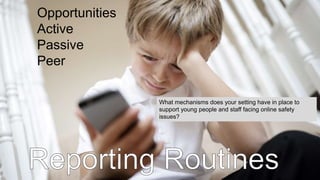
Opportunities
Active
Passive
Peer
What mechanisms does your setting have in place to
support young people and staff facing online safety
issues?
Professional Development
All staff
Frequency
Relevance

Advanced level
How do you ensure that all staff receive appropriate online
safety training that is relevant and regularly up to date?
Policy
Clear
Understood
Respected
Communicated
Do you have online safety policies and acceptable use
policies in place? How do you know they are clear,
understood and respected by all?
Curriculum
Relevance
Scope
Progression
Competencies
Describe how your setting educates children and young
people to build knowledge, skills and capability when it
comes to online safety? How do you assess its
effectiveness?
Secure Infrastructure
Secure
Access
Filtering
Monitoring
Evaluation So What?
Evidence
How do you know?
Inspecting online safety and
security
John Nixon – Her Majesty’s Inspector
Mythbusting specific technology myths
(sourced from stakeholder meetings between schools and the DfE Eductech unit)
 Ofsted inspectors will not penalise or reward you for introducing
technology. However, where it has an impact on the quality of
education offered, they will evaluate the management of its
implementation.
 Ofsted inspectors do not set any requirements for how schools
record work. They will consider any media, including online material,
they can easily access.
 Ofsted inspectors are not anti-technology, but their focus will always
be primarily on the quality of education being provided, rather than
the technology you use. So, does the use of technology enhance the
quality of teaching and learning?
Slide 14
Inspecting online safety
Inspecting safeguarding in early years, education and skills settings
Guidance for inspectors undertaking inspection under the common inspection framework
Definition of Safeguarding:
 Paragraph 10: Safeguarding action may be needed to protect children and learners from:
bullying, including online bullying and prejudice-based bullying
While Paragraph 11 further states:
Safeguarding is not just about protecting children… It relates to broader aspects of care
and education, including:
 online safety and associated issues
Slide 15
Inspecting online safety
 Inspectors will evaluate how well schools fulfil their statutory
duties, and how well staff exercise their professional judgement
in keeping children and learners safe
Paragraph 4 Inspecting safeguarding in early years, education and skills settings
 Inspectors consider:
- the quality and effectiveness of a school’s policies and practices
- how effective leaders, including governors, are in creating a
culture of safeguarding.
Paragraph 15 ‘Inspecting safeguarding in early years, education and skills settings’
Slide 16
GDPR
 There is currently no specific reference to GDPR or the data
protection Act 2018 in the inspection framework or inspectors
guidance.
 Ofsted do not check GDPR compliance as part of their role
 However, Inspectors will consider of any practices that result in
safeguarding concerns arising from the misuse of data.
Slide 17
Inspecting online safety
The grade descriptors for personal development, behaviour and welfare
include:
Outstanding:
 Pupils have an excellent understanding of how to stay safe online, the dangers of
inappropriate use of mobile technology and social networking sites.
 Pupils work hard with the school to prevent all forms of bullying, including online bullying
and prejudice-based bullying
Good:
 The school’s open culture promotes all aspects of pupils’ welfare. They are safe and feel safe.
They have opportunities to learn how to keep themselves safe. They enjoy learning about
how to stay healthy and about emotional and mental health, safe and positive relationships
and how to prevent misuse of technology.
Slide 18
Education Inspection Framework (EIF)
 The EIF will replace the current common inspection framework
(CIF) in September 2019.
 It is currently out for consultation and available at
https://www.gov.uk/government/consultations/education-
inspection-framework-2019-inspecting-the-substance-of-
education
This footer is edited in >Insert > Header & Footer Slide 19
Consultation on the Education inspection framework 2019 Slide 20
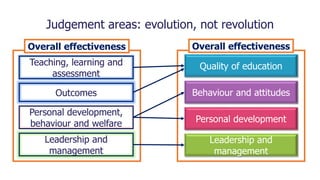
Quality of education
Personal development
Leadership and
management
Behaviour and attitudes
Teaching, learning and
assessment
Personal development,
behaviour and welfare
Leadership and
management
Outcomes
Overall effectiveness Overall effectiveness
Judgement areas: evolution, not revolution
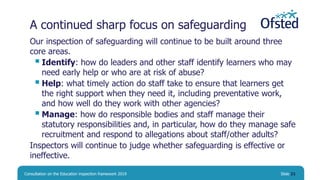
A continued sharp focus on safeguarding
Our inspection of safeguarding will continue to be built around three
core areas.
 Identify: how do leaders and other staff identify learners who may
need early help or who are at risk of abuse?
 Help: what timely action do staff take to ensure that learners get
the right support when they need it, including preventative work,
and how well do they work with other agencies?
 Manage: how do responsible bodies and staff manage their
statutory responsibilities and, in particular, how do they manage safe
recruitment and respond to allegations about staff/other adults?
Inspectors will continue to judge whether safeguarding is effective or
ineffective.
Consultation on the Education inspection framework 2019 Slide 21
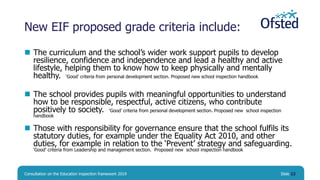
New EIF proposed grade criteria include:
 The curriculum and the school’s wider work support pupils to develop
resilience, confidence and independence and lead a healthy and active
lifestyle, helping them to know how to keep physically and mentally
healthy. ‘Good’ criteria from personal development section. Proposed new school inspection handbook
 The school provides pupils with meaningful opportunities to understand
how to be responsible, respectful, active citizens, who contribute
positively to society. ‘Good’ criteria from personal development section. Proposed new school inspection
handbook
 Those with responsibility for governance ensure that the school fulfils its
statutory duties, for example under the Equality Act 2010, and other
duties, for example in relation to the ‘Prevent’ strategy and safeguarding.
‘Good’ criteria from Leadership and management section. Proposed new school inspection handbook
Consultation on the Education inspection framework 2019 Slide 22
National Cyber Security Centre
Andrew M
24
Who we are:
• UK authority on cyber security
• Created in 2016 to:
“Help make the UK the safest place to live
and do business online”
• Promote cyber security and resilience in our
schools across the UK.
25
Cyber Security in Schools
• Schools are increasingly moving central
functions and teaching and learning online
• Important data including sensitive data is stored
electronically.
26
Cyber risk to schools
• A school’s ability to teach or operate properly
• In exceptional circumstances, a cyber
incident can force a school to close.
• Schools falling victim to an electronic data
breach
.
27
Cyber threats to schools:
• Threats can be malicious or accidental in nature
• They can come externally from cyber criminals or
ex-pupils or staff
• Originate internally from pupils or members of staff
• Prepare and respond
Hamish Mackenzie
Alex Davison
THANK YOU
esafety@swgfl.org.uk www.swgfl.org.uk@swgfl_official
esafety@swgfl.org.uk
+44 344 8002382
@swgfl_offical
@UK_SIC

Inspection Online Safety and Security

  • 1.
    Inspection: Online Safetyand Security David Wright Ken Corish John Nixon HMI UK Safer Internet Centre SWGfL Ofsted Hamish Mackenzie Alex Davison National Cyber Security Centre Royal Hospital School Royal Hospital School
  • 2.
  • 5.
  • 6.
    Opportunities Active Passive Peer What mechanisms doesyour setting have in place to support young people and staff facing online safety issues?
  • 7.
    Professional Development All staff Frequency Relevance Advancedlevel How do you ensure that all staff receive appropriate online safety training that is relevant and regularly up to date?
  • 8.
    Policy Clear Understood Respected Communicated Do you haveonline safety policies and acceptable use policies in place? How do you know they are clear, understood and respected by all?
  • 9.
    Curriculum Relevance Scope Progression Competencies Describe how yoursetting educates children and young people to build knowledge, skills and capability when it comes to online safety? How do you assess its effectiveness?
  • 10.
  • 11.
  • 13.
    Inspecting online safetyand security John Nixon – Her Majesty’s Inspector
  • 14.
    Mythbusting specific technologymyths (sourced from stakeholder meetings between schools and the DfE Eductech unit)  Ofsted inspectors will not penalise or reward you for introducing technology. However, where it has an impact on the quality of education offered, they will evaluate the management of its implementation.  Ofsted inspectors do not set any requirements for how schools record work. They will consider any media, including online material, they can easily access.  Ofsted inspectors are not anti-technology, but their focus will always be primarily on the quality of education being provided, rather than the technology you use. So, does the use of technology enhance the quality of teaching and learning? Slide 14
  • 15.
    Inspecting online safety Inspectingsafeguarding in early years, education and skills settings Guidance for inspectors undertaking inspection under the common inspection framework Definition of Safeguarding:  Paragraph 10: Safeguarding action may be needed to protect children and learners from: bullying, including online bullying and prejudice-based bullying While Paragraph 11 further states: Safeguarding is not just about protecting children… It relates to broader aspects of care and education, including:  online safety and associated issues Slide 15
  • 16.
    Inspecting online safety Inspectors will evaluate how well schools fulfil their statutory duties, and how well staff exercise their professional judgement in keeping children and learners safe Paragraph 4 Inspecting safeguarding in early years, education and skills settings  Inspectors consider: - the quality and effectiveness of a school’s policies and practices - how effective leaders, including governors, are in creating a culture of safeguarding. Paragraph 15 ‘Inspecting safeguarding in early years, education and skills settings’ Slide 16
  • 17.
    GDPR  There iscurrently no specific reference to GDPR or the data protection Act 2018 in the inspection framework or inspectors guidance.  Ofsted do not check GDPR compliance as part of their role  However, Inspectors will consider of any practices that result in safeguarding concerns arising from the misuse of data. Slide 17
  • 18.
    Inspecting online safety Thegrade descriptors for personal development, behaviour and welfare include: Outstanding:  Pupils have an excellent understanding of how to stay safe online, the dangers of inappropriate use of mobile technology and social networking sites.  Pupils work hard with the school to prevent all forms of bullying, including online bullying and prejudice-based bullying Good:  The school’s open culture promotes all aspects of pupils’ welfare. They are safe and feel safe. They have opportunities to learn how to keep themselves safe. They enjoy learning about how to stay healthy and about emotional and mental health, safe and positive relationships and how to prevent misuse of technology. Slide 18
  • 19.
    Education Inspection Framework(EIF)  The EIF will replace the current common inspection framework (CIF) in September 2019.  It is currently out for consultation and available at https://www.gov.uk/government/consultations/education- inspection-framework-2019-inspecting-the-substance-of- education This footer is edited in >Insert > Header & Footer Slide 19
  • 20.
    Consultation on theEducation inspection framework 2019 Slide 20 Quality of education Personal development Leadership and management Behaviour and attitudes Teaching, learning and assessment Personal development, behaviour and welfare Leadership and management Outcomes Overall effectiveness Overall effectiveness Judgement areas: evolution, not revolution
  • 21.
    A continued sharpfocus on safeguarding Our inspection of safeguarding will continue to be built around three core areas.  Identify: how do leaders and other staff identify learners who may need early help or who are at risk of abuse?  Help: what timely action do staff take to ensure that learners get the right support when they need it, including preventative work, and how well do they work with other agencies?  Manage: how do responsible bodies and staff manage their statutory responsibilities and, in particular, how do they manage safe recruitment and respond to allegations about staff/other adults? Inspectors will continue to judge whether safeguarding is effective or ineffective. Consultation on the Education inspection framework 2019 Slide 21
  • 22.
    New EIF proposedgrade criteria include:  The curriculum and the school’s wider work support pupils to develop resilience, confidence and independence and lead a healthy and active lifestyle, helping them to know how to keep physically and mentally healthy. ‘Good’ criteria from personal development section. Proposed new school inspection handbook  The school provides pupils with meaningful opportunities to understand how to be responsible, respectful, active citizens, who contribute positively to society. ‘Good’ criteria from personal development section. Proposed new school inspection handbook  Those with responsibility for governance ensure that the school fulfils its statutory duties, for example under the Equality Act 2010, and other duties, for example in relation to the ‘Prevent’ strategy and safeguarding. ‘Good’ criteria from Leadership and management section. Proposed new school inspection handbook Consultation on the Education inspection framework 2019 Slide 22
  • 23.
    National Cyber SecurityCentre Andrew M
  • 24.
    24 Who we are: •UK authority on cyber security • Created in 2016 to: “Help make the UK the safest place to live and do business online” • Promote cyber security and resilience in our schools across the UK.
  • 25.
    25 Cyber Security inSchools • Schools are increasingly moving central functions and teaching and learning online • Important data including sensitive data is stored electronically.
  • 26.
    26 Cyber risk toschools • A school’s ability to teach or operate properly • In exceptional circumstances, a cyber incident can force a school to close. • Schools falling victim to an electronic data breach .
  • 27.
    27 Cyber threats toschools: • Threats can be malicious or accidental in nature • They can come externally from cyber criminals or ex-pupils or staff • Originate internally from pupils or members of staff • Prepare and respond
  • 28.
  • 41.

Editor's Notes

  • #21 This slide shows the correlation of the current judgement areas to the proposed judgement areas for the new framework. Yes there’s change, but it’s incremental.
  • #22 We are not looking to take the focus away from safeguarding. A focus on safeguarding will remain in inspection and will continue to be built around the Identify, Help and Manage model. We will ensure that the published guidance on inspecting safeguarding in education is updated at the time of final publication.