INSOLVENCY & BANKRUPTCY CODE – A GAME CHANGER ?
Insolvency and Bankruptcy Code 2016 ( I&BC) is occupying premier space in the electronic and Print
media and is drawing a lot of attention due to the chronic problem of Recovery of money and in
particular of Banks and Financial Institutions which are carrying huge Non Performing Assets ( NPA)
mainly lent to corporate. I & BC is being used even by creditors who have supplied goods and services
and also be employees whose salary and terminal dues remain unpaid. To give an idea of the urgency
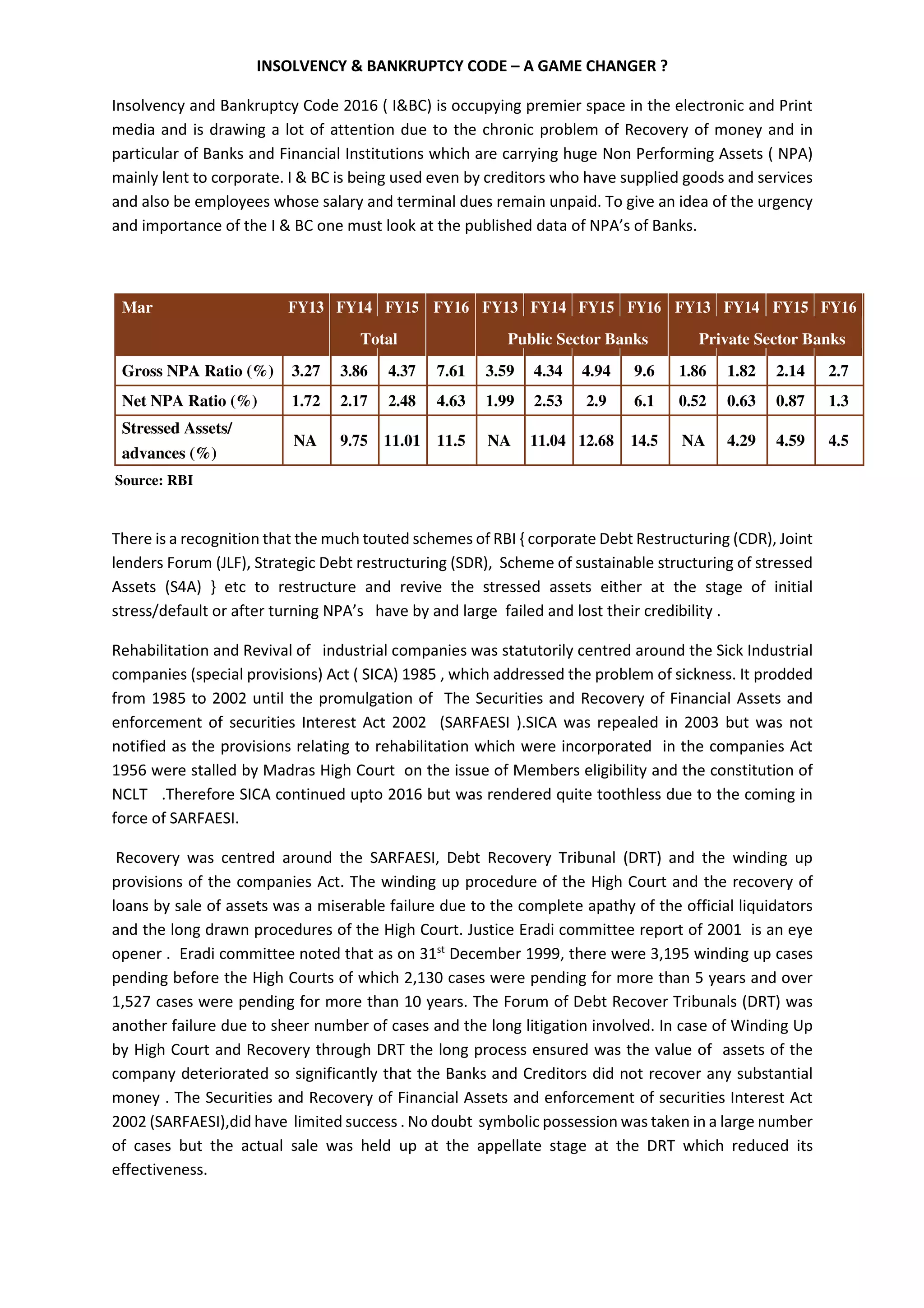
and importance of the I & BC one must look at the published data of NPA’s of Banks.
Mar FY13 FY14 FY15 FY16 FY13 FY14 FY15 FY16 FY13 FY14 FY15 FY16
Total Public Sector Banks Private Sector Banks
Gross NPA Ratio (%) 3.27 3.86 4.37 7.61 3.59 4.34 4.94 9.6 1.86 1.82 2.14 2.7
Net NPA Ratio (%) 1.72 2.17 2.48 4.63 1.99 2.53 2.9 6.1 0.52 0.63 0.87 1.3
Stressed Assets/
NA 9.75 11.01 11.5 NA 11.04 12.68 14.5 NA 4.29 4.59 4.5
advances (%)
Source: RBI
There is a recognition that the much touted schemes of RBI { corporate Debt Restructuring (CDR), Joint
lenders Forum (JLF), Strategic Debt restructuring (SDR), Scheme of sustainable structuring of stressed
Assets (S4A) } etc to restructure and revive the stressed assets either at the stage of initial
stress/default or after turning NPA’s have by and large failed and lost their credibility .
Rehabilitation and Revival of industrial companies was statutorily centred around the Sick Industrial
companies (special provisions) Act ( SICA) 1985 , which addressed the problem of sickness. It prodded
from 1985 to 2002 until the promulgation of The Securities and Recovery of Financial Assets and
enforcement of securities Interest Act 2002 (SARFAESI ).SICA was repealed in 2003 but was not
notified as the provisions relating to rehabilitation which were incorporated in the companies Act
1956 were stalled by Madras High Court on the issue of Members eligibility and the constitution of
NCLT .Therefore SICA continued upto 2016 but was rendered quite toothless due to the coming in
force of SARFAESI.
Recovery was centred around the SARFAESI, Debt Recovery Tribunal (DRT) and the winding up
provisions of the companies Act. The winding up procedure of the High Court and the recovery of
loans by sale of assets was a miserable failure due to the complete apathy of the official liquidators
and the long drawn procedures of the High Court. Justice Eradi committee report of 2001 is an eye
opener . Eradi committee noted that as on 31st
December 1999, there were 3,195 winding up cases
pending before the High Courts of which 2,130 cases were pending for more than 5 years and over
1,527 cases were pending for more than 10 years. The Forum of Debt Recover Tribunals (DRT) was
another failure due to sheer number of cases and the long litigation involved. In case of Winding Up
by High Court and Recovery through DRT the long process ensured was the value of assets of the
company deteriorated so significantly that the Banks and Creditors did not recover any substantial
money . The Securities and Recovery of Financial Assets and enforcement of securities Interest Act
2002 (SARFAESI),did have limited success . No doubt symbolic possession was taken in a large number
of cases but the actual sale was held up at the appellate stage at the DRT which reduced its
effectiveness.
Therefore all in all the existing Rehabilitation and Recovery provisions did not lead to the desired
results .It will be apparent that the chronic problem needed a dynamic solution to reign in the existing
NPA’s and a deterrent to avoid further wilful defaults and new NPA’s . The I&BC 2016 has been brought
with great hope of speeding up the recovery in a time bound manner.
It is pertinent to note that several acts have been replaced or amended to make Insolvency &
Bankruptcy Code 2016 an effective tool. These are outlined in brief below :
1. SICA stand repealed with effect from 1st
December 2016 vide notification dated 25 November
2016. Accordingly ,proceedings in appx 1200 cases at various stages will abate and be referred
to under I&BC under a fresh application.
2. The provisions relating to Revival & Rehabilitation contained in Chapter XIX of Companies
Act 2013 [ sections 253 to 269 ] stand omitted .
3. The provision of winding up for failure to pay “debts”in Section 271 of companies Act 2013
are omitted . Consequently, failure in payment of debts by corporate will be dealt with under
I&BC rather than High Courts. There are appx 4500 cases pending in High Courts which are in
pre-order stage. A notification provides that such cases will stand transferred to NCLT under
the I&BC .
4. The provisions relating to winding up of LLP for failure to pay “debts”in Section 64 of LLP Act
2008 are omitted. Consequently, failure in payment of debts by LLPs will be dealt with under
I& BC.
5. Debt Recovery Tribunals established under The Recovery of Debts Due to Banks and Financial
Institutions Act 1993 would continue to operate and Banks and Financial Institutions can still
approach them in case of Defaults . However, Banks and Financial Institutions can start the
Insolvency procedure under the I&BC by withdrawing the application filed before the NCLT.
6. SARFAESI provisions are not disturbed and Banks and FI can still resort to this Act and taking
possession and selling. However, Banks and FI are eligible to apply under I& BC . On their
application being accepted there will be a moratorium of 180 days on the SARFAESI
proceedings .The recovery will be as per the procedure of I&BC.
Before we look at the highlights of the I&BC which is today looking to be one of the big game changer
for Recovery of NPAs of Banks and Financial Institutions and also of all creditors in general we may
look at what were the objectives in making of this code. The Bankruptcy Law Reform committee laid
down 3 objectives:
1.Low Time to Resolution
2.Low loss in Recovery
3.Higher levels of Debt Financing across a wide variety of Debt instruments.
The committee noted that it took an average 4 years in India to resolve insolvency as compared to
0.8 years in Singapore and 1 Year in London. The committee also noted that creditors, in India
,recover about 25% as against 80%-90% elsewhere making it one of the Lowest Recovery Rate in the
World.
This can be seen from the chart below :
Region/Country Recovery Rate Time Cost
OECD high income 73 1.7 9.1
East Asia & Pacific 33.9 2.6 20.6
Europe & Central Asia 38.2 2.2 13.1
Brazil 15.8 4 12
Canada 87.4 0.8 7
China 36.9 1.7 22
Denmark 88 1 4
Finland 90.3 0.9 3.5
France 78.5 1.9 9
Germany 84.4 1.2 8
Hong Kong Sar,China 87.2 0.8 5
India 26 4.3 9
Japan 92.1 0.6 4.2
Slovenia 89.2 0.8 4
Singapore 88.7 0.8 4
South Africa 35.1 2 18
United States 78.6 1.5 10
HIGHLIGHTS OF THE CODE
1.I&BC will cover debt defaults of Corporates, LLP, Partnership firms and individuals.The provisions
relating to partnership Firms and Individuals are yet to be notified.
2.Applications can be made to NCLT by Financial Creditors [ Secured and Unsecured Lenders ];
Operational Creditors [ creditors for goods ,services and employees ] and the corporate themselves.
3. Time lines for consideration of Applications and Resolution of Cases. Resolution is to be completed
within 180 days ( with an extention of 90 days ) and thereafter the corporate goes for liquidation.
4. On the application being admitted the Board of Directors stand Suspended and the entire
Resolution is to be done by a Resolution Professional who is so qualified .The liquidation is also to be
conducted by Professionals as opposed to the government official Liquidator .
4.Voluntary liquidation is to be done under the I&BC code.
5. Tremendous opportunities for Chartered Accountants ( And other Professionals ) to qualify as
Insolvency Professional and Liquidators. A new class of professional and Professional entities
emerging.
Coming to the details of the code, the Application by Financial Creditors [Secured /unsecured
Creditors ] or the Operational Creditors [ creditors for goods and services] or the corporate itself is
required to be disposed off within 14 days. On the date of such occurrence the Board of Directors
stand suspended and an Interim Resolution is appointed . A moratorium on all legal proceedings
against the assets of the company is declared for a period of 180 Days. The interim resolution
professional is primarily required to issue an advertisement and settle a list of creditors. He is required
to appoint Valuers for the current and Fixed Assets of the company and get the valuation done. He is
required to form a ‘Committee of Creditors’ ( COC) comprising of Financial Creditors ( Secured /
Unsecured Lenders) and call the first meeting of the COC. The COC will at the first instance consider
the confirmation Of the Interim Insolvency Professional as an Insolvency Professional or can appoint
any other person whom they so desire. The change generally happens in cases where the application
is made by the Corporate Debtor as the Insolvency Professional is viewed as the Company appointed
and an insider whereas the FINANCIAL CREDITORS would prefer to have their Insolvency Professional
who will take care of their interest. The Duties of the Insolvency Professional are specified in Sec 18
and 25 of the code. Here it must be mentioned that the Insolvency Professional is required at this
stage to find a solution or Resolve the debt. Therefore, the Insolvency Professional is required to make
an information Memorandum and make it available to any suitor to give a proposal or ‘Resolution
Plan’ . The Insolvency Professional may need inputs of other professionals for controlling the company
cash Flow , find out the financial and operational feasibility for making a detailed Information
Memorandum. The Resolution Plan submitted by suitors could cover reschedulement of Debt
instalments, Write off of Debt OR Purchase of Assets of the company either as a going concern or
Piecemeal purchase. It may be noted that the Insolvency professional does not prepare any Resolution
plan. Its role is only to prepare the INFORMATION MEMORANDUM and evaluate the Resolution Plan
for the benefit of the COC. The COC is required to either accept the Resolution Plan or reject the same.
75% of financial creditors voting rights ( In Value) are required for approval of the Resolution Plan. In
case the COC accepts the proposal the Insolvency Professional moves the matter before the NCLT for
the final order incorporating the Resolution Plan. The Resolution Plan is binding on all the creditors
the corporate Debtor ,the authorities and all stakeholders. In case the Resolution Plan is rejected or
no Resolution Plan is received before the period of 180 days the corporate debtor is to be liquidated
.
The entire process is depicted below :
A corporate who fails in his commitment to pay
The financial creditor may file an
application for initiating the insolvency
resolution process against the corporate
debtor before NCLT, the Adjudicating
Authority(AA)
An operational creditor send a demand notice to
the corporate debtor. Within the 10 days, if the
operational creditor does not receive payment or
notice of dispute, it applies before NCLT for
resolution process.
A defaulting corporate debtor may
also file an application for initiating
corporate insolvency resolution
process with the NCLT the
Adjudicating Authority
Within 14 days of application receipt, if
AA is satisfied about the default and all
other parameters are met it accepts the
application
Within 14 days of application receipt, AA admits
the application if default is established and if
application is complete or else reject the same.
Within 14 days, the AA accepts the
application if it is complete or else
reject the same.
Commencement of corporate insolvency resolution process
AA declares moratorium for Makes public announcement for the initiation of Appointment of an interim
180 days. the process, call for the submission of claims. resolution professional.
Constitute a Committee of Creditors (COC)
Appointment of the resolution professional (RP) (Either Interim resolution professional can continue
or a new one can be appointed by COC with backing of 75% majority (in Value terms)
RP prepares Information Memorandum. Suitor prepares resolution plan and submit to RP. RP examines
all Resolution Plan and presents such plan to COC.
COC accepts the Plan COC rejects the Plan
RP submits Resolution Plan to Adjudicating Authority
AA accepts Resolution plan AA rejects resolution plan
RP implements Resolution plan management to existing/new promoters Corporate debtors goes into Liquidation
From the above it will be seen that all Financial Powers after the commencement of the Insolvency
process vest with the COC. The Insolvency Professional can exercise financial powers only to the extent
of payment for essential services of electricity and water etc. Therefore once the application is
admitted the Financial Creditors are in control of the corporate rather than the Promoters as the Board
stand suspended. This to my Mind is the biggest Change made in the Recovery and rehabilitation Law
since Independence. This has given Hope of finding solutions to the problem of NPAs . However, there
are a lot of Challenges in case of Operating and Running companies being run by Insolvency
Professionals who have no experience as they are required to run the company as a going concern for
180 days when the Resolution Plan is Finalised. It is even more challenging as the Insolvency
Professional are practicing CAs in most of the cases. Whether the Insolvency Professional should be
a signatory to Cheques ? What happens to payments to suppliers of goods and services since all
Financial decisions are with the COC ? How to procure goods and services so as to run the company
when the Insolvency Professional has no financial powers ? How to make payments for salaries and
labour dues when there is no Cash Flow ? How are legal cases to be handled and how professional
fees is to be paid ? In case of listed companies there are challenges of finalising and signing accounts
and declaring quarterly results ? How does the Insolvency Professional meet all the challenges of SEBI
compliances ? There are already murmurs of discontent among lenders on the Role of INSOLVENCY
PROFESSIONALs especially in case of running companies . There is a view gaining ground that the
commencement of Insolvency actually triggers a collapse of the company and therefore the period of
180 days should be reduced to 90 days and the Resolution Plan should be finalised within that period.
.
Further, the legality of several provisions is under challenge and a host of decisions from NCLAT on
various provisions of the I&BC have been pronounced . In the next article some of the key decisions
will be discussed and also the opportunities, Role and challenges before Chartered Accountants in
qualifying and operating as Insolvency Professionals.
INSOLVENCY & BANKRUPTCY CODE – A GAME CHANGER ?

INSOLVENCY & BANKRUPTCY CODE – A GAME CHANGER ?

  • 1.
    INSOLVENCY & BANKRUPTCYCODE – A GAME CHANGER ? Insolvency and Bankruptcy Code 2016 ( I&BC) is occupying premier space in the electronic and Print media and is drawing a lot of attention due to the chronic problem of Recovery of money and in particular of Banks and Financial Institutions which are carrying huge Non Performing Assets ( NPA) mainly lent to corporate. I & BC is being used even by creditors who have supplied goods and services and also be employees whose salary and terminal dues remain unpaid. To give an idea of the urgency and importance of the I & BC one must look at the published data of NPA’s of Banks. Mar FY13 FY14 FY15 FY16 FY13 FY14 FY15 FY16 FY13 FY14 FY15 FY16 Total Public Sector Banks Private Sector Banks Gross NPA Ratio (%) 3.27 3.86 4.37 7.61 3.59 4.34 4.94 9.6 1.86 1.82 2.14 2.7 Net NPA Ratio (%) 1.72 2.17 2.48 4.63 1.99 2.53 2.9 6.1 0.52 0.63 0.87 1.3 Stressed Assets/ NA 9.75 11.01 11.5 NA 11.04 12.68 14.5 NA 4.29 4.59 4.5 advances (%) Source: RBI There is a recognition that the much touted schemes of RBI { corporate Debt Restructuring (CDR), Joint lenders Forum (JLF), Strategic Debt restructuring (SDR), Scheme of sustainable structuring of stressed Assets (S4A) } etc to restructure and revive the stressed assets either at the stage of initial stress/default or after turning NPA’s have by and large failed and lost their credibility . Rehabilitation and Revival of industrial companies was statutorily centred around the Sick Industrial companies (special provisions) Act ( SICA) 1985 , which addressed the problem of sickness. It prodded from 1985 to 2002 until the promulgation of The Securities and Recovery of Financial Assets and enforcement of securities Interest Act 2002 (SARFAESI ).SICA was repealed in 2003 but was not notified as the provisions relating to rehabilitation which were incorporated in the companies Act 1956 were stalled by Madras High Court on the issue of Members eligibility and the constitution of NCLT .Therefore SICA continued upto 2016 but was rendered quite toothless due to the coming in force of SARFAESI. Recovery was centred around the SARFAESI, Debt Recovery Tribunal (DRT) and the winding up provisions of the companies Act. The winding up procedure of the High Court and the recovery of loans by sale of assets was a miserable failure due to the complete apathy of the official liquidators and the long drawn procedures of the High Court. Justice Eradi committee report of 2001 is an eye opener . Eradi committee noted that as on 31st December 1999, there were 3,195 winding up cases pending before the High Courts of which 2,130 cases were pending for more than 5 years and over 1,527 cases were pending for more than 10 years. The Forum of Debt Recover Tribunals (DRT) was another failure due to sheer number of cases and the long litigation involved. In case of Winding Up by High Court and Recovery through DRT the long process ensured was the value of assets of the company deteriorated so significantly that the Banks and Creditors did not recover any substantial money . The Securities and Recovery of Financial Assets and enforcement of securities Interest Act 2002 (SARFAESI),did have limited success . No doubt symbolic possession was taken in a large number of cases but the actual sale was held up at the appellate stage at the DRT which reduced its effectiveness.
  • 2.
    Therefore all inall the existing Rehabilitation and Recovery provisions did not lead to the desired results .It will be apparent that the chronic problem needed a dynamic solution to reign in the existing NPA’s and a deterrent to avoid further wilful defaults and new NPA’s . The I&BC 2016 has been brought with great hope of speeding up the recovery in a time bound manner. It is pertinent to note that several acts have been replaced or amended to make Insolvency & Bankruptcy Code 2016 an effective tool. These are outlined in brief below : 1. SICA stand repealed with effect from 1st December 2016 vide notification dated 25 November 2016. Accordingly ,proceedings in appx 1200 cases at various stages will abate and be referred to under I&BC under a fresh application. 2. The provisions relating to Revival & Rehabilitation contained in Chapter XIX of Companies Act 2013 [ sections 253 to 269 ] stand omitted . 3. The provision of winding up for failure to pay “debts”in Section 271 of companies Act 2013 are omitted . Consequently, failure in payment of debts by corporate will be dealt with under I&BC rather than High Courts. There are appx 4500 cases pending in High Courts which are in pre-order stage. A notification provides that such cases will stand transferred to NCLT under the I&BC . 4. The provisions relating to winding up of LLP for failure to pay “debts”in Section 64 of LLP Act 2008 are omitted. Consequently, failure in payment of debts by LLPs will be dealt with under I& BC. 5. Debt Recovery Tribunals established under The Recovery of Debts Due to Banks and Financial Institutions Act 1993 would continue to operate and Banks and Financial Institutions can still approach them in case of Defaults . However, Banks and Financial Institutions can start the Insolvency procedure under the I&BC by withdrawing the application filed before the NCLT. 6. SARFAESI provisions are not disturbed and Banks and FI can still resort to this Act and taking possession and selling. However, Banks and FI are eligible to apply under I& BC . On their application being accepted there will be a moratorium of 180 days on the SARFAESI proceedings .The recovery will be as per the procedure of I&BC. Before we look at the highlights of the I&BC which is today looking to be one of the big game changer for Recovery of NPAs of Banks and Financial Institutions and also of all creditors in general we may look at what were the objectives in making of this code. The Bankruptcy Law Reform committee laid down 3 objectives: 1.Low Time to Resolution 2.Low loss in Recovery 3.Higher levels of Debt Financing across a wide variety of Debt instruments. The committee noted that it took an average 4 years in India to resolve insolvency as compared to 0.8 years in Singapore and 1 Year in London. The committee also noted that creditors, in India ,recover about 25% as against 80%-90% elsewhere making it one of the Lowest Recovery Rate in the World.
  • 3.
    This can beseen from the chart below : Region/Country Recovery Rate Time Cost OECD high income 73 1.7 9.1 East Asia & Pacific 33.9 2.6 20.6 Europe & Central Asia 38.2 2.2 13.1 Brazil 15.8 4 12 Canada 87.4 0.8 7 China 36.9 1.7 22 Denmark 88 1 4 Finland 90.3 0.9 3.5 France 78.5 1.9 9 Germany 84.4 1.2 8 Hong Kong Sar,China 87.2 0.8 5 India 26 4.3 9 Japan 92.1 0.6 4.2 Slovenia 89.2 0.8 4 Singapore 88.7 0.8 4 South Africa 35.1 2 18 United States 78.6 1.5 10 HIGHLIGHTS OF THE CODE 1.I&BC will cover debt defaults of Corporates, LLP, Partnership firms and individuals.The provisions relating to partnership Firms and Individuals are yet to be notified. 2.Applications can be made to NCLT by Financial Creditors [ Secured and Unsecured Lenders ]; Operational Creditors [ creditors for goods ,services and employees ] and the corporate themselves. 3. Time lines for consideration of Applications and Resolution of Cases. Resolution is to be completed within 180 days ( with an extention of 90 days ) and thereafter the corporate goes for liquidation. 4. On the application being admitted the Board of Directors stand Suspended and the entire Resolution is to be done by a Resolution Professional who is so qualified .The liquidation is also to be conducted by Professionals as opposed to the government official Liquidator . 4.Voluntary liquidation is to be done under the I&BC code. 5. Tremendous opportunities for Chartered Accountants ( And other Professionals ) to qualify as Insolvency Professional and Liquidators. A new class of professional and Professional entities emerging. Coming to the details of the code, the Application by Financial Creditors [Secured /unsecured Creditors ] or the Operational Creditors [ creditors for goods and services] or the corporate itself is required to be disposed off within 14 days. On the date of such occurrence the Board of Directors stand suspended and an Interim Resolution is appointed . A moratorium on all legal proceedings against the assets of the company is declared for a period of 180 Days. The interim resolution professional is primarily required to issue an advertisement and settle a list of creditors. He is required to appoint Valuers for the current and Fixed Assets of the company and get the valuation done. He is
  • 4.
    required to forma ‘Committee of Creditors’ ( COC) comprising of Financial Creditors ( Secured / Unsecured Lenders) and call the first meeting of the COC. The COC will at the first instance consider the confirmation Of the Interim Insolvency Professional as an Insolvency Professional or can appoint any other person whom they so desire. The change generally happens in cases where the application is made by the Corporate Debtor as the Insolvency Professional is viewed as the Company appointed and an insider whereas the FINANCIAL CREDITORS would prefer to have their Insolvency Professional who will take care of their interest. The Duties of the Insolvency Professional are specified in Sec 18 and 25 of the code. Here it must be mentioned that the Insolvency Professional is required at this stage to find a solution or Resolve the debt. Therefore, the Insolvency Professional is required to make an information Memorandum and make it available to any suitor to give a proposal or ‘Resolution Plan’ . The Insolvency Professional may need inputs of other professionals for controlling the company cash Flow , find out the financial and operational feasibility for making a detailed Information Memorandum. The Resolution Plan submitted by suitors could cover reschedulement of Debt instalments, Write off of Debt OR Purchase of Assets of the company either as a going concern or Piecemeal purchase. It may be noted that the Insolvency professional does not prepare any Resolution plan. Its role is only to prepare the INFORMATION MEMORANDUM and evaluate the Resolution Plan for the benefit of the COC. The COC is required to either accept the Resolution Plan or reject the same. 75% of financial creditors voting rights ( In Value) are required for approval of the Resolution Plan. In case the COC accepts the proposal the Insolvency Professional moves the matter before the NCLT for the final order incorporating the Resolution Plan. The Resolution Plan is binding on all the creditors the corporate Debtor ,the authorities and all stakeholders. In case the Resolution Plan is rejected or no Resolution Plan is received before the period of 180 days the corporate debtor is to be liquidated .
  • 5.
    The entire processis depicted below : A corporate who fails in his commitment to pay The financial creditor may file an application for initiating the insolvency resolution process against the corporate debtor before NCLT, the Adjudicating Authority(AA) An operational creditor send a demand notice to the corporate debtor. Within the 10 days, if the operational creditor does not receive payment or notice of dispute, it applies before NCLT for resolution process. A defaulting corporate debtor may also file an application for initiating corporate insolvency resolution process with the NCLT the Adjudicating Authority Within 14 days of application receipt, if AA is satisfied about the default and all other parameters are met it accepts the application Within 14 days of application receipt, AA admits the application if default is established and if application is complete or else reject the same. Within 14 days, the AA accepts the application if it is complete or else reject the same. Commencement of corporate insolvency resolution process AA declares moratorium for Makes public announcement for the initiation of Appointment of an interim 180 days. the process, call for the submission of claims. resolution professional. Constitute a Committee of Creditors (COC) Appointment of the resolution professional (RP) (Either Interim resolution professional can continue or a new one can be appointed by COC with backing of 75% majority (in Value terms) RP prepares Information Memorandum. Suitor prepares resolution plan and submit to RP. RP examines all Resolution Plan and presents such plan to COC. COC accepts the Plan COC rejects the Plan RP submits Resolution Plan to Adjudicating Authority AA accepts Resolution plan AA rejects resolution plan RP implements Resolution plan management to existing/new promoters Corporate debtors goes into Liquidation
  • 6.
    From the aboveit will be seen that all Financial Powers after the commencement of the Insolvency process vest with the COC. The Insolvency Professional can exercise financial powers only to the extent of payment for essential services of electricity and water etc. Therefore once the application is admitted the Financial Creditors are in control of the corporate rather than the Promoters as the Board stand suspended. This to my Mind is the biggest Change made in the Recovery and rehabilitation Law since Independence. This has given Hope of finding solutions to the problem of NPAs . However, there are a lot of Challenges in case of Operating and Running companies being run by Insolvency Professionals who have no experience as they are required to run the company as a going concern for 180 days when the Resolution Plan is Finalised. It is even more challenging as the Insolvency Professional are practicing CAs in most of the cases. Whether the Insolvency Professional should be a signatory to Cheques ? What happens to payments to suppliers of goods and services since all Financial decisions are with the COC ? How to procure goods and services so as to run the company when the Insolvency Professional has no financial powers ? How to make payments for salaries and labour dues when there is no Cash Flow ? How are legal cases to be handled and how professional fees is to be paid ? In case of listed companies there are challenges of finalising and signing accounts and declaring quarterly results ? How does the Insolvency Professional meet all the challenges of SEBI compliances ? There are already murmurs of discontent among lenders on the Role of INSOLVENCY PROFESSIONALs especially in case of running companies . There is a view gaining ground that the commencement of Insolvency actually triggers a collapse of the company and therefore the period of 180 days should be reduced to 90 days and the Resolution Plan should be finalised within that period. . Further, the legality of several provisions is under challenge and a host of decisions from NCLAT on various provisions of the I&BC have been pronounced . In the next article some of the key decisions will be discussed and also the opportunities, Role and challenges before Chartered Accountants in qualifying and operating as Insolvency Professionals.