THE INSOLVENCY &
BANKRUPTCY CODE 2016
IMPORTANT TERMS
Financial creditor- Any person to whom a financial debt is owed and
includes a person to whom such debt has been legally assigned or
transferred to.
Financial Debt Includes;
i. Money borrowed against the payment of interest
ii. Any amount raised pursuant to the issue of bonds, debentures,
stock or any similar instrument
iii. The amount of any liability in resect of any lease or hire purchase
contract
iv. Any counter indemnity obligation in respect of guarantee
of credit or other instrument of bank or financial institution.
OPERATIONAL CREDITOR
Means any person to whom a operational debt is owed and includes a
person to whom such debt has been legally assigned or transferred
to.
Operational Debt; a claim in respect of provision of goods or services
including; employment or a debt in respect of the repayment of dues
arising under any law for the time being in force and payable to the
Central Government, any State Government or any local authority.
MORATORIUM
This operates as a calm period during which there shall be no;
a) Institution of suits or continuation of pending suits or proceedings
by any court of law, tribunal, arbitration panel or other authority;
b) Transfer, encumbrance or disposal of by the corporate debtor any
of its assets or any legal right or beneficial interest therein;
c) The recovery of any property by an owner or lessor where such
property is occupied by or in the possession of the corporate
debtor.
d) The supply of essential goods or services to the corporate debtor
as may specified shall not be terminated or suspended or
interrupted during moratorium period.
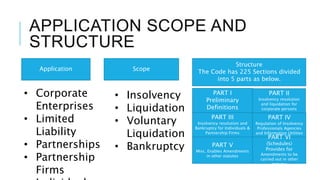
APPLICATION SCOPE AND
STRUCTURE
Application
• Corporate
Enterprises
• Limited
Liability
• Partnerships
• Partnership
Firms
Scope
• Insolvency
• Liquidation
• Voluntary
Liquidation
• Bankruptcy
Structure
The Code has 225 Sections divided
into 5 parts as below.
PART I
Preliminary
Definitions
PART II
Insolvency resolution
and liquidation for
corporate persons
PART III
Insolvency resolution and
Bankruptcy for Individuals &
Partnership Firms
PART IV
Regulation of Insolvency
Professionals Agencies
and Information Utilities
PART V
Misc. Enables Amendments
in other statutes
PART VI
(Schedules)
Provides for
Amendments to be
carried out in other
statutes
INSOLVENCY RESOLUTION
PROCESS FOR COMPANIES & LLP
Application of Default to NCLT
REJECTED
ACCEPTED
(Insolvency
commencem
ent date)
Initiation of Moratorium (S.13 & S.14 )
Appointment of Interim Resolution Professional by NCLT
(30 Days Term) (S.16). Public Announcement (S.15) (14
Days)
Submission of Plan
to NCLT
Implementation of
Plan
Liquidation [S.33]
Constitution of Committee of Creditors by Interim RP (S.21)
which shall appoint the Resolution Professional (S.22)
within 7 Days
Plan Rejected/No Resolution Plan
[S.31 (2)]
Plan Accepted [S.31
(1)]
Application of aggrieved party after contravention of
Withi
n 30
Days
By financial Creditor
(S.7), operational
creditor(S.9)/corporate
debtor itself (S.10)
Within 14
Days
Within 180
Days
(Extended
up to
further 90
Days)
[S.12]
Fast Track;
Within a
period of
90 Days
which may
extend to
not more
than 45
Days.
Minimum 75%
Vote
Minimum threshold 1
Lakh
Moratorium shall
cease to have
effect.
Submission of Resolution plan by Resolution applicant to
the Resolution Professional. (S.30)
Resolution Professional shall present it to Committee of
Creditors for Approval [S.30 (4) ]
NCLT may
give notice
to rectify
the defects
within 7
days
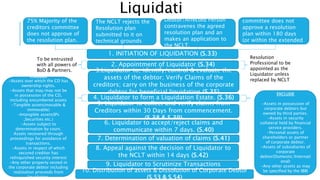
Liquidati
on
75% Majority of the
creditors committee
does not approve of
the resolution plan.
The NCLT rejects the
Resolution plan
submitted to it on
technical grounds
Debtor/Affected Person
contravenes the agreed
resolution plan and an
makes an application to
the NCLT.
The creditors
committee does not
approve a resolution
plan within 180 days
(or within the extended
period of 90 days)
1. INITIATION OF LIQUIDATION (S.33)
2. Appointment of Liquidator (S.34)
Resolution
Professional to be
appointed as the
Liquidator unless
replaced by NCLT
To be entrusted
with all powers of
BoD & Partners. 3.Liquidator to; identify/control & evaluate the
assets of the debtor; Verify Claims of the
creditors; carry on the business of the corporate
debtor for beneficial liquidation (S.35)
4. Liquidator to form a Liquidation Estate. (S.36)
EXCLUDE
-Assets in possession of
corporate debtors but
owned by third parties.
-Assets in security
collateral held by financial
service providers.
-Personal assets of
shareholders or partner
of corporate debtor.
-Assets of subsidiaries of
corporate
debtor(Domestic/Internati
onal)
-Any other assets as may
be specified by the IBBI
INCLUDE
-Assets over which the CD has
ownership rights.
-Assets that may/may not be
in possession of the CD,
including encumbered assets
-Tangible assets(movable &
immovable)
-Intangible assets(IPs
,Securities etc.)
-Assets subject to
determination by court.
Assets recovered through
proceedings for avoidance of
transactions.
-Assets in respect of which
secured creditor has
relinquished security interest
-Any other property vested in
the corporate debtor including
realization proceeds from
liquidation.
5. Liquidator to collect and verify claims from
Creditors within 30 Days from commencement.
(S.38 & S.39)
6. Liquidator to accept/reject claims and
communicate within 7 days. (S.40)
7. Determination of valuation of claims (S.41)
8. Appeal against the decision of Liquidator to
the NCLT within 14 days (S.42)
9. Liquidator to Scrutinize Transactions
10. Distribution of assets & Dissolution of Corporate Debtor
(S.53 & S.54)
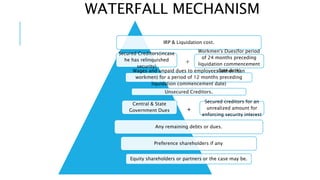
WATERFALL MECHANISM
IRP & Liquidation cost.
Secured Creditors(incase
he has relinquished
security)
Workmen's Dues(for period
of 24 months preceding
liquidation commencement
date date)Wages and unpaid dues to employees (other than
workmen) for a period of 12 months preceding
liquidation commencement date)
Unsecured Creditors.
Central & State
Government Dues
Secured creditors for an
unrealized amount for
enforcing security interest
Any remaining debts or dues.
Preference shareholders if any.
Equity shareholders or partners or the case may be.
+
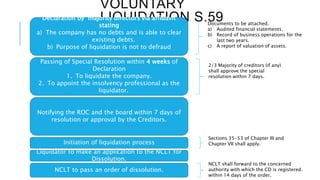
VOLUNTARY
LIQUIDATION S.59Declaration by majority directors via affidavit
stating
a) The company has no debts and is able to clear
existing debts.
b) Purpose of liquidation is not to defraud
Passing of Special Resolution within 4 weeks of
Declaration
1. To liquidate the company.
2. To appoint the insolvency professional as the
liquidator.
Documents to be attached.
a) Audited financial statements.
b) Record of business operations for the
last two years.
c) A report of valuation of assets.
2/3 Majority of creditors (if any)
shall approve the special
resolution within 7 days.
Notifying the ROC and the board within 7 days of
resolution or approval by the Creditors.
Initiation of liquidation process
Sections 35-53 of Chapter III and
Chapter VII shall apply.
Liquidator to make an application to the NCLT for
Dissolution.
NCLT to pass an order of dissolution.
NCLT shall forward to the concerned
authority with which the CD is registered.
within 14 days of the order.
Application for Initiating Fresh Start Process.
Eligible debtor* personally/through IRP can
apply to the DRT for discharge of Qualified
debts**.(S.80)
Eligibility.*
a) Gross annual
income does not
exceed 60k.
b) The agg. Value
of assets does
not exceed 20k.
c) The agg. Value
of qualifying
debts does not
exceed 35k.
d) Not an
undischarged
bankrupt.
e) Does not own a
dwelling unit,
irrespective of
whether it is
encumbered or
not;
f) A fresh start or
IRP or
bankruptcy
process is not
subsisting.
g) No fresh start
order has been
made in the
preceding 12
months of the
FRESH START – Individuals/One Person
Company
Initiation of Interim-Moratorium. (S.81)
Appointment of Resolution Professional. S.82
Qualified Debts**. a) A debt to the extent it
is secured. c) Debt incurred 3 months prior
to the application c) an excluded debt.
Liability to pay for; [a) fine imposed by a
tribunal/court. b) damages for negligence,
nuisance or breach of statutory
contract/other legal obligation. c)
maintenance under any law for the time
being in force. d) student loan e) any other
debt as may be prescribed.]
Examination of Application by RP and
Submission to DRT. S.83
Within 10 days of
appointment
Order of Admission/Rejection of Application by
DRT. Within 14 Days. S.84
Commencement of
Moratorium. S.85
Application of Objection by Creditor &
Examination by RP. S.86
May object on; a)
inclusion of debt as
qualifying debt.
b) Incorrectness of
details of the QD
specified in the order.
Application against decision of RP by
Creditor/Debtor. S.87
Application for Revocation of Order u/s 84 by
RP.
(S.91)
Grounds: a) change in
financial circumstances of the
debtor, the debtor is ineligible
for a fresh start process. b)
non compliance by debtor
under moratorium.
Discharge from a) penalties in respect from QD from the
DOA till DOO. b) interest including penal interest in respect
of QD from the DOA till DOO. c) any other sums owed
under any contract in respect of QD from DOA till DOO.
Order. U/S.92
180
Days.
Unless
revoked
under
S.91
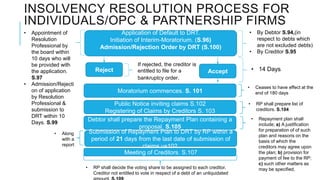
INSOLVENCY RESOLUTION PROCESS FOR
INDIVIDUALS/OPC & PARTNERSHIP FIRMS
Application of Default to DRT.
Initiation of Interim-Moratorium. (S.96)
Admission/Rejection Order by DRT (S.100)
• By Debtor S.94,(in
respect to debts which
are not excluded debts)
• By Creditor S.95
Reject
If rejected, the creditor is
entitled to file for a
bankruptcy order.
Moratorium commences. S. 101
• Appointment of
Resolution
Professional by
the board within
10 days who will
be provided with
the application.
S.97
• Admission/Rejecti
on of application
by Resolution
Professional &
submission to
DRT within 10
Days. S.99
Accept • 14 Days
Public Notice inviting claims S.102
Registering of Claims by Creditors S. 103
Debtor shall prepare the Repayment Plan containing a
proposal. S.105
• Repayment plan shall
include; a) A justification
for preparation of of such
plan and reasons on the
basis of which the
creditors may agree upon
the plan; b) provision for
payment of fee to the RP;
c) such other matters as
may be specified.
• RP shall prepare list of
creditors. S.104
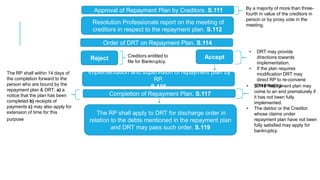
Submission of Repayment Plan to DRT by RP within a
period of 21 days from the last date of submission of
claims us102.
Meeting of Creditors. S.107
• Along
with a
report
• RP shall decide the voting share to be assigned to each creditor.
Creditor not entitled to vote in respect of a debt of an unliquidated
• Ceases to have effect at the
end of 180 days
Approval of Repayment Plan by Creditors. S.111 By a majority of more than three-
fourth in value of the creditors in
person or by proxy vote in the
meeting.
Resolution Professionals report on the meeting of
creditors in respect to the repayment plan. S.112
Order of DRT on Repayment Plan. S.114
Reject Accept
• DRT may provide
directions towards
implementation.
• If the plan requires
modification DRT may
direct RP to re-convene
the meeting.
Creditors entitled to
file for Bankruptcy.
Implementation and supervision of repayment plan by
RP.
S.116
Completion of Repayment Plan. S.117
The RP shall within 14 days of
the completion forward to the
person who are bound by the
repayment plan & DRT; a) a
notice that the plan has been
completed b) receipts of
payments c) may also apply for
extension of time for this
purpose
• S.118 Repayment plan may
come to an end prematurely if
it has not been fully
implemented.
• The debtor or the Creditor
whose claims under
repayment plan have not been
fully satisfied may apply for
bankruptcy.
The RP shall apply to DRT for discharge order in
relation to the debts mentioned in the repayment plan
and DRT may pass such order. S.119
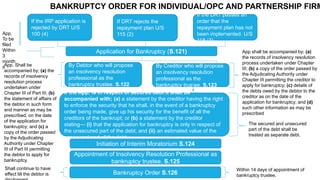
BANKRUPTCY ORDER FOR INDIVIDUAL/OPC AND PARTNERSHIP FIRM
If the IRP application is
rejected by DRT U/S
100 (4)
If DRT rejects the
repayment plan U/S
115 (2)
If the DRT passes an
order that the
repayment plan has not
been implemented. U/S
118 (3)
Application for Bankruptcy (S.121)
App.
To be
filed
Within
3
month
s By Debtor who will propose
an insolvency resolution
professional as the
bankruptcy trustee. S.122
By Creditor who will propose
an insolvency resolution
professional as the
bankruptcy trustee. S.123
App. Shall be
accompanied by; (a) the
records of insolvency
resolution process
undertaken under
Chapter III of Part III; (b)
the statement of affairs of
the debtor in such form
and manner as may be
prescribed, on the date
of the application for
bankruptcy; and (c) a
copy of the order passed
by the Adjudicating
Authority under Chapter
III of Part III permitting
the debtor to apply for
bankruptcy.
App shall be accompanied by; (a)
the records of insolvency resolution
process undertaken under Chapter
III; (b) a copy of the order passed by
the Adjudicating Authority under
Chapter III permitting the creditor to
apply for bankruptcy; (c) details of
the debts owed by the debtor to the
creditor as on the date of the
application for bankruptcy; and (d)
such other information as may be
prescribed
If the App. is in respect of secured debt it shall be
accompanied with; (a) a statement by the creditor having the right
to enforce the security that he shall, in the event of a bankruptcy
order being made, give up his security for the benefit of all the
creditors of the bankrupt; or (b) a statement by the creditor
stating— (i) that the application for bankruptcy is only in respect of
the unsecured part of the debt; and (ii) an estimated value of the
unsecured part of the debt.
The secured and unsecured
part of the debt shall be
treated as separate debt.
Initiation of Interim Moratorium S.124
Appointment of Insolvency Resolution Professional as
bankruptcy trustee. S.125
Bankruptcy Order S.126
Within 14 days of appointment of
bankruptcy trustee.
Shall continue to have
effect till the debtor is
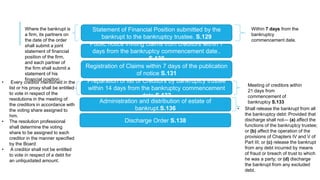
Statement of Financial Position submitted by the
bankrupt to the bankruptcy trustee. S.129
Within 7 days from the
bankruptcy
commencement date.
Public notice inviting claims from creditors within 7
days from the bankruptcy commencement date..
S.130
Where the bankrupt is
a firm, its partners on
the date of the order
shall submit a joint
statement of financial
position of the firm,
and each partner of
the firm shall submit a
statement of his
financial position.
Registration of Claims within 7 days of the publication
of notice S.131
Preparation of list of Creditors by bankruptcy trustee
within 14 days from the bankruptcy commencement
date S.132
Meeting of creditors within
21 days from
commencement of
bankruptcy S.133
• Every creditor mentioned in the
list or his proxy shall be entitled
to vote in respect of the
resolutions in the meeting of
the creditors in accordance with
the voting share assigned to
him.
• The resolution professional
shall determine the voting
share to be assigned to each
creditor in the manner specified
by the Board
• A creditor shall not be entitled
to vote in respect of a debt for
an unliquidated amount.
Administration and distribution of estate of
bankrupt.S.136
Discharge Order S.138
• Shall release the bankrupt from all
the bankruptcy debt: Provided that
discharge shall not— (a) affect the
functions of the bankruptcy trustee;
or (b) affect the operation of the
provisions of Chapters IV and V of
Part III; or (c) release the bankrupt
from any debt incurred by means
of fraud or breach of trust to which
he was a party; or (d) discharge
the bankrupt from any excluded
debt.
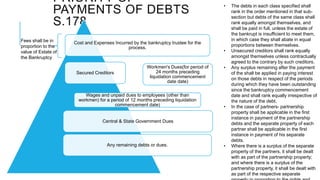
PRIORITY OF
PAYMENTS OF DEBTS
S.178
Cost and Expenses Incurred by the bankruptcy trustee for the
process.
Secured Creditors
Workmen's Dues(for period of
24 months preceding
liquidation commencement
date date)
Wages and unpaid dues to employees (other than
workmen) for a period of 12 months preceding liquidation
commencement date)
Central & State Government Dues
Any remaining debts or dues.
• The debts in each class specified shall
rank in the order mentioned in that sub-
section but debts of the same class shall
rank equally amongst themselves, and
shall be paid in full, unless the estate of
the bankrupt is insufficient to meet them,
in which case they shall abate in equal
proportions between themselves.
• Unsecured creditors shall rank equally
amongst themselves unless contractually
agreed to the contrary by such creditors.
• Any surplus remaining after the payment
of the shall be applied in paying interest
on those debts in respect of the periods
during which they have been outstanding
since the bankruptcy commencement
date and shall rank equally irrespective of
the nature of the debt.
• In the case of partners- partnership
property shall be applicable in the first
instance in payment of the partnership
debts and the separate property of each
partner shall be applicable in the first
instance in payment of his separate
debts.
• Where there is a surplus of the separate
property of the partners, it shall be dealt
with as part of the partnership property;
and where there is a surplus of the
partnership property, it shall be dealt with
as part of the respective separate
Fees shall be in
proportion to the
value of Estate of
the Bankruptcy

Insolvency & Bankruptcy Code 2016

  • 1.
  • 2.
    IMPORTANT TERMS Financial creditor-Any person to whom a financial debt is owed and includes a person to whom such debt has been legally assigned or transferred to. Financial Debt Includes; i. Money borrowed against the payment of interest ii. Any amount raised pursuant to the issue of bonds, debentures, stock or any similar instrument iii. The amount of any liability in resect of any lease or hire purchase contract iv. Any counter indemnity obligation in respect of guarantee of credit or other instrument of bank or financial institution.
  • 3.
    OPERATIONAL CREDITOR Means anyperson to whom a operational debt is owed and includes a person to whom such debt has been legally assigned or transferred to. Operational Debt; a claim in respect of provision of goods or services including; employment or a debt in respect of the repayment of dues arising under any law for the time being in force and payable to the Central Government, any State Government or any local authority.
  • 4.
    MORATORIUM This operates asa calm period during which there shall be no; a) Institution of suits or continuation of pending suits or proceedings by any court of law, tribunal, arbitration panel or other authority; b) Transfer, encumbrance or disposal of by the corporate debtor any of its assets or any legal right or beneficial interest therein; c) The recovery of any property by an owner or lessor where such property is occupied by or in the possession of the corporate debtor. d) The supply of essential goods or services to the corporate debtor as may specified shall not be terminated or suspended or interrupted during moratorium period.
  • 5.
    APPLICATION SCOPE AND STRUCTURE Application •Corporate Enterprises • Limited Liability • Partnerships • Partnership Firms Scope • Insolvency • Liquidation • Voluntary Liquidation • Bankruptcy Structure The Code has 225 Sections divided into 5 parts as below. PART I Preliminary Definitions PART II Insolvency resolution and liquidation for corporate persons PART III Insolvency resolution and Bankruptcy for Individuals & Partnership Firms PART IV Regulation of Insolvency Professionals Agencies and Information Utilities PART V Misc. Enables Amendments in other statutes PART VI (Schedules) Provides for Amendments to be carried out in other statutes
  • 6.
    INSOLVENCY RESOLUTION PROCESS FORCOMPANIES & LLP Application of Default to NCLT REJECTED ACCEPTED (Insolvency commencem ent date) Initiation of Moratorium (S.13 & S.14 ) Appointment of Interim Resolution Professional by NCLT (30 Days Term) (S.16). Public Announcement (S.15) (14 Days) Submission of Plan to NCLT Implementation of Plan Liquidation [S.33] Constitution of Committee of Creditors by Interim RP (S.21) which shall appoint the Resolution Professional (S.22) within 7 Days Plan Rejected/No Resolution Plan [S.31 (2)] Plan Accepted [S.31 (1)] Application of aggrieved party after contravention of Withi n 30 Days By financial Creditor (S.7), operational creditor(S.9)/corporate debtor itself (S.10) Within 14 Days Within 180 Days (Extended up to further 90 Days) [S.12] Fast Track; Within a period of 90 Days which may extend to not more than 45 Days. Minimum 75% Vote Minimum threshold 1 Lakh Moratorium shall cease to have effect. Submission of Resolution plan by Resolution applicant to the Resolution Professional. (S.30) Resolution Professional shall present it to Committee of Creditors for Approval [S.30 (4) ] NCLT may give notice to rectify the defects within 7 days
  • 7.
    Liquidati on 75% Majority ofthe creditors committee does not approve of the resolution plan. The NCLT rejects the Resolution plan submitted to it on technical grounds Debtor/Affected Person contravenes the agreed resolution plan and an makes an application to the NCLT. The creditors committee does not approve a resolution plan within 180 days (or within the extended period of 90 days) 1. INITIATION OF LIQUIDATION (S.33) 2. Appointment of Liquidator (S.34) Resolution Professional to be appointed as the Liquidator unless replaced by NCLT To be entrusted with all powers of BoD & Partners. 3.Liquidator to; identify/control & evaluate the assets of the debtor; Verify Claims of the creditors; carry on the business of the corporate debtor for beneficial liquidation (S.35) 4. Liquidator to form a Liquidation Estate. (S.36) EXCLUDE -Assets in possession of corporate debtors but owned by third parties. -Assets in security collateral held by financial service providers. -Personal assets of shareholders or partner of corporate debtor. -Assets of subsidiaries of corporate debtor(Domestic/Internati onal) -Any other assets as may be specified by the IBBI INCLUDE -Assets over which the CD has ownership rights. -Assets that may/may not be in possession of the CD, including encumbered assets -Tangible assets(movable & immovable) -Intangible assets(IPs ,Securities etc.) -Assets subject to determination by court. Assets recovered through proceedings for avoidance of transactions. -Assets in respect of which secured creditor has relinquished security interest -Any other property vested in the corporate debtor including realization proceeds from liquidation. 5. Liquidator to collect and verify claims from Creditors within 30 Days from commencement. (S.38 & S.39) 6. Liquidator to accept/reject claims and communicate within 7 days. (S.40) 7. Determination of valuation of claims (S.41) 8. Appeal against the decision of Liquidator to the NCLT within 14 days (S.42) 9. Liquidator to Scrutinize Transactions 10. Distribution of assets & Dissolution of Corporate Debtor (S.53 & S.54)
  • 8.
    WATERFALL MECHANISM IRP &Liquidation cost. Secured Creditors(incase he has relinquished security) Workmen's Dues(for period of 24 months preceding liquidation commencement date date)Wages and unpaid dues to employees (other than workmen) for a period of 12 months preceding liquidation commencement date) Unsecured Creditors. Central & State Government Dues Secured creditors for an unrealized amount for enforcing security interest Any remaining debts or dues. Preference shareholders if any. Equity shareholders or partners or the case may be. +
  • 9.
    VOLUNTARY LIQUIDATION S.59Declaration bymajority directors via affidavit stating a) The company has no debts and is able to clear existing debts. b) Purpose of liquidation is not to defraud Passing of Special Resolution within 4 weeks of Declaration 1. To liquidate the company. 2. To appoint the insolvency professional as the liquidator. Documents to be attached. a) Audited financial statements. b) Record of business operations for the last two years. c) A report of valuation of assets. 2/3 Majority of creditors (if any) shall approve the special resolution within 7 days. Notifying the ROC and the board within 7 days of resolution or approval by the Creditors. Initiation of liquidation process Sections 35-53 of Chapter III and Chapter VII shall apply. Liquidator to make an application to the NCLT for Dissolution. NCLT to pass an order of dissolution. NCLT shall forward to the concerned authority with which the CD is registered. within 14 days of the order.
  • 10.
    Application for InitiatingFresh Start Process. Eligible debtor* personally/through IRP can apply to the DRT for discharge of Qualified debts**.(S.80) Eligibility.* a) Gross annual income does not exceed 60k. b) The agg. Value of assets does not exceed 20k. c) The agg. Value of qualifying debts does not exceed 35k. d) Not an undischarged bankrupt. e) Does not own a dwelling unit, irrespective of whether it is encumbered or not; f) A fresh start or IRP or bankruptcy process is not subsisting. g) No fresh start order has been made in the preceding 12 months of the FRESH START – Individuals/One Person Company Initiation of Interim-Moratorium. (S.81) Appointment of Resolution Professional. S.82 Qualified Debts**. a) A debt to the extent it is secured. c) Debt incurred 3 months prior to the application c) an excluded debt. Liability to pay for; [a) fine imposed by a tribunal/court. b) damages for negligence, nuisance or breach of statutory contract/other legal obligation. c) maintenance under any law for the time being in force. d) student loan e) any other debt as may be prescribed.] Examination of Application by RP and Submission to DRT. S.83 Within 10 days of appointment Order of Admission/Rejection of Application by DRT. Within 14 Days. S.84 Commencement of Moratorium. S.85 Application of Objection by Creditor & Examination by RP. S.86 May object on; a) inclusion of debt as qualifying debt. b) Incorrectness of details of the QD specified in the order. Application against decision of RP by Creditor/Debtor. S.87 Application for Revocation of Order u/s 84 by RP. (S.91) Grounds: a) change in financial circumstances of the debtor, the debtor is ineligible for a fresh start process. b) non compliance by debtor under moratorium. Discharge from a) penalties in respect from QD from the DOA till DOO. b) interest including penal interest in respect of QD from the DOA till DOO. c) any other sums owed under any contract in respect of QD from DOA till DOO. Order. U/S.92 180 Days. Unless revoked under S.91
  • 11.
    INSOLVENCY RESOLUTION PROCESSFOR INDIVIDUALS/OPC & PARTNERSHIP FIRMS Application of Default to DRT. Initiation of Interim-Moratorium. (S.96) Admission/Rejection Order by DRT (S.100) • By Debtor S.94,(in respect to debts which are not excluded debts) • By Creditor S.95 Reject If rejected, the creditor is entitled to file for a bankruptcy order. Moratorium commences. S. 101 • Appointment of Resolution Professional by the board within 10 days who will be provided with the application. S.97 • Admission/Rejecti on of application by Resolution Professional & submission to DRT within 10 Days. S.99 Accept • 14 Days Public Notice inviting claims S.102 Registering of Claims by Creditors S. 103 Debtor shall prepare the Repayment Plan containing a proposal. S.105 • Repayment plan shall include; a) A justification for preparation of of such plan and reasons on the basis of which the creditors may agree upon the plan; b) provision for payment of fee to the RP; c) such other matters as may be specified. • RP shall prepare list of creditors. S.104 Submission of Repayment Plan to DRT by RP within a period of 21 days from the last date of submission of claims us102. Meeting of Creditors. S.107 • Along with a report • RP shall decide the voting share to be assigned to each creditor. Creditor not entitled to vote in respect of a debt of an unliquidated • Ceases to have effect at the end of 180 days
  • 12.
    Approval of RepaymentPlan by Creditors. S.111 By a majority of more than three- fourth in value of the creditors in person or by proxy vote in the meeting. Resolution Professionals report on the meeting of creditors in respect to the repayment plan. S.112 Order of DRT on Repayment Plan. S.114 Reject Accept • DRT may provide directions towards implementation. • If the plan requires modification DRT may direct RP to re-convene the meeting. Creditors entitled to file for Bankruptcy. Implementation and supervision of repayment plan by RP. S.116 Completion of Repayment Plan. S.117 The RP shall within 14 days of the completion forward to the person who are bound by the repayment plan & DRT; a) a notice that the plan has been completed b) receipts of payments c) may also apply for extension of time for this purpose • S.118 Repayment plan may come to an end prematurely if it has not been fully implemented. • The debtor or the Creditor whose claims under repayment plan have not been fully satisfied may apply for bankruptcy. The RP shall apply to DRT for discharge order in relation to the debts mentioned in the repayment plan and DRT may pass such order. S.119
  • 13.
    BANKRUPTCY ORDER FORINDIVIDUAL/OPC AND PARTNERSHIP FIRM If the IRP application is rejected by DRT U/S 100 (4) If DRT rejects the repayment plan U/S 115 (2) If the DRT passes an order that the repayment plan has not been implemented. U/S 118 (3) Application for Bankruptcy (S.121) App. To be filed Within 3 month s By Debtor who will propose an insolvency resolution professional as the bankruptcy trustee. S.122 By Creditor who will propose an insolvency resolution professional as the bankruptcy trustee. S.123 App. Shall be accompanied by; (a) the records of insolvency resolution process undertaken under Chapter III of Part III; (b) the statement of affairs of the debtor in such form and manner as may be prescribed, on the date of the application for bankruptcy; and (c) a copy of the order passed by the Adjudicating Authority under Chapter III of Part III permitting the debtor to apply for bankruptcy. App shall be accompanied by; (a) the records of insolvency resolution process undertaken under Chapter III; (b) a copy of the order passed by the Adjudicating Authority under Chapter III permitting the creditor to apply for bankruptcy; (c) details of the debts owed by the debtor to the creditor as on the date of the application for bankruptcy; and (d) such other information as may be prescribed If the App. is in respect of secured debt it shall be accompanied with; (a) a statement by the creditor having the right to enforce the security that he shall, in the event of a bankruptcy order being made, give up his security for the benefit of all the creditors of the bankrupt; or (b) a statement by the creditor stating— (i) that the application for bankruptcy is only in respect of the unsecured part of the debt; and (ii) an estimated value of the unsecured part of the debt. The secured and unsecured part of the debt shall be treated as separate debt. Initiation of Interim Moratorium S.124 Appointment of Insolvency Resolution Professional as bankruptcy trustee. S.125 Bankruptcy Order S.126 Within 14 days of appointment of bankruptcy trustee. Shall continue to have effect till the debtor is
  • 14.
    Statement of FinancialPosition submitted by the bankrupt to the bankruptcy trustee. S.129 Within 7 days from the bankruptcy commencement date. Public notice inviting claims from creditors within 7 days from the bankruptcy commencement date.. S.130 Where the bankrupt is a firm, its partners on the date of the order shall submit a joint statement of financial position of the firm, and each partner of the firm shall submit a statement of his financial position. Registration of Claims within 7 days of the publication of notice S.131 Preparation of list of Creditors by bankruptcy trustee within 14 days from the bankruptcy commencement date S.132 Meeting of creditors within 21 days from commencement of bankruptcy S.133 • Every creditor mentioned in the list or his proxy shall be entitled to vote in respect of the resolutions in the meeting of the creditors in accordance with the voting share assigned to him. • The resolution professional shall determine the voting share to be assigned to each creditor in the manner specified by the Board • A creditor shall not be entitled to vote in respect of a debt for an unliquidated amount. Administration and distribution of estate of bankrupt.S.136 Discharge Order S.138 • Shall release the bankrupt from all the bankruptcy debt: Provided that discharge shall not— (a) affect the functions of the bankruptcy trustee; or (b) affect the operation of the provisions of Chapters IV and V of Part III; or (c) release the bankrupt from any debt incurred by means of fraud or breach of trust to which he was a party; or (d) discharge the bankrupt from any excluded debt.
  • 15.
    PRIORITY OF PAYMENTS OFDEBTS S.178 Cost and Expenses Incurred by the bankruptcy trustee for the process. Secured Creditors Workmen's Dues(for period of 24 months preceding liquidation commencement date date) Wages and unpaid dues to employees (other than workmen) for a period of 12 months preceding liquidation commencement date) Central & State Government Dues Any remaining debts or dues. • The debts in each class specified shall rank in the order mentioned in that sub- section but debts of the same class shall rank equally amongst themselves, and shall be paid in full, unless the estate of the bankrupt is insufficient to meet them, in which case they shall abate in equal proportions between themselves. • Unsecured creditors shall rank equally amongst themselves unless contractually agreed to the contrary by such creditors. • Any surplus remaining after the payment of the shall be applied in paying interest on those debts in respect of the periods during which they have been outstanding since the bankruptcy commencement date and shall rank equally irrespective of the nature of the debt. • In the case of partners- partnership property shall be applicable in the first instance in payment of the partnership debts and the separate property of each partner shall be applicable in the first instance in payment of his separate debts. • Where there is a surplus of the separate property of the partners, it shall be dealt with as part of the partnership property; and where there is a surplus of the partnership property, it shall be dealt with as part of the respective separate Fees shall be in proportion to the value of Estate of the Bankruptcy

Editor's Notes

  • #7 Fast Track within 90 days extendable upto 135 days.