Insights from Knowledge Graphs
Anirudh Prabhu,
Keck Deep Time Data Infrastructure Team
and the Deep Carbon Observatory Data Science Team
@Anirudh_14
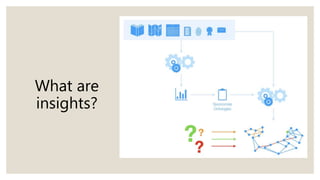
What are
insights?
How do we gain insights?
Reasoners
Visual Analytics
Network Science Approach
Reasoners
ONTOLOGY
5
Rules Engine – Apache Jena Example
[hurricane-half-hourly:
(?candidate dd:candidateEvent ?event),
(?event rdf:type dd:Hurricane),
(?candidate dd:candidateVariable ?variable),
(?variable dd:timeInterval ?timeInterval),
equal(?timeInterval, <http://darkdata.tw.rpi.edu/data/time-interval/half-hourly>),
makeSkolem(?assertion, dd:Hurricane, ?timeInterval)
->
(?candidate dd:compatibilityAssertion ?assertion),
(?assertion rdf:type dd:CompatibilityAssertion),
(?assertion dd:compatibilityValue dd:strong_compatibility),
(?assertion dd:assertionConfidence "0.5"^^xsd:double),
(?assertion dd:basisForAssertion <urn:rule/time_interval/hurricane-half-hourly>)
]
‘Half hourly’ time interval is best for Hurricanes and Tropical Storms.
Antecedent :
Containing
information about
Phenomena and
Temporal
Resolution.
Subsequent :
Containing the
compatibility
assertion
information.
6
Visual
Analytics
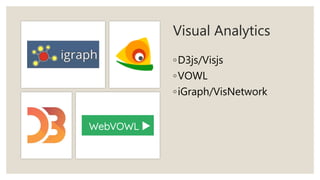
Visual Analytics
◦D3js/Visjs
◦VOWL
◦iGraph/VisNetwork
What is
encoded vs
What is
seen
Encoded Seen/Inferred/Calculated
Nodes Patterns in the Network Geometry
Edges Sub-Communities formed in the
Network
Layout (Mostly Force Directed) Important Hubs in the Network
Additional Parameters for Nodes
(Optional)
Additional metrics that explain the
complexity of the environment
(assortativity, betweenness,
centrality etc.)
9
• Comparison of how different networks change through time also
help understand the given environment.
VOWL
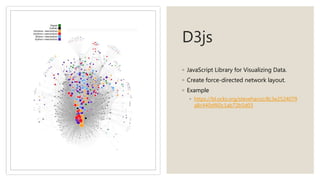
D3js
◦ JavaScript Library for Visualizing Data.
◦ Create force-directed network layout.
◦ Example
◦ https://bl.ocks.org/steveharoz/8c3e2524079
a8c440df60c1ab72b5d03
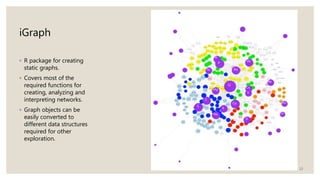
iGraph
◦ R package for creating
static graphs.
◦ Covers most of the
required functions for
creating, analyzing and
interpreting networks.
◦ Graph objects can be
easily converted to
different data structures
required for other
exploration.
12
Pb
U
P
Al
As
Cu
Ca
K
Na
C
S
Si
V
Ba
Fe
Mg
Mo
Se
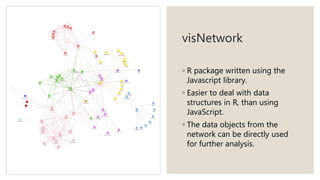
visNetwork
◦ R package written using the
Javascript library.
◦ Easier to deal with data
structures in R, than using
JavaScript.
◦ The data objects from the
network can be directly used
for further analysis.
Coexisting Animal Families through last 542 million years
Animal Family Networks
Ediacaran Assemblage Networks
Extinction Event
at 560 Ma?
Drew Muscente: “Nama and White Sea fauna are different facies,
whereas a mass extinction occurred after the Avalonian.” – science
hypothesis
Network
Science
Approach
Libraries/Packages
17
Igraph
ggnetwork
Network
SNA
visNetwork
D3js
Threejs
ngraph
Data Structure
• Symmetric adjacency matrix
• Rows and column names represent mineral species
• Values represent co-occurrence of 2 minerals
Node List and Properties
Adjacency Matrix
Data Structures (contd.)
• Nodes• Links
What is
encoded vs
What is
seen
Encoded Seen/Inferred/Calculated
Nodes Patterns in the Network Geometry
Edges Sub-Communities formed in the
Network
Layout (Mostly Force Directed) Important Hubs in the Network
Additional Parameters for Nodes
(Optional)
Additional metrics that explain the
complexity of the environment
(assortativity, betweenness,
centrality etc.)
20
• Comparison of how different networks change through time also
help understand the given environment.
Network
Metrics
Comparing
Global
Metrics
22
Assortativity
(Homophily)
◦ Network equivalent of
Pearson correlation
coefficient
◦ Values between 1 & -1
◦ 1 = similarity favors
connections
◦ 0 = non-assortative
◦ -1 = opposites attract
23
•Muscente AD, Prabhu A, Zhong H, Eleish A, Meyer M,
Fox P, Hazen R, and Knoll A (2017) The network
paleoecology of mass extinctions. PNAS.
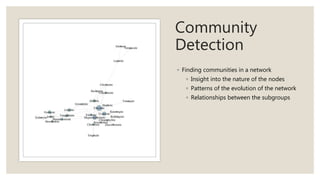
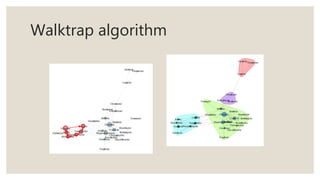
Community
Detection
◦ Finding communities in a network
◦ Insight into the nature of the nodes
◦ Patterns of the evolution of the network
◦ Relationships between the subgroups
Walktrap algorithm
Example : Mineral Co-occurence
26
Morrison SM, Liu C, Eleish A, Prabhu A, Li
C, Ralph J, Downs RT, Golden JJ, Fox P,
Hummer DR, Meyer MB, and Hazen RM
(2017) Network analysis of mineralogical
systems. American Mineralogist 102
• Groups correspond to Paragenetic Mode.
• Paragenetic Mode : Formation Conditions.
• How and when the Minerals were formed.
Example : Evolving Networks
27
Moore, E. K., Hao, J., Prabhu,
A., Zhong, H., Jelen, B. I.,
Meyer, M., ... & Falkowski, P.
G. (2018). Geological and
Chemical Factors that
Impacted the Biological
Utilization of Cobalt in the
Archean Eon. Journal of
Geophysical Research:
Biogeosciences.
Simple Examples
◦ https://jupyter.deepcarbon.net/user/anirudhprabhu/notebooks/Code/R
FM_Network.ipynb
◦ https://deeptime.tw.rpi.edu/jupyter/user/6d32485f-bcb8-473e-99fe-
66ce2f2a4e44/notebooks/U/U_minerals_deposit_types.ipynb
Thank You
Questions?
Metrics: Local
Degree is the number of links connected to a given node.
35
1 2
2
3
0.56
0 0
0.5
0
10
1
1
Betweenness is a measure of the number of geodesic
paths that pass through a given node.
Distance is the geodesic (shortest) between any
two nodes.
Metrics: Global
Density, D, is the no. of links divided by
the no. of possible links
D = 0.66 D = 1D = 0.33
Low density High density
D =
2𝐿
𝑁(𝑁−1)
Metrics: Global
Diameter: largest geodesic distance in a network (the
shortest path between the two most separated nodes)
Mean Distance: average “degree of separation” in a
network
Metrics: Global
Centralization:
A measure of how central a network’s ”most central” node is relative to how
central all the other nodes are.
• Degree centralization: number of links to each node
• Are there many highly interconnected nodes?
• Betweenness centralization: number of shortest paths through
each node
• Are there a few key “broker” nodes?

Insights from Knowledge Graphs

  • 1.
    Insights from KnowledgeGraphs Anirudh Prabhu, Keck Deep Time Data Infrastructure Team and the Deep Carbon Observatory Data Science Team @Anirudh_14
  • 2.
  • 3.
    How do wegain insights? Reasoners Visual Analytics Network Science Approach
  • 4.
  • 5.
  • 6.
    Rules Engine –Apache Jena Example [hurricane-half-hourly: (?candidate dd:candidateEvent ?event), (?event rdf:type dd:Hurricane), (?candidate dd:candidateVariable ?variable), (?variable dd:timeInterval ?timeInterval), equal(?timeInterval, <http://darkdata.tw.rpi.edu/data/time-interval/half-hourly>), makeSkolem(?assertion, dd:Hurricane, ?timeInterval) -> (?candidate dd:compatibilityAssertion ?assertion), (?assertion rdf:type dd:CompatibilityAssertion), (?assertion dd:compatibilityValue dd:strong_compatibility), (?assertion dd:assertionConfidence "0.5"^^xsd:double), (?assertion dd:basisForAssertion <urn:rule/time_interval/hurricane-half-hourly>) ] ‘Half hourly’ time interval is best for Hurricanes and Tropical Storms. Antecedent : Containing information about Phenomena and Temporal Resolution. Subsequent : Containing the compatibility assertion information. 6
  • 7.
  • 8.
  • 9.
    What is encoded vs Whatis seen Encoded Seen/Inferred/Calculated Nodes Patterns in the Network Geometry Edges Sub-Communities formed in the Network Layout (Mostly Force Directed) Important Hubs in the Network Additional Parameters for Nodes (Optional) Additional metrics that explain the complexity of the environment (assortativity, betweenness, centrality etc.) 9 • Comparison of how different networks change through time also help understand the given environment.
  • 10.
  • 11.
    D3js ◦ JavaScript Libraryfor Visualizing Data. ◦ Create force-directed network layout. ◦ Example ◦ https://bl.ocks.org/steveharoz/8c3e2524079 a8c440df60c1ab72b5d03
  • 12.
    iGraph ◦ R packagefor creating static graphs. ◦ Covers most of the required functions for creating, analyzing and interpreting networks. ◦ Graph objects can be easily converted to different data structures required for other exploration. 12 Pb U P Al As Cu Ca K Na C S Si V Ba Fe Mg Mo Se
  • 13.
    visNetwork ◦ R packagewritten using the Javascript library. ◦ Easier to deal with data structures in R, than using JavaScript. ◦ The data objects from the network can be directly used for further analysis.
  • 14.
    Coexisting Animal Familiesthrough last 542 million years Animal Family Networks
  • 15.
    Ediacaran Assemblage Networks ExtinctionEvent at 560 Ma? Drew Muscente: “Nama and White Sea fauna are different facies, whereas a mass extinction occurred after the Avalonian.” – science hypothesis
  • 16.
  • 17.
  • 18.
    Data Structure • Symmetricadjacency matrix • Rows and column names represent mineral species • Values represent co-occurrence of 2 minerals Node List and Properties Adjacency Matrix
  • 19.
  • 20.
    What is encoded vs Whatis seen Encoded Seen/Inferred/Calculated Nodes Patterns in the Network Geometry Edges Sub-Communities formed in the Network Layout (Mostly Force Directed) Important Hubs in the Network Additional Parameters for Nodes (Optional) Additional metrics that explain the complexity of the environment (assortativity, betweenness, centrality etc.) 20 • Comparison of how different networks change through time also help understand the given environment.
  • 21.
  • 22.
  • 23.
    Assortativity (Homophily) ◦ Network equivalentof Pearson correlation coefficient ◦ Values between 1 & -1 ◦ 1 = similarity favors connections ◦ 0 = non-assortative ◦ -1 = opposites attract 23 •Muscente AD, Prabhu A, Zhong H, Eleish A, Meyer M, Fox P, Hazen R, and Knoll A (2017) The network paleoecology of mass extinctions. PNAS.
  • 24.
    Community Detection ◦ Finding communitiesin a network ◦ Insight into the nature of the nodes ◦ Patterns of the evolution of the network ◦ Relationships between the subgroups
  • 25.
  • 26.
    Example : MineralCo-occurence 26 Morrison SM, Liu C, Eleish A, Prabhu A, Li C, Ralph J, Downs RT, Golden JJ, Fox P, Hummer DR, Meyer MB, and Hazen RM (2017) Network analysis of mineralogical systems. American Mineralogist 102 • Groups correspond to Paragenetic Mode. • Paragenetic Mode : Formation Conditions. • How and when the Minerals were formed.
  • 27.
    Example : EvolvingNetworks 27 Moore, E. K., Hao, J., Prabhu, A., Zhong, H., Jelen, B. I., Meyer, M., ... & Falkowski, P. G. (2018). Geological and Chemical Factors that Impacted the Biological Utilization of Cobalt in the Archean Eon. Journal of Geophysical Research: Biogeosciences.
  • 28.
    Simple Examples ◦ https://jupyter.deepcarbon.net/user/anirudhprabhu/notebooks/Code/R FM_Network.ipynb ◦https://deeptime.tw.rpi.edu/jupyter/user/6d32485f-bcb8-473e-99fe- 66ce2f2a4e44/notebooks/U/U_minerals_deposit_types.ipynb
  • 29.
  • 30.
    Metrics: Local Degree isthe number of links connected to a given node. 35 1 2 2 3 0.56 0 0 0.5 0 10 1 1 Betweenness is a measure of the number of geodesic paths that pass through a given node. Distance is the geodesic (shortest) between any two nodes.
  • 31.
    Metrics: Global Density, D,is the no. of links divided by the no. of possible links D = 0.66 D = 1D = 0.33 Low density High density D = 2𝐿 𝑁(𝑁−1)
  • 32.
    Metrics: Global Diameter: largestgeodesic distance in a network (the shortest path between the two most separated nodes) Mean Distance: average “degree of separation” in a network
  • 33.
    Metrics: Global Centralization: A measureof how central a network’s ”most central” node is relative to how central all the other nodes are. • Degree centralization: number of links to each node • Are there many highly interconnected nodes? • Betweenness centralization: number of shortest paths through each node • Are there a few key “broker” nodes?

Editor's Notes

  • #3 https://towardsdatascience.com/knowledge-graphs-and-machine-learning-3939b504c7bc
  • #6 To generate these candidates, we have developed individual rulesets that use compatibility assertions to describe how well the 2 entities work together. A candidate describes a combination of service, event, physical feature, 1-2 data fields. Rules are used to make compatibility assertions about the candidates. Each compatibility assertion value(which can be one of 5 values)and confidence metric(ranged from 0 to 1) pair, is associated with a single candidate. When the rules are run, we get all of the compatibility assertions for a candidate. Another set of rules look at associations between service, variables, events etc and makes a compatibility assertion with the relevance of events related information and visualization services. We then rank the candidates by plugging all the assertions and candidates into our scoring algorithm.
  • #7 In this slide, you can see an example of a rule which state that half-hourly time intervals are ideal to analyze Hurricane and Tropical storm data.
  • #11 Image is hyperlinked to the web version of VOWL.
  • #13 With the Animal Family Fossil Network, we see more pronounced extinction events. This may help identify previously unknown extinction events. When combined with other analytics methods, we can also quantify these extinction events.
  • #14 Click the image for the performance hyperlink. And use it to highlight the how subcommunities can be seen in network layouts.
  • #15 These types of analysis can also be done on larger scales! Here is
  • #21 ()