Inside the BBC
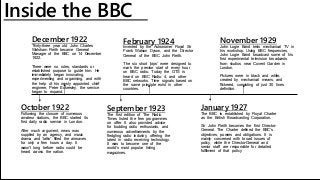
October1922
Following the closure of numerous
amateur stations, the BBC started its
first daily radio service in London.
After much argument, news was
supplied by an agency, and music
drama and 'talks' filled the airwaves
for only a few hours a day. It
wasn't long before radio could be
heard across the nation.
December 1922
Thirty-three year old John Charles
Walsham Reith became General
Manager of the BBC on 14 December
1922.
There were no rules, standards or
established purpose to guide him. He
immediately began innovating,
experimenting and organising, and with
the help of his newly appointed chief
engineer, Peter Eckersley, the service
began to expand.
September 1923
The first edition of The Radio
Times listed the few programmes
on offer. It also provided advice
for budding radio enthusiasts, and
numerous advertisements by the
fledgling radio industry, offering the
latest in radio receiving technology.
It was to become one of the
world’s most popular listing
magazines.
February 1924
Invented by the Astronomer Royal Sir
Frank Watson Dyson, and the Director
General of the BBC John Reith.
The six short 'pips' were designed to
mark the precise start of every hour
on BBC radio. Today the GTS is
heard on BBC Radio 4, and other
BBC networks. Time signals based on
the same principle exist in other
countries.
January 1927
The BBC is established by Royal Charter
as the British Broadcasting Corporation.
Sir John Reith becomes the first Director-
General. The Charter defined the BBC’s
objectives, powers and obligations. It is
mainly concerned with broad issues of
policy, while the Director-General and
senior staff are responsible for detailed
fulfilment of that policy
November 1929
John Logie Baird tests mechanical TV in
his workshop. Using BBC frequencies,
John Logie Baird broadcast some of his
first experimental television broadcasts
from studios near Covent Garden in
London.
Pictures were in black and white,
created by mechanical means, and
flickered, consisting of just 30 lines
definition.
2.
Public Service Broadcasting
The BBC is the world's leading public service broadcaster is used to enrich people's lives with programmes that inform,
educate and entertain. It was established by a Royal Charter, the BBC is a public service broadcaster funded by the licence
fee paid by UK households. They use the income from the licence fee to provide services including 9 national TV channels,
in addition BBC Three, the first TV channel in the world to switch online in 2016 also regional programming, 10 national
radio stations, 40 local radio stations and an extensive website.
BBC World Service broadcasts to the world on radio, on TV and online, providing news and information in 27 languages
and world service English language. They also have commercial operations including BBC Worldwide and BBC Studios, our
TV production subsidiary. Profits from these activities are returned to the BBC for investment in new programming and
services. The BBC’s Board is responsible for ensuring that they fulfil the public service broadcasting service and public
purposes set out in the Charter.
3.
How the BBCis structured.
The BBC was established as the British Broadcasting Corporation by Royal Charter in December 1926 and it’s governance and funding
arrangements have been set out in a Royal Charter ever since. The most recent Charter was awarded from 1 January 2017 for a period of ten years
following a wide-ranging review conducted by Government. As part of that Review new governance and regulatory arrangements were put in
place which established a single BBC Board and gave sole regulatory responsibility for the BBC to Ofcom.
BBC Board
The new, unitary, BBC Board is led by a non-executive Chairman, Sir David Clementi, and consists of a majority of non-executive directors alongside executive directors including the
BBC’s Director-General and Editor in-Chief, Tony Hall. The Board is responsible for ensuring the BBC fulfils its mission and public purposes as set out in the Charter. It does this by;
setting the strategic direction for the BBC, establishing the creative remit, setting the BBC’s Budget and determining the framework for assessing performance.
Board Committees
The Board has a number of committees predominantly made up of non-executive directors as required by the Charter. These include an Audit and Risk Committee; a Nominations
Committee, and Remuneration Committee. It has also established committees responsible for Editorial Guidelines and Standards, Fair Trading and the Nations.
The Executive Committee
The Director-General, Tony Hall, chairs the Executive Committee, which is responsible for the day-to-day running of the BBC and consists of the senior directors managing large
operational areas of the BBC. The Executive Committee is responsible for delivering the BBC’s services in accordance with the strategy and delegation framework agreed by the
Board.
Regulation
The Office of Communications (Ofcom) is the UK’s broadcasting, telecommunications and postal regulatory body. Under the BBC’s Charter it has responsibility for regulating the BBC.
It does this through an Operating Framework and by setting a licence for the BBC that contains the regulatory conditions the BBC is required to meet. Ofcom also assesses
performance, ensures fair and effective competition and regulates how the BBC’s commercial activities interact with its public services. In addition, it regulates BBC content and
output against its Broadcasting Code.
Audit arrangements
The Comptroller and Auditor General, Sir Amyas Morse KCB, has been appointed as the BBC’s auditor. He is supported in this role by the National Audit Office. Sir Amyas and the
NAO are independent of government. As part of the BBC’s governance arrangements, the Comptroller and Auditor General examines, certifies and reports on the BBC’s group
accounts and is appointed as auditor of the BBC’s relevant subsidiaries, unless he and the BBC agree otherwise.
4.
Licence Fee
The licencefee allows the BBC's UK services to remain free of advertisements and independent of shareholder
and political interest, the licence fee is currently £147 it is set to rise to £150.50 from 1 April 2018.
The fee you pay provides a wide range of TV, radio and online content, as well as developing new ways to
deliver it to you. In addition to funding BBC programmes and services, a proportion of the licence fee
contributes to the costs of rolling out broadband to the UK population and funding Welsh Language TV channel
S4C and local TV channels.
The way in which the BBC is funded places significant responsibilities on the BBC as an organisation.
Specifically, it has to:
Provide value for money by focusing expenditure on the programmes and services the public most wants from the BBC...
Ensure that its output is then delivered as cost efficiently as possible...
Ensure effective and efficient collection of the licence fee...
Maximise funding from other sources, most significantly BBC Worldwide.
5.
BBCs Difference
The BBCdiffers from any other company because of the fact that they don’t have adverts like ITV or C4 or
when they do have one its normally about 1-2 minuets where as there normally 5 minutes on any other
channel. If they do have a short advert it normally consists of shows that are on that channel or you
normally see their ident, which is normally the hippos swimming around in the shape of the letter O. This
then makes the company more quick and likeable, berceuse those watching it don't have to wait around
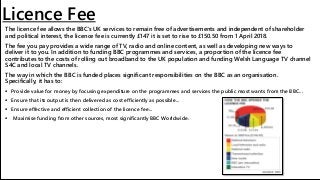
to watch the adverts that come within the middle of the shows. I researched that the BBC actually spends
the licence fee money on supporting the channel, they spend £79 on national television, £20 on local
television and radio so there spending money so they can improve their company, along with all the
many types of shows they show like sports, news, entertainment and many more just for their viewers.