Welcome Learning Package PlanLinear Equation in One VariableBy: Group 4
Group MmemberRyan Jay C. Dayao  Nancy NolascoWilson AndalloConsolacionAranilGil Garcia    Mary Jun VerdilloAntonio Acob, Jr  Ariel GutierezMa. Elena C. Trajano Ma. Nina MarianoNino Batas
Quarter No. Second  QuarterTopic: Linear Equation in One Variable Time Frame: 10 Days
Stage 1Content Standard:     The learner demonstrates understanding of the key concept of first degree equations and inequalities in one variable. Performance Standard:     The learner models situation using oral, written, graphical and algebraic methods to solve problems involving first degree equation and inequalities.
Essential Understanding:     Real-life problems where certain quantities are unknown can be solved using first degree equations in one variable.Essential Question:     How will you use linear equation in solving unknown quantities.
Prior Knowledge:     Some misconceptions may include:A linear equation involves variables and constant with first degree exponent.
Expression is the same with equation.
All variables are solution to equation.
The variable x is an operation for multiplication and negative sign is for subtraction.Transfer Goal:I want my students to learn linear equations in one variable so that in the long run, they will be able on their own to use linear equations and inequalities to solve problems involving real-life situations such as age, number relation problem, work problem, distance problem, and others.
Students will know:Mathematical expressions, first-degree equations in one variable.
First-degree equations in one variable.
Properties of first-degree equation in one variable.
Applications of first-degree equations in one variable.The learner will be able to:Differentiate mathematical expressions from equations.
Identify and describe first-degree equations in one variable.
Give examples of first-degree equations in one variable.
Describe situations wherein first-degree equations in one variable can be used.
Enumerate and explain the different properties of first-degree equations in one variableGive illustrative examples of each property of first-degree equations in one variable.
Apply the properties of equations in solving first-degree equations in one variable.
Verify and explain the solution to problems involving first-degree equations in one variable.
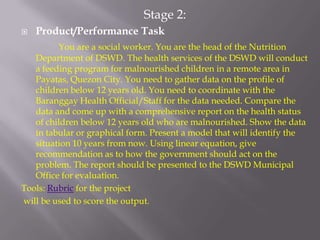
Extend, pose, and solve related problems in real life.Stage 2:Product/Performance TaskYou are a social worker. You are the head of the Nutrition Department of DSWD. The health services of the DSWD will conduct a feeding program for malnourished children in a remote area in Payatas, Quezon City. You need to gather data on the profile of children below 12 years old. You need to coordinate with the Baranggay Health Official/Staff for the data needed. Compare the data and come up with a comprehensive report on the health status of children below 12 years old who are malnourished. Show the data in tabular or graphical form. Present a model that will identify the situation 10 years from now. Using linear equation, give recommendation as to how the government should act on the problem. The report should be presented to the DSWD Municipal Office for evaluation.Tools: Rubric for the project  will be used to score the output.
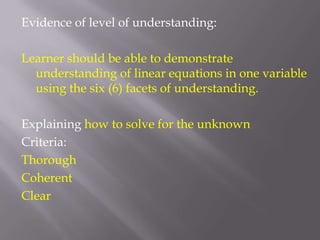
Evidence of level of understanding:Learner should be able to demonstrate understanding of linear equations in one variable using the six (6) facets of understanding.Explaining how to solve for the unknown Criteria:Thorough Coherent Clear
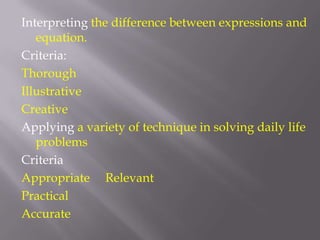
Interpreting the difference between expressions and equation.Criteria:Thorough IllustrativeCreativeApplying a variety of technique in solving daily life problemsCriteriaAppropriate     RelevantPracticalAccurate
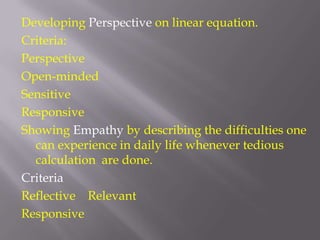
Developing Perspective on linear equation.Criteria:PerspectiveOpen-mindedSensitiveResponsiveShowing Empathy by describing the difficulties one can experience in daily life whenever tedious calculation  are done. CriteriaReflective    RelevantResponsive
Manifesting Self-knowledge by assessing how one can give his/her best solution to a problem/situation.Criteria:ReflectiveResponsiveRelevant
Evidence at the level of performance:Assessment of problems formulated based on the following suggested criteria:Real-life problemsProblems involve linear equationProblems are solved using variety of strategiesTools: Rubrics for assessment of problems formulated and solved.

INSET G4Math

  • 1.
    Welcome Learning PackagePlanLinear Equation in One VariableBy: Group 4
  • 2.
    Group MmemberRyan JayC. Dayao Nancy NolascoWilson AndalloConsolacionAranilGil Garcia Mary Jun VerdilloAntonio Acob, Jr Ariel GutierezMa. Elena C. Trajano Ma. Nina MarianoNino Batas
  • 3.
    Quarter No. Second QuarterTopic: Linear Equation in One Variable Time Frame: 10 Days
  • 4.
    Stage 1Content Standard: The learner demonstrates understanding of the key concept of first degree equations and inequalities in one variable. Performance Standard: The learner models situation using oral, written, graphical and algebraic methods to solve problems involving first degree equation and inequalities.
  • 5.
    Essential Understanding: Real-life problems where certain quantities are unknown can be solved using first degree equations in one variable.Essential Question: How will you use linear equation in solving unknown quantities.
  • 6.
    Prior Knowledge: Some misconceptions may include:A linear equation involves variables and constant with first degree exponent.
  • 7.
    Expression is thesame with equation.
  • 8.
    All variables aresolution to equation.
  • 9.
    The variable xis an operation for multiplication and negative sign is for subtraction.Transfer Goal:I want my students to learn linear equations in one variable so that in the long run, they will be able on their own to use linear equations and inequalities to solve problems involving real-life situations such as age, number relation problem, work problem, distance problem, and others.
  • 10.
    Students will know:Mathematicalexpressions, first-degree equations in one variable.
  • 11.
  • 12.
    Properties of first-degreeequation in one variable.
  • 13.
    Applications of first-degreeequations in one variable.The learner will be able to:Differentiate mathematical expressions from equations.
  • 14.
    Identify and describefirst-degree equations in one variable.
  • 15.
    Give examples offirst-degree equations in one variable.
  • 16.
    Describe situations whereinfirst-degree equations in one variable can be used.
  • 17.
    Enumerate and explainthe different properties of first-degree equations in one variableGive illustrative examples of each property of first-degree equations in one variable.
  • 18.
    Apply the propertiesof equations in solving first-degree equations in one variable.
  • 19.
    Verify and explainthe solution to problems involving first-degree equations in one variable.
  • 20.
    Extend, pose, andsolve related problems in real life.Stage 2:Product/Performance TaskYou are a social worker. You are the head of the Nutrition Department of DSWD. The health services of the DSWD will conduct a feeding program for malnourished children in a remote area in Payatas, Quezon City. You need to gather data on the profile of children below 12 years old. You need to coordinate with the Baranggay Health Official/Staff for the data needed. Compare the data and come up with a comprehensive report on the health status of children below 12 years old who are malnourished. Show the data in tabular or graphical form. Present a model that will identify the situation 10 years from now. Using linear equation, give recommendation as to how the government should act on the problem. The report should be presented to the DSWD Municipal Office for evaluation.Tools: Rubric for the project will be used to score the output.
  • 21.
    Evidence of levelof understanding:Learner should be able to demonstrate understanding of linear equations in one variable using the six (6) facets of understanding.Explaining how to solve for the unknown Criteria:Thorough Coherent Clear
  • 22.
    Interpreting the differencebetween expressions and equation.Criteria:Thorough IllustrativeCreativeApplying a variety of technique in solving daily life problemsCriteriaAppropriate RelevantPracticalAccurate
  • 23.
    Developing Perspective onlinear equation.Criteria:PerspectiveOpen-mindedSensitiveResponsiveShowing Empathy by describing the difficulties one can experience in daily life whenever tedious calculation are done. CriteriaReflective RelevantResponsive
  • 24.
    Manifesting Self-knowledge byassessing how one can give his/her best solution to a problem/situation.Criteria:ReflectiveResponsiveRelevant
  • 25.
    Evidence at thelevel of performance:Assessment of problems formulated based on the following suggested criteria:Real-life problemsProblems involve linear equationProblems are solved using variety of strategiesTools: Rubrics for assessment of problems formulated and solved.