Insertion and
Deletion
Implementation:
Array vs. Linked
List
Arrays and linked lists are fundamental data structures used to store and
manipulate data. The way they handle insertions and deletions can have a
significant impact on performance. Let's explore the time complexities and
trade-offs between these two approaches.
by Aashish singh
Overview of Arrays and Linked Lists
Arrays
Arrays are contiguous blocks of memory that store elements in
a linear fashion. They provide constant-time access to elements
by index.
Linked Lists
Linked lists are a collection of nodes, where each node contains
data and a pointer to the next node. They are dynamic and allow
for efficient insertions and deletions.
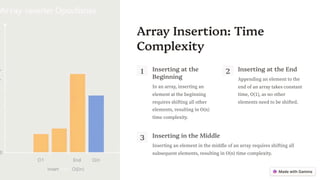
Array Insertion: Time
Complexity
1 Inserting at the
Beginning
In an array, inserting an
element at the beginning
requires shifting all other
elements, resulting in O(n)
time complexity.
2 Inserting at the End
Appending an element to the
end of an array takes constant
time, O(1), as no other
elements need to be shifted.
3 Inserting in the Middle
Inserting an element in the middle of an array requires shifting all
subsequent elements, resulting in O(n) time complexity.
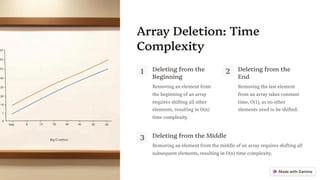
Array Deletion: Time
Complexity
1 Deleting from the
Beginning
Removing an element from
the beginning of an array
requires shifting all other
elements, resulting in O(n)
time complexity.
2 Deleting from the
End
Removing the last element
from an array takes constant
time, O(1), as no other
elements need to be shifted.
3 Deleting from the Middle
Removing an element from the middle of an array requires shifting all
subsequent elements, resulting in O(n) time complexity.
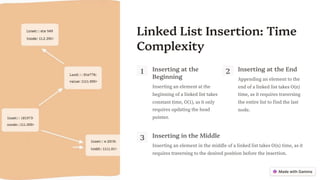
Linked List Insertion: Time
Complexity
1 Inserting at the
Beginning
Inserting an element at the
beginning of a linked list takes
constant time, O(1), as it only
requires updating the head
pointer.
2 Inserting at the End
Appending an element to the
end of a linked list takes O(n)
time, as it requires traversing
the entire list to find the last
node.
3 Inserting in the Middle
Inserting an element in the middle of a linked list takes O(n) time, as it
requires traversing to the desired position before the insertion.
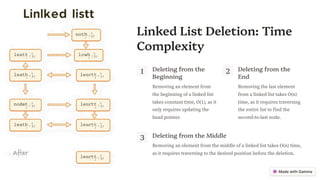
Linked List Deletion: Time
Complexity
1 Deleting from the
Beginning
Removing an element from
the beginning of a linked list
takes constant time, O(1), as it
only requires updating the
head pointer.
2 Deleting from the
End
Removing the last element
from a linked list takes O(n)
time, as it requires traversing
the entire list to find the
second-to-last node.
3 Deleting from the Middle
Removing an element from the middle of a linked list takes O(n) time,
as it requires traversing to the desired position before the deletion.
Comparison: Array vs. Linked List
Array Pros
Constant-time access to elements by
index
Efficient for operations at the end of
the list
Linked List Pros
Efficient for insertions and deletions
at the beginning
Dynamic size, no need to pre-
allocate memory
Trade-offs
Arrays are best for random access, while
linked lists excel at dynamic insertions
and deletions. The choice depends on
the specific requirements of the
application.
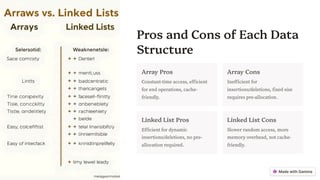
Pros and Cons of Each Data
Structure
Array Pros
Constant-time access, efficient
for end operations, cache-
friendly.
Array Cons
Inefficient for
insertions/deletions, fixed size
requires pre-allocation.
Linked List Pros
Efficient for dynamic
insertions/deletions, no pre-
allocation required.
Linked List Cons
Slower random access, more
memory overhead, not cache-
friendly.
Conclusion and Best
Practices
1 Choose the Right Data Structure
Select the data structure that best fits your application's
requirements, balancing factors like access patterns, memory
usage, and performance.
2 Optimize for Common Operations
If your application relies heavily on insertions and deletions,
a linked list may be the better choice. For random access, an
array is often the preferred option.
3 Combine Data Structures
In some cases, a hybrid approach using both arrays and
linked lists can provide the best of both worlds, depending on
the specific use case.

Insertion-and-Deletion-Implementation-Array-vs-Linked-List.pdf

  • 1.
    Insertion and Deletion Implementation: Array vs.Linked List Arrays and linked lists are fundamental data structures used to store and manipulate data. The way they handle insertions and deletions can have a significant impact on performance. Let's explore the time complexities and trade-offs between these two approaches. by Aashish singh
  • 2.
    Overview of Arraysand Linked Lists Arrays Arrays are contiguous blocks of memory that store elements in a linear fashion. They provide constant-time access to elements by index. Linked Lists Linked lists are a collection of nodes, where each node contains data and a pointer to the next node. They are dynamic and allow for efficient insertions and deletions.
  • 3.
    Array Insertion: Time Complexity 1Inserting at the Beginning In an array, inserting an element at the beginning requires shifting all other elements, resulting in O(n) time complexity. 2 Inserting at the End Appending an element to the end of an array takes constant time, O(1), as no other elements need to be shifted. 3 Inserting in the Middle Inserting an element in the middle of an array requires shifting all subsequent elements, resulting in O(n) time complexity.
  • 4.
    Array Deletion: Time Complexity 1Deleting from the Beginning Removing an element from the beginning of an array requires shifting all other elements, resulting in O(n) time complexity. 2 Deleting from the End Removing the last element from an array takes constant time, O(1), as no other elements need to be shifted. 3 Deleting from the Middle Removing an element from the middle of an array requires shifting all subsequent elements, resulting in O(n) time complexity.
  • 5.
    Linked List Insertion:Time Complexity 1 Inserting at the Beginning Inserting an element at the beginning of a linked list takes constant time, O(1), as it only requires updating the head pointer. 2 Inserting at the End Appending an element to the end of a linked list takes O(n) time, as it requires traversing the entire list to find the last node. 3 Inserting in the Middle Inserting an element in the middle of a linked list takes O(n) time, as it requires traversing to the desired position before the insertion.
  • 6.
    Linked List Deletion:Time Complexity 1 Deleting from the Beginning Removing an element from the beginning of a linked list takes constant time, O(1), as it only requires updating the head pointer. 2 Deleting from the End Removing the last element from a linked list takes O(n) time, as it requires traversing the entire list to find the second-to-last node. 3 Deleting from the Middle Removing an element from the middle of a linked list takes O(n) time, as it requires traversing to the desired position before the deletion.
  • 7.
    Comparison: Array vs.Linked List Array Pros Constant-time access to elements by index Efficient for operations at the end of the list Linked List Pros Efficient for insertions and deletions at the beginning Dynamic size, no need to pre- allocate memory Trade-offs Arrays are best for random access, while linked lists excel at dynamic insertions and deletions. The choice depends on the specific requirements of the application.
  • 8.
    Pros and Consof Each Data Structure Array Pros Constant-time access, efficient for end operations, cache- friendly. Array Cons Inefficient for insertions/deletions, fixed size requires pre-allocation. Linked List Pros Efficient for dynamic insertions/deletions, no pre- allocation required. Linked List Cons Slower random access, more memory overhead, not cache- friendly.
  • 9.
    Conclusion and Best Practices 1Choose the Right Data Structure Select the data structure that best fits your application's requirements, balancing factors like access patterns, memory usage, and performance. 2 Optimize for Common Operations If your application relies heavily on insertions and deletions, a linked list may be the better choice. For random access, an array is often the preferred option. 3 Combine Data Structures In some cases, a hybrid approach using both arrays and linked lists can provide the best of both worlds, depending on the specific use case.