Linked Lists
What is a Linked List?
• A linked list is a data structure used for storing
collections of data.
• A linked list has the following properties.
– Successive elements are connected by pointers
– The last element points to NULL
– Can grow or shrink in size during execution of a program
– Can be made just as long as required (until systems
memory exhausts)
– Does not waste memory space (but takes some extra
memory for pointers). It allocates memory as list grows.
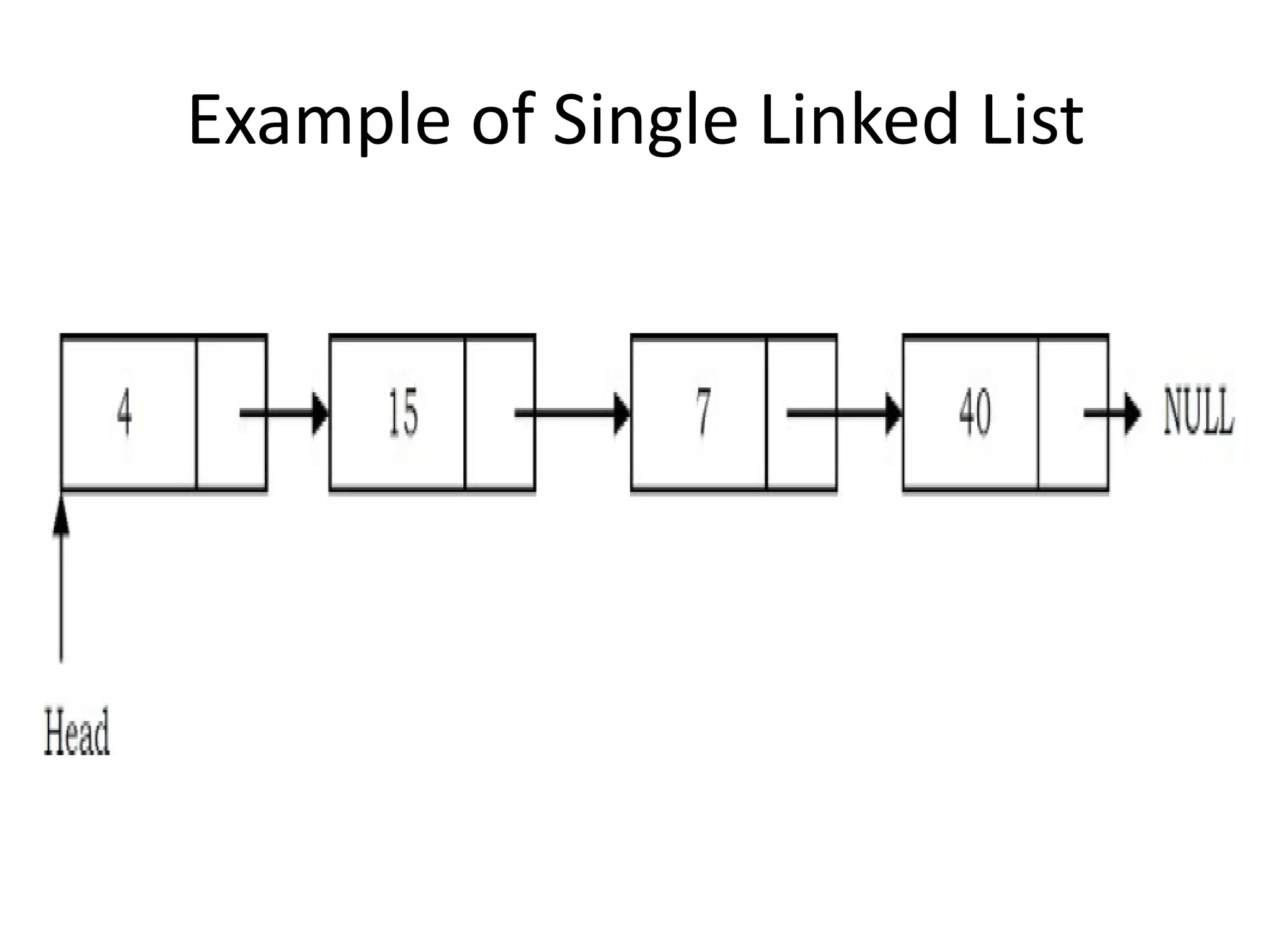
Example of Single Linked List
Linked Lists ADT
• The following operations make linked
lists an ADT:
• Main Linked Lists Operations
–Insert: inserts an element into the list
–Delete: removes and returns the specified
position element from the list
• Auxiliary Linked Lists Operations
–Delete List: removes all elements of the list
(disposes the list)
–Count: returns the number of elements in
the list
–Find nth node from the end of the list
Why Linked Lists?
• Both linked lists and arrays are used to store
collections of data, and since both are used
for the same purpose, we need to
differentiate their usage.
• That means in which cases arrays are suitable
and in which cases linked lists are suitable.
Arrays Overview
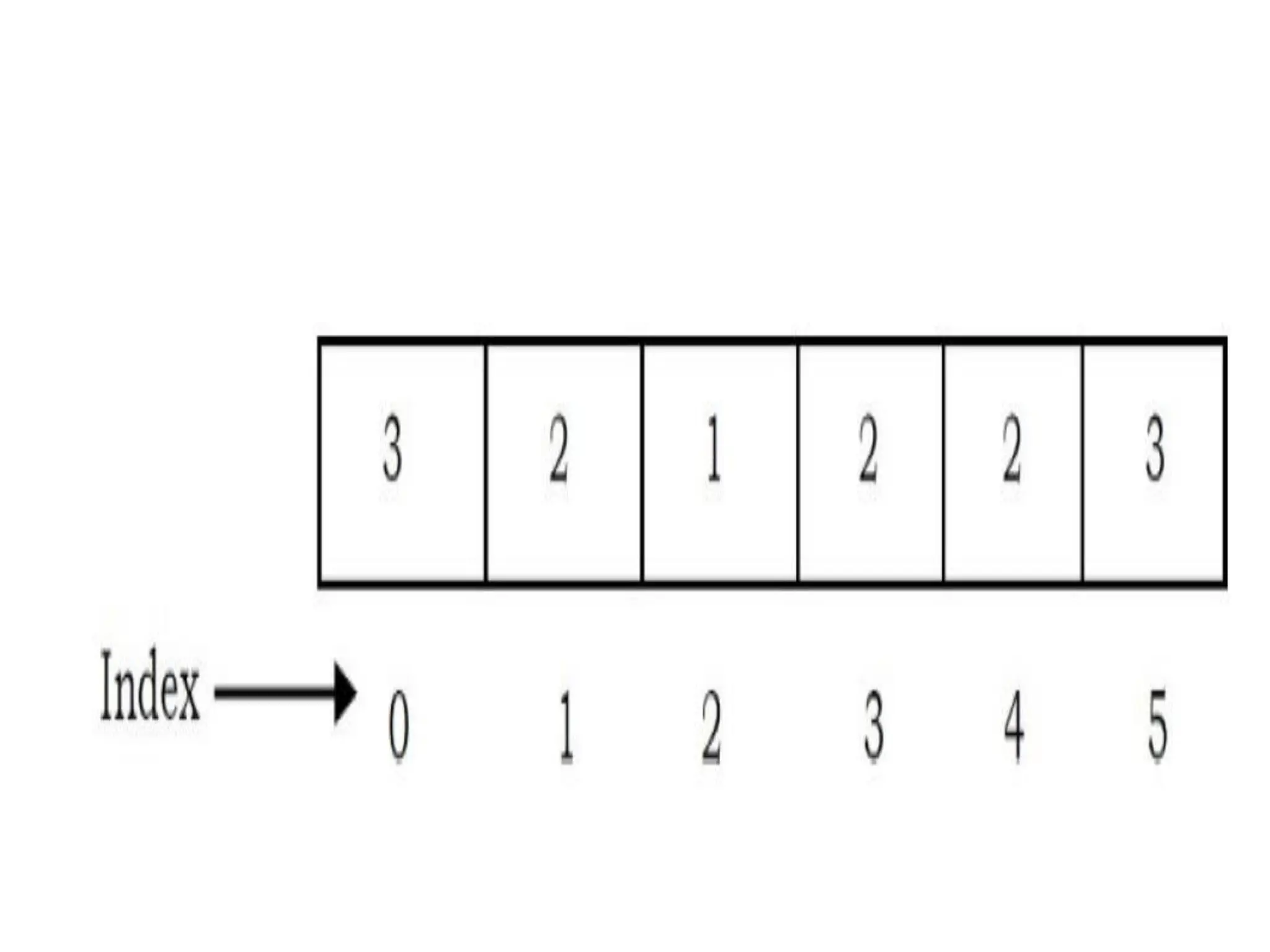
• One memory block is allocated for the entire
array to hold the elements of the array. The
array elements can be accessed in constant
time by using the index of the particular
element as the subscript.
Why Constant Time for Accessing Array
Elements?
• To access an array element, the address of an element
is computed as an offset from the base address of the
array and one multiplication is needed to compute
what is supposed to be added to the base address to
get the memory address of the element. First the size
of an element of that data type is calculated and then
it is multiplied with the index of the element to get the
value to be added to the base address.
• This process takes one multiplication and one addition.
Since these two operations take constant time, we can
say the array access can be performed in constant
time.
Advantages of Arrays
• Simple and easy to use
• Faster access to the elements
(constant access)
First Disadvantage of Arrays
• Preallocates all needed memory up
front and wastes memory space for
indices in the array that are empty.
– Fixed size: The size of the array is
static (specify the array size before
using it).
Second Disadvantage of Arrays
– One block allocation: To allocate the
array itself at the beginning,
sometimes it may not be possible to
get the memory for the complete array
(if the array size is big).
• Eg: A[10000]
Third Disadvantage of Arrays
–Complex position-based insertion: To
insert an element at a given position, we
may need to shift the existing elements.
–This will create a position for us to insert
the new element at the desired position.
–If the position at which we want to add an
element is at the beginning, then the
shifting operation is more expensive.
–A[20]
Dynamic Arrays
• Dynamic array (also called as growable array,
resizable array, dynamic table, or array list) is a
random access, variable-size list data structure
that allows elements to be added or removed.
• One simple way of implementing dynamic arrays
is to initially start with some fixed size array.
• As soon as that array becomes full, create the
new array double the size of the original array.
• Similarly, reduce the array size to half if the
elements in the array are less than half.
Advantages of Linked Lists
• Linked lists have both advantages and
disadvantages.
• Issues in arrays:
– To create an array, we must allocate memory for a
certain number of elements.
– To add more elements to the array when full, we must
create a new array and copy the old array into the
new array.
– This can take a lot of time.
– We can prevent this by allocating lots of space initially
but then we might allocate more than we need and
waste memory.
Advantages of Linked Lists
• The advantage of linked lists is that they can
be expanded in constant time.
– With a linked list, we can start with space for just
one allocated element and add on new elements
easily without the need to do any copying and
reallocating.
Issues with Linked Lists (Disadvantages)
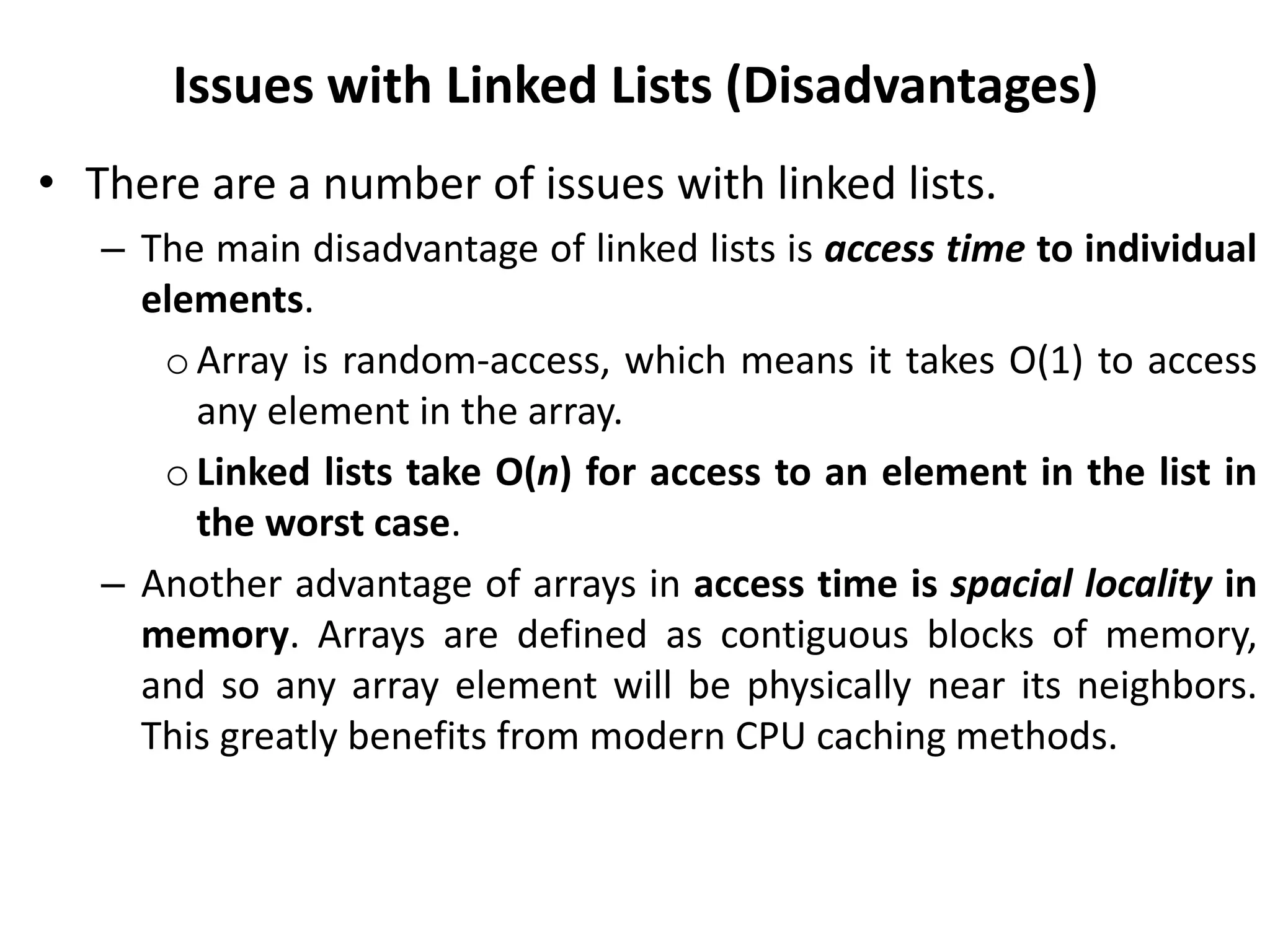
• There are a number of issues with linked lists.
– The main disadvantage of linked lists is access time to individual
elements.
oArray is random-access, which means it takes O(1) to access
any element in the array.
o Linked lists take O(n) for access to an element in the list in
the worst case.
– Another advantage of arrays in access time is spacial locality in
memory. Arrays are defined as contiguous blocks of memory,
and so any array element will be physically near its neighbors.
This greatly benefits from modern CPU caching methods.
• Although the dynamic allocation of storage is a
great advantage, the overhead with storing and
retrieving data can make a big difference.
Sometimes linked lists are hard to manipulate.
If the last item is deleted, the last but one must then
have its pointer changed to hold a NULL reference.
This requires that the list is traversed to find the last
but one link, and its pointer set to a NULL reference.
• Finally, linked lists waste memory in terms of
extra reference points.
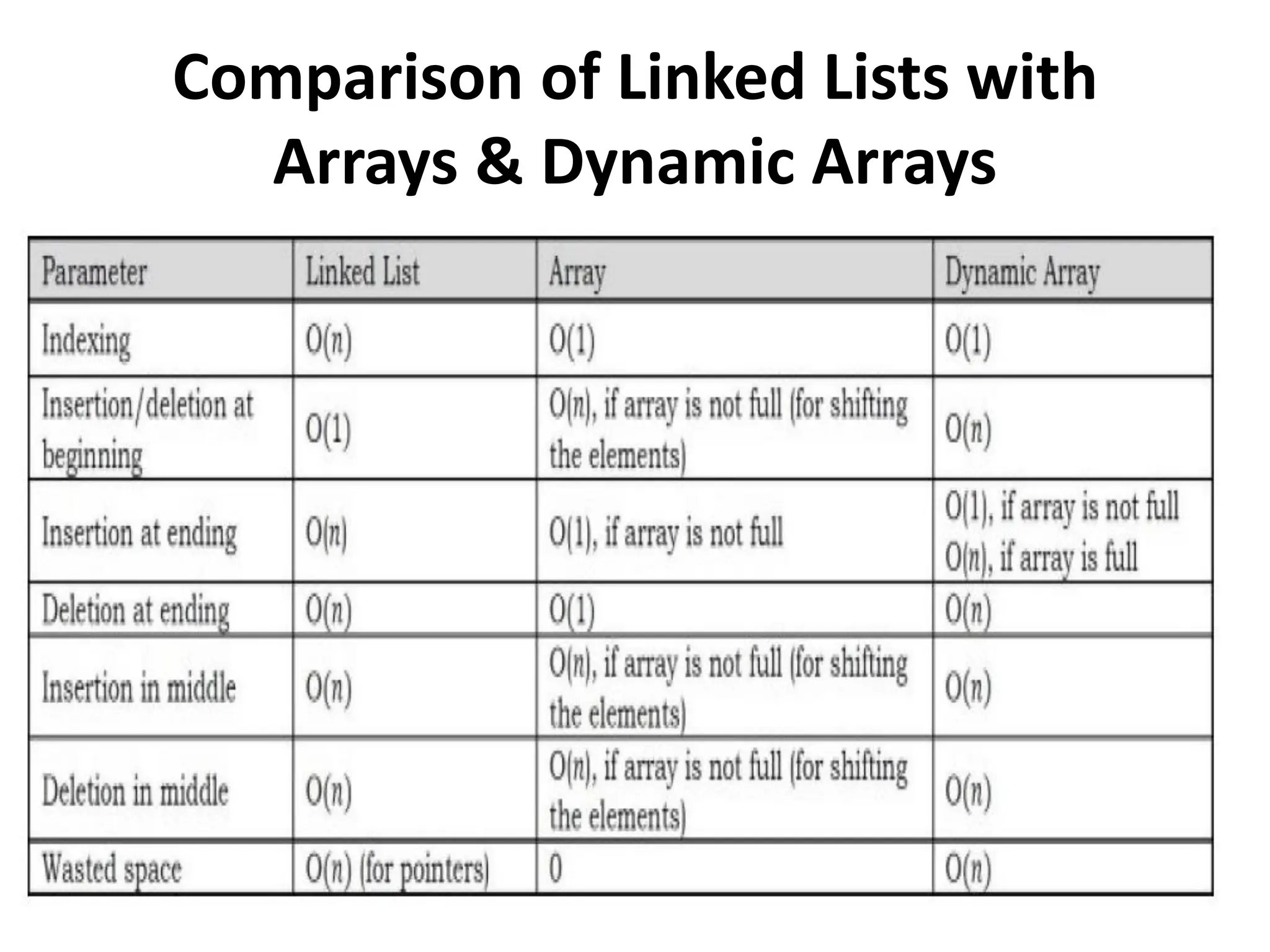
Comparison of Linked Lists with
Arrays & Dynamic Arrays

linked_list.pdf [for undergraduate students

  • 1.
  • 2.
    What is aLinked List? • A linked list is a data structure used for storing collections of data. • A linked list has the following properties. – Successive elements are connected by pointers – The last element points to NULL – Can grow or shrink in size during execution of a program – Can be made just as long as required (until systems memory exhausts) – Does not waste memory space (but takes some extra memory for pointers). It allocates memory as list grows.
  • 3.
    Example of SingleLinked List
  • 4.
    Linked Lists ADT •The following operations make linked lists an ADT: • Main Linked Lists Operations –Insert: inserts an element into the list –Delete: removes and returns the specified position element from the list
  • 5.
    • Auxiliary LinkedLists Operations –Delete List: removes all elements of the list (disposes the list) –Count: returns the number of elements in the list –Find nth node from the end of the list
  • 6.
    Why Linked Lists? •Both linked lists and arrays are used to store collections of data, and since both are used for the same purpose, we need to differentiate their usage. • That means in which cases arrays are suitable and in which cases linked lists are suitable.
  • 7.
    Arrays Overview • Onememory block is allocated for the entire array to hold the elements of the array. The array elements can be accessed in constant time by using the index of the particular element as the subscript.
  • 9.
    Why Constant Timefor Accessing Array Elements? • To access an array element, the address of an element is computed as an offset from the base address of the array and one multiplication is needed to compute what is supposed to be added to the base address to get the memory address of the element. First the size of an element of that data type is calculated and then it is multiplied with the index of the element to get the value to be added to the base address. • This process takes one multiplication and one addition. Since these two operations take constant time, we can say the array access can be performed in constant time.
  • 10.
    Advantages of Arrays •Simple and easy to use • Faster access to the elements (constant access)
  • 11.
    First Disadvantage ofArrays • Preallocates all needed memory up front and wastes memory space for indices in the array that are empty. – Fixed size: The size of the array is static (specify the array size before using it).
  • 12.
    Second Disadvantage ofArrays – One block allocation: To allocate the array itself at the beginning, sometimes it may not be possible to get the memory for the complete array (if the array size is big). • Eg: A[10000]
  • 13.
    Third Disadvantage ofArrays –Complex position-based insertion: To insert an element at a given position, we may need to shift the existing elements. –This will create a position for us to insert the new element at the desired position. –If the position at which we want to add an element is at the beginning, then the shifting operation is more expensive. –A[20]
  • 14.
    Dynamic Arrays • Dynamicarray (also called as growable array, resizable array, dynamic table, or array list) is a random access, variable-size list data structure that allows elements to be added or removed. • One simple way of implementing dynamic arrays is to initially start with some fixed size array. • As soon as that array becomes full, create the new array double the size of the original array. • Similarly, reduce the array size to half if the elements in the array are less than half.
  • 15.
    Advantages of LinkedLists • Linked lists have both advantages and disadvantages. • Issues in arrays: – To create an array, we must allocate memory for a certain number of elements. – To add more elements to the array when full, we must create a new array and copy the old array into the new array. – This can take a lot of time. – We can prevent this by allocating lots of space initially but then we might allocate more than we need and waste memory.
  • 16.
    Advantages of LinkedLists • The advantage of linked lists is that they can be expanded in constant time. – With a linked list, we can start with space for just one allocated element and add on new elements easily without the need to do any copying and reallocating.
  • 17.
    Issues with LinkedLists (Disadvantages) • There are a number of issues with linked lists. – The main disadvantage of linked lists is access time to individual elements. oArray is random-access, which means it takes O(1) to access any element in the array. o Linked lists take O(n) for access to an element in the list in the worst case. – Another advantage of arrays in access time is spacial locality in memory. Arrays are defined as contiguous blocks of memory, and so any array element will be physically near its neighbors. This greatly benefits from modern CPU caching methods.
  • 18.
    • Although thedynamic allocation of storage is a great advantage, the overhead with storing and retrieving data can make a big difference. Sometimes linked lists are hard to manipulate. If the last item is deleted, the last but one must then have its pointer changed to hold a NULL reference. This requires that the list is traversed to find the last but one link, and its pointer set to a NULL reference. • Finally, linked lists waste memory in terms of extra reference points.
  • 19.
    Comparison of LinkedLists with Arrays & Dynamic Arrays