HASHIB ANSARI
M.Sc .(Ag). ENTOMOLOGY
INTRODUCTION
 The world urgently needs new sustainable sources of protein, A
growing population. A scare water and land resources and
declining natural fish stocks make this more critical than ever.
 FAO estimates that insects already form part of the traditional
diets of at least 2 billion people.
 World population is increasing, it is expected to hit 9 billion people
by 2050.
 Current food production will need to almost double but land is
scarce will have profound implications on food production.
 Therefore UN’s has formulated eight Millennium Development
Goals among them 2 are important -
 Eradicating extreme poverty and hunger, and reducing child
mortality.
CONT…..
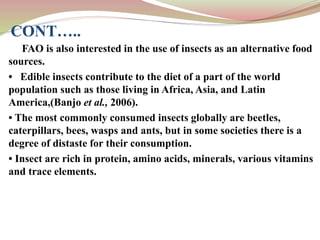
FAO is also interested in the use of insects as an alternative food
sources.
• Edible insects contribute to the diet of a part of the world
population such as those living in Africa, Asia, and Latin
America,(Banjo et al., 2006).
• The most commonly consumed insects globally are beetles,
caterpillars, bees, wasps and ants, but in some societies there is a
degree of distaste for their consumption.
• Insect are rich in protein, amino acids, minerals, various vitamins
and trace elements.
 Cricket company Aspire recently in august,2017 has designed
giant automated cricket farm in 50000 square foot facility.
 Vietnam has taken the challenge of mass larvae poduction 2016.
 Robakowo industry in western Poland for black soldier fly in
(2015-2016).
 AgriProtein company in south africa developed the insect
factofactories in (2016).
 To address this ICIPE and Uganda’s Makerere University
researchers have identified the black soldier fly.
 The PROteINSECT project has 12 partners from 7 countries and
is coordinated by food and Environmental Research Agency
(FERA) in the united kingdom.
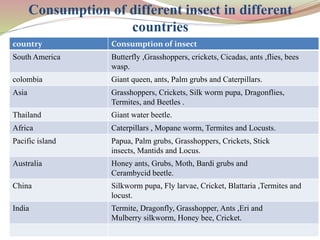
Consumption of different insect in different
countries
country Consumption of insect
South America Butterfly ,Grasshoppers, crickets, Cicadas, ants ,flies, bees
wasp.
colombia Giant queen, ants, Palm grubs and Caterpillars.
Asia Grasshoppers, Crickets, Silk worm pupa, Dragonflies,
Termites, and Beetles .
Thailand Giant water beetle.
Africa Caterpillars , Mopane worm, Termites and Locusts.
Pacific island Papua, Palm grubs, Grasshoppers, Crickets, Stick
insects, Mantids and Locus.
Australia Honey ants, Grubs, Moth, Bardi grubs and
Cerambycid beetle.
China Silkworm pupa, Fly larvae, Cricket, Blattaria ,Termites and
locust.
India Termite, Dragonfly, Grasshopper, Ants ,Eri and
Mulberry silkworm, Honey bee, Cricket.
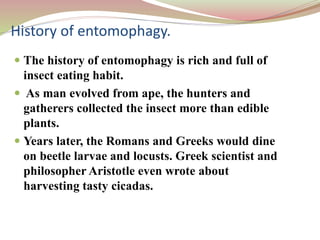
History of entomophagy.
 The history of entomophagy is rich and full of
insect eating habit.
 As man evolved from ape, the hunters and
gatherers collected the insect more than edible
plants.
 Years later, the Romans and Greeks would dine
on beetle larvae and locusts. Greek scientist and
philosopher Aristotle even wrote about
harvesting tasty cicadas.
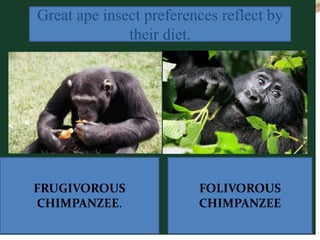
FRUGIVOROUS
CHIMPANZEE.
FOLIVOROUS
CHIMPANZEE
Great ape insect preferences reflect by
their diet.
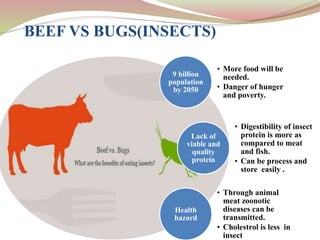
BEEF VS BUGS(INSECTS)
9 billion
population
by 2050
• More food will be
needed.
• Danger of hunger
and poverty.
Lack of
viable and
quality
protein
• Digestibility of insect
protein is more as
compared to meat
and fish.
• Can be process and
store easily .
Health
hazard
• Through animal
meat zoonotic
diseases can be
transmitted.
• Cholestrol is less in
insect
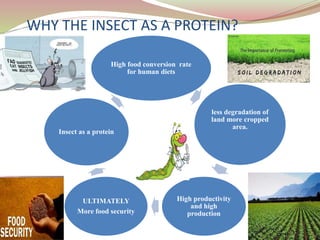
WHY THE INSECT AS A PROTEIN?
High food conversion rate
for human diets
less degradation of
land more cropped
area.
High productivity
and high
production
ULTIMATELY
More food security
Insect as a protein
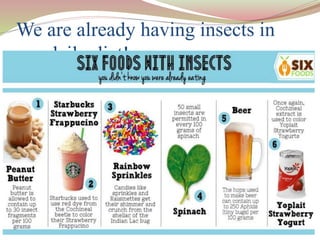
We are already having insects in
our daily diet!
WHY NOT EAT INSECTS?
 In many countries, beef, chicken, and fish are not
easy to procure
 Insects are cheap, sustainable, tasty protein source
 Lots of vitamins and minerals
 Low in fat and cholesterol
 They require less AREA ,WATER AND GAS and
producing more protein.
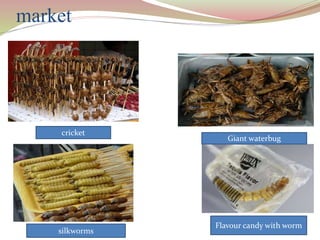
market
cricket
Giant waterbug
silkworms
Flavour candy with worm
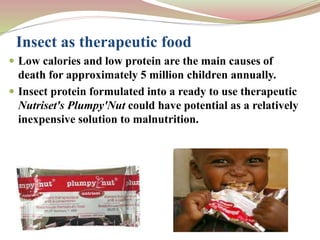
Insect as therapeutic food
 Low calories and low protein are the main causes of
death for approximately 5 million children annually.
 Insect protein formulated into a ready to use therapeutic
Nutriset's Plumpy'Nut could have potential as a relatively
inexpensive solution to malnutrition.
Applications of insect
 Dried and crushed bodies of
the female cochineal insect are
used to add color to foods .
 • This red, pink, and purple
color is used to color ice cream,
yogurts, fruit juices, candies .
Shellac insect used in confectioner's
glaze, resinous glaze, pure food glaze and
natural glaze. This product is used in
many candies to make them shiny and
keep them from sticking together .
• It’s also used to make fruit, such as
apples, shiny again once it has been
cleaned .
Status of entomophagy in India.
 Entomophagy practices among the ethnic communities of
Manipur, north-east India.
Shantibala
et al., 2012
J. Int sci
Objective :To study the entomophagy practices prevalent among ethnic
communities of Manipur, North-east India.
METHODOLOGY
 Surveys were conducted in 25 villages inhabited village of
manipur state.
 Questionnaire based personal interview from 105 persons of the
age 20 and above.
 The questionnaire contained enquiries on insect species used as
food, mode of consumption /utilization, form of preparations, life
stages of insects consumed, association with other ingredients,
culture related to insects, method of collection and any other
uses.
 • To record the marketability.
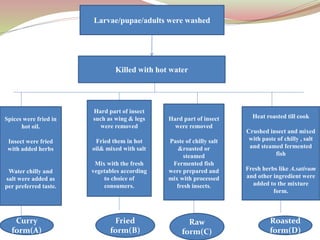
Larvae/pupae/adults were washed
Killed with hot water
Spices were fried in
hot oil.
Insect were fried
with added herbs
Water chilly and
salt were added as
per preferred taste.
Hard part of insect
such as wing & legs
were removed
Fried them in hot
oil& mixed with salt
Mix with the fresh
vegetables according
to choice of
consumers.
Hard part of insect
were removed
Paste of chilly salt
&roasted or
steamed
Fermented fish
were prepared and
mix with processed
fresh insects.
Heat roasted till cook
Crushed insect and mixed
with paste of chilly , salt
and steamed fermented
fish
Fresh herbs like A.sativum
and other ingredient were
added to the mixture
form.
Curry
form(A)
Fried
form(B)
Raw
form(C)
Roasted
form(D)
Results
Tribes :Chothe,Meiteri,Tangkhul,Thadou and Tarao
Use Values Of Different Insect Species Recorded in
Manipur
(Use value was calculated to determine the extent of utilization of
each species. )
CONCLUSION
 The acceptance of 41edible insect species by different ethnic
communities in Manipur indicated the significance of the
insect as a respectable food item and also its role in
promoting noticeable economic input.
INSECT AS PROTEIN FOR LIVESTOCK
 Global demand for animal-sourced foods is accelerating. Fishmeal and
crops such as soya are key ingredients in animal feeds but are not
ecologically or economically sustainable.
 (maggots), which are nutritious and can be mass produced at low cost,
as animal feed.
 Chitin, a polysaccharide found in the exoskeleton of insects, may have a
positive effect on the functioning of the immune system by feeding insects
to chickens, the use of antibiotics in the poultry industry – which may
lead to human infection with drug resistant bacterial strain may be
diminished. –FAO.
Black soldier fly : Hermetia illucens
Black soldier fly larvae (BSFL) are an excellent source
of sustainable protein for aquaculture, animal feed, and
pet and human nutrition. The larvae have voracious
appetites and can be used for composting household food
scraps and agricultural waste products.
INSECT AS A SOURCE OF PROTEIN FOR
LIVESTOCK
Insect as source of protein for fish
Organic management of insect
Insect pest
management
Insect can be
collected
from field
and prepared
as a food
Can be used
as a feed for
animal
Can be
collected for
preparing
organic
manure
Why it is best alternative of food and feed?
Sustainable
development
of the country
Limited
land
resource
s
Set up of
new feed
industry
Nutritional
point of
view
Growing
populatio
n
Vertical farming is easy to
rear insect.
Insect industry will
produce less green
house gases and less
pollution and more
employment.
Insect have high
reproduction rate
and high
fecundity.
There will be high protein content
in feed and food with high viability
and digestibility.
DISADVANTAGES
 Pesticide use can make insects unsuitable for human
consumption
 Herbicides can accumulate in insects through
bioaccumulation.
 Cases of lead poisoning after consumption of chapulines
were reported by the California Department of Health
Services in November 2003.
 Adverse allergic reactions are also a possible hazard.
CONCLUSION
 It is sustainable and ecofreindly, nutritious, flexible and reliable
protein source for the future.
 Insect consumption as an alternative source of food as increasing
in worldwide.
 Edible insects are rich in protein and amino acid, especially
essential amino acids for the human body.
 Insects also have a high feed conversion ratio: on average insects
use 2 kg of feed to produce 1 kg of meat compared to cattle that
require 8 kg for every 1 kg of meat produced.
CONTI….
 It is going to be a future food of our daily diet then
why should we not adopt insect as a protein for us and
our animals(livestock) without exploiting the natural
resources.
 It will be the new branch of commercial entomology
and it may provide employment and job opportunity
and ultimately food security.
THANKING YOU

Insect as a protein

  • 1.
  • 2.
    INTRODUCTION  The worldurgently needs new sustainable sources of protein, A growing population. A scare water and land resources and declining natural fish stocks make this more critical than ever.  FAO estimates that insects already form part of the traditional diets of at least 2 billion people.  World population is increasing, it is expected to hit 9 billion people by 2050.  Current food production will need to almost double but land is scarce will have profound implications on food production.  Therefore UN’s has formulated eight Millennium Development Goals among them 2 are important -  Eradicating extreme poverty and hunger, and reducing child mortality.
  • 3.
    CONT….. FAO is alsointerested in the use of insects as an alternative food sources. • Edible insects contribute to the diet of a part of the world population such as those living in Africa, Asia, and Latin America,(Banjo et al., 2006). • The most commonly consumed insects globally are beetles, caterpillars, bees, wasps and ants, but in some societies there is a degree of distaste for their consumption. • Insect are rich in protein, amino acids, minerals, various vitamins and trace elements.
  • 5.
     Cricket companyAspire recently in august,2017 has designed giant automated cricket farm in 50000 square foot facility.  Vietnam has taken the challenge of mass larvae poduction 2016.  Robakowo industry in western Poland for black soldier fly in (2015-2016).  AgriProtein company in south africa developed the insect factofactories in (2016).  To address this ICIPE and Uganda’s Makerere University researchers have identified the black soldier fly.  The PROteINSECT project has 12 partners from 7 countries and is coordinated by food and Environmental Research Agency (FERA) in the united kingdom.
  • 7.
    Consumption of differentinsect in different countries country Consumption of insect South America Butterfly ,Grasshoppers, crickets, Cicadas, ants ,flies, bees wasp. colombia Giant queen, ants, Palm grubs and Caterpillars. Asia Grasshoppers, Crickets, Silk worm pupa, Dragonflies, Termites, and Beetles . Thailand Giant water beetle. Africa Caterpillars , Mopane worm, Termites and Locusts. Pacific island Papua, Palm grubs, Grasshoppers, Crickets, Stick insects, Mantids and Locus. Australia Honey ants, Grubs, Moth, Bardi grubs and Cerambycid beetle. China Silkworm pupa, Fly larvae, Cricket, Blattaria ,Termites and locust. India Termite, Dragonfly, Grasshopper, Ants ,Eri and Mulberry silkworm, Honey bee, Cricket.
  • 8.
    History of entomophagy. The history of entomophagy is rich and full of insect eating habit.  As man evolved from ape, the hunters and gatherers collected the insect more than edible plants.  Years later, the Romans and Greeks would dine on beetle larvae and locusts. Greek scientist and philosopher Aristotle even wrote about harvesting tasty cicadas.
  • 9.
  • 13.
    BEEF VS BUGS(INSECTS) 9billion population by 2050 • More food will be needed. • Danger of hunger and poverty. Lack of viable and quality protein • Digestibility of insect protein is more as compared to meat and fish. • Can be process and store easily . Health hazard • Through animal meat zoonotic diseases can be transmitted. • Cholestrol is less in insect
  • 14.
    WHY THE INSECTAS A PROTEIN? High food conversion rate for human diets less degradation of land more cropped area. High productivity and high production ULTIMATELY More food security Insect as a protein
  • 15.
    We are alreadyhaving insects in our daily diet!
  • 16.
    WHY NOT EATINSECTS?  In many countries, beef, chicken, and fish are not easy to procure  Insects are cheap, sustainable, tasty protein source  Lots of vitamins and minerals  Low in fat and cholesterol  They require less AREA ,WATER AND GAS and producing more protein.
  • 18.
  • 19.
    Insect as therapeuticfood  Low calories and low protein are the main causes of death for approximately 5 million children annually.  Insect protein formulated into a ready to use therapeutic Nutriset's Plumpy'Nut could have potential as a relatively inexpensive solution to malnutrition.
  • 20.
    Applications of insect Dried and crushed bodies of the female cochineal insect are used to add color to foods .  • This red, pink, and purple color is used to color ice cream, yogurts, fruit juices, candies . Shellac insect used in confectioner's glaze, resinous glaze, pure food glaze and natural glaze. This product is used in many candies to make them shiny and keep them from sticking together . • It’s also used to make fruit, such as apples, shiny again once it has been cleaned .
  • 21.
    Status of entomophagyin India.  Entomophagy practices among the ethnic communities of Manipur, north-east India. Shantibala et al., 2012 J. Int sci Objective :To study the entomophagy practices prevalent among ethnic communities of Manipur, North-east India.
  • 22.
    METHODOLOGY  Surveys wereconducted in 25 villages inhabited village of manipur state.  Questionnaire based personal interview from 105 persons of the age 20 and above.  The questionnaire contained enquiries on insect species used as food, mode of consumption /utilization, form of preparations, life stages of insects consumed, association with other ingredients, culture related to insects, method of collection and any other uses.  • To record the marketability.
  • 23.
    Larvae/pupae/adults were washed Killedwith hot water Spices were fried in hot oil. Insect were fried with added herbs Water chilly and salt were added as per preferred taste. Hard part of insect such as wing & legs were removed Fried them in hot oil& mixed with salt Mix with the fresh vegetables according to choice of consumers. Hard part of insect were removed Paste of chilly salt &roasted or steamed Fermented fish were prepared and mix with processed fresh insects. Heat roasted till cook Crushed insect and mixed with paste of chilly , salt and steamed fermented fish Fresh herbs like A.sativum and other ingredient were added to the mixture form. Curry form(A) Fried form(B) Raw form(C) Roasted form(D)
  • 24.
  • 25.
    Use Values OfDifferent Insect Species Recorded in Manipur (Use value was calculated to determine the extent of utilization of each species. )
  • 26.
    CONCLUSION  The acceptanceof 41edible insect species by different ethnic communities in Manipur indicated the significance of the insect as a respectable food item and also its role in promoting noticeable economic input.
  • 28.
    INSECT AS PROTEINFOR LIVESTOCK  Global demand for animal-sourced foods is accelerating. Fishmeal and crops such as soya are key ingredients in animal feeds but are not ecologically or economically sustainable.  (maggots), which are nutritious and can be mass produced at low cost, as animal feed.  Chitin, a polysaccharide found in the exoskeleton of insects, may have a positive effect on the functioning of the immune system by feeding insects to chickens, the use of antibiotics in the poultry industry – which may lead to human infection with drug resistant bacterial strain may be diminished. –FAO.
  • 29.
    Black soldier fly: Hermetia illucens Black soldier fly larvae (BSFL) are an excellent source of sustainable protein for aquaculture, animal feed, and pet and human nutrition. The larvae have voracious appetites and can be used for composting household food scraps and agricultural waste products.
  • 30.
    INSECT AS ASOURCE OF PROTEIN FOR LIVESTOCK
  • 31.
    Insect as sourceof protein for fish
  • 32.
    Organic management ofinsect Insect pest management Insect can be collected from field and prepared as a food Can be used as a feed for animal Can be collected for preparing organic manure
  • 33.
    Why it isbest alternative of food and feed? Sustainable development of the country Limited land resource s Set up of new feed industry Nutritional point of view Growing populatio n Vertical farming is easy to rear insect. Insect industry will produce less green house gases and less pollution and more employment. Insect have high reproduction rate and high fecundity. There will be high protein content in feed and food with high viability and digestibility.
  • 34.
    DISADVANTAGES  Pesticide usecan make insects unsuitable for human consumption  Herbicides can accumulate in insects through bioaccumulation.  Cases of lead poisoning after consumption of chapulines were reported by the California Department of Health Services in November 2003.  Adverse allergic reactions are also a possible hazard.
  • 35.
    CONCLUSION  It issustainable and ecofreindly, nutritious, flexible and reliable protein source for the future.  Insect consumption as an alternative source of food as increasing in worldwide.  Edible insects are rich in protein and amino acid, especially essential amino acids for the human body.  Insects also have a high feed conversion ratio: on average insects use 2 kg of feed to produce 1 kg of meat compared to cattle that require 8 kg for every 1 kg of meat produced.
  • 36.
    CONTI….  It isgoing to be a future food of our daily diet then why should we not adopt insect as a protein for us and our animals(livestock) without exploiting the natural resources.  It will be the new branch of commercial entomology and it may provide employment and job opportunity and ultimately food security.
  • 37.