INSTITUTIONAL PRESENTATION
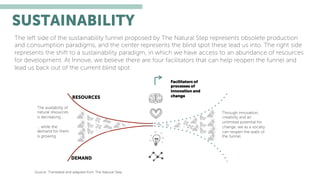
The left side of the sustainability funnel proposed by The Natural Step represents obsolete production
and consumption paradigms, and the center represents the blind spot these lead us into. The right side
represents the shift to a sustainability paradigm, in which we have access to an abundance of resources
for development. At Innove, we believe there are four facilitators that can help reopen the funnel and
lead us back out of the current blind spot:
SUSTAINABILITY
DEMAND
Through innovation,
creativity and an
unlimited potential for
change, we as a society
can reopen the walls of
the funnel.
Source: Translated and adapted from The Natural Step.
The availability of
natural resources
is decreasing…
… while the
demand for them
is growing.
RESOURCES
Facilitators of
processes of
innovation and
change
WHAT IS INNOVE?
INNOVE is a think, engage and do tank that designs and develops processes that enable
organizations, and especially businesses, to achieve their transformation to
sustainability. The future of business will belong to those who are able to adapt to the
new sustainable development paradigm.
For many organizations, this requires a process of self-reinvention. In order to facilitate
this process, INNOVE offers businesses a comprehensive portfolio of services and
support, which we use to produce a new culture in the work teams, leaving behind an
installed capacity for self-management.
THE PILLARS OF OUR WORK
Management of
organizational information
and knowledge, using
collaborative work as a
starting point.
Generation of value for the
business by mitigating risks
and seizing opportunities
through processes of co-
creation and innovation with
the work team.
Construction of capacities for
self-management and
training in sustainable
intrapreneurship within the
work teams.
Networking, sustainable
organizational culture,
good practices and new
reference points,
synergies, linkages, and
alliances with other actors
to promote sustainability.
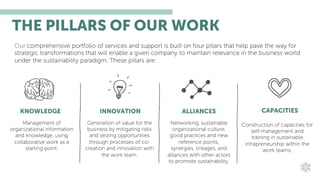
Our comprehensive portfolio of services and support is built on four pillars that help pave the way for
strategic transformations that will enable a given company to maintain relevance in the business world
under the sustainability paradigm. These pillars are:
KNOWLEDGE INNOVATION ALLIANCES CAPACITIES
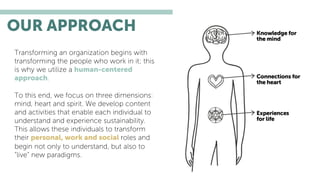
OUR APPROACH
Transforming an organization begins with
transforming the people who work in it; this
is why we utilize a human-centered
approach.
To this end, we focus on three dimensions:
mind, heart and spirit. We develop content
and activities that enable each individual to
understand and experience sustainability.
This allows these individuals to transform
their personal, work and social roles and
begin not only to understand, but also to
“live” new paradigms.
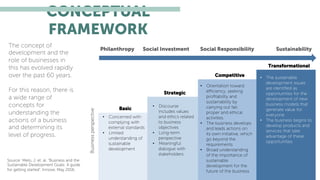
Philanthropy Social Investment Social Responsibility Sustainability
CONCEPTUAL
FRAMEWORK
Businessperspective
Basic
Strategic
Competitive
Transformational
•  Concerned with
complying with
external standards
•  Limited
understanding of
sustainable
development
•  Discourse
includes values
and ethics related
to business
objectives
•  Long-term
perspective
•  Meaningful
dialogue with
stakeholders
•  Orientation toward
efficiency, seeking
profitability and
sustainability by
carrying out fair,
proper and ethical
activities.
•  The business develops
and leads actions on
its own initiative, which
go beyond the
requirements
•  Broad understanding
of the importance of
sustainable
development for the
future of the business
•  The sustainable
development issues
are identified as
opportunities for the
development of new
business models that
generate value for
everyone
•  The business begins to
develop products and
services that take
advantage of these
opportunities
Source: Melo, J. et. al. “Business and the
Sustainable Development Goals: A guide
for getting started”. Innove, May 2016.
The concept of
development and the
role of businesses in
this has evolved rapidly
over the past 60 years.
For this reason, there is
a wide range of
concepts for
understanding the
actions of a business
and determining its
level of progress.
CONCEPTUAL
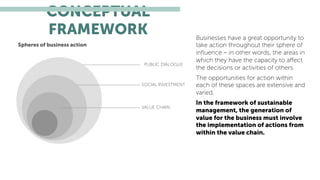
FRAMEWORK Businesses have a great opportunity to
take action throughout their sphere of
influence – in other words, the areas in
which they have the capacity to affect
the decisions or activities of others.
The opportunities for action within
each of these spaces are extensive and
varied.
In the framework of sustainable
management, the generation of
value for the business must involve
the implementation of actions from
within the value chain.
VALUE CHAIN
SOCIAL INVESTMENT
PUBLIC DIALOGUE
Spheres of business action
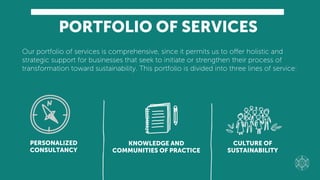
PORTFOLIO OF SERVICES
PERSONALIZED
CONSULTANCY
CULTURE OF
SUSTAINABILITY
KNOWLEDGE AND
COMMUNITIES OF PRACTICE
Our portfolio of services is comprehensive, since it permits us to offer holistic and
strategic support for businesses that seek to initiate or strengthen their process of
transformation toward sustainability. This portfolio is divided into three lines of service:
PERSONALIZED CONSULTANCY
This is the line of personalized consulting and support services we offer to
organizations that are at varying stages of their transition toward sustainability.
Our consulting services can have different scopes, beginning with a sustainability
assessment that we use to develop a specially designed work plan for each client.
Support and co-working are the central elements of this service, since we are
interested in developing truly transformative relationships oriented toward actions
with a high social and environmental impact. We are interested in adding new
allies to a large business network for sustainability, and connecting them to each
other in order to broaden horizons and opportunities.
TOOLKIT
For our personalized consulting and support services, we utilize a toolkit that is organized based on the
four pillars. This enables us to design specialized work plans for each client:
•  Our own assessment tool – “Sustainability
thermometer”
•  Information and knowledge management
•  Systematization, mapping, and analysis
•  Concepts of social innovation, social
impact, and sustainability
•  Actions in the business spheres of
influence
•  Culture of Sustainability and SDG Networking
•  Records of inspiring cases of social innovation,
social impact business models, and social
entrepreneurship
•  Understanding of the territory, the context and the
constellation of actors
•  Cross-sector alliances, synergies, articulations and
cooperation
•  Analysis of risks and opportunities
•  Processes of co-creation and design of
strategies and products
•  Stimulation of the left side of the brain,
creativity and innovation
•  Use of ICTs and lessons in sustainable
entrepreneurship agendas
•  Training spaces utilizing participative
leadership methods
•  Significant dialogue with stakeholders
•  Intrapreneurship training
•  Installation of capacities and training of
trainers
KNOWLEDGE AND COMMUNITIES OF
PRACTICE
This line of services offers businesses a process of information and knowledge management that
produces a specific interpretation, which Innove processes in an infographic and didactic document
by way of a final report. Information and knowledge management enables us to retrieve lessons and
keys to success from previous experiences, as well as identifying strengths and capacities that can be
developed. It also enables us to systematize practices and retrieve organizational knowledge.
Spreading and adapting knowledge is the most important step in designing and facilitating spaces for
conversation and co-creation, as well as communities of learning and practice oriented toward
articulations and alliances for sustainability. We also develop content in multimedia formats in order
to strengthen these spaces and communities.
Inclusive Business Kit: Knowledge and toolkit that makes it possible to analyze, strengthen
and create rurally-based Inclusive Business strategies. We aim to strengthen inclusive business
models in companies as a route for contributing to rural development in a post-conflict and
peacebuilding context.
Innove currently has three core projects in this line of services that can be placed at the disposal of
our allies:
Sustainability School: a collection of publications, webinars, workshops and our own
articles that permit businesses and organizations to easily learn about sustainability. We
recently launched the document: «Business and the Sustainable Development Goals: A
guide for getting started,” available at http://innove.com.co/businessandsdgs/
Sustainable Antioquia: a community of practice built around the SDGs that we are
facilitating for more than 100 local organizations from all sectors throughout 2016. This
project is being carried out in alliance with the business organizations Proantioquia, Centro
de Pensamiento Social and ProSur, and with the universities UPB and EAFIT. More
information is available at: http://innove.com.co/sustainableantioquia/
CULTURE OF SUSTAINABILITY
Sustainability is a new paradigm – a new way of seeing and experiencing the world. As such, a
culture of sustainability is needed to transform the habits from obsolete paradigms that are inhibiting
us from adapting to the conditions of the 21st century.
In order to develop a Culture of Sustainability in individuals and organizations, we create and host
learning and dialogue spaces that take a clear approach to concepts associated with sustainability,
the Sustainable Development Goals, climate change and the COP21 commitments, as well as
offering an understanding of the organizational context and its priorities and opportunities within this
framework. To do so, we rely on participative leadership or “Art of Hosting” methods, which are a
highly effective way of utilizing collective knowhow, uniting work groups and scaling knowledge.
Some of the training spaces include:
What are the Sustainable Development Goals and what do they have to do with my
organization? A space for those interested in learning the origin, content and scope of the
SDGs and how they relate to their organization’s sphere of influence in practice.
Key sustainability standards and their connection with Integrated Management
Systems. This is a training space that provides a clear understanding of the structure, logic
and scope of the most relevant key standards (ISO 26000, GRI -4, Global Compact, DJSI)
and their connection with ISO 9000 and 14000, providing perspective and focus in the
process of constructing materials and indicators to report.
A NEW PARADIGM
Opening the sustainability funnel requires the transformation of production, consumption and
relationship paradigms. New paradigms and ways of being are currently emerging and there are
entrepreneurs with new initiatives, as well as leading companies that are developing new models
that challenge traditional paradigms and carrying out initiatives around themes such as circular and
collaborative economies, sustainable construction, and renewable energies.
In order to reinforce the Culture of Sustainability with a more empirical component, we
complement this line of services with co-working agendas and sessions that enable experiential
learning and direct and first-hand learning and sharing with those who are developing initiatives
within these new paradigms.
RECENT CLIENTS AND EXPERIENCE
We have supported organizations in developing processes oriented towards sustainability.
Recently, we have worked with:
Goal: Co-create a Route Map with affiliated and allied organizations of
ProSur, in order to consolidate Corporate Social Responsibility efforts in the
framework of developing a socially responsible territory in the southern
Aburrá Valley.
Goal: Map the Colombian social innovation ecosystem in order to
determine the best allies for the creation of a Public-Private Social
Innovation Fund.
Goal: Systematize prior experience and conceptualize the new phase of
the Hit Social methodology for the implementation and promotion of
inclusive supply chains.
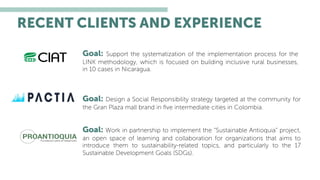
Goal: Design a Social Responsibility strategy targeted at the community for
the Gran Plaza mall brand in five intermediate cities in Colombia.
Goal: Work in partnership to implement the “Sustainable Antioquia” project,
an open space of learning and collaboration for organizations that aims to
introduce them to sustainability-related topics, and particularly to the 17
Sustainable Development Goals (SDGs).
Goal: Support the systematization of the implementation process for the
LINK methodology, which is focused on building inclusive rural businesses,
in 10 cases in Nicaragua.
RECENT CLIENTS AND EXPERIENCE
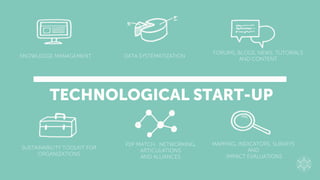
KNOWLEDGE MANAGEMENT DATA SYSTEMATIZATION
FORUMS, BLOGS, NEWS, TUTORIALS
AND CONTENT
TECHNOLOGICAL START-UP
SUSTAINABILITY TOOLKIT FOR
ORGANIZATIONS
P2P MATCH, NETWORKING,
ARTICULATIONS
AND ALLIANCES
MAPPING, INDICATORS, SURVEYS
AND
IMPACT EVALUATIONS
CONTACT US
alianzas@innove.com.co
www.innove.com.co
Twitter: @innove_co
Facebook: /InnoveColombia
Instagram: @innove_co

INNOVE. institutional presentation

  • 1.
  • 2.
    The left sideof the sustainability funnel proposed by The Natural Step represents obsolete production and consumption paradigms, and the center represents the blind spot these lead us into. The right side represents the shift to a sustainability paradigm, in which we have access to an abundance of resources for development. At Innove, we believe there are four facilitators that can help reopen the funnel and lead us back out of the current blind spot: SUSTAINABILITY DEMAND Through innovation, creativity and an unlimited potential for change, we as a society can reopen the walls of the funnel. Source: Translated and adapted from The Natural Step. The availability of natural resources is decreasing… … while the demand for them is growing. RESOURCES Facilitators of processes of innovation and change
  • 3.
    WHAT IS INNOVE? INNOVEis a think, engage and do tank that designs and develops processes that enable organizations, and especially businesses, to achieve their transformation to sustainability. The future of business will belong to those who are able to adapt to the new sustainable development paradigm. For many organizations, this requires a process of self-reinvention. In order to facilitate this process, INNOVE offers businesses a comprehensive portfolio of services and support, which we use to produce a new culture in the work teams, leaving behind an installed capacity for self-management.
  • 4.
    THE PILLARS OFOUR WORK Management of organizational information and knowledge, using collaborative work as a starting point. Generation of value for the business by mitigating risks and seizing opportunities through processes of co- creation and innovation with the work team. Construction of capacities for self-management and training in sustainable intrapreneurship within the work teams. Networking, sustainable organizational culture, good practices and new reference points, synergies, linkages, and alliances with other actors to promote sustainability. Our comprehensive portfolio of services and support is built on four pillars that help pave the way for strategic transformations that will enable a given company to maintain relevance in the business world under the sustainability paradigm. These pillars are: KNOWLEDGE INNOVATION ALLIANCES CAPACITIES
  • 5.
    OUR APPROACH Transforming anorganization begins with transforming the people who work in it; this is why we utilize a human-centered approach. To this end, we focus on three dimensions: mind, heart and spirit. We develop content and activities that enable each individual to understand and experience sustainability. This allows these individuals to transform their personal, work and social roles and begin not only to understand, but also to “live” new paradigms.
  • 6.
    Philanthropy Social InvestmentSocial Responsibility Sustainability CONCEPTUAL FRAMEWORK Businessperspective Basic Strategic Competitive Transformational •  Concerned with complying with external standards •  Limited understanding of sustainable development •  Discourse includes values and ethics related to business objectives •  Long-term perspective •  Meaningful dialogue with stakeholders •  Orientation toward efficiency, seeking profitability and sustainability by carrying out fair, proper and ethical activities. •  The business develops and leads actions on its own initiative, which go beyond the requirements •  Broad understanding of the importance of sustainable development for the future of the business •  The sustainable development issues are identified as opportunities for the development of new business models that generate value for everyone •  The business begins to develop products and services that take advantage of these opportunities Source: Melo, J. et. al. “Business and the Sustainable Development Goals: A guide for getting started”. Innove, May 2016. The concept of development and the role of businesses in this has evolved rapidly over the past 60 years. For this reason, there is a wide range of concepts for understanding the actions of a business and determining its level of progress.
  • 7.
    CONCEPTUAL FRAMEWORK Businesses havea great opportunity to take action throughout their sphere of influence – in other words, the areas in which they have the capacity to affect the decisions or activities of others. The opportunities for action within each of these spaces are extensive and varied. In the framework of sustainable management, the generation of value for the business must involve the implementation of actions from within the value chain. VALUE CHAIN SOCIAL INVESTMENT PUBLIC DIALOGUE Spheres of business action
  • 8.
    PORTFOLIO OF SERVICES PERSONALIZED CONSULTANCY CULTUREOF SUSTAINABILITY KNOWLEDGE AND COMMUNITIES OF PRACTICE Our portfolio of services is comprehensive, since it permits us to offer holistic and strategic support for businesses that seek to initiate or strengthen their process of transformation toward sustainability. This portfolio is divided into three lines of service:
  • 9.
    PERSONALIZED CONSULTANCY This isthe line of personalized consulting and support services we offer to organizations that are at varying stages of their transition toward sustainability. Our consulting services can have different scopes, beginning with a sustainability assessment that we use to develop a specially designed work plan for each client. Support and co-working are the central elements of this service, since we are interested in developing truly transformative relationships oriented toward actions with a high social and environmental impact. We are interested in adding new allies to a large business network for sustainability, and connecting them to each other in order to broaden horizons and opportunities.
  • 10.
    TOOLKIT For our personalizedconsulting and support services, we utilize a toolkit that is organized based on the four pillars. This enables us to design specialized work plans for each client: •  Our own assessment tool – “Sustainability thermometer” •  Information and knowledge management •  Systematization, mapping, and analysis •  Concepts of social innovation, social impact, and sustainability •  Actions in the business spheres of influence •  Culture of Sustainability and SDG Networking •  Records of inspiring cases of social innovation, social impact business models, and social entrepreneurship •  Understanding of the territory, the context and the constellation of actors •  Cross-sector alliances, synergies, articulations and cooperation •  Analysis of risks and opportunities •  Processes of co-creation and design of strategies and products •  Stimulation of the left side of the brain, creativity and innovation •  Use of ICTs and lessons in sustainable entrepreneurship agendas •  Training spaces utilizing participative leadership methods •  Significant dialogue with stakeholders •  Intrapreneurship training •  Installation of capacities and training of trainers
  • 11.
    KNOWLEDGE AND COMMUNITIESOF PRACTICE This line of services offers businesses a process of information and knowledge management that produces a specific interpretation, which Innove processes in an infographic and didactic document by way of a final report. Information and knowledge management enables us to retrieve lessons and keys to success from previous experiences, as well as identifying strengths and capacities that can be developed. It also enables us to systematize practices and retrieve organizational knowledge. Spreading and adapting knowledge is the most important step in designing and facilitating spaces for conversation and co-creation, as well as communities of learning and practice oriented toward articulations and alliances for sustainability. We also develop content in multimedia formats in order to strengthen these spaces and communities.
  • 12.
    Inclusive Business Kit:Knowledge and toolkit that makes it possible to analyze, strengthen and create rurally-based Inclusive Business strategies. We aim to strengthen inclusive business models in companies as a route for contributing to rural development in a post-conflict and peacebuilding context. Innove currently has three core projects in this line of services that can be placed at the disposal of our allies: Sustainability School: a collection of publications, webinars, workshops and our own articles that permit businesses and organizations to easily learn about sustainability. We recently launched the document: «Business and the Sustainable Development Goals: A guide for getting started,” available at http://innove.com.co/businessandsdgs/ Sustainable Antioquia: a community of practice built around the SDGs that we are facilitating for more than 100 local organizations from all sectors throughout 2016. This project is being carried out in alliance with the business organizations Proantioquia, Centro de Pensamiento Social and ProSur, and with the universities UPB and EAFIT. More information is available at: http://innove.com.co/sustainableantioquia/
  • 13.
    CULTURE OF SUSTAINABILITY Sustainabilityis a new paradigm – a new way of seeing and experiencing the world. As such, a culture of sustainability is needed to transform the habits from obsolete paradigms that are inhibiting us from adapting to the conditions of the 21st century. In order to develop a Culture of Sustainability in individuals and organizations, we create and host learning and dialogue spaces that take a clear approach to concepts associated with sustainability, the Sustainable Development Goals, climate change and the COP21 commitments, as well as offering an understanding of the organizational context and its priorities and opportunities within this framework. To do so, we rely on participative leadership or “Art of Hosting” methods, which are a highly effective way of utilizing collective knowhow, uniting work groups and scaling knowledge.
  • 14.
    Some of thetraining spaces include: What are the Sustainable Development Goals and what do they have to do with my organization? A space for those interested in learning the origin, content and scope of the SDGs and how they relate to their organization’s sphere of influence in practice. Key sustainability standards and their connection with Integrated Management Systems. This is a training space that provides a clear understanding of the structure, logic and scope of the most relevant key standards (ISO 26000, GRI -4, Global Compact, DJSI) and their connection with ISO 9000 and 14000, providing perspective and focus in the process of constructing materials and indicators to report.
  • 15.
    A NEW PARADIGM Openingthe sustainability funnel requires the transformation of production, consumption and relationship paradigms. New paradigms and ways of being are currently emerging and there are entrepreneurs with new initiatives, as well as leading companies that are developing new models that challenge traditional paradigms and carrying out initiatives around themes such as circular and collaborative economies, sustainable construction, and renewable energies. In order to reinforce the Culture of Sustainability with a more empirical component, we complement this line of services with co-working agendas and sessions that enable experiential learning and direct and first-hand learning and sharing with those who are developing initiatives within these new paradigms.
  • 16.
    RECENT CLIENTS ANDEXPERIENCE We have supported organizations in developing processes oriented towards sustainability. Recently, we have worked with: Goal: Co-create a Route Map with affiliated and allied organizations of ProSur, in order to consolidate Corporate Social Responsibility efforts in the framework of developing a socially responsible territory in the southern Aburrá Valley. Goal: Map the Colombian social innovation ecosystem in order to determine the best allies for the creation of a Public-Private Social Innovation Fund. Goal: Systematize prior experience and conceptualize the new phase of the Hit Social methodology for the implementation and promotion of inclusive supply chains.
  • 17.
    Goal: Design aSocial Responsibility strategy targeted at the community for the Gran Plaza mall brand in five intermediate cities in Colombia. Goal: Work in partnership to implement the “Sustainable Antioquia” project, an open space of learning and collaboration for organizations that aims to introduce them to sustainability-related topics, and particularly to the 17 Sustainable Development Goals (SDGs). Goal: Support the systematization of the implementation process for the LINK methodology, which is focused on building inclusive rural businesses, in 10 cases in Nicaragua. RECENT CLIENTS AND EXPERIENCE
  • 18.
    KNOWLEDGE MANAGEMENT DATASYSTEMATIZATION FORUMS, BLOGS, NEWS, TUTORIALS AND CONTENT TECHNOLOGICAL START-UP SUSTAINABILITY TOOLKIT FOR ORGANIZATIONS P2P MATCH, NETWORKING, ARTICULATIONS AND ALLIANCES MAPPING, INDICATORS, SURVEYS AND IMPACT EVALUATIONS
  • 19.