Module 1 –Introduction to Enterprise
Sustainability
Sustainability in business means meeting present needs without compromising future generations’ ability to meet
their own. It requires businesses to operate responsibly across environmental, social, and economic dimensions.
2.
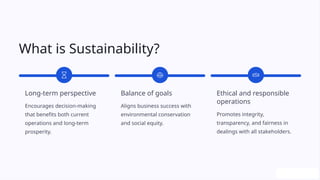
What is Sustainability?
Long-termperspective
Encourages decision-making
that benefits both current
operations and long-term
prosperity.
Balance of goals
Aligns business success with
environmental conservation
and social equity.
Ethical and responsible
operations
Promotes integrity,
transparency, and fairness in
dealings with all stakeholders.
3.
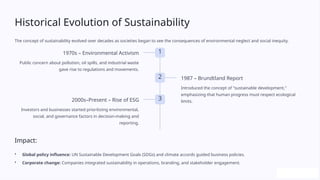
Historical Evolution ofSustainability
The concept of sustainability evolved over decades as societies began to see the consequences of environmental neglect and social inequity.
1
1970s – Environmental Activism
Public concern about pollution, oil spills, and industrial waste
gave rise to regulations and movements.
2 1987 – Brundtland Report
Introduced the concept of "sustainable development,"
emphasizing that human progress must respect ecological
limits.
3
2000s–Present – Rise of ESG
Investors and businesses started prioritizing environmental,
social, and governance factors in decision-making and
reporting.
Impact:
• Global policy influence: UN Sustainable Development Goals (SDGs) and climate accords guided business policies.
• Corporate change: Companies integrated sustainability in operations, branding, and stakeholder engagement.
4.
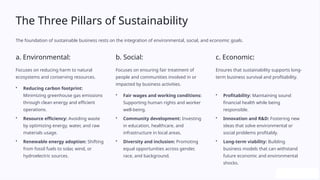
The Three Pillarsof Sustainability
The foundation of sustainable business rests on the integration of environmental, social, and economic goals.
a. Environmental:
Focuses on reducing harm to natural
ecosystems and conserving resources.
• Reducing carbon footprint:
Minimizing greenhouse gas emissions
through clean energy and efficient
operations.
• Resource efficiency: Avoiding waste
by optimizing energy, water, and raw
materials usage.
• Renewable energy adoption: Shifting
from fossil fuels to solar, wind, or
hydroelectric sources.
b. Social:
Focuses on ensuring fair treatment of
people and communities involved in or
impacted by business activities.
• Fair wages and working conditions:
Supporting human rights and worker
well-being.
• Community development: Investing
in education, healthcare, and
infrastructure in local areas.
• Diversity and inclusion: Promoting
equal opportunities across gender,
race, and background.
c. Economic:
Ensures that sustainability supports long-
term business survival and profitability.
• Profitability: Maintaining sound
financial health while being
responsible.
• Innovation and R&D: Fostering new
ideas that solve environmental or
social problems profitably.
• Long-term viability: Building
business models that can withstand
future economic and environmental
shocks.
5.
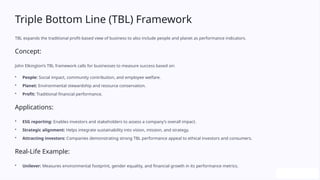
Triple Bottom Line(TBL) Framework
TBL expands the traditional profit-based view of business to also include people and planet as performance indicators.
Concept:
John Elkington’s TBL framework calls for businesses to measure success based on:
• People: Social impact, community contribution, and employee welfare.
• Planet: Environmental stewardship and resource conservation.
• Profit: Traditional financial performance.
Applications:
• ESG reporting: Enables investors and stakeholders to assess a company’s overall impact.
• Strategic alignment: Helps integrate sustainability into vision, mission, and strategy.
• Attracting investors: Companies demonstrating strong TBL performance appeal to ethical investors and consumers.
Real-Life Example:
• Unilever: Measures environmental footprint, gender equality, and financial growth in its performance metrics.
6.
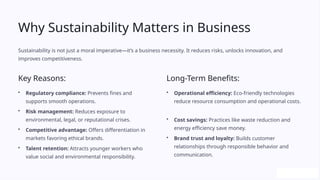
Why Sustainability Mattersin Business
Sustainability is not just a moral imperative—it’s a business necessity. It reduces risks, unlocks innovation, and
improves competitiveness.
Key Reasons:
• Regulatory compliance: Prevents fines and
supports smooth operations.
• Risk management: Reduces exposure to
environmental, legal, or reputational crises.
• Competitive advantage: Offers differentiation in
markets favoring ethical brands.
• Talent retention: Attracts younger workers who
value social and environmental responsibility.
Long-Term Benefits:
• Operational efficiency: Eco-friendly technologies
reduce resource consumption and operational costs.
• Cost savings: Practices like waste reduction and
energy efficiency save money.
• Brand trust and loyalty: Builds customer
relationships through responsible behavior and
communication.
7.
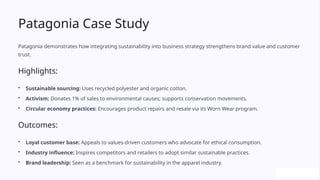
Patagonia Case Study
Patagoniademonstrates how integrating sustainability into business strategy strengthens brand value and customer
trust.
Highlights:
• Sustainable sourcing: Uses recycled polyester and organic cotton.
• Activism: Donates 1% of sales to environmental causes; supports conservation movements.
• Circular economy practices: Encourages product repairs and resale via its Worn Wear program.
Outcomes:
• Loyal customer base: Appeals to values-driven customers who advocate for ethical consumption.
• Industry influence: Inspires competitors and retailers to adopt similar sustainable practices.
• Brand leadership: Seen as a benchmark for sustainability in the apparel industry.
8.
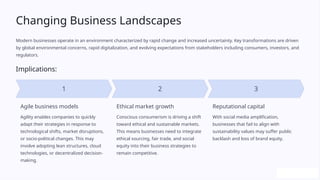
Changing Business Landscapes
Modernbusinesses operate in an environment characterized by rapid change and increased uncertainty. Key transformations are driven
by global environmental concerns, rapid digitalization, and evolving expectations from stakeholders including consumers, investors, and
regulators.
Implications:
Agile business models
Agility enables companies to quickly
adapt their strategies in response to
technological shifts, market disruptions,
or socio-political changes. This may
involve adopting lean structures, cloud
technologies, or decentralized decision-
making.
Ethical market growth
Conscious consumerism is driving a shift
toward ethical and sustainable markets.
This means businesses need to integrate
ethical sourcing, fair trade, and social
equity into their business strategies to
remain competitive.
Reputational capital
With social media amplification,
businesses that fail to align with
sustainability values may suffer public
backlash and loss of brand equity.
9.
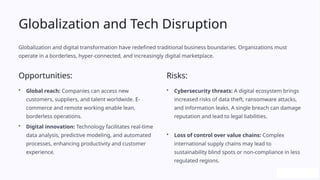
Globalization and TechDisruption
Globalization and digital transformation have redefined traditional business boundaries. Organizations must
operate in a borderless, hyper-connected, and increasingly digital marketplace.
Opportunities:
• Global reach: Companies can access new
customers, suppliers, and talent worldwide. E-
commerce and remote working enable lean,
borderless operations.
• Digital innovation: Technology facilitates real-time
data analysis, predictive modeling, and automated
processes, enhancing productivity and customer
experience.
Risks:
• Cybersecurity threats: A digital ecosystem brings
increased risks of data theft, ransomware attacks,
and information leaks. A single breach can damage
reputation and lead to legal liabilities.
• Loss of control over value chains: Complex
international supply chains may lead to
sustainability blind spots or non-compliance in less
regulated regions.
10.
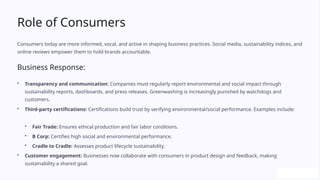
Role of Consumers
Consumerstoday are more informed, vocal, and active in shaping business practices. Social media, sustainability indices, and
online reviews empower them to hold brands accountable.
Business Response:
• Transparency and communication: Companies must regularly report environmental and social impact through
sustainability reports, dashboards, and press releases. Greenwashing is increasingly punished by watchdogs and
customers.
• Third-party certifications: Certifications build trust by verifying environmental/social performance. Examples include:
• Fair Trade: Ensures ethical production and fair labor conditions.
• B Corp: Certifies high social and environmental performance.
• Cradle to Cradle: Assesses product lifecycle sustainability.
• Customer engagement: Businesses now collaborate with consumers in product design and feedback, making
sustainability a shared goal.



![Module 4 PPT 2.pptx hnfvrinv[rwogvjw]vpno](https://cdn.slidesharecdn.com/ss_thumbnails/module4ppt2-250729150448-bfbda77f-thumbnail.jpg?width=640&height=640&fit=bounds)


