


3 Innovative Steps that Increase
Medication Adherence:
HOW TO USE MACHINE LEARNING
AI TO FIND THE NEEDLE IN THE
HAYSTACK
May 14, 2019
50%
of patients with chronic
conditions do not take their
medications as prescribed
WHAT’S THE
IMPACT?
75%
of patients who are
prescribed statins stop
taking them after 2 years
Of all medication-related
hospitalizations that occur
in the US,
1/3 to 2/3
are the result of poor
medication adherence
Poor medication adherence
takes the lives of
125,000 people
a year and costs the
US healthcare system
$300 Billion
Up to
© 2019 Health Dialog
Age: 67
“I take so many different pills that
I can never keep track of what is
going on. Before I know it, a few
days go by without taking some
of my pills or I forget to refill
something altogether.”
MEET SUSAN
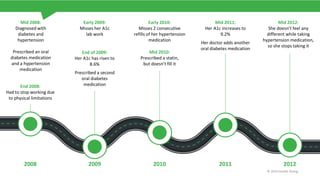
2008 2009 2010 2011 2012
Mid 2008:
Diagnosed with
diabetes and
hypertension
Prescribed an oral
diabetes medication
and a hypertension
medication
End 2008:
Had to stop working due
to physical limitations
Early 2009:
Misses her A1c
lab work
End of 2009:
Her A1c has risen to
8.6%
Prescribed a second
oral diabetes
medication
Mid 2011:
Her A1c increases to
9.2%
Her doctor adds another
oral diabetes medication
Mid 2012:
She doesn’t feel any
different while taking
hypertension medication,
so she stops taking it
Early 2010:
Misses 2 consecutive
refills of her hypertension
medication
Mid 2010:
Prescribed a statin,
but doesn’t fill it
© 2019 Health Dialog
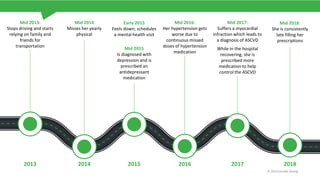
2013 2014 2015 2016 2018
Mid 2013:
Stops driving and starts
relying on family and
friends for
transportation
Mid 2014
Misses her yearly
physical
Mid 2016:
Her hypertension gets
worse due to
continuous missed
doses of hypertension
medication
Mid 2017:
Suffers a myocardial
infraction which leads to
a diagnosis of ASCVD
While in the hospital
recovering, she is
prescribed more
medication to help
control the ASCVD
2017
Mid 2018:
She is consistently
late filling her
prescriptions
Early 2015
Feels down; schedules
a mental health visit
Mid 2015
Is diagnosed with
depression and is
prescribed an
antidepressant
medication
© 2019 Health Dialog
6
• A woman and over 65
• On several medications
• Has high copays and has a lower
income for her area
Predictive models indicate that
Susan will likely be receptive to
telephonic coaching because she is:
WHY SUSAN?
7
• She has shown some evidence of
medication non-adherence
• She has been taking
hypertension medication for an
extended period of time
• She is likely to respond to
specific types of offers
Predictive models indicate she is
likely to improve her medication
adherence patterns with support:
WHY SUSAN?
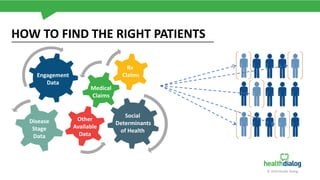
Disease
Stage
Data
Social
Determinants
of Health
Medical
Claims
Rx
ClaimsEngagement
Data
Other
Available
Data
HOW TO FIND THE RIGHT PATIENTS
© 2019 Health Dialog
This is typically where a patient like Susan is found – after a major health event that requires a hospital stay
With our analytics we are able to find
Susan and intervene at an earlier stage.
TYPICAL PROGRAMS FIND SUSAN WHEN IT’S TOO LATE
2008 20182009 2010 2011 2012 2013 2014 2015 2016 2017
Susan suffered a myocardial infarction
which leads to a diagnosis of ASCVD.
While in the hospital recovering, she is
prescribed more medication to help
control the ASCVD.
© 2019 Health Dialog
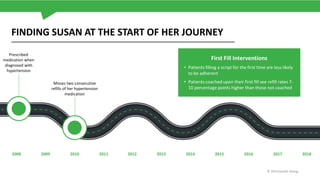
FINDING SUSAN AT THE START OF HER JOURNEY
First Fill Interventions
• Patients filling a script for the first time are less likely
to be adherent
• Patients coached upon their first fill see refill rates 7-
10 percentage points higher than those not coached
2008 20182009 2010 2011 2012 2013 2014 2015 2016 2017
Misses two consecutive
refills of her hypertension
medication
Prescribed
medication when
diagnosed with
hypertension
© 2019 Health Dialog
FINDING SUSAN AT THE START OF HER JOURNEY
Demographics & Social Determinants of Health
• Has physical limitations
• Lives alone
• Lives in a rural location
• Has little discretionary income
• Not a good financial planner
2008 20182009 2010 2011 2012 2013 2014 2015 2016 2017
Had to stop
working due to
physical
limitations
© 2019 Health Dialog
FINDING SUSAN AT THE START OF HER JOURNEY
Multiple Chronic Conditions
These patients are more likely to be non-adherent
than patients with only one chronic condition.
2008 20182009 2010 2011 2012 2013 2014 2015 2016 2017
Her A1c increases to 9.2%.
Her doctor adds another oral
diabetes medication
© 2019 Health Dialog
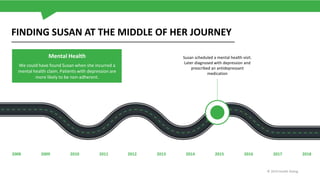
FINDING SUSAN AT THE MIDDLE OF HER JOURNEY
Mental Health
We could have found Susan when she incurred a
mental health claim. Patients with depression are
more likely to be non-adherent.
2008 20182009 2010 2011 2012 2013 2014 2015 2016 2017
Susan scheduled a mental health visit.
Later diagnosed with depression and
prescribed an antidepressant
medication
© 2019 Health Dialog
FINDING SUSAN AT THE MIDDLE OF HER JOURNEY
Early Non-Adherence
We could have found Susan when she showed early signs
of non-adherence upon not taking the hypertension and
oral diabetes medications she was prescribed.
2008 20182009 2010 2011 2012 2013 2014 2015 2016 2017
Suffered a myocardial infarction
which led to a diagnosis of ASCVD.
While in the hospital recovering, she
is prescribed more medication to help
control the ASCVD.
© 2019 Health Dialog
RESULTS FROM 1:1 PATIENT ENGAGEMENT
A Health Coach was able to uncover
Susan’s barriers and help her develop
a plan to overcome them.
Addressed knowledge gaps
Assisted her to switch prescriptions to a 90-day supply
Helped her sign up for a home delivery service
Designed a plan to organize medications
Connected Susan to a local pharmacist
Facilitated provider communications
Scheduled monthly follow-up calls
© 2019 Health Dialog
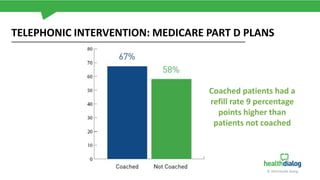
Coached patients had a
refill rate 9 percentage
points higher than
patients not coached
© 2019 Health Dialog
TELEPHONIC INTERVENTION: MEDICARE PART D PLANS
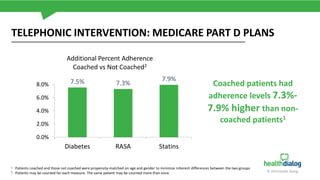
Coached patients had
adherence levels 7.3%-
7.9% higher than non-
coached patients1
7.5% 7.3%
7.9%
0.0%
2.0%
4.0%
6.0%
8.0%
Diabetes RASA Statins
Additional Percent Adherence
Coached vs Not Coached2
1 Patients coached and those not coached were propensity-matched on age and gender to minimize inherent differences between the two groups
2 Patients may be counted for each measure. The same patient may be counted more than once.
TELEPHONIC INTERVENTION: MEDICARE PART D PLANS
© 2019 Health Dialog

Innovative Steps That Increase Medication Adherence

  • 1.
    3 Innovative Stepsthat Increase Medication Adherence: HOW TO USE MACHINE LEARNING AI TO FIND THE NEEDLE IN THE HAYSTACK May 14, 2019
  • 2.
    50% of patients withchronic conditions do not take their medications as prescribed WHAT’S THE IMPACT? 75% of patients who are prescribed statins stop taking them after 2 years Of all medication-related hospitalizations that occur in the US, 1/3 to 2/3 are the result of poor medication adherence Poor medication adherence takes the lives of 125,000 people a year and costs the US healthcare system $300 Billion Up to © 2019 Health Dialog
  • 3.
    Age: 67 “I takeso many different pills that I can never keep track of what is going on. Before I know it, a few days go by without taking some of my pills or I forget to refill something altogether.” MEET SUSAN
  • 4.
    2008 2009 20102011 2012 Mid 2008: Diagnosed with diabetes and hypertension Prescribed an oral diabetes medication and a hypertension medication End 2008: Had to stop working due to physical limitations Early 2009: Misses her A1c lab work End of 2009: Her A1c has risen to 8.6% Prescribed a second oral diabetes medication Mid 2011: Her A1c increases to 9.2% Her doctor adds another oral diabetes medication Mid 2012: She doesn’t feel any different while taking hypertension medication, so she stops taking it Early 2010: Misses 2 consecutive refills of her hypertension medication Mid 2010: Prescribed a statin, but doesn’t fill it © 2019 Health Dialog
  • 5.
    2013 2014 20152016 2018 Mid 2013: Stops driving and starts relying on family and friends for transportation Mid 2014 Misses her yearly physical Mid 2016: Her hypertension gets worse due to continuous missed doses of hypertension medication Mid 2017: Suffers a myocardial infraction which leads to a diagnosis of ASCVD While in the hospital recovering, she is prescribed more medication to help control the ASCVD 2017 Mid 2018: She is consistently late filling her prescriptions Early 2015 Feels down; schedules a mental health visit Mid 2015 Is diagnosed with depression and is prescribed an antidepressant medication © 2019 Health Dialog
  • 6.
    6 • A womanand over 65 • On several medications • Has high copays and has a lower income for her area Predictive models indicate that Susan will likely be receptive to telephonic coaching because she is: WHY SUSAN?
  • 7.
    7 • She hasshown some evidence of medication non-adherence • She has been taking hypertension medication for an extended period of time • She is likely to respond to specific types of offers Predictive models indicate she is likely to improve her medication adherence patterns with support: WHY SUSAN?
  • 8.
  • 9.
    This is typicallywhere a patient like Susan is found – after a major health event that requires a hospital stay With our analytics we are able to find Susan and intervene at an earlier stage. TYPICAL PROGRAMS FIND SUSAN WHEN IT’S TOO LATE 2008 20182009 2010 2011 2012 2013 2014 2015 2016 2017 Susan suffered a myocardial infarction which leads to a diagnosis of ASCVD. While in the hospital recovering, she is prescribed more medication to help control the ASCVD. © 2019 Health Dialog
  • 10.
    FINDING SUSAN ATTHE START OF HER JOURNEY First Fill Interventions • Patients filling a script for the first time are less likely to be adherent • Patients coached upon their first fill see refill rates 7- 10 percentage points higher than those not coached 2008 20182009 2010 2011 2012 2013 2014 2015 2016 2017 Misses two consecutive refills of her hypertension medication Prescribed medication when diagnosed with hypertension © 2019 Health Dialog
  • 11.
    FINDING SUSAN ATTHE START OF HER JOURNEY Demographics & Social Determinants of Health • Has physical limitations • Lives alone • Lives in a rural location • Has little discretionary income • Not a good financial planner 2008 20182009 2010 2011 2012 2013 2014 2015 2016 2017 Had to stop working due to physical limitations © 2019 Health Dialog
  • 12.
    FINDING SUSAN ATTHE START OF HER JOURNEY Multiple Chronic Conditions These patients are more likely to be non-adherent than patients with only one chronic condition. 2008 20182009 2010 2011 2012 2013 2014 2015 2016 2017 Her A1c increases to 9.2%. Her doctor adds another oral diabetes medication © 2019 Health Dialog
  • 13.
    FINDING SUSAN ATTHE MIDDLE OF HER JOURNEY Mental Health We could have found Susan when she incurred a mental health claim. Patients with depression are more likely to be non-adherent. 2008 20182009 2010 2011 2012 2013 2014 2015 2016 2017 Susan scheduled a mental health visit. Later diagnosed with depression and prescribed an antidepressant medication © 2019 Health Dialog
  • 14.
    FINDING SUSAN ATTHE MIDDLE OF HER JOURNEY Early Non-Adherence We could have found Susan when she showed early signs of non-adherence upon not taking the hypertension and oral diabetes medications she was prescribed. 2008 20182009 2010 2011 2012 2013 2014 2015 2016 2017 Suffered a myocardial infarction which led to a diagnosis of ASCVD. While in the hospital recovering, she is prescribed more medication to help control the ASCVD. © 2019 Health Dialog
  • 15.
    RESULTS FROM 1:1PATIENT ENGAGEMENT A Health Coach was able to uncover Susan’s barriers and help her develop a plan to overcome them. Addressed knowledge gaps Assisted her to switch prescriptions to a 90-day supply Helped her sign up for a home delivery service Designed a plan to organize medications Connected Susan to a local pharmacist Facilitated provider communications Scheduled monthly follow-up calls © 2019 Health Dialog
  • 16.
    Coached patients hada refill rate 9 percentage points higher than patients not coached © 2019 Health Dialog TELEPHONIC INTERVENTION: MEDICARE PART D PLANS
  • 17.
    Coached patients had adherencelevels 7.3%- 7.9% higher than non- coached patients1 7.5% 7.3% 7.9% 0.0% 2.0% 4.0% 6.0% 8.0% Diabetes RASA Statins Additional Percent Adherence Coached vs Not Coached2 1 Patients coached and those not coached were propensity-matched on age and gender to minimize inherent differences between the two groups 2 Patients may be counted for each measure. The same patient may be counted more than once. TELEPHONIC INTERVENTION: MEDICARE PART D PLANS © 2019 Health Dialog