DeltaSync BV, the Netherlands
Dr. ir. Rutger de Graaf
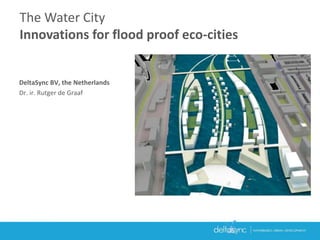
The Water City
Innovations for flood proof eco-cities
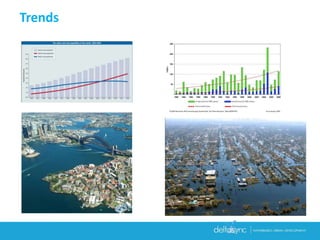
Trends
Trends and traditional approach lead to deltas
that are:
• Increasingly urbanized
• Increasingly under sea level
• Increasingly dependent on large scale, globalizing
networks of energy, water and food supply
• Increasingly vulnerable to floods and droughts
Graaf, R.E. de, F.H.M. van de Ven and N.C. van de Giesen (2007), The Closed City as a strategy to reduce vulnerability of urban areas for
climate change. Water Science and Technology, Vol 56 No 4, pp 165-173, IWA Publishing, London
Why change?
Possible responses towards environmental variation to
reduce vulnerability:
• Reduce environmental variation  Build a threshold,
example:
• Reduce damage if threshold is exceeded  Develop
ability to cope with impacts
• Recover quickly and effectively after damage 
Develop ability to recover
• If future variation is uncertain  Develop ability to
adapt
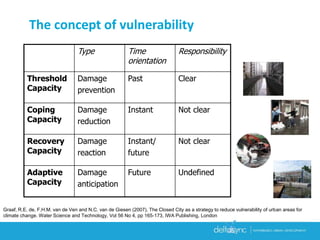
The concept of vulnerability
Graaf, R.E. de, F.H.M. van de Ven and N.C. van de Giesen (2007), The Closed City as a strategy to reduce vulnerability of urban areas for
climate change. Water Science and Technology, Vol 56 No 4, pp 165-173, IWA Publishing, London
Type Time
orientation
Responsibility
Threshold
Capacity
Damage
prevention
Past Clear
Coping
Capacity
Damage
reduction
Instant Not clear
Recovery
Capacity
Damage
reaction
Instant/
future
Not clear
Adaptive
Capacity
Damage
anticipation
Future Undefined
The concept of vulnerability
Graaf, R.E. de, F.H.M. van de Ven and N.C. van de Giesen (2007), The Closed City as a strategy to reduce vulnerability of urban areas for
climate change. Water Science and Technology, Vol 56 No 4, pp 165-173, IWA Publishing, London
The concept of vulnerability
• Vulnerability of a system is difficult to assess
because components of vulnerability are strongly
interrelated.
• Example: Increased flood defense leads to
increased urbanization and a decreased flood
risk perception.
Predicting future water cities, is it possible?
«There is no reason anyone would want a
computer in their home.»
- Ken Olson, president, chairman and founder of Digital Equipment Corp. (DEC), maker of big
business mainframe computers, arguing against the PC in 1977.
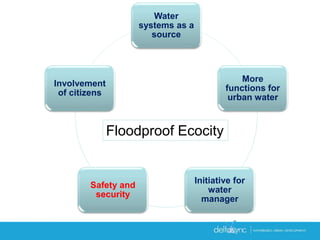
1. Water system as a source
• Energy
• Nutrients
2. More functions for urban water
• Element urban design and urbanization
• Ecosystem
• Mobility
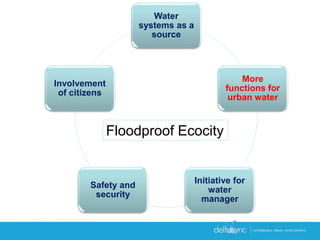
Floodproof Ecocities(1)
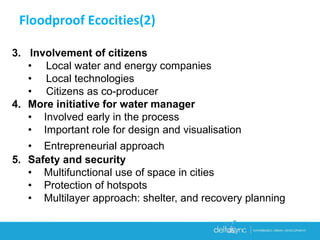
3. Involvement of citizens
• Local water and energy companies
• Local technologies
• Citizens as co-producer
4. More initiative for water manager
• Involved early in the process
• Important role for design and visualisation
• Entrepreneurial approach
5. Safety and security
• Multifunctional use of space in cities
• Protection of hotspots
• Multilayer approach: shelter, and recovery planning
Floodproof Ecocities(2)
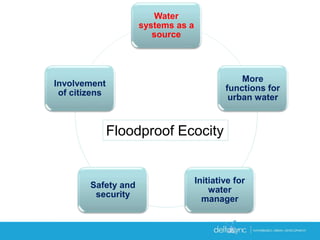
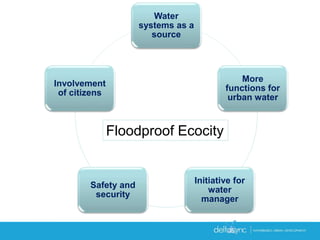
Water
systems as a
source
More
functions for
urban water
Initiative for
water
manager
Safety and
security
Involvement
of citizens
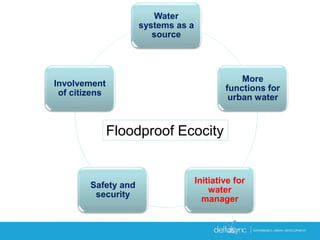
Floodproof Ecocity
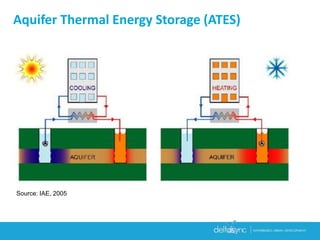
Aquifer Thermal Energy Storage (ATES)
Source: IAE, 2005
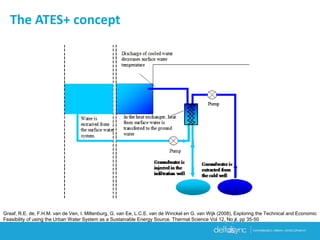
The ATES+ concept
Graaf, R.E. de, F.H.M. van de Ven, I. Miltenburg, G. van Ee, L.C.E. van de Winckel en G. van Wijk (2008), Exploring the Technical and Economic
Feasibility of using the Urban Water System as a Sustainable Energy Source. Thermal Science Vol 12, No 4, pp 35-50
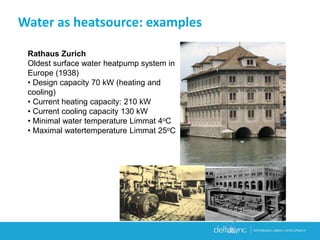
Rathaus Zurich
Oldest surface water heatpump system in
Europe (1938)
• Design capacity 70 kW (heating and
cooling)
• Current heating capacity: 210 kW
• Current cooling capacity 130 kW
• Minimal water temperature Limmat 4oC
• Maximal watertemperature Limmat 25oC
Water as heatsource: examples
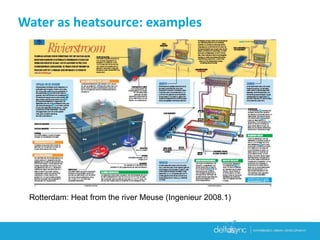
Rotterdam: Heat from the river Meuse (Ingenieur 2008.1)
Water as heatsource: examples
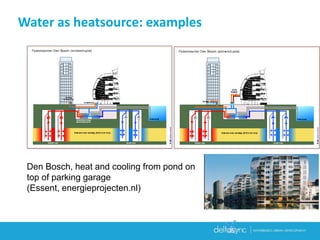
Den Bosch, heat and cooling from pond on
top of parking garage
(Essent, energieprojecten.nl)
Water as heatsource: examples
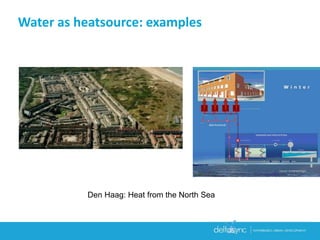
Den Haag: Heat from the North Sea
Water as heatsource: examples
Water
systems as a
source
More
functions for
urban water
Initiative for
water
manager
Safety and
security
Involvement
of citizens
Floodproof Ecocity
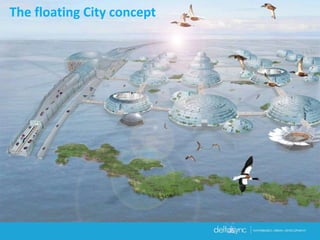
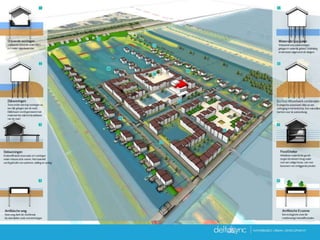
The floating City concept
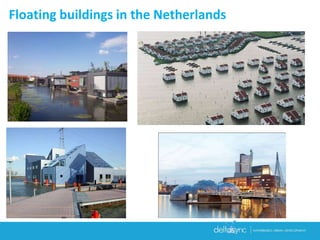
Floating buildings in the Netherlands
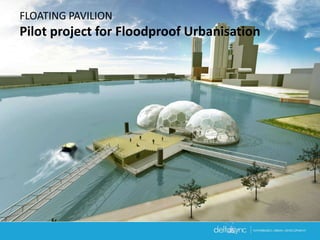
FLOATING PAVILION
Pilot project for Floodproof Urbanisation
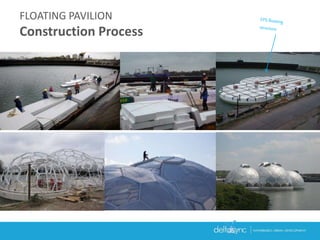
FLOATING PAVILION
Construction Process
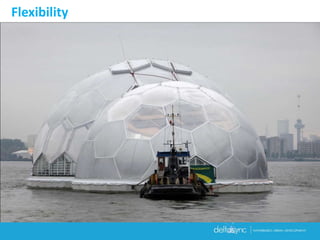
Flexibility
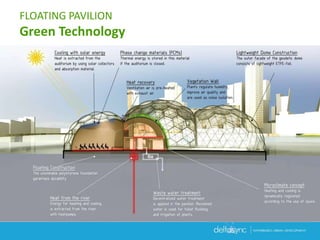
FLOATING PAVILION
Green Technology
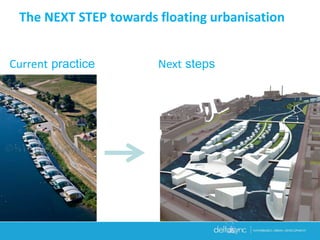
The NEXT STEP towards floating urbanisation
Current practice Next steps
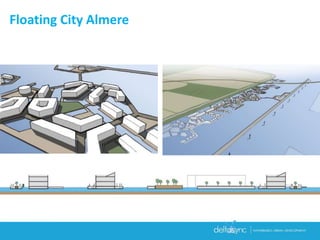
Floating City Almere
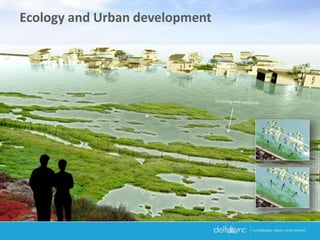
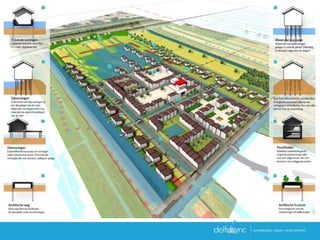
Ecology and Urban development
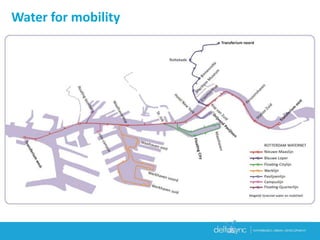
Water for mobility
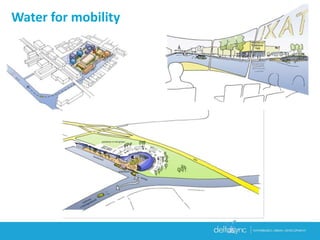
Water for mobility
Water
systems as a
source
More
functions for
urban water
Initiative for
water
manager
Safety and
security
Involvement
of citizens
Floodproof Ecocity
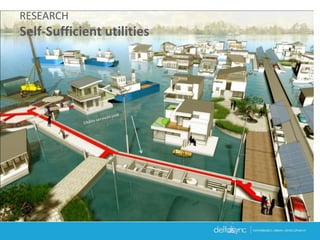
RESEARCH
Self-Sufficient utilities
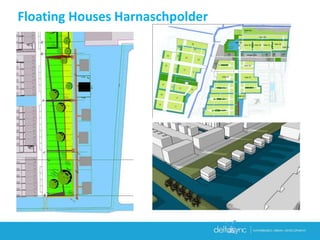
Floating Houses Harnaschpolder
Water
systems as a
source
More
functions for
urban water
Initiative for
water
manager
Safety and
security
Involvement
of citizens
Floodproof Ecocity
Water
systems as a
source
More
functions for
urban water
Initiative for
water
manager
Safety and
security
Involvement
of citizens
Floodproof Ecocity
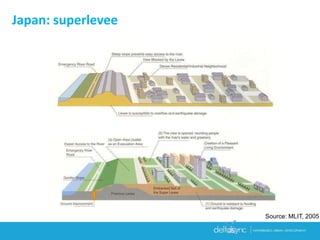
Source: MLIT, 2005
Japan: superlevee
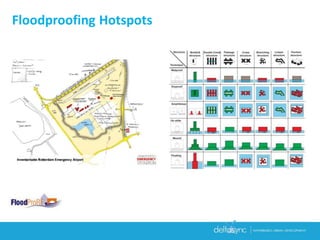
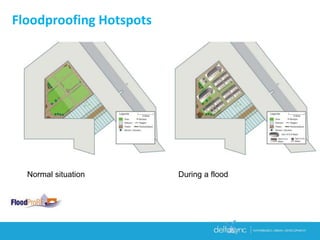
Floodproofing Hotspots
Normal situation During a flood
Water
systems as a
source
More
functions for
urban water
Initiative for
water
manager
Safety and
security
Involvement
of citizens
Floodproof Ecocity
For more information:
DeltaSync
Molengraaffsingel 12-14
2629 JD Delft
Netherlands
Dr. ir. Rutger de Graaf
T: +31 152561872
C: +31 616308790
www.deltasync.nl

Innovations for floodproof ecocities

  • 1.
    DeltaSync BV, theNetherlands Dr. ir. Rutger de Graaf The Water City Innovations for flood proof eco-cities
  • 2.
  • 3.
    Trends and traditionalapproach lead to deltas that are: • Increasingly urbanized • Increasingly under sea level • Increasingly dependent on large scale, globalizing networks of energy, water and food supply • Increasingly vulnerable to floods and droughts Graaf, R.E. de, F.H.M. van de Ven and N.C. van de Giesen (2007), The Closed City as a strategy to reduce vulnerability of urban areas for climate change. Water Science and Technology, Vol 56 No 4, pp 165-173, IWA Publishing, London Why change?
  • 4.
    Possible responses towardsenvironmental variation to reduce vulnerability: • Reduce environmental variation  Build a threshold, example: • Reduce damage if threshold is exceeded  Develop ability to cope with impacts • Recover quickly and effectively after damage  Develop ability to recover • If future variation is uncertain  Develop ability to adapt The concept of vulnerability Graaf, R.E. de, F.H.M. van de Ven and N.C. van de Giesen (2007), The Closed City as a strategy to reduce vulnerability of urban areas for climate change. Water Science and Technology, Vol 56 No 4, pp 165-173, IWA Publishing, London
  • 5.
    Type Time orientation Responsibility Threshold Capacity Damage prevention Past Clear Coping Capacity Damage reduction InstantNot clear Recovery Capacity Damage reaction Instant/ future Not clear Adaptive Capacity Damage anticipation Future Undefined The concept of vulnerability Graaf, R.E. de, F.H.M. van de Ven and N.C. van de Giesen (2007), The Closed City as a strategy to reduce vulnerability of urban areas for climate change. Water Science and Technology, Vol 56 No 4, pp 165-173, IWA Publishing, London
  • 6.
    The concept ofvulnerability • Vulnerability of a system is difficult to assess because components of vulnerability are strongly interrelated. • Example: Increased flood defense leads to increased urbanization and a decreased flood risk perception.
  • 7.
    Predicting future watercities, is it possible? «There is no reason anyone would want a computer in their home.» - Ken Olson, president, chairman and founder of Digital Equipment Corp. (DEC), maker of big business mainframe computers, arguing against the PC in 1977.
  • 8.
    1. Water systemas a source • Energy • Nutrients 2. More functions for urban water • Element urban design and urbanization • Ecosystem • Mobility Floodproof Ecocities(1)
  • 9.
    3. Involvement ofcitizens • Local water and energy companies • Local technologies • Citizens as co-producer 4. More initiative for water manager • Involved early in the process • Important role for design and visualisation • Entrepreneurial approach 5. Safety and security • Multifunctional use of space in cities • Protection of hotspots • Multilayer approach: shelter, and recovery planning Floodproof Ecocities(2)
  • 10.
    Water systems as a source More functionsfor urban water Initiative for water manager Safety and security Involvement of citizens Floodproof Ecocity
  • 11.
    Aquifer Thermal EnergyStorage (ATES) Source: IAE, 2005
  • 12.
    The ATES+ concept Graaf,R.E. de, F.H.M. van de Ven, I. Miltenburg, G. van Ee, L.C.E. van de Winckel en G. van Wijk (2008), Exploring the Technical and Economic Feasibility of using the Urban Water System as a Sustainable Energy Source. Thermal Science Vol 12, No 4, pp 35-50
  • 13.
    Rathaus Zurich Oldest surfacewater heatpump system in Europe (1938) • Design capacity 70 kW (heating and cooling) • Current heating capacity: 210 kW • Current cooling capacity 130 kW • Minimal water temperature Limmat 4oC • Maximal watertemperature Limmat 25oC Water as heatsource: examples
  • 14.
    Rotterdam: Heat fromthe river Meuse (Ingenieur 2008.1) Water as heatsource: examples
  • 15.
    Den Bosch, heatand cooling from pond on top of parking garage (Essent, energieprojecten.nl) Water as heatsource: examples
  • 16.
    Den Haag: Heatfrom the North Sea Water as heatsource: examples
  • 17.
    Water systems as a source More functionsfor urban water Initiative for water manager Safety and security Involvement of citizens Floodproof Ecocity
  • 18.
  • 19.
    Floating buildings inthe Netherlands
  • 20.
    FLOATING PAVILION Pilot projectfor Floodproof Urbanisation
  • 21.
  • 22.
  • 23.
  • 24.
    The NEXT STEPtowards floating urbanisation Current practice Next steps
  • 25.
  • 26.
    Ecology and Urbandevelopment
  • 27.
  • 28.
  • 29.
    Water systems as a source More functionsfor urban water Initiative for water manager Safety and security Involvement of citizens Floodproof Ecocity
  • 30.
  • 31.
  • 32.
  • 33.
    Water systems as a source More functionsfor urban water Initiative for water manager Safety and security Involvement of citizens Floodproof Ecocity
  • 36.
    Water systems as a source More functionsfor urban water Initiative for water manager Safety and security Involvement of citizens Floodproof Ecocity
  • 37.
  • 38.
  • 39.
  • 40.
    Water systems as a source More functionsfor urban water Initiative for water manager Safety and security Involvement of citizens Floodproof Ecocity
  • 41.
    For more information: DeltaSync Molengraaffsingel12-14 2629 JD Delft Netherlands Dr. ir. Rutger de Graaf T: +31 152561872 C: +31 616308790 www.deltasync.nl