THE INDIAN INNOVATION SYSTEM: INFRASTRUCTURE AND EXAMPLES Srinivasa B. S. Nookala 1 (snookala@purdue.edu) Pankaj Sharma 2,3 ,  Anubhav Sharma 4 1 Civil Engineering, Purdue University (USA) 2 Discovery Park, Purdue University (USA) 3 College of Technology (Courtesy)  4 University of New Hampshire School of Law(USA) Technology Transfer Annual Conference, The George Washington University, Washington D.C., November 12-13, 2010
DISCLAIMER All opinions, judgments, and recommendations that are presented here are the opinions and ideas of the authors of the material. References to material in this presentation are still in the development, interpretation and publication process. Any reproduction or citation permitted with the permission of the lead author. All information supplied in this presentation is sole confidential and for the purpose of sharing with the U.S. Department of State and other intended audiences.
Outline Introduction Infrastructure Capabilities Challenges & Opportunities in Organizations Examples of Successful Innovations in India Tata Nano – Case Study Recommendations Conclusions
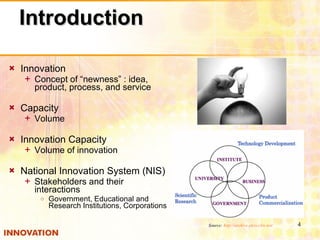
Introduction Innovation  Concept of “newness” : idea, product, process, and service Capacity Volume  Innovation Capacity Volume of innovation National Innovation System (NIS) Stakeholders and their interactions Government, Educational and Research Institutions, Corporations Source:  http://archive.en.occlin.net/
Approach Literature review Web site Open ended questions/interviews Corporations Educational institutions Government agencies
Infrastructure Capabilities Research Parks, Innovation Parks Indian Institute of Technology, Madras; ICICI Knowledge Park Innovation and Entrepreneurship Centers IITD – FIIT; IITB – SINE; ISB – WCED,CLIC; IIMB – NSRCEL; IISC - SID Basic Sciences Research NIN, TFIR, CCMB, NCL, IISc
Infrastructure Capabilities  Critical Points IITM Credit system SINE, FIIT, ISB, IIMs Business Plan competition Conferences, Workshops – for awareness CSIR (CCMB) Patestate – IPR Management, Licensing services, Patent database maintenance
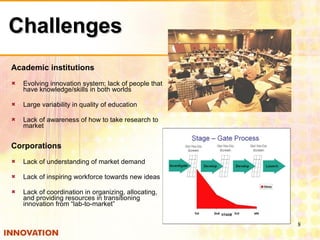
Challenges Academic institutions Evolving innovation system; lack of people that have knowledge/skills in both worlds Large variability in quality of education Lack of awareness of how to take research to market Corporations Lack of understanding of market demand Lack of inspiring workforce towards new ideas Lack of coordination in organizing, allocating, and providing resources in transitioning innovation from “lab-to-market”
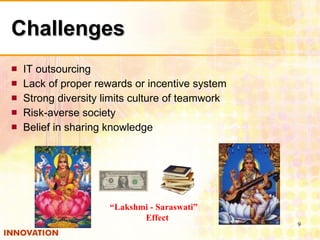
Challenges IT outsourcing Lack of proper rewards or incentive system Strong diversity limits culture of teamwork Risk-averse society Belief in sharing knowledge “ Lakshmi - Saraswati”  Effect
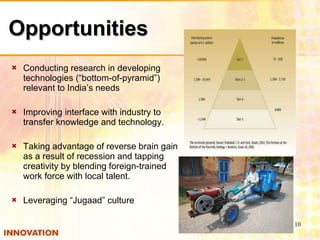
Opportunities Conducting research in developing technologies (“bottom-of-pyramid”) relevant to India’s needs Improving interface with industry to transfer knowledge and technology. Taking advantage of reverse brain gain as a result of recession and tapping creativity by blending foreign-trained work force with local talent. Leveraging “Jugaad” culture
Innovations in India CCMB Potential Diabetes Drug Molecule Insecticide – Rallis Group (Tata) Protects paddy fields from scourge Mahindra Satyam i-DNA, IdeaJunction, Ideation Infosys mConnect - Patent pending middleware solution based on context-aware computing. Wockhardt Cardiology Surgeries - minimally invasive beating heart coronary artery bypass surgery. GE Healthymagination, Ecomagination – Innovations focusing on healthcare and environment respectively
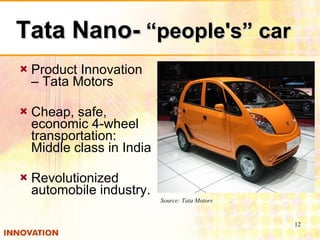
Tata Nano-  “people's” car Product Innovation – Tata Motors Cheap, safe, economic 4-wheel transportation: Middle class in India Revolutionized automobile industry. Source: Tata Motors
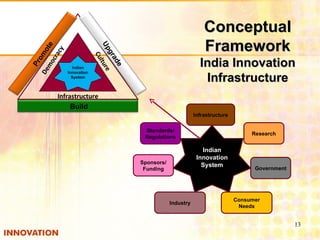
Indian Innovation System Sponsors/ Funding Infrastructure Industry Government Consumer Needs Standards/ Regulations Research Conceptual Framework India Innovation Infrastructure Democracy Culture Infrastructure Indian Innovation System Promote Upgrade Build
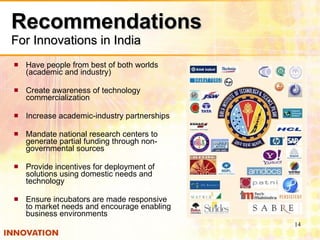
Recommendations For Innovations in India Have people from best of both worlds (academic and industry) Create awareness of technology commercialization Increase academic-industry partnerships  Mandate national research centers to generate partial funding through non-governmental sources  Provide incentives for deployment of solutions using domestic needs and technology Ensure incubators are made responsive to market needs and encourage enabling business environments
Acknowledgements U.S. Department of State Fulbright New Century Scholar Program Council for International Exchange of Scholars Institute of International Education Department of Scholar and Professional Programs Discovery Park, Office of the Vice President for Research Purdue University
Thank you!
APPENDIX
Background NIS:  Nelson , Freeman, Lundvall, 2007; Sornn-Friese, 2000 Innovation in India:  Athreye (2010) and Arora, 2002; Das, 2002; Patibandla; Mudambi, 2003, 2008; D’Costa, 2006; and many others
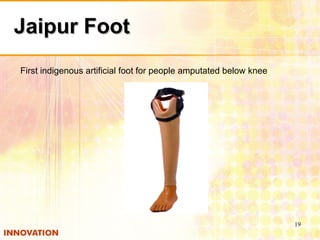
Jaipur Foot First indigenous artificial foot for people amputated below knee
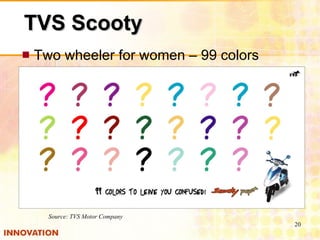
TVS Scooty Two wheeler for women – 99 colors Source: TVS Motor Company
Government’s Role Recently introduced a bill: “ THE PROTECTION AND UTILIZATION OF PUBLIC FUNDED INTELLECTUAL PROPERTY BILL, 2008” “ to provide for the protection and utilization of intellectual property originating from public funded research and for matters connected therewith or incidental thereto.” Financial incentives for researchers and entrepreneurs.
Questionnaire What are the challenges your organization experiences related to innovation? What is the current infrastructure your organization has to fuel the innovation? What are the infrastructure challenges your organization experiences related to innovation? What are the leadership challenges your organization experiences related to innovation? What are the cultural challenges your organization experiences related to innovation? What are the entrepreneurial programs/processes your organization has to foster innovation?
Titles of people interviewed Corporate Organizations Educational Institutions Chief Technology Officer Founders and CEOs General Managers Human Resources Manager Managing Directors President/Vice President Business Development IP Managers Dean Directors (Executive/Deputy) Professors Research Scientist/Faculty Scientific Advisor

Innovation Capacity in India

  • 1.
    THE INDIAN INNOVATIONSYSTEM: INFRASTRUCTURE AND EXAMPLES Srinivasa B. S. Nookala 1 (snookala@purdue.edu) Pankaj Sharma 2,3 , Anubhav Sharma 4 1 Civil Engineering, Purdue University (USA) 2 Discovery Park, Purdue University (USA) 3 College of Technology (Courtesy) 4 University of New Hampshire School of Law(USA) Technology Transfer Annual Conference, The George Washington University, Washington D.C., November 12-13, 2010
  • 2.
    DISCLAIMER All opinions,judgments, and recommendations that are presented here are the opinions and ideas of the authors of the material. References to material in this presentation are still in the development, interpretation and publication process. Any reproduction or citation permitted with the permission of the lead author. All information supplied in this presentation is sole confidential and for the purpose of sharing with the U.S. Department of State and other intended audiences.
  • 3.
    Outline Introduction InfrastructureCapabilities Challenges & Opportunities in Organizations Examples of Successful Innovations in India Tata Nano – Case Study Recommendations Conclusions
  • 4.
    Introduction Innovation Concept of “newness” : idea, product, process, and service Capacity Volume Innovation Capacity Volume of innovation National Innovation System (NIS) Stakeholders and their interactions Government, Educational and Research Institutions, Corporations Source: http://archive.en.occlin.net/
  • 5.
    Approach Literature reviewWeb site Open ended questions/interviews Corporations Educational institutions Government agencies
  • 6.
    Infrastructure Capabilities ResearchParks, Innovation Parks Indian Institute of Technology, Madras; ICICI Knowledge Park Innovation and Entrepreneurship Centers IITD – FIIT; IITB – SINE; ISB – WCED,CLIC; IIMB – NSRCEL; IISC - SID Basic Sciences Research NIN, TFIR, CCMB, NCL, IISc
  • 7.
    Infrastructure Capabilities Critical Points IITM Credit system SINE, FIIT, ISB, IIMs Business Plan competition Conferences, Workshops – for awareness CSIR (CCMB) Patestate – IPR Management, Licensing services, Patent database maintenance
  • 8.
    Challenges Academic institutionsEvolving innovation system; lack of people that have knowledge/skills in both worlds Large variability in quality of education Lack of awareness of how to take research to market Corporations Lack of understanding of market demand Lack of inspiring workforce towards new ideas Lack of coordination in organizing, allocating, and providing resources in transitioning innovation from “lab-to-market”
  • 9.
    Challenges IT outsourcingLack of proper rewards or incentive system Strong diversity limits culture of teamwork Risk-averse society Belief in sharing knowledge “ Lakshmi - Saraswati” Effect
  • 10.
    Opportunities Conducting researchin developing technologies (“bottom-of-pyramid”) relevant to India’s needs Improving interface with industry to transfer knowledge and technology. Taking advantage of reverse brain gain as a result of recession and tapping creativity by blending foreign-trained work force with local talent. Leveraging “Jugaad” culture
  • 11.
    Innovations in IndiaCCMB Potential Diabetes Drug Molecule Insecticide – Rallis Group (Tata) Protects paddy fields from scourge Mahindra Satyam i-DNA, IdeaJunction, Ideation Infosys mConnect - Patent pending middleware solution based on context-aware computing. Wockhardt Cardiology Surgeries - minimally invasive beating heart coronary artery bypass surgery. GE Healthymagination, Ecomagination – Innovations focusing on healthcare and environment respectively
  • 12.
    Tata Nano- “people's” car Product Innovation – Tata Motors Cheap, safe, economic 4-wheel transportation: Middle class in India Revolutionized automobile industry. Source: Tata Motors
  • 13.
    Indian Innovation SystemSponsors/ Funding Infrastructure Industry Government Consumer Needs Standards/ Regulations Research Conceptual Framework India Innovation Infrastructure Democracy Culture Infrastructure Indian Innovation System Promote Upgrade Build
  • 14.
    Recommendations For Innovationsin India Have people from best of both worlds (academic and industry) Create awareness of technology commercialization Increase academic-industry partnerships Mandate national research centers to generate partial funding through non-governmental sources Provide incentives for deployment of solutions using domestic needs and technology Ensure incubators are made responsive to market needs and encourage enabling business environments
  • 15.
    Acknowledgements U.S. Departmentof State Fulbright New Century Scholar Program Council for International Exchange of Scholars Institute of International Education Department of Scholar and Professional Programs Discovery Park, Office of the Vice President for Research Purdue University
  • 16.
  • 17.
  • 18.
    Background NIS: Nelson , Freeman, Lundvall, 2007; Sornn-Friese, 2000 Innovation in India: Athreye (2010) and Arora, 2002; Das, 2002; Patibandla; Mudambi, 2003, 2008; D’Costa, 2006; and many others
  • 19.
    Jaipur Foot Firstindigenous artificial foot for people amputated below knee
  • 20.
    TVS Scooty Twowheeler for women – 99 colors Source: TVS Motor Company
  • 21.
    Government’s Role Recentlyintroduced a bill: “ THE PROTECTION AND UTILIZATION OF PUBLIC FUNDED INTELLECTUAL PROPERTY BILL, 2008” “ to provide for the protection and utilization of intellectual property originating from public funded research and for matters connected therewith or incidental thereto.” Financial incentives for researchers and entrepreneurs.
  • 22.
    Questionnaire What arethe challenges your organization experiences related to innovation? What is the current infrastructure your organization has to fuel the innovation? What are the infrastructure challenges your organization experiences related to innovation? What are the leadership challenges your organization experiences related to innovation? What are the cultural challenges your organization experiences related to innovation? What are the entrepreneurial programs/processes your organization has to foster innovation?
  • 23.
    Titles of peopleinterviewed Corporate Organizations Educational Institutions Chief Technology Officer Founders and CEOs General Managers Human Resources Manager Managing Directors President/Vice President Business Development IP Managers Dean Directors (Executive/Deputy) Professors Research Scientist/Faculty Scientific Advisor