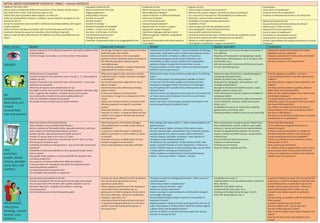
INITIAL NEEDS ASSESSMENT CHECKLIST (INAC) – Version 06/05/10
PRIOR TO THE FIELD VISIT:
Clearly choose and identify (within the boundaries of the disaster stricken area) a
few “Catchment’s Areas” (CA) which you plan to visit
Collect basic existing baseline data/maps/etc. on these CA
Verify security/weather/ transport conditions, access clearance and agree on trip
itinerary to the CA
Set up the assessment team and define individual roles/responsibilities with regard
to data collection
Verify if all team members are familiar with the tool and aware of the time
constraints during the assessment (provide a short briefing if required)
Agree on how the data collected from the different CA will be assembled into one
report.
Population Profile (of CA):
Name of Catchment Area (CA)
Original population?
Influx/outflux into/out?
Number of injured?
Number of dead?
Number of missing?
Number of disabled (if available)?
Children < 5 years (as % of pop)
Sex ratio = # of females / # of men
Any ethnicity/minority issues?
Average household size?
If possible, all population data to be disaggregated by sex
Livelihoods (of CA):
Which social groups are at risk/why?
Main livelihood strategies?
Impact of disaster on different livelihood
assets and strategies?
Loss of livelihood assets?
Coping strategies adopted?
Opportunities to recover or support
appropriate coping strategies?
Livelihood challenges relating to social
difference (gender, disability, marginalised
groups etc)
Agricultural seasonality and climate patterns
in the region
Logistics (of CA):
Local transport network and constraints?
Nearest road; airport; seaport; rail station/customs procedures?
Car, truck and air transport for hire/availability of warehouses?
Electricity / communication infrastructure?
Availability of emergency power generation?
Availability of fuel?
Local transport permits (for goods/persons)?
Local topographic characteristics/constraints
Local weather patterns/constraints
Local procurement (shops open; markets functioning; availability of local
construction material and other material and man power)?
Options to relieve logistical constraints?
Local logistics coordination / support mechanisms?
Coordination:
Local system of coordination
Presence of local first responders?
Presence of international partners in the field now?
Safety and Security (of CA):
Security threats/constraints/UN Security Phase?
Safety issues? Threat of crime?
Attitude of the local authorities?
Use and nature of roadblocks?
Constraints on humanitarian access?
Humanitarian community targeted?
Gender vulnerabilities and coping mechanisms as a result
of disaster?
Main sectors Health Food and nutrition WASH Shelter and NFIs Protection
OBSERVE
General impression of the affected population and health condition of the
child population
Visit the morgue, burial place, count the number of new graves
Percentage damage to crops, livestock and other
livelihood assets and markets
General observations on HH consumption
patterns and the nutritional status and trends of
the affected population; identify specific
vulnerable groups.
Food diversity available in markets (staple food,
vegetables/fruits, protein sources)
Environmental health conditions: General conditions of drainage,
waste water, solid waste and/or medical waste disposal systems;
presence of vectors of diseases; evidence of hazardous
environmental hygiene practices (open defecation, etc.)
Vulnerability of water sources: Distance and topographical
position in relation to potential contamination sources.
Physical conditions of main water systems and excreta disposal
facilities? Lines at water points?
The magnitude of structural damage and estimate of
area affected.
Response of the population (congregating in public
infrastructure, tents/tarpaulin, out in the open, with
host families, etc.).
Safe and accessible distribution NFI/food site (mainly
to most vulnerable groups)
Observe the relationship between the civilian
population and the authorities.
Frequency and nature of check-points and related
constraints on movement.
Are there children in the armed forces?
KEY
INFORMANTS
Note name and
contact
(consult both
men and women)
Catchment area of assessment
Number of deaths in this catchment area in the last 1, 2, 3 days (adults &
children, by sex)
Number of injured in this catchment area, which injuries? – How many
injured to be evacuated?
What first aid systems have already been set up?
Any higher number than usual of the following symptoms: diarrhoea, high
fever, coughing, skin problems, vomiting, loss of consciousness
Any health posts or health clinics within walking distance?
How can injured/sick people be evacuated?
Are people at ease or afraid to go to health facilities?
What percentage of crops, livestock and other
livelihood assets / markets have been damaged
or destroyed?
Has the demand and/or wage rate for casual
labour changed?
Have food prices been affected (purchasing
power of HHs)?
Is there any evidence of reduced food
consumption / hunger as a consequence of the
shock?
What is the nutritional status and trends of the
affected population and specific vulnerable
groups?
What food assistance – both emergency and
long-term in nature – is being provided and how
reliable is this support? (include both food and
cash assistance)
What are the water sources /systems people rely on for drinking
water?
What is total quantity of drinking water available (m³/day)?
In how much has the water supply system/source(s) been
disrupted or damaged? What is the extent of the damage?
Has the quality and/or quantity of the drinking water been
affected? How?
What kind of excreta disposal system(s) does the community rely
on? How many excreta facilities is there? Are most of these
facilities functional?
What is the extent of the damage caused by the disaster to the
excreta disposal system/facilities (if any)?
Determine ratios (%) of intact, partially damaged or
completely destroyed homes.
Identify risk factors (rain, snow, extreme
temperatures, topography, soil conditions, and
drainage contamination).
Damage to infrastructure (health structure, roads,
bridges, culverts, schools, etc.)
Public infrastructure (schools, stadiums) available for
emergency shelter.
What are the local construction styles and materials
used (mud/thatch, masonry, reinforced concrete,
timber, etc.)?
Availability and sources of construction materials
(government, commercial, HHs).
Potential problems related to land use and ownership.
Is family separation a problem – are there
unaccompanied children or families reporting lost
children?
Are there efforts to register unaccompanied or lost
children?
Are there specific problems regarding violence?
SGBV? Who are the perpetrators?
What are the coping strategies of the communities
and threatened groups?
If a specific group is under threat from the
authorities, what is the position of the community?
Are there child headed HHs?
Are children recruited into the armed forces?
Do the children in the community attend school?
Any form of child labour?
Are there any landmine and UXO issues in the place
of settlement or re-settlement?
VISIT
FACILITIES
(health, WASH,
schools, possible
camp sites, and
markets)
Name and contact of the head of facility
Type of health service provided (OPD/IPD/etc.)
General condition of the health facility: adequate electricity, cold chain,
water supply and (medical) waste disposal services?
Number, gender, type and seniority of health personnel
Number of injuries seen so far in last 1,2,3 days
Number of patients (other than trauma) seen so far in last 1,2,3 days.
Most frequent symptoms seen.
Availability of medicines and equipment – any out of stocks of essential
medicines?
Availability of referral possibilities to more specialised health facility –
how is it done?
Any specific health problems in the area BEFORE the disaster? (Any
nutritional problems?)
Any suspicion of serious health threat SINCE the disaster?
Is there provision for emergency evacuation for pregnant women
presenting delivery problems?
Are blood transfusions tested for HIV?
Are any SGBV cases reported or suspected?
Were food stocks in the markets damaged
/destroyed/looted? Is market activity being re-
established?
Is access to markets disrupted – limiting the
ability of purchasers to reach markets or sellers
to restock?
How have the prices of staple foods, fuel and
livestock changed since the shock?
Have school attendance rates been affected?
Who manages the water system? Is water freely available (to all
gender groups)?
Per water system: System functions (Y/N); yield at source
(lts/sec), physical state, contamination risks, treatment capacity,
storage capacity (m³), water transport and/or distribution
network capacity, HH/public connection, local capacity for
emergency repair (skills/equipment)?
Per facility for excreta disposal: Facility functions (Y/N); Type
(public / private)? Number of users? Cleanliness? Presence of
vectors? Safety? Distance to nearest drinking water source? Who
is responsible for cleaning and maintenance?
WASH conditions in Health/Cholera Treatment/Nutritional
centres - Communal shelters - Markets – Schools.
Where spontaneous emergency group shelters have
been established (in schools, stadiums, open public
areas etc.), discuss with community representatives:
Number of people/families settled in the location.
Access to health and WASH services, transportation
infrastructure.
Access to land and land tenure issues.
Exposure to natural hazards
Potential security threats
Need for shelter materials and NFIs.
Discuss with the authorities:
Do the authorities recognize that there are
protection issues?
Is there a political commitment to protection?
Are there detention centres in the vicinity and
would humanitarian access be acceptable?
If there are children in the armed forces, what is
their position on this?
Have schools been destroyed?
Do children still have opportunities to go to school
(access and provision of educational activities)?
Is there any registration mechanism for protection
related issues and assistance?
HOUSEHOLDS
(HHs) (time
allowing; consult
women, men,
children)
General state and condition of the HH.
Number of death(s) in the HH during the last few days and cause(s).
Any increase of sick HH members with specific symptoms such as:
diarrhoea, high fever, coughing, skin problems, vomiting,
unconsciousness?
Do the health personnel treat all people equally?
How has the shock affected the HH’s production
and income (both agricultural and non
agricultural production)
Which coping mechanisms are HHs adopting to
ensure basic food consumption (eg. are
girls/women or elderly eating less food, what is
the use of wild foods, reliance on remittances,
migration, asset sales, etc.?
How long will the HH food and fuel stocks last?
Is assistance being provided and if so are there
specific constraints facing certain groups in
securing access?
Principal source(s) of drinking/treated water? Other sources of
untreated water?
Volume (lts) of water used/pers/day?
Is water treated at HH level? How?
Distance to nearest water point?
Volume and type of water containers at HH level (for transport
and storage) and soap?
Excreta disposal facility private or shared? Is it accessible to
everyone in the HH?
Hygiene practices: Evidence of hand washing practice and use of
soap? Safe disposal of children faeces? Need for sanitary hygienic
supplies? Risky cultural beliefs/customs?
Number of children in HH with diarrhoea and/or skin and eye
infection in the past 96 Hrs?
Availability and access to:
Clothing (reflect on the prevailing climatic conditions).
Mats, blankets.
WASH NFI (see WASH column)
Cooking utensils (pots, pans, etc.).
Cooking and heating fuel (which type of fuel?)
Other NFI needs (bednets, etc.)?
In general, following an acute crisis, during this first
assessment, it may not be proper to interview HHs
on protection issues, in particular if you are not
familiar with the area and context. If there is a
good understanding of the context, you can
consider some indirect queries on protection
issues.
Are you facing any problems with the authorities or
other groups?
Is anyone missing from your family?
Are your children safe – do you feel safe?
Are your children going to school?
Who in the HH collects water and/or firewood and
where?
How has the host community reacted to your
arrival?
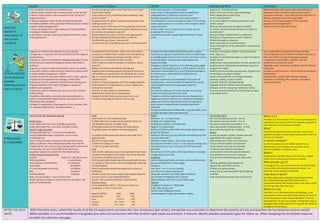
Health Food and nutrition WASH Shelter and NFIs Protection
ANALYSIS
(based on
information of
the current
situation)
Point mortality: # of death per catchment area
Is there a major problem with 1st aid provision to the injured?
Is there a major problem with evacuation of the injured and
pregnant women?
Is there an adequate health facility available dealing with
immediate problems of the population? (Personnel and medical
supplies, waste management?)
Is there any suspicion of a major epidemic of health problem
emerging or already present?
Is the disaster causing a major psychological trauma for a part
of the population?
Are all social groups able to meet their short-term food
consumption needs?
Is the problem due to insufficient food availability, food
access or both?
Do people have the ability to prepare meals (water, fuel,
cooking utensils, etc.)?
Estimate what % of HH require food assistance, what is the
level (shortfall in total food consumption requirements) and
the duration of assistance required?
Would assistance in cash or kind be most appropriate?
Should assistance be freely provided or linked to
conditionality (e.g. labour, training etc)?
Are there specific vulnerable groups and nutritional needs?
Is the water quantity < 15 lts/pers/day?
Water stress: Is the quantity of water available/pers
substantially less (< half) than normally used?
Are there any problems of access to water supplies?
Is it preferable to conduct emergency repair on the existing
water supply system or to construct new emergency water
supply system(s)?
Is there a high risk of contamination of water sources
and/people from faeces?
Are there constraints to good hygiene behaviour? Which
ones?
Settlement - Will affected HHs:
Return to the site of their original dwellings?
Settle independently within host
communities/families?
Be accommodated in temporary planned or self-
settled camps?
What are the options for emergency shelter?
Are there critical environmental factors to take into
consideration?
How can shelter materials best be mobilized?
Identify key infrastructure in need of repair to
facilitate emergency response.
What is the scale of the need for NFIs?
What is the capacity of the authorities or communities
to respond?
What immediate steps can be taken that will have an
important impact on addressing protection issues?
Compliance aptitude – how willing are the authorities to
address protection issues (including GBV)?
How can the coping strategies of the vulnerable
populations be strengthened?
What are the main security threats?
ACTION NEEDED
(think about the
possible
following actions
and prioritize)
Organise or reinforce immediately the mass casualty
management, in particular the first aid facility and the triage of
injured persons
Organise or reinforce immediately adequate evacuation facility
for the seriously injured and pregnant women with delivery
problems
Organise or reinforce health facility (which inputs are needed
as priority?) Is there a need to bring in additional medical staff?
Is medical waste management in place?
Evaluate the need to vaccinate children and/or adults urgently
(if epidemics are expected and coverage is below 80%)
Evaluate the need to establish an EWARN (Early Warning and
Response Network) with rapid investigation capacity (if
epidemics are expected)
Evaluate the need to establish basic psycho-social or mental
health services
Imposition, information, education and communication on
public or environmental health hazards and measures to be
observed by the population
Emergency replacement of key drugs for chronic diseases (HIV,
TB, diabetes, Hypertension, Thyroid problems,…)
Unconditional Food Transfers, either food commodities
provided on a blanket basis (General Food Distributions),
commodities targeted according to specific criteria /
locations; or as unconditional cash transfers.
Cash or food provided on the basis of training or labour
provision
Blanket nutritional interventions (e.g. blanket
Supplementary Feeding programmes) where nutritional
commodities are distributed to all individuals of a certain
age, in a certain area deemed to be facing or at risk of a
nutritional crisis.
Provision of food preparation and food storage materials.
Items required for preparing food, such as cooking sets,
cooking fuel and water.
Provision of information on entitlements,
Road/market infrastructure rehabilitation
Support to further food-security assessments, and
nutritional screening, surveillance and surveys.
Emergency (new/rehabilitated) drinking water supplies
measures are urgently required if less than 15 lts/pers/day
is available (particularly if environmental risk factors such as
dense population, contaminated water supply, poor
hygiene are high).
Emergency “shock” treatment of the drinking water supply
is required if the existing system is still functional, but has
likely been contaminated (as a result of physical damage to
its infrastructure, interrupted/intermittent service
provision, etc.).
HH water treatment is recommended if the quality of
drinking water is poor and most HH understand or can be
quickly taught how to use home water treatment
effectively.
The need for adequate HH water transport and storage
facilities should be assessed in all cases.
Emergency sanitation (particularly excreta disposal) and
hygiene promotion measures are required immediately if
people are settled in high density areas and exposed to
poor sanitary conditions and/or probable diarrhoeal
outbreaks.
Emergency distribution of WASH NFI is required when acute
shortage has been objectively observed.
Provision of emergency shelter material (tarpaulin,
tents, rope, etc.).
Provision of specialized emergency and/or transitional
shelter (tents).
Adapt shelter needs according to HH sizes, gender and
disability factors, taking into consideration long-term
displacement needs.
Mobilize service provision around public infrastructure
functioning as emergency shelter.
Source and provide NFI, according to priorities
(clothing, cooking, access to water).
Provision of fuel for cooking/heating.
Negotiate with the relevant actors on gaining
adequate land for emergency/ temporary shelter.
Provision of tools/materials for the emergency repair
of damaged homes.
Set up registration mechanisms for documenting
unaccompanied and lost children and basic measures to
take care of them during the emergency period.
If appropriate and possible, negotiate with the
authorities on protection issues.
Negotiate access to detention facilities with the relevant
authorities.
Consider protection issues in all conventional emergency
interventions.
If appropriate, consider GBV minimum package
(detection, counselling, PEP, antibiotic, emergency
contraception etc.)
THRESHOLDS
& STANDARDS
Cut-off values for emergency warning
Crude death rate: more than 1/10,000 people/day
Health status
Under fives death rate: more than 2/10,000 U5/day
Among stable pop: 0.5 – 1.0 new contacts/pers/yr
Health Facility Utilisation
Among displaced/refugee population: up to 4.0 new
contacts/pers/yr
After a natural disaster: contacts for first aid will be much
higher, a solid part of the affected population may visit the
established first aid centre or the surviving health facility in the
first few days. (Count on 20 to 50% of the catchment
population looking for contact with the health facility).
Activity Output of 1 pers/hr of work
Health Personnel Requirements
OPD consultation 6 consultations
OPD treatment (dressings etc) 6 treatments
Vaccination 30 children
U-5 clinic & growth monitoring 10 children
ANC 6 women
Assisted delivery 1 delivery
Note: one person/day = 7 hours of field work
Health workers emergency requirements for the above = 60
staff per 10,000 people.
Food
Total needs of 2,100 Kcal/person/day
A 100% daily ration (needs may be partial) consists of:
350-400 g/person/day of staple cereal
20-40 g/person/day of an energy rich food (oil/fat).
50 g/person/day of a protein rich food (legumes).
To supply 10,000 people with food for one week this is
approximately:
28.0 MT of staple cereal
2.8 MT of an energy rich food
3.5 MT of a protein rich food
Cash transfer necessary to purchase equivalent food ration
calculated according to local market costs (to be adjusted
on the basis of market price trends).
Cash
Cash for work rates should take into account both the local
casual labour rates and the cost of meeting basic needs (eg.
the food basket).
Work conditionality should not undermine recovery of
livelihoods
Workers should not have to travel unacceptable distances
to access work or cash / food distribution
Gender roles should be factored in appropriately.
Acute malnutrition (W/H < -2Z scores in under 5 yr
population: > 10% of under fives
Nutrition status
Based on NCHS) GAM SAM
Normal rate <5% <1%
Poor 5 to 9 % <2%
Serious 10 – 14 % >2%
Critical > or = 15 % >5%
Minimum 7.5 - 15 lts/pers/day
Water
drinking: 2.5-3 lts/pers/day
drinking and cooking: 3-6 lts/pers/day
hygiene: 2-6 lts/pers/day
No faecal Coliforms/100 ml (for non treated water supplies
at point of delivery)
Maximum 250 users per tap; 500 users per hand pump; 400
users per open well
Distance to water points < 500 m from housing
Queuing time at water source < 15 minutes (on average, but
not at peak times); max. 3 minutes to fill 20 lts at water
point/tap.
At least two 10-20 lts water collecting containers (+enough
storage capacity per HHs)
Latrine: ideally one/family, minimum one toilet/20 persons
(but up to 50 persons at initial stage)
Sanitation
Distances:
max. 50 m – min. 6 m from housing
min. 30 m from closest water point
Check soil conditions and water table level (pits)
Use of toilets arranged by HHs or gender
Refuse disposal: one communal pit/500 people
1 Hygiene Promoter for 500 people
Hygiene
Soap: 250g /pers/month
Laundry soap: 200g/pers/month
Sanitary hygienic supplies & washable nappies.
Min area available per person: 45 m2
Camps (Site Plans)
Min shelter space per person: 3.5 m2
Min distance between two shelters: 2 m
Open space/public facilities/roads: 15-20%
Favourable drainage & soil conditions.
Socially acceptable, durable, disaster safe and
upgradeable HH design/ materials.
Shelter:
Optimal thermal comfort and ventilation
Access to WASH facilities incorporated
Vector control measures incorporated
Locally sourced materials and labours
Local standard of workmanship & materials
Accountable procurement of resources
Limited environmental impact of settlements
Clothing, bedding and sleeping mats
NFI
Hygiene NFI (see WASH column)
Cooking and eating utensils
Stoves, fuel (15 kg firewood/hh/day) & lighting
materials
Tools and equipments (bed nets if necessary)
What is it?
The INAC is a “first contact” multi-sector tool designed to
contribute to the overall effort of immediate assessment
and response to a humanitarian disaster.
Why?
Few existing assessment tools have been successfully
applied to provide a needs-based analysis within the first
72 hours of a disaster.
In which contexts?
For the first assessment of sudden onset crises or
deterioration of protracted crises or where access
becomes available to complex crises.
When?
Usually within the first 3 days of the start of a sudden-
onset crisis or when access becomes available.
Who should use it?
It is designed as a common tool for the use of DG ECHO,
and any other interested humanitarian worker. No
particular sector expertise is required.
How does it work?
The INAC draws basic conclusions from first-hand key
data collected during rapid field assessments to
recommend priority life-saving actions to be taken within
the first few days after the crisis.
What it is not:
The INAC is not a full assessment methodology. It will
only provide a basic indication of the severity of the crisis
and of the priority actions to be undertaken in the first
day(s)/week(s). As soon as possible, it should give way to
expanded rapid needs assessments to guide the design of
emergency interventions.
AFTER THE FIELD
VISITS
With the entire team, collate the results of all the CA assessments and draw the main conclusions (per sector); extrapolate you conclusion to determine the severity of crisis and prioritize the humanitarian actions needed.
Where possible, it is recommended to triangulate your data and conclusions with that of other rapid needs assessments. If relevant, identify possible assessment gaps for follow up. When designing the immediate response
consider key advocacy messages.

Initial_Needs Assessment Checklist_2021-06-15-01-51-52-pm.pdf

  • 1.
    INITIAL NEEDS ASSESSMENTCHECKLIST (INAC) – Version 06/05/10 PRIOR TO THE FIELD VISIT: Clearly choose and identify (within the boundaries of the disaster stricken area) a few “Catchment’s Areas” (CA) which you plan to visit Collect basic existing baseline data/maps/etc. on these CA Verify security/weather/ transport conditions, access clearance and agree on trip itinerary to the CA Set up the assessment team and define individual roles/responsibilities with regard to data collection Verify if all team members are familiar with the tool and aware of the time constraints during the assessment (provide a short briefing if required) Agree on how the data collected from the different CA will be assembled into one report. Population Profile (of CA): Name of Catchment Area (CA) Original population? Influx/outflux into/out? Number of injured? Number of dead? Number of missing? Number of disabled (if available)? Children < 5 years (as % of pop) Sex ratio = # of females / # of men Any ethnicity/minority issues? Average household size? If possible, all population data to be disaggregated by sex Livelihoods (of CA): Which social groups are at risk/why? Main livelihood strategies? Impact of disaster on different livelihood assets and strategies? Loss of livelihood assets? Coping strategies adopted? Opportunities to recover or support appropriate coping strategies? Livelihood challenges relating to social difference (gender, disability, marginalised groups etc) Agricultural seasonality and climate patterns in the region Logistics (of CA): Local transport network and constraints? Nearest road; airport; seaport; rail station/customs procedures? Car, truck and air transport for hire/availability of warehouses? Electricity / communication infrastructure? Availability of emergency power generation? Availability of fuel? Local transport permits (for goods/persons)? Local topographic characteristics/constraints Local weather patterns/constraints Local procurement (shops open; markets functioning; availability of local construction material and other material and man power)? Options to relieve logistical constraints? Local logistics coordination / support mechanisms? Coordination: Local system of coordination Presence of local first responders? Presence of international partners in the field now? Safety and Security (of CA): Security threats/constraints/UN Security Phase? Safety issues? Threat of crime? Attitude of the local authorities? Use and nature of roadblocks? Constraints on humanitarian access? Humanitarian community targeted? Gender vulnerabilities and coping mechanisms as a result of disaster? Main sectors Health Food and nutrition WASH Shelter and NFIs Protection OBSERVE General impression of the affected population and health condition of the child population Visit the morgue, burial place, count the number of new graves Percentage damage to crops, livestock and other livelihood assets and markets General observations on HH consumption patterns and the nutritional status and trends of the affected population; identify specific vulnerable groups. Food diversity available in markets (staple food, vegetables/fruits, protein sources) Environmental health conditions: General conditions of drainage, waste water, solid waste and/or medical waste disposal systems; presence of vectors of diseases; evidence of hazardous environmental hygiene practices (open defecation, etc.) Vulnerability of water sources: Distance and topographical position in relation to potential contamination sources. Physical conditions of main water systems and excreta disposal facilities? Lines at water points? The magnitude of structural damage and estimate of area affected. Response of the population (congregating in public infrastructure, tents/tarpaulin, out in the open, with host families, etc.). Safe and accessible distribution NFI/food site (mainly to most vulnerable groups) Observe the relationship between the civilian population and the authorities. Frequency and nature of check-points and related constraints on movement. Are there children in the armed forces? KEY INFORMANTS Note name and contact (consult both men and women) Catchment area of assessment Number of deaths in this catchment area in the last 1, 2, 3 days (adults & children, by sex) Number of injured in this catchment area, which injuries? – How many injured to be evacuated? What first aid systems have already been set up? Any higher number than usual of the following symptoms: diarrhoea, high fever, coughing, skin problems, vomiting, loss of consciousness Any health posts or health clinics within walking distance? How can injured/sick people be evacuated? Are people at ease or afraid to go to health facilities? What percentage of crops, livestock and other livelihood assets / markets have been damaged or destroyed? Has the demand and/or wage rate for casual labour changed? Have food prices been affected (purchasing power of HHs)? Is there any evidence of reduced food consumption / hunger as a consequence of the shock? What is the nutritional status and trends of the affected population and specific vulnerable groups? What food assistance – both emergency and long-term in nature – is being provided and how reliable is this support? (include both food and cash assistance) What are the water sources /systems people rely on for drinking water? What is total quantity of drinking water available (m³/day)? In how much has the water supply system/source(s) been disrupted or damaged? What is the extent of the damage? Has the quality and/or quantity of the drinking water been affected? How? What kind of excreta disposal system(s) does the community rely on? How many excreta facilities is there? Are most of these facilities functional? What is the extent of the damage caused by the disaster to the excreta disposal system/facilities (if any)? Determine ratios (%) of intact, partially damaged or completely destroyed homes. Identify risk factors (rain, snow, extreme temperatures, topography, soil conditions, and drainage contamination). Damage to infrastructure (health structure, roads, bridges, culverts, schools, etc.) Public infrastructure (schools, stadiums) available for emergency shelter. What are the local construction styles and materials used (mud/thatch, masonry, reinforced concrete, timber, etc.)? Availability and sources of construction materials (government, commercial, HHs). Potential problems related to land use and ownership. Is family separation a problem – are there unaccompanied children or families reporting lost children? Are there efforts to register unaccompanied or lost children? Are there specific problems regarding violence? SGBV? Who are the perpetrators? What are the coping strategies of the communities and threatened groups? If a specific group is under threat from the authorities, what is the position of the community? Are there child headed HHs? Are children recruited into the armed forces? Do the children in the community attend school? Any form of child labour? Are there any landmine and UXO issues in the place of settlement or re-settlement? VISIT FACILITIES (health, WASH, schools, possible camp sites, and markets) Name and contact of the head of facility Type of health service provided (OPD/IPD/etc.) General condition of the health facility: adequate electricity, cold chain, water supply and (medical) waste disposal services? Number, gender, type and seniority of health personnel Number of injuries seen so far in last 1,2,3 days Number of patients (other than trauma) seen so far in last 1,2,3 days. Most frequent symptoms seen. Availability of medicines and equipment – any out of stocks of essential medicines? Availability of referral possibilities to more specialised health facility – how is it done? Any specific health problems in the area BEFORE the disaster? (Any nutritional problems?) Any suspicion of serious health threat SINCE the disaster? Is there provision for emergency evacuation for pregnant women presenting delivery problems? Are blood transfusions tested for HIV? Are any SGBV cases reported or suspected? Were food stocks in the markets damaged /destroyed/looted? Is market activity being re- established? Is access to markets disrupted – limiting the ability of purchasers to reach markets or sellers to restock? How have the prices of staple foods, fuel and livestock changed since the shock? Have school attendance rates been affected? Who manages the water system? Is water freely available (to all gender groups)? Per water system: System functions (Y/N); yield at source (lts/sec), physical state, contamination risks, treatment capacity, storage capacity (m³), water transport and/or distribution network capacity, HH/public connection, local capacity for emergency repair (skills/equipment)? Per facility for excreta disposal: Facility functions (Y/N); Type (public / private)? Number of users? Cleanliness? Presence of vectors? Safety? Distance to nearest drinking water source? Who is responsible for cleaning and maintenance? WASH conditions in Health/Cholera Treatment/Nutritional centres - Communal shelters - Markets – Schools. Where spontaneous emergency group shelters have been established (in schools, stadiums, open public areas etc.), discuss with community representatives: Number of people/families settled in the location. Access to health and WASH services, transportation infrastructure. Access to land and land tenure issues. Exposure to natural hazards Potential security threats Need for shelter materials and NFIs. Discuss with the authorities: Do the authorities recognize that there are protection issues? Is there a political commitment to protection? Are there detention centres in the vicinity and would humanitarian access be acceptable? If there are children in the armed forces, what is their position on this? Have schools been destroyed? Do children still have opportunities to go to school (access and provision of educational activities)? Is there any registration mechanism for protection related issues and assistance? HOUSEHOLDS (HHs) (time allowing; consult women, men, children) General state and condition of the HH. Number of death(s) in the HH during the last few days and cause(s). Any increase of sick HH members with specific symptoms such as: diarrhoea, high fever, coughing, skin problems, vomiting, unconsciousness? Do the health personnel treat all people equally? How has the shock affected the HH’s production and income (both agricultural and non agricultural production) Which coping mechanisms are HHs adopting to ensure basic food consumption (eg. are girls/women or elderly eating less food, what is the use of wild foods, reliance on remittances, migration, asset sales, etc.? How long will the HH food and fuel stocks last? Is assistance being provided and if so are there specific constraints facing certain groups in securing access? Principal source(s) of drinking/treated water? Other sources of untreated water? Volume (lts) of water used/pers/day? Is water treated at HH level? How? Distance to nearest water point? Volume and type of water containers at HH level (for transport and storage) and soap? Excreta disposal facility private or shared? Is it accessible to everyone in the HH? Hygiene practices: Evidence of hand washing practice and use of soap? Safe disposal of children faeces? Need for sanitary hygienic supplies? Risky cultural beliefs/customs? Number of children in HH with diarrhoea and/or skin and eye infection in the past 96 Hrs? Availability and access to: Clothing (reflect on the prevailing climatic conditions). Mats, blankets. WASH NFI (see WASH column) Cooking utensils (pots, pans, etc.). Cooking and heating fuel (which type of fuel?) Other NFI needs (bednets, etc.)? In general, following an acute crisis, during this first assessment, it may not be proper to interview HHs on protection issues, in particular if you are not familiar with the area and context. If there is a good understanding of the context, you can consider some indirect queries on protection issues. Are you facing any problems with the authorities or other groups? Is anyone missing from your family? Are your children safe – do you feel safe? Are your children going to school? Who in the HH collects water and/or firewood and where? How has the host community reacted to your arrival?
  • 2.
    Health Food andnutrition WASH Shelter and NFIs Protection ANALYSIS (based on information of the current situation) Point mortality: # of death per catchment area Is there a major problem with 1st aid provision to the injured? Is there a major problem with evacuation of the injured and pregnant women? Is there an adequate health facility available dealing with immediate problems of the population? (Personnel and medical supplies, waste management?) Is there any suspicion of a major epidemic of health problem emerging or already present? Is the disaster causing a major psychological trauma for a part of the population? Are all social groups able to meet their short-term food consumption needs? Is the problem due to insufficient food availability, food access or both? Do people have the ability to prepare meals (water, fuel, cooking utensils, etc.)? Estimate what % of HH require food assistance, what is the level (shortfall in total food consumption requirements) and the duration of assistance required? Would assistance in cash or kind be most appropriate? Should assistance be freely provided or linked to conditionality (e.g. labour, training etc)? Are there specific vulnerable groups and nutritional needs? Is the water quantity < 15 lts/pers/day? Water stress: Is the quantity of water available/pers substantially less (< half) than normally used? Are there any problems of access to water supplies? Is it preferable to conduct emergency repair on the existing water supply system or to construct new emergency water supply system(s)? Is there a high risk of contamination of water sources and/people from faeces? Are there constraints to good hygiene behaviour? Which ones? Settlement - Will affected HHs: Return to the site of their original dwellings? Settle independently within host communities/families? Be accommodated in temporary planned or self- settled camps? What are the options for emergency shelter? Are there critical environmental factors to take into consideration? How can shelter materials best be mobilized? Identify key infrastructure in need of repair to facilitate emergency response. What is the scale of the need for NFIs? What is the capacity of the authorities or communities to respond? What immediate steps can be taken that will have an important impact on addressing protection issues? Compliance aptitude – how willing are the authorities to address protection issues (including GBV)? How can the coping strategies of the vulnerable populations be strengthened? What are the main security threats? ACTION NEEDED (think about the possible following actions and prioritize) Organise or reinforce immediately the mass casualty management, in particular the first aid facility and the triage of injured persons Organise or reinforce immediately adequate evacuation facility for the seriously injured and pregnant women with delivery problems Organise or reinforce health facility (which inputs are needed as priority?) Is there a need to bring in additional medical staff? Is medical waste management in place? Evaluate the need to vaccinate children and/or adults urgently (if epidemics are expected and coverage is below 80%) Evaluate the need to establish an EWARN (Early Warning and Response Network) with rapid investigation capacity (if epidemics are expected) Evaluate the need to establish basic psycho-social or mental health services Imposition, information, education and communication on public or environmental health hazards and measures to be observed by the population Emergency replacement of key drugs for chronic diseases (HIV, TB, diabetes, Hypertension, Thyroid problems,…) Unconditional Food Transfers, either food commodities provided on a blanket basis (General Food Distributions), commodities targeted according to specific criteria / locations; or as unconditional cash transfers. Cash or food provided on the basis of training or labour provision Blanket nutritional interventions (e.g. blanket Supplementary Feeding programmes) where nutritional commodities are distributed to all individuals of a certain age, in a certain area deemed to be facing or at risk of a nutritional crisis. Provision of food preparation and food storage materials. Items required for preparing food, such as cooking sets, cooking fuel and water. Provision of information on entitlements, Road/market infrastructure rehabilitation Support to further food-security assessments, and nutritional screening, surveillance and surveys. Emergency (new/rehabilitated) drinking water supplies measures are urgently required if less than 15 lts/pers/day is available (particularly if environmental risk factors such as dense population, contaminated water supply, poor hygiene are high). Emergency “shock” treatment of the drinking water supply is required if the existing system is still functional, but has likely been contaminated (as a result of physical damage to its infrastructure, interrupted/intermittent service provision, etc.). HH water treatment is recommended if the quality of drinking water is poor and most HH understand or can be quickly taught how to use home water treatment effectively. The need for adequate HH water transport and storage facilities should be assessed in all cases. Emergency sanitation (particularly excreta disposal) and hygiene promotion measures are required immediately if people are settled in high density areas and exposed to poor sanitary conditions and/or probable diarrhoeal outbreaks. Emergency distribution of WASH NFI is required when acute shortage has been objectively observed. Provision of emergency shelter material (tarpaulin, tents, rope, etc.). Provision of specialized emergency and/or transitional shelter (tents). Adapt shelter needs according to HH sizes, gender and disability factors, taking into consideration long-term displacement needs. Mobilize service provision around public infrastructure functioning as emergency shelter. Source and provide NFI, according to priorities (clothing, cooking, access to water). Provision of fuel for cooking/heating. Negotiate with the relevant actors on gaining adequate land for emergency/ temporary shelter. Provision of tools/materials for the emergency repair of damaged homes. Set up registration mechanisms for documenting unaccompanied and lost children and basic measures to take care of them during the emergency period. If appropriate and possible, negotiate with the authorities on protection issues. Negotiate access to detention facilities with the relevant authorities. Consider protection issues in all conventional emergency interventions. If appropriate, consider GBV minimum package (detection, counselling, PEP, antibiotic, emergency contraception etc.) THRESHOLDS & STANDARDS Cut-off values for emergency warning Crude death rate: more than 1/10,000 people/day Health status Under fives death rate: more than 2/10,000 U5/day Among stable pop: 0.5 – 1.0 new contacts/pers/yr Health Facility Utilisation Among displaced/refugee population: up to 4.0 new contacts/pers/yr After a natural disaster: contacts for first aid will be much higher, a solid part of the affected population may visit the established first aid centre or the surviving health facility in the first few days. (Count on 20 to 50% of the catchment population looking for contact with the health facility). Activity Output of 1 pers/hr of work Health Personnel Requirements OPD consultation 6 consultations OPD treatment (dressings etc) 6 treatments Vaccination 30 children U-5 clinic & growth monitoring 10 children ANC 6 women Assisted delivery 1 delivery Note: one person/day = 7 hours of field work Health workers emergency requirements for the above = 60 staff per 10,000 people. Food Total needs of 2,100 Kcal/person/day A 100% daily ration (needs may be partial) consists of: 350-400 g/person/day of staple cereal 20-40 g/person/day of an energy rich food (oil/fat). 50 g/person/day of a protein rich food (legumes). To supply 10,000 people with food for one week this is approximately: 28.0 MT of staple cereal 2.8 MT of an energy rich food 3.5 MT of a protein rich food Cash transfer necessary to purchase equivalent food ration calculated according to local market costs (to be adjusted on the basis of market price trends). Cash Cash for work rates should take into account both the local casual labour rates and the cost of meeting basic needs (eg. the food basket). Work conditionality should not undermine recovery of livelihoods Workers should not have to travel unacceptable distances to access work or cash / food distribution Gender roles should be factored in appropriately. Acute malnutrition (W/H < -2Z scores in under 5 yr population: > 10% of under fives Nutrition status Based on NCHS) GAM SAM Normal rate <5% <1% Poor 5 to 9 % <2% Serious 10 – 14 % >2% Critical > or = 15 % >5% Minimum 7.5 - 15 lts/pers/day Water drinking: 2.5-3 lts/pers/day drinking and cooking: 3-6 lts/pers/day hygiene: 2-6 lts/pers/day No faecal Coliforms/100 ml (for non treated water supplies at point of delivery) Maximum 250 users per tap; 500 users per hand pump; 400 users per open well Distance to water points < 500 m from housing Queuing time at water source < 15 minutes (on average, but not at peak times); max. 3 minutes to fill 20 lts at water point/tap. At least two 10-20 lts water collecting containers (+enough storage capacity per HHs) Latrine: ideally one/family, minimum one toilet/20 persons (but up to 50 persons at initial stage) Sanitation Distances: max. 50 m – min. 6 m from housing min. 30 m from closest water point Check soil conditions and water table level (pits) Use of toilets arranged by HHs or gender Refuse disposal: one communal pit/500 people 1 Hygiene Promoter for 500 people Hygiene Soap: 250g /pers/month Laundry soap: 200g/pers/month Sanitary hygienic supplies & washable nappies. Min area available per person: 45 m2 Camps (Site Plans) Min shelter space per person: 3.5 m2 Min distance between two shelters: 2 m Open space/public facilities/roads: 15-20% Favourable drainage & soil conditions. Socially acceptable, durable, disaster safe and upgradeable HH design/ materials. Shelter: Optimal thermal comfort and ventilation Access to WASH facilities incorporated Vector control measures incorporated Locally sourced materials and labours Local standard of workmanship & materials Accountable procurement of resources Limited environmental impact of settlements Clothing, bedding and sleeping mats NFI Hygiene NFI (see WASH column) Cooking and eating utensils Stoves, fuel (15 kg firewood/hh/day) & lighting materials Tools and equipments (bed nets if necessary) What is it? The INAC is a “first contact” multi-sector tool designed to contribute to the overall effort of immediate assessment and response to a humanitarian disaster. Why? Few existing assessment tools have been successfully applied to provide a needs-based analysis within the first 72 hours of a disaster. In which contexts? For the first assessment of sudden onset crises or deterioration of protracted crises or where access becomes available to complex crises. When? Usually within the first 3 days of the start of a sudden- onset crisis or when access becomes available. Who should use it? It is designed as a common tool for the use of DG ECHO, and any other interested humanitarian worker. No particular sector expertise is required. How does it work? The INAC draws basic conclusions from first-hand key data collected during rapid field assessments to recommend priority life-saving actions to be taken within the first few days after the crisis. What it is not: The INAC is not a full assessment methodology. It will only provide a basic indication of the severity of the crisis and of the priority actions to be undertaken in the first day(s)/week(s). As soon as possible, it should give way to expanded rapid needs assessments to guide the design of emergency interventions. AFTER THE FIELD VISITS With the entire team, collate the results of all the CA assessments and draw the main conclusions (per sector); extrapolate you conclusion to determine the severity of crisis and prioritize the humanitarian actions needed. Where possible, it is recommended to triangulate your data and conclusions with that of other rapid needs assessments. If relevant, identify possible assessment gaps for follow up. When designing the immediate response consider key advocacy messages.