Introduction to PHP 
Initializing Arrays 
• No of ways to initialize the array. 
– For e.g. 
• $ncststaff[] = “amrish”; 
$ncststaff[] = “murali”; 
$ncststaff[] = “narayan”; 
• $ncststaff[123] = “amrish”; 
$ncststaff[122] = “murali”; 
$ncststaff[121] = “narayan”; 
• $ncststaff = array (“amrish”, “murali”, “narayan”); 
– to change the indices of the array use => operator. 
A. Chaubal 1
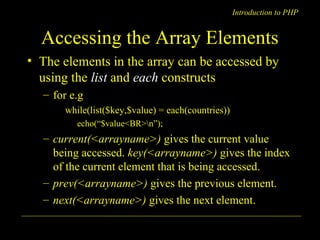
Introduction to PHP 
Accessing the Array Elements 
• The elements in the array can be accessed by 
using the list and each constructs 
– for e.g 
while(list($key,$value) = each(countries)) 
echo(“$value<BR>n”); 
– current(<arrayname>) gives the current value 
being accessed. key(<arrayname>) gives the index 
of the current element that is being accessed. 
– prev(<arrayname>) gives the previous element. 
– next(<arrayname>) gives the next element. 
A. Chaubal 2
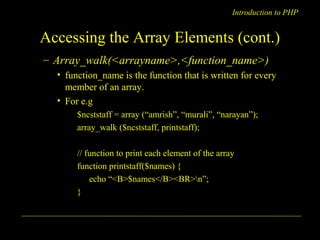
Introduction to PHP 
Accessing the Array Elements (cont.) 
– Array_walk(<arrayname>,<function_name>) 
• function_name is the function that is written for every 
member of an array. 
• For e.g 
$ncststaff = array (“amrish”, “murali”, “narayan”); 
array_walk ($ncststaff, printstaff); 
// function to print each element of the array 
function printstaff($names) { 
echo “<B>$names</B><BR>n”; 
} 
A. Chaubal 3
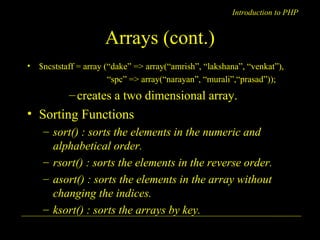
Introduction to PHP 
Arrays (cont.) 
• $ncststaff = array (“dake” => array(“amrish”, “lakshana”, “venkat”), 
“spc” => array(“narayan”, “murali”,“prasad”)); 
– creates a two dimensional array. 
• Sorting Functions 
– sort() : sorts the elements in the numeric and 
alphabetical order. 
– rsort() : sorts the elements in the reverse order. 
– asort() : sorts the elements in the array without 
changing the indices. 
– ksort() : sorts the arrays by key. 
A. Chaubal 4
Introduction to PHP 
Classes 
• Class is a template of an object and includes 
the properties and methods that describe an 
object and behavior. 
• Class in PHP is defined using class statement. 
A. Chaubal 5
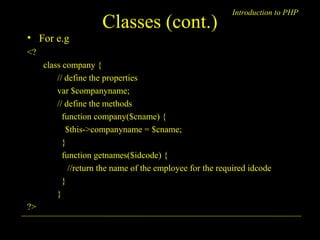
Introduction to PHP Classes (cont.) 
• For e.g 
<? 
class company { 
// define the properties 
var $companyname; 
// define the methods 
function company($cname) { 
$this->companyname = $cname; 
} 
function getnames($idcode) { 
//return the name of the employee for the required idcode 
} 
} 
?> 
A. Chaubal 6
Introduction to PHP 
PHP Richness 
• PHP comes with myriad of options i.e. 
supports several APIs and interfaces to other 
programming tools such as 
– Database connectivity. 
– LDAP 
– XML 
– Mail protocols such as IMAP, SMTP 
– Image functions 
etc…. 
A. Chaubal 7
Introduction to PHP 
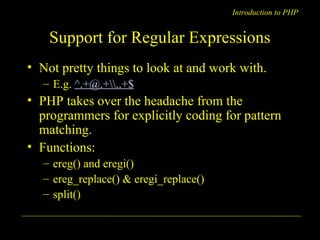
Support for Regular Expressions 
• Not pretty things to look at and work with. 
– E.g. ^.+@.+..+$ 
• PHP takes over the headache from the 
programmers for explicitly coding for pattern 
matching. 
• Functions: 
– ereg() and eregi() 
– ereg_replace() & eregi_replace() 
– split() 
A. Chaubal 8
Introduction to PHP 
Image Generation & Manipulation 
• PHP offers powerful set of functions for 
generating and manipulating the images. 
– Rendering regular geometric figures, modifying 
images 
– manipulate text, font and color and even the pixels 
in the image. 
• ….creating the images on the fly. 
A. Chaubal 9
Introduction to PHP 
Image Generation & Manipulation 
(cont.) 
• PHP uses the GD library for the most of the image 
functionality that it offers. 
• GD library is used for generating the two-dimensional 
graphics. 
• PHP API’s provides us with functions to: 
– Create, delete, resize and modify images. 
– Draw basic geometric figures 
– Manipulate text and fonts 
– Manipulate colors 
– Interlace and manipulate pixels 
– Handle PostScript files 
A. Chaubal 10
Introduction to PHP 
Mailing functions 
• Sending E-Mails 
– Mail() 
• Used to send simple text messages. 
• Depends on the local mail delivery system. 
– Using SMTP 
• Accepts the e-mail for every recipient and goes through trouble 
of delivering the e-mails. 
• Receiving E-Mails 
– PHP works out well with the IMAP protocol. 
– Rich set of support functions 
• Imap_open, impa_delete, imap_close, imap_mail_copy, 
imap_mail_move etc. 
A. Chaubal 11
Introduction to PHP 
PHP-Database Connectivity 
• Supports APIs for accessing large number of 
databases. 
• ODBC is a standard API for accessing a 
database that has PHP support. 
A. Chaubal 12
Introduction to PHP 
PHP-Database Connectivity 
• Some of Oracle 8.x functions. 
– OCILogon 
– OCILogoff 
– OCIParse 
– OCIFetch; OCIFetchInto; OCIFetchStatement 
– OCIExecute 
– OCIFreeStatement 
A. Chaubal 13
Introduction to PHP 
LDAP Support in PHP 
• PHP provides LDAP API’s that allows the 
programmers to create LDAP clients; by 
providing transparent access to backend LDAP 
directory servers. 
– For e.g. 
• Web based e-mail client. 
• Telephone Directory. 
A. Chaubal 14
Introduction to PHP 
XML Support in PHP 
• PHP supports a set of functions that can be 
used for writing PHP-based XML applications. 
• These functions are used for parsing well 
formed XML document. 
A. Chaubal 15
Introduction to PHP 
References 
• Professional PHP programming 
– By Jesus Castagnetto, Chris Schollo et al 
• www.phpbuilder.com 
• www.php.net 
A. Chaubal 16
Introduction to PHP 
THANK YOU 
A. Chaubal 17

Initializing arrays

  • 1.
    Introduction to PHP Initializing Arrays • No of ways to initialize the array. – For e.g. • $ncststaff[] = “amrish”; $ncststaff[] = “murali”; $ncststaff[] = “narayan”; • $ncststaff[123] = “amrish”; $ncststaff[122] = “murali”; $ncststaff[121] = “narayan”; • $ncststaff = array (“amrish”, “murali”, “narayan”); – to change the indices of the array use => operator. A. Chaubal 1
  • 2.
    Introduction to PHP Accessing the Array Elements • The elements in the array can be accessed by using the list and each constructs – for e.g while(list($key,$value) = each(countries)) echo(“$value<BR>n”); – current(<arrayname>) gives the current value being accessed. key(<arrayname>) gives the index of the current element that is being accessed. – prev(<arrayname>) gives the previous element. – next(<arrayname>) gives the next element. A. Chaubal 2
  • 3.
    Introduction to PHP Accessing the Array Elements (cont.) – Array_walk(<arrayname>,<function_name>) • function_name is the function that is written for every member of an array. • For e.g $ncststaff = array (“amrish”, “murali”, “narayan”); array_walk ($ncststaff, printstaff); // function to print each element of the array function printstaff($names) { echo “<B>$names</B><BR>n”; } A. Chaubal 3
  • 4.
    Introduction to PHP Arrays (cont.) • $ncststaff = array (“dake” => array(“amrish”, “lakshana”, “venkat”), “spc” => array(“narayan”, “murali”,“prasad”)); – creates a two dimensional array. • Sorting Functions – sort() : sorts the elements in the numeric and alphabetical order. – rsort() : sorts the elements in the reverse order. – asort() : sorts the elements in the array without changing the indices. – ksort() : sorts the arrays by key. A. Chaubal 4
  • 5.
    Introduction to PHP Classes • Class is a template of an object and includes the properties and methods that describe an object and behavior. • Class in PHP is defined using class statement. A. Chaubal 5
  • 6.
    Introduction to PHPClasses (cont.) • For e.g <? class company { // define the properties var $companyname; // define the methods function company($cname) { $this->companyname = $cname; } function getnames($idcode) { //return the name of the employee for the required idcode } } ?> A. Chaubal 6
  • 7.
    Introduction to PHP PHP Richness • PHP comes with myriad of options i.e. supports several APIs and interfaces to other programming tools such as – Database connectivity. – LDAP – XML – Mail protocols such as IMAP, SMTP – Image functions etc…. A. Chaubal 7
  • 8.
    Introduction to PHP Support for Regular Expressions • Not pretty things to look at and work with. – E.g. ^.+@.+..+$ • PHP takes over the headache from the programmers for explicitly coding for pattern matching. • Functions: – ereg() and eregi() – ereg_replace() & eregi_replace() – split() A. Chaubal 8
  • 9.
    Introduction to PHP Image Generation & Manipulation • PHP offers powerful set of functions for generating and manipulating the images. – Rendering regular geometric figures, modifying images – manipulate text, font and color and even the pixels in the image. • ….creating the images on the fly. A. Chaubal 9
  • 10.
    Introduction to PHP Image Generation & Manipulation (cont.) • PHP uses the GD library for the most of the image functionality that it offers. • GD library is used for generating the two-dimensional graphics. • PHP API’s provides us with functions to: – Create, delete, resize and modify images. – Draw basic geometric figures – Manipulate text and fonts – Manipulate colors – Interlace and manipulate pixels – Handle PostScript files A. Chaubal 10
  • 11.
    Introduction to PHP Mailing functions • Sending E-Mails – Mail() • Used to send simple text messages. • Depends on the local mail delivery system. – Using SMTP • Accepts the e-mail for every recipient and goes through trouble of delivering the e-mails. • Receiving E-Mails – PHP works out well with the IMAP protocol. – Rich set of support functions • Imap_open, impa_delete, imap_close, imap_mail_copy, imap_mail_move etc. A. Chaubal 11
  • 12.
    Introduction to PHP PHP-Database Connectivity • Supports APIs for accessing large number of databases. • ODBC is a standard API for accessing a database that has PHP support. A. Chaubal 12
  • 13.
    Introduction to PHP PHP-Database Connectivity • Some of Oracle 8.x functions. – OCILogon – OCILogoff – OCIParse – OCIFetch; OCIFetchInto; OCIFetchStatement – OCIExecute – OCIFreeStatement A. Chaubal 13
  • 14.
    Introduction to PHP LDAP Support in PHP • PHP provides LDAP API’s that allows the programmers to create LDAP clients; by providing transparent access to backend LDAP directory servers. – For e.g. • Web based e-mail client. • Telephone Directory. A. Chaubal 14
  • 15.
    Introduction to PHP XML Support in PHP • PHP supports a set of functions that can be used for writing PHP-based XML applications. • These functions are used for parsing well formed XML document. A. Chaubal 15
  • 16.
    Introduction to PHP References • Professional PHP programming – By Jesus Castagnetto, Chris Schollo et al • www.phpbuilder.com • www.php.net A. Chaubal 16
  • 17.
    Introduction to PHP THANK YOU A. Chaubal 17