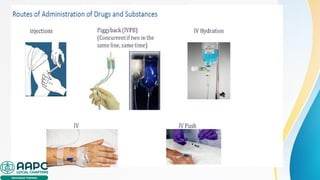
Infusion
Therapy
Coding
By
Ms. Maryam
Khan
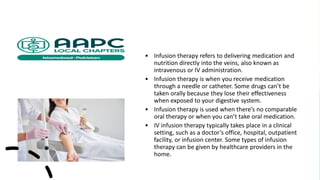
• Infusion therapy refers to delivering medication and
nutrition directly into the veins, also known as
intravenous or IV administration.
• Infusion therapy is when you receive medication
through a needle or catheter. Some drugs can’t be
taken orally because they lose their effectiveness
when exposed to your digestive system.
• Infusion therapy is used when there’s no comparable
oral therapy or when you can’t take oral medication.
• IV infusion therapy typically takes place in a clinical
setting, such as a doctor’s office, hospital, outpatient
facility, or infusion center. Some types of infusion
therapy can be given by healthcare providers in the
home.
GUIDELINES
Injection and infusion codes, including hydration and chemotherapy
administration are found in the CPT codebook beginning with code 96360
(hydration) and ending with code 96549 (unlisted chemotherapy procedure)
➢ Extensive instructional notes within this subsection to assist with
correct code assignment
➢Ensure to review theses notes as the section includes a list of items
essential for accurate coding including: Included components of an injection
or infusion service
• definitions of the various types of infusions
• Correct coding of multiple infusions
• Hierarchy rules
• Units of time instruction
➢Included components –not separately reported –Reference: CPT Assistant
• Intravenous (IV) start
• Access to indwelling IV, subcutaneous catheter, or port
• Flush at conclusion of infusion
• Standard tubing, syringes, and supplies, and preparation of
chemotherapy agents
• CPT Assistant, September 2007, Page 3
CMS VS CPT
GUIDELINES
• CMS instructs the Coders on Facility guidelines.
• The difference is that CPT guidance states that if a patient
receives services crossing over midnight during a single
encounter –multiple initial administrationcodes would apply.
• CMS states that only one initial service per encounter is
appropriate.
• Per Medicare Claims Processing Manual, Coding and Payment
for Drug Administrationstates that:
• Drug administration services are to be reported with a line-item
date of service on the day they are provided.
• In addition, only one initial drug administration service is to be
reported per vascular access site per encounter, including
during an encounter where observation services span more
than 1 calendar day.
• Although as noted, CPT has different guidance for facilities
reporting “initial” service., Medicare contractors are to
continue to follow the guidance provided by CMS
• https://www.cms.gov/regulations
B. Time Documented
• Time documentation is critical because it drives the assignment
and accuracy of the CPT coding of infusion services.
• Key Time ranges
o 15 minutes or less
• Infusions lasting 15 minutes or less would be coded as an IV push
o 16 minutes or more
• Infusion can be reported after 16 minutes
o 31 minutes to 1 hour
• Hydration infusion must be at least 31 minutes in length to bill the
service.
o 16-90 minutes versus more than 90 minutes
• 16-90 minutes represents the first hour of infusion services
• 91 minutes or more represents the subsequent hour of infusion,
in intervals greater than 30 minutes beyond 1-hour increments
o 30 minutes since last reported push
• Each additional sequential IVP of same drug/substance must not
be reported if within 30 minutes of each other.
Rules for Infusion Time
• Documentation of time is required to assign administration
services appropriately:
 ➢IVP < 15 minutes
• 30 minutes between IVP of same drug
 ➢Intravenous infusion
• >16 minutes
• 31 minutes to 1 hour
• > 90 minutes for additional IV
 ➢“Infusion time” is “the actual time over which the infusion is
administered”
 ➢START and STOP times for all drugs/substances are documented
as best practice
 ➢Pause times for drugs should be documented clearly so that the
Coder can calculate correctly.
 ➢Times documented when a medication is “paused” are added
together and coded based on total time; NOT per each start and
stop.
Terminology-
Definitions
• Injection -Delivers a dosage in one “shot,” rather than over a period
of time; may be administered by various routes, including
subcutaneous, intramuscular, intra-arterial, and intravenous
(medication that is given for an immediate effect (typically within 3-
5 minutes) is an injection)
 ➢Infusion –Administration of intravenous fluids and/or drugs over a
period of time for diagnostic or therapeutic purposes (medication or
solution that is provided through saline or other solutions given over
a period of time –usually 30 minutes or more –is an infusion)
 ➢Push –A therapeutic and non-therapeutic infusion administered
over a period of 15 minutes or less
 ➢Initial –First drug given in an infusion setting (based on hierarchy)
 ➢Concurrent –A drug given at the same time as another drug
 ➢Sequential –A new drug given before or after the initial drug
 ➢Additional -Same drug, more time
 ➢Hydration -Typically, an administration of prepackaged fluids
and/or electrolytes without drugs.Examples include normal saline
(NS), sodium chloride (NaCl), dextrose 5 percent in water (D5W),
dextrose in ½ normal saline (D5 ½ saline), dextrose in ½ normal
saline plus potassium (D5 ½ NS+K).
Infusion
Services
Coding
Hierarchy
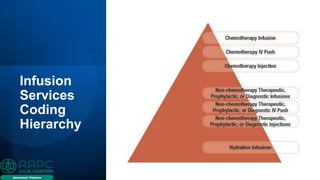
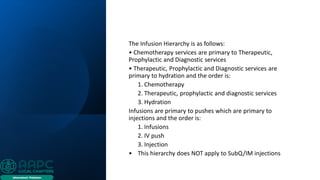
The Infusion Hierarchy is as follows:
• Chemotherapy services are primary to Therapeutic,
Prophylactic and Diagnostic services
• Therapeutic, Prophylactic and Diagnostic services are
primary to hydration and the order is:
1. Chemotherapy
2. Therapeutic, prophylactic and diagnostic services
3. Hydration
Infusions are primary to pushes which are primary to
injections and the order is:
1. Infusions
2. IV push
3. Injection
• This hierarchy does NOT apply to SubQ/IM injections
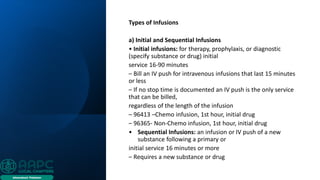
Types of Infusions
a) Initial and Sequential Infusions
• Initial infusions: for therapy, prophylaxis, or diagnostic
(specify substance or drug) initial
service 16-90 minutes
– Bill an IV push for intravenous infusions that last 15 minutes
or less
– If no stop time is documented an IV push is the only service
that can be billed,
regardless of the length of the infusion
– 96413 –Chemo infusion, 1st hour, initial drug
– 96365- Non-Chemo infusion, 1st hour, initial drug
• Sequential Infusions: an infusion or IV push of a new
substance following a primary or
initial service 16 minutes or more
– Requires a new substance or drug
• Chemotherapy administration of non-radionuclide
antineoplastic drugs, antineoplastic agents, monoclonal
antibody agents for non-cancer diagnosis, such as
rheumatologic disorders, and other biologic response
modifiers require physician and/or professional clinical
staff monitoring because of potential for severe adverse
patient reaction. Assign the appropriate code from CPT
codes 96401-96549.
Note: The administration of an antineoplastic drug, non-
radionuclide anti-neoplastic drug, antineoplastic agent or
certain monoclonal antibodies is coded as a chemotherapy
infusion procedure.
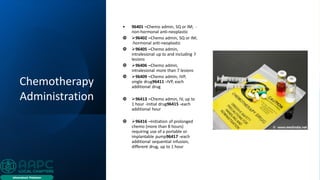
Chemotherapy
Administration
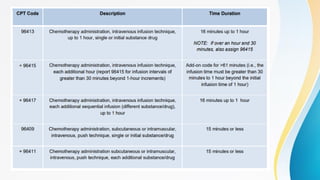
• 96401 –Chemo admin, SQ or IM; -
non-hormonal anti-neoplastic
 ➢96402 –Chemo admin, SQ or IM;
-hormonal anti-neoplastic
 ➢96405 –Chemo admin,
intralesional up to and including 7
lesions
 ➢96406 –Chemo admin,
intralesional more than 7 lesions
 ➢96409 –Chemo admin, IVP,
single drug96411 -IVP, each
additional drug
 ➢96413 –Chemo admin, IV, up to
1 hour -initial drug96415 -each
additional hour
 ➢96416 –Initiation of prolonged
chemo (more than 8 hours)
requiring use of a portable or
implantable pump96417 -each
additional sequential infusion,
different drug, up to 1 hour
Intra-Arterial
Chemotherapy
Administration
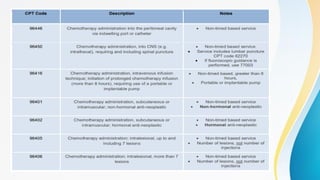
❑ 96420 –Chemo admin, intra-arterial; push technique
❑ 96422 –Chemo admin, intra-arterial; infusion
technique96423 –each additional hour
❑ To report regional intra-arterial chemotherapy
perfusion via membrane oxygenator perfusion pump
to an extremity use CPT 36823
❑ 96425 -intra-arterial infusion technique, initiation of
prolonged infusion (more than 8 hours), requiring the
use of a portable or implantable pump
❑ To report refilling and maintenance of a portable
pump or an implantable infusion pump or reservoir for
drug
Other
Chemotherapy
Injections and
Infusions
• 96440 –Chemo admin into pleural cavity
• 96446 –Chemo admin into peritoneal cavity
• 96450 –Chemo admin into CNS (intrathecal)
• 96542 -Chemo injection, subarachnoid or intraventricular
via SQ reservoir
• 96549-Unlisted chemotherapy procedure
Important Notes:
• CPT codes identify “highly complex drugs and biologic
agents” –which include antineoplastics, Biological
response modifiers, and monoclonal antibodies.
• High-risk medications requiring close monitoring and
observation and additional staff training
• The preparation of the agents is included in the CPT codes
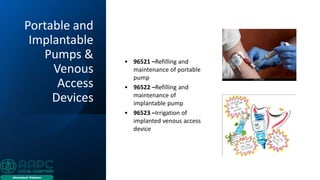
Portable and
Implantable
Pumps &
Venous
Access
Devices
• 96521 –Refilling and
maintenance of portable
pump
• 96522 –Refilling and
maintenance of
implantable pump
• 96523 –Irrigation of
implanted venous access
device
Code it !
Patient presents for chemo Treatment, IV started in LT arm per documentation
IV antiemetic Drug X
starts 14:50/ends15:25 (35 minutes)
IV Chemo Drug A same site
starts 15:30/ends 16:45 (75 minutes)
B12 injection IM -RT Hip
Answer:
▪ 96413 (Chemo Drug A)
▪ 96367 (Antiemetic Drug X)
▪ 96372 (B12 Injection-IM)
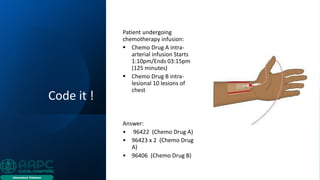
Code it !
Patient undergoing
chemotherapy infusion:
▪ Chemo Drug A intra-
arterial infusion Starts
1:10pm/Ends 03:15pm
(125 minutes)
▪ Chemo Drug B intra-
lesional 10 lesions of
chest
Answer:
• 96422 (Chemo Drug A)
• 96423 x 2 (Chemo Drug
A)
• 96406 (Chemo Drug B)
Code it !
Chemo Drug X (IV
infusion)Starts 10:00am/Ends
12:00pm (120 minutes)
Therapeutic Drug A (IVPB) Same
line Starts 10:30am/Ends
11:30am (60 minutes)
Prophylactics Drug 1 and 2
mixed and infused prior to
Chemo –same line Starts
8:55am/Ends 9:55am
Answers:
• 96413 x 1 (Chemo Drug X)
• 96415 x 1 (Chemo Drug X)
• 96367 x 1 (Prophylactics
Drug 1 & 2)
• 96368 x 1 (Concurrent
Infusion-Therapeutic Drug
A)
Initial Service
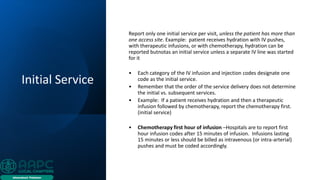
Report only one initial service per visit, unless the patient has more than
one access site. Example: patient receives hydration with IV pushes,
with therapeutic infusions, or with chemotherapy, hydration can be
reported butnotas an initial service unless a separate IV line was started
for it
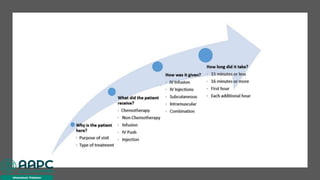
• Each category of the IV infusion and injection codes designate one
code as the initial service.
• Remember that the order of the service delivery does not determine
the initial vs. subsequent services.
• Example: If a patient receives hydration and then a therapeutic
infusion followed by chemotherapy, report the chemotherapy first.
(initial service)
• Chemotherapy first hour of infusion –Hospitals are to report first
hour infusion codes after 15 minutes of infusion. Infusions lasting
15 minutes or less should be billed as intravenous (or intra-arterial)
pushes and must be coded accordingly.
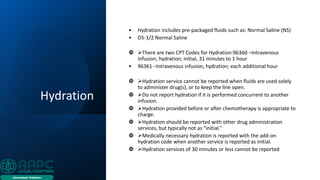
Hydration
• Hydration includes pre-packaged fluids such as: Normal Saline (NS)
• D5-1/2 Normal Saline
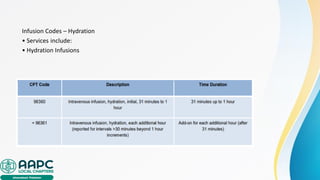
 ➢There are two CPT Codes for Hydration:96360 –Intravenous
infusion, hydration; initial, 31 minutes to 1 hour
• 96361 –Intravenous infusion, hydration; each additional hour
 ➢Hydration service cannot be reported when fluids are used solely
to administer drug(s), or to keep the line open.
 ➢Do not report hydration if it is performed concurrent to another
infusion.
 ➢Hydration provided before or after chemotherapy is appropriate to
charge.
 ➢Hydration should be reported with other drug administration
services, but typically not as “initial.”
 ➢Medically necessary hydration is reported with the add-on
hydration code when another service is reported as initial.
 ➢Hydration services of 30 minutes or less cannot be reported
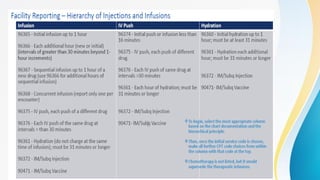
Infusion Codes – Hydration
• Services include:
• Hydration Infusions
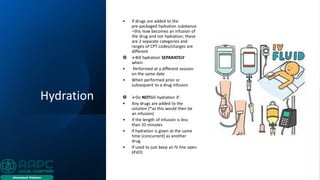
Hydration
• If drugs are added to the
pre‐packaged hydration substance
–this now becomes an infusion of
the drug and not hydration; these
are 2 separate categories and
ranges of CPT codes/charges are
different
 ➢Bill hydration SEPARATELY
when:
• Performed at a different session
on the same date
• When performed prior or
subsequent to a drug infusion
 ➢Do NOTbill hydration if:
• Any drugs are added to the
solution (*as this would then be
an infusion)
• If the length of infusion is less
than 31 minutes
• If hydration is given at the same
time (concurrent) as another
drug.
• If used to just keep an IV line open
(KVO)
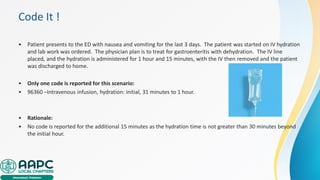
Code It !
• Patient presents to the ED with nausea and vomiting for the last 3 days. The patient was started on IV hydration
and lab work was ordered. The physician plan is to treat for gastroenteritis with dehydration. The IV line
placed, and the hydration is administered for 1 hour and 15 minutes, with the IV then removed and the patient
was discharged to home.
• Only one code is reported for this scenario:
• 96360 –Intravenous infusion, hydration: initial, 31 minutes to 1 hour.
• Rationale:
• No code is reported for the additional 15 minutes as the hydration time is not greater than 30 minutes beyond
the initial hour.
Code It !
• Patient arrives in the ED with nausea and vomiting for the past 2 days. The physician orders lab and starts an IV
for hydration. The patient is diagnosed with viral gastroenteritis and dehydration. The patient was discharged
home after the hydration was completed.
• Hydration started at 03:39 and stopped at 05:30 (101 minutes)
 ➢Two codes are reported:
• 96360 -Intravenous infusion, hydration: initial, 31 minutes to 1 hour.
• 96361 x 1 –each additional hour (list separately in addition to code for primary procedure)
• Rationale:
• use 96361 in conjunction with 96360report 96361 for hydration infusion intervals of greater than 30 minutes
beyond 1-hour increments
• https://jerseyshoreivhydration.com/how
Therapeutic
Intravenous
Push (IVP)
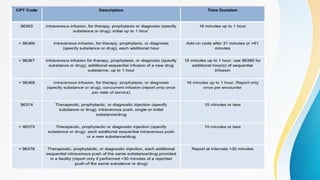
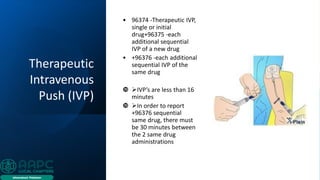
• 96374 -Therapeutic IVP,
single or initial
drug+96375 -each
additional sequential
IVP of a new drug
• +96376 -each additional
sequential IVP of the
same drug
 ➢IVP’s are less than 16
minutes
 ➢In order to report
+96376 sequential
same drug, there must
be 30 minutes between
the 2 same drug
administrations
Therapeutic
Infusions
Therapeutic infusions
(chemotherapy and non-
chemotherapy) have their own
set of coding rules:
• The initial hour of infusion
is 16 minutes to 1 hour
• Add-on codes are reported
for intervals greater than 30
minutes beyond the 1-hour
increments. (90 minutes)
• Time documentation is
critical since separate codes
exist for initial, sequential,
and concurrent infusions
• Remember-an infusion of
15 minutes or less is
reported with an IV push
code.
Concurrent
Infusions
Codes for concurrent infusions are add-on codes that denote multiple
infusions running simultaneously through the same line at the same
time
➢ CPT doesn’t include a code for concurrent administration of
chemotherapy. If a patient receives concurrent chemotherapy
infusions, coders should report the unlisted chemotherapy
administration code 96549.
➢ CPT doesn’t include concurrent codes for hydration, and facilities
don’t receive separate payment for concurrent hydration.
➢ Substances mixed together in one bag are considered one infusion—
not concurrent
➢ Coders can assign the concurrent code when a patient receives
chemotherapy and a therapeutic infusion running at the same time
via the same IV line
➢ Concurrent is also reported when the patient is receiving two
different non-chemotherapy drugs at the same time.
➢ Concurrent infusions can only be reported once per encounter.
Therapeutic, Prophylactic, Diagnostic (TPD)
• 96365 –Intravenous infusion , for therapy, prophylaxis, or diagnosis; initial, up to 1 hour96366 –each additional
hour
• 96367 –additional sequential infusion of a new drug, up to 1 hour
• 96368 –concurrent infusion
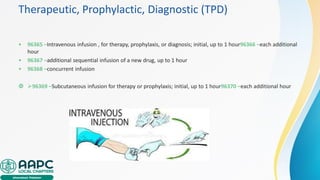
 ➢96369 –Subcutaneous infusion for therapy or prophylaxis; initial, up to 1 hour96370 –each additional hour
Subsequent and Sequential Infusions
The codes for subsequent and sequential infusions are add-on codes. Think of these infusions as one after another
or an infusion that comes before or after the initial drug
➢Sequential infusions denote the administration of a new drug or substance.
➢Chemotherapy Subsequent Infusion Hours ‐ Hospitals are to report additional hours of infusion (e.g., 96413,
96417), either a continuing infusion of the same substance or drug or a sequential infusion of a different substance
or drug, beyond the first hour, and only after more than 30 minutes have passed from the end of the previously
billed hour. Therefore, to bill an additional hour of infusion after the first hour, more than 90 minutes of infusion
services must be provided. One unit of the appropriate code is to be reported for each additional hour of infusion.
➢Coders can report sequential infusion codes for additional different drugs that are given therapeutic, prophylactic,
and diagnostic . But if the same drug is given multiple times, then use 96366, the additional hours code associated
with the sequential therapeutic infusion. The additional hours code 96366 is now used to report multiple services,
including the following:
• Additional hours of the initial service infusion
• Additional hours of a sequential infusion, which means additional hours of an infusion of a new drug
• Additional infusions of the same substance or drug
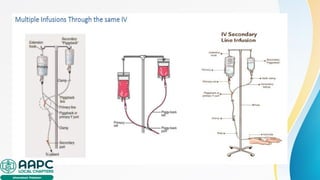
Multiple Infusions
Multiple infusions of different substances or drugs can be reported separately.
• Multiple drugs administered on the same date of service: assign only one initial service code if the medications
are given at the same IV site.
• When a subsequent or concurrent injection or infusion is administered:
• a subsequent or concurrent code is reported.
❖Example: If a patient receives an IV push following an initial one-hour infusion, the IV push is reported as a
subsequent service.
• If multiple medications are mixed in the same bag –there will be only 1 administration charge.
• The initial code is selected based on the hierarchy: Initial infusion reported followed by any subsequent
infusions based on the individual times of the infusions using the appropriate add-on code
Therapeutic, Prophylactic, Diagnostic (TPD)
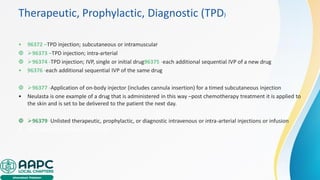
• 96372 –TPD injection; subcutaneous or intramuscular
 ➢96373 –TPD injection; intra-arterial
 ➢96374 -TPD injection; IVP, single or initial drug96375 -each additional sequential IVP of a new drug
• 96376 -each additional sequential IVP of the same drug
 ➢96377 -Application of on-body injector (includes cannula insertion) for a timed subcutaneous injection
• Neulasta is one example of a drug that is administered in this way –post chemotherapy treatment it is applied to
the skin and is set to be delivered to the patient the next day.
 ➢96379–Unlisted therapeutic, prophylactic, or diagnostic intravenous or intra-arterial injections or infusion
• CPT Assistant October 2016, Page 9
Code It !
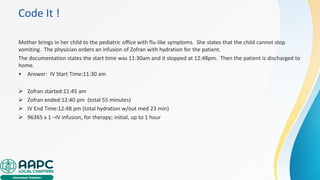
Mother brings in her child to the pediatric office with flu-like symptoms. She states that the child cannot stop
vomiting. The physician orders an infusion of Zofran with hydration for the patient.
The documentation states the start time was 11:30am and it stopped at 12:48pm. Then the patient is discharged to
home.
• Answer: IV Start Time:11:30 am
➢ Zofran started:11:45 am
➢ Zofran ended:12:40 pm (total 55 minutes)
➢ IV End Time:12:48 pm (total hydration w/out med 23 min)
➢ 96365 x 1 –IV infusion, for therapy; initial, up to 1 hour
Code It !
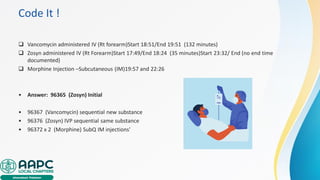
❑ Vancomycin administered IV (Rt forearm)Start 18:51/End 19:51 (132 minutes)
❑ Zosyn administered IV (Rt Forearm)Start 17:49/End 18:24 (35 minutes)Start 23:32/ End (no end time
documented)
❑ Morphine Injection –Subcutaneous (IM)19:57 and 22:26
• Answer: 96365 (Zosyn) Initial
• 96367 (Vancomycin) sequential new substance
• 96376 (Zosyn) IVP sequential same substance
• 96372 x 2 (Morphine) SubQ IM injections'
Code It !
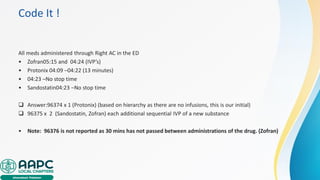
All meds administered through Right AC in the ED
• Zofran05:15 and 04:24 (IVP’s)
• Protonix 04:09 –04:22 (13 minutes)
• 04:23 –No stop time
• Sandostatin04:23 –No stop time
❑ Answer:96374 x 1 (Protonix) (based on hierarchy as there are no infusions, this is our initial)
❑ 96375 x 2 (Sandostatin, Zofran) each additional sequential IVP of a new substance
• Note: 96376 is not reported as 30 mins has not passed between administrations of the drug. (Zofran)
Code It !
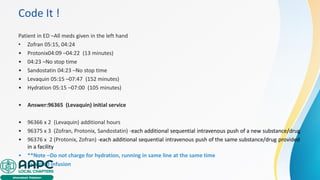
Patient in ED –All meds given in the left hand
• Zofran 05:15, 04:24
• Protonix04:09 –04:22 (13 minutes)
• 04:23 –No stop time
• Sandostatin 04:23 –No stop time
• Levaquin 05:15 –07:47 (152 minutes)
• Hydration 05:15 –07:00 (105 minutes)
• Answer:96365 (Levaquin) initial service
• 96366 x 2 (Levaquin) additional hours
• 96375 x 3 (Zofran, Protonix, Sandostatin) -each additional sequential intravenous push of a new substance/drug
• 96376 x 2 (Protonix, Zofran) -each additional sequential intravenous push of the same substance/drug provided
in a facility
• **Note –Do not charge for hydration, running in same line at the same time
• as a med infusion
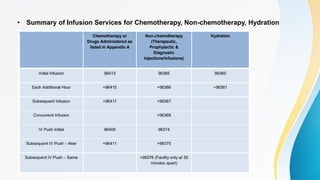
• Summary of Infusion Services for Chemotherapy, Non-chemotherapy, Hydration
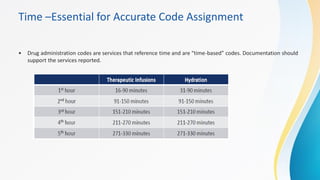
Time –Essential for Accurate Code Assignment
• Drug administration codes are services that reference time and are “time-based” codes. Documentation should
support the services reported.
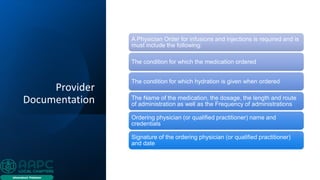
Provider
Documentation
A Physician Order for infusions and injections is required and is
must include the following:
The condition for which the medication ordered
The condition for which hydration is given when ordered
The Name of the medication, the dosage, the length and route
of administration as well as the Frequency of administrations
Ordering physician (or qualified practitioner) name and
credentials
Signature of the ordering physician (or qualified practitioner)
and date
Nursing
Documentation
Nursing documentation
should include the
following:
• Route of administration
• Separate Access Sites
identified
• Correct Dosage of the
medication
• Wasted amount from
single dose vials (if
applicable)
• Start and Stop Times
!!!!!
• Time and site of
Injections administered
Test Your Knowledge
A 40 year-old female presents to the ED with nausea and
vomiting for 15 hours. Patient is given an IV Infusion of D5W
for 4 hours and two IV pushes of Phenergan. The patient is
diagnosed with gastroenteritis and
dehydration.
Initial IV Push x 1: 96374 – Therapeutic, prophylactic, or
diagnostic injection; intravenous push, single or initial
substance/drug.
Additional IV Push x 1: 96376 - Therapeutic, prophylactic, or
diagnostic injection; each additional sequential intravenous
push of the same substance/drug provided in a facility
Hydration x 4: 96361 – Intravenous infusion, hydration; each
additional
hour
Test Your
Knowledge
A 52 year old male presents to the ED with bilateral flank
pain, nausea and vomiting. The patient has an IV started with
Ringers Lactate, an IV push of Phenergan and
Hydromorphone. The patient has a CT Scan with an IV push
of contrast and is diagnosed with bilateral pyelonephritis. IV
Rocephin is infused for 45 minutes at 10am and again at
10pm. How is this coded?
IV Rocephin is infused for 45 minutes at 10am and again at
10pm.
Initial IV Infusion x 1: 96365 – Intravenous infusion, for
therapy, prophylaxis or diagnosis (specify substance or
drug); initial, up to 1 hour
Additional IV Infusion x 1: 96366 – Intravenous infusion, for
therapy, prophylaxis or diagnosis (specify substance or
drug); each additional hour (List separately in addition to
code for primary procedure)
THANK YOU

Infusion_therapy_Coding_by_Ms_Maryam_khan_AAPC_International_local.pdf

  • 1.
  • 2.
    • Infusion therapyrefers to delivering medication and nutrition directly into the veins, also known as intravenous or IV administration. • Infusion therapy is when you receive medication through a needle or catheter. Some drugs can’t be taken orally because they lose their effectiveness when exposed to your digestive system. • Infusion therapy is used when there’s no comparable oral therapy or when you can’t take oral medication. • IV infusion therapy typically takes place in a clinical setting, such as a doctor’s office, hospital, outpatient facility, or infusion center. Some types of infusion therapy can be given by healthcare providers in the home.
  • 3.
    GUIDELINES Injection and infusioncodes, including hydration and chemotherapy administration are found in the CPT codebook beginning with code 96360 (hydration) and ending with code 96549 (unlisted chemotherapy procedure) ➢ Extensive instructional notes within this subsection to assist with correct code assignment ➢Ensure to review theses notes as the section includes a list of items essential for accurate coding including: Included components of an injection or infusion service • definitions of the various types of infusions • Correct coding of multiple infusions • Hierarchy rules • Units of time instruction ➢Included components –not separately reported –Reference: CPT Assistant • Intravenous (IV) start • Access to indwelling IV, subcutaneous catheter, or port • Flush at conclusion of infusion • Standard tubing, syringes, and supplies, and preparation of chemotherapy agents • CPT Assistant, September 2007, Page 3
  • 4.
    CMS VS CPT GUIDELINES •CMS instructs the Coders on Facility guidelines. • The difference is that CPT guidance states that if a patient receives services crossing over midnight during a single encounter –multiple initial administrationcodes would apply. • CMS states that only one initial service per encounter is appropriate. • Per Medicare Claims Processing Manual, Coding and Payment for Drug Administrationstates that: • Drug administration services are to be reported with a line-item date of service on the day they are provided. • In addition, only one initial drug administration service is to be reported per vascular access site per encounter, including during an encounter where observation services span more than 1 calendar day. • Although as noted, CPT has different guidance for facilities reporting “initial” service., Medicare contractors are to continue to follow the guidance provided by CMS • https://www.cms.gov/regulations
  • 5.
    B. Time Documented •Time documentation is critical because it drives the assignment and accuracy of the CPT coding of infusion services. • Key Time ranges o 15 minutes or less • Infusions lasting 15 minutes or less would be coded as an IV push o 16 minutes or more • Infusion can be reported after 16 minutes o 31 minutes to 1 hour • Hydration infusion must be at least 31 minutes in length to bill the service. o 16-90 minutes versus more than 90 minutes • 16-90 minutes represents the first hour of infusion services • 91 minutes or more represents the subsequent hour of infusion, in intervals greater than 30 minutes beyond 1-hour increments o 30 minutes since last reported push • Each additional sequential IVP of same drug/substance must not be reported if within 30 minutes of each other.
  • 6.
    Rules for InfusionTime • Documentation of time is required to assign administration services appropriately:  ➢IVP < 15 minutes • 30 minutes between IVP of same drug  ➢Intravenous infusion • >16 minutes • 31 minutes to 1 hour • > 90 minutes for additional IV  ➢“Infusion time” is “the actual time over which the infusion is administered”  ➢START and STOP times for all drugs/substances are documented as best practice  ➢Pause times for drugs should be documented clearly so that the Coder can calculate correctly.  ➢Times documented when a medication is “paused” are added together and coded based on total time; NOT per each start and stop.
  • 7.
    Terminology- Definitions • Injection -Deliversa dosage in one “shot,” rather than over a period of time; may be administered by various routes, including subcutaneous, intramuscular, intra-arterial, and intravenous (medication that is given for an immediate effect (typically within 3- 5 minutes) is an injection)  ➢Infusion –Administration of intravenous fluids and/or drugs over a period of time for diagnostic or therapeutic purposes (medication or solution that is provided through saline or other solutions given over a period of time –usually 30 minutes or more –is an infusion)  ➢Push –A therapeutic and non-therapeutic infusion administered over a period of 15 minutes or less  ➢Initial –First drug given in an infusion setting (based on hierarchy)  ➢Concurrent –A drug given at the same time as another drug  ➢Sequential –A new drug given before or after the initial drug  ➢Additional -Same drug, more time  ➢Hydration -Typically, an administration of prepackaged fluids and/or electrolytes without drugs.Examples include normal saline (NS), sodium chloride (NaCl), dextrose 5 percent in water (D5W), dextrose in ½ normal saline (D5 ½ saline), dextrose in ½ normal saline plus potassium (D5 ½ NS+K).
  • 8.
  • 11.
    The Infusion Hierarchyis as follows: • Chemotherapy services are primary to Therapeutic, Prophylactic and Diagnostic services • Therapeutic, Prophylactic and Diagnostic services are primary to hydration and the order is: 1. Chemotherapy 2. Therapeutic, prophylactic and diagnostic services 3. Hydration Infusions are primary to pushes which are primary to injections and the order is: 1. Infusions 2. IV push 3. Injection • This hierarchy does NOT apply to SubQ/IM injections
  • 13.
    Types of Infusions a)Initial and Sequential Infusions • Initial infusions: for therapy, prophylaxis, or diagnostic (specify substance or drug) initial service 16-90 minutes – Bill an IV push for intravenous infusions that last 15 minutes or less – If no stop time is documented an IV push is the only service that can be billed, regardless of the length of the infusion – 96413 –Chemo infusion, 1st hour, initial drug – 96365- Non-Chemo infusion, 1st hour, initial drug • Sequential Infusions: an infusion or IV push of a new substance following a primary or initial service 16 minutes or more – Requires a new substance or drug
  • 14.
    • Chemotherapy administrationof non-radionuclide antineoplastic drugs, antineoplastic agents, monoclonal antibody agents for non-cancer diagnosis, such as rheumatologic disorders, and other biologic response modifiers require physician and/or professional clinical staff monitoring because of potential for severe adverse patient reaction. Assign the appropriate code from CPT codes 96401-96549. Note: The administration of an antineoplastic drug, non- radionuclide anti-neoplastic drug, antineoplastic agent or certain monoclonal antibodies is coded as a chemotherapy infusion procedure.
  • 15.
    Chemotherapy Administration • 96401 –Chemoadmin, SQ or IM; - non-hormonal anti-neoplastic  ➢96402 –Chemo admin, SQ or IM; -hormonal anti-neoplastic  ➢96405 –Chemo admin, intralesional up to and including 7 lesions  ➢96406 –Chemo admin, intralesional more than 7 lesions  ➢96409 –Chemo admin, IVP, single drug96411 -IVP, each additional drug  ➢96413 –Chemo admin, IV, up to 1 hour -initial drug96415 -each additional hour  ➢96416 –Initiation of prolonged chemo (more than 8 hours) requiring use of a portable or implantable pump96417 -each additional sequential infusion, different drug, up to 1 hour
  • 16.
    Intra-Arterial Chemotherapy Administration ❑ 96420 –Chemoadmin, intra-arterial; push technique ❑ 96422 –Chemo admin, intra-arterial; infusion technique96423 –each additional hour ❑ To report regional intra-arterial chemotherapy perfusion via membrane oxygenator perfusion pump to an extremity use CPT 36823 ❑ 96425 -intra-arterial infusion technique, initiation of prolonged infusion (more than 8 hours), requiring the use of a portable or implantable pump ❑ To report refilling and maintenance of a portable pump or an implantable infusion pump or reservoir for drug
  • 17.
    Other Chemotherapy Injections and Infusions • 96440–Chemo admin into pleural cavity • 96446 –Chemo admin into peritoneal cavity • 96450 –Chemo admin into CNS (intrathecal) • 96542 -Chemo injection, subarachnoid or intraventricular via SQ reservoir • 96549-Unlisted chemotherapy procedure Important Notes: • CPT codes identify “highly complex drugs and biologic agents” –which include antineoplastics, Biological response modifiers, and monoclonal antibodies. • High-risk medications requiring close monitoring and observation and additional staff training • The preparation of the agents is included in the CPT codes
  • 18.
    Portable and Implantable Pumps & Venous Access Devices •96521 –Refilling and maintenance of portable pump • 96522 –Refilling and maintenance of implantable pump • 96523 –Irrigation of implanted venous access device
  • 19.
    Code it ! Patientpresents for chemo Treatment, IV started in LT arm per documentation IV antiemetic Drug X starts 14:50/ends15:25 (35 minutes) IV Chemo Drug A same site starts 15:30/ends 16:45 (75 minutes) B12 injection IM -RT Hip Answer: ▪ 96413 (Chemo Drug A) ▪ 96367 (Antiemetic Drug X) ▪ 96372 (B12 Injection-IM)
  • 20.
    Code it ! Patientundergoing chemotherapy infusion: ▪ Chemo Drug A intra- arterial infusion Starts 1:10pm/Ends 03:15pm (125 minutes) ▪ Chemo Drug B intra- lesional 10 lesions of chest Answer: • 96422 (Chemo Drug A) • 96423 x 2 (Chemo Drug A) • 96406 (Chemo Drug B)
  • 21.
    Code it ! ChemoDrug X (IV infusion)Starts 10:00am/Ends 12:00pm (120 minutes) Therapeutic Drug A (IVPB) Same line Starts 10:30am/Ends 11:30am (60 minutes) Prophylactics Drug 1 and 2 mixed and infused prior to Chemo –same line Starts 8:55am/Ends 9:55am Answers: • 96413 x 1 (Chemo Drug X) • 96415 x 1 (Chemo Drug X) • 96367 x 1 (Prophylactics Drug 1 & 2) • 96368 x 1 (Concurrent Infusion-Therapeutic Drug A)
  • 25.
    Initial Service Report onlyone initial service per visit, unless the patient has more than one access site. Example: patient receives hydration with IV pushes, with therapeutic infusions, or with chemotherapy, hydration can be reported butnotas an initial service unless a separate IV line was started for it • Each category of the IV infusion and injection codes designate one code as the initial service. • Remember that the order of the service delivery does not determine the initial vs. subsequent services. • Example: If a patient receives hydration and then a therapeutic infusion followed by chemotherapy, report the chemotherapy first. (initial service) • Chemotherapy first hour of infusion –Hospitals are to report first hour infusion codes after 15 minutes of infusion. Infusions lasting 15 minutes or less should be billed as intravenous (or intra-arterial) pushes and must be coded accordingly.
  • 26.
    Hydration • Hydration includespre-packaged fluids such as: Normal Saline (NS) • D5-1/2 Normal Saline  ➢There are two CPT Codes for Hydration:96360 –Intravenous infusion, hydration; initial, 31 minutes to 1 hour • 96361 –Intravenous infusion, hydration; each additional hour  ➢Hydration service cannot be reported when fluids are used solely to administer drug(s), or to keep the line open.  ➢Do not report hydration if it is performed concurrent to another infusion.  ➢Hydration provided before or after chemotherapy is appropriate to charge.  ➢Hydration should be reported with other drug administration services, but typically not as “initial.”  ➢Medically necessary hydration is reported with the add-on hydration code when another service is reported as initial.  ➢Hydration services of 30 minutes or less cannot be reported
  • 27.
    Infusion Codes –Hydration • Services include: • Hydration Infusions
  • 28.
    Hydration • If drugsare added to the pre‐packaged hydration substance –this now becomes an infusion of the drug and not hydration; these are 2 separate categories and ranges of CPT codes/charges are different  ➢Bill hydration SEPARATELY when: • Performed at a different session on the same date • When performed prior or subsequent to a drug infusion  ➢Do NOTbill hydration if: • Any drugs are added to the solution (*as this would then be an infusion) • If the length of infusion is less than 31 minutes • If hydration is given at the same time (concurrent) as another drug. • If used to just keep an IV line open (KVO)
  • 29.
    Code It ! •Patient presents to the ED with nausea and vomiting for the last 3 days. The patient was started on IV hydration and lab work was ordered. The physician plan is to treat for gastroenteritis with dehydration. The IV line placed, and the hydration is administered for 1 hour and 15 minutes, with the IV then removed and the patient was discharged to home. • Only one code is reported for this scenario: • 96360 –Intravenous infusion, hydration: initial, 31 minutes to 1 hour. • Rationale: • No code is reported for the additional 15 minutes as the hydration time is not greater than 30 minutes beyond the initial hour.
  • 30.
    Code It ! •Patient arrives in the ED with nausea and vomiting for the past 2 days. The physician orders lab and starts an IV for hydration. The patient is diagnosed with viral gastroenteritis and dehydration. The patient was discharged home after the hydration was completed. • Hydration started at 03:39 and stopped at 05:30 (101 minutes)  ➢Two codes are reported: • 96360 -Intravenous infusion, hydration: initial, 31 minutes to 1 hour. • 96361 x 1 –each additional hour (list separately in addition to code for primary procedure) • Rationale: • use 96361 in conjunction with 96360report 96361 for hydration infusion intervals of greater than 30 minutes beyond 1-hour increments • https://jerseyshoreivhydration.com/how
  • 31.
    Therapeutic Intravenous Push (IVP) • 96374-Therapeutic IVP, single or initial drug+96375 -each additional sequential IVP of a new drug • +96376 -each additional sequential IVP of the same drug  ➢IVP’s are less than 16 minutes  ➢In order to report +96376 sequential same drug, there must be 30 minutes between the 2 same drug administrations
  • 32.
    Therapeutic Infusions Therapeutic infusions (chemotherapy andnon- chemotherapy) have their own set of coding rules: • The initial hour of infusion is 16 minutes to 1 hour • Add-on codes are reported for intervals greater than 30 minutes beyond the 1-hour increments. (90 minutes) • Time documentation is critical since separate codes exist for initial, sequential, and concurrent infusions • Remember-an infusion of 15 minutes or less is reported with an IV push code.
  • 33.
    Concurrent Infusions Codes for concurrentinfusions are add-on codes that denote multiple infusions running simultaneously through the same line at the same time ➢ CPT doesn’t include a code for concurrent administration of chemotherapy. If a patient receives concurrent chemotherapy infusions, coders should report the unlisted chemotherapy administration code 96549. ➢ CPT doesn’t include concurrent codes for hydration, and facilities don’t receive separate payment for concurrent hydration. ➢ Substances mixed together in one bag are considered one infusion— not concurrent ➢ Coders can assign the concurrent code when a patient receives chemotherapy and a therapeutic infusion running at the same time via the same IV line ➢ Concurrent is also reported when the patient is receiving two different non-chemotherapy drugs at the same time. ➢ Concurrent infusions can only be reported once per encounter.
  • 35.
    Therapeutic, Prophylactic, Diagnostic(TPD) • 96365 –Intravenous infusion , for therapy, prophylaxis, or diagnosis; initial, up to 1 hour96366 –each additional hour • 96367 –additional sequential infusion of a new drug, up to 1 hour • 96368 –concurrent infusion  ➢96369 –Subcutaneous infusion for therapy or prophylaxis; initial, up to 1 hour96370 –each additional hour
  • 36.
    Subsequent and SequentialInfusions The codes for subsequent and sequential infusions are add-on codes. Think of these infusions as one after another or an infusion that comes before or after the initial drug ➢Sequential infusions denote the administration of a new drug or substance. ➢Chemotherapy Subsequent Infusion Hours ‐ Hospitals are to report additional hours of infusion (e.g., 96413, 96417), either a continuing infusion of the same substance or drug or a sequential infusion of a different substance or drug, beyond the first hour, and only after more than 30 minutes have passed from the end of the previously billed hour. Therefore, to bill an additional hour of infusion after the first hour, more than 90 minutes of infusion services must be provided. One unit of the appropriate code is to be reported for each additional hour of infusion. ➢Coders can report sequential infusion codes for additional different drugs that are given therapeutic, prophylactic, and diagnostic . But if the same drug is given multiple times, then use 96366, the additional hours code associated with the sequential therapeutic infusion. The additional hours code 96366 is now used to report multiple services, including the following: • Additional hours of the initial service infusion • Additional hours of a sequential infusion, which means additional hours of an infusion of a new drug • Additional infusions of the same substance or drug
  • 37.
    Multiple Infusions Multiple infusionsof different substances or drugs can be reported separately. • Multiple drugs administered on the same date of service: assign only one initial service code if the medications are given at the same IV site. • When a subsequent or concurrent injection or infusion is administered: • a subsequent or concurrent code is reported. ❖Example: If a patient receives an IV push following an initial one-hour infusion, the IV push is reported as a subsequent service. • If multiple medications are mixed in the same bag –there will be only 1 administration charge. • The initial code is selected based on the hierarchy: Initial infusion reported followed by any subsequent infusions based on the individual times of the infusions using the appropriate add-on code
  • 38.
    Therapeutic, Prophylactic, Diagnostic(TPD) • 96372 –TPD injection; subcutaneous or intramuscular  ➢96373 –TPD injection; intra-arterial  ➢96374 -TPD injection; IVP, single or initial drug96375 -each additional sequential IVP of a new drug • 96376 -each additional sequential IVP of the same drug  ➢96377 -Application of on-body injector (includes cannula insertion) for a timed subcutaneous injection • Neulasta is one example of a drug that is administered in this way –post chemotherapy treatment it is applied to the skin and is set to be delivered to the patient the next day.  ➢96379–Unlisted therapeutic, prophylactic, or diagnostic intravenous or intra-arterial injections or infusion • CPT Assistant October 2016, Page 9
  • 39.
    Code It ! Motherbrings in her child to the pediatric office with flu-like symptoms. She states that the child cannot stop vomiting. The physician orders an infusion of Zofran with hydration for the patient. The documentation states the start time was 11:30am and it stopped at 12:48pm. Then the patient is discharged to home. • Answer: IV Start Time:11:30 am ➢ Zofran started:11:45 am ➢ Zofran ended:12:40 pm (total 55 minutes) ➢ IV End Time:12:48 pm (total hydration w/out med 23 min) ➢ 96365 x 1 –IV infusion, for therapy; initial, up to 1 hour
  • 40.
    Code It ! ❑Vancomycin administered IV (Rt forearm)Start 18:51/End 19:51 (132 minutes) ❑ Zosyn administered IV (Rt Forearm)Start 17:49/End 18:24 (35 minutes)Start 23:32/ End (no end time documented) ❑ Morphine Injection –Subcutaneous (IM)19:57 and 22:26 • Answer: 96365 (Zosyn) Initial • 96367 (Vancomycin) sequential new substance • 96376 (Zosyn) IVP sequential same substance • 96372 x 2 (Morphine) SubQ IM injections'
  • 41.
    Code It ! Allmeds administered through Right AC in the ED • Zofran05:15 and 04:24 (IVP’s) • Protonix 04:09 –04:22 (13 minutes) • 04:23 –No stop time • Sandostatin04:23 –No stop time ❑ Answer:96374 x 1 (Protonix) (based on hierarchy as there are no infusions, this is our initial) ❑ 96375 x 2 (Sandostatin, Zofran) each additional sequential IVP of a new substance • Note: 96376 is not reported as 30 mins has not passed between administrations of the drug. (Zofran)
  • 42.
    Code It ! Patientin ED –All meds given in the left hand • Zofran 05:15, 04:24 • Protonix04:09 –04:22 (13 minutes) • 04:23 –No stop time • Sandostatin 04:23 –No stop time • Levaquin 05:15 –07:47 (152 minutes) • Hydration 05:15 –07:00 (105 minutes) • Answer:96365 (Levaquin) initial service • 96366 x 2 (Levaquin) additional hours • 96375 x 3 (Zofran, Protonix, Sandostatin) -each additional sequential intravenous push of a new substance/drug • 96376 x 2 (Protonix, Zofran) -each additional sequential intravenous push of the same substance/drug provided in a facility • **Note –Do not charge for hydration, running in same line at the same time • as a med infusion
  • 43.
    • Summary ofInfusion Services for Chemotherapy, Non-chemotherapy, Hydration
  • 44.
    Time –Essential forAccurate Code Assignment • Drug administration codes are services that reference time and are “time-based” codes. Documentation should support the services reported.
  • 45.
    Provider Documentation A Physician Orderfor infusions and injections is required and is must include the following: The condition for which the medication ordered The condition for which hydration is given when ordered The Name of the medication, the dosage, the length and route of administration as well as the Frequency of administrations Ordering physician (or qualified practitioner) name and credentials Signature of the ordering physician (or qualified practitioner) and date
  • 46.
    Nursing Documentation Nursing documentation should includethe following: • Route of administration • Separate Access Sites identified • Correct Dosage of the medication • Wasted amount from single dose vials (if applicable) • Start and Stop Times !!!!! • Time and site of Injections administered
  • 47.
    Test Your Knowledge A40 year-old female presents to the ED with nausea and vomiting for 15 hours. Patient is given an IV Infusion of D5W for 4 hours and two IV pushes of Phenergan. The patient is diagnosed with gastroenteritis and dehydration. Initial IV Push x 1: 96374 – Therapeutic, prophylactic, or diagnostic injection; intravenous push, single or initial substance/drug. Additional IV Push x 1: 96376 - Therapeutic, prophylactic, or diagnostic injection; each additional sequential intravenous push of the same substance/drug provided in a facility Hydration x 4: 96361 – Intravenous infusion, hydration; each additional hour
  • 48.
    Test Your Knowledge A 52year old male presents to the ED with bilateral flank pain, nausea and vomiting. The patient has an IV started with Ringers Lactate, an IV push of Phenergan and Hydromorphone. The patient has a CT Scan with an IV push of contrast and is diagnosed with bilateral pyelonephritis. IV Rocephin is infused for 45 minutes at 10am and again at 10pm. How is this coded? IV Rocephin is infused for 45 minutes at 10am and again at 10pm. Initial IV Infusion x 1: 96365 – Intravenous infusion, for therapy, prophylaxis or diagnosis (specify substance or drug); initial, up to 1 hour Additional IV Infusion x 1: 96366 – Intravenous infusion, for therapy, prophylaxis or diagnosis (specify substance or drug); each additional hour (List separately in addition to code for primary procedure)

  • 49.