Building
EVOLUTIONARY
infrastructure
kief@thoughtworks.com
Infrastructure Technologist@
Twitter: @kief
Book: http://oreil.ly/1JKIBVe
Site: http://infrastructure-as-code.com
Some visuals found from the Vault of the Atomic Space Age
http://bit.ly/2KBTbAd
Why?
Ongoing pressure to deliver while
requirements change
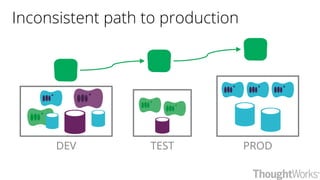
PRODTESTDEV
Inconsistent path to production
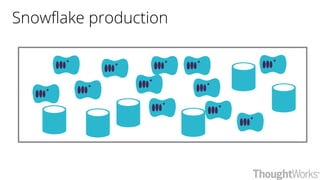
Snowflake production
PROD
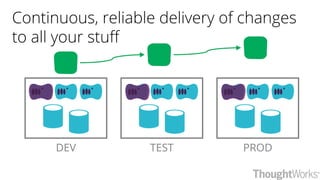
Continuous, reliable delivery of changes
to all your stuff
TESTDEV
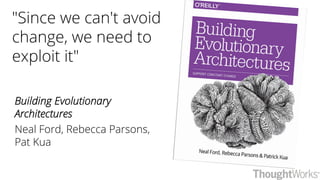
"Since we can't avoid
change, we need to
exploit it"
Building Evolutionary
Architectures
Neal Ford, Rebecca Parsons,
Pat Kua
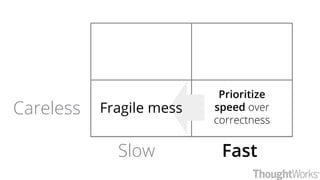
Speed or Quality?
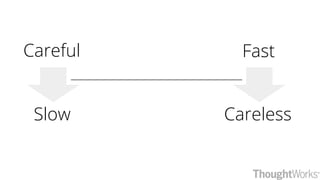
Fast
Slow Careless
Careful
Move
fast and
fix
things
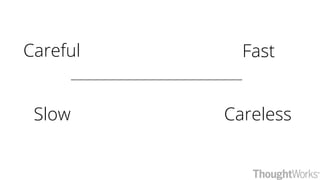
Fast
Slow Careless
Careful
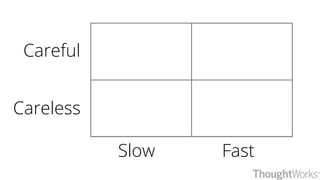
FastSlow
Careful
Careless
FastSlow
Careless
Prioritize
speed over
correctness
Fragile mess
Slow
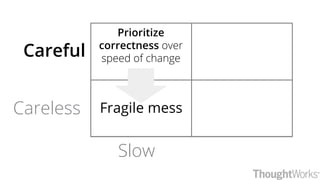
Careful
Careless
Prioritize
correctness over
speed of change
Fragile mess
Slow
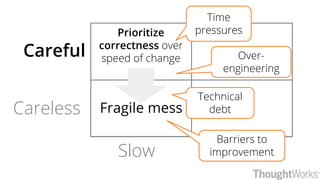
Careful
Careless
Prioritize
correctness over
speed of change
Fragile mess
Time
pressures
Over-
engineering
Technical
debt
Barriers to
improvement
FastSlow
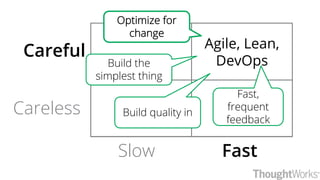
Careful
Careless
Agile, Lean,
DevOpsBuild the
simplest thing
Build quality in
Optimize for
change
Fast,
frequent
feedback
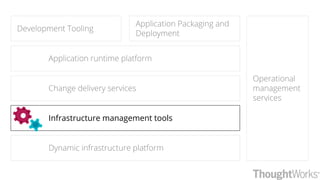
Infrastructure Tools and
Technology
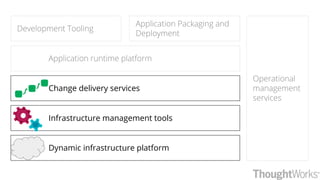
Dynamic infrastructure platform
Change delivery services
Infrastructure management tools
Operational
management
services
Application Packaging and
Deployment
Development Tooling
Application runtime platform
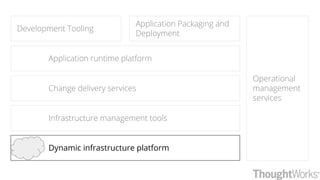
Dynamic infrastructure platform
Change delivery services
Infrastructure management tools
Operational
management
services
Application Packaging and
Deployment
Development Tooling
Application runtime platform
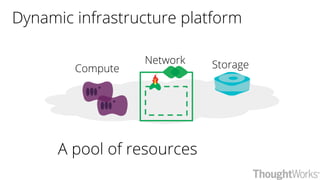
Dynamic infrastructure platform
Compute StorageNetwork
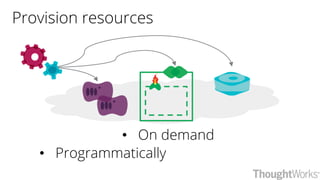
A pool of resources
Provision resources
• On demand
• Programmatically
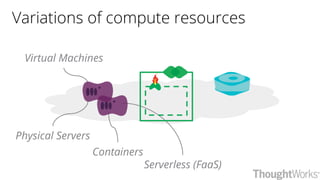
Physical Servers
Containers
Serverless (FaaS)
Variations of compute resources
Virtual Machines
Dynamic infrastructure platform
Change delivery services
Infrastructure management tools
Operational
management
services
Application Packaging and
Deployment
Development Tooling
Application runtime platform
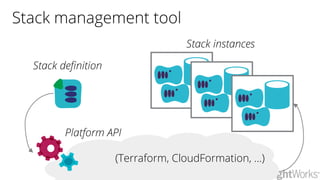
Stack management tool
Stack instances
Platform API
Stack definition
(Terraform, CloudFormation, ...)
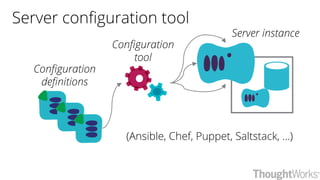
Server configuration tool
Configuration
tool
Configuration
definitions
Server instance
(Ansible, Chef, Puppet, Saltstack, ...)
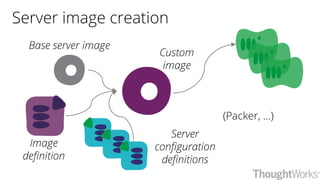
Server image creation
Base server image
Custom
image
Server
configuration
definitions
Image
definition
(Packer, ...)
Concept: Infrastructure Stack
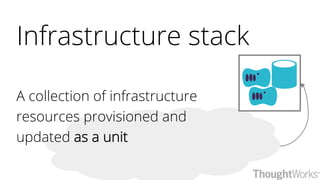
Infrastructure stack
A collection of infrastructure
resources provisioned and
updated as a unit
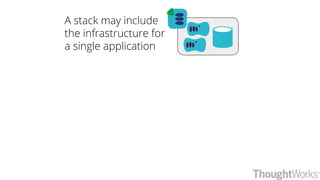
A stack may include
the infrastructure for
a single application
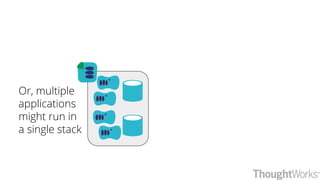
Or, multiple
applications
might run in
a single stack
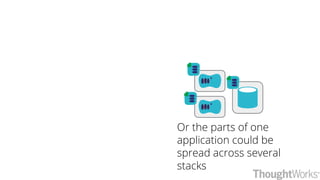
Or the parts of one
application could be
spread across several
stacks
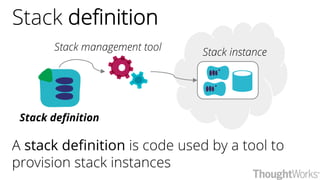
Stack definition
A stack definition is code used by a tool to
provision stack instances
Stack definition
Stack instanceStack management tool
Stack instances
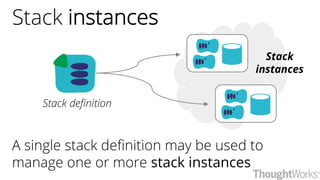
A single stack definition may be used to
manage one or more stack instances
Stack definition
Stack
instances
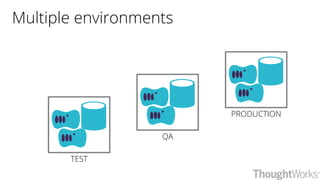
Multiple environments
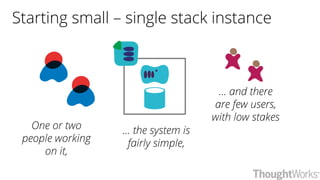
Starting small – single stack instance
One or two
people working
on it,
... the system is
fairly simple,
... and there
are few users,
with low stakes
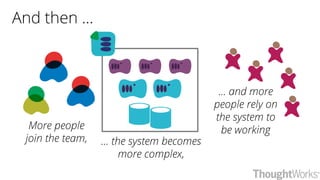
And then ...
More people
join the team, ... the system becomes
more complex,
... and more
people rely on
the system to
be working
PRODUCTION
QA
TEST
Multiple environments
PRODUCTION
QA
TEST
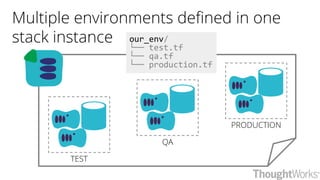
Multiple environments defined in one
stack instance our_env/
└── test.tf
└── qa.tf
└── production.tf
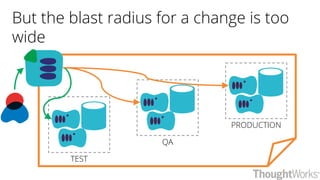
But the blast radius for a change is too
wide
PRODUCTION
QA
TEST
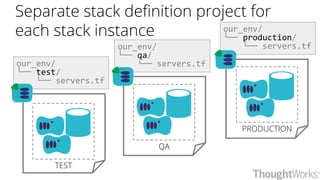
our_env/
└── test/
└── servers.tf
our_env/
└── qa/
└── servers.tf
our_env/
└── production/
└── servers.tf
PRODUCTION
QA
TEST
Separate stack definition project for
each stack instance
QA
PRODUCTION
TEST
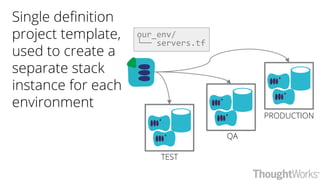
Single definition
project template,
used to create a
separate stack
instance for each
environment
our_env/
└── servers.tf
Pipelines for infrastructure
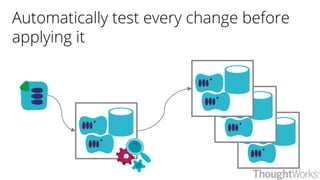
Automatically test every change before
applying it
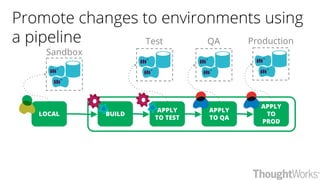
Promote changes to environments using
a pipeline
BUILDLOCAL
APPLY
TO QA
APPLY
TO
PROD
Sandbox
QA Production
APPLY
TO TEST
Test
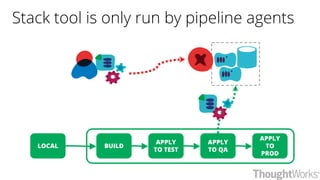
Stack tool is only run by pipeline agents
BUILDLOCAL
APPLY
TO QA
APPLY
TO
PROD
APPLY
TO TEST
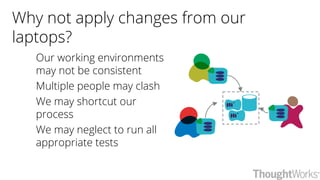
Why not apply changes from our
laptops?
Our working environments
may not be consistent
Multiple people may clash
We may shortcut our
process
We may neglect to run all
appropriate tests
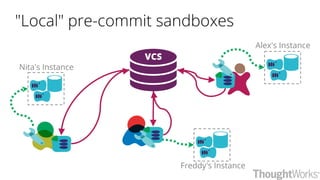
"Local" pre-commit sandboxes
VCS
Nita's Instance
Alex's Instance
Freddy's Instance
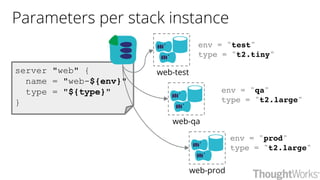
Parameterizing stacks
server "web" {
name = "web-${env}"
type = "${type}"
}
env = "prod"
type = "t2.large"
env = "qa"
type = "t2.large"
env = "test"
type = "t2.tiny"
web-test
web-qa
web-prod
Parameters per stack instance
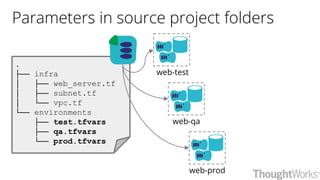
Parameters in source project folders
web-test
web-qa
web-prod
.
├── infra
│ ├── web_server.tf
│ ├── subnet.tf
│ └── vpc.tf
└── environments
├── test.tfvars
├── qa.tfvars
└── prod.tfvars
env
=
"test"
type
=
"t2.tiny"
env
=
"qa"
type
=
"t2.large"
env
=
"prod"
type
=
"t2.large"
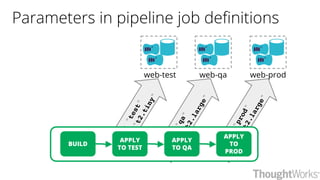
Parameters in pipeline job definitions
BUILD
APPLY
TO QA
APPLY
TO
PROD
APPLY
TO TEST
web-test web-qa web-prod
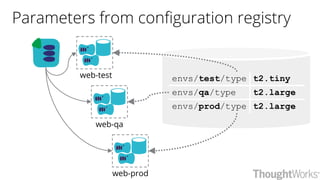
Parameters from configuration registry
web-test
web-qa
web-prod
envs/test/type t2.tiny
envs/qa/type t2.large
envs/prod/type t2.large
Recommendation
Minimize the configurable surface area to
reduce variation between environments
Infrastructure testing
An effective testing regime
drives a clean, decoupled,
evolvable system design
Fitness functions
Define the important characteristics of your
system, how to measure these, and how to
assess progress
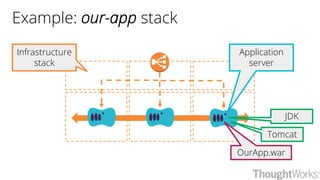
Example: our-app stack
Infrastructure
stack
JDK
Tomcat
OurApp.war
Application
server
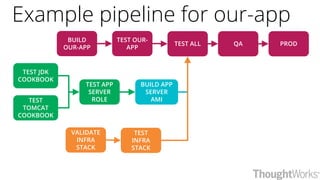
QA PRODTEST ALL
TEST JDK
COOKBOOK
TEST
TOMCAT
COOKBOOK
TEST APP
SERVER
ROLE
BUILD APP
SERVER
AMI
VALIDATE
INFRA
STACK
BUILD
OUR-APP
TEST
INFRA
STACK
TEST OUR-
APP
Example pipeline for our-app
QA PRODTEST ALL
TEST JDK
COOKBOOK
TEST
TOMCAT
COOKBOOK
TEST APP
SERVER
ROLE
APP
SERVER
AMI
VALIDATE
INFRA
STACK
BUILD
OUR-APP
TEST
INFRA
STACK
TEST OUR-
APP
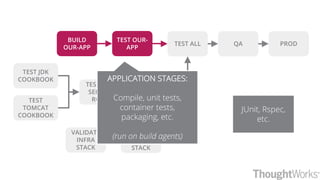
APPLICATION STAGES:
Compile, unit tests,
container tests,
packaging, etc.
(run on build agents)
JUnit, Rspec,
etc.
QA PRODTEST ALL
TEST JDK
COOKBOOK
TEST
TOMCAT
COOKBOOK
TEST APP
SERVER
ROLE
BUILD APP
SERVER
AMI
BUILD
INFRA
STACK
BUILD
OUR-APP
TEST
INFRA
STACK
TEST OUR-
APP
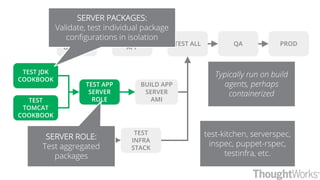
SERVER PACKAGES:
Validate, test individual package
configurations in isolation
SERVER ROLE:
Test aggregated
packages
Typically run on build
agents, perhaps
containerized
test-kitchen, serverspec,
inspec, puppet-rspec,
testinfra, etc.
QA PRODTEST ALL
TEST JDK
COOKBOOK
TEST
TOMCAT
COOKBOOK
TEST APP
SERVER
ROLE
BUILD APP
SERVER
AMI
VALIDATE
INFRA
STACK
BUILD
OUR-APP
TEST
INFRA
STACK
TEST OUR-
APP
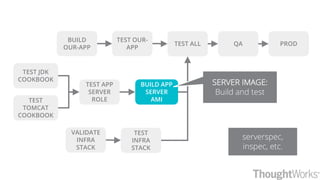
SERVER IMAGE:
Build and test
serverspec,
inspec, etc.
QA PRODTEST ALL
TEST JDK
COOKBOOK
TEST
TOMCAT
COOKBOOK
TEST APP
SERVER
ROLE
BUILD APP
SERVER
AMI
VALIDATE
INFRA
STACK
BUILD
OUR-APP
TEST
INFRA
STACK
TEST OUR-
APP
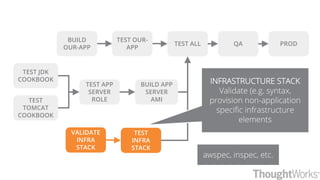
INFRASTRUCTURE STACK
Validate (e.g. syntax,
provision non-application
specific infrastructure
elements
awspec, inspec, etc.
QA PRODTEST ALL
TEST JDK
COOKBOOK
TEST
TOMCAT
COOKBOOK
TEST APP
SERVER
ROLE
BUILD APP
SERVER
AMI
VALIDATE
INFRA
STACK
BUILD
OUR-APP
TEST
INFRA
STACK
TEST OUR-
APP
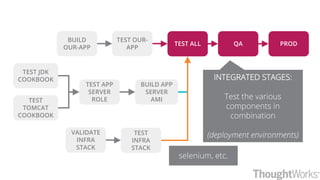
INTEGRATED STAGES:
Test the various
components in
combination
(deployment environments)
selenium, etc.
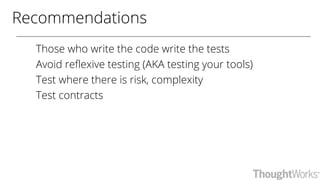
Recommendations
Those who write the code write the tests
Avoid reflexive testing (AKA testing your tools)
Test where there is risk, complexity
Test contracts
Splitting stacks into
microstacks
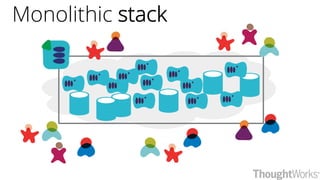
Monolithic stack
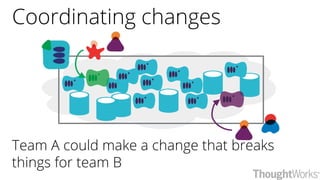
Coordinating changes
Team A could make a change that breaks
things for team B
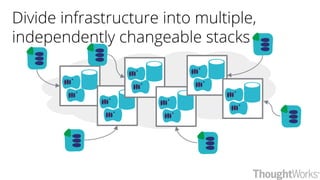
Divide infrastructure into multiple,
independently changeable stacks
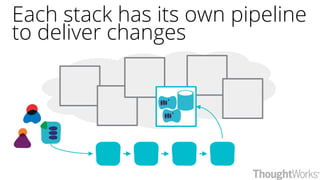
Each stack has its own pipeline
to deliver changes
Strategies for drawing
boundaries
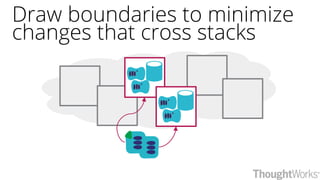
Draw boundaries to minimize
changes that cross stacks
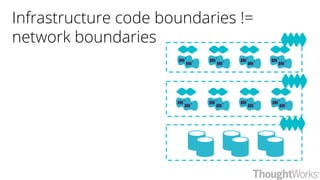
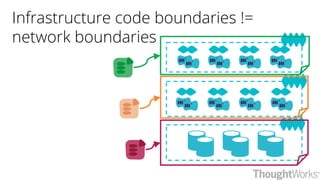
Infrastructure code boundaries !=
network boundaries
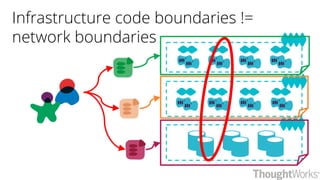
Infrastructure code boundaries !=
network boundaries
Infrastructure code boundaries !=
network boundaries
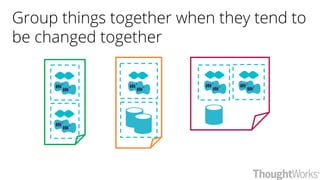
Group things together when they tend to
be changed together
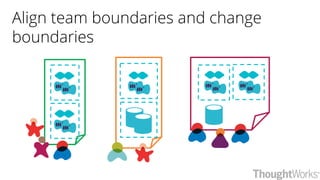
Align team boundaries and change
boundaries
Patterns for infrastructure
stacks
Shared infrastructure
components
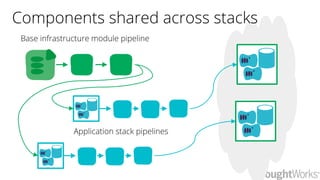
Base infrastructure module pipeline
Application stack pipelines
Components shared across stacks
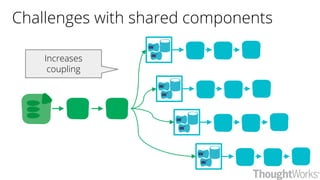
Challenges with shared components
Increases
coupling
Shared infrastructure stacks
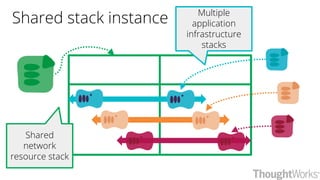
Shared stack instance
Shared
network
resource stack
Multiple
application
infrastructure
stacks
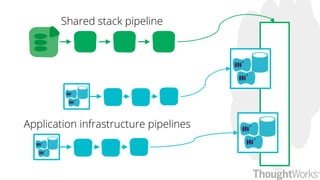
Shared stack pipeline
Application infrastructure pipelines
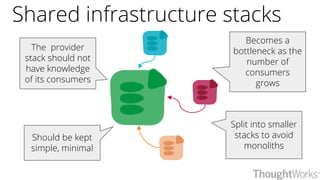
Shared infrastructure stacks
The provider
stack should not
have knowledge
of its consumers
Becomes a
bottleneck as the
number of
consumers
grows
Should be kept
simple, minimal
Split into smaller
stacks to avoid
monoliths
Shared nothing stacks
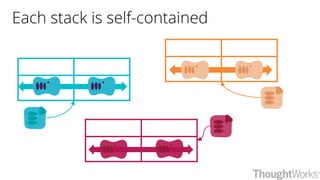
Each stack is self-contained
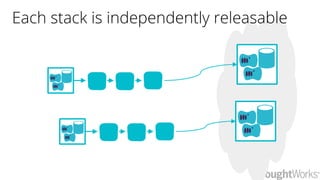
Each stack is independently releasable
Techniques for integrating
stacks
Example of integrated stacks
Shared
infrastructure
stack
Application
infrastructure
stack
vpc_id = "vpc-abcde"
private_subnets = ["sn-12345", "sn-54321"]
Integration at apply-time
vpc_id = "vpc-abcde"
private_subnets = ["sn-12345", "sn-54321"]
Integration by resource discovery
data "aws_vpc" "vpc" {
filter {
name = "tag:Environment"
values = ["${var.env}"]
}
}
data "aws_subnet" "private_subnet" {
filter {
name = "tag:Environment"
values = ["${var.env}"]
}
}
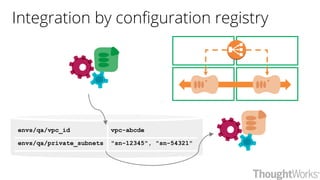
Integration by configuration registry
envs/qa/vpc_id vpc-abcde
envs/qa/private_subnets "sn-12345", "sn-54321"
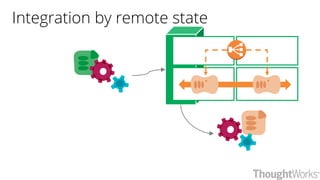
Integration by remote state
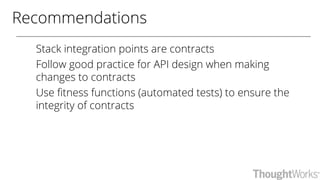
Recommendations
Stack integration points are contracts
Follow good practice for API design when making
changes to contracts
Use fitness functions (automated tests) to ensure the
integrity of contracts
kief@thoughtworks.com
Infrastructure Technologist@
Twitter: @kief
Book: http://oreil.ly/1JKIBVe
Site: http://infrastructure-as-code.com

Evolutionary infrastructure agile 2018 - kief morris