Informing gender-responsive
climate policy and action
Markus Ihalainen - CIFOR
GENDER, CLIMATE CHANGE AND FORESTS
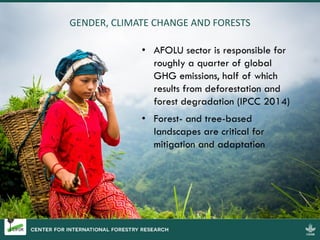
• AFOLU sector is responsible for
roughly a quarter of global
GHG emissions, half of which
results from deforestation and
forest degradation (IPCC 2014)
• Forest- and tree-based
landscapes are critical for
mitigation and adaptation
GENDER, CLIMATE CHANGE AND FORESTS
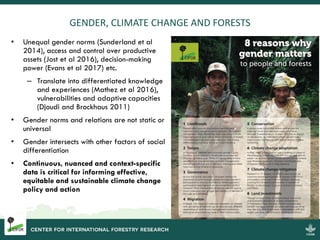
• Unequal gender norms (Sunderland et al
2014), access and control over productive
assets (Jost et al 2016), decision-making
power (Evans et al 2017) etc.
– Translate into differentiated knowledge
and experiences (Mathez et al 2016),
vulnerabilities and adaptive capacities
(Djoudi and Brockhaus 2011)
• Gender norms and relations are not static or
universal
• Gender intersects with other factors of social
differentiation
• Continuous, nuanced and context-specific
data is critical for informing effective,
equitable and sustainable climate change
policy and action
SDD AND FOREST POLICY
• Increase in research on gender and forests, trees and agroforestry
• Lack of systematic and comprehensive data sets on national level
• While many countries have forest-related mitigation and adaptation targets (WWF),
attention to gender often absent in policy making (e.g. Arwida et al 2017)
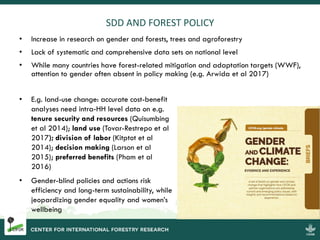
• E.g. land-use change: accurate cost-benefit
analyses need intra-HH level data on e.g.
tenure security and resources (Quisumbing
et al 2014); land use (Tovar-Restrepo et al
2017); division of labor (Kitptot et al
2014); decision making (Larson et al
2015); preferred benefits (Pham et al
2016)
• Gender-blind policies and actions risk
efficiency and long-term sustainability, while
jeopardizing gender equality and women’s
wellbeing
• CIFOR global comparative study on
REDD+ found significant gaps in women’s
awareness of and participation in pilot
projects. 3 years later, women’s FGs in
REDD+ sites reported 17% net decline in
subjective wellbeing relative to male-
dominated FGs and control groups
(Larson et al 2018).
• Failing to address gender issues in
project design and implementation
can have detrimental impacts
• Gender-specific targets and
indicators, continuous monitoring and
adaptive leaning are critical
LEVERAGE SYNERGIES AND RECONCILE TENSIONS
• Gender-responsive climate policy and action can address and transform material
and cultural gender inequalities (e.g. Mukasa et al 2017, Peach Brown 2011,
Bernier et al)
• Gender-equitable policies and projects are also likely to demonstrate better
institutional and environmental performance (Coleman and Mwangi 2013, Agarwal
2010), Leisher et al 2016)
– Synergies should not be assumed, but built on robust data and gender analysis
(Arora-Jonsson 2010)
– Trade-offs may exist between different objectives: SDD is critical for identifying
and addressing potential tensions (Brockhaus et al 2013)
– Policies and initiatives that build on existing local knowledge can allow for
enhanced efficiency while ensuring appropriate benefits (Mathez et al 2016)
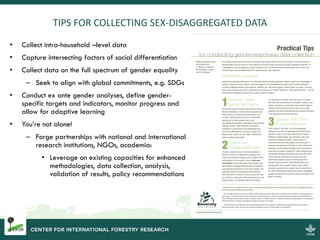
TIPS FOR COLLECTING SEX-DISAGGREGATED DATA
• Collect intra-household –level data
• Capture intersecting factors of social differentiation
• Collect data on the full spectrum of gender equality
– Seek to align with global commitments, e.g. SDGs
• Conduct ex ante gender analyses, define gender-
specific targets and indicators, monitor progress and
allow for adaptive learning
• You’re not alone!
– Forge partnerships with national and international
research institutions, NGOs, academia:
• Leverage on existing capacities for enhanced
methodologies, data collection, analysis,
validation of results, policy recommendations
cifor.org
blog.cifor.org
ForestsTreesAgroforestry.org
Thank you!
Please contact m.ihalainen@cgiar.org for full references – papers referenced
in this presentation are open access and available online

Informing gender-responsive climate policy and action

  • 1.
    Informing gender-responsive climate policyand action Markus Ihalainen - CIFOR
  • 2.
    GENDER, CLIMATE CHANGEAND FORESTS • AFOLU sector is responsible for roughly a quarter of global GHG emissions, half of which results from deforestation and forest degradation (IPCC 2014) • Forest- and tree-based landscapes are critical for mitigation and adaptation
  • 3.
    GENDER, CLIMATE CHANGEAND FORESTS • Unequal gender norms (Sunderland et al 2014), access and control over productive assets (Jost et al 2016), decision-making power (Evans et al 2017) etc. – Translate into differentiated knowledge and experiences (Mathez et al 2016), vulnerabilities and adaptive capacities (Djoudi and Brockhaus 2011) • Gender norms and relations are not static or universal • Gender intersects with other factors of social differentiation • Continuous, nuanced and context-specific data is critical for informing effective, equitable and sustainable climate change policy and action
  • 4.
    SDD AND FORESTPOLICY • Increase in research on gender and forests, trees and agroforestry • Lack of systematic and comprehensive data sets on national level • While many countries have forest-related mitigation and adaptation targets (WWF), attention to gender often absent in policy making (e.g. Arwida et al 2017) • E.g. land-use change: accurate cost-benefit analyses need intra-HH level data on e.g. tenure security and resources (Quisumbing et al 2014); land use (Tovar-Restrepo et al 2017); division of labor (Kitptot et al 2014); decision making (Larson et al 2015); preferred benefits (Pham et al 2016) • Gender-blind policies and actions risk efficiency and long-term sustainability, while jeopardizing gender equality and women’s wellbeing
  • 5.
    • CIFOR globalcomparative study on REDD+ found significant gaps in women’s awareness of and participation in pilot projects. 3 years later, women’s FGs in REDD+ sites reported 17% net decline in subjective wellbeing relative to male- dominated FGs and control groups (Larson et al 2018). • Failing to address gender issues in project design and implementation can have detrimental impacts • Gender-specific targets and indicators, continuous monitoring and adaptive leaning are critical
  • 6.
    LEVERAGE SYNERGIES ANDRECONCILE TENSIONS • Gender-responsive climate policy and action can address and transform material and cultural gender inequalities (e.g. Mukasa et al 2017, Peach Brown 2011, Bernier et al) • Gender-equitable policies and projects are also likely to demonstrate better institutional and environmental performance (Coleman and Mwangi 2013, Agarwal 2010), Leisher et al 2016) – Synergies should not be assumed, but built on robust data and gender analysis (Arora-Jonsson 2010) – Trade-offs may exist between different objectives: SDD is critical for identifying and addressing potential tensions (Brockhaus et al 2013) – Policies and initiatives that build on existing local knowledge can allow for enhanced efficiency while ensuring appropriate benefits (Mathez et al 2016)
  • 7.
    TIPS FOR COLLECTINGSEX-DISAGGREGATED DATA • Collect intra-household –level data • Capture intersecting factors of social differentiation • Collect data on the full spectrum of gender equality – Seek to align with global commitments, e.g. SDGs • Conduct ex ante gender analyses, define gender- specific targets and indicators, monitor progress and allow for adaptive learning • You’re not alone! – Forge partnerships with national and international research institutions, NGOs, academia: • Leverage on existing capacities for enhanced methodologies, data collection, analysis, validation of results, policy recommendations
  • 8.
    cifor.org blog.cifor.org ForestsTreesAgroforestry.org Thank you! Please contactm.ihalainen@cgiar.org for full references – papers referenced in this presentation are open access and available online