Informed Consent:
Promise, Pledge, Contract, or
Platitude?
Michael A. Swit, Esq.
Special Counsel, FDA Law Practice
Duane Morris LLP
Disclaimers
• The views and opinions expressed in the following PowerPoint
slides are those of the individual presenter and should not be
attributed to Drug Information Association, Inc. (“DIA”), its
directors, officers, employees, volunteers, members, chapters,
councils, Communities (formerly known as SIACs) or
affiliates, or the law firm with which the presenter is employed,
or any of the law firm’s clients.
• These PowerPoint slides are the intellectual property of the
individual presenter and are protected under the copyright
laws of the United States of America and other countries.
Used by permission. All rights reserved. Drug Information
Association, Drug Information Association Inc., DIA and DIA
logo are registered trademarks. All other trademarks are the
property of their respective owners.
2
Disclaimers
• These slides support an oral briefing and should not
be relied upon, solely on their own, to support any
conclusion of law or fact.
• This presentation is for general educational purposes
and does not constitute legal advice.
3
4
Historical Background
5
The Nuremberg Code (1947)
• First modern ethical code requiring
– Voluntary consent
– Benefits outweigh risks
– Ability of the subject to terminate participation
6
Declaration of Helsinki (1964)
• Recommendations Guiding Medical Doctors in
Biomedical Research Involving Human Subjects
• Adopted by the 18th World Medical Assembly,
Helsinki, Finland, 1964; revised in Tokyo, 1975;
Venice, 1983; Hong Kong, 1989; South Africa,
1996;Edinburgh 2000; Note of clarification on
paragraph 29; Washington 2002
7
Helsinki Declaration …
• “Concern for the interests of the subject must
always prevail over the interests of science and
society”
http://www.wma.net/en/30publications/10policies/b3/
8
Beecher Article (1966)
• “Ethics and clinical research” — Henry K.
Beecher, New England Journal of Medicine 274
(1966):1354-60
– 22 published medical studies presenting risk to subjects
without their knowledge or approval
– Published in some of the most prestigious journals and
conducted at some of the most acclaimed institutions by
some of the most highly regarded researchers
9
Where the Burden Lies
• “The duty and responsibility for ascertaining the
quality of the consent rests upon each individual
who initiates, directs or engages in the
experiment.”
– Principle 1, The Nuremberg Code
• “When obtaining informed consent for a research
project, the doctor should be particularly cautious
if the subject is in a dependent relationship to him
or her, or under duress.”
– The Declaration of Helsinki
10
Where the Burden Lies …
• “In that case, the informed consent should be
obtained by a doctor who is not engaged in the
investigation and who is completely
independent of this relationship.”
11
Beecher’s Paradox
• The voluntary consent of the human subject is
absolutely essential.
– Nuremberg
• True informed consent is probably an
unattainable goal.
– Beecher
12
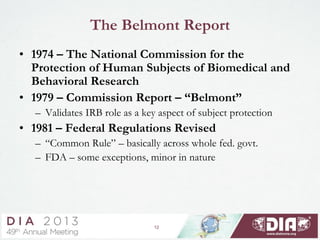
The Belmont Report
• 1974 – The National Commission for the
Protection of Human Subjects of Biomedical and
Behavioral Research
• 1979 – Commission Report – “Belmont”
– Validates IRB role as a key aspect of subject protection
• 1981 – Federal Regulations Revised
– “Common Rule” – basically across whole fed. govt.
– FDA – some exceptions, minor in nature
13
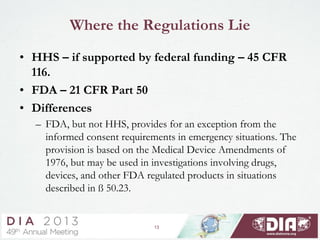
Where the Regulations Lie
• HHS – if supported by federal funding – 45 CFR
116.
• FDA – 21 CFR Part 50
• Differences
– FDA, but not HHS, provides for an exception from the
informed consent requirements in emergency situations. The
provision is based on the Medical Device Amendments of
1976, but may be used in investigations involving drugs,
devices, and other FDA regulated products in situations
described in ß 50.23.
14
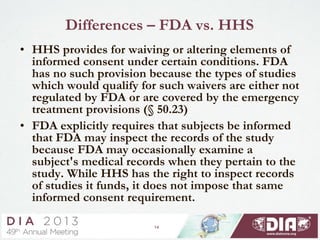
Differences – FDA vs. HHS
• HHS provides for waiving or altering elements of
informed consent under certain conditions. FDA
has no such provision because the types of studies
which would qualify for such waivers are either not
regulated by FDA or are covered by the emergency
treatment provisions (§ 50.23)
• FDA explicitly requires that subjects be informed
that FDA may inspect the records of the study
because FDA may occasionally examine a
subject's medical records when they pertain to the
study. While HHS has the right to inspect records
of studies it funds, it does not impose that same
informed consent requirement.
15
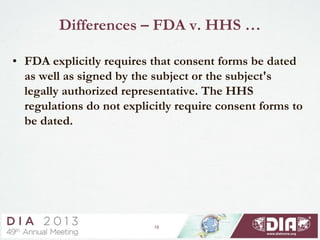
Differences – FDA v. HHS …
• FDA explicitly requires that consent forms be dated
as well as signed by the subject or the subject's
legally authorized representative. The HHS
regulations do not explicitly require consent forms to
be dated.
16
The Law of Informed Consent –
Contract, Fiduciary Duty, Promise,
Pledge or Platitude?
17
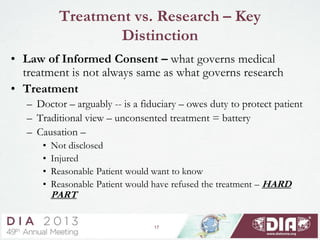
Treatment vs. Research – Key
Distinction
• Law of Informed Consent – what governs medical
treatment is not always same as what governs research
• Treatment
– Doctor – arguably -- is a fiduciary – owes duty to protect patient
– Traditional view – unconsented treatment = battery
– Causation –
• Not disclosed
• Injured
• Reasonable Patient would want to know
• Reasonable Patient would have refused the treatment – HARD
PART
18
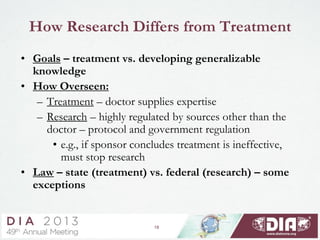
How Research Differs from Treatment
• Goals – treatment vs. developing generalizable
knowledge
• How Overseen:
– Treatment – doctor supplies expertise
– Research – highly regulated by sources other than the
doctor – protocol and government regulation
• e.g., if sponsor concludes treatment is ineffective,
must stop research
• Law – state (treatment) vs. federal (research) – some
exceptions
19
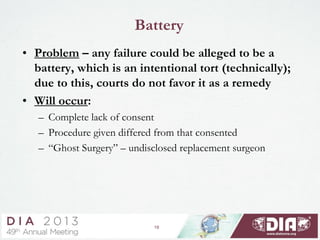
Battery
• Problem – any failure could be alleged to be a
battery, which is an intentional tort (technically);
due to this, courts do not favor it as a remedy
• Will occur:
– Complete lack of consent
– Procedure given differed from that consented
– “Ghost Surgery” – undisclosed replacement surgeon
20
Is the I.C. a Contract Legally Enforceable
by the Subject?
• Basic contract law
– Parties in privity – i.e., the two the made the deal
– Legal subject
– Offer
– Acceptance
– Consideration
• Problem – lack of privity – sponsor may provide the
form, but it is obtained by P.I. from the subject – no
privity between subject and sponsor
21
But, People (Alan Milstein) Still Argue
Contracts
• Suthers & Abney Cases
– GNDF trials – discontinued by Amgen as showing no
benefit – thus, required under IND rules
– Plaintiffs – you owe us the drug under normal contracts
theory and the doctrine of “promissory estoppel” – also
a contracts theory
• Clear promise
• Detrimental reliance by promisee
• Damages by promisee
22
Suthers and Abney Decisions
• No contract
– Amgen not a party to I.C., nor was the P.I. an agent of
Amgen that could bind Amgen via the I.C.; rather they were
“independent contractors”
• Look at control over the P.I.’s work
– Here the protocol drafted by the P.I.
• No promissory estoppel
– Unable to show Amgen promised continued access
23
Fiduciary?
• Suthers & Abney – also asserted that the Amgen
was a fiduciary; not found by court
– Amgen did not set up the clinical initially; no unique duty
owed to subjects or proof that Amgen’s role was done for the
benefit on the patients
• Note: court suggested that the parties to be bound
by contract via the I.C. were the P.I. and the
universities where P.I. worked
24
Problems with Fiduciary Theory
• Goal of research – generalizable knowledge
• Subject is not the prime beneficiary of research –
rather it is the public at large
• P.I. and sponsor both have less control over the way
research is done
Questions?
• Call, e-mail or fax:
Michael A. Swit, Esq.
Special Counsel, FDA Law Practice
Duane Morris LLP
San Diego, California
direct: 619-744-2215
fax: 619-923-6248
maswit@duanemorris.com
• Follow me on:
– LinkedIn: http://www.linkedin.com/in/michaelswit
– Twitter: https://twitter.com/FDACounsel
25
About Your Speaker
Michael A. Swit, Esq., is a Special Counsel in the San Diego office of the international law
firm, Duane Morris, LLP, where he focuses his practice on solving FDA legal challenges
faced by highly-regulated pharmaceutical and medical device companies. Before joining
Duane Morris in March 2012, Swit served for seven years as a vice president at The
Weinberg Group Inc., a preeminent scientific and regulatory consulting firm in the Life
Sciences. His expertise includes product development, compliance and enforcement,
recalls and crisis management, submissions and related traditional FDA regulatory
activities, labeling and advertising, and clinical research efforts for all types of life sciences
companies, with a particular emphasis on drugs, biologics and therapeutic biotech
products. Mr. Swit has been addressing vital FDA legal and regulatory issues since 1984,
both in private practice with McKenna & Cuneo and Heller Ehrman, and as vice president,
general counsel and secretary of Par Pharmaceutical, a top public generic and specialty
drug firm. He also was, from 1994 to 1998, CEO of FDANews.com, a premier publisher of
regulatory newsletters and other specialty information products for FDA-regulated firms.
He has taught and written on many topics relating to FDA regulation and associated
commercial activities and is a past member of the Food & Drug Law Journal Editorial
Board. He earned his A.B., magna cum laude, with high honors in history, at Bowdoin
College, and his law degree at Emory University.
26

Informed Consent: Promise, Pledge, Contract, or Platitude?

  • 1.
    Informed Consent: Promise, Pledge,Contract, or Platitude? Michael A. Swit, Esq. Special Counsel, FDA Law Practice Duane Morris LLP
  • 2.
    Disclaimers • The viewsand opinions expressed in the following PowerPoint slides are those of the individual presenter and should not be attributed to Drug Information Association, Inc. (“DIA”), its directors, officers, employees, volunteers, members, chapters, councils, Communities (formerly known as SIACs) or affiliates, or the law firm with which the presenter is employed, or any of the law firm’s clients. • These PowerPoint slides are the intellectual property of the individual presenter and are protected under the copyright laws of the United States of America and other countries. Used by permission. All rights reserved. Drug Information Association, Drug Information Association Inc., DIA and DIA logo are registered trademarks. All other trademarks are the property of their respective owners. 2
  • 3.
    Disclaimers • These slidessupport an oral briefing and should not be relied upon, solely on their own, to support any conclusion of law or fact. • This presentation is for general educational purposes and does not constitute legal advice. 3
  • 4.
  • 5.
    5 The Nuremberg Code(1947) • First modern ethical code requiring – Voluntary consent – Benefits outweigh risks – Ability of the subject to terminate participation
  • 6.
    6 Declaration of Helsinki(1964) • Recommendations Guiding Medical Doctors in Biomedical Research Involving Human Subjects • Adopted by the 18th World Medical Assembly, Helsinki, Finland, 1964; revised in Tokyo, 1975; Venice, 1983; Hong Kong, 1989; South Africa, 1996;Edinburgh 2000; Note of clarification on paragraph 29; Washington 2002
  • 7.
    7 Helsinki Declaration … •“Concern for the interests of the subject must always prevail over the interests of science and society” http://www.wma.net/en/30publications/10policies/b3/
  • 8.
    8 Beecher Article (1966) •“Ethics and clinical research” — Henry K. Beecher, New England Journal of Medicine 274 (1966):1354-60 – 22 published medical studies presenting risk to subjects without their knowledge or approval – Published in some of the most prestigious journals and conducted at some of the most acclaimed institutions by some of the most highly regarded researchers
  • 9.
    9 Where the BurdenLies • “The duty and responsibility for ascertaining the quality of the consent rests upon each individual who initiates, directs or engages in the experiment.” – Principle 1, The Nuremberg Code • “When obtaining informed consent for a research project, the doctor should be particularly cautious if the subject is in a dependent relationship to him or her, or under duress.” – The Declaration of Helsinki
  • 10.
    10 Where the BurdenLies … • “In that case, the informed consent should be obtained by a doctor who is not engaged in the investigation and who is completely independent of this relationship.”
  • 11.
    11 Beecher’s Paradox • Thevoluntary consent of the human subject is absolutely essential. – Nuremberg • True informed consent is probably an unattainable goal. – Beecher
  • 12.
    12 The Belmont Report •1974 – The National Commission for the Protection of Human Subjects of Biomedical and Behavioral Research • 1979 – Commission Report – “Belmont” – Validates IRB role as a key aspect of subject protection • 1981 – Federal Regulations Revised – “Common Rule” – basically across whole fed. govt. – FDA – some exceptions, minor in nature
  • 13.
    13 Where the RegulationsLie • HHS – if supported by federal funding – 45 CFR 116. • FDA – 21 CFR Part 50 • Differences – FDA, but not HHS, provides for an exception from the informed consent requirements in emergency situations. The provision is based on the Medical Device Amendments of 1976, but may be used in investigations involving drugs, devices, and other FDA regulated products in situations described in ß 50.23.
  • 14.
    14 Differences – FDAvs. HHS • HHS provides for waiving or altering elements of informed consent under certain conditions. FDA has no such provision because the types of studies which would qualify for such waivers are either not regulated by FDA or are covered by the emergency treatment provisions (§ 50.23) • FDA explicitly requires that subjects be informed that FDA may inspect the records of the study because FDA may occasionally examine a subject's medical records when they pertain to the study. While HHS has the right to inspect records of studies it funds, it does not impose that same informed consent requirement.
  • 15.
    15 Differences – FDAv. HHS … • FDA explicitly requires that consent forms be dated as well as signed by the subject or the subject's legally authorized representative. The HHS regulations do not explicitly require consent forms to be dated.
  • 16.
    16 The Law ofInformed Consent – Contract, Fiduciary Duty, Promise, Pledge or Platitude?
  • 17.
    17 Treatment vs. Research– Key Distinction • Law of Informed Consent – what governs medical treatment is not always same as what governs research • Treatment – Doctor – arguably -- is a fiduciary – owes duty to protect patient – Traditional view – unconsented treatment = battery – Causation – • Not disclosed • Injured • Reasonable Patient would want to know • Reasonable Patient would have refused the treatment – HARD PART
  • 18.
    18 How Research Differsfrom Treatment • Goals – treatment vs. developing generalizable knowledge • How Overseen: – Treatment – doctor supplies expertise – Research – highly regulated by sources other than the doctor – protocol and government regulation • e.g., if sponsor concludes treatment is ineffective, must stop research • Law – state (treatment) vs. federal (research) – some exceptions
  • 19.
    19 Battery • Problem –any failure could be alleged to be a battery, which is an intentional tort (technically); due to this, courts do not favor it as a remedy • Will occur: – Complete lack of consent – Procedure given differed from that consented – “Ghost Surgery” – undisclosed replacement surgeon
  • 20.
    20 Is the I.C.a Contract Legally Enforceable by the Subject? • Basic contract law – Parties in privity – i.e., the two the made the deal – Legal subject – Offer – Acceptance – Consideration • Problem – lack of privity – sponsor may provide the form, but it is obtained by P.I. from the subject – no privity between subject and sponsor
  • 21.
    21 But, People (AlanMilstein) Still Argue Contracts • Suthers & Abney Cases – GNDF trials – discontinued by Amgen as showing no benefit – thus, required under IND rules – Plaintiffs – you owe us the drug under normal contracts theory and the doctrine of “promissory estoppel” – also a contracts theory • Clear promise • Detrimental reliance by promisee • Damages by promisee
  • 22.
    22 Suthers and AbneyDecisions • No contract – Amgen not a party to I.C., nor was the P.I. an agent of Amgen that could bind Amgen via the I.C.; rather they were “independent contractors” • Look at control over the P.I.’s work – Here the protocol drafted by the P.I. • No promissory estoppel – Unable to show Amgen promised continued access
  • 23.
    23 Fiduciary? • Suthers &Abney – also asserted that the Amgen was a fiduciary; not found by court – Amgen did not set up the clinical initially; no unique duty owed to subjects or proof that Amgen’s role was done for the benefit on the patients • Note: court suggested that the parties to be bound by contract via the I.C. were the P.I. and the universities where P.I. worked
  • 24.
    24 Problems with FiduciaryTheory • Goal of research – generalizable knowledge • Subject is not the prime beneficiary of research – rather it is the public at large • P.I. and sponsor both have less control over the way research is done
  • 25.
    Questions? • Call, e-mailor fax: Michael A. Swit, Esq. Special Counsel, FDA Law Practice Duane Morris LLP San Diego, California direct: 619-744-2215 fax: 619-923-6248 maswit@duanemorris.com • Follow me on: – LinkedIn: http://www.linkedin.com/in/michaelswit – Twitter: https://twitter.com/FDACounsel 25
  • 26.
    About Your Speaker MichaelA. Swit, Esq., is a Special Counsel in the San Diego office of the international law firm, Duane Morris, LLP, where he focuses his practice on solving FDA legal challenges faced by highly-regulated pharmaceutical and medical device companies. Before joining Duane Morris in March 2012, Swit served for seven years as a vice president at The Weinberg Group Inc., a preeminent scientific and regulatory consulting firm in the Life Sciences. His expertise includes product development, compliance and enforcement, recalls and crisis management, submissions and related traditional FDA regulatory activities, labeling and advertising, and clinical research efforts for all types of life sciences companies, with a particular emphasis on drugs, biologics and therapeutic biotech products. Mr. Swit has been addressing vital FDA legal and regulatory issues since 1984, both in private practice with McKenna & Cuneo and Heller Ehrman, and as vice president, general counsel and secretary of Par Pharmaceutical, a top public generic and specialty drug firm. He also was, from 1994 to 1998, CEO of FDANews.com, a premier publisher of regulatory newsletters and other specialty information products for FDA-regulated firms. He has taught and written on many topics relating to FDA regulation and associated commercial activities and is a past member of the Food & Drug Law Journal Editorial Board. He earned his A.B., magna cum laude, with high honors in history, at Bowdoin College, and his law degree at Emory University. 26