Country Report 
Spain – September 2014
2 
Overview 
General information Most important sectors (% of GDP, 2013) 
Capital: Madrid Services: 70.3 % 
Government type: Parliamentary monarchy Industry: 26.4 % 
Currency: Euro (EUR) Agriculture: 3.3 % 
Population: 46.5 million 
Main import sources (2013, % of total) Main export markets (2013, % of total) 
Germany: 12.1 % France: 16.8 % 
France: 11.7 % Germany: 10.6 % 
Italy: 6.2 % Portugal: 7.8 % 
China: 5.6 % Italy: 7.4% 
The Netherlands: 5.0 % UK: 7.1 % 
Key indicators 2011 2012 2013 2014* 2015* 
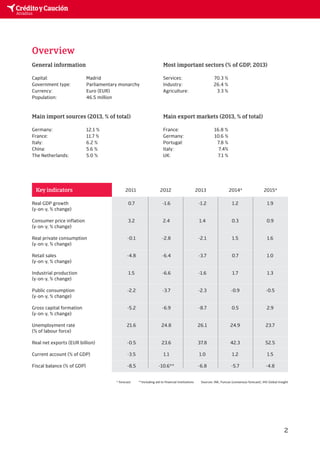
Real GDP growth 0.7 -1.6 -1.2 1.2 1.9 
(y-on-y, % change) 
Consumer price inflation 3.2 2.4 1.4 0.3 0.9 
(y-on-y, % change) 
Real private consumption -0.1 -2.8 -2.1 1.5 1.6 
(y-on-y, % change) 
Retail sales -4.8 -6.4 -3.7 0.7 1.0 
(y-on-y, % change) 
Industrial production 1.5 -6.6 -1.6 1.7 1.3 
(y-on-y, % change) 
Public consumption -2.2 -3.7 -2.3 -0.9 -0.5 
(y-on-y, % change) 
Gross capital formation -5.2 -6.9 -8.7 0.5 2.9 
(y-on-y, % change) 
Unemployment rate 21.6 24.8 26.1 24.9 23.7 
(% of labour force) 
Real net exports (EUR billion) -0.5 23.6 37.8 42.3 52.5 
Current account (% of GDP) -3.5 1.1 1.0 1.2 1.5 
Fiscal balance (% of GDP) -8,5 -10.6** -6.8 -5.7 -4.8 
* forecast **including aid to financial institutions Sources: INE, Funcas (consensus forecast), IHS Global Insight
Political situation 
Stable government 
Spain’s current government under Prime Minister Rajoy is well placed to pursue its economic policy as it holds a 
comfortable absolute majority in parliament and its term lasts until the end of 2015. The government has passed 
some structural reforms aimed at restoring competitiveness and investor confidence. 
Main economic developments 
The economic rebound gains momentum 
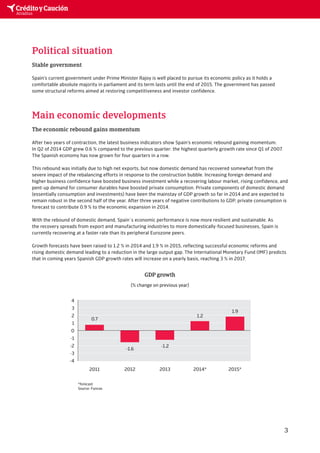
After two years of contraction, the latest business indicators show Spain‘s economic rebound gaining momentum. 
In Q2 of 2014 GDP grew 0.6 % compared to the previous quarter: the highest quarterly growth rate since Q1 of 2007. 
The Spanish economy has now grown for four quarters in a row. 
This rebound was initially due to high net exports, but now domestic demand has recovered somewhat from the 
severe impact of the rebalancing efforts in response to the construction bubble. Increasing foreign demand and 
higher business confidence have boosted business investment while a recovering labour market, rising confidence, and 
pent-up demand for consumer durables have boosted private consumption. Private components of domestic demand 
(essentially consumption and investments) have been the mainstay of GDP growth so far in 2014 and are expected to 
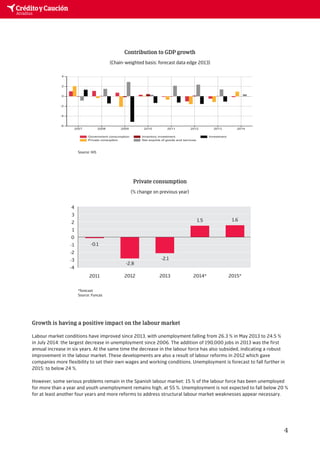
remain robust in the second half of the year. After three years of negative contributions to GDP, private consumption is 
forecast to contribute 0.9 % to the economic expansion in 2014. 
With the rebound of domestic demand, Spain´s economic performance is now more resilient and sustainable. As 
the recovery spreads from export and manufacturing industries to more domestically-focused businesses, Spain is 
currently recovering at a faster rate than its peripheral Eurozone peers. 
Growth forecasts have been raised to 1.2 % in 2014 and 1.9 % in 2015, reflecting successful economic reforms and 
rising domestic demand leading to a reduction in the large output gap. The International Monetary Fund (IMF) predicts 
that in coming years Spanish GDP growth rates will increase on a yearly basis, reaching 3 % in 2017. 
3 
4 
3 
2 
1 
0 
-1 
-2 
-3 
-4 
GDP growth 
(% change on previous year) 
2012 2013 2014* 2015* 
2011 
*forecast 
Source: Funcas 
-1.6 -1.2 
1.2 
1.9 
0.7
GDP growth 
(% change on previous year) !Source: Funcas (consensus forecast) !!!!! 
Contribution to GDP growth 
Private consumption 
(% change on previous year) 
2011 
Growth is having a positive impact on the labour market 
Labour market conditions have improved since 2013, with unemployment falling from 26.3 % in May 2013 to 24.5 % 
in July 2014: the largest decrease in unemployment since 2006. The addition of 190,000 jobs in 2013 was the fi rst 
annual increase in six years. At the same time the decrease in the labour force has also subsided, indicating a robust 
improvement in the labour market. These developments are also a result of labour reforms in 2012 which gave 
companies more fl exibility to set their own wages and working conditions. Unemployment is forecast to fall further in 
2015: to below 24 %. 
However, some serious problems remain in the Spanish labour market: 15 % of the labour force has been unemployed 
for more than a year and youth unemployment remains high, at 55 %. Unemployment is not expected to fall below 20 % 
for at least another four years and more reforms to address structural labour market weaknesses appear necessary. 
4 
(Chain-weighted basis: forecast data edge 2013) 
!Source: IHS 
Bitte ! 
Graphik !!!! 
einfügen 4 
3 
2 
1 
0 
-1 
-2 
-3 
-4 
2012 2013 2014* 2015* 
*forecast 
Source: Funcas 
-2.8 
-2.1 
1.5 1.6 
-0.1
Defl ation woes? 
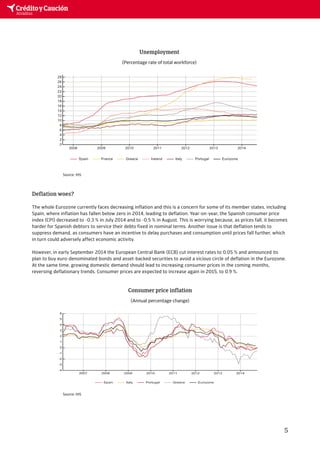
Unemployment 
(Percentage rate of total workforce) 
The whole Eurozone currently faces decreasing infl ation and this is a concern for some of its member states, including 
Spain, where infl ation has fallen below zero in 2014, leading to defl ation. Year-on-year, the Spanish consumer price 
index (CPI) decreased to -0.3 % in July 2014 and to -0.5 % in August. This is worrying because, as prices fall, it becomes 
harder for Spanish debtors to service their debts fi xed in nominal terms. Another issue is that defl ation tends to 
suppress demand, as consumers have an incentive to delay purchases and consumption until prices fall further, which 
in turn could adversely affect economic activity. 
tends to suppress demand, as consumers have an incentive to delay purchases and 
consumption until prices fall further, which in turn could adversely affect economic activity. 
However, in early September 2014 the European Central Bank (ECB) cut interest rates to 
0.05% and announced its plan to buy euro-denominated bonds and asset-backed securities to 
avoid a vicious circle of deflation in the Eurozone. At the same time, growing domestic 
demand should lead to increasing consumer prices in the coming months, reversing 
deflationary trends. Consumer prices are expected to increase again in 2015, to 0.9%. 
However, in early September 2014 the European Central Bank (ECB) cut interest rates to 0.05 % and announced its 
plan to buy euro-denominated bonds and asset-backed securities to avoid a vicious circle of defl ation in the Eurozone. 
At the same time, growing domestic demand should lead to increasing consumer prices in the coming months, 
reversing defl ationary trends. Consumer prices are expected to increase again in 2015, to 0.9 %. 
Consumer price infl ation 
! 
International competitiveness is improving… Spain’s international competitiveness is improving and its export sector is relatively healthy 
and competitive. Indeed, 2007 has been the only recent year in which the GDP-contribution 5 
of 
net exports has been negative. Nevertheless, a Real Effective Exchange Rate (REER) 
comparison (which measures a country’s international competitiveness as costs and !! 
prices 
more reforms to address structural labour market weaknesses appear necessary. !! 
!!!! 
Source: IHS 
!Deflation woes? The whole Eurozone currently faces decreasing inflation and this is a concern for some of its 
member states, including Spain, where inflation has fallen below zero in 2014, leading to 
deflation. Year-on-year, the Spanish consumer price index (CPI) decreased to -0.3% in July 
2014 and to -0.5% in August. This is worrying because, as prices fall, it becomes harder for 
Spanish debtors to service their debts fixed in nominal terms. Another issue is that deflation 
(Annual percentage change) 
Source: IHS
International competitiveness is improving… 
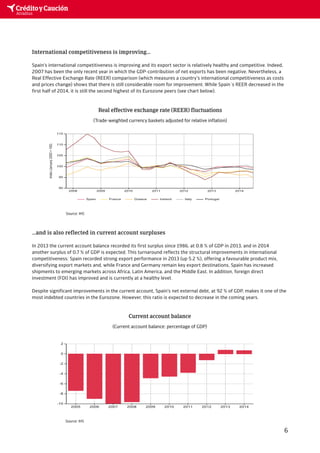
Spain’s international competitiveness is improving and its export sector is relatively healthy and competitive. Indeed, 
2007 has been the only recent year in which the GDP-contribution of net exports has been negative. Nevertheless, a 
Real Effective Exchange Rate (REER) comparison (which measures a country’s international competitiveness as costs 
and prices change) shows that there is still considerable room for improvement. While Spain´s REER decreased in the 
fi rst half of 2014, it is still the second highest of its Eurozone peers (see chart below). 
Real effective exchange rate (REER) fl uctuations 
!!!! 
…and is also reflected in current account surpluses !In 2013 the current account balance recorded its first surplus since 1986, at 0.8% of GDP in 
2013, and in 2014 another surplus of 0.7% of GDP is expected. This turnaround reflects the 
structural improvements in international competitiveness: Spain recorded strong export 
performance in 2013 (up 5.2%), offering a favourable product mix, diversifying export 
markets and, while France and Germany remain key export destinations, Spain has increased 
shipments to emerging markets across Africa, Latin America, and the Middle East. In 
addition, foreign direct investment (FDI) has improved and is currently at a healthy level. 
Despite significant improvements in the current account, Spain’s net external debt, at 92% of 
GDP, makes it one of the most indebted countries in the Eurozone. However, this ratio is 
expected to decrease in the coming years. 
! 
…and is also refl ected in current account surpluses 
In 2013 the current account balance recorded its fi rst surplus since 1986, at 0.8 % of GDP in 2013, and in 2014 
another surplus of 0.7 % of GDP is expected. This turnaround refl ects the structural improvements in international 
competitiveness: Spain recorded strong export performance in 2013 (up 5.2 %), offering a favourable product mix, 
diversifying export markets and, while France and Germany remain key export destinations, Spain has increased 
shipments to emerging markets across Africa, Latin America, and the Middle East. In addition, foreign direct 
investment (FDI) has improved and is currently at a healthy level. 
Despite signifi cant improvements the current account, Spain’s net external debt, at 92 % of GDP, makes it one of the 
most indebted countries in the Eurozone. However, this ratio is expected to decrease in the coming years. 
Current account balance 
!! 
6 
It seems that the economy is on the right track, but current account surpluses underpinned by 
a significant decrease in the REER will need to continue in future years to improve Spain’s 
(Trade-weighted currency baskets adjusted for relative infl ation) 
!Source: IHS 
!…and is also reflected in current account surpluses In 2013 the current account balance recorded its first surplus since 1986, at 0.8% of GDP in 
2013, and in 2014 another surplus of 0.7% of GDP is expected. This turnaround reflects the 
structural improvements in international competitiveness: Spain recorded strong export 
performance in 2013 (up 5.2%), offering a favourable product mix, diversifying export 
markets and, while France and Germany remain key export destinations, Spain has increased 
shipments to emerging markets across Africa, Latin America, and the Middle East. In 
addition, foreign direct investment (FDI) has improved and is currently at a healthy level. 
Despite significant improvements (Current in the account current balance: account, percentage Spain’s of net GDP) 
external debt, at 92% of 
GDP, makes it one of the most indebted countries in the Eurozone. However, this ratio is 
expected to decrease in the coming years. 
! 
!!! 
Source: IHS
!The housing market continues to stabilise 
Spanish housing prices continue their downward trend, although the pace of the decline has 
slowed since the end of last year. House price inflation in early 2014 was -3.75%, and house 
prices are still 25-35% lower than before the economic crisis. There is a large inventory of 
unfinished and empty houses but, as labour market conditions and private consumption 
improve, there is optimism that house prices will stabilise further in 2014 and 2015. 
It seems that the economy is on the right track, but current account surpluses underpinned by a signifi cant decrease 
in the REER will need to continue in future years to improve Spain’s external debt position suffi ciently and to lower 
unemployment. 
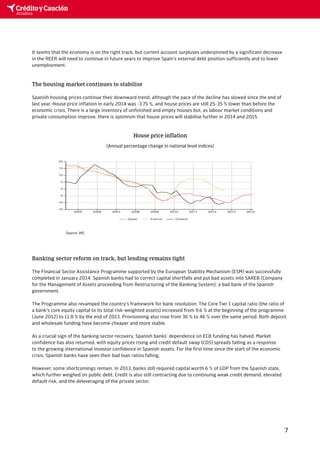
The housing market continues to stabilise 
Spanish housing prices continue their downward trend, although the pace of the decline has slowed since the end of 
last year. House price infl ation in early 2014 was -3.75 %, and house prices are still 25-35 % lower than before the 
economic crisis. There is a large inventory of unfi nished and empty houses but, as labour market conditions and 
private consumption improve, there is optimism that house prices will stabilise further in 2014 and 2015. 
House price infl ation 
(Annual percentage change in national level indices) 
Banking sector reform on track, but lending remains tight 
The Financial Sector Assistance Programme supported by the European Stability Mechanism (ESM) was successfully 
completed in January 2014. Spanish banks had to correct capital shortfalls and put bad assets into SAREB (Company 
for the Management of Assets proceeding from Restructuring of the Banking System); a bad bank of the Spanish 
government. 
The Programme also revamped the country’s framework for bank resolution. The Core Tier 1 capital ratio (the ratio of 
a bank‘s core equity capital to its total risk-weighted assets) increased from 9.6 % at the beginning of the programme 
(June 2012) to 11.8 % by the end of 2013. Provisioning also rose from 36 % to 46 % over the same period. Both deposit 
and wholesale funding have become cheaper and more stable. 
As a crucial sign of the banking sector recovery, Spanish banks’ dependence on ECB funding has halved. Market 
confi dence has also returned, with equity prices rising and credit default swap (CDS) spreads falling as a response 
to the growing international investor confi dence in Spanish assets. For the fi rst time since the start of the economic 
crisis, Spanish banks have seen their bad loan ratios falling. 
However, some shortcomings remain. In 2013, banks still required capital worth 6 % of GDP from the Spanish state, 
which further weighed on public debt. Credit is also still contracting due to continuing weak credit demand, elevated 
default risk, and the deleveraging of the private sector. 
7 
!!! 
!Source: IHS 
!Banking sector reform on track, but lending remains tight The Financial Sector Assistance Programme supported by the European Stability Mechanism 
(ESM) was successfully completed in January 2014. Spanish banks had to correct capital 
shortfalls and put bad assets into SAREB (Company for the Management of Assets 
proceeding from Restructuring of the Banking System); a bad bank of the Spanish 
government. 
The Programme also revamped the country’s framework for bank resolution. The Core Tier 1 
capital ratio (the ratio of a bank's core equity capital to its total risk-weighted assets) increased 
from 9.6% at the beginning of the programme (June 2012) to 11.8% by the end of 2013. 
Provisioning also rose from 36% to 46% over the same period. Both deposit and wholesale 
funding have become cheaper and more stable. 
As a crucial sign of the banking sector recovery, Spanish banks’ dependence on ECB funding 
has halved. Market confidence has also returned, with equity prices rising and credit default 
swap (CDS) spreads falling as a response to the growing international investor confidence in 
Spanish assets. For the first time since the start of the economic crisis, Spanish banks have 
seen their bad loan ratios !!!!!! 
falling.
!Decreasing budget deficits in the coming years !In 2013 Spain´s fiscal deficit amounted to 6.5% of GDP, while public debt increased to 94% 
of GDP. Fiscal consolidation to get public spending under control has continued this year. 
Fiscal reforms have been employed to enhance the sustainability of the pension system and to 
establish a fiscal council. Public debt is expected to peak in 2016 (at 104% of GDP) while the 
fiscal deficit is forecast to continue to decrease in the coming years. In 2014 a fiscal deficit of 
5.7% is forecast, followed by a reduction to 4.8% of GDP in 2015. As agreed with the EU, the 
3% of GDP deficit obligation is projected to be met in 2016. ! 
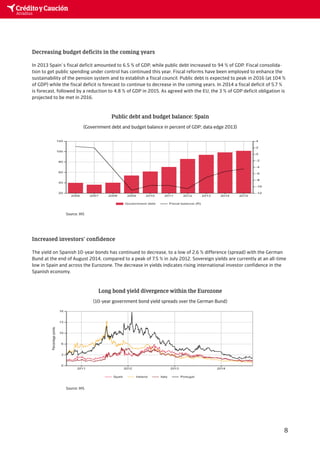
Decreasing budget defi cits in the coming years 
In 2013 Spain´s fi scal defi cit amounted to 6.5 % of GDP, while public debt increased to 94 % of GDP. Fiscal consolida-tion 
to get public spending under control has continued this year. Fiscal reforms have been employed to enhance the 
sustainability of the pension system and to establish a fi scal council. Public debt is expected to peak in 2016 (at 104 % 
of GDP) while the fi scal defi cit is forecast to continue to decrease in the coming years. In 2014 a fi scal defi cit of 5.7 % 
is forecast, followed by a reduction to 4.8 % of GDP in 2015. As agreed with the EU, the 3 % of GDP defi cit obligation is 
projected to be met in 2016. 
Public debt and budget balance: Spain 
!!!! 
Increased investors’ confidence !The yield on Spanish 10-year bonds has continued to decrease, to a low of 2.6% difference 
(spread) with the German Bund at the end of August 2014, compared to a peak of 7.5% in 
July 2012. Sovereign yields are currently at an all-time low in Spain and across the Eurozone. 
The decrease in yields indicates rising international investor confidence in the Spanish 
economy. ! 
Increased investors’ confi dence 
The yield on Spanish 10-year bonds has continued to decrease, to a low of 2.6 % difference (spread) with the German 
Bund at the end of August 2014, compared to a peak of 7.5 % in July 2012. Sovereign yields are currently at an all-time 
low in Spain and across the Eurozone. The decrease in yields indicates rising international investor confi dence in the 
Spanish economy. 
8 
(Government debt and budget balance in percent of GDP; data edge 2013) 
Source: IHS 
Long bond yield divergence within the Eurozone 
! !!! The insolvency environment !! 
Insolvency improvement in 2014 !(10-year government bond yield spreads over the German Bund) 
Source: IHS
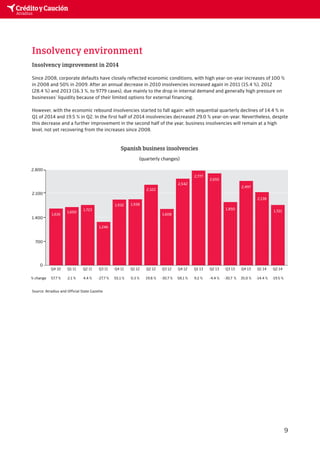
Insolvency environment 
Insolvency improvement in 2014 
Since 2008, corporate defaults have closely reflected economic conditions, with high year-on-year increases of 100 % 
in 2008 and 50% in 2009. After an annual decrease in 2010 insolvencies increased again in 2011 (15.4 %), 2012 
(28.4 %) and 2013 (16.3 %, to 9779 cases), due mainly to the drop in internal demand and generally high pressure on 
businesses’ liquidity because of their limited options for external financing. 
However, with the economic rebound insolvencies started to fall again: with sequential quarterly declines of 14.4 % in 
Q1 of 2014 and 19.5 % in Q2. In the first half of 2014 insolvencies decreased 29.0 % year-on-year. Nevertheless, despite 
this decrease and a further improvement in the second half of the year, business insolvencies will remain at a high 
level, not yet recovering from the increases since 2008. 
9 
2.800 
2.100 
1.400 
700 
0 
% change 
1,616 1,650 1,723 
1,246 
Spanish business insolvencies 
(quarterly changes) 
1,932 1,938 
2,322 
1,608 
2,542 
2,777 
2,655 
1,850 
2,497 
2,138 
1,721 
Q4 10 Q1 11 Q2 11 Q3 11 Q4 11 Q1 12 Q2 12 Q3 12 Q4 12 Q1 13 Q2 13 Q3 13 Q4 13 Q1 14 Q2 14 
57.7 % 2.1 % 4.4 % -27.7 % 55.1 % 0.3 % 19.8 % -30.7 % 58.1 % 9.2 % -4.4 % -30.7 % 35.0 % -14.4 % -19.5 % 
Source: Atradius and Official State Gazette
Automotive/ 
Transport 
Chemicals/ 
Pharma 
Construction 
Construction 
Materials 
Excellent Good Fair Poor Bleak 
10 
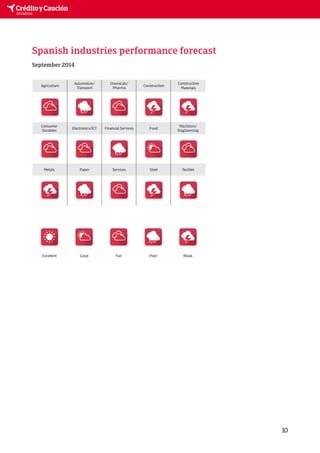
Spanish industries performance forecast 
September 2014 
Agriculture 
Electronics/ICT 
Financial Services 
Food 
Machines/ 
Engineering 
Consumer 
Durables 
Metals Paper Services Steel Textiles
Disclaimer 
This report is provided for information purposes only and is not intended as a recommendation as to particular 
transactions, investments or strategies in any way to any reader. Readers must make their own independent 
decisions, commercial or otherwise, regarding the information provided. While we have made every attempt 
to ensure that the information contained in this report has been obtained from reliable sources, Atradius is not 
responsible for any errors or omissions, or for the results obtained from the use of this information. All 
information in this report is provided ’as is’, with no guarantee of completeness, accuracy, timeliness or of the 
results obtained from its use, and without warranty of any kind, express or implied. In no event will Atradius, 
its related partnerships or corporations, or the partners, agents or employees thereof, be liable to you or 
anyone else for any decision made or action taken in reliance on the information in this report or for any 
consequential, special or similar damages, even if advised of the possibility of such damages. 
Copyright Atradius Credit Insurance N.V. 2014 
Paseo de la Castellana, 4 
28046 Madrid 
T. +34 914 326 300 
F. +34 914 326 501 
creditoycaucion.es

Informe País España (country report spain)

  • 1.
    Country Report Spain– September 2014
  • 2.
    2 Overview Generalinformation Most important sectors (% of GDP, 2013) Capital: Madrid Services: 70.3 % Government type: Parliamentary monarchy Industry: 26.4 % Currency: Euro (EUR) Agriculture: 3.3 % Population: 46.5 million Main import sources (2013, % of total) Main export markets (2013, % of total) Germany: 12.1 % France: 16.8 % France: 11.7 % Germany: 10.6 % Italy: 6.2 % Portugal: 7.8 % China: 5.6 % Italy: 7.4% The Netherlands: 5.0 % UK: 7.1 % Key indicators 2011 2012 2013 2014* 2015* Real GDP growth 0.7 -1.6 -1.2 1.2 1.9 (y-on-y, % change) Consumer price inflation 3.2 2.4 1.4 0.3 0.9 (y-on-y, % change) Real private consumption -0.1 -2.8 -2.1 1.5 1.6 (y-on-y, % change) Retail sales -4.8 -6.4 -3.7 0.7 1.0 (y-on-y, % change) Industrial production 1.5 -6.6 -1.6 1.7 1.3 (y-on-y, % change) Public consumption -2.2 -3.7 -2.3 -0.9 -0.5 (y-on-y, % change) Gross capital formation -5.2 -6.9 -8.7 0.5 2.9 (y-on-y, % change) Unemployment rate 21.6 24.8 26.1 24.9 23.7 (% of labour force) Real net exports (EUR billion) -0.5 23.6 37.8 42.3 52.5 Current account (% of GDP) -3.5 1.1 1.0 1.2 1.5 Fiscal balance (% of GDP) -8,5 -10.6** -6.8 -5.7 -4.8 * forecast **including aid to financial institutions Sources: INE, Funcas (consensus forecast), IHS Global Insight
  • 3.
    Political situation Stablegovernment Spain’s current government under Prime Minister Rajoy is well placed to pursue its economic policy as it holds a comfortable absolute majority in parliament and its term lasts until the end of 2015. The government has passed some structural reforms aimed at restoring competitiveness and investor confidence. Main economic developments The economic rebound gains momentum After two years of contraction, the latest business indicators show Spain‘s economic rebound gaining momentum. In Q2 of 2014 GDP grew 0.6 % compared to the previous quarter: the highest quarterly growth rate since Q1 of 2007. The Spanish economy has now grown for four quarters in a row. This rebound was initially due to high net exports, but now domestic demand has recovered somewhat from the severe impact of the rebalancing efforts in response to the construction bubble. Increasing foreign demand and higher business confidence have boosted business investment while a recovering labour market, rising confidence, and pent-up demand for consumer durables have boosted private consumption. Private components of domestic demand (essentially consumption and investments) have been the mainstay of GDP growth so far in 2014 and are expected to remain robust in the second half of the year. After three years of negative contributions to GDP, private consumption is forecast to contribute 0.9 % to the economic expansion in 2014. With the rebound of domestic demand, Spain´s economic performance is now more resilient and sustainable. As the recovery spreads from export and manufacturing industries to more domestically-focused businesses, Spain is currently recovering at a faster rate than its peripheral Eurozone peers. Growth forecasts have been raised to 1.2 % in 2014 and 1.9 % in 2015, reflecting successful economic reforms and rising domestic demand leading to a reduction in the large output gap. The International Monetary Fund (IMF) predicts that in coming years Spanish GDP growth rates will increase on a yearly basis, reaching 3 % in 2017. 3 4 3 2 1 0 -1 -2 -3 -4 GDP growth (% change on previous year) 2012 2013 2014* 2015* 2011 *forecast Source: Funcas -1.6 -1.2 1.2 1.9 0.7
  • 4.
    GDP growth (%change on previous year) !Source: Funcas (consensus forecast) !!!!! Contribution to GDP growth Private consumption (% change on previous year) 2011 Growth is having a positive impact on the labour market Labour market conditions have improved since 2013, with unemployment falling from 26.3 % in May 2013 to 24.5 % in July 2014: the largest decrease in unemployment since 2006. The addition of 190,000 jobs in 2013 was the fi rst annual increase in six years. At the same time the decrease in the labour force has also subsided, indicating a robust improvement in the labour market. These developments are also a result of labour reforms in 2012 which gave companies more fl exibility to set their own wages and working conditions. Unemployment is forecast to fall further in 2015: to below 24 %. However, some serious problems remain in the Spanish labour market: 15 % of the labour force has been unemployed for more than a year and youth unemployment remains high, at 55 %. Unemployment is not expected to fall below 20 % for at least another four years and more reforms to address structural labour market weaknesses appear necessary. 4 (Chain-weighted basis: forecast data edge 2013) !Source: IHS Bitte ! Graphik !!!! einfügen 4 3 2 1 0 -1 -2 -3 -4 2012 2013 2014* 2015* *forecast Source: Funcas -2.8 -2.1 1.5 1.6 -0.1
  • 5.
    Defl ation woes? Unemployment (Percentage rate of total workforce) The whole Eurozone currently faces decreasing infl ation and this is a concern for some of its member states, including Spain, where infl ation has fallen below zero in 2014, leading to defl ation. Year-on-year, the Spanish consumer price index (CPI) decreased to -0.3 % in July 2014 and to -0.5 % in August. This is worrying because, as prices fall, it becomes harder for Spanish debtors to service their debts fi xed in nominal terms. Another issue is that defl ation tends to suppress demand, as consumers have an incentive to delay purchases and consumption until prices fall further, which in turn could adversely affect economic activity. tends to suppress demand, as consumers have an incentive to delay purchases and consumption until prices fall further, which in turn could adversely affect economic activity. However, in early September 2014 the European Central Bank (ECB) cut interest rates to 0.05% and announced its plan to buy euro-denominated bonds and asset-backed securities to avoid a vicious circle of deflation in the Eurozone. At the same time, growing domestic demand should lead to increasing consumer prices in the coming months, reversing deflationary trends. Consumer prices are expected to increase again in 2015, to 0.9%. However, in early September 2014 the European Central Bank (ECB) cut interest rates to 0.05 % and announced its plan to buy euro-denominated bonds and asset-backed securities to avoid a vicious circle of defl ation in the Eurozone. At the same time, growing domestic demand should lead to increasing consumer prices in the coming months, reversing defl ationary trends. Consumer prices are expected to increase again in 2015, to 0.9 %. Consumer price infl ation ! International competitiveness is improving… Spain’s international competitiveness is improving and its export sector is relatively healthy and competitive. Indeed, 2007 has been the only recent year in which the GDP-contribution 5 of net exports has been negative. Nevertheless, a Real Effective Exchange Rate (REER) comparison (which measures a country’s international competitiveness as costs and !! prices more reforms to address structural labour market weaknesses appear necessary. !! !!!! Source: IHS !Deflation woes? The whole Eurozone currently faces decreasing inflation and this is a concern for some of its member states, including Spain, where inflation has fallen below zero in 2014, leading to deflation. Year-on-year, the Spanish consumer price index (CPI) decreased to -0.3% in July 2014 and to -0.5% in August. This is worrying because, as prices fall, it becomes harder for Spanish debtors to service their debts fixed in nominal terms. Another issue is that deflation (Annual percentage change) Source: IHS
  • 6.
    International competitiveness isimproving… Spain’s international competitiveness is improving and its export sector is relatively healthy and competitive. Indeed, 2007 has been the only recent year in which the GDP-contribution of net exports has been negative. Nevertheless, a Real Effective Exchange Rate (REER) comparison (which measures a country’s international competitiveness as costs and prices change) shows that there is still considerable room for improvement. While Spain´s REER decreased in the fi rst half of 2014, it is still the second highest of its Eurozone peers (see chart below). Real effective exchange rate (REER) fl uctuations !!!! …and is also reflected in current account surpluses !In 2013 the current account balance recorded its first surplus since 1986, at 0.8% of GDP in 2013, and in 2014 another surplus of 0.7% of GDP is expected. This turnaround reflects the structural improvements in international competitiveness: Spain recorded strong export performance in 2013 (up 5.2%), offering a favourable product mix, diversifying export markets and, while France and Germany remain key export destinations, Spain has increased shipments to emerging markets across Africa, Latin America, and the Middle East. In addition, foreign direct investment (FDI) has improved and is currently at a healthy level. Despite significant improvements in the current account, Spain’s net external debt, at 92% of GDP, makes it one of the most indebted countries in the Eurozone. However, this ratio is expected to decrease in the coming years. ! …and is also refl ected in current account surpluses In 2013 the current account balance recorded its fi rst surplus since 1986, at 0.8 % of GDP in 2013, and in 2014 another surplus of 0.7 % of GDP is expected. This turnaround refl ects the structural improvements in international competitiveness: Spain recorded strong export performance in 2013 (up 5.2 %), offering a favourable product mix, diversifying export markets and, while France and Germany remain key export destinations, Spain has increased shipments to emerging markets across Africa, Latin America, and the Middle East. In addition, foreign direct investment (FDI) has improved and is currently at a healthy level. Despite signifi cant improvements the current account, Spain’s net external debt, at 92 % of GDP, makes it one of the most indebted countries in the Eurozone. However, this ratio is expected to decrease in the coming years. Current account balance !! 6 It seems that the economy is on the right track, but current account surpluses underpinned by a significant decrease in the REER will need to continue in future years to improve Spain’s (Trade-weighted currency baskets adjusted for relative infl ation) !Source: IHS !…and is also reflected in current account surpluses In 2013 the current account balance recorded its first surplus since 1986, at 0.8% of GDP in 2013, and in 2014 another surplus of 0.7% of GDP is expected. This turnaround reflects the structural improvements in international competitiveness: Spain recorded strong export performance in 2013 (up 5.2%), offering a favourable product mix, diversifying export markets and, while France and Germany remain key export destinations, Spain has increased shipments to emerging markets across Africa, Latin America, and the Middle East. In addition, foreign direct investment (FDI) has improved and is currently at a healthy level. Despite significant improvements (Current in the account current balance: account, percentage Spain’s of net GDP) external debt, at 92% of GDP, makes it one of the most indebted countries in the Eurozone. However, this ratio is expected to decrease in the coming years. ! !!! Source: IHS
  • 7.
    !The housing marketcontinues to stabilise Spanish housing prices continue their downward trend, although the pace of the decline has slowed since the end of last year. House price inflation in early 2014 was -3.75%, and house prices are still 25-35% lower than before the economic crisis. There is a large inventory of unfinished and empty houses but, as labour market conditions and private consumption improve, there is optimism that house prices will stabilise further in 2014 and 2015. It seems that the economy is on the right track, but current account surpluses underpinned by a signifi cant decrease in the REER will need to continue in future years to improve Spain’s external debt position suffi ciently and to lower unemployment. The housing market continues to stabilise Spanish housing prices continue their downward trend, although the pace of the decline has slowed since the end of last year. House price infl ation in early 2014 was -3.75 %, and house prices are still 25-35 % lower than before the economic crisis. There is a large inventory of unfi nished and empty houses but, as labour market conditions and private consumption improve, there is optimism that house prices will stabilise further in 2014 and 2015. House price infl ation (Annual percentage change in national level indices) Banking sector reform on track, but lending remains tight The Financial Sector Assistance Programme supported by the European Stability Mechanism (ESM) was successfully completed in January 2014. Spanish banks had to correct capital shortfalls and put bad assets into SAREB (Company for the Management of Assets proceeding from Restructuring of the Banking System); a bad bank of the Spanish government. The Programme also revamped the country’s framework for bank resolution. The Core Tier 1 capital ratio (the ratio of a bank‘s core equity capital to its total risk-weighted assets) increased from 9.6 % at the beginning of the programme (June 2012) to 11.8 % by the end of 2013. Provisioning also rose from 36 % to 46 % over the same period. Both deposit and wholesale funding have become cheaper and more stable. As a crucial sign of the banking sector recovery, Spanish banks’ dependence on ECB funding has halved. Market confi dence has also returned, with equity prices rising and credit default swap (CDS) spreads falling as a response to the growing international investor confi dence in Spanish assets. For the fi rst time since the start of the economic crisis, Spanish banks have seen their bad loan ratios falling. However, some shortcomings remain. In 2013, banks still required capital worth 6 % of GDP from the Spanish state, which further weighed on public debt. Credit is also still contracting due to continuing weak credit demand, elevated default risk, and the deleveraging of the private sector. 7 !!! !Source: IHS !Banking sector reform on track, but lending remains tight The Financial Sector Assistance Programme supported by the European Stability Mechanism (ESM) was successfully completed in January 2014. Spanish banks had to correct capital shortfalls and put bad assets into SAREB (Company for the Management of Assets proceeding from Restructuring of the Banking System); a bad bank of the Spanish government. The Programme also revamped the country’s framework for bank resolution. The Core Tier 1 capital ratio (the ratio of a bank's core equity capital to its total risk-weighted assets) increased from 9.6% at the beginning of the programme (June 2012) to 11.8% by the end of 2013. Provisioning also rose from 36% to 46% over the same period. Both deposit and wholesale funding have become cheaper and more stable. As a crucial sign of the banking sector recovery, Spanish banks’ dependence on ECB funding has halved. Market confidence has also returned, with equity prices rising and credit default swap (CDS) spreads falling as a response to the growing international investor confidence in Spanish assets. For the first time since the start of the economic crisis, Spanish banks have seen their bad loan ratios !!!!!! falling.
  • 8.
    !Decreasing budget deficitsin the coming years !In 2013 Spain´s fiscal deficit amounted to 6.5% of GDP, while public debt increased to 94% of GDP. Fiscal consolidation to get public spending under control has continued this year. Fiscal reforms have been employed to enhance the sustainability of the pension system and to establish a fiscal council. Public debt is expected to peak in 2016 (at 104% of GDP) while the fiscal deficit is forecast to continue to decrease in the coming years. In 2014 a fiscal deficit of 5.7% is forecast, followed by a reduction to 4.8% of GDP in 2015. As agreed with the EU, the 3% of GDP deficit obligation is projected to be met in 2016. ! Decreasing budget defi cits in the coming years In 2013 Spain´s fi scal defi cit amounted to 6.5 % of GDP, while public debt increased to 94 % of GDP. Fiscal consolida-tion to get public spending under control has continued this year. Fiscal reforms have been employed to enhance the sustainability of the pension system and to establish a fi scal council. Public debt is expected to peak in 2016 (at 104 % of GDP) while the fi scal defi cit is forecast to continue to decrease in the coming years. In 2014 a fi scal defi cit of 5.7 % is forecast, followed by a reduction to 4.8 % of GDP in 2015. As agreed with the EU, the 3 % of GDP defi cit obligation is projected to be met in 2016. Public debt and budget balance: Spain !!!! Increased investors’ confidence !The yield on Spanish 10-year bonds has continued to decrease, to a low of 2.6% difference (spread) with the German Bund at the end of August 2014, compared to a peak of 7.5% in July 2012. Sovereign yields are currently at an all-time low in Spain and across the Eurozone. The decrease in yields indicates rising international investor confidence in the Spanish economy. ! Increased investors’ confi dence The yield on Spanish 10-year bonds has continued to decrease, to a low of 2.6 % difference (spread) with the German Bund at the end of August 2014, compared to a peak of 7.5 % in July 2012. Sovereign yields are currently at an all-time low in Spain and across the Eurozone. The decrease in yields indicates rising international investor confi dence in the Spanish economy. 8 (Government debt and budget balance in percent of GDP; data edge 2013) Source: IHS Long bond yield divergence within the Eurozone ! !!! The insolvency environment !! Insolvency improvement in 2014 !(10-year government bond yield spreads over the German Bund) Source: IHS
  • 9.
    Insolvency environment Insolvencyimprovement in 2014 Since 2008, corporate defaults have closely reflected economic conditions, with high year-on-year increases of 100 % in 2008 and 50% in 2009. After an annual decrease in 2010 insolvencies increased again in 2011 (15.4 %), 2012 (28.4 %) and 2013 (16.3 %, to 9779 cases), due mainly to the drop in internal demand and generally high pressure on businesses’ liquidity because of their limited options for external financing. However, with the economic rebound insolvencies started to fall again: with sequential quarterly declines of 14.4 % in Q1 of 2014 and 19.5 % in Q2. In the first half of 2014 insolvencies decreased 29.0 % year-on-year. Nevertheless, despite this decrease and a further improvement in the second half of the year, business insolvencies will remain at a high level, not yet recovering from the increases since 2008. 9 2.800 2.100 1.400 700 0 % change 1,616 1,650 1,723 1,246 Spanish business insolvencies (quarterly changes) 1,932 1,938 2,322 1,608 2,542 2,777 2,655 1,850 2,497 2,138 1,721 Q4 10 Q1 11 Q2 11 Q3 11 Q4 11 Q1 12 Q2 12 Q3 12 Q4 12 Q1 13 Q2 13 Q3 13 Q4 13 Q1 14 Q2 14 57.7 % 2.1 % 4.4 % -27.7 % 55.1 % 0.3 % 19.8 % -30.7 % 58.1 % 9.2 % -4.4 % -30.7 % 35.0 % -14.4 % -19.5 % Source: Atradius and Official State Gazette
  • 10.
    Automotive/ Transport Chemicals/ Pharma Construction Construction Materials Excellent Good Fair Poor Bleak 10 Spanish industries performance forecast September 2014 Agriculture Electronics/ICT Financial Services Food Machines/ Engineering Consumer Durables Metals Paper Services Steel Textiles
  • 11.
    Disclaimer This reportis provided for information purposes only and is not intended as a recommendation as to particular transactions, investments or strategies in any way to any reader. Readers must make their own independent decisions, commercial or otherwise, regarding the information provided. While we have made every attempt to ensure that the information contained in this report has been obtained from reliable sources, Atradius is not responsible for any errors or omissions, or for the results obtained from the use of this information. All information in this report is provided ’as is’, with no guarantee of completeness, accuracy, timeliness or of the results obtained from its use, and without warranty of any kind, express or implied. In no event will Atradius, its related partnerships or corporations, or the partners, agents or employees thereof, be liable to you or anyone else for any decision made or action taken in reliance on the information in this report or for any consequential, special or similar damages, even if advised of the possibility of such damages. Copyright Atradius Credit Insurance N.V. 2014 Paseo de la Castellana, 4 28046 Madrid T. +34 914 326 300 F. +34 914 326 501 creditoycaucion.es