INFORMATIVE AND
POSITIVE
MESSAGES
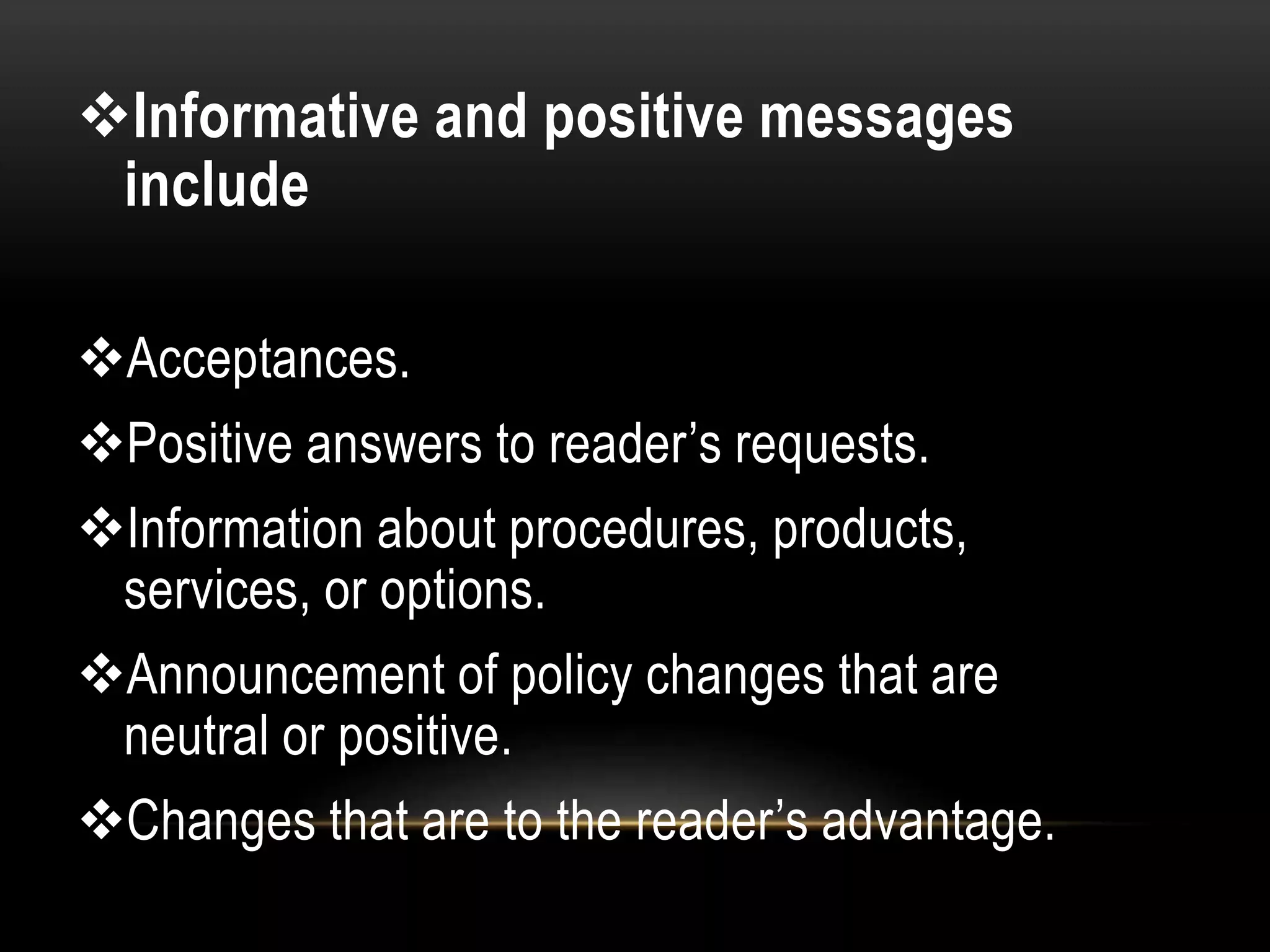
Informative and positive messages
include
Acceptances.
Positive answers to reader’s requests.
Information about procedures, products,
services, or options.
Announcement of policy changes that are
neutral or positive.
Changes that are to the reader’s advantage.
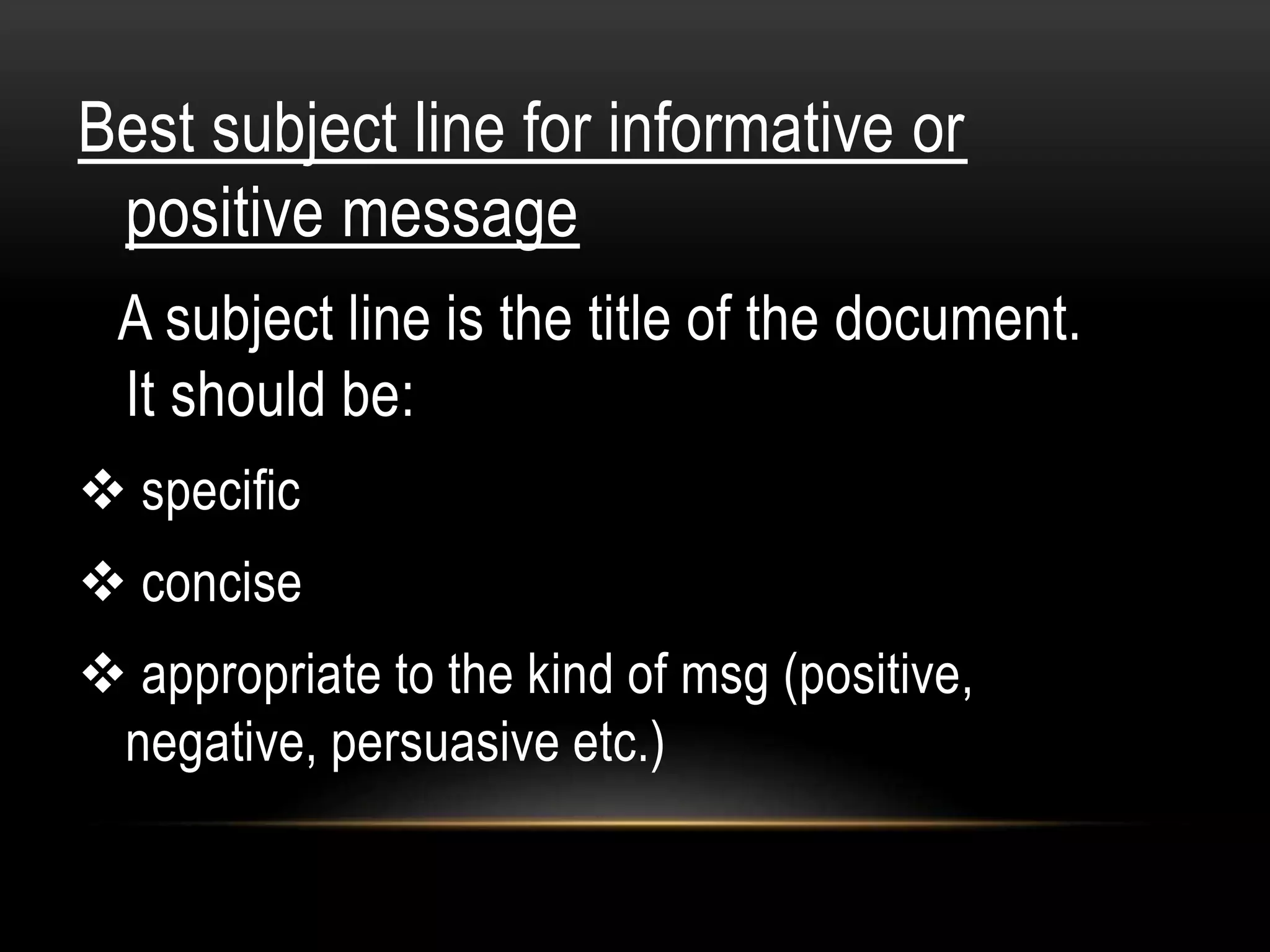
Best subject line for informative or
positive message
A subject line is the title of the document.
It should be:
 specific
 concise
 appropriate to the kind of msg (positive,
negative, persuasive etc.)
SPECIFIC SUBJECT LINE
Too general: Training Sessions
(To make this SL more specific identify the
particular topic of this msg.)
Better: Dates for 2005 Training Sessions.
Or: Evaluation of Training Sessions on
Conducting Interviews.
CONCISE SUBJECT LINE
Subject lines should be short- usually not
more than 10 words.
Wordy SL: Survey of student preferences in
regards to various pizza factors again, the best
revision depends on the specific factors you will
discuss.
Better: Students’ Pizza Preferences
Or: The feasibility of a Domino’s branch on
campus.
SUBJECT LINES APPROPRIATE FOR
THE PATTERN OF ORGANIZATION
When you have good news for the reader,
build goodwill by highlighting it in the
subject line. When your information is
neutral, summarize it concisely for the
subject line.
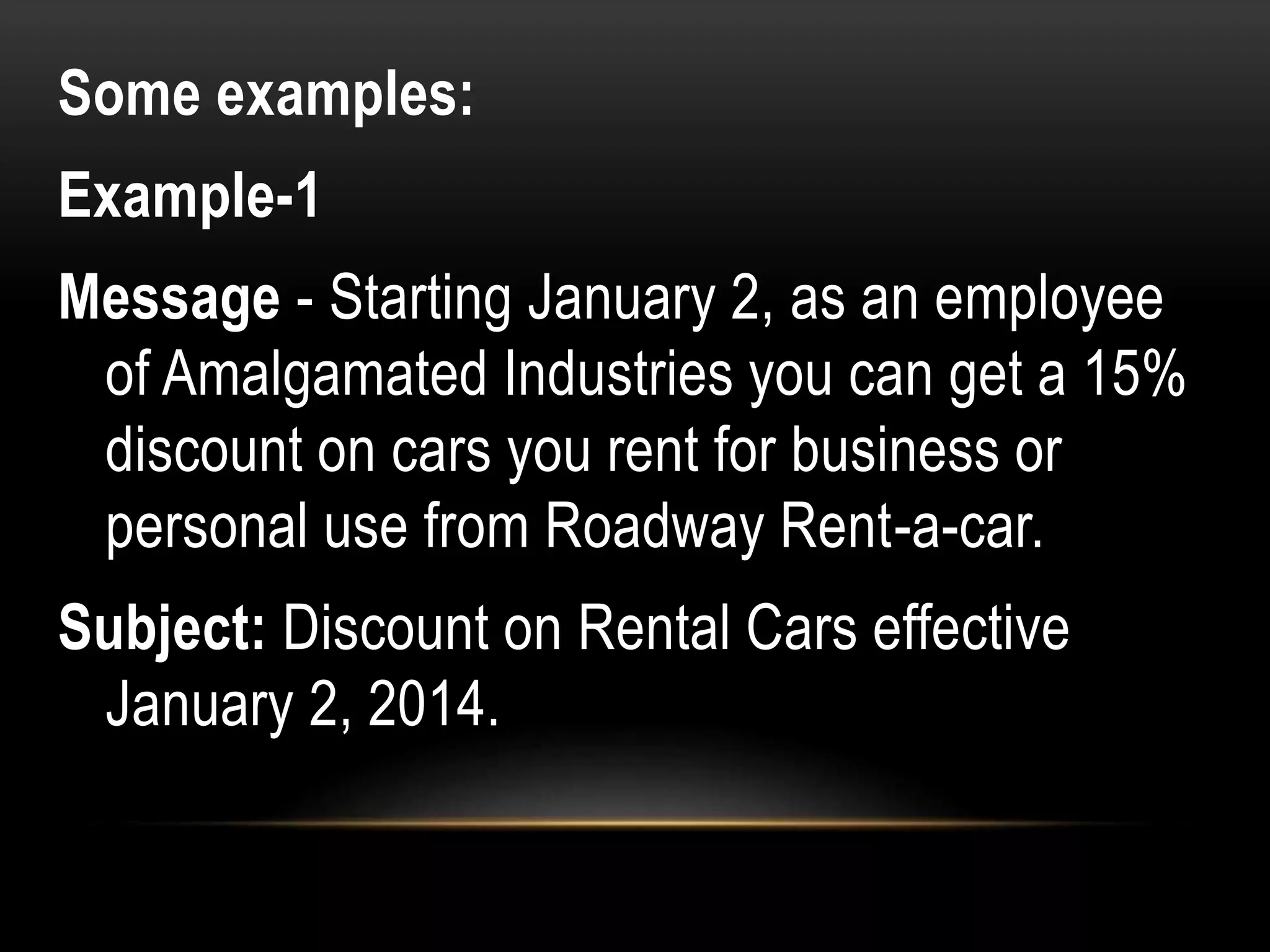
Some examples:
Example-1
Message - Starting January 2, as an employee
of Amalgamated Industries you can get a 15%
discount on cars you rent for business or
personal use from Roadway Rent-a-car.
Subject: Discount on Rental Cars effective
January 2, 2014.
Example 2:
Message: In the last month, we have chosen the
participants and developed a tentative agenda
for the videoconference with France scheduled
for March 21, 2014.
Subject: Update on arrangements for
Videoconference with France.
HOW TO ORGANIZE INFORMATIVE AND
POSITIVE MESSAGE
Main Point
Detail
Negatives
Reader Benifits
Goodwill Ending
Present informative and positive
messages in the following order:
1. Give any good news and summerize the main
points. Share good news immediately. Include
details such as the date policies begin and the
percent of a discount. If the reader has already
raised the issue, make it clear that you’re
responding.
2. Give details, clarifications, background.
Don’t repeat information from the first
paragraph. Provide all the information
necessary to achieve your purpose. Present
details in the order of importance to the reader.
3.Present any negative elements- as
positively as possible.
A policy may have limits; information may
be incomplete; the reader may
have to satisfy requirements to get
a discount or benefit. Make these negatives
clear, but present them as positively as
possible.
4. Explain any reader benefits. Most
informative memos need reader benefits.
Show that the policy or procedure helps
readers, not just the company. In letters,
you may want to give benefits of dealing
with your company as well as benefits of
the product or policy.
5.Use a goodwill ending: positive,
personal, and forward-looking. Shifting
your emphasis away from the message to
the specific reader suggests that serving
the reader is your real concern.
The most common kinds of informative
and positive messages are
confirmations, summaries, adjustments,
thank-you and congratulatory notes.

informative-and-positive-messages

  • 1.
  • 2.
    Informative and positivemessages include Acceptances. Positive answers to reader’s requests. Information about procedures, products, services, or options. Announcement of policy changes that are neutral or positive. Changes that are to the reader’s advantage.
  • 3.
    Best subject linefor informative or positive message A subject line is the title of the document. It should be:  specific  concise  appropriate to the kind of msg (positive, negative, persuasive etc.)
  • 4.
    SPECIFIC SUBJECT LINE Toogeneral: Training Sessions (To make this SL more specific identify the particular topic of this msg.) Better: Dates for 2005 Training Sessions. Or: Evaluation of Training Sessions on Conducting Interviews.
  • 5.
    CONCISE SUBJECT LINE Subjectlines should be short- usually not more than 10 words. Wordy SL: Survey of student preferences in regards to various pizza factors again, the best revision depends on the specific factors you will discuss. Better: Students’ Pizza Preferences Or: The feasibility of a Domino’s branch on campus.
  • 6.
    SUBJECT LINES APPROPRIATEFOR THE PATTERN OF ORGANIZATION When you have good news for the reader, build goodwill by highlighting it in the subject line. When your information is neutral, summarize it concisely for the subject line.
  • 7.
    Some examples: Example-1 Message -Starting January 2, as an employee of Amalgamated Industries you can get a 15% discount on cars you rent for business or personal use from Roadway Rent-a-car. Subject: Discount on Rental Cars effective January 2, 2014.
  • 8.
    Example 2: Message: Inthe last month, we have chosen the participants and developed a tentative agenda for the videoconference with France scheduled for March 21, 2014. Subject: Update on arrangements for Videoconference with France.
  • 9.
    HOW TO ORGANIZEINFORMATIVE AND POSITIVE MESSAGE Main Point Detail Negatives Reader Benifits Goodwill Ending
  • 10.
    Present informative andpositive messages in the following order: 1. Give any good news and summerize the main points. Share good news immediately. Include details such as the date policies begin and the percent of a discount. If the reader has already raised the issue, make it clear that you’re responding.
  • 11.
    2. Give details,clarifications, background. Don’t repeat information from the first paragraph. Provide all the information necessary to achieve your purpose. Present details in the order of importance to the reader.
  • 12.
    3.Present any negativeelements- as positively as possible. A policy may have limits; information may be incomplete; the reader may have to satisfy requirements to get a discount or benefit. Make these negatives clear, but present them as positively as possible.
  • 13.
    4. Explain anyreader benefits. Most informative memos need reader benefits. Show that the policy or procedure helps readers, not just the company. In letters, you may want to give benefits of dealing with your company as well as benefits of the product or policy.
  • 14.
    5.Use a goodwillending: positive, personal, and forward-looking. Shifting your emphasis away from the message to the specific reader suggests that serving the reader is your real concern.
  • 15.
    The most commonkinds of informative and positive messages are confirmations, summaries, adjustments, thank-you and congratulatory notes.