Informative
Speech Outline
Unit 5 Assignment: Informative Speech Outline
Post University
Brenton Sansoni
COM107 – Introduction to Communication
Professor Veronica Vazques
October 2, 2021
INTRODUCTION & THESIS
Thesis Statement:
Life is a matter of choices, and every choice has a consequence.
Embracing negative behaviors and lifestyles results to miserable
and desperate lives while as opting to engage in positive
behaviors and lifestyles is restraining in a way but ends up in
quality life success.
Introduction of Topic:
People, groups and nations in specific geographical economic,
political, cultural and religious text have different
characteristics if inhabitation in special time and place. Their
lifestyle includes day to day behaviors and functions in jobs,
activities, fun and diet. Any person either has or had unpleasant
habits. However, bad habits such as those that both harm human
health and restrict a person from full use of his or her abilities
throughout their life result in illness, disability and even death.
Some people try to get rid of them, others manage to accustom
themselves to a full life without bad habits, while another group
of people does not even think about getting rid of the, and start
living in a health manner.
Main point #1: Changes due to unhealthy lifestyles.
People's lives have changed dramatically in recent years.
Malnutrition, an unhealthy diet, smoking, alcohol consumption,
drug addiction, stress, and so on are examples of unhealthy
lifestyles that are widely practiced. Furthermore, residents' lives
are confronted with new obstacles. Emerging new IT
technologies, such as the internet and virtual communication
networks, for example, present our world with a huge dilemma
that jeopardizes people's physical and mental health. The
problem is that people are overusing and misusing technology.
According to Hagger and Rebar (2020), lifestyle and health risk
behaviors contribute to the leading causes of morbidity and
mortality among young people and adults. The greatest threat to
individual and global health is related to lifestyle and
behavioral choices which is no longer confined to the wealthier
societies (Al-Nakeeb et al, 2015). As a result, people have to be
empowered and encouraged to make positive, life-enhancing
health decisions for themselves on matters such as alcohol
consumption, unhealthy diet, tobacco use and unsafe sex.
According to Hagger and Rebar (2020), lifestyle and health risk
behaviors contribute to the leading causes of morbidity and
mortality among young people and adults. The greatest threat to
individual and global health is related to lifestyle and
behavioral choices which is no longer confined to the wealthier
societies (Al-Nakeeb et al, 2015). As a result, people have to be
empowered and encouraged to make positive, life-enhancing
health decisions for themselves on matters such as alcohol
consumption, unhealthy diet, tobacco use and unsafe sex.
Main point #2: problems associated with bad habit.
It is difficult for people to accept mistakes, but the hardest part
is to correct them since no one is perfect. Lifestyle has a
significant influence on physical and mental health of human
beings. Millions of people follow an unhealthy lifestyle and
encounter problems such as metabolic disease, joint and skeletal
issues, cardio-vascular disease, hypertension, overweight and
violence. As a result, lifestyle ailments result from individual
habits that detract them from activities and push them towards a
sedimentary routine which causes the health issues (Tabish,
2017).
According to Tabish (2017), non-communicable diseases related
to lifestyle habits kills around 4o million people each year,
which is around 70% of all deaths globally. The lifestyle
diseases resulting from individual habits can be controlled.
However, because of different occupations, individuals such as
those who operate machinery experience stress, anxiety and
fatigue which results in use of alcohol and drugs, and live in
high crime areas (Hagger & Rebar, (2020).
Main point #3: influences of bad habits in adolescence.
Unhealthy lifestyle habits can be changed and are frequently
formed throughout adolescence or early adulthood. Despite the
well-documented negative repercussions of harmful lifestyle
choices, a significant proportion of young adults, particularly
university students, participate in unhealthy lifestyle choices
(Kolesynk et al, 2020). The move from high school to university
is usually accompanied by a slew of pressures, all of which can
have a substantial impact on students' health-related lifestyle
choices. The transitional phase is crucial for the establishment
of lifetime healthy attitudes and practices, as well as the
prevention of biochemical precursors to chronic disease later in
life..
Excessive alcohol consumption, poor eating habits, tobacco
consumption, physical inactivity, poor body posture, and a
disrupted biological clock are all risk factors for lifestyle
disorders. The modern workplace (desk occupations) and work-
related stress are also being viewed as significant risk factors.
The negative habits therefore catalyze massive input of stresses
which require successful and ever-changing coping strategies
(Kabir & Nilphamari, 2018). Bad habits influences a pattern of
a person’s practices and behavioral choices therefore result in
unhealthy physical, mental and social wellbeing.
CONCLUSION
Malnutrition, an unhealthy diet, smoking, alcohol consumption,
drug addiction, stress, and so on are examples of unhealthy
lifestyles that are widely practiced.
Lifestyle has a significant influence on physical and mental
health of human beings.
Unhealthy lifestyle habits can be changed and are frequently
formed throughout adolescence or early adulthood.
Life is a series of decisions, each with its own set of
consequences. Negative behaviors and lifestyles lead to a
wretched and desperate existence, whereas healthy behaviors
and lifestyles are limiting in some ways yet lead to excellent
life success.
REFERENCES
Hagger, M. S., & Rebar, A. L. (2020). Habits. The Wiley
Encyclopedia of Health Psychology, 177-182.
Al-Nakeeb, Y., Lyons, M., Dodd, L. J., & Al-Nuaim, A. (2015).
An investigation into the lifestyle, health habits and risk factors
of young adults. International journal of environmental research
and public health, 12(4), 4380-4394.
Kolesnyk, N., Griban, G., Myroshnychenko, M., Tkachenko, P.,
Yavorska, T., Novitska, I., & Verbovskyi, I. (2020). Bad habits
and their impact on students health. Wiadomości Lekarskie.
Official journal of the Polish Medical Association, 2556(73
(11)), 2386-2395.
Kabir, A., & Nilphamari, B. (2018). Bad habits in our daily life
and its solution. CPQ Medicine, 1(6), 1-3.
Student Last Name 2
***Please note for this assignment, you may use the first
person***
Student Name
Instructor Name
English 122
Date
Exploratory Essay and Research Proposal
I began this module with an interest in researching art
conservation and restoration efforts due to the recent burning of
Notre Dame Cathedral in France. As a History major, I have a
certain affinity for old buildings and ancient ruins and I was
curious to learn more about the techniques and policies utilized
when undergoing any kind of restorative efforts. This left me
with three questions: What are the criteria for determining when
art needs restoration or not? What are the restoration practices
and techniques currently in use and are any of them
controversial? Outside of time or nature, what are the most
common threats to art and architecture that cause the need for
restoration and conservation efforts? These seemed like strong
questions to cast a wide net of research with, but I wanted to
narrow my searches down. Since Notre Dame was my
inspiration, I began looking for any articles that discussed any
immediate proposals for rebuilding it. Comment by Katherine
Burton: The introduction includes how/why the student is
interested in the topic and a brief overview of the topic. He
explains how he began his search for sources.
I found my first source when I was researching a rumor
that had been promulgated by numerous sources concerning the
use of a video game in rebuilding the cathedral. Multiple
internet sources had indicated that Ubisoft, the creator of
Assassin’s Creed: Unity, was going to be consulted in efforts to
rebuild Notre Dame Cathedral. However, upon further
investigation it turned out that the company was simply
donating half a million Euros and was “not currently involved
in the reconstruction of Notre Dame” (MacDonald). While the
rumor had turned out to be false, the information that I did find
caused me to consider if perhaps the company should be
consulted in these efforts. The designers of the game “spent 14
months working almost exclusively on the cathedral” to ensure
that the digital model was as accurate as the real thing after all
(MacDonald). I wanted to further research the use of technology
in archeological sites, but I was not satisfied in my research
into Notre Dame specifically and wanted to fulfill that
satisfaction before moving on with my research. Comment by
Katherine Burton: Student begins with how they came across
their first source and what he found. He then segues into how he
“stumbled” upon another source.
This process caused me to stumble upon an old Time
magazine article that had been recently republished. Instead of
being about the fire at Notre Dame, this 2017 article entitled
“Notre Dame Cathedral Is Crumbling. Who Will Help Save It?”
by Vivienne Walt, was a call for help for the medieval building
two years prior to the tragic fire. I was struck by this prophetic
article and knew that I had to read it. It was here that I learned
that the French government budgeted nearly 7 million U.S.
dollars towards restoration efforts of Notre Dame in 2017, but
also that “the cathedral is just one of many old buildings in
need of care. France has thousands of monuments,” and “Notre
Dame is not necessarily the most pressing case” (Walt). At this
point, I wanted to see what technology could do to potentially
alleviate problems like this for governments. Essentially, if
France, for example, has thousands of monuments, is there a
way for technology to handle restoration efforts for some of
those better than others in to ensure that as much restoration as
possible can be done? Comment by Katherine Burton:
Student includes what information he found in this source and
how it begged another question for him to investigate.
With this narrower focus in mind, I turned to the online
resource databases to find more information where I found Dr.
Cristina Portales’ article “Photogrammetry and Augmented
Reality for Cultural Heritage Applications.” This article
explained the usage of augmented reality to recreate a Baroque
vault and Renaissance reredos that used to exist in a Spanish
cathedral. Augmented reality is a process that “permits the
simultaneous viewing of both virtual and real 3D data” (Portales
316). In other words, if we were standing in front of an ancient
gateway that used to have an arch on top of two pillars that has
collapsed, we could utilize augmented reality projections to
create a digital recreation of the fallen arch on top of the real
pillars that remain. This process fascinated me as I immediately
saw it as a potential way to replace restoration efforts for lower
priority projects that could possibly free up funding that could
be reallocated to higher priority restoration efforts. Comment by
Katherine Burton: Having narrowed his focus, the student does
a database search and includes what he learned.
I also found an article entitled “3D Printing and 3D
Scanning of Our Ancient History: Preservation and Protection
of Our Cultural Heritage and Identity,” by Maher Al-Baghdadi.
This article described using 3D printing and scanning
techniques to create numerous replicas of various Iraqi cultural
artifacts. The need for this process is due to “hundreds of
thousands of artifacts,” of Iraqi heritage being scattered to the
archives of museums around the world (Al-Baghdadi 441). In
this context, the author is seeking to use technology to replicate
stored artifacts to make them more visible to the world via mass
production. However, this article also caused me to wonder if
this technology could be utilized to totally replace the
restoration of ancient pottery or similar, smaller works? In
theory, this would again reduce the cost of restoration projects
for nations and allow them to reallocate those funds to higher
priority projects. Comment by Katherine Burton: After
reading this article, the student thinks of another question that
he will try to find an answer for. He is letting the research guide
him and he is describing his process. That is the purpose of an
exploratory research paper.
From this point, I decided to search for art conservation videos
or TED talks. I ended up watching a speech entitled “The Secret
Lives of Paintings,” in which the speaker talked about the
various uses of imaging technologies to expose poor restoration
efforts and reveal the true nature of certain famous images. The
speaker gives a specific example about “the ‘Lady with the
Unicorn,’ another painting by Rafael, well, you see the unicorn.
A lot has been said and written about the unicorn, but if you
take an X-ray of the unicorn, it becomes a puppy dog” (“The
Secret Lives of Paintings”). The speaker goes on to reveal that
Rafael left the piece blank and that these other images were
added to the painting after the fact. This inspired me to research
the ethical considerations regarding art conservation.
Comment by Katherine Burton: The student is using a
variety of sources, including TED talks. After reviewing each
source, he comes up with more questions.
On the ethics front, I found a pair of sources. The first one
concerned the use of Virtual Reality to replicate places like the
Palace at Knossos. Knossos, like many ancient sites, is
constantly under restoration projects because of the age of the
ruins and the volume of visitors they experience each year. To
combat these problems, proposals exist to create a Virtual
Reality model of the Palace of Knossos to have tourists visit
instead of the real site. This proposal is vehemently rejected by
the article “Fighting with Pictures: The Archaeology of
Reconstructions,” where the author points out that “life at
Knossos and Stonehenge in fact derives from the continuous
natural spectacle that monumental artifacts present” (Molyneaux
135). In other words, the thing that makes Stonehenge and
Knossos worth visiting is seeing them in nature, or reality, and
not just simply observing the physical dimensions of the
structures in an artificial world. The second article was an
opinion column in The Times regarding the Bamiyan Buddhas
that were destroyed by the Taliban in 2001. At the present time,
the United Nations Educational, Scientific, and Cultural
Organization (UNESCO) is not planning to restore the Buddhas
for fear of creating a monument to the Taliban despite outcries
to “resurrect a cherished cultural symbol” (Macintyre). This
article caused me to wish to look into UNESCO and their role in
conservation and restoration efforts since they had the ability to
dictate whether something would be restored or not.
Comment by Katherine Burton: The student describes each
component of his research process including specific areas he
wants to investigate.
Notice that each source is correctly cited in MLA format and
each in-text citation corresponds with a source citation on the
works cited page.
UNESCO is an international authority on the “protection and
preservation of cultural and natural heritage around the world
considered to be of outstanding value to humanity” (UNESCO
World Heritage Centre). On their website, they have lists of
sites under their protection and include a separate list for sites
that are endangered. With this organization being the authority
on my topic, I decided at this point that my argument should be
geared towards them.
I believe I have developed a working thesis for the next phase
of this essay if I am approved for it: UNESCO should adopt the
use of technologies like augmented reality, 3D printing, and
virtual reality in restoration practices in order to all eviate the
financial burden of physical restoration projects. Comment by
Katherine Burton: Working thesis statement
Works Cited Comment by Katherine Burton: Correctly
formatted works cited page:
Author last name or title first, followed by the publication (in
italics), volume number, edition number (if those apply), date in
Day Month Year format, database in italics (if applicable), then
the URL or DOI.
Entries are listed in alphabetical order. The https:// has been
removed from the URL and there are no hyperlinks.
Al-Baghdadi, Maher A. R.Sadiq. “3D Printing and 3D Scanning
of Our Ancient History: Preservation and Protection of Our
Cultural Heritage and Identity.” International Journal of Energy
& Environment, vol. 8, no. 5, Sept. 2017, pp. 441–
456. EBSCOhost,
search.ebscohost.com/login.aspx?direct=true&db=a9h&AN=124
951603&site=ehost-live&scope=site.
MacDonald, Keza. “Assassin's Creed Creators Pledge €500,000
to Notre Dame.” The Guardian, Guardian News and Media, 17
Apr. 2019, www.theguardian.com/games/2019/apr/17/assassins-
creed-creators-pledge-500000-notre-dame-restoration.
Macintyre, Ben. "Before We Go, Rebuild the Bamiyan Buddha;
Restoring this Landmark Would Be the Perfect Symbol of the
West's Good Intentions Towards Afghanistan. " Times [London,
England], 24 Apr. 2012, p. 21. Global Issues in Context,
link.galegroup.com.ccco.idm.oclc.org/apps/doc/A287485826/GI
C?u=aur58810&sid=GIC&xid=32958bfb. Accessed 28 Apr.
2019.
Molyneaux, Brian Leigh. “Fighting with Pictures: The
Archaeology of Reconstructions.” Journal of Mediterranean
Archaeology, vol. 12, no. 1, June 1999, p. 134. EBSCOhost,
doi:10.1558/jmea.v12i1.134
Portales, Cristina, et al. “Photogrammetry and Augmented
Reality for Cultural Heritage Applications.” Photogrammetric
Record, vol. 24, no. 128, Dec. 2009, pp. 316–331. EBSCOhost,
doi:10.1111/j.1477-9730.2009.00549.x.
“The Secret Lives of Paintings.” Performance by Maurizio
Seracini, TED, 2012,
www.ted.com/talks/maurizio_seracini_the_secret_lives_of_paint
ings?language=en.
UNESCO World Heritage Centre. “World Heritage.” UNESCO
World Heritage Centre, 2019, whc.unesco.org/en/about/.
Walt, Vivienne. “Notre Dame Cathedral Is Crumbling. Who
Will Help Save It?” Time, Time, 27 July 2017,
time.com/4876087/notre-dame-cathedral-is-crumbling/.
Comment by Katherine Burton: Student has the required
number of sources.
Module 5 Assignment: Researched Argument Essay
Overview
This semester you have discussed and analyzed multiple
perspectives on several topics. You have seen how all writing
exists in connection to others’ perspectives on a topic to create
an ongoing conversation. Now it is time to add your own
perspective to one of these conversations.
This assignment is the culmination of all the practice and
analysis you have completed this semester, and the culmination
of all the research you have completed in Modules 4 and 5.
Your research has allowed you to understand the perspectives,
and now it is time to use that research to add your own credible
voice to the conversation.
You should spend approximately 13 hours on this assignment.
Instructions
1. Research: Continue the research you started in Module 4.
Research the working thesis you developed in your Exploratory
Essay and Research Proposal, and consult the sources from your
field research and your Annotated Bibliography, adding or
changing sources if you need more support.
2. Pre-Write: What background information do your readers
need to know to understand your topic? Why should your
argument matter to your readers? How will you make your topic
significant to your readers? What types of arguments will best
appeal to your readers? What supporting points do you need to
make to support your thesis, and what evidence will you use to
support those points? What is your purpose in writing? What do
you want your readers to do, think, or feel after reading your
essay? What is the most effective tone to use for your
argument?
3. Write: Add your voice to an ongoing conversation on a topic
that is important to you. Write a researched argument
supporting your thesis on your topic.
· Introduction: You should give a thorough overview of the
topic in your introduction. Give background information,
history, and context to the issue. Identify the main points of
conflict or debate. Conclude the introduction with your
argumentative thesis.
· Argument: Argue directly for your position. Support your
claims with specific evidence. Remember to consider appeals to
ethos, logos, and pathos and to avoid logical fallacies. Use your
research to influence your depth of thought on the topic and to
create credibility in your arguments.
· Counterargument: Address at least one counterargument.
Carefully consider at least one of your opposition’s strongest
objections, and overcome or refute it. Support your rebuttal
argument with specific evidence.
· Conclusion: Synthesize the information you present in your
body paragraphs. What do you want your reader to do, think, or
feel after reading your essay?
4. Tips for Success:
· Your essay should be approximately 2,000-2,400 words.
· Your essay should cite 8-10 credible sources as support for
your argument. Your essay should contain 5-7 quotations from
your sources, and should paraphrase other main ideas. Use your
sources effectively, and stay in control of your argument. Be
sure to use quotation marks and in-text citations appropriately
and responsibly.
5. Please be sure to use correct MLA Style for your essay and to
create an MLA Works Cited page. Need help with MLA? Please
refer to the CCCOnline MLA Citation Toolkit
Due Date: Sunday at 11:59 pm of Unit 7
Points: 100
Overview:
This project consists of two parts: a written outline and a
presentation video. You have
already developed a detailed outline in preparation for your
speech. Now, you will deliver
the informative speech via video presentation.
Instructions:
The intent/focus of your speech should be to inform the
audience on a topic of your
choosing. Keep in mind and incorporate all lectures/activities
leading up to the
presentation. Your presentation must be supported by a
minimum of three credible
sources - this excludes personal experience.
You may record the speech using your cell phone or webcam.
You will then upload
your video to Youtube, ensuring you select the “unlisted”
option. This will keep your
video private and allow access only to those who have the video
link. You will then post
the video link in the unit 7 informative speech assignment link.
The length of the speech should be 5 minutes and include:
1. A clear visual aid
2. An attention getter
3. A thesis
4. A preview of main points
5. In speech citations of supporting materials (Say them out
loud during your
speech)
6. A summary of points in the conclusion
7. A memorable ending
8. A works cited page
Optional: If you choose to, you can use a PowerPoint
presentation along with your
speech (5 slide limit). Use the following tutorial to help you
combine your video with
your PowerPoint presentation using a free app called Bandicam.
COM107: Introduction to Communication
Unit 7 Assignment: Informative Speech Presentation
https://www.bandicam.com/how-to-record-powerpoint-
presentation/
Tips and Guidelines:
loudly and clearly so
the audience can hear you.
and be sure there is
no audio feedback on the recording.
expressions and other
body language are in clear view.
-standard attire for presenting in a classroom
setting.
limits.
presentation.
Requirements:
Be sure to read the criteria by which your work will be
evaluated before you write
and again after you write.
Evaluation Rubric for Unit 7 Assignment
CRITERIA Deficient
Needs
Improvement
Proficient Exemplary
(0-5 Points) (6-7 Points) (8-9 Points) (10 Points)
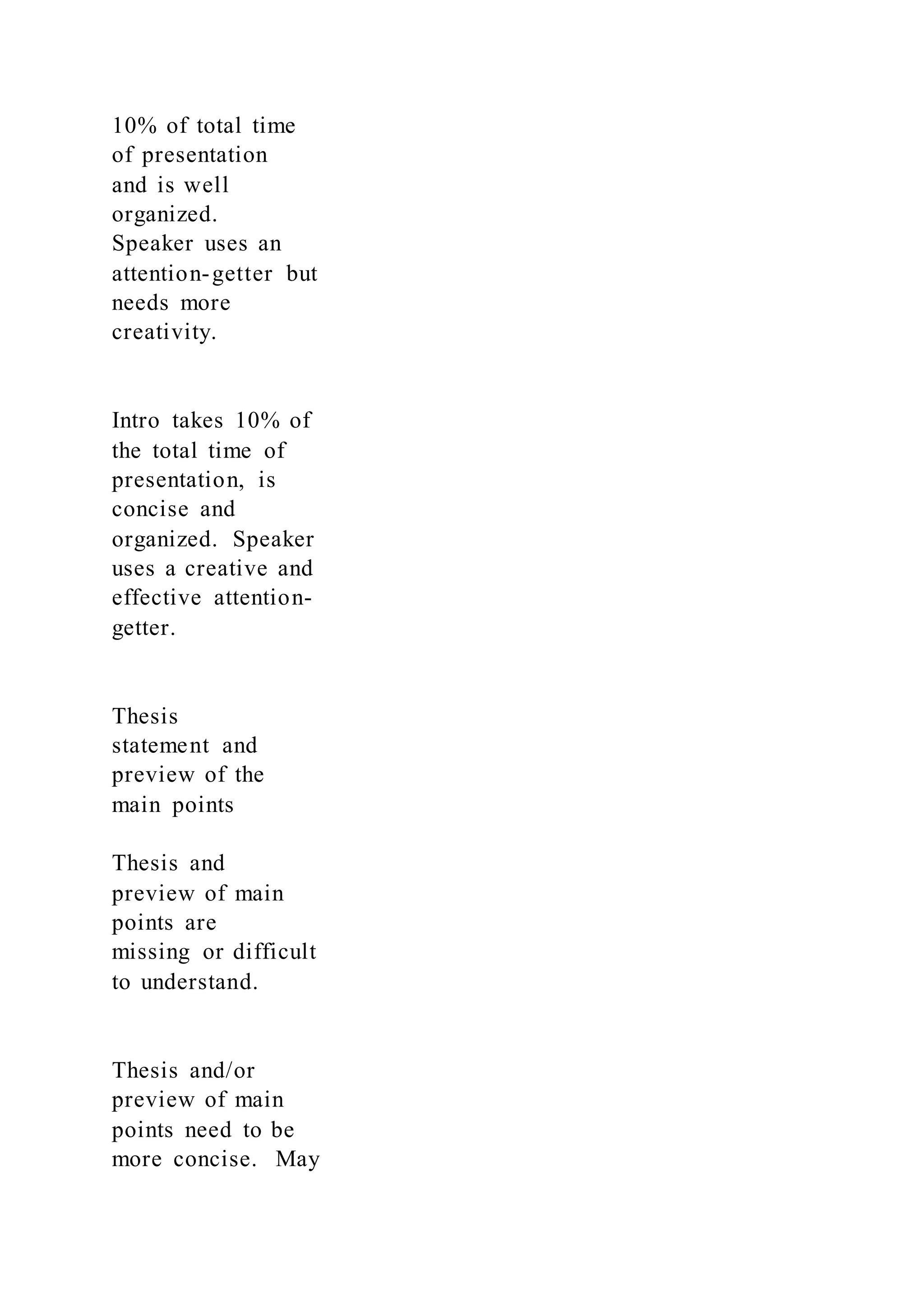
Introduction Intro is
significantly over
or under 10% of
the total time of
presentation.
Speaker does not
use an attention-
getter.
Intro is over or
under 10% of total
time of presentation
and needs more
organization.
Speaker's
attention-getter is
generic and not
engaging.
Intro takes close to
10% of total time
of presentation
and is well
organized.
Speaker uses an
attention-getter but
needs more
creativity.
Intro takes 10% of
the total time of
presentation, is
concise and
organized. Speaker
uses a creative and
effective attention-
getter.
Thesis
statement and
preview of the
main points
Thesis and
preview of main
points are
missing or difficult
to understand.
Thesis and/or
preview of main
points need to be
more concise. May
be confusing, too
wordy or too
general.
Speaker
articulates thesis
and preview of
main points but
may need more
development or
connection to
topic.
Thesis is well
developed and
simply stated.
Speaker clearly
articulates preview
of main points.
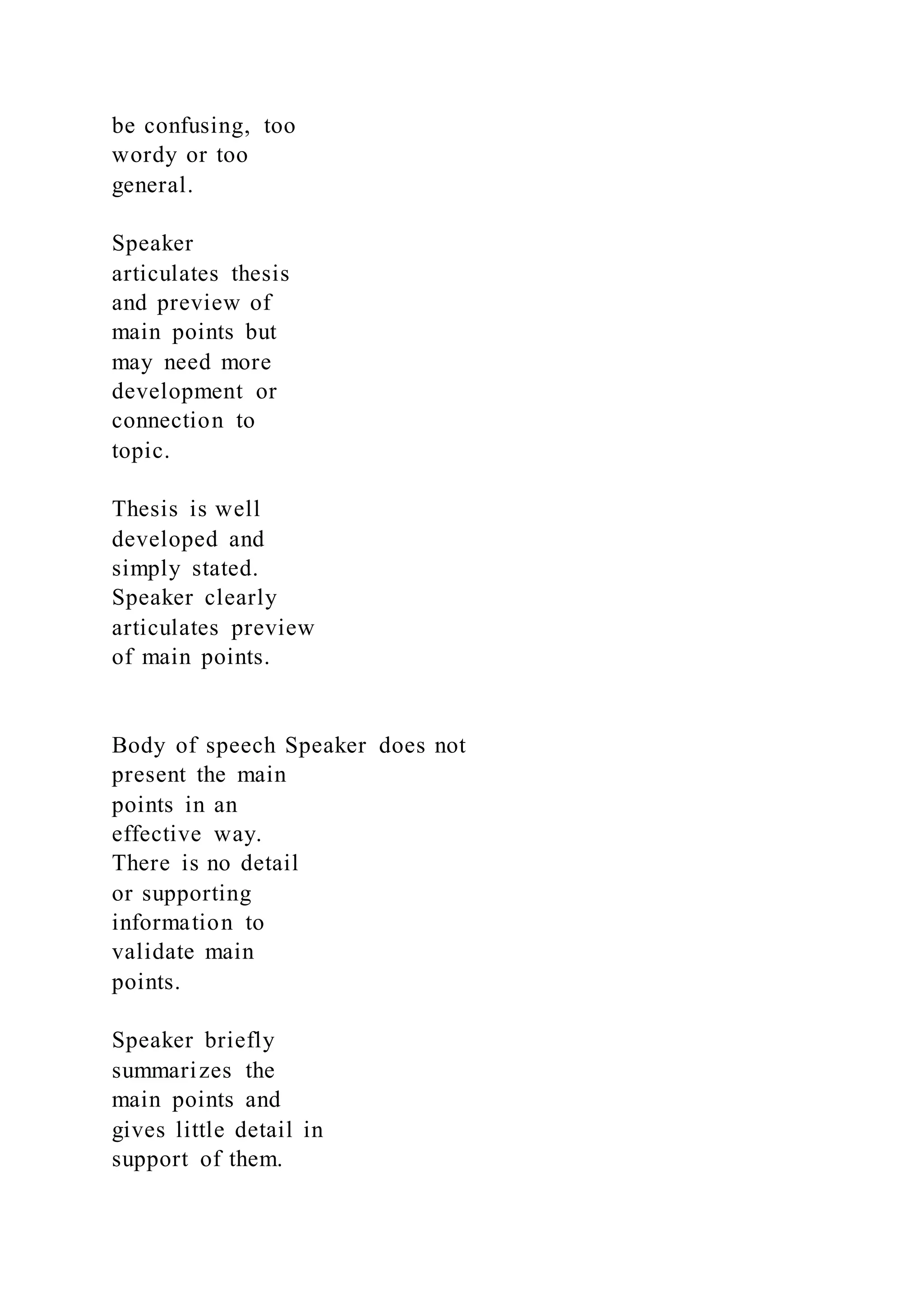
Body of speech Speaker does not
present the main
points in an
effective way.
There is no detail
or supporting
information to
validate main
points.
Speaker briefly
summarizes the
main points and
gives little detail in
support of them.
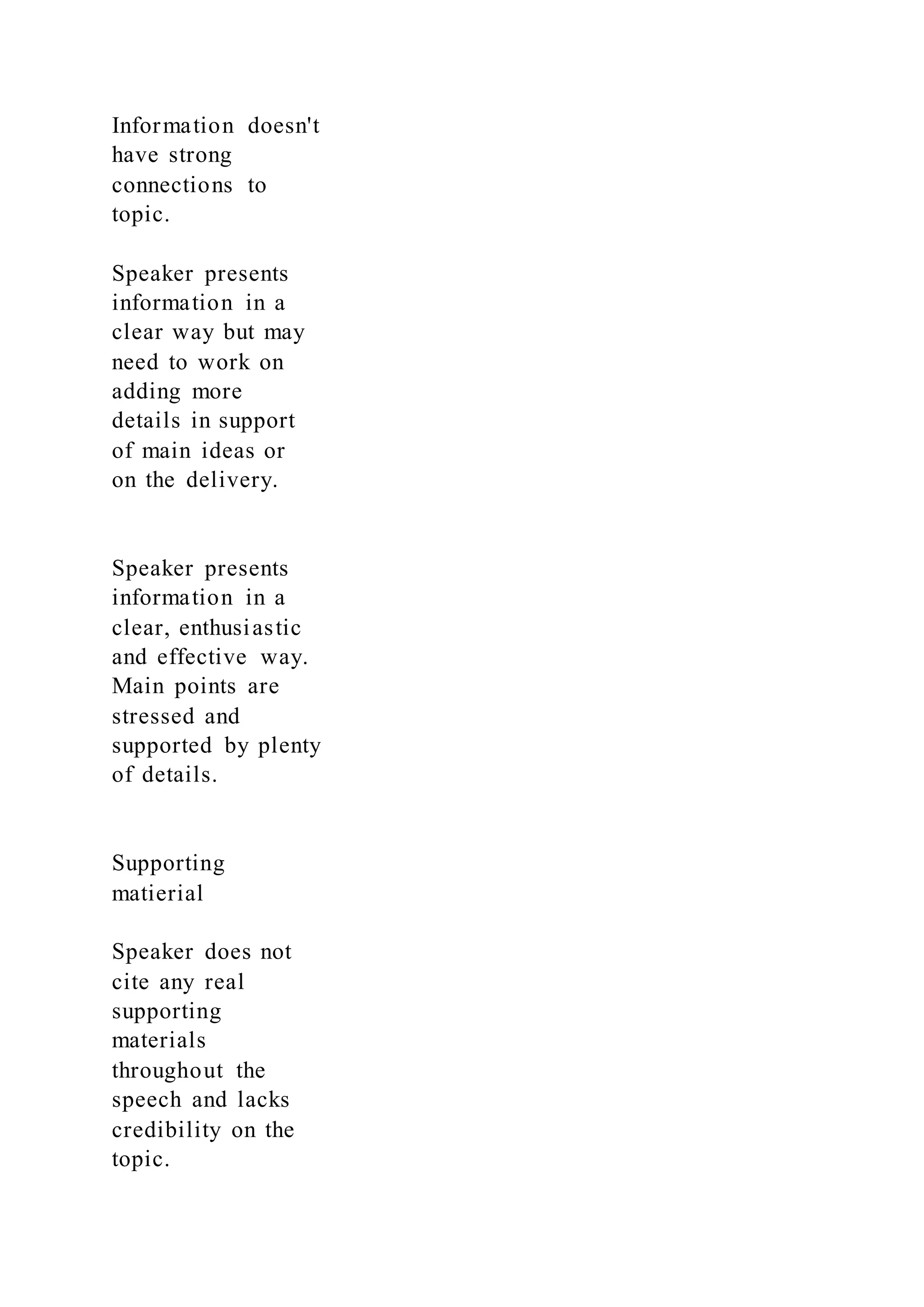
Information doesn't
have strong
connections to
topic.
Speaker presents
information in a
clear way but may
need to work on
adding more
details in support
of main ideas or
on the delivery.
Speaker presents
information in a
clear, enthusiastic
and effective way.
Main points are
stressed and
supported by plenty
of details.
Supporting
matierial
Speaker does not
cite any real
supporting
materials
throughout the
speech and lacks
credibility on the
topic.
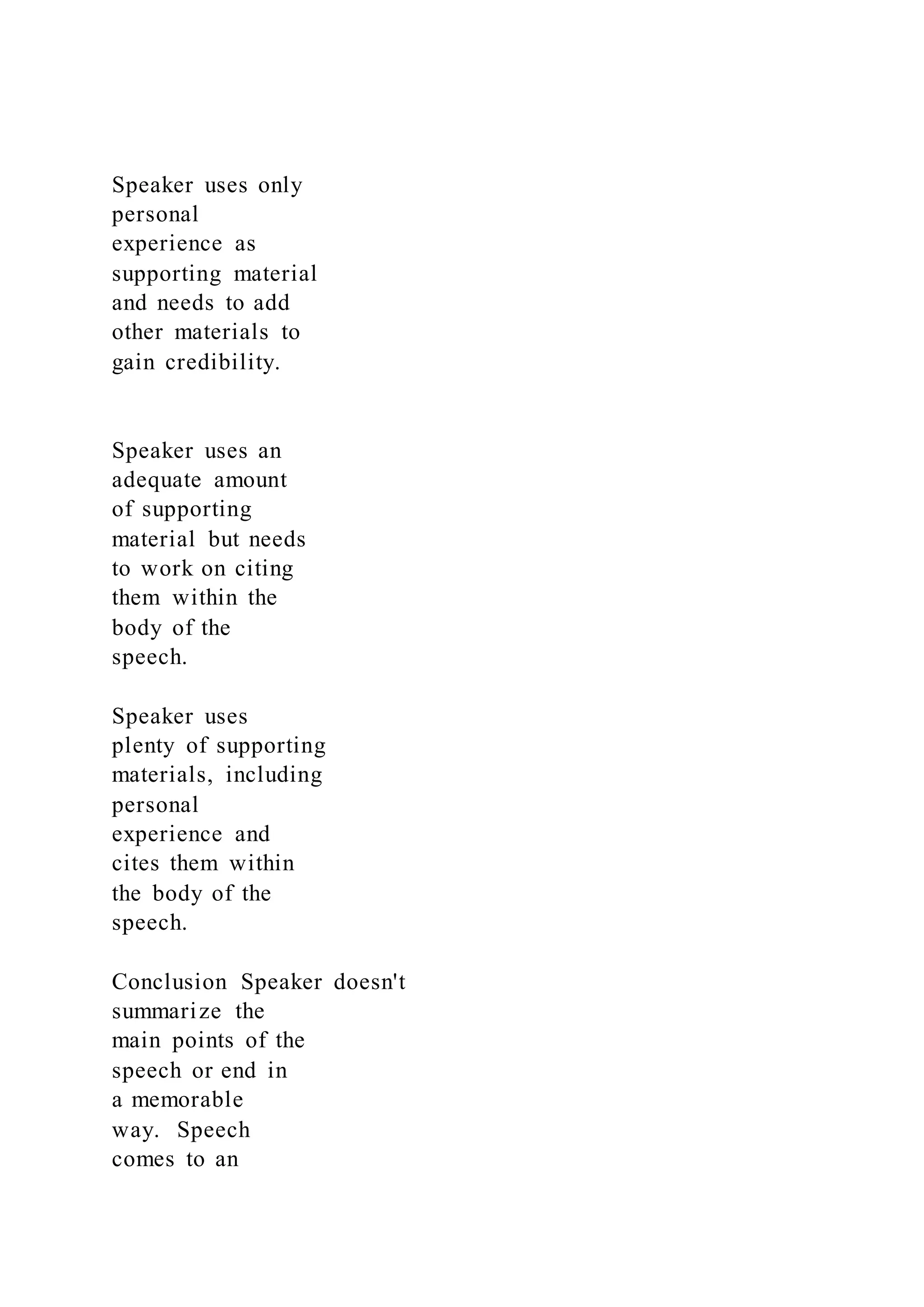
Speaker uses only
personal
experience as
supporting material
and needs to add
other materials to
gain credibility.
Speaker uses an
adequate amount
of supporting
material but needs
to work on citing
them within the
body of the
speech.
Speaker uses
plenty of supporting
materials, including
personal
experience and
cites them within
the body of the
speech.
Conclusion Speaker doesn't
summarize the
main points of the
speech or end in
a memorable
way. Speech
comes to an
awkward or
abrupt end.
Speaker doesn't
summarize main
points of the
speech in an
effective way.
Speaker doesn't
end in a
memorable way or
Speaker
summarizes the
main points of
speech but lacks
creativity in the
transition.
Speaker's closing
thought is
memorable but
Speaker
summarizes the
main points of the
speech in a creative
and effective way.
Speaker's final
thought is
memorable and
powerful.
the closing thought
is too generic.
could use more
imagination.
Format and
length
Is under or over
the requested
length by a
significant
amount.
Is under or over the
requested length by
2-3.
Is under or over
the requested
length by 1
minute.
Meets the length
and format
requirements- 5
minutes.
Works cited
page
Does not include
a works cited
page.
Includes a works
cited page but is
not in the proper
format or may not
have the required
amount of sources.
Includes a works
cited page with
few errors.
Includes a works
cited page in
correct APA format
with 3 credible
sources.
Visual aids There are no
visual aids used
to guide the
audience or they
are confusing and
irrelevant to the
topic.
The visual aids are
confusing or
unorganized. The
visual aids may
contain
misspellings or are
not relevant to the
topic.
Speaker uses
clear visual aids
that help guide the
audience. The
visual aids are
relevant to the
topic and free of
misspellings but
may need more
creativity.
Speaker uses clear
visual aids that help
guide the audience.
The visual aids are
free of misspellings,
are creative,
interesting and
relevant to the
topic.
Organization &
professionalism
There is no
consistent or
logical flow to the
information or
presentation.
Speaker is not
professional,
dressed for a
classroom setting
or uses language
that can be
offensive to
audience.
Audience may have
difficulty following
presentation
because it jumps
around. Speaker
needs to work on
transitions and
flow. May also
need to work on
professionalism.
Speaker presents
information in a
logical sequence
which audience
can follow but may
need to improve
flow from one topic
to the other.
Speaker is
professional and
dressed for
classroom setting.
Speaker presents
information in
logical, interesting
sequence which
audience can
follow. Topics flow
from one to the
other with good
transitions. Speaker
is professional and
dressed for
classroom setting.
Presentation
skills
Speaker is too
quiet or loud, is
not confident in
material, has little
to no eye contact
or is disinterested
or monotone.
Speaker exhibits
some mumbling,
little eye contact or
little to no
expression.
Speaker clearly
articulates ideas
but presentation
skills need
polishing. May
need to work on
more eye contact
and confidence.
Speaker is poised,
articulate, and has
good eye contact.
Speaker presents
information with
enthusiasm and
confidence.

Informative speech outline unit 5 assignment informative spe

  • 1.
    Informative Speech Outline Unit 5Assignment: Informative Speech Outline Post University Brenton Sansoni COM107 – Introduction to Communication Professor Veronica Vazques October 2, 2021 INTRODUCTION & THESIS Thesis Statement: Life is a matter of choices, and every choice has a consequence. Embracing negative behaviors and lifestyles results to miserable and desperate lives while as opting to engage in positive behaviors and lifestyles is restraining in a way but ends up in quality life success. Introduction of Topic: People, groups and nations in specific geographical economic, political, cultural and religious text have different characteristics if inhabitation in special time and place. Their lifestyle includes day to day behaviors and functions in jobs, activities, fun and diet. Any person either has or had unpleasant habits. However, bad habits such as those that both harm human health and restrict a person from full use of his or her abilities throughout their life result in illness, disability and even death. Some people try to get rid of them, others manage to accustom themselves to a full life without bad habits, while another group
  • 2.
    of people doesnot even think about getting rid of the, and start living in a health manner. Main point #1: Changes due to unhealthy lifestyles. People's lives have changed dramatically in recent years. Malnutrition, an unhealthy diet, smoking, alcohol consumption, drug addiction, stress, and so on are examples of unhealthy lifestyles that are widely practiced. Furthermore, residents' lives are confronted with new obstacles. Emerging new IT technologies, such as the internet and virtual communication networks, for example, present our world with a huge dilemma that jeopardizes people's physical and mental health. The problem is that people are overusing and misusing technology. According to Hagger and Rebar (2020), lifestyle and health risk behaviors contribute to the leading causes of morbidity and mortality among young people and adults. The greatest threat to individual and global health is related to lifestyle and behavioral choices which is no longer confined to the wealthier societies (Al-Nakeeb et al, 2015). As a result, people have to be empowered and encouraged to make positive, life-enhancing health decisions for themselves on matters such as alcohol consumption, unhealthy diet, tobacco use and unsafe sex. According to Hagger and Rebar (2020), lifestyle and health risk behaviors contribute to the leading causes of morbidity and mortality among young people and adults. The greatest threat to individual and global health is related to lifestyle and behavioral choices which is no longer confined to the wealthier societies (Al-Nakeeb et al, 2015). As a result, people have to be empowered and encouraged to make positive, life-enhancing health decisions for themselves on matters such as alcohol consumption, unhealthy diet, tobacco use and unsafe sex.
  • 3.
    Main point #2:problems associated with bad habit. It is difficult for people to accept mistakes, but the hardest part is to correct them since no one is perfect. Lifestyle has a significant influence on physical and mental health of human beings. Millions of people follow an unhealthy lifestyle and encounter problems such as metabolic disease, joint and skeletal issues, cardio-vascular disease, hypertension, overweight and violence. As a result, lifestyle ailments result from individual habits that detract them from activities and push them towards a sedimentary routine which causes the health issues (Tabish, 2017). According to Tabish (2017), non-communicable diseases related to lifestyle habits kills around 4o million people each year, which is around 70% of all deaths globally. The lifestyle diseases resulting from individual habits can be controlled. However, because of different occupations, individuals such as those who operate machinery experience stress, anxiety and fatigue which results in use of alcohol and drugs, and live in high crime areas (Hagger & Rebar, (2020). Main point #3: influences of bad habits in adolescence. Unhealthy lifestyle habits can be changed and are frequently formed throughout adolescence or early adulthood. Despite the well-documented negative repercussions of harmful lifestyle choices, a significant proportion of young adults, particularly university students, participate in unhealthy lifestyle choices (Kolesynk et al, 2020). The move from high school to university is usually accompanied by a slew of pressures, all of which can have a substantial impact on students' health-related lifestyle choices. The transitional phase is crucial for the establishment
  • 4.
    of lifetime healthyattitudes and practices, as well as the prevention of biochemical precursors to chronic disease later in life.. Excessive alcohol consumption, poor eating habits, tobacco consumption, physical inactivity, poor body posture, and a disrupted biological clock are all risk factors for lifestyle disorders. The modern workplace (desk occupations) and work- related stress are also being viewed as significant risk factors. The negative habits therefore catalyze massive input of stresses which require successful and ever-changing coping strategies (Kabir & Nilphamari, 2018). Bad habits influences a pattern of a person’s practices and behavioral choices therefore result in unhealthy physical, mental and social wellbeing. CONCLUSION Malnutrition, an unhealthy diet, smoking, alcohol consumption, drug addiction, stress, and so on are examples of unhealthy lifestyles that are widely practiced. Lifestyle has a significant influence on physical and mental health of human beings. Unhealthy lifestyle habits can be changed and are frequently formed throughout adolescence or early adulthood. Life is a series of decisions, each with its own set of consequences. Negative behaviors and lifestyles lead to a wretched and desperate existence, whereas healthy behaviors and lifestyles are limiting in some ways yet lead to excellent life success.
  • 5.
    REFERENCES Hagger, M. S.,& Rebar, A. L. (2020). Habits. The Wiley Encyclopedia of Health Psychology, 177-182. Al-Nakeeb, Y., Lyons, M., Dodd, L. J., & Al-Nuaim, A. (2015). An investigation into the lifestyle, health habits and risk factors of young adults. International journal of environmental research and public health, 12(4), 4380-4394. Kolesnyk, N., Griban, G., Myroshnychenko, M., Tkachenko, P., Yavorska, T., Novitska, I., & Verbovskyi, I. (2020). Bad habits and their impact on students health. Wiadomości Lekarskie. Official journal of the Polish Medical Association, 2556(73 (11)), 2386-2395. Kabir, A., & Nilphamari, B. (2018). Bad habits in our daily life and its solution. CPQ Medicine, 1(6), 1-3. Student Last Name 2 ***Please note for this assignment, you may use the first person*** Student Name Instructor Name English 122 Date Exploratory Essay and Research Proposal I began this module with an interest in researching art conservation and restoration efforts due to the recent burning of Notre Dame Cathedral in France. As a History major, I have a certain affinity for old buildings and ancient ruins and I was
  • 6.
    curious to learnmore about the techniques and policies utilized when undergoing any kind of restorative efforts. This left me with three questions: What are the criteria for determining when art needs restoration or not? What are the restoration practices and techniques currently in use and are any of them controversial? Outside of time or nature, what are the most common threats to art and architecture that cause the need for restoration and conservation efforts? These seemed like strong questions to cast a wide net of research with, but I wanted to narrow my searches down. Since Notre Dame was my inspiration, I began looking for any articles that discussed any immediate proposals for rebuilding it. Comment by Katherine Burton: The introduction includes how/why the student is interested in the topic and a brief overview of the topic. He explains how he began his search for sources. I found my first source when I was researching a rumor that had been promulgated by numerous sources concerning the use of a video game in rebuilding the cathedral. Multiple internet sources had indicated that Ubisoft, the creator of Assassin’s Creed: Unity, was going to be consulted in efforts to rebuild Notre Dame Cathedral. However, upon further investigation it turned out that the company was simply donating half a million Euros and was “not currently involved in the reconstruction of Notre Dame” (MacDonald). While the rumor had turned out to be false, the information that I did find caused me to consider if perhaps the company should be consulted in these efforts. The designers of the game “spent 14 months working almost exclusively on the cathedral” to ensure that the digital model was as accurate as the real thing after all (MacDonald). I wanted to further research the use of technology in archeological sites, but I was not satisfied in my research into Notre Dame specifically and wanted to fulfill that satisfaction before moving on with my research. Comment by Katherine Burton: Student begins with how they came across their first source and what he found. He then segues into how he “stumbled” upon another source.
  • 7.
    This process causedme to stumble upon an old Time magazine article that had been recently republished. Instead of being about the fire at Notre Dame, this 2017 article entitled “Notre Dame Cathedral Is Crumbling. Who Will Help Save It?” by Vivienne Walt, was a call for help for the medieval building two years prior to the tragic fire. I was struck by this prophetic article and knew that I had to read it. It was here that I learned that the French government budgeted nearly 7 million U.S. dollars towards restoration efforts of Notre Dame in 2017, but also that “the cathedral is just one of many old buildings in need of care. France has thousands of monuments,” and “Notre Dame is not necessarily the most pressing case” (Walt). At this point, I wanted to see what technology could do to potentially alleviate problems like this for governments. Essentially, if France, for example, has thousands of monuments, is there a way for technology to handle restoration efforts for some of those better than others in to ensure that as much restoration as possible can be done? Comment by Katherine Burton: Student includes what information he found in this source and how it begged another question for him to investigate. With this narrower focus in mind, I turned to the online resource databases to find more information where I found Dr. Cristina Portales’ article “Photogrammetry and Augmented Reality for Cultural Heritage Applications.” This article explained the usage of augmented reality to recreate a Baroque vault and Renaissance reredos that used to exist in a Spanish cathedral. Augmented reality is a process that “permits the simultaneous viewing of both virtual and real 3D data” (Portales 316). In other words, if we were standing in front of an ancient gateway that used to have an arch on top of two pillars that has collapsed, we could utilize augmented reality projections to create a digital recreation of the fallen arch on top of the real pillars that remain. This process fascinated me as I immediately saw it as a potential way to replace restoration efforts for lower priority projects that could possibly free up funding that could be reallocated to higher priority restoration efforts. Comment by
  • 8.
    Katherine Burton: Havingnarrowed his focus, the student does a database search and includes what he learned. I also found an article entitled “3D Printing and 3D Scanning of Our Ancient History: Preservation and Protection of Our Cultural Heritage and Identity,” by Maher Al-Baghdadi. This article described using 3D printing and scanning techniques to create numerous replicas of various Iraqi cultural artifacts. The need for this process is due to “hundreds of thousands of artifacts,” of Iraqi heritage being scattered to the archives of museums around the world (Al-Baghdadi 441). In this context, the author is seeking to use technology to replicate stored artifacts to make them more visible to the world via mass production. However, this article also caused me to wonder if this technology could be utilized to totally replace the restoration of ancient pottery or similar, smaller works? In theory, this would again reduce the cost of restoration projects for nations and allow them to reallocate those funds to higher priority projects. Comment by Katherine Burton: After reading this article, the student thinks of another question that he will try to find an answer for. He is letting the research guide him and he is describing his process. That is the purpose of an exploratory research paper. From this point, I decided to search for art conservation videos or TED talks. I ended up watching a speech entitled “The Secret Lives of Paintings,” in which the speaker talked about the various uses of imaging technologies to expose poor restoration efforts and reveal the true nature of certain famous images. The speaker gives a specific example about “the ‘Lady with the Unicorn,’ another painting by Rafael, well, you see the unicorn. A lot has been said and written about the unicorn, but if you take an X-ray of the unicorn, it becomes a puppy dog” (“The Secret Lives of Paintings”). The speaker goes on to reveal that Rafael left the piece blank and that these other images were added to the painting after the fact. This inspired me to research the ethical considerations regarding art conservation. Comment by Katherine Burton: The student is using a
  • 9.
    variety of sources,including TED talks. After reviewing each source, he comes up with more questions. On the ethics front, I found a pair of sources. The first one concerned the use of Virtual Reality to replicate places like the Palace at Knossos. Knossos, like many ancient sites, is constantly under restoration projects because of the age of the ruins and the volume of visitors they experience each year. To combat these problems, proposals exist to create a Virtual Reality model of the Palace of Knossos to have tourists visit instead of the real site. This proposal is vehemently rejected by the article “Fighting with Pictures: The Archaeology of Reconstructions,” where the author points out that “life at Knossos and Stonehenge in fact derives from the continuous natural spectacle that monumental artifacts present” (Molyneaux 135). In other words, the thing that makes Stonehenge and Knossos worth visiting is seeing them in nature, or reality, and not just simply observing the physical dimensions of the structures in an artificial world. The second article was an opinion column in The Times regarding the Bamiyan Buddhas that were destroyed by the Taliban in 2001. At the present time, the United Nations Educational, Scientific, and Cultural Organization (UNESCO) is not planning to restore the Buddhas for fear of creating a monument to the Taliban despite outcries to “resurrect a cherished cultural symbol” (Macintyre). This article caused me to wish to look into UNESCO and their role in conservation and restoration efforts since they had the ability to dictate whether something would be restored or not. Comment by Katherine Burton: The student describes each component of his research process including specific areas he wants to investigate. Notice that each source is correctly cited in MLA format and each in-text citation corresponds with a source citation on the works cited page. UNESCO is an international authority on the “protection and preservation of cultural and natural heritage around the world
  • 10.
    considered to beof outstanding value to humanity” (UNESCO World Heritage Centre). On their website, they have lists of sites under their protection and include a separate list for sites that are endangered. With this organization being the authority on my topic, I decided at this point that my argument should be geared towards them. I believe I have developed a working thesis for the next phase of this essay if I am approved for it: UNESCO should adopt the use of technologies like augmented reality, 3D printing, and virtual reality in restoration practices in order to all eviate the financial burden of physical restoration projects. Comment by Katherine Burton: Working thesis statement Works Cited Comment by Katherine Burton: Correctly formatted works cited page: Author last name or title first, followed by the publication (in
  • 11.
    italics), volume number,edition number (if those apply), date in Day Month Year format, database in italics (if applicable), then the URL or DOI. Entries are listed in alphabetical order. The https:// has been removed from the URL and there are no hyperlinks. Al-Baghdadi, Maher A. R.Sadiq. “3D Printing and 3D Scanning of Our Ancient History: Preservation and Protection of Our Cultural Heritage and Identity.” International Journal of Energy & Environment, vol. 8, no. 5, Sept. 2017, pp. 441– 456. EBSCOhost, search.ebscohost.com/login.aspx?direct=true&db=a9h&AN=124 951603&site=ehost-live&scope=site. MacDonald, Keza. “Assassin's Creed Creators Pledge €500,000 to Notre Dame.” The Guardian, Guardian News and Media, 17 Apr. 2019, www.theguardian.com/games/2019/apr/17/assassins- creed-creators-pledge-500000-notre-dame-restoration. Macintyre, Ben. "Before We Go, Rebuild the Bamiyan Buddha; Restoring this Landmark Would Be the Perfect Symbol of the West's Good Intentions Towards Afghanistan. " Times [London, England], 24 Apr. 2012, p. 21. Global Issues in Context, link.galegroup.com.ccco.idm.oclc.org/apps/doc/A287485826/GI C?u=aur58810&sid=GIC&xid=32958bfb. Accessed 28 Apr. 2019. Molyneaux, Brian Leigh. “Fighting with Pictures: The Archaeology of Reconstructions.” Journal of Mediterranean Archaeology, vol. 12, no. 1, June 1999, p. 134. EBSCOhost, doi:10.1558/jmea.v12i1.134 Portales, Cristina, et al. “Photogrammetry and Augmented Reality for Cultural Heritage Applications.” Photogrammetric Record, vol. 24, no. 128, Dec. 2009, pp. 316–331. EBSCOhost, doi:10.1111/j.1477-9730.2009.00549.x. “The Secret Lives of Paintings.” Performance by Maurizio Seracini, TED, 2012, www.ted.com/talks/maurizio_seracini_the_secret_lives_of_paint ings?language=en.
  • 12.
    UNESCO World HeritageCentre. “World Heritage.” UNESCO World Heritage Centre, 2019, whc.unesco.org/en/about/. Walt, Vivienne. “Notre Dame Cathedral Is Crumbling. Who Will Help Save It?” Time, Time, 27 July 2017, time.com/4876087/notre-dame-cathedral-is-crumbling/. Comment by Katherine Burton: Student has the required number of sources. Module 5 Assignment: Researched Argument Essay Overview This semester you have discussed and analyzed multiple perspectives on several topics. You have seen how all writing exists in connection to others’ perspectives on a topic to create an ongoing conversation. Now it is time to add your own perspective to one of these conversations. This assignment is the culmination of all the practice and analysis you have completed this semester, and the culmination of all the research you have completed in Modules 4 and 5. Your research has allowed you to understand the perspectives, and now it is time to use that research to add your own credible voice to the conversation. You should spend approximately 13 hours on this assignment. Instructions 1. Research: Continue the research you started in Module 4. Research the working thesis you developed in your Exploratory Essay and Research Proposal, and consult the sources from your field research and your Annotated Bibliography, adding or changing sources if you need more support. 2. Pre-Write: What background information do your readers need to know to understand your topic? Why should your argument matter to your readers? How will you make your topic significant to your readers? What types of arguments will best appeal to your readers? What supporting points do you need to make to support your thesis, and what evidence will you use to support those points? What is your purpose in writing? What do
  • 13.
    you want yourreaders to do, think, or feel after reading your essay? What is the most effective tone to use for your argument? 3. Write: Add your voice to an ongoing conversation on a topic that is important to you. Write a researched argument supporting your thesis on your topic. · Introduction: You should give a thorough overview of the topic in your introduction. Give background information, history, and context to the issue. Identify the main points of conflict or debate. Conclude the introduction with your argumentative thesis. · Argument: Argue directly for your position. Support your claims with specific evidence. Remember to consider appeals to ethos, logos, and pathos and to avoid logical fallacies. Use your research to influence your depth of thought on the topic and to create credibility in your arguments. · Counterargument: Address at least one counterargument. Carefully consider at least one of your opposition’s strongest objections, and overcome or refute it. Support your rebuttal argument with specific evidence. · Conclusion: Synthesize the information you present in your body paragraphs. What do you want your reader to do, think, or feel after reading your essay? 4. Tips for Success: · Your essay should be approximately 2,000-2,400 words. · Your essay should cite 8-10 credible sources as support for your argument. Your essay should contain 5-7 quotations from your sources, and should paraphrase other main ideas. Use your sources effectively, and stay in control of your argument. Be sure to use quotation marks and in-text citations appropriately and responsibly. 5. Please be sure to use correct MLA Style for your essay and to create an MLA Works Cited page. Need help with MLA? Please refer to the CCCOnline MLA Citation Toolkit
  • 14.
    Due Date: Sundayat 11:59 pm of Unit 7 Points: 100 Overview: This project consists of two parts: a written outline and a presentation video. You have already developed a detailed outline in preparation for your speech. Now, you will deliver the informative speech via video presentation. Instructions: The intent/focus of your speech should be to inform the audience on a topic of your choosing. Keep in mind and incorporate all lectures/activities leading up to the presentation. Your presentation must be supported by a minimum of three credible sources - this excludes personal experience. You may record the speech using your cell phone or webcam. You will then upload your video to Youtube, ensuring you select the “unlisted” option. This will keep your video private and allow access only to those who have the video link. You will then post the video link in the unit 7 informative speech assignment link. The length of the speech should be 5 minutes and include:
  • 15.
    1. A clearvisual aid 2. An attention getter 3. A thesis 4. A preview of main points 5. In speech citations of supporting materials (Say them out loud during your speech) 6. A summary of points in the conclusion 7. A memorable ending 8. A works cited page Optional: If you choose to, you can use a PowerPoint presentation along with your speech (5 slide limit). Use the following tutorial to help you combine your video with your PowerPoint presentation using a free app called Bandicam. COM107: Introduction to Communication Unit 7 Assignment: Informative Speech Presentation https://www.bandicam.com/how-to-record-powerpoint- presentation/ Tips and Guidelines:
  • 16.
    loudly and clearlyso the audience can hear you. and be sure there is no audio feedback on the recording. expressions and other body language are in clear view. -standard attire for presenting in a classroom setting. limits. presentation. Requirements: Be sure to read the criteria by which your work will be evaluated before you write and again after you write.
  • 17.
    Evaluation Rubric forUnit 7 Assignment CRITERIA Deficient Needs Improvement Proficient Exemplary (0-5 Points) (6-7 Points) (8-9 Points) (10 Points) Introduction Intro is significantly over or under 10% of the total time of presentation. Speaker does not use an attention- getter. Intro is over or under 10% of total time of presentation and needs more organization. Speaker's attention-getter is generic and not engaging. Intro takes close to
  • 18.
    10% of totaltime of presentation and is well organized. Speaker uses an attention-getter but needs more creativity. Intro takes 10% of the total time of presentation, is concise and organized. Speaker uses a creative and effective attention- getter. Thesis statement and preview of the main points Thesis and preview of main points are missing or difficult to understand. Thesis and/or preview of main points need to be more concise. May
  • 19.
    be confusing, too wordyor too general. Speaker articulates thesis and preview of main points but may need more development or connection to topic. Thesis is well developed and simply stated. Speaker clearly articulates preview of main points. Body of speech Speaker does not present the main points in an effective way. There is no detail or supporting information to validate main points. Speaker briefly summarizes the main points and gives little detail in support of them.
  • 20.
    Information doesn't have strong connectionsto topic. Speaker presents information in a clear way but may need to work on adding more details in support of main ideas or on the delivery. Speaker presents information in a clear, enthusiastic and effective way. Main points are stressed and supported by plenty of details. Supporting matierial Speaker does not cite any real supporting materials throughout the speech and lacks credibility on the topic.
  • 21.
    Speaker uses only personal experienceas supporting material and needs to add other materials to gain credibility. Speaker uses an adequate amount of supporting material but needs to work on citing them within the body of the speech. Speaker uses plenty of supporting materials, including personal experience and cites them within the body of the speech. Conclusion Speaker doesn't summarize the main points of the speech or end in a memorable way. Speech comes to an
  • 22.
    awkward or abrupt end. Speakerdoesn't summarize main points of the speech in an effective way. Speaker doesn't end in a memorable way or Speaker summarizes the main points of speech but lacks creativity in the transition. Speaker's closing thought is memorable but Speaker summarizes the main points of the speech in a creative and effective way. Speaker's final thought is memorable and powerful. the closing thought is too generic.
  • 23.
    could use more imagination. Formatand length Is under or over the requested length by a significant amount. Is under or over the requested length by 2-3. Is under or over the requested length by 1 minute. Meets the length and format requirements- 5 minutes. Works cited page Does not include a works cited page.
  • 24.
    Includes a works citedpage but is not in the proper format or may not have the required amount of sources. Includes a works cited page with few errors. Includes a works cited page in correct APA format with 3 credible sources. Visual aids There are no visual aids used to guide the audience or they are confusing and irrelevant to the topic. The visual aids are confusing or unorganized. The visual aids may contain misspellings or are not relevant to the topic.
  • 25.
    Speaker uses clear visualaids that help guide the audience. The visual aids are relevant to the topic and free of misspellings but may need more creativity. Speaker uses clear visual aids that help guide the audience. The visual aids are free of misspellings, are creative, interesting and relevant to the topic. Organization & professionalism There is no consistent or logical flow to the information or presentation. Speaker is not professional, dressed for a classroom setting
  • 26.
    or uses language thatcan be offensive to audience. Audience may have difficulty following presentation because it jumps around. Speaker needs to work on transitions and flow. May also need to work on professionalism. Speaker presents information in a logical sequence which audience can follow but may need to improve flow from one topic to the other. Speaker is professional and dressed for classroom setting. Speaker presents information in logical, interesting sequence which audience can follow. Topics flow from one to the
  • 27.
    other with good transitions.Speaker is professional and dressed for classroom setting. Presentation skills Speaker is too quiet or loud, is not confident in material, has little to no eye contact or is disinterested or monotone. Speaker exhibits some mumbling, little eye contact or little to no expression. Speaker clearly articulates ideas but presentation skills need polishing. May need to work on more eye contact and confidence. Speaker is poised, articulate, and has
  • 28.
    good eye contact. Speakerpresents information with enthusiasm and confidence.