tourist guide
RIO DE JANEIRO
NICOLAS A. S. CUNHA
IGOR F. POLISEL
GABRIEL FELIPE
DAVID BORGES
Grupo Info.
Professor: Severo
Ortiz
Prof. Antonio de
Freitas
Avelar
meaning of Rio de Janeiro flag
Dr. Alberto Rosa Fioravanti, The flag
of the state of Rio de Janeiro was
established on October 5 , 1965. The
flag is formed by a rectangle divided
into four quadrants proportional
alternating white and blue colors
• Historically, blue and white present in the flag
symbolize the Portuguese origin of the city , as
are the traditional colors of the monarchy in
Portugal , used since 1097 in the creation of
Portucalense . Only after the proclamation of
the Portuguese Republic was that the state
changed the colors of their flag.
•
There is another interpretation of the
colors of the flag of Rio de Janeiro , the
heraldic significance. White is the
convention of silver, which
traditionally symbolizes innocence ,
purity , beauty, chastity , hope and
peace. Blue symbolizes justice , loyalty,
knowledge, perseverance and
vigilance.
In the center of the coat is an eagle in
flight position , symbolizing the
power and strength of the just and
honest government . The eagle holds
a blue round shell with bands in silver.
Within the range that cuts the shield
is written " April 9, 1892 ," the date of
enactment of the first state
constitution.
In 1992 it was added to the flag the
motto written in Latin " recte
Rempublicam Gerere " which means "
to manage public affairs with
righteousness." The shield is
surrounded by a gold color bead
representing the union of the people
of Rio de Janeiro . Above the shield ,
centralized , is Delta , star silver color,
representing the State of Rio de
Janeiro in the flag of Brazil.
To the left and right of the shield are
arranged , respectively , a stalk of
sugar cane and coffee branch ,
symbolizing the main products of the
earth . The branches are joined by a
color band of silver that involves , and
this range is written " State of Rio de
Janeiro ."
Many people think that Rio de Janeiro
has a typical cuisine , which is not
true. The typically Rio foods are
closely linked to revenues of
Portuguese cuisine , which were
adapted to the reality of this state.
For nearly two centuries , from 1763
to 1960 , the city was the capital of
Portugal and perpetuated , mainly ,
the influence of taste and lusas
traditions in our food.
A very carioca and traditional option
are dishes cod base, an obvious and
delicious Portuguese heritage that
extends to today without many
changes . In fact , there are many
restaurants specializing in serving cod
throughout Rio de Janeiro. And for
those who do not know what to order
, start with a delicious codfish balls ,
which is very well accompanied with
some oil drops !
Dishes like oxtail , tongue, liver steak
and fried sardines can be considered
something typical of Rio's cuisine.
After all, they are eaten very common
for locals restaurants, especially the
most traditional , and we do not see
easily anywhere else .
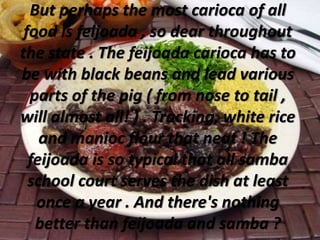
But perhaps the most carioca of all
food is feijoada , so dear throughout
the state . The feijoada carioca has to
be with black beans and lead various
parts of the pig ( from nose to tail ,
will almost all! ) . Tracking, white rice
and manioc flour that neat ! The
feijoada is so typical that all samba
school court serves the dish at least
once a year . And there's nothing
better than feijoada and samba ?
RIO SPORTS
SKATE
SLACKLINE
KITESURF
FOOTBALL
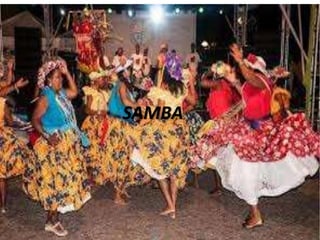
SAMBA
circle dance similar to drumming ,
with dancers soloists, spread
throughout Brazil with choreographic
variants and instrumental
accompaniment

Info

  • 1.
    tourist guide RIO DEJANEIRO NICOLAS A. S. CUNHA IGOR F. POLISEL GABRIEL FELIPE DAVID BORGES Grupo Info. Professor: Severo Ortiz Prof. Antonio de Freitas Avelar
  • 2.
    meaning of Riode Janeiro flag Dr. Alberto Rosa Fioravanti, The flag of the state of Rio de Janeiro was established on October 5 , 1965. The flag is formed by a rectangle divided into four quadrants proportional alternating white and blue colors
  • 3.
    • Historically, blueand white present in the flag symbolize the Portuguese origin of the city , as are the traditional colors of the monarchy in Portugal , used since 1097 in the creation of Portucalense . Only after the proclamation of the Portuguese Republic was that the state changed the colors of their flag. •
  • 4.
    There is anotherinterpretation of the colors of the flag of Rio de Janeiro , the heraldic significance. White is the convention of silver, which traditionally symbolizes innocence , purity , beauty, chastity , hope and peace. Blue symbolizes justice , loyalty, knowledge, perseverance and vigilance.
  • 5.
    In the centerof the coat is an eagle in flight position , symbolizing the power and strength of the just and honest government . The eagle holds a blue round shell with bands in silver. Within the range that cuts the shield is written " April 9, 1892 ," the date of enactment of the first state constitution.
  • 6.
    In 1992 itwas added to the flag the motto written in Latin " recte Rempublicam Gerere " which means " to manage public affairs with righteousness." The shield is surrounded by a gold color bead representing the union of the people of Rio de Janeiro . Above the shield , centralized , is Delta , star silver color, representing the State of Rio de Janeiro in the flag of Brazil.
  • 7.
    To the leftand right of the shield are arranged , respectively , a stalk of sugar cane and coffee branch , symbolizing the main products of the earth . The branches are joined by a color band of silver that involves , and this range is written " State of Rio de Janeiro ."
  • 8.
    Many people thinkthat Rio de Janeiro has a typical cuisine , which is not true. The typically Rio foods are closely linked to revenues of Portuguese cuisine , which were adapted to the reality of this state. For nearly two centuries , from 1763 to 1960 , the city was the capital of Portugal and perpetuated , mainly , the influence of taste and lusas traditions in our food.
  • 9.
    A very cariocaand traditional option are dishes cod base, an obvious and delicious Portuguese heritage that extends to today without many changes . In fact , there are many restaurants specializing in serving cod throughout Rio de Janeiro. And for those who do not know what to order , start with a delicious codfish balls , which is very well accompanied with some oil drops !
  • 10.
    Dishes like oxtail, tongue, liver steak and fried sardines can be considered something typical of Rio's cuisine. After all, they are eaten very common for locals restaurants, especially the most traditional , and we do not see easily anywhere else .
  • 11.
    But perhaps themost carioca of all food is feijoada , so dear throughout the state . The feijoada carioca has to be with black beans and lead various parts of the pig ( from nose to tail , will almost all! ) . Tracking, white rice and manioc flour that neat ! The feijoada is so typical that all samba school court serves the dish at least once a year . And there's nothing better than feijoada and samba ?
  • 12.
  • 13.
  • 14.
  • 15.
  • 16.
  • 17.
  • 18.
    circle dance similarto drumming , with dancers soloists, spread throughout Brazil with choreographic variants and instrumental accompaniment