1 rambo.pandit.1@blogspot.com
Inflation
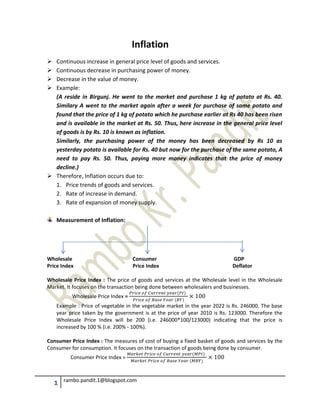
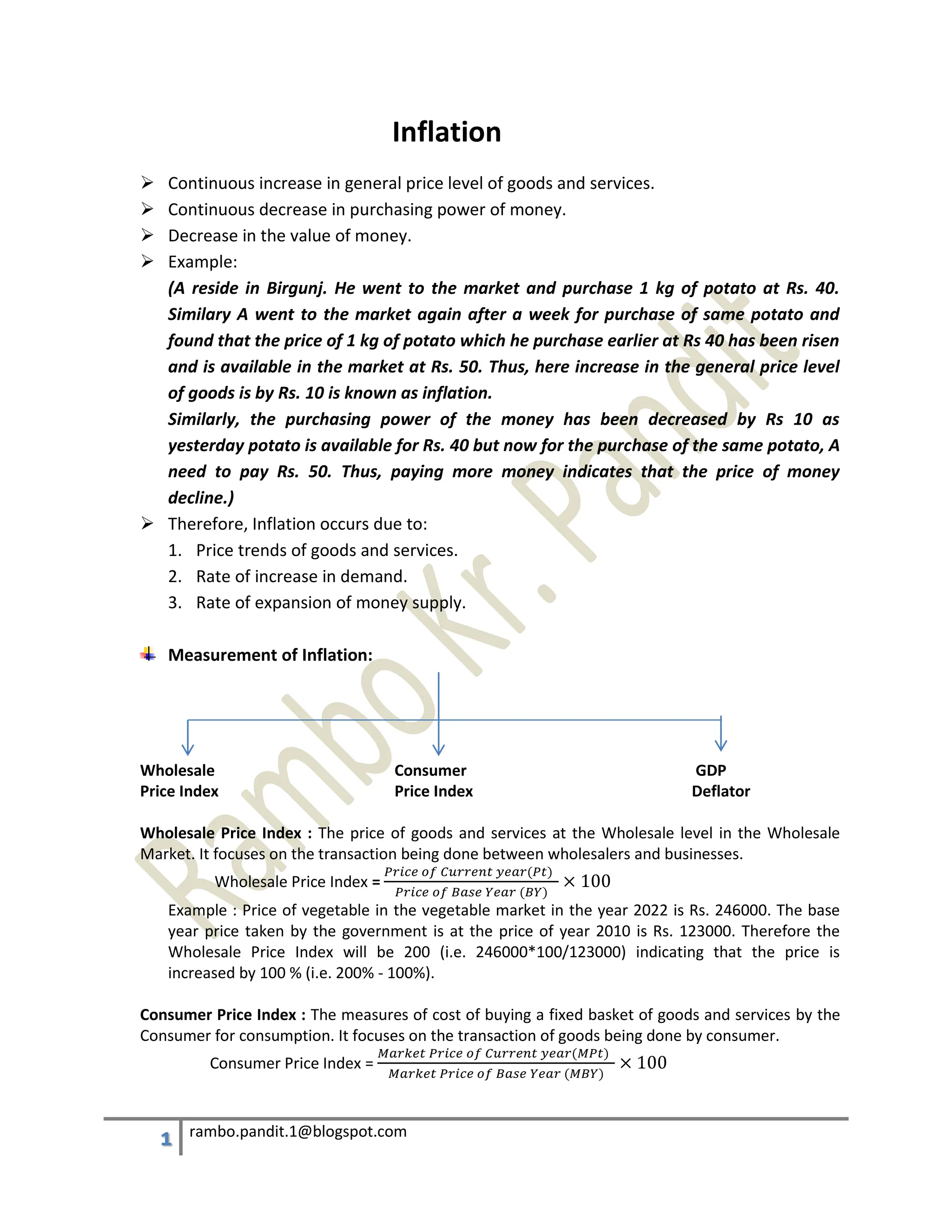
Continuousincrease in general price level of goods and services.
Continuous decrease in purchasing power of money.
Decrease in the value of money.
Example:
(A reside in Birgunj. He went to the market and purchase 1 kg of potato at Rs. 40.
Similary A went to the market again after a week for purchase of same potato and
found that the price of 1 kg of potato which he purchase earlier at Rs 40 has been risen
and is available in the market at Rs. 50. Thus, here increase in the general price level
of goods is by Rs. 10 is known as inflation.
Similarly, the purchasing power of the money has been decreased by Rs 10 as
yesterday potato is available for Rs. 40 but now for the purchase of the same potato, A
need to pay Rs. 50. Thus, paying more money indicates that the price of money
decline.)
Therefore, Inflation occurs due to:
1. Price trends of goods and services.
2. Rate of increase in demand.
3. Rate of expansion of money supply.
Measurement of Inflation:
Wholesale Consumer GDP
Price Index Price Index Deflator
Wholesale Price Index : The price of goods and services at the Wholesale level in the Wholesale
Market. It focuses on the transaction being done between wholesalers and businesses.
Wholesale Price Index =
Example : Price of vegetable in the vegetable market in the year 2022 is Rs. 246000. The base
year price taken by the government is at the price of year 2010 is Rs. 123000. Therefore the
Wholesale Price Index will be 200 (i.e. 246000*100/123000) indicating that the price is
increased by 100 % (i.e. 200% - 100%).
Consumer Price Index : The measures of cost of buying a fixed basket of goods and services by the
Consumer for consumption. It focuses on the transaction of goods being done by consumer.
Consumer Price Index =
2.
2 rambo.pandit.1@blogspot.com
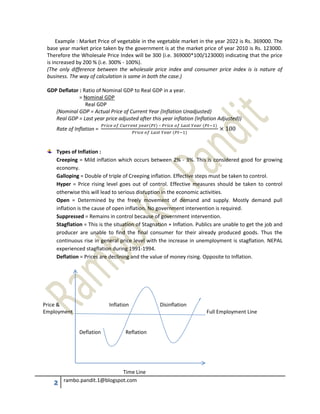
Example :Market Price of vegetable in the vegetable market in the year 2022 is Rs. 369000. The
base year market price taken by the government is at the market price of year 2010 is Rs. 123000.
Therefore the Wholesale Price Index will be 300 (i.e. 369000*100/123000) indicating that the price
is increased by 200 % (i.e. 300% - 100%).
(The only difference between the wholesale price index and consumer price index is is nature of
business. The way of calculation is same in both the case.)
GDP Deflator : Ratio of Nominal GDP to Real GDP in a year.
= Nominal GDP
Real GDP
(Nominal GDP = Actual Price of Current Year (Inflation Unadjusted)
Real GDP = Last year price adjusted after this year inflation (Inflation Adjusted))
Rate of Inflation =
–
Types of Inflation :
Creeping = Mild inflation which occurs between 2% - 3%. This is considered good for growing
economy.
Galloping = Double of triple of Creeping inflation. Effective steps must be taken to control.
Hyper = Price rising level goes out of control. Effective measures should be taken to control
otherwise this will lead to serious disruption in the economic activities.
Open = Determined by the freely movement of demand and supply. Mostly demand pull
inflation is the cause of open inflation. No government intervention is required.
Suppressed = Remains in control because of government intervention.
Stagflation = This is the situation of Stagnation + Inflation. Publics are unable to get the job and
producer are unable to find the final consumer for their already produced goods. Thus the
continuous rise in general price level with the increase in unemployment is stagflation. NEPAL
experienced stagflation during 1991-1994.
Deflation = Prices are declining and the value of money rising. Opposite to Inflation.
Price & Inflation Disinflation
Employment Full Employment Line
Deflation Reflation
Time Line
3.
3 rambo.pandit.1@blogspot.com
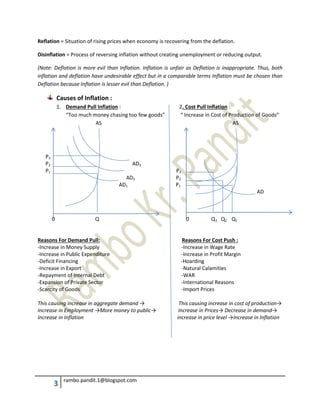
Reflation =Situation of rising prices when economy is recovering from the deflation.
Disinflation = Process of reversing inflation without creating unemployment or reducing output.
(Note: Deflation is more evil than Inflation. Inflation is unfair as Deflation is inappropriate. Thus, both
inflation and deflation have undesirable effect but in a comparable terms Inflation must be chosen than
Deflation because Inflation is lesser evil than Deflation. )
Causes of Inflation :
1. Demand Pull Inflation : 2. Cost Pull Inflation :
“Too much money chasing too few goods” “ Increase in Cost of Production of Goods”
AS AS
P3
P2 AD3
P1 P3
AD2 P2
AD1 P1
AD
0 Q 0 Q3 Q2 Q1
Reasons For Demand Pull: Reasons For Cost Push :
-Increase in Money Supply -Increase in Wage Rate
-Increase in Public Expenditure -Increase in Profit Margin
-Deficit Financing -Hoarding
-Increase in Export -Natural Calamities
-Repayment of Internal Debt -WAR
-Expansion of Private Sector -International Reasons
-Scarcity of Goods -Import Prices
This causing increase in aggregate demand → This causing increase in cost of production→
Increase in Employment →More money to public→ Increase in Prices→ Decrease in demand→
Increase in Inflation increase in price level →Increase in Inflation
4.
4 rambo.pandit.1@blogspot.com
Measures toControl Inflation:
a.Quantitative Control 1. Budgetary Policy
1. Bank Rate Policy › Balanced Budget
2. Cash Reserve Ratio › Deficit Budget
3. Open Market Operation › Surplus Budget
b. Selective Credit Control 2. Taxation
1. Regulation of Consumer Credit › Direct Tax
2. Regulation of Margin Requirement › Indirect Tax
3. Credit Rationing 3.Public Borrowing
4. Direct Action › Internal Borrowing
5. Moral Suasion › External Borrowing
6. Publicity 4. Public Expenditure
› Regular Expenditure
› Development Expenditure
(Note : During the Inflation, the rich get richer and the poor get poorer.)
Monetary Policy Fiscal Policy
Monetary Measures :
1. Bank Rate Policy:
During the period of recessionary and inflationary pressure, central bank
intervene in the economy through the means of loan providing to the
Commercial Bank through interest rate commonly known as Bank Rate.
At the Inflationary pressure, central bank raises the bank rate causing borrowing
from the central bank costlier. So the commercial bank borrow less from the
central bank.
At the deflationary situation, central bank lower the bank rate causing borrowing
from the central bank cheaper. So, the commercial bank borrow more from the
central bank and can provide credit to the other at lower rate of interest causing
output, employment, income & demand to rise.
2. Cash Reserve Ratio :
Central bank have the tools like CRR & SLR to control the operation of the bank. It
is statutory provisions that commercial banks are required to kept by law. A
5.
5 rambo.pandit.1@blogspot.com
certain percentageof their deposit must be kept by the commercial banks in the
form of reserve with the Central Bank.
An increase in the ratio means more deposit must be kept at the Central Bank
while decrease in the ratio means more fund is available with the Commercial
bank for lending.
3. Open Market Operation :
The sale and purchase of securities by the Central Bank is known as Open Market
Operation.
When recessionary pressure observed in the economy, which means a shortage
of fund. Then Central Bank supply money in the economy through purchase of
securities, bills and government bonds causing money flow in the economy.
Similarly, when the inflationary pressure observed in the economy, which means
excess money supply, then the Central Bank sell the securities, bills and
government bonds causing excess money withdraw from the economy. This will
cause lending power of commercial bank contracted and as a result the fair
position restored.
4. Regulation of Consumer Credit:
Almost in every marriage ceremony conducted in Nepal, a Dowry system is seen
in Nepalese environment. One of the major causes of dowry is to obtain wealth
from the second party. The wealth can be in the form of cash, land, jewelry,
computers & vehicle assets. Public purchases vehicle for their personal use too.
Generally, vehicles like Bike, Car etc. are financed through the bank rather than
on one shot payment by Nepalese society.
Thus, central bank have control the installment & hire purchase financing by
issuing various rules and regulations. One of the major control is the requirement
of down payment. The whole payment is categorized into two part namely:
Major Portion : Down payment
Remaining Portion : Financed through Installment
Central Bank influences the supply of money through increase or decrease in the
down payment or by rising or lowering the time period of credit financed.
5. Regulation of Marginal Requirement :
The major function of Central Bank is to provide credit to the public against some
securities. No credit equal to the amount of securities is provided as per the
Unified Directives issued by the Nepal Rastra Bank. Loan to Value Ratio is the
instrument of Marginal Lending. Because of this requirement, Commercial bank
doesn’t provide loan to the full of their value of security. The difference between
6.
6 rambo.pandit.1@blogspot.com
loan andvalue of security is known as marginal requirement. This will helps to
control the money supply in the economy.
6. Credit Rationing :
Central Bank fix maximum amount of loan and advances and also the maximum
ratio of capital of commercial bank to its total assets. Credit to Deposit Ratio fixed
at 90% is an example of credit rationing. Central Bank thus increase of decrease
the ceiling of the bank credit through above mentioned two ways.
Therefore, limiting the maximum or total ceiling of bank loans and advances as
well in certain cases, fixing the maximum limit of loans for specific purposes.
Through this, central bank increase of decrease the ceiling and causing restriction
on the power of commercial bank to create credit.
7. Direct Action :
Direct Action refers to the situation in which one bank does not follow the
Directives, Acts, Rules & Regulation then the prohibitory action adopted by the
Central Bank in the form of refusal of loan, charging penal interest, refusal of
discounting facility, refusal of foreign exchange conversion currency is termed as
Direct Action. This action is charged on those banks who are erring and don’t
follow the policies of the Nepal Rastra Bank.
8. Moral Suasion :
The advices, suggestion, request made by the Central Bank to the Commercial
Bank is known as Moral Suasion. This doesn’t mean legal obligation. Central Bank
generally conducts the meeting and convenes the basic ideas and opinion to
follow the directive. Central Bank highlighted the importance and the benefits of
its adaptability of the policies. Central Bank influences the behavior and acts of
the Commercial Bank in the Moral Suasion.
9. Publicity :
Generally, Central Bank uses the media as a means of transmitting the
information to the general public. Through this means, Central Bank influences
the opinion of the general public through the various data, facts and figures. This
will help Central Bank to control the supply of money in the economy.
7.
7 rambo.pandit.1@blogspot.com
Fiscal Measures:
1.Budgetary Policy :
Budgetary policy is the financial measure through which the whole economic
activities of the nation are regulated. This is the outline through which the
activities are being performed. This defines the various sources for collection
of Revenue and its area of utilization of the Expenditure of the policy.
Through the Budgetary Policy various areas are identified in which the budget
is about to be spent. The budget can be:
Surplus Budget : Revenue Collection > Expenditure made
Deficit Budget : Revenue Collection < Expenditure made
Balanced Budget : Revenue Collection = Expenditure made
2. Taxation :
Taxation is the major sources of revenue through which whole activities of
expenses is about to be performed. The tax collection of the government is
the major instrument through which the economic activities is about to be
regulated.
Whenever there is excess supply of money causing inflationary pressure in the
economy then through increase in taxation, government used to withdraw
money from the market and the supply of money will balanced.
Whenever there is shortage of money causing depression, then through
lowering the tax rate, government inserts money in the economy causing
balanced supply of money in the economy.
The sources of collection of taxation can be of two types:
Direct Tax : The tax that is directly collected by imposing to the general public
firms and institution is known as direct tax. Direct Tax can be in the form of
Income Tax, Land Tax, Rental Tax etc.
Indirect Tax : The tax that is collected indirectly, which burden can be shifted
from one person to another is called Indirect Tax. Example : Value Added Tax,
Excise Tax etc.
3. Public Borrowing :
This is one of the sources of collection of fund to meet the deficit financing of
the government. Borrowing from the Public through the means of issuing
securities, debt, bond etc. is called Public Borrowing. This securities are
backed by government and are never make any faulty of the payment. Public
Borrowing raised by the government can be of two types.
Internal Borrowing : Borrowing made by the government internally with in
the domestic territory of the country is known as Internal Borrowing.
8.
8 rambo.pandit.1@blogspot.com
External Borrowing: Borrowing made by the government through International
Institutions, individual, corporation, government is known as External Borrowings.
4. Public Expenditure :
Presently, government have to spent is expenditure in maintaining law and
order, for its defense and development etc. This is the area where amount is
spent in the form of unproductive expenditure, although it occupy an
important area of the economy. Thus it’s very difficult to cut such expenditure
by the government. Hence, this may influence the supply of money in the
economy.
Public Expenditure can be of two types :
Regular Expenditure : Those expenditure whose nature is of occurring again
and again repeatedly is known as Regular Expenditure. Amount spent on
administrative salary of various government employee, administration
operation expenses like electricity, sanitation etc. are the Recurring
Expenditure.
Developmental Expenditure : Those expenditure which is spent and the
benefits may be obtained in long term period is called Developmental
Expenditure. Construction of Road, Bridge, Dam, School, Colleges, University,
Fun Park, Tourism attraction destination places are some example of
Developmental Expenditure.
Effects of Inflation :
a. On Production:
- Decrease in Quality of the goods
- Encourages holding and speculation
- Change in the pattern of productivity
- Reduces saving as compared to previous period.
b. On Consumption:
- Change in consumption pattern
- Debt instead of saving
- Unequal consumption and lifestyle
c. On Distribution :
- Debtor & Creditor increment and reduction
- Fixed Income Group
- Salary & Wages earner group
- Merchant & Industrialist benefitted
d. Effects on BOP
e. Effects on Exchange Rate
f. Effects on Government
9.
9 rambo.pandit.1@blogspot.com
Monetary Policy
Policy measure undertaken by the Nepal Rastra Bank.
Action taken by NRB to regulate and control the demand and supply of money.
All economic transactions are carried out by the money as the medium of exchange.
NRB influence the money supply in an economy through the flow of credit by the
Commercial Banks.
The various elements of Monetary Policy are:
- Supply of Money
- Availability of the Money
- Rate of Interest
Monetary Policy is used as a policy measures for controlling Inflation in an Economy.
NRB publishes monetary policy at the end of every month, every quarter, half yearly and
at the end of every year.
Objectives :
- Facilitates economic growth
- Ensures Price Stability
- Ensures Exchange Rate Stability
- Achieve Full Employment
- Maintenance of Financial Stability
- Stability in BOP & Foreign Exchange Reserve
- To fulfill the macroeconomic goals
- To make proper management decisions
To keep inflation under control
Significance in Developing Countries like Nepal :
- Economic Development
- Development of Banks & Financial Institutions
- Debt management
- Controlling Inflationary Pressure
- Correct adverse BOP
- Reducing economic inequality
- Adjusting demand and supply of money
- Maintaining economic growth rate
- Ensuring External Sector Stability
- Controlling the size of the flow of credit
- Increasing the financial access
- Measures for influencing the Capital Market
10.
10 rambo.pandit.1@blogspot.com
Types ofMonetary Policy :
Expansionary Monetary Policy Contractionary Monetary Policy
When money is easily available at low rate When money is available with difficulty
of interest is called Expansionary or Easy & at higher rate of interest is called
or Cheap Monetary Policy. Contractionary or Dear Monetary Policy.
Cheap Policy is adopted during depression. Dear Policy is adopted during inflation.
During COVID-19, because of lockdown no After COVID-19, credit of the economy
production take place & to fulfill the public Grows more than targeted level &
money demand for goods purchase, exceed CD Ratio > 90%, NRB adopt tight
Government had followed Easy Policy. Policy.
Raising money through Easy Policy: Taking back money through Tight Policy:
- Purchases of bond & treasury - Selling bonds, securities, t-bills in the
bills in open market. open market.
- Lowering Discount/Bank Rate. - Increasing Discount Rate.
- Lowering Reserve Ratio. - Rising Reserve Ratio.
Instruments of Monetary Policy
Already explained in Inflation chapter. Requested to have a look on it.
Limitation of Monetary Policy
The effectiveness of monetary policy have the following limiting factors :
1. Problems in forecasting
2. Growth of non-banking financial intermediaries
3. Undeveloped money and capital market
4. Time lag for implementation and its response
5. Lack of proper knowledge
6. Policy maker decisions
11.
11 rambo.pandit.1@blogspot.com
Summary:
Every countrymain aims towards the economy is to increase the level of
output and achieve the level of full employment. This is only possible by
increasing the aggregate demand of the economy. By increasing the aggregate
demand, ones need to have go through the expansion of credit to the Industry so
that the production level of the country would increase.
But this could not be possible every time because the commercial bank is
established for the profit motive. So, they might increase their credit expansion in
the areas of non-productive sectors. The non-productive sectors may be the
investment made in land, buildings, and vehicles. Individual may obtain loan from
the bank to fund marriage expenses, education expenses, construction of houses,
buildings etc. So the investment made in non-productive sectors might causes
imbalance in the credit supply in the economy.
This might cause the reduction in the production activities and force to import
even in the goods which might can easily be produced in the Nepal.
This is the main causes of inflation as well as depression/recession in the
economy.
This is corrected through the various means of instrument adopted by the
monetary policy. Open market operation, Bank Rate, Cash Reserve Ratio are
some means through which this got corrected.
Nepal Rastra Bank has made the statutory requirement for the investment made
by the commercial banks in the deprived sector, energy sector, agriculture sector
etc. This causing the commercial bank to divert their existing investment in these
areas which causing less fund available with the bank to make investment in the
Non-productive sectors.
Thus, this whole process helps to accelerate the economic growth of the
economy through the means of adopting various instrument of monetary policy.
This can be understood as:
o Monetary Policy is the good stabilization policy.
o This affects the investment decision through the manipulation of interest
rate.
o This brings out the stability in the economic activities without other
demand management tools.
o This focus on the proper strategy that will enhance their business
operation.
o This helps to established good governance for the development of the
financial institution and its market.
o The monetary policy can influence all major macro variables like GDP,
Savings & Investments, Employment, General Price Level, Foreign Trade &
Balance of Payments.
12.
12 rambo.pandit.1@blogspot.com
Fiscal Policy
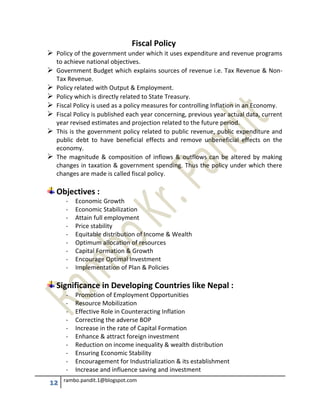
Policy of the government under which it uses expenditure and revenue programs
to achieve national objectives.
Government Budget which explains sources of revenue i.e. Tax Revenue & Non-
Tax Revenue.
Policy related with Output & Employment.
Policy which is directly related to State Treasury.
Fiscal Policy is used as a policy measures for controlling Inflation in an Economy.
Fiscal Policy is published each year concerning, previous year actual data, current
year revised estimates and projection related to the future period.
This is the government policy related to public revenue, public expenditure and
public debt to have beneficial effects and remove unbeneficial effects on the
economy.
The magnitude & composition of inflows & outflows can be altered by making
changes in taxation & government spending. Thus the policy under which there
changes are made is called fiscal policy.
Objectives :
- Economic Growth
- Economic Stabilization
- Attain full employment
- Price stability
- Equitable distribution of Income & Wealth
- Optimum allocation of resources
- Capital Formation & Growth
- Encourage Optimal Investment
- Implementation of Plan & Policies
Significance in Developing Countries like Nepal :
- Promotion of Employment Opportunities
- Resource Mobilization
- Effective Role in Counteracting Inflation
- Correcting the adverse BOP
- Increase in the rate of Capital Formation
- Enhance & attract foreign investment
- Reduction on income inequality & wealth distribution
- Ensuring Economic Stability
- Encouragement for Industrialization & its establishment
- Increase and influence saving and investment
13.
13 rambo.pandit.1@blogspot.com
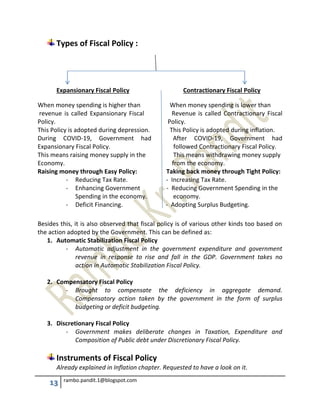
Types ofFiscal Policy :
Expansionary Fiscal Policy Contractionary Fiscal Policy
When money spending is higher than When money spending is lower than
revenue is called Expansionary Fiscal Revenue is called Contractionary Fiscal
Policy. Policy.
This Policy is adopted during depression. This Policy is adopted during inflation.
During COVID-19, Government had After COVID-19, Government had
Expansionary Fiscal Policy. followed Contractionary Fiscal Policy.
This means raising money supply in the This means withdrawing money supply
Economy. from the economy.
Raising money through Easy Policy: Taking back money through Tight Policy:
- Reducing Tax Rate. - Increasing Tax Rate.
- Enhancing Government - Reducing Government Spending in the
Spending in the economy. economy.
- Deficit Financing. - Adopting Surplus Budgeting.
Besides this, it is also observed that fiscal policy is of various other kinds too based on
the action adopted by the Government. This can be defined as:
1. Automatic Stabilization Fiscal Policy
- Automatic adjustment in the government expenditure and government
revenue in response to rise and fall in the GDP. Government takes no
action in Automatic Stabilization Fiscal Policy.
2. Compensatory Fiscal Policy
- Brought to compensate the deficiency in aggregate demand.
Compensatory action taken by the government in the form of surplus
budgeting or deficit budgeting.
3. Discretionary Fiscal Policy
- Government makes deliberate changes in Taxation, Expenditure and
Composition of Public debt under Discretionary Fiscal Policy.
Instruments of Fiscal Policy
Already explained in Inflation chapter. Requested to have a look on it.
14.
14 rambo.pandit.1@blogspot.com
Limitation ofFiscal Policy
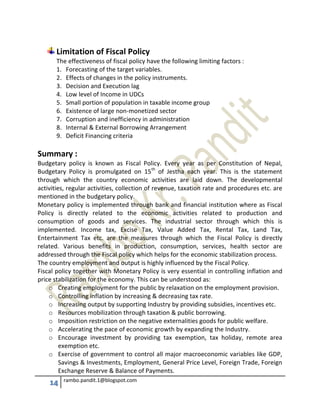
The effectiveness of fiscal policy have the following limiting factors :
1. Forecasting of the target variables.
2. Effects of changes in the policy instruments.
3. Decision and Execution lag
4. Low level of Income in UDCs
5. Small portion of population in taxable income group
6. Existence of large non-monetized sector
7. Corruption and inefficiency in administration
8. Internal & External Borrowing Arrangement
9. Deficit Financing criteria
Summary :
Budgetary policy is known as Fiscal Policy. Every year as per Constitution of Nepal,
Budgetary Policy is promulgated on 15th
of Jestha each year. This is the statement
through which the country economic activities are laid down. The developmental
activities, regular activities, collection of revenue, taxation rate and procedures etc. are
mentioned in the budgetary policy.
Monetary policy is implemented through bank and financial institution where as Fiscal
Policy is directly related to the economic activities related to production and
consumption of goods and services. The industrial sector through which this is
implemented. Income tax, Excise Tax, Value Added Tax, Rental Tax, Land Tax,
Entertainment Tax etc. are the measures through which the Fiscal Policy is directly
related. Various benefits in production, consumption, services, health sector are
addressed through the Fiscal policy which helps for the economic stabilization process.
The country employment and output is highly influenced by the Fiscal Policy.
Fiscal policy together with Monetary Policy is very essential in controlling inflation and
price stabilization for the economy. This can be understood as:
o Creating employment for the public by relaxation on the employment provision.
o Controlling inflation by increasing & decreasing tax rate.
o Increasing output by supporting Industry by providing subsidies, incentives etc.
o Resources mobilization through taxation & public borrowing.
o Imposition restriction on the negative externalities goods for public welfare.
o Accelerating the pace of economic growth by expanding the Industry.
o Encourage investment by providing tax exemption, tax holiday, remote area
exemption etc.
o Exercise of government to control all major macroeconomic variables like GDP,
Savings & Investments, Employment, General Price Level, Foreign Trade, Foreign
Exchange Reserve & Balance of Payments.
15.
15 rambo.pandit.1@blogspot.com
National Income
Final value of goods & services produced in the country at prevailing prices.
It is the sum of all resident income from all productive sources.
It is also defined as the sum of all factors income (wage, interest, rent & profit) in
a country in a year.
It is also termed as the Total Expenditure of a country in a year. Spending’s of
households, private sector & government sector of the country together known
as Total Expenditure in a country.
National Income includes various sectors like Primary, Secondary & Tertiary
Sector.
It measures aggregate economic activities like Production, Income & Expenditure.
National Income is the money value of all the final goods and services produced
by a country during a period of one fiscal year.
National Income is measured at various prices like constant price (base year
price), current price (market cost) and also at factor cost.
National Income is comprised of Gross Domestic Product, Gross National Product,
Net National Product, Personal Income and Disposable Income.
Example:
In Nepal, the population is around three crore. Almost 66 lakh Nepalese went abroad
for the employment. They earn money and do remit every year to support their family
members and relatives financially.
Remaining Nepalese have either engaged in agriculture, fisheries, animal husbandry,
banking, health, construction, electricity, industry, trade and commerce related
activities. Due to this, it generates production in the country.
This production together with remittances constitute National Income in general
sense. So, National Income is the broad chapter which covers both national citizens
and the citizens working outside the country. This also include the foreign citizens who
are in Nepal and contributing towards the production of goods and services.
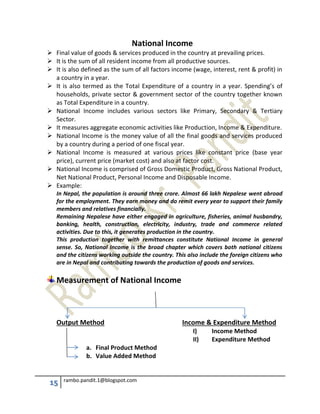
Measurement of National Income
Output Method Income & Expenditure Method
I) Income Method
II) Expenditure Method
a. Final Product Method
b. Value Added Method
16.
16 rambo.pandit.1@blogspot.com
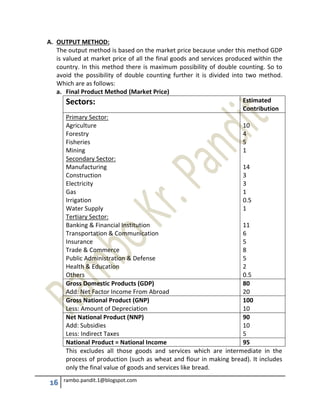
A. OUTPUTMETHOD:
The output method is based on the market price because under this method GDP
is valued at market price of all the final goods and services produced within the
country. In this method there is maximum possibility of double counting. So to
avoid the possibility of double counting further it is divided into two method.
Which are as follows:
a. Final Product Method (Market Price)
Sectors: Estimated
Contribution
Primary Sector:
Agriculture
Forestry
Fisheries
Mining
Secondary Sector:
Manufacturing
Construction
Electricity
Gas
Irrigation
Water Supply
Tertiary Sector:
Banking & Financial Institution
Transportation & Communication
Insurance
Trade & Commerce
Public Administration & Defense
Health & Education
Others
10
4
5
1
14
3
3
1
0.5
1
11
6
5
8
5
2
0.5
Gross Domestic Products (GDP)
Add: Net Factor Income From Abroad
80
20
Gross National Product (GNP)
Less: Amount of Depreciation
100
10
Net National Product (NNP)
Add: Subsidies
Less: Indirect Taxes
90
10
5
National Product = National Income 95
This excludes all those goods and services which are intermediate in the
process of production (such as wheat and flour in making bread). It includes
only the final value of goods and services like bread.
17.
17 rambo.pandit.1@blogspot.com
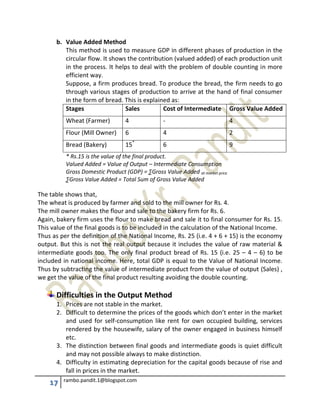
b. ValueAdded Method
This method is used to measure GDP in different phases of production in the
circular flow. It shows the contribution (valued added) of each production unit
in the process. It helps to deal with the problem of double counting in more
efficient way.
Suppose, a firm produces bread. To produce the bread, the firm needs to go
through various stages of production to arrive at the hand of final consumer
in the form of bread. This is explained as:
Stages Sales Cost of Intermediate Gross Value Added
Wheat (Farmer) 4 - 4
Flour (Mill Owner) 6 4 2
Bread (Bakery) 15*
6 9
* Rs.15 is the value of the final product.
Valued Added = Value of Output – Intermediate Consumption
Gross Domestic Product (GDP) = ∑Gross Value Added at market price
∑Gross Value Added = Total Sum of Gross Value Added
The table shows that,
The wheat is produced by farmer and sold to the mill owner for Rs. 4.
The mill owner makes the flour and sale to the bakery firm for Rs. 6.
Again, bakery firm uses the flour to make bread and sale it to final consumer for Rs. 15.
This value of the final goods is to be included in the calculation of the National Income.
Thus as per the definition of the National Income, Rs. 25 (i.e. 4 + 6 + 15) is the economy
output. But this is not the real output because it includes the value of raw material &
intermediate goods too. The only final product bread of Rs. 15 (i.e. 25 – 4 – 6) to be
included in national income. Here, total GDP is equal to the Value of National Income.
Thus by subtracting the value of intermediate product from the value of output (Sales) ,
we get the value of the final product resulting avoiding the double counting.
Difficulties in the Output Method
1. Prices are not stable in the market.
2. Difficult to determine the prices of the goods which don’t enter in the market
and used for self-consumption like rent for own occupied building, services
rendered by the housewife, salary of the owner engaged in business himself
etc.
3. The distinction between final goods and intermediate goods is quiet difficult
and may not possible always to make distinction.
4. Difficulty in estimating depreciation for the capital goods because of rise and
fall in prices in the market.
18.
18 rambo.pandit.1@blogspot.com
5. Itis unclear that how services could be included in the value added method.
6. Lack of adequate and reliable data for the measurement of national income.
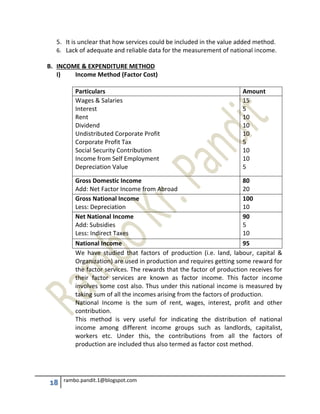
B. INCOME & EXPENDITURE METHOD
I) Income Method (Factor Cost)
Particulars Amount
Wages & Salaries
Interest
Rent
Dividend
Undistributed Corporate Profit
Corporate Profit Tax
Social Security Contribution
Income from Self Employment
Depreciation Value
15
5
10
10
10
5
10
10
5
Gross Domestic Income
Add: Net Factor Income from Abroad
80
20
Gross National Income
Less: Depreciation
100
10
Net National Income
Add: Subsidies
Less: Indirect Taxes
90
5
10
National Income 95
We have studied that factors of production (i.e. land, labour, capital &
Organization) are used in production and requires getting some reward for
the factor services. The rewards that the factor of production receives for
their factor services are known as factor income. This factor income
involves some cost also. Thus under this national income is measured by
taking sum of all the incomes arising from the factors of production.
National Income is the sum of rent, wages, interest, profit and other
contribution.
This method is very useful for indicating the distribution of national
income among different income groups such as landlords, capitalist,
workers etc. Under this, the contributions from all the factors of
production are included thus also termed as factor cost method.
19.
19 rambo.pandit.1@blogspot.com
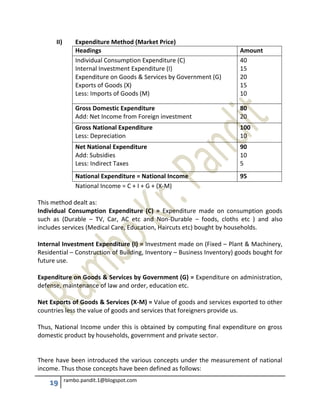
II) ExpenditureMethod (Market Price)
Headings Amount
Individual Consumption Expenditure (C)
Internal Investment Expenditure (I)
Expenditure on Goods & Services by Government (G)
Exports of Goods (X)
Less: Imports of Goods (M)
40
15
20
15
10
Gross Domestic Expenditure
Add: Net Income from Foreign investment
80
20
Gross National Expenditure
Less: Depreciation
100
10
Net National Expenditure
Add: Subsidies
Less: Indirect Taxes
90
10
5
National Expenditure = National Income 95
National Income = C + I + G + (X-M)
This method dealt as:
Individual Consumption Expenditure (C) = Expenditure made on consumption goods
such as (Durable – TV, Car, AC etc and Non-Durable – foods, cloths etc ) and also
includes services (Medical Care, Education, Haircuts etc) bought by households.
Internal Investment Expenditure (I) = Investment made on (Fixed – Plant & Machinery,
Residential – Construction of Building, Inventory – Business Inventory) goods bought for
future use.
Expenditure on Goods & Services by Government (G) = Expenditure on administration,
defense, maintenance of law and order, education etc.
Net Exports of Goods & Services (X-M) = Value of goods and services exported to other
countries less the value of goods and services that foreigners provide us.
Thus, National Income under this is obtained by computing final expenditure on gross
domestic product by households, government and private sector.
There have been introduced the various concepts under the measurement of national
income. Thus those concepts have been defined as follows:
20.
20 rambo.pandit.1@blogspot.com
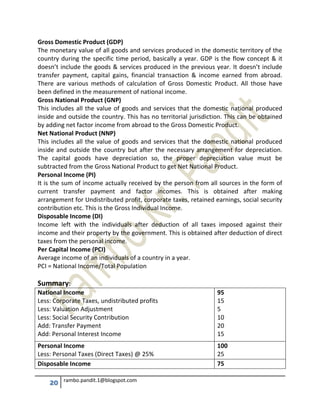
Gross DomesticProduct (GDP)
The monetary value of all goods and services produced in the domestic territory of the
country during the specific time period, basically a year. GDP is the flow concept & it
doesn’t include the goods & services produced in the previous year. It doesn’t include
transfer payment, capital gains, financial transaction & income earned from abroad.
There are various methods of calculation of Gross Domestic Product. All those have
been defined in the measurement of national income.
Gross National Product (GNP)
This includes all the value of goods and services that the domestic national produced
inside and outside the country. This has no territorial jurisdiction. This can be obtained
by adding net factor income from abroad to the Gross Domestic Product.
Net National Product (NNP)
This includes all the value of goods and services that the domestic national produced
inside and outside the country but after the necessary arrangement for depreciation.
The capital goods have depreciation so, the proper depreciation value must be
subtracted from the Gross National Product to get Net National Product.
Personal Income (PI)
It is the sum of income actually received by the person from all sources in the form of
current transfer payment and factor incomes. This is obtained after making
arrangement for Undistributed profit, corporate taxes, retained earnings, social security
contribution etc. This is the Gross Individual Income.
Disposable Income (DI)
Income left with the individuals after deduction of all taxes imposed against their
income and their property by the government. This is obtained after deduction of direct
taxes from the personal income.
Per Capital Income (PCI)
Average income of an individuals of a country in a year.
PCI = National Income/Total Population
Summary:
National Income
Less: Corporate Taxes, undistributed profits
Less: Valuation Adjustment
Less: Social Security Contribution
Add: Transfer Payment
Add: Personal Interest Income
95
15
5
10
20
15
Personal Income
Less: Personal Taxes (Direct Taxes) @ 25%
100
25
Disposable Income 75
21.
21 rambo.pandit.1@blogspot.com
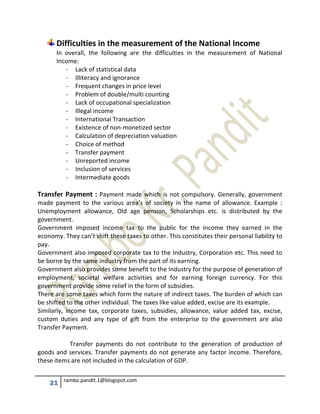
Difficulties inthe measurement of the National Income
In overall, the following are the difficulties in the measurement of National
Income:
- Lack of statistical data
- Illiteracy and ignorance
- Frequent changes in price level
- Problem of double/multi counting
- Lack of occupational specialization
- Illegal income
- International Transaction
- Existence of non-monetized sector
- Calculation of depreciation valuation
- Choice of method
- Transfer payment
- Unreported income
- Inclusion of services
- Intermediate goods
Transfer Payment : Payment made which is not compulsory. Generally, government
made payment to the various area’s of society in the name of allowance. Example :
Unemployment allowance, Old age pension, Scholarships etc. is distributed by the
government.
Government imposed income tax to the public for the income they earned in the
economy. They can’t shift these taxes to other. This constitutes their personal liability to
pay.
Government also imposed corporate tax to the Industry, Corporation etc. This need to
be borne by the same industry from the part of its earning.
Government also provides some benefit to the Industry for the purpose of generation of
employment, societal welfare activities and for earning foreign currency. For this
government provide some relief in the form of subsidies.
There are some taxes which form the nature of indirect taxes. The burden of which can
be shifted to the other individual. The taxes like value added, excise are its example.
Similarly, income tax, corporate taxes, subsidies, allowance, value added tax, excise,
custom duties and any type of gift from the enterprise to the government are also
Transfer Payment.
Transfer payments do not contribute to the generation of production of
goods and services. Transfer payments do not generate any factor income. Therefore,
these items are not included in the calculation of GDP.
22.
22 rambo.pandit.1@blogspot.com
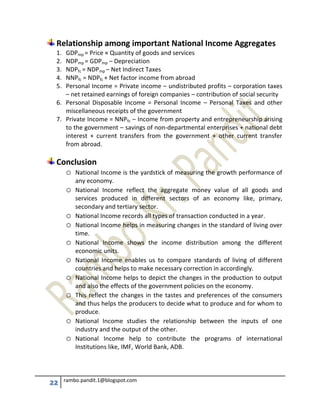
Relationship amongimportant National Income Aggregates
1. GDPmp = Price × Quantity of goods and services
2. NDPmp = GDPmp – Depreciation
3. NDPfc = NDPmp – Net Indirect Taxes
4. NNPfc = NDPfc + Net factor income from abroad
5. Personal Income = Private income – undistributed profits – corporation taxes
– net retained earnings of foreign companies – contribution of social security
6. Personal Disposable Income = Personal Income – Personal Taxes and other
miscellaneous receipts of the government
7. Private Income = NNPfc – Income from property and entrepreneurship arising
to the government – savings of non-departmental enterprises + national debt
interest + current transfers from the government + other current transfer
from abroad.
Conclusion
o National Income is the yardstick of measuring the growth performance of
any economy.
o National Income reflect the aggregate money value of all goods and
services produced in different sectors of an economy like, primary,
secondary and tertiary sector.
o National Income records all types of transaction conducted in a year.
o National Income helps in measuring changes in the standard of living over
time.
o National Income shows the income distribution among the different
economic units.
o National Income enables us to compare standards of living of different
countries and helps to make necessary correction in accordingly.
o National Income helps to depict the changes in the production to output
and also the effects of the government policies on the economy.
o This reflect the changes in the tastes and preferences of the consumers
and thus helps the producers to decide what to produce and for whom to
produce.
o National Income studies the relationship between the inputs of one
industry and the output of the other.
o National Income help to contribute the programs of international
Institutions like, IMF, World Bank, ADB.
23.
23 rambo.pandit.1@blogspot.com
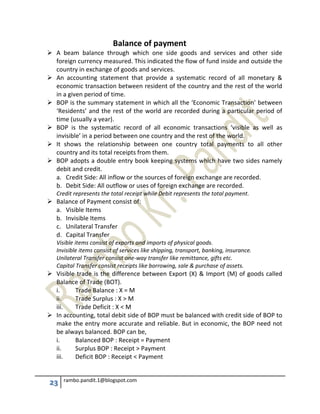
Balance ofpayment
A beam balance through which one side goods and services and other side
foreign currency measured. This indicated the flow of fund inside and outside the
country in exchange of goods and services.
An accounting statement that provide a systematic record of all monetary &
economic transaction between resident of the country and the rest of the world
in a given period of time.
BOP is the summary statement in which all the ‘Economic Transaction’ between
‘Residents’ and the rest of the world are recorded during a particular period of
time (usually a year).
BOP is the systematic record of all economic transactions ‘visible as well as
invisible’ in a period between one country and the rest of the world.
It shows the relationship between one country total payments to all other
country and its total receipts from them.
BOP adopts a double entry book keeping systems which have two sides namely
debit and credit.
a. Credit Side: All inflow or the sources of foreign exchange are recorded.
b. Debit Side: All outflow or uses of foreign exchange are recorded.
Credit represents the total receipt while Debit represents the total payment.
Balance of Payment consist of:
a. Visible Items
b. Invisible Items
c. Unilateral Transfer
d. Capital Transfer
Visible items consist of exports and imports of physical goods.
Invisible items consist of services like shipping, transport, banking, insurance.
Unilateral Transfer consist one-way transfer like remittance, gifts etc.
Capital Transfer consist receipts like borrowing, sale & purchase of assets.
Visible trade is the difference between Export (X) & Import (M) of goods called
Balance of Trade (BOT).
i. Trade Balance : X = M
ii. Trade Surplus : X > M
iii. Trade Deficit : X < M
In accounting, total debit side of BOP must be balanced with credit side of BOP to
make the entry more accurate and reliable. But in economic, the BOP need not
be always balanced. BOP can be,
i. Balanced BOP : Receipt = Payment
ii. Surplus BOP : Receipt > Payment
iii. Deficit BOP : Receipt < Payment
24.
24 rambo.pandit.1@blogspot.com
Example:
Nepal importsseveral goods and exports only a part of imports. Petroleum
products, medicine, raw palm oil, gold, clinker, pulse, paddy, spare parts etc. are the
items which are regularly being imported in Nepal. These items entered in Nepal
through the various customs which record the import and necessary duty is collected
on such items by the customs of Nepal.
Similarly, items like Palm oil, Soyabean Oil, Polyester & other thread, Carpets,
Cardamom, Tea, Wire etc. are being exported from Nepal through customs where the
necessary records are being kept.
Every government keeps a record of the transaction that take place between the
country & the rest of the world during a given period. When exports are made,
amount receipts in exchange of goods are recorded in receipt side and when imports
are made, amount paid in exchange of goods are recorded in payment side. Thus the
process of recording this international transaction is known as the Country’s Balance
of Payment.
Components of Balance of Payment
A. Current Account
Current account refers to the account which records all the transaction
relating to the exports and imports of goods & services, unilateral transfer.
Current account contains the receipt and payment relating to the transaction
of visible as well as invisible during a given period of time.
The current account can be further understood as :
Exports & Import of Goods (Visible Item)
This is defined as the merchandise transaction relating to the export
and import of visible goods. Balance of this visible exports and imports
is known as Balance of Trade.
Exports & Import of Services (Invisible Item)
Services are of generally various types. Services like, Shipping,
Transportation, Banking, Insurance are invisible items. These invisibles
items payment are recorded on debit side.
Unilateral Transfer (One-Sided Transaction)
Gifts, Donation, Remittance are the form of one way transaction. This
refers to those receipt and payment, which takes place without any
services in return.
B. Capital Account
Capital account is different than of Current account. This records all the
transaction between the resident of the country and the rest of the world,
which causes the change in the assets and liability of the resident of the
country or its government.
25.
25 rambo.pandit.1@blogspot.com
Capital accountis concerned with the financial transfers. So, it doesn’t have
direct effect on the income, output and the employment of the country.
These include all types of short term and long term movement of capital.
The Capital Account can be further understood as:
Borrowings and lending to and from abroad
Borrowing and lending from private sector or from government as loan
and borrowing are recorded on debit & credit side of BOP.
Investment to and from abroad
a. Foreign Direct Investment (FDI)
Purchase of Land & Building, Transfer of Machinery etc.
b. Foreign Institutional Investment (FII)
Purchase of Shares, Debentures, Bonds etc.
C. Foreign Exchange Reserve
These are the financial assets of the government held in the Central Bank of
Nepal. This includes Gold Reserve, Foreign Assets, Special Drawing Rights etc.
Beside the above components, there is one more element in BOP,
known as ‘Error & Omissions’. This is not possible that always BOP got
balanced. Sometime the credit side of BOP won’t get tallied with the debit
side of the BOP. There might be the variety of reasons. Thus, it is balanced in
either case through an account named Error & Omission.
Error and Omission is the balancing items which reflects the inability to record
all international transactions accurately.
Under Error and Omission account, it includes the followings:
- Under reporting of transaction
- Over reporting of transaction
- Sampling error
- Smuggling activities etc.
As per International Monetary Fund, Balance of Payment includes three accounts:
1. Current Account
2. Capital Account
3. Financial Account