CONFIDENTIAL AND PROPRIETARY
Any use of this material without the specific permission of NephroPlus is strictly prohibited
May 2018
TOGETHER LET’S KEEP DIALYSIS GUESTS SAFE
2
NephroPlus Introduction – December 2017
Outline for dialysis safety
1. Infection
2. Together to prevent infection in dialysis Guests
3. Catheter care steps
4. Guest self care with catheter
5. Basic steps for Fistula /graft Care
6. Guest self care with fistula/graft
7. How can you help ?
3
NephroPlus Introduction – December 2017
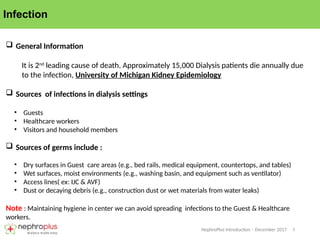
Infection
 General Information
It is 2nd
leading cause of death. Approximately 15,000 Dialysis patients die annually due
to the infection, University of Michigan Kidney Epidemiology
 Sources of infections in dialysis settings
• Guests
• Healthcare workers
• Visitors and household members
 Sources of germs include :
• Dry surfaces in Guest care areas (e.g., bed rails, medical equipment, countertops, and tables)
• Wet surfaces, moist environments (e.g., washing basin, and equipment such as ventilator)
• Access lines( ex: IJC & AVF)
• Dust or decaying debris (e.g., construction dust or wet materials from water leaks)
Note : Maintaining hygiene in center we can avoid spreading infections to the Guest & Healthcare
workers.
4
NephroPlus Introduction – December 2017
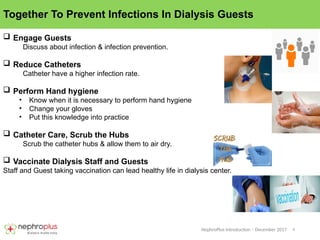
Together To Prevent Infections In Dialysis Guests
 Engage Guests
Discuss about infection & infection prevention.
 Reduce Catheters
Catheter have a higher infection rate.
 Perform Hand hygiene
• Know when it is necessary to perform hand hygiene
• Change your gloves
• Put this knowledge into practice
 Catheter Care, Scrub the Hubs
Scrub the catheter hubs & allow them to air dry.
 Vaccinate Dialysis Staff and Guests
Staff and Guest taking vaccination can lead healthy life in dialysis center.
5
NephroPlus Introduction – December 2017
Continued
 Disinfect the Dialysis Station
Keep clean & neat dialysis room to avoid infections
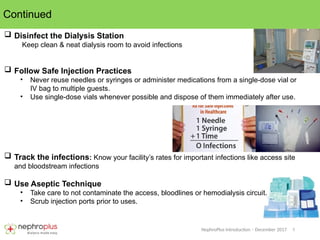
 Follow Safe Injection Practices
• Never reuse needles or syringes or administer medications from a single-dose vial or
IV bag to multiple guests.
• Use single-dose vials whenever possible and dispose of them immediately after use.
 Track the infections: Know your facility’s rates for important infections like access site
and bloodstream infections
 Use Aseptic Technique
• Take care to not contaminate the access, bloodlines or hemodialysis circuit.
• Scrub injection ports prior to uses.
6
NephroPlus Introduction – December 2017
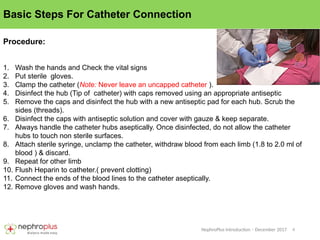
Basic Steps For Catheter Connection
Procedure:
1. Wash the hands and Check the vital signs
2. Put sterile gloves.
3. Clamp the catheter (Note: Never leave an uncapped catheter ).
4. Disinfect the hub (Tip of catheter) with caps removed using an appropriate antiseptic
5. Remove the caps and disinfect the hub with a new antiseptic pad for each hub. Scrub the
sides (threads).
6. Disinfect the caps with antiseptic solution and cover with gauze & keep separate.
7. Always handle the catheter hubs aseptically. Once disinfected, do not allow the catheter
hubs to touch non sterile surfaces.
8. Attach sterile syringe, unclamp the catheter, withdraw blood from each limb (1.8 to 2.0 ml of
blood ) & discard.
9. Repeat for other limb
10. Flush Heparin to catheter.( prevent clotting)
11. Connect the ends of the blood lines to the catheter aseptically.
12. Remove gloves and wash hands.
7
NephroPlus Introduction – December 2017
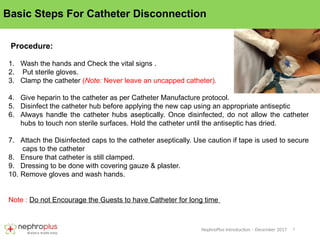
Basic Steps For Catheter Disconnection
Procedure:
1. Wash the hands and Check the vital signs .
2. Put sterile gloves.
3. Clamp the catheter (Note: Never leave an uncapped catheter).
4. Give heparin to the catheter as per Catheter Manufacture protocol.
5. Disinfect the catheter hub before applying the new cap using an appropriate antiseptic
6. Always handle the catheter hubs aseptically. Once disinfected, do not allow the catheter
hubs to touch non sterile surfaces. Hold the catheter until the antiseptic has dried.
7. Attach the Disinfected caps to the catheter aseptically. Use caution if tape is used to secure
caps to the catheter
8. Ensure that catheter is still clamped.
9. Dressing to be done with covering gauze & plaster.
10. Remove gloves and wash hands.
Note : Do not Encourage the Guests to have Catheter for long time
8
NephroPlus Introduction – December 2017
Hemodialysis Catheter Connection-- Checklist
Wear mask
Perform hand hygiene
Put sterile glove
Clamp the catheter and remove caps and disinfect with antiseptic
solution.
Scrub catheter tip with antiseptic
Allow hub antiseptic to dry
Connect catheter to blood lines aseptically
Remove gloves
Perform hand hygiene
9
NephroPlus Introduction – December 2017
Hemodialysis Catheter Disconnection --Checklist
Wear mask
Perform hand hygiene
Put sterile glove
Clamp the catheter
Disconnect catheter from blood lines aseptically.
Flush the heparin into catheter
Attach new caps antiseptically
Secure catheter with gauze /bandage
Remove glove & Perform hand hygiene
10
NephroPlus Introduction – December 2017
Guest Self Care With Catheter
1. Ask your doctor about getting a fistula or graft because catheter have a higher risk of
Infection.
2. Don’t get it wet
3. Wash hands often, especially before & after dialysis treatment
4. Ask the Guest to avoid sleep on catheter side.
5. Ask the Guest to inform to staff or doctor if they have any symptoms like chills or fever..
6. Know what to do if you have any problem with the catheter.
11
NephroPlus Introduction – December 2017
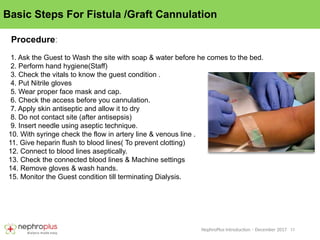
Basic Steps For Fistula /Graft Cannulation
Procedure:
1. Ask the Guest to Wash the site with soap & water before he comes to the bed.
2. Perform hand hygiene(Staff)
3. Check the vitals to know the guest condition .
4. Put Nitrile gloves
5. Wear proper face mask and cap.
6. Check the access before you cannulation.
7. Apply skin antiseptic and allow it to dry
8. Do not contact site (after antisepsis)
9. Insert needle using aseptic technique.
10. With syringe check the flow in artery line & venous line .
11. Give heparin flush to blood lines( To prevent clotting)
12. Connect to blood lines aseptically.
13. Check the connected blood lines & Machine settings
14. Remove gloves & wash hands.
15. Monitor the Guest condition till terminating Dialysis.
12
NephroPlus Introduction – December 2017
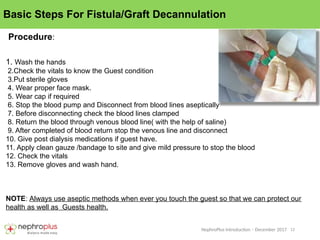
Basic Steps For Fistula/Graft Decannulation
1. Wash the hands
2.Check the vitals to know the Guest condition
3.Put sterile gloves
4. Wear proper face mask.
5. Wear cap if required
6. Stop the blood pump and Disconnect from blood lines aseptically
7. Before disconnecting check the blood lines clamped
8. Return the blood through venous blood line( with the help of saline)
9. After completed of blood return stop the venous line and disconnect
10. Give post dialysis medications if guest have.
11. Apply clean gauze /bandage to site and give mild pressure to stop the blood
12. Check the vitals
13. Remove gloves and wash hand.
NOTE: Always use aseptic methods when ever you touch the guest so that we can protect our
health as well as Guests health.
Procedure:
13
NephroPlus Introduction – December 2017
Hemodialysis fistula/Graft Cannulation—Checklist
Perform hand hygiene
Wear mask
Put nitrile glove
Apply skin antiseptic and allow it to dry.
Do not contact site ( after antisepsis)
Check the access site status.
Insert needles aseptically
Connect to blood lines aseptically
Check machine settings.
Remove glove & Perform hand hygiene
14
NephroPlus Introduction – December 2017
Hemodialysis Fistula/Graft Decannulation-- Checklist
Perform hand hygiene
Wear mask
Put nitrile glove
Check vitals
Disconnect from blood lines aseptically
Remove needles aseptically
Give mild pressure to site to stop blood
Apply clean gauze/bandage to site
Remove glove & Perform hand hygiene
15
NephroPlus Introduction – December 2017
Guest self care with fistula or graft
1. Take care access site at all the time and avoid lifting weight with fistula or graft hand.
2. Avoid scratching or picking it.
3. Wash hands often, before & after dialysis.
4. Use regular medications as per doctor advice
5. Keep checking your access working regularly.
6. Inform the guest to not to Give fistula hand for checking Blood pressure & sample
withdrawal.
7. Ask the Guest to avoid taking injections on Fistula / Graft hand
8. Tell the guest to remove bandage after terminated 4 hours of HD.
16
NephroPlus Introduction – December 2017
Infection Control Best Practices
• Make sure that all Guest receive necessary vaccines to prevent illness
• In Hemodialysis unit Guests are risk with bacterial infection & viral infections like
hepatitis B and C.
• Reduced immunity plays a role in infections
• Guests on dialysis have weakened immune systems and should get certain
vaccines to keep from getting sick
• Increase awareness for dialysis bloodstream infection ( presence & active
multiplication of organisms in blood) prevention through educational efforts.
• Safe injection practices
• Safe handling and decontamination of medical treatment.
• Cleaning and disinfection of equipment and environmental surface.
• Screening viral markers
• Use Personal Protective Equipment(PPE)
17
NephroPlus Introduction – December 2017
How can you Help
1. Good hand hygiene practices every time you care the guests.
2. Ask questions if anyone not used aseptic methods.
3. Pay attention to your work in center.
4. In a respectful way, explain the rules to other health care workers when they are not followed
correct rules.
5. Partner with your Guests
6. Re- educate regularly.
7. To be successful, everyone’s input is needed – Speak up when you see things that might be
improved. Good ideas for change can come from anyone.

Infection control Infection control.pptx

  • 1.
    CONFIDENTIAL AND PROPRIETARY Anyuse of this material without the specific permission of NephroPlus is strictly prohibited May 2018 TOGETHER LET’S KEEP DIALYSIS GUESTS SAFE
  • 2.
    2 NephroPlus Introduction –December 2017 Outline for dialysis safety 1. Infection 2. Together to prevent infection in dialysis Guests 3. Catheter care steps 4. Guest self care with catheter 5. Basic steps for Fistula /graft Care 6. Guest self care with fistula/graft 7. How can you help ?
  • 3.
    3 NephroPlus Introduction –December 2017 Infection  General Information It is 2nd leading cause of death. Approximately 15,000 Dialysis patients die annually due to the infection, University of Michigan Kidney Epidemiology  Sources of infections in dialysis settings • Guests • Healthcare workers • Visitors and household members  Sources of germs include : • Dry surfaces in Guest care areas (e.g., bed rails, medical equipment, countertops, and tables) • Wet surfaces, moist environments (e.g., washing basin, and equipment such as ventilator) • Access lines( ex: IJC & AVF) • Dust or decaying debris (e.g., construction dust or wet materials from water leaks) Note : Maintaining hygiene in center we can avoid spreading infections to the Guest & Healthcare workers.
  • 4.
    4 NephroPlus Introduction –December 2017 Together To Prevent Infections In Dialysis Guests  Engage Guests Discuss about infection & infection prevention.  Reduce Catheters Catheter have a higher infection rate.  Perform Hand hygiene • Know when it is necessary to perform hand hygiene • Change your gloves • Put this knowledge into practice  Catheter Care, Scrub the Hubs Scrub the catheter hubs & allow them to air dry.  Vaccinate Dialysis Staff and Guests Staff and Guest taking vaccination can lead healthy life in dialysis center.
  • 5.
    5 NephroPlus Introduction –December 2017 Continued  Disinfect the Dialysis Station Keep clean & neat dialysis room to avoid infections  Follow Safe Injection Practices • Never reuse needles or syringes or administer medications from a single-dose vial or IV bag to multiple guests. • Use single-dose vials whenever possible and dispose of them immediately after use.  Track the infections: Know your facility’s rates for important infections like access site and bloodstream infections  Use Aseptic Technique • Take care to not contaminate the access, bloodlines or hemodialysis circuit. • Scrub injection ports prior to uses.
  • 6.
    6 NephroPlus Introduction –December 2017 Basic Steps For Catheter Connection Procedure: 1. Wash the hands and Check the vital signs 2. Put sterile gloves. 3. Clamp the catheter (Note: Never leave an uncapped catheter ). 4. Disinfect the hub (Tip of catheter) with caps removed using an appropriate antiseptic 5. Remove the caps and disinfect the hub with a new antiseptic pad for each hub. Scrub the sides (threads). 6. Disinfect the caps with antiseptic solution and cover with gauze & keep separate. 7. Always handle the catheter hubs aseptically. Once disinfected, do not allow the catheter hubs to touch non sterile surfaces. 8. Attach sterile syringe, unclamp the catheter, withdraw blood from each limb (1.8 to 2.0 ml of blood ) & discard. 9. Repeat for other limb 10. Flush Heparin to catheter.( prevent clotting) 11. Connect the ends of the blood lines to the catheter aseptically. 12. Remove gloves and wash hands.
  • 7.
    7 NephroPlus Introduction –December 2017 Basic Steps For Catheter Disconnection Procedure: 1. Wash the hands and Check the vital signs . 2. Put sterile gloves. 3. Clamp the catheter (Note: Never leave an uncapped catheter). 4. Give heparin to the catheter as per Catheter Manufacture protocol. 5. Disinfect the catheter hub before applying the new cap using an appropriate antiseptic 6. Always handle the catheter hubs aseptically. Once disinfected, do not allow the catheter hubs to touch non sterile surfaces. Hold the catheter until the antiseptic has dried. 7. Attach the Disinfected caps to the catheter aseptically. Use caution if tape is used to secure caps to the catheter 8. Ensure that catheter is still clamped. 9. Dressing to be done with covering gauze & plaster. 10. Remove gloves and wash hands. Note : Do not Encourage the Guests to have Catheter for long time
  • 8.
    8 NephroPlus Introduction –December 2017 Hemodialysis Catheter Connection-- Checklist Wear mask Perform hand hygiene Put sterile glove Clamp the catheter and remove caps and disinfect with antiseptic solution. Scrub catheter tip with antiseptic Allow hub antiseptic to dry Connect catheter to blood lines aseptically Remove gloves Perform hand hygiene
  • 9.
    9 NephroPlus Introduction –December 2017 Hemodialysis Catheter Disconnection --Checklist Wear mask Perform hand hygiene Put sterile glove Clamp the catheter Disconnect catheter from blood lines aseptically. Flush the heparin into catheter Attach new caps antiseptically Secure catheter with gauze /bandage Remove glove & Perform hand hygiene
  • 10.
    10 NephroPlus Introduction –December 2017 Guest Self Care With Catheter 1. Ask your doctor about getting a fistula or graft because catheter have a higher risk of Infection. 2. Don’t get it wet 3. Wash hands often, especially before & after dialysis treatment 4. Ask the Guest to avoid sleep on catheter side. 5. Ask the Guest to inform to staff or doctor if they have any symptoms like chills or fever.. 6. Know what to do if you have any problem with the catheter.
  • 11.
    11 NephroPlus Introduction –December 2017 Basic Steps For Fistula /Graft Cannulation Procedure: 1. Ask the Guest to Wash the site with soap & water before he comes to the bed. 2. Perform hand hygiene(Staff) 3. Check the vitals to know the guest condition . 4. Put Nitrile gloves 5. Wear proper face mask and cap. 6. Check the access before you cannulation. 7. Apply skin antiseptic and allow it to dry 8. Do not contact site (after antisepsis) 9. Insert needle using aseptic technique. 10. With syringe check the flow in artery line & venous line . 11. Give heparin flush to blood lines( To prevent clotting) 12. Connect to blood lines aseptically. 13. Check the connected blood lines & Machine settings 14. Remove gloves & wash hands. 15. Monitor the Guest condition till terminating Dialysis.
  • 12.
    12 NephroPlus Introduction –December 2017 Basic Steps For Fistula/Graft Decannulation 1. Wash the hands 2.Check the vitals to know the Guest condition 3.Put sterile gloves 4. Wear proper face mask. 5. Wear cap if required 6. Stop the blood pump and Disconnect from blood lines aseptically 7. Before disconnecting check the blood lines clamped 8. Return the blood through venous blood line( with the help of saline) 9. After completed of blood return stop the venous line and disconnect 10. Give post dialysis medications if guest have. 11. Apply clean gauze /bandage to site and give mild pressure to stop the blood 12. Check the vitals 13. Remove gloves and wash hand. NOTE: Always use aseptic methods when ever you touch the guest so that we can protect our health as well as Guests health. Procedure:
  • 13.
    13 NephroPlus Introduction –December 2017 Hemodialysis fistula/Graft Cannulation—Checklist Perform hand hygiene Wear mask Put nitrile glove Apply skin antiseptic and allow it to dry. Do not contact site ( after antisepsis) Check the access site status. Insert needles aseptically Connect to blood lines aseptically Check machine settings. Remove glove & Perform hand hygiene
  • 14.
    14 NephroPlus Introduction –December 2017 Hemodialysis Fistula/Graft Decannulation-- Checklist Perform hand hygiene Wear mask Put nitrile glove Check vitals Disconnect from blood lines aseptically Remove needles aseptically Give mild pressure to site to stop blood Apply clean gauze/bandage to site Remove glove & Perform hand hygiene
  • 15.
    15 NephroPlus Introduction –December 2017 Guest self care with fistula or graft 1. Take care access site at all the time and avoid lifting weight with fistula or graft hand. 2. Avoid scratching or picking it. 3. Wash hands often, before & after dialysis. 4. Use regular medications as per doctor advice 5. Keep checking your access working regularly. 6. Inform the guest to not to Give fistula hand for checking Blood pressure & sample withdrawal. 7. Ask the Guest to avoid taking injections on Fistula / Graft hand 8. Tell the guest to remove bandage after terminated 4 hours of HD.
  • 16.
    16 NephroPlus Introduction –December 2017 Infection Control Best Practices • Make sure that all Guest receive necessary vaccines to prevent illness • In Hemodialysis unit Guests are risk with bacterial infection & viral infections like hepatitis B and C. • Reduced immunity plays a role in infections • Guests on dialysis have weakened immune systems and should get certain vaccines to keep from getting sick • Increase awareness for dialysis bloodstream infection ( presence & active multiplication of organisms in blood) prevention through educational efforts. • Safe injection practices • Safe handling and decontamination of medical treatment. • Cleaning and disinfection of equipment and environmental surface. • Screening viral markers • Use Personal Protective Equipment(PPE)
  • 17.
    17 NephroPlus Introduction –December 2017 How can you Help 1. Good hand hygiene practices every time you care the guests. 2. Ask questions if anyone not used aseptic methods. 3. Pay attention to your work in center. 4. In a respectful way, explain the rules to other health care workers when they are not followed correct rules. 5. Partner with your Guests 6. Re- educate regularly. 7. To be successful, everyone’s input is needed – Speak up when you see things that might be improved. Good ideas for change can come from anyone.