WHY INFECTION
HAPPENS?
DR.AMOL GAIKWAD
MS (ORTHO)
CONSULTANT ORTHOPAEDIC SURGEON
WHAT IS INFECTION?
THE LODGEMENT &
MULTIPLICATION OF A PARASITE
IN OR ON THE TISSUE OF A HOST
CONSTITUTE ‘’INFECTION’’
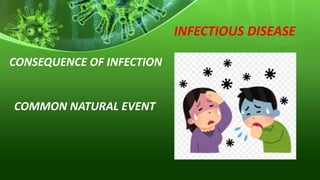
INFECTIOUS DISEASE
CONSEQUENCE OF INFECTION
COMMON NATURAL EVENT
PARASITE
MICROBES THAT CAN
ESTABLISH THEMSELVES
AND MULTIPLY IN HOST
PATHOGEN COMMENSAL
CAPABLE OF
PRODUCING
DISEASE
COMPLETE
HARMONY WITH
HOST
FACULTATIVE
PATHOGENS
CLASSIFICATIONS
PRIMARY INFECTION - initial infection with a parasite in
a host
REINFECTION - subsequent infections by the same
parasite in the host
SECONDARY INFECTION – new parasite sets up an
infection in a host whose resistance is lowered by a pre
existing infectious disease
FOCAL INFECTION – infection at localized sites
CROSS INFECTION – when a patient is already suffering
from a disease a new infection is set up from another host
or another external source
NOSOCOMIAL INFECTION – cross infection occurring in hospital
ENDOGENOUS/EXOGENOUS INFECTIONS
ATYPICAL INFECTION
SUBCLINICAL INFECTION/INAPPARENT INFECTION
LATENT INFECTION
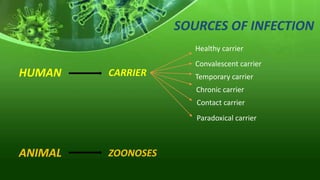
SOURCES OF INFECTION
HUMAN CARRIER
Healthy carrier
Convalescent carrier
Temporary carrier
Chronic carrier
Contact carrier
Paradoxical carrier
ANIMAL ZOONOSES
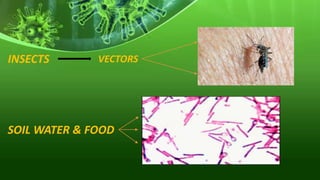
INSECTS VECTORS
MECHANICAL
BIOLOGICAL
SOIL WATER & FOOD
SPORES OF TETANUS BACILLI
CONTAMINATION OR AQUATIC VECTORS
EXTERNAL CONTAMINATION OR
PRE EXISTENT INFECTION
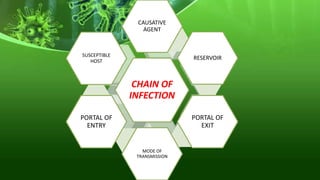
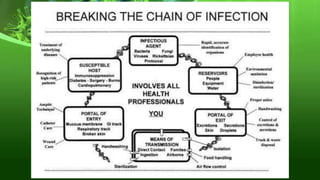
CHAIN OF INFECTION
Six components involved in the transmission of micro organisms
All these six components should be present to transmit an
infectious disease from one human or animal to a susceptible
host
CHAIN OF
INFECTION
CAUSATIVE
AGENT
RESERVOIR
PORTAL OF
EXIT
MODE OF
TRANSMISSION
PORTAL OF
ENTRY
SUSCEPTIBLE
HOST
In order to control or prevent infection it is essential to understand that
transmission of a Pathogen resulting in colonization or infection
requires that six vital links
Each link must be present for infection or colonization to proceed and
breaking of any of the Links can prevent the infection
The aim of isolation precautions is to interrupt these links
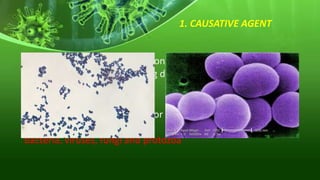
1. CAUSATIVE AGENT
The causative agent for infection is any micro
organism capable of producing disease
Micro organisms responsible for infectious
disease include
bacteria, viruses, fungi and protozoa
2. RESERVOIR
A RESERVOIR IS THE PLACE WHERE THE AGENT SURVIVES, GROWS
AND MULTIPLIES
HUMAN ANIMAL OR ENVIRONMENT
Infectious reservoirs abound in health care settings and may include everything from patients
Visitors and staff members to furniture, medical equipment,
medications, food , water, and blood
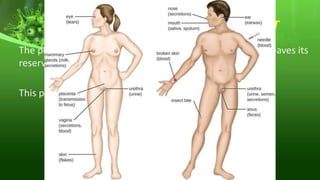
3. PORTAL OF EXIT
The portal of exit is the path by which an infectious agent leaves its
reservoir
This portal is where the micro organism grows
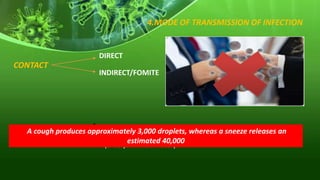
4.MODE OF TRANSMISSION OF INFECTION
CONTACT
DIRECT
INDIRECT/FOMITE
INHALATION DROPLET NUCLEI
(1-10 µm in diameter)
A cough produces approximately 3,000 droplets, whereas a sneeze releases an
estimated 40,000
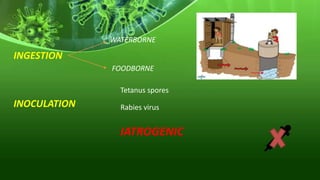
INGESTION
WATERBORNE
FOODBORNE
INOCULATION
Tetanus spores
Rabies virus
IATROGENIC
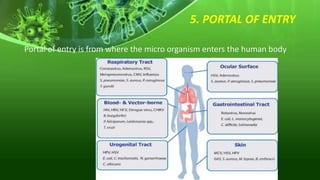
5. PORTAL OF ENTRY
Portal of entry is from where the micro organism enters the human body
6. SUSCEPTIBLE HOST
A susceptible host is a person who can become infected by the
infectious agent
Susceptible hosts include
Patient
Health care personnel
Visitors from the community
RISK FACTORS TO INFECTION
SUSCEPTIBLE HOST
The very young because their immune system does not fully develop until 6 months age
The very old because the age is associated with declining immune system
Poor nutritional status and sociocultural condition
Open wounds and invasive procedures
Suppressed immune system
Weakened health condition
ORTHOPAEDIC O.R. INFECTIONS
STAPHYLOCOCCUS
Staph aureus
Staph epidermidis
MRSA(Methicillin Resistant Staph Aureus)
Staph aureus is the major cause of Surgical Site Infections(SSI)
Staph epidermidis is the major affinity for orthopaedic prosthesis
MRSA is the major cause of osteomyelitis
CHAIN OF O.R. INFECTION
1. RESERVOIR
The reservoir for Staphylococcus is
HUMANS; specifically the nose, skin
touching surgical instruments with bare skin
breaking sterility by touching a nonsterile area
with their sterile gowns or gloves
fail to recognize a perforation or tear in the gloves
during a procedure
Fail to recognize strike through in their gown
during long procedures
not properly wearing the surgical mask covering the
nose since S aureus can populate the nose
poorly perform the patient skin prep to remove
bacteria and other contaminants
2. PORTAL OF EXIT
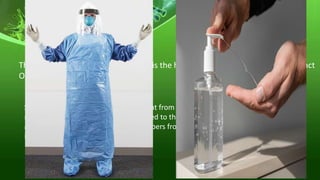
The portal of exit for Staphylococcus is the human skin and nares, through contact
Or sloughing of bacterial cells
Standard Precautions protect the patient from any microbes that the staff member
may be hosting that could be transmitted to the patient via
an open wound, and protect staff members from potential
infection from patients.
3. MODE OF TRANSMISSION
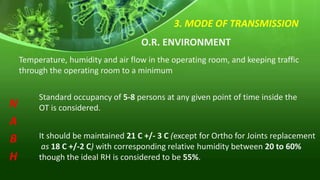
O.R. ENVIRONMENT
Temperature, humidity and air flow in the operating room, and keeping traffic
through the operating room to a minimum
Standard occupancy of 5-8 persons at any given point of time inside the
OT is considered.
N
A
B
H
It should be maintained 21 C +/- 3 C (except for Ortho for Joints replacement
as 18 C +/-2 C) with corresponding relative humidity between 20 to 60%
though the ideal RH is considered to be 55%.
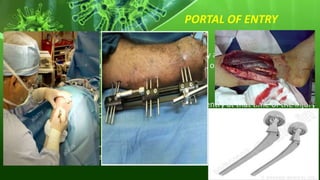
PORTAL OF ENTRY
The portal of entry is either a surgical incision made by a surgeon’s
scalpel, a traumatic wound or a pin site, as in the case of an external
fixation of a fractured bone
A traumatic open wound usually becomes a portal of entry at that time of the injury
and is usually exposed to debris and contaminants before entering the
operating room.
Surgical implants can become a fomite, which can contaminate the surgical portal of entry if
contaminated either before or during a joint-replacement procedure.
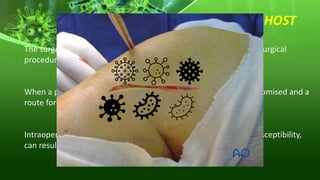
SUSCEPTIBLE HOST
The surgical patient is a susceptible host who, by simply having a surgical
procedure, is exposed to acquiring a SSI
When a procedure is performed, the integrity of the skin is compromised and a
route for bacteria to enter the body has been created.
Intraoperative core hypothermia, another factor that increases susceptibility,
can result in impaired immune function and vasoconstriction.
THANK YOU

Infection

  • 1.
    WHY INFECTION HAPPENS? DR.AMOL GAIKWAD MS(ORTHO) CONSULTANT ORTHOPAEDIC SURGEON
  • 2.
    WHAT IS INFECTION? THELODGEMENT & MULTIPLICATION OF A PARASITE IN OR ON THE TISSUE OF A HOST CONSTITUTE ‘’INFECTION’’
  • 3.
    INFECTIOUS DISEASE CONSEQUENCE OFINFECTION COMMON NATURAL EVENT
  • 4.
    PARASITE MICROBES THAT CAN ESTABLISHTHEMSELVES AND MULTIPLY IN HOST PATHOGEN COMMENSAL CAPABLE OF PRODUCING DISEASE COMPLETE HARMONY WITH HOST FACULTATIVE PATHOGENS
  • 5.
    CLASSIFICATIONS PRIMARY INFECTION -initial infection with a parasite in a host REINFECTION - subsequent infections by the same parasite in the host SECONDARY INFECTION – new parasite sets up an infection in a host whose resistance is lowered by a pre existing infectious disease
  • 6.
    FOCAL INFECTION –infection at localized sites CROSS INFECTION – when a patient is already suffering from a disease a new infection is set up from another host or another external source NOSOCOMIAL INFECTION – cross infection occurring in hospital
  • 7.
    ENDOGENOUS/EXOGENOUS INFECTIONS ATYPICAL INFECTION SUBCLINICALINFECTION/INAPPARENT INFECTION LATENT INFECTION
  • 8.
    SOURCES OF INFECTION HUMANCARRIER Healthy carrier Convalescent carrier Temporary carrier Chronic carrier Contact carrier Paradoxical carrier ANIMAL ZOONOSES
  • 9.
    INSECTS VECTORS MECHANICAL BIOLOGICAL SOIL WATER& FOOD SPORES OF TETANUS BACILLI CONTAMINATION OR AQUATIC VECTORS EXTERNAL CONTAMINATION OR PRE EXISTENT INFECTION
  • 10.
    CHAIN OF INFECTION Sixcomponents involved in the transmission of micro organisms All these six components should be present to transmit an infectious disease from one human or animal to a susceptible host
  • 11.
    CHAIN OF INFECTION CAUSATIVE AGENT RESERVOIR PORTAL OF EXIT MODEOF TRANSMISSION PORTAL OF ENTRY SUSCEPTIBLE HOST
  • 12.
    In order tocontrol or prevent infection it is essential to understand that transmission of a Pathogen resulting in colonization or infection requires that six vital links Each link must be present for infection or colonization to proceed and breaking of any of the Links can prevent the infection The aim of isolation precautions is to interrupt these links
  • 13.
    1. CAUSATIVE AGENT Thecausative agent for infection is any micro organism capable of producing disease Micro organisms responsible for infectious disease include bacteria, viruses, fungi and protozoa
  • 14.
    2. RESERVOIR A RESERVOIRIS THE PLACE WHERE THE AGENT SURVIVES, GROWS AND MULTIPLIES HUMAN ANIMAL OR ENVIRONMENT Infectious reservoirs abound in health care settings and may include everything from patients Visitors and staff members to furniture, medical equipment, medications, food , water, and blood
  • 15.
    3. PORTAL OFEXIT The portal of exit is the path by which an infectious agent leaves its reservoir This portal is where the micro organism grows
  • 16.
    4.MODE OF TRANSMISSIONOF INFECTION CONTACT DIRECT INDIRECT/FOMITE INHALATION DROPLET NUCLEI (1-10 µm in diameter) A cough produces approximately 3,000 droplets, whereas a sneeze releases an estimated 40,000
  • 17.
  • 18.
    5. PORTAL OFENTRY Portal of entry is from where the micro organism enters the human body
  • 19.
    6. SUSCEPTIBLE HOST Asusceptible host is a person who can become infected by the infectious agent Susceptible hosts include Patient Health care personnel Visitors from the community
  • 20.
    RISK FACTORS TOINFECTION SUSCEPTIBLE HOST The very young because their immune system does not fully develop until 6 months age The very old because the age is associated with declining immune system Poor nutritional status and sociocultural condition Open wounds and invasive procedures Suppressed immune system Weakened health condition
  • 21.
    ORTHOPAEDIC O.R. INFECTIONS STAPHYLOCOCCUS Staphaureus Staph epidermidis MRSA(Methicillin Resistant Staph Aureus) Staph aureus is the major cause of Surgical Site Infections(SSI) Staph epidermidis is the major affinity for orthopaedic prosthesis MRSA is the major cause of osteomyelitis
  • 22.
    CHAIN OF O.R.INFECTION 1. RESERVOIR The reservoir for Staphylococcus is HUMANS; specifically the nose, skin touching surgical instruments with bare skin breaking sterility by touching a nonsterile area with their sterile gowns or gloves fail to recognize a perforation or tear in the gloves during a procedure Fail to recognize strike through in their gown during long procedures not properly wearing the surgical mask covering the nose since S aureus can populate the nose poorly perform the patient skin prep to remove bacteria and other contaminants
  • 23.
    2. PORTAL OFEXIT The portal of exit for Staphylococcus is the human skin and nares, through contact Or sloughing of bacterial cells Standard Precautions protect the patient from any microbes that the staff member may be hosting that could be transmitted to the patient via an open wound, and protect staff members from potential infection from patients.
  • 24.
    3. MODE OFTRANSMISSION O.R. ENVIRONMENT Temperature, humidity and air flow in the operating room, and keeping traffic through the operating room to a minimum Standard occupancy of 5-8 persons at any given point of time inside the OT is considered. N A B H It should be maintained 21 C +/- 3 C (except for Ortho for Joints replacement as 18 C +/-2 C) with corresponding relative humidity between 20 to 60% though the ideal RH is considered to be 55%.
  • 25.
    PORTAL OF ENTRY Theportal of entry is either a surgical incision made by a surgeon’s scalpel, a traumatic wound or a pin site, as in the case of an external fixation of a fractured bone A traumatic open wound usually becomes a portal of entry at that time of the injury and is usually exposed to debris and contaminants before entering the operating room. Surgical implants can become a fomite, which can contaminate the surgical portal of entry if contaminated either before or during a joint-replacement procedure.
  • 26.
    SUSCEPTIBLE HOST The surgicalpatient is a susceptible host who, by simply having a surgical procedure, is exposed to acquiring a SSI When a procedure is performed, the integrity of the skin is compromised and a route for bacteria to enter the body has been created. Intraoperative core hypothermia, another factor that increases susceptibility, can result in impaired immune function and vasoconstriction.
  • 28.