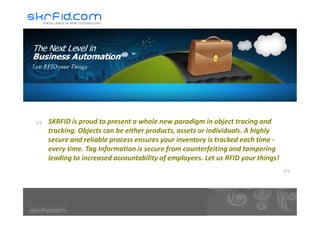
SKRFID is proud to present a whole new paradigm in object tracing and
tracking. Objects can be either products, assets or individuals. A highly
secure and reliable process ensures your inventory is tracked each time -
every time. Tag Information is secure from counterfeiting and tampering
leading to increased accountability of employees. Let us RFID your things!
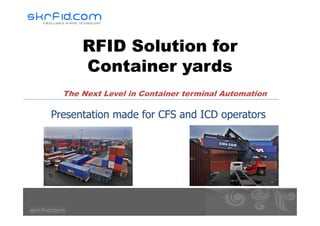
RFID Solution for
Container yards
The Next Level in Container terminal Automation
Presentation made for CFS and ICD operatorsPresentation made for CFS and ICD operatorsPresentation made for CFS and ICD operatorsPresentation made for CFS and ICD operators
about SK RFID
• A Division of SK Group of companies, doing business as SKRFID, is one of the
pioneers in ushering in the Latest RFID technology
• We guide our customers through the planning, design & implementation of
proven, innovative custom or packaged solutions that help achieve theirproven, innovative custom or packaged solutions that help achieve their
business objectives.
• Our team has a vivid skillset to commission your project within deadlines
and budgets.
about RFID
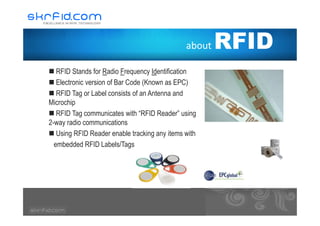
RFID Stands for Radio Frequency Identification
Electronic version of Bar Code (Known as EPC)
RFID Tag or Label consists of an Antenna and
Microchip
RFID Tag communicates with “RFID Reader” usingRFID Tag communicates with “RFID Reader” using
2-way radio communications
Using RFID Reader enable tracking any items with
embedded RFID Labels/Tags
Advantages of RFID
Every RFID tag has unique memory, that allows information to be stored on it.
Physical damage of tag does NOT affect readability, unlike Barcodes
No line of sight requirements, can be read from a distance
Improved Accuracy
It can read multiple tag at same time.It can read multiple tag at same time.
Saves Time in the processes like taking stock inventory and searching for items in
stock.
63% more effective than barcodes for shelf-availability improvement
(based on 12 control stores & 12 normal stores and 29 weeks of study by Wal-Mart CIO Linda Dillman & RFID
Research Center at Univ. of Arkansas - Jan 2006)
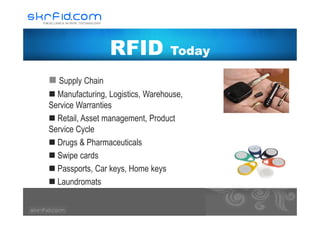
RFID Today
Supply Chain
Manufacturing, Logistics, Warehouse,
Service Warranties
Retail, Asset management, ProductRetail, Asset management, Product
Service Cycle
Drugs & Pharmaceuticals
Swipe cards
Passports, Car keys, Home keys
Laundromats
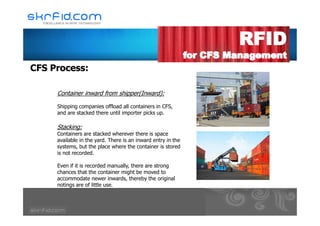
Container inward from shipper(Inward):
Shipping companies offload all containers in CFS,
and are stacked there until importer picks up.
CFS Process:CFS Process:
and are stacked there until importer picks up.
Stacking:
Containers are stacked wherever there is space
available in the yard. There is an inward entry in the
systems, but the place where the container is stored
is not recorded.
Even if it is recorded manually, there are strong
chances that the container might be moved to
accommodate newer inwards, thereby the original
notings are of little use.
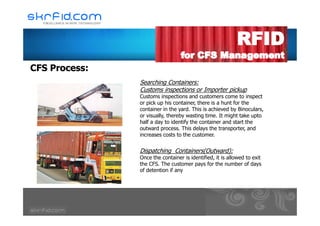
Searching Containers:
Customs inspections or Importer pickup
Customs inspections and customers come to inspect
or pick up his container, there is a hunt for the
container in the yard. This is achieved by Binoculars,
or visually, thereby wasting time. It might take upto
CFS Process:CFS Process:
or visually, thereby wasting time. It might take upto
half a day to identify the container and start the
outward process. This delays the transporter, and
increases costs to the customer.
Dispatching Containers(Outward):
Once the container is identified, it is allowed to exit
the CFS. The customer pays for the number of days
of detention if any
Fully automated Solution, helps
•Quick location of the container
•Real time visibility into Yard layout•Real time visibility into Yard layout
•Faster turnaround for every despatch
•Improved Planning of available space
•Operator efficiency reporting
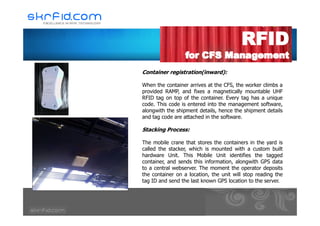
Container registration(inward):
When the container arrives at the CFS, the worker climbs a
provided RAMP, and fixes a magnetically mountable UHF
RFID tag on top of the container. Every tag has a unique
code. This code is entered into the management software,
alongwith the shipment details, hence the shipment detailsalongwith the shipment details, hence the shipment details
and tag code are attached in the software.
Stacking Process:
The mobile crane that stores the containers in the yard is
called the stacker, which is mounted with a custom built
hardware Unit. This Mobile Unit identifies the tagged
container, and sends this information, alongwith GPS data
to a central webserver. The moment the operator deposits
the container on a location, the unit will stop reading the
tag ID and send the last known GPS location to the server.
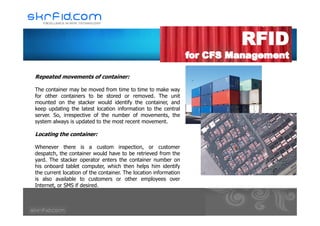
Repeated movements of container:
The container may be moved from time to time to make way
for other containers to be stored or removed. The unit
mounted on the stacker would identify the container, and
keep updating the latest location information to the central
server. So, irrespective of the number of movements, theserver. So, irrespective of the number of movements, the
system always is updated to the most recent movement.
Locating the container:
Whenever there is a custom inspection, or customer
despatch, the container would have to be retrieved from the
yard. The stacker operator enters the container number on
his onboard tablet computer, which then helps him identify
the current location of the container. The location information
is also available to customers or other employees over
Internet, or SMS if desired.
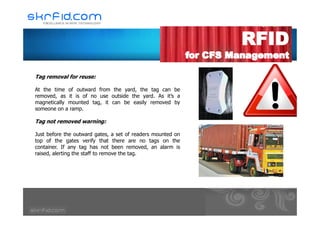
Tag removal for reuse:
At the time of outward from the yard, the tag can be
removed, as it is of no use outside the yard. As it’s a
magnetically mounted tag, it can be easily removed by
someone on a ramp.
Tag not removed warning:
Just before the outward gates, a set of readers mounted on
top of the gates verify that there are no tags on the
container. If any tag has not been removed, an alarm is
raised, alerting the staff to remove the tag.
Total Cost of Ownership
One time cost [Capex]
Magnetic Mounted UHF Tags [number of containers+25%]
Stacker TAG Reader Unit. [number of stackers+10% spares]
RFID Registration Gate. [number of inward lanes]
RFID TAG Outward Warning Gate. [number of outward lanes]RFID TAG Outward Warning Gate. [number of outward lanes]
Tablets for Crane operators [as per choice]
Software as a service annual subscription.
Recurring Cost [Opex]
Software user licences
Annual maintenance
GPRS annual data plan for every stacker
Return of Investment
1. Quick location of the container: reduces delays and avoids
congestions at the yard.
2. Real time visibility into the operations: Accurate inward and
outward count helps to prevent losses.
3. Automated system - Reduced human errors.3. Automated system - Reduced human errors.
4. Automated records - Avoid manipulation of data.
5. Secure and reliable system improves efficiency.
6. Faster turnaround for every despatch: Improves
Productivity
7. Improved planning of available spaces: Increases
scalability
Thank YouThank You
SKRFID, a division of Shamots International,
Reg. Off.: 9, Jhawar House, 285 Princess street, Mumbai 400002, India.
Floor 2, Orbit Plaza, New Prabhadevi Marg, Mumbai 400025, India
Phone: 0091 22 6124 0500; Fax: 0091 22 4333 2550;
Website: www.skrfid.com; Email: Sales@skrfid.com
Presented by Paresh Thakkar;
Phone:0091 22 61240500
Cell: 0091 98709 59559
pcthakkar@skrfid.com

Industry rfid in container yards

  • 1.
    SKRFID is proudto present a whole new paradigm in object tracing and tracking. Objects can be either products, assets or individuals. A highly secure and reliable process ensures your inventory is tracked each time - every time. Tag Information is secure from counterfeiting and tampering leading to increased accountability of employees. Let us RFID your things!
  • 2.
    RFID Solution for Containeryards The Next Level in Container terminal Automation Presentation made for CFS and ICD operatorsPresentation made for CFS and ICD operatorsPresentation made for CFS and ICD operatorsPresentation made for CFS and ICD operators
  • 3.
    about SK RFID •A Division of SK Group of companies, doing business as SKRFID, is one of the pioneers in ushering in the Latest RFID technology • We guide our customers through the planning, design & implementation of proven, innovative custom or packaged solutions that help achieve theirproven, innovative custom or packaged solutions that help achieve their business objectives. • Our team has a vivid skillset to commission your project within deadlines and budgets.
  • 4.
    about RFID RFID Standsfor Radio Frequency Identification Electronic version of Bar Code (Known as EPC) RFID Tag or Label consists of an Antenna and Microchip RFID Tag communicates with “RFID Reader” usingRFID Tag communicates with “RFID Reader” using 2-way radio communications Using RFID Reader enable tracking any items with embedded RFID Labels/Tags
  • 5.
    Advantages of RFID EveryRFID tag has unique memory, that allows information to be stored on it. Physical damage of tag does NOT affect readability, unlike Barcodes No line of sight requirements, can be read from a distance Improved Accuracy It can read multiple tag at same time.It can read multiple tag at same time. Saves Time in the processes like taking stock inventory and searching for items in stock. 63% more effective than barcodes for shelf-availability improvement (based on 12 control stores & 12 normal stores and 29 weeks of study by Wal-Mart CIO Linda Dillman & RFID Research Center at Univ. of Arkansas - Jan 2006)
  • 6.
    RFID Today Supply Chain Manufacturing,Logistics, Warehouse, Service Warranties Retail, Asset management, ProductRetail, Asset management, Product Service Cycle Drugs & Pharmaceuticals Swipe cards Passports, Car keys, Home keys Laundromats
  • 8.
    Container inward fromshipper(Inward): Shipping companies offload all containers in CFS, and are stacked there until importer picks up. CFS Process:CFS Process: and are stacked there until importer picks up. Stacking: Containers are stacked wherever there is space available in the yard. There is an inward entry in the systems, but the place where the container is stored is not recorded. Even if it is recorded manually, there are strong chances that the container might be moved to accommodate newer inwards, thereby the original notings are of little use.
  • 9.
    Searching Containers: Customs inspectionsor Importer pickup Customs inspections and customers come to inspect or pick up his container, there is a hunt for the container in the yard. This is achieved by Binoculars, or visually, thereby wasting time. It might take upto CFS Process:CFS Process: or visually, thereby wasting time. It might take upto half a day to identify the container and start the outward process. This delays the transporter, and increases costs to the customer. Dispatching Containers(Outward): Once the container is identified, it is allowed to exit the CFS. The customer pays for the number of days of detention if any
  • 10.
    Fully automated Solution,helps •Quick location of the container •Real time visibility into Yard layout•Real time visibility into Yard layout •Faster turnaround for every despatch •Improved Planning of available space •Operator efficiency reporting
  • 11.
    Container registration(inward): When thecontainer arrives at the CFS, the worker climbs a provided RAMP, and fixes a magnetically mountable UHF RFID tag on top of the container. Every tag has a unique code. This code is entered into the management software, alongwith the shipment details, hence the shipment detailsalongwith the shipment details, hence the shipment details and tag code are attached in the software. Stacking Process: The mobile crane that stores the containers in the yard is called the stacker, which is mounted with a custom built hardware Unit. This Mobile Unit identifies the tagged container, and sends this information, alongwith GPS data to a central webserver. The moment the operator deposits the container on a location, the unit will stop reading the tag ID and send the last known GPS location to the server.
  • 12.
    Repeated movements ofcontainer: The container may be moved from time to time to make way for other containers to be stored or removed. The unit mounted on the stacker would identify the container, and keep updating the latest location information to the central server. So, irrespective of the number of movements, theserver. So, irrespective of the number of movements, the system always is updated to the most recent movement. Locating the container: Whenever there is a custom inspection, or customer despatch, the container would have to be retrieved from the yard. The stacker operator enters the container number on his onboard tablet computer, which then helps him identify the current location of the container. The location information is also available to customers or other employees over Internet, or SMS if desired.
  • 13.
    Tag removal forreuse: At the time of outward from the yard, the tag can be removed, as it is of no use outside the yard. As it’s a magnetically mounted tag, it can be easily removed by someone on a ramp. Tag not removed warning: Just before the outward gates, a set of readers mounted on top of the gates verify that there are no tags on the container. If any tag has not been removed, an alarm is raised, alerting the staff to remove the tag.
  • 14.
    Total Cost ofOwnership One time cost [Capex] Magnetic Mounted UHF Tags [number of containers+25%] Stacker TAG Reader Unit. [number of stackers+10% spares] RFID Registration Gate. [number of inward lanes] RFID TAG Outward Warning Gate. [number of outward lanes]RFID TAG Outward Warning Gate. [number of outward lanes] Tablets for Crane operators [as per choice] Software as a service annual subscription. Recurring Cost [Opex] Software user licences Annual maintenance GPRS annual data plan for every stacker
  • 15.
    Return of Investment 1.Quick location of the container: reduces delays and avoids congestions at the yard. 2. Real time visibility into the operations: Accurate inward and outward count helps to prevent losses. 3. Automated system - Reduced human errors.3. Automated system - Reduced human errors. 4. Automated records - Avoid manipulation of data. 5. Secure and reliable system improves efficiency. 6. Faster turnaround for every despatch: Improves Productivity 7. Improved planning of available spaces: Increases scalability
  • 16.
    Thank YouThank You SKRFID,a division of Shamots International, Reg. Off.: 9, Jhawar House, 285 Princess street, Mumbai 400002, India. Floor 2, Orbit Plaza, New Prabhadevi Marg, Mumbai 400025, India Phone: 0091 22 6124 0500; Fax: 0091 22 4333 2550; Website: www.skrfid.com; Email: Sales@skrfid.com Presented by Paresh Thakkar; Phone:0091 22 61240500 Cell: 0091 98709 59559 pcthakkar@skrfid.com