Industrial Solid Waste
Management
Introduction
Environmental pollution is the major problem associated
with rapid industrialization, urbanization and rise in
living standards of people.
For developing countries, industrialization was must and
still this activity very much demands to build self reliant
and in uplifting nation’s economy.
However, industrialization on the other hand has also
caused serious problems relating to environmental
pollution. Therefore, wastes seem to be a by-product of
growth..
On the other hand, with increasing demand for raw
materials for industrial production, the non-renewable
resources are dwindling day-by-day.
Therefore, efforts are to be made for controlling pollution
arising out of the disposal of wastes by conversion of
these unwanted wastes into utilizable raw materials for
various beneficial uses.
 The problems relating to disposal of industrial solid
waste are associated with lack of infrastructural facilities
and negligence of industries to take proper safeguards.
 The large and medium industries located in identified
(conforming) industrial areas still have some arrangements
to dispose solid waste.
However, the problem persist with small scale industries.
 In number of cities and towns, small scale industries
find it easy to dispose waste here and there and it makes
difficult for local bodies to collect such waste though it is
not their responsibility.
 In some cities, industrial, residential and commercial
are mixed and thus all waste gets intermingled.
Therefore, it becomes necessary that the local bodies
along with State Pollution Control Board (SPCB) work
out requisite strategy for organizing proper collection
and disposal of industrial solid waste.
 Management of Industrial Solid Waste (ISW) is not the
responsibility of local bodies.
Industries generating solid waste have to manage such
waste by themselves and are required to seek
authorizations from respective State Pollution Control
Boards (SPCBs) under relevant rules.
 However, through joint efforts of SPCBs, local bodies
and the industries, a mechanism could be evolved for
better management.
Industries are required to collect and dispose of their
waste at specific disposal sites and such collection,
treatment and disposal is required to be monitored by
the concerned State Pollution Control Board (SPCB)
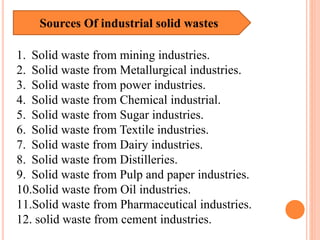
Sources Of industrial solid wastes
1. Solid waste from mining industries.
2. Solid waste from Metallurgical industries.
3. Solid waste from power industries.
4. Solid waste from Chemical industrial.
5. Solid waste from Sugar industries.
6. Solid waste from Textile industries.
7. Solid waste from Dairy industries.
8. Solid waste from Distilleries.
9. Solid waste from Pulp and paper industries.
10.Solid waste from Oil industries.
11.Solid waste from Pharmaceutical industries.
12. solid waste from cement industries.
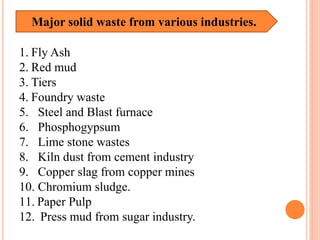
Major solid waste from various industries.
1. Fly Ash
2. Red mud
3. Tiers
4. Foundry waste
5. Steel and Blast furnace
6. Phosphogypsum
7. Lime stone wastes
8. Kiln dust from cement industry
9. Copper slag from copper mines
10. Chromium sludge.
11. Paper Pulp
12. Press mud from sugar industry.
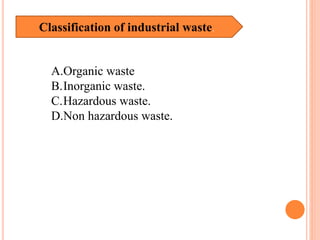
Classification of industrial waste.
A.Organic waste
B.Inorganic waste.
C.Hazardous waste.
D.Non hazardous waste.
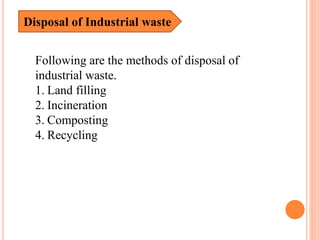
Disposal of Industrial waste
Following are the methods of disposal of
industrial waste.
1. Land filling
2. Incineration
3. Composting
4. Recycling
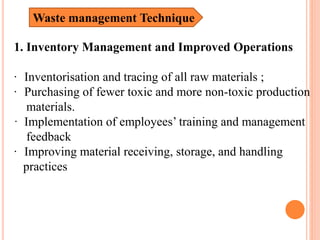
1. Inventory Management and Improved Operations
· Inventorisation and tracing of all raw materials ;
· Purchasing of fewer toxic and more non-toxic production
materials.
· Implementation of employees’ training and management
feedback
· Improving material receiving, storage, and handling
practices
Waste management Technique
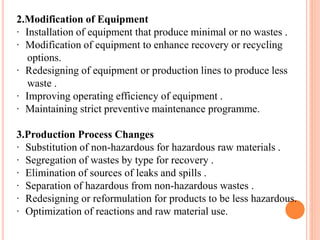
2.Modification of Equipment
· Installation of equipment that produce minimal or no wastes .
· Modification of equipment to enhance recovery or recycling
options.
· Redesigning of equipment or production lines to produce less
waste .
· Improving operating efficiency of equipment .
· Maintaining strict preventive maintenance programme.
3.Production Process Changes
· Substitution of non-hazardous for hazardous raw materials .
· Segregation of wastes by type for recovery .
· Elimination of sources of leaks and spills .
· Separation of hazardous from non-hazardous wastes .
· Redesigning or reformulation for products to be less hazardous.
· Optimization of reactions and raw material use.
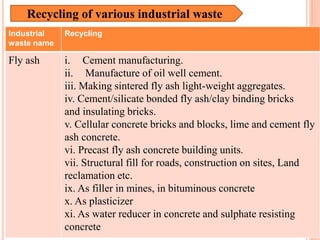
Recycling of various industrial waste
Industrial
waste name
Recycling
Fly ash i. Cement manufacturing.
ii. Manufacture of oil well cement.
iii. Making sintered fly ash light-weight aggregates.
iv. Cement/silicate bonded fly ash/clay binding bricks
and insulating bricks.
v. Cellular concrete bricks and blocks, lime and cement fly
ash concrete.
vi. Precast fly ash concrete building units.
vii. Structural fill for roads, construction on sites, Land
reclamation etc.
ix. As filler in mines, in bituminous concrete
x. As plasticizer
xi. As water reducer in concrete and sulphate resisting
concrete
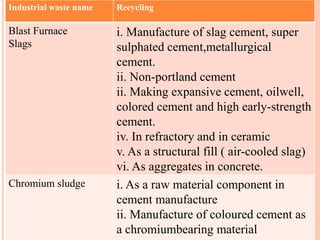
Industrial waste name Recycling
Blast Furnace
Slags
i. Manufacture of slag cement, super
sulphated cement,metallurgical
cement.
ii. Non-portland cement
ii. Making expansive cement, oilwell,
colored cement and high early-strength
cement.
iv. In refractory and in ceramic
v. As a structural fill ( air-cooled slag)
vi. As aggregates in concrete.
Chromium sludge i. As a raw material component in
cement manufacture
ii. Manufacture of coloured cement as
a chromiumbearing material
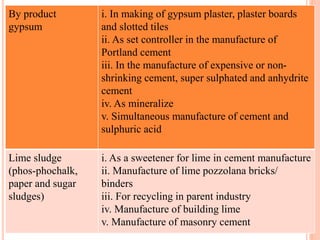
By product
gypsum
i. In making of gypsum plaster, plaster boards
and slotted tiles
ii. As set controller in the manufacture of
Portland cement
iii. In the manufacture of expensive or non-
shrinking cement, super sulphated and anhydrite
cement
iv. As mineralize
v. Simultaneous manufacture of cement and
sulphuric acid
Lime sludge
(phos-phochalk,
paper and sugar
sludges)
i. As a sweetener for lime in cement manufacture
ii. Manufacture of lime pozzolana bricks/
binders
iii. For recycling in parent industry
iv. Manufacture of building lime
v. Manufacture of masonry cement
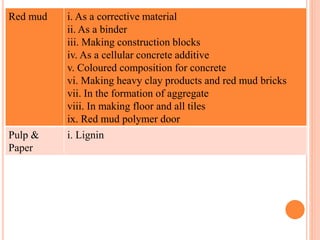
Red mud i. As a corrective material
ii. As a binder
iii. Making construction blocks
iv. As a cellular concrete additive
v. Coloured composition for concrete
vi. Making heavy clay products and red mud bricks
vii. In the formation of aggregate
viii. In making floor and all tiles
ix. Red mud polymer door
Pulp &
Paper
i. Lignin

Industrial Solid Waste Manegement.pptx

  • 1.
  • 2.
    Introduction Environmental pollution isthe major problem associated with rapid industrialization, urbanization and rise in living standards of people. For developing countries, industrialization was must and still this activity very much demands to build self reliant and in uplifting nation’s economy. However, industrialization on the other hand has also caused serious problems relating to environmental pollution. Therefore, wastes seem to be a by-product of growth..
  • 3.
    On the otherhand, with increasing demand for raw materials for industrial production, the non-renewable resources are dwindling day-by-day. Therefore, efforts are to be made for controlling pollution arising out of the disposal of wastes by conversion of these unwanted wastes into utilizable raw materials for various beneficial uses.  The problems relating to disposal of industrial solid waste are associated with lack of infrastructural facilities and negligence of industries to take proper safeguards.  The large and medium industries located in identified (conforming) industrial areas still have some arrangements to dispose solid waste.
  • 4.
    However, the problempersist with small scale industries.  In number of cities and towns, small scale industries find it easy to dispose waste here and there and it makes difficult for local bodies to collect such waste though it is not their responsibility.  In some cities, industrial, residential and commercial are mixed and thus all waste gets intermingled. Therefore, it becomes necessary that the local bodies along with State Pollution Control Board (SPCB) work out requisite strategy for organizing proper collection and disposal of industrial solid waste.  Management of Industrial Solid Waste (ISW) is not the responsibility of local bodies.
  • 5.
    Industries generating solidwaste have to manage such waste by themselves and are required to seek authorizations from respective State Pollution Control Boards (SPCBs) under relevant rules.  However, through joint efforts of SPCBs, local bodies and the industries, a mechanism could be evolved for better management. Industries are required to collect and dispose of their waste at specific disposal sites and such collection, treatment and disposal is required to be monitored by the concerned State Pollution Control Board (SPCB)
  • 6.
    Sources Of industrialsolid wastes 1. Solid waste from mining industries. 2. Solid waste from Metallurgical industries. 3. Solid waste from power industries. 4. Solid waste from Chemical industrial. 5. Solid waste from Sugar industries. 6. Solid waste from Textile industries. 7. Solid waste from Dairy industries. 8. Solid waste from Distilleries. 9. Solid waste from Pulp and paper industries. 10.Solid waste from Oil industries. 11.Solid waste from Pharmaceutical industries. 12. solid waste from cement industries.
  • 7.
    Major solid wastefrom various industries. 1. Fly Ash 2. Red mud 3. Tiers 4. Foundry waste 5. Steel and Blast furnace 6. Phosphogypsum 7. Lime stone wastes 8. Kiln dust from cement industry 9. Copper slag from copper mines 10. Chromium sludge. 11. Paper Pulp 12. Press mud from sugar industry.
  • 8.
    Classification of industrialwaste. A.Organic waste B.Inorganic waste. C.Hazardous waste. D.Non hazardous waste.
  • 9.
    Disposal of Industrialwaste Following are the methods of disposal of industrial waste. 1. Land filling 2. Incineration 3. Composting 4. Recycling
  • 10.
    1. Inventory Managementand Improved Operations · Inventorisation and tracing of all raw materials ; · Purchasing of fewer toxic and more non-toxic production materials. · Implementation of employees’ training and management feedback · Improving material receiving, storage, and handling practices Waste management Technique
  • 11.
    2.Modification of Equipment ·Installation of equipment that produce minimal or no wastes . · Modification of equipment to enhance recovery or recycling options. · Redesigning of equipment or production lines to produce less waste . · Improving operating efficiency of equipment . · Maintaining strict preventive maintenance programme. 3.Production Process Changes · Substitution of non-hazardous for hazardous raw materials . · Segregation of wastes by type for recovery . · Elimination of sources of leaks and spills . · Separation of hazardous from non-hazardous wastes . · Redesigning or reformulation for products to be less hazardous. · Optimization of reactions and raw material use.
  • 12.
    Recycling of variousindustrial waste Industrial waste name Recycling Fly ash i. Cement manufacturing. ii. Manufacture of oil well cement. iii. Making sintered fly ash light-weight aggregates. iv. Cement/silicate bonded fly ash/clay binding bricks and insulating bricks. v. Cellular concrete bricks and blocks, lime and cement fly ash concrete. vi. Precast fly ash concrete building units. vii. Structural fill for roads, construction on sites, Land reclamation etc. ix. As filler in mines, in bituminous concrete x. As plasticizer xi. As water reducer in concrete and sulphate resisting concrete
  • 13.
    Industrial waste nameRecycling Blast Furnace Slags i. Manufacture of slag cement, super sulphated cement,metallurgical cement. ii. Non-portland cement ii. Making expansive cement, oilwell, colored cement and high early-strength cement. iv. In refractory and in ceramic v. As a structural fill ( air-cooled slag) vi. As aggregates in concrete. Chromium sludge i. As a raw material component in cement manufacture ii. Manufacture of coloured cement as a chromiumbearing material
  • 14.
    By product gypsum i. Inmaking of gypsum plaster, plaster boards and slotted tiles ii. As set controller in the manufacture of Portland cement iii. In the manufacture of expensive or non- shrinking cement, super sulphated and anhydrite cement iv. As mineralize v. Simultaneous manufacture of cement and sulphuric acid Lime sludge (phos-phochalk, paper and sugar sludges) i. As a sweetener for lime in cement manufacture ii. Manufacture of lime pozzolana bricks/ binders iii. For recycling in parent industry iv. Manufacture of building lime v. Manufacture of masonry cement
  • 15.
    Red mud i.As a corrective material ii. As a binder iii. Making construction blocks iv. As a cellular concrete additive v. Coloured composition for concrete vi. Making heavy clay products and red mud bricks vii. In the formation of aggregate viii. In making floor and all tiles ix. Red mud polymer door Pulp & Paper i. Lignin